Money in the colonies
Could you live like this?
The overarching
economic system for
Colonial America:
Mercantilism
Mercantilism
The belief that a nation’s wealth will be
increased by controlling and protecting all
parts of trade for the benefit of the nation.
What the heck does that
mean?
Good question! Glad you asked.
“The belief that a nation’s wealth will be
increased by controlling and protecting all parts
of trade for the benefit of the nation.”
“nation” means: Great Britain
“wealth” means: money/goods/profits
“controlling and protecting”: Means: GB
dominates all goods/services/cash in the
colonies.
Take Two:
Great Britain gets to be in charge of all trade
inside and outside of Colonial America; it
gets to take over all profits, goods, services,
cash (gold and silver) and use them/hoard
them for the benefit of Great Britain.
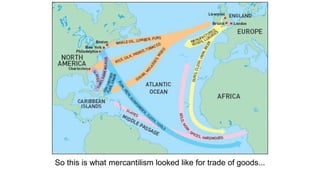
So this is what mercantilism looked like for trade of goods...
Colonists could export goods only to Britain.
Colonists could only import goods from
Britain. Ships were only British. Crew on the
ships was only British...
British monopoly
So what do colonists do
for money?
First question: Why do they need money?
and what is that money?
that’s the second question...
There was no one “money” used!
Britain used: Pounds;
Shillings; Pence.
Colonies used those
words, but not the
value.
Cash: Paper money
and coins. (Also called
specie)
Commodity money:
Tobacco, beaver pelt,
wampum
(shells/beads/bones)
Colonies issued their own
Paper money;
see:
http://en.wikipedia.org/
wiki/Early_American_
currency for examples
Coins: Colonists used
coins from all over the
world, but didn’t really
make their own. But
they had to pay tax in
British specie (cash).
So what were the jobs to
earn money?
That’s the third question...
At first, everyone did
everything
From making furniture to weaving cloth to
growing food, to just living!
But specialization is
needed
People get settled, stable, and start to want
better quality goods and services.
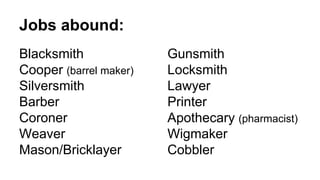
Jobs abound:
Blacksmith
Cooper (barrel maker)
Silversmith
Barber
Coroner
Weaver
Mason/Bricklayer
Gunsmith
Locksmith
Lawyer
Printer
Apothecary (pharmacist)
Wigmaker
Cobbler
But everyone was a farmer first
3 out of 4 American
colonists had a farm
5 to 150 acres, with:
● house
● barn
● yard
● fields
Lots of jobs were
farm-based, and the
entire family pitched
in.
Some sold their crops
(cash crop--usually
not edible, but
sometimes…)
People needed to get paid
● Labor/services are compensated (paid for) in
wages;
● Goods are purchased not bartered (paid for,
not traded for);
● Goods come from home and abroad;
● Money is needed to measure the value of
goods and services. So an economy forms.
Two special cases
Both involve labor...
Indentured Servant
A person who promises to trade their labor
for a set period of time in exchange for room,
board and transportation to the colonies.
Usually a poor, white European.
Slave
A human being who was captured and
forced into labor for another person. The
slave is sold and is considered property-
owned for life. His or her offspring is owned
too. In the colonies, this person was African.

Money in the colonies

  • 1.
    Money in thecolonies Could you live like this?
  • 2.
    The overarching economic systemfor Colonial America: Mercantilism
  • 3.
    Mercantilism The belief thata nation’s wealth will be increased by controlling and protecting all parts of trade for the benefit of the nation.
  • 4.
    What the heckdoes that mean? Good question! Glad you asked.
  • 5.
    “The belief thata nation’s wealth will be increased by controlling and protecting all parts of trade for the benefit of the nation.” “nation” means: Great Britain “wealth” means: money/goods/profits “controlling and protecting”: Means: GB dominates all goods/services/cash in the colonies.
  • 6.
    Take Two: Great Britaingets to be in charge of all trade inside and outside of Colonial America; it gets to take over all profits, goods, services, cash (gold and silver) and use them/hoard them for the benefit of Great Britain.
  • 7.
    So this iswhat mercantilism looked like for trade of goods...
  • 8.
    Colonists could exportgoods only to Britain. Colonists could only import goods from Britain. Ships were only British. Crew on the ships was only British... British monopoly
  • 9.
    So what docolonists do for money? First question: Why do they need money?
  • 10.
    and what isthat money? that’s the second question...
  • 11.
    There was noone “money” used! Britain used: Pounds; Shillings; Pence. Colonies used those words, but not the value. Cash: Paper money and coins. (Also called specie) Commodity money: Tobacco, beaver pelt, wampum (shells/beads/bones)
  • 12.
    Colonies issued theirown Paper money; see: http://en.wikipedia.org/ wiki/Early_American_ currency for examples Coins: Colonists used coins from all over the world, but didn’t really make their own. But they had to pay tax in British specie (cash).
  • 13.
    So what werethe jobs to earn money? That’s the third question...
  • 14.
    At first, everyonedid everything From making furniture to weaving cloth to growing food, to just living!
  • 15.
    But specialization is needed Peopleget settled, stable, and start to want better quality goods and services.
  • 16.
    Jobs abound: Blacksmith Cooper (barrelmaker) Silversmith Barber Coroner Weaver Mason/Bricklayer Gunsmith Locksmith Lawyer Printer Apothecary (pharmacist) Wigmaker Cobbler
  • 17.
    But everyone wasa farmer first 3 out of 4 American colonists had a farm 5 to 150 acres, with: ● house ● barn ● yard ● fields Lots of jobs were farm-based, and the entire family pitched in. Some sold their crops (cash crop--usually not edible, but sometimes…)
  • 18.
    People needed toget paid ● Labor/services are compensated (paid for) in wages; ● Goods are purchased not bartered (paid for, not traded for); ● Goods come from home and abroad; ● Money is needed to measure the value of goods and services. So an economy forms.
  • 19.
    Two special cases Bothinvolve labor...
  • 20.
    Indentured Servant A personwho promises to trade their labor for a set period of time in exchange for room, board and transportation to the colonies. Usually a poor, white European.
  • 21.
    Slave A human beingwho was captured and forced into labor for another person. The slave is sold and is considered property- owned for life. His or her offspring is owned too. In the colonies, this person was African.

Editor's Notes

  • #2 A deeper question: ask: What is money? Technically money is a medium of exchange and a measure of value. Pull that apart...
  • #7 so Great Britain = Smaug the dragon...
  • #8 But we’ll get back to that...
  • #9 a monopoly is the complete control of an industry by one organization. To import is to bring in, to export is to sell out.
  • #12 12 pence per shilling, 20 shillings per pound; based on weights. A pound refers to a pound of silver...literally! so 2.10.06 means, 2 Pounds, 10 shillings, 6 pence. A Farthing is ¼ a penny; A Quid is slang for a pound; a Crown is 5 Shillings...
  • #14 Think about the goods shipped out; what was the skill level to do that? Think about ports and what jobs would be needed to transport and ship raw materials like those.
  • #16 As wealth grows in the colonies, people don’t want to wait the 3 months for an order to get to Britain, 2 months for it to be filled, and another 3 months for it to come back...so they start to make their own stuff!
  • #17 http://mrnussbaum.com/13colonies/13trades/ has some good descriptions of jobs and how they were done...
  • #19 The colonies can’t become a barter system--they have to pay taxes to GB and they have to be able to buy stuff from GB, so even if there was some small scale trading of stuff, money was still necessary.
  • #21 IS received a grant of land upon the completion of the time as well. What are the problems with this system of getting labor?
  • #22 At first, colonists thought they could enslave the native Americans. Why wouldn’t this have worked? More about slavery to come later...