Integrating the Elementary
      Language Arts:
  A Historical Perspective

     E. Jennifer Monaghan
      Douglas K. Hartman

           Chapter 16
Toward Defining the Language Arts 

‱ “Our goal is to define 
 what students should
  learn in the English language arts—reading,
  writing, listening, speaking, viewing, and visual
  representing.”


                     International Reading Association/National Council of Teachers of English
                   (IRA/NCTE). (1996). Standards for the English Language Arts. Newark, DE:
                   International Reading Association/National Council of Teachers of English.
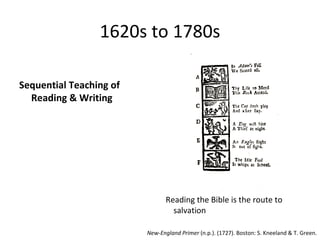
1620s to 1780s

Sequential Teaching of
  Reading & Writing


                                Reading the Bible is the route to
                                  salvation

                         New-England Primer (n.p.). (1727). Boston: S. Kneeland & T. Green.
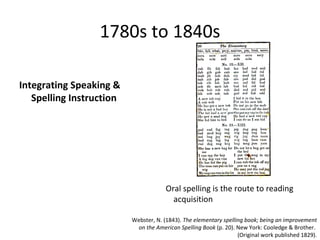
1780s to 1840s

Integrating Speaking &
   Spelling Instruction


                                       Oral spelling is the route to reading
                                         acquisition

                          Webster, N. (1843). The elementary spelling book; being an improvement
                           on the American Spelling Book (p. 20). New York: Cooledge & Brother.
                                                                   (Original work published 1829).
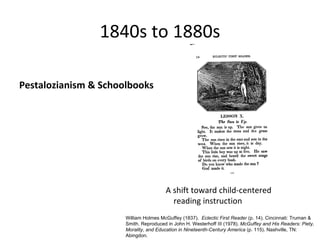
1840s to 1880s

Pestalozianism & Schoolbooks


                                       A shift toward child-centered
                                         reading instruction
                      William Holmes McGuffey (1837). Eclectic First Reader (p. 14). Cincinnati: Truman &
                      Smith. Reproduced in John H. Westerhoff III (1978). McGuffey and His Readers: Piety,
                      Morality, and Education in Nineteenth-Century America (p. 115). Nashville, TN:
                      Abingdon.
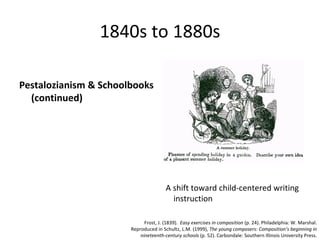
1840s to 1880s

Pestalozianism & Schoolbooks
  (continued)


                                       A shift toward child-centered writing
                                         instruction

                             Frost, J. (1839). Easy exercises in composition (p. 24). Philadelphia: W. Marshal.
                       Reproduced in Schultz, L.M. (1999), The young composers: Composition’s beginning in
                           nineteenth-century schools (p. 52). Carbondale: Southern Illinois University Press.
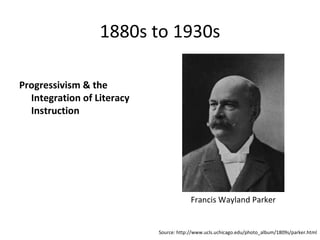
1880s to 1930s

Progressivism & the
  Integration of Literacy
  Instruction


                                         Francis Wayland Parker


                            Source: http://www.ucls.uchicago.edu/photo_album/1809s/parker.html
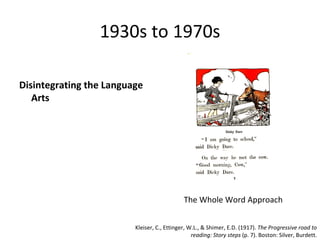
1930s to 1970s

Disintegrating the Language
   Arts


                                             The Whole Word Approach


                         Kleiser, C., Ettinger, W.L., & Shimer, E.D. (1917). The Progressive road to
                                                 reading: Story steps (p. 7). Boston: Silver, Burdett.
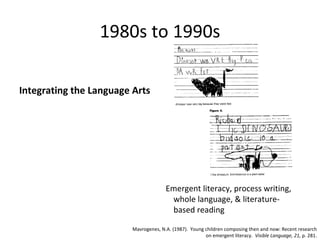
1980s to 1990s

Integrating the Language Arts


                                       Emergent literacy, process writing,
                                        whole language, & literature-
                                        based reading

                         Mavrogenes, N.A. (1987). Young children composing then and now: Recent research
                                                        on emergent literacy. Visible Language, 21, p. 281.
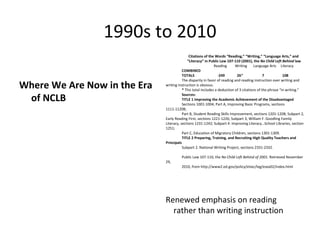
1990s to 2010
                                             Citations of the Words “Reading,” “Writing,” “Language Arts,” and
                                            “Literacy” in Public Law 107-110 (2001), the No Child Left Behind law
                                                              Reading      Writing     Language Arts Literacy
                                         COMBINED
                                         TOTALS                  -249       26*               7           108
                                         The disparity in favor of reading and reading instruction over writing and
Where We Are Now in the Era   writing instruction is obvious.
                                         * This total includes a deduction of 3 citations of the phrase “in writing.”

 of NCLB                                 Sources:
                                         TITLE 1 Improving the Academic Achievement of the Disadvantaged
                                         Sections 1001-1004; Part A, Improving Basic Programs, sections
                              1111-1120B;
                                         Part B, Student Reading Skills Improvement, sections 1201-1208; Subpart 2,
                              Early Reading First, sections 1221-1226; Subpart 3, William F. Goodling Family
                              Literacy, sections 1231-1242; Subpart 4. Improving Literacy
School Libraries, section
                              1251;
                                         Part C, Education of Migratory Children, sections 1301-1309.
                                         TITLE 2 Preparing, Training, and Recruiting High Quality Teachers and
                              Principals
                                         Subpart 2. National Writing Project, sections 2331-2332.

                                        Public Law 107-110, the No Child Left Behind of 2001. Retrieved November
                              29,
                                        2010, from http://www2.ed.gov/policy/elsec/leg/esea02/index.html


                              Renewed emphasis on reading
                                rather than writing instruction
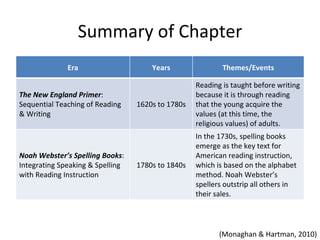
Summary of Chapter
              Era                     Years                Themes/Events

                                                   Reading is taught before writing
The New England Primer:                            because it is through reading
Sequential Teaching of Reading    1620s to 1780s   that the young acquire the
& Writing                                          values (at this time, the
                                                   religious values) of adults.
                                                   In the 1730s, spelling books
                                                   emerge as the key text for
Noah Webster’s Spelling Books:                     American reading instruction,
Integrating Speaking & Spelling   1780s to 1840s   which is based on the alphabet
with Reading Instruction                           method. Noah Webster’s
                                                   spellers outstrip all others in
                                                   their sales.


                                                          (Monaghan & Hartman, 2010)
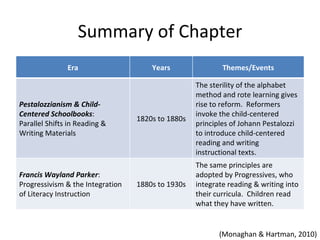
Summary of Chapter
               Era                    Years                Themes/Events

                                                   The sterility of the alphabet
                                                   method and rote learning gives
Pestalozzianism & Child-                           rise to reform. Reformers
Centered Schoolbooks:                              invoke the child-centered
                                  1820s to 1880s
Parallel Shifts in Reading &                       principles of Johann Pestalozzi
Writing Materials                                  to introduce child-centered
                                                   reading and writing
                                                   instructional texts.
                                                   The same principles are
Francis Wayland Parker:                            adopted by Progressives, who
Progressivism & the Integration   1880s to 1930s   integrate reading & writing into
of Literacy Instruction                            their curricula. Children read
                                                   what they have written.


                                                          (Monaghan & Hartman, 2010)
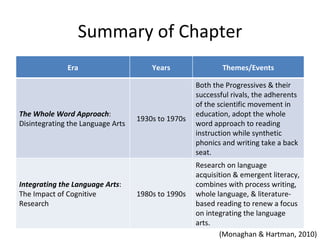
Summary of Chapter
              Era                      Years                Themes/Events

                                                    Both the Progressives & their
                                                    successful rivals, the adherents
                                                    of the scientific movement in
The Whole Word Approach:                            education, adopt the whole
                                   1930s to 1970s
Disintegrating the Language Arts                    word approach to reading
                                                    instruction while synthetic
                                                    phonics and writing take a back
                                                    seat.
                                                    Research on language
                                                    acquisition & emergent literacy,
Integrating the Language Arts:                      combines with process writing,
The Impact of Cognitive            1980s to 1990s   whole language, & literature-
Research                                            based reading to renew a focus
                                                    on integrating the language
                                                    arts.
                                                           (Monaghan & Hartman, 2010)
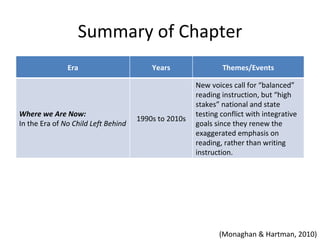
Summary of Chapter
               Era                       Years                Themes/Events

                                                      New voices call for “balanced”
                                                      reading instruction, but “high
                                                      stakes” national and state
Where we Are Now:                                     testing conflict with integrative
                                     1990s to 2010s
In the Era of No Child Left Behind                    goals since they renew the
                                                      exaggerated emphasis on
                                                      reading, rather than writing
                                                      instruction.


                                                             (Monaghan & Hartman, 2010)
For More Information 


      http://historyliteracy.org

Monaghan Hartman (2010) Integrating the Elementary Language Arts

  • 1.
    Integrating the Elementary Language Arts: A Historical Perspective E. Jennifer Monaghan Douglas K. Hartman Chapter 16
  • 2.
    Toward Defining theLanguage Arts 
 ‱ “Our goal is to define 
 what students should learn in the English language arts—reading, writing, listening, speaking, viewing, and visual representing.” International Reading Association/National Council of Teachers of English (IRA/NCTE). (1996). Standards for the English Language Arts. Newark, DE: International Reading Association/National Council of Teachers of English.
  • 3.
    1620s to 1780s SequentialTeaching of Reading & Writing Reading the Bible is the route to salvation New-England Primer (n.p.). (1727). Boston: S. Kneeland & T. Green.
  • 4.
    1780s to 1840s IntegratingSpeaking & Spelling Instruction Oral spelling is the route to reading acquisition Webster, N. (1843). The elementary spelling book; being an improvement on the American Spelling Book (p. 20). New York: Cooledge & Brother. (Original work published 1829).
  • 5.
    1840s to 1880s Pestalozianism& Schoolbooks A shift toward child-centered reading instruction William Holmes McGuffey (1837). Eclectic First Reader (p. 14). Cincinnati: Truman & Smith. Reproduced in John H. Westerhoff III (1978). McGuffey and His Readers: Piety, Morality, and Education in Nineteenth-Century America (p. 115). Nashville, TN: Abingdon.
  • 6.
    1840s to 1880s Pestalozianism& Schoolbooks (continued) A shift toward child-centered writing instruction Frost, J. (1839). Easy exercises in composition (p. 24). Philadelphia: W. Marshal. Reproduced in Schultz, L.M. (1999), The young composers: Composition’s beginning in nineteenth-century schools (p. 52). Carbondale: Southern Illinois University Press.
  • 7.
    1880s to 1930s Progressivism& the Integration of Literacy Instruction Francis Wayland Parker Source: http://www.ucls.uchicago.edu/photo_album/1809s/parker.html
  • 8.
    1930s to 1970s Disintegratingthe Language Arts The Whole Word Approach Kleiser, C., Ettinger, W.L., & Shimer, E.D. (1917). The Progressive road to reading: Story steps (p. 7). Boston: Silver, Burdett.
  • 9.
    1980s to 1990s Integratingthe Language Arts Emergent literacy, process writing, whole language, & literature- based reading Mavrogenes, N.A. (1987). Young children composing then and now: Recent research on emergent literacy. Visible Language, 21, p. 281.
  • 10.
    1990s to 2010 Citations of the Words “Reading,” “Writing,” “Language Arts,” and “Literacy” in Public Law 107-110 (2001), the No Child Left Behind law Reading Writing Language Arts Literacy COMBINED TOTALS -249 26* 7 108 The disparity in favor of reading and reading instruction over writing and Where We Are Now in the Era writing instruction is obvious. * This total includes a deduction of 3 citations of the phrase “in writing.” of NCLB Sources: TITLE 1 Improving the Academic Achievement of the Disadvantaged Sections 1001-1004; Part A, Improving Basic Programs, sections 1111-1120B; Part B, Student Reading Skills Improvement, sections 1201-1208; Subpart 2, Early Reading First, sections 1221-1226; Subpart 3, William F. Goodling Family Literacy, sections 1231-1242; Subpart 4. Improving Literacy
School Libraries, section 1251; Part C, Education of Migratory Children, sections 1301-1309. TITLE 2 Preparing, Training, and Recruiting High Quality Teachers and Principals Subpart 2. National Writing Project, sections 2331-2332. Public Law 107-110, the No Child Left Behind of 2001. Retrieved November 29, 2010, from http://www2.ed.gov/policy/elsec/leg/esea02/index.html Renewed emphasis on reading rather than writing instruction
  • 11.
    Summary of Chapter Era Years Themes/Events Reading is taught before writing The New England Primer: because it is through reading Sequential Teaching of Reading 1620s to 1780s that the young acquire the & Writing values (at this time, the religious values) of adults. In the 1730s, spelling books emerge as the key text for Noah Webster’s Spelling Books: American reading instruction, Integrating Speaking & Spelling 1780s to 1840s which is based on the alphabet with Reading Instruction method. Noah Webster’s spellers outstrip all others in their sales. (Monaghan & Hartman, 2010)
  • 12.
    Summary of Chapter Era Years Themes/Events The sterility of the alphabet method and rote learning gives Pestalozzianism & Child- rise to reform. Reformers Centered Schoolbooks: invoke the child-centered 1820s to 1880s Parallel Shifts in Reading & principles of Johann Pestalozzi Writing Materials to introduce child-centered reading and writing instructional texts. The same principles are Francis Wayland Parker: adopted by Progressives, who Progressivism & the Integration 1880s to 1930s integrate reading & writing into of Literacy Instruction their curricula. Children read what they have written. (Monaghan & Hartman, 2010)
  • 13.
    Summary of Chapter Era Years Themes/Events Both the Progressives & their successful rivals, the adherents of the scientific movement in The Whole Word Approach: education, adopt the whole 1930s to 1970s Disintegrating the Language Arts word approach to reading instruction while synthetic phonics and writing take a back seat. Research on language acquisition & emergent literacy, Integrating the Language Arts: combines with process writing, The Impact of Cognitive 1980s to 1990s whole language, & literature- Research based reading to renew a focus on integrating the language arts. (Monaghan & Hartman, 2010)
  • 14.
    Summary of Chapter Era Years Themes/Events New voices call for “balanced” reading instruction, but “high stakes” national and state Where we Are Now: testing conflict with integrative 1990s to 2010s In the Era of No Child Left Behind goals since they renew the exaggerated emphasis on reading, rather than writing instruction. (Monaghan & Hartman, 2010)
  • 15.
    For More Information
 http://historyliteracy.org