The Impact of Performance Auditing in MoldovaPresentation byEcaterina Paknehad, Member, Court of Accounts of the Republic of Moldova
About Moldova
About the Court of Accounts
Development of Court’s Capacity to Conduct Performance Audits and Audits of IT Systems
Pilot Performance Audits and Additional Audits
Examples of Impact of Performance Audits
Questions?2What will we cover ?
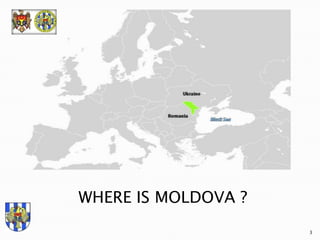
WHERE IS MOLDOVA ?3
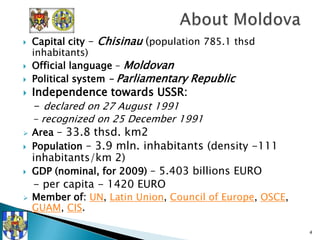
Capital city – Chisinau (population 785.1 thsd inhabitants)
Official language – MoldovanPolitical system – Parliamentary RepublicIndependence towards USSR:   - declared on 27 August 1991   - recognized on 25 December 1991Area – 33.8 thsd. km2
Population – 3.9 mln. inhabitants (density -111 inhabitants/km 2)
GDP (nominal, for 2009) – 5.403 billions EURO   - per capita - 1420 EUROMember of: UN, Latin Union, Council of Europe, OSCE, GUAM, CIS.4            About Moldova
The Court of Accounts: – was established in 1994 as a supreme financial control institution , and since 2008 – it is the SAI of the Republic of Moldova, performing external public audit;has 150 staff, established Plenum(7 members, including the president and deputy president, appointed for a term of 5 years by the Parliament)  and personnel with audit functions, specialty personnel and technical personnel;
is apolitical and has organizational, functional, operational and financial independence;
performs regularity, performance and IT audits;
submits to Parliament, during the year, audit reports, including annual report.5          About the Court of Accounts
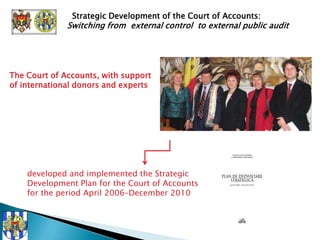
  Strategic Development of the Court of Accounts:           Switching from  external control  to external public auditThe Court of Accounts, with support of international donors and expertsdeveloped and implemented the Strategic Development Plan for the Court of Accounts for the period April 2006–December 2010
Towards October 2008, the Court of Accounts had:3 employees trained in performance audit (IDI INTOSAI, long-term training courses, 2004-2005)About 25 controllers with skills of performing thematic controls in different fields (controls with elements of performance audit, 2004-2006)12 controllers trained for 4 days in performance audit by UK NAO (2006)5 employees had some report preparation and report writing skills, obtained from the UK NAO.7The platform for developing performance audit skills
24 month WB funded Project Implemented by IBTCI:  Performance audits and audits of IT systems. Started Oct 2008/ended Oct 2010
One week modular performance audit training program
Four day report writing/three day report review course
Extensive “hands-on” training/assistance —IBTCI consultants worked day-to-day with Court staff
Pilot audits (5 Performance/3 audits of IT systems)8Development of Court’s Capacity to Conduct                                 Performance Audits and Audits of IT Systems
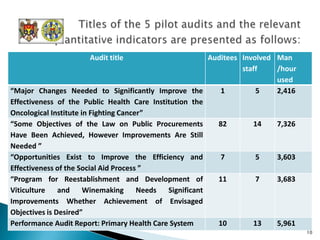
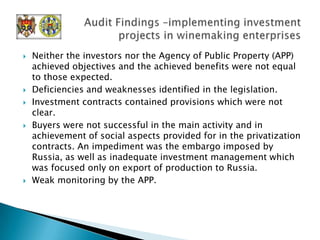
Oncological InstituteImplementation of New Procurement LawSocial Aid Process (requested by the European Commission)Primary Health Care System (requested by the European Commission)Assistance to Viticulture Industry(audits undertaken late 2008 through March 2010)            5 Pilot Performance Audits
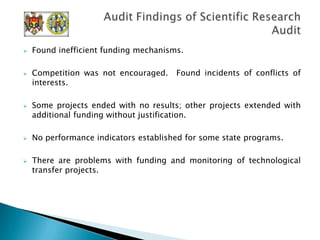
10Titles of the 5 pilot audits and the relevant     quantitative indicators are presented as follows:
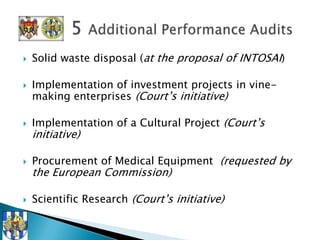
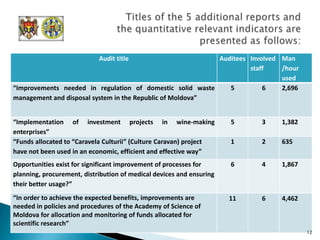
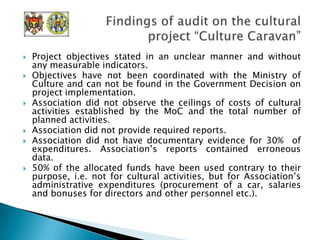
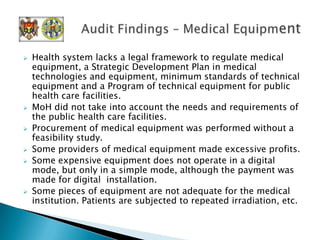
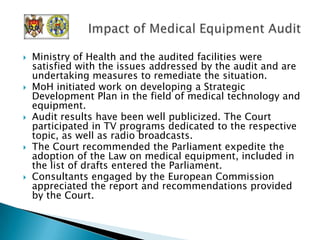
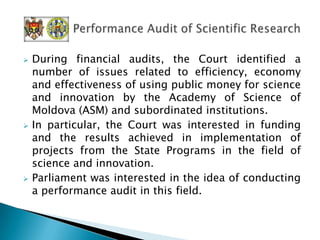
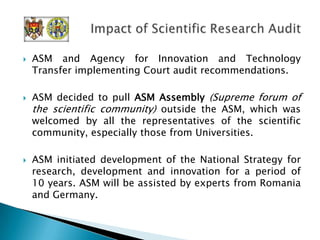
Solid waste disposal (at the proposal of INTOSAI)Implementation of investment projects in vine-making enterprises (Court’s initiative)Implementation of a Cultural Project (Court’s initiative)Procurement of Medical Equipment  (requested by the European Commission)Scientific Research (Court’s initiative)         5 Additional Performance Audits
12      Titles of the 5 additional reports and the quantitative relevant indicators are presented as follows:
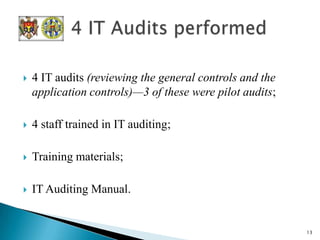
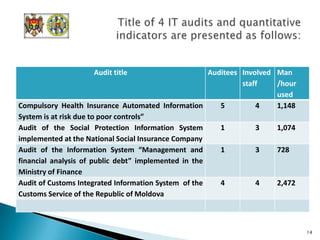
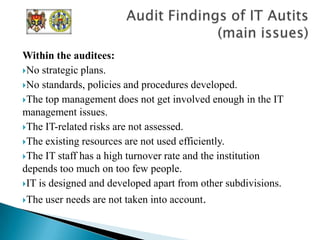
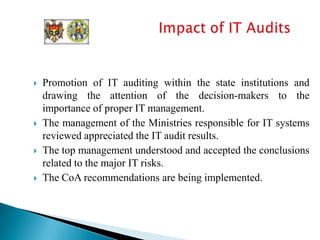
13         4 IT Audits performed4 IT audits (reviewing the general controls and the application controls)—3 of these were pilot audits; 4 staff trained in IT auditing;Training materials;IT Auditing Manual.
14Title of 4 IT audits and quantitative indicators are presented as follows:
15The Court of Accounts thanks Mrs. Linda Weeks and Mr. James Bonnell, Mr. Michael Bitz for their dedication and effort in development of professional capacities of auditors to conduct performance and IT audits
EXAMPLES OF IMPACT OF PERFORMANCE AUDITS16What did we achieve?
Critical Health Care Institution—never been audited.Performance audit found serious problems with the Institute’s systems for managing its resources.Audit identified areas where performance could be improved:  procurement, management of medications, from determining the needs through distribution and use of medications; better utilizing inpatient department; and obtaining information on the technical status of medical equipment.          Oncological Institute
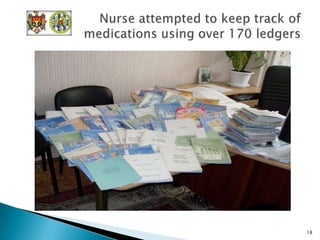
18Nurse attempted to keep track of medications using over 170 ledgers
Director and several senior staff were replaced.Moldova Anti-Corruption Commission investigating medication issues identified by audit.Court report is being used as a guide to improve Institute operations.19               Impact of Audit
In 2008, Moldova passed a new procurement law intended to significantly improve public procurement process.Performance audit assessed whether the objectives of the law were being met.Implementation of New Procurement Law
While some objectives were being achieved,  improvements were still needed.Contracting authorities were not developing procurement plans as required.Procurements were not adequately documented.Significant improvements needed in contract monitoring.Government agency established for overseeing procurement process was not fulfilling mandate.Procurement Audit Findings
Court held one day conference to discuss audit findings among key stakeholders.Got key groups/stakeholders talking to one another.Amendments passed to procurement law to improve implementation.Impact of Audit
In 2008, Moldova implemented new mechanism for payment of social aid.Audit undertaken to determine if there are problems hindering implementation of the new social aid program.Performance Audit of the Social Aid Process
Additional staff needed to effectively implement the process.Internal controls needed to be significantly strengthened throughout the social aid process.Social Aid Process Audit Findings
Impact of the Social Aid AuditEU accepted the Court Performance Audit as a condition for additional assistance to this program.Court audit is being used as a guide to improve all aspects of the Social Aid Process, particularly strengthening internal controls.Ministry of Labor and Social Protection has accepted the proposals and recommendations of the Court to improve the social aid delivery mechanism.The Government approved the proposals for modification of the Regulation on determining and payment of social aid. The Parliament accepted a series of amendments to the Law on social aid, which brought clarity in terms of criteria for qualification for social aid, as well as introduced a new social benefit.
Government established a long term program (2002-2020) for reestablishing and developing viticulture and winemaking in Moldova.Audit assessed the effectiveness of the program.Reestablishment and Development of Viticulture and Winemaking Audit
Identified weaknesses in program implementation, reporting of performance indicators, and management of the program’s financial resources.The Program was developed for the long term but was not adjusted to reflect current economic conditions.Audit Findings – Viticulture and Winemaking
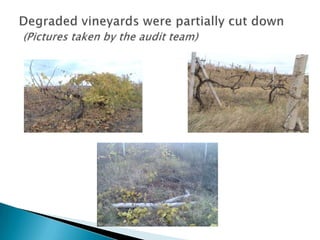
Degraded vineyards were partially cut down (Pictures taken by the audit team)
Impact of Viticulture/Winemaking AuditMinistry of Agriculture developed a new Program for reestablishment and development of viticulture and winemaking for 2011-2020Court requested tax inspections of economic operators which resulted in 5 mln MDL additional collections.General agricultural census was conducted, including  inventory and evaluation of the status of vineyardsThe process of preparing the Viticulture Cadastre was launchedFund to support establishment of vineyards was liquidated. Parliament approved a new subsidizing modality.
Domestic solid wastes have a direct influence on environment, and their inadequate management determines pollution of soil, water, air, flora, fauna etc.
Waste management is a problem in the Republic of Moldova.
The Court of Accounts supported the proposal of the INTOSAI, WGEA Working Group and performed the environment audit, selecting solid waste  management.Performance Audit in the field of environment – domestic solid waste management
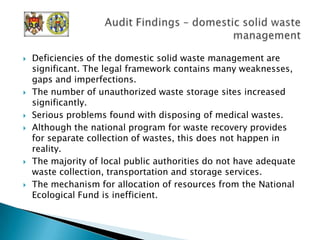
Deficiencies of the domestic solid waste management are significant. The legal framework contains many weaknesses, gaps and imperfections.The number of unauthorized waste storage sites increased significantly.Serious problems found with disposing of medical wastes. Although the national program for waste recovery provides for separate collection of wastes, this does not happen in reality.The majority of local public authorities do not have adequate waste collection, transportation and storage services. The mechanism for allocation of resources from the National Ecological Fund is inefficient.Audit Findings – domestic solid waste management
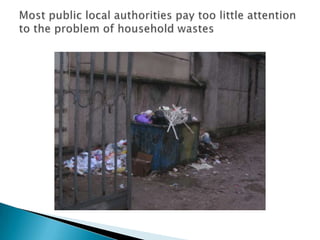
Most public local authorities pay too little attention to the problem of household wastes
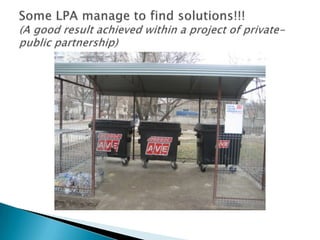
Some LPA manage to find solutions!!!(A good result achieved within a project of private-public partnership)
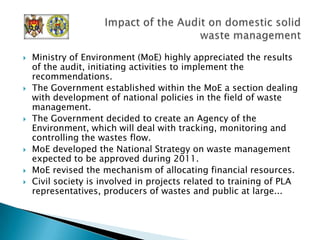
Ministry of Environment (MoE) highly appreciated the results of the audit, initiating activities to implement the recommendations. The Government established within the MoE a section dealing with development of national policies in the field of waste management.The Government decided to create an Agency of the Environment, which will deal with tracking, monitoring and controlling the wastes flow.MoE developed the National Strategy on waste management expected to be approved during 2011.MoE revised the mechanism of allocating financial resources.Civil society is involved in projects related to training of PLA representatives, producers of wastes and public at large...Impact of the Audit on domestic solid waste management
In 2008, Moldova implemented a new mechanism for payment of social aid.Audit was undertaken to determine whether there are problems hindering implementation of the new social aid program.Performance Audit of the Social Aid Process
Additional staff needed to effectively implement the process.Internal controls needed to be significantly strengthened throughout the social aid process.Social Aid Process Audit Findings
EU accepted the Court Performance Audit as a condition for additional assistance to this program.Court audit is being used as a guide to improve all aspects of the Social Aid Process, particularly strengthening internal controls.Impact of the Social Aid Audit
Moldova decided to separate Primary Health Care from hospital care to ensure greater access to health care services.  Started process in early 2008.Undertook audit to assess progress made in achieving objectives.Primary Health Care Performance Audit
Shortages of doctors and lack of continuous training limited effectiveness.Opportunities to significantly improve access to primary health care services.Many care facilities do not meet standards.Opportunities exist to improve the Ministry’s monitoring.Audit Findings- Primary Health Care
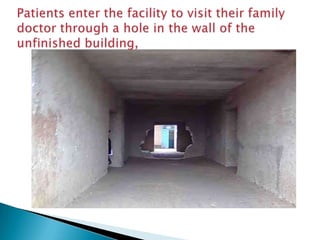
Patients enter the facility to visit their family doctor through a hole in the wall of the unfinished building,
Minister of Health using audit report as a guide for improving program operations.Minister of Health so impressed with the Court’s audit that he wants the Court to conduct performance audits of hospital care and emergency care systems.Impact of Primary Health Care Audit

Moldova presentation miami_5.20.11_engl_final4.26

  • 1.
    The Impact ofPerformance Auditing in MoldovaPresentation byEcaterina Paknehad, Member, Court of Accounts of the Republic of Moldova
  • 2.
  • 3.
    About the Courtof Accounts
  • 4.
    Development of Court’sCapacity to Conduct Performance Audits and Audits of IT Systems
  • 5.
    Pilot Performance Auditsand Additional Audits
  • 6.
    Examples of Impactof Performance Audits
  • 7.
  • 8.
  • 9.
    Capital city –Chisinau (population 785.1 thsd inhabitants)
  • 10.
    Official language –MoldovanPolitical system – Parliamentary RepublicIndependence towards USSR: - declared on 27 August 1991 - recognized on 25 December 1991Area – 33.8 thsd. km2
  • 11.
    Population – 3.9mln. inhabitants (density -111 inhabitants/km 2)
  • 12.
    GDP (nominal, for2009) – 5.403 billions EURO - per capita - 1420 EUROMember of: UN, Latin Union, Council of Europe, OSCE, GUAM, CIS.4 About Moldova
  • 13.
    The Court ofAccounts: – was established in 1994 as a supreme financial control institution , and since 2008 – it is the SAI of the Republic of Moldova, performing external public audit;has 150 staff, established Plenum(7 members, including the president and deputy president, appointed for a term of 5 years by the Parliament) and personnel with audit functions, specialty personnel and technical personnel;
  • 14.
    is apolitical andhas organizational, functional, operational and financial independence;
  • 15.
  • 16.
    submits to Parliament,during the year, audit reports, including annual report.5 About the Court of Accounts
  • 17.
    StrategicDevelopment of the Court of Accounts: Switching from external control to external public auditThe Court of Accounts, with support of international donors and expertsdeveloped and implemented the Strategic Development Plan for the Court of Accounts for the period April 2006–December 2010
  • 18.
    Towards October 2008,the Court of Accounts had:3 employees trained in performance audit (IDI INTOSAI, long-term training courses, 2004-2005)About 25 controllers with skills of performing thematic controls in different fields (controls with elements of performance audit, 2004-2006)12 controllers trained for 4 days in performance audit by UK NAO (2006)5 employees had some report preparation and report writing skills, obtained from the UK NAO.7The platform for developing performance audit skills
  • 19.
    24 month WBfunded Project Implemented by IBTCI: Performance audits and audits of IT systems. Started Oct 2008/ended Oct 2010
  • 20.
    One week modularperformance audit training program
  • 21.
    Four day reportwriting/three day report review course
  • 22.
    Extensive “hands-on” training/assistance—IBTCI consultants worked day-to-day with Court staff
  • 23.
    Pilot audits (5Performance/3 audits of IT systems)8Development of Court’s Capacity to Conduct Performance Audits and Audits of IT Systems
  • 24.
    Oncological InstituteImplementation ofNew Procurement LawSocial Aid Process (requested by the European Commission)Primary Health Care System (requested by the European Commission)Assistance to Viticulture Industry(audits undertaken late 2008 through March 2010) 5 Pilot Performance Audits
  • 25.
    10Titles of the5 pilot audits and the relevant quantitative indicators are presented as follows:
  • 26.
    Solid waste disposal(at the proposal of INTOSAI)Implementation of investment projects in vine-making enterprises (Court’s initiative)Implementation of a Cultural Project (Court’s initiative)Procurement of Medical Equipment (requested by the European Commission)Scientific Research (Court’s initiative) 5 Additional Performance Audits
  • 27.
    12 Titles of the 5 additional reports and the quantitative relevant indicators are presented as follows:
  • 28.
    13 4 IT Audits performed4 IT audits (reviewing the general controls and the application controls)—3 of these were pilot audits; 4 staff trained in IT auditing;Training materials;IT Auditing Manual.
  • 29.
    14Title of 4IT audits and quantitative indicators are presented as follows:
  • 30.
    15The Court ofAccounts thanks Mrs. Linda Weeks and Mr. James Bonnell, Mr. Michael Bitz for their dedication and effort in development of professional capacities of auditors to conduct performance and IT audits
  • 31.
    EXAMPLES OF IMPACTOF PERFORMANCE AUDITS16What did we achieve?
  • 32.
    Critical Health CareInstitution—never been audited.Performance audit found serious problems with the Institute’s systems for managing its resources.Audit identified areas where performance could be improved: procurement, management of medications, from determining the needs through distribution and use of medications; better utilizing inpatient department; and obtaining information on the technical status of medical equipment. Oncological Institute
  • 33.
    18Nurse attempted tokeep track of medications using over 170 ledgers
  • 34.
    Director and severalsenior staff were replaced.Moldova Anti-Corruption Commission investigating medication issues identified by audit.Court report is being used as a guide to improve Institute operations.19 Impact of Audit
  • 35.
    In 2008, Moldovapassed a new procurement law intended to significantly improve public procurement process.Performance audit assessed whether the objectives of the law were being met.Implementation of New Procurement Law
  • 36.
    While some objectiveswere being achieved, improvements were still needed.Contracting authorities were not developing procurement plans as required.Procurements were not adequately documented.Significant improvements needed in contract monitoring.Government agency established for overseeing procurement process was not fulfilling mandate.Procurement Audit Findings
  • 37.
    Court held oneday conference to discuss audit findings among key stakeholders.Got key groups/stakeholders talking to one another.Amendments passed to procurement law to improve implementation.Impact of Audit
  • 38.
    In 2008, Moldovaimplemented new mechanism for payment of social aid.Audit undertaken to determine if there are problems hindering implementation of the new social aid program.Performance Audit of the Social Aid Process
  • 39.
    Additional staff neededto effectively implement the process.Internal controls needed to be significantly strengthened throughout the social aid process.Social Aid Process Audit Findings
  • 40.
    Impact of theSocial Aid AuditEU accepted the Court Performance Audit as a condition for additional assistance to this program.Court audit is being used as a guide to improve all aspects of the Social Aid Process, particularly strengthening internal controls.Ministry of Labor and Social Protection has accepted the proposals and recommendations of the Court to improve the social aid delivery mechanism.The Government approved the proposals for modification of the Regulation on determining and payment of social aid. The Parliament accepted a series of amendments to the Law on social aid, which brought clarity in terms of criteria for qualification for social aid, as well as introduced a new social benefit.
  • 41.
    Government established along term program (2002-2020) for reestablishing and developing viticulture and winemaking in Moldova.Audit assessed the effectiveness of the program.Reestablishment and Development of Viticulture and Winemaking Audit
  • 42.
    Identified weaknesses inprogram implementation, reporting of performance indicators, and management of the program’s financial resources.The Program was developed for the long term but was not adjusted to reflect current economic conditions.Audit Findings – Viticulture and Winemaking
  • 43.
    Degraded vineyards werepartially cut down (Pictures taken by the audit team)
  • 44.
    Impact of Viticulture/WinemakingAuditMinistry of Agriculture developed a new Program for reestablishment and development of viticulture and winemaking for 2011-2020Court requested tax inspections of economic operators which resulted in 5 mln MDL additional collections.General agricultural census was conducted, including inventory and evaluation of the status of vineyardsThe process of preparing the Viticulture Cadastre was launchedFund to support establishment of vineyards was liquidated. Parliament approved a new subsidizing modality.
  • 45.
    Domestic solid wasteshave a direct influence on environment, and their inadequate management determines pollution of soil, water, air, flora, fauna etc.
  • 46.
    Waste management isa problem in the Republic of Moldova.
  • 47.
    The Court ofAccounts supported the proposal of the INTOSAI, WGEA Working Group and performed the environment audit, selecting solid waste management.Performance Audit in the field of environment – domestic solid waste management
  • 48.
    Deficiencies of thedomestic solid waste management are significant. The legal framework contains many weaknesses, gaps and imperfections.The number of unauthorized waste storage sites increased significantly.Serious problems found with disposing of medical wastes. Although the national program for waste recovery provides for separate collection of wastes, this does not happen in reality.The majority of local public authorities do not have adequate waste collection, transportation and storage services. The mechanism for allocation of resources from the National Ecological Fund is inefficient.Audit Findings – domestic solid waste management
  • 49.
    Most public localauthorities pay too little attention to the problem of household wastes
  • 50.
    Some LPA manageto find solutions!!!(A good result achieved within a project of private-public partnership)
  • 51.
    Ministry of Environment(MoE) highly appreciated the results of the audit, initiating activities to implement the recommendations. The Government established within the MoE a section dealing with development of national policies in the field of waste management.The Government decided to create an Agency of the Environment, which will deal with tracking, monitoring and controlling the wastes flow.MoE developed the National Strategy on waste management expected to be approved during 2011.MoE revised the mechanism of allocating financial resources.Civil society is involved in projects related to training of PLA representatives, producers of wastes and public at large...Impact of the Audit on domestic solid waste management
  • 52.
    In 2008, Moldovaimplemented a new mechanism for payment of social aid.Audit was undertaken to determine whether there are problems hindering implementation of the new social aid program.Performance Audit of the Social Aid Process
  • 53.
    Additional staff neededto effectively implement the process.Internal controls needed to be significantly strengthened throughout the social aid process.Social Aid Process Audit Findings
  • 54.
    EU accepted theCourt Performance Audit as a condition for additional assistance to this program.Court audit is being used as a guide to improve all aspects of the Social Aid Process, particularly strengthening internal controls.Impact of the Social Aid Audit
  • 55.
    Moldova decided toseparate Primary Health Care from hospital care to ensure greater access to health care services. Started process in early 2008.Undertook audit to assess progress made in achieving objectives.Primary Health Care Performance Audit
  • 56.
    Shortages of doctorsand lack of continuous training limited effectiveness.Opportunities to significantly improve access to primary health care services.Many care facilities do not meet standards.Opportunities exist to improve the Ministry’s monitoring.Audit Findings- Primary Health Care
  • 57.
    Patients enter thefacility to visit their family doctor through a hole in the wall of the unfinished building,
  • 58.
    Minister of Healthusing audit report as a guide for improving program operations.Minister of Health so impressed with the Court’s audit that he wants the Court to conduct performance audits of hospital care and emergency care systems.Impact of Primary Health Care Audit

Editor's Notes

  • #7 Astfel, întru realizarea pct.42 din Planul de Acţiuni Re­publica Moldova - Uniunea Europeană, Curtea de Conturi, cu sprijinul donatorilor şi experţilor internaţionali, a elaborat şi aprobat Planul de Dez­voltare Strategică a Curţii de Conturi pe perioada aprilie 2006–decembrie 2010, scopul principal al căruia este asigurarea funcţionării Curţii de Con­turi în conformitate cu standardele internaţionale şi ale UE privind cele mai bune practici ale auditului extern. Deci, reformarea instituţiei de control financiar extern în instituţie de audit extern este scopul final al PDS-ului şi constituie una din premisele importante ale integrării în Uniunea Europeană.