SUMMER INTERNSHIP REPORT
LARSEN & TOUBRO FINANCIAL SERVICES
FROM 10th-AUG-2021 TO 15TH-JULY-2021
FACULTY MENTOR AT IMT NAGPUR INDUSTRY MENTOR AT LTFS
DR. SENTHIL KUMAR. S MR. AKASH CHANNA
Submitted By
Mohit Prasad
Roll No: 202032067
The internship opportunity I had with Larsen & Toubro Financial Services
was a great chance for learning and professional development. Therefore, I
consider myself as a very lucky individual as I was provided with an
opportunity to be a part of it. I am also grateful for having a chance to meet so
many wonderful people and professionals who led me through this internship
period.
I am using this opportunity to express my deepest gratitude to Mr. Ajay
Pandey Head Business HR for Wholesale Finance, SME, Mutual Funds and
Corp Function L&T Financial Services for allowing me to carry out my
project at their esteemed organization. I am also indebted to my industry
mentor Mr. Akash channa Zonal Sales Manager - Rural Finance - North
(Uttar Pradesh, Uttarakhand, Haryana and Punjab ) L&T Financial Services.
Mr. Alok Tondon Regional Sales Manager L&T Financial Services. I also
extend my heartfelt gratitude to Mr. Vipul Tiwari Divisional Manager Risk
Containment Unit L&T Financial Services, Miss Kirti Singh Human
resources L&T Financial Services who went above and beyond their domain
to enrich my Internship experience.
Next, I would like to thank my faculty guide, Dr. Senthil Kumar. S for his
continued support and guidance in the execution of the project. He shared his
rich experience and guided me throughout the internship period regarding
what really matters in an organization.
Acknowledgements
As part of my PGDM program, I have completed my internship at
Larsen & Toubro Financial Service. During the period of my
internship, I was officially engaged to serve as a Marketing Intern.
The purpose of this project is to leverage internship experience to
move forward in my career. I accomplished this goal by describing
what I did during the internship, including skills I used to manage
my work. I have provided background information about LTFS and
looked back at my job description and described my internship
experience. I have also talked about what action I took to solve the
problem and complete the task assigned by my supervisor. This
reflection activity points out what learned from the internship as
well the real world intricacies of the marketing of Rural Financial
Products. These reflection activities are compelling and
transformational as I approach the next steps in career development.
Abstract
//01
I completed my internship at Larsen & Toubro Financial Services, as the Marketing
Intern during the course of this year’s summer. I joined the firm with an aim of
enhancing competency and experience in the domain of Marketing and management.
Over the course of internship at the company, my project included Industry Analysis
of Rural Finance sector and holistic appraisal of the SOPs of L&T Financial
Services. My duties as a marketing Intern included : Supporting sales team with
assistance such as coordinating paperwork and responding to basic inquiries.
Shadowing marketing personnel, to better understand goals for marketing
campaigns. Shadowing sales professionals to gain deeper insight into best practices
and strategies for maximizing sales revenue.
Sitting in on sales team trainings to learn successful selling tactics and persuasion
techniques. Assisting with gathering market information, including market data.
Coordinating with public relations and other teams to execute product introductions.
Creating documentation outlining findings for use by project managers. Identifying
operational lacunae which were adversely impacting business operations. Mr.
Akash Channa, who was my boss, instructed me across the entirety of the internship,
incorporating his expertise and knowledge as the Zonal sales manager. Initially, my
interest in applying for this internship stemmed along-term and personal desire to
work in a sales and marketing department after the completion of my studies. During
the course of my internship, I realized that compared, to other similar organisations
working in the sector L&T Financial Services is a favorable organization, to develop
my skills in sales and marketing operations. The company drive and focus in
building a sustainable and stable working environment for its employee motivates
me to pursue a career with it in sales and marketing operations, preferably in as a
sales and marketing manager or assistant manager, after my graduation. Ultimately,
my experience at the organization, educated me on what it takes to achieve success
and gain competence in the industry. The experience has also enabled me to develop
better listening skills and collaboration with colleagues. In the current reflective
report, I will provide an Industry Analysis of the rural finance sector and a holistic
appraisal of L&T Financial Services SOPs as well as suggestions based on my
project which can further optimise the company's operations.
Introduction
//01
01 | Company Introduction
02 | Objective of The Study
03 | Brief Description of the Models Used
04 | Company Analysis
05 | Industry Analysis
06 | Standard Operating Procedures of LTFS
07 | Suggestions & Conclusion
08 | Bibliography
Table of
Contents
L&T Financial Services (LTFS) is one of India’s leading NBFC brands offering a diverse range
of financial products and services across rural, housing and infrastructure finance sector. It also
offers mutual fund products and investment management services.
Headquartered in Mumbai, it caters to the business requirements of its growing customer base
through a nationwide network of branches and meeting centers, a product portfolio covering five
different business verticals
LTFS is promoted by Larsen & Toubro Ltd. (L&T) one of the leading companies in India with
interests in engineering construction electrical & electronics manufacturing & services IT and
financial services.
To be an admired and inspirational
financial institution, creating sustainable
value for all our stakeholders.
Larsen&Toubro Financial
Services
L&T Finance Holdings Ltd. (LTFH) is a financial holding company offering a focused range of
financial products and services across rural housing and wholesale finance sectors as well as mutual
fund products and wealth management services through its wholly-owned subsidiaries viz. L&T
Finance Ltd. L&T Housing Finance Ltd. L&T Infrastructure Finance Company Ltd. L&T Investment
Management Ltd. L&T Capital Markets Ltd. and L&T Infra Debt Fund Ltd. LTFH is registered with
RBI as a CIC-ND-SI. LTFH' s wholesale finance business comprises infrastructure finance structured
corporate finance and supply chain finance. The company also offers debt capital markets services as
part of its wholesale finance business segment. The company's housing finance business comprises
home loans and loans against property and real estate finance. The company's rural finance business
comprises farm equipment finance two wheeler finance and micro loans. L&T Finance Holdings Ltd
was incorporated on May 1 2008 as a public limited company with the name L&T Capital Holdings
Ltd.
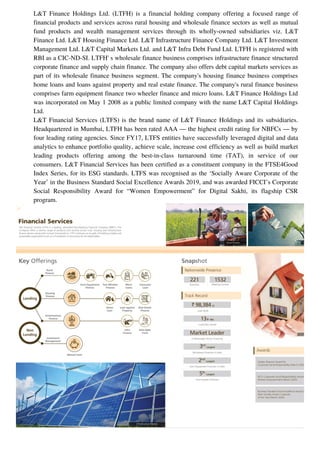
L&T Financial Services (LTFS) is the brand name of L&T Finance Holdings and its subsidiaries.
Headquartered in Mumbai, LTFH has been rated AAA — the highest credit rating for NBFCs — by
four leading rating agencies. Since FY17, LTFS entities have successfully leveraged digital and data
analytics to enhance portfolio quality, achieve scale, increase cost efficiency as well as build market
leading products offering among the best-in-class turnaround time (TAT), in service of our
consumers. L&T Financial Services has been certified as a constituent company in the FTSE4Good
Index Series, for its ESG standards. LTFS was recognised as the ‘Socially Aware Corporate of the
Year’ in the Business Standard Social Excellence Awards 2019, and was awarded FICCI’s Corporate
Social Responsibility Award for “Women Empowerment” for Digital Sakhi, its flagship CSR
program.
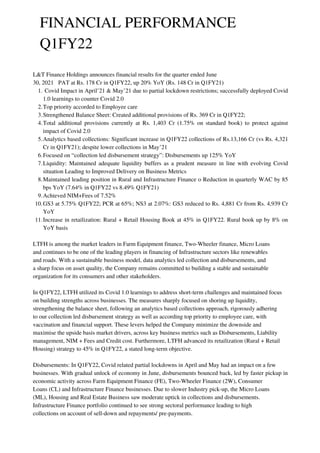
FINANCIAL PERFORMANCE
Q1FY22
Covid Impact in April’21 & May’21 due to partial lockdown restrictions; successfully deployed Covid
1.0 learnings to counter Covid 2.0
Top priority accorded to Employee care
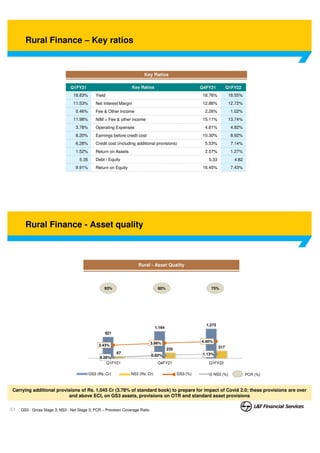
Strengthened Balance Sheet: Created additional provisions of Rs. 369 Cr in Q1FY22;
Total additional provisions currently at Rs. 1,403 Cr (1.75% on standard book) to protect against
impact of Covid 2.0
Analytics based collections: Significant increase in Q1FY22 collections of Rs.13,166 Cr (vs Rs. 4,321
Cr in Q1FY21); despite lower collections in May’21
Focused on “collection led disbursement strategy”: Disbursements up 125% YoY
Liquidity: Maintained adequate liquidity buffers as a prudent measure in line with evolving Covid
situation Leading to Improved Delivery on Business Metrics
Maintained leading position in Rural and Infrastructure Finance o Reduction in quarterly WAC by 85
bps YoY (7.64% in Q1FY22 vs 8.49% Q1FY21)
Achieved NIM+Fees of 7.52%
GS3 at 5.75% Q1FY22; PCR at 65%; NS3 at 2.07%: GS3 reduced to Rs. 4,881 Cr from Rs. 4,939 Cr
YoY
Increase in retailization: Rural + Retail Housing Book at 45% in Q1FY22. Rural book up by 8% on
YoY basis
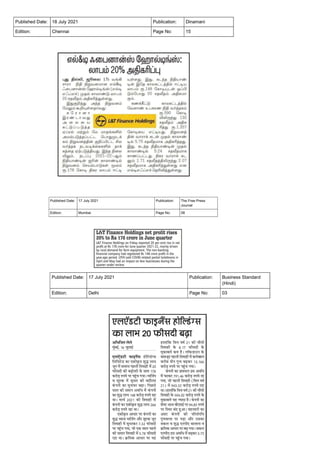
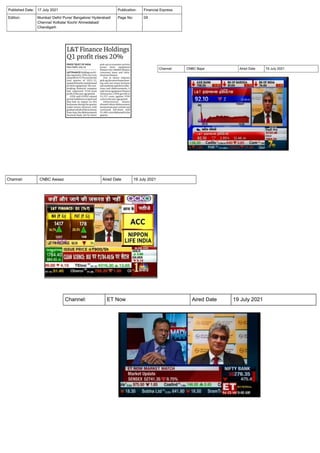
L&T Finance Holdings announces financial results for the quarter ended June
30, 2021 PAT at Rs. 178 Cr in Q1FY22, up 20% YoY (Rs. 148 Cr in Q1FY21)
1.
2.
3.
4.
5.
6.
7.
8.
9.
10.
11.
LTFH is among the market leaders in Farm Equipment finance, Two-Wheeler finance, Micro Loans
and continues to be one of the leading players in financing of Infrastructure sectors like renewables
and roads. With a sustainable business model, data analytics led collection and disbursements, and
a sharp focus on asset quality, the Company remains committed to building a stable and sustainable
organization for its consumers and other stakeholders.
In Q1FY22, LTFH utilized its Covid 1.0 learnings to address short-term challenges and maintained focus
on building strengths across businesses. The measures sharply focused on shoring up liquidity,
strengthening the balance sheet, following an analytics based collections approach, rigorously adhering
to our collection led disbursement strategy as well as according top priority to employee care, with
vaccination and financial support. These levers helped the Company minimize the downside and
maximise the upside basis market drivers, across key business metrics such as Disbursements, Liability
management, NIM + Fees and Credit cost. Furthermore, LTFH advanced its retailization (Rural + Retail
Housing) strategy to 45% in Q1FY22, a stated long-term objective.
Disbursements: In Q1FY22, Covid related partial lockdowns in April and May had an impact on a few
businesses. With gradual unlock of economy in June, disbursements bounced back, led by faster pickup in
economic activity across Farm Equipment Finance (FE), Two-Wheeler Finance (2W), Consumer
Loans (CL) and Infrastructure Finance businesses. Due to slower Industry pick-up, the Micro Loans
(ML), Housing and Real Estate Business saw moderate uptick in collections and disbursements.
Infrastructure Finance portfolio continued to see strong sectoral performance leading to high
collections on account of sell-down and repayments/ pre-payments.
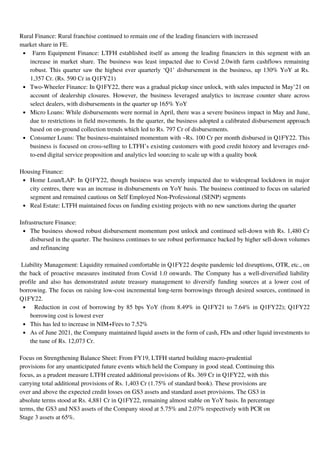
Farm Equipment Finance: LTFH established itself as among the leading financiers in this segment with an
increase in market share. The business was least impacted due to Covid 2.0with farm cashflows remaining
robust. This quarter saw the highest ever quarterly ‘Q1’ disbursement in the business, up 130% YoY at Rs.
1,357 Cr. (Rs. 590 Cr in Q1FY21)
Two-Wheeler Finance: In Q1FY22, there was a gradual pickup since unlock, with sales impacted in May’21 on
account of dealership closures. However, the business leveraged analytics to increase counter share across
select dealers, with disbursements in the quarter up 165% YoY
Micro Loans: While disbursements were normal in April, there was a severe business impact in May and June,
due to restrictions in field movements. In the quarter, the business adopted a calibrated disbursement approach
based on on-ground collection trends which led to Rs. 797 Cr of disbursements.
Consumer Loans: The business-maintained momentum with ~Rs. 100 Cr per month disbursed in Q1FY22. This
business is focused on cross-selling to LTFH’s existing customers with good credit history and leverages end-
to-end digital service proposition and analytics led sourcing to scale up with a quality book
Home Loan/LAP: In Q1FY22, though business was severely impacted due to widespread lockdown in major
city centres, there was an increase in disbursements on YoY basis. The business continued to focus on salaried
segment and remained cautious on Self Employed Non-Professional (SENP) segments
Real Estate: LTFH maintained focus on funding existing projects with no new sanctions during the quarter
The business showed robust disbursement momentum post unlock and continued sell-down with Rs. 1,480 Cr
disbursed in the quarter. The business continues to see robust performance backed by higher sell-down volumes
and refinancing
Reduction in cost of borrowing by 85 bps YoY (from 8.49% in Q1FY21 to 7.64% in Q1FY22); Q1FY22
borrowing cost is lowest ever
This has led to increase in NIM+Fees to 7.52%
As of June 2021, the Company maintained liquid assets in the form of cash, FDs and other liquid investments to
the tune of Rs. 12,073 Cr.
Rural Finance: Rural franchise continued to remain one of the leading financiers with increased
market share in FE.
Housing Finance:
Infrastructure Finance:
Liability Management: Liquidity remained comfortable in Q1FY22 despite pandemic led disruptions, OTR, etc., on
the back of proactive measures instituted from Covid 1.0 onwards. The Company has a well-diversified liability
profile and also has demonstrated astute treasury management to diversify funding sources at a lower cost of
borrowing. The focus on raising low-cost incremental long-term borrowings through desired sources, continued in
Q1FY22.
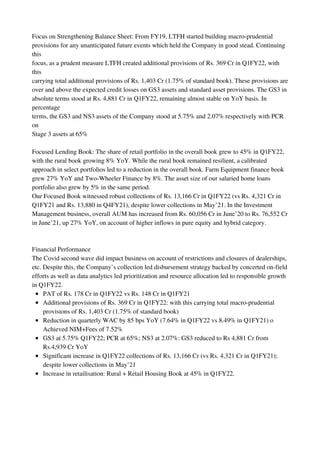
Focus on Strengthening Balance Sheet: From FY19, LTFH started building macro-prudential
provisions for any unanticipated future events which held the Company in good stead. Continuing this
focus, as a prudent measure LTFH created additional provisions of Rs. 369 Cr in Q1FY22, with this
carrying total additional provisions of Rs. 1,403 Cr (1.75% of standard book). These provisions are
over and above the expected credit losses on GS3 assets and standard asset provisions. The GS3 in
absolute terms stood at Rs. 4,881 Cr in Q1FY22, remaining almost stable on YoY basis. In percentage
terms, the GS3 and NS3 assets of the Company stood at 5.75% and 2.07% respectively with PCR on
Stage 3 assets at 65%.
PAT of Rs. 178 Cr in Q1FY22 vs Rs. 148 Cr in Q1FY21
Additional provisions of Rs. 369 Cr in Q1FY22: with this carrying total macro-prudential
provisions of Rs. 1,403 Cr (1.75% of standard book)
Reduction in quarterly WAC by 85 bps YoY (7.64% in Q1FY22 vs 8.49% in Q1FY21) o
Achieved NIM+Fees of 7.52%
GS3 at 5.75% Q1FY22; PCR at 65%; NS3 at 2.07%: GS3 reduced to Rs 4,881 Cr from
Rs.4,939 Cr YoY
Significant increase in Q1FY22 collections of Rs. 13,166 Cr (vs Rs. 4,321 Cr in Q1FY21);
despite lower collections in May’21
Increase in retailisation: Rural + Retail Housing Book at 45% in Q1FY22.
Focus on Strengthening Balance Sheet: From FY19, LTFH started building macro-prudential
provisions for any unanticipated future events which held the Company in good stead. Continuing
this
focus, as a prudent measure LTFH created additional provisions of Rs. 369 Cr in Q1FY22, with
this
carrying total additional provisions of Rs. 1,403 Cr (1.75% of standard book). These provisions are
over and above the expected credit losses on GS3 assets and standard asset provisions. The GS3 in
absolute terms stood at Rs. 4,881 Cr in Q1FY22, remaining almost stable on YoY basis. In
percentage
terms, the GS3 and NS3 assets of the Company stood at 5.75% and 2.07% respectively with PCR
on
Stage 3 assets at 65%
Focused Lending Book: The share of retail portfolio in the overall book grew to 45% in Q1FY22,
with the rural book growing 8% YoY. While the rural book remained resilient, a calibrated
approach in select portfolios led to a reduction in the overall book. Farm Equipment finance book
grew 27% YoY and Two-Wheeler Finance by 8%. The asset size of our salaried home loans
portfolio also grew by 5% in the same period.
Our Focused Book witnessed robust collections of Rs. 13,166 Cr in Q1FY22 (vs Rs. 4,321 Cr in
Q1FY21 and Rs. 13,880 in Q4FY21), despite lower collections in May’21. In the Investment
Management business, overall AUM has increased from Rs. 60,056 Cr in June’20 to Rs. 76,552 Cr
in June’21, up 27% YoY, on account of higher inflows in pure equity and hybrid category.
Financial Performance
The Covid second wave did impact business on account of restrictions and closures of dealerships,
etc. Despite this, the Company’s collection led disbursement strategy backed by concerted on-field
efforts as well as data analytics led prioritization and resource allocation led to responsible growth
in Q1FY22.
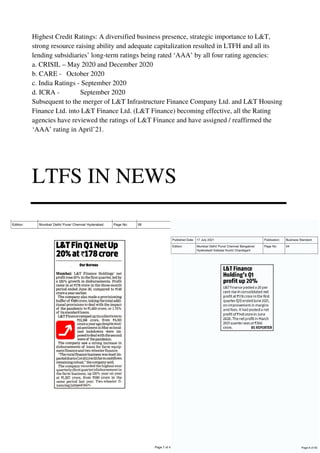
Highest Credit Ratings: A diversified business presence, strategic importance to L&T,
strong resource raising ability and adequate capitalization resulted in LTFH and all its
lending subsidiaries’ long-term ratings being rated ‘AAA’ by all four rating agencies:
a. CRISIL – May 2020 and December 2020
b. CARE - October 2020
c. India Ratings - September 2020
d. ICRA - September 2020
Subsequent to the merger of L&T Infrastructure Finance Company Ltd. and L&T Housing
Finance Ltd. into L&T Finance Ltd. (L&T Finance) becoming effective, all the Rating
agencies have reviewed the ratings of L&T Finance and have assigned / reaffirmed the
‘AAA’ rating in April’21.
LTFS IN NEWS
OBJECTIVE OF THE STUDY
Perform an Industry Analysis of the Farm Equipment Finance sector in state of Uttar
Pradesh.
Perform a thorough assessment of LTFS's Farm Equipment financing procedure and to
suggest measures which can be implemented to further augment the same.
As a Marketing Intern, I was assigned following tasks by my industry mantor.
Brief introduction of the
theoretical models used in this
study
Competitive Forces Model
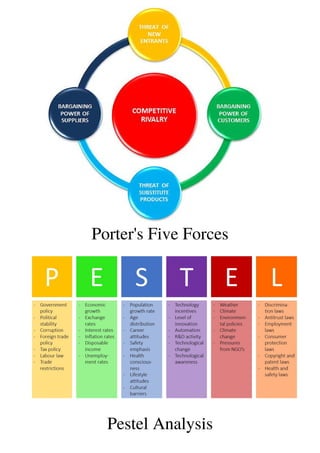
The Competitive Forces Model is an important tool used in strategic analysis to analyze the
competitiveness in an industry. The model is more commonly referred to as the Porter’s Five
Forces Model, which includes the following five forces: intensity of rivalry, threat of
potential new entrants, bargaining power of buyers, bargaining power of suppliers, and
threat of substitute goods and/or services. Porter's Five Forces model identifies and analyzes
competitive forces that shapes industry and helps determine an industry's weaknesses and
strengths. Five Forces analysis is frequently used to identify industry's position to determine
corporate strategy. Porter's model also helps in understanding the level of competition within
the industry and enhance a company's long-term profitability.
Broad Factors Analysis
Broad Factors Analysis, commonly called the PEST Analysis, is a key component of external
analysis. A Broad Factors Analysis assesses and summarizes the four macro-environmental factors
— political, economic, socio-demographic (social), and technological. These factors have
significant impacts on a business’s operating environment, posing opportunities and threats to the
company and all of its competitors. Broad Factors Analysis is widely used in strategic analysis and
planning because it helps companies determine the risks and opportunities in the marketplace. That,
in turn, becomes an important consideration when companies are developing corporate and
business strategies.
SWOT Analysis
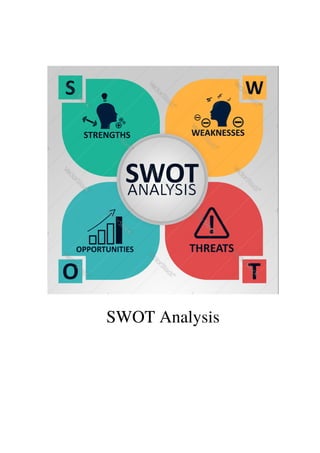
SWOT is an acronym for Strengths, Weaknesses, Opportunities, and Threats.A SWOT Analysis is one
of the most commonly used tools to assess the internal and external environments of a company and is
part of a company’s strategic planning process. In addition, a SWOT analysis can be done for a
product, place, industry, or person. A SWOT analysis helps with both strategic planning and decision-
making, as it introduces opportunities to the company as a forward-looking bridge to generating
strategic alternatives.
Porter's Five Forces
Pestel Analysis
SWOT Analysis
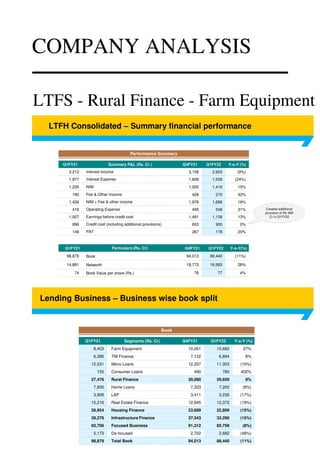
COMPANY ANALYSIS
LTFS - Rural Finance - Farm Equipment
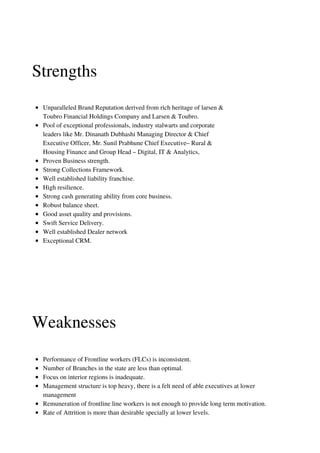
Unparalleled Brand Reputation derived from rich heritage of larsen &
Toubro Financial Holdings Company and Larsen & Toubro.
Pool of exceptional professionals, industry stalwarts and corporate
leaders like Mr. Dinanath Dubhashi Managing Director & Chief
Executive Officer, Mr. Sunil Prabhune Chief Executive– Rural &
Housing Finance and Group Head – Digital, IT & Analytics,
Proven Business strength.
Strong Collections Framework.
Well established liability franchise.
High resilience.
Strong cash generating ability from core business.
Robust balance sheet.
Good asset quality and provisions.
Swift Service Delivery.
Well established Dealer network
Exceptional CRM.
Strengths
Weaknesses
Performance of Frontline workers (FLCs) is inconsistent.
Number of Branches in the state are less than optimal.
Focus on interior regions is inadequate.
Management structure is top heavy, there is a felt need of able executives at lower
management
Remuneration of frontline line workers is not enough to provide long term motivation.
Rate of Attrition is more than desirable specially at lower levels.
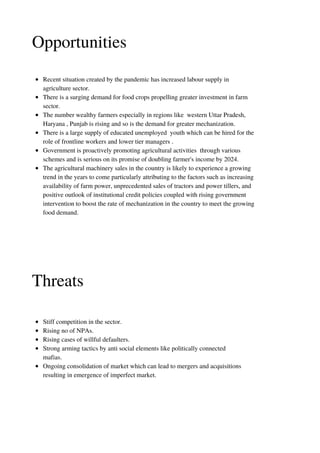
Opportunities
Recent situation created by the pandemic has increased labour supply in
agriculture sector.
There is a surging demand for food crops propelling greater investment in farm
sector.
The number wealthy farmers especially in regions like western Uttar Pradesh,
Haryana , Punjab is rising and so is the demand for greater mechanization.
There is a large supply of educated unemployed youth which can be hired for the
role of frontline workers and lower tier managers .
Government is proactively promoting agricultural activities through various
schemes and is serious on its promise of doubling farmer's income by 2024.
The agricultural machinery sales in the country is likely to experience a growing
trend in the years to come particularly attributing to the factors such as increasing
availability of farm power, unprecedented sales of tractors and power tillers, and
positive outlook of institutional credit policies coupled with rising government
intervention to boost the rate of mechanization in the country to meet the growing
food demand.
Threats
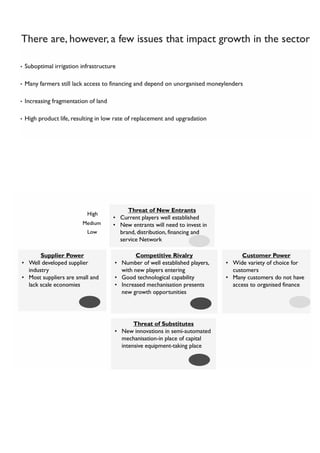
Stiff competition in the sector.
Rising no of NPAs.
Rising cases of willful defaulters.
Strong arming tactics by anti social elements like politically connected
mafias.
Ongoing consolidation of market which can lead to mergers and acquisitions
resulting in emergence of imperfect market.
INDUSTRY ANALYSIS
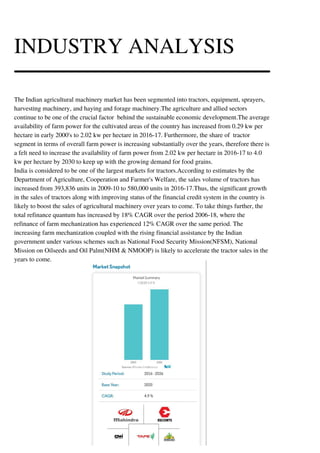
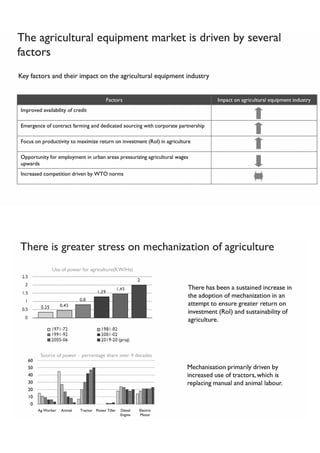
The Indian agricultural machinery market has been segmented into tractors, equipment, sprayers,
harvesting machinery, and haying and forage machinery.The agriculture and allied sectors
continue to be one of the crucial factor behind the sustainable economic development.The average
availability of farm power for the cultivated areas of the country has increased from 0.29 kw per
hectare in early 2000's to 2.02 kw per hectare in 2016-17. Furthermore, the share of tractor
segment in terms of overall farm power is increasing substantially over the years, therefore there is
a felt need to increase the availability of farm power from 2.02 kw per hectare in 2016-17 to 4.0
kw per hectare by 2030 to keep up with the growing demand for food grains.
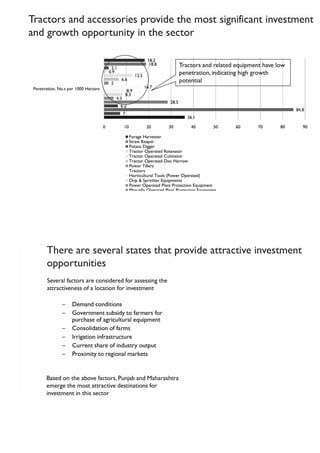
India is considered to be one of the largest markets for tractors.According to estimates by the
Department of Agriculture, Cooperation and Farmer's Welfare, the sales volume of tractors has
increased from 393,836 units in 2009-10 to 580,000 units in 2016-17.Thus, the significant growth
in the sales of tractors along with improving status of the financial credit system in the country is
likely to boost the sales of agricultural machinery over years to come. To take things further, the
total refinance quantum has increased by 18% CAGR over the period 2006-18, where the
refinance of farm mechanization has experienced 12% CAGR over the same period. The
increasing farm mechanization coupled with the rising financial assistance by the Indian
government under various schemes such as National Food Security Mission(NFSM), National
Mission on Oilseeds and Oil Palm(NHM & NMOOP) is likely to accelerate the tractor sales in the
years to come.
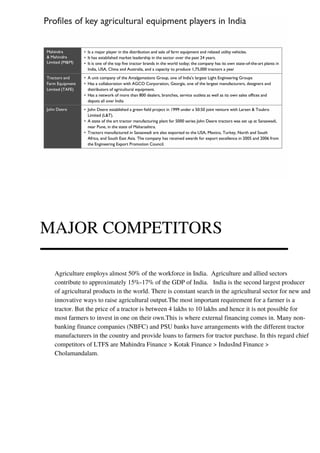
MAJOR COMPETITORS
Agriculture employs almost 50% of the workforce in India. Agriculture and allied sectors
contribute to approximately 15%-17% of the GDP of India. India is the second largest producer
of agricultural products in the world. There is constant search in the agricultural sector for new and
innovative ways to raise agricultural output.The most important requirement for a farmer is a
tractor. But the price of a tractor is between 4 lakhs to 10 lakhs and hence it is not possible for
most farmers to invest in one on their own.This is where external financing comes in. Many non-
banking finance companies (NBFC) and PSU banks have arrangements with the different tractor
manufacturers in the country and provide loans to farmers for tractor purchase. In this regard chief
competitors of LTFS are Mahindra Finance > Kotak Finance > IndusInd Finance >
Cholamandalam.
SOP OF LTFS - FARM
EQUIPMENT FINANCING
Tractor Industry Analysis
On the Basis of Market Size
Uttar Pradesh tops the list for having the maximum tractor sales in the country.
The state currently commands a share of 20.44 percent in the total tractor
sales.The current market size of tractor in UP is pegged at 80,000 units annually.
Maharashtra came second and Rajasthan secured third spot.
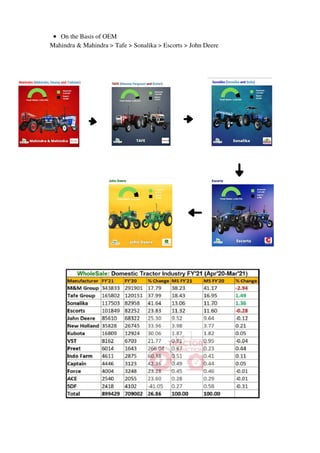
On the Basis of OEM
Mahindra & Mahindra > Tafe > Sonalika > Escorts > John Deere
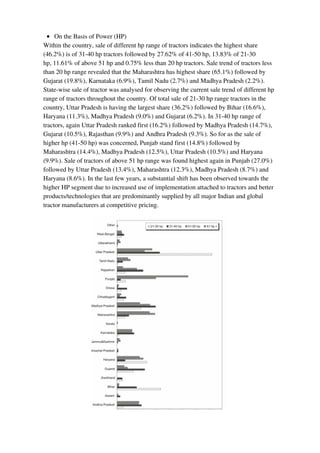
On the Basis of Power (HP)
Within the country, sale of different hp range of tractors indicates the highest share
(46.2%) is of 31-40 hp tractors followed by 27.62% of 41-50 hp, 13.83% of 21-30
hp, 11.61% of above 51 hp and 0.75% less than 20 hp tractors. Sale trend of tractors less
than 20 hp range revealed that the Maharashtra has highest share (65.1%) followed by
Gujarat (19.8%), Karnataka (6.9%), Tamil Nadu (2.7%) and Madhya Pradesh (2.2%).
State-wise sale of tractor was analysed for observing the current sale trend of different hp
range of tractors throughout the country. Of total sale of 21-30 hp range tractors in the
country, Uttar Pradesh is having the largest share (36.2%) followed by Bihar (16.6%),
Haryana (11.3%), Madhya Pradesh (9.0%) and Gujarat (6.2%). In 31-40 hp range of
tractors, again Uttar Pradesh ranked first (16.2%) followed by Madhya Pradesh (14.7%),
Gujarat (10.5%), Rajasthan (9.9%) and Andhra Pradesh (9.3%). So for as the sale of
higher hp (41-50 hp) was concerned, Punjab stand first (14.8%) followed by
Maharashtra (14.4%), Madhya Pradesh (12.5%), Uttar Pradesh (10.5%) and Haryana
(9.9%). Sale of tractors of above 51 hp range was found highest again in Punjab (27.0%)
followed by Uttar Pradesh (13.4%), Maharashtra (12.3%), Madhya Pradesh (8.7%) and
Haryana (8.6%). In the last few years, a substantial shift has been observed towards the
higher HP segment due to increased use of implementation attached to tractors and better
products/technologies that are predominantly supplied by all major Indian and global
tractor manufacturers at competitive pricing.
Uttar Pradesh is the biggest domestic tractor market hence the competition is toughest here,
both Dealers as well as loan seeking clients have multiple options. The company's selling
process should take this into account. The process needs to be beyond formal association
with Dealers, personal rapport based on effective Interpersonal skills is of crucial
importance for creating enduring bonds.
The demand for tractors with respect to its power output (HP) varies within Uttar Pradesh
depending upon the agriculture belt, high HP tractors are more in demand in areas of
western UP where irrigation facilities are good as well as the average size of landholding is
bigger. Care should be exercised in the choice of OEM and model of tractor to be pushed.
Based on the market share of various OEMs it can be seen that there are companies beyond
the top five ( eg Captain Tractors, Force Motors etc ) which would certainly be interested in
gaining a foothold in the state, owing to LTFS's reputation and brand power and the latter's
position negotiations with such companies can yield better ROI.
UP is a state where financial literacy is low, in such a situation the honesty and
commitment of the frontline workers ie. the FLCs and Area managers become critical. Due
emphasis should be given on monitoring of their role through frequent visits by middle
level managers.
45 days interest free
Initiatives like EMI protect which is in operation since the advent of covid 19 pandemic
and provides various benefits to the clients including monetary benefit, as well as health
insurance cover via tie up with ManipalCigna.
Subvention Schemes, through which tie ups are done with OEMs and comparatively
cheaper loans are disbursed, specially for weaker sections.
Hall of Fame, a novel concept of recognising the efforts of the frontline workers.
Dealer's Conference, which is an event for deepening ties with various Dealers as well as
informing them about the various products offered by the company.
Financial Literacy workshops.
Village Camps ( health camps etc ) in collaboration with the district administration which
engages as well as gives back to the community.
Initiatives such as " Digital Sakhi " a programme which trains women to train others in the
areas of banking, digital payments, access to credit through formal financial institutions and
government schemes. The programme touches the lives of thousands, providing them with
opportunities to lead better lives. " JALVAIBHAV " etc.
Following the above mentioned Tractor Industry analysis following important points can be
identified.
Keeping the above enumerated points in mind and then evaluating the sales procedures, I can
based on my internship experience say confidently that LTFS Farm Equipment Finance is doing
a commendable job ( I cannot disclose the actual operating procedure as it is privileged
information ) as is evident by the fact that LTFS has retained its top position as the leading
Farm Equipment Financier in UP, Uttarakhand, Haryana and Punjab. In a sector like this where
competition is cutthroat its the unique value additions which you provide that provide you an
edge. Few such practices followed by LTFS Farm Equipment Finance are
Suggestions & Conclusion
Limitations
The second wave of COVID 19 pandemic created a huge roadblock in the smooth
flow of the Internship. The lockdown in the state forced me to take the Internship to
online mode, significantly dampening the excitement of going on site visits along
my mentor(s). It was only in last 10 days that the lockdown was eased and I was
able to go on few site visits. It is because of this that, I had to rely on secondary data
for this project.
Suggestions
Meticulous third party verification of FLCs to ensure there is no Negligent Hiring.
Robust Training program to educate the lower level employees about not only about the
various products that the company offers but also about crisis management, working
knowledge about relevant legal sections, liasoning with district administration specially
Police services.
Increased Transparency in Incentive models and streamlining of Margin Money concept.
Discouragement of Local liasoning which undermines the process of due verification.
Reduction of excessive dependance on Dealers which the latter exploit by employing
nefarious means.
Linking the Variable Pay component with successful payment of at least 4 installments of
the loan.
Strict adherence on checking the veracity of physical verifications of the material assets of
the clients seeking finance.
Biannual detailed market research involving statistical methods such as multivariate
regression analysis to clearly establish correlation between marketing activities and actual
sales.
Based on my Internship experience and my interactions with company employees belonging to
different hierarchies, I take this opportunity to propose certain measures which can augment the
sales process, reduce the number of NPAs and minimise the risk involved in financing farm
equipments.
Conclusion
My three months long Internship at Larsen & Toubro Financial Services provided me
deep insights into the hyper competitive world of Farm Equipment Financing. The
experience and expertise of my mentor enriched my professional understanding of
Rural Finance and Marketing of Rural financial Products. According to various
studies the Farm Equipment industry reached a value of INR 954.3 Billion in 2020. It
is expected that the market will exhibit moderate growth during 2021-2026.This
market is currently being driven by a number of factors such as easy availability of
credit, government incentives, increasing agricultural productivity, emergence of
contract farming, increasing rural incomes, etc. LTFS Farm Equipment Finance is a
market leader in this segment with strong fundamentals and efficient operating
paradigm. As the market further consolidates LTFS is looking to extend its reach to
yet untapped regions.
Bibliography
ltfs.com
Financial Performance Q1FY22
Financial Performance Q1FY22 - Media Coverage
Business Standard
Financehttps://www.ltfs.com
L&T Annual Review
Ltfs.com
https://www.autopunditz.com/post/tractors-retail-
sales-statistics-july-2020-fada-report
Company Documents, Reports, Shared Material

Mohit prasad 202032067 final sip report

  • 1.
    SUMMER INTERNSHIP REPORT LARSEN& TOUBRO FINANCIAL SERVICES FROM 10th-AUG-2021 TO 15TH-JULY-2021 FACULTY MENTOR AT IMT NAGPUR INDUSTRY MENTOR AT LTFS DR. SENTHIL KUMAR. S MR. AKASH CHANNA Submitted By Mohit Prasad Roll No: 202032067
  • 2.
    The internship opportunityI had with Larsen & Toubro Financial Services was a great chance for learning and professional development. Therefore, I consider myself as a very lucky individual as I was provided with an opportunity to be a part of it. I am also grateful for having a chance to meet so many wonderful people and professionals who led me through this internship period. I am using this opportunity to express my deepest gratitude to Mr. Ajay Pandey Head Business HR for Wholesale Finance, SME, Mutual Funds and Corp Function L&T Financial Services for allowing me to carry out my project at their esteemed organization. I am also indebted to my industry mentor Mr. Akash channa Zonal Sales Manager - Rural Finance - North (Uttar Pradesh, Uttarakhand, Haryana and Punjab ) L&T Financial Services. Mr. Alok Tondon Regional Sales Manager L&T Financial Services. I also extend my heartfelt gratitude to Mr. Vipul Tiwari Divisional Manager Risk Containment Unit L&T Financial Services, Miss Kirti Singh Human resources L&T Financial Services who went above and beyond their domain to enrich my Internship experience. Next, I would like to thank my faculty guide, Dr. Senthil Kumar. S for his continued support and guidance in the execution of the project. He shared his rich experience and guided me throughout the internship period regarding what really matters in an organization. Acknowledgements
  • 3.
    As part ofmy PGDM program, I have completed my internship at Larsen & Toubro Financial Service. During the period of my internship, I was officially engaged to serve as a Marketing Intern. The purpose of this project is to leverage internship experience to move forward in my career. I accomplished this goal by describing what I did during the internship, including skills I used to manage my work. I have provided background information about LTFS and looked back at my job description and described my internship experience. I have also talked about what action I took to solve the problem and complete the task assigned by my supervisor. This reflection activity points out what learned from the internship as well the real world intricacies of the marketing of Rural Financial Products. These reflection activities are compelling and transformational as I approach the next steps in career development. Abstract //01
  • 4.
    I completed myinternship at Larsen & Toubro Financial Services, as the Marketing Intern during the course of this year’s summer. I joined the firm with an aim of enhancing competency and experience in the domain of Marketing and management. Over the course of internship at the company, my project included Industry Analysis of Rural Finance sector and holistic appraisal of the SOPs of L&T Financial Services. My duties as a marketing Intern included : Supporting sales team with assistance such as coordinating paperwork and responding to basic inquiries. Shadowing marketing personnel, to better understand goals for marketing campaigns. Shadowing sales professionals to gain deeper insight into best practices and strategies for maximizing sales revenue. Sitting in on sales team trainings to learn successful selling tactics and persuasion techniques. Assisting with gathering market information, including market data. Coordinating with public relations and other teams to execute product introductions. Creating documentation outlining findings for use by project managers. Identifying operational lacunae which were adversely impacting business operations. Mr. Akash Channa, who was my boss, instructed me across the entirety of the internship, incorporating his expertise and knowledge as the Zonal sales manager. Initially, my interest in applying for this internship stemmed along-term and personal desire to work in a sales and marketing department after the completion of my studies. During the course of my internship, I realized that compared, to other similar organisations working in the sector L&T Financial Services is a favorable organization, to develop my skills in sales and marketing operations. The company drive and focus in building a sustainable and stable working environment for its employee motivates me to pursue a career with it in sales and marketing operations, preferably in as a sales and marketing manager or assistant manager, after my graduation. Ultimately, my experience at the organization, educated me on what it takes to achieve success and gain competence in the industry. The experience has also enabled me to develop better listening skills and collaboration with colleagues. In the current reflective report, I will provide an Industry Analysis of the rural finance sector and a holistic appraisal of L&T Financial Services SOPs as well as suggestions based on my project which can further optimise the company's operations. Introduction //01
  • 5.
    01 | CompanyIntroduction 02 | Objective of The Study 03 | Brief Description of the Models Used 04 | Company Analysis 05 | Industry Analysis 06 | Standard Operating Procedures of LTFS 07 | Suggestions & Conclusion 08 | Bibliography Table of Contents
  • 6.
    L&T Financial Services(LTFS) is one of India’s leading NBFC brands offering a diverse range of financial products and services across rural, housing and infrastructure finance sector. It also offers mutual fund products and investment management services. Headquartered in Mumbai, it caters to the business requirements of its growing customer base through a nationwide network of branches and meeting centers, a product portfolio covering five different business verticals LTFS is promoted by Larsen & Toubro Ltd. (L&T) one of the leading companies in India with interests in engineering construction electrical & electronics manufacturing & services IT and financial services. To be an admired and inspirational financial institution, creating sustainable value for all our stakeholders. Larsen&Toubro Financial Services
  • 7.
    L&T Finance HoldingsLtd. (LTFH) is a financial holding company offering a focused range of financial products and services across rural housing and wholesale finance sectors as well as mutual fund products and wealth management services through its wholly-owned subsidiaries viz. L&T Finance Ltd. L&T Housing Finance Ltd. L&T Infrastructure Finance Company Ltd. L&T Investment Management Ltd. L&T Capital Markets Ltd. and L&T Infra Debt Fund Ltd. LTFH is registered with RBI as a CIC-ND-SI. LTFH' s wholesale finance business comprises infrastructure finance structured corporate finance and supply chain finance. The company also offers debt capital markets services as part of its wholesale finance business segment. The company's housing finance business comprises home loans and loans against property and real estate finance. The company's rural finance business comprises farm equipment finance two wheeler finance and micro loans. L&T Finance Holdings Ltd was incorporated on May 1 2008 as a public limited company with the name L&T Capital Holdings Ltd. L&T Financial Services (LTFS) is the brand name of L&T Finance Holdings and its subsidiaries. Headquartered in Mumbai, LTFH has been rated AAA — the highest credit rating for NBFCs — by four leading rating agencies. Since FY17, LTFS entities have successfully leveraged digital and data analytics to enhance portfolio quality, achieve scale, increase cost efficiency as well as build market leading products offering among the best-in-class turnaround time (TAT), in service of our consumers. L&T Financial Services has been certified as a constituent company in the FTSE4Good Index Series, for its ESG standards. LTFS was recognised as the ‘Socially Aware Corporate of the Year’ in the Business Standard Social Excellence Awards 2019, and was awarded FICCI’s Corporate Social Responsibility Award for “Women Empowerment” for Digital Sakhi, its flagship CSR program.
  • 8.
    FINANCIAL PERFORMANCE Q1FY22 Covid Impactin April’21 & May’21 due to partial lockdown restrictions; successfully deployed Covid 1.0 learnings to counter Covid 2.0 Top priority accorded to Employee care Strengthened Balance Sheet: Created additional provisions of Rs. 369 Cr in Q1FY22; Total additional provisions currently at Rs. 1,403 Cr (1.75% on standard book) to protect against impact of Covid 2.0 Analytics based collections: Significant increase in Q1FY22 collections of Rs.13,166 Cr (vs Rs. 4,321 Cr in Q1FY21); despite lower collections in May’21 Focused on “collection led disbursement strategy”: Disbursements up 125% YoY Liquidity: Maintained adequate liquidity buffers as a prudent measure in line with evolving Covid situation Leading to Improved Delivery on Business Metrics Maintained leading position in Rural and Infrastructure Finance o Reduction in quarterly WAC by 85 bps YoY (7.64% in Q1FY22 vs 8.49% Q1FY21) Achieved NIM+Fees of 7.52% GS3 at 5.75% Q1FY22; PCR at 65%; NS3 at 2.07%: GS3 reduced to Rs. 4,881 Cr from Rs. 4,939 Cr YoY Increase in retailization: Rural + Retail Housing Book at 45% in Q1FY22. Rural book up by 8% on YoY basis L&T Finance Holdings announces financial results for the quarter ended June 30, 2021 PAT at Rs. 178 Cr in Q1FY22, up 20% YoY (Rs. 148 Cr in Q1FY21) 1. 2. 3. 4. 5. 6. 7. 8. 9. 10. 11. LTFH is among the market leaders in Farm Equipment finance, Two-Wheeler finance, Micro Loans and continues to be one of the leading players in financing of Infrastructure sectors like renewables and roads. With a sustainable business model, data analytics led collection and disbursements, and a sharp focus on asset quality, the Company remains committed to building a stable and sustainable organization for its consumers and other stakeholders. In Q1FY22, LTFH utilized its Covid 1.0 learnings to address short-term challenges and maintained focus on building strengths across businesses. The measures sharply focused on shoring up liquidity, strengthening the balance sheet, following an analytics based collections approach, rigorously adhering to our collection led disbursement strategy as well as according top priority to employee care, with vaccination and financial support. These levers helped the Company minimize the downside and maximise the upside basis market drivers, across key business metrics such as Disbursements, Liability management, NIM + Fees and Credit cost. Furthermore, LTFH advanced its retailization (Rural + Retail Housing) strategy to 45% in Q1FY22, a stated long-term objective. Disbursements: In Q1FY22, Covid related partial lockdowns in April and May had an impact on a few businesses. With gradual unlock of economy in June, disbursements bounced back, led by faster pickup in economic activity across Farm Equipment Finance (FE), Two-Wheeler Finance (2W), Consumer Loans (CL) and Infrastructure Finance businesses. Due to slower Industry pick-up, the Micro Loans (ML), Housing and Real Estate Business saw moderate uptick in collections and disbursements. Infrastructure Finance portfolio continued to see strong sectoral performance leading to high collections on account of sell-down and repayments/ pre-payments.
  • 9.
    Farm Equipment Finance:LTFH established itself as among the leading financiers in this segment with an increase in market share. The business was least impacted due to Covid 2.0with farm cashflows remaining robust. This quarter saw the highest ever quarterly ‘Q1’ disbursement in the business, up 130% YoY at Rs. 1,357 Cr. (Rs. 590 Cr in Q1FY21) Two-Wheeler Finance: In Q1FY22, there was a gradual pickup since unlock, with sales impacted in May’21 on account of dealership closures. However, the business leveraged analytics to increase counter share across select dealers, with disbursements in the quarter up 165% YoY Micro Loans: While disbursements were normal in April, there was a severe business impact in May and June, due to restrictions in field movements. In the quarter, the business adopted a calibrated disbursement approach based on on-ground collection trends which led to Rs. 797 Cr of disbursements. Consumer Loans: The business-maintained momentum with ~Rs. 100 Cr per month disbursed in Q1FY22. This business is focused on cross-selling to LTFH’s existing customers with good credit history and leverages end- to-end digital service proposition and analytics led sourcing to scale up with a quality book Home Loan/LAP: In Q1FY22, though business was severely impacted due to widespread lockdown in major city centres, there was an increase in disbursements on YoY basis. The business continued to focus on salaried segment and remained cautious on Self Employed Non-Professional (SENP) segments Real Estate: LTFH maintained focus on funding existing projects with no new sanctions during the quarter The business showed robust disbursement momentum post unlock and continued sell-down with Rs. 1,480 Cr disbursed in the quarter. The business continues to see robust performance backed by higher sell-down volumes and refinancing Reduction in cost of borrowing by 85 bps YoY (from 8.49% in Q1FY21 to 7.64% in Q1FY22); Q1FY22 borrowing cost is lowest ever This has led to increase in NIM+Fees to 7.52% As of June 2021, the Company maintained liquid assets in the form of cash, FDs and other liquid investments to the tune of Rs. 12,073 Cr. Rural Finance: Rural franchise continued to remain one of the leading financiers with increased market share in FE. Housing Finance: Infrastructure Finance: Liability Management: Liquidity remained comfortable in Q1FY22 despite pandemic led disruptions, OTR, etc., on the back of proactive measures instituted from Covid 1.0 onwards. The Company has a well-diversified liability profile and also has demonstrated astute treasury management to diversify funding sources at a lower cost of borrowing. The focus on raising low-cost incremental long-term borrowings through desired sources, continued in Q1FY22. Focus on Strengthening Balance Sheet: From FY19, LTFH started building macro-prudential provisions for any unanticipated future events which held the Company in good stead. Continuing this focus, as a prudent measure LTFH created additional provisions of Rs. 369 Cr in Q1FY22, with this carrying total additional provisions of Rs. 1,403 Cr (1.75% of standard book). These provisions are over and above the expected credit losses on GS3 assets and standard asset provisions. The GS3 in absolute terms stood at Rs. 4,881 Cr in Q1FY22, remaining almost stable on YoY basis. In percentage terms, the GS3 and NS3 assets of the Company stood at 5.75% and 2.07% respectively with PCR on Stage 3 assets at 65%.
  • 10.
    PAT of Rs.178 Cr in Q1FY22 vs Rs. 148 Cr in Q1FY21 Additional provisions of Rs. 369 Cr in Q1FY22: with this carrying total macro-prudential provisions of Rs. 1,403 Cr (1.75% of standard book) Reduction in quarterly WAC by 85 bps YoY (7.64% in Q1FY22 vs 8.49% in Q1FY21) o Achieved NIM+Fees of 7.52% GS3 at 5.75% Q1FY22; PCR at 65%; NS3 at 2.07%: GS3 reduced to Rs 4,881 Cr from Rs.4,939 Cr YoY Significant increase in Q1FY22 collections of Rs. 13,166 Cr (vs Rs. 4,321 Cr in Q1FY21); despite lower collections in May’21 Increase in retailisation: Rural + Retail Housing Book at 45% in Q1FY22. Focus on Strengthening Balance Sheet: From FY19, LTFH started building macro-prudential provisions for any unanticipated future events which held the Company in good stead. Continuing this focus, as a prudent measure LTFH created additional provisions of Rs. 369 Cr in Q1FY22, with this carrying total additional provisions of Rs. 1,403 Cr (1.75% of standard book). These provisions are over and above the expected credit losses on GS3 assets and standard asset provisions. The GS3 in absolute terms stood at Rs. 4,881 Cr in Q1FY22, remaining almost stable on YoY basis. In percentage terms, the GS3 and NS3 assets of the Company stood at 5.75% and 2.07% respectively with PCR on Stage 3 assets at 65% Focused Lending Book: The share of retail portfolio in the overall book grew to 45% in Q1FY22, with the rural book growing 8% YoY. While the rural book remained resilient, a calibrated approach in select portfolios led to a reduction in the overall book. Farm Equipment finance book grew 27% YoY and Two-Wheeler Finance by 8%. The asset size of our salaried home loans portfolio also grew by 5% in the same period. Our Focused Book witnessed robust collections of Rs. 13,166 Cr in Q1FY22 (vs Rs. 4,321 Cr in Q1FY21 and Rs. 13,880 in Q4FY21), despite lower collections in May’21. In the Investment Management business, overall AUM has increased from Rs. 60,056 Cr in June’20 to Rs. 76,552 Cr in June’21, up 27% YoY, on account of higher inflows in pure equity and hybrid category. Financial Performance The Covid second wave did impact business on account of restrictions and closures of dealerships, etc. Despite this, the Company’s collection led disbursement strategy backed by concerted on-field efforts as well as data analytics led prioritization and resource allocation led to responsible growth in Q1FY22.
  • 11.
    Highest Credit Ratings:A diversified business presence, strategic importance to L&T, strong resource raising ability and adequate capitalization resulted in LTFH and all its lending subsidiaries’ long-term ratings being rated ‘AAA’ by all four rating agencies: a. CRISIL – May 2020 and December 2020 b. CARE - October 2020 c. India Ratings - September 2020 d. ICRA - September 2020 Subsequent to the merger of L&T Infrastructure Finance Company Ltd. and L&T Housing Finance Ltd. into L&T Finance Ltd. (L&T Finance) becoming effective, all the Rating agencies have reviewed the ratings of L&T Finance and have assigned / reaffirmed the ‘AAA’ rating in April’21. LTFS IN NEWS
  • 16.
    OBJECTIVE OF THESTUDY Perform an Industry Analysis of the Farm Equipment Finance sector in state of Uttar Pradesh. Perform a thorough assessment of LTFS's Farm Equipment financing procedure and to suggest measures which can be implemented to further augment the same. As a Marketing Intern, I was assigned following tasks by my industry mantor. Brief introduction of the theoretical models used in this study Competitive Forces Model The Competitive Forces Model is an important tool used in strategic analysis to analyze the competitiveness in an industry. The model is more commonly referred to as the Porter’s Five Forces Model, which includes the following five forces: intensity of rivalry, threat of potential new entrants, bargaining power of buyers, bargaining power of suppliers, and threat of substitute goods and/or services. Porter's Five Forces model identifies and analyzes competitive forces that shapes industry and helps determine an industry's weaknesses and strengths. Five Forces analysis is frequently used to identify industry's position to determine corporate strategy. Porter's model also helps in understanding the level of competition within the industry and enhance a company's long-term profitability.
  • 17.
    Broad Factors Analysis BroadFactors Analysis, commonly called the PEST Analysis, is a key component of external analysis. A Broad Factors Analysis assesses and summarizes the four macro-environmental factors — political, economic, socio-demographic (social), and technological. These factors have significant impacts on a business’s operating environment, posing opportunities and threats to the company and all of its competitors. Broad Factors Analysis is widely used in strategic analysis and planning because it helps companies determine the risks and opportunities in the marketplace. That, in turn, becomes an important consideration when companies are developing corporate and business strategies. SWOT Analysis SWOT is an acronym for Strengths, Weaknesses, Opportunities, and Threats.A SWOT Analysis is one of the most commonly used tools to assess the internal and external environments of a company and is part of a company’s strategic planning process. In addition, a SWOT analysis can be done for a product, place, industry, or person. A SWOT analysis helps with both strategic planning and decision- making, as it introduces opportunities to the company as a forward-looking bridge to generating strategic alternatives.
  • 18.
  • 19.
  • 20.
    COMPANY ANALYSIS LTFS -Rural Finance - Farm Equipment
  • 22.
    Unparalleled Brand Reputationderived from rich heritage of larsen & Toubro Financial Holdings Company and Larsen & Toubro. Pool of exceptional professionals, industry stalwarts and corporate leaders like Mr. Dinanath Dubhashi Managing Director & Chief Executive Officer, Mr. Sunil Prabhune Chief Executive– Rural & Housing Finance and Group Head – Digital, IT & Analytics, Proven Business strength. Strong Collections Framework. Well established liability franchise. High resilience. Strong cash generating ability from core business. Robust balance sheet. Good asset quality and provisions. Swift Service Delivery. Well established Dealer network Exceptional CRM. Strengths Weaknesses Performance of Frontline workers (FLCs) is inconsistent. Number of Branches in the state are less than optimal. Focus on interior regions is inadequate. Management structure is top heavy, there is a felt need of able executives at lower management Remuneration of frontline line workers is not enough to provide long term motivation. Rate of Attrition is more than desirable specially at lower levels.
  • 23.
    Opportunities Recent situation createdby the pandemic has increased labour supply in agriculture sector. There is a surging demand for food crops propelling greater investment in farm sector. The number wealthy farmers especially in regions like western Uttar Pradesh, Haryana , Punjab is rising and so is the demand for greater mechanization. There is a large supply of educated unemployed youth which can be hired for the role of frontline workers and lower tier managers . Government is proactively promoting agricultural activities through various schemes and is serious on its promise of doubling farmer's income by 2024. The agricultural machinery sales in the country is likely to experience a growing trend in the years to come particularly attributing to the factors such as increasing availability of farm power, unprecedented sales of tractors and power tillers, and positive outlook of institutional credit policies coupled with rising government intervention to boost the rate of mechanization in the country to meet the growing food demand. Threats Stiff competition in the sector. Rising no of NPAs. Rising cases of willful defaulters. Strong arming tactics by anti social elements like politically connected mafias. Ongoing consolidation of market which can lead to mergers and acquisitions resulting in emergence of imperfect market.
  • 24.
    INDUSTRY ANALYSIS The Indianagricultural machinery market has been segmented into tractors, equipment, sprayers, harvesting machinery, and haying and forage machinery.The agriculture and allied sectors continue to be one of the crucial factor behind the sustainable economic development.The average availability of farm power for the cultivated areas of the country has increased from 0.29 kw per hectare in early 2000's to 2.02 kw per hectare in 2016-17. Furthermore, the share of tractor segment in terms of overall farm power is increasing substantially over the years, therefore there is a felt need to increase the availability of farm power from 2.02 kw per hectare in 2016-17 to 4.0 kw per hectare by 2030 to keep up with the growing demand for food grains. India is considered to be one of the largest markets for tractors.According to estimates by the Department of Agriculture, Cooperation and Farmer's Welfare, the sales volume of tractors has increased from 393,836 units in 2009-10 to 580,000 units in 2016-17.Thus, the significant growth in the sales of tractors along with improving status of the financial credit system in the country is likely to boost the sales of agricultural machinery over years to come. To take things further, the total refinance quantum has increased by 18% CAGR over the period 2006-18, where the refinance of farm mechanization has experienced 12% CAGR over the same period. The increasing farm mechanization coupled with the rising financial assistance by the Indian government under various schemes such as National Food Security Mission(NFSM), National Mission on Oilseeds and Oil Palm(NHM & NMOOP) is likely to accelerate the tractor sales in the years to come.
  • 29.
    MAJOR COMPETITORS Agriculture employsalmost 50% of the workforce in India. Agriculture and allied sectors contribute to approximately 15%-17% of the GDP of India. India is the second largest producer of agricultural products in the world. There is constant search in the agricultural sector for new and innovative ways to raise agricultural output.The most important requirement for a farmer is a tractor. But the price of a tractor is between 4 lakhs to 10 lakhs and hence it is not possible for most farmers to invest in one on their own.This is where external financing comes in. Many non- banking finance companies (NBFC) and PSU banks have arrangements with the different tractor manufacturers in the country and provide loans to farmers for tractor purchase. In this regard chief competitors of LTFS are Mahindra Finance > Kotak Finance > IndusInd Finance > Cholamandalam.
  • 31.
    SOP OF LTFS- FARM EQUIPMENT FINANCING Tractor Industry Analysis On the Basis of Market Size Uttar Pradesh tops the list for having the maximum tractor sales in the country. The state currently commands a share of 20.44 percent in the total tractor sales.The current market size of tractor in UP is pegged at 80,000 units annually. Maharashtra came second and Rajasthan secured third spot.
  • 32.
    On the Basisof OEM Mahindra & Mahindra > Tafe > Sonalika > Escorts > John Deere
  • 33.
    On the Basisof Power (HP) Within the country, sale of different hp range of tractors indicates the highest share (46.2%) is of 31-40 hp tractors followed by 27.62% of 41-50 hp, 13.83% of 21-30 hp, 11.61% of above 51 hp and 0.75% less than 20 hp tractors. Sale trend of tractors less than 20 hp range revealed that the Maharashtra has highest share (65.1%) followed by Gujarat (19.8%), Karnataka (6.9%), Tamil Nadu (2.7%) and Madhya Pradesh (2.2%). State-wise sale of tractor was analysed for observing the current sale trend of different hp range of tractors throughout the country. Of total sale of 21-30 hp range tractors in the country, Uttar Pradesh is having the largest share (36.2%) followed by Bihar (16.6%), Haryana (11.3%), Madhya Pradesh (9.0%) and Gujarat (6.2%). In 31-40 hp range of tractors, again Uttar Pradesh ranked first (16.2%) followed by Madhya Pradesh (14.7%), Gujarat (10.5%), Rajasthan (9.9%) and Andhra Pradesh (9.3%). So for as the sale of higher hp (41-50 hp) was concerned, Punjab stand first (14.8%) followed by Maharashtra (14.4%), Madhya Pradesh (12.5%), Uttar Pradesh (10.5%) and Haryana (9.9%). Sale of tractors of above 51 hp range was found highest again in Punjab (27.0%) followed by Uttar Pradesh (13.4%), Maharashtra (12.3%), Madhya Pradesh (8.7%) and Haryana (8.6%). In the last few years, a substantial shift has been observed towards the higher HP segment due to increased use of implementation attached to tractors and better products/technologies that are predominantly supplied by all major Indian and global tractor manufacturers at competitive pricing.
  • 34.
    Uttar Pradesh isthe biggest domestic tractor market hence the competition is toughest here, both Dealers as well as loan seeking clients have multiple options. The company's selling process should take this into account. The process needs to be beyond formal association with Dealers, personal rapport based on effective Interpersonal skills is of crucial importance for creating enduring bonds. The demand for tractors with respect to its power output (HP) varies within Uttar Pradesh depending upon the agriculture belt, high HP tractors are more in demand in areas of western UP where irrigation facilities are good as well as the average size of landholding is bigger. Care should be exercised in the choice of OEM and model of tractor to be pushed. Based on the market share of various OEMs it can be seen that there are companies beyond the top five ( eg Captain Tractors, Force Motors etc ) which would certainly be interested in gaining a foothold in the state, owing to LTFS's reputation and brand power and the latter's position negotiations with such companies can yield better ROI. UP is a state where financial literacy is low, in such a situation the honesty and commitment of the frontline workers ie. the FLCs and Area managers become critical. Due emphasis should be given on monitoring of their role through frequent visits by middle level managers. 45 days interest free Initiatives like EMI protect which is in operation since the advent of covid 19 pandemic and provides various benefits to the clients including monetary benefit, as well as health insurance cover via tie up with ManipalCigna. Subvention Schemes, through which tie ups are done with OEMs and comparatively cheaper loans are disbursed, specially for weaker sections. Hall of Fame, a novel concept of recognising the efforts of the frontline workers. Dealer's Conference, which is an event for deepening ties with various Dealers as well as informing them about the various products offered by the company. Financial Literacy workshops. Village Camps ( health camps etc ) in collaboration with the district administration which engages as well as gives back to the community. Initiatives such as " Digital Sakhi " a programme which trains women to train others in the areas of banking, digital payments, access to credit through formal financial institutions and government schemes. The programme touches the lives of thousands, providing them with opportunities to lead better lives. " JALVAIBHAV " etc. Following the above mentioned Tractor Industry analysis following important points can be identified. Keeping the above enumerated points in mind and then evaluating the sales procedures, I can based on my internship experience say confidently that LTFS Farm Equipment Finance is doing a commendable job ( I cannot disclose the actual operating procedure as it is privileged information ) as is evident by the fact that LTFS has retained its top position as the leading Farm Equipment Financier in UP, Uttarakhand, Haryana and Punjab. In a sector like this where competition is cutthroat its the unique value additions which you provide that provide you an edge. Few such practices followed by LTFS Farm Equipment Finance are
  • 35.
    Suggestions & Conclusion Limitations Thesecond wave of COVID 19 pandemic created a huge roadblock in the smooth flow of the Internship. The lockdown in the state forced me to take the Internship to online mode, significantly dampening the excitement of going on site visits along my mentor(s). It was only in last 10 days that the lockdown was eased and I was able to go on few site visits. It is because of this that, I had to rely on secondary data for this project. Suggestions Meticulous third party verification of FLCs to ensure there is no Negligent Hiring. Robust Training program to educate the lower level employees about not only about the various products that the company offers but also about crisis management, working knowledge about relevant legal sections, liasoning with district administration specially Police services. Increased Transparency in Incentive models and streamlining of Margin Money concept. Discouragement of Local liasoning which undermines the process of due verification. Reduction of excessive dependance on Dealers which the latter exploit by employing nefarious means. Linking the Variable Pay component with successful payment of at least 4 installments of the loan. Strict adherence on checking the veracity of physical verifications of the material assets of the clients seeking finance. Biannual detailed market research involving statistical methods such as multivariate regression analysis to clearly establish correlation between marketing activities and actual sales. Based on my Internship experience and my interactions with company employees belonging to different hierarchies, I take this opportunity to propose certain measures which can augment the sales process, reduce the number of NPAs and minimise the risk involved in financing farm equipments.
  • 36.
    Conclusion My three monthslong Internship at Larsen & Toubro Financial Services provided me deep insights into the hyper competitive world of Farm Equipment Financing. The experience and expertise of my mentor enriched my professional understanding of Rural Finance and Marketing of Rural financial Products. According to various studies the Farm Equipment industry reached a value of INR 954.3 Billion in 2020. It is expected that the market will exhibit moderate growth during 2021-2026.This market is currently being driven by a number of factors such as easy availability of credit, government incentives, increasing agricultural productivity, emergence of contract farming, increasing rural incomes, etc. LTFS Farm Equipment Finance is a market leader in this segment with strong fundamentals and efficient operating paradigm. As the market further consolidates LTFS is looking to extend its reach to yet untapped regions. Bibliography ltfs.com Financial Performance Q1FY22 Financial Performance Q1FY22 - Media Coverage Business Standard Financehttps://www.ltfs.com L&T Annual Review Ltfs.com https://www.autopunditz.com/post/tractors-retail- sales-statistics-july-2020-fada-report Company Documents, Reports, Shared Material