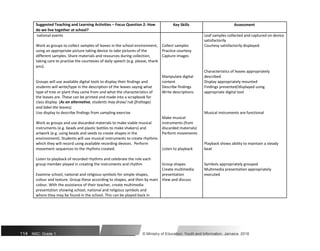
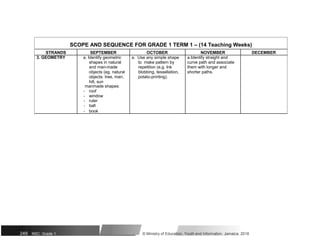
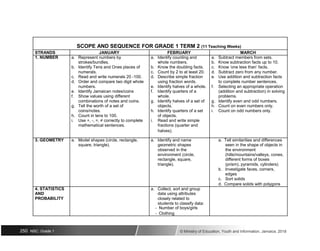
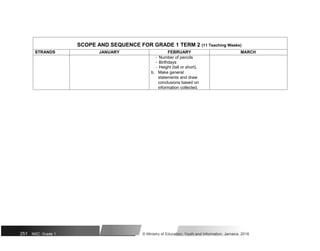
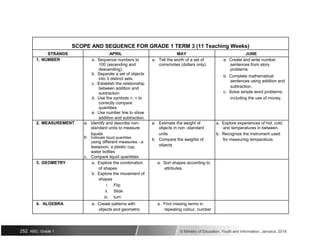
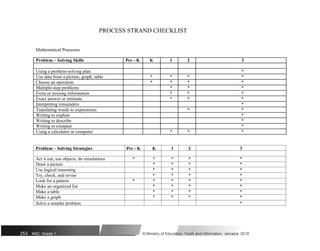
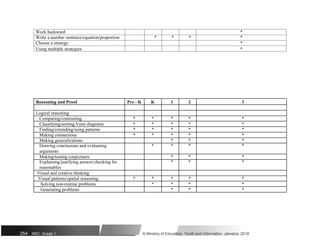
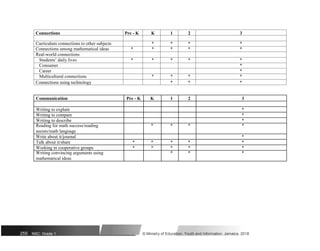
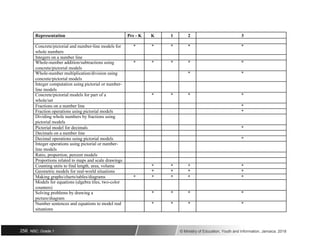
1 NSC: Grade 1 © Ministry of Education, Youth and Information, Jamaica. 2018
NATIONAL STANDARDS CURRICULUM GUIDE
GRADE 1
INTEGRATED STUDIES | LANGUAGE ARTS | MATHEMATICS
2 NSC: Grade 1 © Ministry of Education, Youth and Information, Jamaica. 2018
ACKNOWLEDGEMENT
Our connection with each other is unquestionable and so at the end of this arduous yet rewarding journey, the Ministry of Education, Youth and
Information gratefully acknowledges the contributions of the following individuals and institutions who generously gave of their time and resources
in the planning and development of the National Standards Curriculum (NSC):
• Mrs. Sharon Neil- former DCEO, Curriculum and Support Services, who provided leadership to the process during her tenure
• Mrs. Lena Buckle Scott- DCEO, Curriculum and Support Services, who provided leadership to the process
• Dr. Mary Campbell- former ACEO, Core Curriculum Unit, who started the process
• Mr. Derrick Hall- former ACEO (Acting), Core Curriculum Unit, who continued it
• Dr. Clover- Hamilton Flowers- ACEO, Core Curriculum Unit, who completed the task
• Dr. Lorna Thompson who led the development of the Integrated Studies and Mathematics Window
• Mrs. Novelette McLean Francis, Mrs. Fiona Morris Webb, Mrs. Christa Ferguson Rainford, Mrs. Taina Marsh Harris, Mrs.
Michelle Kerr and Mrs. Olivette Lue-Nicholson who led the development of the Language Window
• Current and former Education Officers of the Core Curriculum Unit who participated in the writing of the curriculum and gave
oversight to the development process
• Principals/ school administrators, lecturers, teachers and other resources persons who participated in the writing process
• Principals and staff of the 40 pilot schools who facilitated the two years of curriculum piloting in their schools
• Regional Directors and Territorial Education Officers who contributed to the development and implementation of the curriculum
• The team of Mathematics and Literacy coaches and specialists led by Dr. Tamika Benjamin and Dr. Andre Hill respectively who
participated in the writing and review of the documents
• Consultants:
- Ms. Lila Oliver, Ms. Mary Surridge, Mr. Brian Male and Ms. Wendy Pemberton for their guidance in the development and design of the curriculum
- Dr. Sherril Gardner and Mrs. Herma Meade Thompson for guidance in the area of integration at Grades 1-3
- Dr. Nancy George and Mrs. Diane Browne for work on the evaluation of the draft curriculum documents
- The team of local reviewers
- The team of international reviewers led by Professor Jari Lavonen, Dr. Kaisa Hahl and Dr. Mary Jean Gallagher
• Miss Jean Hastings, former Director of the Education System Transformation Programme, who during her tenure in the post facilitated the
processes of the Curriculum Units
• Mrs. Winnie Berry and Mrs. Sophia Forbes Hall, former Senior Functional Educational Officers of the Core Curriculum Unit who provided
administrative and technical leadership to the development process.
• Mrs. Michelle Kerr, Senior Functional Education Officer (Acting) and Mrs. Coleen Clarke Russell, Functional Education Officer
who provided administrative leadership to the production process.
• The members of the Curriculum Secretariat, the administrator and secretaries in the Core Curriculum Unit who provided
administrative support during the development and implementation of the curriculum.
• The team of curriculum editors led by Mrs. Taina Williams and Dr. Donna Powell Wilson
• Mrs. Leonie Rhule, Curriculum formatter
• The various stakeholder groups, who provided valuable information on societal needs in relation to the curriculum
• All others whose names do not appear, but who contributed to the production of the NSC
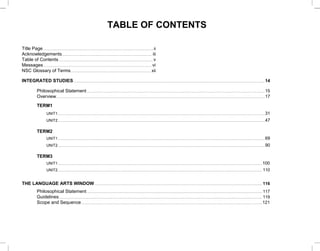
TABLE OF CONTENTS
Title Page ..................................................................................................................ii
Acknowledgements............................................................................................. iii
Table of Contents ................................................................................................. v
Messages................................................................................................................vi
NSC Glossary of Terms................................................................................... xii
INTEGRATED STUDIES......................................................................................................................................................................................................14
Philosophical Statement ........................................................................................................................................................................................15
Overview........................................................................................................................................................................................................................17
TERM1
UNIT1......................................................................................................................................................................................................................31
UNIT2......................................................................................................................................................................................................................47
TERM2
UNIT1......................................................................................................................................................................................................................69
UNIT2......................................................................................................................................................................................................................90
TERM3
UNIT1...................................................................................................................................................................................................................100
UNIT2................................................................................................................................................................................................................... 110
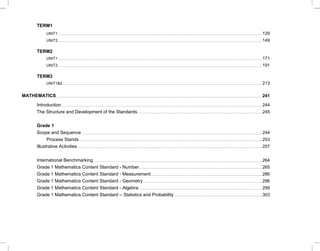
THE LANGUAGE ARTS WINDOW ............................................................................................................................................................................. 116
Philosophical Statement ..................................................................................................................................................................................... 117
Guidelines.................................................................................................................................................................................................................. 119
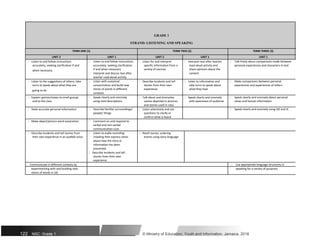
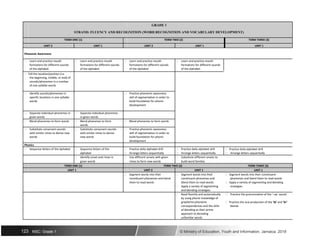
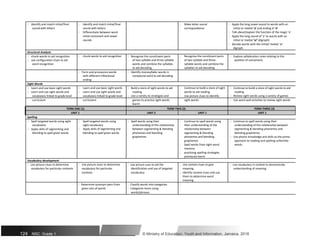
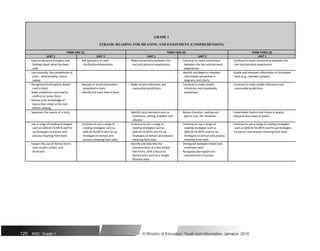
Scope and Sequence...........................................................................................................................................................................................121
TERM1
UNIT1...................................................................................................................................................................................................................129
UNIT2...................................................................................................................................................................................................................149
TERM2
UNIT1...................................................................................................................................................................................................................171
UNIT2...................................................................................................................................................................................................................191
TERM3
UNIT1&2 ..............................................................................................................................................................................................................213
MATHEMATICS.....................................................................................................................................................................................................................241
Introduction................................................................................................................................................................................................................244
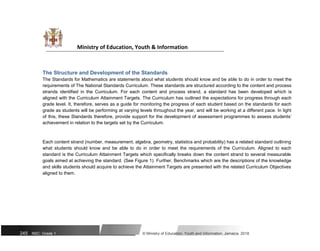
The Structure and Development of the Standards.................................................................................................................................245
Grade 1
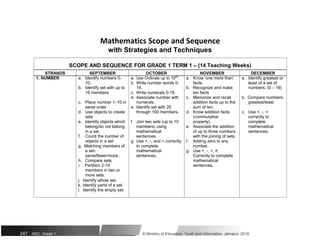
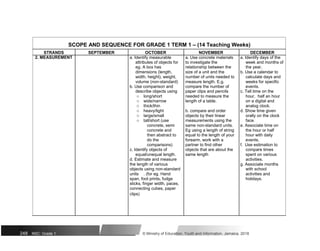
Scope and Sequence...........................................................................................................................................................................................244
Process Stands.............................................................................................................................................................................................253
Illustrative Activities...............................................................................................................................................................................................257
International Benchmarking ..............................................................................................................................................................................264
Grade 1 Mathematics Content Standard - Number...............................................................................................................................265
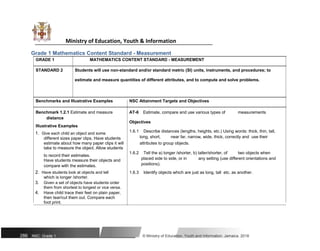
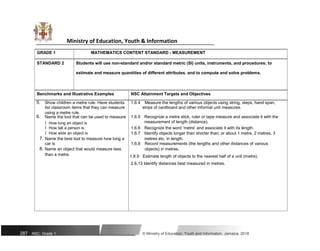
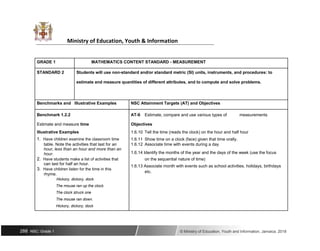
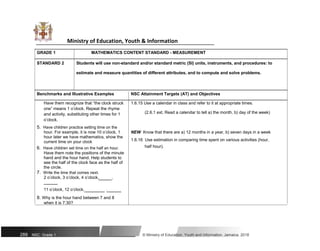
Grade 1 Mathematics Content Standard - Measurement...................................................................................................................286
Grade 1 Mathematics Content Standard - Geometry...........................................................................................................................296
Grade 1 Mathematics Content Standard - Algebra................................................................................................................................299
Grade 1 Mathematics Content Standard – Statistics and Probability...........................................................................................303
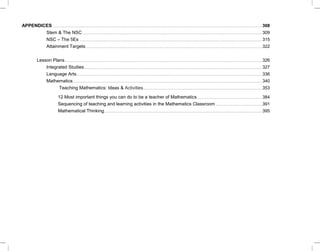
APPENDICES.........................................................................................................................................................................................................................308
Stem & The NSC..........................................................................................................................................................................................309
NSC – The 5Es .............................................................................................................................................................................................315
Attainment Targets ......................................................................................................................................................................................322
Lesson Plans............................................................................................................................................................................................................326
Integrated Studies........................................................................................................................................................................................327
Language Arts................................................................................................................................................................................................336
Mathematics....................................................................................................................................................................................................340
Teaching Mathematics: Ideas & Activities...........................................................................................................................353
12 Most important things you can do to be a teacher of Mathematics...................................................................384
Sequencing of teaching and learning activities in the Mathematics Classroom ................................................391
Mathematical Thinking...................................................................................................................................................................395
M E S S A G E
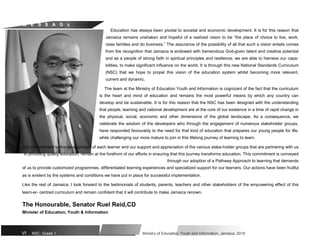
Education has always been pivotal to societal and economic development. It is for this reason that
Jamaica remains unshaken and hopeful of a realized vision to be “the place of choice to live, work,
raise families and do business.” The assurance of the possibility of all that such a vision entails comes
from the recognition that Jamaica is endowed with tremendous God-given talent and creative potential
and as a people of strong faith in spiritual principles and resilience; we are able to harness our capa-
bilities, to make significant influence on the world. It is through this new National Standards Curriculum
(NSC) that we hope to propel this vision of the education system whilst becoming more relevant,
current and dynamic.
The team at the Ministry of Education Youth and Information is cognizant of the fact that the curriculum
is the heart and mind of education and remains the most powerful means by which any country can
develop and be sustainable. It is for this reason that the NSC has been designed with the understanding
that people, learning and national development are at the core of our existence in a time of rapid change in
the physical, social, economic and other dimensions of the global landscape. As a consequence, we
celebrate the wisdom of the developers who through the engagement of numerous stakeholder groups,
have responded favourably to the need for that kind of education that prepares our young people for life;
while challenging our more mature to join in this lifelong journey of learning to learn.
Our commitment to the development of each learner and our support and appreciation of the various stake-holder groups that are partnering with us
in providing quality education, remain at the forefront of our efforts in ensuring that this journey transforms education. This commitment is conveyed
through our adoption of a Pathway Approach to learning that demands
of us to provide customized programmes, differentiated learning experiences and specialized support for our learners. Our actions have been fruitful
as is evident by the systems and conditions we have put in place for successful implementation.
Like the rest of Jamaica, I look forward to the testimonials of students, parents, teachers and other stakeholders of the empowering effect of this
learn-er- centred curriculum and remain confident that it will contribute to make Jamaica renown.
The Honourable, Senator Ruel Reid,CD
Minister of Education, Youth & Information
VI NSC: Grade 1 Ministry of Education, Youth and Information, Jamaica. 2018
M E S S A G E
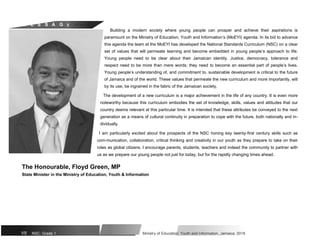
Building a modern society where young people can prosper and achieve their aspirations is
paramount on the Ministry of Education, Youth and Information’s (MoEYI) agenda. In its bid to advance
this agenda the team at the MoEYI has developed the National Standards Curriculum (NSC) on a clear
set of values that will permeate learning and become embedded in young people’s approach to life.
Young people need to be clear about their Jamaican identity. Justice, democracy, tolerance and
respect need to be more than mere words; they need to become an essential part of people’s lives.
Young people’s understanding of, and commitment to, sustainable development is critical to the future
of Jamaica and of the world. These values that permeate the new curriculum and more importantly, will
by its use, be ingrained in the fabric of the Jamaican society.
The development of a new curriculum is a major achievement in the life of any country. It is even more
noteworthy because this curriculum embodies the set of knowledge, skills, values and attitudes that our
country deems relevant at this particular time. It is intended that these attributes be conveyed to the next
generation as a means of cultural continuity in preparation to cope with the future, both nationally and in-
dividually.
I am particularly excited about the prospects of the NSC honing key twenty-first century skills such as
com-munication, collaboration, critical thinking and creativity in our youth as they prepare to take on their
roles as global citizens. I encourage parents, students, teachers and indeed the community to partner with
us as we prepare our young people not just for today, but for the rapidly changing times ahead.
The Honourable, Floyd Green, MP
State Minister in the Ministry of Education, Youth & Information
VII NSC: Grade 1 Ministry of Education, Youth and Information, Jamaica. 2018
M E S S A G E
VIII NSC: Grade 1
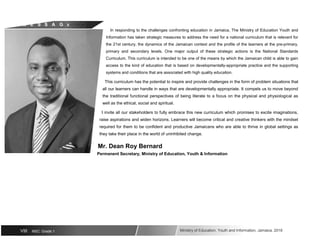
In responding to the challenges confronting education in Jamaica, The Ministry of Education Youth and
Information has taken strategic measures to address the need for a national curriculum that is relevant for
the 21st century, the dynamics of the Jamaican context and the profile of the learners at the pre-primary,
primary and secondary levels. One major output of these strategic actions is the National Standards
Curriculum. This curriculum is intended to be one of the means by which the Jamaican child is able to gain
access to the kind of education that is based on developmentally-appropriate practice and the supporting
systems and conditions that are associated with high quality education.
This curriculum has the potential to inspire and provide challenges in the form of problem situations that
all our learners can handle in ways that are developmentally appropriate. It compels us to move beyond
the traditional functional perspectives of being literate to a focus on the physical and physiological as
well as the ethical, social and spiritual.
I invite all our stakeholders to fully embrace this new curriculum which promises to excite imaginations,
raise aspirations and widen horizons. Learners will become critical and creative thinkers with the mindset
required for them to be confident and productive Jamaicans who are able to thrive in global settings as
they take their place in the world of uninhibited change.
Mr. Dean Roy Bernard
Permanent Secretary, Ministry of Education, Youth & Information
Ministry of Education, Youth and Information, Jamaica. 2018
M E S S A G E
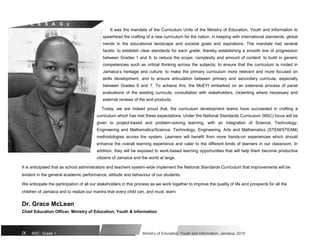
It was the mandate of the Curriculum Units of the Ministry of Education, Youth and Information to
spearhead the crafting of a new curriculum for the nation, in keeping with international standards, global
trends in the educational landscape and societal goals and aspirations. The mandate had several
facets: to establish clear standards for each grade, thereby establishing a smooth line of progression
between Grades 1 and 9; to reduce the scope, complexity and amount of content; to build in generic
competencies such as critical thinking across the subjects; to ensure that the curriculum is rooted in
Jamaica’s heritage and culture; to make the primary curriculum more relevant and more focused on
skills development, and to ensure articulation between primary and secondary curricula, especially
between Grades 6 and 7. To achieve this, the MoEYI embarked on an extensive process of panel
evaluations of the existing curricula, consultation with stakeholders, (re)writing where necessary and
external reviews of the end products.
Today, we are indeed proud that, the curriculum development teams have succeeded in crafting a
curriculum which has met these expectations. Under the National Standards Curriculum (NSC) focus will be
given to project-based and problem-solving learning, with an integration of Science, Technology,
Engineering and Mathematics/Science, Technology, Engineering, Arts and Mathematics (STEM/STEAM)
methodologies across the system. Learners will benefit from more hands-on experiences which should
enhance the overall learning experience and cater to the different kinds of learners in our classroom. In
addition, they will be exposed to work-based learning opportunities that will help them become productive
citizens of Jamaica and the world at large.
It is anticipated that as school administrators and teachers system-wide implement the National Standards Curriculum that improvements will be
evident in the general academic performance, attitude and behaviour of our students.
We anticipate the participation of all our stakeholders in this process as we work together to improve the quality of life and prospects for all the
children of Jamaica and to realize our mantra that every child can, and must, learn.
Dr. Grace McLean
Chief Education Officer, Ministry of Education, Youth & Information
IX NSC: Grade 1 Ministry of Education, Youth and Information, Jamaica. 2018
M E S S A G E
The Ministry of Education Youth and Information (MoEYI) is committed to providing high quality
education to all Jamaican children. We have heard the cries from the various sectors of the Jamaican
society about the level of preparedness/readiness of our students for life in the 21st century; and we
are taking the necessary steps to ensure that our students graduate with marketable skills. The MoEYI
has reviewed and redesigned the Grades 1-9 curricula around the principles of Vision 2030 Goal
number one; “Jamaicans are empowered to achieve their fullest potential”.
The National Standards Curriculum (NSC) will lay the foundation for students by preparing them for
working lives that may span a range of occupations, many of which do not currently exist. This has been
done by way of designers carefully integrating the theoretical principles of Science, Technology,
Engineering and Mathematics/Science, Technology, Engineering, Arts and Mathematics (STEM/STEAM)
methodologies into the curricula at all grade levels. The NSC illustrates that in order to make education
effective for our 21st century children; we need to change how we teach, and what we teach.
We are satisfied that the curriculum designers and writers have produced a curriculum that is indeed
fitting for the 21st century. The NSC was designed to develop students’ understandings of subject matter
and their ability to apply what is learnt; it fosters their ability to communicate and solve problems
collaboratively, think critically and create novel solutions.
The success of our children is dependent on the participation of all stakeholders in the learning process. We encourage you all to be our committed
partners in education as the true impact of this curriculum will only be felt when we have all hands on board. I am indeed proud to be associated
with the development and implementation of this curriculum; it will inspire
hope in our nation and future generations; kudos to the various teams that contributed to its development.
Mrs Lena Buckle Scott
Deputy Chief Education Officer,
Curriculum and Support Services, Ministry of Education, Youth & Information
X NSC: Grade 1 Ministry of Education, Youth and Information, Jamaica. 2018
M E S S A G E
The National Standards Curriculum (NSC) rests on the belief that all learners are endowed with the
capabilities, gifts and talents to fulfil their divine purpose. These attributes are to be further enhanced
or improved in a nurturing, inspiring and inclusive environment; one that caters to the whole person
(soul, spirit and body - spiritual, emotional, social, physical and mental). As learners assume their roles
and responsibilities individually and as communities of learning in such an environment, they become
critical-reflexive thinkers, creative problem solvers, effective communicators and natural collaborators.
A curriculum design of this nature, calls for transformative change at the societal level (Elkind, 2004)1
and not just at the school and classroom levels. This is a call for all stakeholders, as users of the
curriculum, to adopt a critical -reflective and reflexive stance and join learners in the quest for meaning,
purpose and stability as they help to shape the world. By integrating principles from various disciplines
and their related methodologies, learners who interact with the curriculum are provided with enriching
experiences, opportunities for creative expressions and authentic exploration of problems from a classical
standpoint as well as in the context of workplace learning. This is due to the fact that the NSC recognizes
the importance of each discipline in the problem solving process and in development.
Assessment as an element of the curriculum becomes primarily a learning process for charting progress
through self-corrective measures that are informed by feedback from peers and teacher-facilitator. By
providing assessment criteria statements in the curriculum, teachers are encouraged to facilitate learners
functioning as self and peer assessors. This approach should see the learner developing self-direction with
the support of mentors and coaches and forming an intrinsic desire to succeed. These attributes prepare them to face high stakes assessment as
problems to be confronted with courage, a sense of readiness, insight and creative prowess.
These features of the NSC have the potential to influence learners’ profile as Jamaicans who are gratified by an identity of cultural excellence that
embodies moral obligations, intellectual rigour, innovativeness, environmental stewardship and productivity. The curriculum echoes the sentiments of our
National Anthem, National Song and Pledge and serves as rich and credible source of the values and virtues that are woven together to convey the
Jamaican identity. I wish for our school administrators, teachers, students and other stakeholders much success as they work with the document.
Dr Clover Hamilton Flowers
Assistant Chief Education Officer, Core Curriculum Unit, Ministry of Education, Youth & Information
1 Elkind, D. (2004). The problem with constructivism. The Educational Forum, 68(4), 306–12.
XI NSC: Grade 1 Ministry of Education, Youth and Information, Jamaica. 2018
NSC Glossary of Terms
TERMS DEFINITIONS
Range of Content Provides an overview of the concepts, knowledge, skills and attitudes that will be developed in a unit of
study.
About the Unit Gives a brief overview of the content, skills and the methodologies that are covered in the unit as well as
the attitudes to be developed.
Standards Statements that explain what all students are expected to know and be able to do in different content areas
by the end of a course of study e.g. by the end of period spanning grades 4 – 9.
Attainment Targets An attainment target is a desired or expected level of performance at the end of a course of work, within a
given/specified teaching-learning period. Attainment targets identify the knowledge, skills and
understanding which students of different abilities and maturities are expected to have by the end of each
Grade. It is the standard that we expect the majority of children to achieve by the end of the grade.
Benchmarks Behaviours students are expected to exhibit at different stages of development and age/grade levels.
Theme/Strands Unifying idea that recurs throughout a course of study and around which content, concepts and skills are
developed.
Prior Learning It is what students are expected to already know through learning and experience about a topic or a kind
of text.
Specific Objectives Specific objectives state what the student is expected to know or understand as a result of the learning
experience. The specific objective is usually framed in the areas of the knowledge, skills and attitudes that
the students are expected to achieve. Specific objectives tell us what the children will learn or will be
taught.
Suggested Teaching/Learning A teaching/learning activity is an organised doing of things towards
Activities achieving the stated objectives. They are suggested activities that are crafted in a way to be an efficient
vehicle which can move the student between what is to be learnt (objective) and what the student is to
become (outcome).
Key Skills Indicate the important skills that students should develop during the course of a unit. Key skills are aligned
to the suggested teaching and learning activities in the unit which are intended to develop the skill to which
it is aligned. Included in the key skills are the 21
st
century skills such as critical thinking and problem solving,
collaboration, communication and ICT.
XII NSC: Grade 1 Ministry of Education, Youth and Information, Jamaica. 2018
Assessment An assessment is a determination of whether intended results have been achieved. This section of the
curriculum speaks to both the product that will be judged as well as the criteria against which
it will be judged. It must be noted that this section does not introduce new activities. Instead, it speaks
to the judging of the suggested teaching and learning activities. Formal assessment may be conducted
with the aid of instruments (e.g. via written test, portfolio) or by requiring students to complete assigned
tasks (e.g. performance), and is usually recorded against a predetermined scale of grading. Informal
assessment (e.g. via observation or spontaneous student expression) may also reveal important
evidence of learning.
Points to Note This section provides technical information that must be considered in delivering the unit. It may also
include information that provides additional explanation of key concepts that may be unfamiliar to the
teacher as well as suggestions for infusion within the unit.
Extended Learning These are opportunities for students to utilise the knowledge and skills they would have acquired in the
unit in authentic situations/experiences.
Learning Outcomes A learning outcome is a demonstration/behavioural evidence that an intended result has been achieved
at the end of a course of study. The learning outcome tells us if pupils have understood and
grasped what they have been learning.
Links to other Subjects Suggests opportunities for integration and transfer of learning across and within different subject areas.
Key Vocabulary This section consists of a number of words/phrases that addresses the skills, topics and content that
must be covered in the unit.
XIII NSC: Grade 1 Ministry of Education, Youth and Information, Jamaica. 2018
INTEGRATED STUDIES
GRADE 1
14 NSC: Grade 1 © Ministry of Education, Youth and Information, Jamaica. 2018
PHILOSOPHICAL STATEMENT
The NSC for the Grades 1-3 level (early primary) is designed on child centred principles. The multi-disciplinary approach characterised by themes and
related focus questions, serve as contexts for children to explore their environment and solve problems so that they learn about others, themselves and
their environ-ment on a whole. Integrated Studies as one of the Exploratory Core learning area, is complemented with two other Exploratory Core areas;
Language Arts and Mathematics that allow children to be provided with specific learning experiences to enhance literary and numeracy in addition to other
skills, attitudes and values and understandings. The child-centred design is justified as children’s curiosity about their world is based on their interest in
disciplines. Children do not try to understand disciplines as we represent them with labels or names such as Science, Mathematics, Social Studies etc.
Instead, their focus is on the use of their senses to experience the world and to derive meaning from their efforts to satisfy their curiosity. A reward of this
natural tendency is the nurturing of the function of the brain, which thrives on making connections. They also benefit from their acquisition of knowledge
and a variety of skills that help them to survive within the boundaries of the prevailing/acceptable culture of the society. Children are also better able to
experience the interactive and dynamic nature of the world from being able to see the ‘big picture’.
Integration at Grades 1-3, is conveyed in multiple ways by the Integrated Studies Curriculum. These include:
(a) Interdisciplinary Approach using Thematic Web: Problems are presented in the form of themes with overlapping concepts and competencies
that allow children to naturally make connections to multiple learning/subject areas without using these as separate units of knowledge as
they try to understand their world and satisfy curiosity. The Thematic Webb serves as a means of content organization.
(b) STEAM as a methodology: Children explore real-life problems that are appropriate for their level of development, by drawing on concepts, principles,
pro cesses and dispositions from Science, Engineering Design, the Art Forms, Mathematics and Technology as a problem solving tool.
(c) Culture and Creative Art as carriers of content: As children engage in dramatic, musical and visualized art to express themselves, they learn
how to manage their feelings, their imagination, develop confidence, think analogically and reflectively, and become more intuitive among
others. Relevance to the Jamaican culture as conveyed by National Symbols and emblems are encouraged through the opportunities provided
for them to be creative in expressing their ideas and feelings and in demonstrating their physical skills.
(d) Projects in the context of work: The Resource and Technology projects are used to help children handle real life problems with manageable
scope. These projects are also used to begin to expose children to positive work habits and work ethics. They also benefit in terms of
developing physical skills as projects require the manipulation of tangible tools.
15 NSC: Grade 1 © Ministry of Education, Youth and Information, Jamaica. 2018
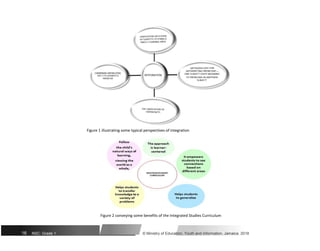
Figure 1 illustrating some typical perspectives of integration
Figure 2 conveying some benefits of the Integrated Studies Curriculum
16 NSC: Grade 1 © Ministry of Education, Youth and Information, Jamaica. 2018
INTEGRATED STUDIES OVERVIEW
GRADE 1
17 NSC: Grade 1 © Ministry of Education, Youth and Information, Jamaica. 2018
THE INTEGRATED CURRICULUM GRADES 1 TO 3
1. INTRODUCTION
An Integrated Curriculum
An integrated curriculum is an approach that starts with the holistic experience of the child and purposefully draws together
knowledge, skills, attitudes and values from within or across subject areas to develop a more powerful understanding of key ideas. It
provides an interconnected and interwoven approach in which learning experiences are inextricably linked and become more
meaningful for the young learner. However, the design of an integrated curriculum does not abandon the skills and understandings
that are specific to the individual key learning areas and these are woven into that integration as clear early learning standards to
form an ‘underpinning architecture’ on which the integrated curriculum is based and on which the curriculum for Grades 4 upwards
can be built.
The Method of Integration Underpinning the Grades 1 to 3 Curriculum
The main method of integration utilized in the design of the Jamaican Integrated Curriculum is the Multidisciplinary approach. This
includes thematic approaches, intra-disciplinary approaches, fusion and infusion of subjects. This approach has been used to
organize the standards from disciplines around agreed themes. Subjects, such as Information, Communication and Technology,
Technical & Vocational Education and Civics Standards are infused throughout the curriculum. Mathematics and Language Arts will
be taught as discrete subjects within the daily time allocated session ‘Windows’. However, teachers will utilize all available
opportunities to infuse the concepts that are taught in the discrete Language Arts and Mathematics Programmes whilst they are
delivering the integrated curriculum.
18 NSC: Grade 1 © Ministry of Education, Youth and Information, Jamaica. 2018
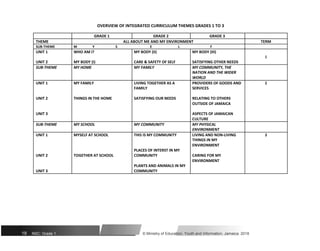
OVERVIEW OF INTEGRATED CURRICULUM THEMES GRADES 1 TO 3
GRADE 1 GRADE 2 GRADE 3
THEME ALL ABOUT ME AND MY ENVIRONMENT TERM
SUB-THEME M Y S E L F
UNIT 1 WHO AM I? MY BODY (II) MY BODY (III)
1
UNIT 2 MY BODY (I) CARE & SAFETY OF SELF SATISFYING OTHER NEEDS
SUB-THEME MY HOME MY FAMILY MY COMMUNITY, THE
NATION AND THE WIDER
WORLD
UNIT 1 MY FAMILY LIVING TOGETHER AS A PROVIDERS OF GOODS AND 2
FAMILY SERVICES
UNIT 2 THINGS IN THE HOME SATISFYING OUR NEEDS RELATING TO OTHERS
OUTSIDE OF JAMAICA
UNIT 3 ASPECTS OF JAMAICAN
CULTURE
SUB-THEME MY SCHOOL MY COMMUNITY MY PHYSICAL
ENVIRONMENT
UNIT 1 MYSELF AT SCHOOL THIS IS MY COMMUNITY LIVING AND NON-LIVING 3
THINGS IN MY
PLACES OF INTERST IN MY
ENVIRONMENT
UNIT 2 TOGETHER AT SCHOOL COMMUNITY CARING FOR MY
PLANTS AND ANIMALS IN MY
ENVIRONMENT
UNIT 3 COMMUNITY
19 NSC: Grade 1 © Ministry of Education, Youth and Information, Jamaica. 2018
Philosophical Underpinning
The National Standards Curriculum (NSC) takes a constructivist approach which is based on the belief that learning occurs when learners are
actively involved in a process of constructing meaning as opposed to passively receiving information (Bruner 1966; Vygotsky 1978).
Constructivist teaching fosters critical thinking, and creates motivated and independent learners. This was also the basis of the existing
curriculum but this curriculum places greater emphasis on generic skills, such as critical thinking, problem solving and independent learning in
order to better prepare students for their future in the twenty-first century (Ananiadoui 2009).
The foundation of a child’s early learning must be secure and structured to enable them to formulate the underpinning principles, competencies
and values that will ensure that they can continue to develop their knowledge and skills base from Grades 4 and beyond within a curriculum that
is both progressive and aligned (Goswamy 2008). So in addition to the greater focus on generic skills and competences, the NSC ensures that all
subjects are well sequenced with clear progression from Grades 1 right through to 9 so that students are prepared adequately for the upper
grades of secondary schooling. The clear statements of standard or grade expectation for each subject ensure that all education stakeholders:
teachers, students, parents, and employers are clear about the expected level of competence of each student in each subject and grade.
While the former Grades 1 to 3 curriculum took an integrated approach on the basis that children naturally learn about the world as
an integrated whole, the revision maintains the integration for the same philosophical reasons but woven within that integration,
are clear early learning standards which form an ‘underpinning architecture’ on which the integrated curriculum is based. This
underpinning structure identifies standards and progression in learning and ensures adequate coverage of essential components of
the subject curriculum that a child is expected to achieve, which articulate clearly with expectations in the Grade 4 curriculum and
beyond.
The overall design of the NSC ensures that the holistic learning needs of children are met from the time they enter school until they
complete secondary schooling (Gardner 1999). The Grades 1 to 3 curriculum has been revised to ensure that the same principles,
philosophy and methodology would be applied consistently throughout a child’s learning journey.
20 NSC: Grade 1 © Ministry of Education, Youth and Information, Jamaica. 2018
The Design Of The Jamaican Integrated Curriculum
The team of Core Curriculum Unit (CCU) Officers, Technical and Vocational Unit Officers, the Head of both units , a local early year’s
consultant recommended by the MoE and other selected resource persons worked with the international team of consultants.
Together they collaboratively agreed on the guidelines for the design of the integrated curriculum as follows:
 It will be a multidisciplinary design with an intra-disciplinary and sub-disciplinary approach. Subjects such as Social Studies,
Science, and Religious Education would form the core; whilst music, drama, visual art, physical education and ICT would be
“the Drivers”

 The Arts to be used as a vehicle to encourage independent thinking, creative and learning skills and holistic learning and for
delivering a curriculum most suited to learning in the early years.

 The integrated curriculum places emphasis on the teaching of higher order critical thinking and learning skills throughout

 Vygotsky’s constructivist approach will be used, as throughout the whole curriculum as well as Norman Webb’s Depth of
Knowledge

 The integrated curriculum will be aligned with the Jamaican National Curriculum Standards with progression evident in each
grade

 Themes will be used that are located in the experience of the child and to suit the Jamaican learning context – the thematic
integrated approach will be based on the same themes as the existing Grades 1 to 3 curriculum

 ICT and Technical Vocational Education Standards for Grades 1 to 3 will be infused throughout

 The discrete teaching of Language and Maths competences will occur in daily ‘windows’ for an allocated time on the daily
classroom timetable for the teaching of Maths and Language

 Maths and Language will be integrated wherever practicable and possible within the multidisciplinary design

 Culture will be infused within the integrated curriculum

 Civics will be part of the integrated subject focus

 As far as practicable, the national celebrations of Jamaica will be built into the integrated curriculum such as Jamaica Day and
Heroes Day
21 NSC: Grade 1 © Ministry of Education, Youth and Information, Jamaica. 2018
The Key Differences Between the Former Curriculum and the Revised Jamaican Integrated Curriculum For Grades 1 To 3
While the former Grades 1 to 3 curriculum took an integrated approach on the basis that children naturally learn about the world as
an integrated whole, the revision maintains the integration for the same philosophical reasons, but woven within this integration,
are clear early learning standards which form an ‘underpinning architecture’ on which the integrated curriculum is based. This
underpinning structure identifies standards and progression in learning to ensure adequate coverage of essential components of the
subject curriculum that a child is expected to achieve. These articulate clearly with expectations in the Grade 4 curriculum and
beyond.
The key changes that have been made to the revised Jamaican Integrated Curriculum for Grades 1 to 3 are as follows:
 The integration has been written against the revised Jamaican curriculum standards; this ensures that teacher’s know what
level of knowledge and skills are achieved at the end of each year in order that these build year on year and so that there is a
firm base on which Grade 4 builds

 There is a seamless transition for continuing learning after the integration from Grade 3 to Grade 4 with the revised
curriculum standards

 Critical thinking and learning skills has been incorporated into the integrated units of work, assisting students to analyse,
problem solve, investigate, question assumptions, apply learning and transfer the key skills that they have learnt into any
given situation and then into lifelong learning

 The content of the integration has been revised in keeping with the 21st
Century teaching & learning experiences
 The assessment is part of the learning process and enables the teacher to make informed and critical judgements on student
progress

 Greater emphasis is placed on building future citizens with a focus on morals, values, principles, attitudes, integrity, heritage
& culture through the curriculum standards and in the teaching of Religious Education, Civics and Social Studies

 Technical Vocational Education Standards for Grades 1 to 3 have been infused within the integration

 Consistency of Core Curriculum Unit Officers in the writing of Grades 4 to 6 as well as Grades 1 to 3 has enabled a holistic
overview of the entire content and curriculum coverage

 The discrete Maths and Language programmes that are taught within the ‘windows’ are both encompassed within the
integrated document for ease of reference for teachers.
22 NSC: Grade 1 © Ministry of Education, Youth and Information, Jamaica. 2018
 Detailed Matrices have been designed which indicate coverage of standards and content of subject areas with the integration
and can be used as a checklist for teachers and principals.
The Teacher’s Guide
Our aim is that this Teacher’s Guide will provide all teachers with a comprehensive collection of exciting, challenging, interesting ideas and
suggestions that will enable them to deliver a varied, stimulating and motivational curriculum to their pupils.
The Statutory Curriculum Standards for Grades 1 to 3 can be found in the Curriculum Framework document. This details the Curriculum
Standards which should be achieved by students in each grade. The Teacher’s Guides have been written against the Statutory Curriculum and all
Learning Objectives are directly linked to the Standards.
In this Teacher’s Guide, each Grade is divided into separate sections. Within each Grade, the Units have been written against the agreed themes
for Grades 1 to 3. The Units have been carefully written and structured to take account of the key cultural and historical days throughout the
year such as Jamaica Day and Heroes Day. The integrated planning to include these key dates will make it easier for teachers to teach the lessons
for each term.
The Units of work
Each Unit has been sub- divided into weekly blocks of work to enable full coverage of the Standards and Learning Objectives which are directly
linked to the theme that is being covered for each term. For example, within the theme Who Am I? For Unit 1 Term 1 Grade 1, there are 6
weekly blocks of suggested activities that can be taught. Each Focus Question has been divided into weekly blocks of work within each Unit.
However, if teachers do have other creative ideas and suggestions of how the Standards and Learning Objectives can be taught and delivered
over the term, then they can include these in the Units of work and modify the weekly blocks of activities accordingly.
Language Arts and Literacy and Mathematics will be taught as discrete subjects every day. An ‘Open Window’ will be on the daily timetable to
teach both these subjects against the programmes that have been designed. However, there are numerous opportunities within each Unit of
work to integrate Maths and Language Arts &Literacy within each theme. Ideas and suggestions of how Language Arts, Literacy and Maths can
be integrated throughout each theme have been included within the Units in this Teacher’s Guide. What is to be taught discretely in the ‘Open
Window’ each term for Language Arts and Literacy and Maths has been included in a separate programme in each Unit of work.
The first page of each unit consists of an overview of the entire learning experience for pupils within the Term. The key skills, resources and
vocabulary that are listed will provide teachers with the complete expected coverage and focus on each specific area for the Term. The key
23 NSC: Grade 1 © Ministry of Education, Youth and Information, Jamaica. 2018
focus for each curriculum area will enable teachers to have an overview of the way in which the integration has been achieved to ensure
coverage of a well-balanced, varied, interesting, enjoyable and integrated curriculum.
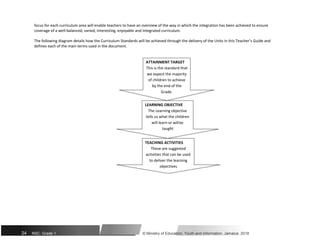
The following diagram details how the Curriculum Standards will be achieved through the delivery of the Units in this Teacher’s Guide and
defines each of the main terms used in the document.
ATTAINMENT TARGET
This is the standard that
we expect the majority
of children to achieve
by the end of the
Grade.
LEARNING OBJECTIVE
The Learning objective
tells us what the children
will learn or willbe
taught
TEACHING ACTIVITIES
These are suggested
activities that can be used
to deliver the learning
objectives
24 NSC: Grade 1 © Ministry of Education, Youth and Information, Jamaica. 2018
LEARNING OUTCOME
The learning outcome tells
us if pupils have understood
and grasped what they have
been learning
The most important point for teachers to remember is that the Standards or the Statutory Curriculum must be taught and covered in each
Grade as specified. This Teacher’s Guide provides a structure that covers the teaching of the Statutory Curriculum and it has been compiled by
educators who have experience and expertise in early childhood education and understand the developmental needs within the Jamaican
context.
The Teacher’s Lesson Planning and Curriculum delivery e-resource will be formulated so that all teachers will be able to contribute their
individual lesson plans and ideas for delivering the curriculum. This e-resource can then be utilized by all teachers to assist them with
implementing the curriculum, as well as to integrate technology in the lessons. The diagram below illustrates the three components of the
curriculum.
25 NSC: Grade 1 © Ministry of Education, Youth and Information, Jamaica. 2018
Curriculum Standards
Teacher’s Guides
E-resources
lesson plans, activities and
ideas for curriculum
delivery.
The Methodology for the Grades 1 to 3 Integrated Curriculum
The curriculum has been specifically designed to suit Jamaica’s population, location, resources, community and cultural values. It is based on
sound development principles, accepted standards of quality and best practices. Pupils will be able to make clear links for learning through the
Integrated Curriculum.
The integrated learning process will promote children’s understanding that knowledge across disciplines is inextricably interconnected rather
than a series of disparate actions – like real life when we connect learning in simple tasks such as cooking – we are reading recipes for
understanding and meaning (Literacy & Language) and we are reliant on the skill of memory recall, experimenting (Science), calculating (Maths),
26 NSC: Grade 1 © Ministry of Education, Youth and Information, Jamaica. 2018
tasting (senses) social skills (Health and family life) etc. when carrying out the cooking task. The integrated curriculum has been written to ensure
that the learning experience is interconnected and that the skills which children learn are transferable.
Civics forms a part of the integrated curriculum. Culture is not taught as a discrete subject in schools, nor does it have a set of standards and
attainment targets. The policy that governs Culture In Education, positions culture as an agent of change and thus views it as a critical
mechanism for identity formation and positive behaviour as gateways to academic excellence. Thus, the fundamental principle for the use of
culture in the curriculum is that it becomes the context, content and methodology by which the curriculum is delivered at all levels across all
subject areas and activities. The context element of culture ensures that everything within the curriculum relates to what is appropriate for the
Jamaican context in which the Jamaican learner is situated. The content of culture relates to everything that contributes to the students
understanding of their uniqueness and the special place of Jamaica in the world. The methodology includes, but is not limited to, the performing
arts. It extends to all aspects of the expressive culture that enriches learning experience and extends beyond chalk and talk. Examples are: field
trips, fashion shows, art exhibitions, panel discussions, games, storytelling and movies.
In delivering the curriculum, teachers will ensure that it is based on the child’s interests as well as the principles of child development and best
practices - this will mean that both the teacher and the child enjoy the learning experience and have fun while teaching and learning. Teachers
have the opportunity to plan learning creatively for students within the Units of work. They are able to be flexible to cater for the learning
development and holistic needs of children through a well-planned, vibrant interlocking curriculum that will ensure children learn and develop
physically, emotionally, morally, socially, intellectually and culturally.
An innovative, integrated curriculum will inevitably improve standards of achievement and ultimately increase children’s enjoyment and
engagement in their learning process. The Integrated Curriculum for Grades 1 to 3 ensures that the holistic needs of pupils are met through the
teaching and learning of high level critical thinking skills and competencies which will ensure that students can mature into adults who can
problem solve, think critically and hence transfer and adapt their knowledge and skills into different learning situations.
Why the Arts should drive the Curriculum
Recent scientific research has sought to make important connections between the brain and the learning experience. The greatest evidence of
this is seen in the brain’s response to things we do in the arts, bringing strong arguments about why the arts are fundamental to the activities of
the brain. The arts connect each new generation to those who have gone before. They equip the newcomer in his or her own pursuit of the
abiding questions: Who am I? What must I do? Where am I going?
27 NSC: Grade 1 © Ministry of Education, Youth and Information, Jamaica. 2018
The arts are holistic phenomena; they accord with the way the child views his or her world – not in compartments, but as a continuum. They
exercise and develop right-brain thinking, so that when the child learns through the arts, he or she acquires an equitable balance between linear
and process thought, emerging as a well-balanced, well-coordinated human being, with inventive and problem-solving capabilities.
Children come “wired for learning” from birth; the things they do naturally at play are all natural forms of art. Give them space and freedom, and
they will play (sing, dance, draw, and pretend) . Auditory, kinaesthetic, verbal and visual engagement takes place naturally. These activities make
use of all the senses, and prepare the brain to learn successfully.
Young children are naturally curious, they want to begin to explore their surroundings and environment from the time they are born and
discover new things. They learn by inquiring, experimenting, using trial and error processes to come to an understanding of the world around
them. In later years, we call these activities and processes ‘science’ and as a subject it is well-suited to active younger children. Science and
process skills of science are an important part of the foundation for the education of all children and we have ensured that the elements of
scientific inquiry, investigation and process skills are embedded in this important early stage of a child’s learning within the Integrated
Curriculum.
This is our vision for each Jamaican learner: a well-balanced, well-coordinated human being, with inventive and problem-solving capabilities.
Our ambition is that every child will leave school and be able to enter a vocation that is suited to his/her skills, talents and expertise. To ensure
that we fully equip them to achieve this target, Resource and Technology overall knowledge, skills and understanding have been infused
throughout this integrated curriculum. Career Awareness, Creativity and Innovation, Exploring Methods and Procedures & Applying solutions
have all been included in this early stage of the Jamaican child’s learning experience and they will continue to be developed subsequently in the
primary and secondary phases.
We hope that all teachers enjoy using this Teacher’s Guide and wish them every success in the progress and achievement of their pupils in
Grades 1 to 3. All Grades 1 to 3 Teachers will play a crucial role in laying the critical foundation stages of learning for the future citizens of
Jamaica. Also, be reminded of the four pillars of education:
 Learning to live together
 Learning to know
 Learning to do
 Learning to be
28 NSC: Grade 1 © Ministry of Education, Youth and Information, Jamaica. 2018
2. A GUIDE FOR TEACHERS - HOW TO USE THE GRADES 1 TO 3 INTEGRATED CURRICULUM TEACHER’S GUIDES
Teachers will need to ensure that they:
 Read the entire Unit before starting to plan their integrated lessons for the term. This will give teachers a holistic overview of everything
that is to be covered under the theme of the Unit and develop a better understanding of the complete context and content for the
learning of their class for the Term.

 Create the learning maps

 Use the 5Es instructional design to plan and write the lesson

 Read the discrete Language Arts and Mathematics programmes for the term and identify opportunities where concepts can be
infused and reinforced during the integrated curriculum
 Plan their lessons carefully to ensure that they are able to cover all of the identified curriculum for the term

 Make lessons enjoyable and exciting for children and use other ideas and strategies that they may have to compliment the
integrated curriculum
 Plan their weekly timetable to ensure that children have a holistic curriculum and a variety of different activities distributed
throughout the week to ensure that they are receiving a broad and balanced curriculum
 Familiarize themselves with the definitions used in the Curriculum documentation. The definitions for the core curriculum language
used can be found on the final pages of the Grades 1,2 & 3 Teacher’s Guides
 Identify key resources that will enable the delivery of the curriculum

 Identify any items or resources that they will need children to bring to school or that parents can assist with, for example,
photographs of themselves for the Unit entitled Who Am I?.
Themes used in Grades 1 to 3
The overall encompassing theme that has been used on which all Units have been positioned is All About Me and My Environment. This overall
theme has then been further broken down into sub themes and then each Unit has been written under a specific theme. For example, in Grade
1 the overall encompassing theme is All About Me and My Environment. The Sub Theme for Term 1 is Myself and then there are 2 separate
Units with individual themes for Term1 which are Who Am I? and My Body (Part 1).
29 NSC: Grade 1 © Ministry of Education, Youth and Information, Jamaica. 2018
Almond, R.G., Steinberg, L.S., & Mislevy, R.J. (2003). A framework for reusing assessment components. In H. Yanai, A. Okada, K. Shigemasu, Y.
Kano, & J.J. Meulman (Eds.), New developments in psychometrics (pp. 28-288). Tokyo
Ananiadoui, K., & Claro, M. (2009). 21st century skills and competences for new millennium learners in OECD countries. OECD Education Working
Paper, No. 41. doi: 10.1787/218525261154)
Bruner JS (1966) Towards a theory of instruction. Cambridge Mass. Harvard University Press
Foster, M. (2004) Higher Order Thinking Skills in Research Developments, Vol. 11 Gardner, H.
(1999). The Disciplined Mind. London:
Goswami, U. (2008). Cognitive Development: The Learning Brain. Psychology Press, Taylor &
Francis Hargreaves, .D (2006) A new shape for learning London SSAT
Mislevy, R.J., Almond, R.G, & Lucas, J.F. A brief introduction to evidence-centred design Princeton NJ
OECD (2003). The PISA 2003 Assessment Framework – Mathematics, Reading, Science and Problem Solving Knowledge and Skills. Paris:
Organisation for Economic Co-operation and Development
Verhoeven, L. (ed) (1994) Functional Literacy. Tilburg
Vygotsky, L. S. (1978) Mind in society: The development of higher psychological processes, Cambridge, MA: Harvard University
Press. Webb, N.L. (2005) Alignment, depth of knowledge and change. Wisconsin
30 NSC: Grade 1 © Ministry of Education, Youth and Information, Jamaica. 2018
NATIONAL STANDARDS CURRICULUM GUIDE
GRADE 1 INTEGRATED STUDIES
TERM1 – UNIT1
31 NSC: Grade 1 © Ministry of Education, Youth and Information, Jamaica. 2018
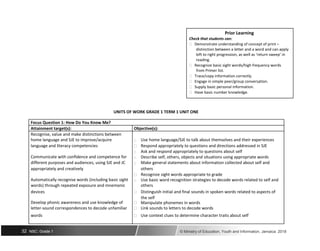
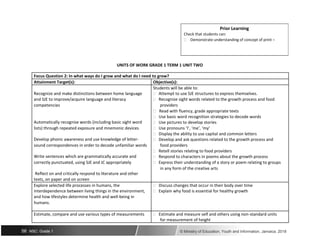
Prior Learning
Check that students can:
 Demonstrate understanding of concept of print –
distinction between a letter and a word and can apply
left to right progression, as well as ‘return sweep’ in
reading.
 Recognize basic sight words/high frequency words
from Primer list.
 Trace/copy information correctly.
 Engage in simple peer/group conversation.
 Supply basic personal information.
 Have basic number knowledge.
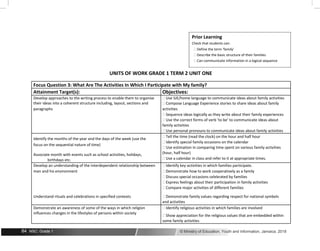
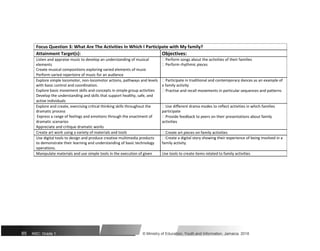
UNITS OF WORK GRADE 1 TERM 1 UNIT ONE
Focus Question 1: How Do You Know Me?
Attainment target(s): Objective(s):
Recognise, value and make distinctions between
home language and SJE to improve/acquire  Use home language/SJE to talk about themselves and their experiences
language and literacy competencies  Respond appropriately to questions and directions addressed in SJE
Communicate with confidence and competence for
 Ask and respond appropriately to questions about self
 Describe self, others, objects and situations using appropriate words
different purposes and audiences, using SJE and JC  Make general statements about information collected about self and
appropriately and creatively others
Automatically recognise words (including basic sight
 Recognize sight words appropriate to grade
 Use basic word recognition strategies to decode words related to self and
words) through repeated exposure and mnemonic others
devices  Distinguish initial and final sounds in spoken words related to aspects of
Develop phonic awareness and use knowledge of
the self
 Manipulate phonemes in words
letter-sound correspondences to decode unfamiliar  Link sounds to letters to decode words
words  Use context clues to determine character traits about self
32 NSC: Grade 1 © Ministry of Education, Youth and Information, Jamaica. 2018
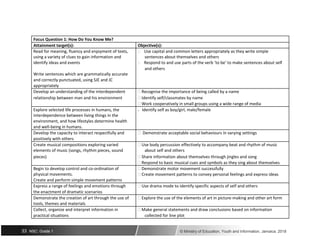
Focus Question 1: How Do You Know Me?
Attainment target(s): Objective(s):
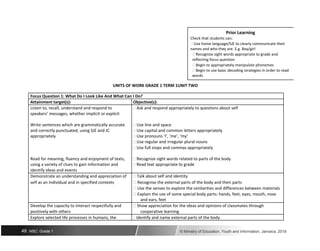
Read for meaning, fluency and enjoyment of texts,  Use capital and common letters appropriately as they write simple
using a variety of clues to gain information and sentences about themselves and others
identify ideas and events  Respond to and use parts of the verb ‘to be’ to make sentences about self
Write sentences which are grammatically accurate
and others
and correctly punctuated, using SJE and JC
appropriately
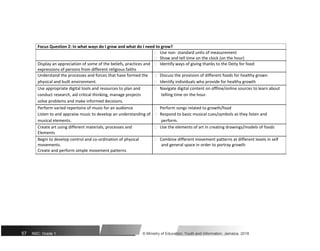
Develop an understanding of the interdependent  Recognise the importance of being called by a name
relationship between man and his environment  Identify self/classmates by name
 Work cooperatively in small groups using a wide range of media
Explore selected life processes in humans, the  Identify self as boy/girl, male/female
interdependence between living things in the
environment, and how lifestyles determine health
and well-being in humans.
Develop the capacity to interact respectfully and  Demonstrate acceptable social behaviours in varying settings
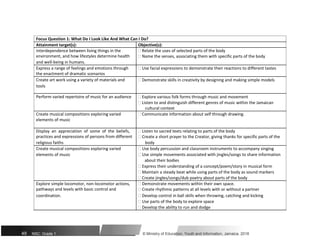
positively with others
Create musical compositions exploring varied  Use body percussion effectively to accompany beat and rhythm of music
elements of music (songs, rhythm pieces, sound about self and others
pieces)  Share information about themselves through jingles and song
 Respond to basic musical cues and symbols as they sing about themselves
Begin to develop control and co-ordination of  Demonstrate motor movement successfully
physical movements.  Create movement patterns to convey personal feelings and express ideas
Create and perform simple movement patterns
Express a range of feelings and emotions through  Use drama mode to identify specific aspects of self and others
the enactment of dramatic scenarios
Demonstrate the creation of art through the use of  Explore the use of the elements of art in picture-making and other art form
tools, themes and materials
Collect, organize and interpret information in  Make general statements and draw conclusions based on information
practical situations collected for line plot
33 NSC: Grade 1 © Ministry of Education, Youth and Information, Jamaica. 2018
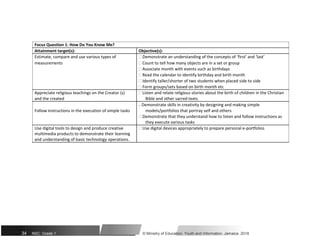
Focus Question 1: How Do You Know Me?
Attainment target(s): Objective(s):
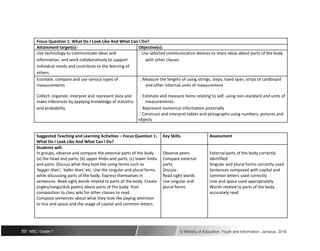
Estimate, compare and use various types of  Demonstrate an understanding of the concepts of ‘first’ and ‘last’
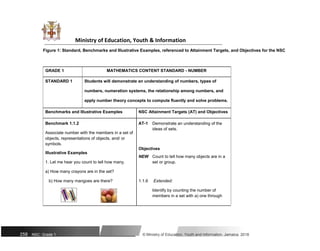
measurements  Count to tell how many objects are in a set or group
 Associate month with events such as birthdays
 Read the calendar to identify birthday and birth month
 Identify taller/shorter of two students when placed side to side
 Form groups/sets based on birth month etc
Appreciate religious teachings on the Creator (s)  Listen and relate religious stories about the birth of children in the Christian
and the created Bible and other sacred texts.
Follow instructions in the execution of simple tasks
 Demonstrate skills in creativity by designing and making simple
models/portfolios that portray self and others
 Demonstrate that they understand how to listen and follow instructions as
they execute various tasks
Use digital tools to design and produce creative  Use digital devices appropriately to prepare personal e-portfolios
multimedia products to demonstrate their learning
and understanding of basic technology operations.
34 NSC: Grade 1 © Ministry of Education, Youth and Information, Jamaica. 2018
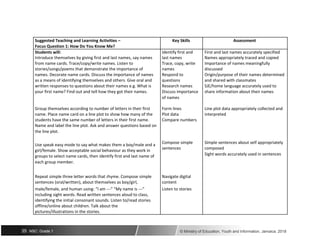
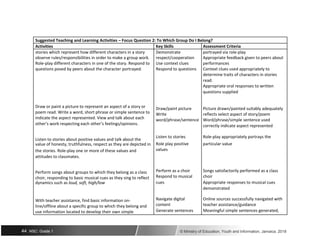
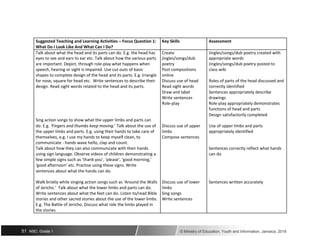
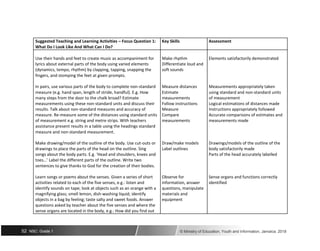
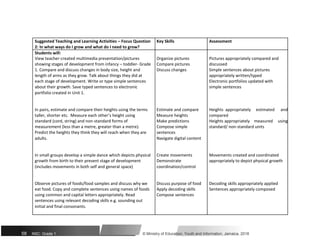
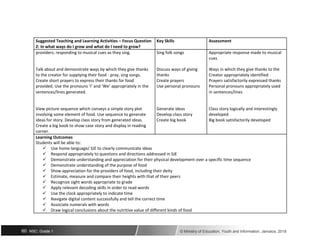
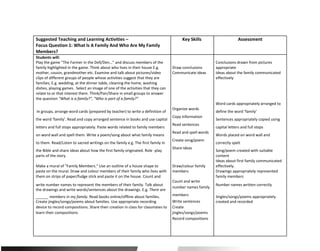
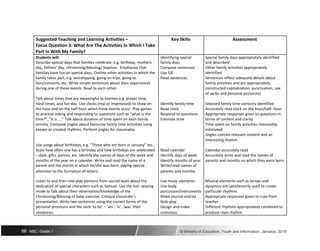
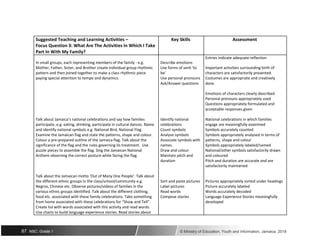
Suggested Teaching and Learning Activities – Key Skills Assessment
Focus Question 1: How Do You Know Me?
Students will: Identify first and First and last names accurately specified
Introduce themselves by giving first and last names, say names last names Names appropriately traced and copied
from name cards. Trace/copy/write names. Listen to Trace, copy, write Importance of names meaningfully
stories/songs/poems that demonstrate the importance of names discussed
names. Decorate name cards. Discuss the importance of names Respond to Origin/purpose of their names determined
as a means of identifying themselves and others. Give oral and questions and shared with classmates
written responses to questions about their names e.g. What is Research names SJE/home language accurately used to
your first name? Find out and tell how they got their names. Discuss importance share information about their names
of names
Group themselves according to number of letters in their first Form lines Line plot data appropriately collected and
name. Place name card on a line plot to show how many of the Plot data interpreted
students have the same number of letters in their first name. Compare numbers
Name and label the line plot. Ask and answer questions based on
the line plot.
Use speak easy mode to say what makes them a boy/male and a
Compose simple Simple sentences about self appropriately
sentences composed
girl/female. Show acceptable social behaviour as they work in
Sight words accurately used in sentences
groups to select name cards, then identify first and last name of
each group member.
Repeat simple three letter words that rhyme. Compose simple Navigate digital
sentences (oral/written), about themselves as boy/girl, content
male/female, and human using: “I am ---” “My name is ---” Listen to stories
including sight words. Read written sentences aloud to class,
identifying the initial consonant sounds. Listen to/read stories
offline/online about children. Talk about the
pictures/illustrations in the stories.
35 NSC: Grade 1 © Ministry of Education, Youth and Information, Jamaica. 2018
Suggested Teaching and Learning Activities – Key Skills Assessment
Focus Question 1: How Do You Know Me?
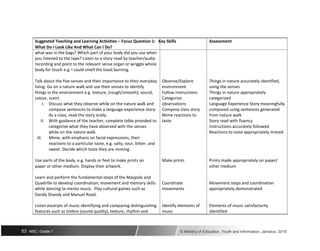
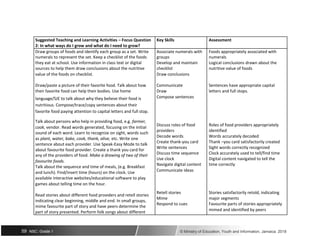
In groups use the body to form the shape of some capital and Form letters Bodies used to accurately form words/
common letters e.g. b, l, M, K, C, E. Class/groups identify letters. Discuss use of names
Play a matching game to pair each letter with their capital and capital letters Importance of capital letters in names
common form. Talk about the similarities and differences appropriately recognized
between the matching pair of common and capital letters by
looking at the lines (curve, straight). Tell why it is important that
their names start with capital letters.
Create a class mural/wall display of drawings and or paintings of Draw/Paint self Drawing/painting of self satisfactorily
themselves. Identify their pictures on the mural and place their Identify self-portrait done
names on them by tracing/ writing/ copying or by selecting their Label pictures Self-portrait accurately identified on mural
name cards from those created by teacher. Pictures labeled accurately with names
Create individual portfolios (using appropriate digital device) on Enter text Personal digital portfolios with
the theme "Myself" with class using photographs and or Capture images photographs and words/sentences
drawings of themselves. Type word (s) or sentence (s) about Compose sentences satisfactorily created
themselves to label and/or explain photographs. Share Read sentences
portfolios with class or in small peer groups.
Listen to stories about birthdays. Talk about birthdates/birthdays Discuss the matter Concept of ‘birthdates’ appropriately
and find their birthday on the calendar. Sing songs related to of ‘birthdates’ demonstrated
birth month using body percussion. e.g. ‘Those who are born in Identify birth Birth months accurately identified on
January ……’ Practise reading and copying/writing number months on calendar calendar
names, days and months. Write sentences about their birth Listen to stories
months and ages. E.g. I was born in December. I am 6 years old.
Draw a cake and with candles representing their age. Talk about
how birthdays are celebrated. (Include the celebrated birthday
36 NSC: Grade 1 © Ministry of Education, Youth and Information, Jamaica. 2018
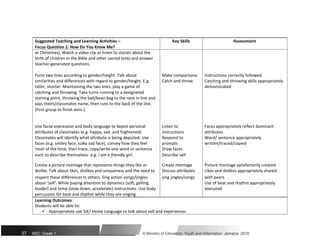
Suggested Teaching and Learning Activities – Key Skills Assessment
Focus Question 1: How Do You Know Me?
at Christmas). Watch a video clip or listen to stories about the
birth of children in the Bible and other sacred texts and answer
teacher-generated questions.
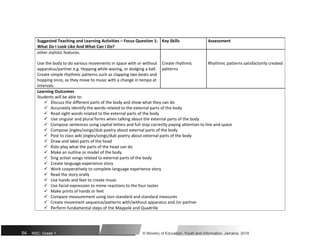
Form two lines according to gender/height. Talk about Make comparisons Instructions correctly followed
similarities and differences with regard to gender/height. E.g. Catch and throw Catching and throwing skills appropriately
taller, shorter Maintaining the two lines, play a game of demonstrated
catching and throwing. Take turns running to a designated
starting point, throwing the ball/bean bag to the next in line and
says theirs/classmates name, then runs to the back of the line.
(First group to finish wins.)
Use facial expression and body language to depict personal Listen to Faces appropriately reflect dominant
attributes of classmates (e.g. happy, sad, and frightened). instructions attributes
Classmates will identify what attribute is being depicted. Use Respond to Word/ sentence appropriately
faces (e.g. smiley face, sulky sad face), convey how they feel prompts written/traced/copied
most of the time, then trace, copy/write one word or sentence Draw faces
each to describe themselves- e.g. I am a friendly girl. Describe self
Create a picture montage that represents things they like or Create montage Picture montage satisfactorily created
dislike. Talk about likes, dislikes and uniqueness and the need to Discuss attributes Likes and dislikes appropriately shared
respect these differences in others. Sing action songs/jingles sing jingles/songs with peers
about ‘self’. While paying attention to dynamics (soft, gelling Use of beat and rhythm appropriately
louder) and temp (slow down, accelerate) instructions. Use body executed
percussion for beat and rhythm while they are singing.
Learning Outcomes
Students will be able to:
 Appropriately use SJE/ Home Language to talk about self and experiences
37 NSC: Grade 1 © Ministry of Education, Youth and Information, Jamaica. 2018
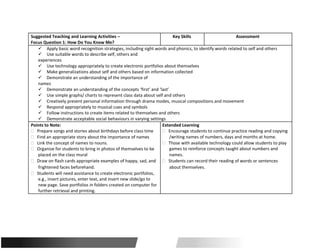
Suggested Teaching and Learning Activities – Key Skills Assessment
Focus Question 1: How Do You Know Me?
Apply basic word recognition strategies, including sight words and phonics, to identify words related to self and others
Use suitable words to describe self, others and
experiences
Use technology appropriately to create electronic portfolios about themselves
Make generalizations about self and others based on information collected
Demonstrate an understanding of the importance of
names
Demonstrate an understanding of the concepts ‘first’ and ‘last’
Use simple graphs/ charts to represent class data about self and others
Creatively present personal information through drama modes, musical compositions and movement
Respond appropriately to musical cues and symbols
Follow instructions to create items related to themselves and others
Demonstrate acceptable social behaviours in varying settings
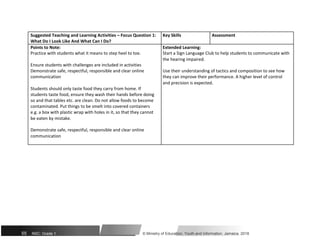
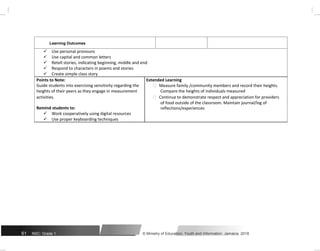
Points to Note: Extended Learning
 Prepare songs and stories about birthdays before class time  Encourage students to continue practice reading and copying
 Find an appropriate story about the importance of names /writing names of numbers, days and months at home.
 Link the concept of names to nouns.  Those with available technology could allow students to play
 Organize for students to bring in photos of themselves to be games to reinforce concepts taught about numbers and
placed on the class mural names.
 Draw on flash cards appropriate examples of happy, sad, and  Students can record their reading of words or sentences
frightened faces beforehand. about themselves.
 Students will need assistance to create electronic portfolios,
e.g., insert pictures, enter text, and insert new slide/go to
new page. Save portfolios in folders created on computer for
further retrieval and printing.
38 NSC: Grade 1 © Ministry of Education, Youth and Information, Jamaica. 2018
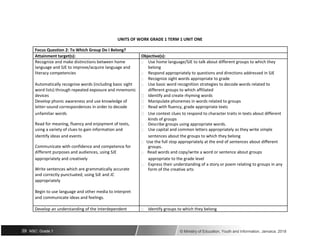
UNITS OF WORK GRADE 1 TERM 1 UNIT ONE
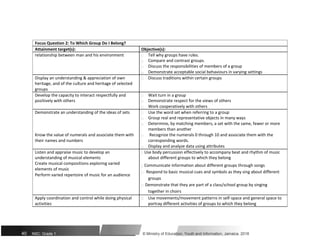
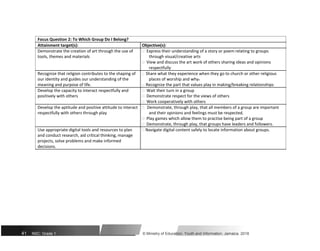
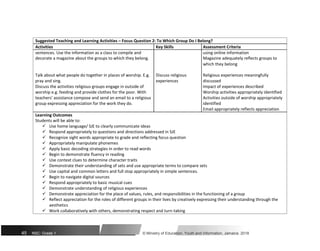
Focus Question 2: To Which Group Do I Belong?
Attainment target(s): Objective(s):
Recognize and make distinctions between home  Use home language/SJE to talk about different groups to which they
language and SJE to improve/acquire language and belong
literacy competencies  Respond appropriately to questions and directions addressed in SJE
 Recognize sight words appropriate to grade
Automatically recognise words (including basic sight  Use basic word recognition strategies to decode words related to
word lists) through repeated exposure and mnemonic different groups to which affiliated
devices  Identify and create rhyming words
Develop phonic awareness and use knowledge of  Manipulate phonemes in words related to groups
letter-sound correspondences in order to decode  Read with fluency, grade appropriate texts
unfamiliar words  Use context clues to respond to character traits in texts about different
Read for meaning, fluency and enjoyment of texts,
kinds of groups
 Describe groups using appropriate words.
using a variety of clues to gain information and  Use capital and common letters appropriately as they write simple
identify ideas and events sentences about the groups to which they belong
Communicate with confidence and competence for
 Use the full stop appropriately at the end of sentences about different
groups.
different purposes and audiences, using SJE  Read words and copy/write a word or sentence about groups
appropriately and creatively appropriate to the grade level
Write sentences which are grammatically accurate
 Express their understanding of a story or poem relating to groups in any
form of the creative arts
and correctly punctuated, using SJE and JC
appropriately
Begin to use language and other media to interpret
and communicate ideas and feelings.
Develop an understanding of the interdependent  Identify groups to which they belong
39 NSC: Grade 1 © Ministry of Education, Youth and Information, Jamaica. 2018
Focus Question 2: To Which Group Do I Belong?
Attainment target(s): Objective(s):
relationship between man and his environment  Tell why groups have rules.
 Compare and contrast groups.
 Discuss the responsibilities of members of a group
 Demonstrate acceptable social behaviours in varying settings
Display an understanding & appreciation of own  Discuss traditions within certain groups
heritage, and of the culture and heritage of selected
groups
Develop the capacity to interact respectfully and  Wait turn in a group
positively with others  Demonstrate respect for the views of others
 Work cooperatively with others
Demonstrate an understanding of the ideas of sets  Use the word set when referring to a group
 Group real and representative objects in many ways
 Determine, by matching members, a set with the same, fewer or more
members than another
Know the value of numerals and associate them with  Recognize the numerals 0 through 10 and associate them with the
their names and numbers corresponding words.
 Display and analyze data using attributes
Listen and appraise music to develop an  Use body percussion effectively to accompany beat and rhythm of music
understanding of musical elements about different groups to which they belong
Create musical compositions exploring varied
Communicate information about different groups through songs
elements of music
 Respond to basic musical cues and symbols as they sing about different
Perform varied repertoire of music for an audience
groups
 Demonstrate that they are part of a class/school group by singing
together in choirs
Apply coordination and control while doing physical  Use movements/movement patterns in self-space and general space to
activities portray different activities of groups to which they belong
40 NSC: Grade 1 © Ministry of Education, Youth and Information, Jamaica. 2018
Focus Question 2: To Which Group Do I Belong?
Attainment target(s): Objective(s):
Demonstrate the creation of art through the use of  Express their understanding of a story or poem relating to groups
tools, themes and materials through visual/creative arts
 View and discuss the art work of others sharing ideas and opinions
respectfully
Recognize that religion contributes to the shaping of  Share what they experience when they go to church or other religious
our identity and guides our understanding of the places of worship and why.
meaning and purpose of life.  Recognize the part that values play in making/breaking relationships
Develop the capacity to interact respectfully and  Wait their turn in a group
positively with others  Demonstrate respect for the views of others
 Work cooperatively with others
Develop the aptitude and positive attitude to interact  Demonstrate, through play, that all members of a group are important
respectfully with others through play and their opinions and feelings must be respected.
 Play games which allow them to practise being part of a group
 Demonstrate, through play, that groups have leaders and followers.
Use appropriate digital tools and resources to plan  Navigate digital content safely to locate information about groups.
and conduct research, aid critical thinking, manage
projects, solve problems and make informed
decisions.
41 NSC: Grade 1 © Ministry of Education, Youth and Information, Jamaica. 2018
Suggested Teaching and Learning Activities – Focus Question 2: To Which Group Do I Belong?
Activities Key Skills Assessment Criteria
Students will:
Discuss pictures of familiar groups, (class, school, family, club Identify groups Groups correctly identified
etc.). Name the various groups to which they belong. Use State similarities Similarities between groups accurately
home language/SJE to discuss why they are in these groups Use home identified
and identify the similarities between various groups. Write a language/SJE Home Language/SJE used to clearly
word/sentence about the group (s) to which they belong. Compose sentences communicate ideas
Use capital and common letters and full stop appropriately in Draw pictures Pictures appropriately reflect groups
sentence. Draw pictures to show the various groups to which drawn
they belong. Write one sentence about the group drawn.
Using SJE/Home Language, discuss the concept of ‘tradition’. Discuss ideas Concept of tradition meaningfully
E.g. celebration activities for Christmas and Easter. Watch Respond discussed
short clips about how different groups such as the school, Write/copy/trace Traditions accurately identified
religious groups and families observe certain traditions (long- sentences Simple sentences appropriately
standing practices) and talk about it. Write /copy/trace two Read sentences composed/copied/traced
simple sentences about traditions which are celebrated Read Sentences satisfactorily read aloud to class
sentences aloud to class.
Identify activities performed by various groups E.g. Teacher Perform movements Movements/Movement patterns
teaching and children at play. Use movements/movement Link movements and adequately depict activities of the specified
patterns in a logical sequence to depict each activity. Present activities groups
movements to class and have them identify the activity being Compare movements
carried out.
Use manipulatives to show/model the number of members in Represent sets/groups Manipulatives appropriately used to
a group/set. In groups, compare the members in set using Compare sets represent sets/groups
terms/symbols for ‘equal’, ‘greater than,’ ‘less than’. Sort Associate numbers Sets accurately compared using
various manipulatives, group them and give reasons for the with sets appropriate terms/symbols
42 NSC: Grade 1 © Ministry of Education, Youth and Information, Jamaica. 2018
Suggested Teaching and Learning Activities – Focus Question 2: To Which Group Do I Belong?
Activities Key Skills Assessment Criteria
groupings (colour, size, shape, texture, etc.). Use number Use verb ‘to be’ Digital content appropriately navigated
names to describe their sets. Use 'is' and 'are' to construct Navigate digital
sentences describing groups. Use available technological content
devices to play online/off lines games to reinforce concepts
about sets.
In groups, formulate and discuss some class rules and say Formulate/discuss Meaningful group rules formulated and
how these rules affect members of the class. Take turns in rules discussed
conversation. Write/copy/trace a rule of the class. Play Wait turns Taking turns in conversation appropriately
games such as ‘Simon Says’ and ‘Follow the leader,’ to Write/trace/copy rule demonstrated
demonstrate their understanding of rules. Respond to rules One rule appropriately
written/traced/copied
Use word wall, as well as interactive offline/online and other Identify sight words Sight words accurately identified
games to, learn sight words related to groups to which they
belong- for example, groups, member, rules, respect, other,
team, help, learn, agree, behave
Listen to audios of short vowel sounds and consonants Read fluently Ask and answer questions appropriately
presented in isolation, as well as within the context of words. Ask and answer Respect and cooperation appropriately
Try to produce the sounds and then identify them in words questions demonstrated while working with peers
related to groups. Record themselves as they produce these
Role-play characters
words. Play back for class discussion. Read short passages
and poems about groups to which they belong.
Listen to stories about rules and responsibilities of members Appraise Characters in stories about
of groups. Using Readers’ Theatre, read aloud parts of the performances rules/responsibilities meaningfully
43 NSC: Grade 1 © Ministry of Education, Youth and Information, Jamaica. 2018
Suggested Teaching and Learning Activities – Focus Question 2: To Which Group Do I Belong?
Activities Key Skills Assessment Criteria
stories which represent how different characters in a story Demonstrate portrayed via role-play
observe rules/responsibilities in order to make a group work. respect/cooperation Appropriate feedback given to peers about
Role-play different characters in one of the story. Respond to Use context clues performances
questions posed by peers about the character portrayed. Respond to questions Context clues used appropriately to
determine traits of characters in stories
read.
Appropriate oral responses to written
questions supplied
Draw or paint a picture to represent an aspect of a story or Draw/paint picture Picture drawn/painted suitably adequately
poem read. Write a word, short phrase or simple sentence to Write reflects select aspect of story/poem
indicate the aspect represented. View and talk about each word/phrase/sentence Word/phrase/simple sentence used
other’s work respecting each other’s feelings/opinions. correctly indicate aspect represented
Listen to stories about positive values and talk about the
Listen to stories Role-play appropriately portrays the
Role play positive particular value
value of honesty, truthfulness, respect as they are depicted in
the stories. Role-play one or more of these values and values
attitudes to classmates.
Perform songs about groups to which they belong as a class Perform as a choir Songs satisfactorily performed as a class
Respond to musical choir
choir, responding to basic musical cues as they sing to reflect
cues Appropriate responses to musical cues
dynamics such as loud, soft, high/low
demonstrated
With teacher assistance, find basic information on- Navigate digital Online sources successfully navigated with
content teacher assistance/guidance
line/offline about a specific group to which they belong and
Generate sentences Meaningful simple sentences generated,
use information located to develop their own simple
44 NSC: Grade 1 © Ministry of Education, Youth and Information, Jamaica. 2018
Suggested Teaching and Learning Activities – Focus Question 2: To Which Group Do I Belong?
Activities Key Skills Assessment Criteria
sentences. Use the information as a class to compile and using online information
decorate a magazine about the groups to which they belong. Magazine adequately reflects groups to
which they belong
Talk about what people do together in places of worship. E.g. Discuss religious Religious experiences meaningfully
pray and sing. experiences discussed
Discuss the activities religious groups engage in outside of Impact of experiences described
worship e.g. feeding and provide clothes for the poor. With Worship activities appropriately identified
teachers’ assistance compose and send an email to a religious Activities outside of worship appropriately
group expressing appreciation for the work they do. identified
Email appropriately reflects appreciation
Learning Outcomes
Students will be able to:
 Use home language/ SJE to clearly communicate ideas

 Respond appropriately to questions and directions addressed in SJE

 Recognize sight words appropriate to grade and reflecting focus question

 Appropriately manipulate phonemes

 Apply basic decoding strategies in order to read words

 Begin to demonstrate fluency in reading

 Use context clues to determine character traits

 Demonstrate their understanding of sets and use appropriate terms to compare sets

 Use capital and common letters and full stop appropriately in simple sentences.

 Begin to navigate digital sources

 Respond appropriately to basic musical cues

 Demonstrate understanding of religious experiences

 Demonstrate appreciation for the place of values, rules, and responsibilities in the functioning of a group

 Reflect appreciation for the roles of different groups in their lives by creatively expressing their understanding through the
aesthetics
 Work collaboratively with others, demonstrating respect and turn-taking
45 NSC: Grade 1 © Ministry of Education, Youth and Information, Jamaica. 2018
Suggested Teaching and Learning Activities – Focus Question 2: To Which Group Do I Belong?
Activities Key Skills Assessment Criteria
Points to Note: Extended Learning
 Include groups such as class, school, family, religious  Maintain a log/journal/diary of how they are able to use positive
groups, club, race, country etc. values to meaningfully function in a group such as church, club or
 Ensure that students are properly supported/guided as family.
they attempt to navigate digital sources  Create a digital story of how they are able to work successfully with
 If students visit websites, remind them about digital a group of their choice
rights and responsibilities
 Include as much modelling as possible as students work
through activities.
46 NSC: Grade 1 © Ministry of Education, Youth and Information, Jamaica. 2018
NATIONAL STANDARDS CURRICULUM GUIDE
GRADE 1 INTEGRATED STUDIES
TERM1 – UNIT2
47 NSC: Grade 1 © Ministry of Education, Youth and Information, Jamaica. 2018
Prior Learning
Check that students can:
 Use home language/SJE to clearly communicate their
names and who they are. E.g. Boy/girl
 Recognize sight words appropriate to grade and
reflecting focus question
 Begin to appropriately manipulate phonemes
 Begin to use basic decoding strategies in order to read
words
UNITS OF WORK GRADE 1 TERM 1UNIT TWO
Focus Question 1: What Do I Look Like And What Can I Do?
Attainment target(s): Objective(s):
Listen to, recall, understand and respond to  Ask and respond appropriately to questions about self
speakers’ messages, whether implicit or explicit
Write sentences which are grammatically accurate  Use line and space
and correctly punctuated, using SJE and JC  Use capital and common letters appropriately
appropriately  Use pronouns ‘I’, ‘me’, ‘my’
 Use regular and irregular plural nouns
 Use full stops and commas appropriately
Read for meaning, fluency and enjoyment of texts,  Recognize sight words related to parts of the body
using a variety of clues to gain information and  Read text appropriate to grade
identify ideas and events
Demonstrate an understanding and appreciation of  Talk about self and identity
self as an individual and in specified contexts  Recognise the external parts of the body and their parts
 Use the senses to explore the similarities and differences between materials
 Explain the use of some special body parts: hands, feet, eyes, mouth, nose
and ears, feet
Develop the capacity to interact respectfully and  Show appreciation for the ideas and opinions of classmates through
positively with others cooperative learning
Explore selected life processes in humans, the  Identify and name external parts of the body
48 NSC: Grade 1 © Ministry of Education, Youth and Information, Jamaica. 2018
Focus Question 1: What Do I Look Like And What Can I Do?
Attainment target(s): Objective(s):
interdependence between living things in the  Relate the uses of selected parts of the body
environment, and how lifestyles determine health  Name the senses, associating them with specific parts of the body
and well-being in humans.
Express a range of feelings and emotions through  Use facial expressions to demonstrate their reactions to different tastes
the enactment of dramatic scenarios
Create art work using a variety of materials and  Demonstrate skills in creativity by designing and making simple models
tools
Perform varied repertoire of music for an audience  Explore various folk forms through music and movement
 Listen to and distinguish different genres of music within the Jamaican
cultural context
Create musical compositions exploring varied  Communicate information about self through drawing.
elements of music
Display an appreciation of some of the beliefs,  Listen to sacred texts relating to parts of the body
practices and expressions of persons from different  Create a short prayer to the Creator, giving thanks for specific parts of the
religious faiths body
Create musical compositions exploring varied  Use body percussion and classroom instruments to accompany singing
elements of music  Use simple movements associated with jingles/songs to share information
about their bodies
 Express their understanding of a concept/poem/story in musical form
 Maintain a steady beat while using parts of the body as sound markers
 Create jingles/songs/dub poetry about parts of the body
Explore simple locomotor, non-locomotor actions,  Demonstrate movements within their own space.
pathways and levels with basic control and  Create rhythmic patterns at all levels with or without a partner
coordination.  Develop control in ball skills when throwing, catching and kicking
 Use parts of the body to explore space
 Develop the ability to run and dodge
49 NSC: Grade 1 © Ministry of Education, Youth and Information, Jamaica. 2018
Focus Question 1: What Do I Look Like And What Can I Do?
Attainment target(s): Objective(s):
Use technology to communicate ideas and  Use selected communication devices to share ideas about parts of the body
information, and work collaboratively to support with other classes
individual needs and contribute to the learning of
others.
Estimate, compare and use various types of  Measure the lengths of using strings, steps, hand span, strips of cardboard
measurements and other informal units of measurement
Collect, organize, interpret and represent data and  Estimate and measure items relating to self, using non-standard and units of
make inferences by applying knowledge of statistics measurements.
and probability.  Represent numerical information pictorially
 Construct and interpret tables and pictographs using numbers, pictures and
objects
Suggested Teaching and Learning Activities – Focus Question 1: Key Skills Assessment
What Do I Look Like And What Can I Do?
Students will:
In groups, observe and compare the external parts of the body Observe peers External parts of the body correctly
(a) the head and parts; (b) upper limbs and parts; (c) lower limbs Compare external identified
and parts. Discuss what they look like using terms such as parts Singular and plural forms correctly used
‘bigger than’, ‘taller than’ etc. Use the singular and plural forms Discuss Sentences composed with capital and
while discussing parts of the body. Express themselves in Read sight words common letters used correctly
sentences. Read sight words related to parts of the body. Create Use singular and Line and space used appropriately
jingles/songs/dub poetry about parts of the body. Post plural forms Words related to parts of the body
composition to class wiki for other classes to read. accurately read
Compose sentences about what they look like paying attention
to line and space and the usage of capital and common letters.
50 NSC: Grade 1 © Ministry of Education, Youth and Information, Jamaica. 2018
Suggested Teaching and Learning Activities – Focus Question 1: Key Skills Assessment
What Do I Look Like And What Can I Do?
Talk about what the head and its parts can do. E.g. the head has Create Jingles/songs/dub poetry created with
eyes to see and ears to ear etc. Talk about how the various parts jingles/songs/dub appropriate words
are important. Depict, through role-play what happens when poetry Jingles/songs/dub poetry posted to
speech, hearing or sight is impaired. Use cut-outs of basic Post compositions class wiki
shapes to complete design of the head and its parts. E.g. triangle online
for nose, square for head etc. Write sentences to describe their Discuss use of head Roles of parts of the head discussed and
design. Read sight words related to the head and its parts. Read sight words correctly identified
Draw and label Sentences appropriately describe
Write sentences drawings
Role-play Role-play appropriately demonstrates
functions of head and parts
Sing action songs to show what the upper limbs and parts can
Design satisfactorily completed
do. E.g. ‘Fingers and thumbs keep moving.’ Talk about the use of Discuss use of upper Use of upper limbs and parts
the upper limbs and parts. E.g. using their hands to take care of limbs appropriately identified
themselves, e.g. I use my hands to keep myself clean, to Compose sentences
communicate - hands wave hello, clap and count.
Talk about how they can also communicate with their hands Sentences correctly reflect what hands
using sign language. Observe videos of children demonstrating a can do
few simple signs such as ‘thank you’, ‘please’, ‘good morning,’
‘good afternoon’ etc. Practise using these signs. Write
sentences about what the hands can do.
Walk briskly while singing action songs such as ‘Around the Walls Discuss use of lower Sentences written accurately
of Jericho.’ Talk about what the lower limbs and parts can do. limbs
Write sentences about what the feet can do. Listen to/read Bible Sing songs
stories and other sacred stories about the use of the lower limbs. Write sentences
E.g. The Battle of Jericho. Discuss what role the limbs played in
the stories
51 NSC: Grade 1 © Ministry of Education, Youth and Information, Jamaica. 2018
Suggested Teaching and Learning Activities – Focus Question 1: Key Skills Assessment
What Do I Look Like And What Can I Do?
Use their hands and feet to create music as accompaniment for Make rhythm Elements satisfactorily demonstrated
lyrics about external parts of the body using varied elements Differentiate loud and
(dynamics, tempo, rhythm) by clapping, tapping, snapping the soft sounds
fingers, and stomping the feet at given prompts.
In pairs, use various parts of the body to complete non-standard Measure distances Measurements appropriately taken
measure (e.g. hand span, length of stride, handful). E.g. How Estimate using standard and non-standard units
many steps from the door to the chalk broad? Estimate measurements of measurement
measurements using these non-standard units and discuss their Follow instructions Logical estimations of distances made
results. Talk about non-standard measures and accuracy of Measure Instructions appropriately followed
measure. Re-measure some of the distances using standard units Compare Accurate comparisons of estimates and
of measurement e.g. string and metre strips. With teachers measurements measurements made
assistance present results in a table using the headings standard
measure and non-standard measurement.
Make drawing/model of the outline of the body. Use cut-outs or Draw/make models Drawings/models of the outline of the
drawings to place the parts of the head on the outline. Sing Label outlines body satisfactorily made
songs about the body parts. E.g. ‘Head and shoulders, knees and Parts of the head accurately labelled
toes…’ Label the different parts of the outline. Write two
sentences to give thanks to God for the creation of their bodies.
Learn songs or poems about the senses. Given a series of short Observe for Sense organs and functions correctly
activities related to each of the five senses, e.g.: listen and information, answer identified
identify sounds on tape; look at objects such as an orange with a questions, manipulate
magnifying glass; smell lemon, dish-washing liquid; identify materials and
objects in a bag by feeling; taste salty and sweet foods. Answer equipment
questions asked by teacher about the five senses and where the
sense organs are located in the body, e.g.: How did you find out
52 NSC: Grade 1 © Ministry of Education, Youth and Information, Jamaica. 2018
Suggested Teaching and Learning Activities – Focus Question 1: Key Skills Assessment
What Do I Look Like And What Can I Do?
what was in the bags? Which part of your body did you use when
you listened to the tape? Listen to a story read by teacher/audio
recording and point to the relevant sense organ or wriggle whole
body for touch e.g. I could smell the toast burning.
Talk about the five senses and their importance to their everyday Observe/Explore Things in nature accurately identified,
living. Go on a nature walk and use their senses to identify environment using the senses
things in the environment e.g. texture, (rough/smooth); sound, Follow instructions Things in nature appropriately
colour, scent. Categorize categorized
I. Discuss what they observe while on the nature walk and observations Language Experience Story meaningfully
compose sentences to make a language experience story. Compose class story composed using sentences generated
As a class, read the story orally. Mime reactions to from nature walk
II. With guidance of the teacher, complete table provided to taste Story read with fluency
categorize what they have observed with the senses Instructions accurately followed
while on the nature walk. Reactions to taste appropriately mimed
III. Mime, with emphasis on facial expressions, their
reactions to a particular taste, e.g. salty, sour, bitter, and
sweet. Decide which taste they are miming.
Use parts of the body, e.g. hands or feet to make prints on Make prints Prints made appropriately on paper/
paper or other medium. Display their artwork. other medium
Learn and perform the fundamental steps of the Maypole and
Quadrille to develop coordination, movement and memory skills Coordinate Movement steps and coordination
while dancing to mento music. Play cultural games such as movements appropriately demonstrated
Dandy Shandy and Manuel Road.
Listen excerpts of music identifying and comparing distinguishing Identify elements of Elements of music satisfactorily
features such as timbre (sound quality), texture, rhythm and music identified
53 NSC: Grade 1 © Ministry of Education, Youth and Information, Jamaica. 2018
Suggested Teaching and Learning Activities – Focus Question 1: Key Skills Assessment
What Do I Look Like And What Can I Do?
other stylistic features.
Use the body to do various movements in space with or without Create rhythmic Rhythmic patterns satisfactorily created
apparatus/partner e.g. Hopping while waving, or dodging a ball. patterns
Create simple rhythmic patterns such as clapping two beats and
hopping once, as they move to music with a change in tempo at
intervals.
Learning Outcomes
Students will be able to:
 Discuss the different parts of the body and show what they can do

 Accurately identify the words related to the external parts of the body

 Read sight words related to the external parts of the body

 Use singular and plural forms when talking about the external parts of the body

 Compose sentences using capital letters and full stop correctly paying attention to line and space

 Compose jingles/songs/dub poetry about external parts of the body

 Post to class wiki jingles/songs/dub poetry about external parts of the body

 Draw and label parts of the head

 Role-play what the parts of the head can do

 Make an outline or model of the body

 Sing action songs related to external parts of the body

 Create language experience story

 Work cooperatively to complete language experience story

 Read the story orally

 Use hands and feet to create music

 Use facial expression to mime reactions to the four tastes

 Make prints of hands or feet

 Compare measurement using non-standard and standard measures

 Create movement sequence/patterns with/without apparatus and /or partner

 Perform fundamental steps of the Maypole and Quadrille
54 NSC: Grade 1 © Ministry of Education, Youth and Information, Jamaica. 2018
Suggested Teaching and Learning Activities – Focus Question 1: Key Skills Assessment
What Do I Look Like And What Can I Do?
Points to Note: Extended Learning:
Practice with students what it means to step heel to toe. Start a Sign Language Club to help students to communicate with
Ensure students with challenges are included in activities
the hearing impaired.
Demonstrate safe, respectful, responsible and clear online Use their understanding of tactics and composition to see how
communication they can improve their performance. A higher level of control
Students should only taste food they carry from home. If
and precision is expected.
students taste food, ensure they wash their hands before doing
so and that tables etc. are clean. Do not allow foods to become
contaminated. Put things to be smelt into covered containers
e.g. a box with plastic wrap with holes in it, so that they cannot
be eaten by mistake.
Demonstrate safe, respectful, responsible and clear online
communication
55 NSC: Grade 1 © Ministry of Education, Youth and Information, Jamaica. 2018
Prior Learning
Check that students can:
 Demonstrate understanding of concept of print –
UNITS OF WORK GRADE 1 TERM 1 UNIT TWO
Focus Question 2: In what ways do I grow and what do I need to grow?
Attainment Target(s): Objective(s):
Recognize and make distinctions between home language
Students will be able to:
 Attempt to use SJE structures to express themselves.
and SJE to improve/acquire language and literacy  Recognize sight words related to the growth process and food
competencies providers
 Read with fluency, grade appropriate texts
Automatically recognise words (including basic sight word
 Use basic word recognition strategies to decode words
 Use pictures to develop stories
lists) through repeated exposure and mnemonic devices  Use pronouns ‘I’, ‘me’, ‘my’
Develop phonic awareness and use knowledge of letter-
 Display the ability to use capital and common letters
 Develop and ask questions related to the growth process and
sound correspondences in order to decode unfamiliar words food providers
Write sentences which are grammatically accurate and
 Retell stories relating to food providers
 Respond to characters in poems about the growth process
correctly punctuated, using SJE and JC appropriately  Express their understanding of a story or poem relating to groups
Reflect on and critically respond to literature and other
in any form of the creative arts
texts, on paper and on screen
Explore selected life processes in humans, the  Discuss changes that occur in their body over time
interdependence between living things in the environment,  Explain why food is essential for healthy growth
and how lifestyles determine health and well-being in
humans.
Estimate, compare and use various types of measurements  Estimate and measure self and others using non-standard units
for measurement of height
56 NSC: Grade 1 © Ministry of Education, Youth and Information, Jamaica. 2018
Focus Question 2: In what ways do I grow and what do I need to grow?
 Use non- standard units of measurement
 Show and tell time on the clock (on the hour)
Display an appreciation of some of the beliefs, practices and  Identify ways of giving thanks to the Deity for food
expressions of persons from different religious faiths
Understand the processes and forces that have formed the  Discuss the provision of different foods for healthy grown
physical and built environment.  Identify individuals who provide for healthy growth
Use appropriate digital tools and resources to plan and  Navigate digital content on offline/online sources to learn about
conduct research, aid critical thinking, manage projects telling time on the hour.
solve problems and make informed decisions.
Perform varied repertoire of music for an audience  Perform songs related to growth/food
Listen to and appraise music to develop an understanding of  Respond to basic musical cues/symbols as they listen and
musical elements. perform.
Create art using different materials, processes and  Use the elements of art in creating drawings/models of foods
Elements
Begin to develop control and co-ordination of physical  Combine different movement patterns at different levels in self
movements. and general space in order to portray growth
Create and perform simple movement patterns
57 NSC: Grade 1 © Ministry of Education, Youth and Information, Jamaica. 2018
Suggested Teaching and Learning Activities – Focus Question Key Skills Assessment
2: In what ways do I grow and what do I need to grow?
Students will:
View teacher-created multimedia presentation/pictures Organize pictures Pictures appropriately compared and
showing stages of development from infancy – toddler- Grade Compare pictures discussed
1. Compare and discuss changes in body size, height and Discuss changes Simple sentences about pictures
length of arms as they grow. Talk about things they did at appropriately written/typed
each stage of development. Write or type simple sentences Electronic portfolios updated with
about their growth. Save typed sentences to electronic simple sentences
portfolio created in Unit 1.
In pairs, estimate and compare their heights using the terms Estimate and compare Heights appropriately estimated and
taller, shorter etc. Measure each other’s height using Measure heights compared
standard (cord, string) and non-standard forms of Make predictions Heights appropriately measured using
measurement (less than a metre, greater than a metre). Compose simple standard/ non-standard units
Predict the heights they think they will reach when they are sentences
adults. Navigate digital content
In small groups develop a simple dance which depicts physical Create movements Movements created and coordinated
growth from birth to their present stage of development Demonstrate appropriately to depict physical growth
(includes movements in both self and general space) coordination/control
Observe pictures of foods/food samples and discuss why we Discuss purpose of food Decoding skills appropriately applied
eat food. Copy and complete sentences using names of foods Apply decoding skills Sentences appropriately composed
using common and capital letters appropriately. Read Compose sentences
sentences using relevant decoding skills e.g. sounding out
initial and final consonants.
58 NSC: Grade 1 © Ministry of Education, Youth and Information, Jamaica. 2018
Suggested Teaching and Learning Activities – Focus Question Key Skills Assessment
2: In what ways do I grow and what do I need to grow?
Draw groups of foods and identify each group as a set. Write Associate numerals with Foods appropriately associated with
numerals to represent the set. Keep a checklist of the foods groups numerals
they eat at school. Use information in class text or digital Develop and maintain Logical conclusions drawn about the
sources to help them draw conclusions about the nutritive checklist nutritive value of foods
value of the foods on checklist. Draw conclusions
Draw/paste a picture of their favorite food. Talk about how Communicate Sentences have appropriate capital
their favorite food can help their bodies. Use home Draw letters and full stops.
language/SJE to talk about why they believe their food is Compose sentences
nutritious. Compose/trace/copy sentences about their
favorite food paying attention to capital letters and full stop.
Talk about persons who help in providing food, e.g. farmer,
Discuss roles of food Roles of food providers appropriately
cook, vendor. Read words generated, focusing on the initial
providers identified
sound of each word. Learn to recognize on sight, words such
Decode words Words accurately decoded
as plant, water, bake, cook, thank, alive, etc. Write one
Create thank-you card Thank –you card satisfactorily created
sentence about each provider. Use Speak-Easy Mode to talk
Write sentences Sight words correctly recognized
about favourite food provider. Create a thank you card for
Discuss time sequence Clock accurately used to tell/find time
any of the providers of food. Make a drawing of two of their
Use clock Digital content navigated to tell the
favourite foods.
Navigate digital content time correctly
Talk about the sequence and time of meals, (e.g. Breakfast
Communicate ideas
and lunch). Find/insert time (hours) on the clock. Use
available interactive websites/educational software to play
games about telling time on the hour.
Read stories about different food providers and retell stories
Retell stories Stories satisfactorily retold, indicating
Mime major segments
indicating clear beginning, middle and end. In small groups,
Respond to cues Favourite parts of stories appropriately
mime favourite part of story and have peers determine the
mimed and identified by peers
part of story presented. Perform folk songs about different
59 NSC: Grade 1 © Ministry of Education, Youth and Information, Jamaica. 2018
Suggested Teaching and Learning Activities – Focus Question Key Skills Assessment
2: In what ways do I grow and what do I need to grow?
providers; responding to musical cues as they sing. Sing folk songs Appropriate response made to musical
cues
Talk about and demonstrate ways by which they give thanks Discuss ways of giving Ways in which they give thanks to the
to the creator for supplying their food - pray, sing songs. thanks Creator appropriately identified
Create short prayers to express their thanks for food Create prayers Prayers satisfactorily expressed thanks
provided. Use the pronouns ‘I’ and ‘We’ appropriately in the Use personal pronouns Personal pronouns appropriately used
sentences/lines generated. in sentences/lines
View picture sequence which conveys a simple story plot Generate ideas Class story logically and interestingly
involving some element of food. Use sequence to generate Develop class story developed
ideas for story. Develop class story from generated ideas. Create big book Big book satisfactorily developed
Create a big book to show case story and display in reading
corner.
Learning Outcomes
Students will be able to:
Use home language/ SJE to clearly communicate ideas
Respond appropriately to questions and directions addressed in SJE
Demonstrate understanding and appreciation for their physical development over a specific time sequence
Demonstrate understanding of the purpose of food
Show appreciation for the providers of food, including their deity
Estimate, measure and compare their heights with that of their peers
Recognize sight words appropriate to grade
Apply relevant decoding skills in order to read words
Use the clock appropriately to indicate time
Navigate digital content successfully and tell the correct time
Associate numerals with words
Draw logical conclusions about the nutritive value of different kinds of food
60 NSC: Grade 1 © Ministry of Education, Youth and Information, Jamaica. 2018
Learning Outcomes
Use personal pronouns
Use capital and common letters
Retell stories, indicating beginning, middle and end
Respond to characters in poems and stories
Create simple class story
Points to Note: Extended Learning
Guide students into exercising sensitivity regarding the  Measure family /community members and record their heights.
heights of their peers as they engage in measurement Compare the heights of individuals measured
activities.  Continue to demonstrate respect and appreciation for providers
Remind students to:
of food outside of the classroom. Maintain journal/log of
reflections/experiences
Work cooperatively using digital resources
Use proper keyboarding techniques
61 NSC: Grade 1 © Ministry of Education, Youth and Information, Jamaica. 2018
Prior Learning
Check that students can:
 Demonstrate understanding of concept of print –
UNITS OF WORK GRADE 1 TERM 1 UNIT TWO
Focus Question 3: How Do I Take Care Of My Body?
Attainment target(s): Objective(s):
Recognise, value and make distinctions between home language Students will:
and SJE to improve/acquire language and literacy competencies  Use home language/SJE to talk about how they care for their
bodies
 Ask and respond appropriately to questions about how they
take care of their bodies
Write sentences which are grammatically accurate and correctly
 Use parts of the verb ‘to be’, ‘has’ ‘have’
 Use the pronouns ‘I’, ‘me’, ‘my’ ‘you’
punctuated, using SJE and JC appropriately  Use capital and common letters and full stops appropriately
Recognise the value of physical activity to their fitness/health  Apply a combination of movement skills to different rhythms in
general space with (manipulation and balance) and without
apparatus.
 Play mini games which include one, two, or a combination of
skills
Display an appreciation of some of the beliefs, practices and  Give thanks to God for their bodies
expressions of persons from different religious faiths  Recognize the importance for the need to rest
Explore selected life processes in humans, the interdependence  Describe ways in which we take care of our bodies
between living things in the environment, and how lifestyles  Identify daily personal habits needed to take care of the body.
determine health and well-being in humans.
Develop an understanding of the interdependent relationship  Describe ways in which we take care of our bodies
between man and his environment.  Identify daily personal habits needed to take care of the body.
Create musical compositions exploring varied elements of music  Compose/recite songs/jingles about caring for the body.
 Apply relevant accompanying skills to enhance singing
62 NSC: Grade 1 © Ministry of Education, Youth and Information, Jamaica. 2018
Focus Question 3: How Do I Take Care Of My Body?
Know the value of numerals and associate them with their  Write the numerals 11 through 20 and associate them with the
names, numbers and ordinals corresponding words.
Collect, organize and interpret information in practical situations.  Identify details on a graph or chart
 Make general statements and draw conclusions based on
information collected.
Explore the use of the elements of art in picture-making and  Use pictures/painting/drawings to create a poster depicting the
other art forms theme “Caring for my body”
 Demonstrate an understanding of how the elements of art
work together to produce art by creating pictures, paintings and
drawings.
Express a range of feelings and emotions through the enactment  Dramatize the various ways in which the body is cared for.
of dramatic scenarios
Use technology to communicate ideas and information, and  Use selected communication devices to share ideas about their
work collaboratively to support individual needs and contribute classmates water intake
to the learning of others
Follow instructions in the execution of simple tasks.  Demonstrate their understanding of care of the body.
63 NSC: Grade 1 © Ministry of Education, Youth and Information, Jamaica. 2018
Suggested Teaching and Learning Activities – Focus Question 3: Key Skills Assessment
How Do I Take Care of My Body?
Students will:
Talk about personal hygiene and what they need to do to take Observe, General cleansing correctly demonstrated
care of their bodies. (Clean clothes; hair care; and oral care). manipulate Importance of personal hygiene stated
Observe pictures/videos/teacher-created multimedia Talk about care of The verbs ‘is’, ‘are’, ‘has’ ‘have’ correctly
presentations related to appropriate personal hygiene showing body used in sentences
general cleanliness. Talk about the important things to do for Demonstrate care of
cleansing the different parts of the body and how often they body
should be done. Use models to demonstrate ways of taking care Compose sentences
of their bodies.
Compose sentences about personal hygiene using ‘is’, ‘are’, Compose/recite Poems/jingles satisfactorily
‘has’, ‘have’ while paying attention to capital and common poems, jingles compose/recited
letters. Recite/compose jingles/poems about personal hygiene.
In groups create a Personal Hygiene Chart using the headings Communicate Personal Hygiene Chart satisfactorily
‘What’ (part of the body to be cleanse) ‘How’ (cleansing process) Create created
and ‘When’ (how often). On the chart draw/paste pictures and Discuss Squeaky Clean Kit contains appropriate
write sentences using the pronouns ‘I’, ‘me’, ‘my’ ‘you’. Prepare Draw/paste items
a Squeaky Clean Kit for the class. Include items such as hand Write Pronouns ‘I’, ‘me’, ‘my’ ‘you’ correctly
sanitizer, hand towel (paper), lotion, liquid hand soap, toilet used in sentences
tissue etc. Use kit in class at appropriate times.
Use home language/SJE to talk about why they believe their Compose sentences Sentences composed correctly
food is nutritious. Compose/trace/copy sentences about their Compare foods
favorite food paying attention to capital letters and full stop.
Compare various types of food using the colours of the traffic
light and what they mean. (Green light foods are healthier,
yellow light foods should be eaten sparingly, red light foods
should be avoided.) Draw/make a traffic light and use it to
compare various types of food.
64 NSC: Grade 1 © Ministry of Education, Youth and Information, Jamaica. 2018
Suggested Teaching and Learning Activities – Focus Question 3: Key Skills Assessment
How Do I Take Care of My Body?
Observe videos/teacher-created multimedia presentation with Identify food Green light foods appropriately identified
‘green light’ foods and talk about the benefits eating these Draw and label food Green light foods satisfactorily drawn and
foods. Use terms such as ‘healthy’ and ‘nutritious’ when talking labeled
about eating properly. Draw/paste and label pictures of green
light foods.
Observe videos/teacher-created multimedia presentation with Yellow light foods appropriately identified
‘yellow light’ foods and talk about why they should be eaten Yellow light foods satisfactorily
occasionally. Talk about the foods identified as yellow light drawn/painted/pasted
foods. Identify foods that they eat at home/school that are in
this category. Some examples of yellow light foods are donuts,
soda etc.
Watch videos/teacher-created multimedia presentation of the Red light foods appropriately identified
harmful effects of’ red light foods’. Talk about why these foods
do not help their bodies and why they should avoid eating them.
(E.g. Cotton candy, sweets and potato fries).
Sing songs/jingles about eating healthy while using body Sing songs Songs/jingles appropriately performed
percussion and classroom instruments. Listen to/read Bible Listen to stories Religious beliefs and practices
stories about eating healthy. E.g. The story of Daniel and his satisfactorily identified
three friends. Talk about how eating healthy can help us to give
service to others and worship to God. The beliefs and practices
of various religious groups in relationship to healthy eating.
Create a “Food Portfolio”. Draw/paint/paste pictures of green Create portfolio Portfolio satisfactorily created
light, yellow light and red light foods. Compose sentences about Compose sentences Sentences correctly composed
each picture. E.g. My name is _____ and I like _____”. Write notes Notes appropriately reflects giving thanks
Read/listen to Bible stories or stories from other sacred text
65 NSC: Grade 1 © Ministry of Education, Youth and Information, Jamaica. 2018
Suggested Teaching and Learning Activities – Focus Question 3: Key Skills Assessment
How Do I Take Care of My Body?
about provision of food. E.g. The feeding of the five thousand.
Write short notes thanking God for providing food for them.
Talk about the benefits of drinking water. Compose/trace/copy Discuss benefits of Importance of drinking water discussed
sentences about the importance of drinking water. In groups, water appropriately recognized
create line plots to ascertain how many cups of water they drink Create line plots Line plot satisfactorily created
each day (Either paste their name card above a numeral Compose sentences Email successfully sent
representing cups or paste pictures of cups above each of their Send email
names.) Display their group’s line plot for discussion. Compare
their water intake to the recommended amount shared by the
teacher. Send a class email to another class informing them
about the water intake of each group of students.
Sing/compose songs/jingles/poems related to the importance of Create Poems/songs/jingles appropriately
drinking water. Post songs/jingles/poems on class/school notice poems/songs/jingles created
board. Talk about the significance of water in the Bible and
other sacred text. E.g. The waters of Marah and healing
Create posters on the theme Taking Care of My Body. Create posters Posters satisfactorily created
Draw/paint use digital devices to search for pictures on personal Browse and search
hygiene, eating right, exercise, children drinking water and digital devices
resting for the poster. Write sentences for each area. Place
posters in designated areas around the school.
Talk about the importance of physical exercise and how this Discuss types of Importance of physical exercise
helps in taking care of their bodies. Talk about the type of exercise: appropriately recognised
physical exercises they do at home. E.g. playing football. leaping , sliding, Various sporting activities satisfactorily
Participate in activities such as tag games and track and field to hopping,
develop transport skills e.g. running, jumping, hopping etc. rotating, dodging
skills
66 NSC: Grade 1 © Ministry of Education, Youth and Information, Jamaica. 2018
Suggested Teaching and Learning Activities – Focus Question 3: Key Skills Assessment
How Do I Take Care of My Body?
Talk about why sleep (rest) is essential for growth, learning and Discuss sleep Importance of sleep appropriately
keeping healthy. Watch videos/teacher-created multimedia Create sentences recognized
presentations/ read books about the importance of sleep. Draw Sentences correctly composed
pictures and write sentences about sleeping.
Learning Outcomes
Students will be able to:
 Demonstrated general personal hygiene practices
 Use parts of the verbs ‘to be’ use in sentences when writing about personal hygiene
 Compose and record poems/jingles/songs about taking care of the body
 Use the traffic light system to categorize foods in the three groups of green light, yellow light and red light foods respectively.
 In groups create a Personal Hygiene Chart to demonstrate their understanding of how to take care of self
 As a class prepare a Squeaky Clean Kit to practice their understanding of personal hygiene while at school
 Use the pronouns ‘I’, ‘me’, ‘my’ ‘you’ in sentences when talking and writing about taking care of their body
 Understand the terminology ‘nutritious/healthy foods’
 Use capital and common letters and full stops when writing about caring care of themselves
 Sing songs related to eating healthy
 Read books offline/online about eating healthy
 Create class journal/portfolio about the categories of food
 Print food patterns for classroom decorations
 As a class, create a line plot to show information about the amount of water they drink daily for a week.
 Discuss the importance of drinking water in order to keep the body healthy
 Use class email to send a group email to another class telling them about the importance of keeping themselves hydrated
by drinking water.

 Create posters on the theme Taking Care of My Body

 Discuss the importance of rest and sleep as a part of taking care of their body
67 NSC: Grade 1 © Ministry of Education, Youth and Information, Jamaica. 2018
Suggested Teaching and Learning Activities – Focus Question 3: Key Skills Assessment
How Do I Take Care of My Body?
Points to Note: Extended Learning
 Each student will create a page for the Class Food Book. Place  Have students create posters showing aspects of proper hand-
in class library. washing and post them throughout the school and near
 If a child is allergic to certain foods, then that food would also bathrooms.
be a red light food.  Read books online/offline about eating healthy to gain
additional information.
 Create an audio version of the Food Portfolio. Type their
sentences and record it using presentation software. Play in
class to reinforce reading.
 Draw/paint/print pictures of fruits and vegetables on a large
paper and laminate to use as placemats.
68 NSC: Grade 1 © Ministry of Education, Youth and Information, Jamaica. 2018
NATIONAL STANDARDS CURRICULUM GUIDE
GRADE 1 INTEGRATED STUDIES
TERM 2 – UNIT 1
69 NSC: Grade 1 © Ministry of Education, Youth and Information, Jamaica. 2018
Prior Learning
Check that students can:
 Relate basic information about themselves and their families
 Construct simple sentences or write short phrases
 Work co-operatively in groups
UNITS OF WORK GRADE 1 TERM 2 UNIT ONE
Focus Question 1: What Is A Family And Who Are My Family Members?
Attainment target(s): Objectives:
Know and value the contributions of communities and  Formulate simple definition of a ‘family’.
institutions in fostering national, regional and  Identify general characteristics of a family.
international integration.  Construct a family tree depicting three generations.
 Demonstrate an appreciation and acceptance of the uniqueness of family
structures
Display an understanding and appreciation of own  Identify and name own parent(s), grandparents and great grand-parents
heritage, and of the culture and heritage of own family  Outline the relationships between generations
group
Explore materials and processes used in making art  Create works of art using information collected about their family
 Create three dimensional (3D) models of their families
Know the value of numerals, associate them with their  Use ordinal numbers to talk about positions in families
names, numbers, ordinals and use concrete objects to  Represent their family size as sets and on a line plot
model patterns, expression and numbers  Associate members of sets with numerals
 Associate numerals with number names
 Compare sets
 Construct simple mathematical sentences
Communicate with confidence and competence for  Use Standard Jamaican English to respond to questions about family members.
different purposes and audiences, using SJE and JC
appropriately and creatively
Identify and comment on the structure of texts and on  Use forms of the verb ‘to be’ appropriately
 Compose simple sentences or short phrases about the family
the language choices, grammar and techniques writers
 Display the ability to use capital and common letters when writing the names of
use to create an impact
family members
70 NSC: Grade 1 © Ministry of Education, Youth and Information, Jamaica. 2018
Focus Question 1: What Is A Family And Who Are My Family Members?
Attainment target(s): Objectives:
Write sentences which are grammatically accurate and  Write briefly about family experiences in journals or portfolios
correctly punctuated, using SJE and JC appropriately
 Draw conclusions from pictures and written material
Read for meaning, fluency and enjoyment of texts, using
a variety of clues to gain information and identify ideas
and events
Express a range of feelings and emotions through the  Use theatre games to explore the structure of the family
enactment of dramatic scenarios
Explore simple locomotor, non-locomotor actions,  Use personal and general space in play and other activities
pathways and levels with basic control and coordination.  Perform locomotor and non-locomotor actions related to games about members
Explore basic movement skills and concepts in simple
of a family
 Take turns in physical activities
group activities
 Engage in regular physical activities
Develop the understanding and skills that support
healthy, safe, and active individuals
Listen and appraise music to develop an understanding  Create jingles/songs/poem about the family
of musical elements.  Use body percussion and classroom instruments to create rhythmic patterns to
Perform varied repertoire of music for an audience
accompany music about the family
 Listen and sing songs about the family responding to musical cues and gestures
Recognize that religion contributes to shaping our  Discuss sacred writings about the family
identity and guides our understanding of the meaning  Recognize that the human family is considered to be the family of God
and purpose of life  Respond to creation stories about the origin of the family structure
Use digital tools to design and produce creative  Use digital devices to make an audio recording of jingles/songs/poem about the
multimedia products to demonstrate their learning and family.
understanding of basic technology operations.
Follow instructions in the execution of simple tasks.  Identify resource and technology used by family members to enhance life and make
tasks easier
71 NSC: Grade 1 © Ministry of Education, Youth and Information, Jamaica. 2018
Suggested Teaching and Learning Activities – Key Skills Assessment
Focus Question 1: What Is A Family And Who Are My Family
Members?
Students will:
Conclusions drawn from pictures
Play the game “The Farmer in the Dell/Den…” and discuss members of the
family highlighted in the game. Think about who lives in their house E.g. Draw conclusions appropriate
mother, cousin, grandmother etc. Examine and talk about pictures/video Communicate ideas Ideas about the family communicated
clips of different groups of people whose activities suggest that they are effectively
families; E.g. wedding, at the dinner table, cleaning the home, washing
dishes, playing games. Select an image of one of the activities that they can
relate to or that interest them. Think/Pair/Share in small groups to answer
the question “What is a family?”, “Who is part of a family?”
Word cards appropriately arranged to
Organize words
In groups, arrange word cards (prepared by teacher) to write a definition of define the word ‘family’
Copy information
the word ‘family’. Read and copy arranged sentence in books and use capital Sentences appropriately copied using
Read sentences
letters and full stops appropriately. Paste words related to family members capital letters and full stops
Read and spell words
on word wall and spell them. Write a poem/song about what family means Words placed on word wall and
Create song/poem
to them. Read/Listen to sacred writings on the family e.g. The first family in correctly spelt
Share ideas
the Bible and share ideas about how the first family originated. Role -play Song/poem created with suitable
parts of the story. content
Draw/colour family
Ideas about first family communicated
Make a mural of "Family Members." Use an outline of a house shape to effectively.
paste on the mural. Draw and colour members of their family who lives with members Drawings appropriately represented
them on strips of paper/fudge stick and paste it on the house. Count and
Count and write
family members
write number names to represent the members of their family. Talk about Number names written correctly
number names family
the drawings and write words/sentences about the drawings. E.g. There are
members
______ members in my family. Read books online/offline about families. Jingles/songs/poems appropriately
Write sentences
Create jingles/songs/poems about families. Use appropriate recording created and recorded
device to record compositions. Share their creation in class for classmates to Create
learn their compositions. jingles/songs/poems
Record compositions
72 NSC: Grade 1 © Ministry of Education, Youth and Information, Jamaica. 2018
Suggested Teaching and Learning Activities – Key Skills Assessment
Focus Question 1: What Is A Family And Who Are My Family
Members?
Create a family album by placing photographs or drawings of each family Create album Family album appropriately created
member that lives with them. Write the common noun describing each Write sentences Word/sentence correctly written
person (e.g., father, sister, etc.) Write word/one sentence about how they Explain drawings Special qualities of family members
are related to them using the forms of the verb ‘to be’ - ‘am’ ‘is’ ‘are’. (e.g., appropriately identified
Write
My uncle is my father’s brother). Invite family member(s) to a "Family words/sentences
Interview questions appropriately
Visiting Day." Introduce family member(s) to the class and talk about what is Use verb ‘to be’
special about that family member. Share the family album with the family formulated
Identify qualities
member. Findings from interview creatively
Prepare simple questions for interviewing grandparents and do the interview
presented
Formulate questions
e.g.: Present ideas
- What is/was the name of your mother/father?
- How did they get their family name?
- In which parish did they grow up?
- What jobs do/did they do?
Use one or more of the creative arts, (drama, music, movement, and visual
arts) share findings of interview with peers.
Sings songs about family e.g “Father Abraham has many sons….” to talk Identify family Family tree satisfactorily represents
about relatives in their family. Use teacher-created template to complete a members members and their relationships
family tree that will depict the children, parents, grandparents and great Construct family tree Adjectives and the verb ‘to be’
grandparents. Use cut outs/ drawings of family members to complete Use adjectives appropriately used
frames. Write sentences using simple adjectives and forms of the verb ‘to be’ Role-play appropriately reflects family
Role play
to describe their family tree. Listen and role play to sacred stories relating to lineage
family lineage. E.g. Adam or Abraham and his descendants.
Make a line plot to show the number members of their family. Make
Paste paper
Papers are suitably pasted on chart
statements about family size by studying the graph. Information on graph is analyzed
Analyze graph
Sets correctly represent family sizes
73 NSC: Grade 1 © Ministry of Education, Youth and Information, Jamaica. 2018
Suggested Teaching and Learning Activities – Key Skills Assessment
Focus Question 1: What Is A Family And Who Are My Family
Members?
Talk about the size of their family as members of a set; for example, Represent sets Numerals accurately associated with
ⱡ ⱡ ⱡ ⱡ ⱡ ⱡ ⱡ ⱡ ⱡ ⱡ ⱡ ⱡ ⱡ ⱡ
Associate sets with word names
numerals/words Sets accurately compared
Mathematical sentences appropriately
Associate each set with a numeral. In groups, compare their family sizes
Compare sets
written
Write mathematical
with those of their peers using the symbols for ‘equal to’, ‘greater than’ and
sentences
‘lesser than’ =, < and >. Write mathematical sentences on paper and mount
in class.
ⱡⱡⱡ
ⱡ ⱡ ⱡ ⱡ ⱡ ⱡ
6 3
six three
6 > 3
Compare their family sizes with those of their peers (from graph) using the
terms ‘bigger’ and ‘smaller’. Decide the size of their family and write
Appropriate conclusion drawn about
sentences to illustrate and draw pictures to represent numbers. E.g. My
family is _______ Talk and write about how many males and the size of their family
females are in their families. Paste news words generated on word wall for
Draw conclusions
Sentences correctly reflect number of
study. males and females
Write sentences
Talk about the position of themselves and siblings within the family using
ordinal numbers such as 1st
, 2nd
, 3rd
. e.g. Draw pictures of their siblings and Identify position
themselves and circle their position. Read and write the ordinal number and Write ordinals
ordinal names. Position in family correctly identified
Create a picture collage (montage) of their immediate family members or
Ordinal number and name correctly
read and written
use modelling materials such as play dough/ clay/ papier mache to create
Create collage/models
Collage/models satisfactorily represent
models of their family or draw and cut out all the members of their family family members
Make mobile
who lives with them and make the figures into a mobile. Label their mobile Mobile created and labeled with
e.g. The _____________ Family Mobile. correct number of family members
74 NSC: Grade 1 © Ministry of Education, Youth and Information, Jamaica. 2018
Suggested Teaching and Learning Activities – Key Skills Assessment
Focus Question 1: What Is A Family And Who Are My Family
Members?
In groups, read information from textbooks about members of the family.
Identify ideas
Pick out details as directed by the teacher. Answer questions in SJE
Recall ideas
- Who are the persons in the story? Ideas accurately identified from stories
Infer details
- What is each person doing? and appropriate inferences made
- Who is the youngest in the story? How do you know? Etc.
Sing songs with rhythmic and melodic accuracy about the family. Use
classroom instruments to accompany the singing and then alternate singing Melody and rhythm appropriately
with the playing of instruments. Maintain rhythm and maintained in singing
Participate in ring games (e.g. ‘Pass the Ball’), practising turn-taking and melody Pitch, and rhythm appropriately use
Play instruments
concentration while learning about the make-up of a family. Coordinate and Movements appropriately
control their movements as they perform different actions in personal and Control/coordinate controlled/coordinated
general space. Turn- taking and concentration
movements
appropriately demonstrated
Take turns
Concentrate/follow
sequence
Throwing and catching
Learning Outcomes
Students will be able to:
Draw conclusions from pictures presented on various family activities
Communicated idea about the family to classmates
Read, write and spell words from class word wall that are related to the family
Construct simple sentences about the family using correct punctuation marks and capital
letters
Create and record jingles/songs/poems about the family
Listen to and role play scenarios about various sacred stories
Draw pictures of themselves and family members living with them that depict appropriate developmental stage
Read and write number names, ordinal number and names
Record jingles/songs/poems about the family and played back to class
Use forms of the verb ‘to be’ –‘ am ‘is’, ‘are’ –when writing about family members
Create family albums using pictures/drawing
75 NSC: Grade 1 © Ministry of Education, Youth and Information, Jamaica. 2018
Suggested Teaching and Learning Activities – Key Skills Assessment
Focus Question 1: What Is A Family And Who Are My Family
Members?
Associate sets with numerals and numerals with words
Use common nouns to refer to family members and talk about special qualities they
possessDevelop and describe basic family tree
Use simple adjectives appropriately to describe their family tree
Formulate simple questions and conduct interviews with family
membersIdentify their position in their family and use ordinals numbers
to representCreate models/collages/mobiles to represent their families
Demonstrate the use of accurate rhythm and melody in the performance of songs, including those relating to the
familyIdentify details in written material
Infer information from stories/pictures read and viewed
Listen appropriately and concentrate to follow rhythms
Use locomotor and non-locomotor movements in personal and general space
Demonstrate the skills of turn-taking and concentration as they perform physical activities
Points to Note: Extended Learning
The family is also addressed in Grade 2. Care should therefore be taken to Allow students to conduct an interview with a family member
deliver this unit within the boundaries specified (as dictated by focus they would like to know more about. Ask them about what they
question) so as not to overload students with content. think when they hear the word ‘family’ and what it means to
To host the Family Visiting Day teachers should ensure that each student has them. Share ideas with a classmate and say what family means
a family represent. If an adult is not able to make it, a relative from another to them.
class could attend. Play ring games learnt in this unit outside of the classroom in
order to build exercise routine.
Write in their journal about any changes in their family structure;
for example, a new baby, a step-parent, and grandparent etc.
joining the family.
Reinforce oral development by allowing students to recreate
their family album digitally using appropriate software. Include
text, audio and pictures. Share with class.
76 NSC: Grade 1 © Ministry of Education, Youth and Information, Jamaica. 2018
Prior Learning
 Define the concept/word family
 Identify their family members
UNITS OF WORK GRADE 1 TERM 2 UNIT ONE
Focus Question 2: How Do Family Members Care For Each Other?
Attainment target(s): Objectives:
Write sentences which are grammatically accurate and correctly  Write simple sentences to describe how family members care for
punctuated, using SJE and JC appropriately each other
 Use family pictures to develop stories about caring for each other
 Write freely in response to stimulus about how family members care
for each other
 Use full stop and question mark
Listen to and respond to speakers’ messages.
 Recognise that spoken language involves interaction and courtesy.
 Respond to questions and directions addressed in SJE.
 Respond to questions characters or situations in print about caring
for each other
Automatically recognise words (including basic sight word lists)
 Respond to and use the present continuous tense.
through repeated exposure and mnemonic devices
Know the value of numerals and associate them with their names,
 Show an understanding of ‘fair share’/equal share
numbers.
Use the basic operations with numbers and number patterns
Recognize the contribution of individuals who have helped to shape  Identify ways in which family members depend on each other
Jamaica’s development over time.  Discuss the rights and responsibilities of different members of a
family
 Explain why the family has rules
 Discuss some of the rules in their family
 Discuss how family members care for the physically challenged or
older members of the family
77 NSC: Grade 1 © Ministry of Education, Youth and Information, Jamaica. 2018
Focus Question 2: How Do Family Members Care For Each Other?
Attainment target(s): Objectives:
Express a range of feelings and emotions through the enactment of  Use the creative arts to demonstrate how family members interact
dramatic scenarios and or display courtesy to each other
 Express their understanding of a story or poem about caring for
family members using the creative arts
Demonstrate an awareness of individual and collective rights, their  Identify responsible actions to take if their human rights are violated
application, and attendant responsibilities
Create art work using a variety of materials and tools  Use drawings to show how family members care for each other
Create musical compositions exploring varied elements of music  Create jingles/ songs/dub poetry about how families care for each
other
Demonstrate an awareness of some of the ways in which religion  Develop an awareness of their capabilities and responsibilities as
influences changes in the lifestyles of persons within society stewards within the family
 Develop an appreciation of the fact that they are accountable to
themselves, God and the human community of which they are a
part
 Become aware of their personal values and those of family members
 Demonstrate an awareness of the relationship between personal and
family stewardship
Explain movement skills and concepts in simple group activities  Demonstrate movements within their own space and create
Develop the understanding and skills that support healthy, safe and rhythmic patterns at all levels with or without a partner
active individual
78 NSC: Grade 1 © Ministry of Education, Youth and Information, Jamaica. 2018
Suggested Teaching and Learning Activities – Key Skills Assessment
Focus Question 2: How Do Family Members Care For Each
Other?
Students will:
Discuss ideas Caring actions discussed
In groups, observe pictures/vidoes of adults demonstrating care for
children; (a) providing for physical needs e.g. food (b) socially e.g. Share experiences Experiences shared
supporting each other (c) emotionally e.g. saying kind words and (d) Write sentences Sentences suitably written
Make item Appreciation item made creatively
spiritually e.g. meeting each other’s spiritual needs. Discuss ways in
which they have experienced these types of caring from their
caregiver. Write prayers thanking the Creator for caring for them. Sing
songs that reflect family members caring for each other.
Look at charts/videos/teacher-created presentations showing adults
providing physical care for children. E.g. buying clothing, transporting
them to school/doctor/clinic/hospital, allowing play time etc. Role
Discuss ideas Ideas generated from discussion appropriately
play their experiences about how their family makes these provisions
Write sentences Sentences suitably written full stop and
for them. Write sentences about acts of care they have experienced
Role play scenarios question mark
from family members using full stop and question mark correctly.
Adequate levels of interaction in role play
Make an appreciation item e.g. card to give to a caregiver(s) thanking done
him/her for providing for their physical needs.
Observe charts/videos of families honoring elders, helping the
Write rules
Listen to stories Rules written
physically challenged, showing courtesy, sharing, obeying the laws of Discuss consequences Consequences of disobeying rules appropriate
the land and respect for each other. Talk about how their family
demonstrates any of the caring acts observed. Role play some of the
scenarios observed from the pictures/videos to re enforce the
importance of these responsibilities in families. Create an “I Care Flag” Discuss roles
by drawing family members demonstrating any social acceptable Roles discussed meaningfully
behaviour e.g. helping an elderly family member. Write a word/phrase
on the flag. Sing songs such as “Peace is a flag flowing from the castle
of my heart…” while waving the flag. Substitute ‘peace’ for
words/phrases written on their flags.
79 NSC: Grade 1 © Ministry of Education, Youth and Information, Jamaica. 2018
Suggested Teaching and Learning Activities – Key Skills Assessment
Focus Question 2: How Do Family Members Care For Each
Other?
Talk about who usually makes the rules at home. From a teacher- Communicate ideas
generated list, write/copy/trace two family rules that they have at Write/copy/trace Ideas about rules communicated in at least
home. Talk about the consequences of disobeying the selected rules. two simple sentences
Listen/relate to stories of how family members contribute to the family
and the community. E.g. A community member saving someone from
drowning/a burning building.
Observe videos/pictures showing family members performing different Illustrate roles
roles. Answer teacher-generated questions about the pictures/videos. Write sentences Roles illustrated appropriately
Think about what each of their family member does at home to show Sentences written appropriate to illustrations
that they care and answer questions such as Who takes care of the
children? Who does the washing in your family?
Fold a sheet of paper in four equal parts. In each section illustrate and
write a word/phrase/sentence about “How We Show Care At Home” Conduct survey
(e.g. Father cooks our dinner.) Talk about their illustrations with the
Discuss Survey analyzed and conclusions drawn
class and use a teacher-created template to conduct a survey to
responsibilities Ideas about responsibilities suitably discussed
determine the most common tasks performed by adults and children.
Talk about responsibilities that are appropriate for adults and children.
Talk about rights and responsibilities that they have at home that Talk
Meaningful discussions about rights and
demonstrate caring acts. E.g. right to food, kind words, right to be Draw pictures
responsibilities
cared for, responsible to do homework etc. Draw a picture/role play a Role play
Pictures drawn appropriate
family performing a caring act. Write a word/phrase/sentence about it.
Scenes role played effectively to convey ideas
Cut pictures from magazines, newspapers etc. that shows the rights of
Cut pictures Pictures taken are appropriate
children being demonstrated. Paste pictures on construction/cartridge
Book created and placed in class library with
paper to create a “The Rights of the Child in Pictures.” class book. Create book
sentences suitable for each picture
Write sentences beneath each picture e.g. “My name is _______. In Write sentences
my family I have a right to ____”
80 NSC: Grade 1 © Ministry of Education, Youth and Information, Jamaica. 2018
Suggested Teaching and Learning Activities – Key Skills Assessment
Focus Question 2: How Do Family Members Care For Each
Other?
Create a class collage showing family members working together as a
team. Write/copy request permission to share family pictures with Create collage Collage created
class. Write sentences Questions phrased correctly
Talk about fair sharing among family members. Practise equal sharing
among their group members. Be given sets of objects (e.g. pencils, Discuss fair sharing Fair sharing discussed
coins, cards, marbles etc.) partition the objects one at a time, to each Practise ‘Partitioning’ Partitioning accurately done
group member to ensure that the sharing is fair. Write a sentence to Count items Correct number of items written
tell how many each member got and how many were in the whole set. Sing songs
Sing songs that illustrate caring such as the song from the Barney Show
or ‘The more we are together….” Talk about the words in the song
“The more we are together, the happier we shall be; for your friend is
my friend and my friend is your friend….” Use sequences of movements
in the song to re enforce concepts of caring.
Use body language to depict acts of care givers (e.g. angry, unkind, and
disinterested). Classmates will identify what action is being depicted. Discuss the concept Ideas about caring discussed
Classmates will perform the positive action that could replace these. of caring Evaluation of accurate portrayal of characters
Make a list orally of kind words that caregivers can use with family
members. Read/listen to Bible stories e.g. The Good Samaritan to
highlight the understanding of caring and support.
Listen to /view sacred writings about forgiveness. E.g. the Story of
Role play Cards appropriately designed
Joseph and His Brothers. Respond to questions about how his father
felt, how the brothers reacted and how family members should treat List words Pictures properly sequenced
Read/Listen to stories
each other. Talk about their experiences of doing wrong to each other
Provide re
and receiving forgiveness. Create a “Forgiveness Card” for a family enforcement for
member. moral/ethical values
Develop the attitude
of empathy
81 NSC: Grade 1 © Ministry of Education, Youth and Information, Jamaica. 2018
Suggested Teaching and Learning Activities – Key Skills Assessment
Focus Question 2: How Do Family Members Care For Each
Other?
Play games that demonstrate care. Form two parallel lines similar to Create card
that in the “London Bridge” game with the students facing each other. Follow instructions Instructions correctly followed
Send a child at a time between the lines, with the students patting the
student on the shoulder while offering words of praise, affection and
appreciation etc. until each child has passed under the bridge.
Participate in a range of physical activities e.g. general exercising, able
tennis or other minor games e.g. jump rope, as part of a family Develop gross motor Evaluate levels of cooperation, timing and
recreation and describe what makes each activity enjoyable. skills coordination of movements
Compose jingles/ songs/dub poetry that describes how family
coordination
members care for each other, using varied elements of music e.g.
tempo, rhythm and correct pitch. Sing to popular tune e.g. “Mulberry Compose jingles/ Jingles/ songs/dub poetry composed with
Bush” Sing the song while tapping the beat/pulse. songs/dub poetry appropriate content
Sing with accurate
pitch and rhythm
Learning Outcomes
Students will be able to:
Discuss the caring actions of caregivers
Share views about how their family care for each other
Write sentences which identify caring activities
Make appreciation items
Generated ideas from discussion about socially acceptable behaviours
Depict appropriate scenarios and actions to identify and emphasize socially acceptable behaviours
Create collages that depicts the behaviours/ideas of the how family members work together as a team
Demonstrate their understanding of partitioning
Demonstrate their understanding of equal sharing
Work collaboratively with each other
Demonstrate an understanding/awareness of cooperation, timing and coordination of movements
Compose jingles/ songs/dub poetry with appropriate content
82 NSC: Grade 1 © Ministry of Education, Youth and Information, Jamaica. 2018
Suggested Teaching and Learning Activities – Key Skills Assessment
Focus Question 2: How Do Family Members Care For Each
Other?
Points to Note: Extended Learning
 Issues of stereotype can be addressed when taking about  Create a photo essay depicting how their family shows care for them.
responsibilities of family members Use appropriate digital device to do a slide show or similar
 Where religious roles exist in families the student(s) should not be presentation, to include text, audio.
judged by the teacher or students.  Digitize the “The Rights of the Child in Pictures,” class book to assist
 Teacher should read the Convention on the Rights of the Child before with oral speech development.
the lesson on rights and responsibilities of children in the family.
83 NSC: Grade 1 © Ministry of Education, Youth and Information, Jamaica. 2018
Prior Learning
Check that students can:
 Define the term ‘family’
 Describe the basic structure of their families
 Can communicate information in a logical sequence
UNITS OF WORK GRADE 1 TERM 2 UNIT ONE
Focus Question 3: What Are The Activities In Which I Participate with My family?
Attainment Target(s): Objectives:
Develop approaches to the writing process to enable them to organise  Use SJE/home language to communicate ideas about family activities
their ideas into a coherent structure including, layout, sections and  Compose Language Experience stories to share ideas about family
paragraphs activities
 Sequence ideas logically as they write about their family experiences
 Use the correct forms of verb ‘to be’ to communicate ideas about
family activities
 Use personal pronouns to communicate ideas about family activities
Identify the months of the year and the days of the week (use the
 Tell the time (read the clock) on the hour and half hour
 Identify special family occasions on the calendar
focus on the sequential nature of time)
 Use estimation in comparing time spent on various family activities
Associate month with events such as school activities, holidays, (hour, half hour)
 Use a calendar in class and refer to it at appropriate times.
birthdays etc.
Develop an understanding of the interdependent relationship between  Identify key activities in which families participate.
man and his environment  Demonstrate how to work cooperatively as a family
 Discuss special occasions celebrated by families
 Express feelings about their participation in family activities
 Compare major activities of different families
Understand rituals and celebrations in specified contexts  Demonstrate family values regarding respect for national symbols
and activities
Demonstrate an awareness of some of the ways in which religion  Identify religious activities in which families are involved
influences changes in the lifestyles of persons within society
 Show appreciation for the religious values that are embedded within
some family activities
84 NSC: Grade 1 © Ministry of Education, Youth and Information, Jamaica. 2018
Focus Question 3: What Are The Activities In Which I Participate with My family?
Attainment Target(s): Objectives:
Listen and appraise music to develop an understanding of musical  Perform songs about the activities of their families
elements  Perform rhythmic pieces
Create musical compositions exploring varied elements of music
Perform varied repertoire of music for an audience
Explore simple locomotor, non-locomotor actions, pathways and levels  Participate in traditional and contemporary dances as an example of
with basic control and coordination. a family activity
Explore basic movement skills and concepts in simple group activities  Practise and recall movements in particular sequences and patterns
Develop the understanding and skills that support healthy, safe, and
active individuals
Explore and create, exercising critical thinking skills throughout the  Use different drama modes to reflect activities in which families
dramatic process participate
Express a range of feelings and emotions through the enactment of  Provide feedback to peers on their presentations about family
dramatic scenarios activities
Appreciate and critique dramatic works
Create art work using a variety of materials and tools  Create art pieces on family activities
Use digital tools to design and produce creative multimedia products  Create a digital story showing their experience of being involved in a
to demonstrate their learning and understanding of basic technology family activity.
operations.
Manipulate materials and use simple tools in the execution of given Use tools to create items related to family activities
85 NSC: Grade 1 © Ministry of Education, Youth and Information, Jamaica. 2018
Suggested Teaching and Learning Activities – Key Skills Assessment
Focus Question 3: What Are The Activities In Which I Take
Part In With My Family?
Students will: Identifying special Special family days appropriately identified
Describe special days that families celebrate, e.g. birthday, mothers’ family days and described
day, fathers’ day, christening/blessing/ baptism. Emphasize that Compose sentences Other family activities appropriately
families have fun on special days. Outline other activities in which the Use SJE identified
family takes part, e.g. worshipping, going on trips, going to Read sentences Sentences reflect adequate details about
fairs/concerts, etc. Write simple sentences about their experiences family activities and are appropriately
during one of these events. Read to each other. constructed capitalization, punctuation, use
Talk about times that are meaningful to families e.g. prayer time,
of verbs and personal pronouns)
meal times, and fun day. Use clocks (real or improvised) to show on Identify family time Selected family time correctly identified
the hour and on the half-hour when these events occur. Play games Read clock Accurately read clock on the hour/half- hour
to practise asking and responding to questions such as “what is the Respond to questions Appropriate responses given to questions in
time?”, “it is ….” Talk about duration of time spent on each family Estimate time terms of content and clarity
activity. Compose jingles about favourite family time activities using Time spent on family activities reasonably
known or created rhythms. Perform jingles for classmates. estimated
Jingles contain relevant content and an
Use songs about birthdays, e.g. “Those who are born in January” etc.,
interesting rhythm
State how often one has a birthday and how birthdays are celebrated Read calendar Calendar accurately read
– date, gifts, parties, etc. Identify the names of days of the week and Identify days of week Accurately write and read the names of
months of the year on a calendar. Write and read the name of a Identify months of year parents and months on which they were born
parent and the month in which he/she was born, paying special Write/read names of
attention to the formation of letters. parents and months
Listen to and then role-play portions from sacred texts about the Use music elements Musical elements such as tempo and
dedication of special characters such as Samuel. Use the hot- seating Use body dynamics are satisfactorily used to create
mode to talk about their observation/knowledge of the percussion/instruments particular rhythms
Christening/Blessing of baby exercise. Critique classmate’s Make journal entries Appropriate responses given to cues from
presentation. Write two sentences using the correct forms of the Role-play teacher
personal pronouns and the verb ‘to be’ – ‘am’, ‘is’, ‘was’ their Design and make Different rhythms appropriately combined to
sentences. costumes produce class rhythm
86 NSC: Grade 1 © Ministry of Education, Youth and Information, Jamaica. 2018
Suggested Teaching and Learning Activities – Key Skills Assessment
Focus Question 3: What Are The Activities In Which I Take
Part In With My Family?
In small groups, each representing members of the family - e.g. Describe emotions
Entries indicate adequate reflection
Mother, Father, Sister, and Brother create individual group rhythmic Use forms of verb ‘to Important activities surrounding birth of
pattern and then joined together to make a class rhythmic piece be’ characters are satisfactorily presented.
paying special attention to tempo and dynamics. Use personal pronouns Costumes are appropriate and creatively
Ask/Answer questions done
Emotions of characters clearly described
Personal pronouns appropriately used
Questions appropriately formulated and
acceptable responses given
Talk about Jamaica’s national celebrations and say how families Identify national National celebrations in which families
participate, e.g. eating, drinking, participate in cultural dances. Name celebrations engage are meaningfully examined
and identify national symbols e.g. National Bird, National Flag. Count symbols Symbols accurately counted
Examine the Jamaican flag and state the patterns, shape and colour. Analyse symbols Symbols appropriately analysed in terms of
Colour a pre-prepared outline of the Jamaica flag. Talk about the Associate symbols with patterns, shape and colour
significance of the flag and the rules governing its treatment. Use names Symbols appropriately labeled/named
puzzle pieces to assemble the flag. Sing the Jamaican National Draw and colour National/other symbols satisfactorily drawn
Anthem observing the correct posture while facing the flag. Maintain pitch and and coloured
duration Pitch and duration are accurate and are
satisfactorily maintained
Talk about the Jamaican motto ‘Out of Many One People’. Talk about
the different ethnic groups in the class/school/community e.g. Sort and paste pictures Pictures appropriately sorted under headings
Negros, Chinese etc. Observe pictures/videos of families in the Label pictures Picture accurately labeled
various ethnic groups identified. Talk about the different clothing, Read words Words accurately decoded
food etc. associated with these family celebrations. Take something Compose stories Language Experience Stories meaningfully
from home associated with these celebrations for “Show and Tell”. developed
Create list with words associated with this activity and read words.
Use charts to build language experience stories. Read stories about
87 NSC: Grade 1 © Ministry of Education, Youth and Information, Jamaica. 2018
Suggested Teaching and Learning Activities – Key Skills Assessment
Focus Question 3: What Are The Activities In Which I Take
Part In With My Family?
children from different cultures. E.g. Anancy stories.
Talk about a picnic as a possible family outing. Use the calendar to
identify a possible date and count the number of days to the event. Share information Relevant information about field trip clearly
In groups, form small family units designate roles to each family Describe experience communicated to peers
member. Within the family units name one activity and list the items Draw and colour Special experiences appropriately described
that will be needed for the picnic. Complete sentences prompts in Compose sentences Favourite scene from trip appropriately
preparation for the picnic .eg. We are the __family; We have Create digital/non- illustrated or digital/non-digital stories
___members in our family etc. Display sentence strips for whole class digital stories satisfactorily created
reading. Talk about their experiences after the picnic. Create a digital Sentences reflect appropriate structure and
picture story about the picnic (using photographs taken) and communicate relevant ideas
write/record three simple sentences about what happened.
Suggest and play games that can be done with the family at the
Create games
picnic. Show respect for family members during this activity. e.g. Games are interesting and involve
Move in
‘Mother/Father may I…” and “Bull in the Pen..” coordinated movement of the body at
personal/general space
The game should get the members to move freely about and to use different levels in personal and general space
Move bodies at
their bodies at different levels. of games
different levels Sequence appropriately indicated through
Coordinate movements the use of ordinal numbers
Apply sequence
Identify
strengths/weaknesses
Learning Outcomes
Students will be able to:
 Clearly communicate the importance of family engagement in personal and national activities
 Compare and contrast their family activities with those of other families
 Accurately read the clock on the hour and half hour
 Make reasonable estimation of time spent on family and other activities
 Compose simple sentences appropriately
 Respond appropriately to questions
88 NSC: Grade 1 © Ministry of Education, Youth and Information, Jamaica. 2018
Suggested Teaching and Learning Activities – Key Skills Assessment
Focus Question 3: What Are The Activities In Which I Take
Part In With My Family?
Appropriately respond to instructions
Design and construct different art forms related to their family activities
Draw and colour pictures relating to family activities appropriately
Demonstrate logical sequence in oral and written communication
Create digital/non-digital stories showing participation in a family activity
Coordinate movements in personal and general space
Accurately count items
Appropriately analyse symbols in regard to pattern, colour and
shape
Points to Note: Extended Learning
Be open to non-traditional family activities which may be suggested by Encourage their families to take them on trips to other places of cultural
interest; for example, the Taino Museum in Spanish Town. Write about their
students, which have not been mentioned or implied in this unit.
experiences in their journals.
Daily sing the Jamaican National Anthem observing the correct Play different games with their families such as video (Power Rangers,
Pokémon ) board games (Snake & Ladder, Chess, and others
posture while facing the flag in order to encourage patriotism.
In addition to bringing the items they could also wear them for “Show
and Tell”
To Do for Picnic
 Picnic can be done in the class/school yard. Be creative
 Following sentences should project: future activities, at least
one rule and some items needed.
89 NSC: Grade 1 © Ministry of Education, Youth and Information, Jamaica. 2018
NATIONAL STANDARDS CURRICULUM GUIDE
GRADE 1 INTEGRATED STUDIES
TERM2 – UNIT2
90 NSC: Grade 1 © Ministry of Education, Youth and Information, Jamaica. 2018
Prior Learning
Check that students can:
 Recognise basic things in their home
UNITS OF WORK GRADE 1 TERM 2 UNIT 2
Focus Question 1: What are the things in my home and what are they used for?
Attainment target(s): Objective(s):
Create art work using a variety of materials and tools  Create 2D and 3Dmodels of things in the home
Explore selected life processes in humans, the interdependence  Classify things within the home
between living things in the environment, and how lifestyles  Relate how tools/machines within the home help to make life easier.
determine health and well-being in humans.
Demonstrate an awareness of some of the ways in which religion  Demonstrate an appreciation for items in their home which have
influences changes in the lifestyles of persons within society religious significance.
Create musical compositions exploring varied elements of music  Compose lyrics for songs relating to things in the home
Perform varied repertoire of music for an audience  Create or imitate sounds heard in the home using elements of music
for presentation to an audience.
Explore paths, geometric shapes and space and make generalization  Identify shapes found on objects in the home.
about geometric relationships within the environment
Explore simple locomotor, non-locomotor actions, pathways and levels  Use personal and general space in play and other activities
with basic control and coordination.
Explore things found in the wider community which can also be  Relate things in the home to the areas in which they are usually
identified at home found.
 Identify the uses of things in the home
 Group things in the home in various categories
 Compare the things found in the in home and the wider community:
then and now.
Express a range of feelings and emotions through the enactment of  Use drama modes to communicate activities done in the home
dramatic scenarios
91 NSC: Grade 1 © Ministry of Education, Youth and Information, Jamaica. 2018
Focus Question 1: What are the things in my home and Key Skills Assessment
what are they used for?
Suggested Teaching and Learning Activities – Focus Question 1
Students will:
Close their eyes and think about the things found in the home (indoor, Using memory to Correct grouping of things in home
outdoors). Talk about and list the things found in the home. Draw and visualize, make 2D Accurate 2D illustrations of things in the home
colour some of the things found in the home. Observe teacher representations, 3d models accurately represents things in the
prepared chart/digital presentation of general items found in the classify, create 3d home
home (indoor, outdoors). Talk about what the items in the picture are models,
used for, e.g. bed for sleeping, ladder for climbing. Make sentences communicate
about uses of things in the home, e.g. “I sleep in my bed”, “The painter
climb the ladder” and read these from flip chart/sentence strips.
Use pictures to make a collage and dramatize some activities done in
the home.
Group the things they have drawn under specific headings: categorize Correct use(s) given for each household item
Collaborate,
a. where they are most commonly found, e.g. Stove in kitchen Correct pluralization of things that are many in
communicate,
Read the names of items from teacher-prepared cards. a room
Read and write
b. Non-Living: furniture, tools, appliances, utensils etc.
analyze, pluralize
c. Living Things: cat, dog, chicken, plants etc.
words, thinking
d. Natural and man-made.
critically
e. Material e.g. rough, smooth, plastic, board, glass, metal
With teacher’s assistance, use the words in one of the groupings to
write about things in the home. Use familiar words to practise singular
and plural forms, e.g. bed/beds; table/tables; plant/plants.
distinguish sounds, Steady beat maintained in rhythm
Use items in the home as percussion instruments to create sounds. creating rhythm and Accuracy of rhythm to pulse
Use objects from the home to play different rhythms and present with movement, work Observations communicated clearly
simple choreography to an audience. Talk about their observations as a cooperatively in
class. group, investigate
Identify animals in the home and sounds they make. E.g. dog barks, relationships,
frog croaks etc. communicate ideas
Match things in the home to the sounds they make e.g. the door
92 NSC: Grade 1 © Ministry of Education, Youth and Information, Jamaica. 2018
Focus Question 1: What are the things in my home and Key Skills Assessment
what are they used for?
Suggested Teaching and Learning Activities – Focus Question 1
bangs, kettle whistles etc. identify and classify Shapes on household items correctly classified
Identify shapes on the items found in the home. E.g. rectangles on shapes, complete Patterns complete accurately
doors, circles on clocks etc. Individually used shapes (cutouts) to create patterns, create
patterns and describe them or continue patterns started by teacher jingles
e.g. ……
Create jingles about the basic shapes found in the home. Make shape
books in which they draw/paste and colour pictures of objects which
are found in the home.
Observe, contribute Accuracy of pitch and rhythmic presentations
View teacher-created digital story OR pictures about the religious to discussions,
items found in homes. Talk about the sacredness/use of these items. Communicate,
Compose a poems/songs on religious items found in the home. performance of
Perform their composition for the class. Where possible, record the poems/songs
songs/poems using available technologies such as computers. Listen to
and discuss each other’s creations.
Ask questions, listen Appropriate comparisons made of household
Listen to and ask questions of an older resident to the class to give an for information, make items of the past and present
account of what life was like for families in the past and what type of comparisons
things there were in the home for families to use for different
purposes. Make comparisons of findings as to what they have in their
homes today in relation to the things in homes of the past in order to
make life easier.
Play an activity called “Musical Shapes In Personal Space”. Talk about Ability to move safely with the use of
playing together safely in personal space. Locate a personal space. Use Use locomotor skills locomotor skills
music (recorded/body percussion) to perform a locomotor skill e.g. Use personal space Working cooperatively in general space
skip, jump. Form a shape that is called out by the teacher .e.g as wide a Personal space effectively
rectangle. Form capital I while trying to form a shape.
93 NSC: Grade 1 © Ministry of Education, Youth and Information, Jamaica. 2018
Focus Question 1: What are the things in my home and Key Skills Assessment
what are they used for?
Suggested Teaching and Learning Activities – Focus Question 1
Learning Outcomes
Students will be able to:
 name and correctly match some items in the home with their uses
 independently create sentences about items in the home with proper past tense form and pluralisation
 classify things in the home using various given criteria
 write about things in the home
 use SJE when talking about things in the home
 produce accurate representation of the items found in the home
 sing with correct pitch and rhythmic accuracy
 present rhythms composed to an audience
 produce a good impression of the texture of an object in the home
 use at least two geometric shapes to make a pattern/picture of an item in the home

 work co-operatively in carrying out assigned tasks
Points to Note:
Not all pupils have access to ICT facilities/equipment- teachers should
therefore seek volunteers where suggested activities require the use of
such equipment.
Teacher should pre- record sound for the relevant activities
Teacher should always display students work each week.
Teacher can highlight similarities between animals, plants and foods
found in Biblical and modern home environments.
Extended Learning
Making additional models of objects found in the home, for class
display: battery-operated, manually-operated, man-made,
natural objects etc.
94 NSC: Grade 1 © Ministry of Education, Youth and Information, Jamaica. 2018
Prior Learning
Check that students can:
 Identify uses of things in the home
UNITS OF WORK GRADE 1 TERM 2 UNIT 2
Focus Question 2: How Do I Care For The Things In The Home And Use Them Safely?
Attainment Target(s): Objective(s):
Explore the environment in order to relate everyday experiences to  Describe ways they can take care of things in their homes.
simple scientific concepts and processes.  Observe and discuss the symbols used on products within the
Begin to appreciate the variety of living things and how they are
home to help keep them safe.
 Identify hazards and risks to their safety at home.
supported by the environment.  Demonstrate willingness to care for things in their home
Develop an understanding of the interdependent relationship between  Identify how things in the home are protected and cared for by
man and his environment authority figures.
 Explain how they use safety rules and information to protect
themselves and others in the home.
 Discuss awareness of and appreciation for safety rules and guidelines
for the home.
 Conduct a simple survey on the number and types of pets found the
home
 Analyze the data and write two sentences to explain their findings
Identify religious rules and other rules that provide guidance for right  Explain the importance of rules and regulations within the home.
and wrong conduct  Identify rewards/consequences for acceptable/unacceptable
Acknowledge that rules do not only govern religion but they also
behaviours with regard to the care and safe use of things in
their home.
govern all aspects of life.  Apply religious principles and teachings as they relate to things in
the home.
Create musical compositions exploring varied elements of music Compose lyrics for songs relating to safety at home
95 NSC: Grade 1 © Ministry of Education, Youth and Information, Jamaica. 2018
Focus Question 2: How Do I Care For The Things In The Home And Use Them Safely?
Attainment Target(s): Objective(s):
Use technology to communicate ideas and information, and work Use ICT tools to make journal entries about caring for living things in
collaboratively to support individual needs and contribute to the the home.
learning of others.
Use digital tools to design and produce creative multimedia products Use ICT tools to create electronic presentations, posters
to demonstrate their learning and understanding of basic technology about the care and safety of living things in the home.
operations.
Express a range of feelings and emotions through the enactment of Use drama modes to highlight how things in the home are used and
dramatic scenarios cared for
96 NSC: Grade 1 © Ministry of Education, Youth and Information, Jamaica. 2018
Suggested Teaching and Learning Activities – Focus Question 2 How Key Skills Assessment
do I care for the things in the home and use them safely?
Students will:
Take to school pictures of their pets at home or create a drawing of Make 2D model, Sentences appropriately constructed using
one they would like to have. They will then use the pictures and write Compose sentences, past tense form.
how they care for their pets using present tense. For example: “I feed Use past tense form, Process of caring for animals documented in
my dog every day”. They will then post these on the chart provided by Contribute to appropriate sequence
the teacher. Create a sound collage of different pets that are in homes. discussions Appropriate journal entry made
Discuss varying sounds and the meanings they may convey. They can Make journal entries
discuss the consequences of not caring for their pets and animals in
the home. (Teacher can introduce the Jamaica Society for the
Prevention of Cruelty of Animals [JSPCA] and other places that house
animals, such as the Hope Zoo). Begin journal entry (manual or
electronic) for five school days about their tasks in caring for animals.
Carry out a simple pet survey. Use a table/pictograph to show the Develop questions,
number and types of pet that the children have at home. Add pets to conduct survey, Table/pictograph correctly constructed and
show how many each child/group/class has. Compare types of pets. construct represents accurate survey information
(Teacher should emphasize the concepts of less than/more than.) tables/graphs, make
comparisons
Take to school pictures of or create drawings of plants in their homes. Make 2D model, Logical arguments given for why and how
contribute to plants are cared for.
Discuss the care of plants and why and how they need to be cared for.
discussions, make Process of caring for plants documented in
Complete journal entry about their tasks in caring for plants.
journal entries appropriate sequence
Use the created drawings to make a class ‘big book’ (resource book) Manipulate materials, Appropriate drawings in ‘big book’
Organize information, Meaning reflections in journals
about caring for plants and animals in their homes.
Pictures/drawings depict meaningful
information
97 NSC: Grade 1 © Ministry of Education, Youth and Information, Jamaica. 2018
Suggested Teaching and Learning Activities – Focus Question 2 How Key Skills Assessment
do I care for the things in the home and use them safely?
Discuss and compare the different resources that are needed for Draw/colour/paste, Posters/presentations contain accurate
plants and animals to survive. Make posters/presentation Communicate information about care of plants and animals.
(electronic/non-electronic) about the effective care of plants and information,
animals. (Posters should depict the resources that plants and animals Make
need to survive.) posters/presentations
Demonstrate through role play, how they feel when things they own in Role play, contribute Face drawings and sound imitations correctly
the home are not cared by other family members. Draw faces to show to discussions, make match mood being communicated
the emotions they feel at such times, e.g. sad, angry. Express how a comparisons, create,
person sounds when happy, sad or angry when something in the home communicate
is cared for/not properly cared for. Create lyrics in to present in form information, make 2D
of either song or dub poetry to class about some emotions and drawings,
dramatize how they are used and cared for.
Take a toy to school for “Show and Tell”. Share about its use, Communicate ideas Posters contain accurate information on the
treatment and storage. Create posters (electronic/non-electronic) through posters, safe use and storage of toys in the home
showing safe use and storage of toys in the home. Use the primary show due regard to
colours to decorate the poster. safety
Use the “hot seat” dramatic mode to share and lead a discussion on Ask and answer Appropriate questions asked and answers
why we should not play games such as football in the house. Share in a questions, participate given to questions on why some games should
teacher-led discussion on games that are appropriate for play in the in discussions not be played in the house
house. Create jingles/songs about safety.
Discuss the safe use of items in the home, e.g. electric iron, stove etc. Participate in Areas appropriately classified as safe and
Identify objects, rooms, or areas in the house that are unsafe for discussions, classify unsafe
children and why. Listen to stories of rules that can be applied at and make
home. E.g. Shadrach, Meshach and Abednego. associations
Discuss the warning labels found in the home. Draw the symbols
Warning labels accurately reproduced
and/or write the phrases on a cartridge paper/construction paper.
(Teacher could draw warning symbols on a drawing board/Bristol Logical sentences written about playing safely
98 NSC: Grade 1 © Ministry of Education, Youth and Information, Jamaica. 2018
Suggested Teaching and Learning Activities – Focus Question 2 How Key Skills Assessment
do I care for the things in the home and use them safely?
board/cartridge paper/construction paper/bond paper to warn children Participate in
in their class of dangers in the home. These could be mounted in a discussions, make 2D
particular area of the class.) Discuss ways in which they can keep safe models
in the house. Write three sentences about playing safely. (Keep the
sentences positive. For Example - children should play with a ball
outside.)
Learning Outcomes
Students will be able to:
show concern and give reasons for caring for things
write sentences using capital letters and full stops
give at least one consequence of misusing certain items
identify some warning symbols on labels
recall and create safety rules
convey the safety message in their creations
contribute towards compiling a ‘big book’
describe and demonstrate ways of caring for plants and animals using electronic and non-electronic devices
sing with correct pitch and rhythmic accuracy
present rhythms composed to an audience
Points to Note: Extended Learning
Posters of pets are available from Jamaica Society for the Prevention of Create a poster to display rules for playing safe.
Cruelty to Animals (JSPCA)
Journal should include sentences, pictures/drawings and details about
how, why and when they care for the plants and/or animals in their
homes.
Teacher should emphasize that playing at home should be done with
attention to safe practices
Teacher should ensure that sentences about safety are written with a
positive emphasis, e.g.: “Children should play with a ball outside.”
99 NSC: Grade 1 © Ministry of Education, Youth and Information, Jamaica. 2018
NATIONAL STANDARDS CURRICULUM GUIDE
GRADE 1 INTEGRATED STUDIES
TERM3 – UNIT1
100 NSC: Grade 1 © Ministry of Education, Youth and Information, Jamaica. 2018
Prior Learning
Check that students can:
 Tell the name of their school and the community in which it is
located.
 Tell the grade they are in, the name of their principal and teacher.
 Describe their uniform – skirt, blouse, tunic, tie, pants, shirt, belt etc.
in terms of colour
UNITS OF WORK GRADE 1 TERM 3 UNIT 1
Focus Question 1: How Do I Know My School?
Attainment Target(s): Objective(s) Pupils will be able to:
Know and value the contributions of communities and  Understand the term ‘environment’ and what is meant by this in relation to
institutions in fostering national, regional and international their school
integration  Identify the important features of their school and explain what makes
them important
 Begin to learn about the history of their school and the location of their
School
 Recognize how rules and regulations are effectively used in their school
 Preserve the environment and appreciate the ways in which they need to
care for it.
 Tell ways in which they can take care of the school and the things in it.
 Develop basic locational skills in their environment (such as home and
school).
Understand and apply aspects of the scientific method  Use process skills to draw conclusions and solve problems – observe,
predict, infer, measure, classify and communicate.
 Identify and group objects and materials found in the school using
simple characteristics
Demonstrate an understanding of the ideas of sets.  Observe, compare, classify geometric shapes taken from the
Estimate, compare and use various types of measurements. environment.
Explore paths and/or shapes in the environment and relate  Create/play games using different shapes.
basic mathematical shapes to everyday life.  Conduct simple surveys to determine safe/unsafe areas around them.
 Sort, group and classify collected data.
101 NSC: Grade 1 © Ministry of Education, Youth and Information, Jamaica. 2018
Recognize that religion contributes to shaping our identity and Show by their behaviour that they value rules and regulations.
guides our understanding of the meaning and purpose of life.
 Recognize positive and moral values contained in sacred and other
stories.
 work co-operatively with their peers
Listen and appraise music to develop an understanding of  Locate and perceive the direction and distance of sounds.
musical elements.  Identify the sources and types of various sounds in the environment.
Create musical compositions exploring varied elements of
 Recognize and respond to differences/similarities in sounds (timbre, pitch,
duration, dynamics, etc.).
music.  Utilize body percussion and classroom instruments to explore
rhythm and patterns
 Create and imitate sounds heard and add to or change these sounds to
express their own ideas.
 Repeat short rhythmic and melodic patterns to freely explore ways
in which sounds can be made with voice, body and classroom instruments.
Explore materials and processes used in making art  Begin to appreciate that different art tools are used to produce art
Work.
 Use play dough/clay/papier-mache to create objects found in the school.
 Recognize different textures used in art creations – rough / smooth.
Communicate with confidence and competence for different  Recognize that spoken language involves interaction and courtesy.
purposes and audiences, using SJE and JC appropriately and  Give praise and acknowledge the contributions of others.
creatively  Write and read information about the history of their school.
Develop phonemic awareness and use knowledge of letter-
sound correspondences in order to decode unfamiliar words
Write sentences which are grammatically accurate and correctly
punctuated, using SJE and JC appropriately
Use digital tools to design and produce creative multimedia Use appropriate digital tools to create photo/digital story about their school.
products to demonstrate their learning and understanding of
basic technology operations.
102 NSC: Grade 1 © Ministry of Education, Youth and Information, Jamaica. 2018
Suggested Teaching and Learning Activities – Focus Key Skills Assessment
Question 1: How Do I Know My School?
Students will: Observe, collect, Information recorded correctly on checklist.
Go on a tour of the school to observe its environment. Teacher will record and report Describing words used effectively to express
provide students with a checklist for them to record as they observe Discuss facts how objects look, move and feel.
and discuss the location, size, number and shape of important Write sentences Sentences written legibly.
buildings, places and objects in and around the school community. Read sentences Sentences read fluently.
Write sentences about the colour, shape, height, texture, size and
movement of things in the school environment. Read sentences to
peers.
Talk about themselves in regards to their school (grade and uniform Create photo/digital Constructed stories or works of art creatively
worn etc.) upon return from the tour. Discuss how they can care for story depict information about the school
the things in the school. Create a photo/digital story or use any Create works of art
picture making techniques to create works of art of their school, Communicate
uniform etc. Share and discuss their creations with their peers.
Characters dramatized appropriately
Dramatize being tour guides and visitors using props (clothes, hats, Directions followed correctly
charts) informing classmates about the location, the address (the Dramatize characters
community and parish) of their school. Discuss the tour. Explore Follow directions
following simple directions to get to a desired destination e.g. Turn
Distances estimated satisfactorily
left to go to the bathroom and right to go to the cafeteria, forward to
go to the Principal’s office etc. Estimate distances to these locations Estimate distances
within the school in terms of far/near. Discuss why they would go to
these different areas in the school and when is the appropriate time
to do so e.g. go to the cafeteria to have lunch when it is lunch time.
Discuss with the teacher how old the school is; its motto and the Motto recited correctly
school’s song. Memorise and recite the motto and perform the Recite motto Melodic line and rhythmic structure of song
school’s song incorporating body percussion and other student-made Perform school song performed accurately
musical instruments.
103 NSC: Grade 1 © Ministry of Education, Youth and Information, Jamaica. 2018
Suggested Teaching and Learning Activities – Focus Key Skills Assessment
Question 1: How Do I Know My School?
Discuss the number of sides, straight and /or curved lines that are in Observe details Shapes identified correctly
the shapes of buildings in and around their school. Compare these Identify
Comparisons done accurately
shapes seen in the environment with the geometric shapes. Use play shapes,straight/curved
dough/clay/papier-mache to create some of these objects. lines
Compare shapes
Participate in a nature walk, feel different surfaces and use a range of
Create objects
Surfaces described accurately
describing words to express how the surfaces look and feel. Either use Observe surfaces Safe and unsafe areas recorded correctly
an image capturing device to take pictures of safe and unsafe areas in Record safe and
the school and use appropriate digital device to display pictures for unsafe areas
class discussion or draw, paint and display pictures. Work in pairs to
Communicate ideas
describe the pictures taken. Each taking turn to describe and listen.
Instuments were appropriately designed and
Place a variety of objects from the environment in a class collector’s Classify objects constructed
box. Classify objects based on similar characteristics –how they feel,
Design and create
the sound they make and how they look. Use a combination of objects
to design and create simple musical instruments. For example, stones instruments
or rice in bottles to make shakers. Discuss the instruments made and Discuss instruments
the possible sounds they will make. Sing a song for example, “Mary and sounds
had a little lamb” and use the instruments made to accompany the
song paying special attention to pitch, timbre and expression.
Listen to/watch video of an animated story, for example, “Jonah and Listen stories
the Whale”. Discuss the importance of rules/following instructions Dramatize activities Instructions followed correctly
and consequences of disobeying rules. Review the rules of their class Create pictograph
and school. In groups, dramatize some of the activities they do at
school. Discuss these activities; highlight their favourite
activity/activities giving reasons. Create a pictograph/line plot
showing the favourite activities of the whole class.
104 NSC: Grade 1 © Ministry of Education, Youth and Information, Jamaica. 2018
Suggested Teaching and Learning Activities – Focus Key Skills Assessment
Question 1: How Do I Know My School?
Children close eyes and listen to all the sounds they hear. Identify the Listen, imitate and Sound collage created satisfactorily
direction the sound is coming from, and what or who is making the create sounds
sound. Children imitate the sounds, create a sound collage and add
movements to the sounds. If possible add melody to create a musical
piece.
Make puzzle
Make a jigsaw puzzle using shapes of things found in the school
environment.
Learning Outcomes
Students will be able to:

Recognize and record information on a checklist

Use describing words to express how objects look, move and feel

Create works of art
Read and write sentences about their school

Construct stories creatively that depict information about their school

Observe lines/sides seen on buildings with geometric shapes in the environment

Follow directions in order to find location within the school

Design and create musical items

Dramatize characters from stories heard

Follow instructions and recite the school’s motto

Create sound collage from sounds heard in the environment
Points to Note: Extended Learning
Before taking students on tour and nature walk, prepare checklist etc. Use the geometric shapes to draw a simple floor plan of their school.
105 NSC: Grade 1 © Ministry of Education, Youth and Information, Jamaica. 2018
Prior Learning
Check that students can:
 State the name of their school
 Give/tell the name of the community in which their school is located
 Identify specific groups within their school community
UNITS OF WORK GRADE 1 TERM 3 UNIT 1
Focus Question 2: Who Are the People At My School and What do They Do?
Attainment Target(s): Objective(s): Pupils will be able to:
Develop an understanding of the interdependent relationship  Identify groups to which they belong at school and discuss the
between man and his environment responsibilities of members of each group.
Know and value the contributions of communities and institutions in
 Explain why groups have rules.
 Understand that there are different individuals and groups in one environ
fostering national, regional and international integration who work together for one common purpose
 Appreciate that each person is unique and has skills and talents to be
 Understand how individual roles support the functioning of the school
 Use role play to demonstrate different job roles of people in school
Collect, organize and interpret information in practical situations and  Sort, group and classify collected data.
use simple probability language.
Recognize that religion contributes to shaping our identity and guides  Work co-operatively with their peers.
our understanding of the meaning and purpose of life  Show by their behavior that they value rules and regulations.
 Recognize people in sacred and other stories, who have contributed to
positive and moral values.
 Identify individuals who have helped us to develop moral values
Use the visual arts to respond to individuals’ decorative and  Use picture making techniques and/or make models of people in the
functional needs school environment
Develop phonemic awareness and use knowledge of letter-sound  Recognize that spoken language involves interaction and courtesy
correspondences in order to decode unfamiliar words  Attempt to use SJE structures to express themselves.
Communicate with confidence and competence for different
 Describe themselves, others, objects and situations using appropriate
words.
106 NSC: Grade 1 © Ministry of Education, Youth and Information, Jamaica. 2018
purposes and audiences, using SJE and JC appropriately and creatively  Identify an audience in their writing.
Express a range of feelings and emotions through the enactment of  Experiment with dramatization of different characters through
dramatic scenarios role play
 Use props to enhance dramatic presentation
Explore the basic movement skills used in various physical activities  Develop control and co-ordination of physical movements through
Apply strategies appropriately; demonstrating an understanding of
dance and simple activities
 Learn how to take turns and cooperate as teams when playing
the different components of a variety of physical activities in order to simple games
enhance their ability to participate successfully in a game
107 NSC: Grade 1 © Ministry of Education, Youth and Information, Jamaica. 2018
Suggested Teaching and Learning Activities – Focus Question 2 Key Skills Assessment
Who Are the People At My School and What do They Do?
Students will:
Identify groups Simple sentences with pronouns constructed
Name the different groups of people who are in the school and say
what they do. Interview people at school about the work they do. Record interviews correctly
Write a report on the interview using complete simple sentences Construct sentences
(including use of personal pronouns) about their interviews e.g. “He Appreciate workers Information recorded accurately
has worked at this school for…. years”. Use the information to create a Sequence
book “Workers at School” Describe the nature of the work done by information
each category of persons in the school and discuss the importance of Create book
each task. Do illustrations and write sentences about a given worker.
Models made appropriately
In groups, make representations of persons in the school using Work cooperatively
puppetry. Explore the texture of art material working with – socks, Create models
cardboard, and paperbags (rough, smooth, soft, hard)
Read or watch a story, for example, ‘The Ten Lepers’, answer questions Read and discuss Questions correctly answered
based on the story. Discuss different ways they can show thanks. stories Cards made appropriately
Identify the people in the school who help and care for them and Create cards
discuss how they can show their appreciation. Compose “Thank You”
cards to express appreciation to the workers in their school. Role play,
using props, the various categories of workers in their school.
List the clubs operating in their school. Research a selected club to find List clubs Information presented accurately
out about its rules, organization and operations. Present the findings Conduct research
to the class. Present information
Listen to and discuss sacred and other stories e.g. ‘Daniel in the Lion’s Listen to story Journals satisfactorily reflect students’ views
Den’ which include rules by which groups are governed. Examine the Discuss values
consequences of obeying or disobeying rules. Discuss relationships
which are made/broken due to observing/not observing values such
as, honesty, truthfulness, patience, forgiveness and respect for others.
In journals write about the importance of obeying rules. Formulate rules
108 NSC: Grade 1 © Ministry of Education, Youth and Information, Jamaica. 2018
Suggested Teaching and Learning Activities – Focus Question 2 Key Skills Assessment
Who Are the People At My School and What do They Do?
In groups formulate three rules that workers within their school should Role play
Characters appropriately portrayed
follow in order to keep themselves safe. Use games such as ‘Who Am
I?’ and do physical movements to imitate what the workers do.
Learning Outcomes
Students will be able to:
Create books with simple sentences about people at their
school.
Make models of persons at their school.
Make puppets depicting workers at their school.
Read and respond to questions correctly
Create ‘Thank You’ cards to show for people appreciation in their school.
Research and present information about the various clubs operating in their school.
List the values that are accepted by their peers and people at their school.
Dramatize the activities done by various workers in their school.
Points to Note: Extended Learning
Talk about the uniforms worn by groups or individuals at their school, Use the geometric shapes to draw a simple floor plan of their school.
e.g. uniforms for school, Brownies, Cub Scouts etc. Discuss why
different groups wear uniforms.
109 NSC: Grade 1 © Ministry of Education, Youth and Information, Jamaica. 2018
NATIONAL STANDARDS CURRICULUM GUIDE
GRADE 1 INTEGRATED STUDIES
TERM3 – UNIT2
110 NSC: Grade 1 © Ministry of Education, Youth and Information, Jamaica. 2018
Prior Learning
Check that students can:
 State the name of their school.
 Give/tell the name of the community in which their school is
located.
 Identify specific groups within their school communities.
Grade 1 Term 3 Unit 2
Focus Question 1: What Are Some Of The Activities And Events At My School?
Attainment Target(s): Objective(s): Pupils will be able to:
Develop an understanding of the interdependent relationship
 Identify activities and events that take place in their school.
 Differentiate between safe and unsafe areas in school.
between man and his environment.  Show respect for various customs and practices present in their
school.
 Report on some activities which take place during school
celebrations.
Estimate, compare and use various types of measurements.  Identify the months of the year and
the days of the week with a focus on the sequential nature of
time.
Display an appreciation of some of the beliefs, practices and  Recognise that special garments, foods, symbols and rituals are
expressions of persons from different religious faiths. associated with certain religious celebrations/ceremonies.
Perform varied repertoire of music for an audience.  Utilize percussion instruments to explore rhythm and patterns.
 Use voices in different ways such as speaking, singing, chanting
and performing with an awareness of being part of a group.
Explore materials and processes used in making art.  Make objects for named purposes using given materials.
 Explore elements and principles of art such as colour, shape,
line, texture and patterns as they are applied in the creative
expressions in our culture.
Develop approaches to The Writing Process to enable them to  Describe events and situations, using appropriate words.
organise their ideas into a coherent structure including, layout,  Recognize that spoken language involves interaction and courtesy.
sections and paragraphs  Write freely in response to stimuli (story, picture, song, poem, etc.).
111 NSC: Grade 1 © Ministry of Education, Youth and Information, Jamaica. 2018
Create musical compositions exploring varied elements of music.  In groups, compose lyrics to reflect Child Month or Teachers’ Day.
Perform varied repertoire of music for an audience.
Recognize that individuals may interpret art differently.  Show an appreciation for the different opinions shared about their
work.
Listen to, recall, understand and respond to speakers’ messages,  List and group objects
whether implicit or explicit.  Listen to others, and tell stories which relate to helping each other
Write sentences which are grammatically accurate and correctly at school.
punctuated, using SJE and JC appropriately.  Describe the actions of others using appropriate words.
Express a range of feelings and emotions through the enactment of  Use props to dramatize selected roles and characters
dramatic scenarios.
Using physical, verbal and visual clues develop a movement  Play games which allow them to practise being part of a group and a
vocabulary. team.
 Move different limbs together to establish relationships, using
different levels.
 Demonstrate, through play, that individuals contribute to the
success of teams/groups.
Work in small groups on collaborative tasks to achieve a desired  Design and make instrument and art work to celebrate school
outcome. events.
Use digital tools to design and produce creative multimedia products Demonstrate cooperation by using appropriate digital tool to capture
to demonstrate their learning and understanding of basic technological images for multimedia presentations about leaves.
operations.
112 NSC: Grade 1 © Ministry of Education, Youth and Information, Jamaica. 2018
Suggested Teaching and Learning Activities – Focus Question 2: How Key Skills Assessment
do we live together at school?
Students will:
Talk about ways in which they live together at school through positive Interact
interaction e.g. friendship, simple courtesies, games, learning, caring Role play Characters appropriately portrayed
and sharing. Use classroom routines to practise friendly behaviours. Compile scrapbook
For example, model giving and receiving compliments. In groups, role
play acts of courtesy, sharing or caring. Name a friend and state
reasons they have that person as a friend. In their scrap book paste
pictures of activities that the friend likes to do.
Use coloured pasta to make friendship necklace or bracelet, or Make necklace/ Friendship item appropriately crafted
handmade card, pixie notes, craft or art item. Write sentences to card/craft item Sentences correctly and legibly written
describe each insert/picture. Write sentences
In groups go outside, one member from each team is blindfolded and Give instructions
Teamwork appropriately shown
needs to reach a particular point without touching any of the obstacles Follow instructions
placed in the way. ( Do not make obstacles too difficult or unsafe) The Work together
other group members will guide the blindfolded student by giving
instructions so that the student can reach the finishing point. Several
students will be given the opportunity to be blindfolded.
Discuss the importance of working together. Read story
Read/listen to the story of ‘The Good Samaritan.’ Role play the
Listen to story
Discuss story Reading fluently done
characters in the story and identify the values and attitudes which Role play Role Play adequately portrays the story
make for good relationship.
Compile scrap book Collage adequately prepared
Make and display a collage depicting some of the national holidays
Make collage Scrap book satisfactorily compiled
which are celebrated at school (e.g. Labour Day, Heroes’ Day).
Compose sentences Songs, dances, stories satisfactorily presented
Compile scrapbook from clippings of events. Compose sentences
Create and perform
about the pictures displayed in the collage. Work in groups to create
songs
and perform songs, dances or stories associated with school and
113 NSC: Grade 1 © Ministry of Education, Youth and Information, Jamaica. 2018
Suggested Teaching and Learning Activities – Focus Question 2: How Key Skills Assessment
do we live together at school?
national events Leaf samples collected and captured on device
satisfactorily
Work as groups to collect samples of leaves in the school environment, Collect samples Courtesy satisfactorily displayed
using an appropriate picture taking device to take pictures of the Practice courtesy
different samples. Share materials and resources during collection, Capture images
taking care to practise the courtesies of daily speech (e.g. please, thank
you).
Characteristics of leaves appropriately
Manipulate digital described
Groups will use available digital tools to display their findings and content Display appropriately mounted
students will write/type in the description of the leaves saying what Describe findings Findings presented/displayed using
type of tree or plant they came from and what the characteristics of Write descriptions appropriate digital tool
the leaves are. These can be printed and made into a scrapbook for
class display. (As an alternative, students may draw/ rub (frottage)
and label the leaves).
Use display to describe findings from sampling exercise
Make musical
Musical instruments are functional
Work as groups and use discarded materials to make viable musical instruments (from
instruments (e.g. beads and plastic bottles to make shakers) and discarded materials)
artwork (e.g. using beads and seeds to create shapes in the Perform movements
environment). Students will use musical instruments to create rhythms
which they will record using available recording devices. Perform Playback shows ability to maintain a steady
movement sequences to the rhythms created. Listen to playback beat
Listen to playback of recorded rhythms and celebrate the role each
group member played in creating the instruments and rhythm Group shapes Symbols appropriately grouped
Create multimedia Multimedia presentation appropriately
Examine school, national and religious symbols for simple shapes, presentation executed
colour and texture. Group these according to shapes, and then by main View and discuss
colour. With the assistance of their teacher, create multimedia
presentation showing school, national and religious symbols and
where they may be found in the school. This can be played back in
114 NSC: Grade 1 © Ministry of Education, Youth and Information, Jamaica. 2018
Suggested Teaching and Learning Activities – Focus Question 2: How Key Skills Assessment
do we live together at school?
class for viewing and discussion. Talk about when and how these
different national and religious symbols are used at school. Show appreciation Appropriate codes of fair play developed
Create team game Game rules satisfactorily explained
Be placed in groups and be given one item e.g. a bat, ball, frisbee, die. Identify rules
Each group will create their own team games. They will identify clear Develop codes of fair
rules and develop their own codes of fair play which will govern the play
games. Groups will explain and demonstrate how the game works. Explain and
demonstrate game
List and assignment of duties appropriate to
the planning of class party
Plan events Invitations appropriately designed.
List and assign duties
Plan a particular school event e.g. a class party. List and assign duties Create/design
according to group. (e.g entertainment, refreshment, invitations) invitations Performance of duties clearly explained
Create / Design invitations for the event that can be given out (see
Language Programme)
Meet in groups and have one reporter from each group use any
selected presentation mode to show how that group will carry out
their part in the function.
Learning Outcomes
Students will be able to:
Effectively use available technological tools to capture and display information
Work together as groups to achieve given outcomes
Relate to others in respectful and courteous ways
Create rhythms from musical instruments they have designed
Recognise that things within their school environment are growing – plants / trees etc
Use movements to tell stories
Points to Note: Extended Learning
115 NSC: Grade 1 © Ministry of Education, Youth and Information, Jamaica. 2018
NATIONAL STANDARDS CURRICULUM GUIDE
LANGUAGE ARTS WINDOW
GRADE 1
116 NSC: Grade 1 © Ministry of Education, Youth and Information, Jamaica. 2018
PHILOSOPHICAL STATEMENT
The Language Arts/English Language programme developed for the National Standards Curriculum (NSC) is underpinned by the general theory of learner-
centredness which is specified in the National Education Strategic Plan (2011-2020). This plan clearly outlines the following objective: “Develop learner-
centred and competency-based curricula at all levels.” (pg. 44). The learner is, therefore, at the core of all teaching/learning experiences and the
objectives, skills, activities, assessment criteria and learning outcomes of all units are written from the learner’s perspective. The learner’s full engagement
and differences are taken into account and the dimensions of ability levels, interests, learning styles and gender are critical factors that were given great
consideration during the development of the teaching units. This means that the traditional text-centred and teacher-centred approaches to English
Language teaching/learning are now given far less focus (aspects of which are not totally eliminated) and learning through authentic real life contexts is
being promoted. Learners now, for example, will engage in simulations in order to develop targeted skills; analyze and respond critically to literature; use
different language/literature media to respond to given scenarios; create original products and use a replicable process to develop written pieces.
Language Arts teaching in the NSC embraces the integration of learning which is promoted by the existing primary and secondary curricula. As students
learn Language skills related to the various strands and sub-strands, they will interface with content and methodologies from a range of disciplines
including Science, Social Studies, Information Technology, Drama, Food and Nutrition, Guidance and Counselling to name a few. These disciplines, which
are termed ‘cross-curricula links,’ are the avenues through which the Language content/skills are learnt and applied in authentic contexts.
The 21st century skills of communication, collaboration, critical thinking and creativity are also fully embraced and are promoted through the
methodologies of simulations, group/peer-work, problem-based tasks and adequate allowance for exploration and innovation. The affective
dimension is also foregrounded through specific objectives which when met, will help to facilitate the development of the aforementioned 21st
century skills. Other values and attitudes, besides those exemplified through effective communication and cooperativeness in collaboration, are also
developed through the inclusion of the affective dimension. Additionally, the themes selected, especially at the grades 7-9 level, are meant to help in
shaping students to face the 21st century as rounded individuals. It is the hoped that students will benefit from the learning contexts of these themes
as they learn language and literature skills that will shape/guide them in becoming life-long learners who will make intelligent and wise choices.
Aspects of the Science, Technology, Engineering and Mathematics (STEM) methodology are embedded within the language programme but will not be
explicitly reflected as in other disciplines which are the pillars of the methodology, such as Science, Mathematics and Technology. In Language Arts,
STEM is reflected through the processes of learning and manipulating the language, such as the writing process; the communication and collaboration
which help to drive processes and the responses of the Language learner to real-life issues through effective oral and written communication. It is also that
aspect of creativity that enriches life’s experiences and solves problems. The STEM methodology is used as the general approach to language application.
It provides opportunities for learners to use their knowledge of the English Language to solve problems and function as valuable citizens.
117 NSC: Grade 1 © Ministry of Education, Youth and Information, Jamaica. 2018
In an attempt to achieve the objectives of true integration, the STEM methodology and foster the development of skills necessary for the 21st century
learner, the Progressive Language Teaching model was used as the basis for the development of the Language programme from Grades 1-9.
Progressive language teaching is task oriented, student-centred and provides opportunities for students to negotiate meaning and interact
meaningfully with the language, rather than participating in activities that demand accurate repetition and memorization of sentences and
grammatical patterns. It is believed that with this under-pinning philosophy, learners will become more rounded users of the language and will be
better able to negotiate meaning, expand their language resources, analyse how language is used, and take part in meaningful social interactions.
118 NSC: Grade 1 © Ministry of Education, Youth and Information, Jamaica. 2018
Guidelines to Using the Programme
Use of the Language Programme
The Grade 1 Language Programme is expected to be delivered during the Language Arts Window. The programme does not utilise a thematic approach and
such, teachers are expected to use available resources and desired content as the context within which the language skills will be developed. The content from
the Integrated Studies curriculum may be incorporated where possible.
Coverage of the Strands
It is expected that the Grade One teacher will teach at least one strand per day AND OR twin strands where necessary and applicable during the one hour
Language Arts Window. By the end of the week, the students must be exposed to all five strands. Additionally, the teacher must make a deliberate attem to
guide students in the holistic development of Language Arts as a communicative skill. As such, they will be better able to manipulate the English Languag As
teachers plan to implement the Language Arts curriculum on a weekly basis, the table below may be used as a guide to plan for the week and ensure full
coverage of the strands.
Grade One – October 3-7
Days: Monday Tuesday Wednesday Thursday Friday
Strand: Listening and Speaking Word Recognition Grammar & Comprehension Writing
and Fluency Conventions
Objectives:  State accurate personal  Apply phonic  Identify and use  Ask questions to  Write most letters,
information skills of appropriately seek elaboration correctly formed and
 Describe incidents and segmenting and personal pronouns  Use a range of oriented, using a
tell stories from their blending to aid in their first person strategies to extract comfortable and
own experience in an in spelling given singular form. meaning from texts efficient pencil grip.
audible voice words Personal Pronouns-  Write with spaces
I, me, between words
accurately
Topic:  Speaking to Inform -  Segmenting and  Personal Pronouns  Monitoring Reading  Letter sizing,
Oral Descriptions Blending – Questioning the alignment and spacing
text
Please note that the above spread of strands and objectives is just an example. This may be the spread employed by one particular Grade One teacher. Anoth
teacher may choose to teach the strands on different days, teach different objectives and or twin strands to achieve integration of concepts and transfer of
learning for the week mentioned. The process of selecting strands and objectives to be taught on particular dates will be dependent on the context in which
individual teachers operate. This context will be influenced by the school culture, the needs of the students, the teaching style employed by the teacher etc.
119 NSC: Grade 1 © Ministry of Education, Youth and Information, Jamaica. 2018
Supporting Model – Literacy 1-2-3 Programme
It is expected that teachers work as best as possible to implement/ teach the programme using the Literacy 1-2-3 model and materials as well as other
supplemental reading materials.
120 NSC: Grade 1 © Ministry of Education, Youth and Information, Jamaica. 2018
NATIONAL STANDARDS CURRICULUM GUIDE
GRADE 1 LANGUAGE ARTS
SCOPE & SEQUENCE
121 NSC: Grade 1 © Ministry of Education, Youth and Information, Jamaica. 2018
GRADE 1
STRAND: LISTENING AND SPEAKING
TERM ONE (1) TERM TWO (2) TERM THREE (3)
UNIT 2 UNIT 1 UNIT 2 UNIT 1 UNIT 1
 Listen to and follow instructions  Listen to and follow instructions  Listen for and interpret  Interpret text after teacher  Talk freely about comparisons made between
accurately, seeking clarification if and accurately, seeking clarification specific information from a read aloud activity and personal experiences and characters in text
when necessary if and when necessary variety of sources share opinions about the
 Interpret and discuss text after content
teacher read aloud activity
 Listen to the suggestions of others; take  Listen with sustained  Describe incidents and tell  Listen to information and  Make comparisons between personal
turns to speak about what they are concentration and build new stories from their own take turns to speak about experiences and experiences of others
going to do stores of words in different experience what they hear
contexts
 Explain opinion/views to small groups  Speak clearly and concisely  Talk about and dramatize  Speak clearly and concisely  Speak clearly and concisely about personal
and to the class using vivid descriptions scenes depicted in pictures with awareness of audience views and factual information
and stories used in class
 State accurate personal information  Describe familiar surroundings/  Listen attentively and ask  Speak clearly and concisely using SJE and JC
people/ things questions to clarify or
confirm what is heard
 Make object/picture word association  Comment on and respond to
verbal and non-verbal
communication cues
 Describe incidents and tell stories from  Listen to audio recording  Retell stories, ordering
their own experience in an audible voice /reading then express views events using story language
about how the story or
information has been
presented.
 Describe incidents and tell
stories from their own
experience
 Communicate in different contexts by  Use appropriate language structures in
experimenting with and building new speaking for a variety of purposes
stores of words in SJE
122 NSC: Grade 1 © Ministry of Education, Youth and Information, Jamaica. 2018
GRADE 1
STRAND: FLUENCY AND RECOGNITION (WORD RECOGNITION AND VOCABULARY DEVELOPMENT)
TERM ONE (1) TERM TWO (2) TERM THREE (3)
UNIT 2 UNIT 1 UNIT 2 UNIT 1 UNIT 1
Phonemic Awareness
 Learn and practice mouth  Learn and practice mouth  Learn and practice mouth  Learn and practice mouth
formations for different sounds formations for different sounds formations for different sounds formations for different sounds
of the alphabet of the alphabet of the alphabet of the alphabet
 Tell the location/position (i.e.
the beginning, middle, or end) of
sounds/phonemes in a number
of one syllable words
 Identify sounds/phonemes in  Practice phonemic awareness
specific locations in one syllable skill of segmentation in order to
words build foundation for phonic
development
 Separate individual phonemes in  Separate individual phonemes
given words in given words
 Blend phonemes to form words  Blend phonemes to form  Blend phonemes to form words
words
 Substitute consonant sounds  Substitute consonant sounds  Practice phonemic awareness
with similar rimes to derive new with similar rimes to derive skill of segmentation in order to
words new words build foundation for phonic
development
Phonics
 Sequence letters of the alphabet  Sequence letters of the  Practice daily alphabet drill  Practice daily alphabet drill  Practice daily alphabet drill
alphabet  Arrange letters sequentially  Arrange letters sequentially  Arrange letters sequentially
 Identify onset and rimes in  Use different onsets with given  Substitute different onsets to
given words rimes to form new words build word families
TERM ONE (1) TERM TWO (2) TERM THREE (3)
UNIT 1 UNIT 2 UNIT 1 UNIT 1
 Segment words into their  Segment words into their  Segment words into their constituent
constituent phonemes and blend constituent phonemes and phonemes and blend them to read words
them to read words blend them to read words  Apply a variety of segmenting and blending
 Apply a variety of segmenting strategies
and blending strategies
 Read fluently and automatically  Practice the pronunciation of the ‘–ay’ sound
by using phonic knowledge of
grapheme-phoneme  Practice the oral production of the ‘bl’ and ‘br’
correspondences and the skills blends
of blending as their prime
approach to decoding
unfamiliar words
123 NSC: Grade 1 © Ministry of Education, Youth and Information, Jamaica. 2018
 Identify and match initial/final  Identify and match initial/final  Make letter sound  Apply the long vowel sound to words with an
sound with letters sound with letters correspondence initial or medial ‘a’ and ending in ‘e’
 Differentiate between word  Talk about/explain the function of the magic ‘e’
initial consonant and vowel  Apply the long sound of ‘a’ to words with an
sounds initial or medial ‘ai’ (digraph)
 decode words with the initial/ medial ‘ai’
digraph.
Structural Analysis
 chunk words to aid recognition  chunk words to aid recognition  Recognise the constituent parts  Recognise the constituent parts  Explore syllabication rules relating to the
 use configuration clues to aid of two-syllable and three-syllable of two-syllable and three- position of consonants
word recognition words and combine the syllables syllable words and combine the
to aid decoding syllables to aid decoding
 Form and pronounce words  Identify monosyllabic words in
with different inflectional compound word to aid decoding
ending
Sight Words
 Learn and use basic sight words  Learn and use basic sight words  Build a store of sight words to aid  Continue to build a store of sight  Continue to build a store of sight words to aid
 Learn and use sight words and  Learn and use sight words and reading words to aid reading reading
vocabulary linked to grade level vocabulary linked to grade level  Use a variety to strategies and  Use picture clues to identify  Review sight words using a variety of games
curriculum curriculum games to practice sight words sight words  Use word wall activities to review sight words
learnt
TERM ONE (1) TERM TWO (2) TERM THREE (3)
UNIT 1 UNIT 2 UNIT 1 UNIT 1
Spelling
 Spell targeted words using sight  Spell targeted words using  Spell words using their  Continue to spell words using  Continue to spell words using their
vocabulary sight vocabulary understanding of the relationship their understanding of the understanding of the relationship between
 Apply skills of segmenting and  Apply skills of segmenting and between segmenting & blending relationship between segmenting & blending phonemes and
blending to spell given words blending to spell given words phonemes and blending segmenting & blending blending graphemes
graphemes phonemes and blending  Use phonic knowledge and skills as the prime
graphemes approach to reading and spelling unfamiliar
 Spell words from sight word words
memory
 practising spelling strategies
previously learnt
Vocabulary development
 Use picture clues to determine  Use picture clues to determine  Use picture cues to aid the  Use context clues to gain  Use vocabulary in context to demonstrate
vocabulary for particular contexts vocabulary for particular identification and use of targeted meaning understanding of meaning
contexts vocabulary  identify context clues and use
them to determine word
meaning
 Determine synonym pairs from  Classify words into categories 
given sets of words  Categorize items using
words/phrases
124 NSC: Grade 1 © Ministry of Education, Youth and Information, Jamaica. 2018
GRADE 1
STRAND: READING FOR MEANING AND ENJOYMENT (COMPREHENSION)
TERM ONE (1) TERM TWO (2) TERM THREE (3)
UNIT 1 UNIT 2 UNIT 1 UNIT 2 UNIT 1
 Express personal thoughts and  Ask questions to seek  Make connections between the  Continue to make connections  Continue to make connections between the
feelings about what has been clarification/elaboration text and personal experiences between the text and personal text and personal experiences
read experiences
 Use correctly, the conventions of  Identify and begin to interpret  Locate and interpret information in formatted
print – directionality, return information presented in texts (e.g., calendar, graphs)
sweep diagrams and charts.
 Recognize/recall explicit details  Restate or recall information  Make simple inferences and  Continue to make simple  Continue to make simple inferences and
read in texts presented in texts reasonable predictions inferences and reasonable reasonable predictions
 Make predictions and read to  Identify the main idea in texts predictions
confirm or revise them
 Discuss prior knowledge of
topics that relate to the text
before reading
 Sequence the events of a story  Identify story elements such as  Relate character, setting and  Understand rhythm and rhyme in poetry.
characters, setting, problem and plot to real- life situations  Interpret the mood of poems
solution
 Use a range of reading strategies  Continue to use a range of  Continue to use a range of  Continue to use a range of  Continue to use a range of reading strategies
such as QAR,DLTA,DRTA and Fix- reading strategies such as reading strategies such as reading strategies such as such as QAR,DLTA,DRTA and Fix-up Strategies
up Strategies to extract and QAR,DLTA,DRTA and Fix-up QAR,DLTA,DRTA and Fix-up QAR,DLTA,DRTA and Fix-up to extract and process meaning from texts
process meaning from texts Strategies to extract and Strategies to extract and process Strategies to extract and process
process meaning from texts meaning from texts meaning from texts
 Explain the use of literary terms   Identify and describe the  Distinguish between fiction and
such as title, author, and characteristics of a few simple nonfiction texts
illustrator text forms, with a focus on  Recognize and explain the
literary texts such as a simple characteristics of prose
fictional story.
125 NSC: Grade 1 © Ministry of Education, Youth and Information, Jamaica. 2018
GRADE 1
STRAND: LANGUAGE STRUCTURE (GRAMMAR AND MECHANICS)
TERM ONE (1) TERM TWO (2) TERM THREE (3)
UNIT 1 UNIT 2 UNIT 1 UNIT 2 UNIT 1
 Identify age -appropriate nouns  Identify and categorize  Use appropriate nouns to make  Use simple sentences to write  Use simple sentences to write about pictures,
in a variety of text common nouns in a variety of simple sentences using SJE and JC about self, to express thoughts experiences, school/home experiences in SJE
text and feelings using both SJE and and JC
JC
 Use the present tense forms of  Respond to and use  Use with precision the present  Accurately identify action  Use present and past tense forms of the verb
the verb ‘to be’- am, is, are appropriately, the past tense tense forms of the verb ‘to do’ verbs. ‘to be’
forms of the verb ‘to be’. (does, do) i.e. am, is, are, was, were
was  Use verbs from a variety of
were reading resources to  Use correctly the present tense form of the
complete given sentences verb ‘to do’ i.e. do, does
 Use the past tense form of the verb ‘to do’ i.e.
 Apply the add- d rule to verbs did
ending in ‘-e’ to denote the  Use the past tense form of the verb ‘to do’ i.e.
did
simple past tense
 Respond to and use present tense forms of
the verb ‘to have’.
 Differentiate between the use of  Differentiate between the use  Use the comma and the full stop in writing
capital and common letters of capital and common letters. simple sentences
 Accurately use full stops in
 Use the question mark in simple sentences
 Distinguish between the use of full stop,
simple sentences. comma and question mark in written and oral
contexts.
 Identify and capitalize proper nouns from a
variety of texts
 Apply the rules of capitalization to writing
proper nouns.
 Describe self and others using Describe a variety of nouns using  Create correct forms of comparative
TERM ONE (1) TERM TWO (2) TERM THREE (3)
UNIT 1 UNIT 2 UNIT 1 UNIT 2 UNIT 1
appropriate adjectives appropriate adjectives. adjectives using the –er ending
 Shape
 Colour
 Texture
 Size
126 NSC: Grade 1 © Ministry of Education, Youth and Information, Jamaica. 2018
TERM ONE (1) TERM TWO (2) TERM THREE (3)
UNIT 1 UNIT 2 UNIT 1 UNIT 2 UNIT 1
 Identify and use appropriately Identify and use appropriately first  Apply the appropriate use of
personal and possessive person singular pronouns Personal personal and possessive
pronouns in their first person Pronouns- I, me, pronouns in their first person
singular form. Possessive Pronouns – my, mine singular form (I, me, my, mine)
 Identify and use personal and
possessive pronouns in their
second person singular/ plural
forms (Personal Pronouns- you;
Possessive Pronouns – your,
yours)
 Apply appropriately the
indefinite articles ‘a’ and ‘an’ in
sentence construction.
 Make singular nouns plural by  Make singular nouns plural by  Apply the ‘-es’ rule to make nouns ending in
adding -s. adding –s: ‘x’ plural
e.g.
 Add ‘s’ to box - boxes
 Add ‘s’ to nouns ending in fox - foxes
‘- e’ to derive the plural ‘-
es’ e.g. roses  Apply the add- d rule to verbs ending in ‘-e’ to
 Make singular nouns plural by denote the simple past tense
adding –es
 Apply the rules of pluralization to nouns
 Add ‘-es’ to nouns ending in
vowels e.g. mangoes, heroes ending with ‘o’ and ‘f’
 Use singular subjects with the  Use plural subjects with the
present continuous tense. present continuous tense.
TERM ONE (1) TERM TWO (2) TERM THREE (3)
UNIT 1 UNIT 2 UNIT 1 UNIT 2 UNIT 1
 Pronounce and spell verbs using  Identify and pronounce those word endings
word family techniques that are realized with the ‘-ed’, ‘d’ and ‘t’
127 NSC: Grade 1 © Ministry of Education, Youth and Information, Jamaica. 2018
GRADE 1
STRAND: COMMUNICATION (WRITING)
TERM ONE (1) TERM TWO (2) TERM THREE (3)
UNIT 1 UNIT 2 UNIT 1 UNIT 2 UNIT 1
 Participate in classroom  Participate in a variety of  Participate in a variety of  Use a variety of pre-writing  Participate in a variety of prewriting activities
discussion about the features of prewriting activities including prewriting activities including strategies (e.g., webbing, including listing, drawing, brainstorming, and
good handwriting drawing, brainstorming, and drawing, brainstorming, and brainstorming, listing, note using graphic organizers.
graphic organizers graphic organizers. taking, outlining, drafting and
using graphic organizers) to
choose a topic and organize
ideas.
Write words and simple Write complete sentences to  Write multiple complete  Write multiple sentences to  Write multiple sentences to support main idea
sentences to demonstrate support a main idea or story sentences to support a main idea support main idea or story
correct letter formation or story
 Edit written work with attention  Modify written pieces to add  Modify written pieces to add  Review and revise own writing  Revise and edit documents for the trait of
to accurate letter formation details details  Review and present constructive quality writing (e.g., sentence fluency and
criticism on the writing of their presentation)
peers
 Select pieces of writing for  Select pieces of writing for Select pieces of writing for  Prepare and publish final drafts.  Prepare and publish final drafts
classroom publication or sharing classroom publication or classroom publication or sharing
with peers sharing with peers with peers
 Develop a clear and fluent  Develop a clear and fluent
handwriting style joined handwriting style
 Write most letters, correctly
formed and oriented, using a
TERM ONE (1) TERM TWO (2) TERM THREE (3)
UNIT 1 UNIT 2 UNIT 1 UNIT 2 UNIT 1
comfortable and efficient pencil
grip
 Write with spaces between
words accurately
128 NSC: Grade 1 © Ministry of Education, Youth and Information, Jamaica. 2018
NATIONAL STANDARDS CURRICULUM GUIDE
GRADE 1 LANGUAGE ARTS
TERM1 – UNIT1 – 6 WEEKS
129 NSC: Grade 1 © Ministry of Education, Youth and Information, Jamaica. 2018
Introduction to the Unit:
This unit serves as an introductory unit in the Grade One Language Programme. It provides opportunities for the students to make a smooth transition from
kindergarten to primary school, in that, students’ experiences range from reinforcing concepts previously learnt as well as introduction to new concepts. Students are
actively engaged in developing listening and speaking skills while asking and responding to questions regarding real and vicarious experiences, for a variety of
purposes in a variety of contexts.
Through a variety of games and activities, students explore and develop phonemic awareness skills focused on blending and segmenting phonemes to spell words
and decipher meaning during the reading process and in isolation. During exploration of texts, the students utilise these skills in an authentic manner as they learn
and use literary terms and develop understanding of the core principles regarding text manipulation. This is done as they aim to decipher meaning and begin to
make simple inferences.
Within the context of reading and writing, students are guided in developing an understanding of the structure of the language. The emphasis at this point in time is
effectively understanding and using nouns in both verbal and written communication. As they explore written communication for a variety of purposes, students
are guided in developing legible handwriting.
At the end of this unit, the students would have engaged in a smooth transition from early childhood to primary instruction. This will prepare them to
accommodate the development of more advanced skills in all the strands.
130 NSC: Grade 1 © Ministry of Education, Youth and Information, Jamaica. 2018
STRAND: SPEAKING AND LISTENING
ATTAINMENT TARGETS OBJECTIVES
Students should be able to:
 Communicate with confidence and competence for different  Listen to and follow instructions accurately, seeking clarification if and when
purposes and audiences, using SJE and JC appropriately and necessary
creatively
 Listen to the suggestions of others; take turns to speak about what they are going
 Listen to, recall, understand and respond to speakers’ messages,
to do
whether implicit or explicit
 Explain opinion/views to small groups and to the class
 Recognise, value and make distinctions between home language
and SJE to improve/acquire language and literacy competencies  State accurate personal information
 Explain and comment on speakers’ use of language, including  Make object/picture word association
use of SJE and JC, and their use of vocabulary, grammar and
 Describe incidents and tell stories from their own experience in an audible voice
other features
 Communicate in different contexts by experimenting with and building new
stores of words in SJE
OBJECTIVES SUGGESTED TEACHING AND LEARNING ACTIVITIES KEY SKILLS ASSESSMENT CRITERIA
Listen to and follow STUDENTS WILL:  Listen Rules for listening and speaking
instructions accurately,
Practise Rules of Listening and Speaking
attentively observed in routine classroom
seeking clarification if activities
and when necessary
 Speak softly in the classroom and in enclosed spaces
 Listen attentively when someone is speaking. (Do not speak  Think before
when others are speaking). speaking
Listen to the
 Look at the person who is speaking.
suggestions of others;
 Raise your hand to indicate when you want to join in a
take turns to speak conversation.
o Wait until you are recognized and invited to speak  Speak audibly
before you start talking.
 Think about what you hear and ask yourself
o Do I agree or disagree with the speaker?
Explain opinion/views  Talk about what you hear with a friend or classmate  State opinions Opinions shared and discussed
to small groups and to o Share with your classmate why you agree or respectfully
disagree with the speaker
131 NSC: Grade 1 © Ministry of Education, Youth and Information, Jamaica. 2018
the class (Rules for listening and speaking should be reinforced through
practice on a daily basis).
State accurate personal Meet and Greet  Ask and Personal information accurately
information
 Introduce self by stating your name then asking your
answer shared
questions
classmates to state their name. e.g. (My name is ______ or I
am _________. What is your name?) Classmate will respond
 Share factual
by stating name and offering a pleasant comment. e.g. (My Oral sentences accurately constructed
personal
name is ____________. Nice to meet you).
Students should be guided in discussing other personal information information
about themselves in class discussions. Talk about likes/dislikes of
games/movies/books/ events/special places. Allow students to
generate discussion topics. Reinforce rules for listening and
speaking through practice.
Make object/picture Matching words to objects /pictures will help students to better  Match words Object/Picture word matching
word association understand the things in the environment. Using a “Pointing” to objects/ accurately done
activity, students will listen to identify different objects/pictures in pictures
the classroom.
 Student points to the door when the teacher says: “Show me
the door.”
Start out with utility words that students are familiar with and
gradually progress into words associated with the environment.
(Examples of utility words, “May I”, “please”, “thank you”,
“pardon me”, “school’, “home”, “safe”, “unsafe”, “body”, “love”,
“friend”, “mommy”, “daddy”, “baby”, “friend”, “church”).
Describe incidents and Free talk:  Share ideas Descriptive words accurately used
tell stories from their
 Talk freely (in language of choice) using descriptive words
 Speak fluently
own experience in an  Speak
relate situations/experiences involving self, home and
audible voice confidently
environment and other things of interest.
 With visual support, use descriptive words to talk about utility
words related to familiar objects. (Examples of utility words,
“uniform,” “shirt,” “shoes,” “socks,” “home,” “house,”
132 NSC: Grade 1 © Ministry of Education, Youth and Information, Jamaica. 2018
“apartment,” “arm,” “face,” “head,” “family,” “mom,” “dad,”
“sister,” “brother,” “school.”)
(Examples of descriptive sentences: 1. I wear black shoes to school.
2. I live in a big house.
Communicate in Practise Guided talk:  Speak clearly Sentences adequately reflected the
different contexts by
 Make verbal statements about self, home and environment
and concisely SJE language structure
experimenting with and in SJE
building new stores of
within the constraints of the language structures learnt e.g. verb
(am, is, are).
words in SJE
133 NSC: Grade 1 © Ministry of Education, Youth and Information, Jamaica. 2018
STRAND: WORD RECOGNITION AND FLUENCY
ATTAINMENT TARGETS OBJECTIVES
Students should be able to:
 Read fluently and with appreciation  Separate individual phonemes in given words
 Automatically recognise words (including basic sight word
 Blend phonemes to form words
 Tell the location i.e. (the beginning, middle, or end) of the s, m, a, d, t
lists) through repeated exposure and mnemonic devices sounds/phonemes in a number of one syllable words
 Establish a concept of print and use a range of word  Identify sounds/phonemes in specific locations in one syllable words
recognition clues, re-reading and reading ahead, to identify  Substitute consonant sounds with similar rhymes to derive new words
 Learn and practise mouth formations for different sounds of the alphabet
new words  Sequence letters of the alphabet
 Develop phonic awareness and use knowledge of letter-sound  Identify and match initial/final sounds with letters
correspondences in order to decode unfamiliar words  Learn and use basic sight words
 Learn and use sight words, vocabulary linked to grade level curriculum
 Chunk words to aid recognition
 Use configuration clues to aid word recognition
 Spell targeted words using sight words
 Apply skills of segmenting and blending to spell given words
 Use picture clues to determine vocabulary for particular contexts
 Work cooperatively with peers
OBJECTIVES SUGGESTED TEACHING AND LEARNING ACTIVITIES KEY SKILLS ASSESSMENT CRITERIA
Phonemic Awareness
Separate individual Watch videos which model how sounds are segmented in words  Segment Phonemes in given words are
phonemes in given read orally or listen to select words orally produced by teacher and phonemes accurately segmented
words segmented into different phonemes. For example,
 Teacher says fan
 She then segments the word orally by saying f/a/n
Students do the same with cvc (consonant, vowel, consonant) and
cvvc (consonant, vowel, vowel, consonant) words given to them
orally such as bed, car, bag, cut, rain, road,
Point to note
134 NSC: Grade 1 © Ministry of Education, Youth and Information, Jamaica. 2018
It is important to remember that this activity is not a spelling
exercise. The focus is on each phoneme, not on graphemes.
Blend phonemes to Observe how phonemes are first segmented, then blended to produce a  Blend Phonemes are accurately blended
form words word. For example, they will note the following steps modelled by phonemes
teacher:
Steps:
She says the sounds in the word red slowly r/e/d- segmentation
She then says the sounds quickly and seamlessly to produce the word
red.
They will then stand and be given several segmented words and be
asked to blend them and produce the word as a whole. The first student
in each case who is able to produce the intended word will be allowed
to sit. The activity continues until most or all students are sitting.
Tell the location i.e. Use blank cards of different colours to Identify where given sounds  Isolate Phonemes accurately segmented,
(the beginning, middle, occur in words (that is, at the beginning, middle or end). For phonemes counted and reproduced
or end) of the s, m, a, d, example,
t sounds/phonemes in a
 The teacher says the word put and then says /u/ is in the
number of one syllable
middle. She then asks “Is /u/ really in the middle of put?
words
 Students independently and quietly segment the word, then
raise the red card if they think that /u/ is really in the middle.
Those who are incorrect will benefit from a student or teacher
demonstration of how the sound is accurately isolated.
Phonics
Learn and practise Watch video or observe as teacher models mouth formations for  Practise Mouth formations for targeted letters
mouth formations for sounds of specific letters of the alphabet. In pairs, practice the mouth of the alphabet are accurate
different sounds of the mouth formations for sounds of targeted letters. formations
alphabet
Sequence letters of the Listen to recordings of the alphabet or view videos of the alphabet.  Repeat letters Letters accurately repeated in
in sequence
135 NSC: Grade 1 © Ministry of Education, Youth and Information, Jamaica. 2018
alphabet Repeat the letters of the alphabet in sequence daily and begin to  Match letters sequence
match letters with sounds/phonemes. with sounds
Arrange letter tiles/cards to complete the alphabet or parts of the  Arrange Letters accurately arranged in
alphabet in sequence, as instructed by the teacher. letters in sequence
sequence
Identify and match View words presented on cards and listen as teacher reads each  Segment and Sounds are accurately matched with
initial/final sounds with word, modelling the segmenting and blending strategies. Note how blend sounds letters
letters initial and final sounds are isolated and the matching letter for each
isolated sound is named and written boldly on the chalk or
whiteboard. In pairs, practise the steps modelled, using given word
 Match sounds
cards.
with letters
Sight Words
Learn and use basic Use Word Wall as resource to learn basic sight words. Play “I Spy’  Identify basic Basic sight words are accurately
sight words and other games which require them to identify words. sight words identified
Learn and use sight
In pairs, are given three basic sight word/other sight word cards.  Compose Basic sight words are satisfactorily
When the teacher calls a basic sight word, they should sort the simple used to compose simple sentences
words, vocabulary
cards and find the word. They should then use each basic sight sentences
linked to grade level
word to write a simple sentence.
curriculum
In pairs, locate basic sight words/other sight words in given  Identify basic Basic sight words are accurately
Work cooperatively portions of class reader or other text. Read aloud the specific sight words recognized in given texts
with peers sentences which include the basic sight words.  Read
sentences
Structural Analysis
Chunk words to aid Follow the steps modelled by teacher in chunking words :  Break words Words are meaningfully chunked to
recognition
 Read aloud a brief passage written on a chart, whiteboard or
into parts aid recognition
136 NSC: Grade 1 © Ministry of Education, Youth and Information, Jamaica. 2018
chalkboard.
 Targeted words found to be challenging to students are written
on a separate space.
 Circle meaningful chunks such as smaller words within the
word or parts such as blends, affixes and inflectional endings.
 Combine the chunks and read the complete word.
Use configuration clues Students trace the outlines of words often confused such as  Use word Word shapes are effectively used to
to aid word recognition where/were, has/as, three/tree. Say what makes the shape of each shapes accurately differentiate between
word in the pair different from the other. In pairs, read simple words
sentences and try to figure out which of the word shapes (and
therefore, the word) would complete the idea being communicated.
Spelling
Spell targeted words Sort word cards and match words to personal items such as bag,  Spell words Targeted words are correctly spelt
using sight vocabulary cup, book, bottle, desk and ------Put away cards and try to spell the from memory
words from memory.
Review sight words by reading each as it is flashed by teacher who  Spell words
stands at the front of the class. Students are then randomly called
to write targeted words on the board.
Apply skills of Observe how teacher models how to use segmenting and blending  Apply strategy
segmenting and strategies to spell words to break words into phonemes and follow
blending to spell given the following steps to do the same with given words:
words
Step 1- Say the word
Step 2- Segment the phonemes
Step 3- Give the letters to match each phoneme
Step 4 – Repeat the word
e.g. pen
137 NSC: Grade 1 © Ministry of Education, Youth and Information, Jamaica. 2018
p/e/n, p-e-n pen
In pairs, practise the strategy using different words which are orally
assigned by teacher.
Vocabulary Development
Use picture clues to Work with assigned pages of class texts to determine vocabulary,  Use picture Picture clues effectively used to
determine vocabulary using the pictures clues which are indicated. clues determine targeted vocabulary
for particular contexts
For example:
The is big. - (big, ball)
STRAND: COMPREHENSION
ATTAINMENT TARGETS OBJECTIVES
Students should be able to:
 Read for meaning, fluency and enjoyment of texts, using a  Express personal thoughts and feelings about what has been read
variety of clues to gain information and identify ideas and  Use correctly, the conventions of print-directionality, return sweep
events  Explain and use literary terms such as title, author, and illustrator
 Use deduction and inference to interpret information and  Discuss prior knowledge of topics that relate to the text before reading
 Use a range of reading strategies such as QAR, DLTA, DRTA and Fix-up
ideas and to predict outcomes
Strategies to extract and process meaning from texts
 Read fluently and with appreciation  Make predictions and read to confirm or revise them
 Recognise/recall explicit details read in texts
 Sequence the events in a story
OBJECTIVES SUGGESTED TEACHING AND LEARNING ACTIVITIES KEY SKILLS ASSESSMENT CRITERIA
Use correctly, the STUDENTS WILL:  Observe Conventions of print accurately and
conventions of print-
Watch a video/observe teacher modelling and highlighting the
teacher model efficiently identified. Print awareness
 Identify
138 NSC: Grade 1 © Ministry of Education, Youth and Information, Jamaica. 2018
directionality, return conventions of print (front, back etc. of a book, reading from left to conventions of skills accurately executed
sweep right, return sweep etc.) to build print awareness. Work with their print
peers to identify and demonstrate the skills highlighted.  Use
conventions of
print
Engage in a game called “Print Awareness”. Stand in a circle with  Use Conventions of print accurately and
book in hand. Race to find specific parts of a book or carry out conventions of efficiently identified. Print awareness
specific actions (such as return sweep) as instructed by the leader in print skills accurately executed
the centre of the circle.
Label the drawing of a book to accurately identify the different  Identify print Drawings/actions accurately labelled
parts of the book. Observe and name print awareness skills awareness
observed on paper or on screen. skills
 Identify parts
of a book
Explain the use of Talk openly about the production of a familiar story book –  Explain Book terminology accurately
literary terms such as discussing the person who draws pictures, writes the book etc. literary terms identified and defined
title, author, and Peruse a variety of grade appropriate fictional materials to identify  Use literary
illustrator title, author and illustrators. Orally express their understanding of terms
 Engage in
the terms discussed.
discussion
Complete teacher prepared worksheet that requires them to  Match terms Worksheet completed with literary
accurately match literary terms learnt with the most appropriate with terms accurately paired with their
definition. definitions respective definitions
Complete cross word puzzle that will require that they produce  Identify and Cross word puzzle completed
terms to match varying explanations, descriptions, scenario etc. E.g. Explain depicting accurate alignment between
Mrs Brown’s brother wrote a book titled “My Pet”. Her brother literary terms the literary terms and the
would be the ______of the book. explanations, scenarios and
descriptions given
Select and read a book from home or the school/class library and  Use literary Show and tell incorporates accurate
engage in a show and tell. Use literary terms in sharing information terms use of the literary terms and
about the text read. information specific to the selected
text
139 NSC: Grade 1 © Ministry of Education, Youth and Information, Jamaica. 2018
Express personal Stand in a circle while music is being played and a mystery bag with  Discuss prior Experiences shared are relevant to the
thoughts and feelings covers of grade level stories is being passed around. When the music knowledge pictures/titles selected
about what has been stops, the person with the bag will select a picture and in 1 minute  Link prior
read share all they know and have experienced relating to the pictures/titles knowledge to
on the page. The game continues until everyone gets a chance. text
Discussion highlights the skills
Engage in a teacher led discussion focused on ascertaining how they involved in linking prior knowledge
were able to link their prior knowledge with the pictures/titles. and experiences with the text before
reading
Work in small groups and engage in playing a game of  Activate prior Responses accurately aligned with the
concentration. Select a picture, title, and sentence or phrase knowledge topic, pictures, sentences or phrases
selected/written by their teacher. They will take turns in asking  Discuss prior selected
each other to react to the prompts in different ways. e.g. How do knowledge
you think the people in this story feel when you look at this picture?
What words do you think will be in this story when you read the
title? (teacher will have a list of the kinds of questions that students
can ask displayed in the classroom).
Discuss prior Engage in a quick write to capture background knowledge  Activate prior Quick writes sharing information
knowledge of topics regarding pictures and titles shared by the teacher or their knowledge regarding prior knowledge for a
that relate to the text classmates. specific topic or picture
before reading
Recognise/recall Observe as teacher models questioning a text in order to derive  Ask probing Questions are relevant, satisfactorily
explicit details read in meaning using the think aloud strategy. Engage in a teacher led questions formulated and able to elicit
texts discussion focused on highlighting the steps involved in information and/or gain clarity on
questioning a text during reading. ideas read
Peruse teacher prepared list of sample questions that may be asked  Engage in Questions asked exemplify those that
to identify explicit details. Collaborate with their teacher to practice discussion will elicit additional information and
using the questions on the list along with their self-generated  Make request clarity and or elaboration
questions to seek recall/ recognise details. inferences
 Ask questions
 Seek clarity
140 NSC: Grade 1 © Ministry of Education, Youth and Information, Jamaica. 2018
Utilize the “Say Something” strategy to have students seek
elaboration and clarification before, during and after reading.
Work in pairs to read a self-selected/teacher-selected text. Take
turns in allowing each other to pause during the reading to “Say
Something” about their reading using a prompt from the “Say
Something Strategy Poster” e.g.
 Ask and
respond to
questions

 Seek clarity
Responses aligned to one or more of
the categories on the Say Something
Strategy poster and demonstrate
monitoring of their own reading as
well as understanding of the text
https://www.pinterest.com/pin/213217363585315037/
Sequence the events in Orally recall activities engaged in from home to school or vice-  Sequence Oral/written retellings accurately
a story versa. Work in small groups to ensure that the activities are in events sequence the events highlighting the
correct sequence.  Recall beginning, middle and ending of
activities stories listened to/read
141 NSC: Grade 1 © Ministry of Education, Youth and Information, Jamaica. 2018
Organise teacher sourced pictures to tell a story. Ensure that  Sequence Pictures realistically and
pictures are accurately sequenced to tell the story in a meaningful events meaningfully sequenced
manner.
Listen to or read grade level text then summarize story in sequence  Sequence Written and oral retellings/ graphic
using oral and written retellings. events organizers capture the story in a
Use sequence guide (a numbered list) or graphic organizers to help
manner that is meaningfully
sequenced
them complete the activity.
Collaborate with their parents/teacher/peer to identify simple things  Identify Information shared is accurate and
they do to extract meaning from texts. Share information with class strategies meaningful
and demonstrate same.  Use strategies
Demonstrations depict the use of
strategies to extract meaning
142 NSC: Grade 1 © Ministry of Education, Youth and Information, Jamaica. 2018
STRAND: GRAMMAR AND CONVENTIONS
ATTAINMENT TARGETS OBJECTIVES
Students should be able to:
 Write sentences which are grammatically accurate and correctly  Identify age-appropriate nouns in a variety of texts
punctuated, using SJE and JC appropriately  Use the present tense forms of the verb ‘to be’- am, is, are
 Differentiate between the use of capital and common letters
 Use and adapt a range of sentence structures according to  Describe self and others using appropriate adjectives
context, distinguishing between SJE and JC  Identify and use appropriately personal and possessive pronouns in their first
person singular form. Personal Pronouns- I, me, Possessive Pronouns – my,
mine
OBJECTIVES SUGGESTED TEACHING AND LEARNING ACTIVITIES KEY SKILLS ASSESSMENT CRITERIA
Identify age-appropriate STUDENTS WILL:  Identify nouns Nouns accurately identified and
nouns in a variety of
Participate in a “Noun Scavenger Hunt” where they look for noun
 Categorize nouns categorized
texts
cards hidden in their classrooms amidst cards with other parts of
speech. List the nouns they find in three categories- ‘People’,
‘Places’, ‘Things’ .
(The student with the longest list wins.)  Generate list of List of nouns for each letter of the
Use the letters of the alphabet to brainstorm a list of nouns
nouns alphabet accurately generated
 Collect pictures of
beginning with each letter. Source pictures of the given nouns and nouns Pictures, letters and lists of nouns
use to create noun mobiles for class display.  Create mobiles satisfactorily used to create
mobiles
Points to Note:
This activity is best completed over a number of sessions.
Use the present tense Competing in pairs use a teacher-made fly swatter to swat the  Use correct verb Correct form of the verb’ to be’
forms of the verb ‘to correct form of the verb (written/typed on cards and mounted on a form accurately identified
be’- am, is, are wall/board) required for a range of sentences read by the teacher.
In teams play a relay game with verb cards (am, is, are) where  Use correct verb
they use verbs to create simple sentences subsequently passing it form Sentences satisfactorily
on to a teammate who will repeat the process.  Construct constructed using the appropriate
sentences present tense form of the verb ‘to
be’
143 NSC: Grade 1 © Ministry of Education, Youth and Information, Jamaica. 2018
Differentiate between Listen to/view teacher-made stories/cartoons about the basic rules  Listen to/view Capitalization rules accurately
the use of capital and for using capital letters. Discuss the capitalization rules heard/seen stories/cartoons explained
common letters and outline the differences observed between capital and common
letters.  Compare capital Differences between capital and
and common common letters correctly identified
Colour words beginning with capital letters on teacher- prepared/
letters
Story words to be capitalized
 Discuss
online story sheets. Talk about the reasons these words are capitalization accurately identified
capitalized. Record other words they know should be capitalized. rules
Capitalization rules adequately
 Identify capital
letters used to justify choices of words to
 Justify choices be capitalized
 Apply
capitalization rules
Describe self and others Create portfolio on the theme “Myself”. Paste pictures of  Use adjectives Pictures satisfactorily labelled with
using appropriate themselves and label with appropriate adjectives.  Describe self appropriate adjectives
adjectives
Half of the class will receive pictures and the other half will
 Compile portfolio
receive cards with age-appropriate adjectives.
Carefully examine given pictures of nouns. Find the student with  Justify choices Adjectives appropriately chosen to
the adjective that appropriately describes their picture. Justify their describe given pictures
choice of adjective.
Choice of adjectives satisfactorily
justified.
Identify and use Listen to stories being read by teacher/peers. Indicate when a  Listen to stories Pronouns correctly identified and
appropriately personal pronoun is heard by shouting, “PRONOUN!”  Identify pronouns adequately discussed in oral stories
and possessive In each case, talk about the nouns which the pronouns replace.  Discuss pronoun
pronouns in their first usage Personal and possessive pronouns
person singular form. Use personal and possessive pronouns to write about themselves  Use possessive accurately used to make portfolio
Personal Pronouns- I, and things they own in their portfolios. and entries about self and possessions
me, personal pronouns
Possessive Pronouns –  Discuss self
my, mine  Make portfolio
entries
144 NSC: Grade 1 © Ministry of Education, Youth and Information, Jamaica. 2018
STRAND: WRITING (COMMUNICATION)
ATTAINMENT TARGETS OBJECTIVES
Students should be able to:
 Develop a clear and fluent handwriting style  Participate in classroom discussion about the features of good handwriting
 Develop approaches to the writing process to enable them to
 Write words and simple sentences to demonstrate correct letter formation
 Edit written work with attention to accurate letter formation
organise their ideas into a coherent structure including,
 Develop a clear and fluent joined handwriting style
layout, sections and paragraphs
 Write most letters, correctly formed and oriented, using a comfortable and
efficient pencil grip
 Write with spaces between words accurately
 Select pieces of writing for classroom publication or sharing with peers
OBJECTIVES SUGGESTED TEACHING AND LEARNING ACTIVITIES KEY SKILLS ASSESSMENT CRITERIA
Participate in classroom STUDENTS WILL:  Make Discussions focused on correct
discussion about the
Collaborate with teacher to peruse and talk about teacher
comparisons formation of letters and accurate
features of good spacing
prepared/sourced samples of good handwriting (focus on letter
handwriting
formation and spacing).
Write words and simple Draw and label pictures. Write sentences about pictures drawn and  Draw Pictures labelled demonstrate correct
sentences to labelled. pictures letter formation
demonstrate correct  Label
letter formation pictures
 Write
sentences
Edit written work with Edit work by using the letter formation chart to write letters  Edit written Written work demonstrates evidence
attention to accurate correctly. work of editing process
letter formation
145 NSC: Grade 1 © Ministry of Education, Youth and Information, Jamaica. 2018
Develop a clear and WRITING PROCESS  Identify errors Errors in writing identified and
fluent joined
Prewriting
in writing corrected
handwriting style  Write letters
Circle or underline inaccurate letter formation or inconsistent
spacing on a sample writing piece prepared by the teacher. Select
another student to correct the error identified.
Write most letters, Drafting  Compose Sentences composed with correct
correctly formed and
 Rewrite a written piece issued by the teacher. Correct errors in
sentences letter formation and spacing
oriented, using a
letter formation and spacing.
comfortable and
efficient pencil grip
Write with spaces Revising  Write legibly Worksheets completed accurately and
between words
Complete teacher prepared worksheet requiring them to write the
with accurate show correctly formed and spaced
accurately spacing letters
names of items, buildings, events etc. using triple lines marking to
accurately form and space letters.
Write with spaces Editing and Proofreading  Identify good Presentations and discussions depict
between words
Peruse each other’s note books to identify examples of good
writing evidence of good practices
accurately practices
practices. Share with the class and where possible demonstrate
ways of correcting the error.
 Select Worksheets highlight students’
samples of
Collaborate with their parents to collect samples of their own writing progress
handwriting from basic or infant school. Paste it on a before and
146 NSC: Grade 1 © Ministry of Education, Youth and Information, Jamaica. 2018
after sheet to show difference between their writing then and now. writing
Select pieces of writing Publishing  Share Published pieces are related to the
for classroom
Mount written pieces in writing corner in classroom.
completed topic of focus and exemplify good use
publication or sharing written work of spacing and formation of letters
with peers.
147 NSC: Grade 1 © Ministry of Education, Youth and Information, Jamaica. 2018
RESOURCES
• Dolch Sight Word List for Grade 1 (basic sight words)
• Fry’s Word List - High frequency words – The first hundred
• Words from Literacy 1-2-3 big/little books (readers)
• Words from concepts being learnt in Integrated Studies
• Words related to general Language Arts content for Term 3 units.
• Relevant learning websites – videos, Power Point presentations and interactive activities , including games
• Word cards
• Letter cards
• Personal flash cards
• Sentence strips
• Supplementary readers
• Laptop
• Multimedia Projector
• Internet
• Tape recorder
• Grade level texts
• Strategy posters – comprehension strategies and skills
• Samples of students’ writing
• Think clouds – with sentence starters
• Picture cards
• Sentence strips
148 NSC: Grade 1 © Ministry of Education, Youth and Information, Jamaica. 2018
NATIONAL STANDARDS CURRICULUM GUIDE
GRADE 1 LANGUAGE ARTS
TERM1 – UNIT2 – 6 WEEKS
149 NSC: Grade 1 © Ministry of Education, Youth and Information, Jamaica. 2018
Grade 1 – Term 1 – Unit 2 – 6 weeks
Introduction to the Unit:
As students continue to explore and make connections between their pre-primary learning and the new knowledge being garnered, they are guided using the
strands as a spring board to developing more complex language skills. They are now becoming more proficient at using listening and speaking skills to
achieve more effective and efficient communication; both verbally and in writing.
They are now utilising the phonemic awareness skills to develop phonic skills that will provide opportunities and challenges of using letter sound
correspondence to spell words and decipher meaning. Additionally, they will continue to build a large store of sight words. As students begin to learn and
understand more complex words, they are guided in interpreting simple nonfiction texts focused on explaining elements such as characters, settings, plot
etc. They will also explore the structure and sequence of these texts.
Exploring non-fiction texts will provide students with an opportunity to encounter different sentence types utilising simple punctuation marks as they begin to
use the writing process to compose sentences and paragraphs.
150 NSC: Grade 1 © Ministry of Education, Youth and Information, Jamaica. 2018
STRAND: SPEAKING AND LISTENING
ATTAINMENT TARGETS OBJECTIVES
Students should be able to:
 Communicate with confidence and competence for different  Speak clearly and concisely using vivid descriptions
purposes and audiences, using SJE and JC appropriately and  Interpret and discuss text after teacher read-aloud activity
creatively  Comment on and respond to verbal and non-verbal communication cues
 Listen to, recall, understand and respond to speakers’ messages,  Listen to audio recording or reading then express views about how the story or
whether implicit or explicit information has been presented
 Recognise, value and make distinctions between home language
 Listen with sustained concentration and build new stores of words in different
and SJE to improve/acquire language and literacy competences context
 Explain and comment on speakers’ use of language, including
 Listen to and follow instructions accurately, seeking clarification if and when
use of SJE and JC, and their use of vocabulary, grammar and necessary
other features  Describe familiar surroundings/people/things
 Describe incidents and tell stories from their own experience
OBJECTIVES SUGGESTED TEACHING AND LEARNING ACTIVITIES KEY SKILLS ASSESSMENT CRITERIA
Speak clearly and STUDENTS WILL:  Use describing Describing words accurately used
concisely using vivid
Talk about “self”
words
Justifications appropriately explained
descriptions  Make
Formulate sentences about ‘self’. Use words that tell:
justifications/
Reason
 what I look like (short, tall, fat, slim)
rationally
 things I can do (sing, dance, run, skip)
Listen attentively to hear how students in the class are “alike” or
different.
Talk about favourite subjects/colours/sporting
activities/foods/events.
Points to Note
Students should be reminded to listen for information to respond to
questions which will follow.
151 NSC: Grade 1 © Ministry of Education, Youth and Information, Jamaica. 2018
Interpret and discuss Use children’s literature to engage students in talks about similar  Listen for Understanding of ideas, events and
text through teacher issues/situations they have. information characters clearly stated
read-aloud activity  Deduce
Comparisons accurately state
 Suggested Trade books – “Grandpa, Is Everything Black, information
Bad?” “Naughty, Eddie Laure”, “Wild, Wild Hair” from text similarities/ differences between self
 Use Trade books to talk about “alike” and “different” e.g. and character/ situation/ event
In what ways am I like Eddie? How is my behaviour
different from Sarah’s?
Comment on and Discuss with classmates the feelings characters in different story  Respond to Empathy appropriately expressed
respond to verbal and portray and allow them to make comparisons with their own verbal and
non-verbal feelings. non-verbal
communication cues  Expressing empathy with characters. e.g. “I understand cues
how he feels because ...”
Listen to audio Listen to stories being read or view recordings of stories.  Deduce Comparisons made and discussed
recording or reading
 Use Trade Books to talk about my body, e.g. “Watch Me
information with reference to stories heard/
then express views from viewed
about how the story or Grow”, “The Hungry Caterpillar” electronic
information has been media
presented  Discuss, using the books as reference, things we need to
grow.
 Use Read Aloud activities to discuss “How to take care of
the body.”
 Talk about taking care of pets/ books/ animals/ the school
grounds/ the environment.
Listen with sustained Recognise new words used by speakers and use them to build  Recognise New words used accurately in
concentration and build vocabulary. vocabulary discussions/ sentence construction
new stores of words in words
different context  Integrate new words learned in speaking activities.  Create word
 Participate in daily vocabulary practice in using new words banks
in sentences and conversation with peers.
 Engage daily in extended learning activities using new
vocabulary words.
 Create word banks with the assistance of peers.
 Use syllabication and other phonetic skills to spell the new
words heard.
152 NSC: Grade 1 © Ministry of Education, Youth and Information, Jamaica. 2018
Listen to and follow Discuss what good listeners and speakers do.  Listen Rules for listening and speaking
instructions accurately,
Practice activities which demonstrate what good speakers and
attentively observed
seeking clarification if
and when necessary listeners do. e.g. listening, speaking, viewing, thinking.  Ask questions
Listen and ask questions to clarify understanding
Listening activities:
Answer

Write down words they have never heard before. Make a guess at
questions
asked
how to spell unfamiliar words. Write down other surrounding
words to decipher what the word might be or to write down the
time when the word was heard so you can go back to the spot and
listen again.
In pairs, assign who will play the "artist" and who will "talk”. The
teacher shows a picture to the “talker”. The goal of each pair is to
come up with an illustration similar to what the teacher will show.
The "talker" will give instructions on how the "artist" will draw the
picture. The artist should listen carefully to the talker to draw the
illustration. They can switch roles afterwards.
Record voice journals about their week/ a special event or activity
they participated in, in response to discussion topic. Listen to
several of their classmates and give each other comments.
Points to Note
(For schools equipped with the requisite ICT tools). This works
just like a blog but with student voices rather than writing. Even if
your school does not have computers with microphones or
recording capabilities, students can use a phone/tablet to record
their voice blog
Describe pictures, Participate in picture discussion. Talk about each picture by  Describe Descriptions are guided by questions
familiar surroundings/ responding to guiding questions. pictures asked
people/things What is this?
153 NSC: Grade 1 © Ministry of Education, Youth and Information, Jamaica. 2018
What is it doing?
Why do you think he is doing this?
What story does this picture tell?
What are these?
What do you do with them?
How many of them are in the picture?
Name the colours.
What is your favourite colour?
Why is it your favourite colour?
Describe incidents and Listen to short stories and pay keen attention to what is said about  Give Descriptions given vividly describe
tell stories from their the characters and the setting. Work in pairs/small groups to descriptions characters and setting
own experience identify the words or phrases used to describe the characters and the  Listen to
setting. Teacher will lead the discussion to provide focus on stories
 Share stories
describing words in stories.
Students will talk about an incident they saw or witnessed. They
will use descriptive words to help classmates to “see” the images
they saw or heard about.
Students will share stories from their own experiences. Their story
can be about a place they visited, what they saw and what they did
there.
Teachers are encouraged to explore other listening and speaking
activities on the internet/offline software/books.
154 NSC: Grade 1 © Ministry of Education, Youth and Information, Jamaica. 2018
STRAND: WORD RECOGNITION AND FLUENCY
ATTAINMENT TARGETS OBJECTIVES
Students should be able to:
 Read fluently and with appreciation  Learn and practice mouth formations for different sounds of the alphabet
 Automatically recognise words (including basic sight word  Separate individual phonemes in given words
 Blend phonemes to form words
lists) through repeated exposure and mnemonic devices
 Substitute consonant sounds in words with similar rhymes to derive new
 Establish a concept of print and use a range of word words
recognition clues, re-reading and reading ahead, to identify  Sequence letters of the alphabet
new words
 Identify onsets and rhymes in given words
 Identify and match initial/final sounds with letters
 Develop phonic awareness and use knowledge of letter-sound  Differentiate between word initial consonant and vowel sounds
correspondences in order to decode unfamiliar words  Chunk words to aid recognition
 Form and pronounce words with different inflectional ending
 Learn and use basic sight words
 Learn and use sight words and vocabulary linked to grade level curriculum
 Spell targeted words using sight vocabulary
 Use picture clues to determine vocabulary for particular contexts
 Apply skills of segmenting and blending to spell given words
 Determine synonym pairs from given sets of words
OBJECTIVES SUGGESTED TEACHING AND LEARNING ACTIVITIES KEY SKILLS ASSESSMENT CRITERIA
Learn and practice STUDENTS WILL:  Practice letter Alphabet sounds reproduced correctly
mouth formations for
Watch alphabet videos and sing along with video to learn and
sounds
different sounds of the
practice the sounds of the letters of the alphabet.
alphabet
Separate individual Continue to practise the skill of separating/ segmenting phonemes  Segment Phonemes are accurately segmented
phonemes in given
155 NSC: Grade 1 © Ministry of Education, Youth and Information, Jamaica. 2018
words by playing the game ‘Back Where I Started’ phonemes
Stand in two lines/teams and alternatively orally segment a word
assigned by the teacher.
As each student correctly segments the given word, he/she will
move to the back of the line. If the student segments the word
incorrectly, he/she will remain in position.
The first line/team to have all students back in their original
position (that is, from front to back) will be declared the winners.
Blend phonemes to Continue to practise the skill of blending phonemes by engaging  Blend Phonemes accurately blended to form
form words the activity called ‘Secret Agent’. The aim of the activity is to phonemes whole words
prevent the enemy from knowing what you are saying by dragging
out the sounds in the word. Listen as teacher segments a word r-a-
g. The first student (enemy) to blend the sounds quickly and say
the word aloud will be the next ‘Secret Agent’. The activity
continues to allow different students to become agents.
Substitute consonant Stand in a large circle and supply a new object word (could be a  Substitute Phonemes appropriately substituted
sounds in words with nonsense word) with the same rhyme after the first participant phonemes to produce new words/non-words
similar rimes to derive (Could be teacher) starts by setting the rhythm and producing the
new words first sentence; for example, ‘I have a sack’. Second participant
could say ‘I have a rack’ and the activity would continue in this
manner. Students who are unable to supply new words by
substituting consonant sounds would be required to stand outside
the circle as the game continues
Phonics
Sequence letters of the In pairs, use letter tiles/cards to rearrange given sequences of  Sequence parts Given letter sequences accurately
alphabet letters of the alphabet to produce the right sequences. of alphabet rearranged according to order of the
For example,
alphabet
156 NSC: Grade 1 © Ministry of Education, Youth and Information, Jamaica. 2018
Identify onsets and On given work cards or erasable writing pads, generate list of  Form word Word patterns are appropriately
rhymes in given words. words/word families by changing the onsets or initial consonant families developed by substituting different
but retaining the given rhyme. onsets in given words
For example,
bat, cat, fat, hat, mat, Pat, rat, sat
Identify and match Listen as words are read individually. When asked to give the  Match Sounds and letters are accurately
initial/final sounds with beginning or end sound, produce the sound heard, then write the initial/final matched
letters related letter on paper and/or trace it in a sandbox. Repeat the sounds to letters
sound, then ‘write it in the air’.
Review letter sounds by working with a given set of letter cards.  Match Sounds and letters are accurately
Listen to the word which is read and respond when asked which initial/final matched
sound occurs at the beginning or the end by holding up the related sounds to letters
letter card.
Differentiate between Listen to tapes of songs with vowel sounds or learn songs with  Memorize
word initial consonant vowel sounds in order to memorize these sounds. vowel sounds
and vowel sounds
Manipulate sounds based on instructions, e.g. substitute an initial  Distinguish Initial consonants are clearly
consonant, for another consonant, and substitute a vowel for between initial differentiated from vowels
another vowel. (Non-words are allowed in this exercise) consonants and
e.g. Teacher holds up the word card with rat and says
vowels
Vowel sounds and initial consonants
In the word rat change the first letter sound - bat are appropriately manipulated to
In the word rat, change the vowel sound to another vowel sound -
 Manipulate reinforce differences between the two
sounds
rot
Structural Analysis
157 NSC: Grade 1 © Ministry of Education, Youth and Information, Jamaica. 2018
Chunk words to aid In pairs, examine given words and identify the parts or words they  Chunk words Targeted words are appropriately
recognition recognize within these words. Read and cover the parts they know chunked to aid recognition
with a strip of paper and then try to use phonics, sight word or
other strategy to figure out the part that is unfamiliar.
Form and pronounce Read sentences with words that have different inflectional  Pronounce Words with inflection endings are
words with different endings. words correctly pronounced
inflectional ending
e.g. The dog runs away.
The dog is running.
Sight Words
Learn and use basic Play ‘Catch the Fly” Word game. Students stand apart from each  Identify sight Basic and other curriculum-related
sight words other outdoors. Basic sight words/other sight words are written on words sight words are accurately identified
fly-shaped paper/cards and are attached to the back of each child
in the game. The teacher calls a basic sight word and the first
person who is able to reach and touch the child with the word on
his/her back is the winner.
Learn and use sight Match sight word cards to large word grid placed on class  Identify and use Sight words are accurately identified
words, vocabulary whiteboard or chalkboard, when targeted sight words (basic and sight words and appropriately used in sentences
linked to grade level other) are called.
curriculum
Use any three (3) sight words on the grid to write simple
sentences.
Spelling
Spell targeted words Learn sight word from labelled items such as table, desk, plant,  Spell sight Sight words accurately spelt from
using sight vocabulary door, board, and window in the classroom over a one week words memory
period. After labels have been removed, write list of words as
directed by teacher.
158 NSC: Grade 1 © Ministry of Education, Youth and Information, Jamaica. 2018
Apply skills of In pairs, practise to segment sounds, match letters to sounds and
segmenting and blend words given by each member of the pair from an approved
blending to spell given list of words.
words
Vocabulary Development
 Spell words Skills of segmenting and blending are
 Apply phonics effectively applied to spell words
skills
Use picture clues to Play Guess the Word Game. In this game, a riddle is given and  Use picture Picture clues are effectively used to
determine vocabulary three pictures are presented to students. They must use one of the clues assist in determining appropriate
for particular contexts pictures to come up with the word that solves the riddle. vocabulary to suit context
For example,
Riddle
I am a word which is just as bright as light and also begins with
the letter ‘b’. I describe someone’s mind but can also describe
other things that you can see. Which word am I?
Pictures
Clue: Brain with sparks showing brilliance
Answer: Brilliant
Determine synonym In pairs, use word wall to select words which mean the same; for  Identify/match Synonyms are accurately identified
pairs from given set of example, big/large, glad/happy, sick/ill. Find and match the synonyms
Cooperation is satisfactorily
words synonyms and present their work on their desks to be viewed by  Work
demonstrated as students work to find
the teacher and peers. cooperatively
and match synonyms
happy glad
159 NSC: Grade 1 © Ministry of Education, Youth and Information, Jamaica. 2018
STRAND: COMPREHENSION
ATTAINMENT TARGETS OBJECTIVES
Students should be able to:
 Read for meaning, fluency and enjoyment of texts, using a  Ask questions to seek clarification/elaboration
variety of clues to gain information and identify ideas and  Restate or recall information presented in texts
events  Identify the main idea in texts
 Use deduction and inference to interpret information and  Continue to use a range of reading strategies such as QAR, DLTA, DRTA and
ideas and to predict outcomes Fix-Up Strategies to extract and process meaning from texts
 Read fluently and with appreciation
OBJECTIVES SUGGESTED TEACHING AND LEARNING ACTIVITIES KEY SKILLS ASSESSMENT CRITERIA
Ask questions to seek STUDENTS WILL:  Respond to Questions and answers generated are
clarification/elaboration
Draw pictures of their favourite activity or toy. In pairs show
questions aligned to picture drawn
 Generate
their item or picture. Take turns asking questions about the questions
picture. After a few minutes they will switch roles.
Points to Note
Before the activity starts advise students to ask their friends
questions about their activity/toy and to remain on topic until it is
their turn to answer questions about their activity/toy.
Restate or recall Observe as teacher engages in a think aloud activity  Observe teacher Questions and responses demonstrate
information presented in demonstrating how to recall/restate details from text read then demonstration understanding of the strategy
texts ask and answer clarifying questions. modelled
Read grade level text and record or restate important details such  Read grade level Details accurately represent
as characters, time, place, sequence etc. using teacher text information presented in text
prepared/sourced checklist / table.  Restate details
Work in pairs to read grade level self-selected text. Prepare  Retell Retellings accurately capture
written or oral retellings to share important information from information read important information in text
160 NSC: Grade 1 © Ministry of Education, Youth and Information, Jamaica. 2018
text. Read retellings to the class for critique.
Collaborate with teacher to engage in a read aloud activity. Use  Restate ideas in Graphic organisers depict the main
teacher prepared/sourced graphic organiser to restate important text ideas deduced from the text
information from the text. Share graphic organiser with
classmates.
identify the main idea in Work in groups to match supporting details with a central or  Identify main Sentence strips accurately matched
texts main idea. One group of students will have strips with the main idea with the main idea
ideas while the rest of the class will be given sentence strips to
read and match with a main idea.
View picture (s) in grade level or any available text. State and  View pictures Ten words supplied accurately
summarize what is happening using ten (10) words or less.  Identify main capture the main idea of the pictures
idea viewed and analysed
Reflect on the activities engaged in over a particular period (e.g.  Reflect on Two words clearly communicate the
weekend or Easter break). Use two words to communicate same activities main idea of the activity or activities
(e.g. Sister’s birthday). Write one or two sentences that could  Identify main engaged in over the period specified
serve as detail sentences for the two word main ideas given by idea
 Provide Detail sentences accurately
their classmates.
supporting constructed to communicate
details meaningful details to support the
main ideas cited
Continue to use a range Read grade level text and use the good readers chart or any other  Read text Use of strategies demonstrated during
of reading strategies strategy chart to extract and process understanding.  Apply strategy the learning episode
such as QAR, DLTA,
DRTA and Fix-Up
Strategies to extract and
process meaning from
texts
161 NSC: Grade 1 © Ministry of Education, Youth and Information, Jamaica. 2018
e.g.
https://teachermaterials.weebly.com/fix-up-strategies.html
Points to Note
Teacher models strategy and gives guidance until students can
apply the strategy independently.
162 NSC: Grade 1 © Ministry of Education, Youth and Information, Jamaica. 2018
STRAND: GRAMMAR AND CONVENTIONS
ATTAINMENT TARGETS OBJECTIVES
Students should be able to:
 Use and adapt a range of sentence structures according to  Accurately use full stops in simple sentences
context, distinguishing between SJE and JC
 Differentiate between the use of capital and common letters
Names, Beginning of sentences, Pronoun ‘I’
 Write sentences which are grammatically accurate and  Respond to and use appropriately the past tense forms of the verb ‘to be’ was,
correctly punctuated, using SJE and JC appropriately were
 Identify and categorize common nouns in a variety of texts
 Use a range of punctuation correctly
 Describe a variety of nouns using appropriate adjectives
Shape
Colour
Texture
Size
 Apply appropriately the indefinite articles ‘a’ and ‘an’ in sentence construction
 Identify and use appropriately first person singular pronouns
Personal Pronouns- I, me,
Possessive Pronouns – my, mine
OBJECTIVES SUGGESTED TEACHING AND LEARNING ACTIVITIES KEY SKILLS ASSESSMENT CRITERIA
Accurately use full STUDENTS WILL:  Observe and Advice accurately given on correct
stops in simple
Observe as teacher models the use of full stops in joint construction
advise on placement of full stops in sentences
sentences punctuation
of sentences. Offer advice as to correct placement of full stops. Full stops correctly used to complete
usage
teacher-made cartoons
Use full stops to complete simple sentences in teacher -created  Construct
sentences
cartoons. Work done by peers satisfactorily
 Use full stops
Take turns to serve as punctuation monitor/ monitress who will
edited for the use of full stops
 Edit for
review the work of their peers to encourage consistent use of full punctuation
stops.
163 NSC: Grade 1 © Ministry of Education, Youth and Information, Jamaica. 2018
Differentiate between With their teacher’s assistance complete a Capital Letter Analysis  Identify Examples of capitalization accurately
the use of capital and Chart using stories from their Readers. capital letters chosen from given stories and
common letters.  Recognise the appropriately used to complete
Rules for Example rules for Capital Letter Chart
capitalization
 Names Capitalization from the
 Read stories
 Beginning of Story
sentences
The letter I I am a boy.
 Pronoun ‘I’
Beginning of We are
a sentence playing.
Name of My name is
people Betty.
Point to Note:
Chart should be tailored to suit the examples of capitalization in the
story/ stories being used.
Describe a variety of Complete an interactive chart by inserting word cards with  Describe Adjectives used appropriately to
nouns using appropriate adjectives that can be used to describe nouns. nouns describe nouns
adjectives
Shape
Nouns Shape Colour Texture Size
 cookie
Colour
block
 pencil
 Texture
phone
 Size Points to Note
Students can be given the table as a worksheet or as a chart.
Activity can be used as a group or independent activity.
164 NSC: Grade 1 © Ministry of Education, Youth and Information, Jamaica. 2018
From a given story find and circle all the adjectives. Choose one of  Identify Adjectives in given story correctly
the adjectives and find/draw a picture which the adjective adjectives identified
describes. Explain to peers why the adjective suits the picture.  Associate
Adjectives appropriately associated
nouns with
Sort classify adjectives used above into categories: with nouns
adjectives
 Discuss Explanations satisfactorily given to
Shape Colour Texture Size
adjectives justify noun and adjective association
 Classify
Adjectives appropriately sorted using
Think/ Search for other adjectives which could fit under each adjectives
heading. given categories
Sing the adjective song below to the tune of “Skip to My Lou”
Adjective Song
Adjectives are
describing words,
Adjectives are
describing words,
Adjectives are
describing words,
They tell more about
nouns.
Big, fat, thin, tall;
Rough, tough, smooth,
(USAID/ MoE partnership for Improved Reading Outcomes)
Identify and categorize Create a common noun poster board on a theme being studied in  Create posters A range of pictures of common nouns
common nouns in a class. Collect and organize pictures in categories e.g. ‘People’,  Identify satisfactorily organized on class
variety of texts. ‘Places’ etc. common poster board
nouns
 Classify
pictures of
165 NSC: Grade 1 © Ministry of Education, Youth and Information, Jamaica. 2018
Compete to search for common nouns in their readers and in nouns Common nouns accurately identified
teacher – made Find-a-Word puzzles.  Compete with in class readers and puzzles
peers
 Complete
Find-a-Word
puzzles
Apply appropriately the In small groups participate in a game of Jigsaw where they put  Collaborate Indefinite articles appropriately used
indefinite articles ‘a’ together sentence strips to make sentences with ‘a’ and ‘an’. with peers to fit sentences together
and ‘an’ in sentence Discuss the differences in the use of both words.  Construct
construction.
Participate in a ring game where they clap to a given rhythm while
sentences
 Use indefinite
supplying a noun with its appropriate indefinite article (‘an’, ‘a’)
articles
attached for every letter of the alphabet.
 Discuss use
E.g. CLAP CLAP… of indefinite
STUDENT #1: “an ant”
articles
Indefinite articles appropriately used
CLAP CLAP… with chosen nouns in ring game
STUDENT #2: “a boy” Indefinite articles and nouns (at least
Use indefinite three) used satisfactorily to construct
Use at least three of the nouns used in the game to construct

article sentences
sentences (articles must be used).  Recognize
nouns
 Associate
Point to Note: nouns with
Students do not need to be introduced to the technical term
letters of the
alphabet
‘indefinite article’ at this grade level.  Construct
sentences
Identify and use Bring to class pictures of themselves doing their favourite activity.  Generate Sentences using nouns and pronouns
appropriately first Write a sentence about the picture using their names and one sentences satisfactorily constructed using
person singular
166 NSC: Grade 1 © Ministry of Education, Youth and Information, Jamaica. 2018
pronouns sentence using a pronoun. from pictures picture stimuli
Read their sentence aloud to a partner and tell them about the
 Identify
Pronoun usage adequately discussed
pronouns
pronoun and the noun it replaces. with peers
Personal Pronouns- I,  Replace
nouns with
me, Pronouns correctly identified in class
pronouns
Possessive Pronouns – Identify pronouns in their readers. Write down the noun to which
Readers
 Discuss
my, mine each pronoun refers. pronoun and Noun and pronoun relationships
noun correctly identified
relationship
167 NSC: Grade 1 © Ministry of Education, Youth and Information, Jamaica. 2018
STRAND: WRITING
ATTAINMENT TARGETS OBJECTIVES
Students should be able to:
 Develop approaches to the writing process to enable them to  Participate in a variety of prewriting activities including drawing, brainstorming,
organise their ideas into a coherent structure including, layout, and graphic organizers
sections and paragraphs  Write multiple complete sentences to support a main idea or story
 Write to narrate, to persuade and for a range of transactional
 Modify written pieces to add details
purposes, using SJE and JC appropriately and incorporating
 Select pieces of writing for classroom publication or sharing with peers
multi -media approaches to their writing
 Develop a clear and fluent joined-handwriting style
 Use language and text forms appropriately and with imagination
to create vibrant and engaging texts
 Write well-constructed paragraphs which have linking sentences
within and between them
OBJECTIVES SUGGESTED TEACHING AND LEARNING ACTIVITIES KEY SKILLS ASSESSMENT CRITERIA
Participate in a variety STUDENTS WILL:  Generate and Ideas generated reflect model chosen
of prewriting activities
WRITING PROCESS
organize ideas (pictures, stories etc.)
including drawing, for writing
brainstorming, and
1. STORY WRITING
graphic organizers.
Prewriting
Examine pictures related to topic of focus. Supply words or
phrases that can be used to talk about the picture, e.g. Words
relating to colour, people etc.
Use words written to orally construct sentences depicting the
topic on which story will be based.
Observe teacher modelling by writing examples of the students’
sentences on the chalkboard.
Write complete Drafting  Compose Sentences composed with new ideas and
sentences to support a  Work in pairs to compose draft of their stories using the sentences are appropriately organized
main idea or story. words identified to assist.
 Work in pairs to use the interactive writing strategy to
compose story using the ideas generated.
168 NSC: Grade 1 © Ministry of Education, Youth and Information, Jamaica. 2018
Modify written pieces Revising  Revise work Revised story reflects modifications
to add details Meet with teacher to discuss the draft pieces. Write down done made
strengths and weaknesses identified by teacher and suggestions
for improving the pieces.
Modify written pieces Editing and Proofreading  Edit work Revised writing reflects feedback from
to add details Rewrite their draft pieces using information from teacher led discussions/conference focusing on
discussion/conference on construction paper. accuracy of information, capitalization,
spelling, handwriting and correct
sequence
Select pieces of writing Publishing  Share Published pieces are related to the topic
for classroom Work with teacher, parent, sibling etc. to prepare (add, colour, completed of focus and exemplify good use of
publication or sharing borders, ensure legible handwriting etc.) written pieces for written work capitalization, punctuation (full stop),
with peers. display in the writing corner or Author’s Wall of Fame. pluralization of nouns, and formation of
Develop a clear and
 Write legibly letters
fluent joined- Pieces reflect joined handwriting style
handwriting style
169 NSC: Grade 1 © Ministry of Education, Youth and Information, Jamaica. 2018
RESOURCES:
• Dolch Sight Word List for Grade 1(basic sight words)
• Fry’s Word List- High frequency words – The first hundred
• Words from Literacy 1-2-3 big/little books (readers)
• Words from concepts being learnt in Integrated Studies
• Words related to general Language Arts content for Term 3 units.
• Relevant learning websites – videos, Power Point presentations and interactive activities , including games
• Word cards
• Letter cards
• Personal flash cards
• Sentence strips
• Supplementary readers
• Laptop
• Multimedia Projector
• Internet
• Tape recorder
170 NSC: Grade 1 © Ministry of Education, Youth and Information, Jamaica. 2018
NATIONAL STANDARDS CURRICULUM GUIDE
GRADE 1 LANGUAGE ARTS
TERM2 – UNIT1 – 6 WEEKS
171 NSC: Grade 1 © Ministry of Education, Youth and Information, Jamaica. 2018
Grades 1 – Term 2 – Unit 1 – 6 week
Introduction to the Unit:
As students approach the second term in Grade 1, they are deemed more mature and are functioning more effectively at the primary level. The level of
scaffolding required has now decreased and they have begun to develop an appreciation for independent learning. For this unit, students will be utilising in an
independent way majority of the skills learnt in term 1. Additionally, those skills will be used as spring boards to acquiring a new set of skills for each strand.
Students will be actively engaged in asking and responding to a variety of messages as they seek to confirm or refute perspectives expressed by their peers. This
will be executed as they engage in listening and interpreting messages from various sources. Students will continue to utilise their knowledge of phonemic
awareness and phonics as they engage in daily alphabet drills and recognise and use constituent parts of words to aid encoding and decoding tasks.
As students decode and encode words with the aim of gaining understanding, they will be guided in using personal experiences and information in text to make
connections and draw inferences from a variety of text forms. At the same time, students understanding and use of personal and possessive pronouns will be
developed and utilised as they read and write for a variety of purposes. Subsequently, students will collaborate with their teacher to develop and use editing
checklists to assess their own writing and that of their peers. All these skills will be demonstrated in a combined way through the composition of more complete
pieces for publishing.
Overall, the completion of this unit will better position students as strategic learners who are more prepared to embrace the level of learner autonomy promoted
by the constructivist approach to learning.
172 NSC: Grade 1 © Ministry of Education, Youth and Information, Jamaica. 2018
STRAND: SPEAKING AND LISTENING
ATTAINMENT TARGETS OBJECTIVES
Students should be able to:
 Communicate with confidence and competence for different  Listen for and interpret specific information from a variety of sources
purposes and audiences, using SJE and JC appropriately and  Listen attentively and ask and answer questions to clarify or confirm what is
creatively heard
 Listen to, recall, understand and respond to speakers’ messages,  Retell stories, ordering events using story language
whether implicit or explicit  Describe incidents and tell stories from their own experience
 Recognise, value and make distinctions between home language  Talk about and dramatize scenes depicted in pictures and stories used in class
and SJE to improve/acquire language and literacy competencies
 Explain and comment on speakers’ use of language, including
use of SJE and JC, and their use of vocabulary, grammar and
other features
OBJECTIVES SUGGESTED TEACHING AND LEARNING ACTIVITIES KEY SKILLS ASSESSMENT CRITERIA
Listen for and interpret STUDENTS WILL:  Listen for Information from text is appropriately
specific information
Listen to Read Aloud activities/ electronic recordings about
specific interpreted and discussed
from a variety of
information
sources different types of families. e.g. nuclear, extended, single-parent,
adopted, foster families.
Discuss types of families.
Share information about their family type.  Speak about
Identify by naming people at home and in their communities.
specific
o How many people are in my family?
information
o Where do I live?
received
o Who are the people in my community? e.g. police,
soldiers, teachers, nurses, vendors, shopkeepers,
mechanics
Listen attentively and Listen to electronic recordings/sounds produced by teacher of  Listen Responses clarified/confirmed
ask and answer different types of sounds attentively information received
questions to clarify or o Listen to sounds and say what animal/thing makes
confirm what is heard the sound.
o Justifiably discuss/ defend response
 Ask questions
173 NSC: Grade 1 © Ministry of Education, Youth and Information, Jamaica. 2018
Examples of sources of sounds: to clarify
information
received
 confirm
information
received
Retell stories, ordering Listen to Read Aloud activities/ recorded stories  Retell stories Information shared is accurately
events using story Recount experiences (e.g. talk about activities in the order they in sequence sequenced
language occurred in the story). Refer students to the retell chart to help them
sequence information.
http://www.whattheteacherwantsblog.com/2011/10/common-core-
and-you-part-deux.html
Describe incidents and Discuss activities students do outside of school  Use describing Describing words accurately used in
tell stories from their Talk freely about their “family time” words presentation/ story telling/ discussion
own experience o Where do you go?
o What do you do there?
o How do you get there?
o When do you go there?
174 NSC: Grade 1 © Ministry of Education, Youth and Information, Jamaica. 2018
Talk about and View different pictures and describe/dramatize what is seen. Share  Describe Descriptions/ dramatization accurately
dramatize scenes scenes seen/ portray scenes in text
depicted in pictures and
described in
stories used in class
stories
 Dramatize
scenes from
stories
similar experiences they have
175 NSC: Grade 1 © Ministry of Education, Youth and Information, Jamaica. 2018
STRAND: WORD RECOGNITION AND FLUENCY
ATTAINMENT TARGETS OBJECTIVES
Students should be able to:
 Read fluently and with appreciation  Practise phonemic awareness skill of segmentation in order to build foundation for
 Automatically recognise words (including basic sight word
phonic development
 Practise daily alphabet drill
lists) through repeated exposure and mnemonic devices  Arrange letters sequentially
 Establish a concept of print and use a range of word  Learn and practise mouth formations for different sounds of the alphabet based on
recognition clues, re-reading and reading ahead, to identify
models provided
 Blend phonemes to form words
new words  Use different onsets with given rimes to create word families
 Develop phonic awareness and use knowledge of letter-  Segment words into their constituent phonemes and blend them to read words
sound correspondences in order to decode unfamiliar words
 Recognise the constituent parts of two-syllable and three-syllable words and
combine the syllables to aid decoding
 Identify monosyllabic words in compound word to aid decoding
 Build a store of sight words to aid reading
 Use a variety of strategies and games to practice sight words learnt through
 Spell words using their understanding of the relationship between segmenting &
blending phonemes and blending graphemes
 Use picture cues to aid the identification and use of targeted vocabulary
 Classify words into categories
 Categorize items using words/phrases
OBJECTIVES SUGGESTED TEACHING AND LEARNING ACTIVITIES KEY SKILLS ASSESSMENT CRITERIA
Students should be able STUDENTS WILL:
to:
Listen to different words read aloud by teacher and produce the  Isolate and Phonemes in specific parts of words
phoneme in a given part of the word i.e. (the beginning, middle, produce are accurately identified.
Practice phonemic
or end) e.g. p, o, g, u, r, v, l phonemes
awareness skill of
176 NSC: Grade 1 © Ministry of Education, Youth and Information, Jamaica. 2018
segmentation in order For example,
to build foundation for
Word- rug
phonic development
Beginning sound -/r/
Medial/middle sound - /u/
End sound - /g/
Listen to recorded one syllable words and do the following after  Count phonemes Phonemes accurately segmented,
teacher modelling:  Reproduce counted and reproduced
Identify how many different sounds they hear in the word
phonemes
Reproduce the sounds they hear in the word.
For example
Three (3) phonemes- r/u/g
In teams, students will take turns to play the game ‘Tell Me  Segment and Phonemes are accurately segmented
What” game. Each team will have a bag of items. The lead blend phonemes and blended
student will dip his/her hand into the bag and grasp an item. He
/she may identify the item by simply feeling it but has the option
of peeping at it as well. The student will say something like ‘I
have an /a /p/ /l/’. The student who is able to blend the sounds
quickly and say the word is given the chance of being the leader
and it continues until the cue is given for it to end.
Phonics
Practice daily alphabet Listen and sing along with alphabet tape as part of daily routine  Listen/participate Daily alphabet drill appropriately
drill as they view alphabet chart in alphabet song practised through listening and
repeating letters and sounds
Arrange letters Write the beginning letter of their last names on letter cards. Hold  Sequence letters Letters are arranged correctly in
sequentially cards in hands and in small groups arrange themselves in alphabetical order
alphabetical order.
177 NSC: Grade 1 © Ministry of Education, Youth and Information, Jamaica. 2018
Learn and practice View and listen to phonics videos or observe teacher modelling  Practise mouth Mouth formations are appropriately
mouth formations for mouth formations for each letter. formations practised based on video/teacher
different sounds of the models
alphabet based on
models provided
Use different onsets Word Families (Phonograms- rimes)  Substitute onsets Word families appropriately created
with given rimes to
Practise word patterns by using magnetic letters or other tools to
 Create word using rimes –en and - it
form new words families
create phonograms [en] and [it] e.g.
men sit
Ben pit
ten lit
den bit
Segment words into Look carefully at given lists of CVC non- words. Demonstrate  Segment and Non-words accurately decoded
their constituent the skill of segmenting these words into phonemes and then blend non-words through the application of segmenting
phonemes and blend blending them together. and blending strategies
them to read words
Blend phonemes to Read given word lists followed by related passages. Apply the  Segment and Words accurately decoded through the
form words skill of blending and segmenting unfamiliar words in order to blend words application of segmenting and
read them. Use teacher/peer demonstration to assist in applying blending strategies
strategy where there is a challenge.
178 NSC: Grade 1 © Ministry of Education, Youth and Information, Jamaica. 2018
STRUCTURAL ANALYSIS
Syllabication
Recognise the Observe teacher modelling syllabication strategy of clapping out  Demonstrate Accurate identification of syllables
constituent parts of each syllable or watch learning video which indicates how this is syllabication of through clapping strategy
two-syllable and three- done. words
syllable words and
They will then listen to given words, e.g.
combine the syllables to
aid decoding family, wedding, birthday, parents, grandparents,
and indicate the syllables by practising the strategy observed.
Identify monosyllabic Identify the two words that are in a compound word and use them  Identify Compound cards are correctly
words in compound to create jig-saw puzzle cards. compound words decoded
words to aid decoding
e.g. batman, eggroll, raindrop,
bat man
SIGHT WORDS
Build a store of sight Develop personal flash cards with basic and other sight words.  Create flash Flash cards meaningfully used to
words to aid reading Refer to words from the Dolch Basic Sight Word List and List of cards revise sight words
200 picture words, as well as words being learnt from the  Revise sight
curriculum. Use these cards to revise words with peers as words
extension activities before classes, during break periods and as
transition between activities.
Use a variety of Play Word Hunt game in which students find sight words hidden  Identify sight Sight words accurately identified
strategies and games to in different parts of the classroom - under chairs, under bags, in words
practice sight words corners, behind cupboards, etc. They search and find as many
179 NSC: Grade 1 © Ministry of Education, Youth and Information, Jamaica. 2018
learnt words as they can but the winner is the one with the highest
number of words and who is able to accurately identify each
word found.
Engage in a number of interactive on-line off-line games with  Identify sight Sight words accurately identified in
sight words at their grade level. words on-line/off-line games
Use Word Wall to reinforce sight word vocabulary through  Revise sight Sight words accurately identified
games such as ‘I Spy’ and other activities. words
Play Hopscotch and other physical games to reinforce sight  Revise sight Sight words accurately identified
words. words
SPELLING
Spell words using their Following teacher modelling, repeat a given word (words with  Spell words by Words accurately spelt using
understanding of the regular phoneme/ grapheme matching) – segment the sounds in segmenting/ segmentation/blending strategies
relationship between the word and then attempt to give the letters which will produce  blending
segmenting & blending the given sounds.
phonemes and blending
graphemes Form two or three large teams and take turns in spelling given
words. Each team member who attempts to spell a word should
demonstrate that he/she can segment the word appropriately into
phonemes and can then supply the letters that are associated with
each sound unit.
VOCABULARY DEVELOPMENT
Use picture cues to aid Complete short cloze passages (worksheet activities) that require  Use picture cues Picture clues are effectively used to
the identification and them to use picture cues to determine and include suitable word. help in determining suitable words to
use of targeted complete cloze passages
vocabulary
Classify words into In small groups find/identify things in the classroom that they  Determine Word categories are appropriately
categories think belong to one group or category. categories of identified and satisfactorily labelled
180 NSC: Grade 1 © Ministry of Education, Youth and Information, Jamaica. 2018
For example, items using individual words or phrases
 lunch bag, gym bag, school bag, crayon bag
 pencil, pen, marker
 chair, bench, stool,
 table, desk, cupboard counter
 computer, tablet, smart board
Share the names of the items of each category with the whole
class so that teacher can record same on the board.
As a class, find a word or phrase to describe the category of items Cooperation is satisfactorily
which is presented by each group.  Label categories demonstrated as groups work with
each other to establish word
categories
181 NSC: Grade 1 © Ministry of Education, Youth and Information, Jamaica. 2018
STRAND: COMPREHENSION
ATTAINMENT TARGETS OBJECTIVES
Students should be able to:
 Read for meaning, fluency and enjoyment of texts, using a  Make connections between the text and personal experiences
variety of clues to gain information and identify ideas and  Make simple inferences and reasonable predictions
events  Identify story elements such as characters, setting, problem and solution.
 Use deduction and inference to interpret information and  Continue to use a range of reading strategies such as QAR, DLTA, DRTA and
Fix-Up Strategies to extract and process meaning from texts.
ideas and to predict outcomes
 Identify and describe the characteristics of a few simple text forms, with a
 Read fluently and with appreciation focus on literary texts such as a simple fictional story
OBJECTIVES SUGGESTED TEACHING AND LEARNING ACTIVITIES KEY SKILLS ASSESSMENT CRITERIA
Make connections STUDENTS WILL:  Make Discussion and collaboration
between the text and
Work in pairs to establish and practice making text connection.
connections highlight and focus on students
personal experiences with text identifying and explaining
Pretend to be the text while their partner acts as the reader required similarities and differences between
to make a connection. Select a sentence/phrase/paragraph relating their personal experiences and those
to a character, the setting or any aspect of the plot and share with outlined in the text
their partner who will then make a personal connection with that
aspect of the text. Continue like this for different parts of the text,
changing roles as they proceed.
Read self-selected text and engage in discussions with their peers.  Read text Pictures drawn accurately capture
Draw a picture to depict their favourite part of the story on one half  Extract details the events from the text as well as
of a page. Then draw a picture showing an experience they have  Make students’’ real or vicarious
had or book they have read that is similar to that in the part of the connections experiences. Similarities and
story they have selected as their favourite. differences clearly outlined
Read grade level text. Work in groups (each group would be  Make Presentations highlight close relation
assigned an element-plot, setting etc.) to compare an aspect of the connections between the element in the story and
story to a real life situation they are aware of. Present their work in that of the real life situation
182 NSC: Grade 1 © Ministry of Education, Youth and Information, Jamaica. 2018
the form of a dramatization or oral presentation. communicated
Make simple inferences Engage in a teacher led discussion and modelling focused on using  Make Inferences and predictions made
and reasonable information in text, along with information from experiences to inferences accurately match information
predictions make intelligent guesses.  Make underlined in text
predictions
Read grade level text and make simple inferences and predictions  Highlight
using strategy poster as guide e.g. clues in text
https://www.tes.com/lessons/PXKJDRSeX5wrnQ/week-19-rl-4-1-
inference_literary
Highlight (circling or underlining) areas in text that influence their
inferences and predictions.
Continue to use a range Read /listen to grade level text then use think clouds to express  Express Responses highlight students’
of reading strategies personal thoughts and feelings. E.g. thoughts and personal thoughts and feelings about
such as QAR, DLTA, feelings the text. Reasons given are valid and
DRTA and Fix-Up I
I like  Respond to
practical
this text read
Strategies to extract and Think…
part
process meaning from ..
texts.
Be randomly selected to comment on the text read using a speech
bubble of their choice. Give reasons where necessary.
Read grade level text then use interest and attitude inventory to  Express Emoticons selected accurately
show their reactions to different parts of the story. Circle or thoughts represent the feelings evoked by
underline the facial expression that best depicts their feelings
183 NSC: Grade 1 © Ministry of Education, Youth and Information, Jamaica. 2018
before, during and after the reading of particular aspects of the various sections of the text
story.
Observe as teacher models the DRTA strategy. Apply strategy to  Communicate Predictions made are refuted or
make predictions about text. thoughts supported based on evidence from
 Apply strategy text
Use of strategy is observed during
activities
Identify story elements In separate lessons, engage in teacher led discussion focused on  Participate in Discussions are focused on
such as characters, explaining one or two elements story at a time. discussion developing an understanding of story
setting, problem and
Draw examples from familiar stories to support explanations.
 Explain story elements
solution. elements
 Use examples
from stories
Examine a series of pictures / picture book and use 5Summary/ 5W  Identify story 5 Summary / 5W graphic organizer
graphic organizer to identify the story elements being examined in elements accurately highlights the story
each lesson. elements as presented in the pictures
https://www.pinterest.com/pin/42291683979166404/
Identify and describe Take their favourite story books to class. Engage in a show and tell  Identify Show and tell demonstrates sound
the characteristics of a exercise to describe the characteristics of each text presented. Read characteristics knowledge of the characteristics of
few simple text forms, and compare two simple grade appropriate texts to determine which of texts fictional texts. Fictional text
with a focus on literary is fictional. State the characteristics that made their choice the
 Describe
accurately selected
characteristics
texts such as a simple fictional text.
of texts
fictional story
184 NSC: Grade 1 © Ministry of Education, Youth and Information, Jamaica. 2018
STRAND: GRAMMAR AND CONVENTIONS
ATTAINMENT TARGETS OBJECTIVES
Students should be able to:
 Use and adapt a range of sentence structures according to  Make singular nouns plural by adding -s.
context, distinguishing between SJE and JC  Use with precision the present tense forms of the verb ‘to do’ (does, do)
 Write sentences which are grammatically accurate and  Use singular subjects with the present continuous tense
 Apply the appropriate use of personal and possessive pronouns in their first
correctly punctuated, using SJE and JC appropriately person singular form (I, me, my, mine)
 Use a range of punctuation correctly  Use appropriate nouns to make simple sentences using SJE and JC
 Identify and use personal and possessive pronouns in their second person singular/
plural forms (Personal Pronouns - you; Possessive Pronouns – your, yours)
OBJECTIVES SUGGESTED TEACHING AND LEARNING ACTIVITIES KEY SKILLS ASSESSMENT CRITERIA
Make singular nouns STUDENTS WILL:  Pluralize Nouns accurately pluralized by adding
plural by adding -s.
Add ‘-s’ to nouns to make them plural e.g.
nouns –s
nuns
buns Nouns correctly identified as singular
sons
Classify nouns
or plural

Identify nouns in given sentences and indicate if they are singular
or plural.
Classify pictures viewed based on whether they are singular or
plural.
Use with precision the Write either ‘do’ or ‘does’ to complete given sentences.  Use the Sentences correctly completed using
present tense forms of correct verb ‘do’ or ‘does’
the verb ‘to do’ (does,
form
do) Sentences constructed with accurate
Participate in a verb relay using the words ‘do’ and ‘does’ as  Create
use of the words ’do’ and ‘does’
sentences
batons. Create sentences using the ‘baton’ received.
185 NSC: Grade 1 © Ministry of Education, Youth and Information, Jamaica. 2018
Use singular subjects Use singular subjects with the present continuous tense verb forms  Use the Present continuous tense (singular)
with the present e. g. correct verb used appropriately to complete and
continuous tense.
____is walking
tense construct sentences
____am walking
Write simple sentences describing the action in given pictures using
 Align subject
and verb
the present continuous tense (singular).
 Construct
sentences
Apply the appropriate Complete simple crossword puzzles using clues which require the  Solve puzzles Crossword puzzles accurately
use of personal and completion of sentences with personal /possessive pronouns in their  Use personal completed using personal and
possessive pronouns in
first person singular form. and possessive possessive pronouns
their first person
pronouns
singular form (I, me, e.g.
my, mine)
1
Across
M
2
2. __ like ice-cream. I
3. Let __ in. N
3
Down
M E
Y
1. That book is ____.
3. This is __ hat.
186 NSC: Grade 1 © Ministry of Education, Youth and Information, Jamaica. 2018
Identify and use Listen to songs/ rhymes to identify personal and possessive  Listen for Personal and possessive pronouns
personal and possessive pronouns in their second person singular/ plural forms (Students information accurately identified in songs/ rhymes
pronouns in their could clap, stand etc. when they hear the pronoun).
second person singular/
plural forms (Personal
Pronouns- you;  Identify and Sentences accurately constructed using
Possessive Pronouns – Pick pronoun word cards from a basket and construct a sentence use pronouns personal and possessive pronouns
your, yours) with the pronoun.  Construct
sentences
Use age-appropriate Cut pictures of nouns from old magazines/ newspapers. Identify a  Identify nouns Nouns appropriately used to construct
nouns to make simple verb which tells what the noun is doing or what the noun is. Paste  Create sentences in SJE/ JC
sentences using SJE picture in scrap book and use the noun to a create sentence. Read sentences
and JC
sentence to peers.  Read
sentences
187 NSC: Grade 1 © Ministry of Education, Youth and Information, Jamaica. 2018
STRAND: WRITING
ATTAINMENT TARGETS OBJECTIVES
Students should be able to:
 Develop approaches to the writing process to enable them to  Participate in a variety of prewriting activities including drawing, brainstorming
organise their ideas into a coherent structure including, layout, and graphic organisers
sections and paragraphs  Write multiple complete sentences to support a main idea or story
 Write to narrate, to persuade and for a range of transactional  Modify written pieces to add details
purposes, using SJE and JC appropriately and incorporating  Select pieces of writing for classroom publication or sharing with peers
multi -media approaches to their writing
 Use language and text forms appropriately and with imagination
to create vibrant and engaging texts
 Write well-constructed paragraphs which have linking sentences
within and between them
OBJECTIVES SUGGESTED TEACHING/LEARNING ACTIVITIS KEY SKILLS ASSESSMENT CRITERIA
Participate in a variety STUDENTS WILL:  Generate ideas Ideas generated clearly aligned to the
of prewriting activities for writing pictures and stories utilized.
including drawing,
Listen to a story/ View pictures. Discuss picture/ story then use a
brainstorming and
graphic organisers graphic organizer to generate ideas for writing.
Points to Note
Students may choose to continue the story, write about the story or
develop other events that may be connected to the story. Students
may write about what happens after the picture/story.
Write multiple Use graphic organizer to write sentences about a story/idea.  Write Sentences reflect ideas generated from
complete sentences to sentences prewriting activity
support a main idea or
story
188 NSC: Grade 1 © Ministry of Education, Youth and Information, Jamaica. 2018
Modify written pieces Contribute to and use simple editing checklists to review written  Asses story Story highlights revision/formatting
to add details work. Produce revised drafts based on feedback.  Extend story based on checklist
Develop and use editing checklist focusing on capitalization,  Compose Details added are relevant/related to
punctuation (full stop), the pluralisation of nouns formation of checklist original story idea
letters appropriate use of verbs ‘to be’ and ‘to do’.
Checklist completed accurately and
covers all the critical areas to be
revised: capitalization, punctuation,
pluralisation of nouns, formation of
letters etc.
Select pieces of writing Display writing in reading/writing corners.
• Publish
Published stories reflect all the critical
for classroom Use Authors Chair to share stories with classmates. element taught:
written
publication or sharing
with peers work  Capitalization
 Punctuation
 Pluralisation of nouns
 Formation of letters etc.
189 NSC: Grade 1 © Ministry of Education, Youth and Information, Jamaica. 2018
RESOURCES:
Dolsch’s basic Sight Word List- The first Hundred
Fry’s basic Sight Word List
Two Hundred (200) picture words
Words from Literacy 1-2-3 big/little books (readers)
Words from concepts being learnt in Integrated Studies
Words related to general Language Arts content for Term I
Relevant learning websites – videos, Power Point presentations
Alphabet tape(s)
Word cards
Letter cards
Personal flash cards
Sentence strips
Worksheets
Supplementary readers
Laptop
Multimedia Projector
Tape recorder
190 NSC: Grade 1 © Ministry of Education, Youth and Information, Jamaica. 2018
NATIONAL STANDARDS CURRICULUM GUIDE
GRADE 1 LANGUAGE ARTS
TERM2 – UNIT2 – 6 WEEKS
191 NSC: Grade 1 © Ministry of Education, Youth and Information, Jamaica. 2018
Grades 1 – Term 2 – Unit 2 – 6 weeks
Introduction to the Unit:
This unit provides an opportunity for students to strengthen their listening and speaking skills by developing a growing awareness of purpose and audience.
Additionally, they will begin to pay keen attention to the protocols for effective listening and speaking.
The focus on phonic and phonemic awareness continues with a view to help students decode unfamiliar words. Additionally, fluency and vocabulary building
strategies feature centrally in this unit.
Students will begin working on interpreting information at the higher levels through the introduction of charts and diagrams. Drawing inferences and
predicting outcomes are two of the comprehension skills targeted in this unit.
Students will be introduced to non- fictional materials and specific focus will be placed on differentiating between fiction and non-fiction materials. As part
of their training in deriving meaning from texts, students will begin to examine basic features associated with prose. Additionally, they will continue to make
connections with the experiences portrayed in their texts and those of their own.
As part of their writing and language usage development in this unit, specific focus will be given to the rules of pluralisation and verb manipulation in simple
sentence structures. Students are encouraged to continue using the writing process to provide structure and organization to their work and to help build their
confidence as young writers.
In summary, the unit seeks to utilise a number of instructional activities and learning materials in order to support students’ Language learning, develop their
creativity and critical thinking skills.
192 NSC: Grade 1 © Ministry of Education, Youth and Information, Jamaica. 2018
STRAND: SPEAKING AND LISTENING
ATTAINMENT TARGETS OBJECTIVES
Students should be able to:
 Communicate with confidence and competence for different  Speak clearly and concisely with awareness of audience
purposes and audiences, using SJE and JC appropriately and  Listen to information and take turns to speak about what they hear
creatively  Interpret text after teacher Read Aloud activity and share opinions about the
 Listen to, recall, understand and respond to speakers’ messages, content
whether implicit or explicit
 Explain and comment on speakers’ use of language, including
use of SJE and JC, and their use of vocabulary, grammar and
other features
OBJECTIVES SUGGESTED TEACHING AND LEARNING ACTIVITIES KEY SKILLS ASSESSMENT CRITERIA
Speak clearly and STUDENTS WILL:  Observe safety Listening and Speaking rules observed
concisely with Initiate conversation using statements or questions. e.g. Children rules in classroom discussions
awareness of audience should not play with matches because ... or, In what ways can
matches be dangerous? …or, In what ways can matches be good?
Discuss current affairs relating to children
o Discuss “good touch” and “bad touch”
o Safe/ unsafe games/ places
o Activities children like/ dislike
o Recreational places children like to visit
Use pictures to initiate discussions about different topics
193 NSC: Grade 1 © Ministry of Education, Youth and Information, Jamaica. 2018
Talk about:
o The foods we eat
o Places we go
o Things we do
Allow students to choose discussion topics.
Listen to information Directed Listening Thinking Activity (DLTA) - Listen to Read  Listen, think, Respond accurately making reference
and take turns to speak Aloud/ recorded information then discuss. analyse and to information received
about what they hear o What was the information mainly about? respond
o Who/ what is the information about?
Morning News activity
o Collaborate with students to create a
o
schedule/roster for news reporting  Make
Take turns in reporting important things they decisions
witnessed or heard about.
o Take turns interviewing the news reporter after
each report is given.
Interview resource persons from the community about the jobs they
do
o Generate questions to ask the resource persons
Interpret text after Engage students in making predictions about a text based on the  Listen, think, Respond accurately making reference
teacher Read Aloud title of the story. Students will listen to teacher Read Aloud activity. reflect, share to information received.
activity and share Story will be paused at pre-selected points for students to verify or opinion and
opinions about the
amend predictions made, and for new predictions to be made.
justify point
content of view
Students will use excerpts from the story to justify or as evidence to
support points made.
Students will use personal/ vicarious experiences to extend or
change the ending of stories; providing clear rationales for changes
made.
194 NSC: Grade 1 © Ministry of Education, Youth and Information, Jamaica. 2018
STRAND: WORD RECOGNITION AND FLUENCY
ATTAINMENT TARGETS OBJECTIVES
Students should be able to:
 Read fluently and with appreciation  Practise daily alphabet drill
 Automatically recognise words (including basic sight
 Learn and practise mouth formations for different sounds of the alphabet
 Arrange letters sequentially
word lists) through repeated exposure and mnemonic  Substitute different onsets to build word families
devices
 Segment words into their constituent phonemes and blend them to read words
 Apply a variety of segmenting and blending strategies
 Establish a concept of print and use a range of word  Read fluently and automatically by using phonic knowledge of grapheme-phoneme
recognition clues, re-reading and reading ahead, to
correspondences and the skills of blending as their prime approach to decoding
unfamiliar words
identify new words  Make letter sound correspondence
 Develop phonic awareness and use knowledge of letter-
 Recognise the constituent parts of two-syllable and three syllable words and
combine the syllables to aid decoding
sound correspondences in order to decode unfamiliar  Continue to build a store of sight words to aid reading
words
 Use picture clues to aid sight word memory
 Continue to spell words using their understanding of the relationship between
segmenting & blending phonemes and blending graphemes
 Spell words from sight word memory
 Practise spelling strategies previously learnt
 Use context clues to gain meaning
 Identify context clues and use them to determine word meaning
OBJECTIVES SUGGESTED TEACHING AND LEARNING ACTIVITIES KEY SKILLS ASSESSMENT CRITERIA
PHONICS
Practise daily alphabet STUDENTS WILL:  Listen/participate Daily alphabet drill appropriately
drill
Listen and sing along with alphabet tape as part of daily routine.
in alphabet song practised through listening and
repeating letters and sounds
Learn and practise View and listen to phonic videos or observe teacher modelling  Practise mouth Mouth formations are appropriately
mouth formations for practised based on video/teacher
195 NSC: Grade 1 © Ministry of Education, Youth and Information, Jamaica. 2018
different sounds of the mouth formations for each letter. formations models
alphabet based on
models provided
Arrange letters Arrange given graphemes sequentially and produce the  Sequence letters Given letters accurately sequenced
sequentially associated sounds.  Link letters and and their sounds accurately produced
Make letter-sound E.g. – k w i c j
sounds
correspondence
c i j k w
Substitute different Continue to build their skills in creating Word Families  Create word Word families appropriately created
onsets to build word
(Rimes- Phonograms)
families by combining suitable onsets with
families rimes –-in and - ig
Practise word patterns by using magnetic letters or other tools to
add onsets to phonograms [in] and [ig] e.g.
-in -ig
win wig
fin fig
pin pig
bin big
tin
Segment words into Look carefully at given lists of cvc non- words; for example, tik,  Segment and Non-words accurately decoded
their constituent wug, and mep .Demonstrate the skill of segmenting these words blend non-words through the application of segmenting
phonemes and blend into phonemes and then blending them together. and blending strategies
them to read words
Read given word lists followed by related passages. Apply the  Segment and Words accurately decoded through
skill of blending and segmenting unfamiliar words in order to blend words the application of segmenting and
read them. Use teacher/peer demonstration to assist in applying blending strategies
196 NSC: Grade 1 © Ministry of Education, Youth and Information, Jamaica. 2018
strategy where there is a challenge. Teacher/peer support used as
 Assist in strategy
necessary to support students in
effectively applying
demonstration segmenting/blending strategies
Read fluently and Using classroom library or software programmes, read graded  Apply phonics Passages accurately read applying
automatically by using levels of passages aloud to peers. Use segmenting and blending strategies strategies of blending and segmenting
phonic knowledge of strategies to decode unfamiliar words encountered. Support peers
Adequate support given to peers as
grapheme-phoneme in demonstrating the strategies as needed.
required
correspondences and
 Assist in strategy
the skills of blending as
demonstration
their prime approach to
decoding unfamiliar
words
STRUCTURAL ANALYSIS
Syllabication
Recognise the In groups select cards with different word parts. Combine the  Form words with New words accurately formed by
constituent parts of parts together to make two and three syllable words. Take turns word parts combining word parts
two-syllable and three reading the words. For example using:
syllable words and
combine the syllables ing part ed cry dle can ,
to aid decoding.
parted, parting, crying, candle can be made.
 Read new words New words accurately read
Read aloud sentences from comic strips which contain words with  Decode words Syllables appropriately used to
two and three syllables. Emphasize syllables as they read.  Identify syllables decode words
Sight Words
Continue to build a Extend personal flash card collection started in Term 2 Unit 1 by  Revise sight Sight words are appropriately
store of sight words to adding words currently being learnt. words reinforced through use of personal
197 NSC: Grade 1 © Ministry of Education, Youth and Information, Jamaica. 2018
aid reading flash cards
Play physical sight word games such as Hopscotch or Pass the  Play sight word Sight words accurately identified as
Ball (the stuffed juice box only comes to you if you are the first to games each game is played
identify the word label on it).
Engage in a number of interactive on-line off-line games with  Identify sight Sight words accurately identified in
sight words at their grade level words on-line/of-line games
Use Word Wall to reinforce sight word vocabulary through games  Revise sight Sight word vocabulary satisfactorily
such as ‘I Spy’ and other activities words revised through use of Word Wall
Use picture clues to aid Add pictures on the flip side of flash cards as desired to aid  Read sight words Picture clues adequately used to read
sight word memory memory. sight words
Spelling
Continue to spell words As a whole class, segment the sounds in the word and then  Spell words by Words accurately spelt using
using their attempt to give the letters which will produce the given sounds. segmenting/blend segmentation/blending strategies
understanding of the ing
relationship between
segmenting & In pairs, practise the segmenting /blending spelling strategies  Spell words by Words accurately spelt using
blending phonemes and practiced as a whole group activity. One member gives each word segmenting/blend segmentation/blending strategies
blending graphemes while the other follows these steps: ing
 Repeat the word given
Steps are appropriately followed and
 Orally segment the sounds in the words
Follow steps turn taking is satisfactorily
 Indicate the letters which produce these sounds 
demonstrated as students work
through spelling strategies
 Take turns
Engage in team spelling of words learnt over the course of Terms  Spell words by Words accurately spelt using
1 & 2 by segmenting and blending sounds and blending segmenting/blend segmentation/blending strategies
graphemes. ing
198 NSC: Grade 1 © Ministry of Education, Youth and Information, Jamaica. 2018
Spell words from sight Memory Strategy 1  Spell words from Words accurately spelt (written down)
word memory
Write it - Get it!
memory after repeated writing practice of these
Examine a set of sight words learnt previously and write each
word ten times on blank paper.
After doing this, students will be prompted to spell by writing
each of these words as they are said by a peer or teacher.
Practise spelling Memory Strategy II  Spell words from Words accurately spelt from memory
strategies previously
See it- Write it
memory
learnt
Listen as teacher calls words which were previously learnt as
sight words. Close their eyes and visualize these words on a ‘page
of their brains’ and then try to simply write these down from
memory
Vocabulary Development
Use context clues to Read/Listen to sentences with nonsense words or non-words and  Identify and use Meanings of nonsense words
gain meaning try to guess the meanings of these words based on clues in the context clues accurately determined using context
sentence. Find and share the clues to the meaning in each clues
sentence with the whole class.
For example:
Context clues are accurately identified
 I cried when I bupped the test.
‘Bupped’ means failed or did badly
Clue - “cried’
 I am not a fam. I tell the truth all the time.
199 NSC: Grade 1 © Ministry of Education, Youth and Information, Jamaica. 2018
‘Fam’ means liar or dishonest person.
Clues
‘Not’ and ‘tell the truth all the time’
Use context clues to With a partner, read sentences extracted from class reader and  Identify and use Meanings of words are accurately
gain meaning other texts, which include targeted (including unfamiliar words). context clues determined using context clues
Determine the meaning of each underlined word, using context
Context clues are accurately identified
clues. State the clues found in each sentence.
Cooperation among pairs is
Identify context clues
satisfactory
and use them to
determine word
meaning
200 NSC: Grade 1 © Ministry of Education, Youth and Information, Jamaica. 2018
STRAND: COMPREHENSION
ATTAINMENT TARGETS OBJECTIVES
Students should be able to:
 Read for meaning, fluency and enjoyment of texts, using a  Identify and begin to interpret information presented in diagrams and charts
variety of clues to gain information and identify ideas and events  Distinguish between fiction and nonfiction texts
 Use deduction and inference to interpret information and ideas
 Recognize and explain the characteristics of prose
and to predict outcomes
 Continue to make connections between text and personal experiences
 Read fluently and with appreciation
 Continue to make simple inferences and reasonable predictions
 Continue to use a range of reading strategies such as QAR, DLA, DRTA and Fix-
up Strategies to extract and process meaning from texts
 Relate character, setting and plot to real-life situations
OBJECTIVES SUGGESTED TEACHING AND LEARNING ACTIVITIES KEY SKILLS ASSESSMENT CRITERIA
Identify and begin to STUDENTS WILL:  Engage in Discussions are focused on identifying
interpret information
Engage in a discussion focused on interpreting information
discussion and interpreting information presented
presented in diagrams  Ask and in texts using graphic aids
and charts presented in simple tables, maps, charts etc. (teacher could employ answer
the use of a chart or PowerPoint presentation to guide the questions
discussion.
Work in pairs to peruse a grade level content text. Find a simple  Identify Presentations are focused on accurately
table, map or chart in the text and tell the teacher their information presenting information identified and
understanding of the information presented. Make oral presented interpreted from the graphic aid
presentations.  Interpret perused
graphic aids
Examine worksheets with graphic aids (tables, charts etc.)and use  Interpret Worksheets are accurately completed
the information presented to respond to teacher prepared questions. graphic aids using information presented/inferred
from graphic aids
Distinguish between Engage in a teacher led discussion focused on distinguishing  Differentiate Discussions are focused on
between
201 NSC: Grade 1 © Ministry of Education, Youth and Information, Jamaica. 2018
fiction and nonfiction between fiction and nonfiction texts (teachers may choose not to fiction and highlighting and explaining the simple
texts use these terms). View supporting teacher prepared chart which non-fiction characteristics of both fiction and
outlines the simple characteristics of both. texts nonfiction texts
 Discuss ideas
Peruse a number of texts issued by the teacher or sourced from the  Identify Texts are placed in the correct pocket
library/reading corner. Check for characteristics of both fiction and characteristics based on the characteristics identified
nonfiction text. Place texts in the correct pocket on chart prepared of texts
by the teacher.
Fiction Nonfiction
Recognize and explain Read short stories and poems/verses. Use a graphic organizer to  Read stories, Discussions adequately explore the
the characteristics of show how they are similar or different. Use the graphic organiser to poems/verses characteristics of prose
prose discuss the characteristics of prose.  Make
comparisons
 Discuss
characteristics
of prose
Continue to make Read fiction and non-fiction texts. Use graphic organisers to show  Read texts Graphic organisers adequately show
connections between personal connections made with the text. Share with classmates.  Make appropriate connections with text
text and personal connections
experiences with text
 Share ideas
202 NSC: Grade 1 © Ministry of Education, Youth and Information, Jamaica. 2018
https://readingstrategiesmsu.weebly.com/making-connections.html
Continue to make After engaging with text, give the meanings of words and phrases  Read texts
simple inferences and encountered in texts. Explain using the text how they were able to  Make
reasonable predictions make inferences. inferences
 Make
Complete a prediction chart during a learning episode. They will predictions
share their prediction charts with peers.
http://mrshansfordsclassroom.blogspot.com/2013/05/prediction-
203 NSC: Grade 1 © Ministry of Education, Youth and Information, Jamaica. 2018
chart.html
Points to Note
Students may draw instead of writing.
Continue to use a range Respond to questions after reading expository texts. Apply the  Apply QAR QAR strategy used appropriately when
of reading strategies QAR Strategy when responding to questions. Strategy responding to questions
such as QAR, DLA,  Answer
DRTA and Fix-up questions
Strategies to extract and
process meaning from
texts
https://www.pinterest.com/pin/220606081719113016/
Relate character, setting After reading a story, make comparisons about character, setting  Make Comparisons made are aligned to the
and plot to real-life and plot to real-life situations. Identify persons who remind them of comparisons elements of the story
situations characters in the story.  Create and
Dramatization depicts similar story
dramatize
In groups, create and dramatize scenes that are similar to the plot of scenes plot
a story read.
204 NSC: Grade 1 © Ministry of Education, Youth and Information, Jamaica. 2018
STRAND: GRAMMAR AND CONVENTIONS
ATTAINMENT TARGETS OBJECTIVES
Students should be able to:
 Use and adapt a range of sentence structures according to  Use simple sentences to write about self, to express thoughts and feelings
context, distinguishing between SJE and JC using both SJE and JC
 Write sentences which are grammatically accurate and  Accurately identify action verbs
correctly punctuated, using SJE and JC appropriately  Use verbs from a variety of reading resources to complete given sentences
 Use a range of punctuation correctly  Apply the add-d rule to verbs ending in ‘-e’ to denote the simple past tense
 Make singular nouns plural by adding –s: Add ‘s’ to nouns ending in
consonants e.g. bats
Add ‘s’ to nouns ending in ‘- e’ to derive the plural ‘-es’ e.g. roses
 Make singular nouns plural by adding –es:
 Add’-es’ to nouns ending in vowels e.g. mangoes, heroes
 Use plural subjects with the present continuous tense
 Pronounce and spell verbs using word family techniques
OBJECTIVES SUGGESTED TEACHING AND LEARNING ACTIVITIES KEY SKILLS ASSESSMENT
Use simple sentences to STUDENTS WILL:  Write Sentences written in SJE/JC
write about self, to
Respond to writing prompts about favourite things e.g. Favourite
sentences satisfactorily express personal thoughts
express thoughts and
 Make and feelings
feelings using both SJE food, place, game, animals etc. Students write simple sentences,
illustrations
and JC illustrate their sentences and share with the class.  Share ideas
Make singular nouns Write poems using singular and plural nouns. Dramatize poems  Write poems Poems reflect accurate use of singular
plural by adding –s: using the nouns (or pictures of the nouns) highlighted in the poem  Use singular and plural nouns
Add ‘s’ to nouns ending as props. and plural
in consonants e.g. bats
nouns
Add ‘s’ to nouns ending
 Dramatize
in ‘- e’ to derive the
poems
plural ‘-es’ e.g. roses
 Collect Pictures of nouns correctly labelled as
Cut pictures of nouns from magazines, newspaper etc. and label pictures singular or plural
205 NSC: Grade 1 © Ministry of Education, Youth and Information, Jamaica. 2018
them as singular/ plural in a scrapbook.  Classify
nouns
Make singular nouns Use the singular and plural forms of nouns they know to complete  Use singular Stories satisfactorily completed with
plural by adding –es: simple stories (stories should be written with blank spaces where and plural appropriate singular and plural noun
the nouns should be). nouns forms
 Complete
stories
Add ‘-es’ to nouns Identify the plural forms of given lists of nouns e.g.  Identify Plural forms of nouns accurately
ending in vowels e.g. plural nouns identified
mangoes, heroes mango
mangoes
206 NSC: Grade 1 © Ministry of Education, Youth and Information, Jamaica. 2018
Accurately identify Use teacher designed board games to say and do verbs that denote  Identify verbs Action verbs accurately pronounced and
action verbs. actions e.g.  Perform performed
Sit – wash - drink - eat
action
 Play board
Find action verbs in simple word search puzzles games Action verbs correctly identified in
word search puzzles
http://tx.english-ch.com/teacher/sophia/kids-a/word-search-verbs/
Pronounce and spell With the help of the teacher create word family posters/  Identify verbs Posters/ mobiles/ bookmarks creatively
verbs using word bookmarks/ mobiles with words such as,  Create posters/ designed to showcase word families
family techniques.
talk ring
bookmarks/
Word families accurately pronounced
mobiles
and spelt
walk sing  Pronounce
words
Share the words on the posters/ bookmarks/ mobiles with  Spell words
classmates
Use verbs from a Copy and complete sentences using verbs identified from various  Write Sentences completed with appropriate
variety of reading reading resources (audio and visual) sentences use of verbs garnered
resources to complete
 Use verbs to
given sentences
complete
sentences
207 NSC: Grade 1 © Ministry of Education, Youth and Information, Jamaica. 2018
Apply the add-d rule to Complete a cloze passage by using the simple past tense of verbs  Complete Past tense rule for the adding -d to
verbs ending in ‘- e’ to ending in ‘–e’ . State the rule for adding –d to verbs ending in –e. cloze passage verbs ending in ‘-e’ correctly applied to
denote the simple past
 Use the complete cloze passage
tense e.g. Dave (wave) _______ at his friend Jane as she went on the simple past
plane. She (move) _______ her bag from one hand to the other. tense
Use plural subjects with Use given sentence frames to record what is happening in their  Complete Sentence frames with plural subjects
the present continuous classroom sentence completed accurately using the present
tense.
e.g.
frames continuous tense
Abby and Dave ______.
___________are talking.
___________are calling.
208 NSC: Grade 1 © Ministry of Education, Youth and Information, Jamaica. 2018
STRAND: WRITING
ATTAINMENT TARGETS OBJECTIVES
Students should be able to:
 Develop approaches to the writing process to enable them to  Use a variety of pre-writing strategies (e.g., webbing, brainstorming, listing, note
organise their ideas into a coherent structure including, layout, taking, outlining, drafting, graphic organizers) to choose a topic and organize
sections and paragraphs ideas
 Write to narrate, to persuade and for a range of transactional  Write multiple sentences to support main idea or story
purposes, using SJE and JC appropriately and incorporating  Review and revise own writing
multi -media approaches to their writing
 Prepare and publish a final draft
 Use language and text forms appropriately and with imagination
 Review and present constructive criticism on the writing of their peers
to create vibrant and engaging texts
 Write well-constructed paragraphs which have linking
sentences within and between them
OBJECTIVES SUGGESTED TEACHING AND LEARNING ACTIVITIES KEY SKILLS ASSESSMENT CRITERIA
Use a variety of pre- STUDENTS WILL:  Generate ideas Ideas generated and documented
writing strategies (e.g.,
Descriptive Writing
for writing showsclear alignment with topic
webbing,
brainstorming, listing,
PREWRITING
note taking, outlining,
 Document
drafting, graphic  Use pictures, films and /or class discussions to talk
ideas to
organizers) to choose a about/describe topic of choice. Provide information related to
support topic
topic and organize physical appearance, texture, size, shape and colour. Work in
ideas. groups to record same in a table; e.g.

Topic:
Physical size shape colour texture
appearance
 Work in pairs to discuss words or phrases that could be used to
describe topic of choice. Record their ideas in a cluster web. Share
their webs with the whole class. Add or delete ideas from
209 NSC: Grade 1 © Ministry of Education, Youth and Information, Jamaica. 2018
the web based on suggestions from their classmates and
teacher. E.g.
Write multiple Drafting  Compose Sentences highlight organization of
sentences to support
Compose sentences and paragraphs using information from cluster
sentences ideas, correct sequence and an
main idea or story.  Work alignment to the main idea
web/description table. collaboratively
Work in small groups to select different categories of the
information on the table/web and individually compose sentences Sentences demonstrate the use of
on sentence strips paying close attention to the use of descriptive adjectives
words/phrases. Work collaboratively in their groups to organise the
sentence strips in a logical manner.
210 NSC: Grade 1 © Ministry of Education, Youth and Information, Jamaica. 2018
Review and revise own Revising  Review work Story reflects an appropriate use of
writing done adjectives, accuracy of information and
Use 5 Finger Summary graphic organiser to review their is sequentially organized
compositions.
https://www.pinterest.com/lenoredan/somebody-
wanted-but-so/
Use information from revision and discussions within their groups
and class to review story to add details, check for accuracy of
information, etc.
Rewrite corrected story on chart, newsprint or in their notebooks
Review and present Edit and Proofreading  Review peers’ Checklist accurately used to review:
constructive criticism Use sticky note pad or colour coded papers to highlight areas of writing capitalization, punctuation (full stop),
on the writing of their strengths and weaknesses in each other’s work. Exchange work for  Use editing pluralization of nouns, adjectives and
peers. correction. checklist formation of letters.
Use teacher prepared/sourced editing checklist to check their work
for errors pertaining to capitalization, punctuation (full stop),
pluralisation of noun, formation of letters, the appropriate use of
adjectives and coherence in writing.
Prepare and publish a Publishing  Publish Completed story reflects all areas of
final draft. Work with their teacher to add presentation details to their written completed writing learnt: capitalization,
pieces for display in the class. story punctuation (full stop), pluralization of
Work collaboratively with their teacher to select at least the best
nouns, adjectives and formation of
211 NSC: Grade 1 © Ministry of Education, Youth and Information, Jamaica. 2018
five pieces for display in the Authors’ Corner or to be published in letters
the school/grade magazine.
RESOURCES:
• Dolch Sight Word List for Grade 1 (basic sight words)
• Fry’s Word List- High frequency words – The First Hundred
• Words from Literacy 1-2-3 big/little books (readers)
• Words from concepts being learnt in Integrated Studies
• Words related to general Language Arts content for Term 2 units.
• Relevant learning websites – videos, Power Point presentations and interactive activities, including games
• Word cards
• Magnetic letters/letter cards
• Personal flash cards
• Sentence strips
• Supplementary readers
• Laptop
• Multimedia Projector
• Internet
• Game /Activity software
• Tape recorder
212 NSC: Grade 1 © Ministry of Education, Youth and Information, Jamaica. 2018
NATIONAL STANDARDS CURRICULUM GUIDE
GRADE 1 LANGUAGE ARTS
TERM3 – UNITS1&2
213 NSC: Grade 1 © Ministry of Education, Youth and Information, Jamaica. 2018
Grade 1 – Term 3 – Units 1 & 2 – 11 weeks
Introduction to the Unit:
This unit seeks to extend the Language skills addressed in the previous units. It emphasizes and reinforces the need for students to speak clearly and concisely
about personal views and factual information using Standard Jamaican English (SJE) and Jamaican Creole (JC). This will be done through the use of a
variety of learning strategies.
Additionally, the unit will help students to read fluently by utilizing their knowledge of phonics as the prime approach to reading. Students will also segment
and blend phonemes as well as blend graphemes in their quest to read fluently. They are expected to continue to use a range of reading strategies to extract and
process meaning from text. The methodology employed suggests that students’ apply the writing process to prepare and publish a final draft utilizing the
grammatical rules learnt.
At the end of the unit the students will have learnt the Language skills necessary to prepare them to access the Grade two Language Arts curriculum.
214 NSC: Grade 1 © Ministry of Education, Youth and Information, Jamaica. 2018
STRAND: SPEAKING AND LISTENING
ATTAINMENT TARGETS OBJECTIVES
Students should be able t
 Communicate with confidence and competence for  Speak clearly and concisely about personal views and factual information
different purposes and audiences, using SJE and JC  Speak clearly and concisely using SJE and JC
appropriately and creatively  Talk freely about comparisons made between personal experiences and character’s
 Listen to, recall, understand and respond to speakers’ experiences in text
messages, whether implicit or explicit  Make comparisons between personal experiences and experiences of others
 Recognise, value and make distinctions between home
 Use appropriate language structures in speaking for a variety of purposes
language and SJE to improve/acquire language and
literacy competencies
 Explain and comment on speakers’ use of language,
including use of SJE and JC, and their use of
vocabulary, grammar and other features
OBJECTIVES SUGGESTED TEACHING AND LEARNING ACTIVITIES KEY SKILLS ASSESSMENT CRITERIA
Speak clearly and STUDENTS WILL:  Talk freely Opinions shared are justified
concisely about
Whole group activity:
personal views and
factual information
Talk freely about things liked or disliked about their school
o Justify their responses citing possible examples for their
personal likes or dislikes
o Discuss ways they can resolve issues relating to their
Make inferences
dislikes 
o Exercise patience by showing respect for personal opinions  Justify responses
o Use utility words, “agree”, “disagree” and “because” to
respond to opinions shared.
Small group activity:
 Use pictures to identify a topic of interest for discussion
 Discuss the topic sharing personal views
 Defend/justify opinions shared
215 NSC: Grade 1 © Ministry of Education, Youth and Information, Jamaica. 2018
Talk freely about their family and the role of members of a family  Discuss ideas Views expressed are aligned to the
o Use characteristics of the definition of family to identify
content shared
o
members of my school family
Discuss the roles of members of school family.
Listen to recordings about Jamaica’s cultural heritage celebrations
o What are the events/ celebrations discussed?
o What are the major activities used in celebration of these
events?
 Discuss language for varying purposes
Speak clearly and Engage in Guided Talk. Teachers can provide sentence prompts for  Use SJE and JC Language used reflected SJE and
concisely using SJE students to complete. JC language structure
and JC
o Complete the statement, “I like playing games because
o
____” or “I enjoy (event/activity) best because (reason)“
My best friend at school is _____________. I like him/her
because ___________.
Complete chain story.  Use SJE or JC Language used reflected mostly
o Students decide on a topic or teacher introduces a topic.  Identify ‘broken SJE language structure
o Student /teacher begins the story with a sentence. links’
o Each student will continue the story by adding a sentence.
 Listen and respond
At the end of the chain students discuss “broken links”. These are
to Complete story
the sentences added which did not reflect the topic under
discussion.
Use appropriate Dramatize different scenarios using dialogue. e.g. students may be  Differentiate Language used reflect awareness
language structures in asked to give directions to a visitor who wants to go to the between SJE and JC of the language structure used and
speaking for a variety principal’s office or talking with their friend about a game/movie.  Give reflections the varying purposes
of purposes
Engage in discussions about the presentations regarding the
language used and the situation in which it was used.
Points to Note
216 NSC: Grade 1 © Ministry of Education, Youth and Information, Jamaica. 2018
Give scenarios which require them to speak for a variety of
purposes.
Talk freely about After listening to a story students will reflect on their own past  Make comparisons Presentations were aligned to the
comparisons made experiences which mirror the experiences of the character(s). In  Discuss experiences experiences of the characters
between personal peers/small group discussions they will compare their experiences
 Share experiences
experiences and with that of the characters. They will cite the experiences/or give a
character’s summary of the experiences in the text and share their comparable
experiences in text experiences. Groups will designate presenters who will take turns
presenting the information discussed. Group members will support
presenters to ensure that experiences are accurately conveyed.
Make comparisons Engage in Free Talk. Pictures can be used to prompt discussions  Make comparisons Comparisons made based on
between personal
 Talk freely about activities you enjoy doing at school
between self and inferential and critical level
experiences and world thinking skills
experiences of others  Talk about activities you do at home
 Talk about activities you do at church
 Talk about activities you do with friends/ family
217 NSC: Grade 1 © Ministry of Education, Youth and Information, Jamaica. 2018
STRAND: WORD RECOGNITION AND FLUENCY
ATTAINMENT TARGETS OBJECTIVES
Students should be able to:
 Read fluently and with appreciation  Segment words into their constituent phonemes and blend them to read words
 Automatically recognise words (including basic sight word  Apply a variety of segmenting and blending strategies
 Practise daily alphabet drill
lists) through repeated exposure and mnemonic devices
 Arrange letters sequentially
 Establish a concept of print and use a range of word  Talk about/explain the function of the magic ‘e’
recognition clues, re-reading and reading ahead, to identify  Apply the long sound of ‘a’ to words with an initial or medial ‘ai’ (digraph)
new words  Decode words with the initial/medial ‘ai’ digraph
 Develop phonic awareness and use knowledge of letter-sound  Work cooperatively in pairs
 Practise the pronunciation of ‘-ay’ sound
correspondences in order to decode unfamiliar words
 Practice the oral production of the ‘bl’ and ‘br’ blends
 Demonstrate support to peers as required in carrying out activities
 Explore syllabication rules relating to the position of consonants
 Continue to build a store of sight words to aid reading
 Review sight words using a variety of games
 Use word wall to review sight words
 Continue to spell words using their understanding of the relationship between
segmenting and blending phonemes and blending graphemes
 Use phonic knowledge and skills as the prime approach to reading and spelling
unfamiliar words
 Use vocabulary in context to demonstrate understanding of meaning
OBJECTIVES SUGGESTED TEACHING AND LEARNING ACTIVITIES KEY SKILLS ASSESSMENT CRITERIA
PHONICS
Practise daily alphabet STUDENTS WILL:  Listen/participate Daily alphabet drill appropriately
drill
Listen and sing along with pre-recorded alphabet song as part of
in alphabet song practised through listening and
repeating letters and sounds
their daily routine.
218 NSC: Grade 1 © Ministry of Education, Youth and Information, Jamaica. 2018
View and listen to phonic videos or observe teacher modelling  Practise mouth Mouth formations are appropriately
mouth formations for each letter. formations practised based on video/teacher
models
Arrange letters In pairs arrange letter cards/tiles in alphabetical order. e.g. given  Sequence letters Letters are correctly arranged in
sequentially n p m o q alphabetical order
Apply the long vowel Engage in dramatization in which each student gets the letter of a  Pronounce long Long vowel sound is accurately
sound to words with an part of words such as rat-, mat- , sam-, and ap-. Students will ‘a’ sound produced in the presence of the
initial or medial ‘a’ and make the sound associated with each letter and will then blend the  Work magic ‘e’ at the end
ending in ‘e sounds to read the word part. A child who is labelled ‘a’ will then collaboratively
Student collaboration in
step forward and say, “In this word part, I make the sound /a/
dramatization is satisfactorily
which is a short sound.”
Talk about /Explain the demonstrated
function of magic ‘e’ One child who is labelled Magic E and has a wand in his hand
will then move to each set of students and in each case will stand
at the end of the word and then turn to the child with the medial
vowel “a” and say: “ ‘a’, I command you to say your name’. The
child with letter ‘a’ will then step forward and say ‘Wow, I am
Demonstrate support to
now /ā/. Each child in that set will again step forward and say the
peers as required in
sound of his/her letter, including the child with the now long ‘a’
carrying out activities
sound. They will then demonstrate the blending of the sound and
will say the new word ‘a’ as in the case of rate, mate, same and
ape.
Rule
The presence of Magic ‘e’ at the end forces the vowel to say its
name or to produce the long sound.
Apply the long sound View interactive Power Point or chart presented by teacher in  Generate words Long vowel sound is accurately
of ‘a’ to words with an which the sound of the digraph ‘ai’ is introduced and emphasized with ‘ai’ digraph produced when an initial or medial
initial or medial ‘ai’ in words e,g, aid, pain, again, jail, mail, tail, sail and then in  Read word
219 NSC: Grade 1 © Ministry of Education, Youth and Information, Jamaica. 2018
(digraph) sentences/paragraphs. lists/sentences ‘ai’ combination occurs in words
In pairs, generate own list of words beginning (with the aid of
 Cooperate with
Cooperation satisfactorily
peers
texts or on-line/offline sources), then use the generated words to demonstrated as students work
Work cooperatively in compose simple sentences. Read word lists and sentences to together
pairs partners and then to the whole group, being sure to clearly
pronounce the ‘ai’ digraph in each word.
Decode words with the Tip
initial/medial ‘ai’
When two vowels go a walking, the first one does the talking.
digraph
Practise the Review the sound of initial and medial ‘ai’ by reading aloud  Decode words Initial and medial ‘ai’ sound
pronunciation of the ‘– sentences which contain words with this sound.  List words accurately pronounced in words
ay’ sound
Watch online/offline video which introduces the ending ‘-ay’
 Compare sounds which are read aloud
sound.
At the end of viewing video, list the words which were featured, Words ending in ‘ ay’ sound are
for example, day, Fay, lay, hay, may, play, say) and try to read accurately recounted and the ending
them aloud with a peer. Emphasize the ending appropriately pronounced
‘-ay’ sound.
Compare ‘ai’ and ‘–ay’ sounds after saying them both aloud in
isolation and in words
Try to create other words ending with ‘-ay’ by adding onsets,
including those which create non-words. Read words aloud with
peers.
Practise the oral Find objects or items in the classroom which begin with either the  Locate objects Appropriate objects that begin with
production of the ‘bl’ bl/br blend (based on which is being done at the time.) Touch the beginning with the ‘bl’ or ‘br’ blend are located
bl/br
220 NSC: Grade 1 © Ministry of Education, Youth and Information, Jamaica. 2018
and ‘br’ blends object/item and say its name aloud, stressing the initial blend.  Produce /bl/ and within the classroom
Now find the word card or write the word on the board that
/br/
matches the object/item found, e.g,
black
block
blue
brick
brown
brush
Demonstrate support to Use puzzles to decipher words with the ‘bl’ and ‘br’ blends e.g.  Support peers Support provided to peers as
peers as required in
black Blake
required
carrying out activities
Words with ‘bl’ and br’ blends
block accurately determined
blew
brick Words accurately read aloud to
brain
peers, with sufficient stress placed
on initial blends
brush
brake
bring
brown
Read the words aloud to peers once they are found. Stress the
221 NSC: Grade 1 © Ministry of Education, Youth and Information, Jamaica. 2018
initial blends.
Apply a variety of Using classroom library or software programmes, read graded  Apply phonic Passages satisfactorily/accurately
segmenting and levels of passages aloud to peers. Use segmenting and blending strategies read, with the application of
blending strategies strategies to decode unfamiliar words encountered. Support peers segmentation/blending done as
in demonstrating the strategies as needed. necessary
STRUCTURAL ANALYSIS
SYLLABICATION
Explore syllabication STUDENTS WILL:  Syllabicate words Words with blends are appropriately
rules relating to the
In pairs, work with targeted words (for example, emblem,
with blends syllabicated
position of consonants
embrace, impress) to practise the rule that states that ‘Consonant
Work cooperatively blends are never separated.’ by trying to syllabicate these words.
with peers
For example,
a/cross
em/blem
em/brace
im/prove
Segment words into Select cards randomly from bag containing words.  Apply strategy Think Aloud strategy clearly
their constituent
Hold each word card selected up to the class and using Think
 Segment words demonstrates how words are
phonemes and blend  Read words segmented into phonemes and
Aloud strategy, segment words into their constituent phonemes
them to read words blended to read words
and blend them to read words. Point to each word part as they read
them aloud, then running the pointer along both words/word parts,
read the complete word.
222 NSC: Grade 1 © Ministry of Education, Youth and Information, Jamaica. 2018
SIGHT WORDS
Continue to build a Extend personal flash card collection started in Term 2 by adding  Identify sight Personal flash card collection is
store of sight words to words currently being learnt. Add pictures on the flip side of flash words satisfactorily extended and there is
aid reading cards as desired to aid memory. evidence that new sight words are
being learnt
Review sight words Use flash cards to play games such as Long Remembrance (Turn  Match sight Sight words accurately matched in
using a variety of cards face down and try to pick up matching cards. It gets better as words flash card games
games the player remembers where certain cards are based on memory),
and ‘Pass Round Donkey’ ( Cards are passed around a circle of
players and they collect as many as they can to match the cards
they have in hand until they have a set number of matching pairs.
Engage in a number of interactive on-line /off-line games with  Identify sight Sight words adequately reinforced in
sight words at their grade level which have been words interactive on-line/offline games
encountered/learnt in this term.
Use word wall Use Word Wall to reinforce sight word vocabulary previously  Revise sight Sight words adequately
activities to review learnt during the term through games such as ‘I Spy’ and other words memorized/reinforced through use
sight words activities. of the Word Wall
SPELLING AND VOCABULARY DEVELOPMENT
Continue to spell words Segment the sounds in the word and then attempt to give the  Spell words by Words accurately spelt using
using their letters which will produce the given sounds. segmenting/blending segmenting/blending technique
understanding of the
relationship between
segmenting and
blending phonemes and
blending graphemes
223 NSC: Grade 1 © Ministry of Education, Youth and Information, Jamaica. 2018
Use phonic knowledge Form two class teams. Each member of the team who attempts  Practise team spelling Segmenting/blending approach to
and skills as the prime to spell the word assigned to that team will be required to spelling adequately practised through
approach to reading demonstrate how the sounds are segmented in each word and team spelling activity
and spelling unfamiliar then to supply the letters associated with the sounds. If a
words member of a team fails to satisfactorily demonstrate the steps,
the following team will be allowed to take that challenge, in
addition to their assigned word. Two marks will be awarded
for each correct attempt.
VOCABULARY DEVELOPMENT
Use vocabulary in Vocabulary Challenge  Compose Targeted words are appropriately
context to demonstrate
Select words from a box on cue from the teacher and formulate an
sentences used in oral and written sentences
understanding of
oral sentences on spot which include the targeted words.
meaning
Provide feedback to peers with the support of the teacher regarding Peer feedback is appropriate
the appropriateness of sentences formulated.
Write at least five sentences (in note books) which include the use
of some the targeted words used in the challenge.
224 NSC: Grade 1 © Ministry of Education, Youth and Information, Jamaica. 2018
STRAND: COMPREHENSION
ATTAINMENT TARGETS OBJECTIVES
Students should be able to:
 Read for meaning, fluency and enjoyment of texts, using a  Understand rhythm and rhyme in poetry
variety of clues to gain information and identify ideas and events  Interpret the mood of poems
 Use deduction and inference to interpret information and ideas  Continue to make connections between the text and personal experiences
and to predict outcomes  Locate and interpret information in formatted texts (e.g., calendar, graphs)
 Read fluently and with appreciation  Continue to make simple inferences and reasonable predictions
 Continue to use a range of reading strategies such as QAR, DLTA, DRTA and Fix-
up Strategies to extract and process meaning from texts
OBJECTIVES SUGGESTED TEACHING AND LEARNING ACTIVITIES KEY SKILLS ASSESSMENT CRITERIA
Understand rhythm and STUDENTS WILL:  Define rhyme Discussions focused on highlighting
rhyme in poetry.
Engage in a teacher guided discussion focused on establishing the
and rhythm and developing understanding of the
terms rhyme and rhythm
meanings of the words ‘rhyme’ and ‘rhythm’.
Watch a You tube or teacher prepared/sourced video about rhymes  Identify Rhymes and rhythm accurately
and rhythm in poetry. Engage in a discussion focused on recalling rhymes and identified
the rhymes and producing the rhythms heard. rhythms
Work in groups to read grade level poems. Circle all the rhymes  Identify Rhymes accurately identified.
and record the rhythm heard when the poem is read. rhymes
Rhythm produced reflects that which is
 Record
rhythm heard when the poem is recited
Interpret the mood of Listen to/read poem selected by the teacher. Engage in a teacher led  Identify mood Discussions focused on the mood of the
poems discussion focussing on the mood of the poem. poem
225 NSC: Grade 1 © Ministry of Education, Youth and Information, Jamaica. 2018
Continue to make Examine grade level picture book. Circle/use post-it stickers to  Make Pictures circled/identified accurately
connections between identify pictures that cause them to remember something that connections relate to students’ experiences shared
the text and personal happened to them or something they experienced. Use the picture
experiences. identified to do a Show and Tell to share the relating experience (s).
Read and discuss grade level text with their teacher. Use graphic  Make text to Discussions focused on interpreting and
organizer below to draw pictures to reflect incidents or experiences self- understanding ideas presented in text
that the story caused them to remember or that which is similar to connections
Completed Text to Self-Connection
the story. e.g.
sheet depicts drawings and information
that connects with ideas in text
http://susanjonesteaching.com/text-to-self-connections-and-little-
freebie/
Post their completed worksheets in the reading corner.
Read grade level text and identify characters with which they can  Read grade Venn diagram reflects comparison
relate. Use Venn diagram template to show comparison between level text between students and the characters in
themselves and the character chosen. Give reasons for the decisions  Make the texts. Reasons given are valid and
taken. connections show explicit connections with the
students’ characteristics and that of the
characters in the text
Locate and interpret Engage in a teacher led discussion focused on establishing the fact  Engage in Discussions focused on explaining the
information in that information presented in text is not always presented in the discussion purpose and type of information
formatted texts (e.g.,  Examine
226 NSC: Grade 1 © Ministry of Education, Youth and Information, Jamaica. 2018
calendar, graphs) form of paragraphs. Examine sample formatted texts projected by sample texts presented in formatted texts
the teacher on screen or chart. Engage in a discussion relating to the
type of information presented in these types of texts. Be instructed
by the teacher to take a sample calendar to school for subsequent
classes.
View and engage in discussion relating to sample calendar mounted  Engage in Discussion highlights the components,
on the chalkboard or in classroom. Collaborate with their teacher to discussion their purposes as well as how to
establish the components of a calendar, its purpose as well as how effectively use a calendar to
to effectively use it. glean/extract information
Respond to teacher prepared/generated questions relating to how to  Respond to Responses are accurate and reflect the
sequence and format information gleaned from a calendar, e.g. the questions correct sequencing and presentation of
sequence of writing the date of an event, someone’s date of birth  Interpret data data gleaned from a calendar, e.g.
etc. DD/MM/Y
Use personal calendars taken to school to locate information such  Locate Information located is accurate
as date of birth of themselves and their parents, etc., dates of information
important events at school or in their community. Present the  Interpret
information to the class. information
Observe as teacher engages them in discovery learning. Explain the  Engage in Discussion and explanations focused on
organization of sample column graph sourced and presented by the discussion establishing the fact that graphs are
teacher or found in content text. organized and interpreted vertically and
horizontally
Examine sample column graph found in text or prepared by the  Locate Responses accurately captured
teacher then answer teacher prepared questions that require that information information presented in graph
they interpret the information presented, e.g. on graphs
 Interpret data
in graphs
227 NSC: Grade 1 © Ministry of Education, Youth and Information, Jamaica. 2018
https://anlaginow.us/navigate/graphing-worksheets.html
Complete teacher prepared worksheet that requires them to analyse  Interpret Worksheets accurately completed using
the information presented on the calendar in order to respond to information information presented on and
questions from their teacher, e.g. on calendars interpreted from the calendar
https://www.pinterest.com/explore/calendar-activities/
228 NSC: Grade 1 © Ministry of Education, Youth and Information, Jamaica. 2018
Continue to make What Am I?  Make Inferences are appropriately made to
simple inferences and
Word cards with clues are divided equally among the groups. Take
inferences/ answer questions.
reasonable predictions predictions
turns readng the clues and the person to the right responds. The
card is passed on if it is answered correctly.The next person then
reads one of his cards.
I am pointed. My job is to write. I can also make scribbles.
What am I?
a. pencil
b. scissors
c. comb
Continue to use a range Using classroom library or software programmes, read graded  Apply Passages satisfactorily/accurately read,
of reading strategies levels of passages aloud to peers. Use reading strategies to strategies with the application of strategies
such as QAR, DLTA, understand texts. Support peers in demonstrating the strategies as  Read
DRTA and Fix-up
needed.
passages
Strategies to extract and  Support peers
process meaning from
texts
229 NSC: Grade 1 © Ministry of Education, Youth and Information, Jamaica. 2018
STRAND: GRAMMAR AND CONVENTIONS
ATTAINMENT TARGETS OBJECTIVES
Students should be able to:
 Use and adapt a range of sentence structures according to  Use simple sentences to write about pictures, experiences, school/home
context, distinguishing between SJE and JC
experiences in SJE and JC
 Use present and past tense forms of the verb ‘to be’ i.e. am, is, are, was, were
 Write sentences which are grammatically accurate and correctly  Apply the ‘-es’ rule to nouns ending in ‘x’ e.g. box-boxes, fox-foxes
punctuated, using SJE and JC appropriately  Apply the add- d rule to verbs ending in ‘-e’ to denote the simple past tense
 Identify and pronounce those word endings that are realized with the ‘-ed’, ‘d’ and
 Use a range of punctuation correctly ‘t’ sounds
 Use the comma and the full stop in writing simple sentences
 Use the question mark in simple sentences
 Identify and capitalize proper nouns from a variety of texts
 Use correctly the present tense form of the verb ‘to do’ i.e. do, does
 Use the past tense form of the verb ‘to do’ i.e. did
 Use present and past tense forms of the verb ‘to be’ i.e. am, is, are, was, were
 Apply the rules of pluralisation to nouns ending with ‘o’ and ‘f’
 Apply the rules of capitalization to writing proper nouns
 Respond to and use present tense forms of the verb ‘to have’
 Distinguish between the use of full stop, comma and question mark in written and
oral contexts
 Create correct forms of comparative adjectives using the –er ending
OBJECTIVES SUGGESTED TEACHING AND LEARNING ACTIVITIES KEY SKILLS ASSESSMENT CRITERIA
Use simple sentences to STUDENTS WILL:  Write Sentences written/discussed using SJE
write about pictures,
Given a series of three pictures, write a sentence about each picture.
sentences and JC satisfactorily describe
experiences, school/  Use SJE and pictures/experience
home experiences in
Tell an elbow partner about an experience they had at school/home.
JC
SJE and JC
 Ask and
Their partner will ask two questions about the experience. They
Respond to
will answer, then write a few sentences about the experience to
questions
share with the class.
 Share with
230 NSC: Grade 1 © Ministry of Education, Youth and Information, Jamaica. 2018
peers
Apply the ‘-es’ rule to Sort given noun cards into categories which indicate how they  Classify nouns Nouns correctly classified based on the
make nouns ending in should be pluralized e.g. Categories could include those nouns rules governing their pluralisation
‘x’ plural ending in ‘x’, nouns ending in vowels, etc.
e.g. Plural forms of nouns accurately
 Pluralize
box - boxes
Play a teacher-made board game where they compete to earn points supplied to successfully compete in
nouns
for supplying the plural form of nouns indicated by the game. board game
 Play board
fox - foxes games
Apply the add -d rule Create oral chain stories in the past tense using a specified list of  Create chain Chain stories satisfactorily created
to verbs ending in ‘-e’ verbs ending in ‘e’. stories using the correct past tense of given
to denote the simple  Use the Past verbs
past tense
Points to note: Tense
The ‘-d’ past tense ending is usually added to the verb when it has
a long vowel sound and ends in an ‘–e’ e.g.
baked
liked
smiled
liked
Identify and pronounce Use a table to classify given verbs based on how the past tense  Classify verbs Verb endings accurately pronounced
those word endings that ending is pronounced  Pronounce and classified
are realized with the ‘- verb endings
ed’, ‘D’ and ‘t’ sounds -ed -d -t
wanted played baked
Points to Note:
231 NSC: Grade 1 © Ministry of Education, Youth and Information, Jamaica. 2018
If the base verb ends in the ‘t’ or ‘d’ sounds then the‘–ed’
pronunciation is applied e.g.
end - ended
want - wanted
If the base verb ends in the ‘p’, ‘f’, ‘s’, ‘k’,’sh’ or ‘ch’ sounds
then the ‘–ed’ pronunciation is applied as ‘t’
Base verbs ending in the silent‘e’usually attract the‘t’
pronunciation for the ‘–ed’ past tense
bake - baked hope - hoped
laugh - laughed (‘gh’ pronounced ‘f’)
watch – watched wash - washed
If the base verb ends in other sounds then the ‘–ed’
pronunciation is applied as ‘d’ e.g.
care - cared play - played allow - allowed
blaze - blazed
Use the comma and the Use full stops to separate simple sentences in teacher- made comic  Punctuate Sentences accurately punctuated with
full stop in writing strip. comic strips full stops
simple sentences
Select members of their peers to act as ‘punctuation police’. They
 Review
Written work adequately reviewed for
written work
will review the works of their peers and issue ‘punctuation tickets’ use of full stops and commas
if commas and full stops are missing from written work.
Sentences constructed with attention to
Point to Note: Role may be rotated from time to time  Construct given instructions and to accurate use of
Follow given instructions to construct sentences using commas e.g.
sentences commas
 Follow
Write a sentence listing the names of four children in your class. instructions
 Use commas
Use the question mark Make ‘question mark sticks’ (question mark drawn on cardboard  Listen for Question mark sticks’ are used to
in simple sentences and pasted to a piece of stick) and use them to indicate where information accurately indicate where question
question marks should be placed in stories read by their teacher.  Use question marks should be located in oral stories
marks
232 NSC: Grade 1 © Ministry of Education, Youth and Information, Jamaica. 2018
Identify and capitalize Capitalize the names and addresses of important places in their  Capitalize Names and addresses of important
proper nouns from a community e.g. school, church, hospital, library etc. proper nouns places appropriately capitalized
variety of texts
Read stories to identify and classify proper nouns used in the story.
 Read for
Proper nouns used in stories accurately
information
Categories could include people , places, animals, things identified and classified
 Identify proper
nouns
 Classify
Points to Note: proper nouns
names of persons e.g.
Bob Dan
places (cities; names of schools, restaurants, events, churches)
Kingston, Hill River Primary,
Burger King,
Cartoon and Puppet Show,
Hill Side Church
others (names of animals, days of the week, months of the year,
cartoon characters etc.)
Spot
Monday
January
Dora and Diego
Use correctly the Complete story frames by using the present tense form of the verbs  Distinguish Story frames completed with accurate
present tense form of ‘do’ and ‘does’. the verbs ‘do’ use of the verbs ’do’ and ‘does’
the verb ‘to do’ i.e. do, and ‘does’
does
 Complete
233 NSC: Grade 1 © Ministry of Education, Youth and Information, Jamaica. 2018
story frames
Use the past tense form In pairs create two survey questions to interview their peers about a  Construct The past tense form of the verb ‘to do’
of the verb ‘to do’ i.e. recent school event e.g. Sports Day, Fun Day, Easter Programme questions appropriately used to construct survey
did etc. Questions must include the word ‘did’.  Use the past questions about school events
tense form of
the verb ’to
do’
Use present and past Describe events in picture stories using the present and past tense  Use present Events depicted in pictures adequately
tense forms of the verb forms of the verb ’to be’. and past tense described using a range of the present
‘to be’ i.e. am, is, are, forms of the and past forms of the verb ‘to be’
was, were verb ’to be’
 Describe
events in
pictures
Apply the rules of Observe as teacher demonstrates the rules of pluralisation to nouns  Apply ‘Mad libs’ completed with the
pluralisation to nouns ending in ‘o’ and ‘f’. pluralisation appropriate use of plural nouns ending
ending with ‘o’ and ‘f’.
Complete a teacher made ‘mad lib’ for a story where the words to
rules in ‘o’ and ‘f’
be filled in are singular/ plural nouns ending with ‘o’ and ‘f’
e.g. zero, tomato, hero, leaf, life and self
Points to note:
Teacher can reinforce the rules through board games and other
interactive activities.
Apply the rules of Create sentences to demonstrate the various rules for capitalizing  Construct Sentences created reflect accurate
capitalization to writing proper nouns e.g. sentences application of relevant capitalization
proper nouns.  Apply rules
234 NSC: Grade 1 © Ministry of Education, Youth and Information, Jamaica. 2018
capitalization
Capital letters begin rules
the names of the
months of the year
Student writes: I was born in the month of June.
Capital letters begin
the names of
people
Student writes: My name is Grace-Ann.
Respond to and use Complete a table showing appropriate use of the verb ‘to have’  Use present Table accurately completed with the
present tense forms of (present tense) with a variety of subjects tense forms of present tense forms of the verb ‘to
the verb ‘to have’. verb ‘to have’ have’
The Verb ‘to have’:
I ____
you ____
 Describe
they ____
Gabby ____ pictures
Pictures described using the appropriate
 Construct
present tense forms of the verb ‘to
sentences
Describe events in pictures using sentences which include the use have’
 Use the
of the verb ‘to have’ in its present tense forms. present tense
form of the
verb ‘to have’
235 NSC: Grade 1 © Ministry of Education, Youth and Information, Jamaica. 2018
Distinguish between the In groups design a punctuation rule book with illustrations and  Record Punctuation rules for use of full stop,
use of full stop, comma examples. punctuation comma and question mark creatively
and question mark in rules documented in a rule book
written and oral
 Design
contexts. Correct expression for punctuation
Discuss proper expression for each punctuation mark. Practise booklet
marks adequately discussed.
 Discuss
proper expression in regular oral reading of stories/
punctuation
poems/dialogues etc. Oral reading done with adequate
marks attention to the correct expression of
 Articulate
punctuation marks.
proper
expression in
oral reading
Create correct forms of Match comparative adjective expressions (-er ending) with the  Describe Appropriate comparative expressions
comparative adjectives appropriate pictures they describe. pictures with –er endings chosen to accurately
using the –er ending.  Use describe pictures
comparative
Sentences accurately constructed using
Write comparative sentences (-er ending) about things in their
expressions
comparative expressions which
 Construct
class, homes, books or neighbourhood. adequately describe things in the
sentences
environment
236 NSC: Grade 1 © Ministry of Education, Youth and Information, Jamaica. 2018
STRAND: WRITING
ATTAINMENT TARGETS OBJECTIVES
Students should be able to:
 Develop approaches to the writing process to enable them to  Participate in a variety of prewriting activities including listing, drawing,
organise their ideas into a coherent structure including, brainstorming, and graphic organizers.
layout, sections and paragraphs
 Write multiple sentences to support main idea
 Write to narrate, to persuade and for a range of transactional
 Revise and edit documents for the trait of quality writing (e.g., organization, word
purposes, using SJE and JC appropriately and incorporating
choice, sentence fluency and presentation)
multi -media approaches to their writing
 Prepare and publish a final draft
 Use language and text forms appropriately and with
imagination to create vibrant and engaging texts
 Write well-constructed paragraphs which have linking
sentences within and between them
OBJECTIVES SUGGESTED TEACHING AND LEARNING ACTIVITIES KEY SKILLS ASSESSMENT CRITERIA
Participate in a variety GIVING DIRECTIONS  Generate and Ideas generated reflect model chosen
of prewriting activities
Prewriting
organize
including listing, ideas for
drawing, brainstorming, STUDENTS WILL: writing
and graphic organizers.
View/examine simple maps to trace route to school or other
important community buildings.
Work in small groups to sequence jumbled pictures to outline route
to school or other important community buildings that will be
recorded by the teacher on the chalkboard.
Create lists or draw captioned pictures to sequence events in a
process ( e.g. pass the tree, turn at the gas station etc.)
237 NSC: Grade 1 © Ministry of Education, Youth and Information, Jamaica. 2018
https://www.pinterest.com/pin/332562753704712410/
Write multiple Drafting  Compose Sentences composed with new ideas
sentences to support
Compose sentences using ideas generated from graphic
sentences and appropriately organized and
main idea sequenced
organizer. Use sentences to create pamphlet/flyer to give
direction to school or other important buildings.
Add drawings, pictures, colouring to enhance the
pamphlet/flyer
Revise and edit Revising  Revise work Revised writing reflects feedback from
documents for the trait
Work in groups, exchange pamphlets and plan brief dramatization
done peers and teacher focusing on accuracy
of quality writing (e.g., of information, capitalization, spelling,
organization, word to follow the directions outlined in the pamphlet.
handwriting and correct sequence
choice, sentence
fluency and Observe each other’s role play to check for accuracy and identify
presentation) gaps in the directions given.
Remain in their groups to peruse pamphlets/flyers using teacher
prepared questions and feedback from class discussion. Revisit
sequence of steps to ensure accuracy.
Editing and Proofreading  Use
proofreading
238 NSC: Grade 1 © Ministry of Education, Youth and Information, Jamaica. 2018
Select teacher prepared editing cards focusing on capitalization, markers to edit
punctuation (full stop), spelling, handwriting (formation of letters writing
and neatness) from editing box.
Peruse their pamphlets/flyers to identify instances of the
proofreading markers e.g.
https://www.carsondellosa.com/products/168073--Editing-
Proofreading-Marks-Stickers-168073
Sample Editing Cards;
Front
CAPITALIZATION
Back
Prepare and publish a Publishing  Publish Published pamphlets/flyers demonstrate
239 NSC: Grade 1 © Ministry of Education, Youth and Information, Jamaica. 2018
final draft Collaborate with their teacher/parent to refine and prepare their written work good use of all the elements learnt:
pamphlet/flyer for publishing. capitalization, spelling, handwriting and
Publish pamphlet/flyer in classroom information centre/bulletin
sequencing
board.
RESOURCES:
 Dolch Sight Word List for Grade 1 (basic sight words)
 Fry’s Word List - High frequency words – The first hundred
 Words from Literacy 1-2-3 Big/Little books (Readers)
 Words from concepts being learnt in Integrated Studies
 Words related to general Language Arts content for Term 3 units.
 Relevant learning websites – videos, Power Point presentations and interactive activities, including games
 Word cards
 Letter cards
 Personal flash cards
 Sentence strips
 Supplementary readers
 Laptop
 Multimedia Projector
 Internet
 Tape recorder
 Grade level texts
 Strategy posters – outlining strategies
 Flash cards
 Samples of students’ writing
240 NSC: Grade 1 © Ministry of Education, Youth and Information, Jamaica. 2018
NATIONAL STANDARDS CURRICULUM GUIDE
MATHEMATICS
GRADE 1
241 NSC: Grade 1 © Ministry of Education, Youth and Information, Jamaica. 2018
Ministry of Education, Youth & Information
Out of many, one people..... Jamaica
Maths Prayers
Lord, teach me to number my days
And graph them according to your ways
Trusting you to base me in my plan
To complement your perfect diagram
Subtract the points you do not want from me
But add the values you have set for me
Divide the dividends I possess accordingly
So I can multiply them systematically.
Draw the lines I have to follow
Guide me properly with your arrow
Because sometimes I tend to be irrational
Yet all the while you want me to be rational.
Well, I learn that life is like a slope
With it ascends and descends that I must cope
Going through such a wonderful formula
Is just like solving problems in algebra
Life is indeed an infinite equation
Perfected by your eternal computation
And only a minuscule yet projection
Give thanks and praise your Almighty creation.
242 NSC: Grade 1 © Ministry of Education, Youth and Information, Jamaica. 2018
Ministry of Education, Youth & Information
Dear Father in Heaven,
Enlighten my mind so that I may recognize Your good works for what they are and neither add to nor
subtract any fraction from all that You have commanded of me. (Deuteronomy 12:32)
Supply and multiply the seed of Your righteousness in and through me, so that I may rightly divide
the word of truth and present myself to You as a worker who does not need to be ashamed.
(2Corinthians 9:10-11; 2 Timothy 2:15)
For You are worthy of all praise and deserve nothing less than my best, as there is no other God
who is equal to or greater than You.
How precious also are Your thoughts to me, O God! How great is the sum of them!
(Psalms 139:17)
May my thoughts also be a sweet savor to You as I count Your blessings to infinity, in Jesus name,
Amen!
243 NSC: Grade 1 © Ministry of Education, Youth and Information, Jamaica. 2018
Ministry of Education, Youth & Information
It is your life, live it right.
Bickersteth Infant and Primary
Introduction
The Jamaican Standards for Mathematics are statements about what students should know and be able to do in order to
meet the Attainment Targets of The Primary Curriculum. The standards are articulated by grade level and describe a
connected body of mathematical understandings and competencies that provide a foundation for all students in Grades 1
to 3.
The curriculum and the Standards for Mathematics complement each other. The standards provide support for teachers to
monitor student progress and the success of teaching and learning programmes. They provide administrators and other
stakeholders with a comprehensive overview of what students should be achieving in Grades 1 – 3. Most importantly, they
provide a means by which student performance can be assessed in relation to the curriculum attainment targets and
objectives, hence providing teachers with the necessary information to decide upon next steps for learning with students
and to target students who need extra assistance.
These Standards are not intended to encompass the entire curriculum for a given grade, nor does it prescribe how the
content should be taught. Teachers are encouraged to go beyond the standards and to select instructional strategies and
assessment methods appropriate for their students
Together, the Curriculum and the Standards will play an important role in the successful development of students’
mathematical ability by assisting teachers to improve the quality of teaching and learning in all Jamaican classrooms.
244 NSC: Grade 1 © Ministry of Education, Youth and Information, Jamaica. 2018
Ministry of Education, Youth & Information
The Structure and Development of the Standards
The Standards for Mathematics are statements about what students should know and be able to do in order to meet the
requirements of The National Standards Curriculum. These standards are structured according to the content and process
strands identified in the Curriculum. For each content and process strand, a standard has been developed which is
aligned with the Curriculum Attainment Targets. The Curriculum has outlined the expectations for progress through each
grade level. It, therefore, serves as a guide for monitoring the progress of each student based on the standards for each
grade as students will be performing at varying levels throughout the year, and will be working at a different pace. In light
of this, these Standards therefore, provide support for the development of assessment programmes to assess students’
achievement in relation to the targets set by the Curriculum.
Each content strand (number, measurement, algebra, geometry, statistics and probability) has a related standard outlining
what students should know and be able to do in order to meet the requirements of the Curriculum. Aligned to each
standard is the Curriculum Attainment Targets which specifically breaks down the content strand to several measurable
goals aimed at achieving the standard. (See Figure 1). Further, Benchmarks which are the descriptions of the knowledge
and skills students should acquire to achieve the Attainment Targets are presented with the related Curriculum Objectives
aligned to them.
245 NSC: Grade 1 © Ministry of Education, Youth and Information, Jamaica. 2018
NATIONAL STANDARDS CURRICULUM GUIDE
GRADE 1 MATHEMATICS
SCOPE AND SEQUENCE
246 NSC: Grade 1 © Ministry of Education, Youth and Information, Jamaica. 2018
Mathematics Scope and Sequence
with Strategies and Techniques
SCOPE AND SEQUENCE FOR GRADE 1 TERM 1 – (14 Teaching Weeks)
STRANDS SEPTEMBER OCTOBER NOVEMBER DECEMBER
1. NUMBER a. Identify numbers 0- a. Use Ordinals up to 10th
. a. Know ‘one more than’ a. Identify greatest or
10. b. Write number words 0- facts. least of a set of
b. Identify set with up to 19. b. Recognize and make numbers. (0 – 19)
19 members c. Write numerals 0-19. ten facts
d. Associate number with c. Memorize and recall b. Compare numbers:
c. Place number 1–10 in numerals. addition facts up to the greatest/least.
serial order e. Identify set with 20 sum of ten.
d. Use objects to create through 100 members. d. Know addition facts c. Use +, -, =
sets (commutative correctly to
e. Identify objects which f. Join two sets (up to 10 property). complete
belong/do not belong members) using e. Associate the addition mathematical
in a set. mathematical of up to three numbers sentences.
f. Count the number of sentences. with the joining of sets.
objects in a set g. Use +, -, and = correctly f. Adding zero to any
g. Matching members of to complete number.
a set- mathematical g. Use +, -, =, ≠,
same/fewer/more.. sentences. Correctly to complete
h. Compare sets. mathematical
i. Partition 2-10 sentences.
members in two or
more sets.
j. Identify whole set.
k. Identify parts of a set.
l. Identify the empty set.
247 NSC: Grade 1 © Ministry of Education, Youth and Information, Jamaica. 2018
SCOPE AND SEQUENCE FOR GRADE 1 TERM 1 – (14 Teaching Weeks)
STRANDS SEPTEMBER OCTOBER NOVEMBER DECEMBER
2. MEASUREMENT a. Identify measurable a. Use concrete materials a. Identify days of the
attributes of objects for to investigate the week and months of
eg. A box has relationship between the the year.
dimensions (length, size of a unit and the b. Use a calendar to
width, height), weight, number of units needed to calculate days and
volume (non-standard) measure length. E.g. weeks for specific
b. Use comparison and compare the number of events.
describe objects using paper clips and pencils c. Tell time on the
o long/short needed to measure the hour, half an hour
o wide/narrow length of a table. on a digital and
o thick/thin analog clock.
o heavy/light b. compare and order d. Show time given
o large/small objects by their linear orally on the clock
o tall/short (use measurements using the face.
concrete, semi same non-standard units. e. Associate time on
concrete and Eg using a length of string the hour or half
then abstract to equal to the length of your hour with daily
do the forearm, work with a events.
comparisons) partner to find other f. Use estimation to
c. Identify objects of objects that are about the compare times
equal/unequal length. same length spent on various
d. Estimate and measure activities.
the length of various g. Associate months
objects using non-standard with school
units . (for eg. Hand activities and
span, foot prints, fudge holidays.
sticks, finger width, paces,
connecting cubes, paper
clips)
248 NSC: Grade 1 © Ministry of Education, Youth and Information, Jamaica. 2018
SCOPE AND SEQUENCE FOR GRADE 1 TERM 1 – (14 Teaching Weeks)
STRANDS SEPTEMBER OCTOBER NOVEMBER DECEMBER
3. GEOMETRY a. Identify geometric a. Use any simple shape a.Identify straight and
shapes in natural to make pattern by curve path and associate
and man-made repetition (e.g. Ink them with longer and
objects (eg. natural blobbing, tessellation, shorter paths.
objects: tree, man, potato-printing).
hill, sun
manmade shapes:
- roof
- window
- ruler
- ball
- book
249 NSC: Grade 1 © Ministry of Education, Youth and Information, Jamaica. 2018
SCOPE AND SEQUENCE FOR GRADE 1 TERM 2 (11 Teaching Weeks)
STRANDS JANUARY FEBRUARY MARCH
1. NUMBER a. Represent numbers by a. Identify counting and a. Subtract members from sets.
strokes/bundles. whole numbers. b. Know subtraction facts up to 10.
b. Identify Tens and Ones places of b. Know the doubling facts. c. Know ‘one less than’ facts.
numerals. c. Count by 2 to at least 20. d. Subtract zero from any number.
c. Read and write numerals 20 -100. d. Describe simple fraction e. Use addition and subtraction facts
d. Order and compare two digit whole using fraction words. to complete number sentences.
numbers. e. Identify halves of a whole. f. Selecting an appropriate operation
e. Identify Jamaican notes/coins f. Identify quarters of a (addition and subtraction) in solving
f. Show values using different whole. problems.
combinations of notes and coins. g. Identify halves of a set of g. Identify even and odd numbers.
g. Tell the worth of a set of objects. h. Count on even numbers only.
coins/notes. h. Identify quarters of a set i. Count on odd numbers only.
h. Count in tens to 100. of objects.
i. Use +, -, =, ≠ correctly to complete i. Read and write simple
mathematical sentences. fractions (quarter and
halves).
3. GEOMETRY a. Model shapes (circle, rectangle, a. Identify and name a. Tell similarities and differences
square, triangle). geometric shapes seen in the shape of objects in
observed in the the environment
environment (circle, (hills/mountains/valleys, cones,
rectangle, square, different forms of boxes
triangle). (prism), pyramids, cylinders)
b. Investigate faces, corners,
edges
c. Sort solids
d. Compare solids with polygons
4. STATISTICS a. Collect, sort and group
AND data using attributes
PROBABILITY closely related to
-
students to classify data:
Number of boys/girls
- Clothing
250 NSC: Grade 1 © Ministry of Education, Youth and Information, Jamaica. 2018
SCOPE AND SEQUENCE FOR GRADE 1 TERM 2 (11 Teaching Weeks)
STRANDS JANUARY FEBRUARY MARCH
- Number of pencils
- Birthdays
- Height (tall or short).
b. Make general
statements and draw
conclusions based on
information collected.
251 NSC: Grade 1 © Ministry of Education, Youth and Information, Jamaica. 2018
SCOPE AND SEQUENCE FOR GRADE 1 TERM 3 (11 Teaching Weeks)
STRANDS APRIL MAY JUNE
1. NUMBER a. Sequence numbers to a. Tell the worth of a set of a. Create and write number
100 (ascending and coins/notes (dollars only). sentences from story
descending). problems
b. Separate a set of objects
b. Complete mathematical
into 3 distinct sets.
sentences using addition and
c. Establish the relationship
subtraction.
between addition and
c. Solve simple word problems,
subtraction
including the use of money.
d. Use the symbols <, > to
correctly compare
quantities
e. Use number line to show
addition and subtraction.
2. MEASUREMENT a. Identify and describe non- a. Estimate the weight of a. Explore experiences of hot, cold,
standard units to measure objects in non -standard and temperatures in between.
b.
liquids units b. Recognize the instrument used
Estimate liquid quantities
b. Compare the weights of for measuring temperature.
using different measures - a
objects
teaspoon, a plastic cup,
water bottles
c. Compare liquid quantities
3. GEOMETRY a. Explore the combination a. Sort shapes according to
of shapes attributes.
b. Explore the movement of
shapes
i. Flip
ii. Slide
iii. turn
4. ALGEBRA a. Create patterns with a. Find missing terms in
objects and geometric repeating colour, number
252 NSC: Grade 1 © Ministry of Education, Youth and Information, Jamaica. 2018
PROCESS STRAND CHECKLIST
Mathematical Processes
Problem – Solving Skills Pre - K K 1 2 3
Using a problem-solving plan *
Use data from a picture, graph, table * * * *
Choose an operation * * * *
Multiple-step problems * * *
Extra or missing information * * *
Exact answer or estimate * * *
Interpreting remainders *
Translating words to expressions * *
Writing to explain *
Writing to describe *
Writing to compare *
Using a calculator or computer * * *
Problem – Solving Strategies Pre - K K 1 2 3
Act it out, use objects, do simulations * * * * *
Draw a picture * * * *
Use logical reasoning * * * *
Try, check, and revise * * * *
Look for a pattern * * * * *
Make an organized list * * * *
Make a table * * * *
Make a graph * * * *
Solve a simpler problem *
253 NSC: Grade 1 © Ministry of Education, Youth and Information, Jamaica. 2018
Work backward *
Write a number sentence/equation/proportion * * * *
Choose a strategy *
Using multiple strategies *
Reasoning and Proof Pre - K K 1 2 3
Logical reasoning
Comparing/contrasting * * * * *
Classifying/sorting/Venn diagrams * * * * *
Finding/extending/using patterns * * * * *
Making connections * * * * *
Making generalizations * * *
Drawing conclusions and evaluating * * * *
arguments
Making/testing conjectures * * *
Explaining/justifying answer/checking for * * *
reasonables
Visual and creative thinking
Visual patterns/spatial reasoning * * * * *
Solving non-routine problems * * * *
Generating problems * * *
254 NSC: Grade 1 © Ministry of Education, Youth and Information, Jamaica. 2018
Connections Pre - K K 1 2 3
Curriculum connections to other subjects * * * *
Connections among mathematical ideas * * * * *
Real-world connections
Students’ daily lives * * * * *
Consumer *
Career *
Multicultural connections * * * *
Connections using technology * * *
Communication Pre - K K 1 2 3
Writing to explain *
Writing to compare *
Writing to describe *
Reading for math success/reading * * * *
assists/math language
Write about it/journal *
Talk about it/share * * * * *
Working in cooperative groups * * * * *
Writing convincing arguments using * * *
mathematical ideas
255 NSC: Grade 1 © Ministry of Education, Youth and Information, Jamaica. 2018
Representation Pre - K K 1 2 3
Concrete/pictorial and number-line models for * * * * *
whole numbers
Integers on a number line
Whole-number addition/subtractions using * * * * *
concrete/pictorial models
Whole-number multiplication/division using * *
concrete/pictorial models
Integer computation using pictorial or number-
line models
Concrete/pictorial models for part of a * * * *
whole/set
Fractions on a number line *
Fraction operations using pictorial models *
Dividing whole numbers by fractions using
pictorial models
Pictorial model for decimals *
Decimals on a number line
Decimal operations using pictorial models *
Integer operations using pictorial or number-
line models
Ratio, proportion, percent models
Proportions related to maps and scale drawings
Counting units to find length, area, volume * * * *
Geometric models for real-world situations * * * *
Making graphs/charts/tables/diagrams * * * * *
Models for equations (algebra tiles, two-color
counters)
Solving problems by drawing a * * * *
picture/diagram
Number sentences and equations to model real * * * *
situations
256 NSC: Grade 1 © Ministry of Education, Youth and Information, Jamaica. 2018
NATIONAL STANDARDS CURRICULUM GUIDE
ILLUSTRATIVE ACTIVITIES
257 NSC: Grade 1 © Ministry of Education, Youth and Information, Jamaica. 2018
Ministry of Education, Youth & Information
Figure 1: Standard, Benchmarks and Illustrative Examples, referenced to Attainment Targets, and Objectives for the NSC
GRADE 1 MATHEMATICS CONTENT STANDARD - NUMBER
STANDARD 1 Students will demonstrate an understanding of numbers, types of
numbers, numeration systems, the relationship among numbers, and
apply number theory concepts to compute fluently and solve problems.
Benchmarks and Illustrative Examples NSC Attainment Targets (AT) and Objectives
Benchmark 1.1.2 AT-1 Demonstrate an understanding of the
Associate number with the members in a set of
ideas of sets.
objects, representations of objects, and/ or
symbols.
Objectives
Illustrative Examples
NEW Count to tell how many objects are in a
1. Let me hear you count to tell how many. set or group.
a) How many crayons are in the set?
b) How many mangoes are there? 1.1.6 Extended:
Identify by counting the number of
members in a set with a) one through
258 NSC: Grade 1 © Ministry of Education, Youth and Information, Jamaica. 2018
Ministry of Education, Youth & Information
c) How many stars are there in all? ten members, b) 11 through 99
members.
NEW Identify the empty set / set with no
members
The Rationale for the alignment is based on the following:
ï Mathematics programmes in schools are based on the NSC.
ï The National Assessment Programme and assessment instruments used in schools align with the structure
of Curriculum.
There are five (5) content and five (5) process strands identified for which attainment targets have been developed and presented in
the Curriculum. The Benchmarks and Illustrative examples make reference to these targets and objectives. The objectives listed as,
‘New’ is either implied in or not covered in the target grade in the listed objectives in the former Curriculum.
259 NSC: Grade 1 © Ministry of Education, Youth and Information, Jamaica. 2018
Ministry of Education, Youth & Information
Figure 2: Content and Process Strands in Mathematics
CONTENT STRANDS PROCESS STRANDS
“What students should learn” “Ways of acquiring and using
content knowledge”
ï Number ï Problem Solving
ï Measurement ï Reasoning and Proof
ï Geometry ï Communication
ï Algebra ï Connections
ï Statistics and ï Representation
Probability
These two strands are inextricably linked, as one cannot solve problems without understanding and using
mathematical content. The content strands are intended to support the process strands so as to prepare students to:
ï Become Competent problem solvers,
ï Communicate effectively
ï Reason logically,
ï Make mathematical connections and
ï Use mathematical representations to model and interpret practical situations.
260 NSC: Grade 1 © Ministry of Education, Youth and Information, Jamaica. 2018
Ministry of Education, Youth & Information
Table 1 shows the five content and process strands.
Table 1: The Five Content and Process Standards
Content Standards Process Standards
NUMBER PROBLEM SOLVING
Students will: Students will:
Demonstrate an understanding of numbers, types Develop new mathematical knowledge through
of numbers, numeration systems, the relationship problem solving and employ a variety of problem
among numbers, and apply number theory solving strategies to solve real-life mathematical
concepts to compute fluently and solve problems. problems that arise in varied contexts.
MEASUREMENT REASONING AND PROOF
Students will: Students will:
Use non-standard and/or standard metric (SI) units, Use reasoning and proof when solving mathematical
instruments, and procedures to estimate and problems; make and investigate mathematical
measure quantities of different attributes, and to assumptions; develop, select, evaluate and apply
compute and solve problems. mathematical arguments, as well as various types of
reasoning and methods of proofs.
GEOMETRY COMMUNICATION
Students will: Students will:
Apply geometric concepts (points, paths, lines, Organise and build on mathematical thinking by
shapes) to reason about objects and space in the communicating clear and precise mathematical
environment. language to express ideas; analyze and evaluate
mathematical thinking strategies of others.
ALGEBRA CONNECTIONS
Students will: Students will:
261 NSC: Grade 1 © Ministry of Education, Youth and Information, Jamaica. 2018
Ministry of Education, Youth & Information
Use symbols and variables to reason about number Recognize and use connections among mathematical
relationships, to solve problems and make ideas; demonstrate an understanding of how
decisions. mathematical ideas are interconnected; use the
mathematical connections to produce a coherent
whole; as well as recognize and apply mathematics in
contexts across the content areas.
STATISTICS AND PROBABILITY REPRESENTATION
Students will: Students will:
Collect, organize, display and interpret data to find Create and use representations to organize, record,
solutions and/or make decisions in practical and communicate mathematical ideas; select, apply,
situations; understand and apply basic concepts of and translate among mathematical representations to
probability. solve problems: use representations to model and
interpret physical, social, and mathematical
phenomena.
Figure 2 illustrates the mathematics framework as articulated in the Curriculum and the Standards document. At the
centre is mathematical problem solving which is central to mathematics learning? It involves the acquisition and
application of mathematics concepts and skills in a wide range of contexts. The development of mathematical problem
solving skills is dependent on the concepts, skills, attitudes and metacognition inherent in the curriculum. The Process
strands are all encompassing as they represent the processes involved in acquiring and applying mathematical
knowledge. They include reasoning and proof, communication, connections, representation and problem solving.
262 NSC: Grade 1 © Ministry of Education, Youth and Information, Jamaica. 2018
Ministry of Education, Youth & Information
Figure 3: The Jamaican Mathematics Framework
ï Numerical
ï Computation
ï Algebraic
ï Manipulation
ï Spatial awareness
ï Data Analysis
ï Measurement
ï Use of mathematical
tools
ï Critical thinking
ï Estimation
ï Confidence
ï Perseverance
ï High expectations
ï Willingness
ï Precision
ATTITUDES
& BELIEFS
SKILLS
ï Reasoning & proof
ï Communication
ï Connections
ï Representation ï Number
ï Problem solving ï Algebra
ï Geometry
ï Statistics
ï Probability
ï Measurement
CONCEPTS
MATHEMATICAL
PROBLEM
METACOGNITION
ï Monitoring of
one’s own thinking
ï Self-regulation of
learning
263 NSC: Grade 1 © Ministry of Education, Youth and Information, Jamaica. 2018
Ministry of Education, Youth & Information
International Benchmarking
The development of the standards and benchmarks was informed by a comparative analysis of standards for
mathematics developed in Japan, Singapore, Hong Kong, Australia, United Kingdom, Canada and the United States.
In particular, several benchmarks from the internationally renowned National Council of Teachers of Mathematics
(NCTM) were adopted.
It has become increasingly important to gauge Jamaica’s expectations against international standards. By comparing our
Standards with international trends, it provides us with the opportunity to share in the best practices based on research
evidence and learn from the successes of others. It affords us the opportunity to examine high performing models such
as Japan to gain new insights and explore possibilities for collaboration. A 7 week training session on Lesson Study,
held in Japan in 2012, has helped to refashion our planning and delivery of Mathematics.
264 NSC: Grade 1 © Ministry of Education, Youth and Information, Jamaica. 2018
Ministry of Education, Youth & Information
Grade 1 Mathematics Content Standard – Number
GRADE 1 MATHEMATICS CONTENT STANDARD - NUMBER
STANDARD 1 Students will demonstrate an understanding of numbers, types of numbers, numeration systems, the
relationship among numbers, and apply number theory concepts to compute fluently and solve
problems.
Benchmarks and Illustrative Examples NSC Attainment Targets (AT) and Objectives
Benchmark 1.1.1 AT-1 Demonstrate an understanding of the ideas of sets.
Demonstrate an understanding of groups or Objectives
sets using actual objects or pictures of objects.
1.1.1 Extended:
Illustrative Examples
Group and ungroup real or representative objects in many ways.
1. Here are some toys in a box, pick out the
ones that belong together? Ask: Why did 1.1.2 Use the word set when referring to a group.
you put these together? Expected answer:
1.1.3 Identify objects which are in and which are not in a set.
using attributes such as size, shape and
colour (e.g., all cars, all red)
265 NSC: Grade 1 © Ministry of Education, Youth and Information, Jamaica. 2018
Ministry of Education, Youth & Information
NEW Use one to one correspondence to match two sets: e.g. Give each
person a cup of tea, a ball, a straw.
1.1.4 Determine by matching, members a set with the same, fewer or more
2. Which food does not belong in this set?
members than another.
1.1.8 Extended:
How can you tell?
Partition a set with two to ten members into two sets, and put it back
together.
3. Which set has more?
4. Have students identify situations in which
things come in ones, twos, threes etc.
Benchmark 1.1.2 AT-1 Demonstrate an understanding of the ideas of sets.
Associate number with; the members in a set of
objects, representations of objects, and/ or
Objectives
symbols.
Illustrative Examples NEW Count to tell how many objects are in a set or group.
1. Let me hear you count to tell how many.
266 NSC: Grade 1 © Ministry of Education, Youth and Information, Jamaica. 2018
Ministry of Education, Youth & Information
a) Crayons? b) Mangoes? 1.1.6 Extended:
Identify by counting the number of members in a set with a) one
through ten members, b) 11 through 99 members.
NEW Identify the empty set / set with no members
c) How many stars are in the picture below?
267 NSC: Grade 1 © Ministry of Education, Youth and Information, Jamaica. 2018
Ministry of Education, Youth & Information
GRADE 1 MATHEMATICS CONTENT STANDARD - NUMBER
STANDARD 1 Students will demonstrate an understanding of numbers, types of numbers, numeration systems,
and the relationship among numbers, and apply number theory concepts to compute fluently and
solve problems.
Benchmarks and Illustrative Examples NSC Attainment Targets and Objectives
Benchmark 1.1.3 AT-2 Know the value of numerals and associate them with their names,
Read and write number words and numerals
numbers and ordinals
using the Hindu-Arabic place value system, and
associate both with the number of objects up to
Objectives
99.
Illustrative Examples
1.2.2 Recognize the numerals 0, 1, 2, 3, 4, 5, 6, 7, 8, 9, 10 and associate
them with sets having the corresponding number of members.
1. How many? Write the numeral, and the 1.2.3 Extended:
number name in words. Recognize the number names ‘zero’ through ‘nineteen’ and associate
them with sets having the corresponding number of members.
Numeral: Word:
2. Draw objects (strokes, bundles of tens and
ones) to show
a) 9
b) 10
268 NSC: Grade 1 © Ministry of Education, Youth and Information, Jamaica. 2018
Ministry of Education, Youth & Information
c) 62
3. I have fifty six mangoes, how many bags
with 10 mangoes can I make from them?
(Draw the number of objects and show
the groupings.)
4. How many groups of tens did you make?
5. How many mangoes were left over?
6. Write the number names for the following:
a) 11
b) 19
c) 12
d) 28
e) 15
f) 13
7. Have students count the number of
cups, plates, forks, paper napkins
needed for their class party. Count
in twos and in tens as well.
1.2.4 Write the numerals 0 through 10 and associate them with the
corresponding words.
NEW Write number names, zero through ninety- nine, to show up to ninety
nine objects.
1.2.5 Represent numbers (amounts of objects) by strokes, bundles of ten
and single ones.
1.2.6 Group objects in tens and ones and write the number of tens and
the number of ones.
1.2.7 Read and write the numerals 11 through 100 and associate them with
the numbers they represent.
1.2.8 Apply the base ten concepts to writing amounts of money (e.g. $10 +$1
= $11).
NEW Identify different names for, and or ways to show the same number of
objects.
(Obj. 2.2.2)
269 NSC: Grade 1 © Ministry of Education, Youth and Information, Jamaica. 2018
Ministry of Education, Youth & Information
GRADE 1 MATHEMATICS CONTENT STANDARD - NUMBER
STANDARD 1 Students will demonstrate an understanding of numbers, types of numbers, numeration systems, the
relationship among numbers, and apply number theory concepts to compute fluently and solve
problems.
Benchmarks and Illustrative Examples NSC Attainment Targets and Objectives
Benchmark 1.1.4 AT-1 Demonstrate an understanding of the ideas of sets.
Demonstrate an understanding of the Objectives
magnitude (size) of numbers and use this to
1.1.7 Compare two numbers and tell which is greater.
compare and to place whole numbers in serial
order including on the number line. 1.1.6 Demonstrate an understanding of the serial order of the numbers one
Illustrative Examples through ten
1. How many cupcakes? Write the number that (e.g., know that six is one more than five etc.)
shows one more than the number of
AT-3 Use the basic operations with numbers and number patterns
cupcakes shown.
Objectives
one more is 1.3.28 Show the greatest or the least of a set of given numbers.
2. Which is greater? Why?
a) 9 or 8
b) 56 or 63
3. What is the number before 5, and the next
two numbers when counting by twos?
270 NSC: Grade 1 © Ministry of Education, Youth and Information, Jamaica. 2018
Ministry of Education, Youth & Information
, 5, 7, ,
4. Where would 29, 31, 32 go on the number
line?
30
5. Use songs and rhymes to practice
counting backwards and
forwards, for example “One little,
two little Indians”
1.3.25 Demonstrate an understanding of the serial order of numbers up to
100.
1.3.26 Identify the next number in any sequence of counting numbers.
1.3.27 Count by twos (up to twenty at least).
1.3.32 Count in tens up to 100
NEW Order and compare 2-digit whole numbers using a number line.
271 NSC: Grade 1 © Ministry of Education, Youth and Information, Jamaica. 2018
Ministry of Education, Youth & Information
GRADE 1 MATHEMATICS CONTENT STANDARD - NUMBER
STANDARD 1 Students will demonstrate an understanding of numbers, types of numbers, numeration systems, the
relationship among numbers, and apply number theory concepts to compute fluently and solve
problems.
Benchmarks and Illustrative Examples NSC Attainment Targets and Objectives
Benchmark 1.1.5 AT-2 Know the value of numerals and associate them with their names,
Demonstrate an understanding of the use of
numbers and ordinals.
numbers to tell positions (ordinals), other
properties and types of number.
272 NSC: Grade 1 © Ministry of Education, Youth and Information, Jamaica. 2018
Ministry of Education, Youth & Information
GRADE 1 MATHEMATICS CONTENT STANDARD - NUMBER
STANDARD 1 Students will demonstrate an understanding of numbers, types of numbers, numeration systems, the
relationship among numbers, and apply number theory concepts to compute fluently and solve
problems.
Benchmarks and Illustrative Examples NSC Attainment Targets and Objectives
Illustrative Examples Objectives
1. Which of these shows an even number of 1.2.1 Extended:
objects? Use the ordinal numbers first, second, to tenth to identify objects, symbols,
persons in a position
2. Mark the fourth star from the moon. AT-3 Use the basic operations with numbers and number patterns
3. Which does not belong? Explain your
reasoning.
2, 9,
1.3.29 Identify even and odd numbers.
3, 7, 5
4. Have students selected their favorite
number, create their own number
1.3.30 Count on the even numbers only.
booklets showing different ways of
arranging the selected number.
5. Discuss the possibility that someone
1.3.31 Count on the odd numbers only.
can be first in a situation, but is also
the last.
273 NSC: Grade 1 © Ministry of Education, Youth and Information, Jamaica. 2018
Ministry of Education, Youth & Information
GRADE 1 MATHEMATICS CONTENT STANDARD - NUMBER
STANDARD 1 Students will demonstrate an understanding of numbers, types of numbers, numeration systems, the
relationship among numbers, and apply number theory concepts to compute fluently and solve
problems.
Benchmarks and Illustrative Examples NSC Attainment Targets and Objectives
Benchmark 1.1.6 AT-3 Use the basic operations with numbers and number patterns
Understand and use fractional numbers to
name equal parts of an object or a set of Objectives
objects
NEW Identify whole and parts of objects.
Illustrative Examples
1.3.6 Describe a fraction as one or more parts of several equal parts.
1.3.7 Tell whether or not a given picture shows halves.
1. How many parts? Are the parts equal?
1.3.8 Tell whether or not a given picture shows fourths (quarters)
a) 1.3.9 Show one half or fourths of a given object.
1.3.10 Identify in different ways (including folding), from given quantities,
halves or fourths (quarters).
b)
2. Which shows a whole fruit?
274 NSC: Grade 1 © Ministry of Education, Youth and Information, Jamaica. 2018
Ministry of Education, Youth & Information
GRADE 1 MATHEMATICS CONTENT STANDARD - NUMBER
STANDARD 1 Students will demonstrate an understanding of numbers, types of numbers, numeration systems, the
relationship among numbers, and apply number theory concepts to compute fluently and solve
problems.
Benchmarks and Illustrative Examples NSC Attainment Targets and Objectives
NEW Tell the number of equal parts into which an object or a set has been
divided.
(Expected Answer: Pineapple and
NEW Know words: half, fourths/ quarters, fraction
NEW Use numerals to describe
Papaya)
halves or fourths of an object (Objective
If students say papaya, then investigate
2.3.27
if 2 halves of a different whole equals
one)
3. Shade the given fraction
a) Two fourths
b) One half
4. Which fraction of a shape is bigger? Show
by folding, e.g., Take a sheet of paper
and fold to show one half, one quarter etc.
275 NSC: Grade 1 © Ministry of Education, Youth and Information, Jamaica. 2018
Ministry of Education, Youth & Information
GRADE 1 MATHEMATICS CONTENT STANDARD - NUMBER
STANDARD 1 Students will demonstrate an understanding of numbers, types of numbers, numeration systems, the
relationship among numbers, and apply number theory concepts to compute fluently and solve
problems.
Benchmarks and Illustrative Examples NSC Attainment Targets and Objectives
(a) 1 Or 1
b) 2
, or 2
How do you
(Note: AT & Objectives are on previous page)
2 4 2 4
know?
5. Write the fraction to tell what part is
shaded?
6. Write the number name for
(a) 1
2
(b) 4
1
276 NSC: Grade 1 © Ministry of Education, Youth and Information, Jamaica. 2018
Ministry of Education, Youth & Information
GRADE 1 MATHEMATICS CONTENT STANDARD - NUMBER
STANDARD 1 Students will demonstrate an understanding of numbers, types of numbers, numeration systems, the
relationship among numbers, and apply number theory concepts to compute fluently and solve
problems.
Benchmarks and Illustrative Examples NSC Attainment Targets and Objectives
Benchmark 1.1.7 AT-5 Demonstrate an understanding of the use and value of money
Identify the value of notes and coins in the Objectives
Jamaican currency and apply these values to
1.5.1 Identify various Jamaican coins - $1,
the use of money to everyday situations such
$5, $10, $20 and notes - $50, $100,
as purchases.
1.5.1 B Establish equal values of different combinations of notes or coins
Illustrative Examples e.g. show $50 as $20, $10 etc.
1. Dawn has a $100 note and wants to 1.5.2 Extended:
exchange it for $10 coins. How many $10
Tell or show the worth/value of any set of coins and notes when shown
coins should she get? (This could be
changed to b) a $50 note c) a $20 coin) actual or pictures of them.
2. What is the total value of the notes and
coins shown?
277 NSC: Grade 1 © Ministry of Education, Youth and Information, Jamaica. 2018
Ministry of Education, Youth & Information
GRADE 1 MATHEMATICS CONTENT STANDARD - NUMBER
STANDARD 1 Students will demonstrate an understanding of numbers, types of numbers, numeration systems, the
relationship among numbers, and apply number theory concepts to compute fluently and solve
problems.
Benchmarks and Illustrative Examples NSC Attainment Targets and Objectives
Benchmark 1.1.8 AT-4 Use mathematical symbols for comparison and decision making.
Identify simple mathematical symbols and use
these symbols to show comparisons and
number operations.
Illustrative Examples
Objectives
1.4.1 a Extended:
1. Paula’s roses. Use ‘+’ and ‘=’ to write addition sentences suggested by the joining of
Two are spoilt and have to be thrown away? sets.
Complete the number sentence.
1.4.1 b Extended:
Use ’–‘ and ‘=’ to write subtraction sentences suggested by the
partitioning of sets.
2. Fill in the missing symbols to make these 1.4.2 Use the = and ≠ symbols to
true identify correct or incorrect addition and subtraction facts.
(a) 6 3 = 9
(b) 17 10= 7
3. I have 50 mangoes, John gives me 10
more, I now have 60 mangoes in all.
278 NSC: Grade 1 © Ministry of Education, Youth and Information, Jamaica. 2018
Ministry of Education, Youth & Information
GRADE 1 MATHEMATICS CONTENT STANDARD - NUMBER
STANDARD 1 Students will demonstrate an understanding of numbers, types of numbers, numeration systems, the
relationship among numbers, and apply number theory concepts to compute fluently and solve
problems.
Benchmarks and Illustrative Examples NSC Attainment Targets and Objectives
Complete the number sentence to show the
1.4. 3 Use < and >, = in making comparisons
information given.
50 10 =
279 NSC: Grade 1 © Ministry of Education, Youth and Information, Jamaica. 2018
Ministry of Education, Youth & Information
GRADE 1 MATHEMATICS CONTENT STANDARD - NUMBER
STANDARD 1 Students will demonstrate an understanding of numbers, types of numbers, numeration systems, the
relationship among numbers, and apply number theory concepts to compute fluently and solve
problems.
Benchmarks and Illustrative Examples NSC Attainment Targets (AT) and Objectives
Benchmark 1.1.9 AT-3 Use the basic operations with numbers and number patterns
Compute with whole numbers quickly and Objectives
accurately; use these skills to find answers or to
1.3.1 Join two sets into one set having as many as ten members and show the
make decisions in realistic (problem) situations.
relationship between the two sets using a number sentence.
a) Model the number operation: addition, and
1.3.11 Associate the joining of two sets with addition.
add whole numbers up to sum 99.
Illustrative Examples 1.3.15 Associate the addition of three numbers with the joining of three
1. Suppose that the student knows 6 + 5=11
sets
1.3.2 Know the “one more than” facts.
then the student should also know that 5 +6
= 11; and that 11- 6=5; 11- 5= 6; (these are 1.3.3 Know the “one less than” facts.
called related facts). 1.3.4 Know up to “make ten facts.”
2. If the child knows that 7 + 3 = 10 then 1.3.5 Know the “doubling facts”.
he/she should be able to reason that 7 + 4 1.3.14 Memorize and recall addition facts up to a sum of a) 10 (at least), b) 18
=11, because 7 + 4 is 1 more than 7 + 3.
3. Give the child a number say 19 then ask
questions such as:
a) Which number is 1 more than 19?
b) Which is 1 less than 19?
280 NSC: Grade 1 © Ministry of Education, Youth and Information, Jamaica. 2018
Ministry of Education, Youth & Information
GRADE 1 MATHEMATICS CONTENT STANDARD - NUMBER
STANDARD 1 Students will demonstrate an understanding of numbers, types of numbers, numeration systems, the
relationship among numbers, and apply number theory concepts to compute fluently and solve
problems.
Benchmarks and Illustrative Examples NSC Attainment Targets (AT) and Objectives
c) Which number when doubled and 1 is
NEW 2.3.12 Add zero to any number
added to it will give you 19?
1.3.16 Add two 2-digit numbers or one 2-digit and one 1-digit number,
d) How many tens and ones are there in
19? without renaming, horizontally or vertically.
e) What number must be added to 19 to
1.3. 12 Use addition facts when solving problems stated orally
give you 19?
1.3.13 Show pairs of related addition facts (commutative property) 5+ 3 =8, 3+5
4. Which combinations of three different whole
Numbers, greater than zero, have a sum of =8 as suggested by a picture.
10? 1.3.22a Use (understand) the inverse relationship between addition and
subtraction (e.g. 7 + 3 =10, 10 – 3 =7)
1.3.21 a Distinguish between problems given orally which suggest addition
5. Jaaziel has 22 stickers, his brother gave and those which suggest subtraction.
him 34 more. 1.4.5a Use a number line to model addition and use this to solve problems.
a) Which operation should he used to find
out how many he now has?
b) How many does Jaaziel have in all?
c) Show the commutative property of the
two numbers
6. Use knowledge of number facts to solve the
following
a) 5 + 4 + 6 = b) 3 + 9 + 1 +7 =
281 NSC: Grade 1 © Ministry of Education, Youth and Information, Jamaica. 2018
Ministry of Education, Youth & Information
GRADE 1 MATHEMATICS CONTENT STANDARD - NUMBER
STANDARD 1 Students will demonstrate an understanding of numbers, types of numbers, numeration systems, the
relationship among numbers, and apply number theory concepts to compute fluently and solve
problems.
Benchmarks and Illustrative Examples NSC Attainment Targets (AT) and Objectives
Benchmark 1.1.9 AT-1 Demonstrate an understanding of the ideas of sets.
Compute with whole numbers quickly and Objectives
accurately; use these skills to find answers or to
1.1.8 Partition a set with two to ten members into two sets.
make decisions in realistic (problem) situations.
b) Model the number operation: subtraction, 1.1.9 Discover and show the number for a whole set and each of its two
parts.
and subtract whole numbers from sum 99.
1.3.17 Remove a part from a set of ten or fewer numbers, tell the number of the
Illustrative Examples remaining part, and write a number sentence to show the relationship
1. Amy has ten fingers of ripe bananas. She
between the sets.
1.3.18 Associate the removal of a part of a set with subtraction.
used four of them to make some fritters.
1.3.19 Apply the relationship learnt in joining and separating sets in picture
How many bananas she has left? Write a
situations.
number sentence to show the information.
Write the related facts for 10 – 6 = 4.
2. 9 kittens were waiting for their dinner. 4 got
sleepy and went to bed. How many are still
waiting?
3. Write the numeral that tells the number on
each dog’s kennel.
282 NSC: Grade 1 © Ministry of Education, Youth and Information, Jamaica. 2018
Ministry of Education, Youth & Information
GRADE 1 MATHEMATICS CONTENT STANDARD - NUMBER
STANDARD 1 Students will demonstrate an understanding of numbers, types of numbers, numeration systems, the
relationship among numbers, and apply number theory concepts to compute fluently and solve
problems.
Benchmarks and Illustrative Examples NSC Attainment Targets (AT) and Objectives
1.3.22 b Use the inverse relationship between addition and
subtraction
The number on Diamond’s kennel is 5 less than 9
(E.g. 7+3 = 10, 10-7 = 3, 10-3=7).
1.3.23 Separate a set of objects into three parts and show the relationship
between the three sets.
The number on Randy’s kennel is 6 more than 10 NEW 2.3.13 Subtract zero from any number of objects and subtract to get
zero.
1.3.20 Memorize and show subtraction facts from a maximum sum of ten
The number on Spyke’s kennel is 4 less than 12 (e.g. 9 -2 = 7 and 9-7 = 2).
1.4.5b Use a number line to model subtraction and use this to solve problems.
4. There are 6 humming birds.
283 NSC: Grade 1 © Ministry of Education, Youth and Information, Jamaica. 2018
Ministry of Education, Youth & Information
GRADE 1 MATHEMATICS CONTENT STANDARD - NUMBER
STANDARD 1 Students will demonstrate an understanding of numbers, types of numbers, numeration systems, the
relationship among numbers, and apply number theory concepts to compute fluently and solve
problems.
Benchmarks and Illustrative Examples NSC Attainment Targets (AT) and Objectives
There are 5 robins. 1.3.21b Distinguish between problems given orally which suggest
There are 4 parrots.
addition and those which suggest subtraction.
a. Write a number sentence to match the
information given.
b. How many birds in all?
c. How many more hummingbirds than
parrots?
Benchmark 1.1.9 AT- 5 Demonstrate an understanding of the use and value of money
Compute with whole numbers quickly and
accurately; use these skills to find answers or to
Objective
make decisions in realistic (problem) situations.
c) Add and subtract amounts of money and 1.5.3 Solve simple word problems, including the use of money.
measures
Illustrative Examples
284 NSC: Grade 1 © Ministry of Education, Youth and Information, Jamaica. 2018
Ministry of Education, Youth & Information
GRADE 1 MATHEMATICS CONTENT STANDARD - NUMBER
STANDARD 1 Students will demonstrate an understanding of numbers, types of numbers, numeration systems, the
relationship among numbers, and apply number theory concepts to compute fluently and solve
problems.
Benchmarks and Illustrative Examples NSC Attainment Targets (AT) and Objectives
1. I had $12 and dad gave me half of what I
had. Write a number sentence to match the
statement and say how much money I now
2.
have.
Sandy says that $25 - $5 =$30. Is she
3.
correct? Explain.
I have $14. How much more do I need to
save to have $20?
285 NSC: Grade 1 © Ministry of Education, Youth and Information, Jamaica. 2018
Ministry of Education, Youth & Information
Grade 1 Mathematics Content Standard - Measurement
GRADE 1 MATHEMATICS CONTENT STANDARD - MEASUREMENT
STANDARD 2 Students will use non-standard and/or standard metric (SI) units, instruments, and procedures; to
estimate and measure quantities of different attributes, and to compute and solve problems.
Benchmarks and Illustrative Examples NSC Attainment Targets and Objectives
Benchmark 1.2.1 Estimate and measure AT-6 Estimate, compare and use various types of measurements
distance
Objectives
Illustrative Examples
1.6.1 Describe distances (lengths, heights, etc.) Using words: thick, thin, tall,
1. Give each child an object and some
long, short, near far, narrow, wide, thick, correctly and use their
different sizes paper clips. Have students
attributes to group objects.
estimate about how many paper clips it will
take to measure the object. Allow students
1.6.2 Tell the a) longer /shorter, b) taller/shorter, of two objects when
to record their estimates.
placed side to side, or in any setting (use different orientations and
Have students measure their objects and
positions).
compare with the estimates.
2. Have students look at objects and tell 1.6.3 Identify objects which are just as long, tall etc. as another.
which is longer /shorter.
3. Given a set of objects have students order
them from shortest to longest or vice versa.
4. Have child trace their feet on plain paper,
then tear/cut them out. Compare each
foot print.
286 NSC: Grade 1 © Ministry of Education, Youth and Information, Jamaica. 2018
Ministry of Education, Youth & Information
GRADE 1 MATHEMATICS CONTENT STANDARD - MEASUREMENT
STANDARD 2 Students will use non-standard and/or standard metric (SI) units, instruments, and procedures; to
estimate and measure quantities of different attributes, and to compute and solve problems.
Benchmarks and Illustrative Examples NSC Attainment Targets and Objectives
5. Show children a metre rule. Have students 1.6.4 Measure the lengths of various objects using string, steps, hand span,
list classroom items that they can measure strips of cardboard and other informal unit measures.
6.
using a metre rule.
1.6.5 Recognize a metre stick, ruler or tape measure and associate it with the
Name the tool that can be used to measure
ï How long an object is measurement of length (distance).
1.6.6 Recognize the word ‘metre’ and associate it with its length.
ï How tall a person is
ï How wide an object is 1.6.7 Identify objects longer than shorter than, or about 1 metre, 2 metres, 3
7. Name the best tool to measure how long a metres etc. in length.
car is 1.6.8 Record measurements (the lengths and other distances of various
8. Name an object that would measure less objects) in metres.
than a metre. 1.6.9 Estimate length of objects to the nearest half of a unit (metre).
2.6.13 Identify distances best measured in metres.
287 NSC: Grade 1 © Ministry of Education, Youth and Information, Jamaica. 2018
Ministry of Education, Youth & Information
GRADE 1 MATHEMATICS CONTENT STANDARD - MEASUREMENT
STANDARD 2 Students will use non-standard and/or standard metric (SI) units, instruments, and procedures: to
estimate and measure quantities of different attributes, and to compute and solve problems.
Benchmarks and Illustrative Examples NSC Attainment Targets (AT) and Objectives
Benchmark 1.2.2 AT-6 Estimate, compare and use various types of measurements
Estimate and measure time Objectives
Illustrative Examples 1.6.10 Tell the time (reads the clock) on the hour and half hour
1. Have children examine the classroom time 1.6.11 Show time on a clock (face) given that time orally.
table. Note the activities that last for an 1.6.12 Associate time with events during a day
hour, less than an hour and more than an
1.6.14 Identify the months of the year and the days of the week (use the focus
hour.
on the sequential nature of time)
2. Have students make a list of activities that
can last for half an hour.
1.6.13 Associate month with events such as school activities, holidays, birthdays
3. Have children listen for the time in this
etc.
rhyme.
Hickory, dickory, dock
The mouse ran up the clock.
The clock struck one
The mouse ran down.
Hickory, dickory, dock
288 NSC: Grade 1 © Ministry of Education, Youth and Information, Jamaica. 2018
Ministry of Education, Youth & Information
GRADE 1 MATHEMATICS CONTENT STANDARD - MEASUREMENT
STANDARD 2 Students will use non-standard and/or standard metric (SI) units, instruments, and procedures: to
estimate and measure quantities of different attributes, and to compute and solve problems.
Benchmarks and Illustrative Examples NSC Attainment Targets (AT) and Objectives
Have them recognize that “the clock struck 1.6.15 Use a calendar in class and refer to it at appropriate times.
one” means 1 o’clock. Repeat the rhyme
(2.6.1 ext. Read a calendar to tell a) the month, b) day of the week)
and activity, substituting other times for 1
o’clock.
5. Have children practice setting time on the
NEW Know that there are a) 12 months in a year, b) seven days in a week
hour. For example, it is now 10 o’clock, 1
hour later we have mathematics, show the
1.6.16 Use estimation in comparing time spent on various activities (hour,
current time on your clock
half hour).
6. Have children set time on the half an hour.
Have them note the positions of the minute
hand and the hour hand. Help students to
see the half of the clock face as the half of
the circle.
7. Write the time that comes next.
2 o’clock, 3 o’clock, 4 o’clock, ,
11 o’clock, 12 o’clock, ,
8. Why is the hour hand between 7 and 8
when it is 7:30?
289 NSC: Grade 1 © Ministry of Education, Youth and Information, Jamaica. 2018
Ministry of Education, Youth & Information
GRADE 1 MATHEMATICS CONTENT STANDARD - MEASUREMENT
STANDARD 2 Students will use non-standard and/or standard metric (SI) units, instruments, and procedures: to
estimate and measure quantities of different attributes, and to compute and solve problems.
Benchmarks and Illustrative Examples NSC Attainment Targets (AT) and Objectives
9. Display the current month on the year. Have
children identify various days, weeks on the
calendar month. How many days are left?
On which day is the 1st
of the next month?
The last day of the month before?
10. Help children fill in the days on a calendar
month by putting in the 1st
few days.
290 NSC: Grade 1 © Ministry of Education, Youth and Information, Jamaica. 2018
Ministry of Education, Youth & Information
GRADE 1 MATHEMATICS CONTENT STANDARD - MEASUREMENT
STANDARD 2 Students will use non-standard and/or standard metric (SI) units, instruments, and procedures; to
estimate and measure quantities of different attributes, and to compute and solve problems.
Benchmarks and Illustrative Examples NSC Attainment Targets (AT) and Objectives
Benchmark 1.2.3 AT-6 Estimate, compare and use various types of measurements
Estimate and measure liquid capacity or
volume
Illustrative Examples
Objectives
1.6.17 Tell how many of a small container will fill a large container.
1. Provide 3 containers of different sizes and
1.6.18 Recognize a a) teaspoon, b) measuring cup and know that
shapes; sand or rice and measuring cups.
these measure the amounts of liquid.
Have them estimate then investigate to find
out which container will hold the most/ the
1.6.19 Use the litre measure to tell which container holds a) more than, b)
least. How many cups will it hold?
less than, c) the same amount as 1 litre, 2 litres, 3 litres etc.
2. How can you tell if a container holds more
than or less than a litre?
3. Which would you take a cup of milk or a litre
of milk to share with yourself and two
friends? Explain.
291 NSC: Grade 1 © Ministry of Education, Youth and Information, Jamaica. 2018
Ministry of Education, Youth & Information
GRADE 1 MATHEMATICS CONTENT STANDARD - MEASUREMENT
STANDARD 2 Students will use non-standard and/or standard metric (SI) units, instruments, and procedures; to
estimate and measure quantities of different attributes, and to compute and solve problems.
Benchmarks and Illustrative Examples NSC Attainment Targets (AT) and Objectives
NEW 2.6.20 Identify quantities in everyday life which are measured in
4. Sam drank a cup of milo. Did he drink less litres.
than or more than a litre? 1.6.20 Use estimation exercises in comparing amounts of liquids.
5. Rhonda waters the garden. Did she use
more than or less than a litre?
6. Which is best used to measure the amount
of medicine to be taken, a teaspoon or a
cup?
7. Which is the best estimate of how much
water the fish tank holds?
1 litre or 10 litres
292 NSC: Grade 1 © Ministry of Education, Youth and Information, Jamaica. 2018
Ministry of Education, Youth & Information
GRADE 1 MATHEMATICS CONTENT STANDARD - MEASUREMENT
STANDARD 2 Students will use non-standard and/or standard metric (SI) units, instruments, and procedures; to
estimate and measure quantities of different attributes, and to compute and solve problems.
Benchmarks and Illustrative Examples NSC Attainment Targets (AT) and Objectives
Benchmark 1.2.4 AT-6 Estimate, compare and use various types of measurements
Estimate and measure mass. Objectives
Illustrative Examples 2.6.4 Compare the mass of different objects with the mass of a given object.
1. Ask children how many cubes they
1.6.1m Describe objects using heavy, light correctly.
NEW Know the lighter or heavier of two objects on a balance (actual or
think it will take to balance a mango.
2. Discuss what happens to the scale when pictures of)
one object is lighter than the other.
NEW Identify objects in everyday life that are measured in kilograms / or using
3. Number the animals/objects from lightest to
a scale/balance.
heaviest. Use 1 for lightest and 4 for
heaviest.
a.
b. truck, car, motor bike, bus
4. Which is best measured in kilograms, a
baby or five paper clips?
293 NSC: Grade 1 © Ministry of Education, Youth and Information, Jamaica. 2018
Ministry of Education, Youth & Information
GRADE 1 MATHEMATICS CONTENT STANDARD - MEASUREMENT
STANDARD 2 Students will use non-standard and/or standard metric (SI) units, instruments, and procedures; to
estimate and measure quantities of different attributes, and to compute and solve problems.
Benchmarks and Illustrative Examples NSC Attainment Targets (AT) and Objectives
1.6.21 Use estimation exercises in comparing mass.
Benchmark 1.2.5 AT-6 Estimate, compare and use various types of measurements
Understand the concept, estimate and measure Objectives
temperature, and use these to solve related
NEW 2.6.9 Identify the thermometer and associate it with experiences of hot,
everyday problems.
cold, warm and cool.
Illustrative Examples
1. Display a thermometer and discuss that it is
used to measure the temperature of how
hot or cold something is. Draw their
attention to the red line noting how it goes
up as the temperature gets hotter.
2. Match the tool that best measures the
following
294 NSC: Grade 1 © Ministry of Education, Youth and Information, Jamaica. 2018
Ministry of Education, Youth & Information
GRADE 1 MATHEMATICS CONTENT STANDARD - MEASUREMENT
STANDARD 2 Students will use non-standard and/or standard metric (SI) units, instruments, and procedures; to
estimate and measure quantities of different attributes, and to compute and solve problems.
Benchmarks and Illustrative Examples NSC Attainment Targets (AT) and Objectives
How long is it?
How heavy is it?
How cold is it?
295 NSC: Grade 1 © Ministry of Education, Youth and Information, Jamaica. 2018
Ministry of Education, Youth & Information
Grade 1 Mathematics Content Standard – Geometry
GRADE 1 MATHEMATICS CONTENT STANDARD - GEOMETRY
STANDARD 3 Students will apply geometric concepts (points, paths, lines, shapes) to reason about objects and
space in the environment.
Benchmarks and Illustrative Examples NSC Attainment Targets (AT) and Objectives
Benchmark 1.3.1 AT-7 Explore paths and/or shapes in the environment and relate basic
Explore ideas of points, paths, lines, and
mathematical shapes to everyday life.
Objectives
shapes and relate these to objects in the
environment.
1.7.1 Observe and draw natural shapes (e.g. tree, sun, rock, hill, man...)
Illustrative Examples 1.7.2 Observe and draw man-made shapes (e.g. roof, window, bat, ball,
1. Have students use drinking straws to model book, ruler...).
the basic geometric shapes. 1.7.4 Model basic shapes: triangle, rectangle, square, circle using modeling
2. Have children compare the shapes.
clay (e.g. Plasticine) or similar medium.
3. Given pre-cut geometric shapes have
children make animals of their choice with
them.
4. Which of these shapes are man-made?
296 NSC: Grade 1 © Ministry of Education, Youth and Information, Jamaica. 2018
Ministry of Education, Youth & Information
GRADE 1 MATHEMATICS CONTENT STANDARD - GEOMETRY
STANDARD 3 Students will apply geometric concepts (points, paths, lines, shapes) to reason about objects and
space in the environment.
Benchmarks and Illustrative Examples NSC Attainment Targets (AT) and Objectives
Benchmark 1.3.2 AT-7 Explore paths and/or shapes in the environment and relate basic
Identify, describe and name shapes seen in the
mathematical shapes to everyday life.
environment Objectives
Illustrative Examples NEW Tell similarities and differences seen in the shape of objects in the
1. How is a circle different from other environment
geometric shapes? 1.7.5. Identify and name (orally) geometric shapes: circle, square, rectangle,
triangle, observed in the environment.
2. Which two plane shapes/geometric shapes NEW Describe a shape by noting the type of sides (straight or curved), the
look most similar? number of sides, the number of corners.
NEW Know words (orally): triangle, square, rectangle, circle, and associate
Shape Names of Shapes them with the appropriate shape.
1.7.3 Use any simple shape to make patterns by repetition (ink blobbing,
potato printing, tessellation)
Square
Triangle
297 NSC: Grade 1 © Ministry of Education, Youth and Information, Jamaica. 2018
Ministry of Education, Youth & Information
GRADE 1 MATHEMATICS CONTENT STANDARD - GEOMETRY
STANDARD 3 Students will apply geometric concepts (points, paths, lines, shapes) to reason about objects and
space in the environment.
Benchmarks and Illustrative Examples NSC Attainment Targets (AT) and Objectives
Circle
Rectangle
298 NSC: Grade 1 © Ministry of Education, Youth and Information, Jamaica. 2018
Ministry of Education, Youth & Information
Grade 1 Mathematics Content Standard – Algebra
GRADE 1 MATHEMATICS CONTENT STANDARD - ALGEBRA
STANDARD 4 Students will use symbols and variables to reason about number relationships, to solve
problems, and make decisions.
Benchmarks and Illustrative Examples NSC Attainment Targets (AT) and Objectives
Benchmark 1.4.1 AT-8 Demonstrate the use of variables in mathematical sentences.
Write simple mathematical sentences with a Objectives
box, (blank, and a letter of the English alphabet
1.8.1Mod. Use and understand the use of symbols to represent unknown
or any other symbol) to represent unknown
numbers in mathematical phrases or sentences
amounts, in problem situations stated in
diagrams or words.
AT-4 Use mathematical symbols for comparison and decision making
Illustrative Examples 1.4.4 Write number sentences corresponding to problem situations described in
Write the missing numbers to make the words or a diagrams.
sentences true.
1. * + 5= 6
2. 6 - ∎ = 4
Ajani had 6 pens and his Sister Ava-lee gave
him 3 more. How many does he have now?
Write the mathematical sentence then solve.
299 NSC: Grade 1 © Ministry of Education, Youth and Information, Jamaica. 2018
Ministry of Education, Youth & Information
GRADE 1 MATHEMATICS CONTENT STANDARD - ALGEBRA
STANDARD 4 Students will use symbols and variables to reason about number relationships, to solve
problems, and make decisions.
Benchmarks and Illustrative Examples NSC Attainment Targets (AT) and Objectives
Benchmark 1.4.2 AT-3 Use the basic operations with numbers and number patterns
Find the number the symbol represents to make Objective
a mathematical sentence true (box, blank, and
1.3.24 Use known addition/subtraction facts to complete number sentences with
a letter of the English Alphabet or any other
unknown numbers.
symbol).
AT-8 Demonstrate the use of variables in mathematical sentences.
Illustrative Examples
Objective
1.8.2 Solve simple ‘n-sentences’ e.g., 6 + n =10, what is n?
1. What must be added to 3 to make 10?
2. n +n = 10, what is n?
3. b – 2 = 5, what is b?
4. I am an even number, when you double me
you get 8. What number am I?
300 NSC: Grade 1 © Ministry of Education, Youth and Information, Jamaica. 2018
Ministry of Education, Youth & Information
GRADE 1 MATHEMATICS CONTENT STANDARD - ALGEBRA
STANDARD 4 Students will use symbols and variables to reason about number relationships, to solve
problems, and make decisions.
Benchmarks and Illustrative Examples NSC Attainment Targets (AT) and Objectives
Benchmark 1.4.3 AT-4 Use mathematical symbols for comparison and decision making
Evaluate a mathematical (number) sentence to NEW Tell whether or not a mathematical sentence is appropriate to the
grade level with symbols +, −, = is true or false, e.g.,
tell whether or not it is true.
Is 7 + 5 = 12 true?
1. Write TRUE or FALSE.
a. 3 + 3= 5
1.4.3 Tell whether a mathematical sentence with symbols >, < is true or
b. 10-1= 9
false.
c. When you double 7 and take away 4
you are left with 9
2. Fill in the missing symbols to make the NEW Compare number expressions and insert the appropriate symbol, >, <
sentences true? to make it true.
a. 7  3
b. 5  9
c. 6  6
3. Use =, ≠ to make these
mathematical sentences true.
a. 89
301 NSC: Grade 1 © Ministry of Education, Youth and Information, Jamaica. 2018
Ministry of Education, Youth & Information
GRADE 1 MATHEMATICS CONTENT STANDARD - ALGEBRA
STANDARD 4 Students will use symbols and variables to reason about number relationships, to solve
problems, and make decisions.
Benchmarks and Illustrative Examples NSC Attainment Targets (AT) and Objectives
b. 4 +2  2+4 NEW Insert symbols =, ≠ to make
mathematical sentences true.
302 NSC: Grade 1 © Ministry of Education, Youth and Information, Jamaica. 2018
Ministry of Education, Youth & Information
Grade 1 Mathematics Content Standard – Statistics and Probability
GRADE 1
MATHEMATICS CONTENT STANDARD – STATISTICS AND PROBABILITY
STANDARD 5 The student will collect, organize, display and interpret data to find solutions and/or make decisions in
practical situations, and understand and apply basic concepts of probability.
Benchmarks and Illustrative Examples NSC Attainment Targets (AT) and Objectives
Benchmark 1.5.1 AT-9 Collect, organize and interpret information in practical situations and
Collect, organize, and present data use simple probability language.
Objectives
Illustrative Examples
1.9.1 Collect, sort and group data.
1. Have children carry out an in class survey.
1.9.2 Use attributes closely related to the students to classify data (e.g.
For example, ‘What kind of pet do you
Number of boys / girls, clothing, number of pencils, birthdays,
have?” Or “What kind of pet would you like
heights in terms of tall or short).
to have?”
2. Record the survey results on a picture graph
1.9.4 Construct simple tables, pictographs, and bar graphs using strokes,
numbers, and pictures of objects to represented items.
on chart/board.
3. Have them discuss the graph. For example,
303 NSC: Grade 1 © Ministry of Education, Youth and Information, Jamaica. 2018
Ministry of Education, Youth & Information
GRADE 1
MATHEMATICS CONTENT STANDARD – STATISTICS AND PROBABILITY
STANDARD 5 The student will collect, organize, display and interpret data to find solutions and/or make decisions in
practical situations, and understand and apply basic concepts of probability.
Benchmarks and Illustrative Examples NSC Attainment Targets (AT) and Objectives
a) How many different types of pets
does the class have?
b) Which pet is the most popular?
c) How many more cats than dogs?
4. Have child discuss the line plot.
5. Have students create a line plot to show
how many of them were born in a
particular month.
6. Have students name and label the line plot.
7. After completing the graph, discuss
the mode and range.
304 NSC: Grade 1 © Ministry of Education, Youth and Information, Jamaica. 2018
Ministry of Education, Youth & Information
GRADE 1
MATHEMATICS CONTENT STANDARD – STATISTICS AND PROBABILITY
STANDARD 5 The student will collect, organize, display and interpret data to find solutions and/or make decisions in
practical situations, and understand and apply basic concepts of probability.
Benchmarks and Illustrative Examples NSC Attainment Targets (AT) and Objectives
Benchmark 1.5.2 AT-9 Collect, organize and interpret information in practical situations
Interpret data presented in simple tables, bar
and use simple probability language.
graphs, and pictographs Objectives
Illustrative Examples 1.9.5 Interpret simple graphs without a key
1. Have students write and count the number
NEW Identify details on a graph or chart e.g. how many objects are in each
of letters in their first names.
category
2. Guide students to colour in the appropriate
box for his or her number of letters on the NEW Make comparisons of categories on a graph a key of 1:1: Tells which
prepared bar graph “Number of Letters in
category has most, least.
Our Names”
3. Have children use a different colour for each 1.9.3 Make general statements and draw conclusions based on
letter. information collected.
4. Have children discuss and draw conclusion
about the data.
a. What information does the bar graph
tell you?
b. How many letters are in the name/s
with the most letters? The fewest?
305 NSC: Grade 1 © Ministry of Education, Youth and Information, Jamaica. 2018
Ministry of Education, Youth & Information
GRADE 1
MATHEMATICS CONTENT STANDARD – STATISTICS AND PROBABILITY
STANDARD 5 The student will collect, organize, display and interpret data to find solutions and/or make decisions in
practical situations, and understand and apply basic concepts of probability.
Benchmarks and Illustrative Examples NSC Attainment Targets (AT) and Objectives
c. How many more letters does the
name with the most letters have
than those with the fewest?
d. Can you tell how many children
have 5 letters in their names from
the graph? Explain
Benchmark 1.5.3 AT-9 Collect, organize and interpret information in practical situations
Understand and apply basic concepts of
and use simple probability language.
probability Objectives
Have children tell which of these occurrences
are certain, impossible or maybe.
1.9.6 Discuss everyday occurrences as being one of certain, impossible or
a) The sun will set in the east.
maybe (use examples relating to their own experiences).
b) When I flip a coin I will get the head.
c) The first day of the week is always
d)
Sunday.
At least one of your front teeth is
missing.
306 NSC: Grade 1 © Ministry of Education, Youth and Information, Jamaica. 2018
Ministry of Education, Youth & Information
GRADE 1
MATHEMATICS CONTENT STANDARD – STATISTICS AND PROBABILITY
STANDARD 5 The student will collect, organize, display and interpret data to find solutions and/or make decisions in
practical situations, and understand and apply basic concepts of probability.
Benchmarks and Illustrative Examples NSC Attainment Targets (AT) and Objectives
e) Friday comes before Saturday at all times
307 NSC: Grade 1 © Ministry of Education, Youth and Information, Jamaica. 2018
NATIONAL STANDARDS CURRICULUM GUIDE
NSC APPENDICES
308 NSC: Grade 1 © Ministry of Education, Youth and Information, Jamaica. 2018
NATIONAL STANDARDS CURRICULUM GUIDE
STEM & THE NSC
309 NSC: Grade 1 © Ministry of Education, Youth and Information, Jamaica. 2018
PERSPECTIVES OF SCIENCE, TECHNOLOGY, ENGINEERING, MATHEMATICS & THE AESTHETICS
(STEM/STEAM) IN RELATION TO THE NATIONAL STANDARD CURRICULUM (NSC)
INTRODUCTION & BACKGROUND
The integration of theoretical principles that relate to STEM/STEAM Education in the NSC began in June 2014. This move was influenced by
recommendations of the STEM Steering Committee that emphasized the need to develop learners who are not just productive, but who would
also be innovative Jamaicans. STEM integration was also regarded as one of the strategic long term means of addressing the economic
challenges being faced by Jamaica using education as a primary vehicle for the implied transformational change to happen, beginning from short
term efforts.
Initial discussions and deliberations promoted an emphasis on STEM rather than STEAM Education. However, critical analysis of the
conversations conveyed the perspective of STEM as a collection of related disciplines that all learners should have the opportunity of pursuing,
to develop the competencies they offer and as a consequence be able to gain employment or become employers in STEM related areas. As
stakeholders from different backgrounds processed their understanding of STEM, new meanings of the concept emerged from the
discussions. One was the perspective of STEM as a methodology. There was, however, concern about the exclusion of “A” in STEM. This “A”
component however, brought to the discussion, multiple meanings. In some instances, “A” was taken to mean a focus on affective
development or affectivity. In other cases, it was used in reference to the Aesthetics as a field and was considered an important component to
be included if educators are serious about issues of discrimination, holistic learning and current research on the iterative function of the brain
that warrants attention to brain based learning and the role of the Arts in promoting knowledge integration to cater to multiple domains of
learning. There was also discontent about neglecting the Performing Arts when related creative industries contribute significantly to economic
development. The concern was that the role of the Arts to economic development was being trivialized.
310 NSC: Grade 1 © Ministry of Education, Youth and Information, Jamaica. 2018
The call for the integration of the Aesthetics or Art forms became more pronounced as STEM took on more national significance. This was
supported by research that indicates the importance of the Aesthetics in developing values and attitudes, in promoting holistic learning and in
serving as drivers of innovations. By integrating principles from STEM with those from the Arts/Aesthetics, the approach to problem solving
would encourage greater appreciation for and reliance on the interdependent nature of knowledge when science and arts intersect.
Additionally, STEAM as a methodology encourages the harmonizing of the cognitive and the emotional domains in the problem-solving
process.
The concept of STEAM was adopted in 2015, as an integrative approach to education and a methodology that pays attention to the benefits
to be derived from the inclusion of the Arts or Aesthetics with STEM related principles. These collective benefits are supported by Jolly (2014),
Sousa and Pilecki (2013) and include divergent thinking; differentiated learning; Arts integration; focus on intrinsic motivation and informed
decision-making.
PERSPECTIVES OF STEM/STEAM IN THE CONTEXT OF THE NSC
In the context of the NSC, STEM/STEAM is used in a number of ways. These include:
STEM/STEAM as an integrative learning approach and methodology in facilitating learning. This perspective places emphasis on
STEM/STEAM as a means of helping learners become creative or innovative problem solvers and lifelong learners who rely on scientific
principles (laws and theories) to address issues/concerns or to deal with observed phenomenon that are puzzling for them or that
inspire interest. As an approach, the focus is on solving problems based on principles. As methodology, the focus is on the system of
practical procedures to be used to translate principles into the problem -solving processes or to choose from available problem- solving
models.
STEM/STEAM as an Experiential-Vocational Learning Framework that is based on problem solving through the project-based
approach. Emphasis is placed on solving real life problems in a context that requires learners and their facilitators to observe work-
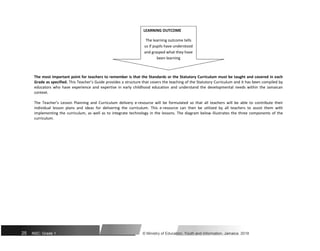
based principles. The primary purpose for this focus is for learners to: (i) become employable (ii) prepare for further education and/or
for occupational or work readiness.
311 NSC: Grade 1 © Ministry of Education, Youth and Information, Jamaica. 2018
STEM as types of institutions in which learning is organized as a meta-discipline as described by Morrison and Bartlet (2009). Based on
this perspective, STEM facilitates the demonstration of knowledge in a manner that removes the boundaries of each discipline for
application to problem as would be practised in the real world.
IMPLICATIONS OF PERSPECTIVES OF STEM/STEAM IN LIGHT OF THE NSC
Since the NSC is based on Constructivism principles, STEM/STEAM as an approach and methodology, has to be established on post-positivistic
thinking. From this position, STEM/STEAM influences the kind of practice that promotes collaboration, negotiation of meaning and openness to
scrutiny.
The NSC developers selected a Constructivist approach that included the deliberation, designing and development stages of the curriculum
process. Evidence of the influence of Constructivism can be seen the NSC Framework Document that conveys the following emphasis:
(i) The element of objectives is presented in two forms; firstly as Learning Objectives to focus attention on process and experience
rather than product. Secondly as Learning Outcomes that serve as some of the outputs of the process. They include the basic
understandings, skills and dispositions anticipated from learners’ engagement in the planned experiences.
(ii) The element of content is treated as contexts for learners to think critically, solve problems creatively while developing their identity as
Jamaicans. Content is not expected to be treated as disciplines to be mastered but as areas that contribute knowledge, skill sets and
attitudes that form the composite of competencies to be acquired from their integration in the learning situations.
(iii) The element of learning experiences (method) is presented as a set of learning activities that serves as a source of problems to be
addressed as a part of the learning process. These real-life activities provide the scope of knowledge, skills and required dispositions
or character traits for learners to make sense of that aspect of life or the world that they represent. They are the threads that
connect all the other elements of the curriculum and allow for the integration of STEM/STEAM in the following ways:
 Identification of activities that are presented as problems to be solved using the STEM/STEAM approach based on contextual
312 NSC: Grade 1 © Ministry of Education, Youth and Information, Jamaica. 2018
 Integrating activities to form a real problem to be solved as a short, medium or long term project to which the project based
learning would be applied.

 The examination of learning activities by learners and teachers as co-learners through multiple lenses using content of
science, technology, mathematics and the humanities that they have already explored to engage in the problem identification
and definition processes.

 Extending learning in the formal setting to the informal by connecting co-curricular initiatives that are STEM/STEAM based that
learners are undertaking at the institutional level through clubs and societies, as whole school projects or in partnership with
external stakeholders.

 Using the learning activities to review STEM/STEAM initiatives that form a part of the informal curriculum to and for reflection
on action.

 Using activities as springboards for reflecting on career or occupational interest in STEM/STEAM related areas.

(iv) The element of evaluation is communicated in two major ways; firstly as prior learning which serves diagnostic purpose and
secondly as an on-going developmental process. This formative focus is indicated by the inclusion of explicitly stated assessment
criteria that are to be used alongside the learning activities. The use of assessment criteria as counterparts of the learning activities
also indicates that assessment is learner centred since it is serving developmental rather than promotional purpose and as a
consequence, allows learners to self-correct as they use feedback to develop feed-forward capabilities. Evidence of learning, based
on the learning outcomes, can be collected from various types of assessment methods that emphasize the learner centred
constructivist orientation. This brings to the fore the need for serious consideration to be given to differentiation in assessment for
fairness and credibility of claims about learners’ capabilities and to inform decisions that will impact their educational journey.
313 NSC: Grade 1 © Ministry of Education, Youth and Information, Jamaica. 2018
In general, this integrated approach, which is the context of STEAM, is aimed at improving the quality of the educational experience for
learners while influencing the achievement of the aims of education that relate to productivity and creativity as part of the profile of
the Jamaican learner.
REFERENCES
1. Jolly, A. (2014). STEM vs. STEAM: Do the Arts belong? Retrieved from: http://www.edweek.org/tm/articles/2014/11/18/ctq-
jolly-stem-vs-steam.html
2. Morrison, J., Raymond, V. & Barlett, B. (2009). STEM as a curriculum: An experiential approach. Retrieved
from: http://www.edweek.org/ew/articles/2009/03/04/23bartlett.h28.html
3. Sousa, D., Pilecki, T. (2013). STEM to STEAM: Using brain compatible strategies to integrate the Arts. London:
SAGE Publications Ltd.
4. Trochim, Williams, M.K., (2006). Positivism & post-positivism. Web Centre for Social Research Methods. Retrieved
from: http://www.socialresearchmethos.net/kb/positivsm.php
314 NSC: Grade 1 © Ministry of Education, Youth and Information, Jamaica. 2018
NATIONAL STANDARDS CURRICULUM GUIDE
NSC THE 5Es
315 NSC: Grade 1 © Ministry of Education, Youth and Information, Jamaica. 2018
The 5Es Overview: “The 5E Learning Cycle”
What is a 5E Learning Cycle?
This model describes an approach for facilitating learning that can be used for entire programmes, specific units and
individual lessons. The NSC supports the 5E constructivist learning cycle, as it places emphasis on the processes that may be
used to help students to be personally involved in the learning situation as they are guided to build their own understandings
from experiences and new ideas.
316 NSC: Grade 1 © Ministry of Education, Youth and Information, Jamaica. 2018
Figure 1. Illustrating one version of the 5E model that conveys the role of evaluation as an interconnecting process that is at
the core of the learning experience.
Figure 2, illustrating a cyclical perspective of the model with each process being given similar emphasis in contributing to
the learning experience on a whole
EXPLANATION OF THE INSTRUCTIONAL MODEL
What are the 5Es?
The 5Es represent five key interrelated processes that provide the kind of learning experiences for learners to experience the
curriculum or planned learning episodes: Engage, Explore, Explain, Extend (or Elaborate), and Evaluate.
ENGAGE: The purpose of the ENGAGEMENT dimension is to help students to be ready intellectually, socially, emotionally
etc. for the session. Attention is given to the students’ interests and to getting them personally involved in the lesson, while pre-
317 NSC: Grade 1 © Ministry of Education, Youth and Information, Jamaica. 2018
assessing prior understandings, attitudes and/or skills. During the experience, students first encounter and identify the
instructional task and their roles and responsibilities. During the ENGAGEMENT activity, students make connections between past
and present learning experiences, setting the organizational groundwork for upcoming activities. The engagement activity may be
used to (a) help student unearth prior knowledge (b) arouse their curiosity (c) encourage students to ask questions as a sign that they
have wonderments or are puzzled.
EXPLORE: The purpose of the EXPLORATION dimension is to get students involved in solving a real problem that is
based on a selected context. EXPLORATION provides them with a chance to build their own understanding of the
phenomenon being investigated and the attitude and skills involved for arriving at a workable solution. In exploring the
students have the opportunity to get directly involved with the phenomenon and materials. As they work together in learning teams
or independently, the need to share and communicate becomes necessary from the experiences. The teacher functions as a facilitator,
providing materials, guarding against obstacles to learning and guiding the students to operate based on agreements. The students
become inquirers and co-owners of the learning process. In exploring, they also ask questions, formulate hypothesis, search for
answers or information/data, reflect with others, test their own predictions and draw conclusions.
EXPLAIN: The purpose of the EXPLANATORY dimension is to provide students with an opportunity to assess their thinking and
to use intellectual standards as critical thinkers to communicate their perspectives and/or the meaning of the experiences. They rely on
communication tools and their skills as Language users to: (a) organize their thoughts so that they are clear, relevant, significant, fair,
accurate etc. (b) validate or affirm others (c) self-motivate. Reflection also occurs during the process and may cause students to adjust
318 NSC: Grade 1 © Ministry of Education, Youth and Information, Jamaica. 2018
their perspective or justify their claims and summarise the lessons being learned. Providing explanations contributes to vocabulary
building and self-corrective actions to deal with misconceptions that they become aware of from feedback of their peers and/or
their facilitator.
EXTEND: The purpose of this dimension is to allow students to use their new knowledge and continue to explore its
significance and implications. Students work independently or with others to expand on the concepts and principles they have
learned, make connections to other related concepts and principles within and/or across disciplines, and apply their understandings in
new ways to unfamiliar situations.
EVALUATE: The purpose of the EVALUATION dimension is for both students and facilitator to determine progress being
made or the extent to which learning has taken place based on the stated objectives or emergent objectives. EVALUATION is
treated primarily as an on-going diagnostic and developmental process that allows the learner to become aware of gaps to be treated
and progress made from their efforts to acquire the competencies that were the focus of the session. Examples of competencies include
understanding of concepts, principles and processes and demonstrating various skills. Evaluation and assessment can occur at different
points during the learning episode. Some of the tools that assist in this diagnostic and formative process include rubrics, teacher
observation log, self-inventories, peer critique, student interviews, reflective presentations, displays/expositions, portfolios,
performances, project and problem-based learning products. Analysis of reflections, video recordings are useful in helping students to
determine the depth of their thinking and understanding and the objectives they have or have not achieved.
319 NSC: Grade 1 © Ministry of Education, Youth and Information, Jamaica. 2018
Who developed the 5E model?
The Biological Science Curriculum Study (BSCS), a team led by Principal Investigator Roger Bybee, developed the
instructional model for constructivism, called the "Five Es".
The Link between the 5E model and Types of Learning Activities
The five (5) types of Learning Activities purported by Yelon (1996) can be integrated with the 5E’s so as to enrich the teaching
and learning process. He noted that every instructional plan should include the following learning activities
1. Motivation Activities: Intended to help learners to be ready for the session
2. Orientation Activities: Inform students of their roles and responsibilities based the purpose or objectives of a learning episode.
3. Information Activities: Allow students to manipulate current knowledge, access/retrieve and generate new ideas
4. Application Activities: Allow for the use of knowledge and skills in novel situations
5. Evaluation Activities: Allow for reflection, corrective actions and sourcing of evidence to confirm/refute claims about
learning.
These activities can be planned to serve one of the purposes of each dimension of the 5E model. For example, ENGAGEMENT may
be comprised a Motivation Activity and an Orientation Activity. EXPLORATION and EXPLANATION require an Information
Activity, while EXTEND requires an Application Activity. EVALUATION requires the kind of activity that will contribute to the
collection of data for assessing and arriving at a conclusion about performance based on stated or expected purpose for which
learning is being facilitated.
320 NSC: Grade 1 © Ministry of Education, Youth and Information, Jamaica. 2018
References
Meegan, G. (2017). The intellectual standards. Retrieved from https://theelementsofthought.org/the-intellectual-standards/
The 5 E Model (n.d.). Retrieved from http://tiny.cc/7ogijy
The 5 E Model (n.d.). Retrieved from http://tiny.cc/oogijy
321 NSC: Grade 1 © Ministry of Education, Youth and Information, Jamaica. 2018
NATIONAL STANDARDS CURRICULUM GUIDE
ATTAINMENT TARGETS
322 NSC: Grade 1 © Ministry of Education, Youth and Information, Jamaica. 2018
ATTAINMENT TARGETS
GRADE 1
SUBJECTS ATTAINMENT TARGETS
LANGUAGE ARTS Speaking and Listening
Communicate with confidence and competence for different purposes and audiences, using
SJE and JC appropriately and creatively
Listen to, recall, understand and respond to speakers’ messages, whether implicit or explicit
Recognise, value and make distinctions between home language and SJE to improve/acquire
language and literacy competencies
Explain and comment on speakers’ use of language, including use of SJE and JC, and their use
of vocabulary, grammar and other features
Reading with Fluency and Recognition
 Read fluently and with appreciation
 Automatically recognise words (including basic sight word lists) through repeated exposure
and mnemonic devices

 Establish a concept of print and use a range of word recognition clues, re-reading and
reading ahead, to identify new words
 Develop phonic awareness and use knowledge of letter-sound correspondences in order to
decode unfamiliar words
Reading for Meaning and Enjoyment
 Read for meaning, fluency and enjoyment of texts, using a variety of clues to gain
information and identify ideas and events

 Use deduction and inference to interpret information and ideas and to predict outcomes
 Identify and comment on the structure of texts and on the language choices, grammar
and techniques writers use to create an impact
 Reflect on and critically respond to literature and other texts, on paper and on screen
Reading for Information
 Research activities on issues and interests by generating ideas and exploring texts using a
range of strategies
323 NSC: Grade 1 © Ministry of Education, Youth and Information, Jamaica. 2018
 Identify and use text features to support navigation of texts, retrieve and synthesize
information gained from a range of sources
Writing: Communication
 Develop approaches to the writing process to enable them to organise their ideas into a
coherent structure including, layout, sections and paragraphs
 Write to narrate, to persuade and for a range of transactional purposes, using SJE and JC
appropriately and incorporating multi -media approaches to their writing
 Use language and text forms appropriately and with imagination to create vibrant and
engaging texts
Write well-constructed paragraphs which have linking sentences within and between them
Writing: Language Structure
Use and adapt a range of sentence structures according to context, distinguishing between
SJE and JC
Write sentences which are grammatically accurate and correctly punctuated, using SJE and JC
appropriately
Use a range of punctuation correctly
MATHEMATICS AT1a. Know the value of numerals, associate them with their names, numbers, ordinals
and use concrete objects to model patterns, expression and numbers
AT1b. Use the basic operations, number relationships, patterns, number facts,
calculators and appropriate software to compute and estimate in order to solve real
world problems involving fractions, percentages and decimals.
AT2.Use the correct units, tools and attributes to estimate, compare and carry out the
processes of measurement to given degree of accuracy.
AT3 Explore paths, geometric shapes and space and make generalization about
geometric relationships within the environment
AT4. Employ algebraic reasoning through the use of expressions, equations and formulae
to interpret, model and solve problems involving unknown quantities
AT5. Collect, organise, interpret and represent data and make inferences by applying
knowledge of statistics and probability.
324 NSC: Grade 1 © Ministry of Education, Youth and Information, Jamaica. 2018
SCIENCE Begin to explore the environment in order to relate everyday experiences to
simple scientific concepts and processes.
Begin to understand and apply aspects of the scientific method.
Begin to explore selected life processes in humans, the interdependence
between living things in the environment, and how lifestyles determine health
and well-being in humans.
Begin to appreciate the impact of selected human activity and natural
phenomena on the environment.
Begin to explore the properties of various materials, substances, selected
forces and forms of energy through the use of the senses.
Begin to demonstrate stewardship for living things and the environment.
Begin to demonstrate a positive attitude towards the use of scientific
language.
Begin to demonstrate positive interpersonal skills in order to foster good
working relationships.
325 NSC: Grade 1 © Ministry of Education, Youth and Information, Jamaica. 2018
NATIONAL STANDARDS CURRICULUM GUIDE
LESSON PLANS
326 NSC: Grade 1 © Ministry of Education, Youth and Information, Jamaica. 2018
NATIONAL STANDARDS CURRICULUM GUIDE
INTEGRATED STUDIES
327 NSC: Grade 1 © Ministry of Education, Youth and Information, Jamaica. 2018
Integrated Lesson Plan
Theme: Who AM I?
Focus Question: How do you know me?
Term 1: Date: Subject: Integrated Studies Duration: 3 HOURS
Objectives
 Talk about self, using factual expressions. For example,
“I am a boy/girl.”

“I am six/seven years old.”
“I am a Jamaican.”
“I am a handsome/beautiful Jamaican boy/girl.”

 Share personal character traits. For example,
“I am very moody when I feel uncomfortable/unhappy.”
“I like when others say good things about me.”
“I do not enjoy reading aloud to my classmates.”

 Develop a clear and fluent handwriting style.
 Write letters, correctly formed and oriented, using a comfortable and appropriate pencil grip
 Use body percussion effectively to accompany, beat and rhythm of the music
 Write sentences using capital letters and full stop correctly
 Use simple movements associated with jingles/songs to share information about themselves. For example,
“Who is coming next?”
“Those who were born in (month) skip around.”
 Talk about self as part of a family. For example,
“I am an only child.”
328 NSC: Grade 1 © Ministry of Education, Youth and Information, Jamaica. 2018
“I have one big sister.”
“I have a little brother.”
 Recognize the number names “zero” through “nineteen” and associate them with sets having the corresponding number
of members

 Write the numerals zero through nineteen and associate them with the corresponding words
 Identify the months of the year and the days of the week
 Associate month with events such as school activities, holidays, birthdays
 Use a calendar in class and refer to it at appropriate times
Key concepts/ Vocabulary:
Name; male; female; gender;
relatives; movement; family; Who
am I; What do I look like; What is
my name; To which family do I
belong; family name
/lineage/surname.
Resources/Equipment: Skills:
Markers  Discuss their identity
Cartridge paper
 Question, observe and explore Who I am
 Draw portraits
 Paint
 Listen
 Trace letters
 Write name and short sentences
Engage/Starter/ warm up / Introduction:
The Pageant
Stand and introduce themselves to the class, noting their full name; how old they are; to which parish they belong and what is their
favourite animal/sporting activity.
329 NSC: Grade 1 © Ministry of Education, Youth and Information, Jamaica. 2018
Teaching/Learning /Main Activities:
SESSION 1
1. In pairs, children talk about who they are; what they look like; what they like and or don’t like; in which parish
they live, the name of the country in which they live and in which country were they born. Pairs will then engage
in a "Square and Share" activity to share their information. (Exploration and Explanation)
2. Have children sing a familiar song about “me”. For example, Jesus loves me this I know; I love you/me by Barney;
I am a promise. Allow students to personalize the songs by inserting their names in the songs as they sing. Ensure
that children use body percussion to the beat and rhythm while they are singing. (Extension)
3. Have children select their names from a given pile. Have them talk about their names, what is their first name; what
letter it starts with; how many letters are in their first name. Have the same discussion about their surname.
4. Have children colour/ decorate their names. When they are through colouring/ decorating their names play the
game “Who is coming next Punchinello little fellow?” Have the children place all the names in a bag. Have a child
select and show the selected name to the class. The child whose name it is must identify his or her name after which
he or she does an action for the others to imitate.
Exploration/Teaching/Learning /Main Activities:
SESSION 2
1. Have students listen to a story about names. (See Appendix)
2. Children talk about the story. Share in whole group their names and why it is important to have short names.
3. Talk about their family names. Discuss why their family/surnames are important. Talk about how they got their surname.
Discuss what would happen at home or at school everyone had the same first and last name.
4. Do a name sort in class. Have the children see if anyone else in the class has either his/her first or last name or names made
up of the same letters. Let them solve the problem of what teacher should do so as to know each student differently.
5. Individually, students count and tell the number of letters in their names. Challenge the student to pair with someone else
and see who has more/same/fewer letters in their names. Also, let them tell and write how many letters are there altogether
in their name.
6. Have children tell, then find and circle their birth month on a calendar.
7. Sing and act out the song Those who were born in January skip around.
8. Have children find out the number of students in the class who were born in each month. Have children display the
330 NSC: Grade 1 © Ministry of Education, Youth and Information, Jamaica. 2018
information gathered on a chart using whatever method they choose.
Evaluation:
Students write at least one sentence in their journal about what they learned from the lesson.
Note to teachers:
Those students who cannot write their own sentence should be given the opportunity to see their own sentence written down so that they can
copy the same.
331 NSC: Grade 1 © Ministry of Education, Youth and Information, Jamaica. 2018
Appendix
ACTIVITIES ABOUT NAMES
 Provide name tags for children. Encourage young children to spell their name for you and print their name using a capital
letter of the first letter and lowercase letters for all the other letters. Say the name of each letter as you write it. Allow the
children to write their own names if they can.

 At the end of the Focus Question (Who Am I), provide materials for a craft related to names. Ask the children to stick or
glue their name tag on their craft project and make a display of all the projects.

 Encourage parents and guardians to tell children why they were given their particular names.

 Encourage parents and guardians to look up the meaning of their child’s name on the internet.
STORIES FOR AGES 3 - 7
A My Name is Alice by Jane Bayer The well-known jump rope ditty which is built on letters of the alphabet is illustrated with animals from
all over the world. Help children think of similar chants of their own names!
Catalina Magdalina Hoopensteiner Wallendiner Hogan Logan Bogan Was Her Name by Tedd Arnold Presents the words--and varying forms of
the name--of a classic camp song that dates at least from the 1940s. She had two holes on the bottom of her nose--one for her fingers, and
one for her toes! Though she has two arms that drag along the ground, two feet bigger than a bathroom mat, and just two teeth in her mouth,
life for Catalina is full and fun!
Chrysanthemum by Kevin Henkes (also available as a big book, as a DVD and in other formats.) Chrysanthemum thinks her name is absolutely
perfect, until her first day of school. "You're named after a flower!" teases Victoria. "Let's smell her," says Jo. Chrysanthemum wilts. What will
it take to make her blossom again?
Edmund for Short: A Tale from China Plate Farm by Chris Jackson When Edmund the pig discovers that the cows on China Plate Farm all have
grand names based on their body markings, he decides to mark himself so he can have a grand name of his own, but nobody notices, as a
new calf is being born on the farm.
Andy: That’s My Name by Tomie DePaola
332 NSC: Grade 1 © Ministry of Education, Youth and Information, Jamaica. 2018
Andy's friends construct different words from his name: "an" words, "and" words, and "andy" words.
Call Me Little Echo Hawk by Terry EchoHawk
Every child has a name, and the story of Echo Hawk will motivate children everywhere to seek out stories about their own names. In “Call
Me Little Echo Hawk,” children will also learn to be proud of their heritage and their ancestors.
Christopher Changes His Name by Itah Sadu Christopher. Mulamba is tired of being one of three boys with the same first name in his class, so
he picks out a series of new names honouring a variety of black heroes, from the star of his aunt's Trinidadian folktales to scientist Elijah
McCoy to Michael Jordan, but in the process his own name gets lost.
The First Thing My Mama Told Me by Susan Marie Swanson A young girl celebrates the name that was chosen just for her. “When I was born,
the first thing my mama told me was my name”. Lucy remembers lots of things about her name. Seven-year-old Lucy describes special
memories about her name from each of her birthdays.
Hope by Isabell Monk. Isabell Monk’s depiction of how a girl learns about her rich biracial heritage will help all children see themselves with
pride and self-respect.
I Am Renè, the Boy by Rene Colato Lainez. When Renè learns that his name is also a girl’s name, he does some research and relates the name’s
meaning and letters to his homeland of El Salvador and the things that make him special.
Ivan to Make You Laugh: Jokes about Novel, Nifty, and Notorious Names by Sam Schultz Presents a variety of jokes about people’s names.
Josephina Hates Her Name by Diana Engel. After Grandma explains that she named Josephina after her talented, daring older sister, Josephina
starts to appreciate her unusual name.
A Lion Named Shirley Williamson by Bernard Waber. The lions at the zoo are jealous of the new lioness because of her fancy name and
because of the special treatment she receives from the Zookeeper.
Merry Christmas, What’s Your Name by Bernice Chardiet
When a little girl changes her name to one she likes better, she starts a trend among her classmates that leads to complete confusion.
333 NSC: Grade 1 © Ministry of Education, Youth and Information, Jamaica. 2018
Mommy Doesn’t Know My Name by Suzanne Williams. This loving and humorous story depicts frustrated Hannah, who tries to get her mother
to call her by her real name rather than the pet names she uses.
My Name Is Yoon by Helen Recorvits Disliking her name as written in English, Korean-born Yoon, or “shining wisdom,” refers to herself as “cat,”
“bird,” and “cupcake,” as a way to feel more comfortable in her new school and new country.
Name Games: Using Children’s Names to Link Oral Language and Print by Traci Ferguson Geiser.
This teacher resource is rich in phonics and oral language practice. Each of the ten complete lesson cycles culminates in a unique bookmaking
activity. Loaded with reproducibles, Name Games keep teacher preparation time to a minimum.
The Name Jar by Yangsook Choi. Being the new kid in school is hard enough, but what about when nobody can pronounce your name? Having
just moved from Korea, Unhei is anxious that the kids will like her. So instead of introducing herself on the first day of school, she tells the class
that she will choose a name by the following week. Her new classmates are fascinated by this no-name girl and decide to help out by filling a
glass jar with names for her to pick from.
Nutty Names: A Book of Name Jokes by Mark Ziegler The only thing kids think is funnier than a good joke is… more good jokes!
These supercharged joke books contain more jokes than ever. Get ready to laugh!
The Other Emily by Gibbs Davis
Emily believes her name belongs to her alone, but on the first day of school, she discovers she is not the only Emily in the world.
A Perfect Name by Charlene Costanza
Mama and Papa Potamus try out many different names for their newborn daughter before finding just the right one in time for her
naming ceremony.
Rumpelstiltskin by Paul O. Zelinsky
A strange little man helps the miller's daughter spin straw into gold. In this highly inventive and splendid rendering of a favourite Grimm fairy
tale, award-winning storyteller and illustrator Paul O. Zelinsky evokes a world of Medieval magic.
Santa’s Book of Names by David McPhail
334 NSC: Grade 1 © Ministry of Education, Youth and Information, Jamaica. 2018
A young boy who has trouble reading, helps Santa with his yearly rounds and receives a special Christmas present.
Three Names of Me by Mary Cummings
A girl adopted from China explains that her three names--one her birth mother whispered in her ear, one the babysitters at her orphanage called
her, and one her American parents gave her--are each an important part of who she is. Includes scrapbooking ideas for other girls adopted from
China.
Tikki Tikki Tembo by Arlene Mosel This story why the Chinese no longer honor their firstborn with an unusually long name such as “Tikki tikki
tembo-no sa rembo- chari bari ruchi-pip peri pembo!” This re-creation of an ancient Chinese folktale has hooked legions of children, teachers,
and parents, who return, generation after generation, to learn about the danger of having such an honorable name, especially when one falls
into a well.
335 NSC: Grade 1 © Ministry of Education, Youth and Information, Jamaica. 2018
NATIONAL STANDARDS CURRICULUM GUIDE
LANGUAGE ARTS
336 NSC: Grade 1 © Ministry of Education, Youth and Information, Jamaica. 2018
Grade: One
Subject: Language Arts
Time: One hour
Strand: Writing
Topic: Story Writing
Objectives: Pupils should be able to:
1. Review and present constructive criticism on the writing of their peers
2. Use an editing checklist to identify errors in the writing of their peers
Materials: drafts of students’ stories, editing checklists, sticky note pad
Procedure
Engage
Whole Group Activity
Students observe as teacher models the editing stage of the writing process by using a checklist to review a sample of writing. Students
participate by giving feedback as teacher uses the Think Aloud Strategy to identify errors. Teacher will use sticky notes to highlight the errors.
337 NSC: Grade 1 © Ministry of Education, Youth and Information, Jamaica. 2018
e.g. my friend and I played football. the rain fall.
we get wet.
We stoped playing and goed home.
My mother was sad. I was cold
Pupils review sticky notes, discuss and make suggestions for correcting the errors.
Explain
Pupils will be given the checklist and will review and give examples of each
criterion. https://www.pinterest.com/explore/writing-checklist/
338 NSC: Grade 1 © Ministry of Education, Youth and Information, Jamaica. 2018
Explore
Sentence strips with sentences to be edited will be placed around the classroom. Students will be given 2 samples of the checklist to edit any
two sentences placed around the classroom. Students will write their corrected versions on post it notes. Students will share corrected versions
with class by sticking the post it notes under the strips they edited.
Extend/Elaborate
Pair Activity
Pupils will exchange story drafts, then use the checklist to identify errors. Using the sticky notes, they will note the errors.
Whole Group Activity
Pupils share some of the errors with the class. Together the class will make suggestions for correcting these errors. Teacher/students will record
the suggestions on whiteboard/flip chart paper.
Independent Activity
Pupils will use sticky notes and suggestions to make amendments to their drafts.
Evaluate
339 NSC: Grade 1 © Ministry of Education, Youth and Information, Jamaica. 2018
NATIONAL STANDARDS CURRICULUM GUIDE
MATHEMATICS
340 NSC: Grade 1 © Ministry of Education, Youth and Information, Jamaica. 2018
Ministry of Education, Youth & Information
Lesson Plan
Lesson Plan Lesson Plan
Grade: 1
Topic: Fraction of an Object
Grade: 1
Term 1: Date: Subject: Mathematics Duration: 1 hour
Objectives
ï Tell whether or not a given picture shows fourths (quarters)
ï Show one fourth of a given object.
ï Identify different ways to show given quantities (quarters).
Key concepts / Resources/Equipment: Skills:
Vocabulary:
ï Geoboard
ïUse Geoboard to show
ï Quarter
quarters/fourths
ï Plain paper ïFold paper in four equal part
ï One fourth ï Dotted square paper ïDivide dotted square in
ï Square region ï Elastic bands various ways to show
ï Bullas quarters
Starter: Give students various picture puzzle pieces cut in four equal parts to fit together.
Have them fit the pieces together and tell what they notice about the puzzle pieces (they are
cut into four equal pieces). Have them tell/show how they know that the pieces are the same
in shape and size.
341 NSC: Grade 1 © Ministry of Education, Youth and Information, Jamaica. 2018
Ministry of Education, Youth & Information
Teaching/Learning/Exploring Activities:
ï Have students work in cooperative groups of four to cut a bulla into four equal parts.
ï Allow students to explain how they went above cutting the bulla into four equal parts.
ï Teacher cuts one bulla into two equal parts and have children identify the fraction that
each piece represents. Teacher cuts one of the halves in two equal parts and ask students
to tell/guess what one of those pieces represents. If students can’t tell, teacher further
cuts the other half in two equal parts and ask students to tell what fraction each piece
represents.
ï Have students recognize that each piece is called one quarter or one fourth.
ï Have children give examples of where or when do they ever hear or used the
word quarter.
ï Have children use the four quarters to show
 one fourth/one quarter

 one half

 tell how many fourths make a half

 what fraction of a half is a quarter/fourth

 how many halves are there in 1 whole

ï Draw students’ attention to two fourths and one half representing the same piece of bulla.
ï Provide students in cooperative groups of 5 with Geoboards and elastic bands to
show quarters.
ï Have students use cut out circles to represent the fractions drawn on Geoboard.
ï Give each cooperative learning group a copy of the following diagram:
342 NSC: Grade 1 © Ministry of Education, Youth and Information, Jamaica. 2018
Ministry of Education, Youth & Information
Have students prove that the square is divided into fourths/quarters.
Assessment:
ï Have students divide dotted squares into quarters/fourths in different ways. All
students are given the same four colours to work with. Have students colour each
square using a different colour for each quarter. (the aim is to create a class quilt)
Students may take these home to finish.
Evaluation/Reflection:
Which mathematical skills are developed? (Problem solving, communication,
reasoning, connections, and representation.
343 NSC: Grade 1 © Ministry of Education, Youth and Information, Jamaica. 2018
Ministry of Education, Youth & Information
How did the activities help the students understand the concepts of whole, halves and
quarters and the relationships they share among themselves?
Does the lesson give children opportunities to activate prior knowledge, acquire knowledge,
understand knowledge, use knowledge and reflect on knowledge?
How did the teacher use the activities to assess students’ understanding of whole, halves
and quarters?
Evaluation / Reflection:
Were students able to:
ï fold a given square into quarters?
ï identify the quarters in given shapes?
ï divide other shapes in quarters (fourths)?
ï tell how many quarters in a half ?
ï tell how many quarters in a whole?
344 NSC: Grade 1 © Ministry of Education, Youth and Information, Jamaica. 2018
Ministry of Education, Youth & Information
Dot Paper Squares
· · · · · · ·
· · · · · · ·
· · · · · · ·
· · · · · · · · ·
· · · · · · · · ·
·
· · · · · · · · ·
· · · · · · · ·
· · · · · · · · ·
· · · · · · · · ·
· · · · · · · ·
345 NSC: Grade 1 © Ministry of Education, Youth and Information, Jamaica. 2018
Ministry of Education, Youth & Information
346 NSC: Grade 1 © Ministry of Education, Youth and Information, Jamaica. 2018
Ministry of Education, Youth & Information
347 NSC: Grade 1 © Ministry of Education, Youth and Information, Jamaica. 2018
Ministry of Education, Youth & Information
Number lesson Plan
Topic: Multiplication (repeated addition) Duration: 60 minutes
Objectives
Students should be able to:
ï State, using multiplication ideas, in a sentence the idea of repeated addition of the
same number (e.g. moving from 3+3+ 3+3 to 4×3)
ï Differentiate between the use of multiplication and addition to find “How many in all”
ï Show the correct multiplication facts for a repeat addition, example, by use of an array.
Key concepts / Resources/Equipment: Skills:
Vocabulary: plain paper, dice , pencil ï Drawing sets
Repeated addition ; ï Writing multiplication facts
multiplication; times; array; ï Making an array
facts
Starter:
ï Let’s find out how many oranges in total are in the 4 heaps.
ï How did you get your answer? What method did you use?
Teaching/Learning /Main/Exploring Activities:
Let’s investigate the calculation we use to find the total
when there are the same number of items in several groups.
348 NSC: Grade 1 © Ministry of Education, Youth and Information, Jamaica. 2018
Ministry of Education, Youth & Information
1. Pupils play the game CIRCLES AND STARS
Pupils, in pairs, take turn and throw the die twice. On the first throw the
pupilsdraw the circles and on the second throw draw the stars in the circle. For
example if the first number is 3 and the second one is 4 then the pupil would draw 3
circles with 4 stars in each circle. Then write the multiplication facts beneath each
game.
2. After each pair plays 6 times, the teacher asks what products were obtained and
how. Pupils write the results on the chalkboard.
1 1×1
2 1×2 2×1
3 1×3 3×1
4 1×4 2×2 4×1
5 1×5 5×1
6 1×6 6×1 2×3 3×2
3. Students create their own array, show it to their elbow partner.
4. The answer is 10. What is the question?
Extension
ï Solve:
“Come into my parlour”
Said the spider to the fly.
“Answer now my question
Unless you want to die.
349 NSC: Grade 1 © Ministry of Education, Youth and Information, Jamaica. 2018
Ministry of Education, Youth & Information
To give me twenty-eight fly legs
The number I desire
How many flies
Am I going to require?
Technology Integration possibility:
Numeric Interactive Software: Fractions_06
350 NSC: Grade 1 © Ministry of Education, Youth and Information, Jamaica. 2018
Ministry of Education, Youth & Information
Number - Lesson #5
Topic: Fractions (of a set of objects) Duration: 60 minutes
Objective:
ï Use numerals 21 and 14 to describe halves and fourths of an object or a set of objects.
Key concepts / Vocabulary: Resources/Equipment: Skills:
quarter, one fourth, half. Counters, students worksheet ïDividing in 2 or 4 equal
parts
Starter:
Sing ‘fractions’ song. Distribute to pairs of students 8 candies (skittles). Have students recognize
that the 8 candies make one whole. Have them divide their whole in two equal parts, then further
divide each halves into two again (to get quarters). Students will explain what they have done and
describe how many they have in each group. They will be allowed to eat the candies at the end of
the class.
Teaching/Learning /Exploring Activities:
1. Give 24 counters/pebbles to each group of students (maximum six students).
2. Have students make two equal groups from the set counters/pebbles.
3. Discuss with class the number of counters in each group and say what fraction of the
whole each group represents.
4. Have students share the counters in four equal groups. How many would be in each
group? What fraction of the counter is each group?
5. Place students in groups of 8. At the start of selected music they will quickly move to form
groups representing given fractions 1 , 1.
2 4
6. Students to consider: Each parish capital in Jamaica has a Mayor in the Parish Council. A
half of this number represents men. Draw pictures showing all the mayors and indicate
those that are men.
351 NSC: Grade 1 © Ministry of Education, Youth and Information, Jamaica. 2018
Ministry of Education, Youth & Information
Plenary: A fraction can be part of a whole object or a set of objects.
Assessment:
1. Given a work sheet, students divide the various sets of objects as directed.
2. Also have students colour each required fraction using a different colour for each.
Evaluation / Reflection:
Were students able to:
Which mathematical skills are developed? (Problem solving, communication, reasoning,
connections, and representation.
How the activities did helped the students understand the concepts of partitioning different sets
of objects into equal parts?
Does the lesson give children opportunities to activate prior knowledge, acquire
knowledge, understand knowledge, use knowledge and reflect on knowledge?
How did the teacher use the activities to assess students’ understanding of partitioning?
352 NSC: Grade 1 © Ministry of Education, Youth and Information, Jamaica. 2018
NATIONAL STANDARDS CURRICULUM GUIDE
TEACHING MATHEMATICS:
IDEAS & ACTIVITIES
353 NSC: Grade 1 © Ministry of Education, Youth and Information, Jamaica. 2018
Ministry of Education, Youth & Information
Teaching Mathematics through Games
Alpha-Bits
All 26 letters of the English alphabet are in a bag. The vowels are A, E, I, O, U and sometimes Y.
1. How many possible outcomes are there when drawing a letter from the bag?
2. What are the chances of drawing a vowel form the bag?
3. What are the chances of drawing a consonant from the bag?
4. What are the chances of drawing the letter:
B? K?
Z? A?
5. If two of each vowel are placed inside the bag, along with one of each consonant, what are the chances of drawing a vowel?
6. If the letters A through J are removed from the bag, what are the chances of drawing the letter M? and U?
7. If the vowels are removed from the bag, what are the chances of drawing a consonant?
8. If the blocks for the numbers 1-9 are combined with the 26 letter blocks, what are the chances of drawing:
1. A number? 2. A letter 3. A vowel 4. A consonant
354 NSC: Grade 1 © Ministry of Education, Youth and Information, Jamaica. 2018
Ministry of Education, Youth & Information
Teaching Mathematics through Games
Fraction Activity
Instruction: Insert the following fractions so that each row and column adds to give one (1).
1
2
1
32
3
8
7
16
5
32
1
16
1
4
5
8
3
16
17
32
1
8
9
32
355 NSC: Grade 1 © Ministry of Education, Youth and Information, Jamaica. 2018
Ministry of Education, Youth & Information
MULTIPLICATION CHART
356 NSC: Grade 1 © Ministry of Education, Youth and Information, Jamaica. 2018
Ministry of Education, Youth & Information
Fraction Activity
Instruction: Insert the following fractions so that each row and column adds to give one (1).
1
2
1
32
3
8
7
16
5
32
1
16
1
4
5
8
3
16
17
32
1
8
9
32
357 NSC: Grade 1 © Ministry of Education, Youth and Information, Jamaica. 2018
Ministry of Education, Youth & Information
358 NSC: Grade 1 © Ministry of Education, Youth and Information, Jamaica. 2018
Ministry of Education, Youth & Information
150 Teaching Methods
1. Lecture by teacher (and what else can you do!)
2. Class discussion conducted by teacher (and what else!)
3. Recitation oral questions by teacher answered orally by students (then what!)
4. Discussion groups conducted by selected student chairpersons (yes, and what else!)
5. Lecture-demonstration by teacher (and then what 145 other techniques!)
6. Lecture-demonstration by another instructor(s) from a special field (guest speaker)
7. Presentation by a panel of instructors or students
8. Presentations by student panels from the class: class invited to participate
9. Student reports by individuals
10. Student-group reports by committees from the class
11. Debate (informal) on current issues by students from class
12. Class discussions conducted by a student or student committee
13. Forums
14. Bulletin boards
15. Small groups such as task oriented, discussion, Socratic
16. Choral speaking
17. Collecting
18. Textbook assignments
19. Reading assignments in journals, monographs, etc.
20. Reading assignments in supplementary books
21. Assignment to outline portions of the textbook
22. Assignment to outline certain supplementary readings
359 NSC: Grade 1 © Ministry of Education, Youth and Information, Jamaica. 2018
Ministry of Education, Youth & Information
23. Debates (formal)
24. Crossword puzzles
25. Construction of vocabulary lists
26. Vocabulary drills
27. Diaries
28. Dances of places or periods studied
29. Construction of summaries by students
30. Dressing dolls
31. Required term paper
32. Panel discussion
33. Biographical reports given by students
34. Reports on published research studies and experiments by students
35. Library research on topics or problems
36. Written book reports by students
37. Flags
38. Jigsaw puzzle maps
39. Hall of Fame by topic or era (military or political leaders, heroes)
40. Flannel boards
41. Use of pretest
42. Gaming and simulation
43. Flash cards
44. Flowcharts
45. Interviews
46. Maps, transparencies, globes
47. Mobiles
48. Audio-tutorial lessons (individualized instruction)
49. Models
50. Music
360 NSC: Grade 1 © Ministry of Education, Youth and Information, Jamaica. 2018
Ministry of Education, Youth & Information
51. Field trips
52. Drama, role playing
53. Open textbook study
54. Committee projects--small groups
55. Notebook
56. Murals and montages
57. Class projects
58. Individual projects
59. Quiz down gaming
60. Modeling in various media
61. Pen pals
62. Photographs
63. Laboratory experiments performed by more than two students working together
64. Use of dramatization, skits, plays
65. Student construction of diagrams, charts, or graphs
66. Making of posters by students
67. Students drawing pictures or cartoons vividly portray principles or facts
68. Problem solving or case studies
69. Puppets
70. Use of chalkboard by instructor as aid in teaching
71. Use of diagrams, tables, graphs, and charts by instructor in teaching
72. Use of exhibits and displays by instructor
73. Reproductions
74. Construction of exhibits and displays by students
75. Use of slides
76. Use of filmstrips
77. Use of motion pictures, educational films, videotapes
78. Use of theater motion pictures
361 NSC: Grade 1 © Ministry of Education, Youth and Information, Jamaica. 2018
Ministry of Education, Youth & Information
79. Use of recordings
80. Use of radio programs
81. Use of television
82. Role playing
83. Sand tables
84. School affiliations
85. Verbal illustrations: use of anecdotes and parables to illustrate
86. Service projects
87. Stamps, coins, and other hobbies
88. Use of community or local resources
89. Story telling
90. Surveys
91. Tutorial: students assigned to other students for assistance, peer teaching
92. Coaching: special assistance provided for students having difficulty in the course
93. Oral reports
94. Word association activity
95. Workbooks
96. Using case studies reported in literature to illustrate psychological principles and facts
97. Construction of scrapbooks
98. Applying simple statistical techniques to class data
99. Time lines
100. "Group dynamics" techniques
101. Units of instruction organized by topics
102. Non directive techniques applied to the classroom
103. Supervised study during class period
104. Use of sociometric text to make sociometric analysis of class
105. Use of technology and instructional resources
106. Open textbook tests, take home tests
362 NSC: Grade 1 © Ministry of Education, Youth and Information, Jamaica. 2018
Ministry of Education, Youth & Information
107. Put idea into picture
108. Write a caption for chart, picture, or cartoon
109. Reading aloud
110. Differentiated assignment and homework
111. Telling about a trip
112. Mock convention
113. Filling out forms (income tax, checks)
114. Prepare editorial for school paper
115. Attend council meeting, school board meeting
116. Exchanging "things"
117. Making announcements
118. Taking part (community elections)
119. Playing music from other countries or times
120. Studying local history
121. Compile list of older citizens as resource people
122. Students from abroad (exchange students)
123. Obtain free and low cost materials
124. Collect old magazines
125. Collect colored slides
126. Visit an "ethnic" restaurant
127. Specialize in one country
128. Follow a world leader (in the media)
129. Visit an employment agency
130. Start a campaign
131. Conduct a series
132. Investigate a life
133. Assist an immigrant
134. Volunteer (tutoring, hospital)
363 NSC: Grade 1 © Ministry of Education, Youth and Information, Jamaica. 2018
Ministry of Education, Youth & Information
135. Prepare an exhibit
136. Detect propaganda
137. Join an organization
138. Collect money for a cause
139. Elect a "Hall of Fame" for males
140. Elect a "Hall of Fame" for females
141. Construct a salt map
142. Construct a drama
143. Prepare presentation for senior citizen group
144. Invite senior citizen(s) to present local history to class including displaying artifacts (clothing, tools, objects, etc.)
145. Prepare mock newspaper on specific topic or era
146. Draw a giant map on floor of classroom
147. Research local archaeological site
148. Exchange program with schools from different parts of the state
149. In brainstorming small group, students identify a list of techniques and strategies that best fit their class.
Attachment: 150 Teaching Methods [PDF, 33 KB]
- See more at: http://teaching.uncc.edu/learning-resources/articles-books/best-practice/instructional-
methods/150-teaching-methods#sthash.yM7PA7xP.dpuf
364 NSC: Grade 1 © Ministry of Education, Youth and Information, Jamaica. 2018
Ministry of Education, Youth & Information
THE LAWS OF TEACHING - by John Milton Gregory THE SEVEN FACTORS
1. Teaching has its natural laws as fixed as the laws of the planets or
of growing organisms. It is a process in which definite forces are
employed to produce definite results, and these results follow as
regularly and certainly as the day follows the sun. What the teacher
does, he does through natural agencies working out their natural
effects. Causation is as certain -- if not always so obvious nor so
easily understood -- in the movements of mind as in those of matter.
The laws of mind are as fixed as material laws.
2. To discover the laws of any process, whether of mind or of matter,
makes it possible to bring that process under the control of one who
knows the laws and can command the conditions. Knowledge of the laws
of electric currents has made it possible to send messages through
the oceans; and he who masters the laws of teaching may convey to the
minds of others the experience of the race. He who would gain
harvests must obey nature's laws for the growing of corn, and he who
would teach a child successfully must [16] follow the laws of
365 NSC: Grade 1 © Ministry of Education, Youth and Information, Jamaica. 2018
Ministry of Education, Youth & Information
teaching. Nowhere, in the world of mind or in the world of matter,
can man produce any effects except as he employs the means upon which
those effects depend.
3. Teaching, in its simplest sense, is the communication of
experience. This experience may consist of facts, truths, doctrines,
ideas, or ideals, or it may consist of the processes or skills of an
art. It may be taught by the use of words, by signs, by objects, by
actions, or by examples; but whatever the substance, the mode, or the
aim of the teaching, the act itself, fundamentally considered, is
always substantially the same: it is a communication of experience.
It is painting in the mind of another the picture in one's own -- the
shaping of the thought and understanding to the comprehension of some
truth which the teacher knows and wishes to communicate. Further on
we shall see that the word "communication" is used here, not in the
sense of the transmission of a mental something from one person to
another, but rather in the sense of helping another to reproduce the
366 NSC: Grade 1 © Ministry of Education, Youth and Information, Jamaica. 2018
Ministry of Education, Youth & Information
same experience and thus to make it common to the two.
4. To discover the law of any phenomenon, we must subject that
phenomenon to a scientific analysis and study its separate parts. If
any complete act of teaching be so analyzed, it will be found to
contain seven distinct elements or [17] factors: (1) two personal
factors -- a teacher and a learner; (2) two mental factors -- a
common language or medium of communication, and a lesson or truth or
art to be communicated; and (3) three functional acts or processes --
that of the teacher, that of the learner, and a final or finishing
process to test and fix the result.
5. These are essential elements in every full and complete act of
teaching. Whether the lesson be a single fact told in three minutes,
or a lecture occupying as many hours, the seven factors are all
present, if the work is effective. None of them can be omitted, and
367 NSC: Grade 1 © Ministry of Education, Youth and Information, Jamaica. 2018
Ministry of Education, Youth & Information
no others need be added. If there is a true science of teaching, it
must be found in the laws and relations of these seven factors.
6. To discover their laws, let us pass the seven factors again in
careful review: (1) a teacher; (2) a learner; (3) a common language or
medium of communication; (4) a lesson or truth; (5) the teacher's
work; (6) the learner's work; (7) the review work, which organizes,
applies, perfects, and fastens the work which has been done. Each of
these seven factors are distinguished from the rest by some essential
characteristics; each is a distinct entity or fact of nature. Since
every fact of nature is the product and proof of some law of nature,
each element here described has its own [18] great law of function,
and these taken together constitute The Seven Laws of Teaching.
7. It may seem trivial so, to insist upon all this. Some will say: "Of
course there can be no teaching without a teacher and a pupil,
without a language and a lesson, and unless the teacher teaches and
368 NSC: Grade 1 © Ministry of Education, Youth and Information, Jamaica. 2018
Ministry of Education, Youth & Information
the learner learns; or, finally, without a proper review, if any
assurance is to be gained that the work has been successful. All this
is too obvious to need assertion." So also is it obvious that when
seeds, soil, heat, light, and moisture come together in proper
measure, plants are produced and grow to the harvest; but the
obviousness of these common facts does not prevent their hiding among
them some of the most profound and mysterious laws of nature. So,
too, a simple act of teaching may hide within it some of the most
potent and significant laws of mental life.
369 NSC: Grade 1 © Ministry of Education, Youth and Information, Jamaica. 2018
Ministry of Education, Youth & Information
Teaching Mathematics through Games
Fraction Activity - Solution
1
16
9
32 5 8
1
32
1 4 3 8
1 2
7
16
3
16 17 32
1
8
5
32
370 NSC: Grade 1 © Ministry of Education, Youth and Information, Jamaica. 2018
Ministry of Education, Youth & Information
Teaching Mathematics through Games
Investigations & Their Responses.
1. Identify the numbers that cannot be formed from the sum of consecutive whole numbers.
1 0 + 1 17 8 + 9
2 18 5 + 6 + 7; 3 + 4 + 5 + 6
3 1 + 2 19 9 + 10
4 20 2 + 3 + 4 + 5 + 6
5 2 + 3 21 10 + 11; 6 + 7 + 8
6 1 + 2 + 3 22 4 + 5 + 6 + 7
7 3 + 4 23 11 + 12
8 24 7 + 8 + 9
9 4 + 5; 2 + 3 + 4 25 12 + 13; 3 + 4 + 5 + 6 + 7
10 1 + 2 + 3 + 4 26 5 + 6 + 7 + 8
11 5 + 6 27 13 + 14; 8 + 9 + 10
12 3 + 4 + 5 28 1 + 2 + 3 + 4 + 5 + 6 + 7
13 6 + 7 29 14 + 15
14 2 + 3 + 4 + 5 30 9 + 10 + 11; 6 + 7 + 8 + 9
15 7 + 8; 4 + 5 + 6; 1 + 2 + 3 + 4 + 5 31 15 + 16
16 32
The numbers 2, 4, 8, 16, 32 are identified as not being able to be formed from the sum of consecutive whole numbers. The next in the series
should be 32. But note that these are all powers of 2. So powers of 2 cannot be formed from the sum of consecutive whole numbers.
371 NSC: Grade 1 © Ministry of Education, Youth and Information, Jamaica. 2018
Ministry of Education, Youth & Information
2. Integer triangles are triangles with sides being whole numbers. Identify the length of sides for integer triangles
whose perimeter is 9. Then find those for 10, 11, 12, and 13. Note that the sum of any two sides must be greater
than the third side.
Peri Possible Combinations
7 1 + 3 + 3 2 + 2 + 3
8 2 + 3 + 3
9 3 + 3 + 3 2 + 3 + 4 4 + 4 + 1
10 2 + 4 + 4 3 + 3 + 4
11 3 + 4 + 4 3 + 3 + 5 2 + 4 + 5 1 + 5 + 5
12 2 + 5 + 5 3 + 4 + 5 4 + 4 + 4
13 5 + 4 + 4 3 + 5 + 5 3 + 4 + 6 1 + 6 + 6 2 + 5 + 6
14 2 + 6 + 6 4 + 5 + 5 6 + 4 + 4 3 + 5 + 6
15 5 + 5 + 5 4 + 5 + 6 3 + 5 + 7 2 + 6 + 7 1 + 7 + 7 3 + 6 + 6
16 4 + 5 + 7 5 + 5 + 6 4 + 6 + 6 3 + 6 + 7 2 + 7 + 7
17 1 + 8 + 8 2 + 7 + 8 3 + 6 + 8 5 + 5 + 7 4 + 6 + 7 4 + 5 + 8 3 + 7 + 7
18 6 + 6 + 6 5 + 6 + 7 4 + 6 + 8 2 + 8 + 8 3 + 7 + 8 5 + 5 + 8
19 4 + 9 + 6 3 + 9 + 7 2 + 9 + 8 5 + 5 + 9 3 + 8 + 8 4 + 8 + 7 5 + 8 + 6 6 + 7 + 6 5 + 7 + 7
20 2 + 9 + 9 4 + 8 + 8 6 + 7 + 7 8 + 6 + 6 3 + 9 + 8 4 + 9 + 7 5 + 9 + 6
3. What happens when you add any two, three, four etc consecutive whole numbers? Investigate.
Action Response Example Generalization
Add two consecutive Always an odd number or
13 + 14 = 27 2n + 1
whole numbers one more than twice the first
number
Add three consecutive Three times the middle
whole numbers number 20 + 21 + 22 = 63 3(n + 1)
372 NSC: Grade 1 © Ministry of Education, Youth and Information, Jamaica. 2018
Ministry of Education, Youth & Information
Add four consecutive Even number that is six
11 + 12 + 13 + 14 = 50 4n + 6
whole numbers more than four times the
first number
Add five consecutive Five times the middle 7 + 8 + 9 + 10 + 11 = 45 5(n + 2)
whole numbers number
Add six consecutive Odd number that is fifteen 10 + 11 + 12 + 13 +
6n + 15
whole numbers more than six times the first 14 + 15 = 75
number
Add seven consecutive Seven times the middle 22 + 23 + 24 + 25 + 26 +
whole numbers number 27 + 28 = 175 7(n + 3)
Add eight consecutive Even number which is 28
40 + 41 + 42 + 43 + 44 + 8n + 28
whole numbers more than 8 times the first
number 45 + 46 + 47 = 348
4. Write the factors of numbers and determine the number of odd and even factors of each. Any
patterns?
Number Factors # of odd # of even
factors factors
2 2 0 1
3 3 1 0
4 2, 4 0 2
5 5 1 0
6 2, 3, 6 1 2
7 7 1 0
8 2, 4, 8 0 3
9 3, 9 2 0
10 2, 5, 10 1 2
11 11 1 0
12 2, 3, 4, 6, 12 1 4
13 13 1 0
373 NSC: Grade 1 © Ministry of Education, Youth and Information, Jamaica. 2018
Ministry of Education, Youth & Information
14 2, 7, 14 1 2
15 3, 5, 15 3 0
16 2, 4, 8, 16 0 4
17 17 1 0
18 2, 3, 6, 9, 18 2 3
19 19 1 0
20 2, 4, 5, 10, 20 1 4
21 3, 7, 21 3 0
22 2, 11, 22 1 2
23 23 1 0
24 2, 3, 4, 6, 8, 12, 24 1 6
25 5, 25 2 0
26 2, 13, 26 1 2
27 3, 9, 27 3 0
28 2, 4, 7, 14, 28 1 4
29 29 1 0
30 2, 3, 5, 6, 15, 30 3 3
31 31 1 0
32 2, 4, 8, 16, 32 0 5
33 3, 11, 33 3 0
34 2, 17, 34 1 2
35 5, 7, 35 3 0
36 2, 3, 4, 6, 9, 12, 18, 36 2 6
37 37 1 0
38 2, 29, 38 1 2
39 3, 13, 39 3 0
40 2, 4, 5, 8, 10, 20, 40 1 6
 Two raised to any power has only even factors.

 All numbers with one odd and no even factor are primes.
374 NSC: Grade 1 © Ministry of Education, Youth and Information, Jamaica. 2018
Ministry of Education, Youth & Information
5. When the sum of factors of a given number (excluding the number itself) equals the number itself, the original number
is said to be a perfect number.
Number Factors Sum of factors
6 3 + 2 + 1 6
28 14 + 7 + 4 + 2 + 1 28
What are the next two perfect numbers?
6. Given that each cell is a square, find out how many squares are in the particular grids below. Use the table that follows
to fill the responses.
2 x 2 3 x 3 4 x 4
Grid size # of 1 x 1 # of 2 x 2 # of 3 x 3 # of 4 x 4 # of 5 x 5 Total
1 x 1 1 - - - - 1
375 NSC: Grade 1 © Ministry of Education, Youth and Information, Jamaica. 2018
Ministry of Education, Youth & Information
2 x 2 4 1 - - - 5
3 x 3 9 4 1 - - 14
4 x 4 16 9 4 1 - 30
5 x 5 25 16 9 4 1 55
6 x 6 36 25 16 9 4 91
n x n n 2
(n-1) 2
(n-2) 2
(n-3) 2
(n-4)2
7. When two vertices of a polygon are joined, the resulting line segment is a diagonal. One condition is that the vertices
do not already share a side. Determine the number of diagonals of polygons with sides 4, 5, 6, 7, 8, 9, 10… Investigate
to establish
any pattern.
Number of sides Breakdown of diagonals Number of
of polygon
(+ signs excluded)
diagonals
4 11 2
5 221 5
376 NSC: Grade 1 © Ministry of Education, Youth and Information, Jamaica. 2018
Ministry of Education, Youth & Information
6 3321 9
7 44321 14
8 554321 20
9 6654321 27
10 77654321 35
11
12
n
The number of diagonals, as indicated in the last column, is 2, 5, 9, 14, 20, 27, 35 … You will notice that you add 3, 4, 5,
6, 7, 8 to the preceding numbers to obtain the next in the series. It is clear then, that you will need to add 9 to 35
to get the number of diagonals for a polygon with 11 sides. That is 44. To that you add 10 to get the number of
diagonals for a polygon of 12 sides. The now becomes 54. For a polygon with n sides the result is……..
8. A palindrome is a number that is read the same backwards and forwards. Hence, the numbers 232, 171 and 10601 are
palindromes. Indeed, the year 2002 is a palindrome. Can you identify the year before 2002 that was a palindrome?
377 NSC: Grade 1 © Ministry of Education, Youth and Information, Jamaica. 2018
Ministry of Education, Youth & Information
A number which is not a palindrome may be made into one using one or more steps. To make any number into a
palindrome, the number is reversed and the sum of both is found. Hence 43 + 34 = 77. Forty-three takes one step to become
a palindrome. 68 + 86 = 154; 154 + 451 = 605; 605 + 506 = 1111. The number 68 will take three steps to become a
palindrome. Now try 86.
In the grid below identify all the numbers that will take one step to be made into a palindrome. Following that, identify
those that will take two steps, then those that will take three steps and then those that will take four steps. Seek for patterns.
On a 0 – 99 chart indicate clearly the numbers that
 are already palindromes
 need one step to become a palindrome

 need two steps to become a palindrome
need three steps to become a palindrome
378 NSC: Grade 1 © Ministry of Education, Youth and Information, Jamaica. 2018
Ministry of Education, Youth & Information
0 1 2 3 4 5 6 7 8 9
10 11 12 13 14 15 16 17 18 19
20 21 22 23 24 25 26 27 28 29
30 31 32 33 34 35 36 37 38 39
40 41 42 43 44 45 46 47 48 49
50 51 52 53 54 55 56 57 58 59
60 61 62 63 64 65 66 67 68 69
70 71 72 73 74 75 76 77 78 79
80 81 82 83 84 85 86 87 88 89
90 91 92 93 94 95 96 97 98 99
379 NSC: Grade 1 © Ministry of Education, Youth and Information, Jamaica. 2018
Ministry of Education, Youth & Information
Centre of Interest
The Centre of Interest should have basic supplies such as:
Paper Counters Calculator
Crayons Straws Geoboards
Sharpeners Used matches/ Abacus
Plasticine Toothpicks Graph/Squared paper
Magazines Solids Puzzles
Cuisenaire rods Worksheets Mirrors
Toys Books Water containers
Building blocks Measuring tools Glue
Boxes Strings/Cords Scale/Balance
Cardboard Brown paper Egg cartons
Cartridge paper Sand Primary scissors
380 NSC: Grade 1 © Ministry of Education, Youth and Information, Jamaica. 2018
Ministry of Education, Youth & Information
381 NSC: Grade 1 © Ministry of Education, Youth and Information, Jamaica. 2018
Ministry of Education, Youth & Information
382 NSC: Grade 1 © Ministry of Education, Youth and Information, Jamaica. 2018
Ministry of Education, Youth & Information
383 NSC: Grade 1 © Ministry of Education, Youth and Information, Jamaica. 2018
12 Most Important Things You Can Do To Be
A Teacher of Mathematics
Not too long ago, teachers saw the main goal of math instruction as helping children become proficient in paper and
pencil computation. Today, mathematics instruction is less about teaching basic computation and more about helping
students become creative thinkers who are comfortable with all areas of mathematics and are able to apply mathematical
skills to a range of problem solving situations.
Making these goals a daily part of math instruction may require a shift in the way you think about mathematics
and your role in teaching it. I also offer the following suggestions and examples from actual classroom lessons to help
you rethink your teaching practices.
384 NSC: Grade 1 © Ministry of Education, Youth and Information, Jamaica. 2018
1. Set the following expectation for your students: Do only what makes sense to you.
Too often, students see math as a collection of steps and tricks that they must learn. This misconception leads to
common recurring errors in arithmetic calculations – when subtracting, students will subtract the smaller from the larger
rather than renaming ; when dividing, they’ll omit a zero and wind up with an answer that is ten times too small; when
combining fractions, they’ll erroneously add both the numerators and the denominators. In all instances, students arrive at
answers that make no sense.
2. Have your students explain their reasoning in all instances.
It is insufficient and shortsighted to rely on quick right answers as indications of mathematical power. During Math
lessons, probe children’s thinking when they respond. Ask: Why do you think that? Why does that make sense?
Convince us. Prove it. Does anyone have a different way to think about the problem? Does anyone have another
explanation? When children are asked to explain their thinking they are forced to organize their ideas. They have the
opportunity to develop, cement, and expand their understanding. Teachers are accustomed to asking students to explain
their thinking when their responses are incorrect. It’s important, however, to ask children to explain their reasoning at all
times, even when their answers are correct.
3. Encourage children to talk with one another during math class.
385 NSC: Grade 1 © Ministry of Education, Youth and Information, Jamaica. 2018
Communication is essential for learning. Having students work quietly – and by themselves – limits their opportunity for
learning. Interaction maximizes children’s opportunities to talk about their ideas, get feedback for their thinking and hear
other points of view. The challenge today is to have students engage in dialogue and work together to solve problems
and bring meaning to mathematical ideas. Students can learn from one another, as well as from teachers.
4. Make writing an integral part of math learning.
Communication in math class should include writing as well as talking. In his book, Writing to Learn, William Zinsser
states: “Writing is how we think our way into a subject and make it our own.” When children write in Math class, they have
to revisit their thinking and reflect on their ideas. Students’ writing gives teachers a way to assess how their students are
thinking and what they understand. Writing in math class best extends from children’s thinking. When small-group
interaction or whole-group discussion precedes a writing assignment, students have a chance to formulate their ideas
before they’re expected to write. It’s also helpful to write prompts on the board for the students to use to get started. For
example: I think the answer is ___________.
I think this because _______________.
5. Embed math activities in contexts.
386 NSC: Grade 1 © Ministry of Education, Youth and Information, Jamaica. 2018
When connected to situations, mathematics comes alive. Contexts give students access to otherwise abstract ideas. They
stimulate students’ interest and provide a purpose for learning mathematics. Contexts can draw on real life examples or
they can be created from imaginary situations. Many children’s books, for example, offer starting points for classroom
mathematics lessons.
6. Use manipulative materials whenever possible.
Mathematics materials provide a concrete context for thinking about mathematics. They give children hands-on
experiences for grabbing onto mathematics ideas, turning them around and viewing them in different ways.
Manipulative materials can serve in several ways – to introduce concepts, to pose problems, and to serve as tools to
figure out solutions. It is important that manipulative are not relegated only to young children, but that they are made
available to students in every grade.
7. Bring the quality and richness often apparent in students’ writing and art into their math work.
Typically in elementary classrooms, children’s rich, varied and creative art and writing fill the walls, while the math work
that is posted commonly consists of arithmetic worksheets or progress charts that track students’ learning of basic facts.
In Language Arts and art lessons, children’s imaginative ideas are invited and applauded: unique and unexpected
results are common. While in math lessons, students often learn and practice specific prescribed methods; consistency
among student papers is desired.
387 NSC: Grade 1 © Ministry of Education, Youth and Information, Jamaica. 2018
Find ways to make math lessons and assignments as intriguing, rich, and motivating as they are in other areas of the
curriculum. Give students the chance to use their creativity when thinking about mathematics. Encourage them to be
inventive and trust that they will be.
8. Make Calculators available to children at all times.
Calculators are valuable tools for doing laborious mathematical computations. Owning a calculator is practically a
birthright and a basic tool few adults do without. As stated in the NCTM Curriculum and Evaluation Standards for School
Mathematics (page 8): Contrary to the fears of many, the availability of calculators…has expanded students’ capability of
performing calculations”.
Calculators are not a replacement for students’ thinking. In any problem situation, a child needs to know which buttons to
push, whether the answer displayed makes sense, and what decision to do with the results. Calculators eliminate the
drudge of complex calculations. They also help children solve problems they may not otherwise be able to tackle.
9. Let children push the curriculum rather than having the curriculum push the children.
Choose depth and breadth. David Hawkins has said: “You don’t want to cover a subject: you what to uncover it” (The
Having of Wonderful Ideas by Eleanor Duckworth, Teachers’ College Press, 1987) There are many pressures on
teachers, and the school year passes by quickly. But students’ understanding is key and doesn’t always happen
according to the schedule suggested in text materials. Just as students should do only what makes sense to them, the
388 NSC: Grade 1 © Ministry of Education, Youth and Information, Jamaica. 2018
same is true for teachers. There is value in staying with a topic in which children are interested, pushing more deeply and
taking the time for a side investigation that can extend a lesson in a different direction.
10. Keep an eye out for instructional activities that are accessible to students with different levels of
interest and experience.
A wonderful quality of good children’s books is that they delight adults as well. Of course, adults appreciate books for
different reasons than children do, but enjoyment and learning can occur simultaneously at all levels. The same holds
true for mathematical investigations. Teachers should search for activities that can engage children who have the least
mathematical experience while challenging students with the most experience.
11. Remember that confusion and partial understanding are natural to the learning process.
Do not expect all students to learn everything at the same time, and do not expect all children to get the same message from
every lesson. Although teachers want all their students to be successful, they rarely reach every student with any one lesson.
Learning should be viewed as a long-range goal, not as a lesson objective. It’s important that children do not feel deficient,
hopeless or excluded from learning mathematics. The classroom culture should reinforce the belief that errors are
opportunities for learning and should support children taking risks without fear of failure or embarrassment.
389 NSC: Grade 1 © Ministry of Education, Youth and Information, Jamaica. 2018
12. Take delight in students’ thinking.
There is no one way to think about any mathematical problem. Encourage students to think in different ways. After
children respond to a question (and, of course, have explained their thinking), ask: Does anyone have a different
idea? Keep asking until all children who volunteer has offered their ideas. By encouraging participation, you’ll not only
learn more about individual children’s thinking, but you’ll also send students the message that there is more than one
way to look at any problem or situation.
390 NSC: Grade 1 © Ministry of Education, Youth and Information, Jamaica. 2018
Sequencing of Teaching and Learning Activities in the
Mathematics Classroom
The following sequence of five activities has been described as the Japanese lesson pattern which we have adopted
for the Jamaican classroom..
1. The Lesson Pattern
1. Reviewing the previous lesson
2. Presenting the problems for the day
3. Students working individually or in groups
4. Discussing solutions methods
5. Highlighting and summarizing the main point
2. Commonly used to describe u teachers’ key roles
a. “Hatsumon” …at the presentation of the problem
“Hatsumon” means, asking a key question for provoking students’ thinking at a particular point in a lesson. At the
beginning of the lesson, the teacher may ask a question for probing or promoting students’ understanding of the problem.
In a whole-class discussion, on the other hand, he or she may ask, for example, about the connections among proposed
approaches to the problem or the efficiency and applicability of each approach.
391 NSC: Grade 1 © Ministry of Education, Youth and Information, Jamaica. 2018
b. “Kikan-shido” …during problem solving by students
“Kikan-shido” which means an “instruction at students’ desk”, includes a purposeful scanning by the teacher of students’
problem solving on their own. The teacher moves about the classroom, monitoring the students and students’
activities…mainly silently, doing these two important activities which are closely tied to the whole-class discussion that will
follow. First, he or she assesses the progress of students’ problem solving. In some cases, the teacher suggests a
direction for students to follow or gives hints to the students for approaching the problem. Second, he or she will
make a mental note of several students who made the expected approaches or other important approaches to the
problem.
Students will be asked to present their solutions later. Thus, in this period of the purposeful scanning, the teacher
considers questions like “which solution methods should I have students present first?” of “How can I direct the discussion
towards an integration of students’ ideas? Some of the answers to such questions are prepared in the planning phase but
some are not.
c. Q`1
n
“Neriage” or “Neriai”…. in a whole-class discussion
There is a term for describing the dynamic and collaborative nature of a whole-class discussion during the lesson. The
term “Neriage” or “Neriai” in Japanese refers to “kneading up” or polishing up”. In the context of teaching the term
works as a metaphor for the process of “polishing up” students’ ideas and getting an integrated mathematical idea
through a whole-class discussion.
Japanese teachers regard “Neriage or “Neriai” as critical for the success or failure of the entire lesson.
392 NSC: Grade 1 © Ministry of Education, Youth and Information, Jamaica. 2018
Based on his or her observations during “Kikan-shido”, the teacher carefully calls on students, asking them to represent
their method or solving the problem on the chalkboard, selecting the students in a particular order. The order is quite
important to the teacher for both encouraging those students who found naïve methods and for showing students’ ideas in
relation to the mathematical connections that will be discussed later. In some case, even an incorrect method or error may
be presented, if the teacher thinks it would be beneficial for the class. Students’ ideas are presented on the chalkboard, to
be compared with each other with oral explanations. The teacher’s role is not to point out the best solution, but to guide
discussion by students towards an integrated idea.
d. “Matome” as summing up
“Matome” means “summing up”. Japanese teachers think that this stage is indispensable to any successful lesson. It is
identified as a critical difference between U.S. and Japanese classroom activities. According to the U. S. -Japan,
comparative analysis, at the Matome stage, Japanese teachers tends to make a final and careful comment on students’
work in term of mathematical sophistication.
Generally speaking, in the Matome stage, what students have discussed in the whole-class discussion is reviewed
briefly and what they have learned through the lesson is summarized by the teacher.
e. “Banshee”: Effective Use of Chalkboard
Another important technique used the teacher relates to the use of chalkboard, which is referred as “Bansho” by
Japanese teachers. Teachers usually try to keep all that is written during the lesson on the chalkboard without erasing if
possible. From the learner’s perspective, it is easier to compare multiple solution methods if they appear on the
393 NSC: Grade 1 © Ministry of Education, Youth and Information, Jamaica. 2018
chalkboard simultaneously. Also, the chalkboard can be a written record of the entire lesson, which gives both the
students and teacher a bird's-eye view of what has happened in the class at the end of each lesson.
The Eight Mathematical Practices
1 I can solve problems without giving up.
2 I can think about numbers in many ways.
3 I can explain my thinking and try to understand others.
4 I can show my work in many ways.
5 I can use mathematics tools and tell why I chose them.
6 I can work carefully and check my work
7 I can use what I know to solve new problems.
8 I can solve problems by looking for rules and patterns
394 NSC: Grade 1 © Ministry of Education, Youth and Information, Jamaica. 2018
Ministry of Education, Youth & Information
395 NSC: Grade 1 © Ministry of Education, Youth and Information, Jamaica. 2018
396 NSC: Grade 1 © Ministry of Education, Youth and Information, Jamaica. 2018

MOE-NSC-GRADE-1-Int.-Studies-Language-Math-FINAL.doc

  • 1.
    1 NSC: Grade1 © Ministry of Education, Youth and Information, Jamaica. 2018
  • 2.
    NATIONAL STANDARDS CURRICULUMGUIDE GRADE 1 INTEGRATED STUDIES | LANGUAGE ARTS | MATHEMATICS 2 NSC: Grade 1 © Ministry of Education, Youth and Information, Jamaica. 2018
  • 3.
    ACKNOWLEDGEMENT Our connection witheach other is unquestionable and so at the end of this arduous yet rewarding journey, the Ministry of Education, Youth and Information gratefully acknowledges the contributions of the following individuals and institutions who generously gave of their time and resources in the planning and development of the National Standards Curriculum (NSC): • Mrs. Sharon Neil- former DCEO, Curriculum and Support Services, who provided leadership to the process during her tenure • Mrs. Lena Buckle Scott- DCEO, Curriculum and Support Services, who provided leadership to the process • Dr. Mary Campbell- former ACEO, Core Curriculum Unit, who started the process • Mr. Derrick Hall- former ACEO (Acting), Core Curriculum Unit, who continued it • Dr. Clover- Hamilton Flowers- ACEO, Core Curriculum Unit, who completed the task • Dr. Lorna Thompson who led the development of the Integrated Studies and Mathematics Window • Mrs. Novelette McLean Francis, Mrs. Fiona Morris Webb, Mrs. Christa Ferguson Rainford, Mrs. Taina Marsh Harris, Mrs. Michelle Kerr and Mrs. Olivette Lue-Nicholson who led the development of the Language Window • Current and former Education Officers of the Core Curriculum Unit who participated in the writing of the curriculum and gave oversight to the development process • Principals/ school administrators, lecturers, teachers and other resources persons who participated in the writing process • Principals and staff of the 40 pilot schools who facilitated the two years of curriculum piloting in their schools • Regional Directors and Territorial Education Officers who contributed to the development and implementation of the curriculum • The team of Mathematics and Literacy coaches and specialists led by Dr. Tamika Benjamin and Dr. Andre Hill respectively who participated in the writing and review of the documents • Consultants: - Ms. Lila Oliver, Ms. Mary Surridge, Mr. Brian Male and Ms. Wendy Pemberton for their guidance in the development and design of the curriculum - Dr. Sherril Gardner and Mrs. Herma Meade Thompson for guidance in the area of integration at Grades 1-3 - Dr. Nancy George and Mrs. Diane Browne for work on the evaluation of the draft curriculum documents - The team of local reviewers - The team of international reviewers led by Professor Jari Lavonen, Dr. Kaisa Hahl and Dr. Mary Jean Gallagher
  • 4.
    • Miss JeanHastings, former Director of the Education System Transformation Programme, who during her tenure in the post facilitated the processes of the Curriculum Units • Mrs. Winnie Berry and Mrs. Sophia Forbes Hall, former Senior Functional Educational Officers of the Core Curriculum Unit who provided administrative and technical leadership to the development process. • Mrs. Michelle Kerr, Senior Functional Education Officer (Acting) and Mrs. Coleen Clarke Russell, Functional Education Officer who provided administrative leadership to the production process. • The members of the Curriculum Secretariat, the administrator and secretaries in the Core Curriculum Unit who provided administrative support during the development and implementation of the curriculum. • The team of curriculum editors led by Mrs. Taina Williams and Dr. Donna Powell Wilson • Mrs. Leonie Rhule, Curriculum formatter • The various stakeholder groups, who provided valuable information on societal needs in relation to the curriculum • All others whose names do not appear, but who contributed to the production of the NSC
  • 5.
    TABLE OF CONTENTS TitlePage ..................................................................................................................ii Acknowledgements............................................................................................. iii Table of Contents ................................................................................................. v Messages................................................................................................................vi NSC Glossary of Terms................................................................................... xii INTEGRATED STUDIES......................................................................................................................................................................................................14 Philosophical Statement ........................................................................................................................................................................................15 Overview........................................................................................................................................................................................................................17 TERM1 UNIT1......................................................................................................................................................................................................................31 UNIT2......................................................................................................................................................................................................................47 TERM2 UNIT1......................................................................................................................................................................................................................69 UNIT2......................................................................................................................................................................................................................90 TERM3 UNIT1...................................................................................................................................................................................................................100 UNIT2................................................................................................................................................................................................................... 110 THE LANGUAGE ARTS WINDOW ............................................................................................................................................................................. 116 Philosophical Statement ..................................................................................................................................................................................... 117 Guidelines.................................................................................................................................................................................................................. 119 Scope and Sequence...........................................................................................................................................................................................121
  • 6.
    TERM1 UNIT1...................................................................................................................................................................................................................129 UNIT2...................................................................................................................................................................................................................149 TERM2 UNIT1...................................................................................................................................................................................................................171 UNIT2...................................................................................................................................................................................................................191 TERM3 UNIT1&2 ..............................................................................................................................................................................................................213 MATHEMATICS.....................................................................................................................................................................................................................241 Introduction................................................................................................................................................................................................................244 The Structureand Development of the Standards.................................................................................................................................245 Grade 1 Scope and Sequence...........................................................................................................................................................................................244 Process Stands.............................................................................................................................................................................................253 Illustrative Activities...............................................................................................................................................................................................257 International Benchmarking ..............................................................................................................................................................................264 Grade 1 Mathematics Content Standard - Number...............................................................................................................................265 Grade 1 Mathematics Content Standard - Measurement...................................................................................................................286 Grade 1 Mathematics Content Standard - Geometry...........................................................................................................................296 Grade 1 Mathematics Content Standard - Algebra................................................................................................................................299 Grade 1 Mathematics Content Standard – Statistics and Probability...........................................................................................303
  • 7.
    APPENDICES.........................................................................................................................................................................................................................308 Stem & TheNSC..........................................................................................................................................................................................309 NSC – The 5Es .............................................................................................................................................................................................315 Attainment Targets ......................................................................................................................................................................................322 Lesson Plans............................................................................................................................................................................................................326 Integrated Studies........................................................................................................................................................................................327 Language Arts................................................................................................................................................................................................336 Mathematics....................................................................................................................................................................................................340 Teaching Mathematics: Ideas & Activities...........................................................................................................................353 12 Most important things you can do to be a teacher of Mathematics...................................................................384 Sequencing of teaching and learning activities in the Mathematics Classroom ................................................391 Mathematical Thinking...................................................................................................................................................................395
  • 8.
    M E SS A G E Education has always been pivotal to societal and economic development. It is for this reason that Jamaica remains unshaken and hopeful of a realized vision to be “the place of choice to live, work, raise families and do business.” The assurance of the possibility of all that such a vision entails comes from the recognition that Jamaica is endowed with tremendous God-given talent and creative potential and as a people of strong faith in spiritual principles and resilience; we are able to harness our capa- bilities, to make significant influence on the world. It is through this new National Standards Curriculum (NSC) that we hope to propel this vision of the education system whilst becoming more relevant, current and dynamic. The team at the Ministry of Education Youth and Information is cognizant of the fact that the curriculum is the heart and mind of education and remains the most powerful means by which any country can develop and be sustainable. It is for this reason that the NSC has been designed with the understanding that people, learning and national development are at the core of our existence in a time of rapid change in the physical, social, economic and other dimensions of the global landscape. As a consequence, we celebrate the wisdom of the developers who through the engagement of numerous stakeholder groups, have responded favourably to the need for that kind of education that prepares our young people for life; while challenging our more mature to join in this lifelong journey of learning to learn. Our commitment to the development of each learner and our support and appreciation of the various stake-holder groups that are partnering with us in providing quality education, remain at the forefront of our efforts in ensuring that this journey transforms education. This commitment is conveyed through our adoption of a Pathway Approach to learning that demands of us to provide customized programmes, differentiated learning experiences and specialized support for our learners. Our actions have been fruitful as is evident by the systems and conditions we have put in place for successful implementation. Like the rest of Jamaica, I look forward to the testimonials of students, parents, teachers and other stakeholders of the empowering effect of this learn-er- centred curriculum and remain confident that it will contribute to make Jamaica renown. The Honourable, Senator Ruel Reid,CD Minister of Education, Youth & Information VI NSC: Grade 1 Ministry of Education, Youth and Information, Jamaica. 2018
  • 9.
    M E SS A G E Building a modern society where young people can prosper and achieve their aspirations is paramount on the Ministry of Education, Youth and Information’s (MoEYI) agenda. In its bid to advance this agenda the team at the MoEYI has developed the National Standards Curriculum (NSC) on a clear set of values that will permeate learning and become embedded in young people’s approach to life. Young people need to be clear about their Jamaican identity. Justice, democracy, tolerance and respect need to be more than mere words; they need to become an essential part of people’s lives. Young people’s understanding of, and commitment to, sustainable development is critical to the future of Jamaica and of the world. These values that permeate the new curriculum and more importantly, will by its use, be ingrained in the fabric of the Jamaican society. The development of a new curriculum is a major achievement in the life of any country. It is even more noteworthy because this curriculum embodies the set of knowledge, skills, values and attitudes that our country deems relevant at this particular time. It is intended that these attributes be conveyed to the next generation as a means of cultural continuity in preparation to cope with the future, both nationally and in- dividually. I am particularly excited about the prospects of the NSC honing key twenty-first century skills such as com-munication, collaboration, critical thinking and creativity in our youth as they prepare to take on their roles as global citizens. I encourage parents, students, teachers and indeed the community to partner with us as we prepare our young people not just for today, but for the rapidly changing times ahead. The Honourable, Floyd Green, MP State Minister in the Ministry of Education, Youth & Information VII NSC: Grade 1 Ministry of Education, Youth and Information, Jamaica. 2018
  • 10.
    M E SS A G E VIII NSC: Grade 1 In responding to the challenges confronting education in Jamaica, The Ministry of Education Youth and Information has taken strategic measures to address the need for a national curriculum that is relevant for the 21st century, the dynamics of the Jamaican context and the profile of the learners at the pre-primary, primary and secondary levels. One major output of these strategic actions is the National Standards Curriculum. This curriculum is intended to be one of the means by which the Jamaican child is able to gain access to the kind of education that is based on developmentally-appropriate practice and the supporting systems and conditions that are associated with high quality education. This curriculum has the potential to inspire and provide challenges in the form of problem situations that all our learners can handle in ways that are developmentally appropriate. It compels us to move beyond the traditional functional perspectives of being literate to a focus on the physical and physiological as well as the ethical, social and spiritual. I invite all our stakeholders to fully embrace this new curriculum which promises to excite imaginations, raise aspirations and widen horizons. Learners will become critical and creative thinkers with the mindset required for them to be confident and productive Jamaicans who are able to thrive in global settings as they take their place in the world of uninhibited change. Mr. Dean Roy Bernard Permanent Secretary, Ministry of Education, Youth & Information Ministry of Education, Youth and Information, Jamaica. 2018
  • 11.
    M E SS A G E It was the mandate of the Curriculum Units of the Ministry of Education, Youth and Information to spearhead the crafting of a new curriculum for the nation, in keeping with international standards, global trends in the educational landscape and societal goals and aspirations. The mandate had several facets: to establish clear standards for each grade, thereby establishing a smooth line of progression between Grades 1 and 9; to reduce the scope, complexity and amount of content; to build in generic competencies such as critical thinking across the subjects; to ensure that the curriculum is rooted in Jamaica’s heritage and culture; to make the primary curriculum more relevant and more focused on skills development, and to ensure articulation between primary and secondary curricula, especially between Grades 6 and 7. To achieve this, the MoEYI embarked on an extensive process of panel evaluations of the existing curricula, consultation with stakeholders, (re)writing where necessary and external reviews of the end products. Today, we are indeed proud that, the curriculum development teams have succeeded in crafting a curriculum which has met these expectations. Under the National Standards Curriculum (NSC) focus will be given to project-based and problem-solving learning, with an integration of Science, Technology, Engineering and Mathematics/Science, Technology, Engineering, Arts and Mathematics (STEM/STEAM) methodologies across the system. Learners will benefit from more hands-on experiences which should enhance the overall learning experience and cater to the different kinds of learners in our classroom. In addition, they will be exposed to work-based learning opportunities that will help them become productive citizens of Jamaica and the world at large. It is anticipated that as school administrators and teachers system-wide implement the National Standards Curriculum that improvements will be evident in the general academic performance, attitude and behaviour of our students. We anticipate the participation of all our stakeholders in this process as we work together to improve the quality of life and prospects for all the children of Jamaica and to realize our mantra that every child can, and must, learn. Dr. Grace McLean Chief Education Officer, Ministry of Education, Youth & Information IX NSC: Grade 1 Ministry of Education, Youth and Information, Jamaica. 2018
  • 12.
    M E SS A G E The Ministry of Education Youth and Information (MoEYI) is committed to providing high quality education to all Jamaican children. We have heard the cries from the various sectors of the Jamaican society about the level of preparedness/readiness of our students for life in the 21st century; and we are taking the necessary steps to ensure that our students graduate with marketable skills. The MoEYI has reviewed and redesigned the Grades 1-9 curricula around the principles of Vision 2030 Goal number one; “Jamaicans are empowered to achieve their fullest potential”. The National Standards Curriculum (NSC) will lay the foundation for students by preparing them for working lives that may span a range of occupations, many of which do not currently exist. This has been done by way of designers carefully integrating the theoretical principles of Science, Technology, Engineering and Mathematics/Science, Technology, Engineering, Arts and Mathematics (STEM/STEAM) methodologies into the curricula at all grade levels. The NSC illustrates that in order to make education effective for our 21st century children; we need to change how we teach, and what we teach. We are satisfied that the curriculum designers and writers have produced a curriculum that is indeed fitting for the 21st century. The NSC was designed to develop students’ understandings of subject matter and their ability to apply what is learnt; it fosters their ability to communicate and solve problems collaboratively, think critically and create novel solutions. The success of our children is dependent on the participation of all stakeholders in the learning process. We encourage you all to be our committed partners in education as the true impact of this curriculum will only be felt when we have all hands on board. I am indeed proud to be associated with the development and implementation of this curriculum; it will inspire hope in our nation and future generations; kudos to the various teams that contributed to its development. Mrs Lena Buckle Scott Deputy Chief Education Officer, Curriculum and Support Services, Ministry of Education, Youth & Information X NSC: Grade 1 Ministry of Education, Youth and Information, Jamaica. 2018
  • 13.
    M E SS A G E The National Standards Curriculum (NSC) rests on the belief that all learners are endowed with the capabilities, gifts and talents to fulfil their divine purpose. These attributes are to be further enhanced or improved in a nurturing, inspiring and inclusive environment; one that caters to the whole person (soul, spirit and body - spiritual, emotional, social, physical and mental). As learners assume their roles and responsibilities individually and as communities of learning in such an environment, they become critical-reflexive thinkers, creative problem solvers, effective communicators and natural collaborators. A curriculum design of this nature, calls for transformative change at the societal level (Elkind, 2004)1 and not just at the school and classroom levels. This is a call for all stakeholders, as users of the curriculum, to adopt a critical -reflective and reflexive stance and join learners in the quest for meaning, purpose and stability as they help to shape the world. By integrating principles from various disciplines and their related methodologies, learners who interact with the curriculum are provided with enriching experiences, opportunities for creative expressions and authentic exploration of problems from a classical standpoint as well as in the context of workplace learning. This is due to the fact that the NSC recognizes the importance of each discipline in the problem solving process and in development. Assessment as an element of the curriculum becomes primarily a learning process for charting progress through self-corrective measures that are informed by feedback from peers and teacher-facilitator. By providing assessment criteria statements in the curriculum, teachers are encouraged to facilitate learners functioning as self and peer assessors. This approach should see the learner developing self-direction with the support of mentors and coaches and forming an intrinsic desire to succeed. These attributes prepare them to face high stakes assessment as problems to be confronted with courage, a sense of readiness, insight and creative prowess. These features of the NSC have the potential to influence learners’ profile as Jamaicans who are gratified by an identity of cultural excellence that embodies moral obligations, intellectual rigour, innovativeness, environmental stewardship and productivity. The curriculum echoes the sentiments of our National Anthem, National Song and Pledge and serves as rich and credible source of the values and virtues that are woven together to convey the Jamaican identity. I wish for our school administrators, teachers, students and other stakeholders much success as they work with the document. Dr Clover Hamilton Flowers Assistant Chief Education Officer, Core Curriculum Unit, Ministry of Education, Youth & Information 1 Elkind, D. (2004). The problem with constructivism. The Educational Forum, 68(4), 306–12. XI NSC: Grade 1 Ministry of Education, Youth and Information, Jamaica. 2018
  • 14.
    NSC Glossary ofTerms TERMS DEFINITIONS Range of Content Provides an overview of the concepts, knowledge, skills and attitudes that will be developed in a unit of study. About the Unit Gives a brief overview of the content, skills and the methodologies that are covered in the unit as well as the attitudes to be developed. Standards Statements that explain what all students are expected to know and be able to do in different content areas by the end of a course of study e.g. by the end of period spanning grades 4 – 9. Attainment Targets An attainment target is a desired or expected level of performance at the end of a course of work, within a given/specified teaching-learning period. Attainment targets identify the knowledge, skills and understanding which students of different abilities and maturities are expected to have by the end of each Grade. It is the standard that we expect the majority of children to achieve by the end of the grade. Benchmarks Behaviours students are expected to exhibit at different stages of development and age/grade levels. Theme/Strands Unifying idea that recurs throughout a course of study and around which content, concepts and skills are developed. Prior Learning It is what students are expected to already know through learning and experience about a topic or a kind of text. Specific Objectives Specific objectives state what the student is expected to know or understand as a result of the learning experience. The specific objective is usually framed in the areas of the knowledge, skills and attitudes that the students are expected to achieve. Specific objectives tell us what the children will learn or will be taught. Suggested Teaching/Learning A teaching/learning activity is an organised doing of things towards Activities achieving the stated objectives. They are suggested activities that are crafted in a way to be an efficient vehicle which can move the student between what is to be learnt (objective) and what the student is to become (outcome). Key Skills Indicate the important skills that students should develop during the course of a unit. Key skills are aligned to the suggested teaching and learning activities in the unit which are intended to develop the skill to which it is aligned. Included in the key skills are the 21 st century skills such as critical thinking and problem solving, collaboration, communication and ICT. XII NSC: Grade 1 Ministry of Education, Youth and Information, Jamaica. 2018
  • 15.
    Assessment An assessmentis a determination of whether intended results have been achieved. This section of the curriculum speaks to both the product that will be judged as well as the criteria against which it will be judged. It must be noted that this section does not introduce new activities. Instead, it speaks to the judging of the suggested teaching and learning activities. Formal assessment may be conducted with the aid of instruments (e.g. via written test, portfolio) or by requiring students to complete assigned tasks (e.g. performance), and is usually recorded against a predetermined scale of grading. Informal assessment (e.g. via observation or spontaneous student expression) may also reveal important evidence of learning. Points to Note This section provides technical information that must be considered in delivering the unit. It may also include information that provides additional explanation of key concepts that may be unfamiliar to the teacher as well as suggestions for infusion within the unit. Extended Learning These are opportunities for students to utilise the knowledge and skills they would have acquired in the unit in authentic situations/experiences. Learning Outcomes A learning outcome is a demonstration/behavioural evidence that an intended result has been achieved at the end of a course of study. The learning outcome tells us if pupils have understood and grasped what they have been learning. Links to other Subjects Suggests opportunities for integration and transfer of learning across and within different subject areas. Key Vocabulary This section consists of a number of words/phrases that addresses the skills, topics and content that must be covered in the unit. XIII NSC: Grade 1 Ministry of Education, Youth and Information, Jamaica. 2018
  • 16.
    INTEGRATED STUDIES GRADE 1 14NSC: Grade 1 © Ministry of Education, Youth and Information, Jamaica. 2018
  • 17.
    PHILOSOPHICAL STATEMENT The NSCfor the Grades 1-3 level (early primary) is designed on child centred principles. The multi-disciplinary approach characterised by themes and related focus questions, serve as contexts for children to explore their environment and solve problems so that they learn about others, themselves and their environ-ment on a whole. Integrated Studies as one of the Exploratory Core learning area, is complemented with two other Exploratory Core areas; Language Arts and Mathematics that allow children to be provided with specific learning experiences to enhance literary and numeracy in addition to other skills, attitudes and values and understandings. The child-centred design is justified as children’s curiosity about their world is based on their interest in disciplines. Children do not try to understand disciplines as we represent them with labels or names such as Science, Mathematics, Social Studies etc. Instead, their focus is on the use of their senses to experience the world and to derive meaning from their efforts to satisfy their curiosity. A reward of this natural tendency is the nurturing of the function of the brain, which thrives on making connections. They also benefit from their acquisition of knowledge and a variety of skills that help them to survive within the boundaries of the prevailing/acceptable culture of the society. Children are also better able to experience the interactive and dynamic nature of the world from being able to see the ‘big picture’. Integration at Grades 1-3, is conveyed in multiple ways by the Integrated Studies Curriculum. These include: (a) Interdisciplinary Approach using Thematic Web: Problems are presented in the form of themes with overlapping concepts and competencies that allow children to naturally make connections to multiple learning/subject areas without using these as separate units of knowledge as they try to understand their world and satisfy curiosity. The Thematic Webb serves as a means of content organization. (b) STEAM as a methodology: Children explore real-life problems that are appropriate for their level of development, by drawing on concepts, principles, pro cesses and dispositions from Science, Engineering Design, the Art Forms, Mathematics and Technology as a problem solving tool. (c) Culture and Creative Art as carriers of content: As children engage in dramatic, musical and visualized art to express themselves, they learn how to manage their feelings, their imagination, develop confidence, think analogically and reflectively, and become more intuitive among others. Relevance to the Jamaican culture as conveyed by National Symbols and emblems are encouraged through the opportunities provided for them to be creative in expressing their ideas and feelings and in demonstrating their physical skills. (d) Projects in the context of work: The Resource and Technology projects are used to help children handle real life problems with manageable scope. These projects are also used to begin to expose children to positive work habits and work ethics. They also benefit in terms of developing physical skills as projects require the manipulation of tangible tools. 15 NSC: Grade 1 © Ministry of Education, Youth and Information, Jamaica. 2018
  • 18.
    Figure 1 illustratingsome typical perspectives of integration Figure 2 conveying some benefits of the Integrated Studies Curriculum 16 NSC: Grade 1 © Ministry of Education, Youth and Information, Jamaica. 2018
  • 19.
    INTEGRATED STUDIES OVERVIEW GRADE1 17 NSC: Grade 1 © Ministry of Education, Youth and Information, Jamaica. 2018
  • 20.
    THE INTEGRATED CURRICULUMGRADES 1 TO 3 1. INTRODUCTION An Integrated Curriculum An integrated curriculum is an approach that starts with the holistic experience of the child and purposefully draws together knowledge, skills, attitudes and values from within or across subject areas to develop a more powerful understanding of key ideas. It provides an interconnected and interwoven approach in which learning experiences are inextricably linked and become more meaningful for the young learner. However, the design of an integrated curriculum does not abandon the skills and understandings that are specific to the individual key learning areas and these are woven into that integration as clear early learning standards to form an ‘underpinning architecture’ on which the integrated curriculum is based and on which the curriculum for Grades 4 upwards can be built. The Method of Integration Underpinning the Grades 1 to 3 Curriculum The main method of integration utilized in the design of the Jamaican Integrated Curriculum is the Multidisciplinary approach. This includes thematic approaches, intra-disciplinary approaches, fusion and infusion of subjects. This approach has been used to organize the standards from disciplines around agreed themes. Subjects, such as Information, Communication and Technology, Technical & Vocational Education and Civics Standards are infused throughout the curriculum. Mathematics and Language Arts will be taught as discrete subjects within the daily time allocated session ‘Windows’. However, teachers will utilize all available opportunities to infuse the concepts that are taught in the discrete Language Arts and Mathematics Programmes whilst they are delivering the integrated curriculum. 18 NSC: Grade 1 © Ministry of Education, Youth and Information, Jamaica. 2018
  • 21.
    OVERVIEW OF INTEGRATEDCURRICULUM THEMES GRADES 1 TO 3 GRADE 1 GRADE 2 GRADE 3 THEME ALL ABOUT ME AND MY ENVIRONMENT TERM SUB-THEME M Y S E L F UNIT 1 WHO AM I? MY BODY (II) MY BODY (III) 1 UNIT 2 MY BODY (I) CARE & SAFETY OF SELF SATISFYING OTHER NEEDS SUB-THEME MY HOME MY FAMILY MY COMMUNITY, THE NATION AND THE WIDER WORLD UNIT 1 MY FAMILY LIVING TOGETHER AS A PROVIDERS OF GOODS AND 2 FAMILY SERVICES UNIT 2 THINGS IN THE HOME SATISFYING OUR NEEDS RELATING TO OTHERS OUTSIDE OF JAMAICA UNIT 3 ASPECTS OF JAMAICAN CULTURE SUB-THEME MY SCHOOL MY COMMUNITY MY PHYSICAL ENVIRONMENT UNIT 1 MYSELF AT SCHOOL THIS IS MY COMMUNITY LIVING AND NON-LIVING 3 THINGS IN MY PLACES OF INTERST IN MY ENVIRONMENT UNIT 2 TOGETHER AT SCHOOL COMMUNITY CARING FOR MY PLANTS AND ANIMALS IN MY ENVIRONMENT UNIT 3 COMMUNITY 19 NSC: Grade 1 © Ministry of Education, Youth and Information, Jamaica. 2018
  • 22.
    Philosophical Underpinning The NationalStandards Curriculum (NSC) takes a constructivist approach which is based on the belief that learning occurs when learners are actively involved in a process of constructing meaning as opposed to passively receiving information (Bruner 1966; Vygotsky 1978). Constructivist teaching fosters critical thinking, and creates motivated and independent learners. This was also the basis of the existing curriculum but this curriculum places greater emphasis on generic skills, such as critical thinking, problem solving and independent learning in order to better prepare students for their future in the twenty-first century (Ananiadoui 2009). The foundation of a child’s early learning must be secure and structured to enable them to formulate the underpinning principles, competencies and values that will ensure that they can continue to develop their knowledge and skills base from Grades 4 and beyond within a curriculum that is both progressive and aligned (Goswamy 2008). So in addition to the greater focus on generic skills and competences, the NSC ensures that all subjects are well sequenced with clear progression from Grades 1 right through to 9 so that students are prepared adequately for the upper grades of secondary schooling. The clear statements of standard or grade expectation for each subject ensure that all education stakeholders: teachers, students, parents, and employers are clear about the expected level of competence of each student in each subject and grade. While the former Grades 1 to 3 curriculum took an integrated approach on the basis that children naturally learn about the world as an integrated whole, the revision maintains the integration for the same philosophical reasons but woven within that integration, are clear early learning standards which form an ‘underpinning architecture’ on which the integrated curriculum is based. This underpinning structure identifies standards and progression in learning and ensures adequate coverage of essential components of the subject curriculum that a child is expected to achieve, which articulate clearly with expectations in the Grade 4 curriculum and beyond. The overall design of the NSC ensures that the holistic learning needs of children are met from the time they enter school until they complete secondary schooling (Gardner 1999). The Grades 1 to 3 curriculum has been revised to ensure that the same principles, philosophy and methodology would be applied consistently throughout a child’s learning journey. 20 NSC: Grade 1 © Ministry of Education, Youth and Information, Jamaica. 2018
  • 23.
    The Design OfThe Jamaican Integrated Curriculum The team of Core Curriculum Unit (CCU) Officers, Technical and Vocational Unit Officers, the Head of both units , a local early year’s consultant recommended by the MoE and other selected resource persons worked with the international team of consultants. Together they collaboratively agreed on the guidelines for the design of the integrated curriculum as follows:  It will be a multidisciplinary design with an intra-disciplinary and sub-disciplinary approach. Subjects such as Social Studies, Science, and Religious Education would form the core; whilst music, drama, visual art, physical education and ICT would be “the Drivers”   The Arts to be used as a vehicle to encourage independent thinking, creative and learning skills and holistic learning and for delivering a curriculum most suited to learning in the early years.   The integrated curriculum places emphasis on the teaching of higher order critical thinking and learning skills throughout   Vygotsky’s constructivist approach will be used, as throughout the whole curriculum as well as Norman Webb’s Depth of Knowledge   The integrated curriculum will be aligned with the Jamaican National Curriculum Standards with progression evident in each grade   Themes will be used that are located in the experience of the child and to suit the Jamaican learning context – the thematic integrated approach will be based on the same themes as the existing Grades 1 to 3 curriculum   ICT and Technical Vocational Education Standards for Grades 1 to 3 will be infused throughout   The discrete teaching of Language and Maths competences will occur in daily ‘windows’ for an allocated time on the daily classroom timetable for the teaching of Maths and Language   Maths and Language will be integrated wherever practicable and possible within the multidisciplinary design   Culture will be infused within the integrated curriculum   Civics will be part of the integrated subject focus   As far as practicable, the national celebrations of Jamaica will be built into the integrated curriculum such as Jamaica Day and Heroes Day 21 NSC: Grade 1 © Ministry of Education, Youth and Information, Jamaica. 2018
  • 24.
    The Key DifferencesBetween the Former Curriculum and the Revised Jamaican Integrated Curriculum For Grades 1 To 3 While the former Grades 1 to 3 curriculum took an integrated approach on the basis that children naturally learn about the world as an integrated whole, the revision maintains the integration for the same philosophical reasons, but woven within this integration, are clear early learning standards which form an ‘underpinning architecture’ on which the integrated curriculum is based. This underpinning structure identifies standards and progression in learning to ensure adequate coverage of essential components of the subject curriculum that a child is expected to achieve. These articulate clearly with expectations in the Grade 4 curriculum and beyond. The key changes that have been made to the revised Jamaican Integrated Curriculum for Grades 1 to 3 are as follows:  The integration has been written against the revised Jamaican curriculum standards; this ensures that teacher’s know what level of knowledge and skills are achieved at the end of each year in order that these build year on year and so that there is a firm base on which Grade 4 builds   There is a seamless transition for continuing learning after the integration from Grade 3 to Grade 4 with the revised curriculum standards   Critical thinking and learning skills has been incorporated into the integrated units of work, assisting students to analyse, problem solve, investigate, question assumptions, apply learning and transfer the key skills that they have learnt into any given situation and then into lifelong learning   The content of the integration has been revised in keeping with the 21st Century teaching & learning experiences  The assessment is part of the learning process and enables the teacher to make informed and critical judgements on student progress   Greater emphasis is placed on building future citizens with a focus on morals, values, principles, attitudes, integrity, heritage & culture through the curriculum standards and in the teaching of Religious Education, Civics and Social Studies   Technical Vocational Education Standards for Grades 1 to 3 have been infused within the integration   Consistency of Core Curriculum Unit Officers in the writing of Grades 4 to 6 as well as Grades 1 to 3 has enabled a holistic overview of the entire content and curriculum coverage   The discrete Maths and Language programmes that are taught within the ‘windows’ are both encompassed within the integrated document for ease of reference for teachers. 22 NSC: Grade 1 © Ministry of Education, Youth and Information, Jamaica. 2018
  • 25.
     Detailed Matriceshave been designed which indicate coverage of standards and content of subject areas with the integration and can be used as a checklist for teachers and principals. The Teacher’s Guide Our aim is that this Teacher’s Guide will provide all teachers with a comprehensive collection of exciting, challenging, interesting ideas and suggestions that will enable them to deliver a varied, stimulating and motivational curriculum to their pupils. The Statutory Curriculum Standards for Grades 1 to 3 can be found in the Curriculum Framework document. This details the Curriculum Standards which should be achieved by students in each grade. The Teacher’s Guides have been written against the Statutory Curriculum and all Learning Objectives are directly linked to the Standards. In this Teacher’s Guide, each Grade is divided into separate sections. Within each Grade, the Units have been written against the agreed themes for Grades 1 to 3. The Units have been carefully written and structured to take account of the key cultural and historical days throughout the year such as Jamaica Day and Heroes Day. The integrated planning to include these key dates will make it easier for teachers to teach the lessons for each term. The Units of work Each Unit has been sub- divided into weekly blocks of work to enable full coverage of the Standards and Learning Objectives which are directly linked to the theme that is being covered for each term. For example, within the theme Who Am I? For Unit 1 Term 1 Grade 1, there are 6 weekly blocks of suggested activities that can be taught. Each Focus Question has been divided into weekly blocks of work within each Unit. However, if teachers do have other creative ideas and suggestions of how the Standards and Learning Objectives can be taught and delivered over the term, then they can include these in the Units of work and modify the weekly blocks of activities accordingly. Language Arts and Literacy and Mathematics will be taught as discrete subjects every day. An ‘Open Window’ will be on the daily timetable to teach both these subjects against the programmes that have been designed. However, there are numerous opportunities within each Unit of work to integrate Maths and Language Arts &Literacy within each theme. Ideas and suggestions of how Language Arts, Literacy and Maths can be integrated throughout each theme have been included within the Units in this Teacher’s Guide. What is to be taught discretely in the ‘Open Window’ each term for Language Arts and Literacy and Maths has been included in a separate programme in each Unit of work. The first page of each unit consists of an overview of the entire learning experience for pupils within the Term. The key skills, resources and vocabulary that are listed will provide teachers with the complete expected coverage and focus on each specific area for the Term. The key 23 NSC: Grade 1 © Ministry of Education, Youth and Information, Jamaica. 2018
  • 26.
    focus for eachcurriculum area will enable teachers to have an overview of the way in which the integration has been achieved to ensure coverage of a well-balanced, varied, interesting, enjoyable and integrated curriculum. The following diagram details how the Curriculum Standards will be achieved through the delivery of the Units in this Teacher’s Guide and defines each of the main terms used in the document. ATTAINMENT TARGET This is the standard that we expect the majority of children to achieve by the end of the Grade. LEARNING OBJECTIVE The Learning objective tells us what the children will learn or willbe taught TEACHING ACTIVITIES These are suggested activities that can be used to deliver the learning objectives 24 NSC: Grade 1 © Ministry of Education, Youth and Information, Jamaica. 2018
  • 27.
    LEARNING OUTCOME The learningoutcome tells us if pupils have understood and grasped what they have been learning The most important point for teachers to remember is that the Standards or the Statutory Curriculum must be taught and covered in each Grade as specified. This Teacher’s Guide provides a structure that covers the teaching of the Statutory Curriculum and it has been compiled by educators who have experience and expertise in early childhood education and understand the developmental needs within the Jamaican context. The Teacher’s Lesson Planning and Curriculum delivery e-resource will be formulated so that all teachers will be able to contribute their individual lesson plans and ideas for delivering the curriculum. This e-resource can then be utilized by all teachers to assist them with implementing the curriculum, as well as to integrate technology in the lessons. The diagram below illustrates the three components of the curriculum. 25 NSC: Grade 1 © Ministry of Education, Youth and Information, Jamaica. 2018
  • 28.
    Curriculum Standards Teacher’s Guides E-resources lessonplans, activities and ideas for curriculum delivery. The Methodology for the Grades 1 to 3 Integrated Curriculum The curriculum has been specifically designed to suit Jamaica’s population, location, resources, community and cultural values. It is based on sound development principles, accepted standards of quality and best practices. Pupils will be able to make clear links for learning through the Integrated Curriculum. The integrated learning process will promote children’s understanding that knowledge across disciplines is inextricably interconnected rather than a series of disparate actions – like real life when we connect learning in simple tasks such as cooking – we are reading recipes for understanding and meaning (Literacy & Language) and we are reliant on the skill of memory recall, experimenting (Science), calculating (Maths), 26 NSC: Grade 1 © Ministry of Education, Youth and Information, Jamaica. 2018
  • 29.
    tasting (senses) socialskills (Health and family life) etc. when carrying out the cooking task. The integrated curriculum has been written to ensure that the learning experience is interconnected and that the skills which children learn are transferable. Civics forms a part of the integrated curriculum. Culture is not taught as a discrete subject in schools, nor does it have a set of standards and attainment targets. The policy that governs Culture In Education, positions culture as an agent of change and thus views it as a critical mechanism for identity formation and positive behaviour as gateways to academic excellence. Thus, the fundamental principle for the use of culture in the curriculum is that it becomes the context, content and methodology by which the curriculum is delivered at all levels across all subject areas and activities. The context element of culture ensures that everything within the curriculum relates to what is appropriate for the Jamaican context in which the Jamaican learner is situated. The content of culture relates to everything that contributes to the students understanding of their uniqueness and the special place of Jamaica in the world. The methodology includes, but is not limited to, the performing arts. It extends to all aspects of the expressive culture that enriches learning experience and extends beyond chalk and talk. Examples are: field trips, fashion shows, art exhibitions, panel discussions, games, storytelling and movies. In delivering the curriculum, teachers will ensure that it is based on the child’s interests as well as the principles of child development and best practices - this will mean that both the teacher and the child enjoy the learning experience and have fun while teaching and learning. Teachers have the opportunity to plan learning creatively for students within the Units of work. They are able to be flexible to cater for the learning development and holistic needs of children through a well-planned, vibrant interlocking curriculum that will ensure children learn and develop physically, emotionally, morally, socially, intellectually and culturally. An innovative, integrated curriculum will inevitably improve standards of achievement and ultimately increase children’s enjoyment and engagement in their learning process. The Integrated Curriculum for Grades 1 to 3 ensures that the holistic needs of pupils are met through the teaching and learning of high level critical thinking skills and competencies which will ensure that students can mature into adults who can problem solve, think critically and hence transfer and adapt their knowledge and skills into different learning situations. Why the Arts should drive the Curriculum Recent scientific research has sought to make important connections between the brain and the learning experience. The greatest evidence of this is seen in the brain’s response to things we do in the arts, bringing strong arguments about why the arts are fundamental to the activities of the brain. The arts connect each new generation to those who have gone before. They equip the newcomer in his or her own pursuit of the abiding questions: Who am I? What must I do? Where am I going? 27 NSC: Grade 1 © Ministry of Education, Youth and Information, Jamaica. 2018
  • 30.
    The arts areholistic phenomena; they accord with the way the child views his or her world – not in compartments, but as a continuum. They exercise and develop right-brain thinking, so that when the child learns through the arts, he or she acquires an equitable balance between linear and process thought, emerging as a well-balanced, well-coordinated human being, with inventive and problem-solving capabilities. Children come “wired for learning” from birth; the things they do naturally at play are all natural forms of art. Give them space and freedom, and they will play (sing, dance, draw, and pretend) . Auditory, kinaesthetic, verbal and visual engagement takes place naturally. These activities make use of all the senses, and prepare the brain to learn successfully. Young children are naturally curious, they want to begin to explore their surroundings and environment from the time they are born and discover new things. They learn by inquiring, experimenting, using trial and error processes to come to an understanding of the world around them. In later years, we call these activities and processes ‘science’ and as a subject it is well-suited to active younger children. Science and process skills of science are an important part of the foundation for the education of all children and we have ensured that the elements of scientific inquiry, investigation and process skills are embedded in this important early stage of a child’s learning within the Integrated Curriculum. This is our vision for each Jamaican learner: a well-balanced, well-coordinated human being, with inventive and problem-solving capabilities. Our ambition is that every child will leave school and be able to enter a vocation that is suited to his/her skills, talents and expertise. To ensure that we fully equip them to achieve this target, Resource and Technology overall knowledge, skills and understanding have been infused throughout this integrated curriculum. Career Awareness, Creativity and Innovation, Exploring Methods and Procedures & Applying solutions have all been included in this early stage of the Jamaican child’s learning experience and they will continue to be developed subsequently in the primary and secondary phases. We hope that all teachers enjoy using this Teacher’s Guide and wish them every success in the progress and achievement of their pupils in Grades 1 to 3. All Grades 1 to 3 Teachers will play a crucial role in laying the critical foundation stages of learning for the future citizens of Jamaica. Also, be reminded of the four pillars of education:  Learning to live together  Learning to know  Learning to do  Learning to be 28 NSC: Grade 1 © Ministry of Education, Youth and Information, Jamaica. 2018
  • 31.
    2. A GUIDEFOR TEACHERS - HOW TO USE THE GRADES 1 TO 3 INTEGRATED CURRICULUM TEACHER’S GUIDES Teachers will need to ensure that they:  Read the entire Unit before starting to plan their integrated lessons for the term. This will give teachers a holistic overview of everything that is to be covered under the theme of the Unit and develop a better understanding of the complete context and content for the learning of their class for the Term.   Create the learning maps   Use the 5Es instructional design to plan and write the lesson   Read the discrete Language Arts and Mathematics programmes for the term and identify opportunities where concepts can be infused and reinforced during the integrated curriculum  Plan their lessons carefully to ensure that they are able to cover all of the identified curriculum for the term   Make lessons enjoyable and exciting for children and use other ideas and strategies that they may have to compliment the integrated curriculum  Plan their weekly timetable to ensure that children have a holistic curriculum and a variety of different activities distributed throughout the week to ensure that they are receiving a broad and balanced curriculum  Familiarize themselves with the definitions used in the Curriculum documentation. The definitions for the core curriculum language used can be found on the final pages of the Grades 1,2 & 3 Teacher’s Guides  Identify key resources that will enable the delivery of the curriculum   Identify any items or resources that they will need children to bring to school or that parents can assist with, for example, photographs of themselves for the Unit entitled Who Am I?. Themes used in Grades 1 to 3 The overall encompassing theme that has been used on which all Units have been positioned is All About Me and My Environment. This overall theme has then been further broken down into sub themes and then each Unit has been written under a specific theme. For example, in Grade 1 the overall encompassing theme is All About Me and My Environment. The Sub Theme for Term 1 is Myself and then there are 2 separate Units with individual themes for Term1 which are Who Am I? and My Body (Part 1). 29 NSC: Grade 1 © Ministry of Education, Youth and Information, Jamaica. 2018
  • 32.
    Almond, R.G., Steinberg,L.S., & Mislevy, R.J. (2003). A framework for reusing assessment components. In H. Yanai, A. Okada, K. Shigemasu, Y. Kano, & J.J. Meulman (Eds.), New developments in psychometrics (pp. 28-288). Tokyo Ananiadoui, K., & Claro, M. (2009). 21st century skills and competences for new millennium learners in OECD countries. OECD Education Working Paper, No. 41. doi: 10.1787/218525261154) Bruner JS (1966) Towards a theory of instruction. Cambridge Mass. Harvard University Press Foster, M. (2004) Higher Order Thinking Skills in Research Developments, Vol. 11 Gardner, H. (1999). The Disciplined Mind. London: Goswami, U. (2008). Cognitive Development: The Learning Brain. Psychology Press, Taylor & Francis Hargreaves, .D (2006) A new shape for learning London SSAT Mislevy, R.J., Almond, R.G, & Lucas, J.F. A brief introduction to evidence-centred design Princeton NJ OECD (2003). The PISA 2003 Assessment Framework – Mathematics, Reading, Science and Problem Solving Knowledge and Skills. Paris: Organisation for Economic Co-operation and Development Verhoeven, L. (ed) (1994) Functional Literacy. Tilburg Vygotsky, L. S. (1978) Mind in society: The development of higher psychological processes, Cambridge, MA: Harvard University Press. Webb, N.L. (2005) Alignment, depth of knowledge and change. Wisconsin 30 NSC: Grade 1 © Ministry of Education, Youth and Information, Jamaica. 2018
  • 33.
    NATIONAL STANDARDS CURRICULUMGUIDE GRADE 1 INTEGRATED STUDIES TERM1 – UNIT1 31 NSC: Grade 1 © Ministry of Education, Youth and Information, Jamaica. 2018
  • 34.
    Prior Learning Check thatstudents can:  Demonstrate understanding of concept of print – distinction between a letter and a word and can apply left to right progression, as well as ‘return sweep’ in reading.  Recognize basic sight words/high frequency words from Primer list.  Trace/copy information correctly.  Engage in simple peer/group conversation.  Supply basic personal information.  Have basic number knowledge. UNITS OF WORK GRADE 1 TERM 1 UNIT ONE Focus Question 1: How Do You Know Me? Attainment target(s): Objective(s): Recognise, value and make distinctions between home language and SJE to improve/acquire  Use home language/SJE to talk about themselves and their experiences language and literacy competencies  Respond appropriately to questions and directions addressed in SJE Communicate with confidence and competence for  Ask and respond appropriately to questions about self  Describe self, others, objects and situations using appropriate words different purposes and audiences, using SJE and JC  Make general statements about information collected about self and appropriately and creatively others Automatically recognise words (including basic sight  Recognize sight words appropriate to grade  Use basic word recognition strategies to decode words related to self and words) through repeated exposure and mnemonic others devices  Distinguish initial and final sounds in spoken words related to aspects of Develop phonic awareness and use knowledge of the self  Manipulate phonemes in words letter-sound correspondences to decode unfamiliar  Link sounds to letters to decode words words  Use context clues to determine character traits about self 32 NSC: Grade 1 © Ministry of Education, Youth and Information, Jamaica. 2018
  • 35.
    Focus Question 1:How Do You Know Me? Attainment target(s): Objective(s): Read for meaning, fluency and enjoyment of texts,  Use capital and common letters appropriately as they write simple using a variety of clues to gain information and sentences about themselves and others identify ideas and events  Respond to and use parts of the verb ‘to be’ to make sentences about self Write sentences which are grammatically accurate and others and correctly punctuated, using SJE and JC appropriately Develop an understanding of the interdependent  Recognise the importance of being called by a name relationship between man and his environment  Identify self/classmates by name  Work cooperatively in small groups using a wide range of media Explore selected life processes in humans, the  Identify self as boy/girl, male/female interdependence between living things in the environment, and how lifestyles determine health and well-being in humans. Develop the capacity to interact respectfully and  Demonstrate acceptable social behaviours in varying settings positively with others Create musical compositions exploring varied  Use body percussion effectively to accompany beat and rhythm of music elements of music (songs, rhythm pieces, sound about self and others pieces)  Share information about themselves through jingles and song  Respond to basic musical cues and symbols as they sing about themselves Begin to develop control and co-ordination of  Demonstrate motor movement successfully physical movements.  Create movement patterns to convey personal feelings and express ideas Create and perform simple movement patterns Express a range of feelings and emotions through  Use drama mode to identify specific aspects of self and others the enactment of dramatic scenarios Demonstrate the creation of art through the use of  Explore the use of the elements of art in picture-making and other art form tools, themes and materials Collect, organize and interpret information in  Make general statements and draw conclusions based on information practical situations collected for line plot 33 NSC: Grade 1 © Ministry of Education, Youth and Information, Jamaica. 2018
  • 36.
    Focus Question 1:How Do You Know Me? Attainment target(s): Objective(s): Estimate, compare and use various types of  Demonstrate an understanding of the concepts of ‘first’ and ‘last’ measurements  Count to tell how many objects are in a set or group  Associate month with events such as birthdays  Read the calendar to identify birthday and birth month  Identify taller/shorter of two students when placed side to side  Form groups/sets based on birth month etc Appreciate religious teachings on the Creator (s)  Listen and relate religious stories about the birth of children in the Christian and the created Bible and other sacred texts. Follow instructions in the execution of simple tasks  Demonstrate skills in creativity by designing and making simple models/portfolios that portray self and others  Demonstrate that they understand how to listen and follow instructions as they execute various tasks Use digital tools to design and produce creative  Use digital devices appropriately to prepare personal e-portfolios multimedia products to demonstrate their learning and understanding of basic technology operations. 34 NSC: Grade 1 © Ministry of Education, Youth and Information, Jamaica. 2018
  • 37.
    Suggested Teaching andLearning Activities – Key Skills Assessment Focus Question 1: How Do You Know Me? Students will: Identify first and First and last names accurately specified Introduce themselves by giving first and last names, say names last names Names appropriately traced and copied from name cards. Trace/copy/write names. Listen to Trace, copy, write Importance of names meaningfully stories/songs/poems that demonstrate the importance of names discussed names. Decorate name cards. Discuss the importance of names Respond to Origin/purpose of their names determined as a means of identifying themselves and others. Give oral and questions and shared with classmates written responses to questions about their names e.g. What is Research names SJE/home language accurately used to your first name? Find out and tell how they got their names. Discuss importance share information about their names of names Group themselves according to number of letters in their first Form lines Line plot data appropriately collected and name. Place name card on a line plot to show how many of the Plot data interpreted students have the same number of letters in their first name. Compare numbers Name and label the line plot. Ask and answer questions based on the line plot. Use speak easy mode to say what makes them a boy/male and a Compose simple Simple sentences about self appropriately sentences composed girl/female. Show acceptable social behaviour as they work in Sight words accurately used in sentences groups to select name cards, then identify first and last name of each group member. Repeat simple three letter words that rhyme. Compose simple Navigate digital sentences (oral/written), about themselves as boy/girl, content male/female, and human using: “I am ---” “My name is ---” Listen to stories including sight words. Read written sentences aloud to class, identifying the initial consonant sounds. Listen to/read stories offline/online about children. Talk about the pictures/illustrations in the stories. 35 NSC: Grade 1 © Ministry of Education, Youth and Information, Jamaica. 2018
  • 38.
    Suggested Teaching andLearning Activities – Key Skills Assessment Focus Question 1: How Do You Know Me? In groups use the body to form the shape of some capital and Form letters Bodies used to accurately form words/ common letters e.g. b, l, M, K, C, E. Class/groups identify letters. Discuss use of names Play a matching game to pair each letter with their capital and capital letters Importance of capital letters in names common form. Talk about the similarities and differences appropriately recognized between the matching pair of common and capital letters by looking at the lines (curve, straight). Tell why it is important that their names start with capital letters. Create a class mural/wall display of drawings and or paintings of Draw/Paint self Drawing/painting of self satisfactorily themselves. Identify their pictures on the mural and place their Identify self-portrait done names on them by tracing/ writing/ copying or by selecting their Label pictures Self-portrait accurately identified on mural name cards from those created by teacher. Pictures labeled accurately with names Create individual portfolios (using appropriate digital device) on Enter text Personal digital portfolios with the theme "Myself" with class using photographs and or Capture images photographs and words/sentences drawings of themselves. Type word (s) or sentence (s) about Compose sentences satisfactorily created themselves to label and/or explain photographs. Share Read sentences portfolios with class or in small peer groups. Listen to stories about birthdays. Talk about birthdates/birthdays Discuss the matter Concept of ‘birthdates’ appropriately and find their birthday on the calendar. Sing songs related to of ‘birthdates’ demonstrated birth month using body percussion. e.g. ‘Those who are born in Identify birth Birth months accurately identified on January ……’ Practise reading and copying/writing number months on calendar calendar names, days and months. Write sentences about their birth Listen to stories months and ages. E.g. I was born in December. I am 6 years old. Draw a cake and with candles representing their age. Talk about how birthdays are celebrated. (Include the celebrated birthday 36 NSC: Grade 1 © Ministry of Education, Youth and Information, Jamaica. 2018
  • 39.
    Suggested Teaching andLearning Activities – Key Skills Assessment Focus Question 1: How Do You Know Me? at Christmas). Watch a video clip or listen to stories about the birth of children in the Bible and other sacred texts and answer teacher-generated questions. Form two lines according to gender/height. Talk about Make comparisons Instructions correctly followed similarities and differences with regard to gender/height. E.g. Catch and throw Catching and throwing skills appropriately taller, shorter Maintaining the two lines, play a game of demonstrated catching and throwing. Take turns running to a designated starting point, throwing the ball/bean bag to the next in line and says theirs/classmates name, then runs to the back of the line. (First group to finish wins.) Use facial expression and body language to depict personal Listen to Faces appropriately reflect dominant attributes of classmates (e.g. happy, sad, and frightened). instructions attributes Classmates will identify what attribute is being depicted. Use Respond to Word/ sentence appropriately faces (e.g. smiley face, sulky sad face), convey how they feel prompts written/traced/copied most of the time, then trace, copy/write one word or sentence Draw faces each to describe themselves- e.g. I am a friendly girl. Describe self Create a picture montage that represents things they like or Create montage Picture montage satisfactorily created dislike. Talk about likes, dislikes and uniqueness and the need to Discuss attributes Likes and dislikes appropriately shared respect these differences in others. Sing action songs/jingles sing jingles/songs with peers about ‘self’. While paying attention to dynamics (soft, gelling Use of beat and rhythm appropriately louder) and temp (slow down, accelerate) instructions. Use body executed percussion for beat and rhythm while they are singing. Learning Outcomes Students will be able to:  Appropriately use SJE/ Home Language to talk about self and experiences 37 NSC: Grade 1 © Ministry of Education, Youth and Information, Jamaica. 2018
  • 40.
    Suggested Teaching andLearning Activities – Key Skills Assessment Focus Question 1: How Do You Know Me? Apply basic word recognition strategies, including sight words and phonics, to identify words related to self and others Use suitable words to describe self, others and experiences Use technology appropriately to create electronic portfolios about themselves Make generalizations about self and others based on information collected Demonstrate an understanding of the importance of names Demonstrate an understanding of the concepts ‘first’ and ‘last’ Use simple graphs/ charts to represent class data about self and others Creatively present personal information through drama modes, musical compositions and movement Respond appropriately to musical cues and symbols Follow instructions to create items related to themselves and others Demonstrate acceptable social behaviours in varying settings Points to Note: Extended Learning  Prepare songs and stories about birthdays before class time  Encourage students to continue practice reading and copying  Find an appropriate story about the importance of names /writing names of numbers, days and months at home.  Link the concept of names to nouns.  Those with available technology could allow students to play  Organize for students to bring in photos of themselves to be games to reinforce concepts taught about numbers and placed on the class mural names.  Draw on flash cards appropriate examples of happy, sad, and  Students can record their reading of words or sentences frightened faces beforehand. about themselves.  Students will need assistance to create electronic portfolios, e.g., insert pictures, enter text, and insert new slide/go to new page. Save portfolios in folders created on computer for further retrieval and printing.
  • 41.
    38 NSC: Grade1 © Ministry of Education, Youth and Information, Jamaica. 2018
  • 42.
    UNITS OF WORKGRADE 1 TERM 1 UNIT ONE Focus Question 2: To Which Group Do I Belong? Attainment target(s): Objective(s): Recognize and make distinctions between home  Use home language/SJE to talk about different groups to which they language and SJE to improve/acquire language and belong literacy competencies  Respond appropriately to questions and directions addressed in SJE  Recognize sight words appropriate to grade Automatically recognise words (including basic sight  Use basic word recognition strategies to decode words related to word lists) through repeated exposure and mnemonic different groups to which affiliated devices  Identify and create rhyming words Develop phonic awareness and use knowledge of  Manipulate phonemes in words related to groups letter-sound correspondences in order to decode  Read with fluency, grade appropriate texts unfamiliar words  Use context clues to respond to character traits in texts about different Read for meaning, fluency and enjoyment of texts, kinds of groups  Describe groups using appropriate words. using a variety of clues to gain information and  Use capital and common letters appropriately as they write simple identify ideas and events sentences about the groups to which they belong Communicate with confidence and competence for  Use the full stop appropriately at the end of sentences about different groups. different purposes and audiences, using SJE  Read words and copy/write a word or sentence about groups appropriately and creatively appropriate to the grade level Write sentences which are grammatically accurate  Express their understanding of a story or poem relating to groups in any form of the creative arts and correctly punctuated, using SJE and JC appropriately Begin to use language and other media to interpret and communicate ideas and feelings. Develop an understanding of the interdependent  Identify groups to which they belong 39 NSC: Grade 1 © Ministry of Education, Youth and Information, Jamaica. 2018
  • 43.
    Focus Question 2:To Which Group Do I Belong? Attainment target(s): Objective(s): relationship between man and his environment  Tell why groups have rules.  Compare and contrast groups.  Discuss the responsibilities of members of a group  Demonstrate acceptable social behaviours in varying settings Display an understanding & appreciation of own  Discuss traditions within certain groups heritage, and of the culture and heritage of selected groups Develop the capacity to interact respectfully and  Wait turn in a group positively with others  Demonstrate respect for the views of others  Work cooperatively with others Demonstrate an understanding of the ideas of sets  Use the word set when referring to a group  Group real and representative objects in many ways  Determine, by matching members, a set with the same, fewer or more members than another Know the value of numerals and associate them with  Recognize the numerals 0 through 10 and associate them with the their names and numbers corresponding words.  Display and analyze data using attributes Listen and appraise music to develop an  Use body percussion effectively to accompany beat and rhythm of music understanding of musical elements about different groups to which they belong Create musical compositions exploring varied Communicate information about different groups through songs elements of music  Respond to basic musical cues and symbols as they sing about different Perform varied repertoire of music for an audience groups  Demonstrate that they are part of a class/school group by singing together in choirs Apply coordination and control while doing physical  Use movements/movement patterns in self-space and general space to activities portray different activities of groups to which they belong 40 NSC: Grade 1 © Ministry of Education, Youth and Information, Jamaica. 2018
  • 44.
    Focus Question 2:To Which Group Do I Belong? Attainment target(s): Objective(s): Demonstrate the creation of art through the use of  Express their understanding of a story or poem relating to groups tools, themes and materials through visual/creative arts  View and discuss the art work of others sharing ideas and opinions respectfully Recognize that religion contributes to the shaping of  Share what they experience when they go to church or other religious our identity and guides our understanding of the places of worship and why. meaning and purpose of life.  Recognize the part that values play in making/breaking relationships Develop the capacity to interact respectfully and  Wait their turn in a group positively with others  Demonstrate respect for the views of others  Work cooperatively with others Develop the aptitude and positive attitude to interact  Demonstrate, through play, that all members of a group are important respectfully with others through play and their opinions and feelings must be respected.  Play games which allow them to practise being part of a group  Demonstrate, through play, that groups have leaders and followers. Use appropriate digital tools and resources to plan  Navigate digital content safely to locate information about groups. and conduct research, aid critical thinking, manage projects, solve problems and make informed decisions. 41 NSC: Grade 1 © Ministry of Education, Youth and Information, Jamaica. 2018
  • 45.
    Suggested Teaching andLearning Activities – Focus Question 2: To Which Group Do I Belong? Activities Key Skills Assessment Criteria Students will: Discuss pictures of familiar groups, (class, school, family, club Identify groups Groups correctly identified etc.). Name the various groups to which they belong. Use State similarities Similarities between groups accurately home language/SJE to discuss why they are in these groups Use home identified and identify the similarities between various groups. Write a language/SJE Home Language/SJE used to clearly word/sentence about the group (s) to which they belong. Compose sentences communicate ideas Use capital and common letters and full stop appropriately in Draw pictures Pictures appropriately reflect groups sentence. Draw pictures to show the various groups to which drawn they belong. Write one sentence about the group drawn. Using SJE/Home Language, discuss the concept of ‘tradition’. Discuss ideas Concept of tradition meaningfully E.g. celebration activities for Christmas and Easter. Watch Respond discussed short clips about how different groups such as the school, Write/copy/trace Traditions accurately identified religious groups and families observe certain traditions (long- sentences Simple sentences appropriately standing practices) and talk about it. Write /copy/trace two Read sentences composed/copied/traced simple sentences about traditions which are celebrated Read Sentences satisfactorily read aloud to class sentences aloud to class. Identify activities performed by various groups E.g. Teacher Perform movements Movements/Movement patterns teaching and children at play. Use movements/movement Link movements and adequately depict activities of the specified patterns in a logical sequence to depict each activity. Present activities groups movements to class and have them identify the activity being Compare movements carried out. Use manipulatives to show/model the number of members in Represent sets/groups Manipulatives appropriately used to a group/set. In groups, compare the members in set using Compare sets represent sets/groups terms/symbols for ‘equal’, ‘greater than,’ ‘less than’. Sort Associate numbers Sets accurately compared using various manipulatives, group them and give reasons for the with sets appropriate terms/symbols 42 NSC: Grade 1 © Ministry of Education, Youth and Information, Jamaica. 2018
  • 46.
    Suggested Teaching andLearning Activities – Focus Question 2: To Which Group Do I Belong? Activities Key Skills Assessment Criteria groupings (colour, size, shape, texture, etc.). Use number Use verb ‘to be’ Digital content appropriately navigated names to describe their sets. Use 'is' and 'are' to construct Navigate digital sentences describing groups. Use available technological content devices to play online/off lines games to reinforce concepts about sets. In groups, formulate and discuss some class rules and say Formulate/discuss Meaningful group rules formulated and how these rules affect members of the class. Take turns in rules discussed conversation. Write/copy/trace a rule of the class. Play Wait turns Taking turns in conversation appropriately games such as ‘Simon Says’ and ‘Follow the leader,’ to Write/trace/copy rule demonstrated demonstrate their understanding of rules. Respond to rules One rule appropriately written/traced/copied Use word wall, as well as interactive offline/online and other Identify sight words Sight words accurately identified games to, learn sight words related to groups to which they belong- for example, groups, member, rules, respect, other, team, help, learn, agree, behave Listen to audios of short vowel sounds and consonants Read fluently Ask and answer questions appropriately presented in isolation, as well as within the context of words. Ask and answer Respect and cooperation appropriately Try to produce the sounds and then identify them in words questions demonstrated while working with peers related to groups. Record themselves as they produce these Role-play characters words. Play back for class discussion. Read short passages and poems about groups to which they belong. Listen to stories about rules and responsibilities of members Appraise Characters in stories about of groups. Using Readers’ Theatre, read aloud parts of the performances rules/responsibilities meaningfully 43 NSC: Grade 1 © Ministry of Education, Youth and Information, Jamaica. 2018
  • 47.
    Suggested Teaching andLearning Activities – Focus Question 2: To Which Group Do I Belong? Activities Key Skills Assessment Criteria stories which represent how different characters in a story Demonstrate portrayed via role-play observe rules/responsibilities in order to make a group work. respect/cooperation Appropriate feedback given to peers about Role-play different characters in one of the story. Respond to Use context clues performances questions posed by peers about the character portrayed. Respond to questions Context clues used appropriately to determine traits of characters in stories read. Appropriate oral responses to written questions supplied Draw or paint a picture to represent an aspect of a story or Draw/paint picture Picture drawn/painted suitably adequately poem read. Write a word, short phrase or simple sentence to Write reflects select aspect of story/poem indicate the aspect represented. View and talk about each word/phrase/sentence Word/phrase/simple sentence used other’s work respecting each other’s feelings/opinions. correctly indicate aspect represented Listen to stories about positive values and talk about the Listen to stories Role-play appropriately portrays the Role play positive particular value value of honesty, truthfulness, respect as they are depicted in the stories. Role-play one or more of these values and values attitudes to classmates. Perform songs about groups to which they belong as a class Perform as a choir Songs satisfactorily performed as a class Respond to musical choir choir, responding to basic musical cues as they sing to reflect cues Appropriate responses to musical cues dynamics such as loud, soft, high/low demonstrated With teacher assistance, find basic information on- Navigate digital Online sources successfully navigated with content teacher assistance/guidance line/offline about a specific group to which they belong and Generate sentences Meaningful simple sentences generated, use information located to develop their own simple 44 NSC: Grade 1 © Ministry of Education, Youth and Information, Jamaica. 2018
  • 48.
    Suggested Teaching andLearning Activities – Focus Question 2: To Which Group Do I Belong? Activities Key Skills Assessment Criteria sentences. Use the information as a class to compile and using online information decorate a magazine about the groups to which they belong. Magazine adequately reflects groups to which they belong Talk about what people do together in places of worship. E.g. Discuss religious Religious experiences meaningfully pray and sing. experiences discussed Discuss the activities religious groups engage in outside of Impact of experiences described worship e.g. feeding and provide clothes for the poor. With Worship activities appropriately identified teachers’ assistance compose and send an email to a religious Activities outside of worship appropriately group expressing appreciation for the work they do. identified Email appropriately reflects appreciation Learning Outcomes Students will be able to:  Use home language/ SJE to clearly communicate ideas   Respond appropriately to questions and directions addressed in SJE   Recognize sight words appropriate to grade and reflecting focus question   Appropriately manipulate phonemes   Apply basic decoding strategies in order to read words   Begin to demonstrate fluency in reading   Use context clues to determine character traits   Demonstrate their understanding of sets and use appropriate terms to compare sets   Use capital and common letters and full stop appropriately in simple sentences.   Begin to navigate digital sources   Respond appropriately to basic musical cues   Demonstrate understanding of religious experiences   Demonstrate appreciation for the place of values, rules, and responsibilities in the functioning of a group   Reflect appreciation for the roles of different groups in their lives by creatively expressing their understanding through the aesthetics  Work collaboratively with others, demonstrating respect and turn-taking 45 NSC: Grade 1 © Ministry of Education, Youth and Information, Jamaica. 2018
  • 49.
    Suggested Teaching andLearning Activities – Focus Question 2: To Which Group Do I Belong? Activities Key Skills Assessment Criteria Points to Note: Extended Learning  Include groups such as class, school, family, religious  Maintain a log/journal/diary of how they are able to use positive groups, club, race, country etc. values to meaningfully function in a group such as church, club or  Ensure that students are properly supported/guided as family. they attempt to navigate digital sources  Create a digital story of how they are able to work successfully with  If students visit websites, remind them about digital a group of their choice rights and responsibilities  Include as much modelling as possible as students work through activities. 46 NSC: Grade 1 © Ministry of Education, Youth and Information, Jamaica. 2018
  • 50.
    NATIONAL STANDARDS CURRICULUMGUIDE GRADE 1 INTEGRATED STUDIES TERM1 – UNIT2 47 NSC: Grade 1 © Ministry of Education, Youth and Information, Jamaica. 2018
  • 51.
    Prior Learning Check thatstudents can:  Use home language/SJE to clearly communicate their names and who they are. E.g. Boy/girl  Recognize sight words appropriate to grade and reflecting focus question  Begin to appropriately manipulate phonemes  Begin to use basic decoding strategies in order to read words UNITS OF WORK GRADE 1 TERM 1UNIT TWO Focus Question 1: What Do I Look Like And What Can I Do? Attainment target(s): Objective(s): Listen to, recall, understand and respond to  Ask and respond appropriately to questions about self speakers’ messages, whether implicit or explicit Write sentences which are grammatically accurate  Use line and space and correctly punctuated, using SJE and JC  Use capital and common letters appropriately appropriately  Use pronouns ‘I’, ‘me’, ‘my’  Use regular and irregular plural nouns  Use full stops and commas appropriately Read for meaning, fluency and enjoyment of texts,  Recognize sight words related to parts of the body using a variety of clues to gain information and  Read text appropriate to grade identify ideas and events Demonstrate an understanding and appreciation of  Talk about self and identity self as an individual and in specified contexts  Recognise the external parts of the body and their parts  Use the senses to explore the similarities and differences between materials  Explain the use of some special body parts: hands, feet, eyes, mouth, nose and ears, feet Develop the capacity to interact respectfully and  Show appreciation for the ideas and opinions of classmates through positively with others cooperative learning Explore selected life processes in humans, the  Identify and name external parts of the body 48 NSC: Grade 1 © Ministry of Education, Youth and Information, Jamaica. 2018
  • 52.
    Focus Question 1:What Do I Look Like And What Can I Do? Attainment target(s): Objective(s): interdependence between living things in the  Relate the uses of selected parts of the body environment, and how lifestyles determine health  Name the senses, associating them with specific parts of the body and well-being in humans. Express a range of feelings and emotions through  Use facial expressions to demonstrate their reactions to different tastes the enactment of dramatic scenarios Create art work using a variety of materials and  Demonstrate skills in creativity by designing and making simple models tools Perform varied repertoire of music for an audience  Explore various folk forms through music and movement  Listen to and distinguish different genres of music within the Jamaican cultural context Create musical compositions exploring varied  Communicate information about self through drawing. elements of music Display an appreciation of some of the beliefs,  Listen to sacred texts relating to parts of the body practices and expressions of persons from different  Create a short prayer to the Creator, giving thanks for specific parts of the religious faiths body Create musical compositions exploring varied  Use body percussion and classroom instruments to accompany singing elements of music  Use simple movements associated with jingles/songs to share information about their bodies  Express their understanding of a concept/poem/story in musical form  Maintain a steady beat while using parts of the body as sound markers  Create jingles/songs/dub poetry about parts of the body Explore simple locomotor, non-locomotor actions,  Demonstrate movements within their own space. pathways and levels with basic control and  Create rhythmic patterns at all levels with or without a partner coordination.  Develop control in ball skills when throwing, catching and kicking  Use parts of the body to explore space  Develop the ability to run and dodge 49 NSC: Grade 1 © Ministry of Education, Youth and Information, Jamaica. 2018
  • 53.
    Focus Question 1:What Do I Look Like And What Can I Do? Attainment target(s): Objective(s): Use technology to communicate ideas and  Use selected communication devices to share ideas about parts of the body information, and work collaboratively to support with other classes individual needs and contribute to the learning of others. Estimate, compare and use various types of  Measure the lengths of using strings, steps, hand span, strips of cardboard measurements and other informal units of measurement Collect, organize, interpret and represent data and  Estimate and measure items relating to self, using non-standard and units of make inferences by applying knowledge of statistics measurements. and probability.  Represent numerical information pictorially  Construct and interpret tables and pictographs using numbers, pictures and objects Suggested Teaching and Learning Activities – Focus Question 1: Key Skills Assessment What Do I Look Like And What Can I Do? Students will: In groups, observe and compare the external parts of the body Observe peers External parts of the body correctly (a) the head and parts; (b) upper limbs and parts; (c) lower limbs Compare external identified and parts. Discuss what they look like using terms such as parts Singular and plural forms correctly used ‘bigger than’, ‘taller than’ etc. Use the singular and plural forms Discuss Sentences composed with capital and while discussing parts of the body. Express themselves in Read sight words common letters used correctly sentences. Read sight words related to parts of the body. Create Use singular and Line and space used appropriately jingles/songs/dub poetry about parts of the body. Post plural forms Words related to parts of the body composition to class wiki for other classes to read. accurately read Compose sentences about what they look like paying attention to line and space and the usage of capital and common letters. 50 NSC: Grade 1 © Ministry of Education, Youth and Information, Jamaica. 2018
  • 54.
    Suggested Teaching andLearning Activities – Focus Question 1: Key Skills Assessment What Do I Look Like And What Can I Do? Talk about what the head and its parts can do. E.g. the head has Create Jingles/songs/dub poetry created with eyes to see and ears to ear etc. Talk about how the various parts jingles/songs/dub appropriate words are important. Depict, through role-play what happens when poetry Jingles/songs/dub poetry posted to speech, hearing or sight is impaired. Use cut-outs of basic Post compositions class wiki shapes to complete design of the head and its parts. E.g. triangle online for nose, square for head etc. Write sentences to describe their Discuss use of head Roles of parts of the head discussed and design. Read sight words related to the head and its parts. Read sight words correctly identified Draw and label Sentences appropriately describe Write sentences drawings Role-play Role-play appropriately demonstrates functions of head and parts Sing action songs to show what the upper limbs and parts can Design satisfactorily completed do. E.g. ‘Fingers and thumbs keep moving.’ Talk about the use of Discuss use of upper Use of upper limbs and parts the upper limbs and parts. E.g. using their hands to take care of limbs appropriately identified themselves, e.g. I use my hands to keep myself clean, to Compose sentences communicate - hands wave hello, clap and count. Talk about how they can also communicate with their hands Sentences correctly reflect what hands using sign language. Observe videos of children demonstrating a can do few simple signs such as ‘thank you’, ‘please’, ‘good morning,’ ‘good afternoon’ etc. Practise using these signs. Write sentences about what the hands can do. Walk briskly while singing action songs such as ‘Around the Walls Discuss use of lower Sentences written accurately of Jericho.’ Talk about what the lower limbs and parts can do. limbs Write sentences about what the feet can do. Listen to/read Bible Sing songs stories and other sacred stories about the use of the lower limbs. Write sentences E.g. The Battle of Jericho. Discuss what role the limbs played in the stories 51 NSC: Grade 1 © Ministry of Education, Youth and Information, Jamaica. 2018
  • 55.
    Suggested Teaching andLearning Activities – Focus Question 1: Key Skills Assessment What Do I Look Like And What Can I Do? Use their hands and feet to create music as accompaniment for Make rhythm Elements satisfactorily demonstrated lyrics about external parts of the body using varied elements Differentiate loud and (dynamics, tempo, rhythm) by clapping, tapping, snapping the soft sounds fingers, and stomping the feet at given prompts. In pairs, use various parts of the body to complete non-standard Measure distances Measurements appropriately taken measure (e.g. hand span, length of stride, handful). E.g. How Estimate using standard and non-standard units many steps from the door to the chalk broad? Estimate measurements of measurement measurements using these non-standard units and discuss their Follow instructions Logical estimations of distances made results. Talk about non-standard measures and accuracy of Measure Instructions appropriately followed measure. Re-measure some of the distances using standard units Compare Accurate comparisons of estimates and of measurement e.g. string and metre strips. With teachers measurements measurements made assistance present results in a table using the headings standard measure and non-standard measurement. Make drawing/model of the outline of the body. Use cut-outs or Draw/make models Drawings/models of the outline of the drawings to place the parts of the head on the outline. Sing Label outlines body satisfactorily made songs about the body parts. E.g. ‘Head and shoulders, knees and Parts of the head accurately labelled toes…’ Label the different parts of the outline. Write two sentences to give thanks to God for the creation of their bodies. Learn songs or poems about the senses. Given a series of short Observe for Sense organs and functions correctly activities related to each of the five senses, e.g.: listen and information, answer identified identify sounds on tape; look at objects such as an orange with a questions, manipulate magnifying glass; smell lemon, dish-washing liquid; identify materials and objects in a bag by feeling; taste salty and sweet foods. Answer equipment questions asked by teacher about the five senses and where the sense organs are located in the body, e.g.: How did you find out 52 NSC: Grade 1 © Ministry of Education, Youth and Information, Jamaica. 2018
  • 56.
    Suggested Teaching andLearning Activities – Focus Question 1: Key Skills Assessment What Do I Look Like And What Can I Do? what was in the bags? Which part of your body did you use when you listened to the tape? Listen to a story read by teacher/audio recording and point to the relevant sense organ or wriggle whole body for touch e.g. I could smell the toast burning. Talk about the five senses and their importance to their everyday Observe/Explore Things in nature accurately identified, living. Go on a nature walk and use their senses to identify environment using the senses things in the environment e.g. texture, (rough/smooth); sound, Follow instructions Things in nature appropriately colour, scent. Categorize categorized I. Discuss what they observe while on the nature walk and observations Language Experience Story meaningfully compose sentences to make a language experience story. Compose class story composed using sentences generated As a class, read the story orally. Mime reactions to from nature walk II. With guidance of the teacher, complete table provided to taste Story read with fluency categorize what they have observed with the senses Instructions accurately followed while on the nature walk. Reactions to taste appropriately mimed III. Mime, with emphasis on facial expressions, their reactions to a particular taste, e.g. salty, sour, bitter, and sweet. Decide which taste they are miming. Use parts of the body, e.g. hands or feet to make prints on Make prints Prints made appropriately on paper/ paper or other medium. Display their artwork. other medium Learn and perform the fundamental steps of the Maypole and Quadrille to develop coordination, movement and memory skills Coordinate Movement steps and coordination while dancing to mento music. Play cultural games such as movements appropriately demonstrated Dandy Shandy and Manuel Road. Listen excerpts of music identifying and comparing distinguishing Identify elements of Elements of music satisfactorily features such as timbre (sound quality), texture, rhythm and music identified 53 NSC: Grade 1 © Ministry of Education, Youth and Information, Jamaica. 2018
  • 57.
    Suggested Teaching andLearning Activities – Focus Question 1: Key Skills Assessment What Do I Look Like And What Can I Do? other stylistic features. Use the body to do various movements in space with or without Create rhythmic Rhythmic patterns satisfactorily created apparatus/partner e.g. Hopping while waving, or dodging a ball. patterns Create simple rhythmic patterns such as clapping two beats and hopping once, as they move to music with a change in tempo at intervals. Learning Outcomes Students will be able to:  Discuss the different parts of the body and show what they can do   Accurately identify the words related to the external parts of the body   Read sight words related to the external parts of the body   Use singular and plural forms when talking about the external parts of the body   Compose sentences using capital letters and full stop correctly paying attention to line and space   Compose jingles/songs/dub poetry about external parts of the body   Post to class wiki jingles/songs/dub poetry about external parts of the body   Draw and label parts of the head   Role-play what the parts of the head can do   Make an outline or model of the body   Sing action songs related to external parts of the body   Create language experience story   Work cooperatively to complete language experience story   Read the story orally   Use hands and feet to create music   Use facial expression to mime reactions to the four tastes   Make prints of hands or feet   Compare measurement using non-standard and standard measures   Create movement sequence/patterns with/without apparatus and /or partner   Perform fundamental steps of the Maypole and Quadrille 54 NSC: Grade 1 © Ministry of Education, Youth and Information, Jamaica. 2018
  • 58.
    Suggested Teaching andLearning Activities – Focus Question 1: Key Skills Assessment What Do I Look Like And What Can I Do? Points to Note: Extended Learning: Practice with students what it means to step heel to toe. Start a Sign Language Club to help students to communicate with Ensure students with challenges are included in activities the hearing impaired. Demonstrate safe, respectful, responsible and clear online Use their understanding of tactics and composition to see how communication they can improve their performance. A higher level of control Students should only taste food they carry from home. If and precision is expected. students taste food, ensure they wash their hands before doing so and that tables etc. are clean. Do not allow foods to become contaminated. Put things to be smelt into covered containers e.g. a box with plastic wrap with holes in it, so that they cannot be eaten by mistake. Demonstrate safe, respectful, responsible and clear online communication 55 NSC: Grade 1 © Ministry of Education, Youth and Information, Jamaica. 2018
  • 59.
    Prior Learning Check thatstudents can:  Demonstrate understanding of concept of print – UNITS OF WORK GRADE 1 TERM 1 UNIT TWO Focus Question 2: In what ways do I grow and what do I need to grow? Attainment Target(s): Objective(s): Recognize and make distinctions between home language Students will be able to:  Attempt to use SJE structures to express themselves. and SJE to improve/acquire language and literacy  Recognize sight words related to the growth process and food competencies providers  Read with fluency, grade appropriate texts Automatically recognise words (including basic sight word  Use basic word recognition strategies to decode words  Use pictures to develop stories lists) through repeated exposure and mnemonic devices  Use pronouns ‘I’, ‘me’, ‘my’ Develop phonic awareness and use knowledge of letter-  Display the ability to use capital and common letters  Develop and ask questions related to the growth process and sound correspondences in order to decode unfamiliar words food providers Write sentences which are grammatically accurate and  Retell stories relating to food providers  Respond to characters in poems about the growth process correctly punctuated, using SJE and JC appropriately  Express their understanding of a story or poem relating to groups Reflect on and critically respond to literature and other in any form of the creative arts texts, on paper and on screen Explore selected life processes in humans, the  Discuss changes that occur in their body over time interdependence between living things in the environment,  Explain why food is essential for healthy growth and how lifestyles determine health and well-being in humans. Estimate, compare and use various types of measurements  Estimate and measure self and others using non-standard units for measurement of height 56 NSC: Grade 1 © Ministry of Education, Youth and Information, Jamaica. 2018
  • 60.
    Focus Question 2:In what ways do I grow and what do I need to grow?  Use non- standard units of measurement  Show and tell time on the clock (on the hour) Display an appreciation of some of the beliefs, practices and  Identify ways of giving thanks to the Deity for food expressions of persons from different religious faiths Understand the processes and forces that have formed the  Discuss the provision of different foods for healthy grown physical and built environment.  Identify individuals who provide for healthy growth Use appropriate digital tools and resources to plan and  Navigate digital content on offline/online sources to learn about conduct research, aid critical thinking, manage projects telling time on the hour. solve problems and make informed decisions. Perform varied repertoire of music for an audience  Perform songs related to growth/food Listen to and appraise music to develop an understanding of  Respond to basic musical cues/symbols as they listen and musical elements. perform. Create art using different materials, processes and  Use the elements of art in creating drawings/models of foods Elements Begin to develop control and co-ordination of physical  Combine different movement patterns at different levels in self movements. and general space in order to portray growth Create and perform simple movement patterns 57 NSC: Grade 1 © Ministry of Education, Youth and Information, Jamaica. 2018
  • 61.
    Suggested Teaching andLearning Activities – Focus Question Key Skills Assessment 2: In what ways do I grow and what do I need to grow? Students will: View teacher-created multimedia presentation/pictures Organize pictures Pictures appropriately compared and showing stages of development from infancy – toddler- Grade Compare pictures discussed 1. Compare and discuss changes in body size, height and Discuss changes Simple sentences about pictures length of arms as they grow. Talk about things they did at appropriately written/typed each stage of development. Write or type simple sentences Electronic portfolios updated with about their growth. Save typed sentences to electronic simple sentences portfolio created in Unit 1. In pairs, estimate and compare their heights using the terms Estimate and compare Heights appropriately estimated and taller, shorter etc. Measure each other’s height using Measure heights compared standard (cord, string) and non-standard forms of Make predictions Heights appropriately measured using measurement (less than a metre, greater than a metre). Compose simple standard/ non-standard units Predict the heights they think they will reach when they are sentences adults. Navigate digital content In small groups develop a simple dance which depicts physical Create movements Movements created and coordinated growth from birth to their present stage of development Demonstrate appropriately to depict physical growth (includes movements in both self and general space) coordination/control Observe pictures of foods/food samples and discuss why we Discuss purpose of food Decoding skills appropriately applied eat food. Copy and complete sentences using names of foods Apply decoding skills Sentences appropriately composed using common and capital letters appropriately. Read Compose sentences sentences using relevant decoding skills e.g. sounding out initial and final consonants. 58 NSC: Grade 1 © Ministry of Education, Youth and Information, Jamaica. 2018
  • 62.
    Suggested Teaching andLearning Activities – Focus Question Key Skills Assessment 2: In what ways do I grow and what do I need to grow? Draw groups of foods and identify each group as a set. Write Associate numerals with Foods appropriately associated with numerals to represent the set. Keep a checklist of the foods groups numerals they eat at school. Use information in class text or digital Develop and maintain Logical conclusions drawn about the sources to help them draw conclusions about the nutritive checklist nutritive value of foods value of the foods on checklist. Draw conclusions Draw/paste a picture of their favorite food. Talk about how Communicate Sentences have appropriate capital their favorite food can help their bodies. Use home Draw letters and full stops. language/SJE to talk about why they believe their food is Compose sentences nutritious. Compose/trace/copy sentences about their favorite food paying attention to capital letters and full stop. Talk about persons who help in providing food, e.g. farmer, Discuss roles of food Roles of food providers appropriately cook, vendor. Read words generated, focusing on the initial providers identified sound of each word. Learn to recognize on sight, words such Decode words Words accurately decoded as plant, water, bake, cook, thank, alive, etc. Write one Create thank-you card Thank –you card satisfactorily created sentence about each provider. Use Speak-Easy Mode to talk Write sentences Sight words correctly recognized about favourite food provider. Create a thank you card for Discuss time sequence Clock accurately used to tell/find time any of the providers of food. Make a drawing of two of their Use clock Digital content navigated to tell the favourite foods. Navigate digital content time correctly Talk about the sequence and time of meals, (e.g. Breakfast Communicate ideas and lunch). Find/insert time (hours) on the clock. Use available interactive websites/educational software to play games about telling time on the hour. Read stories about different food providers and retell stories Retell stories Stories satisfactorily retold, indicating Mime major segments indicating clear beginning, middle and end. In small groups, Respond to cues Favourite parts of stories appropriately mime favourite part of story and have peers determine the mimed and identified by peers part of story presented. Perform folk songs about different 59 NSC: Grade 1 © Ministry of Education, Youth and Information, Jamaica. 2018
  • 63.
    Suggested Teaching andLearning Activities – Focus Question Key Skills Assessment 2: In what ways do I grow and what do I need to grow? providers; responding to musical cues as they sing. Sing folk songs Appropriate response made to musical cues Talk about and demonstrate ways by which they give thanks Discuss ways of giving Ways in which they give thanks to the to the creator for supplying their food - pray, sing songs. thanks Creator appropriately identified Create short prayers to express their thanks for food Create prayers Prayers satisfactorily expressed thanks provided. Use the pronouns ‘I’ and ‘We’ appropriately in the Use personal pronouns Personal pronouns appropriately used sentences/lines generated. in sentences/lines View picture sequence which conveys a simple story plot Generate ideas Class story logically and interestingly involving some element of food. Use sequence to generate Develop class story developed ideas for story. Develop class story from generated ideas. Create big book Big book satisfactorily developed Create a big book to show case story and display in reading corner. Learning Outcomes Students will be able to: Use home language/ SJE to clearly communicate ideas Respond appropriately to questions and directions addressed in SJE Demonstrate understanding and appreciation for their physical development over a specific time sequence Demonstrate understanding of the purpose of food Show appreciation for the providers of food, including their deity Estimate, measure and compare their heights with that of their peers Recognize sight words appropriate to grade Apply relevant decoding skills in order to read words Use the clock appropriately to indicate time Navigate digital content successfully and tell the correct time Associate numerals with words Draw logical conclusions about the nutritive value of different kinds of food 60 NSC: Grade 1 © Ministry of Education, Youth and Information, Jamaica. 2018
  • 64.
    Learning Outcomes Use personalpronouns Use capital and common letters Retell stories, indicating beginning, middle and end Respond to characters in poems and stories Create simple class story Points to Note: Extended Learning Guide students into exercising sensitivity regarding the  Measure family /community members and record their heights. heights of their peers as they engage in measurement Compare the heights of individuals measured activities.  Continue to demonstrate respect and appreciation for providers Remind students to: of food outside of the classroom. Maintain journal/log of reflections/experiences Work cooperatively using digital resources Use proper keyboarding techniques 61 NSC: Grade 1 © Ministry of Education, Youth and Information, Jamaica. 2018
  • 65.
    Prior Learning Check thatstudents can:  Demonstrate understanding of concept of print – UNITS OF WORK GRADE 1 TERM 1 UNIT TWO Focus Question 3: How Do I Take Care Of My Body? Attainment target(s): Objective(s): Recognise, value and make distinctions between home language Students will: and SJE to improve/acquire language and literacy competencies  Use home language/SJE to talk about how they care for their bodies  Ask and respond appropriately to questions about how they take care of their bodies Write sentences which are grammatically accurate and correctly  Use parts of the verb ‘to be’, ‘has’ ‘have’  Use the pronouns ‘I’, ‘me’, ‘my’ ‘you’ punctuated, using SJE and JC appropriately  Use capital and common letters and full stops appropriately Recognise the value of physical activity to their fitness/health  Apply a combination of movement skills to different rhythms in general space with (manipulation and balance) and without apparatus.  Play mini games which include one, two, or a combination of skills Display an appreciation of some of the beliefs, practices and  Give thanks to God for their bodies expressions of persons from different religious faiths  Recognize the importance for the need to rest Explore selected life processes in humans, the interdependence  Describe ways in which we take care of our bodies between living things in the environment, and how lifestyles  Identify daily personal habits needed to take care of the body. determine health and well-being in humans. Develop an understanding of the interdependent relationship  Describe ways in which we take care of our bodies between man and his environment.  Identify daily personal habits needed to take care of the body. Create musical compositions exploring varied elements of music  Compose/recite songs/jingles about caring for the body.  Apply relevant accompanying skills to enhance singing 62 NSC: Grade 1 © Ministry of Education, Youth and Information, Jamaica. 2018
  • 66.
    Focus Question 3:How Do I Take Care Of My Body? Know the value of numerals and associate them with their  Write the numerals 11 through 20 and associate them with the names, numbers and ordinals corresponding words. Collect, organize and interpret information in practical situations.  Identify details on a graph or chart  Make general statements and draw conclusions based on information collected. Explore the use of the elements of art in picture-making and  Use pictures/painting/drawings to create a poster depicting the other art forms theme “Caring for my body”  Demonstrate an understanding of how the elements of art work together to produce art by creating pictures, paintings and drawings. Express a range of feelings and emotions through the enactment  Dramatize the various ways in which the body is cared for. of dramatic scenarios Use technology to communicate ideas and information, and  Use selected communication devices to share ideas about their work collaboratively to support individual needs and contribute classmates water intake to the learning of others Follow instructions in the execution of simple tasks.  Demonstrate their understanding of care of the body. 63 NSC: Grade 1 © Ministry of Education, Youth and Information, Jamaica. 2018
  • 67.
    Suggested Teaching andLearning Activities – Focus Question 3: Key Skills Assessment How Do I Take Care of My Body? Students will: Talk about personal hygiene and what they need to do to take Observe, General cleansing correctly demonstrated care of their bodies. (Clean clothes; hair care; and oral care). manipulate Importance of personal hygiene stated Observe pictures/videos/teacher-created multimedia Talk about care of The verbs ‘is’, ‘are’, ‘has’ ‘have’ correctly presentations related to appropriate personal hygiene showing body used in sentences general cleanliness. Talk about the important things to do for Demonstrate care of cleansing the different parts of the body and how often they body should be done. Use models to demonstrate ways of taking care Compose sentences of their bodies. Compose sentences about personal hygiene using ‘is’, ‘are’, Compose/recite Poems/jingles satisfactorily ‘has’, ‘have’ while paying attention to capital and common poems, jingles compose/recited letters. Recite/compose jingles/poems about personal hygiene. In groups create a Personal Hygiene Chart using the headings Communicate Personal Hygiene Chart satisfactorily ‘What’ (part of the body to be cleanse) ‘How’ (cleansing process) Create created and ‘When’ (how often). On the chart draw/paste pictures and Discuss Squeaky Clean Kit contains appropriate write sentences using the pronouns ‘I’, ‘me’, ‘my’ ‘you’. Prepare Draw/paste items a Squeaky Clean Kit for the class. Include items such as hand Write Pronouns ‘I’, ‘me’, ‘my’ ‘you’ correctly sanitizer, hand towel (paper), lotion, liquid hand soap, toilet used in sentences tissue etc. Use kit in class at appropriate times. Use home language/SJE to talk about why they believe their Compose sentences Sentences composed correctly food is nutritious. Compose/trace/copy sentences about their Compare foods favorite food paying attention to capital letters and full stop. Compare various types of food using the colours of the traffic light and what they mean. (Green light foods are healthier, yellow light foods should be eaten sparingly, red light foods should be avoided.) Draw/make a traffic light and use it to compare various types of food. 64 NSC: Grade 1 © Ministry of Education, Youth and Information, Jamaica. 2018
  • 68.
    Suggested Teaching andLearning Activities – Focus Question 3: Key Skills Assessment How Do I Take Care of My Body? Observe videos/teacher-created multimedia presentation with Identify food Green light foods appropriately identified ‘green light’ foods and talk about the benefits eating these Draw and label food Green light foods satisfactorily drawn and foods. Use terms such as ‘healthy’ and ‘nutritious’ when talking labeled about eating properly. Draw/paste and label pictures of green light foods. Observe videos/teacher-created multimedia presentation with Yellow light foods appropriately identified ‘yellow light’ foods and talk about why they should be eaten Yellow light foods satisfactorily occasionally. Talk about the foods identified as yellow light drawn/painted/pasted foods. Identify foods that they eat at home/school that are in this category. Some examples of yellow light foods are donuts, soda etc. Watch videos/teacher-created multimedia presentation of the Red light foods appropriately identified harmful effects of’ red light foods’. Talk about why these foods do not help their bodies and why they should avoid eating them. (E.g. Cotton candy, sweets and potato fries). Sing songs/jingles about eating healthy while using body Sing songs Songs/jingles appropriately performed percussion and classroom instruments. Listen to/read Bible Listen to stories Religious beliefs and practices stories about eating healthy. E.g. The story of Daniel and his satisfactorily identified three friends. Talk about how eating healthy can help us to give service to others and worship to God. The beliefs and practices of various religious groups in relationship to healthy eating. Create a “Food Portfolio”. Draw/paint/paste pictures of green Create portfolio Portfolio satisfactorily created light, yellow light and red light foods. Compose sentences about Compose sentences Sentences correctly composed each picture. E.g. My name is _____ and I like _____”. Write notes Notes appropriately reflects giving thanks Read/listen to Bible stories or stories from other sacred text 65 NSC: Grade 1 © Ministry of Education, Youth and Information, Jamaica. 2018
  • 69.
    Suggested Teaching andLearning Activities – Focus Question 3: Key Skills Assessment How Do I Take Care of My Body? about provision of food. E.g. The feeding of the five thousand. Write short notes thanking God for providing food for them. Talk about the benefits of drinking water. Compose/trace/copy Discuss benefits of Importance of drinking water discussed sentences about the importance of drinking water. In groups, water appropriately recognized create line plots to ascertain how many cups of water they drink Create line plots Line plot satisfactorily created each day (Either paste their name card above a numeral Compose sentences Email successfully sent representing cups or paste pictures of cups above each of their Send email names.) Display their group’s line plot for discussion. Compare their water intake to the recommended amount shared by the teacher. Send a class email to another class informing them about the water intake of each group of students. Sing/compose songs/jingles/poems related to the importance of Create Poems/songs/jingles appropriately drinking water. Post songs/jingles/poems on class/school notice poems/songs/jingles created board. Talk about the significance of water in the Bible and other sacred text. E.g. The waters of Marah and healing Create posters on the theme Taking Care of My Body. Create posters Posters satisfactorily created Draw/paint use digital devices to search for pictures on personal Browse and search hygiene, eating right, exercise, children drinking water and digital devices resting for the poster. Write sentences for each area. Place posters in designated areas around the school. Talk about the importance of physical exercise and how this Discuss types of Importance of physical exercise helps in taking care of their bodies. Talk about the type of exercise: appropriately recognised physical exercises they do at home. E.g. playing football. leaping , sliding, Various sporting activities satisfactorily Participate in activities such as tag games and track and field to hopping, develop transport skills e.g. running, jumping, hopping etc. rotating, dodging skills 66 NSC: Grade 1 © Ministry of Education, Youth and Information, Jamaica. 2018
  • 70.
    Suggested Teaching andLearning Activities – Focus Question 3: Key Skills Assessment How Do I Take Care of My Body? Talk about why sleep (rest) is essential for growth, learning and Discuss sleep Importance of sleep appropriately keeping healthy. Watch videos/teacher-created multimedia Create sentences recognized presentations/ read books about the importance of sleep. Draw Sentences correctly composed pictures and write sentences about sleeping. Learning Outcomes Students will be able to:  Demonstrated general personal hygiene practices  Use parts of the verbs ‘to be’ use in sentences when writing about personal hygiene  Compose and record poems/jingles/songs about taking care of the body  Use the traffic light system to categorize foods in the three groups of green light, yellow light and red light foods respectively.  In groups create a Personal Hygiene Chart to demonstrate their understanding of how to take care of self  As a class prepare a Squeaky Clean Kit to practice their understanding of personal hygiene while at school  Use the pronouns ‘I’, ‘me’, ‘my’ ‘you’ in sentences when talking and writing about taking care of their body  Understand the terminology ‘nutritious/healthy foods’  Use capital and common letters and full stops when writing about caring care of themselves  Sing songs related to eating healthy  Read books offline/online about eating healthy  Create class journal/portfolio about the categories of food  Print food patterns for classroom decorations  As a class, create a line plot to show information about the amount of water they drink daily for a week.  Discuss the importance of drinking water in order to keep the body healthy  Use class email to send a group email to another class telling them about the importance of keeping themselves hydrated by drinking water.   Create posters on the theme Taking Care of My Body   Discuss the importance of rest and sleep as a part of taking care of their body 67 NSC: Grade 1 © Ministry of Education, Youth and Information, Jamaica. 2018
  • 71.
    Suggested Teaching andLearning Activities – Focus Question 3: Key Skills Assessment How Do I Take Care of My Body? Points to Note: Extended Learning  Each student will create a page for the Class Food Book. Place  Have students create posters showing aspects of proper hand- in class library. washing and post them throughout the school and near  If a child is allergic to certain foods, then that food would also bathrooms. be a red light food.  Read books online/offline about eating healthy to gain additional information.  Create an audio version of the Food Portfolio. Type their sentences and record it using presentation software. Play in class to reinforce reading.  Draw/paint/print pictures of fruits and vegetables on a large paper and laminate to use as placemats. 68 NSC: Grade 1 © Ministry of Education, Youth and Information, Jamaica. 2018
  • 72.
    NATIONAL STANDARDS CURRICULUMGUIDE GRADE 1 INTEGRATED STUDIES TERM 2 – UNIT 1 69 NSC: Grade 1 © Ministry of Education, Youth and Information, Jamaica. 2018
  • 73.
    Prior Learning Check thatstudents can:  Relate basic information about themselves and their families  Construct simple sentences or write short phrases  Work co-operatively in groups UNITS OF WORK GRADE 1 TERM 2 UNIT ONE Focus Question 1: What Is A Family And Who Are My Family Members? Attainment target(s): Objectives: Know and value the contributions of communities and  Formulate simple definition of a ‘family’. institutions in fostering national, regional and  Identify general characteristics of a family. international integration.  Construct a family tree depicting three generations.  Demonstrate an appreciation and acceptance of the uniqueness of family structures Display an understanding and appreciation of own  Identify and name own parent(s), grandparents and great grand-parents heritage, and of the culture and heritage of own family  Outline the relationships between generations group Explore materials and processes used in making art  Create works of art using information collected about their family  Create three dimensional (3D) models of their families Know the value of numerals, associate them with their  Use ordinal numbers to talk about positions in families names, numbers, ordinals and use concrete objects to  Represent their family size as sets and on a line plot model patterns, expression and numbers  Associate members of sets with numerals  Associate numerals with number names  Compare sets  Construct simple mathematical sentences Communicate with confidence and competence for  Use Standard Jamaican English to respond to questions about family members. different purposes and audiences, using SJE and JC appropriately and creatively Identify and comment on the structure of texts and on  Use forms of the verb ‘to be’ appropriately  Compose simple sentences or short phrases about the family the language choices, grammar and techniques writers  Display the ability to use capital and common letters when writing the names of use to create an impact family members 70 NSC: Grade 1 © Ministry of Education, Youth and Information, Jamaica. 2018
  • 74.
    Focus Question 1:What Is A Family And Who Are My Family Members? Attainment target(s): Objectives: Write sentences which are grammatically accurate and  Write briefly about family experiences in journals or portfolios correctly punctuated, using SJE and JC appropriately  Draw conclusions from pictures and written material Read for meaning, fluency and enjoyment of texts, using a variety of clues to gain information and identify ideas and events Express a range of feelings and emotions through the  Use theatre games to explore the structure of the family enactment of dramatic scenarios Explore simple locomotor, non-locomotor actions,  Use personal and general space in play and other activities pathways and levels with basic control and coordination.  Perform locomotor and non-locomotor actions related to games about members Explore basic movement skills and concepts in simple of a family  Take turns in physical activities group activities  Engage in regular physical activities Develop the understanding and skills that support healthy, safe, and active individuals Listen and appraise music to develop an understanding  Create jingles/songs/poem about the family of musical elements.  Use body percussion and classroom instruments to create rhythmic patterns to Perform varied repertoire of music for an audience accompany music about the family  Listen and sing songs about the family responding to musical cues and gestures Recognize that religion contributes to shaping our  Discuss sacred writings about the family identity and guides our understanding of the meaning  Recognize that the human family is considered to be the family of God and purpose of life  Respond to creation stories about the origin of the family structure Use digital tools to design and produce creative  Use digital devices to make an audio recording of jingles/songs/poem about the multimedia products to demonstrate their learning and family. understanding of basic technology operations. Follow instructions in the execution of simple tasks.  Identify resource and technology used by family members to enhance life and make tasks easier 71 NSC: Grade 1 © Ministry of Education, Youth and Information, Jamaica. 2018
  • 75.
    Suggested Teaching andLearning Activities – Key Skills Assessment Focus Question 1: What Is A Family And Who Are My Family Members? Students will: Conclusions drawn from pictures Play the game “The Farmer in the Dell/Den…” and discuss members of the family highlighted in the game. Think about who lives in their house E.g. Draw conclusions appropriate mother, cousin, grandmother etc. Examine and talk about pictures/video Communicate ideas Ideas about the family communicated clips of different groups of people whose activities suggest that they are effectively families; E.g. wedding, at the dinner table, cleaning the home, washing dishes, playing games. Select an image of one of the activities that they can relate to or that interest them. Think/Pair/Share in small groups to answer the question “What is a family?”, “Who is part of a family?” Word cards appropriately arranged to Organize words In groups, arrange word cards (prepared by teacher) to write a definition of define the word ‘family’ Copy information the word ‘family’. Read and copy arranged sentence in books and use capital Sentences appropriately copied using Read sentences letters and full stops appropriately. Paste words related to family members capital letters and full stops Read and spell words on word wall and spell them. Write a poem/song about what family means Words placed on word wall and Create song/poem to them. Read/Listen to sacred writings on the family e.g. The first family in correctly spelt Share ideas the Bible and share ideas about how the first family originated. Role -play Song/poem created with suitable parts of the story. content Draw/colour family Ideas about first family communicated Make a mural of "Family Members." Use an outline of a house shape to effectively. paste on the mural. Draw and colour members of their family who lives with members Drawings appropriately represented them on strips of paper/fudge stick and paste it on the house. Count and Count and write family members write number names to represent the members of their family. Talk about Number names written correctly number names family the drawings and write words/sentences about the drawings. E.g. There are members ______ members in my family. Read books online/offline about families. Jingles/songs/poems appropriately Write sentences Create jingles/songs/poems about families. Use appropriate recording created and recorded device to record compositions. Share their creation in class for classmates to Create learn their compositions. jingles/songs/poems Record compositions
  • 76.
    72 NSC: Grade1 © Ministry of Education, Youth and Information, Jamaica. 2018
  • 77.
    Suggested Teaching andLearning Activities – Key Skills Assessment Focus Question 1: What Is A Family And Who Are My Family Members? Create a family album by placing photographs or drawings of each family Create album Family album appropriately created member that lives with them. Write the common noun describing each Write sentences Word/sentence correctly written person (e.g., father, sister, etc.) Write word/one sentence about how they Explain drawings Special qualities of family members are related to them using the forms of the verb ‘to be’ - ‘am’ ‘is’ ‘are’. (e.g., appropriately identified Write My uncle is my father’s brother). Invite family member(s) to a "Family words/sentences Interview questions appropriately Visiting Day." Introduce family member(s) to the class and talk about what is Use verb ‘to be’ special about that family member. Share the family album with the family formulated Identify qualities member. Findings from interview creatively Prepare simple questions for interviewing grandparents and do the interview presented Formulate questions e.g.: Present ideas - What is/was the name of your mother/father? - How did they get their family name? - In which parish did they grow up? - What jobs do/did they do? Use one or more of the creative arts, (drama, music, movement, and visual arts) share findings of interview with peers. Sings songs about family e.g “Father Abraham has many sons….” to talk Identify family Family tree satisfactorily represents about relatives in their family. Use teacher-created template to complete a members members and their relationships family tree that will depict the children, parents, grandparents and great Construct family tree Adjectives and the verb ‘to be’ grandparents. Use cut outs/ drawings of family members to complete Use adjectives appropriately used frames. Write sentences using simple adjectives and forms of the verb ‘to be’ Role-play appropriately reflects family Role play to describe their family tree. Listen and role play to sacred stories relating to lineage family lineage. E.g. Adam or Abraham and his descendants. Make a line plot to show the number members of their family. Make Paste paper Papers are suitably pasted on chart statements about family size by studying the graph. Information on graph is analyzed Analyze graph Sets correctly represent family sizes 73 NSC: Grade 1 © Ministry of Education, Youth and Information, Jamaica. 2018
  • 78.
    Suggested Teaching andLearning Activities – Key Skills Assessment Focus Question 1: What Is A Family And Who Are My Family Members? Talk about the size of their family as members of a set; for example, Represent sets Numerals accurately associated with ⱡ ⱡ ⱡ ⱡ ⱡ ⱡ ⱡ ⱡ ⱡ ⱡ ⱡ ⱡ ⱡ ⱡ Associate sets with word names numerals/words Sets accurately compared Mathematical sentences appropriately Associate each set with a numeral. In groups, compare their family sizes Compare sets written Write mathematical with those of their peers using the symbols for ‘equal to’, ‘greater than’ and sentences ‘lesser than’ =, < and >. Write mathematical sentences on paper and mount in class. ⱡⱡⱡ ⱡ ⱡ ⱡ ⱡ ⱡ ⱡ 6 3 six three 6 > 3 Compare their family sizes with those of their peers (from graph) using the terms ‘bigger’ and ‘smaller’. Decide the size of their family and write Appropriate conclusion drawn about sentences to illustrate and draw pictures to represent numbers. E.g. My family is _______ Talk and write about how many males and the size of their family females are in their families. Paste news words generated on word wall for Draw conclusions Sentences correctly reflect number of study. males and females Write sentences Talk about the position of themselves and siblings within the family using ordinal numbers such as 1st , 2nd , 3rd . e.g. Draw pictures of their siblings and Identify position themselves and circle their position. Read and write the ordinal number and Write ordinals ordinal names. Position in family correctly identified Create a picture collage (montage) of their immediate family members or Ordinal number and name correctly read and written use modelling materials such as play dough/ clay/ papier mache to create Create collage/models Collage/models satisfactorily represent models of their family or draw and cut out all the members of their family family members Make mobile who lives with them and make the figures into a mobile. Label their mobile Mobile created and labeled with e.g. The _____________ Family Mobile. correct number of family members 74 NSC: Grade 1 © Ministry of Education, Youth and Information, Jamaica. 2018
  • 79.
    Suggested Teaching andLearning Activities – Key Skills Assessment Focus Question 1: What Is A Family And Who Are My Family Members? In groups, read information from textbooks about members of the family. Identify ideas Pick out details as directed by the teacher. Answer questions in SJE Recall ideas - Who are the persons in the story? Ideas accurately identified from stories Infer details - What is each person doing? and appropriate inferences made - Who is the youngest in the story? How do you know? Etc. Sing songs with rhythmic and melodic accuracy about the family. Use classroom instruments to accompany the singing and then alternate singing Melody and rhythm appropriately with the playing of instruments. Maintain rhythm and maintained in singing Participate in ring games (e.g. ‘Pass the Ball’), practising turn-taking and melody Pitch, and rhythm appropriately use Play instruments concentration while learning about the make-up of a family. Coordinate and Movements appropriately control their movements as they perform different actions in personal and Control/coordinate controlled/coordinated general space. Turn- taking and concentration movements appropriately demonstrated Take turns Concentrate/follow sequence Throwing and catching Learning Outcomes Students will be able to: Draw conclusions from pictures presented on various family activities Communicated idea about the family to classmates Read, write and spell words from class word wall that are related to the family Construct simple sentences about the family using correct punctuation marks and capital letters Create and record jingles/songs/poems about the family Listen to and role play scenarios about various sacred stories Draw pictures of themselves and family members living with them that depict appropriate developmental stage Read and write number names, ordinal number and names Record jingles/songs/poems about the family and played back to class Use forms of the verb ‘to be’ –‘ am ‘is’, ‘are’ –when writing about family members Create family albums using pictures/drawing 75 NSC: Grade 1 © Ministry of Education, Youth and Information, Jamaica. 2018
  • 80.
    Suggested Teaching andLearning Activities – Key Skills Assessment Focus Question 1: What Is A Family And Who Are My Family Members? Associate sets with numerals and numerals with words Use common nouns to refer to family members and talk about special qualities they possessDevelop and describe basic family tree Use simple adjectives appropriately to describe their family tree Formulate simple questions and conduct interviews with family membersIdentify their position in their family and use ordinals numbers to representCreate models/collages/mobiles to represent their families Demonstrate the use of accurate rhythm and melody in the performance of songs, including those relating to the familyIdentify details in written material Infer information from stories/pictures read and viewed Listen appropriately and concentrate to follow rhythms Use locomotor and non-locomotor movements in personal and general space Demonstrate the skills of turn-taking and concentration as they perform physical activities Points to Note: Extended Learning The family is also addressed in Grade 2. Care should therefore be taken to Allow students to conduct an interview with a family member deliver this unit within the boundaries specified (as dictated by focus they would like to know more about. Ask them about what they question) so as not to overload students with content. think when they hear the word ‘family’ and what it means to To host the Family Visiting Day teachers should ensure that each student has them. Share ideas with a classmate and say what family means a family represent. If an adult is not able to make it, a relative from another to them. class could attend. Play ring games learnt in this unit outside of the classroom in order to build exercise routine. Write in their journal about any changes in their family structure; for example, a new baby, a step-parent, and grandparent etc. joining the family. Reinforce oral development by allowing students to recreate their family album digitally using appropriate software. Include text, audio and pictures. Share with class. 76 NSC: Grade 1 © Ministry of Education, Youth and Information, Jamaica. 2018
  • 81.
    Prior Learning  Definethe concept/word family  Identify their family members UNITS OF WORK GRADE 1 TERM 2 UNIT ONE Focus Question 2: How Do Family Members Care For Each Other? Attainment target(s): Objectives: Write sentences which are grammatically accurate and correctly  Write simple sentences to describe how family members care for punctuated, using SJE and JC appropriately each other  Use family pictures to develop stories about caring for each other  Write freely in response to stimulus about how family members care for each other  Use full stop and question mark Listen to and respond to speakers’ messages.  Recognise that spoken language involves interaction and courtesy.  Respond to questions and directions addressed in SJE.  Respond to questions characters or situations in print about caring for each other Automatically recognise words (including basic sight word lists)  Respond to and use the present continuous tense. through repeated exposure and mnemonic devices Know the value of numerals and associate them with their names,  Show an understanding of ‘fair share’/equal share numbers. Use the basic operations with numbers and number patterns Recognize the contribution of individuals who have helped to shape  Identify ways in which family members depend on each other Jamaica’s development over time.  Discuss the rights and responsibilities of different members of a family  Explain why the family has rules  Discuss some of the rules in their family  Discuss how family members care for the physically challenged or older members of the family 77 NSC: Grade 1 © Ministry of Education, Youth and Information, Jamaica. 2018
  • 82.
    Focus Question 2:How Do Family Members Care For Each Other? Attainment target(s): Objectives: Express a range of feelings and emotions through the enactment of  Use the creative arts to demonstrate how family members interact dramatic scenarios and or display courtesy to each other  Express their understanding of a story or poem about caring for family members using the creative arts Demonstrate an awareness of individual and collective rights, their  Identify responsible actions to take if their human rights are violated application, and attendant responsibilities Create art work using a variety of materials and tools  Use drawings to show how family members care for each other Create musical compositions exploring varied elements of music  Create jingles/ songs/dub poetry about how families care for each other Demonstrate an awareness of some of the ways in which religion  Develop an awareness of their capabilities and responsibilities as influences changes in the lifestyles of persons within society stewards within the family  Develop an appreciation of the fact that they are accountable to themselves, God and the human community of which they are a part  Become aware of their personal values and those of family members  Demonstrate an awareness of the relationship between personal and family stewardship Explain movement skills and concepts in simple group activities  Demonstrate movements within their own space and create Develop the understanding and skills that support healthy, safe and rhythmic patterns at all levels with or without a partner active individual 78 NSC: Grade 1 © Ministry of Education, Youth and Information, Jamaica. 2018
  • 83.
    Suggested Teaching andLearning Activities – Key Skills Assessment Focus Question 2: How Do Family Members Care For Each Other? Students will: Discuss ideas Caring actions discussed In groups, observe pictures/vidoes of adults demonstrating care for children; (a) providing for physical needs e.g. food (b) socially e.g. Share experiences Experiences shared supporting each other (c) emotionally e.g. saying kind words and (d) Write sentences Sentences suitably written Make item Appreciation item made creatively spiritually e.g. meeting each other’s spiritual needs. Discuss ways in which they have experienced these types of caring from their caregiver. Write prayers thanking the Creator for caring for them. Sing songs that reflect family members caring for each other. Look at charts/videos/teacher-created presentations showing adults providing physical care for children. E.g. buying clothing, transporting them to school/doctor/clinic/hospital, allowing play time etc. Role Discuss ideas Ideas generated from discussion appropriately play their experiences about how their family makes these provisions Write sentences Sentences suitably written full stop and for them. Write sentences about acts of care they have experienced Role play scenarios question mark from family members using full stop and question mark correctly. Adequate levels of interaction in role play Make an appreciation item e.g. card to give to a caregiver(s) thanking done him/her for providing for their physical needs. Observe charts/videos of families honoring elders, helping the Write rules Listen to stories Rules written physically challenged, showing courtesy, sharing, obeying the laws of Discuss consequences Consequences of disobeying rules appropriate the land and respect for each other. Talk about how their family demonstrates any of the caring acts observed. Role play some of the scenarios observed from the pictures/videos to re enforce the importance of these responsibilities in families. Create an “I Care Flag” Discuss roles by drawing family members demonstrating any social acceptable Roles discussed meaningfully behaviour e.g. helping an elderly family member. Write a word/phrase on the flag. Sing songs such as “Peace is a flag flowing from the castle of my heart…” while waving the flag. Substitute ‘peace’ for words/phrases written on their flags. 79 NSC: Grade 1 © Ministry of Education, Youth and Information, Jamaica. 2018
  • 84.
    Suggested Teaching andLearning Activities – Key Skills Assessment Focus Question 2: How Do Family Members Care For Each Other? Talk about who usually makes the rules at home. From a teacher- Communicate ideas generated list, write/copy/trace two family rules that they have at Write/copy/trace Ideas about rules communicated in at least home. Talk about the consequences of disobeying the selected rules. two simple sentences Listen/relate to stories of how family members contribute to the family and the community. E.g. A community member saving someone from drowning/a burning building. Observe videos/pictures showing family members performing different Illustrate roles roles. Answer teacher-generated questions about the pictures/videos. Write sentences Roles illustrated appropriately Think about what each of their family member does at home to show Sentences written appropriate to illustrations that they care and answer questions such as Who takes care of the children? Who does the washing in your family? Fold a sheet of paper in four equal parts. In each section illustrate and write a word/phrase/sentence about “How We Show Care At Home” Conduct survey (e.g. Father cooks our dinner.) Talk about their illustrations with the Discuss Survey analyzed and conclusions drawn class and use a teacher-created template to conduct a survey to responsibilities Ideas about responsibilities suitably discussed determine the most common tasks performed by adults and children. Talk about responsibilities that are appropriate for adults and children. Talk about rights and responsibilities that they have at home that Talk Meaningful discussions about rights and demonstrate caring acts. E.g. right to food, kind words, right to be Draw pictures responsibilities cared for, responsible to do homework etc. Draw a picture/role play a Role play Pictures drawn appropriate family performing a caring act. Write a word/phrase/sentence about it. Scenes role played effectively to convey ideas Cut pictures from magazines, newspapers etc. that shows the rights of Cut pictures Pictures taken are appropriate children being demonstrated. Paste pictures on construction/cartridge Book created and placed in class library with paper to create a “The Rights of the Child in Pictures.” class book. Create book sentences suitable for each picture Write sentences beneath each picture e.g. “My name is _______. In Write sentences my family I have a right to ____”
  • 85.
    80 NSC: Grade1 © Ministry of Education, Youth and Information, Jamaica. 2018
  • 86.
    Suggested Teaching andLearning Activities – Key Skills Assessment Focus Question 2: How Do Family Members Care For Each Other? Create a class collage showing family members working together as a team. Write/copy request permission to share family pictures with Create collage Collage created class. Write sentences Questions phrased correctly Talk about fair sharing among family members. Practise equal sharing among their group members. Be given sets of objects (e.g. pencils, Discuss fair sharing Fair sharing discussed coins, cards, marbles etc.) partition the objects one at a time, to each Practise ‘Partitioning’ Partitioning accurately done group member to ensure that the sharing is fair. Write a sentence to Count items Correct number of items written tell how many each member got and how many were in the whole set. Sing songs Sing songs that illustrate caring such as the song from the Barney Show or ‘The more we are together….” Talk about the words in the song “The more we are together, the happier we shall be; for your friend is my friend and my friend is your friend….” Use sequences of movements in the song to re enforce concepts of caring. Use body language to depict acts of care givers (e.g. angry, unkind, and disinterested). Classmates will identify what action is being depicted. Discuss the concept Ideas about caring discussed Classmates will perform the positive action that could replace these. of caring Evaluation of accurate portrayal of characters Make a list orally of kind words that caregivers can use with family members. Read/listen to Bible stories e.g. The Good Samaritan to highlight the understanding of caring and support. Listen to /view sacred writings about forgiveness. E.g. the Story of Role play Cards appropriately designed Joseph and His Brothers. Respond to questions about how his father felt, how the brothers reacted and how family members should treat List words Pictures properly sequenced Read/Listen to stories each other. Talk about their experiences of doing wrong to each other Provide re and receiving forgiveness. Create a “Forgiveness Card” for a family enforcement for member. moral/ethical values Develop the attitude of empathy 81 NSC: Grade 1 © Ministry of Education, Youth and Information, Jamaica. 2018
  • 87.
    Suggested Teaching andLearning Activities – Key Skills Assessment Focus Question 2: How Do Family Members Care For Each Other? Play games that demonstrate care. Form two parallel lines similar to Create card that in the “London Bridge” game with the students facing each other. Follow instructions Instructions correctly followed Send a child at a time between the lines, with the students patting the student on the shoulder while offering words of praise, affection and appreciation etc. until each child has passed under the bridge. Participate in a range of physical activities e.g. general exercising, able tennis or other minor games e.g. jump rope, as part of a family Develop gross motor Evaluate levels of cooperation, timing and recreation and describe what makes each activity enjoyable. skills coordination of movements Compose jingles/ songs/dub poetry that describes how family coordination members care for each other, using varied elements of music e.g. tempo, rhythm and correct pitch. Sing to popular tune e.g. “Mulberry Compose jingles/ Jingles/ songs/dub poetry composed with Bush” Sing the song while tapping the beat/pulse. songs/dub poetry appropriate content Sing with accurate pitch and rhythm Learning Outcomes Students will be able to: Discuss the caring actions of caregivers Share views about how their family care for each other Write sentences which identify caring activities Make appreciation items Generated ideas from discussion about socially acceptable behaviours Depict appropriate scenarios and actions to identify and emphasize socially acceptable behaviours Create collages that depicts the behaviours/ideas of the how family members work together as a team Demonstrate their understanding of partitioning Demonstrate their understanding of equal sharing Work collaboratively with each other Demonstrate an understanding/awareness of cooperation, timing and coordination of movements Compose jingles/ songs/dub poetry with appropriate content 82 NSC: Grade 1 © Ministry of Education, Youth and Information, Jamaica. 2018
  • 88.
    Suggested Teaching andLearning Activities – Key Skills Assessment Focus Question 2: How Do Family Members Care For Each Other? Points to Note: Extended Learning  Issues of stereotype can be addressed when taking about  Create a photo essay depicting how their family shows care for them. responsibilities of family members Use appropriate digital device to do a slide show or similar  Where religious roles exist in families the student(s) should not be presentation, to include text, audio. judged by the teacher or students.  Digitize the “The Rights of the Child in Pictures,” class book to assist  Teacher should read the Convention on the Rights of the Child before with oral speech development. the lesson on rights and responsibilities of children in the family. 83 NSC: Grade 1 © Ministry of Education, Youth and Information, Jamaica. 2018
  • 89.
    Prior Learning Check thatstudents can:  Define the term ‘family’  Describe the basic structure of their families  Can communicate information in a logical sequence UNITS OF WORK GRADE 1 TERM 2 UNIT ONE Focus Question 3: What Are The Activities In Which I Participate with My family? Attainment Target(s): Objectives: Develop approaches to the writing process to enable them to organise  Use SJE/home language to communicate ideas about family activities their ideas into a coherent structure including, layout, sections and  Compose Language Experience stories to share ideas about family paragraphs activities  Sequence ideas logically as they write about their family experiences  Use the correct forms of verb ‘to be’ to communicate ideas about family activities  Use personal pronouns to communicate ideas about family activities Identify the months of the year and the days of the week (use the  Tell the time (read the clock) on the hour and half hour  Identify special family occasions on the calendar focus on the sequential nature of time)  Use estimation in comparing time spent on various family activities Associate month with events such as school activities, holidays, (hour, half hour)  Use a calendar in class and refer to it at appropriate times. birthdays etc. Develop an understanding of the interdependent relationship between  Identify key activities in which families participate. man and his environment  Demonstrate how to work cooperatively as a family  Discuss special occasions celebrated by families  Express feelings about their participation in family activities  Compare major activities of different families Understand rituals and celebrations in specified contexts  Demonstrate family values regarding respect for national symbols and activities Demonstrate an awareness of some of the ways in which religion  Identify religious activities in which families are involved influences changes in the lifestyles of persons within society  Show appreciation for the religious values that are embedded within some family activities 84 NSC: Grade 1 © Ministry of Education, Youth and Information, Jamaica. 2018
  • 90.
    Focus Question 3:What Are The Activities In Which I Participate with My family? Attainment Target(s): Objectives: Listen and appraise music to develop an understanding of musical  Perform songs about the activities of their families elements  Perform rhythmic pieces Create musical compositions exploring varied elements of music Perform varied repertoire of music for an audience Explore simple locomotor, non-locomotor actions, pathways and levels  Participate in traditional and contemporary dances as an example of with basic control and coordination. a family activity Explore basic movement skills and concepts in simple group activities  Practise and recall movements in particular sequences and patterns Develop the understanding and skills that support healthy, safe, and active individuals Explore and create, exercising critical thinking skills throughout the  Use different drama modes to reflect activities in which families dramatic process participate Express a range of feelings and emotions through the enactment of  Provide feedback to peers on their presentations about family dramatic scenarios activities Appreciate and critique dramatic works Create art work using a variety of materials and tools  Create art pieces on family activities Use digital tools to design and produce creative multimedia products  Create a digital story showing their experience of being involved in a to demonstrate their learning and understanding of basic technology family activity. operations. Manipulate materials and use simple tools in the execution of given Use tools to create items related to family activities 85 NSC: Grade 1 © Ministry of Education, Youth and Information, Jamaica. 2018
  • 91.
    Suggested Teaching andLearning Activities – Key Skills Assessment Focus Question 3: What Are The Activities In Which I Take Part In With My Family? Students will: Identifying special Special family days appropriately identified Describe special days that families celebrate, e.g. birthday, mothers’ family days and described day, fathers’ day, christening/blessing/ baptism. Emphasize that Compose sentences Other family activities appropriately families have fun on special days. Outline other activities in which the Use SJE identified family takes part, e.g. worshipping, going on trips, going to Read sentences Sentences reflect adequate details about fairs/concerts, etc. Write simple sentences about their experiences family activities and are appropriately during one of these events. Read to each other. constructed capitalization, punctuation, use Talk about times that are meaningful to families e.g. prayer time, of verbs and personal pronouns) meal times, and fun day. Use clocks (real or improvised) to show on Identify family time Selected family time correctly identified the hour and on the half-hour when these events occur. Play games Read clock Accurately read clock on the hour/half- hour to practise asking and responding to questions such as “what is the Respond to questions Appropriate responses given to questions in time?”, “it is ….” Talk about duration of time spent on each family Estimate time terms of content and clarity activity. Compose jingles about favourite family time activities using Time spent on family activities reasonably known or created rhythms. Perform jingles for classmates. estimated Jingles contain relevant content and an Use songs about birthdays, e.g. “Those who are born in January” etc., interesting rhythm State how often one has a birthday and how birthdays are celebrated Read calendar Calendar accurately read – date, gifts, parties, etc. Identify the names of days of the week and Identify days of week Accurately write and read the names of months of the year on a calendar. Write and read the name of a Identify months of year parents and months on which they were born parent and the month in which he/she was born, paying special Write/read names of attention to the formation of letters. parents and months Listen to and then role-play portions from sacred texts about the Use music elements Musical elements such as tempo and dedication of special characters such as Samuel. Use the hot- seating Use body dynamics are satisfactorily used to create mode to talk about their observation/knowledge of the percussion/instruments particular rhythms Christening/Blessing of baby exercise. Critique classmate’s Make journal entries Appropriate responses given to cues from presentation. Write two sentences using the correct forms of the Role-play teacher personal pronouns and the verb ‘to be’ – ‘am’, ‘is’, ‘was’ their Design and make Different rhythms appropriately combined to sentences. costumes produce class rhythm 86 NSC: Grade 1 © Ministry of Education, Youth and Information, Jamaica. 2018
  • 92.
    Suggested Teaching andLearning Activities – Key Skills Assessment Focus Question 3: What Are The Activities In Which I Take Part In With My Family? In small groups, each representing members of the family - e.g. Describe emotions Entries indicate adequate reflection Mother, Father, Sister, and Brother create individual group rhythmic Use forms of verb ‘to Important activities surrounding birth of pattern and then joined together to make a class rhythmic piece be’ characters are satisfactorily presented. paying special attention to tempo and dynamics. Use personal pronouns Costumes are appropriate and creatively Ask/Answer questions done Emotions of characters clearly described Personal pronouns appropriately used Questions appropriately formulated and acceptable responses given Talk about Jamaica’s national celebrations and say how families Identify national National celebrations in which families participate, e.g. eating, drinking, participate in cultural dances. Name celebrations engage are meaningfully examined and identify national symbols e.g. National Bird, National Flag. Count symbols Symbols accurately counted Examine the Jamaican flag and state the patterns, shape and colour. Analyse symbols Symbols appropriately analysed in terms of Colour a pre-prepared outline of the Jamaica flag. Talk about the Associate symbols with patterns, shape and colour significance of the flag and the rules governing its treatment. Use names Symbols appropriately labeled/named puzzle pieces to assemble the flag. Sing the Jamaican National Draw and colour National/other symbols satisfactorily drawn Anthem observing the correct posture while facing the flag. Maintain pitch and and coloured duration Pitch and duration are accurate and are satisfactorily maintained Talk about the Jamaican motto ‘Out of Many One People’. Talk about the different ethnic groups in the class/school/community e.g. Sort and paste pictures Pictures appropriately sorted under headings Negros, Chinese etc. Observe pictures/videos of families in the Label pictures Picture accurately labeled various ethnic groups identified. Talk about the different clothing, Read words Words accurately decoded food etc. associated with these family celebrations. Take something Compose stories Language Experience Stories meaningfully from home associated with these celebrations for “Show and Tell”. developed Create list with words associated with this activity and read words. Use charts to build language experience stories. Read stories about 87 NSC: Grade 1 © Ministry of Education, Youth and Information, Jamaica. 2018
  • 93.
    Suggested Teaching andLearning Activities – Key Skills Assessment Focus Question 3: What Are The Activities In Which I Take Part In With My Family? children from different cultures. E.g. Anancy stories. Talk about a picnic as a possible family outing. Use the calendar to identify a possible date and count the number of days to the event. Share information Relevant information about field trip clearly In groups, form small family units designate roles to each family Describe experience communicated to peers member. Within the family units name one activity and list the items Draw and colour Special experiences appropriately described that will be needed for the picnic. Complete sentences prompts in Compose sentences Favourite scene from trip appropriately preparation for the picnic .eg. We are the __family; We have Create digital/non- illustrated or digital/non-digital stories ___members in our family etc. Display sentence strips for whole class digital stories satisfactorily created reading. Talk about their experiences after the picnic. Create a digital Sentences reflect appropriate structure and picture story about the picnic (using photographs taken) and communicate relevant ideas write/record three simple sentences about what happened. Suggest and play games that can be done with the family at the Create games picnic. Show respect for family members during this activity. e.g. Games are interesting and involve Move in ‘Mother/Father may I…” and “Bull in the Pen..” coordinated movement of the body at personal/general space The game should get the members to move freely about and to use different levels in personal and general space Move bodies at their bodies at different levels. of games different levels Sequence appropriately indicated through Coordinate movements the use of ordinal numbers Apply sequence Identify strengths/weaknesses Learning Outcomes Students will be able to:  Clearly communicate the importance of family engagement in personal and national activities  Compare and contrast their family activities with those of other families  Accurately read the clock on the hour and half hour  Make reasonable estimation of time spent on family and other activities  Compose simple sentences appropriately  Respond appropriately to questions 88 NSC: Grade 1 © Ministry of Education, Youth and Information, Jamaica. 2018
  • 94.
    Suggested Teaching andLearning Activities – Key Skills Assessment Focus Question 3: What Are The Activities In Which I Take Part In With My Family? Appropriately respond to instructions Design and construct different art forms related to their family activities Draw and colour pictures relating to family activities appropriately Demonstrate logical sequence in oral and written communication Create digital/non-digital stories showing participation in a family activity Coordinate movements in personal and general space Accurately count items Appropriately analyse symbols in regard to pattern, colour and shape Points to Note: Extended Learning Be open to non-traditional family activities which may be suggested by Encourage their families to take them on trips to other places of cultural interest; for example, the Taino Museum in Spanish Town. Write about their students, which have not been mentioned or implied in this unit. experiences in their journals. Daily sing the Jamaican National Anthem observing the correct Play different games with their families such as video (Power Rangers, Pokémon ) board games (Snake & Ladder, Chess, and others posture while facing the flag in order to encourage patriotism. In addition to bringing the items they could also wear them for “Show and Tell” To Do for Picnic  Picnic can be done in the class/school yard. Be creative  Following sentences should project: future activities, at least one rule and some items needed. 89 NSC: Grade 1 © Ministry of Education, Youth and Information, Jamaica. 2018
  • 95.
    NATIONAL STANDARDS CURRICULUMGUIDE GRADE 1 INTEGRATED STUDIES TERM2 – UNIT2 90 NSC: Grade 1 © Ministry of Education, Youth and Information, Jamaica. 2018
  • 96.
    Prior Learning Check thatstudents can:  Recognise basic things in their home UNITS OF WORK GRADE 1 TERM 2 UNIT 2 Focus Question 1: What are the things in my home and what are they used for? Attainment target(s): Objective(s): Create art work using a variety of materials and tools  Create 2D and 3Dmodels of things in the home Explore selected life processes in humans, the interdependence  Classify things within the home between living things in the environment, and how lifestyles  Relate how tools/machines within the home help to make life easier. determine health and well-being in humans. Demonstrate an awareness of some of the ways in which religion  Demonstrate an appreciation for items in their home which have influences changes in the lifestyles of persons within society religious significance. Create musical compositions exploring varied elements of music  Compose lyrics for songs relating to things in the home Perform varied repertoire of music for an audience  Create or imitate sounds heard in the home using elements of music for presentation to an audience. Explore paths, geometric shapes and space and make generalization  Identify shapes found on objects in the home. about geometric relationships within the environment Explore simple locomotor, non-locomotor actions, pathways and levels  Use personal and general space in play and other activities with basic control and coordination. Explore things found in the wider community which can also be  Relate things in the home to the areas in which they are usually identified at home found.  Identify the uses of things in the home  Group things in the home in various categories  Compare the things found in the in home and the wider community: then and now. Express a range of feelings and emotions through the enactment of  Use drama modes to communicate activities done in the home dramatic scenarios 91 NSC: Grade 1 © Ministry of Education, Youth and Information, Jamaica. 2018
  • 97.
    Focus Question 1:What are the things in my home and Key Skills Assessment what are they used for? Suggested Teaching and Learning Activities – Focus Question 1 Students will: Close their eyes and think about the things found in the home (indoor, Using memory to Correct grouping of things in home outdoors). Talk about and list the things found in the home. Draw and visualize, make 2D Accurate 2D illustrations of things in the home colour some of the things found in the home. Observe teacher representations, 3d models accurately represents things in the prepared chart/digital presentation of general items found in the classify, create 3d home home (indoor, outdoors). Talk about what the items in the picture are models, used for, e.g. bed for sleeping, ladder for climbing. Make sentences communicate about uses of things in the home, e.g. “I sleep in my bed”, “The painter climb the ladder” and read these from flip chart/sentence strips. Use pictures to make a collage and dramatize some activities done in the home. Group the things they have drawn under specific headings: categorize Correct use(s) given for each household item Collaborate, a. where they are most commonly found, e.g. Stove in kitchen Correct pluralization of things that are many in communicate, Read the names of items from teacher-prepared cards. a room Read and write b. Non-Living: furniture, tools, appliances, utensils etc. analyze, pluralize c. Living Things: cat, dog, chicken, plants etc. words, thinking d. Natural and man-made. critically e. Material e.g. rough, smooth, plastic, board, glass, metal With teacher’s assistance, use the words in one of the groupings to write about things in the home. Use familiar words to practise singular and plural forms, e.g. bed/beds; table/tables; plant/plants. distinguish sounds, Steady beat maintained in rhythm Use items in the home as percussion instruments to create sounds. creating rhythm and Accuracy of rhythm to pulse Use objects from the home to play different rhythms and present with movement, work Observations communicated clearly simple choreography to an audience. Talk about their observations as a cooperatively in class. group, investigate Identify animals in the home and sounds they make. E.g. dog barks, relationships, frog croaks etc. communicate ideas Match things in the home to the sounds they make e.g. the door 92 NSC: Grade 1 © Ministry of Education, Youth and Information, Jamaica. 2018
  • 98.
    Focus Question 1:What are the things in my home and Key Skills Assessment what are they used for? Suggested Teaching and Learning Activities – Focus Question 1 bangs, kettle whistles etc. identify and classify Shapes on household items correctly classified Identify shapes on the items found in the home. E.g. rectangles on shapes, complete Patterns complete accurately doors, circles on clocks etc. Individually used shapes (cutouts) to create patterns, create patterns and describe them or continue patterns started by teacher jingles e.g. …… Create jingles about the basic shapes found in the home. Make shape books in which they draw/paste and colour pictures of objects which are found in the home. Observe, contribute Accuracy of pitch and rhythmic presentations View teacher-created digital story OR pictures about the religious to discussions, items found in homes. Talk about the sacredness/use of these items. Communicate, Compose a poems/songs on religious items found in the home. performance of Perform their composition for the class. Where possible, record the poems/songs songs/poems using available technologies such as computers. Listen to and discuss each other’s creations. Ask questions, listen Appropriate comparisons made of household Listen to and ask questions of an older resident to the class to give an for information, make items of the past and present account of what life was like for families in the past and what type of comparisons things there were in the home for families to use for different purposes. Make comparisons of findings as to what they have in their homes today in relation to the things in homes of the past in order to make life easier. Play an activity called “Musical Shapes In Personal Space”. Talk about Ability to move safely with the use of playing together safely in personal space. Locate a personal space. Use Use locomotor skills locomotor skills music (recorded/body percussion) to perform a locomotor skill e.g. Use personal space Working cooperatively in general space skip, jump. Form a shape that is called out by the teacher .e.g as wide a Personal space effectively rectangle. Form capital I while trying to form a shape. 93 NSC: Grade 1 © Ministry of Education, Youth and Information, Jamaica. 2018
  • 99.
    Focus Question 1:What are the things in my home and Key Skills Assessment what are they used for? Suggested Teaching and Learning Activities – Focus Question 1 Learning Outcomes Students will be able to:  name and correctly match some items in the home with their uses  independently create sentences about items in the home with proper past tense form and pluralisation  classify things in the home using various given criteria  write about things in the home  use SJE when talking about things in the home  produce accurate representation of the items found in the home  sing with correct pitch and rhythmic accuracy  present rhythms composed to an audience  produce a good impression of the texture of an object in the home  use at least two geometric shapes to make a pattern/picture of an item in the home   work co-operatively in carrying out assigned tasks Points to Note: Not all pupils have access to ICT facilities/equipment- teachers should therefore seek volunteers where suggested activities require the use of such equipment. Teacher should pre- record sound for the relevant activities Teacher should always display students work each week. Teacher can highlight similarities between animals, plants and foods found in Biblical and modern home environments. Extended Learning Making additional models of objects found in the home, for class display: battery-operated, manually-operated, man-made, natural objects etc. 94 NSC: Grade 1 © Ministry of Education, Youth and Information, Jamaica. 2018
  • 100.
    Prior Learning Check thatstudents can:  Identify uses of things in the home UNITS OF WORK GRADE 1 TERM 2 UNIT 2 Focus Question 2: How Do I Care For The Things In The Home And Use Them Safely? Attainment Target(s): Objective(s): Explore the environment in order to relate everyday experiences to  Describe ways they can take care of things in their homes. simple scientific concepts and processes.  Observe and discuss the symbols used on products within the Begin to appreciate the variety of living things and how they are home to help keep them safe.  Identify hazards and risks to their safety at home. supported by the environment.  Demonstrate willingness to care for things in their home Develop an understanding of the interdependent relationship between  Identify how things in the home are protected and cared for by man and his environment authority figures.  Explain how they use safety rules and information to protect themselves and others in the home.  Discuss awareness of and appreciation for safety rules and guidelines for the home.  Conduct a simple survey on the number and types of pets found the home  Analyze the data and write two sentences to explain their findings Identify religious rules and other rules that provide guidance for right  Explain the importance of rules and regulations within the home. and wrong conduct  Identify rewards/consequences for acceptable/unacceptable Acknowledge that rules do not only govern religion but they also behaviours with regard to the care and safe use of things in their home. govern all aspects of life.  Apply religious principles and teachings as they relate to things in the home. Create musical compositions exploring varied elements of music Compose lyrics for songs relating to safety at home 95 NSC: Grade 1 © Ministry of Education, Youth and Information, Jamaica. 2018
  • 101.
    Focus Question 2:How Do I Care For The Things In The Home And Use Them Safely? Attainment Target(s): Objective(s): Use technology to communicate ideas and information, and work Use ICT tools to make journal entries about caring for living things in collaboratively to support individual needs and contribute to the the home. learning of others. Use digital tools to design and produce creative multimedia products Use ICT tools to create electronic presentations, posters to demonstrate their learning and understanding of basic technology about the care and safety of living things in the home. operations. Express a range of feelings and emotions through the enactment of Use drama modes to highlight how things in the home are used and dramatic scenarios cared for 96 NSC: Grade 1 © Ministry of Education, Youth and Information, Jamaica. 2018
  • 102.
    Suggested Teaching andLearning Activities – Focus Question 2 How Key Skills Assessment do I care for the things in the home and use them safely? Students will: Take to school pictures of their pets at home or create a drawing of Make 2D model, Sentences appropriately constructed using one they would like to have. They will then use the pictures and write Compose sentences, past tense form. how they care for their pets using present tense. For example: “I feed Use past tense form, Process of caring for animals documented in my dog every day”. They will then post these on the chart provided by Contribute to appropriate sequence the teacher. Create a sound collage of different pets that are in homes. discussions Appropriate journal entry made Discuss varying sounds and the meanings they may convey. They can Make journal entries discuss the consequences of not caring for their pets and animals in the home. (Teacher can introduce the Jamaica Society for the Prevention of Cruelty of Animals [JSPCA] and other places that house animals, such as the Hope Zoo). Begin journal entry (manual or electronic) for five school days about their tasks in caring for animals. Carry out a simple pet survey. Use a table/pictograph to show the Develop questions, number and types of pet that the children have at home. Add pets to conduct survey, Table/pictograph correctly constructed and show how many each child/group/class has. Compare types of pets. construct represents accurate survey information (Teacher should emphasize the concepts of less than/more than.) tables/graphs, make comparisons Take to school pictures of or create drawings of plants in their homes. Make 2D model, Logical arguments given for why and how contribute to plants are cared for. Discuss the care of plants and why and how they need to be cared for. discussions, make Process of caring for plants documented in Complete journal entry about their tasks in caring for plants. journal entries appropriate sequence Use the created drawings to make a class ‘big book’ (resource book) Manipulate materials, Appropriate drawings in ‘big book’ Organize information, Meaning reflections in journals about caring for plants and animals in their homes. Pictures/drawings depict meaningful information 97 NSC: Grade 1 © Ministry of Education, Youth and Information, Jamaica. 2018
  • 103.
    Suggested Teaching andLearning Activities – Focus Question 2 How Key Skills Assessment do I care for the things in the home and use them safely? Discuss and compare the different resources that are needed for Draw/colour/paste, Posters/presentations contain accurate plants and animals to survive. Make posters/presentation Communicate information about care of plants and animals. (electronic/non-electronic) about the effective care of plants and information, animals. (Posters should depict the resources that plants and animals Make need to survive.) posters/presentations Demonstrate through role play, how they feel when things they own in Role play, contribute Face drawings and sound imitations correctly the home are not cared by other family members. Draw faces to show to discussions, make match mood being communicated the emotions they feel at such times, e.g. sad, angry. Express how a comparisons, create, person sounds when happy, sad or angry when something in the home communicate is cared for/not properly cared for. Create lyrics in to present in form information, make 2D of either song or dub poetry to class about some emotions and drawings, dramatize how they are used and cared for. Take a toy to school for “Show and Tell”. Share about its use, Communicate ideas Posters contain accurate information on the treatment and storage. Create posters (electronic/non-electronic) through posters, safe use and storage of toys in the home showing safe use and storage of toys in the home. Use the primary show due regard to colours to decorate the poster. safety Use the “hot seat” dramatic mode to share and lead a discussion on Ask and answer Appropriate questions asked and answers why we should not play games such as football in the house. Share in a questions, participate given to questions on why some games should teacher-led discussion on games that are appropriate for play in the in discussions not be played in the house house. Create jingles/songs about safety. Discuss the safe use of items in the home, e.g. electric iron, stove etc. Participate in Areas appropriately classified as safe and Identify objects, rooms, or areas in the house that are unsafe for discussions, classify unsafe children and why. Listen to stories of rules that can be applied at and make home. E.g. Shadrach, Meshach and Abednego. associations Discuss the warning labels found in the home. Draw the symbols Warning labels accurately reproduced and/or write the phrases on a cartridge paper/construction paper. (Teacher could draw warning symbols on a drawing board/Bristol Logical sentences written about playing safely 98 NSC: Grade 1 © Ministry of Education, Youth and Information, Jamaica. 2018
  • 104.
    Suggested Teaching andLearning Activities – Focus Question 2 How Key Skills Assessment do I care for the things in the home and use them safely? board/cartridge paper/construction paper/bond paper to warn children Participate in in their class of dangers in the home. These could be mounted in a discussions, make 2D particular area of the class.) Discuss ways in which they can keep safe models in the house. Write three sentences about playing safely. (Keep the sentences positive. For Example - children should play with a ball outside.) Learning Outcomes Students will be able to: show concern and give reasons for caring for things write sentences using capital letters and full stops give at least one consequence of misusing certain items identify some warning symbols on labels recall and create safety rules convey the safety message in their creations contribute towards compiling a ‘big book’ describe and demonstrate ways of caring for plants and animals using electronic and non-electronic devices sing with correct pitch and rhythmic accuracy present rhythms composed to an audience Points to Note: Extended Learning Posters of pets are available from Jamaica Society for the Prevention of Create a poster to display rules for playing safe. Cruelty to Animals (JSPCA) Journal should include sentences, pictures/drawings and details about how, why and when they care for the plants and/or animals in their homes. Teacher should emphasize that playing at home should be done with attention to safe practices Teacher should ensure that sentences about safety are written with a positive emphasis, e.g.: “Children should play with a ball outside.” 99 NSC: Grade 1 © Ministry of Education, Youth and Information, Jamaica. 2018
  • 105.
    NATIONAL STANDARDS CURRICULUMGUIDE GRADE 1 INTEGRATED STUDIES TERM3 – UNIT1 100 NSC: Grade 1 © Ministry of Education, Youth and Information, Jamaica. 2018
  • 106.
    Prior Learning Check thatstudents can:  Tell the name of their school and the community in which it is located.  Tell the grade they are in, the name of their principal and teacher.  Describe their uniform – skirt, blouse, tunic, tie, pants, shirt, belt etc. in terms of colour UNITS OF WORK GRADE 1 TERM 3 UNIT 1 Focus Question 1: How Do I Know My School? Attainment Target(s): Objective(s) Pupils will be able to: Know and value the contributions of communities and  Understand the term ‘environment’ and what is meant by this in relation to institutions in fostering national, regional and international their school integration  Identify the important features of their school and explain what makes them important  Begin to learn about the history of their school and the location of their School  Recognize how rules and regulations are effectively used in their school  Preserve the environment and appreciate the ways in which they need to care for it.  Tell ways in which they can take care of the school and the things in it.  Develop basic locational skills in their environment (such as home and school). Understand and apply aspects of the scientific method  Use process skills to draw conclusions and solve problems – observe, predict, infer, measure, classify and communicate.  Identify and group objects and materials found in the school using simple characteristics Demonstrate an understanding of the ideas of sets.  Observe, compare, classify geometric shapes taken from the Estimate, compare and use various types of measurements. environment. Explore paths and/or shapes in the environment and relate  Create/play games using different shapes. basic mathematical shapes to everyday life.  Conduct simple surveys to determine safe/unsafe areas around them.  Sort, group and classify collected data. 101 NSC: Grade 1 © Ministry of Education, Youth and Information, Jamaica. 2018
  • 107.
    Recognize that religioncontributes to shaping our identity and Show by their behaviour that they value rules and regulations. guides our understanding of the meaning and purpose of life.  Recognize positive and moral values contained in sacred and other stories.  work co-operatively with their peers Listen and appraise music to develop an understanding of  Locate and perceive the direction and distance of sounds. musical elements.  Identify the sources and types of various sounds in the environment. Create musical compositions exploring varied elements of  Recognize and respond to differences/similarities in sounds (timbre, pitch, duration, dynamics, etc.). music.  Utilize body percussion and classroom instruments to explore rhythm and patterns  Create and imitate sounds heard and add to or change these sounds to express their own ideas.  Repeat short rhythmic and melodic patterns to freely explore ways in which sounds can be made with voice, body and classroom instruments. Explore materials and processes used in making art  Begin to appreciate that different art tools are used to produce art Work.  Use play dough/clay/papier-mache to create objects found in the school.  Recognize different textures used in art creations – rough / smooth. Communicate with confidence and competence for different  Recognize that spoken language involves interaction and courtesy. purposes and audiences, using SJE and JC appropriately and  Give praise and acknowledge the contributions of others. creatively  Write and read information about the history of their school. Develop phonemic awareness and use knowledge of letter- sound correspondences in order to decode unfamiliar words Write sentences which are grammatically accurate and correctly punctuated, using SJE and JC appropriately Use digital tools to design and produce creative multimedia Use appropriate digital tools to create photo/digital story about their school. products to demonstrate their learning and understanding of basic technology operations. 102 NSC: Grade 1 © Ministry of Education, Youth and Information, Jamaica. 2018
  • 108.
    Suggested Teaching andLearning Activities – Focus Key Skills Assessment Question 1: How Do I Know My School? Students will: Observe, collect, Information recorded correctly on checklist. Go on a tour of the school to observe its environment. Teacher will record and report Describing words used effectively to express provide students with a checklist for them to record as they observe Discuss facts how objects look, move and feel. and discuss the location, size, number and shape of important Write sentences Sentences written legibly. buildings, places and objects in and around the school community. Read sentences Sentences read fluently. Write sentences about the colour, shape, height, texture, size and movement of things in the school environment. Read sentences to peers. Talk about themselves in regards to their school (grade and uniform Create photo/digital Constructed stories or works of art creatively worn etc.) upon return from the tour. Discuss how they can care for story depict information about the school the things in the school. Create a photo/digital story or use any Create works of art picture making techniques to create works of art of their school, Communicate uniform etc. Share and discuss their creations with their peers. Characters dramatized appropriately Dramatize being tour guides and visitors using props (clothes, hats, Directions followed correctly charts) informing classmates about the location, the address (the Dramatize characters community and parish) of their school. Discuss the tour. Explore Follow directions following simple directions to get to a desired destination e.g. Turn Distances estimated satisfactorily left to go to the bathroom and right to go to the cafeteria, forward to go to the Principal’s office etc. Estimate distances to these locations Estimate distances within the school in terms of far/near. Discuss why they would go to these different areas in the school and when is the appropriate time to do so e.g. go to the cafeteria to have lunch when it is lunch time. Discuss with the teacher how old the school is; its motto and the Motto recited correctly school’s song. Memorise and recite the motto and perform the Recite motto Melodic line and rhythmic structure of song school’s song incorporating body percussion and other student-made Perform school song performed accurately musical instruments. 103 NSC: Grade 1 © Ministry of Education, Youth and Information, Jamaica. 2018
  • 109.
    Suggested Teaching andLearning Activities – Focus Key Skills Assessment Question 1: How Do I Know My School? Discuss the number of sides, straight and /or curved lines that are in Observe details Shapes identified correctly the shapes of buildings in and around their school. Compare these Identify Comparisons done accurately shapes seen in the environment with the geometric shapes. Use play shapes,straight/curved dough/clay/papier-mache to create some of these objects. lines Compare shapes Participate in a nature walk, feel different surfaces and use a range of Create objects Surfaces described accurately describing words to express how the surfaces look and feel. Either use Observe surfaces Safe and unsafe areas recorded correctly an image capturing device to take pictures of safe and unsafe areas in Record safe and the school and use appropriate digital device to display pictures for unsafe areas class discussion or draw, paint and display pictures. Work in pairs to Communicate ideas describe the pictures taken. Each taking turn to describe and listen. Instuments were appropriately designed and Place a variety of objects from the environment in a class collector’s Classify objects constructed box. Classify objects based on similar characteristics –how they feel, Design and create the sound they make and how they look. Use a combination of objects to design and create simple musical instruments. For example, stones instruments or rice in bottles to make shakers. Discuss the instruments made and Discuss instruments the possible sounds they will make. Sing a song for example, “Mary and sounds had a little lamb” and use the instruments made to accompany the song paying special attention to pitch, timbre and expression. Listen to/watch video of an animated story, for example, “Jonah and Listen stories the Whale”. Discuss the importance of rules/following instructions Dramatize activities Instructions followed correctly and consequences of disobeying rules. Review the rules of their class Create pictograph and school. In groups, dramatize some of the activities they do at school. Discuss these activities; highlight their favourite activity/activities giving reasons. Create a pictograph/line plot showing the favourite activities of the whole class. 104 NSC: Grade 1 © Ministry of Education, Youth and Information, Jamaica. 2018
  • 110.
    Suggested Teaching andLearning Activities – Focus Key Skills Assessment Question 1: How Do I Know My School? Children close eyes and listen to all the sounds they hear. Identify the Listen, imitate and Sound collage created satisfactorily direction the sound is coming from, and what or who is making the create sounds sound. Children imitate the sounds, create a sound collage and add movements to the sounds. If possible add melody to create a musical piece. Make puzzle Make a jigsaw puzzle using shapes of things found in the school environment. Learning Outcomes Students will be able to:  Recognize and record information on a checklist  Use describing words to express how objects look, move and feel  Create works of art Read and write sentences about their school  Construct stories creatively that depict information about their school  Observe lines/sides seen on buildings with geometric shapes in the environment  Follow directions in order to find location within the school  Design and create musical items  Dramatize characters from stories heard  Follow instructions and recite the school’s motto  Create sound collage from sounds heard in the environment Points to Note: Extended Learning Before taking students on tour and nature walk, prepare checklist etc. Use the geometric shapes to draw a simple floor plan of their school. 105 NSC: Grade 1 © Ministry of Education, Youth and Information, Jamaica. 2018
  • 111.
    Prior Learning Check thatstudents can:  State the name of their school  Give/tell the name of the community in which their school is located  Identify specific groups within their school community UNITS OF WORK GRADE 1 TERM 3 UNIT 1 Focus Question 2: Who Are the People At My School and What do They Do? Attainment Target(s): Objective(s): Pupils will be able to: Develop an understanding of the interdependent relationship  Identify groups to which they belong at school and discuss the between man and his environment responsibilities of members of each group. Know and value the contributions of communities and institutions in  Explain why groups have rules.  Understand that there are different individuals and groups in one environ fostering national, regional and international integration who work together for one common purpose  Appreciate that each person is unique and has skills and talents to be  Understand how individual roles support the functioning of the school  Use role play to demonstrate different job roles of people in school Collect, organize and interpret information in practical situations and  Sort, group and classify collected data. use simple probability language. Recognize that religion contributes to shaping our identity and guides  Work co-operatively with their peers. our understanding of the meaning and purpose of life  Show by their behavior that they value rules and regulations.  Recognize people in sacred and other stories, who have contributed to positive and moral values.  Identify individuals who have helped us to develop moral values Use the visual arts to respond to individuals’ decorative and  Use picture making techniques and/or make models of people in the functional needs school environment Develop phonemic awareness and use knowledge of letter-sound  Recognize that spoken language involves interaction and courtesy correspondences in order to decode unfamiliar words  Attempt to use SJE structures to express themselves. Communicate with confidence and competence for different  Describe themselves, others, objects and situations using appropriate words. 106 NSC: Grade 1 © Ministry of Education, Youth and Information, Jamaica. 2018
  • 112.
    purposes and audiences,using SJE and JC appropriately and creatively  Identify an audience in their writing. Express a range of feelings and emotions through the enactment of  Experiment with dramatization of different characters through dramatic scenarios role play  Use props to enhance dramatic presentation Explore the basic movement skills used in various physical activities  Develop control and co-ordination of physical movements through Apply strategies appropriately; demonstrating an understanding of dance and simple activities  Learn how to take turns and cooperate as teams when playing the different components of a variety of physical activities in order to simple games enhance their ability to participate successfully in a game 107 NSC: Grade 1 © Ministry of Education, Youth and Information, Jamaica. 2018
  • 113.
    Suggested Teaching andLearning Activities – Focus Question 2 Key Skills Assessment Who Are the People At My School and What do They Do? Students will: Identify groups Simple sentences with pronouns constructed Name the different groups of people who are in the school and say what they do. Interview people at school about the work they do. Record interviews correctly Write a report on the interview using complete simple sentences Construct sentences (including use of personal pronouns) about their interviews e.g. “He Appreciate workers Information recorded accurately has worked at this school for…. years”. Use the information to create a Sequence book “Workers at School” Describe the nature of the work done by information each category of persons in the school and discuss the importance of Create book each task. Do illustrations and write sentences about a given worker. Models made appropriately In groups, make representations of persons in the school using Work cooperatively puppetry. Explore the texture of art material working with – socks, Create models cardboard, and paperbags (rough, smooth, soft, hard) Read or watch a story, for example, ‘The Ten Lepers’, answer questions Read and discuss Questions correctly answered based on the story. Discuss different ways they can show thanks. stories Cards made appropriately Identify the people in the school who help and care for them and Create cards discuss how they can show their appreciation. Compose “Thank You” cards to express appreciation to the workers in their school. Role play, using props, the various categories of workers in their school. List the clubs operating in their school. Research a selected club to find List clubs Information presented accurately out about its rules, organization and operations. Present the findings Conduct research to the class. Present information Listen to and discuss sacred and other stories e.g. ‘Daniel in the Lion’s Listen to story Journals satisfactorily reflect students’ views Den’ which include rules by which groups are governed. Examine the Discuss values consequences of obeying or disobeying rules. Discuss relationships which are made/broken due to observing/not observing values such as, honesty, truthfulness, patience, forgiveness and respect for others. In journals write about the importance of obeying rules. Formulate rules 108 NSC: Grade 1 © Ministry of Education, Youth and Information, Jamaica. 2018
  • 114.
    Suggested Teaching andLearning Activities – Focus Question 2 Key Skills Assessment Who Are the People At My School and What do They Do? In groups formulate three rules that workers within their school should Role play Characters appropriately portrayed follow in order to keep themselves safe. Use games such as ‘Who Am I?’ and do physical movements to imitate what the workers do. Learning Outcomes Students will be able to: Create books with simple sentences about people at their school. Make models of persons at their school. Make puppets depicting workers at their school. Read and respond to questions correctly Create ‘Thank You’ cards to show for people appreciation in their school. Research and present information about the various clubs operating in their school. List the values that are accepted by their peers and people at their school. Dramatize the activities done by various workers in their school. Points to Note: Extended Learning Talk about the uniforms worn by groups or individuals at their school, Use the geometric shapes to draw a simple floor plan of their school. e.g. uniforms for school, Brownies, Cub Scouts etc. Discuss why different groups wear uniforms. 109 NSC: Grade 1 © Ministry of Education, Youth and Information, Jamaica. 2018
  • 115.
    NATIONAL STANDARDS CURRICULUMGUIDE GRADE 1 INTEGRATED STUDIES TERM3 – UNIT2 110 NSC: Grade 1 © Ministry of Education, Youth and Information, Jamaica. 2018
  • 116.
    Prior Learning Check thatstudents can:  State the name of their school.  Give/tell the name of the community in which their school is located.  Identify specific groups within their school communities. Grade 1 Term 3 Unit 2 Focus Question 1: What Are Some Of The Activities And Events At My School? Attainment Target(s): Objective(s): Pupils will be able to: Develop an understanding of the interdependent relationship  Identify activities and events that take place in their school.  Differentiate between safe and unsafe areas in school. between man and his environment.  Show respect for various customs and practices present in their school.  Report on some activities which take place during school celebrations. Estimate, compare and use various types of measurements.  Identify the months of the year and the days of the week with a focus on the sequential nature of time. Display an appreciation of some of the beliefs, practices and  Recognise that special garments, foods, symbols and rituals are expressions of persons from different religious faiths. associated with certain religious celebrations/ceremonies. Perform varied repertoire of music for an audience.  Utilize percussion instruments to explore rhythm and patterns.  Use voices in different ways such as speaking, singing, chanting and performing with an awareness of being part of a group. Explore materials and processes used in making art.  Make objects for named purposes using given materials.  Explore elements and principles of art such as colour, shape, line, texture and patterns as they are applied in the creative expressions in our culture. Develop approaches to The Writing Process to enable them to  Describe events and situations, using appropriate words. organise their ideas into a coherent structure including, layout,  Recognize that spoken language involves interaction and courtesy. sections and paragraphs  Write freely in response to stimuli (story, picture, song, poem, etc.). 111 NSC: Grade 1 © Ministry of Education, Youth and Information, Jamaica. 2018
  • 117.
    Create musical compositionsexploring varied elements of music.  In groups, compose lyrics to reflect Child Month or Teachers’ Day. Perform varied repertoire of music for an audience. Recognize that individuals may interpret art differently.  Show an appreciation for the different opinions shared about their work. Listen to, recall, understand and respond to speakers’ messages,  List and group objects whether implicit or explicit.  Listen to others, and tell stories which relate to helping each other Write sentences which are grammatically accurate and correctly at school. punctuated, using SJE and JC appropriately.  Describe the actions of others using appropriate words. Express a range of feelings and emotions through the enactment of  Use props to dramatize selected roles and characters dramatic scenarios. Using physical, verbal and visual clues develop a movement  Play games which allow them to practise being part of a group and a vocabulary. team.  Move different limbs together to establish relationships, using different levels.  Demonstrate, through play, that individuals contribute to the success of teams/groups. Work in small groups on collaborative tasks to achieve a desired  Design and make instrument and art work to celebrate school outcome. events. Use digital tools to design and produce creative multimedia products Demonstrate cooperation by using appropriate digital tool to capture to demonstrate their learning and understanding of basic technological images for multimedia presentations about leaves. operations. 112 NSC: Grade 1 © Ministry of Education, Youth and Information, Jamaica. 2018
  • 118.
    Suggested Teaching andLearning Activities – Focus Question 2: How Key Skills Assessment do we live together at school? Students will: Talk about ways in which they live together at school through positive Interact interaction e.g. friendship, simple courtesies, games, learning, caring Role play Characters appropriately portrayed and sharing. Use classroom routines to practise friendly behaviours. Compile scrapbook For example, model giving and receiving compliments. In groups, role play acts of courtesy, sharing or caring. Name a friend and state reasons they have that person as a friend. In their scrap book paste pictures of activities that the friend likes to do. Use coloured pasta to make friendship necklace or bracelet, or Make necklace/ Friendship item appropriately crafted handmade card, pixie notes, craft or art item. Write sentences to card/craft item Sentences correctly and legibly written describe each insert/picture. Write sentences In groups go outside, one member from each team is blindfolded and Give instructions Teamwork appropriately shown needs to reach a particular point without touching any of the obstacles Follow instructions placed in the way. ( Do not make obstacles too difficult or unsafe) The Work together other group members will guide the blindfolded student by giving instructions so that the student can reach the finishing point. Several students will be given the opportunity to be blindfolded. Discuss the importance of working together. Read story Read/listen to the story of ‘The Good Samaritan.’ Role play the Listen to story Discuss story Reading fluently done characters in the story and identify the values and attitudes which Role play Role Play adequately portrays the story make for good relationship. Compile scrap book Collage adequately prepared Make and display a collage depicting some of the national holidays Make collage Scrap book satisfactorily compiled which are celebrated at school (e.g. Labour Day, Heroes’ Day). Compose sentences Songs, dances, stories satisfactorily presented Compile scrapbook from clippings of events. Compose sentences Create and perform about the pictures displayed in the collage. Work in groups to create songs and perform songs, dances or stories associated with school and 113 NSC: Grade 1 © Ministry of Education, Youth and Information, Jamaica. 2018
  • 119.
    Suggested Teaching andLearning Activities – Focus Question 2: How Key Skills Assessment do we live together at school? national events Leaf samples collected and captured on device satisfactorily Work as groups to collect samples of leaves in the school environment, Collect samples Courtesy satisfactorily displayed using an appropriate picture taking device to take pictures of the Practice courtesy different samples. Share materials and resources during collection, Capture images taking care to practise the courtesies of daily speech (e.g. please, thank you). Characteristics of leaves appropriately Manipulate digital described Groups will use available digital tools to display their findings and content Display appropriately mounted students will write/type in the description of the leaves saying what Describe findings Findings presented/displayed using type of tree or plant they came from and what the characteristics of Write descriptions appropriate digital tool the leaves are. These can be printed and made into a scrapbook for class display. (As an alternative, students may draw/ rub (frottage) and label the leaves). Use display to describe findings from sampling exercise Make musical Musical instruments are functional Work as groups and use discarded materials to make viable musical instruments (from instruments (e.g. beads and plastic bottles to make shakers) and discarded materials) artwork (e.g. using beads and seeds to create shapes in the Perform movements environment). Students will use musical instruments to create rhythms which they will record using available recording devices. Perform Playback shows ability to maintain a steady movement sequences to the rhythms created. Listen to playback beat Listen to playback of recorded rhythms and celebrate the role each group member played in creating the instruments and rhythm Group shapes Symbols appropriately grouped Create multimedia Multimedia presentation appropriately Examine school, national and religious symbols for simple shapes, presentation executed colour and texture. Group these according to shapes, and then by main View and discuss colour. With the assistance of their teacher, create multimedia presentation showing school, national and religious symbols and where they may be found in the school. This can be played back in 114 NSC: Grade 1 © Ministry of Education, Youth and Information, Jamaica. 2018
  • 120.
    Suggested Teaching andLearning Activities – Focus Question 2: How Key Skills Assessment do we live together at school? class for viewing and discussion. Talk about when and how these different national and religious symbols are used at school. Show appreciation Appropriate codes of fair play developed Create team game Game rules satisfactorily explained Be placed in groups and be given one item e.g. a bat, ball, frisbee, die. Identify rules Each group will create their own team games. They will identify clear Develop codes of fair rules and develop their own codes of fair play which will govern the play games. Groups will explain and demonstrate how the game works. Explain and demonstrate game List and assignment of duties appropriate to the planning of class party Plan events Invitations appropriately designed. List and assign duties Plan a particular school event e.g. a class party. List and assign duties Create/design according to group. (e.g entertainment, refreshment, invitations) invitations Performance of duties clearly explained Create / Design invitations for the event that can be given out (see Language Programme) Meet in groups and have one reporter from each group use any selected presentation mode to show how that group will carry out their part in the function. Learning Outcomes Students will be able to: Effectively use available technological tools to capture and display information Work together as groups to achieve given outcomes Relate to others in respectful and courteous ways Create rhythms from musical instruments they have designed Recognise that things within their school environment are growing – plants / trees etc Use movements to tell stories Points to Note: Extended Learning 115 NSC: Grade 1 © Ministry of Education, Youth and Information, Jamaica. 2018
  • 121.
    NATIONAL STANDARDS CURRICULUMGUIDE LANGUAGE ARTS WINDOW GRADE 1 116 NSC: Grade 1 © Ministry of Education, Youth and Information, Jamaica. 2018
  • 122.
    PHILOSOPHICAL STATEMENT The LanguageArts/English Language programme developed for the National Standards Curriculum (NSC) is underpinned by the general theory of learner- centredness which is specified in the National Education Strategic Plan (2011-2020). This plan clearly outlines the following objective: “Develop learner- centred and competency-based curricula at all levels.” (pg. 44). The learner is, therefore, at the core of all teaching/learning experiences and the objectives, skills, activities, assessment criteria and learning outcomes of all units are written from the learner’s perspective. The learner’s full engagement and differences are taken into account and the dimensions of ability levels, interests, learning styles and gender are critical factors that were given great consideration during the development of the teaching units. This means that the traditional text-centred and teacher-centred approaches to English Language teaching/learning are now given far less focus (aspects of which are not totally eliminated) and learning through authentic real life contexts is being promoted. Learners now, for example, will engage in simulations in order to develop targeted skills; analyze and respond critically to literature; use different language/literature media to respond to given scenarios; create original products and use a replicable process to develop written pieces. Language Arts teaching in the NSC embraces the integration of learning which is promoted by the existing primary and secondary curricula. As students learn Language skills related to the various strands and sub-strands, they will interface with content and methodologies from a range of disciplines including Science, Social Studies, Information Technology, Drama, Food and Nutrition, Guidance and Counselling to name a few. These disciplines, which are termed ‘cross-curricula links,’ are the avenues through which the Language content/skills are learnt and applied in authentic contexts. The 21st century skills of communication, collaboration, critical thinking and creativity are also fully embraced and are promoted through the methodologies of simulations, group/peer-work, problem-based tasks and adequate allowance for exploration and innovation. The affective dimension is also foregrounded through specific objectives which when met, will help to facilitate the development of the aforementioned 21st century skills. Other values and attitudes, besides those exemplified through effective communication and cooperativeness in collaboration, are also developed through the inclusion of the affective dimension. Additionally, the themes selected, especially at the grades 7-9 level, are meant to help in shaping students to face the 21st century as rounded individuals. It is the hoped that students will benefit from the learning contexts of these themes as they learn language and literature skills that will shape/guide them in becoming life-long learners who will make intelligent and wise choices. Aspects of the Science, Technology, Engineering and Mathematics (STEM) methodology are embedded within the language programme but will not be explicitly reflected as in other disciplines which are the pillars of the methodology, such as Science, Mathematics and Technology. In Language Arts, STEM is reflected through the processes of learning and manipulating the language, such as the writing process; the communication and collaboration which help to drive processes and the responses of the Language learner to real-life issues through effective oral and written communication. It is also that aspect of creativity that enriches life’s experiences and solves problems. The STEM methodology is used as the general approach to language application. It provides opportunities for learners to use their knowledge of the English Language to solve problems and function as valuable citizens. 117 NSC: Grade 1 © Ministry of Education, Youth and Information, Jamaica. 2018
  • 123.
    In an attemptto achieve the objectives of true integration, the STEM methodology and foster the development of skills necessary for the 21st century learner, the Progressive Language Teaching model was used as the basis for the development of the Language programme from Grades 1-9. Progressive language teaching is task oriented, student-centred and provides opportunities for students to negotiate meaning and interact meaningfully with the language, rather than participating in activities that demand accurate repetition and memorization of sentences and grammatical patterns. It is believed that with this under-pinning philosophy, learners will become more rounded users of the language and will be better able to negotiate meaning, expand their language resources, analyse how language is used, and take part in meaningful social interactions. 118 NSC: Grade 1 © Ministry of Education, Youth and Information, Jamaica. 2018
  • 124.
    Guidelines to Usingthe Programme Use of the Language Programme The Grade 1 Language Programme is expected to be delivered during the Language Arts Window. The programme does not utilise a thematic approach and such, teachers are expected to use available resources and desired content as the context within which the language skills will be developed. The content from the Integrated Studies curriculum may be incorporated where possible. Coverage of the Strands It is expected that the Grade One teacher will teach at least one strand per day AND OR twin strands where necessary and applicable during the one hour Language Arts Window. By the end of the week, the students must be exposed to all five strands. Additionally, the teacher must make a deliberate attem to guide students in the holistic development of Language Arts as a communicative skill. As such, they will be better able to manipulate the English Languag As teachers plan to implement the Language Arts curriculum on a weekly basis, the table below may be used as a guide to plan for the week and ensure full coverage of the strands. Grade One – October 3-7 Days: Monday Tuesday Wednesday Thursday Friday Strand: Listening and Speaking Word Recognition Grammar & Comprehension Writing and Fluency Conventions Objectives:  State accurate personal  Apply phonic  Identify and use  Ask questions to  Write most letters, information skills of appropriately seek elaboration correctly formed and  Describe incidents and segmenting and personal pronouns  Use a range of oriented, using a tell stories from their blending to aid in their first person strategies to extract comfortable and own experience in an in spelling given singular form. meaning from texts efficient pencil grip. audible voice words Personal Pronouns-  Write with spaces I, me, between words accurately Topic:  Speaking to Inform -  Segmenting and  Personal Pronouns  Monitoring Reading  Letter sizing, Oral Descriptions Blending – Questioning the alignment and spacing text Please note that the above spread of strands and objectives is just an example. This may be the spread employed by one particular Grade One teacher. Anoth teacher may choose to teach the strands on different days, teach different objectives and or twin strands to achieve integration of concepts and transfer of learning for the week mentioned. The process of selecting strands and objectives to be taught on particular dates will be dependent on the context in which individual teachers operate. This context will be influenced by the school culture, the needs of the students, the teaching style employed by the teacher etc. 119 NSC: Grade 1 © Ministry of Education, Youth and Information, Jamaica. 2018
  • 125.
    Supporting Model –Literacy 1-2-3 Programme It is expected that teachers work as best as possible to implement/ teach the programme using the Literacy 1-2-3 model and materials as well as other supplemental reading materials. 120 NSC: Grade 1 © Ministry of Education, Youth and Information, Jamaica. 2018
  • 126.
    NATIONAL STANDARDS CURRICULUMGUIDE GRADE 1 LANGUAGE ARTS SCOPE & SEQUENCE 121 NSC: Grade 1 © Ministry of Education, Youth and Information, Jamaica. 2018
  • 127.
    GRADE 1 STRAND: LISTENINGAND SPEAKING TERM ONE (1) TERM TWO (2) TERM THREE (3) UNIT 2 UNIT 1 UNIT 2 UNIT 1 UNIT 1  Listen to and follow instructions  Listen to and follow instructions  Listen for and interpret  Interpret text after teacher  Talk freely about comparisons made between accurately, seeking clarification if and accurately, seeking clarification specific information from a read aloud activity and personal experiences and characters in text when necessary if and when necessary variety of sources share opinions about the  Interpret and discuss text after content teacher read aloud activity  Listen to the suggestions of others; take  Listen with sustained  Describe incidents and tell  Listen to information and  Make comparisons between personal turns to speak about what they are concentration and build new stories from their own take turns to speak about experiences and experiences of others going to do stores of words in different experience what they hear contexts  Explain opinion/views to small groups  Speak clearly and concisely  Talk about and dramatize  Speak clearly and concisely  Speak clearly and concisely about personal and to the class using vivid descriptions scenes depicted in pictures with awareness of audience views and factual information and stories used in class  State accurate personal information  Describe familiar surroundings/  Listen attentively and ask  Speak clearly and concisely using SJE and JC people/ things questions to clarify or confirm what is heard  Make object/picture word association  Comment on and respond to verbal and non-verbal communication cues  Describe incidents and tell stories from  Listen to audio recording  Retell stories, ordering their own experience in an audible voice /reading then express views events using story language about how the story or information has been presented.  Describe incidents and tell stories from their own experience  Communicate in different contexts by  Use appropriate language structures in experimenting with and building new speaking for a variety of purposes stores of words in SJE 122 NSC: Grade 1 © Ministry of Education, Youth and Information, Jamaica. 2018
  • 128.
    GRADE 1 STRAND: FLUENCYAND RECOGNITION (WORD RECOGNITION AND VOCABULARY DEVELOPMENT) TERM ONE (1) TERM TWO (2) TERM THREE (3) UNIT 2 UNIT 1 UNIT 2 UNIT 1 UNIT 1 Phonemic Awareness  Learn and practice mouth  Learn and practice mouth  Learn and practice mouth  Learn and practice mouth formations for different sounds formations for different sounds formations for different sounds formations for different sounds of the alphabet of the alphabet of the alphabet of the alphabet  Tell the location/position (i.e. the beginning, middle, or end) of sounds/phonemes in a number of one syllable words  Identify sounds/phonemes in  Practice phonemic awareness specific locations in one syllable skill of segmentation in order to words build foundation for phonic development  Separate individual phonemes in  Separate individual phonemes given words in given words  Blend phonemes to form words  Blend phonemes to form  Blend phonemes to form words words  Substitute consonant sounds  Substitute consonant sounds  Practice phonemic awareness with similar rimes to derive new with similar rimes to derive skill of segmentation in order to words new words build foundation for phonic development Phonics  Sequence letters of the alphabet  Sequence letters of the  Practice daily alphabet drill  Practice daily alphabet drill  Practice daily alphabet drill alphabet  Arrange letters sequentially  Arrange letters sequentially  Arrange letters sequentially  Identify onset and rimes in  Use different onsets with given  Substitute different onsets to given words rimes to form new words build word families TERM ONE (1) TERM TWO (2) TERM THREE (3) UNIT 1 UNIT 2 UNIT 1 UNIT 1  Segment words into their  Segment words into their  Segment words into their constituent constituent phonemes and blend constituent phonemes and phonemes and blend them to read words them to read words blend them to read words  Apply a variety of segmenting and blending  Apply a variety of segmenting strategies and blending strategies  Read fluently and automatically  Practice the pronunciation of the ‘–ay’ sound by using phonic knowledge of grapheme-phoneme  Practice the oral production of the ‘bl’ and ‘br’ correspondences and the skills blends of blending as their prime approach to decoding unfamiliar words 123 NSC: Grade 1 © Ministry of Education, Youth and Information, Jamaica. 2018
  • 129.
     Identify andmatch initial/final  Identify and match initial/final  Make letter sound  Apply the long vowel sound to words with an sound with letters sound with letters correspondence initial or medial ‘a’ and ending in ‘e’  Differentiate between word  Talk about/explain the function of the magic ‘e’ initial consonant and vowel  Apply the long sound of ‘a’ to words with an sounds initial or medial ‘ai’ (digraph)  decode words with the initial/ medial ‘ai’ digraph. Structural Analysis  chunk words to aid recognition  chunk words to aid recognition  Recognise the constituent parts  Recognise the constituent parts  Explore syllabication rules relating to the  use configuration clues to aid of two-syllable and three-syllable of two-syllable and three- position of consonants word recognition words and combine the syllables syllable words and combine the to aid decoding syllables to aid decoding  Form and pronounce words  Identify monosyllabic words in with different inflectional compound word to aid decoding ending Sight Words  Learn and use basic sight words  Learn and use basic sight words  Build a store of sight words to aid  Continue to build a store of sight  Continue to build a store of sight words to aid  Learn and use sight words and  Learn and use sight words and reading words to aid reading reading vocabulary linked to grade level vocabulary linked to grade level  Use a variety to strategies and  Use picture clues to identify  Review sight words using a variety of games curriculum curriculum games to practice sight words sight words  Use word wall activities to review sight words learnt TERM ONE (1) TERM TWO (2) TERM THREE (3) UNIT 1 UNIT 2 UNIT 1 UNIT 1 Spelling  Spell targeted words using sight  Spell targeted words using  Spell words using their  Continue to spell words using  Continue to spell words using their vocabulary sight vocabulary understanding of the relationship their understanding of the understanding of the relationship between  Apply skills of segmenting and  Apply skills of segmenting and between segmenting & blending relationship between segmenting & blending phonemes and blending to spell given words blending to spell given words phonemes and blending segmenting & blending blending graphemes graphemes phonemes and blending  Use phonic knowledge and skills as the prime graphemes approach to reading and spelling unfamiliar  Spell words from sight word words memory  practising spelling strategies previously learnt Vocabulary development  Use picture clues to determine  Use picture clues to determine  Use picture cues to aid the  Use context clues to gain  Use vocabulary in context to demonstrate vocabulary for particular contexts vocabulary for particular identification and use of targeted meaning understanding of meaning contexts vocabulary  identify context clues and use them to determine word meaning  Determine synonym pairs from  Classify words into categories  given sets of words  Categorize items using words/phrases 124 NSC: Grade 1 © Ministry of Education, Youth and Information, Jamaica. 2018
  • 130.
    GRADE 1 STRAND: READINGFOR MEANING AND ENJOYMENT (COMPREHENSION) TERM ONE (1) TERM TWO (2) TERM THREE (3) UNIT 1 UNIT 2 UNIT 1 UNIT 2 UNIT 1  Express personal thoughts and  Ask questions to seek  Make connections between the  Continue to make connections  Continue to make connections between the feelings about what has been clarification/elaboration text and personal experiences between the text and personal text and personal experiences read experiences  Use correctly, the conventions of  Identify and begin to interpret  Locate and interpret information in formatted print – directionality, return information presented in texts (e.g., calendar, graphs) sweep diagrams and charts.  Recognize/recall explicit details  Restate or recall information  Make simple inferences and  Continue to make simple  Continue to make simple inferences and read in texts presented in texts reasonable predictions inferences and reasonable reasonable predictions  Make predictions and read to  Identify the main idea in texts predictions confirm or revise them  Discuss prior knowledge of topics that relate to the text before reading  Sequence the events of a story  Identify story elements such as  Relate character, setting and  Understand rhythm and rhyme in poetry. characters, setting, problem and plot to real- life situations  Interpret the mood of poems solution  Use a range of reading strategies  Continue to use a range of  Continue to use a range of  Continue to use a range of  Continue to use a range of reading strategies such as QAR,DLTA,DRTA and Fix- reading strategies such as reading strategies such as reading strategies such as such as QAR,DLTA,DRTA and Fix-up Strategies up Strategies to extract and QAR,DLTA,DRTA and Fix-up QAR,DLTA,DRTA and Fix-up QAR,DLTA,DRTA and Fix-up to extract and process meaning from texts process meaning from texts Strategies to extract and Strategies to extract and process Strategies to extract and process process meaning from texts meaning from texts meaning from texts  Explain the use of literary terms   Identify and describe the  Distinguish between fiction and such as title, author, and characteristics of a few simple nonfiction texts illustrator text forms, with a focus on  Recognize and explain the literary texts such as a simple characteristics of prose fictional story. 125 NSC: Grade 1 © Ministry of Education, Youth and Information, Jamaica. 2018
  • 131.
    GRADE 1 STRAND: LANGUAGESTRUCTURE (GRAMMAR AND MECHANICS) TERM ONE (1) TERM TWO (2) TERM THREE (3) UNIT 1 UNIT 2 UNIT 1 UNIT 2 UNIT 1  Identify age -appropriate nouns  Identify and categorize  Use appropriate nouns to make  Use simple sentences to write  Use simple sentences to write about pictures, in a variety of text common nouns in a variety of simple sentences using SJE and JC about self, to express thoughts experiences, school/home experiences in SJE text and feelings using both SJE and and JC JC  Use the present tense forms of  Respond to and use  Use with precision the present  Accurately identify action  Use present and past tense forms of the verb the verb ‘to be’- am, is, are appropriately, the past tense tense forms of the verb ‘to do’ verbs. ‘to be’ forms of the verb ‘to be’. (does, do) i.e. am, is, are, was, were was  Use verbs from a variety of were reading resources to  Use correctly the present tense form of the complete given sentences verb ‘to do’ i.e. do, does  Use the past tense form of the verb ‘to do’ i.e.  Apply the add- d rule to verbs did ending in ‘-e’ to denote the  Use the past tense form of the verb ‘to do’ i.e. did simple past tense  Respond to and use present tense forms of the verb ‘to have’.  Differentiate between the use of  Differentiate between the use  Use the comma and the full stop in writing capital and common letters of capital and common letters. simple sentences  Accurately use full stops in  Use the question mark in simple sentences  Distinguish between the use of full stop, simple sentences. comma and question mark in written and oral contexts.  Identify and capitalize proper nouns from a variety of texts  Apply the rules of capitalization to writing proper nouns.  Describe self and others using Describe a variety of nouns using  Create correct forms of comparative TERM ONE (1) TERM TWO (2) TERM THREE (3) UNIT 1 UNIT 2 UNIT 1 UNIT 2 UNIT 1 appropriate adjectives appropriate adjectives. adjectives using the –er ending  Shape  Colour  Texture  Size 126 NSC: Grade 1 © Ministry of Education, Youth and Information, Jamaica. 2018
  • 132.
    TERM ONE (1)TERM TWO (2) TERM THREE (3) UNIT 1 UNIT 2 UNIT 1 UNIT 2 UNIT 1  Identify and use appropriately Identify and use appropriately first  Apply the appropriate use of personal and possessive person singular pronouns Personal personal and possessive pronouns in their first person Pronouns- I, me, pronouns in their first person singular form. Possessive Pronouns – my, mine singular form (I, me, my, mine)  Identify and use personal and possessive pronouns in their second person singular/ plural forms (Personal Pronouns- you; Possessive Pronouns – your, yours)  Apply appropriately the indefinite articles ‘a’ and ‘an’ in sentence construction.  Make singular nouns plural by  Make singular nouns plural by  Apply the ‘-es’ rule to make nouns ending in adding -s. adding –s: ‘x’ plural e.g.  Add ‘s’ to box - boxes  Add ‘s’ to nouns ending in fox - foxes ‘- e’ to derive the plural ‘- es’ e.g. roses  Apply the add- d rule to verbs ending in ‘-e’ to  Make singular nouns plural by denote the simple past tense adding –es  Apply the rules of pluralization to nouns  Add ‘-es’ to nouns ending in vowels e.g. mangoes, heroes ending with ‘o’ and ‘f’  Use singular subjects with the  Use plural subjects with the present continuous tense. present continuous tense. TERM ONE (1) TERM TWO (2) TERM THREE (3) UNIT 1 UNIT 2 UNIT 1 UNIT 2 UNIT 1  Pronounce and spell verbs using  Identify and pronounce those word endings word family techniques that are realized with the ‘-ed’, ‘d’ and ‘t’ 127 NSC: Grade 1 © Ministry of Education, Youth and Information, Jamaica. 2018
  • 133.
    GRADE 1 STRAND: COMMUNICATION(WRITING) TERM ONE (1) TERM TWO (2) TERM THREE (3) UNIT 1 UNIT 2 UNIT 1 UNIT 2 UNIT 1  Participate in classroom  Participate in a variety of  Participate in a variety of  Use a variety of pre-writing  Participate in a variety of prewriting activities discussion about the features of prewriting activities including prewriting activities including strategies (e.g., webbing, including listing, drawing, brainstorming, and good handwriting drawing, brainstorming, and drawing, brainstorming, and brainstorming, listing, note using graphic organizers. graphic organizers graphic organizers. taking, outlining, drafting and using graphic organizers) to choose a topic and organize ideas. Write words and simple Write complete sentences to  Write multiple complete  Write multiple sentences to  Write multiple sentences to support main idea sentences to demonstrate support a main idea or story sentences to support a main idea support main idea or story correct letter formation or story  Edit written work with attention  Modify written pieces to add  Modify written pieces to add  Review and revise own writing  Revise and edit documents for the trait of to accurate letter formation details details  Review and present constructive quality writing (e.g., sentence fluency and criticism on the writing of their presentation) peers  Select pieces of writing for  Select pieces of writing for Select pieces of writing for  Prepare and publish final drafts.  Prepare and publish final drafts classroom publication or sharing classroom publication or classroom publication or sharing with peers sharing with peers with peers  Develop a clear and fluent  Develop a clear and fluent handwriting style joined handwriting style  Write most letters, correctly formed and oriented, using a TERM ONE (1) TERM TWO (2) TERM THREE (3) UNIT 1 UNIT 2 UNIT 1 UNIT 2 UNIT 1 comfortable and efficient pencil grip  Write with spaces between words accurately 128 NSC: Grade 1 © Ministry of Education, Youth and Information, Jamaica. 2018
  • 134.
    NATIONAL STANDARDS CURRICULUMGUIDE GRADE 1 LANGUAGE ARTS TERM1 – UNIT1 – 6 WEEKS 129 NSC: Grade 1 © Ministry of Education, Youth and Information, Jamaica. 2018
  • 135.
    Introduction to theUnit: This unit serves as an introductory unit in the Grade One Language Programme. It provides opportunities for the students to make a smooth transition from kindergarten to primary school, in that, students’ experiences range from reinforcing concepts previously learnt as well as introduction to new concepts. Students are actively engaged in developing listening and speaking skills while asking and responding to questions regarding real and vicarious experiences, for a variety of purposes in a variety of contexts. Through a variety of games and activities, students explore and develop phonemic awareness skills focused on blending and segmenting phonemes to spell words and decipher meaning during the reading process and in isolation. During exploration of texts, the students utilise these skills in an authentic manner as they learn and use literary terms and develop understanding of the core principles regarding text manipulation. This is done as they aim to decipher meaning and begin to make simple inferences. Within the context of reading and writing, students are guided in developing an understanding of the structure of the language. The emphasis at this point in time is effectively understanding and using nouns in both verbal and written communication. As they explore written communication for a variety of purposes, students are guided in developing legible handwriting. At the end of this unit, the students would have engaged in a smooth transition from early childhood to primary instruction. This will prepare them to accommodate the development of more advanced skills in all the strands. 130 NSC: Grade 1 © Ministry of Education, Youth and Information, Jamaica. 2018
  • 136.
    STRAND: SPEAKING ANDLISTENING ATTAINMENT TARGETS OBJECTIVES Students should be able to:  Communicate with confidence and competence for different  Listen to and follow instructions accurately, seeking clarification if and when purposes and audiences, using SJE and JC appropriately and necessary creatively  Listen to the suggestions of others; take turns to speak about what they are going  Listen to, recall, understand and respond to speakers’ messages, to do whether implicit or explicit  Explain opinion/views to small groups and to the class  Recognise, value and make distinctions between home language and SJE to improve/acquire language and literacy competencies  State accurate personal information  Explain and comment on speakers’ use of language, including  Make object/picture word association use of SJE and JC, and their use of vocabulary, grammar and  Describe incidents and tell stories from their own experience in an audible voice other features  Communicate in different contexts by experimenting with and building new stores of words in SJE OBJECTIVES SUGGESTED TEACHING AND LEARNING ACTIVITIES KEY SKILLS ASSESSMENT CRITERIA Listen to and follow STUDENTS WILL:  Listen Rules for listening and speaking instructions accurately, Practise Rules of Listening and Speaking attentively observed in routine classroom seeking clarification if activities and when necessary  Speak softly in the classroom and in enclosed spaces  Listen attentively when someone is speaking. (Do not speak  Think before when others are speaking). speaking Listen to the  Look at the person who is speaking. suggestions of others;  Raise your hand to indicate when you want to join in a take turns to speak conversation. o Wait until you are recognized and invited to speak  Speak audibly before you start talking.  Think about what you hear and ask yourself o Do I agree or disagree with the speaker? Explain opinion/views  Talk about what you hear with a friend or classmate  State opinions Opinions shared and discussed to small groups and to o Share with your classmate why you agree or respectfully disagree with the speaker 131 NSC: Grade 1 © Ministry of Education, Youth and Information, Jamaica. 2018
  • 137.
    the class (Rulesfor listening and speaking should be reinforced through practice on a daily basis). State accurate personal Meet and Greet  Ask and Personal information accurately information  Introduce self by stating your name then asking your answer shared questions classmates to state their name. e.g. (My name is ______ or I am _________. What is your name?) Classmate will respond  Share factual by stating name and offering a pleasant comment. e.g. (My Oral sentences accurately constructed personal name is ____________. Nice to meet you). Students should be guided in discussing other personal information information about themselves in class discussions. Talk about likes/dislikes of games/movies/books/ events/special places. Allow students to generate discussion topics. Reinforce rules for listening and speaking through practice. Make object/picture Matching words to objects /pictures will help students to better  Match words Object/Picture word matching word association understand the things in the environment. Using a “Pointing” to objects/ accurately done activity, students will listen to identify different objects/pictures in pictures the classroom.  Student points to the door when the teacher says: “Show me the door.” Start out with utility words that students are familiar with and gradually progress into words associated with the environment. (Examples of utility words, “May I”, “please”, “thank you”, “pardon me”, “school’, “home”, “safe”, “unsafe”, “body”, “love”, “friend”, “mommy”, “daddy”, “baby”, “friend”, “church”). Describe incidents and Free talk:  Share ideas Descriptive words accurately used tell stories from their  Talk freely (in language of choice) using descriptive words  Speak fluently own experience in an  Speak relate situations/experiences involving self, home and audible voice confidently environment and other things of interest.  With visual support, use descriptive words to talk about utility words related to familiar objects. (Examples of utility words, “uniform,” “shirt,” “shoes,” “socks,” “home,” “house,” 132 NSC: Grade 1 © Ministry of Education, Youth and Information, Jamaica. 2018
  • 138.
    “apartment,” “arm,” “face,”“head,” “family,” “mom,” “dad,” “sister,” “brother,” “school.”) (Examples of descriptive sentences: 1. I wear black shoes to school. 2. I live in a big house. Communicate in Practise Guided talk:  Speak clearly Sentences adequately reflected the different contexts by  Make verbal statements about self, home and environment and concisely SJE language structure experimenting with and in SJE building new stores of within the constraints of the language structures learnt e.g. verb (am, is, are). words in SJE 133 NSC: Grade 1 © Ministry of Education, Youth and Information, Jamaica. 2018
  • 139.
    STRAND: WORD RECOGNITIONAND FLUENCY ATTAINMENT TARGETS OBJECTIVES Students should be able to:  Read fluently and with appreciation  Separate individual phonemes in given words  Automatically recognise words (including basic sight word  Blend phonemes to form words  Tell the location i.e. (the beginning, middle, or end) of the s, m, a, d, t lists) through repeated exposure and mnemonic devices sounds/phonemes in a number of one syllable words  Establish a concept of print and use a range of word  Identify sounds/phonemes in specific locations in one syllable words recognition clues, re-reading and reading ahead, to identify  Substitute consonant sounds with similar rhymes to derive new words  Learn and practise mouth formations for different sounds of the alphabet new words  Sequence letters of the alphabet  Develop phonic awareness and use knowledge of letter-sound  Identify and match initial/final sounds with letters correspondences in order to decode unfamiliar words  Learn and use basic sight words  Learn and use sight words, vocabulary linked to grade level curriculum  Chunk words to aid recognition  Use configuration clues to aid word recognition  Spell targeted words using sight words  Apply skills of segmenting and blending to spell given words  Use picture clues to determine vocabulary for particular contexts  Work cooperatively with peers OBJECTIVES SUGGESTED TEACHING AND LEARNING ACTIVITIES KEY SKILLS ASSESSMENT CRITERIA Phonemic Awareness Separate individual Watch videos which model how sounds are segmented in words  Segment Phonemes in given words are phonemes in given read orally or listen to select words orally produced by teacher and phonemes accurately segmented words segmented into different phonemes. For example,  Teacher says fan  She then segments the word orally by saying f/a/n Students do the same with cvc (consonant, vowel, consonant) and cvvc (consonant, vowel, vowel, consonant) words given to them orally such as bed, car, bag, cut, rain, road, Point to note 134 NSC: Grade 1 © Ministry of Education, Youth and Information, Jamaica. 2018
  • 140.
    It is importantto remember that this activity is not a spelling exercise. The focus is on each phoneme, not on graphemes. Blend phonemes to Observe how phonemes are first segmented, then blended to produce a  Blend Phonemes are accurately blended form words word. For example, they will note the following steps modelled by phonemes teacher: Steps: She says the sounds in the word red slowly r/e/d- segmentation She then says the sounds quickly and seamlessly to produce the word red. They will then stand and be given several segmented words and be asked to blend them and produce the word as a whole. The first student in each case who is able to produce the intended word will be allowed to sit. The activity continues until most or all students are sitting. Tell the location i.e. Use blank cards of different colours to Identify where given sounds  Isolate Phonemes accurately segmented, (the beginning, middle, occur in words (that is, at the beginning, middle or end). For phonemes counted and reproduced or end) of the s, m, a, d, example, t sounds/phonemes in a  The teacher says the word put and then says /u/ is in the number of one syllable middle. She then asks “Is /u/ really in the middle of put? words  Students independently and quietly segment the word, then raise the red card if they think that /u/ is really in the middle. Those who are incorrect will benefit from a student or teacher demonstration of how the sound is accurately isolated. Phonics Learn and practise Watch video or observe as teacher models mouth formations for  Practise Mouth formations for targeted letters mouth formations for sounds of specific letters of the alphabet. In pairs, practice the mouth of the alphabet are accurate different sounds of the mouth formations for sounds of targeted letters. formations alphabet Sequence letters of the Listen to recordings of the alphabet or view videos of the alphabet.  Repeat letters Letters accurately repeated in in sequence 135 NSC: Grade 1 © Ministry of Education, Youth and Information, Jamaica. 2018
  • 141.
    alphabet Repeat theletters of the alphabet in sequence daily and begin to  Match letters sequence match letters with sounds/phonemes. with sounds Arrange letter tiles/cards to complete the alphabet or parts of the  Arrange Letters accurately arranged in alphabet in sequence, as instructed by the teacher. letters in sequence sequence Identify and match View words presented on cards and listen as teacher reads each  Segment and Sounds are accurately matched with initial/final sounds with word, modelling the segmenting and blending strategies. Note how blend sounds letters letters initial and final sounds are isolated and the matching letter for each isolated sound is named and written boldly on the chalk or whiteboard. In pairs, practise the steps modelled, using given word  Match sounds cards. with letters Sight Words Learn and use basic Use Word Wall as resource to learn basic sight words. Play “I Spy’  Identify basic Basic sight words are accurately sight words and other games which require them to identify words. sight words identified Learn and use sight In pairs, are given three basic sight word/other sight word cards.  Compose Basic sight words are satisfactorily When the teacher calls a basic sight word, they should sort the simple used to compose simple sentences words, vocabulary cards and find the word. They should then use each basic sight sentences linked to grade level word to write a simple sentence. curriculum In pairs, locate basic sight words/other sight words in given  Identify basic Basic sight words are accurately Work cooperatively portions of class reader or other text. Read aloud the specific sight words recognized in given texts with peers sentences which include the basic sight words.  Read sentences Structural Analysis Chunk words to aid Follow the steps modelled by teacher in chunking words :  Break words Words are meaningfully chunked to recognition  Read aloud a brief passage written on a chart, whiteboard or into parts aid recognition 136 NSC: Grade 1 © Ministry of Education, Youth and Information, Jamaica. 2018
  • 142.
    chalkboard.  Targeted wordsfound to be challenging to students are written on a separate space.  Circle meaningful chunks such as smaller words within the word or parts such as blends, affixes and inflectional endings.  Combine the chunks and read the complete word. Use configuration clues Students trace the outlines of words often confused such as  Use word Word shapes are effectively used to to aid word recognition where/were, has/as, three/tree. Say what makes the shape of each shapes accurately differentiate between word in the pair different from the other. In pairs, read simple words sentences and try to figure out which of the word shapes (and therefore, the word) would complete the idea being communicated. Spelling Spell targeted words Sort word cards and match words to personal items such as bag,  Spell words Targeted words are correctly spelt using sight vocabulary cup, book, bottle, desk and ------Put away cards and try to spell the from memory words from memory. Review sight words by reading each as it is flashed by teacher who  Spell words stands at the front of the class. Students are then randomly called to write targeted words on the board. Apply skills of Observe how teacher models how to use segmenting and blending  Apply strategy segmenting and strategies to spell words to break words into phonemes and follow blending to spell given the following steps to do the same with given words: words Step 1- Say the word Step 2- Segment the phonemes Step 3- Give the letters to match each phoneme Step 4 – Repeat the word e.g. pen 137 NSC: Grade 1 © Ministry of Education, Youth and Information, Jamaica. 2018
  • 143.
    p/e/n, p-e-n pen Inpairs, practise the strategy using different words which are orally assigned by teacher. Vocabulary Development Use picture clues to Work with assigned pages of class texts to determine vocabulary,  Use picture Picture clues effectively used to determine vocabulary using the pictures clues which are indicated. clues determine targeted vocabulary for particular contexts For example: The is big. - (big, ball) STRAND: COMPREHENSION ATTAINMENT TARGETS OBJECTIVES Students should be able to:  Read for meaning, fluency and enjoyment of texts, using a  Express personal thoughts and feelings about what has been read variety of clues to gain information and identify ideas and  Use correctly, the conventions of print-directionality, return sweep events  Explain and use literary terms such as title, author, and illustrator  Use deduction and inference to interpret information and  Discuss prior knowledge of topics that relate to the text before reading  Use a range of reading strategies such as QAR, DLTA, DRTA and Fix-up ideas and to predict outcomes Strategies to extract and process meaning from texts  Read fluently and with appreciation  Make predictions and read to confirm or revise them  Recognise/recall explicit details read in texts  Sequence the events in a story OBJECTIVES SUGGESTED TEACHING AND LEARNING ACTIVITIES KEY SKILLS ASSESSMENT CRITERIA Use correctly, the STUDENTS WILL:  Observe Conventions of print accurately and conventions of print- Watch a video/observe teacher modelling and highlighting the teacher model efficiently identified. Print awareness  Identify 138 NSC: Grade 1 © Ministry of Education, Youth and Information, Jamaica. 2018
  • 144.
    directionality, return conventionsof print (front, back etc. of a book, reading from left to conventions of skills accurately executed sweep right, return sweep etc.) to build print awareness. Work with their print peers to identify and demonstrate the skills highlighted.  Use conventions of print Engage in a game called “Print Awareness”. Stand in a circle with  Use Conventions of print accurately and book in hand. Race to find specific parts of a book or carry out conventions of efficiently identified. Print awareness specific actions (such as return sweep) as instructed by the leader in print skills accurately executed the centre of the circle. Label the drawing of a book to accurately identify the different  Identify print Drawings/actions accurately labelled parts of the book. Observe and name print awareness skills awareness observed on paper or on screen. skills  Identify parts of a book Explain the use of Talk openly about the production of a familiar story book –  Explain Book terminology accurately literary terms such as discussing the person who draws pictures, writes the book etc. literary terms identified and defined title, author, and Peruse a variety of grade appropriate fictional materials to identify  Use literary illustrator title, author and illustrators. Orally express their understanding of terms  Engage in the terms discussed. discussion Complete teacher prepared worksheet that requires them to  Match terms Worksheet completed with literary accurately match literary terms learnt with the most appropriate with terms accurately paired with their definition. definitions respective definitions Complete cross word puzzle that will require that they produce  Identify and Cross word puzzle completed terms to match varying explanations, descriptions, scenario etc. E.g. Explain depicting accurate alignment between Mrs Brown’s brother wrote a book titled “My Pet”. Her brother literary terms the literary terms and the would be the ______of the book. explanations, scenarios and descriptions given Select and read a book from home or the school/class library and  Use literary Show and tell incorporates accurate engage in a show and tell. Use literary terms in sharing information terms use of the literary terms and about the text read. information specific to the selected text 139 NSC: Grade 1 © Ministry of Education, Youth and Information, Jamaica. 2018
  • 145.
    Express personal Standin a circle while music is being played and a mystery bag with  Discuss prior Experiences shared are relevant to the thoughts and feelings covers of grade level stories is being passed around. When the music knowledge pictures/titles selected about what has been stops, the person with the bag will select a picture and in 1 minute  Link prior read share all they know and have experienced relating to the pictures/titles knowledge to on the page. The game continues until everyone gets a chance. text Discussion highlights the skills Engage in a teacher led discussion focused on ascertaining how they involved in linking prior knowledge were able to link their prior knowledge with the pictures/titles. and experiences with the text before reading Work in small groups and engage in playing a game of  Activate prior Responses accurately aligned with the concentration. Select a picture, title, and sentence or phrase knowledge topic, pictures, sentences or phrases selected/written by their teacher. They will take turns in asking  Discuss prior selected each other to react to the prompts in different ways. e.g. How do knowledge you think the people in this story feel when you look at this picture? What words do you think will be in this story when you read the title? (teacher will have a list of the kinds of questions that students can ask displayed in the classroom). Discuss prior Engage in a quick write to capture background knowledge  Activate prior Quick writes sharing information knowledge of topics regarding pictures and titles shared by the teacher or their knowledge regarding prior knowledge for a that relate to the text classmates. specific topic or picture before reading Recognise/recall Observe as teacher models questioning a text in order to derive  Ask probing Questions are relevant, satisfactorily explicit details read in meaning using the think aloud strategy. Engage in a teacher led questions formulated and able to elicit texts discussion focused on highlighting the steps involved in information and/or gain clarity on questioning a text during reading. ideas read Peruse teacher prepared list of sample questions that may be asked  Engage in Questions asked exemplify those that to identify explicit details. Collaborate with their teacher to practice discussion will elicit additional information and using the questions on the list along with their self-generated  Make request clarity and or elaboration questions to seek recall/ recognise details. inferences  Ask questions  Seek clarity 140 NSC: Grade 1 © Ministry of Education, Youth and Information, Jamaica. 2018
  • 146.
    Utilize the “SaySomething” strategy to have students seek elaboration and clarification before, during and after reading. Work in pairs to read a self-selected/teacher-selected text. Take turns in allowing each other to pause during the reading to “Say Something” about their reading using a prompt from the “Say Something Strategy Poster” e.g.  Ask and respond to questions   Seek clarity Responses aligned to one or more of the categories on the Say Something Strategy poster and demonstrate monitoring of their own reading as well as understanding of the text https://www.pinterest.com/pin/213217363585315037/ Sequence the events in Orally recall activities engaged in from home to school or vice-  Sequence Oral/written retellings accurately a story versa. Work in small groups to ensure that the activities are in events sequence the events highlighting the correct sequence.  Recall beginning, middle and ending of activities stories listened to/read 141 NSC: Grade 1 © Ministry of Education, Youth and Information, Jamaica. 2018
  • 147.
    Organise teacher sourcedpictures to tell a story. Ensure that  Sequence Pictures realistically and pictures are accurately sequenced to tell the story in a meaningful events meaningfully sequenced manner. Listen to or read grade level text then summarize story in sequence  Sequence Written and oral retellings/ graphic using oral and written retellings. events organizers capture the story in a Use sequence guide (a numbered list) or graphic organizers to help manner that is meaningfully sequenced them complete the activity. Collaborate with their parents/teacher/peer to identify simple things  Identify Information shared is accurate and they do to extract meaning from texts. Share information with class strategies meaningful and demonstrate same.  Use strategies Demonstrations depict the use of strategies to extract meaning 142 NSC: Grade 1 © Ministry of Education, Youth and Information, Jamaica. 2018
  • 148.
    STRAND: GRAMMAR ANDCONVENTIONS ATTAINMENT TARGETS OBJECTIVES Students should be able to:  Write sentences which are grammatically accurate and correctly  Identify age-appropriate nouns in a variety of texts punctuated, using SJE and JC appropriately  Use the present tense forms of the verb ‘to be’- am, is, are  Differentiate between the use of capital and common letters  Use and adapt a range of sentence structures according to  Describe self and others using appropriate adjectives context, distinguishing between SJE and JC  Identify and use appropriately personal and possessive pronouns in their first person singular form. Personal Pronouns- I, me, Possessive Pronouns – my, mine OBJECTIVES SUGGESTED TEACHING AND LEARNING ACTIVITIES KEY SKILLS ASSESSMENT CRITERIA Identify age-appropriate STUDENTS WILL:  Identify nouns Nouns accurately identified and nouns in a variety of Participate in a “Noun Scavenger Hunt” where they look for noun  Categorize nouns categorized texts cards hidden in their classrooms amidst cards with other parts of speech. List the nouns they find in three categories- ‘People’, ‘Places’, ‘Things’ . (The student with the longest list wins.)  Generate list of List of nouns for each letter of the Use the letters of the alphabet to brainstorm a list of nouns nouns alphabet accurately generated  Collect pictures of beginning with each letter. Source pictures of the given nouns and nouns Pictures, letters and lists of nouns use to create noun mobiles for class display.  Create mobiles satisfactorily used to create mobiles Points to Note: This activity is best completed over a number of sessions. Use the present tense Competing in pairs use a teacher-made fly swatter to swat the  Use correct verb Correct form of the verb’ to be’ forms of the verb ‘to correct form of the verb (written/typed on cards and mounted on a form accurately identified be’- am, is, are wall/board) required for a range of sentences read by the teacher. In teams play a relay game with verb cards (am, is, are) where  Use correct verb they use verbs to create simple sentences subsequently passing it form Sentences satisfactorily on to a teammate who will repeat the process.  Construct constructed using the appropriate sentences present tense form of the verb ‘to be’ 143 NSC: Grade 1 © Ministry of Education, Youth and Information, Jamaica. 2018
  • 149.
    Differentiate between Listento/view teacher-made stories/cartoons about the basic rules  Listen to/view Capitalization rules accurately the use of capital and for using capital letters. Discuss the capitalization rules heard/seen stories/cartoons explained common letters and outline the differences observed between capital and common letters.  Compare capital Differences between capital and and common common letters correctly identified Colour words beginning with capital letters on teacher- prepared/ letters Story words to be capitalized  Discuss online story sheets. Talk about the reasons these words are capitalization accurately identified capitalized. Record other words they know should be capitalized. rules Capitalization rules adequately  Identify capital letters used to justify choices of words to  Justify choices be capitalized  Apply capitalization rules Describe self and others Create portfolio on the theme “Myself”. Paste pictures of  Use adjectives Pictures satisfactorily labelled with using appropriate themselves and label with appropriate adjectives.  Describe self appropriate adjectives adjectives Half of the class will receive pictures and the other half will  Compile portfolio receive cards with age-appropriate adjectives. Carefully examine given pictures of nouns. Find the student with  Justify choices Adjectives appropriately chosen to the adjective that appropriately describes their picture. Justify their describe given pictures choice of adjective. Choice of adjectives satisfactorily justified. Identify and use Listen to stories being read by teacher/peers. Indicate when a  Listen to stories Pronouns correctly identified and appropriately personal pronoun is heard by shouting, “PRONOUN!”  Identify pronouns adequately discussed in oral stories and possessive In each case, talk about the nouns which the pronouns replace.  Discuss pronoun pronouns in their first usage Personal and possessive pronouns person singular form. Use personal and possessive pronouns to write about themselves  Use possessive accurately used to make portfolio Personal Pronouns- I, and things they own in their portfolios. and entries about self and possessions me, personal pronouns Possessive Pronouns –  Discuss self my, mine  Make portfolio entries 144 NSC: Grade 1 © Ministry of Education, Youth and Information, Jamaica. 2018
  • 150.
    STRAND: WRITING (COMMUNICATION) ATTAINMENTTARGETS OBJECTIVES Students should be able to:  Develop a clear and fluent handwriting style  Participate in classroom discussion about the features of good handwriting  Develop approaches to the writing process to enable them to  Write words and simple sentences to demonstrate correct letter formation  Edit written work with attention to accurate letter formation organise their ideas into a coherent structure including,  Develop a clear and fluent joined handwriting style layout, sections and paragraphs  Write most letters, correctly formed and oriented, using a comfortable and efficient pencil grip  Write with spaces between words accurately  Select pieces of writing for classroom publication or sharing with peers OBJECTIVES SUGGESTED TEACHING AND LEARNING ACTIVITIES KEY SKILLS ASSESSMENT CRITERIA Participate in classroom STUDENTS WILL:  Make Discussions focused on correct discussion about the Collaborate with teacher to peruse and talk about teacher comparisons formation of letters and accurate features of good spacing prepared/sourced samples of good handwriting (focus on letter handwriting formation and spacing). Write words and simple Draw and label pictures. Write sentences about pictures drawn and  Draw Pictures labelled demonstrate correct sentences to labelled. pictures letter formation demonstrate correct  Label letter formation pictures  Write sentences Edit written work with Edit work by using the letter formation chart to write letters  Edit written Written work demonstrates evidence attention to accurate correctly. work of editing process letter formation 145 NSC: Grade 1 © Ministry of Education, Youth and Information, Jamaica. 2018
  • 151.
    Develop a clearand WRITING PROCESS  Identify errors Errors in writing identified and fluent joined Prewriting in writing corrected handwriting style  Write letters Circle or underline inaccurate letter formation or inconsistent spacing on a sample writing piece prepared by the teacher. Select another student to correct the error identified. Write most letters, Drafting  Compose Sentences composed with correct correctly formed and  Rewrite a written piece issued by the teacher. Correct errors in sentences letter formation and spacing oriented, using a letter formation and spacing. comfortable and efficient pencil grip Write with spaces Revising  Write legibly Worksheets completed accurately and between words Complete teacher prepared worksheet requiring them to write the with accurate show correctly formed and spaced accurately spacing letters names of items, buildings, events etc. using triple lines marking to accurately form and space letters. Write with spaces Editing and Proofreading  Identify good Presentations and discussions depict between words Peruse each other’s note books to identify examples of good writing evidence of good practices accurately practices practices. Share with the class and where possible demonstrate ways of correcting the error.  Select Worksheets highlight students’ samples of Collaborate with their parents to collect samples of their own writing progress handwriting from basic or infant school. Paste it on a before and 146 NSC: Grade 1 © Ministry of Education, Youth and Information, Jamaica. 2018
  • 152.
    after sheet toshow difference between their writing then and now. writing Select pieces of writing Publishing  Share Published pieces are related to the for classroom Mount written pieces in writing corner in classroom. completed topic of focus and exemplify good use publication or sharing written work of spacing and formation of letters with peers. 147 NSC: Grade 1 © Ministry of Education, Youth and Information, Jamaica. 2018
  • 153.
    RESOURCES • Dolch SightWord List for Grade 1 (basic sight words) • Fry’s Word List - High frequency words – The first hundred • Words from Literacy 1-2-3 big/little books (readers) • Words from concepts being learnt in Integrated Studies • Words related to general Language Arts content for Term 3 units. • Relevant learning websites – videos, Power Point presentations and interactive activities , including games • Word cards • Letter cards • Personal flash cards • Sentence strips • Supplementary readers • Laptop • Multimedia Projector • Internet • Tape recorder • Grade level texts • Strategy posters – comprehension strategies and skills • Samples of students’ writing • Think clouds – with sentence starters • Picture cards • Sentence strips 148 NSC: Grade 1 © Ministry of Education, Youth and Information, Jamaica. 2018
  • 154.
    NATIONAL STANDARDS CURRICULUMGUIDE GRADE 1 LANGUAGE ARTS TERM1 – UNIT2 – 6 WEEKS 149 NSC: Grade 1 © Ministry of Education, Youth and Information, Jamaica. 2018
  • 155.
    Grade 1 –Term 1 – Unit 2 – 6 weeks Introduction to the Unit: As students continue to explore and make connections between their pre-primary learning and the new knowledge being garnered, they are guided using the strands as a spring board to developing more complex language skills. They are now becoming more proficient at using listening and speaking skills to achieve more effective and efficient communication; both verbally and in writing. They are now utilising the phonemic awareness skills to develop phonic skills that will provide opportunities and challenges of using letter sound correspondence to spell words and decipher meaning. Additionally, they will continue to build a large store of sight words. As students begin to learn and understand more complex words, they are guided in interpreting simple nonfiction texts focused on explaining elements such as characters, settings, plot etc. They will also explore the structure and sequence of these texts. Exploring non-fiction texts will provide students with an opportunity to encounter different sentence types utilising simple punctuation marks as they begin to use the writing process to compose sentences and paragraphs. 150 NSC: Grade 1 © Ministry of Education, Youth and Information, Jamaica. 2018
  • 156.
    STRAND: SPEAKING ANDLISTENING ATTAINMENT TARGETS OBJECTIVES Students should be able to:  Communicate with confidence and competence for different  Speak clearly and concisely using vivid descriptions purposes and audiences, using SJE and JC appropriately and  Interpret and discuss text after teacher read-aloud activity creatively  Comment on and respond to verbal and non-verbal communication cues  Listen to, recall, understand and respond to speakers’ messages,  Listen to audio recording or reading then express views about how the story or whether implicit or explicit information has been presented  Recognise, value and make distinctions between home language  Listen with sustained concentration and build new stores of words in different and SJE to improve/acquire language and literacy competences context  Explain and comment on speakers’ use of language, including  Listen to and follow instructions accurately, seeking clarification if and when use of SJE and JC, and their use of vocabulary, grammar and necessary other features  Describe familiar surroundings/people/things  Describe incidents and tell stories from their own experience OBJECTIVES SUGGESTED TEACHING AND LEARNING ACTIVITIES KEY SKILLS ASSESSMENT CRITERIA Speak clearly and STUDENTS WILL:  Use describing Describing words accurately used concisely using vivid Talk about “self” words Justifications appropriately explained descriptions  Make Formulate sentences about ‘self’. Use words that tell: justifications/ Reason  what I look like (short, tall, fat, slim) rationally  things I can do (sing, dance, run, skip) Listen attentively to hear how students in the class are “alike” or different. Talk about favourite subjects/colours/sporting activities/foods/events. Points to Note Students should be reminded to listen for information to respond to questions which will follow. 151 NSC: Grade 1 © Ministry of Education, Youth and Information, Jamaica. 2018
  • 157.
    Interpret and discussUse children’s literature to engage students in talks about similar  Listen for Understanding of ideas, events and text through teacher issues/situations they have. information characters clearly stated read-aloud activity  Deduce Comparisons accurately state  Suggested Trade books – “Grandpa, Is Everything Black, information Bad?” “Naughty, Eddie Laure”, “Wild, Wild Hair” from text similarities/ differences between self  Use Trade books to talk about “alike” and “different” e.g. and character/ situation/ event In what ways am I like Eddie? How is my behaviour different from Sarah’s? Comment on and Discuss with classmates the feelings characters in different story  Respond to Empathy appropriately expressed respond to verbal and portray and allow them to make comparisons with their own verbal and non-verbal feelings. non-verbal communication cues  Expressing empathy with characters. e.g. “I understand cues how he feels because ...” Listen to audio Listen to stories being read or view recordings of stories.  Deduce Comparisons made and discussed recording or reading  Use Trade Books to talk about my body, e.g. “Watch Me information with reference to stories heard/ then express views from viewed about how the story or Grow”, “The Hungry Caterpillar” electronic information has been media presented  Discuss, using the books as reference, things we need to grow.  Use Read Aloud activities to discuss “How to take care of the body.”  Talk about taking care of pets/ books/ animals/ the school grounds/ the environment. Listen with sustained Recognise new words used by speakers and use them to build  Recognise New words used accurately in concentration and build vocabulary. vocabulary discussions/ sentence construction new stores of words in words different context  Integrate new words learned in speaking activities.  Create word  Participate in daily vocabulary practice in using new words banks in sentences and conversation with peers.  Engage daily in extended learning activities using new vocabulary words.  Create word banks with the assistance of peers.  Use syllabication and other phonetic skills to spell the new words heard. 152 NSC: Grade 1 © Ministry of Education, Youth and Information, Jamaica. 2018
  • 158.
    Listen to andfollow Discuss what good listeners and speakers do.  Listen Rules for listening and speaking instructions accurately, Practice activities which demonstrate what good speakers and attentively observed seeking clarification if and when necessary listeners do. e.g. listening, speaking, viewing, thinking.  Ask questions Listen and ask questions to clarify understanding Listening activities: Answer  Write down words they have never heard before. Make a guess at questions asked how to spell unfamiliar words. Write down other surrounding words to decipher what the word might be or to write down the time when the word was heard so you can go back to the spot and listen again. In pairs, assign who will play the "artist" and who will "talk”. The teacher shows a picture to the “talker”. The goal of each pair is to come up with an illustration similar to what the teacher will show. The "talker" will give instructions on how the "artist" will draw the picture. The artist should listen carefully to the talker to draw the illustration. They can switch roles afterwards. Record voice journals about their week/ a special event or activity they participated in, in response to discussion topic. Listen to several of their classmates and give each other comments. Points to Note (For schools equipped with the requisite ICT tools). This works just like a blog but with student voices rather than writing. Even if your school does not have computers with microphones or recording capabilities, students can use a phone/tablet to record their voice blog Describe pictures, Participate in picture discussion. Talk about each picture by  Describe Descriptions are guided by questions familiar surroundings/ responding to guiding questions. pictures asked people/things What is this? 153 NSC: Grade 1 © Ministry of Education, Youth and Information, Jamaica. 2018
  • 159.
    What is itdoing? Why do you think he is doing this? What story does this picture tell? What are these? What do you do with them? How many of them are in the picture? Name the colours. What is your favourite colour? Why is it your favourite colour? Describe incidents and Listen to short stories and pay keen attention to what is said about  Give Descriptions given vividly describe tell stories from their the characters and the setting. Work in pairs/small groups to descriptions characters and setting own experience identify the words or phrases used to describe the characters and the  Listen to setting. Teacher will lead the discussion to provide focus on stories  Share stories describing words in stories. Students will talk about an incident they saw or witnessed. They will use descriptive words to help classmates to “see” the images they saw or heard about. Students will share stories from their own experiences. Their story can be about a place they visited, what they saw and what they did there. Teachers are encouraged to explore other listening and speaking activities on the internet/offline software/books. 154 NSC: Grade 1 © Ministry of Education, Youth and Information, Jamaica. 2018
  • 160.
    STRAND: WORD RECOGNITIONAND FLUENCY ATTAINMENT TARGETS OBJECTIVES Students should be able to:  Read fluently and with appreciation  Learn and practice mouth formations for different sounds of the alphabet  Automatically recognise words (including basic sight word  Separate individual phonemes in given words  Blend phonemes to form words lists) through repeated exposure and mnemonic devices  Substitute consonant sounds in words with similar rhymes to derive new  Establish a concept of print and use a range of word words recognition clues, re-reading and reading ahead, to identify  Sequence letters of the alphabet new words  Identify onsets and rhymes in given words  Identify and match initial/final sounds with letters  Develop phonic awareness and use knowledge of letter-sound  Differentiate between word initial consonant and vowel sounds correspondences in order to decode unfamiliar words  Chunk words to aid recognition  Form and pronounce words with different inflectional ending  Learn and use basic sight words  Learn and use sight words and vocabulary linked to grade level curriculum  Spell targeted words using sight vocabulary  Use picture clues to determine vocabulary for particular contexts  Apply skills of segmenting and blending to spell given words  Determine synonym pairs from given sets of words OBJECTIVES SUGGESTED TEACHING AND LEARNING ACTIVITIES KEY SKILLS ASSESSMENT CRITERIA Learn and practice STUDENTS WILL:  Practice letter Alphabet sounds reproduced correctly mouth formations for Watch alphabet videos and sing along with video to learn and sounds different sounds of the practice the sounds of the letters of the alphabet. alphabet Separate individual Continue to practise the skill of separating/ segmenting phonemes  Segment Phonemes are accurately segmented phonemes in given 155 NSC: Grade 1 © Ministry of Education, Youth and Information, Jamaica. 2018
  • 161.
    words by playingthe game ‘Back Where I Started’ phonemes Stand in two lines/teams and alternatively orally segment a word assigned by the teacher. As each student correctly segments the given word, he/she will move to the back of the line. If the student segments the word incorrectly, he/she will remain in position. The first line/team to have all students back in their original position (that is, from front to back) will be declared the winners. Blend phonemes to Continue to practise the skill of blending phonemes by engaging  Blend Phonemes accurately blended to form form words the activity called ‘Secret Agent’. The aim of the activity is to phonemes whole words prevent the enemy from knowing what you are saying by dragging out the sounds in the word. Listen as teacher segments a word r-a- g. The first student (enemy) to blend the sounds quickly and say the word aloud will be the next ‘Secret Agent’. The activity continues to allow different students to become agents. Substitute consonant Stand in a large circle and supply a new object word (could be a  Substitute Phonemes appropriately substituted sounds in words with nonsense word) with the same rhyme after the first participant phonemes to produce new words/non-words similar rimes to derive (Could be teacher) starts by setting the rhythm and producing the new words first sentence; for example, ‘I have a sack’. Second participant could say ‘I have a rack’ and the activity would continue in this manner. Students who are unable to supply new words by substituting consonant sounds would be required to stand outside the circle as the game continues Phonics Sequence letters of the In pairs, use letter tiles/cards to rearrange given sequences of  Sequence parts Given letter sequences accurately alphabet letters of the alphabet to produce the right sequences. of alphabet rearranged according to order of the For example, alphabet 156 NSC: Grade 1 © Ministry of Education, Youth and Information, Jamaica. 2018
  • 162.
    Identify onsets andOn given work cards or erasable writing pads, generate list of  Form word Word patterns are appropriately rhymes in given words. words/word families by changing the onsets or initial consonant families developed by substituting different but retaining the given rhyme. onsets in given words For example, bat, cat, fat, hat, mat, Pat, rat, sat Identify and match Listen as words are read individually. When asked to give the  Match Sounds and letters are accurately initial/final sounds with beginning or end sound, produce the sound heard, then write the initial/final matched letters related letter on paper and/or trace it in a sandbox. Repeat the sounds to letters sound, then ‘write it in the air’. Review letter sounds by working with a given set of letter cards.  Match Sounds and letters are accurately Listen to the word which is read and respond when asked which initial/final matched sound occurs at the beginning or the end by holding up the related sounds to letters letter card. Differentiate between Listen to tapes of songs with vowel sounds or learn songs with  Memorize word initial consonant vowel sounds in order to memorize these sounds. vowel sounds and vowel sounds Manipulate sounds based on instructions, e.g. substitute an initial  Distinguish Initial consonants are clearly consonant, for another consonant, and substitute a vowel for between initial differentiated from vowels another vowel. (Non-words are allowed in this exercise) consonants and e.g. Teacher holds up the word card with rat and says vowels Vowel sounds and initial consonants In the word rat change the first letter sound - bat are appropriately manipulated to In the word rat, change the vowel sound to another vowel sound -  Manipulate reinforce differences between the two sounds rot Structural Analysis 157 NSC: Grade 1 © Ministry of Education, Youth and Information, Jamaica. 2018
  • 163.
    Chunk words toaid In pairs, examine given words and identify the parts or words they  Chunk words Targeted words are appropriately recognition recognize within these words. Read and cover the parts they know chunked to aid recognition with a strip of paper and then try to use phonics, sight word or other strategy to figure out the part that is unfamiliar. Form and pronounce Read sentences with words that have different inflectional  Pronounce Words with inflection endings are words with different endings. words correctly pronounced inflectional ending e.g. The dog runs away. The dog is running. Sight Words Learn and use basic Play ‘Catch the Fly” Word game. Students stand apart from each  Identify sight Basic and other curriculum-related sight words other outdoors. Basic sight words/other sight words are written on words sight words are accurately identified fly-shaped paper/cards and are attached to the back of each child in the game. The teacher calls a basic sight word and the first person who is able to reach and touch the child with the word on his/her back is the winner. Learn and use sight Match sight word cards to large word grid placed on class  Identify and use Sight words are accurately identified words, vocabulary whiteboard or chalkboard, when targeted sight words (basic and sight words and appropriately used in sentences linked to grade level other) are called. curriculum Use any three (3) sight words on the grid to write simple sentences. Spelling Spell targeted words Learn sight word from labelled items such as table, desk, plant,  Spell sight Sight words accurately spelt from using sight vocabulary door, board, and window in the classroom over a one week words memory period. After labels have been removed, write list of words as directed by teacher. 158 NSC: Grade 1 © Ministry of Education, Youth and Information, Jamaica. 2018
  • 164.
    Apply skills ofIn pairs, practise to segment sounds, match letters to sounds and segmenting and blend words given by each member of the pair from an approved blending to spell given list of words. words Vocabulary Development  Spell words Skills of segmenting and blending are  Apply phonics effectively applied to spell words skills Use picture clues to Play Guess the Word Game. In this game, a riddle is given and  Use picture Picture clues are effectively used to determine vocabulary three pictures are presented to students. They must use one of the clues assist in determining appropriate for particular contexts pictures to come up with the word that solves the riddle. vocabulary to suit context For example, Riddle I am a word which is just as bright as light and also begins with the letter ‘b’. I describe someone’s mind but can also describe other things that you can see. Which word am I? Pictures Clue: Brain with sparks showing brilliance Answer: Brilliant Determine synonym In pairs, use word wall to select words which mean the same; for  Identify/match Synonyms are accurately identified pairs from given set of example, big/large, glad/happy, sick/ill. Find and match the synonyms Cooperation is satisfactorily words synonyms and present their work on their desks to be viewed by  Work demonstrated as students work to find the teacher and peers. cooperatively and match synonyms happy glad 159 NSC: Grade 1 © Ministry of Education, Youth and Information, Jamaica. 2018
  • 165.
    STRAND: COMPREHENSION ATTAINMENT TARGETSOBJECTIVES Students should be able to:  Read for meaning, fluency and enjoyment of texts, using a  Ask questions to seek clarification/elaboration variety of clues to gain information and identify ideas and  Restate or recall information presented in texts events  Identify the main idea in texts  Use deduction and inference to interpret information and  Continue to use a range of reading strategies such as QAR, DLTA, DRTA and ideas and to predict outcomes Fix-Up Strategies to extract and process meaning from texts  Read fluently and with appreciation OBJECTIVES SUGGESTED TEACHING AND LEARNING ACTIVITIES KEY SKILLS ASSESSMENT CRITERIA Ask questions to seek STUDENTS WILL:  Respond to Questions and answers generated are clarification/elaboration Draw pictures of their favourite activity or toy. In pairs show questions aligned to picture drawn  Generate their item or picture. Take turns asking questions about the questions picture. After a few minutes they will switch roles. Points to Note Before the activity starts advise students to ask their friends questions about their activity/toy and to remain on topic until it is their turn to answer questions about their activity/toy. Restate or recall Observe as teacher engages in a think aloud activity  Observe teacher Questions and responses demonstrate information presented in demonstrating how to recall/restate details from text read then demonstration understanding of the strategy texts ask and answer clarifying questions. modelled Read grade level text and record or restate important details such  Read grade level Details accurately represent as characters, time, place, sequence etc. using teacher text information presented in text prepared/sourced checklist / table.  Restate details Work in pairs to read grade level self-selected text. Prepare  Retell Retellings accurately capture written or oral retellings to share important information from information read important information in text 160 NSC: Grade 1 © Ministry of Education, Youth and Information, Jamaica. 2018
  • 166.
    text. Read retellingsto the class for critique. Collaborate with teacher to engage in a read aloud activity. Use  Restate ideas in Graphic organisers depict the main teacher prepared/sourced graphic organiser to restate important text ideas deduced from the text information from the text. Share graphic organiser with classmates. identify the main idea in Work in groups to match supporting details with a central or  Identify main Sentence strips accurately matched texts main idea. One group of students will have strips with the main idea with the main idea ideas while the rest of the class will be given sentence strips to read and match with a main idea. View picture (s) in grade level or any available text. State and  View pictures Ten words supplied accurately summarize what is happening using ten (10) words or less.  Identify main capture the main idea of the pictures idea viewed and analysed Reflect on the activities engaged in over a particular period (e.g.  Reflect on Two words clearly communicate the weekend or Easter break). Use two words to communicate same activities main idea of the activity or activities (e.g. Sister’s birthday). Write one or two sentences that could  Identify main engaged in over the period specified serve as detail sentences for the two word main ideas given by idea  Provide Detail sentences accurately their classmates. supporting constructed to communicate details meaningful details to support the main ideas cited Continue to use a range Read grade level text and use the good readers chart or any other  Read text Use of strategies demonstrated during of reading strategies strategy chart to extract and process understanding.  Apply strategy the learning episode such as QAR, DLTA, DRTA and Fix-Up Strategies to extract and process meaning from texts 161 NSC: Grade 1 © Ministry of Education, Youth and Information, Jamaica. 2018
  • 167.
    e.g. https://teachermaterials.weebly.com/fix-up-strategies.html Points to Note Teachermodels strategy and gives guidance until students can apply the strategy independently. 162 NSC: Grade 1 © Ministry of Education, Youth and Information, Jamaica. 2018
  • 168.
    STRAND: GRAMMAR ANDCONVENTIONS ATTAINMENT TARGETS OBJECTIVES Students should be able to:  Use and adapt a range of sentence structures according to  Accurately use full stops in simple sentences context, distinguishing between SJE and JC  Differentiate between the use of capital and common letters Names, Beginning of sentences, Pronoun ‘I’  Write sentences which are grammatically accurate and  Respond to and use appropriately the past tense forms of the verb ‘to be’ was, correctly punctuated, using SJE and JC appropriately were  Identify and categorize common nouns in a variety of texts  Use a range of punctuation correctly  Describe a variety of nouns using appropriate adjectives Shape Colour Texture Size  Apply appropriately the indefinite articles ‘a’ and ‘an’ in sentence construction  Identify and use appropriately first person singular pronouns Personal Pronouns- I, me, Possessive Pronouns – my, mine OBJECTIVES SUGGESTED TEACHING AND LEARNING ACTIVITIES KEY SKILLS ASSESSMENT CRITERIA Accurately use full STUDENTS WILL:  Observe and Advice accurately given on correct stops in simple Observe as teacher models the use of full stops in joint construction advise on placement of full stops in sentences sentences punctuation of sentences. Offer advice as to correct placement of full stops. Full stops correctly used to complete usage teacher-made cartoons Use full stops to complete simple sentences in teacher -created  Construct sentences cartoons. Work done by peers satisfactorily  Use full stops Take turns to serve as punctuation monitor/ monitress who will edited for the use of full stops  Edit for review the work of their peers to encourage consistent use of full punctuation stops. 163 NSC: Grade 1 © Ministry of Education, Youth and Information, Jamaica. 2018
  • 169.
    Differentiate between Withtheir teacher’s assistance complete a Capital Letter Analysis  Identify Examples of capitalization accurately the use of capital and Chart using stories from their Readers. capital letters chosen from given stories and common letters.  Recognise the appropriately used to complete Rules for Example rules for Capital Letter Chart capitalization  Names Capitalization from the  Read stories  Beginning of Story sentences The letter I I am a boy.  Pronoun ‘I’ Beginning of We are a sentence playing. Name of My name is people Betty. Point to Note: Chart should be tailored to suit the examples of capitalization in the story/ stories being used. Describe a variety of Complete an interactive chart by inserting word cards with  Describe Adjectives used appropriately to nouns using appropriate adjectives that can be used to describe nouns. nouns describe nouns adjectives Shape Nouns Shape Colour Texture Size  cookie Colour block  pencil  Texture phone  Size Points to Note Students can be given the table as a worksheet or as a chart. Activity can be used as a group or independent activity. 164 NSC: Grade 1 © Ministry of Education, Youth and Information, Jamaica. 2018
  • 170.
    From a givenstory find and circle all the adjectives. Choose one of  Identify Adjectives in given story correctly the adjectives and find/draw a picture which the adjective adjectives identified describes. Explain to peers why the adjective suits the picture.  Associate Adjectives appropriately associated nouns with Sort classify adjectives used above into categories: with nouns adjectives  Discuss Explanations satisfactorily given to Shape Colour Texture Size adjectives justify noun and adjective association  Classify Adjectives appropriately sorted using Think/ Search for other adjectives which could fit under each adjectives heading. given categories Sing the adjective song below to the tune of “Skip to My Lou” Adjective Song Adjectives are describing words, Adjectives are describing words, Adjectives are describing words, They tell more about nouns. Big, fat, thin, tall; Rough, tough, smooth, (USAID/ MoE partnership for Improved Reading Outcomes) Identify and categorize Create a common noun poster board on a theme being studied in  Create posters A range of pictures of common nouns common nouns in a class. Collect and organize pictures in categories e.g. ‘People’,  Identify satisfactorily organized on class variety of texts. ‘Places’ etc. common poster board nouns  Classify pictures of 165 NSC: Grade 1 © Ministry of Education, Youth and Information, Jamaica. 2018
  • 171.
    Compete to searchfor common nouns in their readers and in nouns Common nouns accurately identified teacher – made Find-a-Word puzzles.  Compete with in class readers and puzzles peers  Complete Find-a-Word puzzles Apply appropriately the In small groups participate in a game of Jigsaw where they put  Collaborate Indefinite articles appropriately used indefinite articles ‘a’ together sentence strips to make sentences with ‘a’ and ‘an’. with peers to fit sentences together and ‘an’ in sentence Discuss the differences in the use of both words.  Construct construction. Participate in a ring game where they clap to a given rhythm while sentences  Use indefinite supplying a noun with its appropriate indefinite article (‘an’, ‘a’) articles attached for every letter of the alphabet.  Discuss use E.g. CLAP CLAP… of indefinite STUDENT #1: “an ant” articles Indefinite articles appropriately used CLAP CLAP… with chosen nouns in ring game STUDENT #2: “a boy” Indefinite articles and nouns (at least Use indefinite three) used satisfactorily to construct Use at least three of the nouns used in the game to construct  article sentences sentences (articles must be used).  Recognize nouns  Associate Point to Note: nouns with Students do not need to be introduced to the technical term letters of the alphabet ‘indefinite article’ at this grade level.  Construct sentences Identify and use Bring to class pictures of themselves doing their favourite activity.  Generate Sentences using nouns and pronouns appropriately first Write a sentence about the picture using their names and one sentences satisfactorily constructed using person singular 166 NSC: Grade 1 © Ministry of Education, Youth and Information, Jamaica. 2018
  • 172.
    pronouns sentence usinga pronoun. from pictures picture stimuli Read their sentence aloud to a partner and tell them about the  Identify Pronoun usage adequately discussed pronouns pronoun and the noun it replaces. with peers Personal Pronouns- I,  Replace nouns with me, Pronouns correctly identified in class pronouns Possessive Pronouns – Identify pronouns in their readers. Write down the noun to which Readers  Discuss my, mine each pronoun refers. pronoun and Noun and pronoun relationships noun correctly identified relationship 167 NSC: Grade 1 © Ministry of Education, Youth and Information, Jamaica. 2018
  • 173.
    STRAND: WRITING ATTAINMENT TARGETSOBJECTIVES Students should be able to:  Develop approaches to the writing process to enable them to  Participate in a variety of prewriting activities including drawing, brainstorming, organise their ideas into a coherent structure including, layout, and graphic organizers sections and paragraphs  Write multiple complete sentences to support a main idea or story  Write to narrate, to persuade and for a range of transactional  Modify written pieces to add details purposes, using SJE and JC appropriately and incorporating  Select pieces of writing for classroom publication or sharing with peers multi -media approaches to their writing  Develop a clear and fluent joined-handwriting style  Use language and text forms appropriately and with imagination to create vibrant and engaging texts  Write well-constructed paragraphs which have linking sentences within and between them OBJECTIVES SUGGESTED TEACHING AND LEARNING ACTIVITIES KEY SKILLS ASSESSMENT CRITERIA Participate in a variety STUDENTS WILL:  Generate and Ideas generated reflect model chosen of prewriting activities WRITING PROCESS organize ideas (pictures, stories etc.) including drawing, for writing brainstorming, and 1. STORY WRITING graphic organizers. Prewriting Examine pictures related to topic of focus. Supply words or phrases that can be used to talk about the picture, e.g. Words relating to colour, people etc. Use words written to orally construct sentences depicting the topic on which story will be based. Observe teacher modelling by writing examples of the students’ sentences on the chalkboard. Write complete Drafting  Compose Sentences composed with new ideas and sentences to support a  Work in pairs to compose draft of their stories using the sentences are appropriately organized main idea or story. words identified to assist.  Work in pairs to use the interactive writing strategy to compose story using the ideas generated. 168 NSC: Grade 1 © Ministry of Education, Youth and Information, Jamaica. 2018
  • 174.
    Modify written piecesRevising  Revise work Revised story reflects modifications to add details Meet with teacher to discuss the draft pieces. Write down done made strengths and weaknesses identified by teacher and suggestions for improving the pieces. Modify written pieces Editing and Proofreading  Edit work Revised writing reflects feedback from to add details Rewrite their draft pieces using information from teacher led discussions/conference focusing on discussion/conference on construction paper. accuracy of information, capitalization, spelling, handwriting and correct sequence Select pieces of writing Publishing  Share Published pieces are related to the topic for classroom Work with teacher, parent, sibling etc. to prepare (add, colour, completed of focus and exemplify good use of publication or sharing borders, ensure legible handwriting etc.) written pieces for written work capitalization, punctuation (full stop), with peers. display in the writing corner or Author’s Wall of Fame. pluralization of nouns, and formation of Develop a clear and  Write legibly letters fluent joined- Pieces reflect joined handwriting style handwriting style 169 NSC: Grade 1 © Ministry of Education, Youth and Information, Jamaica. 2018
  • 175.
    RESOURCES: • Dolch SightWord List for Grade 1(basic sight words) • Fry’s Word List- High frequency words – The first hundred • Words from Literacy 1-2-3 big/little books (readers) • Words from concepts being learnt in Integrated Studies • Words related to general Language Arts content for Term 3 units. • Relevant learning websites – videos, Power Point presentations and interactive activities , including games • Word cards • Letter cards • Personal flash cards • Sentence strips • Supplementary readers • Laptop • Multimedia Projector • Internet • Tape recorder 170 NSC: Grade 1 © Ministry of Education, Youth and Information, Jamaica. 2018
  • 176.
    NATIONAL STANDARDS CURRICULUMGUIDE GRADE 1 LANGUAGE ARTS TERM2 – UNIT1 – 6 WEEKS 171 NSC: Grade 1 © Ministry of Education, Youth and Information, Jamaica. 2018
  • 177.
    Grades 1 –Term 2 – Unit 1 – 6 week Introduction to the Unit: As students approach the second term in Grade 1, they are deemed more mature and are functioning more effectively at the primary level. The level of scaffolding required has now decreased and they have begun to develop an appreciation for independent learning. For this unit, students will be utilising in an independent way majority of the skills learnt in term 1. Additionally, those skills will be used as spring boards to acquiring a new set of skills for each strand. Students will be actively engaged in asking and responding to a variety of messages as they seek to confirm or refute perspectives expressed by their peers. This will be executed as they engage in listening and interpreting messages from various sources. Students will continue to utilise their knowledge of phonemic awareness and phonics as they engage in daily alphabet drills and recognise and use constituent parts of words to aid encoding and decoding tasks. As students decode and encode words with the aim of gaining understanding, they will be guided in using personal experiences and information in text to make connections and draw inferences from a variety of text forms. At the same time, students understanding and use of personal and possessive pronouns will be developed and utilised as they read and write for a variety of purposes. Subsequently, students will collaborate with their teacher to develop and use editing checklists to assess their own writing and that of their peers. All these skills will be demonstrated in a combined way through the composition of more complete pieces for publishing. Overall, the completion of this unit will better position students as strategic learners who are more prepared to embrace the level of learner autonomy promoted by the constructivist approach to learning. 172 NSC: Grade 1 © Ministry of Education, Youth and Information, Jamaica. 2018
  • 178.
    STRAND: SPEAKING ANDLISTENING ATTAINMENT TARGETS OBJECTIVES Students should be able to:  Communicate with confidence and competence for different  Listen for and interpret specific information from a variety of sources purposes and audiences, using SJE and JC appropriately and  Listen attentively and ask and answer questions to clarify or confirm what is creatively heard  Listen to, recall, understand and respond to speakers’ messages,  Retell stories, ordering events using story language whether implicit or explicit  Describe incidents and tell stories from their own experience  Recognise, value and make distinctions between home language  Talk about and dramatize scenes depicted in pictures and stories used in class and SJE to improve/acquire language and literacy competencies  Explain and comment on speakers’ use of language, including use of SJE and JC, and their use of vocabulary, grammar and other features OBJECTIVES SUGGESTED TEACHING AND LEARNING ACTIVITIES KEY SKILLS ASSESSMENT CRITERIA Listen for and interpret STUDENTS WILL:  Listen for Information from text is appropriately specific information Listen to Read Aloud activities/ electronic recordings about specific interpreted and discussed from a variety of information sources different types of families. e.g. nuclear, extended, single-parent, adopted, foster families. Discuss types of families. Share information about their family type.  Speak about Identify by naming people at home and in their communities. specific o How many people are in my family? information o Where do I live? received o Who are the people in my community? e.g. police, soldiers, teachers, nurses, vendors, shopkeepers, mechanics Listen attentively and Listen to electronic recordings/sounds produced by teacher of  Listen Responses clarified/confirmed ask and answer different types of sounds attentively information received questions to clarify or o Listen to sounds and say what animal/thing makes confirm what is heard the sound. o Justifiably discuss/ defend response  Ask questions 173 NSC: Grade 1 © Ministry of Education, Youth and Information, Jamaica. 2018
  • 179.
    Examples of sourcesof sounds: to clarify information received  confirm information received Retell stories, ordering Listen to Read Aloud activities/ recorded stories  Retell stories Information shared is accurately events using story Recount experiences (e.g. talk about activities in the order they in sequence sequenced language occurred in the story). Refer students to the retell chart to help them sequence information. http://www.whattheteacherwantsblog.com/2011/10/common-core- and-you-part-deux.html Describe incidents and Discuss activities students do outside of school  Use describing Describing words accurately used in tell stories from their Talk freely about their “family time” words presentation/ story telling/ discussion own experience o Where do you go? o What do you do there? o How do you get there? o When do you go there? 174 NSC: Grade 1 © Ministry of Education, Youth and Information, Jamaica. 2018
  • 180.
    Talk about andView different pictures and describe/dramatize what is seen. Share  Describe Descriptions/ dramatization accurately dramatize scenes scenes seen/ portray scenes in text depicted in pictures and described in stories used in class stories  Dramatize scenes from stories similar experiences they have 175 NSC: Grade 1 © Ministry of Education, Youth and Information, Jamaica. 2018
  • 181.
    STRAND: WORD RECOGNITIONAND FLUENCY ATTAINMENT TARGETS OBJECTIVES Students should be able to:  Read fluently and with appreciation  Practise phonemic awareness skill of segmentation in order to build foundation for  Automatically recognise words (including basic sight word phonic development  Practise daily alphabet drill lists) through repeated exposure and mnemonic devices  Arrange letters sequentially  Establish a concept of print and use a range of word  Learn and practise mouth formations for different sounds of the alphabet based on recognition clues, re-reading and reading ahead, to identify models provided  Blend phonemes to form words new words  Use different onsets with given rimes to create word families  Develop phonic awareness and use knowledge of letter-  Segment words into their constituent phonemes and blend them to read words sound correspondences in order to decode unfamiliar words  Recognise the constituent parts of two-syllable and three-syllable words and combine the syllables to aid decoding  Identify monosyllabic words in compound word to aid decoding  Build a store of sight words to aid reading  Use a variety of strategies and games to practice sight words learnt through  Spell words using their understanding of the relationship between segmenting & blending phonemes and blending graphemes  Use picture cues to aid the identification and use of targeted vocabulary  Classify words into categories  Categorize items using words/phrases OBJECTIVES SUGGESTED TEACHING AND LEARNING ACTIVITIES KEY SKILLS ASSESSMENT CRITERIA Students should be able STUDENTS WILL: to: Listen to different words read aloud by teacher and produce the  Isolate and Phonemes in specific parts of words phoneme in a given part of the word i.e. (the beginning, middle, produce are accurately identified. Practice phonemic or end) e.g. p, o, g, u, r, v, l phonemes awareness skill of 176 NSC: Grade 1 © Ministry of Education, Youth and Information, Jamaica. 2018
  • 182.
    segmentation in orderFor example, to build foundation for Word- rug phonic development Beginning sound -/r/ Medial/middle sound - /u/ End sound - /g/ Listen to recorded one syllable words and do the following after  Count phonemes Phonemes accurately segmented, teacher modelling:  Reproduce counted and reproduced Identify how many different sounds they hear in the word phonemes Reproduce the sounds they hear in the word. For example Three (3) phonemes- r/u/g In teams, students will take turns to play the game ‘Tell Me  Segment and Phonemes are accurately segmented What” game. Each team will have a bag of items. The lead blend phonemes and blended student will dip his/her hand into the bag and grasp an item. He /she may identify the item by simply feeling it but has the option of peeping at it as well. The student will say something like ‘I have an /a /p/ /l/’. The student who is able to blend the sounds quickly and say the word is given the chance of being the leader and it continues until the cue is given for it to end. Phonics Practice daily alphabet Listen and sing along with alphabet tape as part of daily routine  Listen/participate Daily alphabet drill appropriately drill as they view alphabet chart in alphabet song practised through listening and repeating letters and sounds Arrange letters Write the beginning letter of their last names on letter cards. Hold  Sequence letters Letters are arranged correctly in sequentially cards in hands and in small groups arrange themselves in alphabetical order alphabetical order. 177 NSC: Grade 1 © Ministry of Education, Youth and Information, Jamaica. 2018
  • 183.
    Learn and practiceView and listen to phonics videos or observe teacher modelling  Practise mouth Mouth formations are appropriately mouth formations for mouth formations for each letter. formations practised based on video/teacher different sounds of the models alphabet based on models provided Use different onsets Word Families (Phonograms- rimes)  Substitute onsets Word families appropriately created with given rimes to Practise word patterns by using magnetic letters or other tools to  Create word using rimes –en and - it form new words families create phonograms [en] and [it] e.g. men sit Ben pit ten lit den bit Segment words into Look carefully at given lists of CVC non- words. Demonstrate  Segment and Non-words accurately decoded their constituent the skill of segmenting these words into phonemes and then blend non-words through the application of segmenting phonemes and blend blending them together. and blending strategies them to read words Blend phonemes to Read given word lists followed by related passages. Apply the  Segment and Words accurately decoded through the form words skill of blending and segmenting unfamiliar words in order to blend words application of segmenting and read them. Use teacher/peer demonstration to assist in applying blending strategies strategy where there is a challenge. 178 NSC: Grade 1 © Ministry of Education, Youth and Information, Jamaica. 2018
  • 184.
    STRUCTURAL ANALYSIS Syllabication Recognise theObserve teacher modelling syllabication strategy of clapping out  Demonstrate Accurate identification of syllables constituent parts of each syllable or watch learning video which indicates how this is syllabication of through clapping strategy two-syllable and three- done. words syllable words and They will then listen to given words, e.g. combine the syllables to aid decoding family, wedding, birthday, parents, grandparents, and indicate the syllables by practising the strategy observed. Identify monosyllabic Identify the two words that are in a compound word and use them  Identify Compound cards are correctly words in compound to create jig-saw puzzle cards. compound words decoded words to aid decoding e.g. batman, eggroll, raindrop, bat man SIGHT WORDS Build a store of sight Develop personal flash cards with basic and other sight words.  Create flash Flash cards meaningfully used to words to aid reading Refer to words from the Dolch Basic Sight Word List and List of cards revise sight words 200 picture words, as well as words being learnt from the  Revise sight curriculum. Use these cards to revise words with peers as words extension activities before classes, during break periods and as transition between activities. Use a variety of Play Word Hunt game in which students find sight words hidden  Identify sight Sight words accurately identified strategies and games to in different parts of the classroom - under chairs, under bags, in words practice sight words corners, behind cupboards, etc. They search and find as many 179 NSC: Grade 1 © Ministry of Education, Youth and Information, Jamaica. 2018
  • 185.
    learnt words asthey can but the winner is the one with the highest number of words and who is able to accurately identify each word found. Engage in a number of interactive on-line off-line games with  Identify sight Sight words accurately identified in sight words at their grade level. words on-line/off-line games Use Word Wall to reinforce sight word vocabulary through  Revise sight Sight words accurately identified games such as ‘I Spy’ and other activities. words Play Hopscotch and other physical games to reinforce sight  Revise sight Sight words accurately identified words. words SPELLING Spell words using their Following teacher modelling, repeat a given word (words with  Spell words by Words accurately spelt using understanding of the regular phoneme/ grapheme matching) – segment the sounds in segmenting/ segmentation/blending strategies relationship between the word and then attempt to give the letters which will produce  blending segmenting & blending the given sounds. phonemes and blending graphemes Form two or three large teams and take turns in spelling given words. Each team member who attempts to spell a word should demonstrate that he/she can segment the word appropriately into phonemes and can then supply the letters that are associated with each sound unit. VOCABULARY DEVELOPMENT Use picture cues to aid Complete short cloze passages (worksheet activities) that require  Use picture cues Picture clues are effectively used to the identification and them to use picture cues to determine and include suitable word. help in determining suitable words to use of targeted complete cloze passages vocabulary Classify words into In small groups find/identify things in the classroom that they  Determine Word categories are appropriately categories think belong to one group or category. categories of identified and satisfactorily labelled 180 NSC: Grade 1 © Ministry of Education, Youth and Information, Jamaica. 2018
  • 186.
    For example, itemsusing individual words or phrases  lunch bag, gym bag, school bag, crayon bag  pencil, pen, marker  chair, bench, stool,  table, desk, cupboard counter  computer, tablet, smart board Share the names of the items of each category with the whole class so that teacher can record same on the board. As a class, find a word or phrase to describe the category of items Cooperation is satisfactorily which is presented by each group.  Label categories demonstrated as groups work with each other to establish word categories 181 NSC: Grade 1 © Ministry of Education, Youth and Information, Jamaica. 2018
  • 187.
    STRAND: COMPREHENSION ATTAINMENT TARGETSOBJECTIVES Students should be able to:  Read for meaning, fluency and enjoyment of texts, using a  Make connections between the text and personal experiences variety of clues to gain information and identify ideas and  Make simple inferences and reasonable predictions events  Identify story elements such as characters, setting, problem and solution.  Use deduction and inference to interpret information and  Continue to use a range of reading strategies such as QAR, DLTA, DRTA and Fix-Up Strategies to extract and process meaning from texts. ideas and to predict outcomes  Identify and describe the characteristics of a few simple text forms, with a  Read fluently and with appreciation focus on literary texts such as a simple fictional story OBJECTIVES SUGGESTED TEACHING AND LEARNING ACTIVITIES KEY SKILLS ASSESSMENT CRITERIA Make connections STUDENTS WILL:  Make Discussion and collaboration between the text and Work in pairs to establish and practice making text connection. connections highlight and focus on students personal experiences with text identifying and explaining Pretend to be the text while their partner acts as the reader required similarities and differences between to make a connection. Select a sentence/phrase/paragraph relating their personal experiences and those to a character, the setting or any aspect of the plot and share with outlined in the text their partner who will then make a personal connection with that aspect of the text. Continue like this for different parts of the text, changing roles as they proceed. Read self-selected text and engage in discussions with their peers.  Read text Pictures drawn accurately capture Draw a picture to depict their favourite part of the story on one half  Extract details the events from the text as well as of a page. Then draw a picture showing an experience they have  Make students’’ real or vicarious had or book they have read that is similar to that in the part of the connections experiences. Similarities and story they have selected as their favourite. differences clearly outlined Read grade level text. Work in groups (each group would be  Make Presentations highlight close relation assigned an element-plot, setting etc.) to compare an aspect of the connections between the element in the story and story to a real life situation they are aware of. Present their work in that of the real life situation 182 NSC: Grade 1 © Ministry of Education, Youth and Information, Jamaica. 2018
  • 188.
    the form ofa dramatization or oral presentation. communicated Make simple inferences Engage in a teacher led discussion and modelling focused on using  Make Inferences and predictions made and reasonable information in text, along with information from experiences to inferences accurately match information predictions make intelligent guesses.  Make underlined in text predictions Read grade level text and make simple inferences and predictions  Highlight using strategy poster as guide e.g. clues in text https://www.tes.com/lessons/PXKJDRSeX5wrnQ/week-19-rl-4-1- inference_literary Highlight (circling or underlining) areas in text that influence their inferences and predictions. Continue to use a range Read /listen to grade level text then use think clouds to express  Express Responses highlight students’ of reading strategies personal thoughts and feelings. E.g. thoughts and personal thoughts and feelings about such as QAR, DLTA, feelings the text. Reasons given are valid and DRTA and Fix-Up I I like  Respond to practical this text read Strategies to extract and Think… part process meaning from .. texts. Be randomly selected to comment on the text read using a speech bubble of their choice. Give reasons where necessary. Read grade level text then use interest and attitude inventory to  Express Emoticons selected accurately show their reactions to different parts of the story. Circle or thoughts represent the feelings evoked by underline the facial expression that best depicts their feelings 183 NSC: Grade 1 © Ministry of Education, Youth and Information, Jamaica. 2018
  • 189.
    before, during andafter the reading of particular aspects of the various sections of the text story. Observe as teacher models the DRTA strategy. Apply strategy to  Communicate Predictions made are refuted or make predictions about text. thoughts supported based on evidence from  Apply strategy text Use of strategy is observed during activities Identify story elements In separate lessons, engage in teacher led discussion focused on  Participate in Discussions are focused on such as characters, explaining one or two elements story at a time. discussion developing an understanding of story setting, problem and Draw examples from familiar stories to support explanations.  Explain story elements solution. elements  Use examples from stories Examine a series of pictures / picture book and use 5Summary/ 5W  Identify story 5 Summary / 5W graphic organizer graphic organizer to identify the story elements being examined in elements accurately highlights the story each lesson. elements as presented in the pictures https://www.pinterest.com/pin/42291683979166404/ Identify and describe Take their favourite story books to class. Engage in a show and tell  Identify Show and tell demonstrates sound the characteristics of a exercise to describe the characteristics of each text presented. Read characteristics knowledge of the characteristics of few simple text forms, and compare two simple grade appropriate texts to determine which of texts fictional texts. Fictional text with a focus on literary is fictional. State the characteristics that made their choice the  Describe accurately selected characteristics texts such as a simple fictional text. of texts fictional story 184 NSC: Grade 1 © Ministry of Education, Youth and Information, Jamaica. 2018
  • 190.
    STRAND: GRAMMAR ANDCONVENTIONS ATTAINMENT TARGETS OBJECTIVES Students should be able to:  Use and adapt a range of sentence structures according to  Make singular nouns plural by adding -s. context, distinguishing between SJE and JC  Use with precision the present tense forms of the verb ‘to do’ (does, do)  Write sentences which are grammatically accurate and  Use singular subjects with the present continuous tense  Apply the appropriate use of personal and possessive pronouns in their first correctly punctuated, using SJE and JC appropriately person singular form (I, me, my, mine)  Use a range of punctuation correctly  Use appropriate nouns to make simple sentences using SJE and JC  Identify and use personal and possessive pronouns in their second person singular/ plural forms (Personal Pronouns - you; Possessive Pronouns – your, yours) OBJECTIVES SUGGESTED TEACHING AND LEARNING ACTIVITIES KEY SKILLS ASSESSMENT CRITERIA Make singular nouns STUDENTS WILL:  Pluralize Nouns accurately pluralized by adding plural by adding -s. Add ‘-s’ to nouns to make them plural e.g. nouns –s nuns buns Nouns correctly identified as singular sons Classify nouns or plural  Identify nouns in given sentences and indicate if they are singular or plural. Classify pictures viewed based on whether they are singular or plural. Use with precision the Write either ‘do’ or ‘does’ to complete given sentences.  Use the Sentences correctly completed using present tense forms of correct verb ‘do’ or ‘does’ the verb ‘to do’ (does, form do) Sentences constructed with accurate Participate in a verb relay using the words ‘do’ and ‘does’ as  Create use of the words ’do’ and ‘does’ sentences batons. Create sentences using the ‘baton’ received. 185 NSC: Grade 1 © Ministry of Education, Youth and Information, Jamaica. 2018
  • 191.
    Use singular subjectsUse singular subjects with the present continuous tense verb forms  Use the Present continuous tense (singular) with the present e. g. correct verb used appropriately to complete and continuous tense. ____is walking tense construct sentences ____am walking Write simple sentences describing the action in given pictures using  Align subject and verb the present continuous tense (singular).  Construct sentences Apply the appropriate Complete simple crossword puzzles using clues which require the  Solve puzzles Crossword puzzles accurately use of personal and completion of sentences with personal /possessive pronouns in their  Use personal completed using personal and possessive pronouns in first person singular form. and possessive possessive pronouns their first person pronouns singular form (I, me, e.g. my, mine) 1 Across M 2 2. __ like ice-cream. I 3. Let __ in. N 3 Down M E Y 1. That book is ____. 3. This is __ hat. 186 NSC: Grade 1 © Ministry of Education, Youth and Information, Jamaica. 2018
  • 192.
    Identify and useListen to songs/ rhymes to identify personal and possessive  Listen for Personal and possessive pronouns personal and possessive pronouns in their second person singular/ plural forms (Students information accurately identified in songs/ rhymes pronouns in their could clap, stand etc. when they hear the pronoun). second person singular/ plural forms (Personal Pronouns- you;  Identify and Sentences accurately constructed using Possessive Pronouns – Pick pronoun word cards from a basket and construct a sentence use pronouns personal and possessive pronouns your, yours) with the pronoun.  Construct sentences Use age-appropriate Cut pictures of nouns from old magazines/ newspapers. Identify a  Identify nouns Nouns appropriately used to construct nouns to make simple verb which tells what the noun is doing or what the noun is. Paste  Create sentences in SJE/ JC sentences using SJE picture in scrap book and use the noun to a create sentence. Read sentences and JC sentence to peers.  Read sentences 187 NSC: Grade 1 © Ministry of Education, Youth and Information, Jamaica. 2018
  • 193.
    STRAND: WRITING ATTAINMENT TARGETSOBJECTIVES Students should be able to:  Develop approaches to the writing process to enable them to  Participate in a variety of prewriting activities including drawing, brainstorming organise their ideas into a coherent structure including, layout, and graphic organisers sections and paragraphs  Write multiple complete sentences to support a main idea or story  Write to narrate, to persuade and for a range of transactional  Modify written pieces to add details purposes, using SJE and JC appropriately and incorporating  Select pieces of writing for classroom publication or sharing with peers multi -media approaches to their writing  Use language and text forms appropriately and with imagination to create vibrant and engaging texts  Write well-constructed paragraphs which have linking sentences within and between them OBJECTIVES SUGGESTED TEACHING/LEARNING ACTIVITIS KEY SKILLS ASSESSMENT CRITERIA Participate in a variety STUDENTS WILL:  Generate ideas Ideas generated clearly aligned to the of prewriting activities for writing pictures and stories utilized. including drawing, Listen to a story/ View pictures. Discuss picture/ story then use a brainstorming and graphic organisers graphic organizer to generate ideas for writing. Points to Note Students may choose to continue the story, write about the story or develop other events that may be connected to the story. Students may write about what happens after the picture/story. Write multiple Use graphic organizer to write sentences about a story/idea.  Write Sentences reflect ideas generated from complete sentences to sentences prewriting activity support a main idea or story 188 NSC: Grade 1 © Ministry of Education, Youth and Information, Jamaica. 2018
  • 194.
    Modify written piecesContribute to and use simple editing checklists to review written  Asses story Story highlights revision/formatting to add details work. Produce revised drafts based on feedback.  Extend story based on checklist Develop and use editing checklist focusing on capitalization,  Compose Details added are relevant/related to punctuation (full stop), the pluralisation of nouns formation of checklist original story idea letters appropriate use of verbs ‘to be’ and ‘to do’. Checklist completed accurately and covers all the critical areas to be revised: capitalization, punctuation, pluralisation of nouns, formation of letters etc. Select pieces of writing Display writing in reading/writing corners. • Publish Published stories reflect all the critical for classroom Use Authors Chair to share stories with classmates. element taught: written publication or sharing with peers work  Capitalization  Punctuation  Pluralisation of nouns  Formation of letters etc. 189 NSC: Grade 1 © Ministry of Education, Youth and Information, Jamaica. 2018
  • 195.
    RESOURCES: Dolsch’s basic SightWord List- The first Hundred Fry’s basic Sight Word List Two Hundred (200) picture words Words from Literacy 1-2-3 big/little books (readers) Words from concepts being learnt in Integrated Studies Words related to general Language Arts content for Term I Relevant learning websites – videos, Power Point presentations Alphabet tape(s) Word cards Letter cards Personal flash cards Sentence strips Worksheets Supplementary readers Laptop Multimedia Projector Tape recorder 190 NSC: Grade 1 © Ministry of Education, Youth and Information, Jamaica. 2018
  • 196.
    NATIONAL STANDARDS CURRICULUMGUIDE GRADE 1 LANGUAGE ARTS TERM2 – UNIT2 – 6 WEEKS 191 NSC: Grade 1 © Ministry of Education, Youth and Information, Jamaica. 2018
  • 197.
    Grades 1 –Term 2 – Unit 2 – 6 weeks Introduction to the Unit: This unit provides an opportunity for students to strengthen their listening and speaking skills by developing a growing awareness of purpose and audience. Additionally, they will begin to pay keen attention to the protocols for effective listening and speaking. The focus on phonic and phonemic awareness continues with a view to help students decode unfamiliar words. Additionally, fluency and vocabulary building strategies feature centrally in this unit. Students will begin working on interpreting information at the higher levels through the introduction of charts and diagrams. Drawing inferences and predicting outcomes are two of the comprehension skills targeted in this unit. Students will be introduced to non- fictional materials and specific focus will be placed on differentiating between fiction and non-fiction materials. As part of their training in deriving meaning from texts, students will begin to examine basic features associated with prose. Additionally, they will continue to make connections with the experiences portrayed in their texts and those of their own. As part of their writing and language usage development in this unit, specific focus will be given to the rules of pluralisation and verb manipulation in simple sentence structures. Students are encouraged to continue using the writing process to provide structure and organization to their work and to help build their confidence as young writers. In summary, the unit seeks to utilise a number of instructional activities and learning materials in order to support students’ Language learning, develop their creativity and critical thinking skills. 192 NSC: Grade 1 © Ministry of Education, Youth and Information, Jamaica. 2018
  • 198.
    STRAND: SPEAKING ANDLISTENING ATTAINMENT TARGETS OBJECTIVES Students should be able to:  Communicate with confidence and competence for different  Speak clearly and concisely with awareness of audience purposes and audiences, using SJE and JC appropriately and  Listen to information and take turns to speak about what they hear creatively  Interpret text after teacher Read Aloud activity and share opinions about the  Listen to, recall, understand and respond to speakers’ messages, content whether implicit or explicit  Explain and comment on speakers’ use of language, including use of SJE and JC, and their use of vocabulary, grammar and other features OBJECTIVES SUGGESTED TEACHING AND LEARNING ACTIVITIES KEY SKILLS ASSESSMENT CRITERIA Speak clearly and STUDENTS WILL:  Observe safety Listening and Speaking rules observed concisely with Initiate conversation using statements or questions. e.g. Children rules in classroom discussions awareness of audience should not play with matches because ... or, In what ways can matches be dangerous? …or, In what ways can matches be good? Discuss current affairs relating to children o Discuss “good touch” and “bad touch” o Safe/ unsafe games/ places o Activities children like/ dislike o Recreational places children like to visit Use pictures to initiate discussions about different topics 193 NSC: Grade 1 © Ministry of Education, Youth and Information, Jamaica. 2018
  • 199.
    Talk about: o Thefoods we eat o Places we go o Things we do Allow students to choose discussion topics. Listen to information Directed Listening Thinking Activity (DLTA) - Listen to Read  Listen, think, Respond accurately making reference and take turns to speak Aloud/ recorded information then discuss. analyse and to information received about what they hear o What was the information mainly about? respond o Who/ what is the information about? Morning News activity o Collaborate with students to create a o schedule/roster for news reporting  Make Take turns in reporting important things they decisions witnessed or heard about. o Take turns interviewing the news reporter after each report is given. Interview resource persons from the community about the jobs they do o Generate questions to ask the resource persons Interpret text after Engage students in making predictions about a text based on the  Listen, think, Respond accurately making reference teacher Read Aloud title of the story. Students will listen to teacher Read Aloud activity. reflect, share to information received. activity and share Story will be paused at pre-selected points for students to verify or opinion and opinions about the amend predictions made, and for new predictions to be made. justify point content of view Students will use excerpts from the story to justify or as evidence to support points made. Students will use personal/ vicarious experiences to extend or change the ending of stories; providing clear rationales for changes made. 194 NSC: Grade 1 © Ministry of Education, Youth and Information, Jamaica. 2018
  • 200.
    STRAND: WORD RECOGNITIONAND FLUENCY ATTAINMENT TARGETS OBJECTIVES Students should be able to:  Read fluently and with appreciation  Practise daily alphabet drill  Automatically recognise words (including basic sight  Learn and practise mouth formations for different sounds of the alphabet  Arrange letters sequentially word lists) through repeated exposure and mnemonic  Substitute different onsets to build word families devices  Segment words into their constituent phonemes and blend them to read words  Apply a variety of segmenting and blending strategies  Establish a concept of print and use a range of word  Read fluently and automatically by using phonic knowledge of grapheme-phoneme recognition clues, re-reading and reading ahead, to correspondences and the skills of blending as their prime approach to decoding unfamiliar words identify new words  Make letter sound correspondence  Develop phonic awareness and use knowledge of letter-  Recognise the constituent parts of two-syllable and three syllable words and combine the syllables to aid decoding sound correspondences in order to decode unfamiliar  Continue to build a store of sight words to aid reading words  Use picture clues to aid sight word memory  Continue to spell words using their understanding of the relationship between segmenting & blending phonemes and blending graphemes  Spell words from sight word memory  Practise spelling strategies previously learnt  Use context clues to gain meaning  Identify context clues and use them to determine word meaning OBJECTIVES SUGGESTED TEACHING AND LEARNING ACTIVITIES KEY SKILLS ASSESSMENT CRITERIA PHONICS Practise daily alphabet STUDENTS WILL:  Listen/participate Daily alphabet drill appropriately drill Listen and sing along with alphabet tape as part of daily routine. in alphabet song practised through listening and repeating letters and sounds Learn and practise View and listen to phonic videos or observe teacher modelling  Practise mouth Mouth formations are appropriately mouth formations for practised based on video/teacher 195 NSC: Grade 1 © Ministry of Education, Youth and Information, Jamaica. 2018
  • 201.
    different sounds ofthe mouth formations for each letter. formations models alphabet based on models provided Arrange letters Arrange given graphemes sequentially and produce the  Sequence letters Given letters accurately sequenced sequentially associated sounds.  Link letters and and their sounds accurately produced Make letter-sound E.g. – k w i c j sounds correspondence c i j k w Substitute different Continue to build their skills in creating Word Families  Create word Word families appropriately created onsets to build word (Rimes- Phonograms) families by combining suitable onsets with families rimes –-in and - ig Practise word patterns by using magnetic letters or other tools to add onsets to phonograms [in] and [ig] e.g. -in -ig win wig fin fig pin pig bin big tin Segment words into Look carefully at given lists of cvc non- words; for example, tik,  Segment and Non-words accurately decoded their constituent wug, and mep .Demonstrate the skill of segmenting these words blend non-words through the application of segmenting phonemes and blend into phonemes and then blending them together. and blending strategies them to read words Read given word lists followed by related passages. Apply the  Segment and Words accurately decoded through skill of blending and segmenting unfamiliar words in order to blend words the application of segmenting and read them. Use teacher/peer demonstration to assist in applying blending strategies 196 NSC: Grade 1 © Ministry of Education, Youth and Information, Jamaica. 2018
  • 202.
    strategy where thereis a challenge. Teacher/peer support used as  Assist in strategy necessary to support students in effectively applying demonstration segmenting/blending strategies Read fluently and Using classroom library or software programmes, read graded  Apply phonics Passages accurately read applying automatically by using levels of passages aloud to peers. Use segmenting and blending strategies strategies of blending and segmenting phonic knowledge of strategies to decode unfamiliar words encountered. Support peers Adequate support given to peers as grapheme-phoneme in demonstrating the strategies as needed. required correspondences and  Assist in strategy the skills of blending as demonstration their prime approach to decoding unfamiliar words STRUCTURAL ANALYSIS Syllabication Recognise the In groups select cards with different word parts. Combine the  Form words with New words accurately formed by constituent parts of parts together to make two and three syllable words. Take turns word parts combining word parts two-syllable and three reading the words. For example using: syllable words and combine the syllables ing part ed cry dle can , to aid decoding. parted, parting, crying, candle can be made.  Read new words New words accurately read Read aloud sentences from comic strips which contain words with  Decode words Syllables appropriately used to two and three syllables. Emphasize syllables as they read.  Identify syllables decode words Sight Words Continue to build a Extend personal flash card collection started in Term 2 Unit 1 by  Revise sight Sight words are appropriately store of sight words to adding words currently being learnt. words reinforced through use of personal 197 NSC: Grade 1 © Ministry of Education, Youth and Information, Jamaica. 2018
  • 203.
    aid reading flashcards Play physical sight word games such as Hopscotch or Pass the  Play sight word Sight words accurately identified as Ball (the stuffed juice box only comes to you if you are the first to games each game is played identify the word label on it). Engage in a number of interactive on-line off-line games with  Identify sight Sight words accurately identified in sight words at their grade level words on-line/of-line games Use Word Wall to reinforce sight word vocabulary through games  Revise sight Sight word vocabulary satisfactorily such as ‘I Spy’ and other activities words revised through use of Word Wall Use picture clues to aid Add pictures on the flip side of flash cards as desired to aid  Read sight words Picture clues adequately used to read sight word memory memory. sight words Spelling Continue to spell words As a whole class, segment the sounds in the word and then  Spell words by Words accurately spelt using using their attempt to give the letters which will produce the given sounds. segmenting/blend segmentation/blending strategies understanding of the ing relationship between segmenting & In pairs, practise the segmenting /blending spelling strategies  Spell words by Words accurately spelt using blending phonemes and practiced as a whole group activity. One member gives each word segmenting/blend segmentation/blending strategies blending graphemes while the other follows these steps: ing  Repeat the word given Steps are appropriately followed and  Orally segment the sounds in the words Follow steps turn taking is satisfactorily  Indicate the letters which produce these sounds  demonstrated as students work through spelling strategies  Take turns Engage in team spelling of words learnt over the course of Terms  Spell words by Words accurately spelt using 1 & 2 by segmenting and blending sounds and blending segmenting/blend segmentation/blending strategies graphemes. ing 198 NSC: Grade 1 © Ministry of Education, Youth and Information, Jamaica. 2018
  • 204.
    Spell words fromsight Memory Strategy 1  Spell words from Words accurately spelt (written down) word memory Write it - Get it! memory after repeated writing practice of these Examine a set of sight words learnt previously and write each word ten times on blank paper. After doing this, students will be prompted to spell by writing each of these words as they are said by a peer or teacher. Practise spelling Memory Strategy II  Spell words from Words accurately spelt from memory strategies previously See it- Write it memory learnt Listen as teacher calls words which were previously learnt as sight words. Close their eyes and visualize these words on a ‘page of their brains’ and then try to simply write these down from memory Vocabulary Development Use context clues to Read/Listen to sentences with nonsense words or non-words and  Identify and use Meanings of nonsense words gain meaning try to guess the meanings of these words based on clues in the context clues accurately determined using context sentence. Find and share the clues to the meaning in each clues sentence with the whole class. For example: Context clues are accurately identified  I cried when I bupped the test. ‘Bupped’ means failed or did badly Clue - “cried’  I am not a fam. I tell the truth all the time. 199 NSC: Grade 1 © Ministry of Education, Youth and Information, Jamaica. 2018
  • 205.
    ‘Fam’ means liaror dishonest person. Clues ‘Not’ and ‘tell the truth all the time’ Use context clues to With a partner, read sentences extracted from class reader and  Identify and use Meanings of words are accurately gain meaning other texts, which include targeted (including unfamiliar words). context clues determined using context clues Determine the meaning of each underlined word, using context Context clues are accurately identified clues. State the clues found in each sentence. Cooperation among pairs is Identify context clues satisfactory and use them to determine word meaning 200 NSC: Grade 1 © Ministry of Education, Youth and Information, Jamaica. 2018
  • 206.
    STRAND: COMPREHENSION ATTAINMENT TARGETSOBJECTIVES Students should be able to:  Read for meaning, fluency and enjoyment of texts, using a  Identify and begin to interpret information presented in diagrams and charts variety of clues to gain information and identify ideas and events  Distinguish between fiction and nonfiction texts  Use deduction and inference to interpret information and ideas  Recognize and explain the characteristics of prose and to predict outcomes  Continue to make connections between text and personal experiences  Read fluently and with appreciation  Continue to make simple inferences and reasonable predictions  Continue to use a range of reading strategies such as QAR, DLA, DRTA and Fix- up Strategies to extract and process meaning from texts  Relate character, setting and plot to real-life situations OBJECTIVES SUGGESTED TEACHING AND LEARNING ACTIVITIES KEY SKILLS ASSESSMENT CRITERIA Identify and begin to STUDENTS WILL:  Engage in Discussions are focused on identifying interpret information Engage in a discussion focused on interpreting information discussion and interpreting information presented presented in diagrams  Ask and in texts using graphic aids and charts presented in simple tables, maps, charts etc. (teacher could employ answer the use of a chart or PowerPoint presentation to guide the questions discussion. Work in pairs to peruse a grade level content text. Find a simple  Identify Presentations are focused on accurately table, map or chart in the text and tell the teacher their information presenting information identified and understanding of the information presented. Make oral presented interpreted from the graphic aid presentations.  Interpret perused graphic aids Examine worksheets with graphic aids (tables, charts etc.)and use  Interpret Worksheets are accurately completed the information presented to respond to teacher prepared questions. graphic aids using information presented/inferred from graphic aids Distinguish between Engage in a teacher led discussion focused on distinguishing  Differentiate Discussions are focused on between 201 NSC: Grade 1 © Ministry of Education, Youth and Information, Jamaica. 2018
  • 207.
    fiction and nonfictionbetween fiction and nonfiction texts (teachers may choose not to fiction and highlighting and explaining the simple texts use these terms). View supporting teacher prepared chart which non-fiction characteristics of both fiction and outlines the simple characteristics of both. texts nonfiction texts  Discuss ideas Peruse a number of texts issued by the teacher or sourced from the  Identify Texts are placed in the correct pocket library/reading corner. Check for characteristics of both fiction and characteristics based on the characteristics identified nonfiction text. Place texts in the correct pocket on chart prepared of texts by the teacher. Fiction Nonfiction Recognize and explain Read short stories and poems/verses. Use a graphic organizer to  Read stories, Discussions adequately explore the the characteristics of show how they are similar or different. Use the graphic organiser to poems/verses characteristics of prose prose discuss the characteristics of prose.  Make comparisons  Discuss characteristics of prose Continue to make Read fiction and non-fiction texts. Use graphic organisers to show  Read texts Graphic organisers adequately show connections between personal connections made with the text. Share with classmates.  Make appropriate connections with text text and personal connections experiences with text  Share ideas 202 NSC: Grade 1 © Ministry of Education, Youth and Information, Jamaica. 2018
  • 208.
    https://readingstrategiesmsu.weebly.com/making-connections.html Continue to makeAfter engaging with text, give the meanings of words and phrases  Read texts simple inferences and encountered in texts. Explain using the text how they were able to  Make reasonable predictions make inferences. inferences  Make Complete a prediction chart during a learning episode. They will predictions share their prediction charts with peers. http://mrshansfordsclassroom.blogspot.com/2013/05/prediction- 203 NSC: Grade 1 © Ministry of Education, Youth and Information, Jamaica. 2018
  • 209.
    chart.html Points to Note Studentsmay draw instead of writing. Continue to use a range Respond to questions after reading expository texts. Apply the  Apply QAR QAR strategy used appropriately when of reading strategies QAR Strategy when responding to questions. Strategy responding to questions such as QAR, DLA,  Answer DRTA and Fix-up questions Strategies to extract and process meaning from texts https://www.pinterest.com/pin/220606081719113016/ Relate character, setting After reading a story, make comparisons about character, setting  Make Comparisons made are aligned to the and plot to real-life and plot to real-life situations. Identify persons who remind them of comparisons elements of the story situations characters in the story.  Create and Dramatization depicts similar story dramatize In groups, create and dramatize scenes that are similar to the plot of scenes plot a story read. 204 NSC: Grade 1 © Ministry of Education, Youth and Information, Jamaica. 2018
  • 210.
    STRAND: GRAMMAR ANDCONVENTIONS ATTAINMENT TARGETS OBJECTIVES Students should be able to:  Use and adapt a range of sentence structures according to  Use simple sentences to write about self, to express thoughts and feelings context, distinguishing between SJE and JC using both SJE and JC  Write sentences which are grammatically accurate and  Accurately identify action verbs correctly punctuated, using SJE and JC appropriately  Use verbs from a variety of reading resources to complete given sentences  Use a range of punctuation correctly  Apply the add-d rule to verbs ending in ‘-e’ to denote the simple past tense  Make singular nouns plural by adding –s: Add ‘s’ to nouns ending in consonants e.g. bats Add ‘s’ to nouns ending in ‘- e’ to derive the plural ‘-es’ e.g. roses  Make singular nouns plural by adding –es:  Add’-es’ to nouns ending in vowels e.g. mangoes, heroes  Use plural subjects with the present continuous tense  Pronounce and spell verbs using word family techniques OBJECTIVES SUGGESTED TEACHING AND LEARNING ACTIVITIES KEY SKILLS ASSESSMENT Use simple sentences to STUDENTS WILL:  Write Sentences written in SJE/JC write about self, to Respond to writing prompts about favourite things e.g. Favourite sentences satisfactorily express personal thoughts express thoughts and  Make and feelings feelings using both SJE food, place, game, animals etc. Students write simple sentences, illustrations and JC illustrate their sentences and share with the class.  Share ideas Make singular nouns Write poems using singular and plural nouns. Dramatize poems  Write poems Poems reflect accurate use of singular plural by adding –s: using the nouns (or pictures of the nouns) highlighted in the poem  Use singular and plural nouns Add ‘s’ to nouns ending as props. and plural in consonants e.g. bats nouns Add ‘s’ to nouns ending  Dramatize in ‘- e’ to derive the poems plural ‘-es’ e.g. roses  Collect Pictures of nouns correctly labelled as Cut pictures of nouns from magazines, newspaper etc. and label pictures singular or plural 205 NSC: Grade 1 © Ministry of Education, Youth and Information, Jamaica. 2018
  • 211.
    them as singular/plural in a scrapbook.  Classify nouns Make singular nouns Use the singular and plural forms of nouns they know to complete  Use singular Stories satisfactorily completed with plural by adding –es: simple stories (stories should be written with blank spaces where and plural appropriate singular and plural noun the nouns should be). nouns forms  Complete stories Add ‘-es’ to nouns Identify the plural forms of given lists of nouns e.g.  Identify Plural forms of nouns accurately ending in vowels e.g. plural nouns identified mangoes, heroes mango mangoes 206 NSC: Grade 1 © Ministry of Education, Youth and Information, Jamaica. 2018
  • 212.
    Accurately identify Useteacher designed board games to say and do verbs that denote  Identify verbs Action verbs accurately pronounced and action verbs. actions e.g.  Perform performed Sit – wash - drink - eat action  Play board Find action verbs in simple word search puzzles games Action verbs correctly identified in word search puzzles http://tx.english-ch.com/teacher/sophia/kids-a/word-search-verbs/ Pronounce and spell With the help of the teacher create word family posters/  Identify verbs Posters/ mobiles/ bookmarks creatively verbs using word bookmarks/ mobiles with words such as,  Create posters/ designed to showcase word families family techniques. talk ring bookmarks/ Word families accurately pronounced mobiles and spelt walk sing  Pronounce words Share the words on the posters/ bookmarks/ mobiles with  Spell words classmates Use verbs from a Copy and complete sentences using verbs identified from various  Write Sentences completed with appropriate variety of reading reading resources (audio and visual) sentences use of verbs garnered resources to complete  Use verbs to given sentences complete sentences 207 NSC: Grade 1 © Ministry of Education, Youth and Information, Jamaica. 2018
  • 213.
    Apply the add-drule to Complete a cloze passage by using the simple past tense of verbs  Complete Past tense rule for the adding -d to verbs ending in ‘- e’ to ending in ‘–e’ . State the rule for adding –d to verbs ending in –e. cloze passage verbs ending in ‘-e’ correctly applied to denote the simple past  Use the complete cloze passage tense e.g. Dave (wave) _______ at his friend Jane as she went on the simple past plane. She (move) _______ her bag from one hand to the other. tense Use plural subjects with Use given sentence frames to record what is happening in their  Complete Sentence frames with plural subjects the present continuous classroom sentence completed accurately using the present tense. e.g. frames continuous tense Abby and Dave ______. ___________are talking. ___________are calling. 208 NSC: Grade 1 © Ministry of Education, Youth and Information, Jamaica. 2018
  • 214.
    STRAND: WRITING ATTAINMENT TARGETSOBJECTIVES Students should be able to:  Develop approaches to the writing process to enable them to  Use a variety of pre-writing strategies (e.g., webbing, brainstorming, listing, note organise their ideas into a coherent structure including, layout, taking, outlining, drafting, graphic organizers) to choose a topic and organize sections and paragraphs ideas  Write to narrate, to persuade and for a range of transactional  Write multiple sentences to support main idea or story purposes, using SJE and JC appropriately and incorporating  Review and revise own writing multi -media approaches to their writing  Prepare and publish a final draft  Use language and text forms appropriately and with imagination  Review and present constructive criticism on the writing of their peers to create vibrant and engaging texts  Write well-constructed paragraphs which have linking sentences within and between them OBJECTIVES SUGGESTED TEACHING AND LEARNING ACTIVITIES KEY SKILLS ASSESSMENT CRITERIA Use a variety of pre- STUDENTS WILL:  Generate ideas Ideas generated and documented writing strategies (e.g., Descriptive Writing for writing showsclear alignment with topic webbing, brainstorming, listing, PREWRITING note taking, outlining,  Document drafting, graphic  Use pictures, films and /or class discussions to talk ideas to organizers) to choose a about/describe topic of choice. Provide information related to support topic topic and organize physical appearance, texture, size, shape and colour. Work in ideas. groups to record same in a table; e.g.  Topic: Physical size shape colour texture appearance  Work in pairs to discuss words or phrases that could be used to describe topic of choice. Record their ideas in a cluster web. Share their webs with the whole class. Add or delete ideas from 209 NSC: Grade 1 © Ministry of Education, Youth and Information, Jamaica. 2018
  • 215.
    the web basedon suggestions from their classmates and teacher. E.g. Write multiple Drafting  Compose Sentences highlight organization of sentences to support Compose sentences and paragraphs using information from cluster sentences ideas, correct sequence and an main idea or story.  Work alignment to the main idea web/description table. collaboratively Work in small groups to select different categories of the information on the table/web and individually compose sentences Sentences demonstrate the use of on sentence strips paying close attention to the use of descriptive adjectives words/phrases. Work collaboratively in their groups to organise the sentence strips in a logical manner. 210 NSC: Grade 1 © Ministry of Education, Youth and Information, Jamaica. 2018
  • 216.
    Review and reviseown Revising  Review work Story reflects an appropriate use of writing done adjectives, accuracy of information and Use 5 Finger Summary graphic organiser to review their is sequentially organized compositions. https://www.pinterest.com/lenoredan/somebody- wanted-but-so/ Use information from revision and discussions within their groups and class to review story to add details, check for accuracy of information, etc. Rewrite corrected story on chart, newsprint or in their notebooks Review and present Edit and Proofreading  Review peers’ Checklist accurately used to review: constructive criticism Use sticky note pad or colour coded papers to highlight areas of writing capitalization, punctuation (full stop), on the writing of their strengths and weaknesses in each other’s work. Exchange work for  Use editing pluralization of nouns, adjectives and peers. correction. checklist formation of letters. Use teacher prepared/sourced editing checklist to check their work for errors pertaining to capitalization, punctuation (full stop), pluralisation of noun, formation of letters, the appropriate use of adjectives and coherence in writing. Prepare and publish a Publishing  Publish Completed story reflects all areas of final draft. Work with their teacher to add presentation details to their written completed writing learnt: capitalization, pieces for display in the class. story punctuation (full stop), pluralization of Work collaboratively with their teacher to select at least the best nouns, adjectives and formation of 211 NSC: Grade 1 © Ministry of Education, Youth and Information, Jamaica. 2018
  • 217.
    five pieces fordisplay in the Authors’ Corner or to be published in letters the school/grade magazine. RESOURCES: • Dolch Sight Word List for Grade 1 (basic sight words) • Fry’s Word List- High frequency words – The First Hundred • Words from Literacy 1-2-3 big/little books (readers) • Words from concepts being learnt in Integrated Studies • Words related to general Language Arts content for Term 2 units. • Relevant learning websites – videos, Power Point presentations and interactive activities, including games • Word cards • Magnetic letters/letter cards • Personal flash cards • Sentence strips • Supplementary readers • Laptop • Multimedia Projector • Internet • Game /Activity software • Tape recorder 212 NSC: Grade 1 © Ministry of Education, Youth and Information, Jamaica. 2018
  • 218.
    NATIONAL STANDARDS CURRICULUMGUIDE GRADE 1 LANGUAGE ARTS TERM3 – UNITS1&2 213 NSC: Grade 1 © Ministry of Education, Youth and Information, Jamaica. 2018
  • 219.
    Grade 1 –Term 3 – Units 1 & 2 – 11 weeks Introduction to the Unit: This unit seeks to extend the Language skills addressed in the previous units. It emphasizes and reinforces the need for students to speak clearly and concisely about personal views and factual information using Standard Jamaican English (SJE) and Jamaican Creole (JC). This will be done through the use of a variety of learning strategies. Additionally, the unit will help students to read fluently by utilizing their knowledge of phonics as the prime approach to reading. Students will also segment and blend phonemes as well as blend graphemes in their quest to read fluently. They are expected to continue to use a range of reading strategies to extract and process meaning from text. The methodology employed suggests that students’ apply the writing process to prepare and publish a final draft utilizing the grammatical rules learnt. At the end of the unit the students will have learnt the Language skills necessary to prepare them to access the Grade two Language Arts curriculum. 214 NSC: Grade 1 © Ministry of Education, Youth and Information, Jamaica. 2018
  • 220.
    STRAND: SPEAKING ANDLISTENING ATTAINMENT TARGETS OBJECTIVES Students should be able t  Communicate with confidence and competence for  Speak clearly and concisely about personal views and factual information different purposes and audiences, using SJE and JC  Speak clearly and concisely using SJE and JC appropriately and creatively  Talk freely about comparisons made between personal experiences and character’s  Listen to, recall, understand and respond to speakers’ experiences in text messages, whether implicit or explicit  Make comparisons between personal experiences and experiences of others  Recognise, value and make distinctions between home  Use appropriate language structures in speaking for a variety of purposes language and SJE to improve/acquire language and literacy competencies  Explain and comment on speakers’ use of language, including use of SJE and JC, and their use of vocabulary, grammar and other features OBJECTIVES SUGGESTED TEACHING AND LEARNING ACTIVITIES KEY SKILLS ASSESSMENT CRITERIA Speak clearly and STUDENTS WILL:  Talk freely Opinions shared are justified concisely about Whole group activity: personal views and factual information Talk freely about things liked or disliked about their school o Justify their responses citing possible examples for their personal likes or dislikes o Discuss ways they can resolve issues relating to their Make inferences dislikes  o Exercise patience by showing respect for personal opinions  Justify responses o Use utility words, “agree”, “disagree” and “because” to respond to opinions shared. Small group activity:  Use pictures to identify a topic of interest for discussion  Discuss the topic sharing personal views  Defend/justify opinions shared 215 NSC: Grade 1 © Ministry of Education, Youth and Information, Jamaica. 2018
  • 221.
    Talk freely abouttheir family and the role of members of a family  Discuss ideas Views expressed are aligned to the o Use characteristics of the definition of family to identify content shared o members of my school family Discuss the roles of members of school family. Listen to recordings about Jamaica’s cultural heritage celebrations o What are the events/ celebrations discussed? o What are the major activities used in celebration of these events?  Discuss language for varying purposes Speak clearly and Engage in Guided Talk. Teachers can provide sentence prompts for  Use SJE and JC Language used reflected SJE and concisely using SJE students to complete. JC language structure and JC o Complete the statement, “I like playing games because o ____” or “I enjoy (event/activity) best because (reason)“ My best friend at school is _____________. I like him/her because ___________. Complete chain story.  Use SJE or JC Language used reflected mostly o Students decide on a topic or teacher introduces a topic.  Identify ‘broken SJE language structure o Student /teacher begins the story with a sentence. links’ o Each student will continue the story by adding a sentence.  Listen and respond At the end of the chain students discuss “broken links”. These are to Complete story the sentences added which did not reflect the topic under discussion. Use appropriate Dramatize different scenarios using dialogue. e.g. students may be  Differentiate Language used reflect awareness language structures in asked to give directions to a visitor who wants to go to the between SJE and JC of the language structure used and speaking for a variety principal’s office or talking with their friend about a game/movie.  Give reflections the varying purposes of purposes Engage in discussions about the presentations regarding the language used and the situation in which it was used. Points to Note 216 NSC: Grade 1 © Ministry of Education, Youth and Information, Jamaica. 2018
  • 222.
    Give scenarios whichrequire them to speak for a variety of purposes. Talk freely about After listening to a story students will reflect on their own past  Make comparisons Presentations were aligned to the comparisons made experiences which mirror the experiences of the character(s). In  Discuss experiences experiences of the characters between personal peers/small group discussions they will compare their experiences  Share experiences experiences and with that of the characters. They will cite the experiences/or give a character’s summary of the experiences in the text and share their comparable experiences in text experiences. Groups will designate presenters who will take turns presenting the information discussed. Group members will support presenters to ensure that experiences are accurately conveyed. Make comparisons Engage in Free Talk. Pictures can be used to prompt discussions  Make comparisons Comparisons made based on between personal  Talk freely about activities you enjoy doing at school between self and inferential and critical level experiences and world thinking skills experiences of others  Talk about activities you do at home  Talk about activities you do at church  Talk about activities you do with friends/ family 217 NSC: Grade 1 © Ministry of Education, Youth and Information, Jamaica. 2018
  • 223.
    STRAND: WORD RECOGNITIONAND FLUENCY ATTAINMENT TARGETS OBJECTIVES Students should be able to:  Read fluently and with appreciation  Segment words into their constituent phonemes and blend them to read words  Automatically recognise words (including basic sight word  Apply a variety of segmenting and blending strategies  Practise daily alphabet drill lists) through repeated exposure and mnemonic devices  Arrange letters sequentially  Establish a concept of print and use a range of word  Talk about/explain the function of the magic ‘e’ recognition clues, re-reading and reading ahead, to identify  Apply the long sound of ‘a’ to words with an initial or medial ‘ai’ (digraph) new words  Decode words with the initial/medial ‘ai’ digraph  Develop phonic awareness and use knowledge of letter-sound  Work cooperatively in pairs  Practise the pronunciation of ‘-ay’ sound correspondences in order to decode unfamiliar words  Practice the oral production of the ‘bl’ and ‘br’ blends  Demonstrate support to peers as required in carrying out activities  Explore syllabication rules relating to the position of consonants  Continue to build a store of sight words to aid reading  Review sight words using a variety of games  Use word wall to review sight words  Continue to spell words using their understanding of the relationship between segmenting and blending phonemes and blending graphemes  Use phonic knowledge and skills as the prime approach to reading and spelling unfamiliar words  Use vocabulary in context to demonstrate understanding of meaning OBJECTIVES SUGGESTED TEACHING AND LEARNING ACTIVITIES KEY SKILLS ASSESSMENT CRITERIA PHONICS Practise daily alphabet STUDENTS WILL:  Listen/participate Daily alphabet drill appropriately drill Listen and sing along with pre-recorded alphabet song as part of in alphabet song practised through listening and repeating letters and sounds their daily routine. 218 NSC: Grade 1 © Ministry of Education, Youth and Information, Jamaica. 2018
  • 224.
    View and listento phonic videos or observe teacher modelling  Practise mouth Mouth formations are appropriately mouth formations for each letter. formations practised based on video/teacher models Arrange letters In pairs arrange letter cards/tiles in alphabetical order. e.g. given  Sequence letters Letters are correctly arranged in sequentially n p m o q alphabetical order Apply the long vowel Engage in dramatization in which each student gets the letter of a  Pronounce long Long vowel sound is accurately sound to words with an part of words such as rat-, mat- , sam-, and ap-. Students will ‘a’ sound produced in the presence of the initial or medial ‘a’ and make the sound associated with each letter and will then blend the  Work magic ‘e’ at the end ending in ‘e sounds to read the word part. A child who is labelled ‘a’ will then collaboratively Student collaboration in step forward and say, “In this word part, I make the sound /a/ dramatization is satisfactorily which is a short sound.” Talk about /Explain the demonstrated function of magic ‘e’ One child who is labelled Magic E and has a wand in his hand will then move to each set of students and in each case will stand at the end of the word and then turn to the child with the medial vowel “a” and say: “ ‘a’, I command you to say your name’. The child with letter ‘a’ will then step forward and say ‘Wow, I am Demonstrate support to now /ā/. Each child in that set will again step forward and say the peers as required in sound of his/her letter, including the child with the now long ‘a’ carrying out activities sound. They will then demonstrate the blending of the sound and will say the new word ‘a’ as in the case of rate, mate, same and ape. Rule The presence of Magic ‘e’ at the end forces the vowel to say its name or to produce the long sound. Apply the long sound View interactive Power Point or chart presented by teacher in  Generate words Long vowel sound is accurately of ‘a’ to words with an which the sound of the digraph ‘ai’ is introduced and emphasized with ‘ai’ digraph produced when an initial or medial initial or medial ‘ai’ in words e,g, aid, pain, again, jail, mail, tail, sail and then in  Read word 219 NSC: Grade 1 © Ministry of Education, Youth and Information, Jamaica. 2018
  • 225.
    (digraph) sentences/paragraphs. lists/sentences‘ai’ combination occurs in words In pairs, generate own list of words beginning (with the aid of  Cooperate with Cooperation satisfactorily peers texts or on-line/offline sources), then use the generated words to demonstrated as students work Work cooperatively in compose simple sentences. Read word lists and sentences to together pairs partners and then to the whole group, being sure to clearly pronounce the ‘ai’ digraph in each word. Decode words with the Tip initial/medial ‘ai’ When two vowels go a walking, the first one does the talking. digraph Practise the Review the sound of initial and medial ‘ai’ by reading aloud  Decode words Initial and medial ‘ai’ sound pronunciation of the ‘– sentences which contain words with this sound.  List words accurately pronounced in words ay’ sound Watch online/offline video which introduces the ending ‘-ay’  Compare sounds which are read aloud sound. At the end of viewing video, list the words which were featured, Words ending in ‘ ay’ sound are for example, day, Fay, lay, hay, may, play, say) and try to read accurately recounted and the ending them aloud with a peer. Emphasize the ending appropriately pronounced ‘-ay’ sound. Compare ‘ai’ and ‘–ay’ sounds after saying them both aloud in isolation and in words Try to create other words ending with ‘-ay’ by adding onsets, including those which create non-words. Read words aloud with peers. Practise the oral Find objects or items in the classroom which begin with either the  Locate objects Appropriate objects that begin with production of the ‘bl’ bl/br blend (based on which is being done at the time.) Touch the beginning with the ‘bl’ or ‘br’ blend are located bl/br 220 NSC: Grade 1 © Ministry of Education, Youth and Information, Jamaica. 2018
  • 226.
    and ‘br’ blendsobject/item and say its name aloud, stressing the initial blend.  Produce /bl/ and within the classroom Now find the word card or write the word on the board that /br/ matches the object/item found, e.g, black block blue brick brown brush Demonstrate support to Use puzzles to decipher words with the ‘bl’ and ‘br’ blends e.g.  Support peers Support provided to peers as peers as required in black Blake required carrying out activities Words with ‘bl’ and br’ blends block accurately determined blew brick Words accurately read aloud to brain peers, with sufficient stress placed on initial blends brush brake bring brown Read the words aloud to peers once they are found. Stress the 221 NSC: Grade 1 © Ministry of Education, Youth and Information, Jamaica. 2018
  • 227.
    initial blends. Apply avariety of Using classroom library or software programmes, read graded  Apply phonic Passages satisfactorily/accurately segmenting and levels of passages aloud to peers. Use segmenting and blending strategies read, with the application of blending strategies strategies to decode unfamiliar words encountered. Support peers segmentation/blending done as in demonstrating the strategies as needed. necessary STRUCTURAL ANALYSIS SYLLABICATION Explore syllabication STUDENTS WILL:  Syllabicate words Words with blends are appropriately rules relating to the In pairs, work with targeted words (for example, emblem, with blends syllabicated position of consonants embrace, impress) to practise the rule that states that ‘Consonant Work cooperatively blends are never separated.’ by trying to syllabicate these words. with peers For example, a/cross em/blem em/brace im/prove Segment words into Select cards randomly from bag containing words.  Apply strategy Think Aloud strategy clearly their constituent Hold each word card selected up to the class and using Think  Segment words demonstrates how words are phonemes and blend  Read words segmented into phonemes and Aloud strategy, segment words into their constituent phonemes them to read words blended to read words and blend them to read words. Point to each word part as they read them aloud, then running the pointer along both words/word parts, read the complete word. 222 NSC: Grade 1 © Ministry of Education, Youth and Information, Jamaica. 2018
  • 228.
    SIGHT WORDS Continue tobuild a Extend personal flash card collection started in Term 2 by adding  Identify sight Personal flash card collection is store of sight words to words currently being learnt. Add pictures on the flip side of flash words satisfactorily extended and there is aid reading cards as desired to aid memory. evidence that new sight words are being learnt Review sight words Use flash cards to play games such as Long Remembrance (Turn  Match sight Sight words accurately matched in using a variety of cards face down and try to pick up matching cards. It gets better as words flash card games games the player remembers where certain cards are based on memory), and ‘Pass Round Donkey’ ( Cards are passed around a circle of players and they collect as many as they can to match the cards they have in hand until they have a set number of matching pairs. Engage in a number of interactive on-line /off-line games with  Identify sight Sight words adequately reinforced in sight words at their grade level which have been words interactive on-line/offline games encountered/learnt in this term. Use word wall Use Word Wall to reinforce sight word vocabulary previously  Revise sight Sight words adequately activities to review learnt during the term through games such as ‘I Spy’ and other words memorized/reinforced through use sight words activities. of the Word Wall SPELLING AND VOCABULARY DEVELOPMENT Continue to spell words Segment the sounds in the word and then attempt to give the  Spell words by Words accurately spelt using using their letters which will produce the given sounds. segmenting/blending segmenting/blending technique understanding of the relationship between segmenting and blending phonemes and blending graphemes 223 NSC: Grade 1 © Ministry of Education, Youth and Information, Jamaica. 2018
  • 229.
    Use phonic knowledgeForm two class teams. Each member of the team who attempts  Practise team spelling Segmenting/blending approach to and skills as the prime to spell the word assigned to that team will be required to spelling adequately practised through approach to reading demonstrate how the sounds are segmented in each word and team spelling activity and spelling unfamiliar then to supply the letters associated with the sounds. If a words member of a team fails to satisfactorily demonstrate the steps, the following team will be allowed to take that challenge, in addition to their assigned word. Two marks will be awarded for each correct attempt. VOCABULARY DEVELOPMENT Use vocabulary in Vocabulary Challenge  Compose Targeted words are appropriately context to demonstrate Select words from a box on cue from the teacher and formulate an sentences used in oral and written sentences understanding of oral sentences on spot which include the targeted words. meaning Provide feedback to peers with the support of the teacher regarding Peer feedback is appropriate the appropriateness of sentences formulated. Write at least five sentences (in note books) which include the use of some the targeted words used in the challenge. 224 NSC: Grade 1 © Ministry of Education, Youth and Information, Jamaica. 2018
  • 230.
    STRAND: COMPREHENSION ATTAINMENT TARGETSOBJECTIVES Students should be able to:  Read for meaning, fluency and enjoyment of texts, using a  Understand rhythm and rhyme in poetry variety of clues to gain information and identify ideas and events  Interpret the mood of poems  Use deduction and inference to interpret information and ideas  Continue to make connections between the text and personal experiences and to predict outcomes  Locate and interpret information in formatted texts (e.g., calendar, graphs)  Read fluently and with appreciation  Continue to make simple inferences and reasonable predictions  Continue to use a range of reading strategies such as QAR, DLTA, DRTA and Fix- up Strategies to extract and process meaning from texts OBJECTIVES SUGGESTED TEACHING AND LEARNING ACTIVITIES KEY SKILLS ASSESSMENT CRITERIA Understand rhythm and STUDENTS WILL:  Define rhyme Discussions focused on highlighting rhyme in poetry. Engage in a teacher guided discussion focused on establishing the and rhythm and developing understanding of the terms rhyme and rhythm meanings of the words ‘rhyme’ and ‘rhythm’. Watch a You tube or teacher prepared/sourced video about rhymes  Identify Rhymes and rhythm accurately and rhythm in poetry. Engage in a discussion focused on recalling rhymes and identified the rhymes and producing the rhythms heard. rhythms Work in groups to read grade level poems. Circle all the rhymes  Identify Rhymes accurately identified. and record the rhythm heard when the poem is read. rhymes Rhythm produced reflects that which is  Record rhythm heard when the poem is recited Interpret the mood of Listen to/read poem selected by the teacher. Engage in a teacher led  Identify mood Discussions focused on the mood of the poems discussion focussing on the mood of the poem. poem 225 NSC: Grade 1 © Ministry of Education, Youth and Information, Jamaica. 2018
  • 231.
    Continue to makeExamine grade level picture book. Circle/use post-it stickers to  Make Pictures circled/identified accurately connections between identify pictures that cause them to remember something that connections relate to students’ experiences shared the text and personal happened to them or something they experienced. Use the picture experiences. identified to do a Show and Tell to share the relating experience (s). Read and discuss grade level text with their teacher. Use graphic  Make text to Discussions focused on interpreting and organizer below to draw pictures to reflect incidents or experiences self- understanding ideas presented in text that the story caused them to remember or that which is similar to connections Completed Text to Self-Connection the story. e.g. sheet depicts drawings and information that connects with ideas in text http://susanjonesteaching.com/text-to-self-connections-and-little- freebie/ Post their completed worksheets in the reading corner. Read grade level text and identify characters with which they can  Read grade Venn diagram reflects comparison relate. Use Venn diagram template to show comparison between level text between students and the characters in themselves and the character chosen. Give reasons for the decisions  Make the texts. Reasons given are valid and taken. connections show explicit connections with the students’ characteristics and that of the characters in the text Locate and interpret Engage in a teacher led discussion focused on establishing the fact  Engage in Discussions focused on explaining the information in that information presented in text is not always presented in the discussion purpose and type of information formatted texts (e.g.,  Examine 226 NSC: Grade 1 © Ministry of Education, Youth and Information, Jamaica. 2018
  • 232.
    calendar, graphs) formof paragraphs. Examine sample formatted texts projected by sample texts presented in formatted texts the teacher on screen or chart. Engage in a discussion relating to the type of information presented in these types of texts. Be instructed by the teacher to take a sample calendar to school for subsequent classes. View and engage in discussion relating to sample calendar mounted  Engage in Discussion highlights the components, on the chalkboard or in classroom. Collaborate with their teacher to discussion their purposes as well as how to establish the components of a calendar, its purpose as well as how effectively use a calendar to to effectively use it. glean/extract information Respond to teacher prepared/generated questions relating to how to  Respond to Responses are accurate and reflect the sequence and format information gleaned from a calendar, e.g. the questions correct sequencing and presentation of sequence of writing the date of an event, someone’s date of birth  Interpret data data gleaned from a calendar, e.g. etc. DD/MM/Y Use personal calendars taken to school to locate information such  Locate Information located is accurate as date of birth of themselves and their parents, etc., dates of information important events at school or in their community. Present the  Interpret information to the class. information Observe as teacher engages them in discovery learning. Explain the  Engage in Discussion and explanations focused on organization of sample column graph sourced and presented by the discussion establishing the fact that graphs are teacher or found in content text. organized and interpreted vertically and horizontally Examine sample column graph found in text or prepared by the  Locate Responses accurately captured teacher then answer teacher prepared questions that require that information information presented in graph they interpret the information presented, e.g. on graphs  Interpret data in graphs 227 NSC: Grade 1 © Ministry of Education, Youth and Information, Jamaica. 2018
  • 233.
    https://anlaginow.us/navigate/graphing-worksheets.html Complete teacher preparedworksheet that requires them to analyse  Interpret Worksheets accurately completed using the information presented on the calendar in order to respond to information information presented on and questions from their teacher, e.g. on calendars interpreted from the calendar https://www.pinterest.com/explore/calendar-activities/ 228 NSC: Grade 1 © Ministry of Education, Youth and Information, Jamaica. 2018
  • 234.
    Continue to makeWhat Am I?  Make Inferences are appropriately made to simple inferences and Word cards with clues are divided equally among the groups. Take inferences/ answer questions. reasonable predictions predictions turns readng the clues and the person to the right responds. The card is passed on if it is answered correctly.The next person then reads one of his cards. I am pointed. My job is to write. I can also make scribbles. What am I? a. pencil b. scissors c. comb Continue to use a range Using classroom library or software programmes, read graded  Apply Passages satisfactorily/accurately read, of reading strategies levels of passages aloud to peers. Use reading strategies to strategies with the application of strategies such as QAR, DLTA, understand texts. Support peers in demonstrating the strategies as  Read DRTA and Fix-up needed. passages Strategies to extract and  Support peers process meaning from texts 229 NSC: Grade 1 © Ministry of Education, Youth and Information, Jamaica. 2018
  • 235.
    STRAND: GRAMMAR ANDCONVENTIONS ATTAINMENT TARGETS OBJECTIVES Students should be able to:  Use and adapt a range of sentence structures according to  Use simple sentences to write about pictures, experiences, school/home context, distinguishing between SJE and JC experiences in SJE and JC  Use present and past tense forms of the verb ‘to be’ i.e. am, is, are, was, were  Write sentences which are grammatically accurate and correctly  Apply the ‘-es’ rule to nouns ending in ‘x’ e.g. box-boxes, fox-foxes punctuated, using SJE and JC appropriately  Apply the add- d rule to verbs ending in ‘-e’ to denote the simple past tense  Identify and pronounce those word endings that are realized with the ‘-ed’, ‘d’ and  Use a range of punctuation correctly ‘t’ sounds  Use the comma and the full stop in writing simple sentences  Use the question mark in simple sentences  Identify and capitalize proper nouns from a variety of texts  Use correctly the present tense form of the verb ‘to do’ i.e. do, does  Use the past tense form of the verb ‘to do’ i.e. did  Use present and past tense forms of the verb ‘to be’ i.e. am, is, are, was, were  Apply the rules of pluralisation to nouns ending with ‘o’ and ‘f’  Apply the rules of capitalization to writing proper nouns  Respond to and use present tense forms of the verb ‘to have’  Distinguish between the use of full stop, comma and question mark in written and oral contexts  Create correct forms of comparative adjectives using the –er ending OBJECTIVES SUGGESTED TEACHING AND LEARNING ACTIVITIES KEY SKILLS ASSESSMENT CRITERIA Use simple sentences to STUDENTS WILL:  Write Sentences written/discussed using SJE write about pictures, Given a series of three pictures, write a sentence about each picture. sentences and JC satisfactorily describe experiences, school/  Use SJE and pictures/experience home experiences in Tell an elbow partner about an experience they had at school/home. JC SJE and JC  Ask and Their partner will ask two questions about the experience. They Respond to will answer, then write a few sentences about the experience to questions share with the class.  Share with 230 NSC: Grade 1 © Ministry of Education, Youth and Information, Jamaica. 2018
  • 236.
    peers Apply the ‘-es’rule to Sort given noun cards into categories which indicate how they  Classify nouns Nouns correctly classified based on the make nouns ending in should be pluralized e.g. Categories could include those nouns rules governing their pluralisation ‘x’ plural ending in ‘x’, nouns ending in vowels, etc. e.g. Plural forms of nouns accurately  Pluralize box - boxes Play a teacher-made board game where they compete to earn points supplied to successfully compete in nouns for supplying the plural form of nouns indicated by the game. board game  Play board fox - foxes games Apply the add -d rule Create oral chain stories in the past tense using a specified list of  Create chain Chain stories satisfactorily created to verbs ending in ‘-e’ verbs ending in ‘e’. stories using the correct past tense of given to denote the simple  Use the Past verbs past tense Points to note: Tense The ‘-d’ past tense ending is usually added to the verb when it has a long vowel sound and ends in an ‘–e’ e.g. baked liked smiled liked Identify and pronounce Use a table to classify given verbs based on how the past tense  Classify verbs Verb endings accurately pronounced those word endings that ending is pronounced  Pronounce and classified are realized with the ‘- verb endings ed’, ‘D’ and ‘t’ sounds -ed -d -t wanted played baked Points to Note: 231 NSC: Grade 1 © Ministry of Education, Youth and Information, Jamaica. 2018
  • 237.
    If the baseverb ends in the ‘t’ or ‘d’ sounds then the‘–ed’ pronunciation is applied e.g. end - ended want - wanted If the base verb ends in the ‘p’, ‘f’, ‘s’, ‘k’,’sh’ or ‘ch’ sounds then the ‘–ed’ pronunciation is applied as ‘t’ Base verbs ending in the silent‘e’usually attract the‘t’ pronunciation for the ‘–ed’ past tense bake - baked hope - hoped laugh - laughed (‘gh’ pronounced ‘f’) watch – watched wash - washed If the base verb ends in other sounds then the ‘–ed’ pronunciation is applied as ‘d’ e.g. care - cared play - played allow - allowed blaze - blazed Use the comma and the Use full stops to separate simple sentences in teacher- made comic  Punctuate Sentences accurately punctuated with full stop in writing strip. comic strips full stops simple sentences Select members of their peers to act as ‘punctuation police’. They  Review Written work adequately reviewed for written work will review the works of their peers and issue ‘punctuation tickets’ use of full stops and commas if commas and full stops are missing from written work. Sentences constructed with attention to Point to Note: Role may be rotated from time to time  Construct given instructions and to accurate use of Follow given instructions to construct sentences using commas e.g. sentences commas  Follow Write a sentence listing the names of four children in your class. instructions  Use commas Use the question mark Make ‘question mark sticks’ (question mark drawn on cardboard  Listen for Question mark sticks’ are used to in simple sentences and pasted to a piece of stick) and use them to indicate where information accurately indicate where question question marks should be placed in stories read by their teacher.  Use question marks should be located in oral stories marks 232 NSC: Grade 1 © Ministry of Education, Youth and Information, Jamaica. 2018
  • 238.
    Identify and capitalizeCapitalize the names and addresses of important places in their  Capitalize Names and addresses of important proper nouns from a community e.g. school, church, hospital, library etc. proper nouns places appropriately capitalized variety of texts Read stories to identify and classify proper nouns used in the story.  Read for Proper nouns used in stories accurately information Categories could include people , places, animals, things identified and classified  Identify proper nouns  Classify Points to Note: proper nouns names of persons e.g. Bob Dan places (cities; names of schools, restaurants, events, churches) Kingston, Hill River Primary, Burger King, Cartoon and Puppet Show, Hill Side Church others (names of animals, days of the week, months of the year, cartoon characters etc.) Spot Monday January Dora and Diego Use correctly the Complete story frames by using the present tense form of the verbs  Distinguish Story frames completed with accurate present tense form of ‘do’ and ‘does’. the verbs ‘do’ use of the verbs ’do’ and ‘does’ the verb ‘to do’ i.e. do, and ‘does’ does  Complete 233 NSC: Grade 1 © Ministry of Education, Youth and Information, Jamaica. 2018
  • 239.
    story frames Use thepast tense form In pairs create two survey questions to interview their peers about a  Construct The past tense form of the verb ‘to do’ of the verb ‘to do’ i.e. recent school event e.g. Sports Day, Fun Day, Easter Programme questions appropriately used to construct survey did etc. Questions must include the word ‘did’.  Use the past questions about school events tense form of the verb ’to do’ Use present and past Describe events in picture stories using the present and past tense  Use present Events depicted in pictures adequately tense forms of the verb forms of the verb ’to be’. and past tense described using a range of the present ‘to be’ i.e. am, is, are, forms of the and past forms of the verb ‘to be’ was, were verb ’to be’  Describe events in pictures Apply the rules of Observe as teacher demonstrates the rules of pluralisation to nouns  Apply ‘Mad libs’ completed with the pluralisation to nouns ending in ‘o’ and ‘f’. pluralisation appropriate use of plural nouns ending ending with ‘o’ and ‘f’. Complete a teacher made ‘mad lib’ for a story where the words to rules in ‘o’ and ‘f’ be filled in are singular/ plural nouns ending with ‘o’ and ‘f’ e.g. zero, tomato, hero, leaf, life and self Points to note: Teacher can reinforce the rules through board games and other interactive activities. Apply the rules of Create sentences to demonstrate the various rules for capitalizing  Construct Sentences created reflect accurate capitalization to writing proper nouns e.g. sentences application of relevant capitalization proper nouns.  Apply rules 234 NSC: Grade 1 © Ministry of Education, Youth and Information, Jamaica. 2018
  • 240.
    capitalization Capital letters beginrules the names of the months of the year Student writes: I was born in the month of June. Capital letters begin the names of people Student writes: My name is Grace-Ann. Respond to and use Complete a table showing appropriate use of the verb ‘to have’  Use present Table accurately completed with the present tense forms of (present tense) with a variety of subjects tense forms of present tense forms of the verb ‘to the verb ‘to have’. verb ‘to have’ have’ The Verb ‘to have’: I ____ you ____  Describe they ____ Gabby ____ pictures Pictures described using the appropriate  Construct present tense forms of the verb ‘to sentences Describe events in pictures using sentences which include the use have’  Use the of the verb ‘to have’ in its present tense forms. present tense form of the verb ‘to have’ 235 NSC: Grade 1 © Ministry of Education, Youth and Information, Jamaica. 2018
  • 241.
    Distinguish between theIn groups design a punctuation rule book with illustrations and  Record Punctuation rules for use of full stop, use of full stop, comma examples. punctuation comma and question mark creatively and question mark in rules documented in a rule book written and oral  Design contexts. Correct expression for punctuation Discuss proper expression for each punctuation mark. Practise booklet marks adequately discussed.  Discuss proper expression in regular oral reading of stories/ punctuation poems/dialogues etc. Oral reading done with adequate marks attention to the correct expression of  Articulate punctuation marks. proper expression in oral reading Create correct forms of Match comparative adjective expressions (-er ending) with the  Describe Appropriate comparative expressions comparative adjectives appropriate pictures they describe. pictures with –er endings chosen to accurately using the –er ending.  Use describe pictures comparative Sentences accurately constructed using Write comparative sentences (-er ending) about things in their expressions comparative expressions which  Construct class, homes, books or neighbourhood. adequately describe things in the sentences environment 236 NSC: Grade 1 © Ministry of Education, Youth and Information, Jamaica. 2018
  • 242.
    STRAND: WRITING ATTAINMENT TARGETSOBJECTIVES Students should be able to:  Develop approaches to the writing process to enable them to  Participate in a variety of prewriting activities including listing, drawing, organise their ideas into a coherent structure including, brainstorming, and graphic organizers. layout, sections and paragraphs  Write multiple sentences to support main idea  Write to narrate, to persuade and for a range of transactional  Revise and edit documents for the trait of quality writing (e.g., organization, word purposes, using SJE and JC appropriately and incorporating choice, sentence fluency and presentation) multi -media approaches to their writing  Prepare and publish a final draft  Use language and text forms appropriately and with imagination to create vibrant and engaging texts  Write well-constructed paragraphs which have linking sentences within and between them OBJECTIVES SUGGESTED TEACHING AND LEARNING ACTIVITIES KEY SKILLS ASSESSMENT CRITERIA Participate in a variety GIVING DIRECTIONS  Generate and Ideas generated reflect model chosen of prewriting activities Prewriting organize including listing, ideas for drawing, brainstorming, STUDENTS WILL: writing and graphic organizers. View/examine simple maps to trace route to school or other important community buildings. Work in small groups to sequence jumbled pictures to outline route to school or other important community buildings that will be recorded by the teacher on the chalkboard. Create lists or draw captioned pictures to sequence events in a process ( e.g. pass the tree, turn at the gas station etc.) 237 NSC: Grade 1 © Ministry of Education, Youth and Information, Jamaica. 2018
  • 243.
    https://www.pinterest.com/pin/332562753704712410/ Write multiple Drafting Compose Sentences composed with new ideas sentences to support Compose sentences using ideas generated from graphic sentences and appropriately organized and main idea sequenced organizer. Use sentences to create pamphlet/flyer to give direction to school or other important buildings. Add drawings, pictures, colouring to enhance the pamphlet/flyer Revise and edit Revising  Revise work Revised writing reflects feedback from documents for the trait Work in groups, exchange pamphlets and plan brief dramatization done peers and teacher focusing on accuracy of quality writing (e.g., of information, capitalization, spelling, organization, word to follow the directions outlined in the pamphlet. handwriting and correct sequence choice, sentence fluency and Observe each other’s role play to check for accuracy and identify presentation) gaps in the directions given. Remain in their groups to peruse pamphlets/flyers using teacher prepared questions and feedback from class discussion. Revisit sequence of steps to ensure accuracy. Editing and Proofreading  Use proofreading 238 NSC: Grade 1 © Ministry of Education, Youth and Information, Jamaica. 2018
  • 244.
    Select teacher preparedediting cards focusing on capitalization, markers to edit punctuation (full stop), spelling, handwriting (formation of letters writing and neatness) from editing box. Peruse their pamphlets/flyers to identify instances of the proofreading markers e.g. https://www.carsondellosa.com/products/168073--Editing- Proofreading-Marks-Stickers-168073 Sample Editing Cards; Front CAPITALIZATION Back Prepare and publish a Publishing  Publish Published pamphlets/flyers demonstrate 239 NSC: Grade 1 © Ministry of Education, Youth and Information, Jamaica. 2018
  • 245.
    final draft Collaboratewith their teacher/parent to refine and prepare their written work good use of all the elements learnt: pamphlet/flyer for publishing. capitalization, spelling, handwriting and Publish pamphlet/flyer in classroom information centre/bulletin sequencing board. RESOURCES:  Dolch Sight Word List for Grade 1 (basic sight words)  Fry’s Word List - High frequency words – The first hundred  Words from Literacy 1-2-3 Big/Little books (Readers)  Words from concepts being learnt in Integrated Studies  Words related to general Language Arts content for Term 3 units.  Relevant learning websites – videos, Power Point presentations and interactive activities, including games  Word cards  Letter cards  Personal flash cards  Sentence strips  Supplementary readers  Laptop  Multimedia Projector  Internet  Tape recorder  Grade level texts  Strategy posters – outlining strategies  Flash cards  Samples of students’ writing 240 NSC: Grade 1 © Ministry of Education, Youth and Information, Jamaica. 2018
  • 246.
    NATIONAL STANDARDS CURRICULUMGUIDE MATHEMATICS GRADE 1 241 NSC: Grade 1 © Ministry of Education, Youth and Information, Jamaica. 2018
  • 247.
    Ministry of Education,Youth & Information Out of many, one people..... Jamaica Maths Prayers Lord, teach me to number my days And graph them according to your ways Trusting you to base me in my plan To complement your perfect diagram Subtract the points you do not want from me But add the values you have set for me Divide the dividends I possess accordingly So I can multiply them systematically. Draw the lines I have to follow Guide me properly with your arrow Because sometimes I tend to be irrational Yet all the while you want me to be rational. Well, I learn that life is like a slope With it ascends and descends that I must cope Going through such a wonderful formula Is just like solving problems in algebra Life is indeed an infinite equation Perfected by your eternal computation And only a minuscule yet projection Give thanks and praise your Almighty creation. 242 NSC: Grade 1 © Ministry of Education, Youth and Information, Jamaica. 2018
  • 248.
    Ministry of Education,Youth & Information Dear Father in Heaven, Enlighten my mind so that I may recognize Your good works for what they are and neither add to nor subtract any fraction from all that You have commanded of me. (Deuteronomy 12:32) Supply and multiply the seed of Your righteousness in and through me, so that I may rightly divide the word of truth and present myself to You as a worker who does not need to be ashamed. (2Corinthians 9:10-11; 2 Timothy 2:15) For You are worthy of all praise and deserve nothing less than my best, as there is no other God who is equal to or greater than You. How precious also are Your thoughts to me, O God! How great is the sum of them! (Psalms 139:17) May my thoughts also be a sweet savor to You as I count Your blessings to infinity, in Jesus name, Amen! 243 NSC: Grade 1 © Ministry of Education, Youth and Information, Jamaica. 2018
  • 249.
    Ministry of Education,Youth & Information It is your life, live it right. Bickersteth Infant and Primary Introduction The Jamaican Standards for Mathematics are statements about what students should know and be able to do in order to meet the Attainment Targets of The Primary Curriculum. The standards are articulated by grade level and describe a connected body of mathematical understandings and competencies that provide a foundation for all students in Grades 1 to 3. The curriculum and the Standards for Mathematics complement each other. The standards provide support for teachers to monitor student progress and the success of teaching and learning programmes. They provide administrators and other stakeholders with a comprehensive overview of what students should be achieving in Grades 1 – 3. Most importantly, they provide a means by which student performance can be assessed in relation to the curriculum attainment targets and objectives, hence providing teachers with the necessary information to decide upon next steps for learning with students and to target students who need extra assistance. These Standards are not intended to encompass the entire curriculum for a given grade, nor does it prescribe how the content should be taught. Teachers are encouraged to go beyond the standards and to select instructional strategies and assessment methods appropriate for their students Together, the Curriculum and the Standards will play an important role in the successful development of students’ mathematical ability by assisting teachers to improve the quality of teaching and learning in all Jamaican classrooms. 244 NSC: Grade 1 © Ministry of Education, Youth and Information, Jamaica. 2018
  • 250.
    Ministry of Education,Youth & Information The Structure and Development of the Standards The Standards for Mathematics are statements about what students should know and be able to do in order to meet the requirements of The National Standards Curriculum. These standards are structured according to the content and process strands identified in the Curriculum. For each content and process strand, a standard has been developed which is aligned with the Curriculum Attainment Targets. The Curriculum has outlined the expectations for progress through each grade level. It, therefore, serves as a guide for monitoring the progress of each student based on the standards for each grade as students will be performing at varying levels throughout the year, and will be working at a different pace. In light of this, these Standards therefore, provide support for the development of assessment programmes to assess students’ achievement in relation to the targets set by the Curriculum. Each content strand (number, measurement, algebra, geometry, statistics and probability) has a related standard outlining what students should know and be able to do in order to meet the requirements of the Curriculum. Aligned to each standard is the Curriculum Attainment Targets which specifically breaks down the content strand to several measurable goals aimed at achieving the standard. (See Figure 1). Further, Benchmarks which are the descriptions of the knowledge and skills students should acquire to achieve the Attainment Targets are presented with the related Curriculum Objectives aligned to them. 245 NSC: Grade 1 © Ministry of Education, Youth and Information, Jamaica. 2018
  • 251.
    NATIONAL STANDARDS CURRICULUMGUIDE GRADE 1 MATHEMATICS SCOPE AND SEQUENCE 246 NSC: Grade 1 © Ministry of Education, Youth and Information, Jamaica. 2018
  • 252.
    Mathematics Scope andSequence with Strategies and Techniques SCOPE AND SEQUENCE FOR GRADE 1 TERM 1 – (14 Teaching Weeks) STRANDS SEPTEMBER OCTOBER NOVEMBER DECEMBER 1. NUMBER a. Identify numbers 0- a. Use Ordinals up to 10th . a. Know ‘one more than’ a. Identify greatest or 10. b. Write number words 0- facts. least of a set of b. Identify set with up to 19. b. Recognize and make numbers. (0 – 19) 19 members c. Write numerals 0-19. ten facts d. Associate number with c. Memorize and recall b. Compare numbers: c. Place number 1–10 in numerals. addition facts up to the greatest/least. serial order e. Identify set with 20 sum of ten. d. Use objects to create through 100 members. d. Know addition facts c. Use +, -, = sets (commutative correctly to e. Identify objects which f. Join two sets (up to 10 property). complete belong/do not belong members) using e. Associate the addition mathematical in a set. mathematical of up to three numbers sentences. f. Count the number of sentences. with the joining of sets. objects in a set g. Use +, -, and = correctly f. Adding zero to any g. Matching members of to complete number. a set- mathematical g. Use +, -, =, ≠, same/fewer/more.. sentences. Correctly to complete h. Compare sets. mathematical i. Partition 2-10 sentences. members in two or more sets. j. Identify whole set. k. Identify parts of a set. l. Identify the empty set. 247 NSC: Grade 1 © Ministry of Education, Youth and Information, Jamaica. 2018
  • 253.
    SCOPE AND SEQUENCEFOR GRADE 1 TERM 1 – (14 Teaching Weeks) STRANDS SEPTEMBER OCTOBER NOVEMBER DECEMBER 2. MEASUREMENT a. Identify measurable a. Use concrete materials a. Identify days of the attributes of objects for to investigate the week and months of eg. A box has relationship between the the year. dimensions (length, size of a unit and the b. Use a calendar to width, height), weight, number of units needed to calculate days and volume (non-standard) measure length. E.g. weeks for specific b. Use comparison and compare the number of events. describe objects using paper clips and pencils c. Tell time on the o long/short needed to measure the hour, half an hour o wide/narrow length of a table. on a digital and o thick/thin analog clock. o heavy/light b. compare and order d. Show time given o large/small objects by their linear orally on the clock o tall/short (use measurements using the face. concrete, semi same non-standard units. e. Associate time on concrete and Eg using a length of string the hour or half then abstract to equal to the length of your hour with daily do the forearm, work with a events. comparisons) partner to find other f. Use estimation to c. Identify objects of objects that are about the compare times equal/unequal length. same length spent on various d. Estimate and measure activities. the length of various g. Associate months objects using non-standard with school units . (for eg. Hand activities and span, foot prints, fudge holidays. sticks, finger width, paces, connecting cubes, paper clips) 248 NSC: Grade 1 © Ministry of Education, Youth and Information, Jamaica. 2018
  • 254.
    SCOPE AND SEQUENCEFOR GRADE 1 TERM 1 – (14 Teaching Weeks) STRANDS SEPTEMBER OCTOBER NOVEMBER DECEMBER 3. GEOMETRY a. Identify geometric a. Use any simple shape a.Identify straight and shapes in natural to make pattern by curve path and associate and man-made repetition (e.g. Ink them with longer and objects (eg. natural blobbing, tessellation, shorter paths. objects: tree, man, potato-printing). hill, sun manmade shapes: - roof - window - ruler - ball - book 249 NSC: Grade 1 © Ministry of Education, Youth and Information, Jamaica. 2018
  • 255.
    SCOPE AND SEQUENCEFOR GRADE 1 TERM 2 (11 Teaching Weeks) STRANDS JANUARY FEBRUARY MARCH 1. NUMBER a. Represent numbers by a. Identify counting and a. Subtract members from sets. strokes/bundles. whole numbers. b. Know subtraction facts up to 10. b. Identify Tens and Ones places of b. Know the doubling facts. c. Know ‘one less than’ facts. numerals. c. Count by 2 to at least 20. d. Subtract zero from any number. c. Read and write numerals 20 -100. d. Describe simple fraction e. Use addition and subtraction facts d. Order and compare two digit whole using fraction words. to complete number sentences. numbers. e. Identify halves of a whole. f. Selecting an appropriate operation e. Identify Jamaican notes/coins f. Identify quarters of a (addition and subtraction) in solving f. Show values using different whole. problems. combinations of notes and coins. g. Identify halves of a set of g. Identify even and odd numbers. g. Tell the worth of a set of objects. h. Count on even numbers only. coins/notes. h. Identify quarters of a set i. Count on odd numbers only. h. Count in tens to 100. of objects. i. Use +, -, =, ≠ correctly to complete i. Read and write simple mathematical sentences. fractions (quarter and halves). 3. GEOMETRY a. Model shapes (circle, rectangle, a. Identify and name a. Tell similarities and differences square, triangle). geometric shapes seen in the shape of objects in observed in the the environment environment (circle, (hills/mountains/valleys, cones, rectangle, square, different forms of boxes triangle). (prism), pyramids, cylinders) b. Investigate faces, corners, edges c. Sort solids d. Compare solids with polygons 4. STATISTICS a. Collect, sort and group AND data using attributes PROBABILITY closely related to - students to classify data: Number of boys/girls - Clothing 250 NSC: Grade 1 © Ministry of Education, Youth and Information, Jamaica. 2018
  • 256.
    SCOPE AND SEQUENCEFOR GRADE 1 TERM 2 (11 Teaching Weeks) STRANDS JANUARY FEBRUARY MARCH - Number of pencils - Birthdays - Height (tall or short). b. Make general statements and draw conclusions based on information collected. 251 NSC: Grade 1 © Ministry of Education, Youth and Information, Jamaica. 2018
  • 257.
    SCOPE AND SEQUENCEFOR GRADE 1 TERM 3 (11 Teaching Weeks) STRANDS APRIL MAY JUNE 1. NUMBER a. Sequence numbers to a. Tell the worth of a set of a. Create and write number 100 (ascending and coins/notes (dollars only). sentences from story descending). problems b. Separate a set of objects b. Complete mathematical into 3 distinct sets. sentences using addition and c. Establish the relationship subtraction. between addition and c. Solve simple word problems, subtraction including the use of money. d. Use the symbols <, > to correctly compare quantities e. Use number line to show addition and subtraction. 2. MEASUREMENT a. Identify and describe non- a. Estimate the weight of a. Explore experiences of hot, cold, standard units to measure objects in non -standard and temperatures in between. b. liquids units b. Recognize the instrument used Estimate liquid quantities b. Compare the weights of for measuring temperature. using different measures - a objects teaspoon, a plastic cup, water bottles c. Compare liquid quantities 3. GEOMETRY a. Explore the combination a. Sort shapes according to of shapes attributes. b. Explore the movement of shapes i. Flip ii. Slide iii. turn 4. ALGEBRA a. Create patterns with a. Find missing terms in objects and geometric repeating colour, number 252 NSC: Grade 1 © Ministry of Education, Youth and Information, Jamaica. 2018
  • 258.
    PROCESS STRAND CHECKLIST MathematicalProcesses Problem – Solving Skills Pre - K K 1 2 3 Using a problem-solving plan * Use data from a picture, graph, table * * * * Choose an operation * * * * Multiple-step problems * * * Extra or missing information * * * Exact answer or estimate * * * Interpreting remainders * Translating words to expressions * * Writing to explain * Writing to describe * Writing to compare * Using a calculator or computer * * * Problem – Solving Strategies Pre - K K 1 2 3 Act it out, use objects, do simulations * * * * * Draw a picture * * * * Use logical reasoning * * * * Try, check, and revise * * * * Look for a pattern * * * * * Make an organized list * * * * Make a table * * * * Make a graph * * * * Solve a simpler problem * 253 NSC: Grade 1 © Ministry of Education, Youth and Information, Jamaica. 2018
  • 259.
    Work backward * Writea number sentence/equation/proportion * * * * Choose a strategy * Using multiple strategies * Reasoning and Proof Pre - K K 1 2 3 Logical reasoning Comparing/contrasting * * * * * Classifying/sorting/Venn diagrams * * * * * Finding/extending/using patterns * * * * * Making connections * * * * * Making generalizations * * * Drawing conclusions and evaluating * * * * arguments Making/testing conjectures * * * Explaining/justifying answer/checking for * * * reasonables Visual and creative thinking Visual patterns/spatial reasoning * * * * * Solving non-routine problems * * * * Generating problems * * * 254 NSC: Grade 1 © Ministry of Education, Youth and Information, Jamaica. 2018
  • 260.
    Connections Pre -K K 1 2 3 Curriculum connections to other subjects * * * * Connections among mathematical ideas * * * * * Real-world connections Students’ daily lives * * * * * Consumer * Career * Multicultural connections * * * * Connections using technology * * * Communication Pre - K K 1 2 3 Writing to explain * Writing to compare * Writing to describe * Reading for math success/reading * * * * assists/math language Write about it/journal * Talk about it/share * * * * * Working in cooperative groups * * * * * Writing convincing arguments using * * * mathematical ideas 255 NSC: Grade 1 © Ministry of Education, Youth and Information, Jamaica. 2018
  • 261.
    Representation Pre -K K 1 2 3 Concrete/pictorial and number-line models for * * * * * whole numbers Integers on a number line Whole-number addition/subtractions using * * * * * concrete/pictorial models Whole-number multiplication/division using * * concrete/pictorial models Integer computation using pictorial or number- line models Concrete/pictorial models for part of a * * * * whole/set Fractions on a number line * Fraction operations using pictorial models * Dividing whole numbers by fractions using pictorial models Pictorial model for decimals * Decimals on a number line Decimal operations using pictorial models * Integer operations using pictorial or number- line models Ratio, proportion, percent models Proportions related to maps and scale drawings Counting units to find length, area, volume * * * * Geometric models for real-world situations * * * * Making graphs/charts/tables/diagrams * * * * * Models for equations (algebra tiles, two-color counters) Solving problems by drawing a * * * * picture/diagram Number sentences and equations to model real * * * * situations 256 NSC: Grade 1 © Ministry of Education, Youth and Information, Jamaica. 2018
  • 262.
    NATIONAL STANDARDS CURRICULUMGUIDE ILLUSTRATIVE ACTIVITIES 257 NSC: Grade 1 © Ministry of Education, Youth and Information, Jamaica. 2018
  • 263.
    Ministry of Education,Youth & Information Figure 1: Standard, Benchmarks and Illustrative Examples, referenced to Attainment Targets, and Objectives for the NSC GRADE 1 MATHEMATICS CONTENT STANDARD - NUMBER STANDARD 1 Students will demonstrate an understanding of numbers, types of numbers, numeration systems, the relationship among numbers, and apply number theory concepts to compute fluently and solve problems. Benchmarks and Illustrative Examples NSC Attainment Targets (AT) and Objectives Benchmark 1.1.2 AT-1 Demonstrate an understanding of the Associate number with the members in a set of ideas of sets. objects, representations of objects, and/ or symbols. Objectives Illustrative Examples NEW Count to tell how many objects are in a 1. Let me hear you count to tell how many. set or group. a) How many crayons are in the set? b) How many mangoes are there? 1.1.6 Extended: Identify by counting the number of members in a set with a) one through 258 NSC: Grade 1 © Ministry of Education, Youth and Information, Jamaica. 2018
  • 264.
    Ministry of Education,Youth & Information c) How many stars are there in all? ten members, b) 11 through 99 members. NEW Identify the empty set / set with no members The Rationale for the alignment is based on the following: ï Mathematics programmes in schools are based on the NSC. ï The National Assessment Programme and assessment instruments used in schools align with the structure of Curriculum. There are five (5) content and five (5) process strands identified for which attainment targets have been developed and presented in the Curriculum. The Benchmarks and Illustrative examples make reference to these targets and objectives. The objectives listed as, ‘New’ is either implied in or not covered in the target grade in the listed objectives in the former Curriculum. 259 NSC: Grade 1 © Ministry of Education, Youth and Information, Jamaica. 2018
  • 265.
    Ministry of Education,Youth & Information Figure 2: Content and Process Strands in Mathematics CONTENT STRANDS PROCESS STRANDS “What students should learn” “Ways of acquiring and using content knowledge” ï Number ï Problem Solving ï Measurement ï Reasoning and Proof ï Geometry ï Communication ï Algebra ï Connections ï Statistics and ï Representation Probability These two strands are inextricably linked, as one cannot solve problems without understanding and using mathematical content. The content strands are intended to support the process strands so as to prepare students to: ï Become Competent problem solvers, ï Communicate effectively ï Reason logically, ï Make mathematical connections and ï Use mathematical representations to model and interpret practical situations. 260 NSC: Grade 1 © Ministry of Education, Youth and Information, Jamaica. 2018
  • 266.
    Ministry of Education,Youth & Information Table 1 shows the five content and process strands. Table 1: The Five Content and Process Standards Content Standards Process Standards NUMBER PROBLEM SOLVING Students will: Students will: Demonstrate an understanding of numbers, types Develop new mathematical knowledge through of numbers, numeration systems, the relationship problem solving and employ a variety of problem among numbers, and apply number theory solving strategies to solve real-life mathematical concepts to compute fluently and solve problems. problems that arise in varied contexts. MEASUREMENT REASONING AND PROOF Students will: Students will: Use non-standard and/or standard metric (SI) units, Use reasoning and proof when solving mathematical instruments, and procedures to estimate and problems; make and investigate mathematical measure quantities of different attributes, and to assumptions; develop, select, evaluate and apply compute and solve problems. mathematical arguments, as well as various types of reasoning and methods of proofs. GEOMETRY COMMUNICATION Students will: Students will: Apply geometric concepts (points, paths, lines, Organise and build on mathematical thinking by shapes) to reason about objects and space in the communicating clear and precise mathematical environment. language to express ideas; analyze and evaluate mathematical thinking strategies of others. ALGEBRA CONNECTIONS Students will: Students will: 261 NSC: Grade 1 © Ministry of Education, Youth and Information, Jamaica. 2018
  • 267.
    Ministry of Education,Youth & Information Use symbols and variables to reason about number Recognize and use connections among mathematical relationships, to solve problems and make ideas; demonstrate an understanding of how decisions. mathematical ideas are interconnected; use the mathematical connections to produce a coherent whole; as well as recognize and apply mathematics in contexts across the content areas. STATISTICS AND PROBABILITY REPRESENTATION Students will: Students will: Collect, organize, display and interpret data to find Create and use representations to organize, record, solutions and/or make decisions in practical and communicate mathematical ideas; select, apply, situations; understand and apply basic concepts of and translate among mathematical representations to probability. solve problems: use representations to model and interpret physical, social, and mathematical phenomena. Figure 2 illustrates the mathematics framework as articulated in the Curriculum and the Standards document. At the centre is mathematical problem solving which is central to mathematics learning? It involves the acquisition and application of mathematics concepts and skills in a wide range of contexts. The development of mathematical problem solving skills is dependent on the concepts, skills, attitudes and metacognition inherent in the curriculum. The Process strands are all encompassing as they represent the processes involved in acquiring and applying mathematical knowledge. They include reasoning and proof, communication, connections, representation and problem solving. 262 NSC: Grade 1 © Ministry of Education, Youth and Information, Jamaica. 2018
  • 268.
    Ministry of Education,Youth & Information Figure 3: The Jamaican Mathematics Framework ï Numerical ï Computation ï Algebraic ï Manipulation ï Spatial awareness ï Data Analysis ï Measurement ï Use of mathematical tools ï Critical thinking ï Estimation ï Confidence ï Perseverance ï High expectations ï Willingness ï Precision ATTITUDES & BELIEFS SKILLS ï Reasoning & proof ï Communication ï Connections ï Representation ï Number ï Problem solving ï Algebra ï Geometry ï Statistics ï Probability ï Measurement CONCEPTS MATHEMATICAL PROBLEM METACOGNITION ï Monitoring of one’s own thinking ï Self-regulation of learning 263 NSC: Grade 1 © Ministry of Education, Youth and Information, Jamaica. 2018
  • 269.
    Ministry of Education,Youth & Information International Benchmarking The development of the standards and benchmarks was informed by a comparative analysis of standards for mathematics developed in Japan, Singapore, Hong Kong, Australia, United Kingdom, Canada and the United States. In particular, several benchmarks from the internationally renowned National Council of Teachers of Mathematics (NCTM) were adopted. It has become increasingly important to gauge Jamaica’s expectations against international standards. By comparing our Standards with international trends, it provides us with the opportunity to share in the best practices based on research evidence and learn from the successes of others. It affords us the opportunity to examine high performing models such as Japan to gain new insights and explore possibilities for collaboration. A 7 week training session on Lesson Study, held in Japan in 2012, has helped to refashion our planning and delivery of Mathematics. 264 NSC: Grade 1 © Ministry of Education, Youth and Information, Jamaica. 2018
  • 270.
    Ministry of Education,Youth & Information Grade 1 Mathematics Content Standard – Number GRADE 1 MATHEMATICS CONTENT STANDARD - NUMBER STANDARD 1 Students will demonstrate an understanding of numbers, types of numbers, numeration systems, the relationship among numbers, and apply number theory concepts to compute fluently and solve problems. Benchmarks and Illustrative Examples NSC Attainment Targets (AT) and Objectives Benchmark 1.1.1 AT-1 Demonstrate an understanding of the ideas of sets. Demonstrate an understanding of groups or Objectives sets using actual objects or pictures of objects. 1.1.1 Extended: Illustrative Examples Group and ungroup real or representative objects in many ways. 1. Here are some toys in a box, pick out the ones that belong together? Ask: Why did 1.1.2 Use the word set when referring to a group. you put these together? Expected answer: 1.1.3 Identify objects which are in and which are not in a set. using attributes such as size, shape and colour (e.g., all cars, all red) 265 NSC: Grade 1 © Ministry of Education, Youth and Information, Jamaica. 2018
  • 271.
    Ministry of Education,Youth & Information NEW Use one to one correspondence to match two sets: e.g. Give each person a cup of tea, a ball, a straw. 1.1.4 Determine by matching, members a set with the same, fewer or more 2. Which food does not belong in this set? members than another. 1.1.8 Extended: How can you tell? Partition a set with two to ten members into two sets, and put it back together. 3. Which set has more? 4. Have students identify situations in which things come in ones, twos, threes etc. Benchmark 1.1.2 AT-1 Demonstrate an understanding of the ideas of sets. Associate number with; the members in a set of objects, representations of objects, and/ or Objectives symbols. Illustrative Examples NEW Count to tell how many objects are in a set or group. 1. Let me hear you count to tell how many. 266 NSC: Grade 1 © Ministry of Education, Youth and Information, Jamaica. 2018
  • 272.
    Ministry of Education,Youth & Information a) Crayons? b) Mangoes? 1.1.6 Extended: Identify by counting the number of members in a set with a) one through ten members, b) 11 through 99 members. NEW Identify the empty set / set with no members c) How many stars are in the picture below? 267 NSC: Grade 1 © Ministry of Education, Youth and Information, Jamaica. 2018
  • 273.
    Ministry of Education,Youth & Information GRADE 1 MATHEMATICS CONTENT STANDARD - NUMBER STANDARD 1 Students will demonstrate an understanding of numbers, types of numbers, numeration systems, and the relationship among numbers, and apply number theory concepts to compute fluently and solve problems. Benchmarks and Illustrative Examples NSC Attainment Targets and Objectives Benchmark 1.1.3 AT-2 Know the value of numerals and associate them with their names, Read and write number words and numerals numbers and ordinals using the Hindu-Arabic place value system, and associate both with the number of objects up to Objectives 99. Illustrative Examples 1.2.2 Recognize the numerals 0, 1, 2, 3, 4, 5, 6, 7, 8, 9, 10 and associate them with sets having the corresponding number of members. 1. How many? Write the numeral, and the 1.2.3 Extended: number name in words. Recognize the number names ‘zero’ through ‘nineteen’ and associate them with sets having the corresponding number of members. Numeral: Word: 2. Draw objects (strokes, bundles of tens and ones) to show a) 9 b) 10 268 NSC: Grade 1 © Ministry of Education, Youth and Information, Jamaica. 2018
  • 274.
    Ministry of Education,Youth & Information c) 62 3. I have fifty six mangoes, how many bags with 10 mangoes can I make from them? (Draw the number of objects and show the groupings.) 4. How many groups of tens did you make? 5. How many mangoes were left over? 6. Write the number names for the following: a) 11 b) 19 c) 12 d) 28 e) 15 f) 13 7. Have students count the number of cups, plates, forks, paper napkins needed for their class party. Count in twos and in tens as well. 1.2.4 Write the numerals 0 through 10 and associate them with the corresponding words. NEW Write number names, zero through ninety- nine, to show up to ninety nine objects. 1.2.5 Represent numbers (amounts of objects) by strokes, bundles of ten and single ones. 1.2.6 Group objects in tens and ones and write the number of tens and the number of ones. 1.2.7 Read and write the numerals 11 through 100 and associate them with the numbers they represent. 1.2.8 Apply the base ten concepts to writing amounts of money (e.g. $10 +$1 = $11). NEW Identify different names for, and or ways to show the same number of objects. (Obj. 2.2.2) 269 NSC: Grade 1 © Ministry of Education, Youth and Information, Jamaica. 2018
  • 275.
    Ministry of Education,Youth & Information GRADE 1 MATHEMATICS CONTENT STANDARD - NUMBER STANDARD 1 Students will demonstrate an understanding of numbers, types of numbers, numeration systems, the relationship among numbers, and apply number theory concepts to compute fluently and solve problems. Benchmarks and Illustrative Examples NSC Attainment Targets and Objectives Benchmark 1.1.4 AT-1 Demonstrate an understanding of the ideas of sets. Demonstrate an understanding of the Objectives magnitude (size) of numbers and use this to 1.1.7 Compare two numbers and tell which is greater. compare and to place whole numbers in serial order including on the number line. 1.1.6 Demonstrate an understanding of the serial order of the numbers one Illustrative Examples through ten 1. How many cupcakes? Write the number that (e.g., know that six is one more than five etc.) shows one more than the number of AT-3 Use the basic operations with numbers and number patterns cupcakes shown. Objectives one more is 1.3.28 Show the greatest or the least of a set of given numbers. 2. Which is greater? Why? a) 9 or 8 b) 56 or 63 3. What is the number before 5, and the next two numbers when counting by twos? 270 NSC: Grade 1 © Ministry of Education, Youth and Information, Jamaica. 2018
  • 276.
    Ministry of Education,Youth & Information , 5, 7, , 4. Where would 29, 31, 32 go on the number line? 30 5. Use songs and rhymes to practice counting backwards and forwards, for example “One little, two little Indians” 1.3.25 Demonstrate an understanding of the serial order of numbers up to 100. 1.3.26 Identify the next number in any sequence of counting numbers. 1.3.27 Count by twos (up to twenty at least). 1.3.32 Count in tens up to 100 NEW Order and compare 2-digit whole numbers using a number line. 271 NSC: Grade 1 © Ministry of Education, Youth and Information, Jamaica. 2018
  • 277.
    Ministry of Education,Youth & Information GRADE 1 MATHEMATICS CONTENT STANDARD - NUMBER STANDARD 1 Students will demonstrate an understanding of numbers, types of numbers, numeration systems, the relationship among numbers, and apply number theory concepts to compute fluently and solve problems. Benchmarks and Illustrative Examples NSC Attainment Targets and Objectives Benchmark 1.1.5 AT-2 Know the value of numerals and associate them with their names, Demonstrate an understanding of the use of numbers and ordinals. numbers to tell positions (ordinals), other properties and types of number. 272 NSC: Grade 1 © Ministry of Education, Youth and Information, Jamaica. 2018
  • 278.
    Ministry of Education,Youth & Information GRADE 1 MATHEMATICS CONTENT STANDARD - NUMBER STANDARD 1 Students will demonstrate an understanding of numbers, types of numbers, numeration systems, the relationship among numbers, and apply number theory concepts to compute fluently and solve problems. Benchmarks and Illustrative Examples NSC Attainment Targets and Objectives Illustrative Examples Objectives 1. Which of these shows an even number of 1.2.1 Extended: objects? Use the ordinal numbers first, second, to tenth to identify objects, symbols, persons in a position 2. Mark the fourth star from the moon. AT-3 Use the basic operations with numbers and number patterns 3. Which does not belong? Explain your reasoning. 2, 9, 1.3.29 Identify even and odd numbers. 3, 7, 5 4. Have students selected their favorite number, create their own number 1.3.30 Count on the even numbers only. booklets showing different ways of arranging the selected number. 5. Discuss the possibility that someone 1.3.31 Count on the odd numbers only. can be first in a situation, but is also the last. 273 NSC: Grade 1 © Ministry of Education, Youth and Information, Jamaica. 2018
  • 279.
    Ministry of Education,Youth & Information GRADE 1 MATHEMATICS CONTENT STANDARD - NUMBER STANDARD 1 Students will demonstrate an understanding of numbers, types of numbers, numeration systems, the relationship among numbers, and apply number theory concepts to compute fluently and solve problems. Benchmarks and Illustrative Examples NSC Attainment Targets and Objectives Benchmark 1.1.6 AT-3 Use the basic operations with numbers and number patterns Understand and use fractional numbers to name equal parts of an object or a set of Objectives objects NEW Identify whole and parts of objects. Illustrative Examples 1.3.6 Describe a fraction as one or more parts of several equal parts. 1.3.7 Tell whether or not a given picture shows halves. 1. How many parts? Are the parts equal? 1.3.8 Tell whether or not a given picture shows fourths (quarters) a) 1.3.9 Show one half or fourths of a given object. 1.3.10 Identify in different ways (including folding), from given quantities, halves or fourths (quarters). b) 2. Which shows a whole fruit? 274 NSC: Grade 1 © Ministry of Education, Youth and Information, Jamaica. 2018
  • 280.
    Ministry of Education,Youth & Information GRADE 1 MATHEMATICS CONTENT STANDARD - NUMBER STANDARD 1 Students will demonstrate an understanding of numbers, types of numbers, numeration systems, the relationship among numbers, and apply number theory concepts to compute fluently and solve problems. Benchmarks and Illustrative Examples NSC Attainment Targets and Objectives NEW Tell the number of equal parts into which an object or a set has been divided. (Expected Answer: Pineapple and NEW Know words: half, fourths/ quarters, fraction NEW Use numerals to describe Papaya) halves or fourths of an object (Objective If students say papaya, then investigate 2.3.27 if 2 halves of a different whole equals one) 3. Shade the given fraction a) Two fourths b) One half 4. Which fraction of a shape is bigger? Show by folding, e.g., Take a sheet of paper and fold to show one half, one quarter etc. 275 NSC: Grade 1 © Ministry of Education, Youth and Information, Jamaica. 2018
  • 281.
    Ministry of Education,Youth & Information GRADE 1 MATHEMATICS CONTENT STANDARD - NUMBER STANDARD 1 Students will demonstrate an understanding of numbers, types of numbers, numeration systems, the relationship among numbers, and apply number theory concepts to compute fluently and solve problems. Benchmarks and Illustrative Examples NSC Attainment Targets and Objectives (a) 1 Or 1 b) 2 , or 2 How do you (Note: AT & Objectives are on previous page) 2 4 2 4 know? 5. Write the fraction to tell what part is shaded? 6. Write the number name for (a) 1 2 (b) 4 1 276 NSC: Grade 1 © Ministry of Education, Youth and Information, Jamaica. 2018
  • 282.
    Ministry of Education,Youth & Information GRADE 1 MATHEMATICS CONTENT STANDARD - NUMBER STANDARD 1 Students will demonstrate an understanding of numbers, types of numbers, numeration systems, the relationship among numbers, and apply number theory concepts to compute fluently and solve problems. Benchmarks and Illustrative Examples NSC Attainment Targets and Objectives Benchmark 1.1.7 AT-5 Demonstrate an understanding of the use and value of money Identify the value of notes and coins in the Objectives Jamaican currency and apply these values to 1.5.1 Identify various Jamaican coins - $1, the use of money to everyday situations such $5, $10, $20 and notes - $50, $100, as purchases. 1.5.1 B Establish equal values of different combinations of notes or coins Illustrative Examples e.g. show $50 as $20, $10 etc. 1. Dawn has a $100 note and wants to 1.5.2 Extended: exchange it for $10 coins. How many $10 Tell or show the worth/value of any set of coins and notes when shown coins should she get? (This could be changed to b) a $50 note c) a $20 coin) actual or pictures of them. 2. What is the total value of the notes and coins shown? 277 NSC: Grade 1 © Ministry of Education, Youth and Information, Jamaica. 2018
  • 283.
    Ministry of Education,Youth & Information GRADE 1 MATHEMATICS CONTENT STANDARD - NUMBER STANDARD 1 Students will demonstrate an understanding of numbers, types of numbers, numeration systems, the relationship among numbers, and apply number theory concepts to compute fluently and solve problems. Benchmarks and Illustrative Examples NSC Attainment Targets and Objectives Benchmark 1.1.8 AT-4 Use mathematical symbols for comparison and decision making. Identify simple mathematical symbols and use these symbols to show comparisons and number operations. Illustrative Examples Objectives 1.4.1 a Extended: 1. Paula’s roses. Use ‘+’ and ‘=’ to write addition sentences suggested by the joining of Two are spoilt and have to be thrown away? sets. Complete the number sentence. 1.4.1 b Extended: Use ’–‘ and ‘=’ to write subtraction sentences suggested by the partitioning of sets. 2. Fill in the missing symbols to make these 1.4.2 Use the = and ≠ symbols to true identify correct or incorrect addition and subtraction facts. (a) 6 3 = 9 (b) 17 10= 7 3. I have 50 mangoes, John gives me 10 more, I now have 60 mangoes in all. 278 NSC: Grade 1 © Ministry of Education, Youth and Information, Jamaica. 2018
  • 284.
    Ministry of Education,Youth & Information GRADE 1 MATHEMATICS CONTENT STANDARD - NUMBER STANDARD 1 Students will demonstrate an understanding of numbers, types of numbers, numeration systems, the relationship among numbers, and apply number theory concepts to compute fluently and solve problems. Benchmarks and Illustrative Examples NSC Attainment Targets and Objectives Complete the number sentence to show the 1.4. 3 Use < and >, = in making comparisons information given. 50 10 = 279 NSC: Grade 1 © Ministry of Education, Youth and Information, Jamaica. 2018
  • 285.
    Ministry of Education,Youth & Information GRADE 1 MATHEMATICS CONTENT STANDARD - NUMBER STANDARD 1 Students will demonstrate an understanding of numbers, types of numbers, numeration systems, the relationship among numbers, and apply number theory concepts to compute fluently and solve problems. Benchmarks and Illustrative Examples NSC Attainment Targets (AT) and Objectives Benchmark 1.1.9 AT-3 Use the basic operations with numbers and number patterns Compute with whole numbers quickly and Objectives accurately; use these skills to find answers or to 1.3.1 Join two sets into one set having as many as ten members and show the make decisions in realistic (problem) situations. relationship between the two sets using a number sentence. a) Model the number operation: addition, and 1.3.11 Associate the joining of two sets with addition. add whole numbers up to sum 99. Illustrative Examples 1.3.15 Associate the addition of three numbers with the joining of three 1. Suppose that the student knows 6 + 5=11 sets 1.3.2 Know the “one more than” facts. then the student should also know that 5 +6 = 11; and that 11- 6=5; 11- 5= 6; (these are 1.3.3 Know the “one less than” facts. called related facts). 1.3.4 Know up to “make ten facts.” 2. If the child knows that 7 + 3 = 10 then 1.3.5 Know the “doubling facts”. he/she should be able to reason that 7 + 4 1.3.14 Memorize and recall addition facts up to a sum of a) 10 (at least), b) 18 =11, because 7 + 4 is 1 more than 7 + 3. 3. Give the child a number say 19 then ask questions such as: a) Which number is 1 more than 19? b) Which is 1 less than 19? 280 NSC: Grade 1 © Ministry of Education, Youth and Information, Jamaica. 2018
  • 286.
    Ministry of Education,Youth & Information GRADE 1 MATHEMATICS CONTENT STANDARD - NUMBER STANDARD 1 Students will demonstrate an understanding of numbers, types of numbers, numeration systems, the relationship among numbers, and apply number theory concepts to compute fluently and solve problems. Benchmarks and Illustrative Examples NSC Attainment Targets (AT) and Objectives c) Which number when doubled and 1 is NEW 2.3.12 Add zero to any number added to it will give you 19? 1.3.16 Add two 2-digit numbers or one 2-digit and one 1-digit number, d) How many tens and ones are there in 19? without renaming, horizontally or vertically. e) What number must be added to 19 to 1.3. 12 Use addition facts when solving problems stated orally give you 19? 1.3.13 Show pairs of related addition facts (commutative property) 5+ 3 =8, 3+5 4. Which combinations of three different whole Numbers, greater than zero, have a sum of =8 as suggested by a picture. 10? 1.3.22a Use (understand) the inverse relationship between addition and subtraction (e.g. 7 + 3 =10, 10 – 3 =7) 1.3.21 a Distinguish between problems given orally which suggest addition 5. Jaaziel has 22 stickers, his brother gave and those which suggest subtraction. him 34 more. 1.4.5a Use a number line to model addition and use this to solve problems. a) Which operation should he used to find out how many he now has? b) How many does Jaaziel have in all? c) Show the commutative property of the two numbers 6. Use knowledge of number facts to solve the following a) 5 + 4 + 6 = b) 3 + 9 + 1 +7 = 281 NSC: Grade 1 © Ministry of Education, Youth and Information, Jamaica. 2018
  • 287.
    Ministry of Education,Youth & Information GRADE 1 MATHEMATICS CONTENT STANDARD - NUMBER STANDARD 1 Students will demonstrate an understanding of numbers, types of numbers, numeration systems, the relationship among numbers, and apply number theory concepts to compute fluently and solve problems. Benchmarks and Illustrative Examples NSC Attainment Targets (AT) and Objectives Benchmark 1.1.9 AT-1 Demonstrate an understanding of the ideas of sets. Compute with whole numbers quickly and Objectives accurately; use these skills to find answers or to 1.1.8 Partition a set with two to ten members into two sets. make decisions in realistic (problem) situations. b) Model the number operation: subtraction, 1.1.9 Discover and show the number for a whole set and each of its two parts. and subtract whole numbers from sum 99. 1.3.17 Remove a part from a set of ten or fewer numbers, tell the number of the Illustrative Examples remaining part, and write a number sentence to show the relationship 1. Amy has ten fingers of ripe bananas. She between the sets. 1.3.18 Associate the removal of a part of a set with subtraction. used four of them to make some fritters. 1.3.19 Apply the relationship learnt in joining and separating sets in picture How many bananas she has left? Write a situations. number sentence to show the information. Write the related facts for 10 – 6 = 4. 2. 9 kittens were waiting for their dinner. 4 got sleepy and went to bed. How many are still waiting? 3. Write the numeral that tells the number on each dog’s kennel. 282 NSC: Grade 1 © Ministry of Education, Youth and Information, Jamaica. 2018
  • 288.
    Ministry of Education,Youth & Information GRADE 1 MATHEMATICS CONTENT STANDARD - NUMBER STANDARD 1 Students will demonstrate an understanding of numbers, types of numbers, numeration systems, the relationship among numbers, and apply number theory concepts to compute fluently and solve problems. Benchmarks and Illustrative Examples NSC Attainment Targets (AT) and Objectives 1.3.22 b Use the inverse relationship between addition and subtraction The number on Diamond’s kennel is 5 less than 9 (E.g. 7+3 = 10, 10-7 = 3, 10-3=7). 1.3.23 Separate a set of objects into three parts and show the relationship between the three sets. The number on Randy’s kennel is 6 more than 10 NEW 2.3.13 Subtract zero from any number of objects and subtract to get zero. 1.3.20 Memorize and show subtraction facts from a maximum sum of ten The number on Spyke’s kennel is 4 less than 12 (e.g. 9 -2 = 7 and 9-7 = 2). 1.4.5b Use a number line to model subtraction and use this to solve problems. 4. There are 6 humming birds. 283 NSC: Grade 1 © Ministry of Education, Youth and Information, Jamaica. 2018
  • 289.
    Ministry of Education,Youth & Information GRADE 1 MATHEMATICS CONTENT STANDARD - NUMBER STANDARD 1 Students will demonstrate an understanding of numbers, types of numbers, numeration systems, the relationship among numbers, and apply number theory concepts to compute fluently and solve problems. Benchmarks and Illustrative Examples NSC Attainment Targets (AT) and Objectives There are 5 robins. 1.3.21b Distinguish between problems given orally which suggest There are 4 parrots. addition and those which suggest subtraction. a. Write a number sentence to match the information given. b. How many birds in all? c. How many more hummingbirds than parrots? Benchmark 1.1.9 AT- 5 Demonstrate an understanding of the use and value of money Compute with whole numbers quickly and accurately; use these skills to find answers or to Objective make decisions in realistic (problem) situations. c) Add and subtract amounts of money and 1.5.3 Solve simple word problems, including the use of money. measures Illustrative Examples 284 NSC: Grade 1 © Ministry of Education, Youth and Information, Jamaica. 2018
  • 290.
    Ministry of Education,Youth & Information GRADE 1 MATHEMATICS CONTENT STANDARD - NUMBER STANDARD 1 Students will demonstrate an understanding of numbers, types of numbers, numeration systems, the relationship among numbers, and apply number theory concepts to compute fluently and solve problems. Benchmarks and Illustrative Examples NSC Attainment Targets (AT) and Objectives 1. I had $12 and dad gave me half of what I had. Write a number sentence to match the statement and say how much money I now 2. have. Sandy says that $25 - $5 =$30. Is she 3. correct? Explain. I have $14. How much more do I need to save to have $20? 285 NSC: Grade 1 © Ministry of Education, Youth and Information, Jamaica. 2018
  • 291.
    Ministry of Education,Youth & Information Grade 1 Mathematics Content Standard - Measurement GRADE 1 MATHEMATICS CONTENT STANDARD - MEASUREMENT STANDARD 2 Students will use non-standard and/or standard metric (SI) units, instruments, and procedures; to estimate and measure quantities of different attributes, and to compute and solve problems. Benchmarks and Illustrative Examples NSC Attainment Targets and Objectives Benchmark 1.2.1 Estimate and measure AT-6 Estimate, compare and use various types of measurements distance Objectives Illustrative Examples 1.6.1 Describe distances (lengths, heights, etc.) Using words: thick, thin, tall, 1. Give each child an object and some long, short, near far, narrow, wide, thick, correctly and use their different sizes paper clips. Have students attributes to group objects. estimate about how many paper clips it will take to measure the object. Allow students 1.6.2 Tell the a) longer /shorter, b) taller/shorter, of two objects when to record their estimates. placed side to side, or in any setting (use different orientations and Have students measure their objects and positions). compare with the estimates. 2. Have students look at objects and tell 1.6.3 Identify objects which are just as long, tall etc. as another. which is longer /shorter. 3. Given a set of objects have students order them from shortest to longest or vice versa. 4. Have child trace their feet on plain paper, then tear/cut them out. Compare each foot print. 286 NSC: Grade 1 © Ministry of Education, Youth and Information, Jamaica. 2018
  • 292.
    Ministry of Education,Youth & Information GRADE 1 MATHEMATICS CONTENT STANDARD - MEASUREMENT STANDARD 2 Students will use non-standard and/or standard metric (SI) units, instruments, and procedures; to estimate and measure quantities of different attributes, and to compute and solve problems. Benchmarks and Illustrative Examples NSC Attainment Targets and Objectives 5. Show children a metre rule. Have students 1.6.4 Measure the lengths of various objects using string, steps, hand span, list classroom items that they can measure strips of cardboard and other informal unit measures. 6. using a metre rule. 1.6.5 Recognize a metre stick, ruler or tape measure and associate it with the Name the tool that can be used to measure ï How long an object is measurement of length (distance). 1.6.6 Recognize the word ‘metre’ and associate it with its length. ï How tall a person is ï How wide an object is 1.6.7 Identify objects longer than shorter than, or about 1 metre, 2 metres, 3 7. Name the best tool to measure how long a metres etc. in length. car is 1.6.8 Record measurements (the lengths and other distances of various 8. Name an object that would measure less objects) in metres. than a metre. 1.6.9 Estimate length of objects to the nearest half of a unit (metre). 2.6.13 Identify distances best measured in metres. 287 NSC: Grade 1 © Ministry of Education, Youth and Information, Jamaica. 2018
  • 293.
    Ministry of Education,Youth & Information GRADE 1 MATHEMATICS CONTENT STANDARD - MEASUREMENT STANDARD 2 Students will use non-standard and/or standard metric (SI) units, instruments, and procedures: to estimate and measure quantities of different attributes, and to compute and solve problems. Benchmarks and Illustrative Examples NSC Attainment Targets (AT) and Objectives Benchmark 1.2.2 AT-6 Estimate, compare and use various types of measurements Estimate and measure time Objectives Illustrative Examples 1.6.10 Tell the time (reads the clock) on the hour and half hour 1. Have children examine the classroom time 1.6.11 Show time on a clock (face) given that time orally. table. Note the activities that last for an 1.6.12 Associate time with events during a day hour, less than an hour and more than an 1.6.14 Identify the months of the year and the days of the week (use the focus hour. on the sequential nature of time) 2. Have students make a list of activities that can last for half an hour. 1.6.13 Associate month with events such as school activities, holidays, birthdays 3. Have children listen for the time in this etc. rhyme. Hickory, dickory, dock The mouse ran up the clock. The clock struck one The mouse ran down. Hickory, dickory, dock 288 NSC: Grade 1 © Ministry of Education, Youth and Information, Jamaica. 2018
  • 294.
    Ministry of Education,Youth & Information GRADE 1 MATHEMATICS CONTENT STANDARD - MEASUREMENT STANDARD 2 Students will use non-standard and/or standard metric (SI) units, instruments, and procedures: to estimate and measure quantities of different attributes, and to compute and solve problems. Benchmarks and Illustrative Examples NSC Attainment Targets (AT) and Objectives Have them recognize that “the clock struck 1.6.15 Use a calendar in class and refer to it at appropriate times. one” means 1 o’clock. Repeat the rhyme (2.6.1 ext. Read a calendar to tell a) the month, b) day of the week) and activity, substituting other times for 1 o’clock. 5. Have children practice setting time on the NEW Know that there are a) 12 months in a year, b) seven days in a week hour. For example, it is now 10 o’clock, 1 hour later we have mathematics, show the 1.6.16 Use estimation in comparing time spent on various activities (hour, current time on your clock half hour). 6. Have children set time on the half an hour. Have them note the positions of the minute hand and the hour hand. Help students to see the half of the clock face as the half of the circle. 7. Write the time that comes next. 2 o’clock, 3 o’clock, 4 o’clock, , 11 o’clock, 12 o’clock, , 8. Why is the hour hand between 7 and 8 when it is 7:30? 289 NSC: Grade 1 © Ministry of Education, Youth and Information, Jamaica. 2018
  • 295.
    Ministry of Education,Youth & Information GRADE 1 MATHEMATICS CONTENT STANDARD - MEASUREMENT STANDARD 2 Students will use non-standard and/or standard metric (SI) units, instruments, and procedures: to estimate and measure quantities of different attributes, and to compute and solve problems. Benchmarks and Illustrative Examples NSC Attainment Targets (AT) and Objectives 9. Display the current month on the year. Have children identify various days, weeks on the calendar month. How many days are left? On which day is the 1st of the next month? The last day of the month before? 10. Help children fill in the days on a calendar month by putting in the 1st few days. 290 NSC: Grade 1 © Ministry of Education, Youth and Information, Jamaica. 2018
  • 296.
    Ministry of Education,Youth & Information GRADE 1 MATHEMATICS CONTENT STANDARD - MEASUREMENT STANDARD 2 Students will use non-standard and/or standard metric (SI) units, instruments, and procedures; to estimate and measure quantities of different attributes, and to compute and solve problems. Benchmarks and Illustrative Examples NSC Attainment Targets (AT) and Objectives Benchmark 1.2.3 AT-6 Estimate, compare and use various types of measurements Estimate and measure liquid capacity or volume Illustrative Examples Objectives 1.6.17 Tell how many of a small container will fill a large container. 1. Provide 3 containers of different sizes and 1.6.18 Recognize a a) teaspoon, b) measuring cup and know that shapes; sand or rice and measuring cups. these measure the amounts of liquid. Have them estimate then investigate to find out which container will hold the most/ the 1.6.19 Use the litre measure to tell which container holds a) more than, b) least. How many cups will it hold? less than, c) the same amount as 1 litre, 2 litres, 3 litres etc. 2. How can you tell if a container holds more than or less than a litre? 3. Which would you take a cup of milk or a litre of milk to share with yourself and two friends? Explain. 291 NSC: Grade 1 © Ministry of Education, Youth and Information, Jamaica. 2018
  • 297.
    Ministry of Education,Youth & Information GRADE 1 MATHEMATICS CONTENT STANDARD - MEASUREMENT STANDARD 2 Students will use non-standard and/or standard metric (SI) units, instruments, and procedures; to estimate and measure quantities of different attributes, and to compute and solve problems. Benchmarks and Illustrative Examples NSC Attainment Targets (AT) and Objectives NEW 2.6.20 Identify quantities in everyday life which are measured in 4. Sam drank a cup of milo. Did he drink less litres. than or more than a litre? 1.6.20 Use estimation exercises in comparing amounts of liquids. 5. Rhonda waters the garden. Did she use more than or less than a litre? 6. Which is best used to measure the amount of medicine to be taken, a teaspoon or a cup? 7. Which is the best estimate of how much water the fish tank holds? 1 litre or 10 litres 292 NSC: Grade 1 © Ministry of Education, Youth and Information, Jamaica. 2018
  • 298.
    Ministry of Education,Youth & Information GRADE 1 MATHEMATICS CONTENT STANDARD - MEASUREMENT STANDARD 2 Students will use non-standard and/or standard metric (SI) units, instruments, and procedures; to estimate and measure quantities of different attributes, and to compute and solve problems. Benchmarks and Illustrative Examples NSC Attainment Targets (AT) and Objectives Benchmark 1.2.4 AT-6 Estimate, compare and use various types of measurements Estimate and measure mass. Objectives Illustrative Examples 2.6.4 Compare the mass of different objects with the mass of a given object. 1. Ask children how many cubes they 1.6.1m Describe objects using heavy, light correctly. NEW Know the lighter or heavier of two objects on a balance (actual or think it will take to balance a mango. 2. Discuss what happens to the scale when pictures of) one object is lighter than the other. NEW Identify objects in everyday life that are measured in kilograms / or using 3. Number the animals/objects from lightest to a scale/balance. heaviest. Use 1 for lightest and 4 for heaviest. a. b. truck, car, motor bike, bus 4. Which is best measured in kilograms, a baby or five paper clips? 293 NSC: Grade 1 © Ministry of Education, Youth and Information, Jamaica. 2018
  • 299.
    Ministry of Education,Youth & Information GRADE 1 MATHEMATICS CONTENT STANDARD - MEASUREMENT STANDARD 2 Students will use non-standard and/or standard metric (SI) units, instruments, and procedures; to estimate and measure quantities of different attributes, and to compute and solve problems. Benchmarks and Illustrative Examples NSC Attainment Targets (AT) and Objectives 1.6.21 Use estimation exercises in comparing mass. Benchmark 1.2.5 AT-6 Estimate, compare and use various types of measurements Understand the concept, estimate and measure Objectives temperature, and use these to solve related NEW 2.6.9 Identify the thermometer and associate it with experiences of hot, everyday problems. cold, warm and cool. Illustrative Examples 1. Display a thermometer and discuss that it is used to measure the temperature of how hot or cold something is. Draw their attention to the red line noting how it goes up as the temperature gets hotter. 2. Match the tool that best measures the following 294 NSC: Grade 1 © Ministry of Education, Youth and Information, Jamaica. 2018
  • 300.
    Ministry of Education,Youth & Information GRADE 1 MATHEMATICS CONTENT STANDARD - MEASUREMENT STANDARD 2 Students will use non-standard and/or standard metric (SI) units, instruments, and procedures; to estimate and measure quantities of different attributes, and to compute and solve problems. Benchmarks and Illustrative Examples NSC Attainment Targets (AT) and Objectives How long is it? How heavy is it? How cold is it? 295 NSC: Grade 1 © Ministry of Education, Youth and Information, Jamaica. 2018
  • 301.
    Ministry of Education,Youth & Information Grade 1 Mathematics Content Standard – Geometry GRADE 1 MATHEMATICS CONTENT STANDARD - GEOMETRY STANDARD 3 Students will apply geometric concepts (points, paths, lines, shapes) to reason about objects and space in the environment. Benchmarks and Illustrative Examples NSC Attainment Targets (AT) and Objectives Benchmark 1.3.1 AT-7 Explore paths and/or shapes in the environment and relate basic Explore ideas of points, paths, lines, and mathematical shapes to everyday life. Objectives shapes and relate these to objects in the environment. 1.7.1 Observe and draw natural shapes (e.g. tree, sun, rock, hill, man...) Illustrative Examples 1.7.2 Observe and draw man-made shapes (e.g. roof, window, bat, ball, 1. Have students use drinking straws to model book, ruler...). the basic geometric shapes. 1.7.4 Model basic shapes: triangle, rectangle, square, circle using modeling 2. Have children compare the shapes. clay (e.g. Plasticine) or similar medium. 3. Given pre-cut geometric shapes have children make animals of their choice with them. 4. Which of these shapes are man-made? 296 NSC: Grade 1 © Ministry of Education, Youth and Information, Jamaica. 2018
  • 302.
    Ministry of Education,Youth & Information GRADE 1 MATHEMATICS CONTENT STANDARD - GEOMETRY STANDARD 3 Students will apply geometric concepts (points, paths, lines, shapes) to reason about objects and space in the environment. Benchmarks and Illustrative Examples NSC Attainment Targets (AT) and Objectives Benchmark 1.3.2 AT-7 Explore paths and/or shapes in the environment and relate basic Identify, describe and name shapes seen in the mathematical shapes to everyday life. environment Objectives Illustrative Examples NEW Tell similarities and differences seen in the shape of objects in the 1. How is a circle different from other environment geometric shapes? 1.7.5. Identify and name (orally) geometric shapes: circle, square, rectangle, triangle, observed in the environment. 2. Which two plane shapes/geometric shapes NEW Describe a shape by noting the type of sides (straight or curved), the look most similar? number of sides, the number of corners. NEW Know words (orally): triangle, square, rectangle, circle, and associate Shape Names of Shapes them with the appropriate shape. 1.7.3 Use any simple shape to make patterns by repetition (ink blobbing, potato printing, tessellation) Square Triangle 297 NSC: Grade 1 © Ministry of Education, Youth and Information, Jamaica. 2018
  • 303.
    Ministry of Education,Youth & Information GRADE 1 MATHEMATICS CONTENT STANDARD - GEOMETRY STANDARD 3 Students will apply geometric concepts (points, paths, lines, shapes) to reason about objects and space in the environment. Benchmarks and Illustrative Examples NSC Attainment Targets (AT) and Objectives Circle Rectangle 298 NSC: Grade 1 © Ministry of Education, Youth and Information, Jamaica. 2018
  • 304.
    Ministry of Education,Youth & Information Grade 1 Mathematics Content Standard – Algebra GRADE 1 MATHEMATICS CONTENT STANDARD - ALGEBRA STANDARD 4 Students will use symbols and variables to reason about number relationships, to solve problems, and make decisions. Benchmarks and Illustrative Examples NSC Attainment Targets (AT) and Objectives Benchmark 1.4.1 AT-8 Demonstrate the use of variables in mathematical sentences. Write simple mathematical sentences with a Objectives box, (blank, and a letter of the English alphabet 1.8.1Mod. Use and understand the use of symbols to represent unknown or any other symbol) to represent unknown numbers in mathematical phrases or sentences amounts, in problem situations stated in diagrams or words. AT-4 Use mathematical symbols for comparison and decision making Illustrative Examples 1.4.4 Write number sentences corresponding to problem situations described in Write the missing numbers to make the words or a diagrams. sentences true. 1. * + 5= 6 2. 6 - ∎ = 4 Ajani had 6 pens and his Sister Ava-lee gave him 3 more. How many does he have now? Write the mathematical sentence then solve. 299 NSC: Grade 1 © Ministry of Education, Youth and Information, Jamaica. 2018
  • 305.
    Ministry of Education,Youth & Information GRADE 1 MATHEMATICS CONTENT STANDARD - ALGEBRA STANDARD 4 Students will use symbols and variables to reason about number relationships, to solve problems, and make decisions. Benchmarks and Illustrative Examples NSC Attainment Targets (AT) and Objectives Benchmark 1.4.2 AT-3 Use the basic operations with numbers and number patterns Find the number the symbol represents to make Objective a mathematical sentence true (box, blank, and 1.3.24 Use known addition/subtraction facts to complete number sentences with a letter of the English Alphabet or any other unknown numbers. symbol). AT-8 Demonstrate the use of variables in mathematical sentences. Illustrative Examples Objective 1.8.2 Solve simple ‘n-sentences’ e.g., 6 + n =10, what is n? 1. What must be added to 3 to make 10? 2. n +n = 10, what is n? 3. b – 2 = 5, what is b? 4. I am an even number, when you double me you get 8. What number am I? 300 NSC: Grade 1 © Ministry of Education, Youth and Information, Jamaica. 2018
  • 306.
    Ministry of Education,Youth & Information GRADE 1 MATHEMATICS CONTENT STANDARD - ALGEBRA STANDARD 4 Students will use symbols and variables to reason about number relationships, to solve problems, and make decisions. Benchmarks and Illustrative Examples NSC Attainment Targets (AT) and Objectives Benchmark 1.4.3 AT-4 Use mathematical symbols for comparison and decision making Evaluate a mathematical (number) sentence to NEW Tell whether or not a mathematical sentence is appropriate to the grade level with symbols +, −, = is true or false, e.g., tell whether or not it is true. Is 7 + 5 = 12 true? 1. Write TRUE or FALSE. a. 3 + 3= 5 1.4.3 Tell whether a mathematical sentence with symbols >, < is true or b. 10-1= 9 false. c. When you double 7 and take away 4 you are left with 9 2. Fill in the missing symbols to make the NEW Compare number expressions and insert the appropriate symbol, >, < sentences true? to make it true. a. 7  3 b. 5  9 c. 6  6 3. Use =, ≠ to make these mathematical sentences true. a. 89 301 NSC: Grade 1 © Ministry of Education, Youth and Information, Jamaica. 2018
  • 307.
    Ministry of Education,Youth & Information GRADE 1 MATHEMATICS CONTENT STANDARD - ALGEBRA STANDARD 4 Students will use symbols and variables to reason about number relationships, to solve problems, and make decisions. Benchmarks and Illustrative Examples NSC Attainment Targets (AT) and Objectives b. 4 +2  2+4 NEW Insert symbols =, ≠ to make mathematical sentences true. 302 NSC: Grade 1 © Ministry of Education, Youth and Information, Jamaica. 2018
  • 308.
    Ministry of Education,Youth & Information Grade 1 Mathematics Content Standard – Statistics and Probability GRADE 1 MATHEMATICS CONTENT STANDARD – STATISTICS AND PROBABILITY STANDARD 5 The student will collect, organize, display and interpret data to find solutions and/or make decisions in practical situations, and understand and apply basic concepts of probability. Benchmarks and Illustrative Examples NSC Attainment Targets (AT) and Objectives Benchmark 1.5.1 AT-9 Collect, organize and interpret information in practical situations and Collect, organize, and present data use simple probability language. Objectives Illustrative Examples 1.9.1 Collect, sort and group data. 1. Have children carry out an in class survey. 1.9.2 Use attributes closely related to the students to classify data (e.g. For example, ‘What kind of pet do you Number of boys / girls, clothing, number of pencils, birthdays, have?” Or “What kind of pet would you like heights in terms of tall or short). to have?” 2. Record the survey results on a picture graph 1.9.4 Construct simple tables, pictographs, and bar graphs using strokes, numbers, and pictures of objects to represented items. on chart/board. 3. Have them discuss the graph. For example, 303 NSC: Grade 1 © Ministry of Education, Youth and Information, Jamaica. 2018
  • 309.
    Ministry of Education,Youth & Information GRADE 1 MATHEMATICS CONTENT STANDARD – STATISTICS AND PROBABILITY STANDARD 5 The student will collect, organize, display and interpret data to find solutions and/or make decisions in practical situations, and understand and apply basic concepts of probability. Benchmarks and Illustrative Examples NSC Attainment Targets (AT) and Objectives a) How many different types of pets does the class have? b) Which pet is the most popular? c) How many more cats than dogs? 4. Have child discuss the line plot. 5. Have students create a line plot to show how many of them were born in a particular month. 6. Have students name and label the line plot. 7. After completing the graph, discuss the mode and range. 304 NSC: Grade 1 © Ministry of Education, Youth and Information, Jamaica. 2018
  • 310.
    Ministry of Education,Youth & Information GRADE 1 MATHEMATICS CONTENT STANDARD – STATISTICS AND PROBABILITY STANDARD 5 The student will collect, organize, display and interpret data to find solutions and/or make decisions in practical situations, and understand and apply basic concepts of probability. Benchmarks and Illustrative Examples NSC Attainment Targets (AT) and Objectives Benchmark 1.5.2 AT-9 Collect, organize and interpret information in practical situations Interpret data presented in simple tables, bar and use simple probability language. graphs, and pictographs Objectives Illustrative Examples 1.9.5 Interpret simple graphs without a key 1. Have students write and count the number NEW Identify details on a graph or chart e.g. how many objects are in each of letters in their first names. category 2. Guide students to colour in the appropriate box for his or her number of letters on the NEW Make comparisons of categories on a graph a key of 1:1: Tells which prepared bar graph “Number of Letters in category has most, least. Our Names” 3. Have children use a different colour for each 1.9.3 Make general statements and draw conclusions based on letter. information collected. 4. Have children discuss and draw conclusion about the data. a. What information does the bar graph tell you? b. How many letters are in the name/s with the most letters? The fewest? 305 NSC: Grade 1 © Ministry of Education, Youth and Information, Jamaica. 2018
  • 311.
    Ministry of Education,Youth & Information GRADE 1 MATHEMATICS CONTENT STANDARD – STATISTICS AND PROBABILITY STANDARD 5 The student will collect, organize, display and interpret data to find solutions and/or make decisions in practical situations, and understand and apply basic concepts of probability. Benchmarks and Illustrative Examples NSC Attainment Targets (AT) and Objectives c. How many more letters does the name with the most letters have than those with the fewest? d. Can you tell how many children have 5 letters in their names from the graph? Explain Benchmark 1.5.3 AT-9 Collect, organize and interpret information in practical situations Understand and apply basic concepts of and use simple probability language. probability Objectives Have children tell which of these occurrences are certain, impossible or maybe. 1.9.6 Discuss everyday occurrences as being one of certain, impossible or a) The sun will set in the east. maybe (use examples relating to their own experiences). b) When I flip a coin I will get the head. c) The first day of the week is always d) Sunday. At least one of your front teeth is missing. 306 NSC: Grade 1 © Ministry of Education, Youth and Information, Jamaica. 2018
  • 312.
    Ministry of Education,Youth & Information GRADE 1 MATHEMATICS CONTENT STANDARD – STATISTICS AND PROBABILITY STANDARD 5 The student will collect, organize, display and interpret data to find solutions and/or make decisions in practical situations, and understand and apply basic concepts of probability. Benchmarks and Illustrative Examples NSC Attainment Targets (AT) and Objectives e) Friday comes before Saturday at all times 307 NSC: Grade 1 © Ministry of Education, Youth and Information, Jamaica. 2018
  • 313.
    NATIONAL STANDARDS CURRICULUMGUIDE NSC APPENDICES 308 NSC: Grade 1 © Ministry of Education, Youth and Information, Jamaica. 2018
  • 314.
    NATIONAL STANDARDS CURRICULUMGUIDE STEM & THE NSC 309 NSC: Grade 1 © Ministry of Education, Youth and Information, Jamaica. 2018
  • 315.
    PERSPECTIVES OF SCIENCE,TECHNOLOGY, ENGINEERING, MATHEMATICS & THE AESTHETICS (STEM/STEAM) IN RELATION TO THE NATIONAL STANDARD CURRICULUM (NSC) INTRODUCTION & BACKGROUND The integration of theoretical principles that relate to STEM/STEAM Education in the NSC began in June 2014. This move was influenced by recommendations of the STEM Steering Committee that emphasized the need to develop learners who are not just productive, but who would also be innovative Jamaicans. STEM integration was also regarded as one of the strategic long term means of addressing the economic challenges being faced by Jamaica using education as a primary vehicle for the implied transformational change to happen, beginning from short term efforts. Initial discussions and deliberations promoted an emphasis on STEM rather than STEAM Education. However, critical analysis of the conversations conveyed the perspective of STEM as a collection of related disciplines that all learners should have the opportunity of pursuing, to develop the competencies they offer and as a consequence be able to gain employment or become employers in STEM related areas. As stakeholders from different backgrounds processed their understanding of STEM, new meanings of the concept emerged from the discussions. One was the perspective of STEM as a methodology. There was, however, concern about the exclusion of “A” in STEM. This “A” component however, brought to the discussion, multiple meanings. In some instances, “A” was taken to mean a focus on affective development or affectivity. In other cases, it was used in reference to the Aesthetics as a field and was considered an important component to be included if educators are serious about issues of discrimination, holistic learning and current research on the iterative function of the brain that warrants attention to brain based learning and the role of the Arts in promoting knowledge integration to cater to multiple domains of learning. There was also discontent about neglecting the Performing Arts when related creative industries contribute significantly to economic development. The concern was that the role of the Arts to economic development was being trivialized. 310 NSC: Grade 1 © Ministry of Education, Youth and Information, Jamaica. 2018
  • 316.
    The call forthe integration of the Aesthetics or Art forms became more pronounced as STEM took on more national significance. This was supported by research that indicates the importance of the Aesthetics in developing values and attitudes, in promoting holistic learning and in serving as drivers of innovations. By integrating principles from STEM with those from the Arts/Aesthetics, the approach to problem solving would encourage greater appreciation for and reliance on the interdependent nature of knowledge when science and arts intersect. Additionally, STEAM as a methodology encourages the harmonizing of the cognitive and the emotional domains in the problem-solving process. The concept of STEAM was adopted in 2015, as an integrative approach to education and a methodology that pays attention to the benefits to be derived from the inclusion of the Arts or Aesthetics with STEM related principles. These collective benefits are supported by Jolly (2014), Sousa and Pilecki (2013) and include divergent thinking; differentiated learning; Arts integration; focus on intrinsic motivation and informed decision-making. PERSPECTIVES OF STEM/STEAM IN THE CONTEXT OF THE NSC In the context of the NSC, STEM/STEAM is used in a number of ways. These include: STEM/STEAM as an integrative learning approach and methodology in facilitating learning. This perspective places emphasis on STEM/STEAM as a means of helping learners become creative or innovative problem solvers and lifelong learners who rely on scientific principles (laws and theories) to address issues/concerns or to deal with observed phenomenon that are puzzling for them or that inspire interest. As an approach, the focus is on solving problems based on principles. As methodology, the focus is on the system of practical procedures to be used to translate principles into the problem -solving processes or to choose from available problem- solving models. STEM/STEAM as an Experiential-Vocational Learning Framework that is based on problem solving through the project-based approach. Emphasis is placed on solving real life problems in a context that requires learners and their facilitators to observe work- based principles. The primary purpose for this focus is for learners to: (i) become employable (ii) prepare for further education and/or for occupational or work readiness. 311 NSC: Grade 1 © Ministry of Education, Youth and Information, Jamaica. 2018
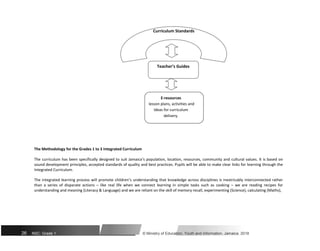
  • 317.
    STEM as typesof institutions in which learning is organized as a meta-discipline as described by Morrison and Bartlet (2009). Based on this perspective, STEM facilitates the demonstration of knowledge in a manner that removes the boundaries of each discipline for application to problem as would be practised in the real world. IMPLICATIONS OF PERSPECTIVES OF STEM/STEAM IN LIGHT OF THE NSC Since the NSC is based on Constructivism principles, STEM/STEAM as an approach and methodology, has to be established on post-positivistic thinking. From this position, STEM/STEAM influences the kind of practice that promotes collaboration, negotiation of meaning and openness to scrutiny. The NSC developers selected a Constructivist approach that included the deliberation, designing and development stages of the curriculum process. Evidence of the influence of Constructivism can be seen the NSC Framework Document that conveys the following emphasis: (i) The element of objectives is presented in two forms; firstly as Learning Objectives to focus attention on process and experience rather than product. Secondly as Learning Outcomes that serve as some of the outputs of the process. They include the basic understandings, skills and dispositions anticipated from learners’ engagement in the planned experiences. (ii) The element of content is treated as contexts for learners to think critically, solve problems creatively while developing their identity as Jamaicans. Content is not expected to be treated as disciplines to be mastered but as areas that contribute knowledge, skill sets and attitudes that form the composite of competencies to be acquired from their integration in the learning situations. (iii) The element of learning experiences (method) is presented as a set of learning activities that serves as a source of problems to be addressed as a part of the learning process. These real-life activities provide the scope of knowledge, skills and required dispositions or character traits for learners to make sense of that aspect of life or the world that they represent. They are the threads that connect all the other elements of the curriculum and allow for the integration of STEM/STEAM in the following ways:  Identification of activities that are presented as problems to be solved using the STEM/STEAM approach based on contextual 312 NSC: Grade 1 © Ministry of Education, Youth and Information, Jamaica. 2018
  • 318.
     Integrating activitiesto form a real problem to be solved as a short, medium or long term project to which the project based learning would be applied.   The examination of learning activities by learners and teachers as co-learners through multiple lenses using content of science, technology, mathematics and the humanities that they have already explored to engage in the problem identification and definition processes.   Extending learning in the formal setting to the informal by connecting co-curricular initiatives that are STEM/STEAM based that learners are undertaking at the institutional level through clubs and societies, as whole school projects or in partnership with external stakeholders.   Using the learning activities to review STEM/STEAM initiatives that form a part of the informal curriculum to and for reflection on action.   Using activities as springboards for reflecting on career or occupational interest in STEM/STEAM related areas.  (iv) The element of evaluation is communicated in two major ways; firstly as prior learning which serves diagnostic purpose and secondly as an on-going developmental process. This formative focus is indicated by the inclusion of explicitly stated assessment criteria that are to be used alongside the learning activities. The use of assessment criteria as counterparts of the learning activities also indicates that assessment is learner centred since it is serving developmental rather than promotional purpose and as a consequence, allows learners to self-correct as they use feedback to develop feed-forward capabilities. Evidence of learning, based on the learning outcomes, can be collected from various types of assessment methods that emphasize the learner centred constructivist orientation. This brings to the fore the need for serious consideration to be given to differentiation in assessment for fairness and credibility of claims about learners’ capabilities and to inform decisions that will impact their educational journey. 313 NSC: Grade 1 © Ministry of Education, Youth and Information, Jamaica. 2018
  • 319.
    In general, thisintegrated approach, which is the context of STEAM, is aimed at improving the quality of the educational experience for learners while influencing the achievement of the aims of education that relate to productivity and creativity as part of the profile of the Jamaican learner. REFERENCES 1. Jolly, A. (2014). STEM vs. STEAM: Do the Arts belong? Retrieved from: http://www.edweek.org/tm/articles/2014/11/18/ctq- jolly-stem-vs-steam.html 2. Morrison, J., Raymond, V. & Barlett, B. (2009). STEM as a curriculum: An experiential approach. Retrieved from: http://www.edweek.org/ew/articles/2009/03/04/23bartlett.h28.html 3. Sousa, D., Pilecki, T. (2013). STEM to STEAM: Using brain compatible strategies to integrate the Arts. London: SAGE Publications Ltd. 4. Trochim, Williams, M.K., (2006). Positivism & post-positivism. Web Centre for Social Research Methods. Retrieved from: http://www.socialresearchmethos.net/kb/positivsm.php 314 NSC: Grade 1 © Ministry of Education, Youth and Information, Jamaica. 2018
  • 320.
    NATIONAL STANDARDS CURRICULUMGUIDE NSC THE 5Es 315 NSC: Grade 1 © Ministry of Education, Youth and Information, Jamaica. 2018
  • 321.
    The 5Es Overview:“The 5E Learning Cycle” What is a 5E Learning Cycle? This model describes an approach for facilitating learning that can be used for entire programmes, specific units and individual lessons. The NSC supports the 5E constructivist learning cycle, as it places emphasis on the processes that may be used to help students to be personally involved in the learning situation as they are guided to build their own understandings from experiences and new ideas. 316 NSC: Grade 1 © Ministry of Education, Youth and Information, Jamaica. 2018
  • 322.
    Figure 1. Illustratingone version of the 5E model that conveys the role of evaluation as an interconnecting process that is at the core of the learning experience. Figure 2, illustrating a cyclical perspective of the model with each process being given similar emphasis in contributing to the learning experience on a whole EXPLANATION OF THE INSTRUCTIONAL MODEL What are the 5Es? The 5Es represent five key interrelated processes that provide the kind of learning experiences for learners to experience the curriculum or planned learning episodes: Engage, Explore, Explain, Extend (or Elaborate), and Evaluate. ENGAGE: The purpose of the ENGAGEMENT dimension is to help students to be ready intellectually, socially, emotionally etc. for the session. Attention is given to the students’ interests and to getting them personally involved in the lesson, while pre- 317 NSC: Grade 1 © Ministry of Education, Youth and Information, Jamaica. 2018
  • 323.
    assessing prior understandings,attitudes and/or skills. During the experience, students first encounter and identify the instructional task and their roles and responsibilities. During the ENGAGEMENT activity, students make connections between past and present learning experiences, setting the organizational groundwork for upcoming activities. The engagement activity may be used to (a) help student unearth prior knowledge (b) arouse their curiosity (c) encourage students to ask questions as a sign that they have wonderments or are puzzled. EXPLORE: The purpose of the EXPLORATION dimension is to get students involved in solving a real problem that is based on a selected context. EXPLORATION provides them with a chance to build their own understanding of the phenomenon being investigated and the attitude and skills involved for arriving at a workable solution. In exploring the students have the opportunity to get directly involved with the phenomenon and materials. As they work together in learning teams or independently, the need to share and communicate becomes necessary from the experiences. The teacher functions as a facilitator, providing materials, guarding against obstacles to learning and guiding the students to operate based on agreements. The students become inquirers and co-owners of the learning process. In exploring, they also ask questions, formulate hypothesis, search for answers or information/data, reflect with others, test their own predictions and draw conclusions. EXPLAIN: The purpose of the EXPLANATORY dimension is to provide students with an opportunity to assess their thinking and to use intellectual standards as critical thinkers to communicate their perspectives and/or the meaning of the experiences. They rely on communication tools and their skills as Language users to: (a) organize their thoughts so that they are clear, relevant, significant, fair, accurate etc. (b) validate or affirm others (c) self-motivate. Reflection also occurs during the process and may cause students to adjust 318 NSC: Grade 1 © Ministry of Education, Youth and Information, Jamaica. 2018
  • 324.
    their perspective orjustify their claims and summarise the lessons being learned. Providing explanations contributes to vocabulary building and self-corrective actions to deal with misconceptions that they become aware of from feedback of their peers and/or their facilitator. EXTEND: The purpose of this dimension is to allow students to use their new knowledge and continue to explore its significance and implications. Students work independently or with others to expand on the concepts and principles they have learned, make connections to other related concepts and principles within and/or across disciplines, and apply their understandings in new ways to unfamiliar situations. EVALUATE: The purpose of the EVALUATION dimension is for both students and facilitator to determine progress being made or the extent to which learning has taken place based on the stated objectives or emergent objectives. EVALUATION is treated primarily as an on-going diagnostic and developmental process that allows the learner to become aware of gaps to be treated and progress made from their efforts to acquire the competencies that were the focus of the session. Examples of competencies include understanding of concepts, principles and processes and demonstrating various skills. Evaluation and assessment can occur at different points during the learning episode. Some of the tools that assist in this diagnostic and formative process include rubrics, teacher observation log, self-inventories, peer critique, student interviews, reflective presentations, displays/expositions, portfolios, performances, project and problem-based learning products. Analysis of reflections, video recordings are useful in helping students to determine the depth of their thinking and understanding and the objectives they have or have not achieved. 319 NSC: Grade 1 © Ministry of Education, Youth and Information, Jamaica. 2018
  • 325.
    Who developed the5E model? The Biological Science Curriculum Study (BSCS), a team led by Principal Investigator Roger Bybee, developed the instructional model for constructivism, called the "Five Es". The Link between the 5E model and Types of Learning Activities The five (5) types of Learning Activities purported by Yelon (1996) can be integrated with the 5E’s so as to enrich the teaching and learning process. He noted that every instructional plan should include the following learning activities 1. Motivation Activities: Intended to help learners to be ready for the session 2. Orientation Activities: Inform students of their roles and responsibilities based the purpose or objectives of a learning episode. 3. Information Activities: Allow students to manipulate current knowledge, access/retrieve and generate new ideas 4. Application Activities: Allow for the use of knowledge and skills in novel situations 5. Evaluation Activities: Allow for reflection, corrective actions and sourcing of evidence to confirm/refute claims about learning. These activities can be planned to serve one of the purposes of each dimension of the 5E model. For example, ENGAGEMENT may be comprised a Motivation Activity and an Orientation Activity. EXPLORATION and EXPLANATION require an Information Activity, while EXTEND requires an Application Activity. EVALUATION requires the kind of activity that will contribute to the collection of data for assessing and arriving at a conclusion about performance based on stated or expected purpose for which learning is being facilitated. 320 NSC: Grade 1 © Ministry of Education, Youth and Information, Jamaica. 2018
  • 326.
    References Meegan, G. (2017).The intellectual standards. Retrieved from https://theelementsofthought.org/the-intellectual-standards/ The 5 E Model (n.d.). Retrieved from http://tiny.cc/7ogijy The 5 E Model (n.d.). Retrieved from http://tiny.cc/oogijy 321 NSC: Grade 1 © Ministry of Education, Youth and Information, Jamaica. 2018
  • 327.
    NATIONAL STANDARDS CURRICULUMGUIDE ATTAINMENT TARGETS 322 NSC: Grade 1 © Ministry of Education, Youth and Information, Jamaica. 2018
  • 328.
    ATTAINMENT TARGETS GRADE 1 SUBJECTSATTAINMENT TARGETS LANGUAGE ARTS Speaking and Listening Communicate with confidence and competence for different purposes and audiences, using SJE and JC appropriately and creatively Listen to, recall, understand and respond to speakers’ messages, whether implicit or explicit Recognise, value and make distinctions between home language and SJE to improve/acquire language and literacy competencies Explain and comment on speakers’ use of language, including use of SJE and JC, and their use of vocabulary, grammar and other features Reading with Fluency and Recognition  Read fluently and with appreciation  Automatically recognise words (including basic sight word lists) through repeated exposure and mnemonic devices   Establish a concept of print and use a range of word recognition clues, re-reading and reading ahead, to identify new words  Develop phonic awareness and use knowledge of letter-sound correspondences in order to decode unfamiliar words Reading for Meaning and Enjoyment  Read for meaning, fluency and enjoyment of texts, using a variety of clues to gain information and identify ideas and events   Use deduction and inference to interpret information and ideas and to predict outcomes  Identify and comment on the structure of texts and on the language choices, grammar and techniques writers use to create an impact  Reflect on and critically respond to literature and other texts, on paper and on screen Reading for Information  Research activities on issues and interests by generating ideas and exploring texts using a range of strategies 323 NSC: Grade 1 © Ministry of Education, Youth and Information, Jamaica. 2018
  • 329.
     Identify anduse text features to support navigation of texts, retrieve and synthesize information gained from a range of sources Writing: Communication  Develop approaches to the writing process to enable them to organise their ideas into a coherent structure including, layout, sections and paragraphs  Write to narrate, to persuade and for a range of transactional purposes, using SJE and JC appropriately and incorporating multi -media approaches to their writing  Use language and text forms appropriately and with imagination to create vibrant and engaging texts Write well-constructed paragraphs which have linking sentences within and between them Writing: Language Structure Use and adapt a range of sentence structures according to context, distinguishing between SJE and JC Write sentences which are grammatically accurate and correctly punctuated, using SJE and JC appropriately Use a range of punctuation correctly MATHEMATICS AT1a. Know the value of numerals, associate them with their names, numbers, ordinals and use concrete objects to model patterns, expression and numbers AT1b. Use the basic operations, number relationships, patterns, number facts, calculators and appropriate software to compute and estimate in order to solve real world problems involving fractions, percentages and decimals. AT2.Use the correct units, tools and attributes to estimate, compare and carry out the processes of measurement to given degree of accuracy. AT3 Explore paths, geometric shapes and space and make generalization about geometric relationships within the environment AT4. Employ algebraic reasoning through the use of expressions, equations and formulae to interpret, model and solve problems involving unknown quantities AT5. Collect, organise, interpret and represent data and make inferences by applying knowledge of statistics and probability. 324 NSC: Grade 1 © Ministry of Education, Youth and Information, Jamaica. 2018
  • 330.
    SCIENCE Begin toexplore the environment in order to relate everyday experiences to simple scientific concepts and processes. Begin to understand and apply aspects of the scientific method. Begin to explore selected life processes in humans, the interdependence between living things in the environment, and how lifestyles determine health and well-being in humans. Begin to appreciate the impact of selected human activity and natural phenomena on the environment. Begin to explore the properties of various materials, substances, selected forces and forms of energy through the use of the senses. Begin to demonstrate stewardship for living things and the environment. Begin to demonstrate a positive attitude towards the use of scientific language. Begin to demonstrate positive interpersonal skills in order to foster good working relationships. 325 NSC: Grade 1 © Ministry of Education, Youth and Information, Jamaica. 2018
  • 331.
    NATIONAL STANDARDS CURRICULUMGUIDE LESSON PLANS 326 NSC: Grade 1 © Ministry of Education, Youth and Information, Jamaica. 2018
  • 332.
    NATIONAL STANDARDS CURRICULUMGUIDE INTEGRATED STUDIES 327 NSC: Grade 1 © Ministry of Education, Youth and Information, Jamaica. 2018
  • 333.
    Integrated Lesson Plan Theme:Who AM I? Focus Question: How do you know me? Term 1: Date: Subject: Integrated Studies Duration: 3 HOURS Objectives  Talk about self, using factual expressions. For example, “I am a boy/girl.”  “I am six/seven years old.” “I am a Jamaican.” “I am a handsome/beautiful Jamaican boy/girl.”   Share personal character traits. For example, “I am very moody when I feel uncomfortable/unhappy.” “I like when others say good things about me.” “I do not enjoy reading aloud to my classmates.”   Develop a clear and fluent handwriting style.  Write letters, correctly formed and oriented, using a comfortable and appropriate pencil grip  Use body percussion effectively to accompany, beat and rhythm of the music  Write sentences using capital letters and full stop correctly  Use simple movements associated with jingles/songs to share information about themselves. For example, “Who is coming next?” “Those who were born in (month) skip around.”  Talk about self as part of a family. For example, “I am an only child.” 328 NSC: Grade 1 © Ministry of Education, Youth and Information, Jamaica. 2018
  • 334.
    “I have onebig sister.” “I have a little brother.”  Recognize the number names “zero” through “nineteen” and associate them with sets having the corresponding number of members   Write the numerals zero through nineteen and associate them with the corresponding words  Identify the months of the year and the days of the week  Associate month with events such as school activities, holidays, birthdays  Use a calendar in class and refer to it at appropriate times Key concepts/ Vocabulary: Name; male; female; gender; relatives; movement; family; Who am I; What do I look like; What is my name; To which family do I belong; family name /lineage/surname. Resources/Equipment: Skills: Markers  Discuss their identity Cartridge paper  Question, observe and explore Who I am  Draw portraits  Paint  Listen  Trace letters  Write name and short sentences Engage/Starter/ warm up / Introduction: The Pageant Stand and introduce themselves to the class, noting their full name; how old they are; to which parish they belong and what is their favourite animal/sporting activity. 329 NSC: Grade 1 © Ministry of Education, Youth and Information, Jamaica. 2018
  • 335.
    Teaching/Learning /Main Activities: SESSION1 1. In pairs, children talk about who they are; what they look like; what they like and or don’t like; in which parish they live, the name of the country in which they live and in which country were they born. Pairs will then engage in a "Square and Share" activity to share their information. (Exploration and Explanation) 2. Have children sing a familiar song about “me”. For example, Jesus loves me this I know; I love you/me by Barney; I am a promise. Allow students to personalize the songs by inserting their names in the songs as they sing. Ensure that children use body percussion to the beat and rhythm while they are singing. (Extension) 3. Have children select their names from a given pile. Have them talk about their names, what is their first name; what letter it starts with; how many letters are in their first name. Have the same discussion about their surname. 4. Have children colour/ decorate their names. When they are through colouring/ decorating their names play the game “Who is coming next Punchinello little fellow?” Have the children place all the names in a bag. Have a child select and show the selected name to the class. The child whose name it is must identify his or her name after which he or she does an action for the others to imitate. Exploration/Teaching/Learning /Main Activities: SESSION 2 1. Have students listen to a story about names. (See Appendix) 2. Children talk about the story. Share in whole group their names and why it is important to have short names. 3. Talk about their family names. Discuss why their family/surnames are important. Talk about how they got their surname. Discuss what would happen at home or at school everyone had the same first and last name. 4. Do a name sort in class. Have the children see if anyone else in the class has either his/her first or last name or names made up of the same letters. Let them solve the problem of what teacher should do so as to know each student differently. 5. Individually, students count and tell the number of letters in their names. Challenge the student to pair with someone else and see who has more/same/fewer letters in their names. Also, let them tell and write how many letters are there altogether in their name. 6. Have children tell, then find and circle their birth month on a calendar. 7. Sing and act out the song Those who were born in January skip around. 8. Have children find out the number of students in the class who were born in each month. Have children display the 330 NSC: Grade 1 © Ministry of Education, Youth and Information, Jamaica. 2018
  • 336.
    information gathered ona chart using whatever method they choose. Evaluation: Students write at least one sentence in their journal about what they learned from the lesson. Note to teachers: Those students who cannot write their own sentence should be given the opportunity to see their own sentence written down so that they can copy the same. 331 NSC: Grade 1 © Ministry of Education, Youth and Information, Jamaica. 2018
  • 337.
    Appendix ACTIVITIES ABOUT NAMES Provide name tags for children. Encourage young children to spell their name for you and print their name using a capital letter of the first letter and lowercase letters for all the other letters. Say the name of each letter as you write it. Allow the children to write their own names if they can.   At the end of the Focus Question (Who Am I), provide materials for a craft related to names. Ask the children to stick or glue their name tag on their craft project and make a display of all the projects.   Encourage parents and guardians to tell children why they were given their particular names.   Encourage parents and guardians to look up the meaning of their child’s name on the internet. STORIES FOR AGES 3 - 7 A My Name is Alice by Jane Bayer The well-known jump rope ditty which is built on letters of the alphabet is illustrated with animals from all over the world. Help children think of similar chants of their own names! Catalina Magdalina Hoopensteiner Wallendiner Hogan Logan Bogan Was Her Name by Tedd Arnold Presents the words--and varying forms of the name--of a classic camp song that dates at least from the 1940s. She had two holes on the bottom of her nose--one for her fingers, and one for her toes! Though she has two arms that drag along the ground, two feet bigger than a bathroom mat, and just two teeth in her mouth, life for Catalina is full and fun! Chrysanthemum by Kevin Henkes (also available as a big book, as a DVD and in other formats.) Chrysanthemum thinks her name is absolutely perfect, until her first day of school. "You're named after a flower!" teases Victoria. "Let's smell her," says Jo. Chrysanthemum wilts. What will it take to make her blossom again? Edmund for Short: A Tale from China Plate Farm by Chris Jackson When Edmund the pig discovers that the cows on China Plate Farm all have grand names based on their body markings, he decides to mark himself so he can have a grand name of his own, but nobody notices, as a new calf is being born on the farm. Andy: That’s My Name by Tomie DePaola 332 NSC: Grade 1 © Ministry of Education, Youth and Information, Jamaica. 2018
  • 338.
    Andy's friends constructdifferent words from his name: "an" words, "and" words, and "andy" words. Call Me Little Echo Hawk by Terry EchoHawk Every child has a name, and the story of Echo Hawk will motivate children everywhere to seek out stories about their own names. In “Call Me Little Echo Hawk,” children will also learn to be proud of their heritage and their ancestors. Christopher Changes His Name by Itah Sadu Christopher. Mulamba is tired of being one of three boys with the same first name in his class, so he picks out a series of new names honouring a variety of black heroes, from the star of his aunt's Trinidadian folktales to scientist Elijah McCoy to Michael Jordan, but in the process his own name gets lost. The First Thing My Mama Told Me by Susan Marie Swanson A young girl celebrates the name that was chosen just for her. “When I was born, the first thing my mama told me was my name”. Lucy remembers lots of things about her name. Seven-year-old Lucy describes special memories about her name from each of her birthdays. Hope by Isabell Monk. Isabell Monk’s depiction of how a girl learns about her rich biracial heritage will help all children see themselves with pride and self-respect. I Am Renè, the Boy by Rene Colato Lainez. When Renè learns that his name is also a girl’s name, he does some research and relates the name’s meaning and letters to his homeland of El Salvador and the things that make him special. Ivan to Make You Laugh: Jokes about Novel, Nifty, and Notorious Names by Sam Schultz Presents a variety of jokes about people’s names. Josephina Hates Her Name by Diana Engel. After Grandma explains that she named Josephina after her talented, daring older sister, Josephina starts to appreciate her unusual name. A Lion Named Shirley Williamson by Bernard Waber. The lions at the zoo are jealous of the new lioness because of her fancy name and because of the special treatment she receives from the Zookeeper. Merry Christmas, What’s Your Name by Bernice Chardiet When a little girl changes her name to one she likes better, she starts a trend among her classmates that leads to complete confusion. 333 NSC: Grade 1 © Ministry of Education, Youth and Information, Jamaica. 2018
  • 339.
    Mommy Doesn’t KnowMy Name by Suzanne Williams. This loving and humorous story depicts frustrated Hannah, who tries to get her mother to call her by her real name rather than the pet names she uses. My Name Is Yoon by Helen Recorvits Disliking her name as written in English, Korean-born Yoon, or “shining wisdom,” refers to herself as “cat,” “bird,” and “cupcake,” as a way to feel more comfortable in her new school and new country. Name Games: Using Children’s Names to Link Oral Language and Print by Traci Ferguson Geiser. This teacher resource is rich in phonics and oral language practice. Each of the ten complete lesson cycles culminates in a unique bookmaking activity. Loaded with reproducibles, Name Games keep teacher preparation time to a minimum. The Name Jar by Yangsook Choi. Being the new kid in school is hard enough, but what about when nobody can pronounce your name? Having just moved from Korea, Unhei is anxious that the kids will like her. So instead of introducing herself on the first day of school, she tells the class that she will choose a name by the following week. Her new classmates are fascinated by this no-name girl and decide to help out by filling a glass jar with names for her to pick from. Nutty Names: A Book of Name Jokes by Mark Ziegler The only thing kids think is funnier than a good joke is… more good jokes! These supercharged joke books contain more jokes than ever. Get ready to laugh! The Other Emily by Gibbs Davis Emily believes her name belongs to her alone, but on the first day of school, she discovers she is not the only Emily in the world. A Perfect Name by Charlene Costanza Mama and Papa Potamus try out many different names for their newborn daughter before finding just the right one in time for her naming ceremony. Rumpelstiltskin by Paul O. Zelinsky A strange little man helps the miller's daughter spin straw into gold. In this highly inventive and splendid rendering of a favourite Grimm fairy tale, award-winning storyteller and illustrator Paul O. Zelinsky evokes a world of Medieval magic. Santa’s Book of Names by David McPhail 334 NSC: Grade 1 © Ministry of Education, Youth and Information, Jamaica. 2018
  • 340.
    A young boywho has trouble reading, helps Santa with his yearly rounds and receives a special Christmas present. Three Names of Me by Mary Cummings A girl adopted from China explains that her three names--one her birth mother whispered in her ear, one the babysitters at her orphanage called her, and one her American parents gave her--are each an important part of who she is. Includes scrapbooking ideas for other girls adopted from China. Tikki Tikki Tembo by Arlene Mosel This story why the Chinese no longer honor their firstborn with an unusually long name such as “Tikki tikki tembo-no sa rembo- chari bari ruchi-pip peri pembo!” This re-creation of an ancient Chinese folktale has hooked legions of children, teachers, and parents, who return, generation after generation, to learn about the danger of having such an honorable name, especially when one falls into a well. 335 NSC: Grade 1 © Ministry of Education, Youth and Information, Jamaica. 2018
  • 341.
    NATIONAL STANDARDS CURRICULUMGUIDE LANGUAGE ARTS 336 NSC: Grade 1 © Ministry of Education, Youth and Information, Jamaica. 2018
  • 342.
    Grade: One Subject: LanguageArts Time: One hour Strand: Writing Topic: Story Writing Objectives: Pupils should be able to: 1. Review and present constructive criticism on the writing of their peers 2. Use an editing checklist to identify errors in the writing of their peers Materials: drafts of students’ stories, editing checklists, sticky note pad Procedure Engage Whole Group Activity Students observe as teacher models the editing stage of the writing process by using a checklist to review a sample of writing. Students participate by giving feedback as teacher uses the Think Aloud Strategy to identify errors. Teacher will use sticky notes to highlight the errors. 337 NSC: Grade 1 © Ministry of Education, Youth and Information, Jamaica. 2018
  • 343.
    e.g. my friendand I played football. the rain fall. we get wet. We stoped playing and goed home. My mother was sad. I was cold Pupils review sticky notes, discuss and make suggestions for correcting the errors. Explain Pupils will be given the checklist and will review and give examples of each criterion. https://www.pinterest.com/explore/writing-checklist/ 338 NSC: Grade 1 © Ministry of Education, Youth and Information, Jamaica. 2018
  • 344.
    Explore Sentence strips withsentences to be edited will be placed around the classroom. Students will be given 2 samples of the checklist to edit any two sentences placed around the classroom. Students will write their corrected versions on post it notes. Students will share corrected versions with class by sticking the post it notes under the strips they edited. Extend/Elaborate Pair Activity Pupils will exchange story drafts, then use the checklist to identify errors. Using the sticky notes, they will note the errors. Whole Group Activity Pupils share some of the errors with the class. Together the class will make suggestions for correcting these errors. Teacher/students will record the suggestions on whiteboard/flip chart paper. Independent Activity Pupils will use sticky notes and suggestions to make amendments to their drafts. Evaluate 339 NSC: Grade 1 © Ministry of Education, Youth and Information, Jamaica. 2018
  • 345.
    NATIONAL STANDARDS CURRICULUMGUIDE MATHEMATICS 340 NSC: Grade 1 © Ministry of Education, Youth and Information, Jamaica. 2018
  • 346.
    Ministry of Education,Youth & Information Lesson Plan Lesson Plan Lesson Plan Grade: 1 Topic: Fraction of an Object Topic: Fraction of an Object Grade: 1 Term 1: Date: Subject: Mathematics Duration: 1 hour Objectives ï Tell whether or not a given picture shows fourths (quarters) ï Show one fourth of a given object. ï Identify different ways to show given quantities (quarters). Key concepts / Resources/Equipment: Skills: Vocabulary: ï Geoboard ïUse Geoboard to show ï Quarter quarters/fourths ï Plain paper ïFold paper in four equal part ï One fourth ï Dotted square paper ïDivide dotted square in ï Square region ï Elastic bands various ways to show ï Bullas quarters Starter: Give students various picture puzzle pieces cut in four equal parts to fit together. Have them fit the pieces together and tell what they notice about the puzzle pieces (they are cut into four equal pieces). Have them tell/show how they know that the pieces are the same in shape and size. 341 NSC: Grade 1 © Ministry of Education, Youth and Information, Jamaica. 2018
  • 347.
    Ministry of Education,Youth & Information Teaching/Learning/Exploring Activities: ï Have students work in cooperative groups of four to cut a bulla into four equal parts. ï Allow students to explain how they went above cutting the bulla into four equal parts. ï Teacher cuts one bulla into two equal parts and have children identify the fraction that each piece represents. Teacher cuts one of the halves in two equal parts and ask students to tell/guess what one of those pieces represents. If students can’t tell, teacher further cuts the other half in two equal parts and ask students to tell what fraction each piece represents. ï Have students recognize that each piece is called one quarter or one fourth. ï Have children give examples of where or when do they ever hear or used the word quarter. ï Have children use the four quarters to show  one fourth/one quarter   one half   tell how many fourths make a half   what fraction of a half is a quarter/fourth   how many halves are there in 1 whole  ï Draw students’ attention to two fourths and one half representing the same piece of bulla. ï Provide students in cooperative groups of 5 with Geoboards and elastic bands to show quarters. ï Have students use cut out circles to represent the fractions drawn on Geoboard. ï Give each cooperative learning group a copy of the following diagram: 342 NSC: Grade 1 © Ministry of Education, Youth and Information, Jamaica. 2018
  • 348.
    Ministry of Education,Youth & Information Have students prove that the square is divided into fourths/quarters. Assessment: ï Have students divide dotted squares into quarters/fourths in different ways. All students are given the same four colours to work with. Have students colour each square using a different colour for each quarter. (the aim is to create a class quilt) Students may take these home to finish. Evaluation/Reflection: Which mathematical skills are developed? (Problem solving, communication, reasoning, connections, and representation. 343 NSC: Grade 1 © Ministry of Education, Youth and Information, Jamaica. 2018
  • 349.
    Ministry of Education,Youth & Information How did the activities help the students understand the concepts of whole, halves and quarters and the relationships they share among themselves? Does the lesson give children opportunities to activate prior knowledge, acquire knowledge, understand knowledge, use knowledge and reflect on knowledge? How did the teacher use the activities to assess students’ understanding of whole, halves and quarters? Evaluation / Reflection: Were students able to: ï fold a given square into quarters? ï identify the quarters in given shapes? ï divide other shapes in quarters (fourths)? ï tell how many quarters in a half ? ï tell how many quarters in a whole? 344 NSC: Grade 1 © Ministry of Education, Youth and Information, Jamaica. 2018
  • 350.
    Ministry of Education,Youth & Information Dot Paper Squares · · · · · · · · · · · · · · · · · · · · · · · · · · · · · · · · · · · · · · · · · · · · · · · · · · · · · · · · · · · · · · · · · · · · · · · · · · · · · · · · · · · 345 NSC: Grade 1 © Ministry of Education, Youth and Information, Jamaica. 2018
  • 351.
    Ministry of Education,Youth & Information 346 NSC: Grade 1 © Ministry of Education, Youth and Information, Jamaica. 2018
  • 352.
    Ministry of Education,Youth & Information 347 NSC: Grade 1 © Ministry of Education, Youth and Information, Jamaica. 2018
  • 353.
    Ministry of Education,Youth & Information Number lesson Plan Topic: Multiplication (repeated addition) Duration: 60 minutes Objectives Students should be able to: ï State, using multiplication ideas, in a sentence the idea of repeated addition of the same number (e.g. moving from 3+3+ 3+3 to 4×3) ï Differentiate between the use of multiplication and addition to find “How many in all” ï Show the correct multiplication facts for a repeat addition, example, by use of an array. Key concepts / Resources/Equipment: Skills: Vocabulary: plain paper, dice , pencil ï Drawing sets Repeated addition ; ï Writing multiplication facts multiplication; times; array; ï Making an array facts Starter: ï Let’s find out how many oranges in total are in the 4 heaps. ï How did you get your answer? What method did you use? Teaching/Learning /Main/Exploring Activities: Let’s investigate the calculation we use to find the total when there are the same number of items in several groups. 348 NSC: Grade 1 © Ministry of Education, Youth and Information, Jamaica. 2018
  • 354.
    Ministry of Education,Youth & Information 1. Pupils play the game CIRCLES AND STARS Pupils, in pairs, take turn and throw the die twice. On the first throw the pupilsdraw the circles and on the second throw draw the stars in the circle. For example if the first number is 3 and the second one is 4 then the pupil would draw 3 circles with 4 stars in each circle. Then write the multiplication facts beneath each game. 2. After each pair plays 6 times, the teacher asks what products were obtained and how. Pupils write the results on the chalkboard. 1 1×1 2 1×2 2×1 3 1×3 3×1 4 1×4 2×2 4×1 5 1×5 5×1 6 1×6 6×1 2×3 3×2 3. Students create their own array, show it to their elbow partner. 4. The answer is 10. What is the question? Extension ï Solve: “Come into my parlour” Said the spider to the fly. “Answer now my question Unless you want to die. 349 NSC: Grade 1 © Ministry of Education, Youth and Information, Jamaica. 2018
  • 355.
    Ministry of Education,Youth & Information To give me twenty-eight fly legs The number I desire How many flies Am I going to require? Technology Integration possibility: Numeric Interactive Software: Fractions_06 350 NSC: Grade 1 © Ministry of Education, Youth and Information, Jamaica. 2018
  • 356.
    Ministry of Education,Youth & Information Number - Lesson #5 Topic: Fractions (of a set of objects) Duration: 60 minutes Objective: ï Use numerals 21 and 14 to describe halves and fourths of an object or a set of objects. Key concepts / Vocabulary: Resources/Equipment: Skills: quarter, one fourth, half. Counters, students worksheet ïDividing in 2 or 4 equal parts Starter: Sing ‘fractions’ song. Distribute to pairs of students 8 candies (skittles). Have students recognize that the 8 candies make one whole. Have them divide their whole in two equal parts, then further divide each halves into two again (to get quarters). Students will explain what they have done and describe how many they have in each group. They will be allowed to eat the candies at the end of the class. Teaching/Learning /Exploring Activities: 1. Give 24 counters/pebbles to each group of students (maximum six students). 2. Have students make two equal groups from the set counters/pebbles. 3. Discuss with class the number of counters in each group and say what fraction of the whole each group represents. 4. Have students share the counters in four equal groups. How many would be in each group? What fraction of the counter is each group? 5. Place students in groups of 8. At the start of selected music they will quickly move to form groups representing given fractions 1 , 1. 2 4 6. Students to consider: Each parish capital in Jamaica has a Mayor in the Parish Council. A half of this number represents men. Draw pictures showing all the mayors and indicate those that are men. 351 NSC: Grade 1 © Ministry of Education, Youth and Information, Jamaica. 2018
  • 357.
    Ministry of Education,Youth & Information Plenary: A fraction can be part of a whole object or a set of objects. Assessment: 1. Given a work sheet, students divide the various sets of objects as directed. 2. Also have students colour each required fraction using a different colour for each. Evaluation / Reflection: Were students able to: Which mathematical skills are developed? (Problem solving, communication, reasoning, connections, and representation. How the activities did helped the students understand the concepts of partitioning different sets of objects into equal parts? Does the lesson give children opportunities to activate prior knowledge, acquire knowledge, understand knowledge, use knowledge and reflect on knowledge? How did the teacher use the activities to assess students’ understanding of partitioning? 352 NSC: Grade 1 © Ministry of Education, Youth and Information, Jamaica. 2018
  • 358.
    NATIONAL STANDARDS CURRICULUMGUIDE TEACHING MATHEMATICS: IDEAS & ACTIVITIES 353 NSC: Grade 1 © Ministry of Education, Youth and Information, Jamaica. 2018
  • 359.
    Ministry of Education,Youth & Information Teaching Mathematics through Games Alpha-Bits All 26 letters of the English alphabet are in a bag. The vowels are A, E, I, O, U and sometimes Y. 1. How many possible outcomes are there when drawing a letter from the bag? 2. What are the chances of drawing a vowel form the bag? 3. What are the chances of drawing a consonant from the bag? 4. What are the chances of drawing the letter: B? K? Z? A? 5. If two of each vowel are placed inside the bag, along with one of each consonant, what are the chances of drawing a vowel? 6. If the letters A through J are removed from the bag, what are the chances of drawing the letter M? and U? 7. If the vowels are removed from the bag, what are the chances of drawing a consonant? 8. If the blocks for the numbers 1-9 are combined with the 26 letter blocks, what are the chances of drawing: 1. A number? 2. A letter 3. A vowel 4. A consonant 354 NSC: Grade 1 © Ministry of Education, Youth and Information, Jamaica. 2018
  • 360.
    Ministry of Education,Youth & Information Teaching Mathematics through Games Fraction Activity Instruction: Insert the following fractions so that each row and column adds to give one (1). 1 2 1 32 3 8 7 16 5 32 1 16 1 4 5 8 3 16 17 32 1 8 9 32 355 NSC: Grade 1 © Ministry of Education, Youth and Information, Jamaica. 2018
  • 361.
    Ministry of Education,Youth & Information MULTIPLICATION CHART 356 NSC: Grade 1 © Ministry of Education, Youth and Information, Jamaica. 2018
  • 362.
    Ministry of Education,Youth & Information Fraction Activity Instruction: Insert the following fractions so that each row and column adds to give one (1). 1 2 1 32 3 8 7 16 5 32 1 16 1 4 5 8 3 16 17 32 1 8 9 32 357 NSC: Grade 1 © Ministry of Education, Youth and Information, Jamaica. 2018
  • 363.
    Ministry of Education,Youth & Information 358 NSC: Grade 1 © Ministry of Education, Youth and Information, Jamaica. 2018
  • 364.
    Ministry of Education,Youth & Information 150 Teaching Methods 1. Lecture by teacher (and what else can you do!) 2. Class discussion conducted by teacher (and what else!) 3. Recitation oral questions by teacher answered orally by students (then what!) 4. Discussion groups conducted by selected student chairpersons (yes, and what else!) 5. Lecture-demonstration by teacher (and then what 145 other techniques!) 6. Lecture-demonstration by another instructor(s) from a special field (guest speaker) 7. Presentation by a panel of instructors or students 8. Presentations by student panels from the class: class invited to participate 9. Student reports by individuals 10. Student-group reports by committees from the class 11. Debate (informal) on current issues by students from class 12. Class discussions conducted by a student or student committee 13. Forums 14. Bulletin boards 15. Small groups such as task oriented, discussion, Socratic 16. Choral speaking 17. Collecting 18. Textbook assignments 19. Reading assignments in journals, monographs, etc. 20. Reading assignments in supplementary books 21. Assignment to outline portions of the textbook 22. Assignment to outline certain supplementary readings 359 NSC: Grade 1 © Ministry of Education, Youth and Information, Jamaica. 2018
  • 365.
    Ministry of Education,Youth & Information 23. Debates (formal) 24. Crossword puzzles 25. Construction of vocabulary lists 26. Vocabulary drills 27. Diaries 28. Dances of places or periods studied 29. Construction of summaries by students 30. Dressing dolls 31. Required term paper 32. Panel discussion 33. Biographical reports given by students 34. Reports on published research studies and experiments by students 35. Library research on topics or problems 36. Written book reports by students 37. Flags 38. Jigsaw puzzle maps 39. Hall of Fame by topic or era (military or political leaders, heroes) 40. Flannel boards 41. Use of pretest 42. Gaming and simulation 43. Flash cards 44. Flowcharts 45. Interviews 46. Maps, transparencies, globes 47. Mobiles 48. Audio-tutorial lessons (individualized instruction) 49. Models 50. Music 360 NSC: Grade 1 © Ministry of Education, Youth and Information, Jamaica. 2018
  • 366.
    Ministry of Education,Youth & Information 51. Field trips 52. Drama, role playing 53. Open textbook study 54. Committee projects--small groups 55. Notebook 56. Murals and montages 57. Class projects 58. Individual projects 59. Quiz down gaming 60. Modeling in various media 61. Pen pals 62. Photographs 63. Laboratory experiments performed by more than two students working together 64. Use of dramatization, skits, plays 65. Student construction of diagrams, charts, or graphs 66. Making of posters by students 67. Students drawing pictures or cartoons vividly portray principles or facts 68. Problem solving or case studies 69. Puppets 70. Use of chalkboard by instructor as aid in teaching 71. Use of diagrams, tables, graphs, and charts by instructor in teaching 72. Use of exhibits and displays by instructor 73. Reproductions 74. Construction of exhibits and displays by students 75. Use of slides 76. Use of filmstrips 77. Use of motion pictures, educational films, videotapes 78. Use of theater motion pictures 361 NSC: Grade 1 © Ministry of Education, Youth and Information, Jamaica. 2018
  • 367.
    Ministry of Education,Youth & Information 79. Use of recordings 80. Use of radio programs 81. Use of television 82. Role playing 83. Sand tables 84. School affiliations 85. Verbal illustrations: use of anecdotes and parables to illustrate 86. Service projects 87. Stamps, coins, and other hobbies 88. Use of community or local resources 89. Story telling 90. Surveys 91. Tutorial: students assigned to other students for assistance, peer teaching 92. Coaching: special assistance provided for students having difficulty in the course 93. Oral reports 94. Word association activity 95. Workbooks 96. Using case studies reported in literature to illustrate psychological principles and facts 97. Construction of scrapbooks 98. Applying simple statistical techniques to class data 99. Time lines 100. "Group dynamics" techniques 101. Units of instruction organized by topics 102. Non directive techniques applied to the classroom 103. Supervised study during class period 104. Use of sociometric text to make sociometric analysis of class 105. Use of technology and instructional resources 106. Open textbook tests, take home tests 362 NSC: Grade 1 © Ministry of Education, Youth and Information, Jamaica. 2018
  • 368.
    Ministry of Education,Youth & Information 107. Put idea into picture 108. Write a caption for chart, picture, or cartoon 109. Reading aloud 110. Differentiated assignment and homework 111. Telling about a trip 112. Mock convention 113. Filling out forms (income tax, checks) 114. Prepare editorial for school paper 115. Attend council meeting, school board meeting 116. Exchanging "things" 117. Making announcements 118. Taking part (community elections) 119. Playing music from other countries or times 120. Studying local history 121. Compile list of older citizens as resource people 122. Students from abroad (exchange students) 123. Obtain free and low cost materials 124. Collect old magazines 125. Collect colored slides 126. Visit an "ethnic" restaurant 127. Specialize in one country 128. Follow a world leader (in the media) 129. Visit an employment agency 130. Start a campaign 131. Conduct a series 132. Investigate a life 133. Assist an immigrant 134. Volunteer (tutoring, hospital) 363 NSC: Grade 1 © Ministry of Education, Youth and Information, Jamaica. 2018
  • 369.
    Ministry of Education,Youth & Information 135. Prepare an exhibit 136. Detect propaganda 137. Join an organization 138. Collect money for a cause 139. Elect a "Hall of Fame" for males 140. Elect a "Hall of Fame" for females 141. Construct a salt map 142. Construct a drama 143. Prepare presentation for senior citizen group 144. Invite senior citizen(s) to present local history to class including displaying artifacts (clothing, tools, objects, etc.) 145. Prepare mock newspaper on specific topic or era 146. Draw a giant map on floor of classroom 147. Research local archaeological site 148. Exchange program with schools from different parts of the state 149. In brainstorming small group, students identify a list of techniques and strategies that best fit their class. Attachment: 150 Teaching Methods [PDF, 33 KB] - See more at: http://teaching.uncc.edu/learning-resources/articles-books/best-practice/instructional- methods/150-teaching-methods#sthash.yM7PA7xP.dpuf 364 NSC: Grade 1 © Ministry of Education, Youth and Information, Jamaica. 2018
  • 370.
    Ministry of Education,Youth & Information THE LAWS OF TEACHING - by John Milton Gregory THE SEVEN FACTORS 1. Teaching has its natural laws as fixed as the laws of the planets or of growing organisms. It is a process in which definite forces are employed to produce definite results, and these results follow as regularly and certainly as the day follows the sun. What the teacher does, he does through natural agencies working out their natural effects. Causation is as certain -- if not always so obvious nor so easily understood -- in the movements of mind as in those of matter. The laws of mind are as fixed as material laws. 2. To discover the laws of any process, whether of mind or of matter, makes it possible to bring that process under the control of one who knows the laws and can command the conditions. Knowledge of the laws of electric currents has made it possible to send messages through the oceans; and he who masters the laws of teaching may convey to the minds of others the experience of the race. He who would gain harvests must obey nature's laws for the growing of corn, and he who would teach a child successfully must [16] follow the laws of 365 NSC: Grade 1 © Ministry of Education, Youth and Information, Jamaica. 2018
  • 371.
    Ministry of Education,Youth & Information teaching. Nowhere, in the world of mind or in the world of matter, can man produce any effects except as he employs the means upon which those effects depend. 3. Teaching, in its simplest sense, is the communication of experience. This experience may consist of facts, truths, doctrines, ideas, or ideals, or it may consist of the processes or skills of an art. It may be taught by the use of words, by signs, by objects, by actions, or by examples; but whatever the substance, the mode, or the aim of the teaching, the act itself, fundamentally considered, is always substantially the same: it is a communication of experience. It is painting in the mind of another the picture in one's own -- the shaping of the thought and understanding to the comprehension of some truth which the teacher knows and wishes to communicate. Further on we shall see that the word "communication" is used here, not in the sense of the transmission of a mental something from one person to another, but rather in the sense of helping another to reproduce the 366 NSC: Grade 1 © Ministry of Education, Youth and Information, Jamaica. 2018
  • 372.
    Ministry of Education,Youth & Information same experience and thus to make it common to the two. 4. To discover the law of any phenomenon, we must subject that phenomenon to a scientific analysis and study its separate parts. If any complete act of teaching be so analyzed, it will be found to contain seven distinct elements or [17] factors: (1) two personal factors -- a teacher and a learner; (2) two mental factors -- a common language or medium of communication, and a lesson or truth or art to be communicated; and (3) three functional acts or processes -- that of the teacher, that of the learner, and a final or finishing process to test and fix the result. 5. These are essential elements in every full and complete act of teaching. Whether the lesson be a single fact told in three minutes, or a lecture occupying as many hours, the seven factors are all present, if the work is effective. None of them can be omitted, and 367 NSC: Grade 1 © Ministry of Education, Youth and Information, Jamaica. 2018
  • 373.
    Ministry of Education,Youth & Information no others need be added. If there is a true science of teaching, it must be found in the laws and relations of these seven factors. 6. To discover their laws, let us pass the seven factors again in careful review: (1) a teacher; (2) a learner; (3) a common language or medium of communication; (4) a lesson or truth; (5) the teacher's work; (6) the learner's work; (7) the review work, which organizes, applies, perfects, and fastens the work which has been done. Each of these seven factors are distinguished from the rest by some essential characteristics; each is a distinct entity or fact of nature. Since every fact of nature is the product and proof of some law of nature, each element here described has its own [18] great law of function, and these taken together constitute The Seven Laws of Teaching. 7. It may seem trivial so, to insist upon all this. Some will say: "Of course there can be no teaching without a teacher and a pupil, without a language and a lesson, and unless the teacher teaches and 368 NSC: Grade 1 © Ministry of Education, Youth and Information, Jamaica. 2018
  • 374.
    Ministry of Education,Youth & Information the learner learns; or, finally, without a proper review, if any assurance is to be gained that the work has been successful. All this is too obvious to need assertion." So also is it obvious that when seeds, soil, heat, light, and moisture come together in proper measure, plants are produced and grow to the harvest; but the obviousness of these common facts does not prevent their hiding among them some of the most profound and mysterious laws of nature. So, too, a simple act of teaching may hide within it some of the most potent and significant laws of mental life. 369 NSC: Grade 1 © Ministry of Education, Youth and Information, Jamaica. 2018
  • 375.
    Ministry of Education,Youth & Information Teaching Mathematics through Games Fraction Activity - Solution Fraction Activity - Solution 1 16 9 32 5 8 1 32 1 4 3 8 1 2 7 16 3 16 17 32 1 8 5 32 370 NSC: Grade 1 © Ministry of Education, Youth and Information, Jamaica. 2018
  • 376.
    Ministry of Education,Youth & Information Teaching Mathematics through Games Investigations & Their Responses. 1. Identify the numbers that cannot be formed from the sum of consecutive whole numbers. 1 0 + 1 17 8 + 9 2 18 5 + 6 + 7; 3 + 4 + 5 + 6 3 1 + 2 19 9 + 10 4 20 2 + 3 + 4 + 5 + 6 5 2 + 3 21 10 + 11; 6 + 7 + 8 6 1 + 2 + 3 22 4 + 5 + 6 + 7 7 3 + 4 23 11 + 12 8 24 7 + 8 + 9 9 4 + 5; 2 + 3 + 4 25 12 + 13; 3 + 4 + 5 + 6 + 7 10 1 + 2 + 3 + 4 26 5 + 6 + 7 + 8 11 5 + 6 27 13 + 14; 8 + 9 + 10 12 3 + 4 + 5 28 1 + 2 + 3 + 4 + 5 + 6 + 7 13 6 + 7 29 14 + 15 14 2 + 3 + 4 + 5 30 9 + 10 + 11; 6 + 7 + 8 + 9 15 7 + 8; 4 + 5 + 6; 1 + 2 + 3 + 4 + 5 31 15 + 16 16 32 The numbers 2, 4, 8, 16, 32 are identified as not being able to be formed from the sum of consecutive whole numbers. The next in the series should be 32. But note that these are all powers of 2. So powers of 2 cannot be formed from the sum of consecutive whole numbers. 371 NSC: Grade 1 © Ministry of Education, Youth and Information, Jamaica. 2018
  • 377.
    Ministry of Education,Youth & Information 2. Integer triangles are triangles with sides being whole numbers. Identify the length of sides for integer triangles whose perimeter is 9. Then find those for 10, 11, 12, and 13. Note that the sum of any two sides must be greater than the third side. Peri Possible Combinations 7 1 + 3 + 3 2 + 2 + 3 8 2 + 3 + 3 9 3 + 3 + 3 2 + 3 + 4 4 + 4 + 1 10 2 + 4 + 4 3 + 3 + 4 11 3 + 4 + 4 3 + 3 + 5 2 + 4 + 5 1 + 5 + 5 12 2 + 5 + 5 3 + 4 + 5 4 + 4 + 4 13 5 + 4 + 4 3 + 5 + 5 3 + 4 + 6 1 + 6 + 6 2 + 5 + 6 14 2 + 6 + 6 4 + 5 + 5 6 + 4 + 4 3 + 5 + 6 15 5 + 5 + 5 4 + 5 + 6 3 + 5 + 7 2 + 6 + 7 1 + 7 + 7 3 + 6 + 6 16 4 + 5 + 7 5 + 5 + 6 4 + 6 + 6 3 + 6 + 7 2 + 7 + 7 17 1 + 8 + 8 2 + 7 + 8 3 + 6 + 8 5 + 5 + 7 4 + 6 + 7 4 + 5 + 8 3 + 7 + 7 18 6 + 6 + 6 5 + 6 + 7 4 + 6 + 8 2 + 8 + 8 3 + 7 + 8 5 + 5 + 8 19 4 + 9 + 6 3 + 9 + 7 2 + 9 + 8 5 + 5 + 9 3 + 8 + 8 4 + 8 + 7 5 + 8 + 6 6 + 7 + 6 5 + 7 + 7 20 2 + 9 + 9 4 + 8 + 8 6 + 7 + 7 8 + 6 + 6 3 + 9 + 8 4 + 9 + 7 5 + 9 + 6 3. What happens when you add any two, three, four etc consecutive whole numbers? Investigate. Action Response Example Generalization Add two consecutive Always an odd number or 13 + 14 = 27 2n + 1 whole numbers one more than twice the first number Add three consecutive Three times the middle whole numbers number 20 + 21 + 22 = 63 3(n + 1) 372 NSC: Grade 1 © Ministry of Education, Youth and Information, Jamaica. 2018
  • 378.
    Ministry of Education,Youth & Information Add four consecutive Even number that is six 11 + 12 + 13 + 14 = 50 4n + 6 whole numbers more than four times the first number Add five consecutive Five times the middle 7 + 8 + 9 + 10 + 11 = 45 5(n + 2) whole numbers number Add six consecutive Odd number that is fifteen 10 + 11 + 12 + 13 + 6n + 15 whole numbers more than six times the first 14 + 15 = 75 number Add seven consecutive Seven times the middle 22 + 23 + 24 + 25 + 26 + whole numbers number 27 + 28 = 175 7(n + 3) Add eight consecutive Even number which is 28 40 + 41 + 42 + 43 + 44 + 8n + 28 whole numbers more than 8 times the first number 45 + 46 + 47 = 348 4. Write the factors of numbers and determine the number of odd and even factors of each. Any patterns? Number Factors # of odd # of even factors factors 2 2 0 1 3 3 1 0 4 2, 4 0 2 5 5 1 0 6 2, 3, 6 1 2 7 7 1 0 8 2, 4, 8 0 3 9 3, 9 2 0 10 2, 5, 10 1 2 11 11 1 0 12 2, 3, 4, 6, 12 1 4 13 13 1 0 373 NSC: Grade 1 © Ministry of Education, Youth and Information, Jamaica. 2018
  • 379.
    Ministry of Education,Youth & Information 14 2, 7, 14 1 2 15 3, 5, 15 3 0 16 2, 4, 8, 16 0 4 17 17 1 0 18 2, 3, 6, 9, 18 2 3 19 19 1 0 20 2, 4, 5, 10, 20 1 4 21 3, 7, 21 3 0 22 2, 11, 22 1 2 23 23 1 0 24 2, 3, 4, 6, 8, 12, 24 1 6 25 5, 25 2 0 26 2, 13, 26 1 2 27 3, 9, 27 3 0 28 2, 4, 7, 14, 28 1 4 29 29 1 0 30 2, 3, 5, 6, 15, 30 3 3 31 31 1 0 32 2, 4, 8, 16, 32 0 5 33 3, 11, 33 3 0 34 2, 17, 34 1 2 35 5, 7, 35 3 0 36 2, 3, 4, 6, 9, 12, 18, 36 2 6 37 37 1 0 38 2, 29, 38 1 2 39 3, 13, 39 3 0 40 2, 4, 5, 8, 10, 20, 40 1 6  Two raised to any power has only even factors.   All numbers with one odd and no even factor are primes. 374 NSC: Grade 1 © Ministry of Education, Youth and Information, Jamaica. 2018
  • 380.
    Ministry of Education,Youth & Information 5. When the sum of factors of a given number (excluding the number itself) equals the number itself, the original number is said to be a perfect number. Number Factors Sum of factors 6 3 + 2 + 1 6 28 14 + 7 + 4 + 2 + 1 28 What are the next two perfect numbers? 6. Given that each cell is a square, find out how many squares are in the particular grids below. Use the table that follows to fill the responses. 2 x 2 3 x 3 4 x 4 Grid size # of 1 x 1 # of 2 x 2 # of 3 x 3 # of 4 x 4 # of 5 x 5 Total 1 x 1 1 - - - - 1 375 NSC: Grade 1 © Ministry of Education, Youth and Information, Jamaica. 2018
  • 381.
    Ministry of Education,Youth & Information 2 x 2 4 1 - - - 5 3 x 3 9 4 1 - - 14 4 x 4 16 9 4 1 - 30 5 x 5 25 16 9 4 1 55 6 x 6 36 25 16 9 4 91 n x n n 2 (n-1) 2 (n-2) 2 (n-3) 2 (n-4)2 7. When two vertices of a polygon are joined, the resulting line segment is a diagonal. One condition is that the vertices do not already share a side. Determine the number of diagonals of polygons with sides 4, 5, 6, 7, 8, 9, 10… Investigate to establish any pattern. Number of sides Breakdown of diagonals Number of of polygon (+ signs excluded) diagonals 4 11 2 5 221 5 376 NSC: Grade 1 © Ministry of Education, Youth and Information, Jamaica. 2018
  • 382.
    Ministry of Education,Youth & Information 6 3321 9 7 44321 14 8 554321 20 9 6654321 27 10 77654321 35 11 12 n The number of diagonals, as indicated in the last column, is 2, 5, 9, 14, 20, 27, 35 … You will notice that you add 3, 4, 5, 6, 7, 8 to the preceding numbers to obtain the next in the series. It is clear then, that you will need to add 9 to 35 to get the number of diagonals for a polygon with 11 sides. That is 44. To that you add 10 to get the number of diagonals for a polygon of 12 sides. The now becomes 54. For a polygon with n sides the result is…….. 8. A palindrome is a number that is read the same backwards and forwards. Hence, the numbers 232, 171 and 10601 are palindromes. Indeed, the year 2002 is a palindrome. Can you identify the year before 2002 that was a palindrome? 377 NSC: Grade 1 © Ministry of Education, Youth and Information, Jamaica. 2018
  • 383.
    Ministry of Education,Youth & Information A number which is not a palindrome may be made into one using one or more steps. To make any number into a palindrome, the number is reversed and the sum of both is found. Hence 43 + 34 = 77. Forty-three takes one step to become a palindrome. 68 + 86 = 154; 154 + 451 = 605; 605 + 506 = 1111. The number 68 will take three steps to become a palindrome. Now try 86. In the grid below identify all the numbers that will take one step to be made into a palindrome. Following that, identify those that will take two steps, then those that will take three steps and then those that will take four steps. Seek for patterns. On a 0 – 99 chart indicate clearly the numbers that  are already palindromes  need one step to become a palindrome   need two steps to become a palindrome need three steps to become a palindrome 378 NSC: Grade 1 © Ministry of Education, Youth and Information, Jamaica. 2018
  • 384.
    Ministry of Education,Youth & Information 0 1 2 3 4 5 6 7 8 9 10 11 12 13 14 15 16 17 18 19 20 21 22 23 24 25 26 27 28 29 30 31 32 33 34 35 36 37 38 39 40 41 42 43 44 45 46 47 48 49 50 51 52 53 54 55 56 57 58 59 60 61 62 63 64 65 66 67 68 69 70 71 72 73 74 75 76 77 78 79 80 81 82 83 84 85 86 87 88 89 90 91 92 93 94 95 96 97 98 99 379 NSC: Grade 1 © Ministry of Education, Youth and Information, Jamaica. 2018
  • 385.
    Ministry of Education,Youth & Information Centre of Interest The Centre of Interest should have basic supplies such as: Paper Counters Calculator Crayons Straws Geoboards Sharpeners Used matches/ Abacus Plasticine Toothpicks Graph/Squared paper Magazines Solids Puzzles Cuisenaire rods Worksheets Mirrors Toys Books Water containers Building blocks Measuring tools Glue Boxes Strings/Cords Scale/Balance Cardboard Brown paper Egg cartons Cartridge paper Sand Primary scissors 380 NSC: Grade 1 © Ministry of Education, Youth and Information, Jamaica. 2018
  • 386.
    Ministry of Education,Youth & Information 381 NSC: Grade 1 © Ministry of Education, Youth and Information, Jamaica. 2018
  • 387.
    Ministry of Education,Youth & Information 382 NSC: Grade 1 © Ministry of Education, Youth and Information, Jamaica. 2018
  • 388.
    Ministry of Education,Youth & Information 383 NSC: Grade 1 © Ministry of Education, Youth and Information, Jamaica. 2018
  • 389.
    12 Most ImportantThings You Can Do To Be A Teacher of Mathematics Not too long ago, teachers saw the main goal of math instruction as helping children become proficient in paper and pencil computation. Today, mathematics instruction is less about teaching basic computation and more about helping students become creative thinkers who are comfortable with all areas of mathematics and are able to apply mathematical skills to a range of problem solving situations. Making these goals a daily part of math instruction may require a shift in the way you think about mathematics and your role in teaching it. I also offer the following suggestions and examples from actual classroom lessons to help you rethink your teaching practices. 384 NSC: Grade 1 © Ministry of Education, Youth and Information, Jamaica. 2018
  • 390.
    1. Set thefollowing expectation for your students: Do only what makes sense to you. Too often, students see math as a collection of steps and tricks that they must learn. This misconception leads to common recurring errors in arithmetic calculations – when subtracting, students will subtract the smaller from the larger rather than renaming ; when dividing, they’ll omit a zero and wind up with an answer that is ten times too small; when combining fractions, they’ll erroneously add both the numerators and the denominators. In all instances, students arrive at answers that make no sense. 2. Have your students explain their reasoning in all instances. It is insufficient and shortsighted to rely on quick right answers as indications of mathematical power. During Math lessons, probe children’s thinking when they respond. Ask: Why do you think that? Why does that make sense? Convince us. Prove it. Does anyone have a different way to think about the problem? Does anyone have another explanation? When children are asked to explain their thinking they are forced to organize their ideas. They have the opportunity to develop, cement, and expand their understanding. Teachers are accustomed to asking students to explain their thinking when their responses are incorrect. It’s important, however, to ask children to explain their reasoning at all times, even when their answers are correct. 3. Encourage children to talk with one another during math class. 385 NSC: Grade 1 © Ministry of Education, Youth and Information, Jamaica. 2018
  • 391.
    Communication is essentialfor learning. Having students work quietly – and by themselves – limits their opportunity for learning. Interaction maximizes children’s opportunities to talk about their ideas, get feedback for their thinking and hear other points of view. The challenge today is to have students engage in dialogue and work together to solve problems and bring meaning to mathematical ideas. Students can learn from one another, as well as from teachers. 4. Make writing an integral part of math learning. Communication in math class should include writing as well as talking. In his book, Writing to Learn, William Zinsser states: “Writing is how we think our way into a subject and make it our own.” When children write in Math class, they have to revisit their thinking and reflect on their ideas. Students’ writing gives teachers a way to assess how their students are thinking and what they understand. Writing in math class best extends from children’s thinking. When small-group interaction or whole-group discussion precedes a writing assignment, students have a chance to formulate their ideas before they’re expected to write. It’s also helpful to write prompts on the board for the students to use to get started. For example: I think the answer is ___________. I think this because _______________. 5. Embed math activities in contexts. 386 NSC: Grade 1 © Ministry of Education, Youth and Information, Jamaica. 2018
  • 392.
    When connected tosituations, mathematics comes alive. Contexts give students access to otherwise abstract ideas. They stimulate students’ interest and provide a purpose for learning mathematics. Contexts can draw on real life examples or they can be created from imaginary situations. Many children’s books, for example, offer starting points for classroom mathematics lessons. 6. Use manipulative materials whenever possible. Mathematics materials provide a concrete context for thinking about mathematics. They give children hands-on experiences for grabbing onto mathematics ideas, turning them around and viewing them in different ways. Manipulative materials can serve in several ways – to introduce concepts, to pose problems, and to serve as tools to figure out solutions. It is important that manipulative are not relegated only to young children, but that they are made available to students in every grade. 7. Bring the quality and richness often apparent in students’ writing and art into their math work. Typically in elementary classrooms, children’s rich, varied and creative art and writing fill the walls, while the math work that is posted commonly consists of arithmetic worksheets or progress charts that track students’ learning of basic facts. In Language Arts and art lessons, children’s imaginative ideas are invited and applauded: unique and unexpected results are common. While in math lessons, students often learn and practice specific prescribed methods; consistency among student papers is desired. 387 NSC: Grade 1 © Ministry of Education, Youth and Information, Jamaica. 2018
  • 393.
    Find ways tomake math lessons and assignments as intriguing, rich, and motivating as they are in other areas of the curriculum. Give students the chance to use their creativity when thinking about mathematics. Encourage them to be inventive and trust that they will be. 8. Make Calculators available to children at all times. Calculators are valuable tools for doing laborious mathematical computations. Owning a calculator is practically a birthright and a basic tool few adults do without. As stated in the NCTM Curriculum and Evaluation Standards for School Mathematics (page 8): Contrary to the fears of many, the availability of calculators…has expanded students’ capability of performing calculations”. Calculators are not a replacement for students’ thinking. In any problem situation, a child needs to know which buttons to push, whether the answer displayed makes sense, and what decision to do with the results. Calculators eliminate the drudge of complex calculations. They also help children solve problems they may not otherwise be able to tackle. 9. Let children push the curriculum rather than having the curriculum push the children. Choose depth and breadth. David Hawkins has said: “You don’t want to cover a subject: you what to uncover it” (The Having of Wonderful Ideas by Eleanor Duckworth, Teachers’ College Press, 1987) There are many pressures on teachers, and the school year passes by quickly. But students’ understanding is key and doesn’t always happen according to the schedule suggested in text materials. Just as students should do only what makes sense to them, the 388 NSC: Grade 1 © Ministry of Education, Youth and Information, Jamaica. 2018
  • 394.
    same is truefor teachers. There is value in staying with a topic in which children are interested, pushing more deeply and taking the time for a side investigation that can extend a lesson in a different direction. 10. Keep an eye out for instructional activities that are accessible to students with different levels of interest and experience. A wonderful quality of good children’s books is that they delight adults as well. Of course, adults appreciate books for different reasons than children do, but enjoyment and learning can occur simultaneously at all levels. The same holds true for mathematical investigations. Teachers should search for activities that can engage children who have the least mathematical experience while challenging students with the most experience. 11. Remember that confusion and partial understanding are natural to the learning process. Do not expect all students to learn everything at the same time, and do not expect all children to get the same message from every lesson. Although teachers want all their students to be successful, they rarely reach every student with any one lesson. Learning should be viewed as a long-range goal, not as a lesson objective. It’s important that children do not feel deficient, hopeless or excluded from learning mathematics. The classroom culture should reinforce the belief that errors are opportunities for learning and should support children taking risks without fear of failure or embarrassment. 389 NSC: Grade 1 © Ministry of Education, Youth and Information, Jamaica. 2018
  • 395.
    12. Take delightin students’ thinking. There is no one way to think about any mathematical problem. Encourage students to think in different ways. After children respond to a question (and, of course, have explained their thinking), ask: Does anyone have a different idea? Keep asking until all children who volunteer has offered their ideas. By encouraging participation, you’ll not only learn more about individual children’s thinking, but you’ll also send students the message that there is more than one way to look at any problem or situation. 390 NSC: Grade 1 © Ministry of Education, Youth and Information, Jamaica. 2018
  • 396.
    Sequencing of Teachingand Learning Activities in the Mathematics Classroom The following sequence of five activities has been described as the Japanese lesson pattern which we have adopted for the Jamaican classroom.. 1. The Lesson Pattern 1. Reviewing the previous lesson 2. Presenting the problems for the day 3. Students working individually or in groups 4. Discussing solutions methods 5. Highlighting and summarizing the main point 2. Commonly used to describe u teachers’ key roles a. “Hatsumon” …at the presentation of the problem “Hatsumon” means, asking a key question for provoking students’ thinking at a particular point in a lesson. At the beginning of the lesson, the teacher may ask a question for probing or promoting students’ understanding of the problem. In a whole-class discussion, on the other hand, he or she may ask, for example, about the connections among proposed approaches to the problem or the efficiency and applicability of each approach. 391 NSC: Grade 1 © Ministry of Education, Youth and Information, Jamaica. 2018
  • 397.
    b. “Kikan-shido” …duringproblem solving by students “Kikan-shido” which means an “instruction at students’ desk”, includes a purposeful scanning by the teacher of students’ problem solving on their own. The teacher moves about the classroom, monitoring the students and students’ activities…mainly silently, doing these two important activities which are closely tied to the whole-class discussion that will follow. First, he or she assesses the progress of students’ problem solving. In some cases, the teacher suggests a direction for students to follow or gives hints to the students for approaching the problem. Second, he or she will make a mental note of several students who made the expected approaches or other important approaches to the problem. Students will be asked to present their solutions later. Thus, in this period of the purposeful scanning, the teacher considers questions like “which solution methods should I have students present first?” of “How can I direct the discussion towards an integration of students’ ideas? Some of the answers to such questions are prepared in the planning phase but some are not. c. Q`1 n “Neriage” or “Neriai”…. in a whole-class discussion There is a term for describing the dynamic and collaborative nature of a whole-class discussion during the lesson. The term “Neriage” or “Neriai” in Japanese refers to “kneading up” or polishing up”. In the context of teaching the term works as a metaphor for the process of “polishing up” students’ ideas and getting an integrated mathematical idea through a whole-class discussion. Japanese teachers regard “Neriage or “Neriai” as critical for the success or failure of the entire lesson. 392 NSC: Grade 1 © Ministry of Education, Youth and Information, Jamaica. 2018
  • 398.
    Based on hisor her observations during “Kikan-shido”, the teacher carefully calls on students, asking them to represent their method or solving the problem on the chalkboard, selecting the students in a particular order. The order is quite important to the teacher for both encouraging those students who found naïve methods and for showing students’ ideas in relation to the mathematical connections that will be discussed later. In some case, even an incorrect method or error may be presented, if the teacher thinks it would be beneficial for the class. Students’ ideas are presented on the chalkboard, to be compared with each other with oral explanations. The teacher’s role is not to point out the best solution, but to guide discussion by students towards an integrated idea. d. “Matome” as summing up “Matome” means “summing up”. Japanese teachers think that this stage is indispensable to any successful lesson. It is identified as a critical difference between U.S. and Japanese classroom activities. According to the U. S. -Japan, comparative analysis, at the Matome stage, Japanese teachers tends to make a final and careful comment on students’ work in term of mathematical sophistication. Generally speaking, in the Matome stage, what students have discussed in the whole-class discussion is reviewed briefly and what they have learned through the lesson is summarized by the teacher. e. “Banshee”: Effective Use of Chalkboard Another important technique used the teacher relates to the use of chalkboard, which is referred as “Bansho” by Japanese teachers. Teachers usually try to keep all that is written during the lesson on the chalkboard without erasing if possible. From the learner’s perspective, it is easier to compare multiple solution methods if they appear on the 393 NSC: Grade 1 © Ministry of Education, Youth and Information, Jamaica. 2018
  • 399.
    chalkboard simultaneously. Also,the chalkboard can be a written record of the entire lesson, which gives both the students and teacher a bird's-eye view of what has happened in the class at the end of each lesson. The Eight Mathematical Practices 1 I can solve problems without giving up. 2 I can think about numbers in many ways. 3 I can explain my thinking and try to understand others. 4 I can show my work in many ways. 5 I can use mathematics tools and tell why I chose them. 6 I can work carefully and check my work 7 I can use what I know to solve new problems. 8 I can solve problems by looking for rules and patterns 394 NSC: Grade 1 © Ministry of Education, Youth and Information, Jamaica. 2018
  • 400.
    Ministry of Education,Youth & Information 395 NSC: Grade 1 © Ministry of Education, Youth and Information, Jamaica. 2018
  • 401.
    396 NSC: Grade1 © Ministry of Education, Youth and Information, Jamaica. 2018