DFMEA :
Design for
Robustness
Pick one project from your
group for this section
DFMEA Steps
1. Review the design
2. Brainstorm potential failure modes
3. List potential effects of failure
4. List potential causes for each failure
5. Rank failures
a) Severity
b) Occurrence
c) Detection
d) RPN = Severity X Occurrence X Detection
6. Develop action plan
7. Implement fixes
8. Revisit potential failure risks
In a group, identify one project
to use as an example for this
exercise
Describe the project so the whole
group understands it
Brainstorm Failures
What could go wrong?
What could break?
Are there systems your design relies
upon?
o e.g. myEPICS authenticates through
Purdue’s career accounts
Are there things that could fail over
time?
Brainstorm a list of potential
failures and their causes for
one project
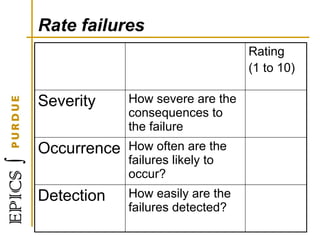
Rate failures
Rating
(1 to 10)
Severity How severe are the
consequences to
the failure
Occurrence How often are the
failures likely to
occur?
Detection How easily are the
failures detected?
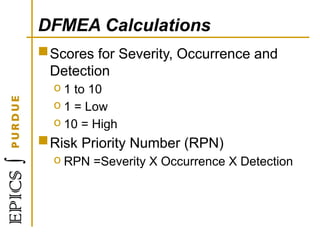
DFMEA Calculations
Scores for Severity, Occurrence and
Detection
o 1 to 10
o 1 = Low
o 10 = High
Risk Priority Number (RPN)
o RPN =Severity X Occurrence X Detection
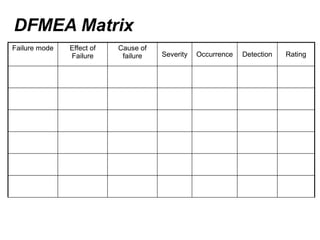
DFMEA Matrix
Failure mode Effect of
Failure
Cause of
failure Severity Occurrence Detection Rating
Take 5 potential failure
scenarios and rate them
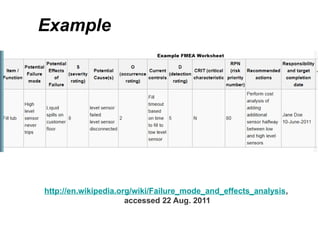
Example
http://en.wikipedia.org/wiki/Failure_mode_and_effects_analysis,
accessed 22 Aug. 2011
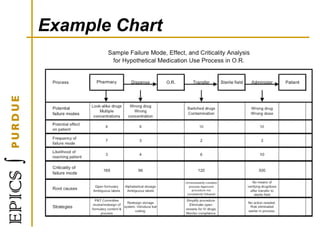
Example Chart
Identify the failure scenario that
should be addressed first
Develop an action plan to
address the failure scenario
Continue the process
Implement the plan to eliminate the
failure scenario
Revisit other potential failure risks
o Prioritize
o Eliminate failure scenarios
Continue until risks are below
determined thresholds
o Show to the design reviews for
confirmation
Can we get rid of all failures?
All cars have brakes that will eventually
fail
o Potentially catastrophic
o Early warning squealers to notify
Questions/Discussion
Testing in Design
William Oakes
Learning Objectives
 At the end of this session, you will be
able to:
1. Describe at least three ways to test your
projects
2. Describe how prototypes can be used in
testing
3. Categorize potential failures for a design
Testing
How do we know our projects will work?
o When we deliver it?
o For the intended life?
• What is the expected life?
How do we know the project will
function like we want and for the users
intended?
How do we know we are meeting the
right needs?
Testing
Designers have to know that their
design will function
o Plan testing along the way
Tests look at
o Function – does it perform like we intended
• Under what conditions?
o User testing – does it meet needs
• Can people use it as intended
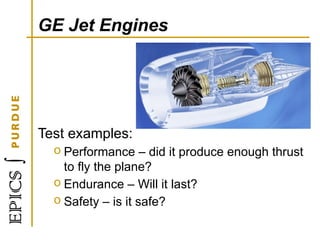
GE Jet Engines
Test examples:
o Performance – did it produce enough thrust
to fly the plane?
o Endurance – Will it last?
o Safety – is it safe?
Jet Engine Testing
Proof of concept
o Analysis – computer tests
o Component tests
Fit and form
o CAD models
o Wooden and/or rapid prototype models
• Can we reach things?
o Interface fits
Jet Engine Testing
Assembly tests
Ground tests
o Performance
o Endurance – simulate flights
o Safety – what could go wrong
• Bird strikes
• Water (rain) ingestion
• Hail ingestion
• Blade failures
Flight tests
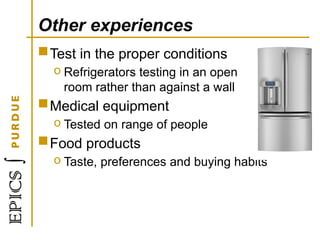
Other experiences
Test in the proper conditions
o Refrigerators testing in an open
room rather than against a wall
Medical equipment
o Tested on range of people
Food products
o Taste, preferences and buying habits
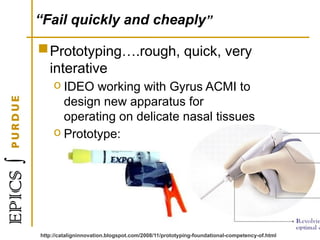
“Fail quickly and cheaply”
Prototyping….rough, quick, very
interative
o IDEO working with Gyrus ACMI to
design new apparatus for
operating on delicate nasal tissues
o Prototype:
http://cataligninnovation.blogspot.com/2008/11/prototyping-foundational-competency-of.html
Think, pair, share….
What questions and/or issues need to
be tested for your current project?
Find one or two others to share your
answers
o Introduce yourself
o Describe your project
o Answer the first question
More discussion
Individually
o What tests need to be done on the project?
Share what you answered for your
project with the same person or pair.
Test plans
At GE and other companies there are
teams that are dedicated on testing
o How do we take an engine and test it?
o How do we test a new medical device?
o How to we insure that the software works?
Create a test plan for your design
o What tests need to be done?
o What will they measure?
o What are the criteria for success and failure?
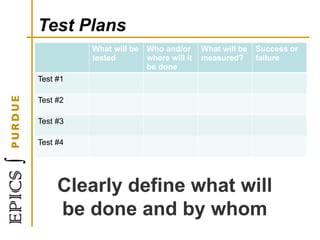
Test Plans
What will be
tested
Who and/or
where will it
be done
What will be
measured?
Success or
failure
Test #1
Test #2
Test #3
Test #4
Clearly define what will
be done and by whom
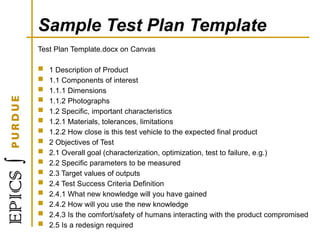
Sample Test Plan Template
Test Plan Template.docx on Canvas
 1 Description of Product
 1.1 Components of interest
 1.1.1 Dimensions
 1.1.2 Photographs
 1.2 Specific, important characteristics
 1.2.1 Materials, tolerances, limitations
 1.2.2 How close is this test vehicle to the expected final product
 2 Objectives of Test
 2.1 Overall goal (characterization, optimization, test to failure, e.g.)
 2.2 Specific parameters to be measured
 2.3 Target values of outputs
 2.4 Test Success Criteria Definition
 2.4.1 What new knowledge will you have gained
 2.4.2 How will you use the new knowledge
 2.4.3 Is the comfort/safety of humans interacting with the product compromised
 2.5 Is a redesign required
Discussion
In your pairs or groups, identify one test
that was proposed and develop the
who, what, where, why and the success
criteria
Test tips
User testing and prototypes
Component tests
o Small parts that are demonstrated can help
hold the team accountable
Fit and form tests
Simulate usage
o Walked on the Martian surface
Use Cases – software
o Build a case or example of how to use the
design and see if it works correctly
Another example…
Testing in the proper conditions
Delivery of
Projects
Delivery Steps
Review the delivery checklist used at
Purdue
Modify the checklist assuming that your
students will finish their designs and deliver
them to a user or client
Questions/Discussion

Module8_DFMEA_Testing_Innovation_Creativity_v7Innovation_Creativity_v7Delivery_v1.pptx

  • 1.
    DFMEA : Design for Robustness Pickone project from your group for this section
  • 2.
    DFMEA Steps 1. Reviewthe design 2. Brainstorm potential failure modes 3. List potential effects of failure 4. List potential causes for each failure 5. Rank failures a) Severity b) Occurrence c) Detection d) RPN = Severity X Occurrence X Detection 6. Develop action plan 7. Implement fixes 8. Revisit potential failure risks
  • 3.
    In a group,identify one project to use as an example for this exercise Describe the project so the whole group understands it
  • 4.
    Brainstorm Failures What couldgo wrong? What could break? Are there systems your design relies upon? o e.g. myEPICS authenticates through Purdue’s career accounts Are there things that could fail over time?
  • 5.
    Brainstorm a listof potential failures and their causes for one project
  • 6.
    Rate failures Rating (1 to10) Severity How severe are the consequences to the failure Occurrence How often are the failures likely to occur? Detection How easily are the failures detected?
  • 7.
    DFMEA Calculations Scores forSeverity, Occurrence and Detection o 1 to 10 o 1 = Low o 10 = High Risk Priority Number (RPN) o RPN =Severity X Occurrence X Detection
  • 8.
    DFMEA Matrix Failure modeEffect of Failure Cause of failure Severity Occurrence Detection Rating
  • 9.
    Take 5 potentialfailure scenarios and rate them
  • 10.
  • 11.
  • 12.
    Identify the failurescenario that should be addressed first
  • 13.
    Develop an actionplan to address the failure scenario
  • 14.
    Continue the process Implementthe plan to eliminate the failure scenario Revisit other potential failure risks o Prioritize o Eliminate failure scenarios Continue until risks are below determined thresholds o Show to the design reviews for confirmation
  • 15.
    Can we getrid of all failures? All cars have brakes that will eventually fail o Potentially catastrophic o Early warning squealers to notify
  • 16.
  • 17.
  • 18.
    Learning Objectives  Atthe end of this session, you will be able to: 1. Describe at least three ways to test your projects 2. Describe how prototypes can be used in testing 3. Categorize potential failures for a design
  • 19.
    Testing How do weknow our projects will work? o When we deliver it? o For the intended life? • What is the expected life? How do we know the project will function like we want and for the users intended? How do we know we are meeting the right needs?
  • 20.
    Testing Designers have toknow that their design will function o Plan testing along the way Tests look at o Function – does it perform like we intended • Under what conditions? o User testing – does it meet needs • Can people use it as intended
  • 21.
    GE Jet Engines Testexamples: o Performance – did it produce enough thrust to fly the plane? o Endurance – Will it last? o Safety – is it safe?
  • 22.
    Jet Engine Testing Proofof concept o Analysis – computer tests o Component tests Fit and form o CAD models o Wooden and/or rapid prototype models • Can we reach things? o Interface fits
  • 23.
    Jet Engine Testing Assemblytests Ground tests o Performance o Endurance – simulate flights o Safety – what could go wrong • Bird strikes • Water (rain) ingestion • Hail ingestion • Blade failures Flight tests
  • 24.
    Other experiences Test inthe proper conditions o Refrigerators testing in an open room rather than against a wall Medical equipment o Tested on range of people Food products o Taste, preferences and buying habits
  • 25.
    “Fail quickly andcheaply” Prototyping….rough, quick, very interative o IDEO working with Gyrus ACMI to design new apparatus for operating on delicate nasal tissues o Prototype: http://cataligninnovation.blogspot.com/2008/11/prototyping-foundational-competency-of.html
  • 26.
    Think, pair, share…. Whatquestions and/or issues need to be tested for your current project? Find one or two others to share your answers o Introduce yourself o Describe your project o Answer the first question
  • 27.
    More discussion Individually o Whattests need to be done on the project? Share what you answered for your project with the same person or pair.
  • 28.
    Test plans At GEand other companies there are teams that are dedicated on testing o How do we take an engine and test it? o How do we test a new medical device? o How to we insure that the software works? Create a test plan for your design o What tests need to be done? o What will they measure? o What are the criteria for success and failure?
  • 29.
    Test Plans What willbe tested Who and/or where will it be done What will be measured? Success or failure Test #1 Test #2 Test #3 Test #4 Clearly define what will be done and by whom
  • 30.
    Sample Test PlanTemplate Test Plan Template.docx on Canvas  1 Description of Product  1.1 Components of interest  1.1.1 Dimensions  1.1.2 Photographs  1.2 Specific, important characteristics  1.2.1 Materials, tolerances, limitations  1.2.2 How close is this test vehicle to the expected final product  2 Objectives of Test  2.1 Overall goal (characterization, optimization, test to failure, e.g.)  2.2 Specific parameters to be measured  2.3 Target values of outputs  2.4 Test Success Criteria Definition  2.4.1 What new knowledge will you have gained  2.4.2 How will you use the new knowledge  2.4.3 Is the comfort/safety of humans interacting with the product compromised  2.5 Is a redesign required
  • 31.
    Discussion In your pairsor groups, identify one test that was proposed and develop the who, what, where, why and the success criteria
  • 32.
    Test tips User testingand prototypes Component tests o Small parts that are demonstrated can help hold the team accountable Fit and form tests Simulate usage o Walked on the Martian surface Use Cases – software o Build a case or example of how to use the design and see if it works correctly
  • 33.
    Another example… Testing inthe proper conditions
  • 34.
  • 35.
    Delivery Steps Review thedelivery checklist used at Purdue Modify the checklist assuming that your students will finish their designs and deliver them to a user or client
  • 36.