Ethics in 
Electrical and Computer Engineering

Lecture #4: Engineering as Social
Experimentation	

Prof. K.M. Passino	

The Ohio State University	

Department of Electrical and Computer Engineering
Engineering as Experimentation	

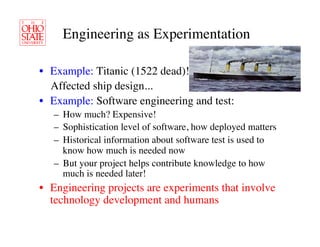
• Example: Titanic (1522 dead)! 	

Affected ship design...	

• Example: Software engineering and test:	

– How much? Expensive!	

– Sophistication level of software, how deployed matters	

– Historical information about software test is used to
know how much is needed now	

– But your project helps contribute knowledge to how
much is needed later!	

• Engineering projects are experiments that involve
technology development and humans
The Design Process	

Engineering product design steps:	


Concepts	


Preliminary designs, tests	


More detailed designs	


More tests (? - may cost $$)	


Production	


More tests! (? - may cost $$$)	

------------------------------------------------------


The public purchases/uses the product	


More tests!!! How to gather results of these tests?	


Role of profits/competition with other companies?	


Dangerous!!! Engineers are asked to do this!
Similarities to Standard Experiments	

• Projects carried out in partial ignorance, outcomes
are uncertain	

– Engineers are asked to make things work without all the
available scientific knowledge (including that about
humans), safety facts, environment, health, social
influences, etc.	

– Good design relies on information gathered before and
after a product leaves the factory - especially when the
product is tested in its true “environment,” not fake
ones used to simulate the real environment (e.g.,
temperature cycling electronic products)
Using the public to perform tests…	

• We redesign using the public to test our
products!	

• Special care is obviously needed for safety,
avoiding loss of customers	

• Example: Software test for popular software
(e.g., word processing programs,
spreadsheets, etc.), computer hardware	

• Diligence helps, but also…
Learning from the Past	

• Product history matters! Respect the past!	

• Can you always know it? Competence, openness
to learning. Do not be afraid to ask!	

• Can you know about a competitor’s safety
statistics?	

• Are there good communication channels in your
own company? 	

• Between different departments?	

• Across “generations” of engineers?	

• Is there a dangerous “generation gap” between
young and old engineers?
Contrasts with Standard
Experiments	

• Experiment control?	

– Cannot control what humans may do with a product	

– What applications will it be used for?	

– Will they subject it to unforseen stresses?	

• Informed consent? (e.g., in medical trials)	

– Keystone of engineer - public interaction	

– What “experiments” are acceptable? Keep in mind that
there is a large variance on the types of customers you
might have. Can they all read?	

• Knowledge gained? Seek the unexpected!
Responsible Experimentalists	

1. Conscientiousness: Protect safety knowledge,
respect right of consent of public	

2. Comprehensive perspective: Awareness of
experimental nature of projects, forecasting,
monitoring	

3. Moral autonomy: Personally engaged,
thoughtful, involvement in project	

4. Accountability: Accept responsibility for results
of a project (avoid fragmentation, diffusion, time
pressures)
Taking charge…	

• Engineers are not the sole experimenters	

– Managers	

– Marketing people	

– Public	

• But, “with knowledge comes responsibility”	

• Engineers are in a unique position to:	

– Monitor projects	

– Identify risks	

– Develop facts for informed consent	

• An engineering professional will take on the
responsibility!
Role of Laws in Engineering	

“Rules of responsible experimentation:”	


- Laws can produce many benefits	


- Produce minimal standards of 	


professional conduct	


- Provide motive to comply with 	


standards	


- Provide support and defense for people 	


who wish to act ethically
Balanced Outlook on Law: 
Rules of Experimentation?	

• Not covering engineering law here	

• You may learn some on-the-job	

• Likely to learn some “industrial standards,” some
of which directly pertain to safety	

• Tendency toward more detail...	

• “Minimal compliance” Is it enough?	

– Morally acceptable?	

– What about push of new technologies? Areas where
there is no law?	

• Government/law can be too detailed - can squash
moral autonomy of engineers - good balance?
Case studies (from students) for
Engineering as Social Experimentation
Software…	

• Student: “I was involved in designing and testing network
communication software. Some tests were still being run
when clients requested the software. We were unable to
finish the tests, and gave the product to the customer
knowing that the system caused lock-ups and loss of data.
We then used the feedback from these clients to debug the
software, and repeated the process.” What to do?	

• Similar student case: In software engineering I have
encountered problems in that the time required for testing
the product and the deadline for testing may conflict, and
some parts of the testing may have to be compromised to
meet those deadlines.” What factors enter the compromise
in deadlines?
Computer testing…	

Student: “On a recent co-op job my company had
just shipped its latest and greatest computer
product. After a few months in the field it was
found to vastly lack the processor power it needed
to do what it claimed to do. The fix that followed
had to have the shortest turn around time I had
ever seen. The fix was top quality, but the damage
had been done. A full scale test, or even
simulation, would have predicted this problem
before shipping.” What should the co-op do?
Trust specifications of other’s subcomponents?
Meeting specifications…	

Student: “At my co-op position I was placed in a design team
to create an audio system. The project was a classic
example of marketing wanting the product so bad that time
lines were regarded higher than the quality of the product.
The audio system's first prototypes arrived with many
problems, some of which could not be resolved until after
the product was released. It basically came down to the
decision of letting the consumers find all the problems, and
then hoping that the management would provide the team
with more time and funding to fix the problems, to try to
keep the customers happy.” What should the student do?
Environment…	

Student: “A turbidity meter was used to monitor if
contaminants were getting into the water that goes
into the river. When those meters failed to alarm
us, and a white pigment went into the river, my
project that focused on redesigning the monitoring
station was given support.”	


Can/should the engineer do anything? 	

Creative solutions?
Environment…	

Student: “In wastewater treatment plants, control systems are
tested in the field. The control systems are designed
according to specifications and ISA/IEEE rules, but the
testing of how the systems will operate under real life
situations is done after installing them. Two questions
arise, then: first, can the plant design withstand additional
rain, population increases, weather problems, etc? Second,
can the control system adequately analyze these new
factors and operate the plant successfully? If anything
fails, the great danger is the release of raw sewage/sludge
and bacteria onto land and into the water supply.” 	

What can the engineer do? Will competence solve the
problem?
Law, minimal compliance…	

Student: “My problem came with a company involved in the design and
manufacturing of PC power supplies. Some manufacturing
organizations, have focused on 100% minimal compliance and hence
substituted parts to achieve their cost objectives. This resulted in
unsafe final consumer products. An industry push for CSA and UL
certification of power supply modules enhanced the minimal level
achieved for standard sub assemblies. Since the FCC and FTC act as
police organizations, it is not usually known that there is a problem
until much mayhem occurs. When other companies began selling
smoking PCs the industry began to push to use only modules which
would meet UL and CSA standards. The minimalists were forced to
up the ante or lose considerable business.” 	


Should an engineering professional be a “minimalist”? Role of tests?
Meeting specifications…
	

• Student: The heated hoses we manufacture were
using a 100 ohm platinum RTD substitute. The
hose resellers were rating the range of heat as
higher than the RTDs could actually model
linearly. We had years with no problems until one
customer started running the product at the top of
the temperature rating. We immediately stopped
production and found another RTD that would be
suitable. All stock was pulled and rebuilt. The fix
took almost a year. Is this cost, worth getting it
right?
Successful use of customers in
testing
	

• Student: Welders built for an alpha run of
production were sent to a select group of
customers to be tested in the field. The
customers did have “informed consent” that
these machines were in the early stages of
testing. Many changes were made based on
their feedback. A proper approach to
design?
Recognizing social experimentation:
NSPE, BER Case 96-4	

• Engineer A is employed by a software
company and is involved in the design of
specialized software in connection with the
operations of facilities affecting the public
health and safety (i.e., nuclear, air quality
control, water quality control). As the part
of the design of a particular software
system, Engineer A conducts extensive
testing and although the tests demonstrate…
that the software is safe to use under existing
standards, Engineer A is aware of new draft
standards that are about to be released by a
standard setting organization-standards
which the newly designed software may not
meet. Testing is extremely costly and the
company’s clients are eager to begin to
move forward. The software company is
eager to satisfy its clients, protect the
software company’s finances, and protect…
…existing jobs; but at the same time, the
management of the software company
wants to be sure that the software is safe to
use. A series of tests proposed by Engineer
A will likely result in a decision whether to
move forward with the use of the software.
The tests are costly and will delay the use of
the software by at least six months, which
will put the company at a competitive…
…disadvantage and cost the company a
significant amount of money. Also,
delaying implementation will mean the state
public service commission utility rates will
rise significantly during this time. The
company requests Engineer A’s
recommendation concerning the need for
additional software testing.
Where is the social experimentation
in this case study?
	

• It is in the case study since it was via social
experimentation that they came up with the
new standards	

– Old standards, show that there is not enough
testing to catch a problem with the software	

– New standards invented to capture the problem
via new testing	

• Question: Where will this trend lead us over
many years?
Attendance Question	

• Name as many technologies or systems
that ECEs are involved in designing,
maintaining, or improving and that
involve important safety considerations	

• Describe examples of “engineering as
social experimentation” that you have
seen in the engineering workplace (save
safety concerns for next lecture) but do
not mention company names	

Please: Put your name on the sheet of paper
and turn it in...

Lecture4EngSocExp.ppt (1).pdf

  • 1.
    Ethics in Electricaland Computer Engineering Lecture #4: Engineering as Social Experimentation Prof. K.M. Passino The Ohio State University Department of Electrical and Computer Engineering
  • 2.
    Engineering as Experimentation •Example: Titanic (1522 dead)! Affected ship design... • Example: Software engineering and test: – How much? Expensive! – Sophistication level of software, how deployed matters – Historical information about software test is used to know how much is needed now – But your project helps contribute knowledge to how much is needed later! • Engineering projects are experiments that involve technology development and humans
  • 3.
    The Design Process Engineeringproduct design steps: Concepts Preliminary designs, tests More detailed designs More tests (? - may cost $$) Production More tests! (? - may cost $$$) ------------------------------------------------------ The public purchases/uses the product More tests!!! How to gather results of these tests? Role of profits/competition with other companies? Dangerous!!! Engineers are asked to do this!
  • 4.
    Similarities to StandardExperiments • Projects carried out in partial ignorance, outcomes are uncertain – Engineers are asked to make things work without all the available scientific knowledge (including that about humans), safety facts, environment, health, social influences, etc. – Good design relies on information gathered before and after a product leaves the factory - especially when the product is tested in its true “environment,” not fake ones used to simulate the real environment (e.g., temperature cycling electronic products)
  • 5.
    Using the publicto perform tests… • We redesign using the public to test our products! • Special care is obviously needed for safety, avoiding loss of customers • Example: Software test for popular software (e.g., word processing programs, spreadsheets, etc.), computer hardware • Diligence helps, but also…
  • 6.
    Learning from thePast • Product history matters! Respect the past! • Can you always know it? Competence, openness to learning. Do not be afraid to ask! • Can you know about a competitor’s safety statistics? • Are there good communication channels in your own company? • Between different departments? • Across “generations” of engineers? • Is there a dangerous “generation gap” between young and old engineers?
  • 7.
    Contrasts with Standard Experiments •Experiment control? – Cannot control what humans may do with a product – What applications will it be used for? – Will they subject it to unforseen stresses? • Informed consent? (e.g., in medical trials) – Keystone of engineer - public interaction – What “experiments” are acceptable? Keep in mind that there is a large variance on the types of customers you might have. Can they all read? • Knowledge gained? Seek the unexpected!
  • 8.
    Responsible Experimentalists 1. Conscientiousness:Protect safety knowledge, respect right of consent of public 2. Comprehensive perspective: Awareness of experimental nature of projects, forecasting, monitoring 3. Moral autonomy: Personally engaged, thoughtful, involvement in project 4. Accountability: Accept responsibility for results of a project (avoid fragmentation, diffusion, time pressures)
  • 9.
    Taking charge… • Engineersare not the sole experimenters – Managers – Marketing people – Public • But, “with knowledge comes responsibility” • Engineers are in a unique position to: – Monitor projects – Identify risks – Develop facts for informed consent • An engineering professional will take on the responsibility!
  • 10.
    Role of Lawsin Engineering “Rules of responsible experimentation:” - Laws can produce many benefits - Produce minimal standards of professional conduct - Provide motive to comply with standards - Provide support and defense for people who wish to act ethically
  • 11.
    Balanced Outlook onLaw: Rules of Experimentation? • Not covering engineering law here • You may learn some on-the-job • Likely to learn some “industrial standards,” some of which directly pertain to safety • Tendency toward more detail... • “Minimal compliance” Is it enough? – Morally acceptable? – What about push of new technologies? Areas where there is no law? • Government/law can be too detailed - can squash moral autonomy of engineers - good balance?
  • 12.
    Case studies (fromstudents) for Engineering as Social Experimentation Software… • Student: “I was involved in designing and testing network communication software. Some tests were still being run when clients requested the software. We were unable to finish the tests, and gave the product to the customer knowing that the system caused lock-ups and loss of data. We then used the feedback from these clients to debug the software, and repeated the process.” What to do? • Similar student case: In software engineering I have encountered problems in that the time required for testing the product and the deadline for testing may conflict, and some parts of the testing may have to be compromised to meet those deadlines.” What factors enter the compromise in deadlines?
  • 13.
    Computer testing… Student: “Ona recent co-op job my company had just shipped its latest and greatest computer product. After a few months in the field it was found to vastly lack the processor power it needed to do what it claimed to do. The fix that followed had to have the shortest turn around time I had ever seen. The fix was top quality, but the damage had been done. A full scale test, or even simulation, would have predicted this problem before shipping.” What should the co-op do? Trust specifications of other’s subcomponents?
  • 14.
    Meeting specifications… Student: “Atmy co-op position I was placed in a design team to create an audio system. The project was a classic example of marketing wanting the product so bad that time lines were regarded higher than the quality of the product. The audio system's first prototypes arrived with many problems, some of which could not be resolved until after the product was released. It basically came down to the decision of letting the consumers find all the problems, and then hoping that the management would provide the team with more time and funding to fix the problems, to try to keep the customers happy.” What should the student do?
  • 15.
    Environment… Student: “A turbiditymeter was used to monitor if contaminants were getting into the water that goes into the river. When those meters failed to alarm us, and a white pigment went into the river, my project that focused on redesigning the monitoring station was given support.” Can/should the engineer do anything? Creative solutions?
  • 16.
    Environment… Student: “In wastewatertreatment plants, control systems are tested in the field. The control systems are designed according to specifications and ISA/IEEE rules, but the testing of how the systems will operate under real life situations is done after installing them. Two questions arise, then: first, can the plant design withstand additional rain, population increases, weather problems, etc? Second, can the control system adequately analyze these new factors and operate the plant successfully? If anything fails, the great danger is the release of raw sewage/sludge and bacteria onto land and into the water supply.” What can the engineer do? Will competence solve the problem?
  • 17.
    Law, minimal compliance… Student:“My problem came with a company involved in the design and manufacturing of PC power supplies. Some manufacturing organizations, have focused on 100% minimal compliance and hence substituted parts to achieve their cost objectives. This resulted in unsafe final consumer products. An industry push for CSA and UL certification of power supply modules enhanced the minimal level achieved for standard sub assemblies. Since the FCC and FTC act as police organizations, it is not usually known that there is a problem until much mayhem occurs. When other companies began selling smoking PCs the industry began to push to use only modules which would meet UL and CSA standards. The minimalists were forced to up the ante or lose considerable business.” Should an engineering professional be a “minimalist”? Role of tests?
  • 18.
    Meeting specifications… • Student:The heated hoses we manufacture were using a 100 ohm platinum RTD substitute. The hose resellers were rating the range of heat as higher than the RTDs could actually model linearly. We had years with no problems until one customer started running the product at the top of the temperature rating. We immediately stopped production and found another RTD that would be suitable. All stock was pulled and rebuilt. The fix took almost a year. Is this cost, worth getting it right?
  • 19.
    Successful use ofcustomers in testing • Student: Welders built for an alpha run of production were sent to a select group of customers to be tested in the field. The customers did have “informed consent” that these machines were in the early stages of testing. Many changes were made based on their feedback. A proper approach to design?
  • 20.
    Recognizing social experimentation: NSPE,BER Case 96-4 • Engineer A is employed by a software company and is involved in the design of specialized software in connection with the operations of facilities affecting the public health and safety (i.e., nuclear, air quality control, water quality control). As the part of the design of a particular software system, Engineer A conducts extensive testing and although the tests demonstrate…
  • 21.
    that the softwareis safe to use under existing standards, Engineer A is aware of new draft standards that are about to be released by a standard setting organization-standards which the newly designed software may not meet. Testing is extremely costly and the company’s clients are eager to begin to move forward. The software company is eager to satisfy its clients, protect the software company’s finances, and protect…
  • 22.
    …existing jobs; butat the same time, the management of the software company wants to be sure that the software is safe to use. A series of tests proposed by Engineer A will likely result in a decision whether to move forward with the use of the software. The tests are costly and will delay the use of the software by at least six months, which will put the company at a competitive…
  • 23.
    …disadvantage and costthe company a significant amount of money. Also, delaying implementation will mean the state public service commission utility rates will rise significantly during this time. The company requests Engineer A’s recommendation concerning the need for additional software testing.
  • 24.
    Where is thesocial experimentation in this case study? • It is in the case study since it was via social experimentation that they came up with the new standards – Old standards, show that there is not enough testing to catch a problem with the software – New standards invented to capture the problem via new testing • Question: Where will this trend lead us over many years?
  • 25.
    Attendance Question • Nameas many technologies or systems that ECEs are involved in designing, maintaining, or improving and that involve important safety considerations • Describe examples of “engineering as social experimentation” that you have seen in the engineering workplace (save safety concerns for next lecture) but do not mention company names Please: Put your name on the sheet of paper and turn it in...