Brothers & SistersBrothers & Sisters
Welcome to a PresentationWelcome to a Presentation
onon
ImprovingImproving
Basic Service DeliveryBasic Service Delivery
G. Kondala Rao
Chief Engineer
APUFIDC; Mob 9618888983
email: raogkondala2020@gmail.com
• Urban Basic Services - Delivery systems
• Improving Service Delivery
• Role of Different Functionaries
• Services Management
• Regulatory Mechanism
• Service Level Benchmarking
• Challenges in Service Delivery
• Addressing the Challenges
• Way Forward
Overview
2
Urban Basic Services
• Water Supply
• Sanitation – On-site and off-site
• Solid Waste Management
• Storm Water Drainage
• Roads, Bridges, Flyovers and Transport
• Street Lighting
• Parks & Play Grounds
• Burial Grounds
Millennium Development Goal 7: Ensure
Environmental Sustainability
Target 7.C: “Halve, by 2015, the proportion of
people without sustainable access to safe drinking
water and basic sanitation”
In the world >0.86 billion people lack access to
safe water supply and >2.5 billion lack access to
safe sanitation
 In India, 12.73 lakh children < 1 yr age (IMR 42 per 1000
live births) died in 2011 due to Wat-san related diseases4
Basic Principles in Service Delivery
• Water and Sanitation for All
• Safety and Security for All
• Basic civic services should be:
– Universal and Accessible
– Sustainable
– Affordable and Equitable
• Disaster Risk Reduction & Climate Change Adaptation
• Environmental sustainability
• Financial sustainability
• Energy and Water conservation
• Resource Use Efficiency
Delivery Systems
• Municipal Administration Department
– Commissioner & Director of Municipal Administration;
– Public Health & Municipal Engineering Department;
– Director of Town & Country Planning;
– Urban Development Authorities.
• Engineer-in-Chief (Public Health)
– SE (PH), EE (PH), DEE (PH);
– Municipal Engineers – EE, DEE, AE, MAE.
• Activities performed: Preparation of DPRs, obtaining
sanctions, tendering, implementation, QA, O&M.
• SWM - collection, segregation, recycling, composting, landfill
mgt., dealt by MHO, C&DMA monitors. Tech. inputs by Engrs.
• Projects will be executed by private contracting
agencies, or on PPP basis.
Roles & Responsibilities
• Adm. Sanction by Commissioner/Standing
Council/Council/Govt. based on Cost.
• Technical Sanction accorded by:
– E-in-C (PH)/CE (PH) - for works > Rs.50 lakhs
– SE (PH) - for works from Rs.10-50 lakhs
– EE (PH) - for works up to Rs.10 lakhs
• Tenders will be approved by Commissioner: based on
recommendation of CE up to Rs.2 cr., SE up to Rs.50
lakhs and of EE up to Rs.10 lakhs.
• For 2-10 Cr. works, COT approval is necessary for
finalizing the tenders.
• For > 10 Cr. works, EPC system of contract should
be followed.
Roles & Responsibilities
• Engineers are responsible: for the implementation
and quality of works.
• They are responsible for: proper O&M of facilities.
• They are also responsible for proper O&M of SWM
vehicles, landfill etc.
• The Engineers will be assisted by
– Work Inspectors in field for maintaining quality of works, and
– Draughtsmen in office for ensuring accuracy of designs,
estimates, drawings, tenders, Agreements etc.
• They will be under the Admin. Control of E-in-C (PH).
• Tenders for works costing >Rs1 Lakh shall be thro’
e-procurement.
• CE/SE/EE act as adviser on engg. issues to Council.
Management – Regulatory Mechanism
• Council is the Statutory Authority responsible for Governance
of the ULB in line with the prevailing legislative framework.
• Commissioner is Adm. Head managing its day-to-day affairs.
• A realistic Budget will be prepared by Commissioner involving
all depts. and the citizens in a transparent manner, and
approved by the Council.
• The engg. proposals will be put up to the Council through the
Commissioner, complying with the Budget provision.
• All activities of Engg. Section i.e., Projects/Construction,
Quality Control and O&M of utilities to be monitored by the SE.
• Third Party QA/QC (TPQA) mandatory for all works >1 lakh.
• TPQA also is desirable for O&M activities also.
Management – Regulatory Mechanism
• The Council is expected to oversee:
• That all its resolutions are in tune with the
Municipal Corporations Act,
• The execution of works, their quality and timely
completion,
• O&M management,
• Community participation in every aspect of
Governance,
• The councillors are the bridge between the Council
and the citizens, both ways,
• Social audit,
• Sanction of projects, funding from State/Central
Govts., updation of accounts and audit.
Urban Vision
Characteristics of a Smart City
• Governance - Smart, participatory and consultative
• Efficient services - Universal, accessible, equitable and affordable
• Mobility - Seamless, Safe and Green Transport
• Public safety - Safe and secure for all
• Economy - Competitive, productive and equitable
• Finances - Self-sustaining
• Environment - Sustainable, clean, green, renewable energy driven
• Technology - Digital, innovation driven with Integration, ITES, OFC
• Planning - Inclusive, Low carbon growth model
• Citizens - Healthy, eco-friendly, knowledgeable, skilled and
gainfully employed
• Recreational life - vibrant
• Livability - Eminently livable, affordable market places
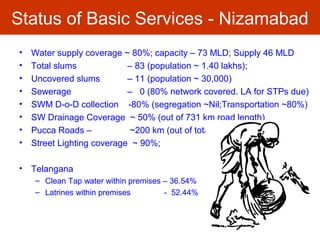
Status of Basic Services - Nizamabad
• Water supply coverage ~ 80%; capacity – 73 MLD; Supply 46 MLD
• Total slums – 83 (population ~ 1.40 lakhs);
• Uncovered slums – 11 (population ~ 30,000)
• Sewerage – 0 (80% network covered. LA for STPs due)
• SWM D-o-D collection -80% (segregation ~Nil;Transportation ~80%)
• SW Drainage Coverage ~ 50% (out of 731 km road length)
• Pucca Roads – ~200 km (out of total 731km)
• Street Lighting coverage ~ 90%;
• Telangana
– Clean Tap water within premises – 36.54%
– Latrines within premises - 52.44%
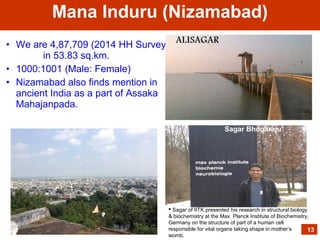
• We are 4,87,709 (2014 HH Survey);
in 53.83 sq.km.
• 1000:1001 (Male: Female)
• Nizamabad also finds mention in
ancient India as a part of Assaka
Mahajanpada.
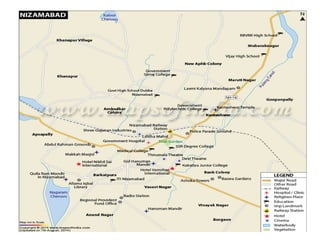
Mana Induru (Nizamabad)
13
 Sagar of IITK presented his research in structural biology
& biochemistry at the Max Planck Institute of Biochemistry,
Germany on the structure of part of a human cell
responsible for vital organs taking shape in mother’s
womb.
Sagar Bhogaraju
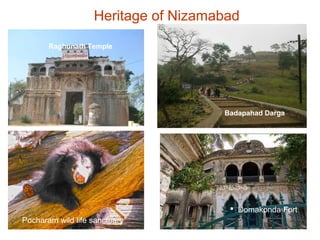
Heritage of Nizamabad
Badapahad Darga
Raghunath Temple
 Domakonda Fort
Pocharam wild life sanctuary
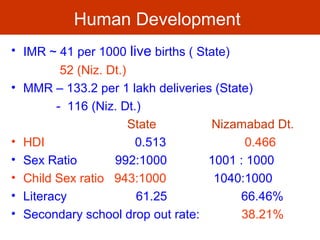
Human Development
• IMR ~ 41 per 1000 live births ( State)
52 (Niz. Dt.)
• MMR – 133.2 per 1 lakh deliveries (State)
- 116 (Niz. Dt.)
State Nizamabad Dt.
• HDI 0.513 0.466
• Sex Ratio 992:1000 1001 : 1000
• Child Sex ratio 943:1000 1040:1000
• Literacy 61.25 66.46%
• Secondary school drop out rate: 38.21%
Corporators – Onerous responsibilities
• Adopting a vision and future direction for the city.
• Endeavour:
– To implement the state and central level urban legislations;
– Central and state level policies, programmes etc.
• Deliberations on policy and institutional issues in Council:
– Sanction of projects;
– Budget approval and sanction of funds;
– Develop his division and contribute to overall growth of city;
• Citizens needs and grievances:
– Accessibility to citizens; improving quality of life, incl. vulnerable groups
– Represent their needs & grievances in Council, approval
– Ensure citizens participation in municipal programmes;
• Giving direction and guidance to municipal officials
• Monitoring implementation: CRs, projects, QA/QC and O&M
• Envtl. sustainability – Create awareness on Energy & Water
• Coordinate with local, higher authorities-approvals, funding
• Playing a Mediatory role between public and the Council.
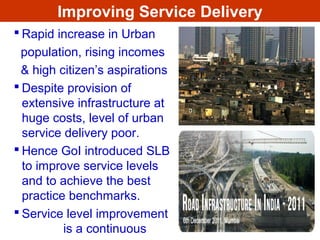
Improving Service Delivery
 Rapid increase in Urban
population, rising incomes
& high citizen’s aspirations
 Despite provision of
extensive infrastructure at
huge costs, level of urban
service delivery poor.
 Hence GoI introduced SLB
to improve service levels
and to achieve the best
practice benchmarks.
 Service level improvement
is a continuous
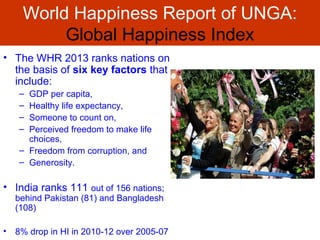
World Happiness Report of UNGA:
Global Happiness Index
• The WHR 2013 ranks nations on
the basis of six key factors that
include:
– GDP per capita,
– Healthy life expectancy,
– Someone to count on,
– Perceived freedom to make life
choices,
– Freedom from corruption, and
– Generosity.
• India ranks 111 out of 156 nations;
behind Pakistan (81) and Bangladesh
(108)
• 8% drop in HI in 2010-12 over 2005-07
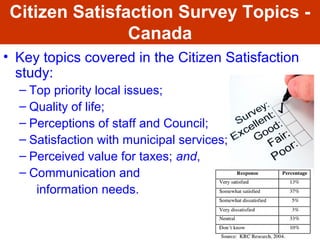
Citizen Satisfaction Survey Topics -
Canada
• Key topics covered in the Citizen Satisfaction
study:
– Top priority local issues;
– Quality of life;
– Perceptions of staff and Council;
– Satisfaction with municipal services;
– Perceived value for taxes; and,
– Communication and
information needs.
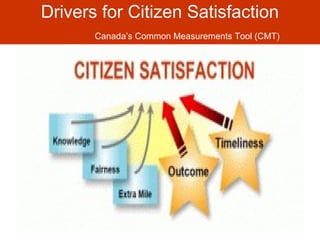
Drivers for Citizen Satisfaction
Canada’s Common Measurements Tool (CMT)
Need for Smart Cities
 The global environment in which people live.
 People's thinking and values about their way of life are
undergoing significant changes.
 If people and the Earth are both changing, then surely the
cities that link them together must also change.
 The international call for action in response to changes in the
global and urban environments.
 The world in which people live is being changed by:
Rresource depletion,
Urban issues, and
Problems brought about by climate change and
Increases in the size and concentration of population.
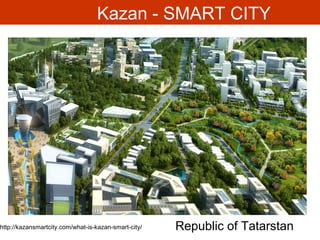
Kazan - SMART CITY
Republic of Tatarstanhttp://kazansmartcity.com/what-is-kazan-smart-city/
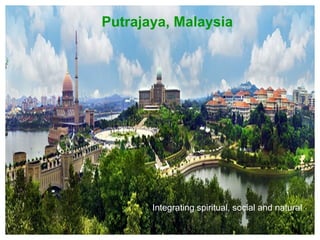
Putrajaya, Malaysia
Integrating spiritual, social and natural
Amsterdam
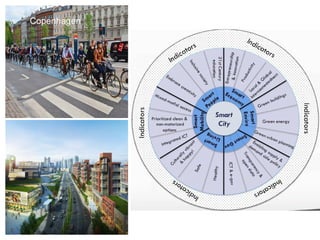
Copenhagen
Amsterdam
Copenhagen
Copenhagen
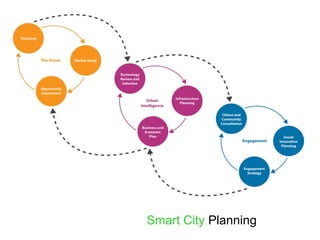
Smart City Planning
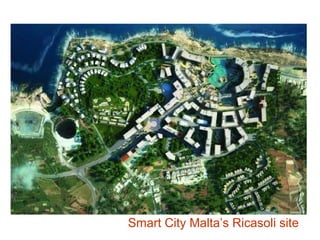
Smart City Malta’s Ricasoli site
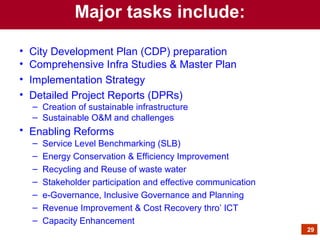
• City Development Plan (CDP) preparation
• Comprehensive Infra Studies & Master Plan
• Implementation Strategy
• Detailed Project Reports (DPRs)
– Creation of sustainable infrastructure
– Sustainable O&M and challenges
• Enabling Reforms
– Service Level Benchmarking (SLB)
– Energy Conservation & Efficiency Improvement
– Recycling and Reuse of waste water
– Stakeholder participation and effective communication
– e-Governance, Inclusive Governance and Planning
– Revenue Improvement & Cost Recovery thro’ ICT
– Capacity Enhancement
Major tasks include:
29
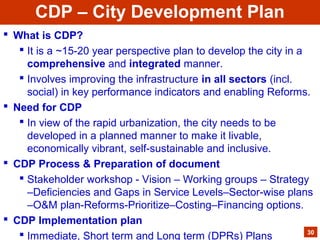
 What is CDP?
 It is a ~15-20 year perspective plan to develop the city in a
comprehensive and integrated manner.
 Involves improving the infrastructure in all sectors (incl.
social) in key performance indicators and enabling Reforms.
 Need for CDP
 In view of the rapid urbanization, the city needs to be
developed in a planned manner to make it livable,
economically vibrant, self-sustainable and inclusive.
 CDP Process & Preparation of document
 Stakeholder workshop - Vision – Working groups – Strategy
–Deficiencies and Gaps in Service Levels–Sector-wise plans
–O&M plan-Reforms-Prioritize–Costing–Financing options.
 CDP Implementation plan
 Immediate, Short term and Long term (DPRs) Plans 30
CDP – City Development Plan
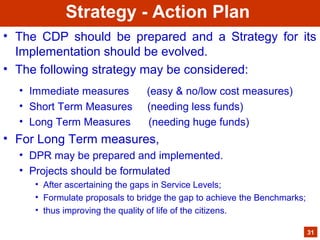
• The CDP should be prepared and a Strategy for its
Implementation should be evolved.
• The following strategy may be considered:
• Immediate measures (easy & no/low cost measures)
• Short Term Measures (needing less funds)
• Long Term Measures (needing huge funds)
• For Long Term measures,
• DPR may be prepared and implemented.
• Projects should be formulated
• After ascertaining the gaps in Service Levels;
• Formulate proposals to bridge the gap to achieve the Benchmarks;
• thus improving the quality of life of the citizens.
31
Strategy - Action Plan
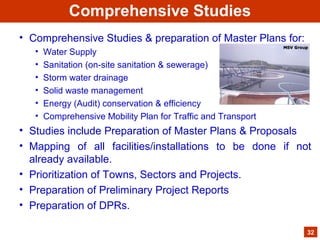
• Comprehensive Studies & preparation of Master Plans for:
• Water Supply
• Sanitation (on-site sanitation & sewerage)
• Storm water drainage
• Solid waste management
• Energy (Audit) conservation & efficiency
• Comprehensive Mobility Plan for Traffic and Transport
• Studies include Preparation of Master Plans & Proposals
• Mapping of all facilities/installations to be done if not
already available.
• Prioritization of Towns, Sectors and Projects.
• Preparation of Preliminary Project Reports
• Preparation of DPRs.
32
Comprehensive Studies
• Per capita supply of water in LPCD - 135
• Coverage of water supply connections - 100 %
• Extent of Non-revenue water - 20%
• Extent of metering - 100%
• Continuity of Water Supplied - 24 hrs
• Efficiency in redressal of customer complaints - 80%
• Quality of Water Supplied - 100%
• Cost recovery - 100%
• Efficiency in Collection of Water Charges - 90%
33
SLBs – Urban Water Supply
 Coverage of Toilets - 100%
 Coverage of Sewerage Network - 100%
 Collection efficiency of Sewerage Network - 100%
 Adequacy of Sewage Treatment Capacity - 100%
 Quality of Sewage Treatment - 100%
 Extent of Reuse and Recycling of Sewage - 20%
 Extent of cost recovery in waste water mgt.- 100%
 Efficiency in redressal of customer complaints- 80%
 Efficiency in Collection of Sewerage Charges - 90%
34
SLB’s – Sewerage
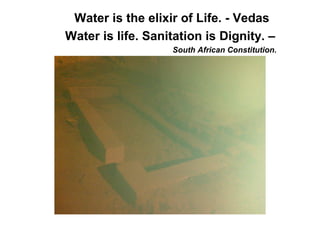
Water is the elixir of Life. - Vedas
Water is life. Sanitation is Dignity. –
South African Constitution.
 Coverage of with covered drains - 100%
 Incidence of water logging (No. of times) - 0
36
SLB’s – Storm Water Drainage
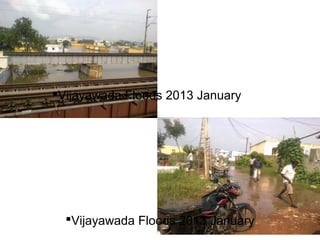
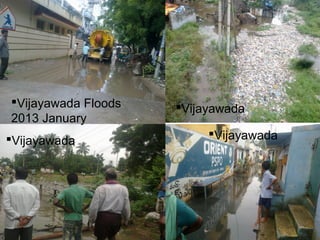
Vijayawada Floods
2013 January
Vijayawada
Vijayawada
Vijayawada
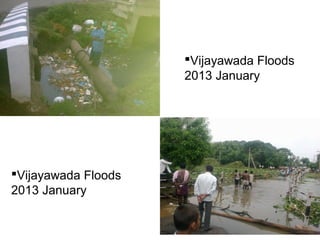
Vijayawada Floods
2013 January
Vijayawada Floods
2013 January
Vijayawada Floods 2013 January
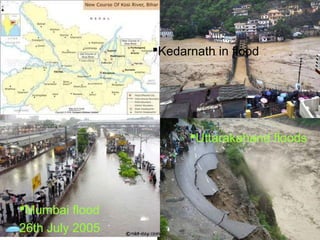
Uttarakahand floods
Kedarnath in flood
Mumbai flood
26th July 2005
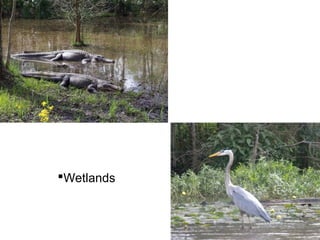
Wetlands
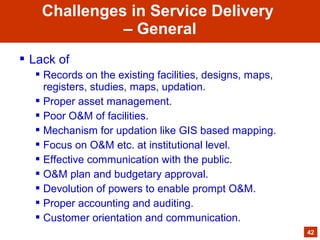
 Lack of
 Records on the existing facilities, designs, maps,
registers, studies, maps, updation.
 Proper asset management.
 Poor O&M of facilities.
 Mechanism for updation like GIS based mapping.
 Focus on O&M etc. at institutional level.
 Effective communication with the public.
 O&M plan and budgetary approval.
 Devolution of powers to enable prompt O&M.
 Proper accounting and auditing.
 Customer orientation and communication.
42
Challenges in Service Delivery
– General
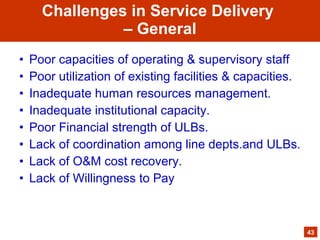
• Poor capacities of operating & supervisory staff
• Poor utilization of existing facilities & capacities.
• Inadequate human resources management.
• Inadequate institutional capacity.
• Poor Financial strength of ULBs.
• Lack of coordination among line depts.and ULBs.
• Lack of O&M cost recovery.
• Lack of Willingness to Pay
43
Challenges in Service Delivery
– General
 Absence of holistic, multi-sectoral, basin-wise
approach to projects - integrating rural-urban.
 Poor condition of utilities due to poor O&M.
 Non-Revenue Water (Volume of water delivered into the
network – Billed consumption)
 Intermittent supply & no thrust on 24x7 supply.
 Lack of metering and poor working of meters.
 Unviable Tariff.
 Absence of Seasonal Tariffs and Telescopic Charges
for energy.
44
Challenges in Service Delivery
– Water Supply
 Inappropriately targeted subsidies.
 Poor billing and collection systems.
 Lack of water conservation and Water Safety Plan.
 Non-adoption of Recycling, Reuse of waste water.
 Non-adoption of latest technology and softwares.
 Lack of focus on energy conservation and efficiency
 Poor O&M of water supply facilities.
 Preventing contamination of water sources
 Improving efficiency, if necessary thro’ PPP, of:
 Billing,
 O&M of pumping stations,
45
Challenges in Service Delivery
– Water Supply
ONSITE SANITATION / SEWERAGE
• Lack of awareness in citizens on proper usage of
Individual Toilets.
• Lack of effective septage management.
• Lack of advance planning for LA for STPs.
• Lack of focus on O&M of sewage pumping
stations, STPs, sewer cleaning etc.
• Lack of modern sewer cleaning equipment.
• Lack of focus on eliminating manual scavenging.
• Lack of focus on workers’ safety and health.
46
Challenges in Service Delivery
– Sewerage & SWM
SWM
• Focus on 5R’s – Reduce, Reuse, Recycle, Recover, Residual
Management.
• Lack of full coverage of Door to Door collection.
• Absence of source segregation.
• Absence of a closed loop approach for SWM.
• Poor O&M of transportation equipment.
• Lack of Landfill site.
• Poor management of Landfill by just dumping.
• Lack of technical capacities and understanding of SWM
related issues - composting, Waste to Energy etc.
47
Challenges in Service Delivery
– Solid Waste Management
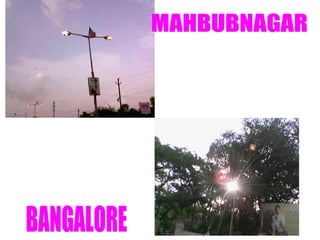
• Poor energy conservation
• Lack of energy efficiency initiatives and latest
technologies in Lighting & Saving
• LED/Induction Lamps, Timer Controllers and
Power savers.
• Poor understanding of energy related issues in
ULB staff.
• Lack of use of renewable energy technologies
– solar, wind, hybrid etc.
• Lack of coordination with NREDCAP, MNRE,
BEE etc.
48
Challenges in Service Delivery
– Street Lighting
• India loses Rs.60000 Cr / annum. due to traffic
congestion.
• There is general lack of
• Awareness on National Urban Transport Policy 2006.
• Focus on public transport.
• Focus on non-motorized transport.
• Civic sense among general public.
• Junction improvements, traffic signaling.
• Focus on improving Green mobility & Connectivity.
• Focus on Road safety.
• Integration of Land use & Transportation planning.
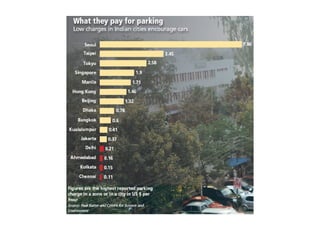
• Rationalization of parking charges.
• Road pricing and Congestion charging. 50
Challenges in Service Delivery
– Urban Transport
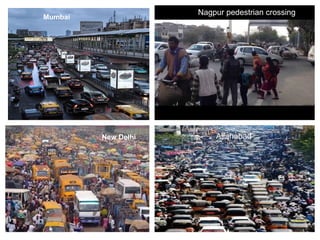
New Delhi
More Roads, More Congestion,
Mumbai
Nagpur pedestrian crossing
Allahabad
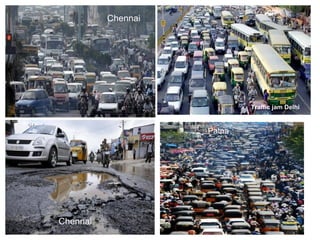
Chennai
Traffic jam Delhi
Patna
Chennai
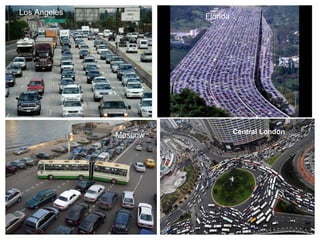
Los Angeles Florida
Chennai
Pedestrians crossing NagpurCentral London
Moscow
• Operation & Maintenance
• Operation;
• Routine and Repair & Breakdown maintenance
• Bring dignity to O&M functions by:
• Greater focus on O&M of utilities by the Management.
• O&M monitoring cell at Council level for periodical review
• Recognizing good performance.
• Prepare O&M plan for the city
• Covering all sectors & Council approval for O&M allocations
• Customer grievance cell, online monitoring and linkage to citizens charter
• Capacity building of staff to be accorded top priority.
• Health, Safety and Environmental standards to be ensured.
• Quality & Quantity of supply to be continuously monitored – testing,
metering & pressure gauges.
56
Operation & Maintenance
• A O&M Monitoring Committee at Council level will oversee the
implementation of O&M plan. It will:
• Comprise Mayor, Commissioner, one Corporator for each sector,
HOD of Engg.Wing, CDS/SLF members, external engg. expert.
• Monitor the execution of O&M plan on continuous basis.
• Meet monthly and review the implementation of O&M plan in all
sectors in the city, w.r.t. targeted service levels.
• Review the working of TPQA and Social Audit Group/Agency.
• It will Monitor: Water drawls, pumping, filtration, disinfection, filling,
overflows, distribution, supply thro’ taps and Residual Chlorine.
• It will also monitor leakages, unauthorized connections, drainage
crossings and sewage/sullage discharges.
• Cause water audit and arrive at NRW. Take actions to bring it <20%.
• Oversee water conservation and efficiency of use of water supplied.
• Monitor water safety by overseeing implementation of Water Safety Plan
57
Monitoring of O&M - Water supply
• Metering–enables volumetric charging, effective control, demand mgt.
• Pilot 24x7 water supply - helps prevent water pollution and wastage,
promotes convenience and girls’ education.
• Tariff rationalization - for achieving full O&M cost recovery and
automatic annual updating of tariffs.
• Energy conservation & efficiency improvement in Water Supply,
Sewerage and Street Lighting; water conservation.
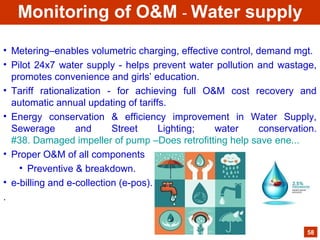
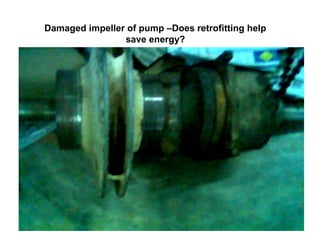
#38. Damaged impeller of pump –Does retrofitting help save ene...
• Proper O&M of all components
• Preventive & breakdown.
• e-billing and e-collection (e-pos).
.
58
Monitoring of O&M - Water supply
Damaged impeller of pump –Does retrofitting help
save energy?
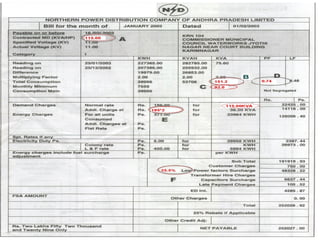
• Rationalizing Contracted Maximum Demand
• Installation of capacitors
• Segregation of Light & Fan loads
• Improving O&M of equipment. Eg. PF meter
• Conducting energy audit for pumping stations
• Improving capacities of operating staff
60
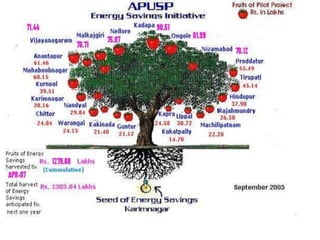
APUSP INITIATIVES– Water Pumping
• Analyzing past power bills
• Liaison with DISCOMs for timely reconciliation
• Appeal to ERC on seasonal pumping etc.
• Going for Gravity flow – wherever feasible
• Converting LT category to HT - HT category to LT
• Prompt payment of energy bills
61
APUSP INITIATIVES– Water Pumping
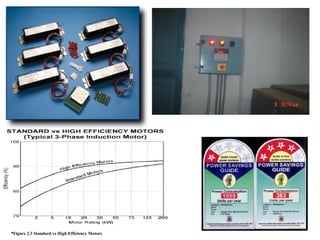
Figure 2.3 Standard vs High Efficiency Motors
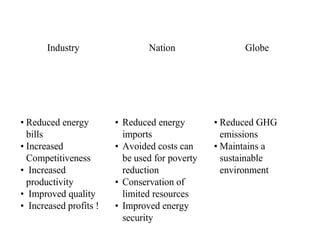
Energy Efficiency Benefits
Industry
• Reduced energy
bills
• Increased
Competitiveness
• Increased
productivity
• Improved quality
• Increased profits !
Nation
• Reduced energy
imports
• Avoided costs can
be used for poverty
reduction
• Conservation of
limited resources
• Improved energy
security
Globe
• Reduced GHG
emissions
• Maintains a
sustainable
environment
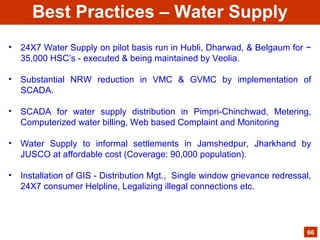
• 24X7 Water Supply on pilot basis run in Hubli, Dharwad, & Belgaum for ~
35,000 HSC’s - executed & being maintained by Veolia.
• Substantial NRW reduction in VMC & GVMC by implementation of
SCADA.
• SCADA for water supply distribution in Pimpri-Chinchwad, Metering,
Computerized water billing, Web based Complaint and Monitoring
• Water Supply to informal settlements in Jamshedpur, Jharkhand by
JUSCO at affordable cost (Coverage: 90,000 population).
• Installation of GIS - Distribution Mgt., Single window grievance redressal,
24X7 consumer Helpline, Legalizing illegal connections etc.
66
Best Practices – Water Supply
• Water Safety Plan in Vijayawada Municipal Corporation from
source to consumer point – hazard and risk assessment &
minimization
• Storm Water Drainage
• Fukuoka - San-no rain water adjustment pond in a park for
flood control
• Tsurumi River Channel improprement (Embankment,
bridging etc.)
• Multipurpose retarding basin for Tsurumi River at
Yukohama international general athletic stadium and
diversion channel.
• Near Tsurumi River, a building has adopted a piloti type
structure to permit the use of the retarding basin to protect it
during floods.
72
Best Practices – Water Supply
SEWERAGE
• STP along with power generation in Delawas,
Pratap Nagar & Jawer Nagar in Jaipur, Rajastan.
• Electricity generation from STP in Vadodara,
Gujarat.
MSW
• MSW rejuvenation project in Gorai Dumping
yard, Mumbai Maharastra (2010). This is spread
over 19.6 Ha.,2.34 Mn.T upto 26m.ht. Agency:
United Phosphorus&Vamderweil for 15 yrs under
DBOOT.
• Carbon credits exp. ~Rs.72Cr.(> capital cost). 73
Best Practices
• Congestion Charging is in operation since Feb 2003 & extended
later. Main aim is to reduce congestion in central London by
encouraging drivers to switch from private car use to other modes of
transport.
• During its hours of operation, vehicle drivers have to pay £8/day to
travel within the Congestion Charging zone, subject to certain
discounts.
• It also produces net revenues to support London's Transport
Strategy, most of which was allocated to improve bus
operations.
• Congestion was substantially reduced within the zone by reducing
the traffic entering the zone by ~ 20%.
•This has made central London a pleasant place to live, work and
visit.
• The initial traffic and congestion reduction led to overall CO2
reductions of 16% in the charging zone, NOx emission reduction of
8%, PM10 of 6%.
The Central London Congestion Charging
Scheme
Best Practices – Transport Sector
• For delivering improved and efficient services to all by:
• Encouraging participation of all stakeholders from planning to O&M.
• Focus on meeting SLBs for improving citizens’ quality of life.
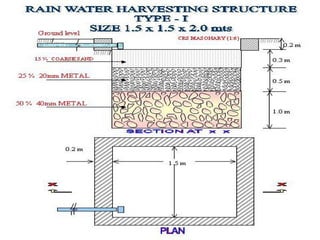
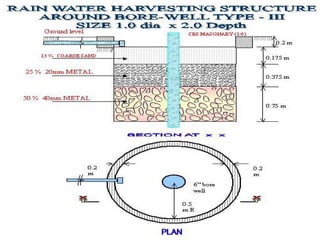
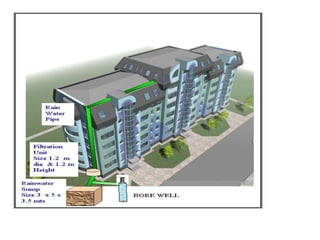
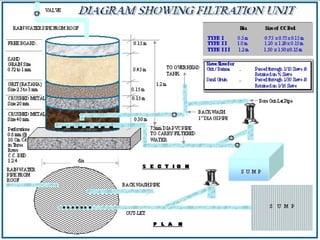
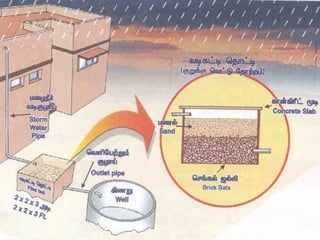
• Wise water Management– a) RWH, b) Ground Water Recharging, c)
Grey Water Recycling,
• 24x7 water supply (universal, affordable, safe). Water is life.
• Implement Water Safety Plan.
• Sanitation for All - Open defecation free – universal, affordable
sanitation. Sanitation is Dignity. Swachh Bharat.
• Storm Water Drainage – 100% coverage, minimum incidences of
inundation as per design rainfall.
• Integrated SWM - end-to-end green solution (garbage free).
• Green mobility, Safe, Efficient & Sustainable transport.
• Facilitating citizens to be delighted with municipal services.
75
Way Forward
Contd….
 Prepare O&M plan with costs for all sectors:
 Inviting participation of all stakeholders
 Sector-wise allocations in municipal budget to achieve SLBs
 Delegation of powers
 O&M Monitoring Committee to review implementation
 Implement O&M plan & ensure sustainability of infra.
 Achieve full O&M cost recovery. Rationalize tariff.
 Implement e-pos system for billing and collection.
 Utilize I&CT, GIS, GPS, Remote Sensing technologies in
improving Service Delivery & Cost Recovery.
 Focus on enhancing energy and water conservation &
efficiency improvement, and reduce expenditure.
 Develop Human Resources and provide motivation. 76
Way Forward
???
Purpose of life?
• Purpose of our life?
• MY family? Are WE connected?
• Love our fellow beings? Why?
• How do we get happiness in life?
• We are what we are at present. How?
Essentials for Fulfillment
• We share genes - African ancestors - 80000 years
ago.
• The inner urge - to serve our fellow beings?
• Duty saturated with Love towards Fellow Beings -
Transforms into Service
• A Goal -Team work-Together Everyone Achieves
More
• Trust – Ownership - Learning – Sharing -
Networking
• Sustained Capacity Building
• Perseverance & Continuous Monitoring
• Appreciation for Good Performers
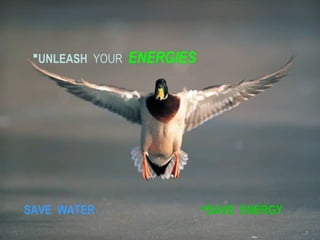
UNLEASH YOUR ENERGIES
SAVE WATER SAVE ENERGY

Module service delivery niz 04.12.2014 rev2

  • 1.
    Brothers & SistersBrothers& Sisters Welcome to a PresentationWelcome to a Presentation onon ImprovingImproving Basic Service DeliveryBasic Service Delivery G. Kondala Rao Chief Engineer APUFIDC; Mob 9618888983 email: raogkondala2020@gmail.com
  • 2.
    • Urban BasicServices - Delivery systems • Improving Service Delivery • Role of Different Functionaries • Services Management • Regulatory Mechanism • Service Level Benchmarking • Challenges in Service Delivery • Addressing the Challenges • Way Forward Overview 2
  • 3.
    Urban Basic Services •Water Supply • Sanitation – On-site and off-site • Solid Waste Management • Storm Water Drainage • Roads, Bridges, Flyovers and Transport • Street Lighting • Parks & Play Grounds • Burial Grounds
  • 4.
    Millennium Development Goal7: Ensure Environmental Sustainability Target 7.C: “Halve, by 2015, the proportion of people without sustainable access to safe drinking water and basic sanitation” In the world >0.86 billion people lack access to safe water supply and >2.5 billion lack access to safe sanitation  In India, 12.73 lakh children < 1 yr age (IMR 42 per 1000 live births) died in 2011 due to Wat-san related diseases4
  • 5.
    Basic Principles inService Delivery • Water and Sanitation for All • Safety and Security for All • Basic civic services should be: – Universal and Accessible – Sustainable – Affordable and Equitable • Disaster Risk Reduction & Climate Change Adaptation • Environmental sustainability • Financial sustainability • Energy and Water conservation • Resource Use Efficiency
  • 6.
    Delivery Systems • MunicipalAdministration Department – Commissioner & Director of Municipal Administration; – Public Health & Municipal Engineering Department; – Director of Town & Country Planning; – Urban Development Authorities. • Engineer-in-Chief (Public Health) – SE (PH), EE (PH), DEE (PH); – Municipal Engineers – EE, DEE, AE, MAE. • Activities performed: Preparation of DPRs, obtaining sanctions, tendering, implementation, QA, O&M. • SWM - collection, segregation, recycling, composting, landfill mgt., dealt by MHO, C&DMA monitors. Tech. inputs by Engrs. • Projects will be executed by private contracting agencies, or on PPP basis.
  • 7.
    Roles & Responsibilities •Adm. Sanction by Commissioner/Standing Council/Council/Govt. based on Cost. • Technical Sanction accorded by: – E-in-C (PH)/CE (PH) - for works > Rs.50 lakhs – SE (PH) - for works from Rs.10-50 lakhs – EE (PH) - for works up to Rs.10 lakhs • Tenders will be approved by Commissioner: based on recommendation of CE up to Rs.2 cr., SE up to Rs.50 lakhs and of EE up to Rs.10 lakhs. • For 2-10 Cr. works, COT approval is necessary for finalizing the tenders. • For > 10 Cr. works, EPC system of contract should be followed.
  • 8.
    Roles & Responsibilities •Engineers are responsible: for the implementation and quality of works. • They are responsible for: proper O&M of facilities. • They are also responsible for proper O&M of SWM vehicles, landfill etc. • The Engineers will be assisted by – Work Inspectors in field for maintaining quality of works, and – Draughtsmen in office for ensuring accuracy of designs, estimates, drawings, tenders, Agreements etc. • They will be under the Admin. Control of E-in-C (PH). • Tenders for works costing >Rs1 Lakh shall be thro’ e-procurement. • CE/SE/EE act as adviser on engg. issues to Council.
  • 9.
    Management – RegulatoryMechanism • Council is the Statutory Authority responsible for Governance of the ULB in line with the prevailing legislative framework. • Commissioner is Adm. Head managing its day-to-day affairs. • A realistic Budget will be prepared by Commissioner involving all depts. and the citizens in a transparent manner, and approved by the Council. • The engg. proposals will be put up to the Council through the Commissioner, complying with the Budget provision. • All activities of Engg. Section i.e., Projects/Construction, Quality Control and O&M of utilities to be monitored by the SE. • Third Party QA/QC (TPQA) mandatory for all works >1 lakh. • TPQA also is desirable for O&M activities also.
  • 10.
    Management – RegulatoryMechanism • The Council is expected to oversee: • That all its resolutions are in tune with the Municipal Corporations Act, • The execution of works, their quality and timely completion, • O&M management, • Community participation in every aspect of Governance, • The councillors are the bridge between the Council and the citizens, both ways, • Social audit, • Sanction of projects, funding from State/Central Govts., updation of accounts and audit.
  • 11.
    Urban Vision Characteristics ofa Smart City • Governance - Smart, participatory and consultative • Efficient services - Universal, accessible, equitable and affordable • Mobility - Seamless, Safe and Green Transport • Public safety - Safe and secure for all • Economy - Competitive, productive and equitable • Finances - Self-sustaining • Environment - Sustainable, clean, green, renewable energy driven • Technology - Digital, innovation driven with Integration, ITES, OFC • Planning - Inclusive, Low carbon growth model • Citizens - Healthy, eco-friendly, knowledgeable, skilled and gainfully employed • Recreational life - vibrant • Livability - Eminently livable, affordable market places
  • 12.
    Status of BasicServices - Nizamabad • Water supply coverage ~ 80%; capacity – 73 MLD; Supply 46 MLD • Total slums – 83 (population ~ 1.40 lakhs); • Uncovered slums – 11 (population ~ 30,000) • Sewerage – 0 (80% network covered. LA for STPs due) • SWM D-o-D collection -80% (segregation ~Nil;Transportation ~80%) • SW Drainage Coverage ~ 50% (out of 731 km road length) • Pucca Roads – ~200 km (out of total 731km) • Street Lighting coverage ~ 90%; • Telangana – Clean Tap water within premises – 36.54% – Latrines within premises - 52.44%
  • 13.
    • We are4,87,709 (2014 HH Survey); in 53.83 sq.km. • 1000:1001 (Male: Female) • Nizamabad also finds mention in ancient India as a part of Assaka Mahajanpada. Mana Induru (Nizamabad) 13  Sagar of IITK presented his research in structural biology & biochemistry at the Max Planck Institute of Biochemistry, Germany on the structure of part of a human cell responsible for vital organs taking shape in mother’s womb. Sagar Bhogaraju
  • 15.
    Heritage of Nizamabad BadapahadDarga Raghunath Temple  Domakonda Fort Pocharam wild life sanctuary
  • 16.
    Human Development • IMR~ 41 per 1000 live births ( State) 52 (Niz. Dt.) • MMR – 133.2 per 1 lakh deliveries (State) - 116 (Niz. Dt.) State Nizamabad Dt. • HDI 0.513 0.466 • Sex Ratio 992:1000 1001 : 1000 • Child Sex ratio 943:1000 1040:1000 • Literacy 61.25 66.46% • Secondary school drop out rate: 38.21%
  • 17.
    Corporators – Onerousresponsibilities • Adopting a vision and future direction for the city. • Endeavour: – To implement the state and central level urban legislations; – Central and state level policies, programmes etc. • Deliberations on policy and institutional issues in Council: – Sanction of projects; – Budget approval and sanction of funds; – Develop his division and contribute to overall growth of city; • Citizens needs and grievances: – Accessibility to citizens; improving quality of life, incl. vulnerable groups – Represent their needs & grievances in Council, approval – Ensure citizens participation in municipal programmes; • Giving direction and guidance to municipal officials • Monitoring implementation: CRs, projects, QA/QC and O&M • Envtl. sustainability – Create awareness on Energy & Water • Coordinate with local, higher authorities-approvals, funding • Playing a Mediatory role between public and the Council.
  • 18.
    Improving Service Delivery Rapid increase in Urban population, rising incomes & high citizen’s aspirations  Despite provision of extensive infrastructure at huge costs, level of urban service delivery poor.  Hence GoI introduced SLB to improve service levels and to achieve the best practice benchmarks.  Service level improvement is a continuous
  • 19.
    World Happiness Reportof UNGA: Global Happiness Index • The WHR 2013 ranks nations on the basis of six key factors that include: – GDP per capita, – Healthy life expectancy, – Someone to count on, – Perceived freedom to make life choices, – Freedom from corruption, and – Generosity. • India ranks 111 out of 156 nations; behind Pakistan (81) and Bangladesh (108) • 8% drop in HI in 2010-12 over 2005-07
  • 20.
    Citizen Satisfaction SurveyTopics - Canada • Key topics covered in the Citizen Satisfaction study: – Top priority local issues; – Quality of life; – Perceptions of staff and Council; – Satisfaction with municipal services; – Perceived value for taxes; and, – Communication and information needs.
  • 21.
    Drivers for CitizenSatisfaction Canada’s Common Measurements Tool (CMT)
  • 22.
    Need for SmartCities  The global environment in which people live.  People's thinking and values about their way of life are undergoing significant changes.  If people and the Earth are both changing, then surely the cities that link them together must also change.  The international call for action in response to changes in the global and urban environments.  The world in which people live is being changed by: Rresource depletion, Urban issues, and Problems brought about by climate change and Increases in the size and concentration of population.
  • 23.
    Kazan - SMARTCITY Republic of Tatarstanhttp://kazansmartcity.com/what-is-kazan-smart-city/
  • 24.
  • 25.
  • 27.
  • 28.
    Smart City Malta’sRicasoli site
  • 29.
    • City DevelopmentPlan (CDP) preparation • Comprehensive Infra Studies & Master Plan • Implementation Strategy • Detailed Project Reports (DPRs) – Creation of sustainable infrastructure – Sustainable O&M and challenges • Enabling Reforms – Service Level Benchmarking (SLB) – Energy Conservation & Efficiency Improvement – Recycling and Reuse of waste water – Stakeholder participation and effective communication – e-Governance, Inclusive Governance and Planning – Revenue Improvement & Cost Recovery thro’ ICT – Capacity Enhancement Major tasks include: 29
  • 30.
     What isCDP?  It is a ~15-20 year perspective plan to develop the city in a comprehensive and integrated manner.  Involves improving the infrastructure in all sectors (incl. social) in key performance indicators and enabling Reforms.  Need for CDP  In view of the rapid urbanization, the city needs to be developed in a planned manner to make it livable, economically vibrant, self-sustainable and inclusive.  CDP Process & Preparation of document  Stakeholder workshop - Vision – Working groups – Strategy –Deficiencies and Gaps in Service Levels–Sector-wise plans –O&M plan-Reforms-Prioritize–Costing–Financing options.  CDP Implementation plan  Immediate, Short term and Long term (DPRs) Plans 30 CDP – City Development Plan
  • 31.
    • The CDPshould be prepared and a Strategy for its Implementation should be evolved. • The following strategy may be considered: • Immediate measures (easy & no/low cost measures) • Short Term Measures (needing less funds) • Long Term Measures (needing huge funds) • For Long Term measures, • DPR may be prepared and implemented. • Projects should be formulated • After ascertaining the gaps in Service Levels; • Formulate proposals to bridge the gap to achieve the Benchmarks; • thus improving the quality of life of the citizens. 31 Strategy - Action Plan
  • 32.
    • Comprehensive Studies& preparation of Master Plans for: • Water Supply • Sanitation (on-site sanitation & sewerage) • Storm water drainage • Solid waste management • Energy (Audit) conservation & efficiency • Comprehensive Mobility Plan for Traffic and Transport • Studies include Preparation of Master Plans & Proposals • Mapping of all facilities/installations to be done if not already available. • Prioritization of Towns, Sectors and Projects. • Preparation of Preliminary Project Reports • Preparation of DPRs. 32 Comprehensive Studies
  • 33.
    • Per capitasupply of water in LPCD - 135 • Coverage of water supply connections - 100 % • Extent of Non-revenue water - 20% • Extent of metering - 100% • Continuity of Water Supplied - 24 hrs • Efficiency in redressal of customer complaints - 80% • Quality of Water Supplied - 100% • Cost recovery - 100% • Efficiency in Collection of Water Charges - 90% 33 SLBs – Urban Water Supply
  • 34.
     Coverage ofToilets - 100%  Coverage of Sewerage Network - 100%  Collection efficiency of Sewerage Network - 100%  Adequacy of Sewage Treatment Capacity - 100%  Quality of Sewage Treatment - 100%  Extent of Reuse and Recycling of Sewage - 20%  Extent of cost recovery in waste water mgt.- 100%  Efficiency in redressal of customer complaints- 80%  Efficiency in Collection of Sewerage Charges - 90% 34 SLB’s – Sewerage
  • 35.
    Water is theelixir of Life. - Vedas Water is life. Sanitation is Dignity. – South African Constitution.
  • 36.
     Coverage ofwith covered drains - 100%  Incidence of water logging (No. of times) - 0 36 SLB’s – Storm Water Drainage
  • 37.
  • 38.
  • 39.
    Vijayawada Floods 2013January Vijayawada Floods 2013 January
  • 40.
    Uttarakahand floods Kedarnath inflood Mumbai flood 26th July 2005
  • 41.
  • 42.
     Lack of Records on the existing facilities, designs, maps, registers, studies, maps, updation.  Proper asset management.  Poor O&M of facilities.  Mechanism for updation like GIS based mapping.  Focus on O&M etc. at institutional level.  Effective communication with the public.  O&M plan and budgetary approval.  Devolution of powers to enable prompt O&M.  Proper accounting and auditing.  Customer orientation and communication. 42 Challenges in Service Delivery – General
  • 43.
    • Poor capacitiesof operating & supervisory staff • Poor utilization of existing facilities & capacities. • Inadequate human resources management. • Inadequate institutional capacity. • Poor Financial strength of ULBs. • Lack of coordination among line depts.and ULBs. • Lack of O&M cost recovery. • Lack of Willingness to Pay 43 Challenges in Service Delivery – General
  • 44.
     Absence ofholistic, multi-sectoral, basin-wise approach to projects - integrating rural-urban.  Poor condition of utilities due to poor O&M.  Non-Revenue Water (Volume of water delivered into the network – Billed consumption)  Intermittent supply & no thrust on 24x7 supply.  Lack of metering and poor working of meters.  Unviable Tariff.  Absence of Seasonal Tariffs and Telescopic Charges for energy. 44 Challenges in Service Delivery – Water Supply
  • 45.
     Inappropriately targetedsubsidies.  Poor billing and collection systems.  Lack of water conservation and Water Safety Plan.  Non-adoption of Recycling, Reuse of waste water.  Non-adoption of latest technology and softwares.  Lack of focus on energy conservation and efficiency  Poor O&M of water supply facilities.  Preventing contamination of water sources  Improving efficiency, if necessary thro’ PPP, of:  Billing,  O&M of pumping stations, 45 Challenges in Service Delivery – Water Supply
  • 46.
    ONSITE SANITATION /SEWERAGE • Lack of awareness in citizens on proper usage of Individual Toilets. • Lack of effective septage management. • Lack of advance planning for LA for STPs. • Lack of focus on O&M of sewage pumping stations, STPs, sewer cleaning etc. • Lack of modern sewer cleaning equipment. • Lack of focus on eliminating manual scavenging. • Lack of focus on workers’ safety and health. 46 Challenges in Service Delivery – Sewerage & SWM
  • 47.
    SWM • Focus on5R’s – Reduce, Reuse, Recycle, Recover, Residual Management. • Lack of full coverage of Door to Door collection. • Absence of source segregation. • Absence of a closed loop approach for SWM. • Poor O&M of transportation equipment. • Lack of Landfill site. • Poor management of Landfill by just dumping. • Lack of technical capacities and understanding of SWM related issues - composting, Waste to Energy etc. 47 Challenges in Service Delivery – Solid Waste Management
  • 48.
    • Poor energyconservation • Lack of energy efficiency initiatives and latest technologies in Lighting & Saving • LED/Induction Lamps, Timer Controllers and Power savers. • Poor understanding of energy related issues in ULB staff. • Lack of use of renewable energy technologies – solar, wind, hybrid etc. • Lack of coordination with NREDCAP, MNRE, BEE etc. 48 Challenges in Service Delivery – Street Lighting
  • 50.
    • India losesRs.60000 Cr / annum. due to traffic congestion. • There is general lack of • Awareness on National Urban Transport Policy 2006. • Focus on public transport. • Focus on non-motorized transport. • Civic sense among general public. • Junction improvements, traffic signaling. • Focus on improving Green mobility & Connectivity. • Focus on Road safety. • Integration of Land use & Transportation planning. • Rationalization of parking charges. • Road pricing and Congestion charging. 50 Challenges in Service Delivery – Urban Transport
  • 52.
    New Delhi More Roads,More Congestion, Mumbai Nagpur pedestrian crossing Allahabad
  • 53.
  • 54.
    Los Angeles Florida Chennai Pedestrianscrossing NagpurCentral London Moscow
  • 56.
    • Operation &Maintenance • Operation; • Routine and Repair & Breakdown maintenance • Bring dignity to O&M functions by: • Greater focus on O&M of utilities by the Management. • O&M monitoring cell at Council level for periodical review • Recognizing good performance. • Prepare O&M plan for the city • Covering all sectors & Council approval for O&M allocations • Customer grievance cell, online monitoring and linkage to citizens charter • Capacity building of staff to be accorded top priority. • Health, Safety and Environmental standards to be ensured. • Quality & Quantity of supply to be continuously monitored – testing, metering & pressure gauges. 56 Operation & Maintenance
  • 57.
    • A O&MMonitoring Committee at Council level will oversee the implementation of O&M plan. It will: • Comprise Mayor, Commissioner, one Corporator for each sector, HOD of Engg.Wing, CDS/SLF members, external engg. expert. • Monitor the execution of O&M plan on continuous basis. • Meet monthly and review the implementation of O&M plan in all sectors in the city, w.r.t. targeted service levels. • Review the working of TPQA and Social Audit Group/Agency. • It will Monitor: Water drawls, pumping, filtration, disinfection, filling, overflows, distribution, supply thro’ taps and Residual Chlorine. • It will also monitor leakages, unauthorized connections, drainage crossings and sewage/sullage discharges. • Cause water audit and arrive at NRW. Take actions to bring it <20%. • Oversee water conservation and efficiency of use of water supplied. • Monitor water safety by overseeing implementation of Water Safety Plan 57 Monitoring of O&M - Water supply
  • 58.
    • Metering–enables volumetriccharging, effective control, demand mgt. • Pilot 24x7 water supply - helps prevent water pollution and wastage, promotes convenience and girls’ education. • Tariff rationalization - for achieving full O&M cost recovery and automatic annual updating of tariffs. • Energy conservation & efficiency improvement in Water Supply, Sewerage and Street Lighting; water conservation. #38. Damaged impeller of pump –Does retrofitting help save ene... • Proper O&M of all components • Preventive & breakdown. • e-billing and e-collection (e-pos). . 58 Monitoring of O&M - Water supply
  • 59.
    Damaged impeller ofpump –Does retrofitting help save energy?
  • 60.
    • Rationalizing ContractedMaximum Demand • Installation of capacitors • Segregation of Light & Fan loads • Improving O&M of equipment. Eg. PF meter • Conducting energy audit for pumping stations • Improving capacities of operating staff 60 APUSP INITIATIVES– Water Pumping
  • 61.
    • Analyzing pastpower bills • Liaison with DISCOMs for timely reconciliation • Appeal to ERC on seasonal pumping etc. • Going for Gravity flow – wherever feasible • Converting LT category to HT - HT category to LT • Prompt payment of energy bills 61 APUSP INITIATIVES– Water Pumping
  • 63.
    Figure 2.3 Standardvs High Efficiency Motors
  • 65.
    Energy Efficiency Benefits Industry •Reduced energy bills • Increased Competitiveness • Increased productivity • Improved quality • Increased profits ! Nation • Reduced energy imports • Avoided costs can be used for poverty reduction • Conservation of limited resources • Improved energy security Globe • Reduced GHG emissions • Maintains a sustainable environment
  • 66.
    • 24X7 WaterSupply on pilot basis run in Hubli, Dharwad, & Belgaum for ~ 35,000 HSC’s - executed & being maintained by Veolia. • Substantial NRW reduction in VMC & GVMC by implementation of SCADA. • SCADA for water supply distribution in Pimpri-Chinchwad, Metering, Computerized water billing, Web based Complaint and Monitoring • Water Supply to informal settlements in Jamshedpur, Jharkhand by JUSCO at affordable cost (Coverage: 90,000 population). • Installation of GIS - Distribution Mgt., Single window grievance redressal, 24X7 consumer Helpline, Legalizing illegal connections etc. 66 Best Practices – Water Supply
  • 72.
    • Water SafetyPlan in Vijayawada Municipal Corporation from source to consumer point – hazard and risk assessment & minimization • Storm Water Drainage • Fukuoka - San-no rain water adjustment pond in a park for flood control • Tsurumi River Channel improprement (Embankment, bridging etc.) • Multipurpose retarding basin for Tsurumi River at Yukohama international general athletic stadium and diversion channel. • Near Tsurumi River, a building has adopted a piloti type structure to permit the use of the retarding basin to protect it during floods. 72 Best Practices – Water Supply
  • 73.
    SEWERAGE • STP alongwith power generation in Delawas, Pratap Nagar & Jawer Nagar in Jaipur, Rajastan. • Electricity generation from STP in Vadodara, Gujarat. MSW • MSW rejuvenation project in Gorai Dumping yard, Mumbai Maharastra (2010). This is spread over 19.6 Ha.,2.34 Mn.T upto 26m.ht. Agency: United Phosphorus&Vamderweil for 15 yrs under DBOOT. • Carbon credits exp. ~Rs.72Cr.(> capital cost). 73 Best Practices
  • 74.
    • Congestion Chargingis in operation since Feb 2003 & extended later. Main aim is to reduce congestion in central London by encouraging drivers to switch from private car use to other modes of transport. • During its hours of operation, vehicle drivers have to pay £8/day to travel within the Congestion Charging zone, subject to certain discounts. • It also produces net revenues to support London's Transport Strategy, most of which was allocated to improve bus operations. • Congestion was substantially reduced within the zone by reducing the traffic entering the zone by ~ 20%. •This has made central London a pleasant place to live, work and visit. • The initial traffic and congestion reduction led to overall CO2 reductions of 16% in the charging zone, NOx emission reduction of 8%, PM10 of 6%. The Central London Congestion Charging Scheme Best Practices – Transport Sector
  • 75.
    • For deliveringimproved and efficient services to all by: • Encouraging participation of all stakeholders from planning to O&M. • Focus on meeting SLBs for improving citizens’ quality of life. • Wise water Management– a) RWH, b) Ground Water Recharging, c) Grey Water Recycling, • 24x7 water supply (universal, affordable, safe). Water is life. • Implement Water Safety Plan. • Sanitation for All - Open defecation free – universal, affordable sanitation. Sanitation is Dignity. Swachh Bharat. • Storm Water Drainage – 100% coverage, minimum incidences of inundation as per design rainfall. • Integrated SWM - end-to-end green solution (garbage free). • Green mobility, Safe, Efficient & Sustainable transport. • Facilitating citizens to be delighted with municipal services. 75 Way Forward Contd….
  • 76.
     Prepare O&Mplan with costs for all sectors:  Inviting participation of all stakeholders  Sector-wise allocations in municipal budget to achieve SLBs  Delegation of powers  O&M Monitoring Committee to review implementation  Implement O&M plan & ensure sustainability of infra.  Achieve full O&M cost recovery. Rationalize tariff.  Implement e-pos system for billing and collection.  Utilize I&CT, GIS, GPS, Remote Sensing technologies in improving Service Delivery & Cost Recovery.  Focus on enhancing energy and water conservation & efficiency improvement, and reduce expenditure.  Develop Human Resources and provide motivation. 76 Way Forward
  • 77.
  • 78.
    Purpose of life? •Purpose of our life? • MY family? Are WE connected? • Love our fellow beings? Why? • How do we get happiness in life? • We are what we are at present. How?
  • 79.
    Essentials for Fulfillment •We share genes - African ancestors - 80000 years ago. • The inner urge - to serve our fellow beings? • Duty saturated with Love towards Fellow Beings - Transforms into Service • A Goal -Team work-Together Everyone Achieves More • Trust – Ownership - Learning – Sharing - Networking • Sustained Capacity Building • Perseverance & Continuous Monitoring • Appreciation for Good Performers
  • 80.
    UNLEASH YOUR ENERGIES SAVEWATER SAVE ENERGY