MODULE 8
CONSTRUCTION COSTS
Lesson 1
Fast-Tracking vs. Crashing, Relationship
between Activity Direct Cost & Activity
Duration – Assumptions
(PROF. R K CHOUDHARY
GCE GAYA)
Learning Objectives
• Fast-tracking vs Crashing
• Relationship between activity direct cost &
activity duration – Assumptions
• Procedure for finding minimum direct cost for
crashed project durations
• Influence of indirect cost and relationship
between total cost and project duration
3
5 4d 9
B
7 11
5d 5
A
11 3d
D
5 11
5 6d 11
C
5 11
0 14
0 14
Activity Duration Predecessor
A 5 -
B 4 A
C 6 A
D 3 B,C
Consider the ABCD Project
Current duration : 14 days
Expected duration : 10 days
How can it be done ?
Reducing Project Duration
• Fast-Tracking
– Preforming activities in parallel in order to reduce project duration
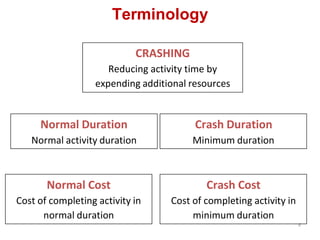
• Crashing
– Reducing duration of activities in order to reduce project duration
Change of execution sequence or duration will have cost implication.
Time-Cost Trade-Off analysis is used to find the minimum
overall project cost for a specified project duration
Focus is on Crashing 5
Crash Cost
Cost of completing activity in
minimum duration
Terminology
6
Normal Cost
Cost of completing activity in
normal duration
CRASHING
Reducing activity time by
expending additional resources
Normal Duration
Normal activity duration
Crash Duration
Minimum duration
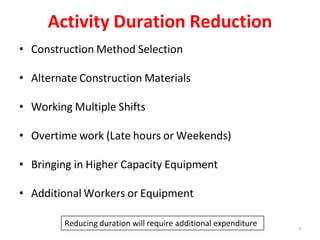
Activity Duration Reduction
• Construction Method Selection
• Alternate Construction Materials
• Working Multiple Shifts
• Overtime work (Late hours or Weekends)
• Bringing in Higher Capacity Equipment
• Additional Workers or Equipment
7
Reducing duration will require additional expenditure
Activity: Time vs Cost - Relationship
Crash cost
Linear - Assumption
Piecewise Linear - Assumption
Actual Relationship
Normal
cost
Crash time Normal
time
Activity time
8
Cost Slope = cost / time
= (Crash cost – Normal cost)
(Normal time – Crash time)
Lesson 2
Time-Cost trade-off: ABCD Example
Project, Steps for Crashing
B
7 11
5d 5
A
5
113d
D
11
5 6d 11
C
5 11
Act ND
days
Pred CD
days
NC
u
CC
u
A 5 - 3 250 300
B 4 A 3 300 375
C 6 A 3 350 875
D 3 B,C 2 300 350
5 4d 9
0 14
0 14
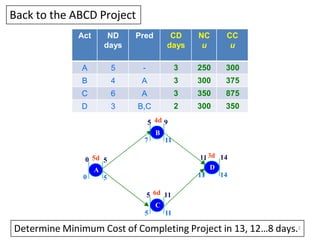
Back to the ABCD Project
Determine Minimum Cost of Completing Project in 13, 12…8 days.2
B
7 11
5d 5
A
5
113d
D
11
5 6d 11
C
5 11
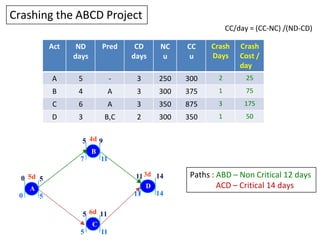
CC/day = (CC-NC) /(ND-CD)
Act ND
days
Pred CD
days
NC
u
CC
u
Crash
Days
Crash
Cost /
day
A 5 - 3 250 300 2 25
B 4 A 3 300 375 1 75
C 6 A 3 350 875 3 175
D 3 B,C 2 300 350 1 50
5 4d 9
0 14
0 14
Crashing the ABCD Project
Paths : ABD – Non Critical 12 days
ACD – Critical 14 days
B
11
5
4d
A
4
5
11
03d
D
11
0
4
5 6d 11
C
4
5 11
0
Act ND
days
Pred CD
days
NC
u
CC
u
Crash
Days
Crash
Cost /
day
A 5 - 3 250 300 2 25
B 4 A 3 300 375 1 75
C 6 A 3 350 875 1 175
D 3 B,C 2 300 350 1 50
4d 8
9
0
0
14
3
14
Step 1: Crash the critical path
ACD.
Options available to crash
A= u 25
C= u 175
D= u 50
Crash A by 1 day: Cost = u 25
Still the critical path is ACD (13 days)
ABCD Project Crash Duration - 13 days
7
6
4
3 4d 8
7
B
1
90
4
3d
A
A
4
3
10
1
903d
D
D
9
4 6d 10
3 6d 9
C
4 C
3 9
10
6
5
4
3
Act ND
days
Pred CD
days
NC
u
CC
u
Crash
Days
Crash
Cost /
day
A 5 - 3 250 300 2 25
B 4 A 3 300 375 1 75
C 6 A 3 350 875 3 175
D 3 B,C 2 300 350 1 50
0 12
0
0 1
13
2
Step 2: Crash the critical path
ACD.
Options available to crash
A= u 25
C= u 175
D= u 50
Crash A by 1 day: Cost = u 25
(A cannot be crashed any further)
Still the critical path is ACD (12 days)
ABCD Project Crash Duration - 12 days
3 4d 7
B
9
3d
A
3
9 2
3d
D
9
3 6d 9
C
3 9
5
3
Act ND
days
Pred CD
days
NC
u
CC
u
Crash
Days
Crash
Cost /
day
A 5 - 3 250 300 2 25
B 4 A 3 300 375 1 75
C 6 A 3 350 475 1 125
D 3 B,C 2 300 350 1 50
0 11
2
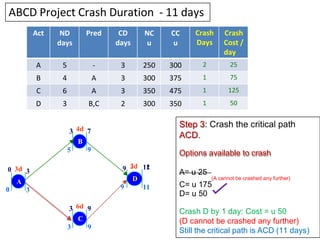
Step 3: Crash the critical path
ACD.
Options available to crash
A= u 25
0 11
(A cannot be crashed any further)
C= u 175
D= u 50
Crash D by 1 day: Cost = u 50
(D cannot be crashed any further)
Still the critical path is ACD (11 days)
ABCD Project Crash Duration - 11 days
3 4d 7
B
9
8
3d
A
3
8
9 2d
D
8
9
3 5
6d 9
8
C
3 9
8
5
4
3
Act ND
days
Pred CD
days
NC
u
CC
u
Crash
Days
Crash
Cost /
day
A 5 - 3 250 300 2 25
B 4 A 3 300 375 1 75
C 6 A 3 350 475 1 125
D 3 B,C 2 300 350 1 50
0 11
0
0 11
0
ABCD Project Crash Duration - 10 days
Step 4: Crash the critical path ACD.
Options available to crash
A= u 25 (A cannot be crashed any further)
C= u 175
D= u 50 (D cannot be crashed any further)
Crash C by 1 day: Cost = u 175
Still the critical path is ACD (10 days)
3 4d 7
B
7
8
3d
A
3
7
8 2d
D
8
7
3 5
4d 8
7
C
3 7
8
3
4
3
Act ND
days
Pred CD
days
NC
u
CC
u
Crash
Days
Crash
Cost /
day
A 5 - 3 250 300 2 25
B 4 A 3 300 375 1 75
C 6 A 3 350 475 1 125
D 3 B,C 2 300 350 1 50
0 1
90
Step 5: Crash the critical path ACD.
Options available to crash
A= u 25
0 1
90
(A cannot be crashed any further)
C= u 175
D= u 50 (D cannot be crashed any further)
Crash C by 1 day: Cost = u 175
Both ABD & ACD are Critical (9
days)
ABCD Project Crash Duration - 9 days
3 4
3d 6
7
B
7
6
3d
A
3
6
7 2d
D
7
6
3 4
3d 6
7
C
3 7
6
3
4
3
Act ND
days
Pred CD
days
NC
u
CC
u
Crash
Days
Crash
Cost /
day
A 5 - 3 250 300 2 25
B 4 A 3 300 375 1 75
C 6 A 3 350 475 1 125
D 3 B,C 2 300 350 1 50
0 8
9
0 8
9
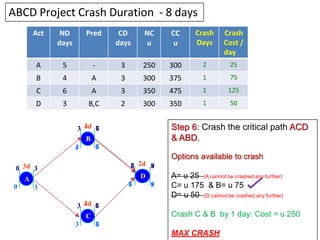
Step 6: Crash the critical path ACD
& ABD.
Options available to crash
A= u 25 (A cannot be crashed any further)
C= u 175 & B= u 75
D= u 50 (D cannot be crashed any further)
Crash C & B by 1 day: Cost = u 250
MAX CRASH
ABCD Project Crash Duration - 8 days
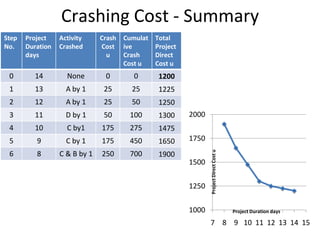
Crashing Cost - Summary
2000
1750
1500
1250
1000
7 8 9 10 11 12 13 14 15
Project Duration days
Project
Direct
Cost
u
Step
No.
Project
Duration
days
Activity
Crashed
Crash
Cost
u
Cumulat
ive
Crash
Cost u
Total
Project
Direct
Cost u
0 14 None 0 0 1200
1 13 A by 1 25 25 1225
2 12 A by 1 25 50 1250
3 11 D by 1 50 100 1300
4 10 C by1 175 275 1475
5 9 C by 1 175 450 1650
6 8 C & B by 1 250 700 1900
11
2000
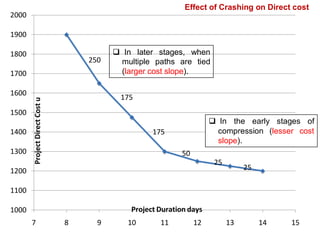
Effect of Crashing on Direct cost
1900
1800
1700
1600
1500
250
 In later stages, when
multiple paths are tied
(larger cost slope).
175
 In the early stages of
1400
1300
175
50
compression (lesser cost
slope).
1200
25
25
1100
1000 Project Duration days
7 8 9 10 11 12 13 14 15
Project
Direct
Cost
u
INDIRECT COSTS
 Project overhead
 Staff, manager, project engineer salary.
 Office equipment and temporary utilities like
electricity, phone.
 General overhead
 Main office expenses- rent, maintenance.
 Site equipment and vehicles.
 Lawyers and accountants, Advertising and Social activities.
 Contingency fees
 Additional cost allocated for unknown events.
Not directly related to activities 12
Effect of crashing on Indirect cost
 These expenses are
constant for each day
of the project
 When the project
duration is decreased
total indirect cost will
decrease
13
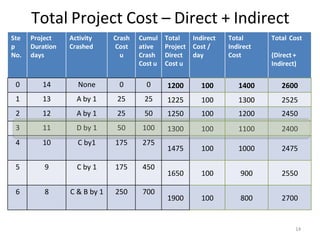
Total Overhead Cost
Total Project Cost – Direct + Indirect
Ste
p
No.
Project
Duration
days
Activity
Crashed
Crash
Cost
u
Cumul
ative
Crash
Cost u
Total
Project
Direct
Cost u
Indirect
Cost /
day
Total
Indirect
Cost
Total Cost
(Direct +
Indirect)
0 14 None 0 0 1200 100 1400 2600
1 13 A by 1 25 25 1225 100 1300 2525
2 12 A by 1 25 50 1250 100 1200 2450
3 11 D by 1 50 100 1300 100 1100 2400
4 10 C by1 175 275
1475 100 1000 2475
5 9 C by 1 175 450
1650 100 900 2550
6 8 C & B by 1 250 700
1900 100 800 2700
14
Cost
u
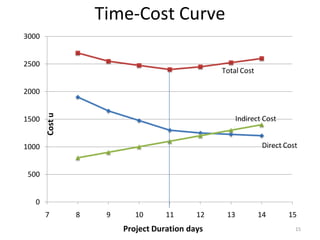
Time-Cost Curve
3000
2500
Total Cost
2000
1500 Indirect Cost
1000 Direct Cost
500
0
7 8 9 10 11 12 13 14 15
Project Duration days 15
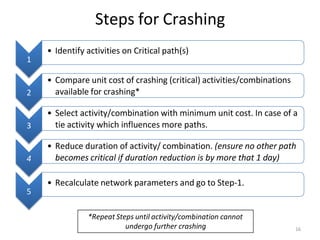
Steps for Crashing
• Identify activities on Critical path(s)
1
• Compare unit cost of crashing (critical) activities/combinations
2 available for crashing*
• Select activity/combination with minimum unit cost. In case of a
3 tie activity which influences more paths.
• Reduce duration of activity/ combination. (ensure no other path
4 becomes critical if duration reduction is by more that 1 day)
• Recalculate network parameters and go to Step-1.
5
16
*Repeat Steps until activity/combination cannot
undergo further crashing

MODULE 8 NOTES CEM (1).pdf

  • 1.
    MODULE 8 CONSTRUCTION COSTS Lesson1 Fast-Tracking vs. Crashing, Relationship between Activity Direct Cost & Activity Duration – Assumptions (PROF. R K CHOUDHARY GCE GAYA)
  • 2.
    Learning Objectives • Fast-trackingvs Crashing • Relationship between activity direct cost & activity duration – Assumptions • Procedure for finding minimum direct cost for crashed project durations • Influence of indirect cost and relationship between total cost and project duration 3
  • 3.
    5 4d 9 B 711 5d 5 A 11 3d D 5 11 5 6d 11 C 5 11 0 14 0 14 Activity Duration Predecessor A 5 - B 4 A C 6 A D 3 B,C Consider the ABCD Project Current duration : 14 days Expected duration : 10 days How can it be done ?
  • 4.
    Reducing Project Duration •Fast-Tracking – Preforming activities in parallel in order to reduce project duration • Crashing – Reducing duration of activities in order to reduce project duration Change of execution sequence or duration will have cost implication. Time-Cost Trade-Off analysis is used to find the minimum overall project cost for a specified project duration Focus is on Crashing 5
  • 5.
    Crash Cost Cost ofcompleting activity in minimum duration Terminology 6 Normal Cost Cost of completing activity in normal duration CRASHING Reducing activity time by expending additional resources Normal Duration Normal activity duration Crash Duration Minimum duration
  • 6.
    Activity Duration Reduction •Construction Method Selection • Alternate Construction Materials • Working Multiple Shifts • Overtime work (Late hours or Weekends) • Bringing in Higher Capacity Equipment • Additional Workers or Equipment 7 Reducing duration will require additional expenditure
  • 7.
    Activity: Time vsCost - Relationship Crash cost Linear - Assumption Piecewise Linear - Assumption Actual Relationship Normal cost Crash time Normal time Activity time 8 Cost Slope = cost / time = (Crash cost – Normal cost) (Normal time – Crash time)
  • 8.
    Lesson 2 Time-Cost trade-off:ABCD Example Project, Steps for Crashing
  • 9.
    B 7 11 5d 5 A 5 113d D 11 56d 11 C 5 11 Act ND days Pred CD days NC u CC u A 5 - 3 250 300 B 4 A 3 300 375 C 6 A 3 350 875 D 3 B,C 2 300 350 5 4d 9 0 14 0 14 Back to the ABCD Project Determine Minimum Cost of Completing Project in 13, 12…8 days.2
  • 10.
    B 7 11 5d 5 A 5 113d D 11 56d 11 C 5 11 CC/day = (CC-NC) /(ND-CD) Act ND days Pred CD days NC u CC u Crash Days Crash Cost / day A 5 - 3 250 300 2 25 B 4 A 3 300 375 1 75 C 6 A 3 350 875 3 175 D 3 B,C 2 300 350 1 50 5 4d 9 0 14 0 14 Crashing the ABCD Project Paths : ABD – Non Critical 12 days ACD – Critical 14 days
  • 11.
    B 11 5 4d A 4 5 11 03d D 11 0 4 5 6d 11 C 4 511 0 Act ND days Pred CD days NC u CC u Crash Days Crash Cost / day A 5 - 3 250 300 2 25 B 4 A 3 300 375 1 75 C 6 A 3 350 875 1 175 D 3 B,C 2 300 350 1 50 4d 8 9 0 0 14 3 14 Step 1: Crash the critical path ACD. Options available to crash A= u 25 C= u 175 D= u 50 Crash A by 1 day: Cost = u 25 Still the critical path is ACD (13 days) ABCD Project Crash Duration - 13 days 7 6
  • 12.
    4 3 4d 8 7 B 1 90 4 3d A A 4 3 10 1 903d D D 9 46d 10 3 6d 9 C 4 C 3 9 10 6 5 4 3 Act ND days Pred CD days NC u CC u Crash Days Crash Cost / day A 5 - 3 250 300 2 25 B 4 A 3 300 375 1 75 C 6 A 3 350 875 3 175 D 3 B,C 2 300 350 1 50 0 12 0 0 1 13 2 Step 2: Crash the critical path ACD. Options available to crash A= u 25 C= u 175 D= u 50 Crash A by 1 day: Cost = u 25 (A cannot be crashed any further) Still the critical path is ACD (12 days) ABCD Project Crash Duration - 12 days
  • 13.
    3 4d 7 B 9 3d A 3 92 3d D 9 3 6d 9 C 3 9 5 3 Act ND days Pred CD days NC u CC u Crash Days Crash Cost / day A 5 - 3 250 300 2 25 B 4 A 3 300 375 1 75 C 6 A 3 350 475 1 125 D 3 B,C 2 300 350 1 50 0 11 2 Step 3: Crash the critical path ACD. Options available to crash A= u 25 0 11 (A cannot be crashed any further) C= u 175 D= u 50 Crash D by 1 day: Cost = u 50 (D cannot be crashed any further) Still the critical path is ACD (11 days) ABCD Project Crash Duration - 11 days
  • 14.
    3 4d 7 B 9 8 3d A 3 8 92d D 8 9 3 5 6d 9 8 C 3 9 8 5 4 3 Act ND days Pred CD days NC u CC u Crash Days Crash Cost / day A 5 - 3 250 300 2 25 B 4 A 3 300 375 1 75 C 6 A 3 350 475 1 125 D 3 B,C 2 300 350 1 50 0 11 0 0 11 0 ABCD Project Crash Duration - 10 days Step 4: Crash the critical path ACD. Options available to crash A= u 25 (A cannot be crashed any further) C= u 175 D= u 50 (D cannot be crashed any further) Crash C by 1 day: Cost = u 175 Still the critical path is ACD (10 days)
  • 15.
    3 4d 7 B 7 8 3d A 3 7 82d D 8 7 3 5 4d 8 7 C 3 7 8 3 4 3 Act ND days Pred CD days NC u CC u Crash Days Crash Cost / day A 5 - 3 250 300 2 25 B 4 A 3 300 375 1 75 C 6 A 3 350 475 1 125 D 3 B,C 2 300 350 1 50 0 1 90 Step 5: Crash the critical path ACD. Options available to crash A= u 25 0 1 90 (A cannot be crashed any further) C= u 175 D= u 50 (D cannot be crashed any further) Crash C by 1 day: Cost = u 175 Both ABD & ACD are Critical (9 days) ABCD Project Crash Duration - 9 days
  • 16.
    3 4 3d 6 7 B 7 6 3d A 3 6 72d D 7 6 3 4 3d 6 7 C 3 7 6 3 4 3 Act ND days Pred CD days NC u CC u Crash Days Crash Cost / day A 5 - 3 250 300 2 25 B 4 A 3 300 375 1 75 C 6 A 3 350 475 1 125 D 3 B,C 2 300 350 1 50 0 8 9 0 8 9 Step 6: Crash the critical path ACD & ABD. Options available to crash A= u 25 (A cannot be crashed any further) C= u 175 & B= u 75 D= u 50 (D cannot be crashed any further) Crash C & B by 1 day: Cost = u 250 MAX CRASH ABCD Project Crash Duration - 8 days
  • 17.
    Crashing Cost -Summary 2000 1750 1500 1250 1000 7 8 9 10 11 12 13 14 15 Project Duration days Project Direct Cost u Step No. Project Duration days Activity Crashed Crash Cost u Cumulat ive Crash Cost u Total Project Direct Cost u 0 14 None 0 0 1200 1 13 A by 1 25 25 1225 2 12 A by 1 25 50 1250 3 11 D by 1 50 100 1300 4 10 C by1 175 275 1475 5 9 C by 1 175 450 1650 6 8 C & B by 1 250 700 1900
  • 18.
    11 2000 Effect of Crashingon Direct cost 1900 1800 1700 1600 1500 250  In later stages, when multiple paths are tied (larger cost slope). 175  In the early stages of 1400 1300 175 50 compression (lesser cost slope). 1200 25 25 1100 1000 Project Duration days 7 8 9 10 11 12 13 14 15 Project Direct Cost u
  • 19.
    INDIRECT COSTS  Projectoverhead  Staff, manager, project engineer salary.  Office equipment and temporary utilities like electricity, phone.  General overhead  Main office expenses- rent, maintenance.  Site equipment and vehicles.  Lawyers and accountants, Advertising and Social activities.  Contingency fees  Additional cost allocated for unknown events. Not directly related to activities 12
  • 20.
    Effect of crashingon Indirect cost  These expenses are constant for each day of the project  When the project duration is decreased total indirect cost will decrease 13 Total Overhead Cost
  • 21.
    Total Project Cost– Direct + Indirect Ste p No. Project Duration days Activity Crashed Crash Cost u Cumul ative Crash Cost u Total Project Direct Cost u Indirect Cost / day Total Indirect Cost Total Cost (Direct + Indirect) 0 14 None 0 0 1200 100 1400 2600 1 13 A by 1 25 25 1225 100 1300 2525 2 12 A by 1 25 50 1250 100 1200 2450 3 11 D by 1 50 100 1300 100 1100 2400 4 10 C by1 175 275 1475 100 1000 2475 5 9 C by 1 175 450 1650 100 900 2550 6 8 C & B by 1 250 700 1900 100 800 2700 14
  • 22.
    Cost u Time-Cost Curve 3000 2500 Total Cost 2000 1500Indirect Cost 1000 Direct Cost 500 0 7 8 9 10 11 12 13 14 15 Project Duration days 15
  • 23.
    Steps for Crashing •Identify activities on Critical path(s) 1 • Compare unit cost of crashing (critical) activities/combinations 2 available for crashing* • Select activity/combination with minimum unit cost. In case of a 3 tie activity which influences more paths. • Reduce duration of activity/ combination. (ensure no other path 4 becomes critical if duration reduction is by more that 1 day) • Recalculate network parameters and go to Step-1. 5 16 *Repeat Steps until activity/combination cannot undergo further crashing