Module 7
Created by S. O’Brien-Duke
Logical
Operators
• Boolean Expressions
• Evaluates to True or False
• Can be formed using the logical
operator And and Or
• And
• Expression evaluates to True only
when both expressions (conditions)
are True
• If intGrade > 0 And intGrade < 100
Then
Me.lblDisplay.Text = “Valid
grade.”
Logical Operators
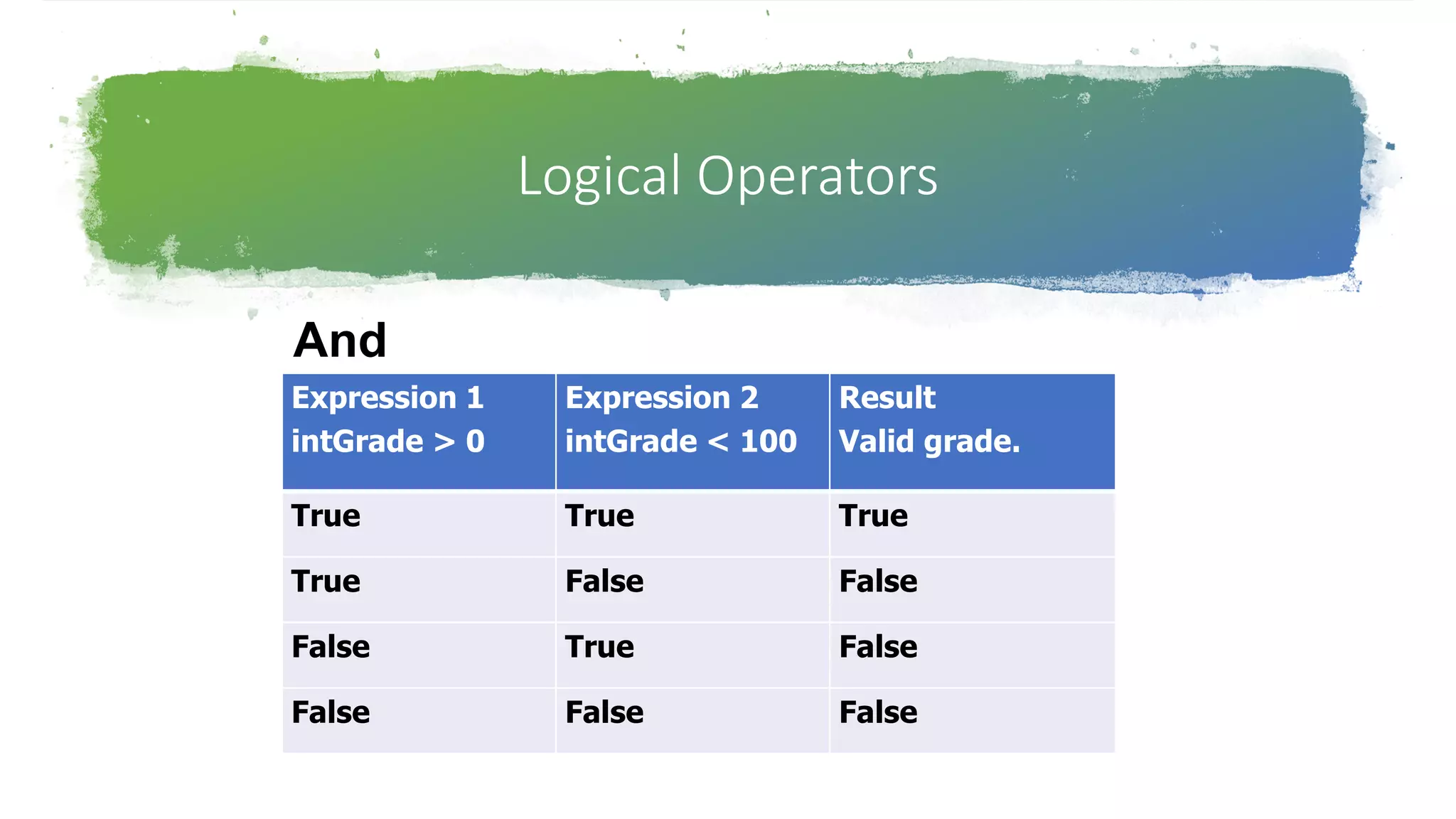
And
Expression 1
intGrade > 0
Expression 2
intGrade < 100
Result
Valid grade.
True True True
True False False
False True False
False False False
Logical
Operators
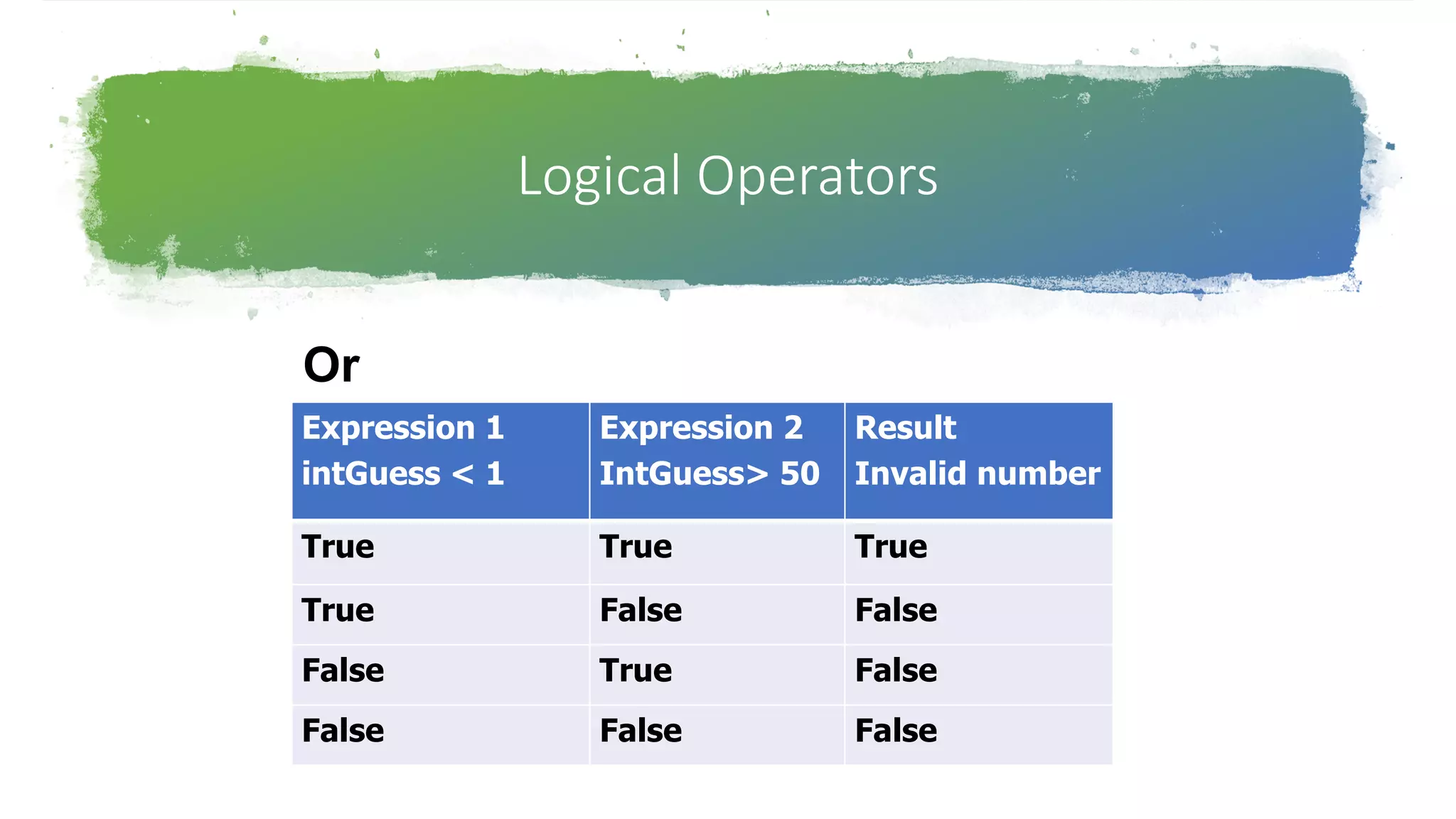
• Or
• If either expression (condition) is
true, then the entire expression is
True.
• If intGuess < 1 Or IntGuess> 50
Then
Me.lblMessage.Text = “Invalid
number”.
Logical Operators
Or
Expression 1
intGuess < 1
Expression 2
IntGuess> 50
Result
Invalid number
True True True
True False False
False True False
False False False
Logical
Operators
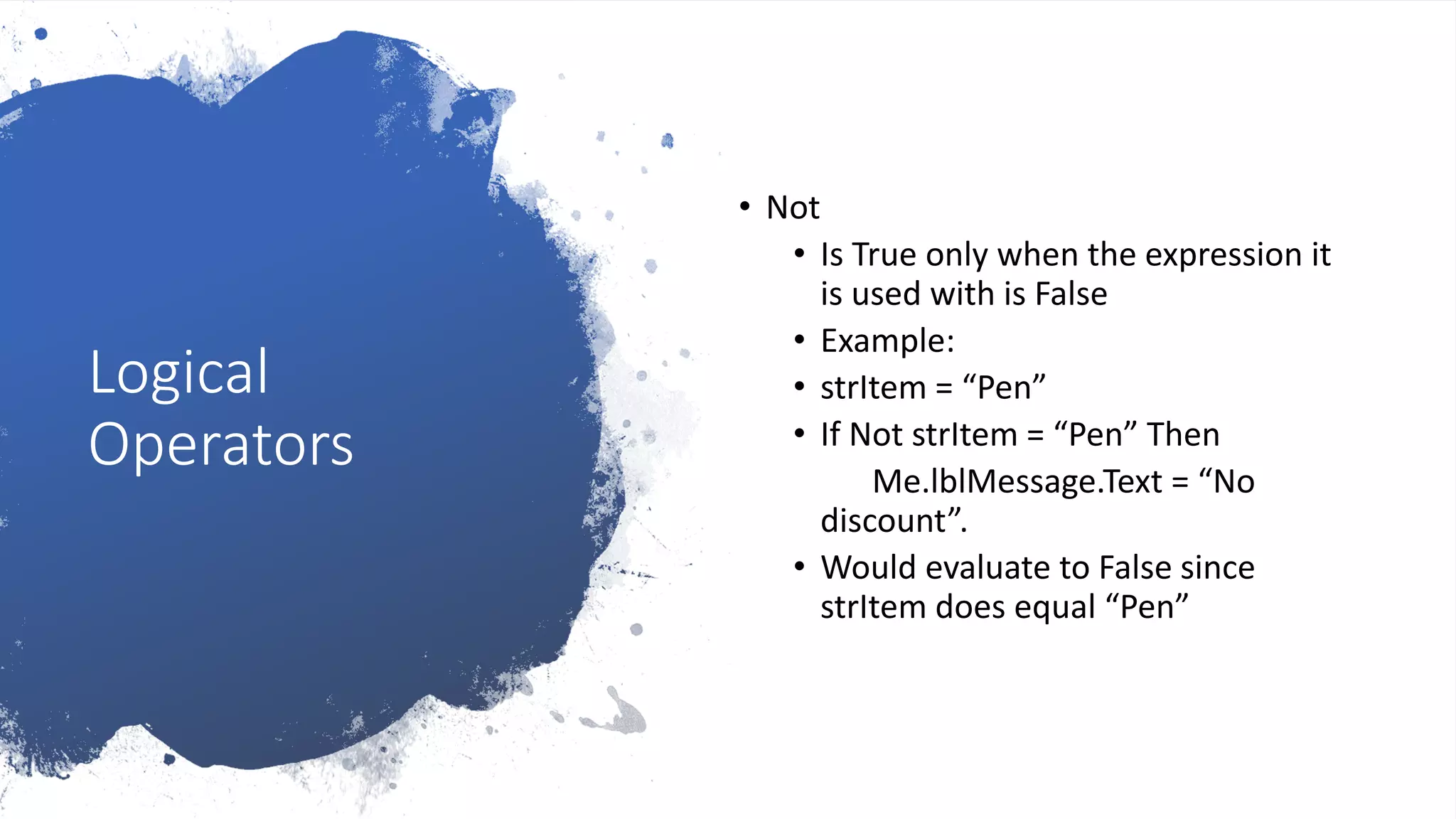
• Not
• Is True only when the expression it
is used with is False
• Example:
• strItem = “Pen”
• If Not strItem = “Pen” Then
Me.lblMessage.Text = “No
discount”.
• Would evaluate to False since
strItem does equal “Pen”
Logical Operators
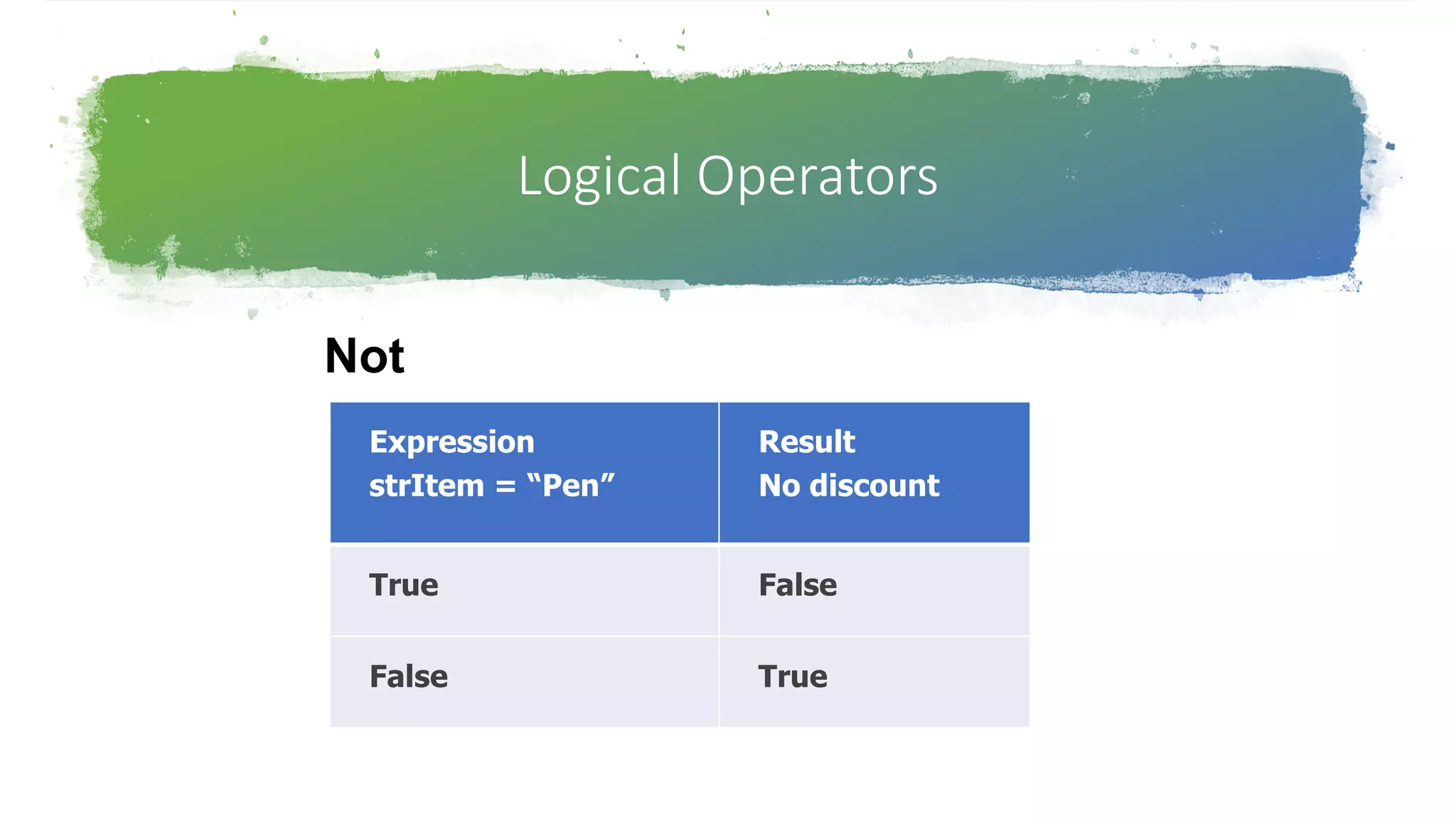
Not
Expression
strItem = “Pen”
Result
No discount
True False
False True
Generating
Random
Numbers
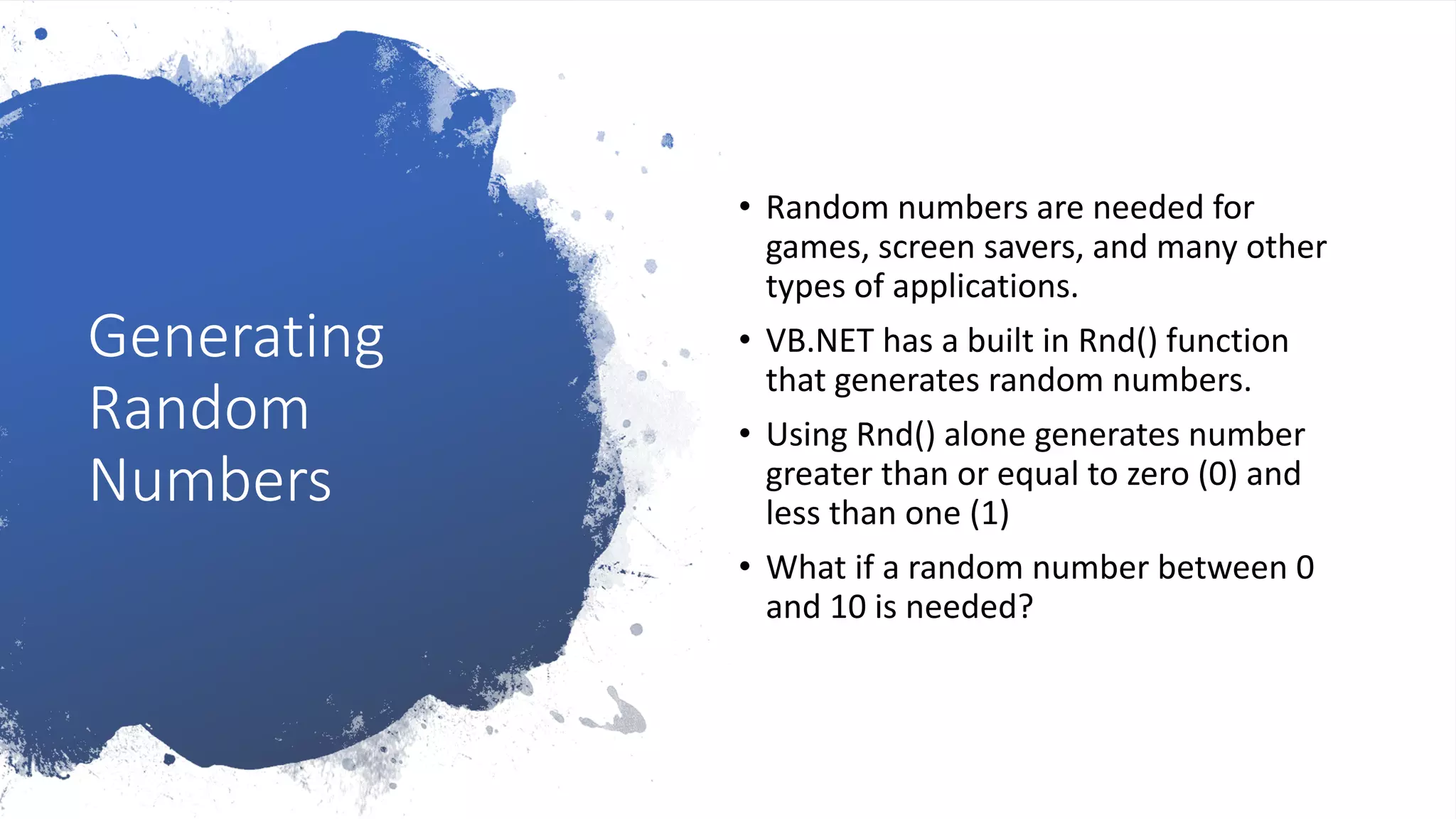
• Random numbers are needed for
games, screen savers, and many other
types of applications.
• VB.NET has a built in Rnd() function
that generates random numbers.
• Using Rnd() alone generates number
greater than or equal to zero (0) and
less than one (1)
• What if a random number between 0
and 10 is needed?
Generating
Random
Numbers
• A range can be specified using this
formula
• (HighNumber – LowNumber + 1) *
Rnd() + LowNumber
• Example:
• We need a random number
between 10 and 30
• ((30-10+1 ) * Rnd() + 10)
• 21 * Rnd() + 10
• Using this formula we will have a
decimal number…Why?
Generating
Random
Numbers
• Rnd() generates number greater than or
equal to zero (0) and less than one (1)
• Rnd() always generates a decimal
• To generate an integer, the Int() function
can be used
• Int(21 * Rnd()) + 10
• The decimal potion of the calculation
is truncated
• Randomize()
• Initializes the Rnd() function
• Randomize() statement is added to the
event procedure before the Rnd()
function is used
Static Variables
• Variables have scope
• Local scope – declared in a
procedure
• Called a local variable
• Global scope – declared outside of
the procedure
• Called a global variable
• Variables also have a lifetime
• Local variable lifetime – duration of
the procedure
• Global variable lifetime – duration
of the program
Static Variables
• Lifetime of a local variable can be
extended by using a Static declaration
statement
• Static variableName as dataType = value
• Keyword Static replaces Dim
• Must be explicitly initialized in the
declaration
• Static variables
• Scope – local to the procedure
• Lifetime – duration of the program
• Necessary in event procedures with
variables that should be retained in
memory throughout program
execution
Counter
Variables
• A counter is a variable storing a
number that is incremented by a
constant value
• Useful for:
• Keeping track how many times a
button is clicked
• A guess is entered
• A password is typed
• A web site is visited
Counter
Variables
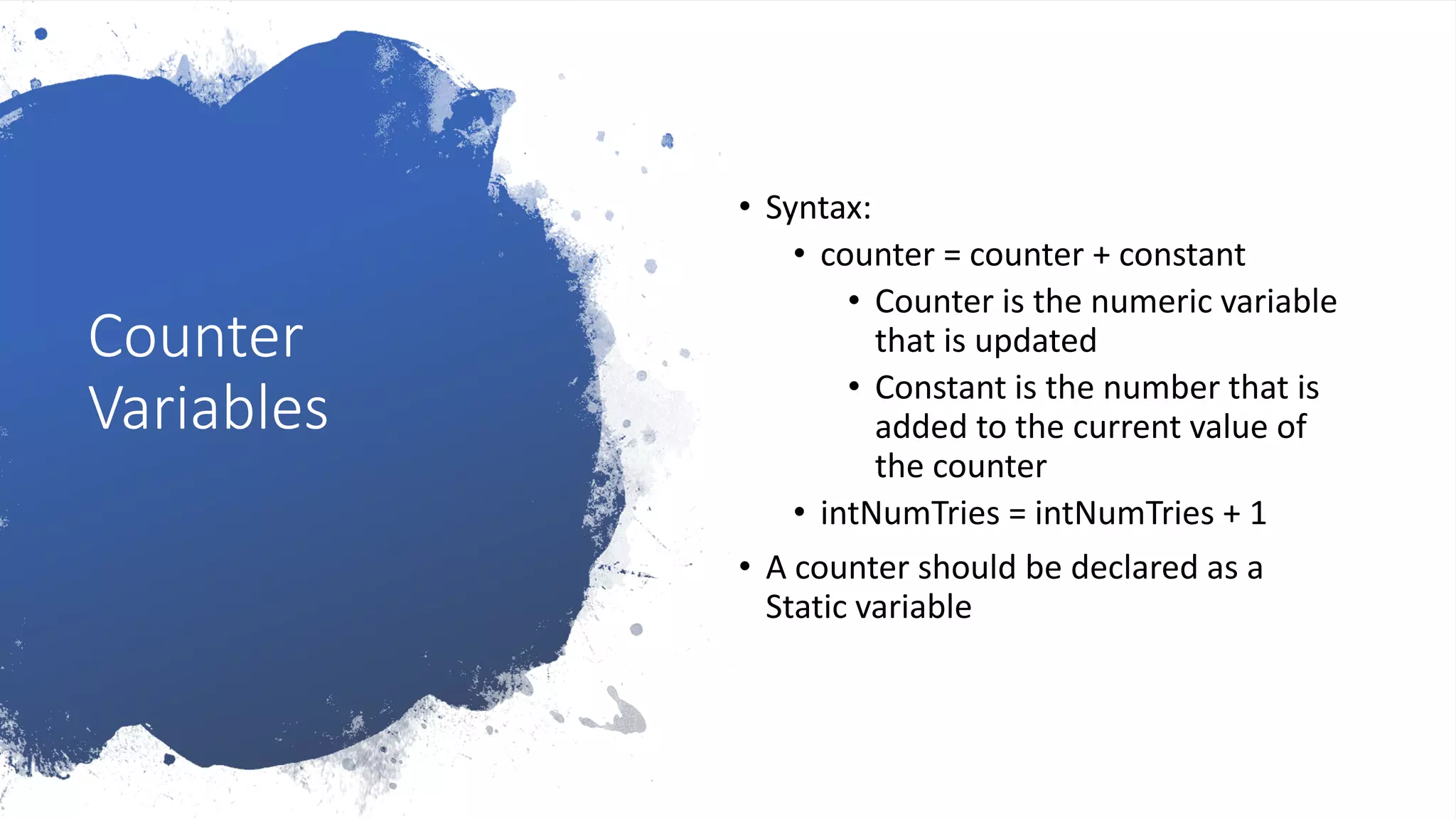
• Syntax:
• counter = counter + constant
• Counter is the numeric variable
that is updated
• Constant is the number that is
added to the current value of
the counter
• intNumTries = intNumTries + 1
• A counter should be declared as a
Static variable
The
Select…Case
Statement
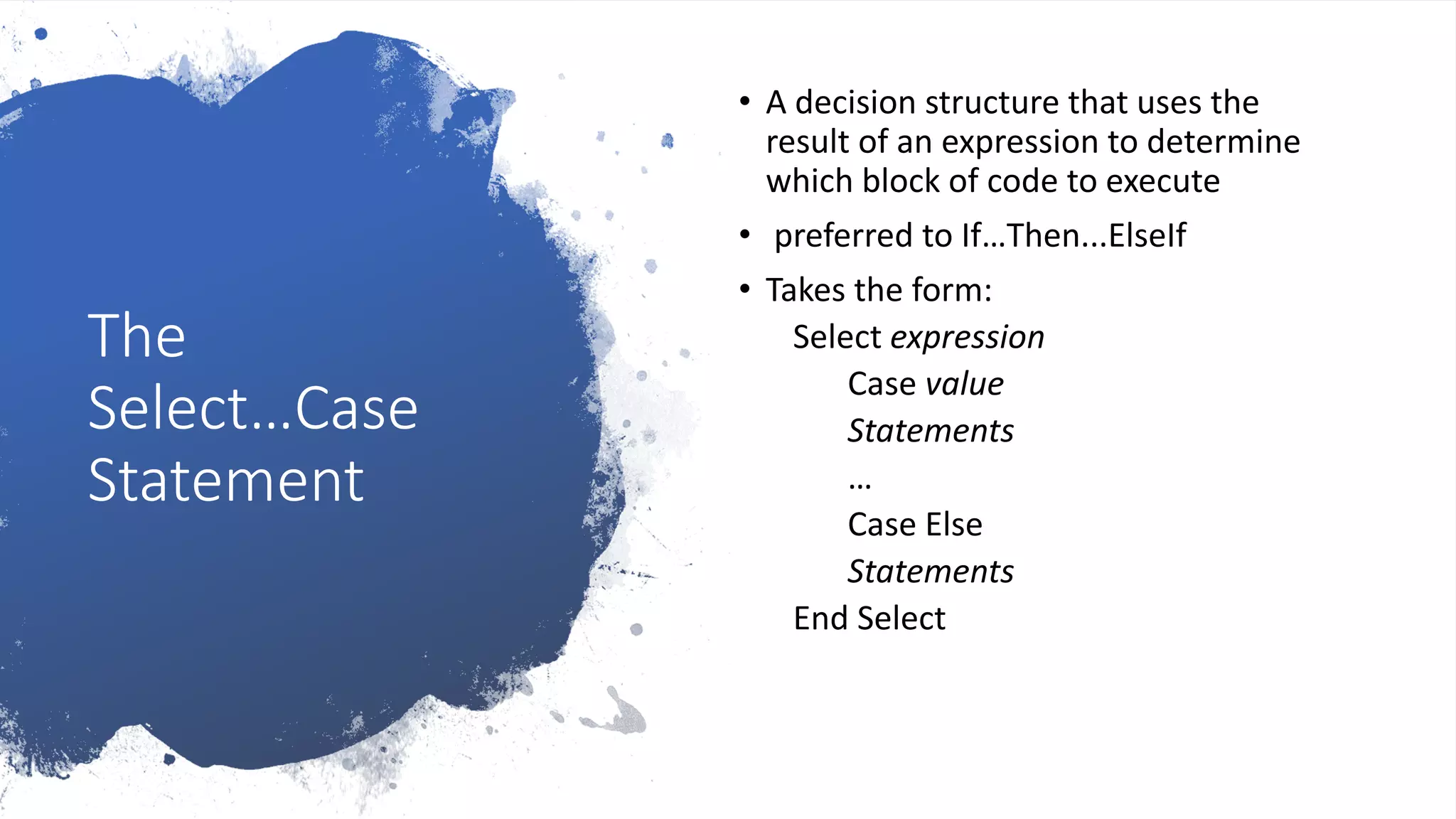
• A decision structure that uses the
result of an expression to determine
which block of code to execute
• preferred to If…Then...ElseIf
• Takes the form:
Select expression
Case value
Statements
…
Case Else
Statements
End Select
The
Select…Case
Statement
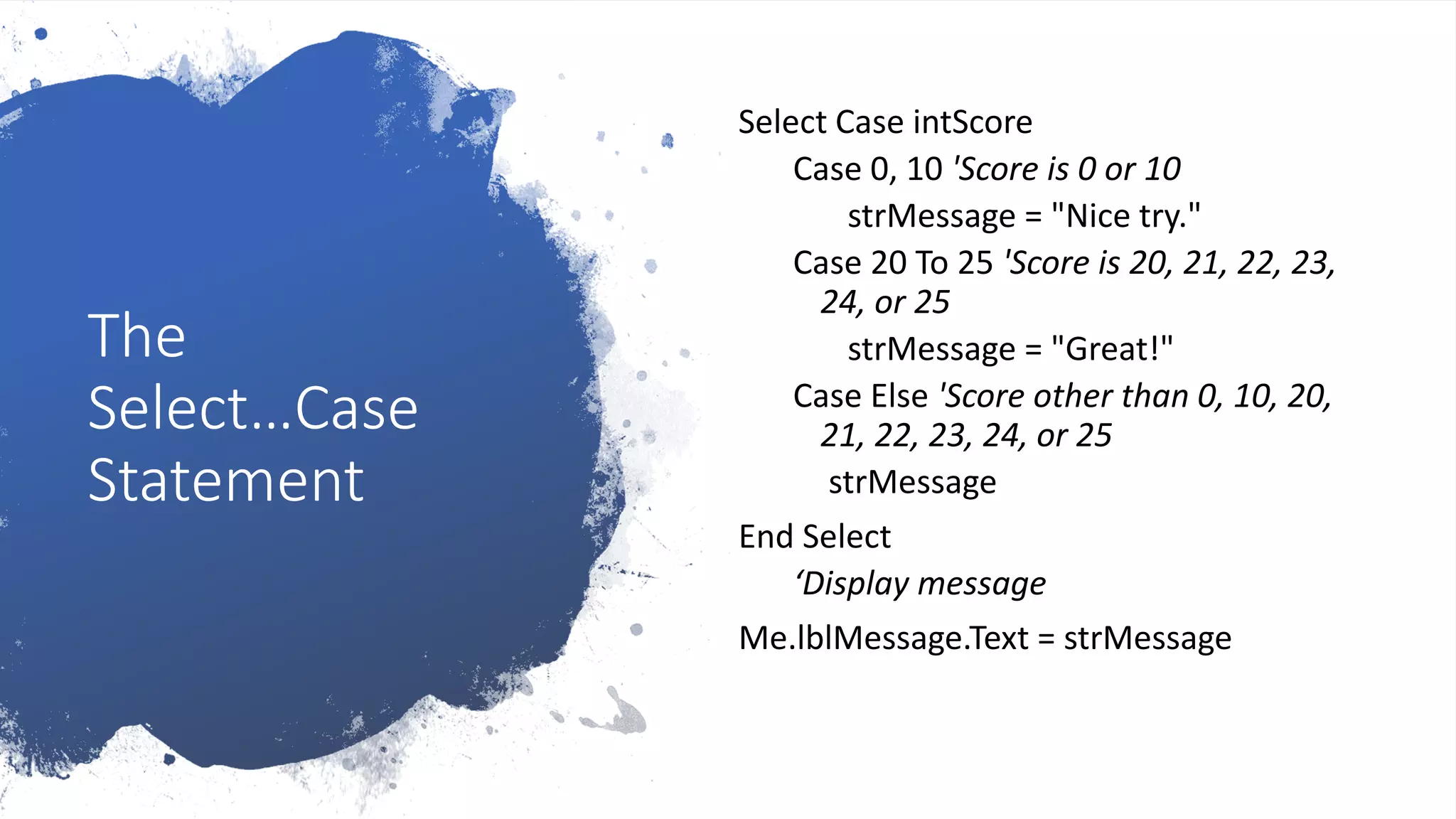
Select Case intScore
Case 0, 10 'Score is 0 or 10
strMessage = "Nice try."
Case 20 To 25 'Score is 20, 21, 22, 23,
24, or 25
strMessage = "Great!"
Case Else 'Score other than 0, 10, 20,
21, 22, 23, 24, or 25
strMessage
End Select
‘Display message
Me.lblMessage.Text = strMessage
The
Select…Case
Statement
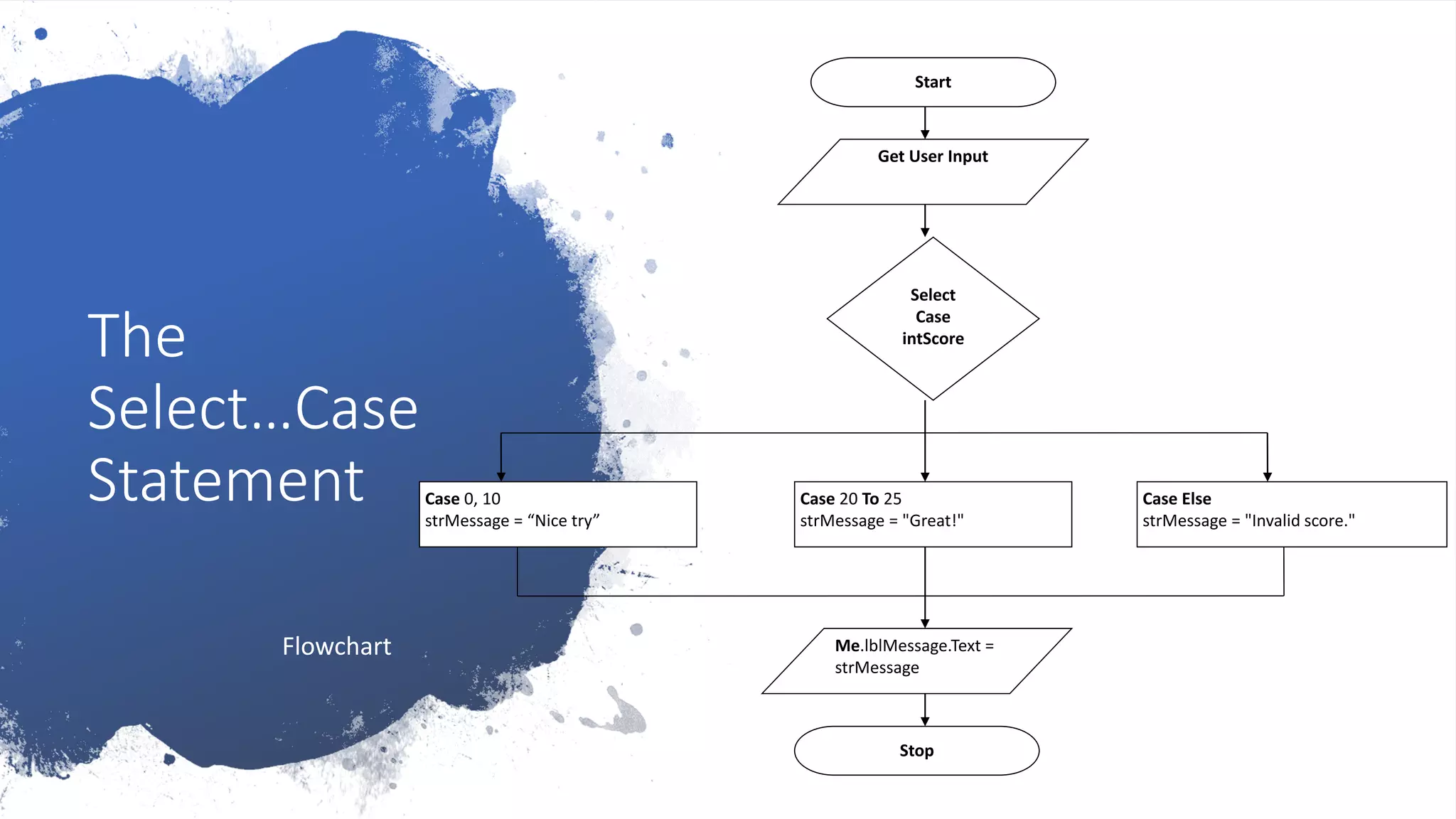
Start
Get User Input
Me.lblMessage.Text =
strMessage
Stop
Select
Case
intScore
Case 0, 10
strMessage = “Nice try”
Case 20 To 25
strMessage = "Great!"
Case Else
strMessage = "Invalid score."
Flowchart
The
Select…Case Is
Statement
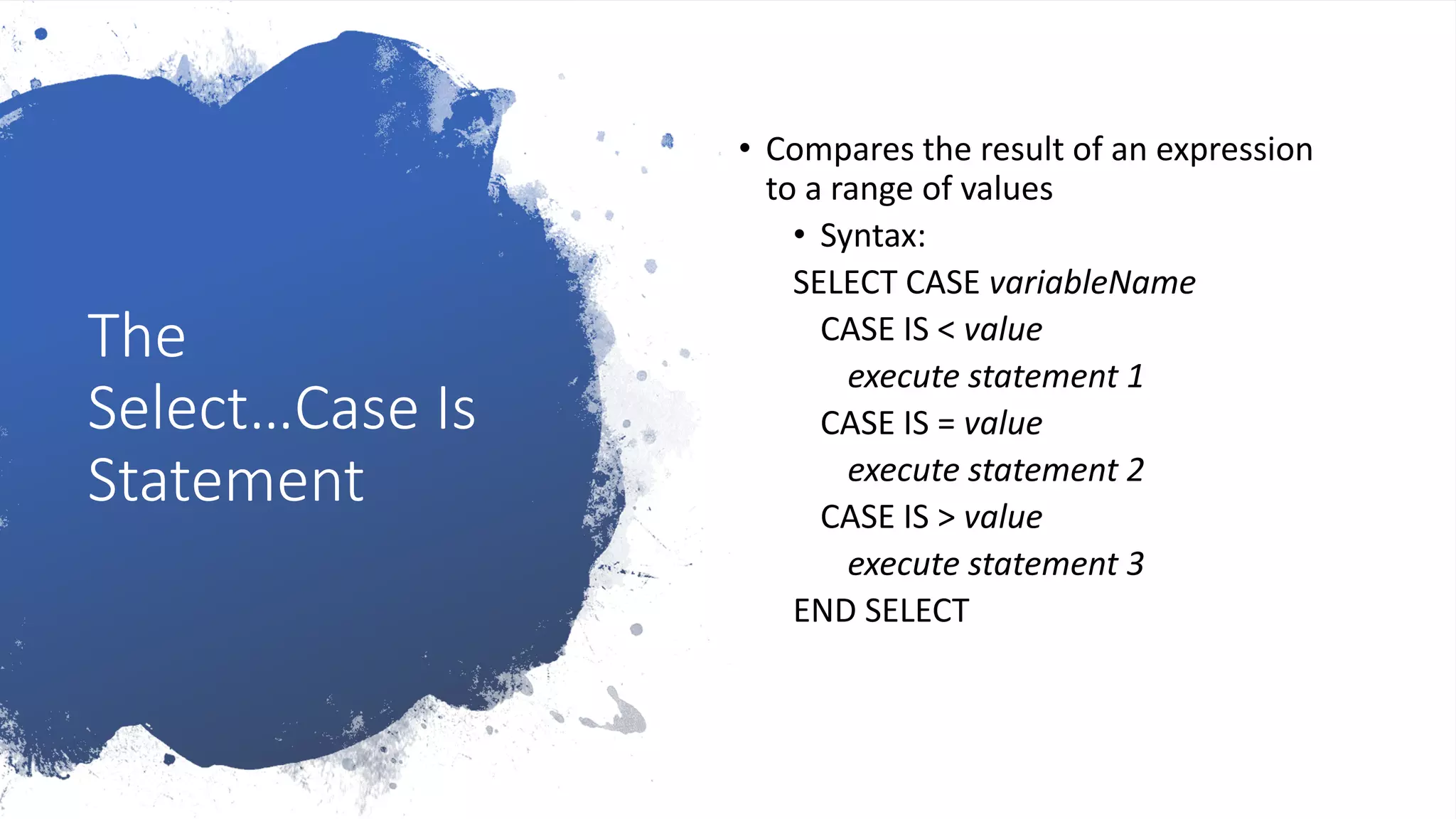
• Compares the result of an expression
to a range of values
• Syntax:
SELECT CASE variableName
CASE IS < value
execute statement 1
CASE IS = value
execute statement 2
CASE IS > value
execute statement 3
END SELECT
The
Select…Case Is
Statement
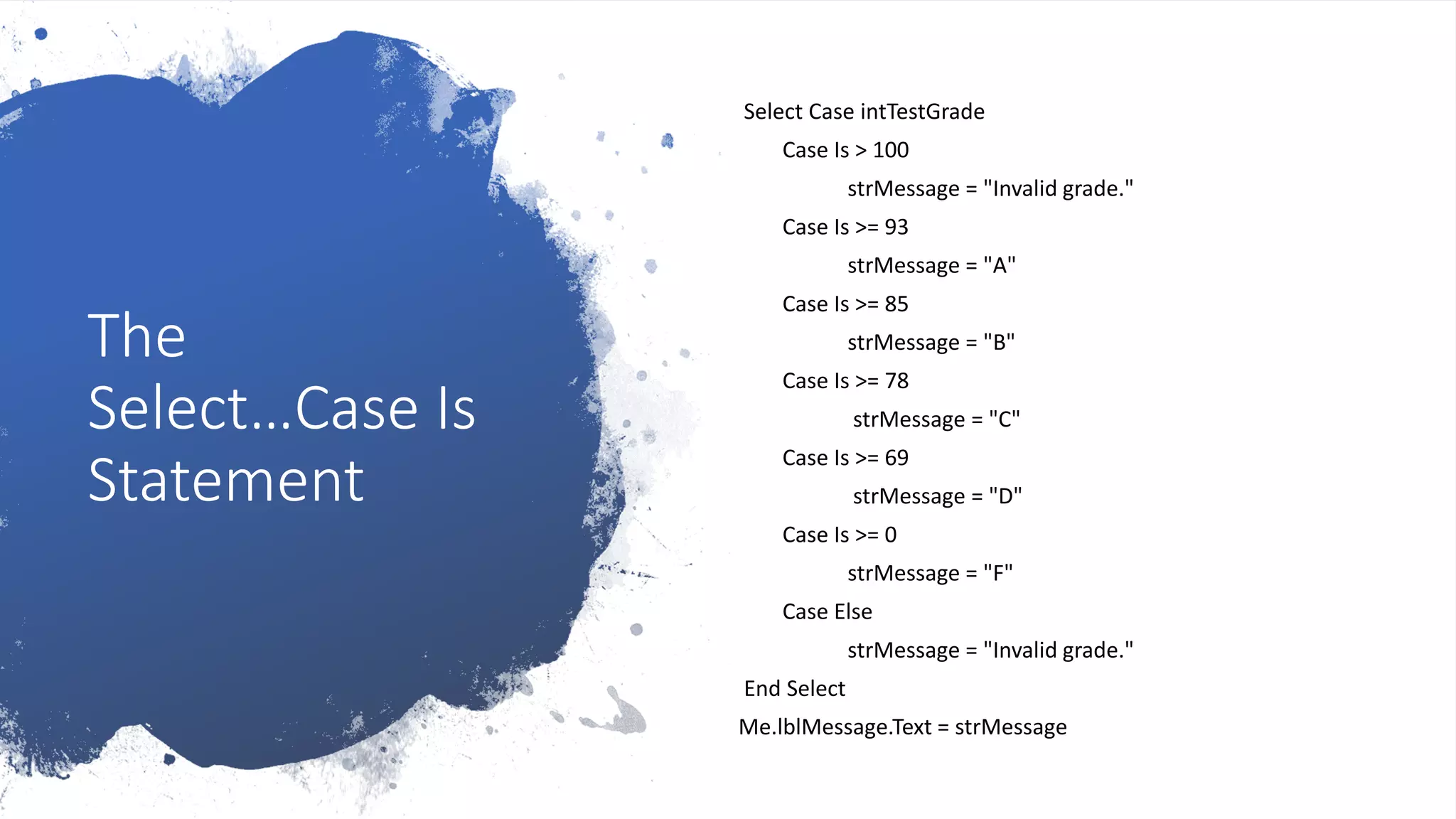
Select Case intTestGrade
Case Is > 100
strMessage = "Invalid grade."
Case Is >= 93
strMessage = "A"
Case Is >= 85
strMessage = "B"
Case Is >= 78
strMessage = "C"
Case Is >= 69
strMessage = "D"
Case Is >= 0
strMessage = "F"
Case Else
strMessage = "Invalid grade."
End Select
Me.lblMessage.Text = strMessage
Review
Displaying a
Message Box
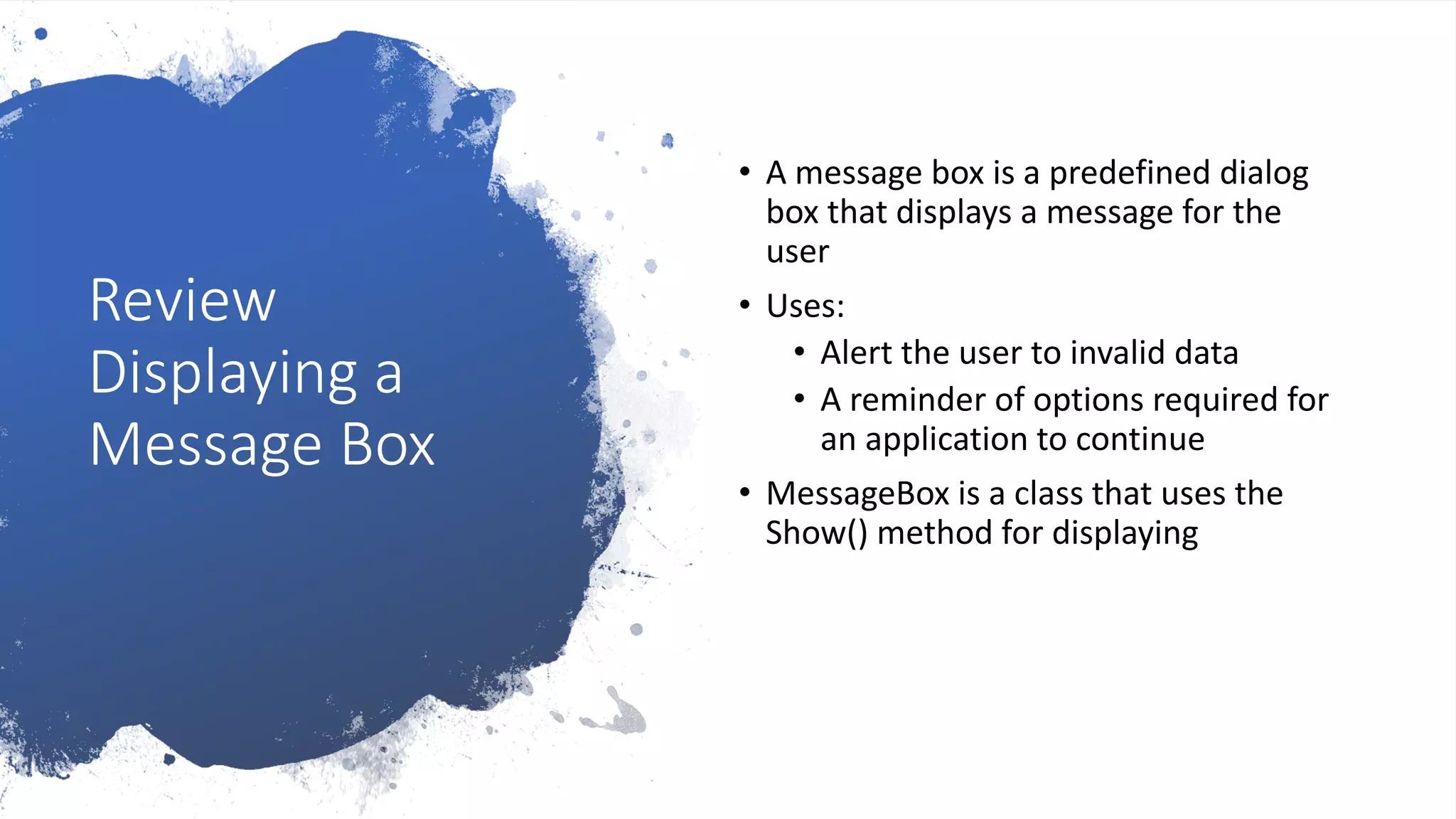
• A message box is a predefined dialog
box that displays a message for the
user
• Uses:
• Alert the user to invalid data
• A reminder of options required for
an application to continue
• MessageBox is a class that uses the
Show() method for displaying
More About Displaying a
Message Box
• Syntax:
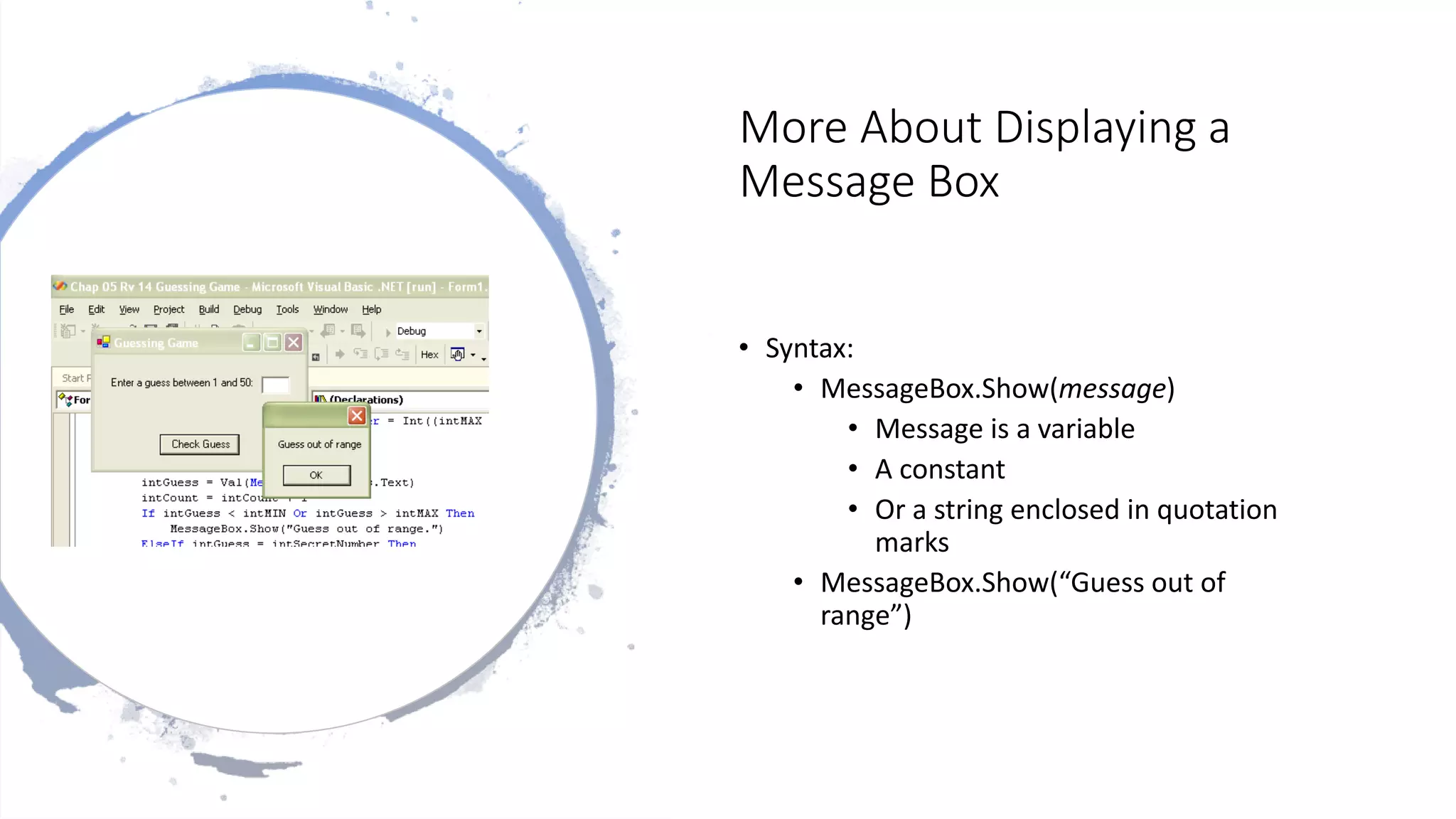
• MessageBox.Show(message)
• Message is a variable
• A constant
• Or a string enclosed in quotation
marks
• MessageBox.Show(“Guess out of
range”)
More About Displaying a
Message Box
• Syntax:
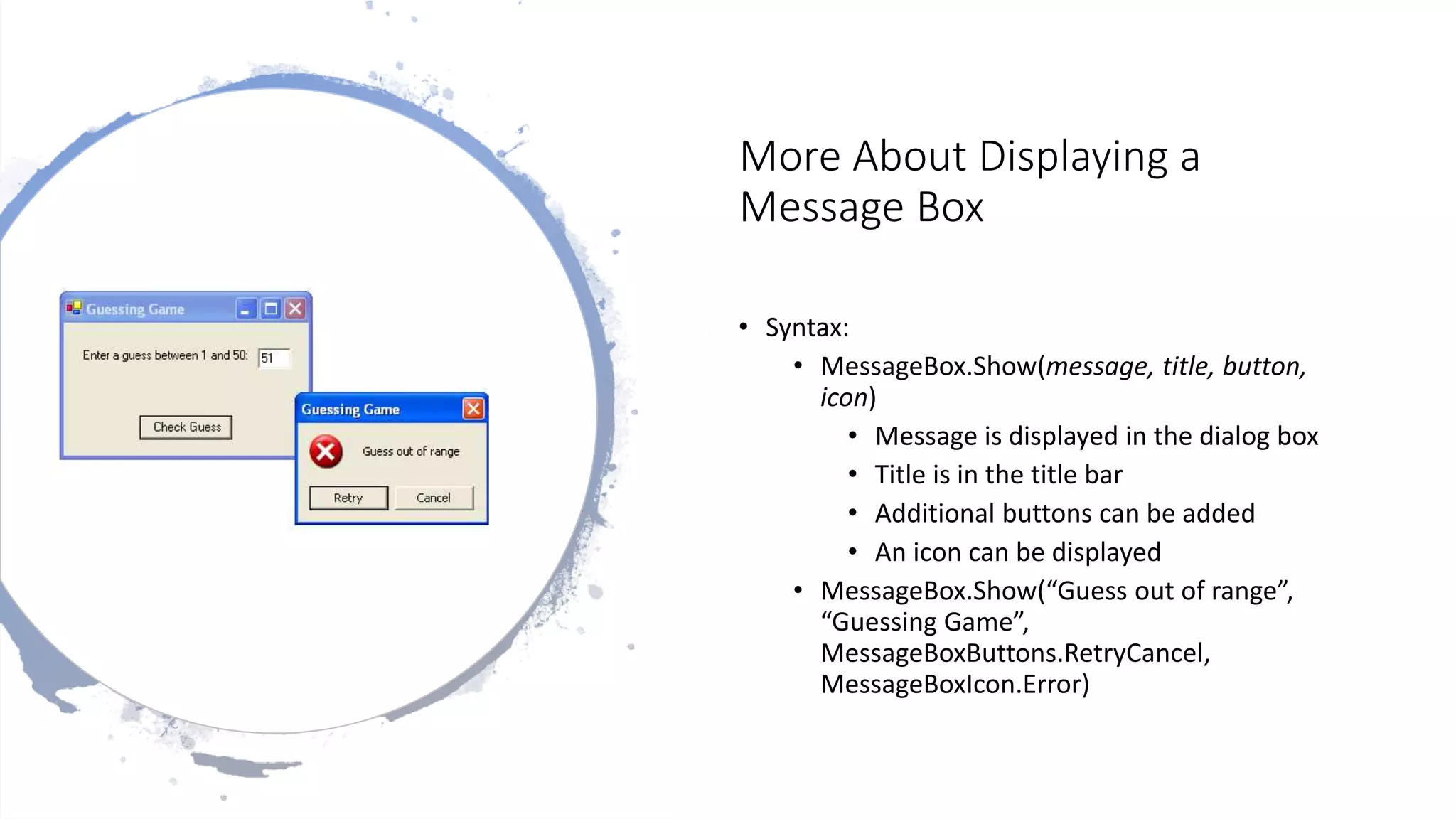
• MessageBox.Show(message, title, button,
icon)
• Message is displayed in the dialog box
• Title is in the title bar
• Additional buttons can be added
• An icon can be displayed
• MessageBox.Show(“Guess out of range”,
“Guessing Game”,
MessageBoxButtons.RetryCancel,
MessageBoxIcon.Error)
The CheckBox
Control
• Allows the user to select options
• One or more check boxes can be
selected
• CheckBoxes can be placed inside a
GroupBox object
• CheckBox object has the properties:
• Name
• Identifies the control object
• Has prefix chk
• Text
• Text displayed next to the box
• Checked
• Can be set to True or False to display the
check box with or without a check
The CheckBox
Control
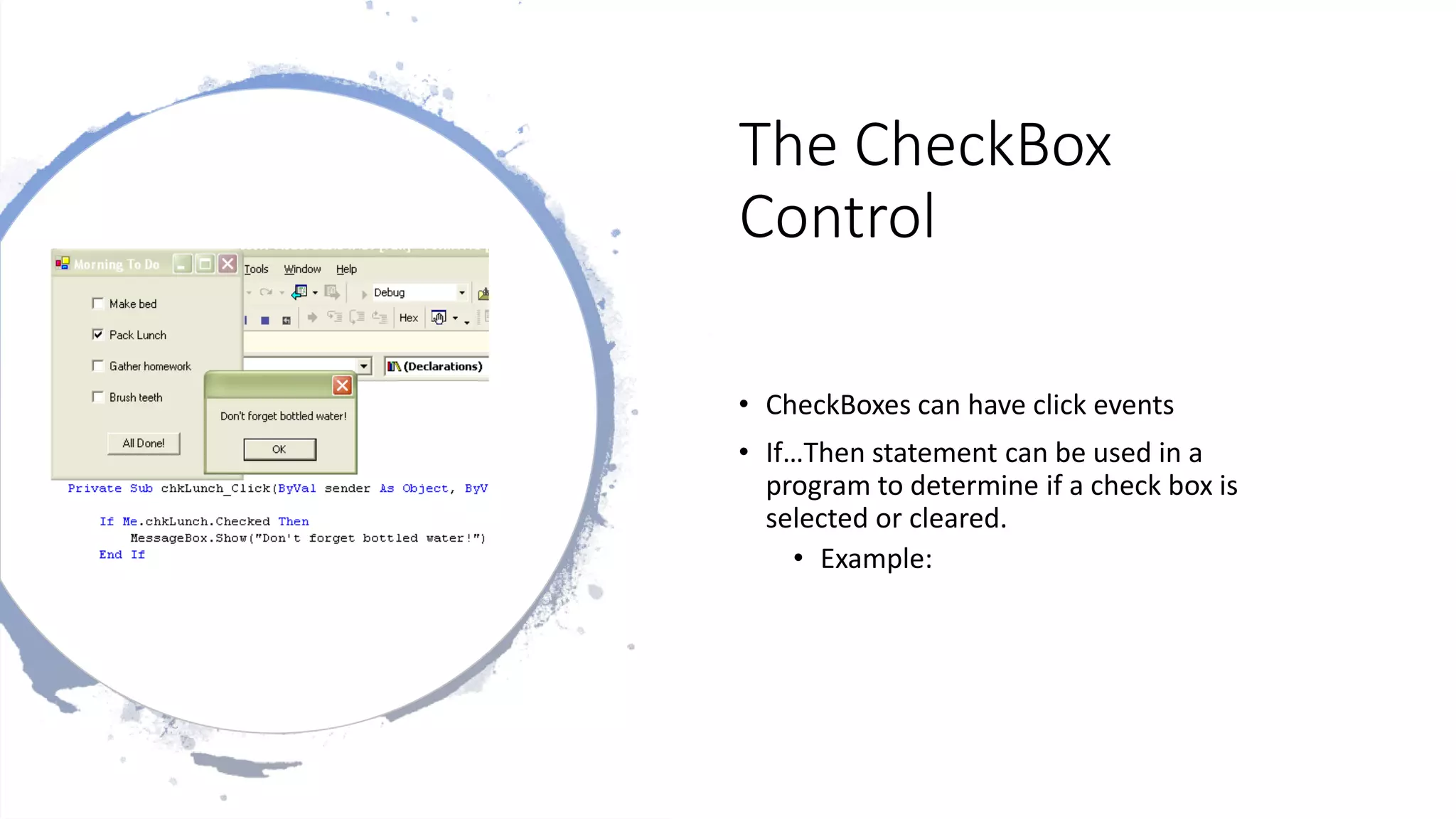
• CheckBoxes can have click events
• If…Then statement can be used in a
program to determine if a check box is
selected or cleared.
• Example:
Line-
Continuation
Character
• Visual Basic.NET statements that are
long can be typed onto two or more
lines when the line-continuation
character is used.
• The underscore (_) is the line-
continuation character and MUST have
a space before it and nothing after it
and cannot occur within quotation
marks.
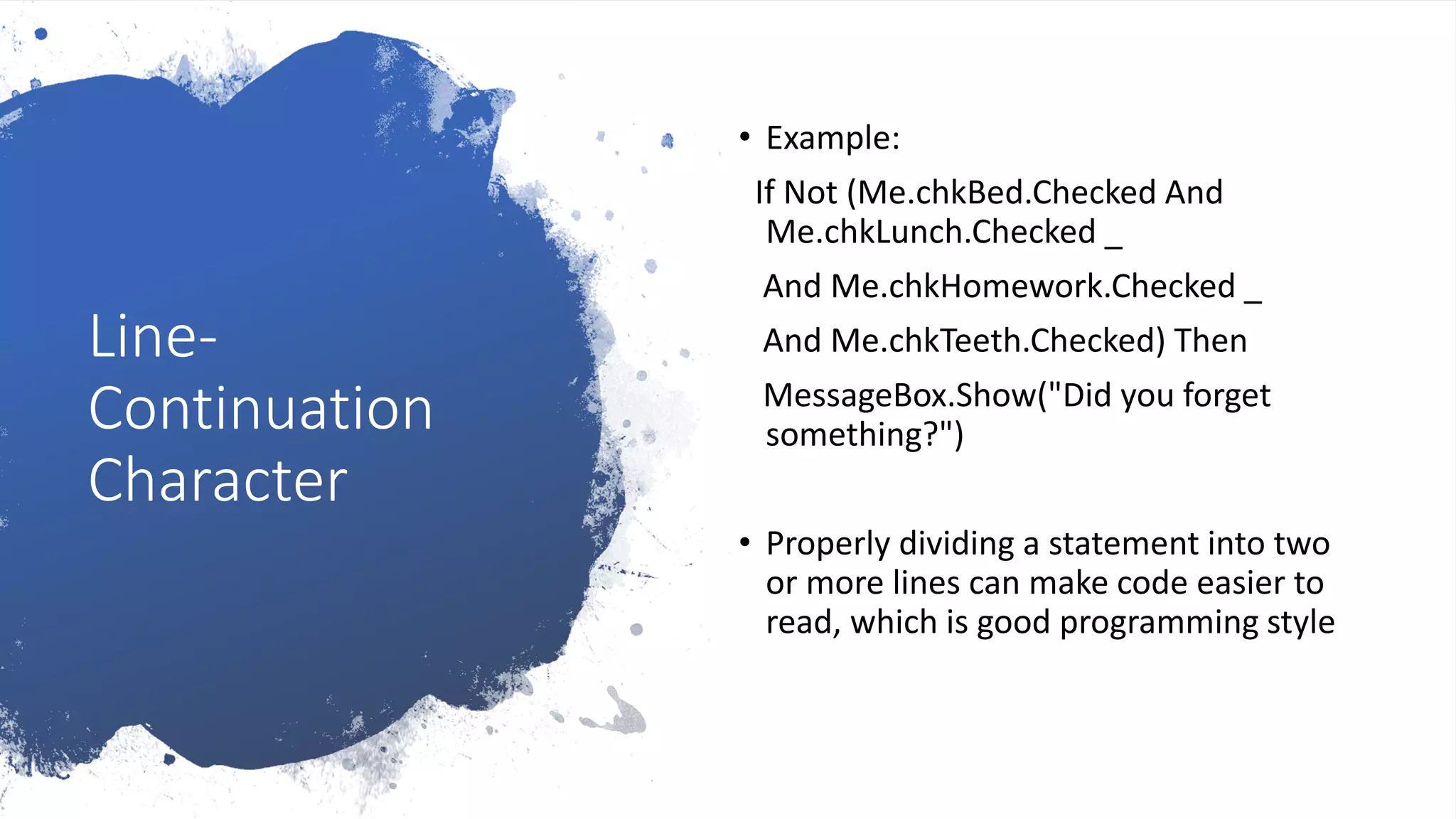
Line-
Continuation
Character
• Example:
If Not (Me.chkBed.Checked And
Me.chkLunch.Checked _
And Me.chkHomework.Checked _
And Me.chkTeeth.Checked) Then
MessageBox.Show("Did you forget
something?")
• Properly dividing a statement into two
or more lines can make code easier to
read, which is good programming style

Module 7

  • 1.
    Module 7 Created byS. O’Brien-Duke
  • 2.
    Logical Operators • Boolean Expressions •Evaluates to True or False • Can be formed using the logical operator And and Or • And • Expression evaluates to True only when both expressions (conditions) are True • If intGrade > 0 And intGrade < 100 Then Me.lblDisplay.Text = “Valid grade.”
  • 3.
    Logical Operators And Expression 1 intGrade> 0 Expression 2 intGrade < 100 Result Valid grade. True True True True False False False True False False False False
  • 4.
    Logical Operators • Or • Ifeither expression (condition) is true, then the entire expression is True. • If intGuess < 1 Or IntGuess> 50 Then Me.lblMessage.Text = “Invalid number”.
  • 5.
    Logical Operators Or Expression 1 intGuess< 1 Expression 2 IntGuess> 50 Result Invalid number True True True True False False False True False False False False
  • 6.
    Logical Operators • Not • IsTrue only when the expression it is used with is False • Example: • strItem = “Pen” • If Not strItem = “Pen” Then Me.lblMessage.Text = “No discount”. • Would evaluate to False since strItem does equal “Pen”
  • 7.
    Logical Operators Not Expression strItem =“Pen” Result No discount True False False True
  • 8.
    Generating Random Numbers • Random numbersare needed for games, screen savers, and many other types of applications. • VB.NET has a built in Rnd() function that generates random numbers. • Using Rnd() alone generates number greater than or equal to zero (0) and less than one (1) • What if a random number between 0 and 10 is needed?
  • 9.
    Generating Random Numbers • A rangecan be specified using this formula • (HighNumber – LowNumber + 1) * Rnd() + LowNumber • Example: • We need a random number between 10 and 30 • ((30-10+1 ) * Rnd() + 10) • 21 * Rnd() + 10 • Using this formula we will have a decimal number…Why?
  • 10.
    Generating Random Numbers • Rnd() generatesnumber greater than or equal to zero (0) and less than one (1) • Rnd() always generates a decimal • To generate an integer, the Int() function can be used • Int(21 * Rnd()) + 10 • The decimal potion of the calculation is truncated • Randomize() • Initializes the Rnd() function • Randomize() statement is added to the event procedure before the Rnd() function is used
  • 11.
    Static Variables • Variableshave scope • Local scope – declared in a procedure • Called a local variable • Global scope – declared outside of the procedure • Called a global variable • Variables also have a lifetime • Local variable lifetime – duration of the procedure • Global variable lifetime – duration of the program
  • 12.
    Static Variables • Lifetimeof a local variable can be extended by using a Static declaration statement • Static variableName as dataType = value • Keyword Static replaces Dim • Must be explicitly initialized in the declaration • Static variables • Scope – local to the procedure • Lifetime – duration of the program • Necessary in event procedures with variables that should be retained in memory throughout program execution
  • 13.
    Counter Variables • A counteris a variable storing a number that is incremented by a constant value • Useful for: • Keeping track how many times a button is clicked • A guess is entered • A password is typed • A web site is visited
  • 14.
    Counter Variables • Syntax: • counter= counter + constant • Counter is the numeric variable that is updated • Constant is the number that is added to the current value of the counter • intNumTries = intNumTries + 1 • A counter should be declared as a Static variable
  • 15.
    The Select…Case Statement • A decisionstructure that uses the result of an expression to determine which block of code to execute • preferred to If…Then...ElseIf • Takes the form: Select expression Case value Statements … Case Else Statements End Select
  • 16.
    The Select…Case Statement Select Case intScore Case0, 10 'Score is 0 or 10 strMessage = "Nice try." Case 20 To 25 'Score is 20, 21, 22, 23, 24, or 25 strMessage = "Great!" Case Else 'Score other than 0, 10, 20, 21, 22, 23, 24, or 25 strMessage End Select ‘Display message Me.lblMessage.Text = strMessage
  • 17.
    The Select…Case Statement Start Get User Input Me.lblMessage.Text= strMessage Stop Select Case intScore Case 0, 10 strMessage = “Nice try” Case 20 To 25 strMessage = "Great!" Case Else strMessage = "Invalid score." Flowchart
  • 18.
    The Select…Case Is Statement • Comparesthe result of an expression to a range of values • Syntax: SELECT CASE variableName CASE IS < value execute statement 1 CASE IS = value execute statement 2 CASE IS > value execute statement 3 END SELECT
  • 19.
    The Select…Case Is Statement Select CaseintTestGrade Case Is > 100 strMessage = "Invalid grade." Case Is >= 93 strMessage = "A" Case Is >= 85 strMessage = "B" Case Is >= 78 strMessage = "C" Case Is >= 69 strMessage = "D" Case Is >= 0 strMessage = "F" Case Else strMessage = "Invalid grade." End Select Me.lblMessage.Text = strMessage
  • 20.
    Review Displaying a Message Box •A message box is a predefined dialog box that displays a message for the user • Uses: • Alert the user to invalid data • A reminder of options required for an application to continue • MessageBox is a class that uses the Show() method for displaying
  • 21.
    More About Displayinga Message Box • Syntax: • MessageBox.Show(message) • Message is a variable • A constant • Or a string enclosed in quotation marks • MessageBox.Show(“Guess out of range”)
  • 22.
    More About Displayinga Message Box • Syntax: • MessageBox.Show(message, title, button, icon) • Message is displayed in the dialog box • Title is in the title bar • Additional buttons can be added • An icon can be displayed • MessageBox.Show(“Guess out of range”, “Guessing Game”, MessageBoxButtons.RetryCancel, MessageBoxIcon.Error)
  • 23.
    The CheckBox Control • Allowsthe user to select options • One or more check boxes can be selected • CheckBoxes can be placed inside a GroupBox object • CheckBox object has the properties: • Name • Identifies the control object • Has prefix chk • Text • Text displayed next to the box • Checked • Can be set to True or False to display the check box with or without a check
  • 24.
    The CheckBox Control • CheckBoxescan have click events • If…Then statement can be used in a program to determine if a check box is selected or cleared. • Example:
  • 25.
    Line- Continuation Character • Visual Basic.NETstatements that are long can be typed onto two or more lines when the line-continuation character is used. • The underscore (_) is the line- continuation character and MUST have a space before it and nothing after it and cannot occur within quotation marks.
  • 26.
    Line- Continuation Character • Example: If Not(Me.chkBed.Checked And Me.chkLunch.Checked _ And Me.chkHomework.Checked _ And Me.chkTeeth.Checked) Then MessageBox.Show("Did you forget something?") • Properly dividing a statement into two or more lines can make code easier to read, which is good programming style