System Analysis & Design
DCS 2213
Systems Analysis & Design
Analyzing the Business Case
Introduction
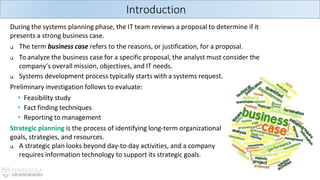
During the systems planning phase, the IT team reviews a proposal to determine if it
presents a strong business case.
❑ The term business case refers to the reasons, or justification, for a proposal.
❑ To analyze the business case for a specific proposal, the analyst must consider the
company’s overall mission, objectives, and IT needs.
❑ Systems development process typically starts with a systems request.
Preliminary investigation follows to evaluate:
• Feasibility study
• Fact finding techniques
• Reporting to management
Strategic planning is the process of identifying long-term organizational
goals, strategies, and resources.
❑ A strategic plan looks beyond day-to-day activities, and a company
requires information technology to support its strategic goals.
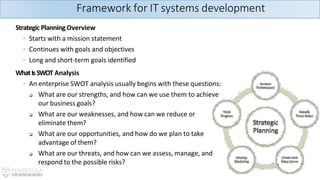
StrategicPlanning Overview
◦ Starts with a mission statement
◦ Continues with goals and objectives
◦ Long and short-term goals identified
WhatIsSWOT Analysis
◦ An enterprise SWOT analysis usually begins with these questions:
❑ What are our strengths, and how can we use them to achieve
our business goals?
❑ What are our weaknesses, and how can we reduce or
eliminate them?
❑ What are our opportunities, and how do we plan to take
advantage of them?
❑ What are our threats, and how can we assess, manage, and
respond to the possible risks?
Framework for IT systems development
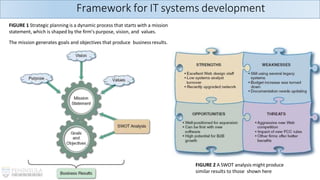
FIGURE 1 Strategic planning is a dynamic process that starts with a mission
statement, which is shaped by the firm’s purpose, vision, and values.
The mission generates goals and objectives that produce business results.
FIGURE 2 A SWOT analysis might produce
similar results to those shown here
Framework for IT systems development
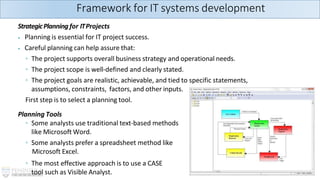
FIGURE 3 This SWOT analysis example focuses on a specific asset,
such as a company patent.
Framework for IT systems development
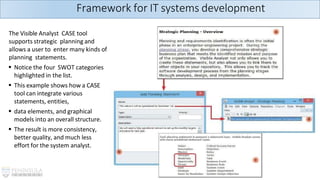
StrategicPlanning for ITProjects
⦁ Planning is essential for IT project success.
⦁ Careful planning can help assure that:
◦ The project supports overall business strategy and operational needs.
◦ The project scope is well-defined and clearly stated.
◦ The project goals are realistic, achievable, and tied to specific statements,
assumptions, constraints, factors, and other inputs.
First step is to select a planning tool.
Planning Tools
◦ Some analysts use traditional text-based methods
like Microsoft Word.
◦ Some analysts prefer a spreadsheet method like
Microsoft Excel.
◦ The most effective approach is to use a CASE
tool such as Visible Analyst.
Framework for IT systems development
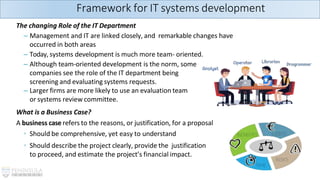
The Visible Analyst CASE tool
supports strategic planning and
allows a user to enter many kinds of
planning statements.
▪ Notice the four SWOT categories
highlighted in the list.
▪ This example shows how a CASE
tool can integrate various
statements, entities,
▪ data elements, and graphical
models into an overall structure.
▪ The result is more consistency,
better quality, and much less
effort for the system analyst.
Framework for IT systems development
The changing Role of the IT Department
– Management and IT are linked closely, and remarkable changes have
occurred in both areas
– Today, systems development is much more team- oriented.
– Although team-oriented development is the norm, some
companies see the role of the IT department being
screening and evaluating systems requests.
– Larger firms are more likely to use an evaluation team
or systems review committee.
What is a Business Case?
A business case refers to the reasons, or justification, for a proposal
◦ Should be comprehensive, yet easy to understand
◦ Should describe the project clearly, provide the justification
to proceed, and estimate the project’s financial impact.
Framework for IT systems development
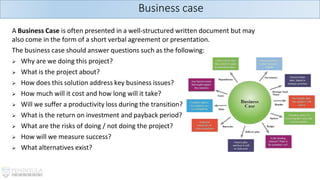
A Business Case is often presented in a well-structured written document but may
also come in the form of a short verbal agreement or presentation.
The business case should answer questions such as the following:
➢ Why are we doing this project?
➢ What is the project about?
➢ How does this solution address key business issues?
➢ How much will it cost and how long will it take?
➢ Will we suffer a productivity loss during the transition?
➢ What is the return on investment and payback period?
➢ What are the risks of doing / not doing the project?
➢ How will we measure success?
➢ What alternatives exist?
Business case
Information Systems Projects
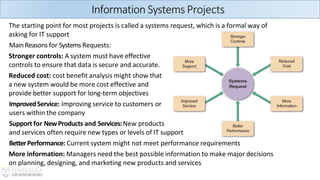
The starting point for most projects is called a systems request, which is a formal way of
asking for IT support
MainReasons for SystemsRequests:
Stronger controls: A system must have effective
controls to ensure that data is secure and accurate.
Reduced cost: cost benefit analysis might show that
a new system would be more cost effective and
provide better support for long-term objectives
ImprovedService: Improving service to customers or
users within the company
Support for NewProducts and Services:New products
and services often require new types or levels of IT support
BetterPerformance: Current system might not meet performance requirements
More information: Managers need the best possible information to make major decisions
on planning, designing, and marketing new products and services
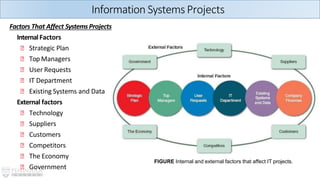
FIGURE Internal and external factors that affect IT projects.
Information Systems Projects
Factors That Affect SystemsProjects
InternalFactors
🞄 Strategic Plan
🞄 Top Managers
🞄 User Requests
🞄 IT Department
🞄 Existing Systems and Data
External factors
🞄 Technology
🞄 Suppliers
🞄 Customers
🞄 Competitors
🞄
🞄
The Economy
Government
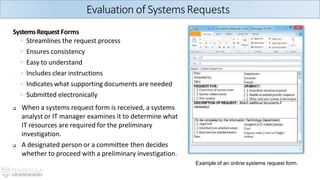
SystemsRequestForms
◦ Streamlines the request process
◦ Ensures consistency
◦ Easy to understand
◦ Includes clear instructions
◦ Indicates what supporting documents are needed
◦ Submitted electronically
❑ When a systems request form is received, a systems
analyst or IT manager examines it to determine what
IT resources are required for the preliminary
investigation.
❑ A designated person or a committee then decides
whether to proceed with a preliminary investigation.
Example of an online systems request form.
Evaluation of SystemsRequests
SystemsReviewCommittee
▪ Most large companies use a systems review committee to evaluate systems requests.
▪ With a broader viewpoint, a committee can establish priorities more effectively than an individual.
▪ The IT director usually serves as a technical consultant to ensure that committee members are aware of
crucial issues, problems, and opportunities.
Disadvantages of committee:
❑ Action on requests must wait until the committee meets
❑ Members might favor projects requested by their own departments
❑ Internal political differences could delay important decisions
Suppose four requests must be reviewed:
1. The marketing group wants to analyze current customer spending habits and forecast future trends.
2. The technical support group wants a cellular link so service representatives can download technical data
instantly.
3. The accounting department wants to redesign customer statements and allow Internet access.
4. The production staff wants an inventory control system that can exchange data with major suppliers.
Which projects should the firm pursue? What criteria should be applied? How
should priorities be determined? To answer these questions, the individual or the committee must assess
the feasibility of each request.
Evaluation of SystemsRequests
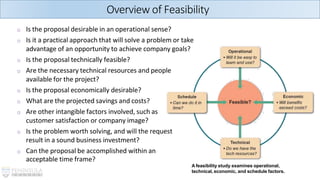
Overview of Feasibility
o Is the proposal desirable in an operational sense?
o Is it a practical approach that will solve a problem or take
advantage of an opportunity to achieve company goals?
o Is the proposal technically feasible?
o Are the necessary technical resources and people
available for the project?
o Is the proposal economically desirable?
o What are the projected savings and costs?
o Are other intangible factors involved, such as
customer satisfaction or company image?
o Is the problem worth solving, and will the request
result in a sound business investment?
o Can the proposal be accomplished within an
acceptable time frame?
A feasibility study examines operational,
technical, economic, and schedule factors.
❑ Operational feasibility means that a proposed system will be used effectively after
it has been developed.
❑ If users have difficulty with a new system, it will not produce the expected benefits.
◦ Does management support the project?
o Do users support the project?
o Is the current system well liked and effectively used?
o Do users see the need for change?
◦ Will the new system result in a workforce reduction?
If so, what will happen to affected employees?
◦ Will the new system require training for users?
If so, is the company prepared to provide the necessary resources for training
current employees?
◦ Will users be involved in planning the new system right from the start?
Overview of Feasibility
Technical feasibility refers to the technical resources needed to develop, purchase,
install, or operate the system.
When assessing technical feasibility, an analyst should consider the following points:
Does the company have the necessary hardware, software, and network resources?
-If not, can those resources be acquired without difficulty?
Does the company have the needed technical expertise?
-If not, can it be acquired?
Does the proposed platform have sufficient capacity for future needs?
-If not, can it be expanded?
The questions that are asked would be:
◦ Will a prototype be required?
◦ Will the hardware and software environment be reliable?
◦ Will it integrate with other company information systems, both now and in the
future?
◦ Will it interface properly with external systems operated by customers and
suppliers?
Overview of Feasibility
Economic feasibility means that the projected benefits of the proposed system outweigh
the estimated costs usually considered the total cost of ownership (TCO),
which includes ongoing support and maintenance costs, as well as acquisition costs.
To determine TCO, the analyst must estimate costs in each of the following areas:
Costs for people, including IT staff and users
◦ Costs for hardware and equipment
◦ Cost of software, including in-house development as well as purchases from vendors
◦ Cost for formal and informal training, including peer-to-peer support
◦ Cost of licenses and fees
◦ Cost of consulting expenses
◦ Facility costs
◦ The estimated cost of not developing the system or postponing the project
Overview of Feasibility
⦁ Tangible Benefits
◦ A new scheduling system that
reduces overtime
◦ An online package tracking
system that improves
service and decreases the
need for clerical staff
◦ A sophisticated inventory
control system that cuts excess
inventory and eliminates
production delays
⦁ IntangibleBenefits
◦ A user-friendly system that
improves employee job
satisfaction
◦ A sales tracking system that
supplies better information for
marketing decisions
◦ A new Web site that enhances
the company’s image
Overview of Feasibility
The first step in evaluating feasibility is to identify and weed out systems requests that are
not feasible.
For example, a request would not be feasible if it required hardware or software that the
company already had rejected
▪ Even if the request is feasible, it might not be necessary. For example, a request for
multiple versions of a report could require considerable design and programming effort.
▪ Requests that are not currently feasible can be resubmitted as new hardware,
software, or expertise becomes available
❑ As the project progresses, conditions often change, and acquisition costs might
increase, the project might become more expensive than anticipated.
❑ In addition, managers and users sometimes lose confidence in a project.
❑ For all those reasons, Feasibility analysis is an ongoing task that must be performed
throughout the systems development process.
Evaluating Feasibility
When assessing a project’s priority, a systems analyst should consider the following:
Factors That Affect Priority
◦ Will the proposed system reduce costs?
Where? When? How? How much?
◦ Will the system increase revenue for the company?
Where? When? How? How much?
◦ Will the systems project result in more information or produce better results?
How? Are the results measurable?
◦ Will the system serve customers better?
◦ Will the system serve the organization better?
◦ Can the project be implemented in a reasonable time period?
How long will the results last?
◦ Are the necessary financial, human, and technical resources available?
Setting Priorities
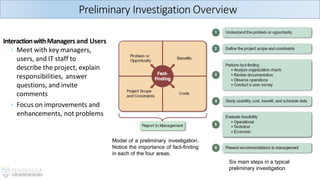
Model of a preliminary investigation.
Notice the importance of fact-finding
in each of the four areas.
Six main steps in a typical
preliminary investigation.
Preliminary Investigation Overview
InteractionwithManagers and Users
◦ Meet with key managers,
users, and IT staff to
describe the project, explain
responsibilities, answer
questions, and invite
comments
◦ Focus on improvements and
enhancements, not problems
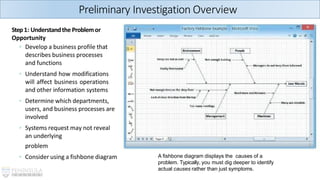
A fishbone diagram displays the causes of a
problem. Typically, you must dig deeper to identify
actual causes rather than just symptoms.
Preliminary Investigation Overview
Step1: Understandthe Problemor
Opportunity
◦ Develop a business profile that
describes business processes
and functions
◦ Understand how modifications
will affect business operations
and other information systems
◦ Determine which departments,
users, and business processes are
involved
◦ Systems request may not reveal
an underlying
problem
◦ Consider using a fishbone diagram
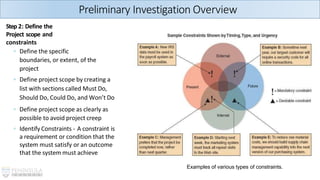
Examples of various types of constraints.
Preliminary Investigation Overview
Step 2: Define the
Project scope and
constraints
◦ Define the specific
boundaries, or extent, of the
project
◦ Define project scope by creating a
list with sections called Must Do,
Should Do, Could Do, and Won’t Do
◦ Define project scope as clearly as
possible to avoid project creep
◦ Identify Constraints - A constraint is
a requirement or condition that the
system must satisfy or an outcome
that the system must achieve
Step3: Perform Fact-Finding
◦ Gather data about project usability, costs, benefits, and
schedules
◦ Analyze organization charts
🞄 Understand the functions and identify people you
want
to interview.
• ReviewDocumentation
🞄 Investigate the current system documentation
🞄 Check with users to confirm that you are receiving
accurate and complete
information
◦ Observe Operations
🞄 See how workers carry out typical tasks
🞄 Sample inputs and
outputs of the system
Preliminary Investigation Overview
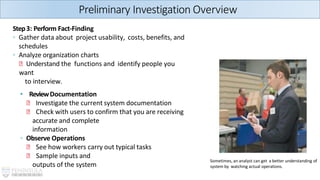
Sometimes, an analyst can get a better understanding of
system by watching actual operations.
42
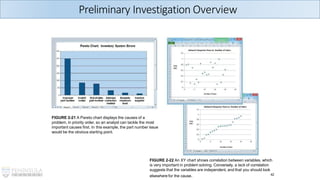
FIGURE 2-21 A Pareto chart displays the causes of a
problem, in priority order, so an analyst can tackle the most
important causes first. In this example, the part number issue
would be the obvious starting point.
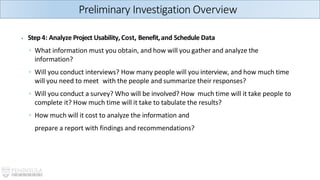
FIGURE 2-22 An XY chart shows correlation between variables, which
is very important in problem solving. Conversely, a lack of correlation
suggests that the variables are independent, and that you should look
elsewhere for the cause.
Preliminary Investigation Overview
⦁ Step4: Analyze Project Usability, Cost, Benefit,and Schedule Data
◦ What information must you obtain, and how will you gather and analyze the
information?
◦ Will you conduct interviews? How many people will you interview, and how much time
will you need to meet with the people and summarize their responses?
◦ Will you conduct a survey? Who will be involved? How much time will it take people to
complete it? How much time will it take to tabulate the results?
◦ How much will it cost to analyze the information and
prepare a report with findings and recommendations?
Preliminary Investigation Overview
Step 5: The following guidelines should also be considered:
Operational feasibility.
• Fact-finding should have included a review of user needs, requirements, and expectations.
• When this data is analyzed, look for areas that might present problems for system users and how they
might be resolved.
• Because operational feasibility means that a system will be used effectively, this is a vital area of
concern.
Technical feasibility.
• The fact-finding data should identify the hardware, software, and network resources needed to
develop, install, and operate the system.
• With this data, a checklist can be developed that will highlight technical costs and concerns, if any.
Economic feasibility.
• Using the fact-finding data, financial analysis tools can be applied to assess feasibility.
• The cost-benefit data will be an important factor for management to consider.
• Also, a cost estimate for the project development team will be built into the project management
plan.
Schedule feasibility.
• The fact-finding data should include stakeholder expectations regarding acceptable timing and
completion dates.
• The schedule data will be incorporated into the project plan in the form of task durations and
milestones.
Step6: Present Resultsand Recommendationsto Management
The final task in the preliminary investigation is to prepare a report to management,
and possibly deliver a presentation
◦ Typical Report Includes:
🞄 Introduction
🞄 Systems Request Summary
🞄 Findings
🞄 Case for Action
🞄 Project Roles
🞄 Time and Costs Estimates
🞄 Expected Benefits
🞄 Appendix
Preliminary Investigation Overview
Summary
❑ Explained the concept of a business case and how a business case affects
an IT project
❑ Described the strategic planning process and why it is important to the IT
team
❑ Conduct a SWOT analysis and describe the four factors involved
❑ List reasons for systems projects and factors that affect such projects
❑ Describe systems requests and the role of the systems review committee
❑ Define operational, technical, economic, and schedule feasibility
❑ Explain the factors that affect project priorities
❑ Describe the steps and the end product of a preliminary investigation

WEEK2-Analyzing the Business Case.pdf

  • 1.
    System Analysis &Design DCS 2213 Systems Analysis & Design Analyzing the Business Case
  • 2.
    Introduction During the systemsplanning phase, the IT team reviews a proposal to determine if it presents a strong business case. ❑ The term business case refers to the reasons, or justification, for a proposal. ❑ To analyze the business case for a specific proposal, the analyst must consider the company’s overall mission, objectives, and IT needs. ❑ Systems development process typically starts with a systems request. Preliminary investigation follows to evaluate: • Feasibility study • Fact finding techniques • Reporting to management Strategic planning is the process of identifying long-term organizational goals, strategies, and resources. ❑ A strategic plan looks beyond day-to-day activities, and a company requires information technology to support its strategic goals.
  • 3.
    StrategicPlanning Overview ◦ Startswith a mission statement ◦ Continues with goals and objectives ◦ Long and short-term goals identified WhatIsSWOT Analysis ◦ An enterprise SWOT analysis usually begins with these questions: ❑ What are our strengths, and how can we use them to achieve our business goals? ❑ What are our weaknesses, and how can we reduce or eliminate them? ❑ What are our opportunities, and how do we plan to take advantage of them? ❑ What are our threats, and how can we assess, manage, and respond to the possible risks? Framework for IT systems development
  • 4.
    FIGURE 1 Strategicplanning is a dynamic process that starts with a mission statement, which is shaped by the firm’s purpose, vision, and values. The mission generates goals and objectives that produce business results. FIGURE 2 A SWOT analysis might produce similar results to those shown here Framework for IT systems development
  • 5.
    FIGURE 3 ThisSWOT analysis example focuses on a specific asset, such as a company patent. Framework for IT systems development
  • 6.
    StrategicPlanning for ITProjects ⦁Planning is essential for IT project success. ⦁ Careful planning can help assure that: ◦ The project supports overall business strategy and operational needs. ◦ The project scope is well-defined and clearly stated. ◦ The project goals are realistic, achievable, and tied to specific statements, assumptions, constraints, factors, and other inputs. First step is to select a planning tool. Planning Tools ◦ Some analysts use traditional text-based methods like Microsoft Word. ◦ Some analysts prefer a spreadsheet method like Microsoft Excel. ◦ The most effective approach is to use a CASE tool such as Visible Analyst. Framework for IT systems development
  • 7.
    The Visible AnalystCASE tool supports strategic planning and allows a user to enter many kinds of planning statements. ▪ Notice the four SWOT categories highlighted in the list. ▪ This example shows how a CASE tool can integrate various statements, entities, ▪ data elements, and graphical models into an overall structure. ▪ The result is more consistency, better quality, and much less effort for the system analyst. Framework for IT systems development
  • 8.
    The changing Roleof the IT Department – Management and IT are linked closely, and remarkable changes have occurred in both areas – Today, systems development is much more team- oriented. – Although team-oriented development is the norm, some companies see the role of the IT department being screening and evaluating systems requests. – Larger firms are more likely to use an evaluation team or systems review committee. What is a Business Case? A business case refers to the reasons, or justification, for a proposal ◦ Should be comprehensive, yet easy to understand ◦ Should describe the project clearly, provide the justification to proceed, and estimate the project’s financial impact. Framework for IT systems development
  • 9.
    A Business Caseis often presented in a well-structured written document but may also come in the form of a short verbal agreement or presentation. The business case should answer questions such as the following: ➢ Why are we doing this project? ➢ What is the project about? ➢ How does this solution address key business issues? ➢ How much will it cost and how long will it take? ➢ Will we suffer a productivity loss during the transition? ➢ What is the return on investment and payback period? ➢ What are the risks of doing / not doing the project? ➢ How will we measure success? ➢ What alternatives exist? Business case
  • 10.
    Information Systems Projects Thestarting point for most projects is called a systems request, which is a formal way of asking for IT support MainReasons for SystemsRequests: Stronger controls: A system must have effective controls to ensure that data is secure and accurate. Reduced cost: cost benefit analysis might show that a new system would be more cost effective and provide better support for long-term objectives ImprovedService: Improving service to customers or users within the company Support for NewProducts and Services:New products and services often require new types or levels of IT support BetterPerformance: Current system might not meet performance requirements More information: Managers need the best possible information to make major decisions on planning, designing, and marketing new products and services
  • 11.
    FIGURE Internal andexternal factors that affect IT projects. Information Systems Projects Factors That Affect SystemsProjects InternalFactors 🞄 Strategic Plan 🞄 Top Managers 🞄 User Requests 🞄 IT Department 🞄 Existing Systems and Data External factors 🞄 Technology 🞄 Suppliers 🞄 Customers 🞄 Competitors 🞄 🞄 The Economy Government
  • 12.
    SystemsRequestForms ◦ Streamlines therequest process ◦ Ensures consistency ◦ Easy to understand ◦ Includes clear instructions ◦ Indicates what supporting documents are needed ◦ Submitted electronically ❑ When a systems request form is received, a systems analyst or IT manager examines it to determine what IT resources are required for the preliminary investigation. ❑ A designated person or a committee then decides whether to proceed with a preliminary investigation. Example of an online systems request form. Evaluation of SystemsRequests
  • 13.
    SystemsReviewCommittee ▪ Most largecompanies use a systems review committee to evaluate systems requests. ▪ With a broader viewpoint, a committee can establish priorities more effectively than an individual. ▪ The IT director usually serves as a technical consultant to ensure that committee members are aware of crucial issues, problems, and opportunities. Disadvantages of committee: ❑ Action on requests must wait until the committee meets ❑ Members might favor projects requested by their own departments ❑ Internal political differences could delay important decisions Suppose four requests must be reviewed: 1. The marketing group wants to analyze current customer spending habits and forecast future trends. 2. The technical support group wants a cellular link so service representatives can download technical data instantly. 3. The accounting department wants to redesign customer statements and allow Internet access. 4. The production staff wants an inventory control system that can exchange data with major suppliers. Which projects should the firm pursue? What criteria should be applied? How should priorities be determined? To answer these questions, the individual or the committee must assess the feasibility of each request. Evaluation of SystemsRequests
  • 14.
    Overview of Feasibility oIs the proposal desirable in an operational sense? o Is it a practical approach that will solve a problem or take advantage of an opportunity to achieve company goals? o Is the proposal technically feasible? o Are the necessary technical resources and people available for the project? o Is the proposal economically desirable? o What are the projected savings and costs? o Are other intangible factors involved, such as customer satisfaction or company image? o Is the problem worth solving, and will the request result in a sound business investment? o Can the proposal be accomplished within an acceptable time frame? A feasibility study examines operational, technical, economic, and schedule factors.
  • 15.
    ❑ Operational feasibilitymeans that a proposed system will be used effectively after it has been developed. ❑ If users have difficulty with a new system, it will not produce the expected benefits. ◦ Does management support the project? o Do users support the project? o Is the current system well liked and effectively used? o Do users see the need for change? ◦ Will the new system result in a workforce reduction? If so, what will happen to affected employees? ◦ Will the new system require training for users? If so, is the company prepared to provide the necessary resources for training current employees? ◦ Will users be involved in planning the new system right from the start? Overview of Feasibility
  • 16.
    Technical feasibility refersto the technical resources needed to develop, purchase, install, or operate the system. When assessing technical feasibility, an analyst should consider the following points: Does the company have the necessary hardware, software, and network resources? -If not, can those resources be acquired without difficulty? Does the company have the needed technical expertise? -If not, can it be acquired? Does the proposed platform have sufficient capacity for future needs? -If not, can it be expanded? The questions that are asked would be: ◦ Will a prototype be required? ◦ Will the hardware and software environment be reliable? ◦ Will it integrate with other company information systems, both now and in the future? ◦ Will it interface properly with external systems operated by customers and suppliers? Overview of Feasibility
  • 17.
    Economic feasibility meansthat the projected benefits of the proposed system outweigh the estimated costs usually considered the total cost of ownership (TCO), which includes ongoing support and maintenance costs, as well as acquisition costs. To determine TCO, the analyst must estimate costs in each of the following areas: Costs for people, including IT staff and users ◦ Costs for hardware and equipment ◦ Cost of software, including in-house development as well as purchases from vendors ◦ Cost for formal and informal training, including peer-to-peer support ◦ Cost of licenses and fees ◦ Cost of consulting expenses ◦ Facility costs ◦ The estimated cost of not developing the system or postponing the project Overview of Feasibility
  • 18.
    ⦁ Tangible Benefits ◦A new scheduling system that reduces overtime ◦ An online package tracking system that improves service and decreases the need for clerical staff ◦ A sophisticated inventory control system that cuts excess inventory and eliminates production delays ⦁ IntangibleBenefits ◦ A user-friendly system that improves employee job satisfaction ◦ A sales tracking system that supplies better information for marketing decisions ◦ A new Web site that enhances the company’s image Overview of Feasibility
  • 19.
    The first stepin evaluating feasibility is to identify and weed out systems requests that are not feasible. For example, a request would not be feasible if it required hardware or software that the company already had rejected ▪ Even if the request is feasible, it might not be necessary. For example, a request for multiple versions of a report could require considerable design and programming effort. ▪ Requests that are not currently feasible can be resubmitted as new hardware, software, or expertise becomes available ❑ As the project progresses, conditions often change, and acquisition costs might increase, the project might become more expensive than anticipated. ❑ In addition, managers and users sometimes lose confidence in a project. ❑ For all those reasons, Feasibility analysis is an ongoing task that must be performed throughout the systems development process. Evaluating Feasibility
  • 20.
    When assessing aproject’s priority, a systems analyst should consider the following: Factors That Affect Priority ◦ Will the proposed system reduce costs? Where? When? How? How much? ◦ Will the system increase revenue for the company? Where? When? How? How much? ◦ Will the systems project result in more information or produce better results? How? Are the results measurable? ◦ Will the system serve customers better? ◦ Will the system serve the organization better? ◦ Can the project be implemented in a reasonable time period? How long will the results last? ◦ Are the necessary financial, human, and technical resources available? Setting Priorities
  • 21.
    Model of apreliminary investigation. Notice the importance of fact-finding in each of the four areas. Six main steps in a typical preliminary investigation. Preliminary Investigation Overview InteractionwithManagers and Users ◦ Meet with key managers, users, and IT staff to describe the project, explain responsibilities, answer questions, and invite comments ◦ Focus on improvements and enhancements, not problems
  • 22.
    A fishbone diagramdisplays the causes of a problem. Typically, you must dig deeper to identify actual causes rather than just symptoms. Preliminary Investigation Overview Step1: Understandthe Problemor Opportunity ◦ Develop a business profile that describes business processes and functions ◦ Understand how modifications will affect business operations and other information systems ◦ Determine which departments, users, and business processes are involved ◦ Systems request may not reveal an underlying problem ◦ Consider using a fishbone diagram
  • 23.
    Examples of varioustypes of constraints. Preliminary Investigation Overview Step 2: Define the Project scope and constraints ◦ Define the specific boundaries, or extent, of the project ◦ Define project scope by creating a list with sections called Must Do, Should Do, Could Do, and Won’t Do ◦ Define project scope as clearly as possible to avoid project creep ◦ Identify Constraints - A constraint is a requirement or condition that the system must satisfy or an outcome that the system must achieve
  • 24.
    Step3: Perform Fact-Finding ◦Gather data about project usability, costs, benefits, and schedules ◦ Analyze organization charts 🞄 Understand the functions and identify people you want to interview. • ReviewDocumentation 🞄 Investigate the current system documentation 🞄 Check with users to confirm that you are receiving accurate and complete information ◦ Observe Operations 🞄 See how workers carry out typical tasks 🞄 Sample inputs and outputs of the system Preliminary Investigation Overview Sometimes, an analyst can get a better understanding of system by watching actual operations.
  • 25.
    42 FIGURE 2-21 APareto chart displays the causes of a problem, in priority order, so an analyst can tackle the most important causes first. In this example, the part number issue would be the obvious starting point. FIGURE 2-22 An XY chart shows correlation between variables, which is very important in problem solving. Conversely, a lack of correlation suggests that the variables are independent, and that you should look elsewhere for the cause. Preliminary Investigation Overview
  • 26.
    ⦁ Step4: AnalyzeProject Usability, Cost, Benefit,and Schedule Data ◦ What information must you obtain, and how will you gather and analyze the information? ◦ Will you conduct interviews? How many people will you interview, and how much time will you need to meet with the people and summarize their responses? ◦ Will you conduct a survey? Who will be involved? How much time will it take people to complete it? How much time will it take to tabulate the results? ◦ How much will it cost to analyze the information and prepare a report with findings and recommendations? Preliminary Investigation Overview
  • 27.
    Preliminary Investigation Overview Step5: The following guidelines should also be considered: Operational feasibility. • Fact-finding should have included a review of user needs, requirements, and expectations. • When this data is analyzed, look for areas that might present problems for system users and how they might be resolved. • Because operational feasibility means that a system will be used effectively, this is a vital area of concern. Technical feasibility. • The fact-finding data should identify the hardware, software, and network resources needed to develop, install, and operate the system. • With this data, a checklist can be developed that will highlight technical costs and concerns, if any. Economic feasibility. • Using the fact-finding data, financial analysis tools can be applied to assess feasibility. • The cost-benefit data will be an important factor for management to consider. • Also, a cost estimate for the project development team will be built into the project management plan. Schedule feasibility. • The fact-finding data should include stakeholder expectations regarding acceptable timing and completion dates. • The schedule data will be incorporated into the project plan in the form of task durations and milestones.
  • 28.
    Step6: Present ResultsandRecommendationsto Management The final task in the preliminary investigation is to prepare a report to management, and possibly deliver a presentation ◦ Typical Report Includes: 🞄 Introduction 🞄 Systems Request Summary 🞄 Findings 🞄 Case for Action 🞄 Project Roles 🞄 Time and Costs Estimates 🞄 Expected Benefits 🞄 Appendix Preliminary Investigation Overview
  • 29.
    Summary ❑ Explained theconcept of a business case and how a business case affects an IT project ❑ Described the strategic planning process and why it is important to the IT team ❑ Conduct a SWOT analysis and describe the four factors involved ❑ List reasons for systems projects and factors that affect such projects ❑ Describe systems requests and the role of the systems review committee ❑ Define operational, technical, economic, and schedule feasibility ❑ Explain the factors that affect project priorities ❑ Describe the steps and the end product of a preliminary investigation