Module 4 SPIRITUALITY  This module will assist participants to provide  appropriate spiritual care
Session Content Spirituality The relationship between religion and spirituality Exploration of the nature of religious care, spiritual care and pastoral care Explore your own spirituality Explore some basic spiritual concerns that may arise in palliative care Explore appropriate spiritual care
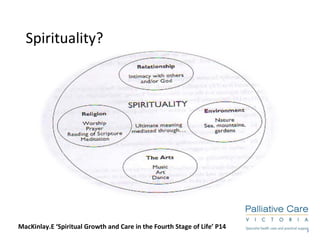
Spirituality? MacKinlay.E ‘Spiritual  Growth  and Care in the Fourth Stage of Life’ P14
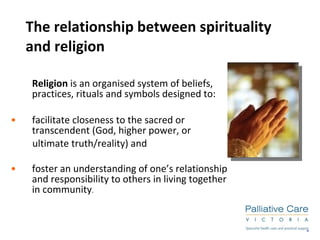
The relationship between spirituality and religion Religion  is an organised system of beliefs, practices, rituals and symbols designed to: facilitate closeness to the sacred or transcendent (God, higher power, or  ultimate truth/reality) and foster an understanding of one’s relationship and responsibility to others in living together in community .
The relationship between spirituality  and religion Spirituality  is defined as:  The personal quest for understanding answers to ultimate questions about life, about meaning, and about relationship to the sacred or transcendent, which may (or may not) lead to or arise from the development of religious rituals and the formation of community. Koenig, McCullough & Larson ‘Handbook of Religion and Health’ 2001 p18
What is spiritual care? Spiritual care that reflects the pastoral tradition: Engages others as fellow human beings: mutual relationship is desired Attends to the way people receive care (not only the ways in which care is delivered) Attends to the possibilities inherent in each situation (not only the problems) Supports and preserves the settings that nurture a person’s spirit. Rumbold, B. ‘Spirituality in the workplace’
What is pastoral care? Reflects the Christian tradition and today involves holistic care, not necessarily by ordained clergy, with the fostering of guidance, healing, support and reconciliation in peoples lives.  Is more than caring for a persons physical needs Pastoral care is spiritual care that reflects the pastoral tradition.
Essence of spirituality V OCATION What is the purpose of my life? COMMUNITY To whom do I belong? H OPE/MEANING What keeps me going? (B.   Rumbold)
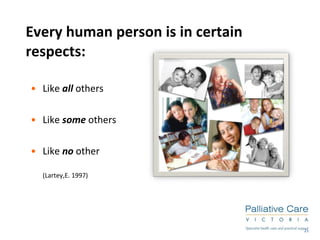
Every human person is in certain respects: Like  all  others Like  some  others Like  no  other (Lartey,E. 1997)
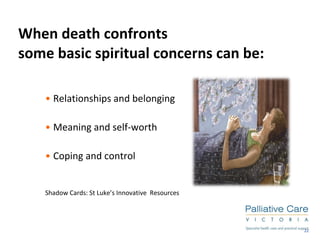
When death confronts some basic spiritual concerns can be: Relationships and belonging Meaning and self-worth Coping and control Shadow Cards: St Luke’s Innovative  Resources
When death confronts relationships and belonging Who are the significant others? Do they offer appropriate support? Has the ill person any unfinished business with them?
When death confronts meaning and self-worth Does the ill person feel valued by the other/s? What does he/she mean to them? What does the illness mean?
When death confronts coping and control Self affirmation and supportive relationships assist the ill person to maintain control over their situation Influenced by spiritual maturity
Spiritual issues in palliative care   People reflect on: Past Present Future
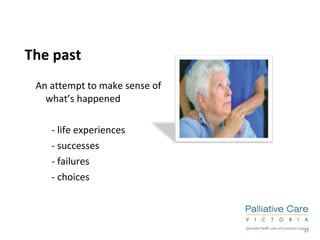
The past An attempt to make sense of what’s happened - life experiences - successes - failures - choices
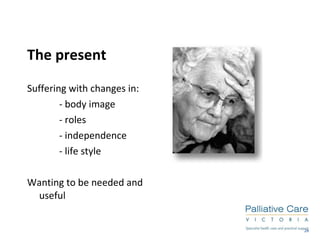
The present Suffering with changes in: - body image - roles - independence - life style  Wanting to be needed and useful
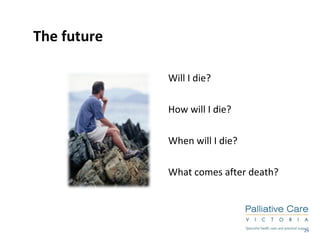
The future Will I die? How will I die? When will I die? What comes after death?
To offer care we need to: Build bridges with conversations Hear a person’s story Build trust Have some relationship
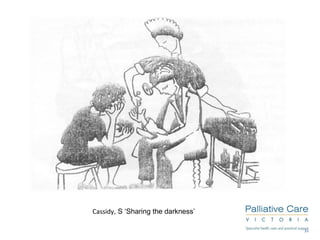
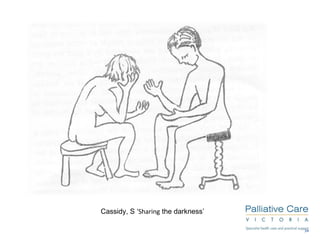
Cassidy , S ‘Sharing the darkness’
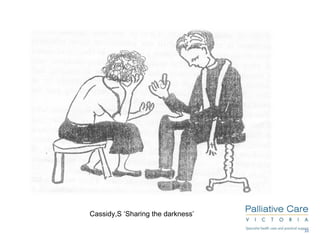
Cassidy,S ‘Sharing the darkness’
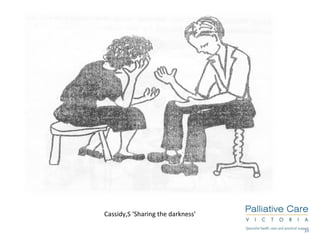
Cassidy, S ‘ Sharing  the darkness’
What do I do when I feel out of my depth? You are not expected to have all the answers! Do not run away or change the subject.  Allow the client to go where they will. Discuss your feelings with the Manager of Volunteers They may need to refer onto a;  - a minister, priest, rabbi etc - a pastoral care worker Their care will compliment your care which continues!
The spiritual dimension is experienced by everyone and includes -  The whole range of the person’s life experiences The context of relationships we exist within with hopes, fears, meanings, beliefs, doubts, expectations ‘ Spiritual care has the potential for  healing /wellbeing  in the face of the infirmities of existence’   (Tanyi R, 2002)
Spiritual care Accepts an individual ‘unconditionally ’ It is ‘ the client’  who defines the area for spiritual care ‘ not’  the caregiver/staff Poses many questions with few answers - can be a threatening aspect of care Is like a dance, the carer allows the client to lead Begins by listening and receiving questions, doubts, fears as presented - allows other (person) to ‘be’

Module 4 Spirituality Slides

  • 1.
    Module 4 SPIRITUALITY This module will assist participants to provide appropriate spiritual care
  • 2.
    Session Content SpiritualityThe relationship between religion and spirituality Exploration of the nature of religious care, spiritual care and pastoral care Explore your own spirituality Explore some basic spiritual concerns that may arise in palliative care Explore appropriate spiritual care
  • 3.
    Spirituality? MacKinlay.E ‘Spiritual Growth and Care in the Fourth Stage of Life’ P14
  • 4.
    The relationship betweenspirituality and religion Religion is an organised system of beliefs, practices, rituals and symbols designed to: facilitate closeness to the sacred or transcendent (God, higher power, or ultimate truth/reality) and foster an understanding of one’s relationship and responsibility to others in living together in community .
  • 5.
    The relationship betweenspirituality and religion Spirituality is defined as: The personal quest for understanding answers to ultimate questions about life, about meaning, and about relationship to the sacred or transcendent, which may (or may not) lead to or arise from the development of religious rituals and the formation of community. Koenig, McCullough & Larson ‘Handbook of Religion and Health’ 2001 p18
  • 6.
    What is spiritualcare? Spiritual care that reflects the pastoral tradition: Engages others as fellow human beings: mutual relationship is desired Attends to the way people receive care (not only the ways in which care is delivered) Attends to the possibilities inherent in each situation (not only the problems) Supports and preserves the settings that nurture a person’s spirit. Rumbold, B. ‘Spirituality in the workplace’
  • 7.
    What is pastoralcare? Reflects the Christian tradition and today involves holistic care, not necessarily by ordained clergy, with the fostering of guidance, healing, support and reconciliation in peoples lives. Is more than caring for a persons physical needs Pastoral care is spiritual care that reflects the pastoral tradition.
  • 20.
    Essence of spiritualityV OCATION What is the purpose of my life? COMMUNITY To whom do I belong? H OPE/MEANING What keeps me going? (B. Rumbold)
  • 21.
    Every human personis in certain respects: Like all others Like some others Like no other (Lartey,E. 1997)
  • 22.
    When death confrontssome basic spiritual concerns can be: Relationships and belonging Meaning and self-worth Coping and control Shadow Cards: St Luke’s Innovative Resources
  • 23.
    When death confrontsrelationships and belonging Who are the significant others? Do they offer appropriate support? Has the ill person any unfinished business with them?
  • 24.
    When death confrontsmeaning and self-worth Does the ill person feel valued by the other/s? What does he/she mean to them? What does the illness mean?
  • 25.
    When death confrontscoping and control Self affirmation and supportive relationships assist the ill person to maintain control over their situation Influenced by spiritual maturity
  • 26.
    Spiritual issues inpalliative care People reflect on: Past Present Future
  • 27.
    The past Anattempt to make sense of what’s happened - life experiences - successes - failures - choices
  • 28.
    The present Sufferingwith changes in: - body image - roles - independence - life style Wanting to be needed and useful
  • 29.
    The future WillI die? How will I die? When will I die? What comes after death?
  • 30.
    To offer carewe need to: Build bridges with conversations Hear a person’s story Build trust Have some relationship
  • 31.
    Cassidy , S‘Sharing the darkness’
  • 32.
  • 33.
  • 34.
    Cassidy, S ‘Sharing the darkness’
  • 35.
    What do Ido when I feel out of my depth? You are not expected to have all the answers! Do not run away or change the subject. Allow the client to go where they will. Discuss your feelings with the Manager of Volunteers They may need to refer onto a; - a minister, priest, rabbi etc - a pastoral care worker Their care will compliment your care which continues!
  • 36.
    The spiritual dimensionis experienced by everyone and includes - The whole range of the person’s life experiences The context of relationships we exist within with hopes, fears, meanings, beliefs, doubts, expectations ‘ Spiritual care has the potential for healing /wellbeing in the face of the infirmities of existence’ (Tanyi R, 2002)
  • 37.
    Spiritual care Acceptsan individual ‘unconditionally ’ It is ‘ the client’ who defines the area for spiritual care ‘ not’ the caregiver/staff Poses many questions with few answers - can be a threatening aspect of care Is like a dance, the carer allows the client to lead Begins by listening and receiving questions, doubts, fears as presented - allows other (person) to ‘be’

Editor's Notes

  • #21 6. Discuss Slide 5 mins What gives me meaning? To be in relationship with family/friends/colleagues/environment/home/church To whom do I belong? In other words where do I find a sense of belonging? What keeps me going? The opportunity for creativity/hospitality/ being valued for who I am (validation as a person)/ self worth. A reason for being/relationships with significant others. Having some control over my life. Some thoughts for presenter To further explore & identify our own spirituality:- b) Spiritual Care Worksheet 2 – Personal Reflection Exercise 25mins 5 – 10 mins Individually reflect & write your answers 10 mins In pairs – discuss what this process was like for you – ie; not necessarily the answers you wrote. 5 min Large group - Did anything emerge? - Similarities/Differences? i.e. A ‘debrief’ * Be aware this may be confronting for some participants who may feel they have little purpose or people they ‘belong’ to. Facilitator may need to explore/facilitate further discussion with these individuals either in the group or individually. BREAK 15 MINS
  • #24 Whole group activity Compare each sheet to each O/H/Slide as a way of discussing the points When confronted with the prospect of death we’re often faced with what it means to be human.
  • #25 Compare O/H/Slide to sheet and discuss in Large Group with examples where appropriate
  • #26 Compare O/H/Slide and sheet and discuss in Large Group the implications for clients & staff re control & coping.
  • #27 b) Spiritual Issues in Palliative Care - people tend to reflect on these 3 - past, present & future
  • #28 Can anyone think of some examples personal or from other people? Partner activity: Share an example with the person next to you
  • #29 Partner activity: Can anyone think of some examples personal or from other people? Share with the person next to you how someone might struggle if their role/lifestyle/image was changed dramatically.
  • #30 8. Whole group discussion Whole group discussion Can anyone think of some examples personal or from other people Discuss How do we respond to these questions? What are some appropriate answers? ( As a volunteer/nurse/PCA) What might the person be really asking you? What is under/behind the question? Re will I die? A question like this may indicate that the person does not understand what palliative care is. How will I die? A question like this may be asking for reassurance/ they may be frightened. When will I die? May indicate wanting to put house in order. What comes after death? No one has the whole truth and can really know. We continue on in the lives of those we love and who have loved us. This bond goes on after death. What might they be really asking? To be present with them in their reality, wanting to talk with someone about death, it’s possible they can’t do this with family because they won’t let them. See scenarios: 1 & 2
  • #31 We need to: build bridges with conversations -low key type questions if meeting for first times hear a person’s story -past, present, future -How it was -How it is -How it might be build trust & relationship -respect their pace/what they want / don’t want to talk about -respect their choices -silence -maintain confidentiality -allow their autonomy
  • #32 Ask what might be happening here?
  • #33 Ask what might be happening here?
  • #34 Ask what might be happening here?
  • #35 See explanatory handout from Shelia Cassidy’s book “Sharing the Darkness”. Read some of this to the group. Or get the group to go into small groups read and discuss.
  • #38 We need to practise being able to sit with not having answers, just questions. Give over the responsibility for fixing/ answering or rescuing. Take our cue from the other person. They will change the subject if they need to. We’re not in charge of their life!