KNOWING YOURSELF
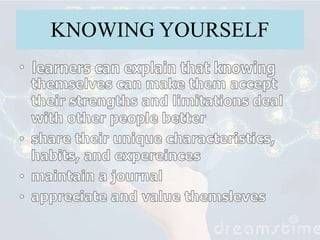
KNOWING YOURSELF
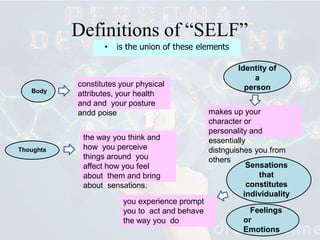
Definitions of “SELF”
• is the union of these elements
Body
Thoughts
Sensations
that
constitutes
individuality
Identity of
a
person
Feelings
or
Emotions
constitutes your physical
attributes, your health
and and your posture
andd poise
the way you think and
how you perceive
things around you
affect how you feel
about them and bring
about sensations.
you experience prompt
you to act and behave
the way you do
makes up your
character or
personality and
essentially
distnguishes you from
others
Focused, Good-
looking, Helping,
Inspiring,
Intelligent,
Leadership,
Learning,
Motivated,
Optimistic, Open-
minded,
Organized,
Outgoing,
Responsible,
Self- Controlled
Determined ,
Confident,
Disciplined,
Educated,
Empathetic,
Emotional
Intelligent,
Energetic,
Entertaining,
Fast, Flexible,
Social, Wisdom,
Warm,
Thoughtful
Action-oriented
Analytical
Authentic
Compassionate
Artistic
Caring
Adventurous
Athletic
Clever
Charming Creative
Curious Precise
Communicative
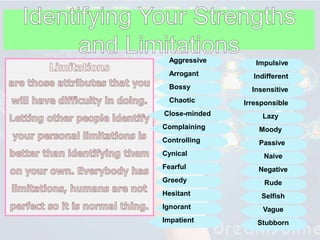
Aggressive
Arrogant
Bossy
Chaotic
Close-minded
Complaining
Controlling
Cynical
Fearful
Greedy
Hesitant
Ignorant
Impatient
Impulsive
Indifferent
Insensitive
Irresponsible
Lazy
Moody
Passive
Naive
Negative
Rude
Selfish
Vague
Stubborn
Nature Nurture
 Heredity • Environment
 Genetic make-up • acquired surrounding
 From the • habits/ routines
developmeny in the • practices of atittudes
womb of a mother • observed behaiviors
It is always a complex combination of
genes, environmental exposure and
experiences, and cultural backgrounds.
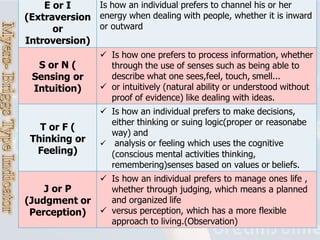
E or I
(Extraversion
or
Introversion)
Is how an individual prefers to channel his or her
energy when dealing with people, whether it is inward
or outward
S or N (
Sensing or
Intuition)
 Is how one prefers to process information, whether
through the use of senses such as being able to
describe what one sees,feel, touch, smell...
 or intuitively (natural ability or understood without
proof of evidence) like dealing with ideas.
T or F (
Thinking or
Feeling)
 Is how an individual prefers to make decisions,
either thinking or suing logic(proper or reasonabe
way) and
 analysis or feeling which uses the cognitive
(conscious mental activities thinking,
remembering)senses based on values or beliefs.
J or P
(Judgment or
Perception)
 Is how an individual prefers to manage ones life ,
whether through judging, which means a planned
and organized life
 versus perception, which has a more flexible
approach to living.(Observation)
Module 2 Knowing Oneself.pptx

Module 2 Knowing Oneself.pptx

  • 1.
  • 2.
  • 3.
    Definitions of “SELF” •is the union of these elements Body Thoughts Sensations that constitutes individuality Identity of a person Feelings or Emotions constitutes your physical attributes, your health and and your posture andd poise the way you think and how you perceive things around you affect how you feel about them and bring about sensations. you experience prompt you to act and behave the way you do makes up your character or personality and essentially distnguishes you from others
  • 9.
    Focused, Good- looking, Helping, Inspiring, Intelligent, Leadership, Learning, Motivated, Optimistic,Open- minded, Organized, Outgoing, Responsible, Self- Controlled Determined , Confident, Disciplined, Educated, Empathetic, Emotional Intelligent, Energetic, Entertaining, Fast, Flexible, Social, Wisdom, Warm, Thoughtful Action-oriented Analytical Authentic Compassionate Artistic Caring Adventurous Athletic Clever Charming Creative Curious Precise Communicative
  • 11.
  • 13.
    Nature Nurture  Heredity• Environment  Genetic make-up • acquired surrounding  From the • habits/ routines developmeny in the • practices of atittudes womb of a mother • observed behaiviors It is always a complex combination of genes, environmental exposure and experiences, and cultural backgrounds.
  • 16.
    E or I (Extraversion or Introversion) Ishow an individual prefers to channel his or her energy when dealing with people, whether it is inward or outward S or N ( Sensing or Intuition)  Is how one prefers to process information, whether through the use of senses such as being able to describe what one sees,feel, touch, smell...  or intuitively (natural ability or understood without proof of evidence) like dealing with ideas. T or F ( Thinking or Feeling)  Is how an individual prefers to make decisions, either thinking or suing logic(proper or reasonabe way) and  analysis or feeling which uses the cognitive (conscious mental activities thinking, remembering)senses based on values or beliefs. J or P (Judgment or Perception)  Is how an individual prefers to manage ones life , whether through judging, which means a planned and organized life  versus perception, which has a more flexible approach to living.(Observation)