Project Management -
Overview
Module:02 Project Management
Overview
PM Knowledge Areas
Project Life cycles
Project Phases
Product Life cycles
Organizational Structures
PM Job Functions
Department of Information Technology - SRIT 2
Project
 What is Project?
 Converting a vision, a dream or a need to reality.
 Planned Activity with finite start and finish.
 Project – Formal Definition
A Project is a temporary endeavor undertaken to accomplish a
unique purpose.
ForEg:
 An Activity / a job that has a beginning and an end (Time)
 A specified outcome(Scope)
 At a stated level of Performance(Quality)
 At a budget(Costs).
Department of Information Technology - SRIT 3
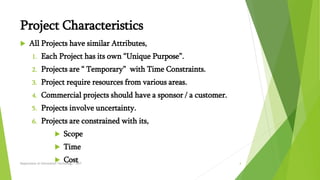
Project Characteristics
 All Projects have similar Attributes,
1. Each Project has its own “Unique Purpose”.
2. Projects are “ Temporary” with Time Constraints.
3. Project require resources from various areas.
4. Commercial projects should have a sponsor / a customer.
5. Projects involve uncertainty.
6. Projects are constrained with its,
 Scope
 Time
 Cost
Department of Information Technology - SRIT 4
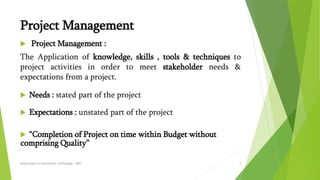
Project Management
 Project Management :
The Application of knowledge, skills , tools & techniques to
project activities in order to meet stakeholder needs &
expectations from a project.
 Needs : stated part of the project
 Expectations : unstated part of the project
 “Completion of Project on time within Budget without
comprising Quality”
Department of Information Technology - SRIT 5
Why do companies use PM?
 To handle projects effectively in an organization.
 To define the project and agree with the customer.
 To plan and assess resource needs for the project.
 To estimate project cost and make proposals.
 To plan & schedule activities in a project.
 To allocate the right resource at the right time.
 To assess risk and failure points and make backup plans.
 To lead a project team effectively and communicate well.
Department of Information Technology - SRIT 6
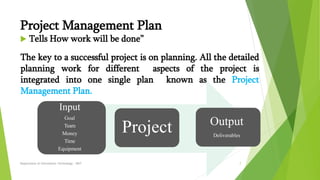
Project Management Plan
 Tells How work will be done”
The key to a successful project is on planning. All the detailed
planning work for different aspects of the project is
integrated into one single plan known as the Project
Management Plan.
Project
Input
Goal
Team
Money
Time
Equipment
Output
Deliverables
Department of Information Technology - SRIT 7
Project Management Process
Department of Information Technology - SRIT 8
Project Management Process Groups
Department of Information Technology - SRIT 9
PM Knowledge Areas
PM Knowledge
Areas
Cost
Change
Document
Integration
1
Scope
2
Time 3
4
Quality
5
Risk
8
Human
Resource
Communi
Cation
7
Procure
ment
9
6
Department of Information Technology - SRIT 10
Project Life Cycle & Project Phases
 A project life cycle is the sequence of phases that a project goes
through from its initiation to its closure.
 Which vary with the project or industry. Some general phases
like Concept, Development, Implementation, and Support.
 Project Phases
 The Initiation Phase: Starting of the project
 The Planning Phase: Organizing and Preparing
 The Execution Phase: Carrying out the project
 The Termination Phase: Closing the project
Department of Information Technology - SRIT 11
Project Life Cycle
Department of Information Technology - SRIT 12
Product Life Cycle
 The product life cycle has 4 stages, each with its own
characteristics,
 Introduction Stage – This stage of the cycle could be the most
expensive for a company launching a new product.
 Growth Stage – The growth stage is typically characterized by a
strong growth in sales and profits.
 Maturity Stage – During the maturity stage, the product is
established.
 Decline Stage – Eventually, the market for a product will start to
shrink, and this is what’s known as the decline stage.
Department of Information Technology - SRIT 13
Product Life Cycle - Example
 Introduction – 3D TVs
 Growth – Blueray discs/DVR
 Maturity – DVD
 Decline – Video cassette
Department of Information Technology - SRIT 14
Product Life Cycle - for software products
 Typical SDLC framework is followed in Software Product.
 SDLC Phases include Planning, analysis, design, implementation
and support.
 There are several SDLC models such as,
 Water fall model – well defined, linear stages of system
development and support.
 Spiral Model – products are developed using iterative approach
rather than linear approach.
Department of Information Technology - SRIT 15
Organizational Structures
 What is Organizational Structures ?
How job tasks are formally divided, grouped, and
coordinated.
Key Elements:
• Work specialization
• Departmentalization
• Chain of command
• Span of control
• Centralization and
decentralization
• Formalization
Department of Information Technology - SRIT 16
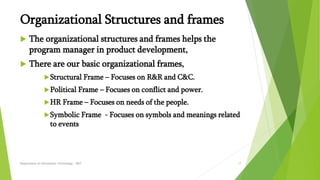
Organizational Structures and frames
 The organizational structures and frames helps the
program manager in product development,
 There are our basic organizational frames,
Structural Frame – Focuses on R&R and C&C.
Political Frame – Focuses on conflict and power.
HR Frame – Focuses on needs of the people.
Symbolic Frame - Focuses on symbols and meanings related
to events
Department of Information Technology - SRIT 17
Influences of Organizational Structures on Projects
Department of Information Technology - SRIT 18
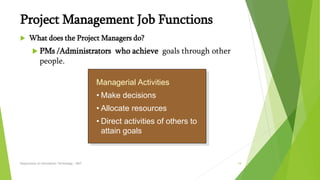
Project Management Job Functions
 What does the Project Managers do?
 PMs /Administrators who achieve goals through other
people.
Managerial Activities
• Make decisions
• Allocate resources
• Direct activities of others to
attain goals
Department of Information Technology - SRIT 19
Project Management Job Functions
 It is strongly suggested by the author that the PMs must develop
the following skills,
 Communication Skills – Listening and Persuading
 Organizational Skills – Planning , Goal Setting and Analyzing
 Team Building Skills – People Skills, Motivation and empathy etc…
 Leadership Skills – Sets Example, Energetic, Visionary etc…
 Coping Skills – Flexibility, Creativity , Patience, and Persistence
 Technological Skills – Expertise in technologies, project and
Experience
Department of Information Technology - SRIT 20
Department of Information Technology - SRIT 21

Module 2 - IDP.pptx

  • 1.
  • 2.
    Module:02 Project Management Overview PMKnowledge Areas Project Life cycles Project Phases Product Life cycles Organizational Structures PM Job Functions Department of Information Technology - SRIT 2
  • 3.
    Project  What isProject?  Converting a vision, a dream or a need to reality.  Planned Activity with finite start and finish.  Project – Formal Definition A Project is a temporary endeavor undertaken to accomplish a unique purpose. ForEg:  An Activity / a job that has a beginning and an end (Time)  A specified outcome(Scope)  At a stated level of Performance(Quality)  At a budget(Costs). Department of Information Technology - SRIT 3
  • 4.
    Project Characteristics  AllProjects have similar Attributes, 1. Each Project has its own “Unique Purpose”. 2. Projects are “ Temporary” with Time Constraints. 3. Project require resources from various areas. 4. Commercial projects should have a sponsor / a customer. 5. Projects involve uncertainty. 6. Projects are constrained with its,  Scope  Time  Cost Department of Information Technology - SRIT 4
  • 5.
    Project Management  ProjectManagement : The Application of knowledge, skills , tools & techniques to project activities in order to meet stakeholder needs & expectations from a project.  Needs : stated part of the project  Expectations : unstated part of the project  “Completion of Project on time within Budget without comprising Quality” Department of Information Technology - SRIT 5
  • 6.
    Why do companiesuse PM?  To handle projects effectively in an organization.  To define the project and agree with the customer.  To plan and assess resource needs for the project.  To estimate project cost and make proposals.  To plan & schedule activities in a project.  To allocate the right resource at the right time.  To assess risk and failure points and make backup plans.  To lead a project team effectively and communicate well. Department of Information Technology - SRIT 6
  • 7.
    Project Management Plan Tells How work will be done” The key to a successful project is on planning. All the detailed planning work for different aspects of the project is integrated into one single plan known as the Project Management Plan. Project Input Goal Team Money Time Equipment Output Deliverables Department of Information Technology - SRIT 7
  • 8.
    Project Management Process Departmentof Information Technology - SRIT 8
  • 9.
    Project Management ProcessGroups Department of Information Technology - SRIT 9
  • 10.
    PM Knowledge Areas PMKnowledge Areas Cost Change Document Integration 1 Scope 2 Time 3 4 Quality 5 Risk 8 Human Resource Communi Cation 7 Procure ment 9 6 Department of Information Technology - SRIT 10
  • 11.
    Project Life Cycle& Project Phases  A project life cycle is the sequence of phases that a project goes through from its initiation to its closure.  Which vary with the project or industry. Some general phases like Concept, Development, Implementation, and Support.  Project Phases  The Initiation Phase: Starting of the project  The Planning Phase: Organizing and Preparing  The Execution Phase: Carrying out the project  The Termination Phase: Closing the project Department of Information Technology - SRIT 11
  • 12.
    Project Life Cycle Departmentof Information Technology - SRIT 12
  • 13.
    Product Life Cycle The product life cycle has 4 stages, each with its own characteristics,  Introduction Stage – This stage of the cycle could be the most expensive for a company launching a new product.  Growth Stage – The growth stage is typically characterized by a strong growth in sales and profits.  Maturity Stage – During the maturity stage, the product is established.  Decline Stage – Eventually, the market for a product will start to shrink, and this is what’s known as the decline stage. Department of Information Technology - SRIT 13
  • 14.
    Product Life Cycle- Example  Introduction – 3D TVs  Growth – Blueray discs/DVR  Maturity – DVD  Decline – Video cassette Department of Information Technology - SRIT 14
  • 15.
    Product Life Cycle- for software products  Typical SDLC framework is followed in Software Product.  SDLC Phases include Planning, analysis, design, implementation and support.  There are several SDLC models such as,  Water fall model – well defined, linear stages of system development and support.  Spiral Model – products are developed using iterative approach rather than linear approach. Department of Information Technology - SRIT 15
  • 16.
    Organizational Structures  Whatis Organizational Structures ? How job tasks are formally divided, grouped, and coordinated. Key Elements: • Work specialization • Departmentalization • Chain of command • Span of control • Centralization and decentralization • Formalization Department of Information Technology - SRIT 16
  • 17.
    Organizational Structures andframes  The organizational structures and frames helps the program manager in product development,  There are our basic organizational frames, Structural Frame – Focuses on R&R and C&C. Political Frame – Focuses on conflict and power. HR Frame – Focuses on needs of the people. Symbolic Frame - Focuses on symbols and meanings related to events Department of Information Technology - SRIT 17
  • 18.
    Influences of OrganizationalStructures on Projects Department of Information Technology - SRIT 18
  • 19.
    Project Management JobFunctions  What does the Project Managers do?  PMs /Administrators who achieve goals through other people. Managerial Activities • Make decisions • Allocate resources • Direct activities of others to attain goals Department of Information Technology - SRIT 19
  • 20.
    Project Management JobFunctions  It is strongly suggested by the author that the PMs must develop the following skills,  Communication Skills – Listening and Persuading  Organizational Skills – Planning , Goal Setting and Analyzing  Team Building Skills – People Skills, Motivation and empathy etc…  Leadership Skills – Sets Example, Energetic, Visionary etc…  Coping Skills – Flexibility, Creativity , Patience, and Persistence  Technological Skills – Expertise in technologies, project and Experience Department of Information Technology - SRIT 20
  • 21.
    Department of InformationTechnology - SRIT 21