Suspension
System
What is suspension system?
• Suspension is the system of tires, tire air, springs,
shock absorbers and linkages that connects a
vehicle to its wheels and allows relative motion
between the two.
• It Protects the vehicle itself and any cargo or
luggage from damage and wear.
Function of suspension system?
• Supports the weight.
• Provides a smooth ride.
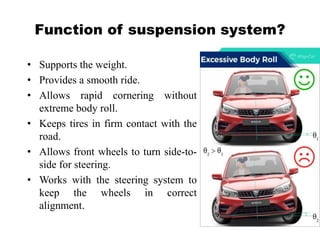
• Allows rapid cornering without
extreme body roll.
• Keeps tires in firm contact with the
road.
• Allows front wheels to turn side-to-
side for steering.
• Works with the steering system to
keep the wheels in correct
alignment.
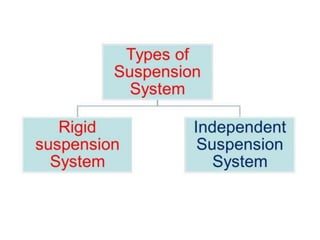
Type of Suspension System
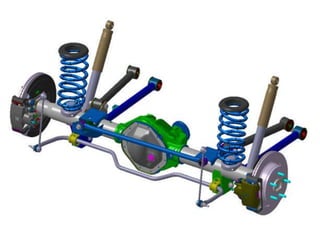
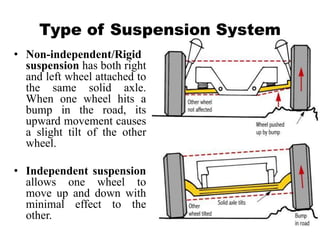
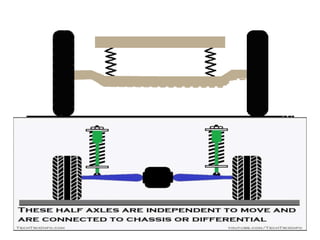
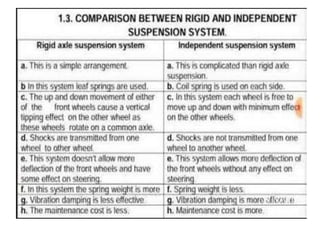
• Non-independent/Rigid
suspension has both right
and left wheel attached to
the same solid axle.
When one wheel hits a
bump in the road, its
upward movement causes
a slight tilt of the other
wheel.
• Independent suspension
allows one wheel to
move up and down with
minimal effect to the
other.
Type of Suspension System
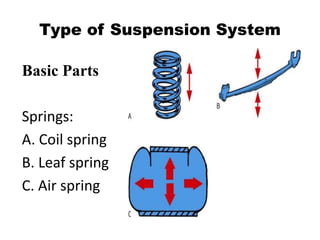
Basic Parts
Springs:
A. Coil spring
B. Leaf spring
C. Air spring
Type of Suspension System
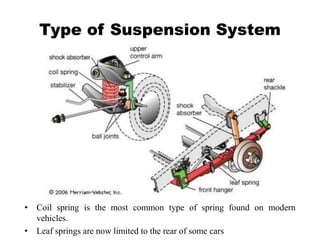
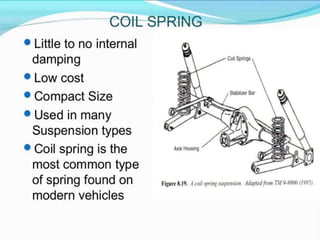
• Coil spring is the most common type of spring found on modern
vehicles.
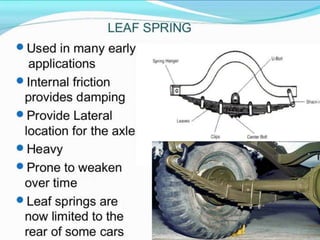
• Leaf springs are now limited to the rear of some cars
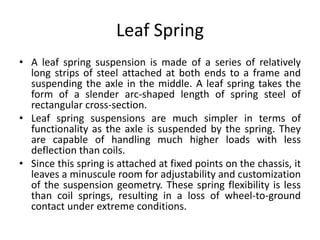
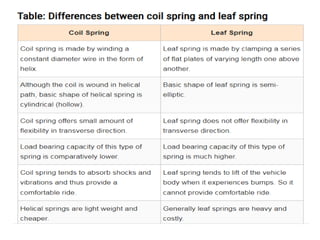
Leaf Spring
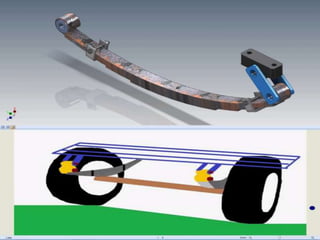
• A leaf spring suspension is made of a series of relatively
long strips of steel attached at both ends to a frame and
suspending the axle in the middle. A leaf spring takes the
form of a slender arc-shaped length of spring steel of
rectangular cross-section.
• Leaf spring suspensions are much simpler in terms of
functionality as the axle is suspended by the spring. They
are capable of handling much higher loads with less
deflection than coils.
• Since this spring is attached at fixed points on the chassis, it
leaves a minuscule room for adjustability and customization
of the suspension geometry. These spring flexibility is less
than coil springs, resulting in a loss of wheel-to-ground
contact under extreme conditions.
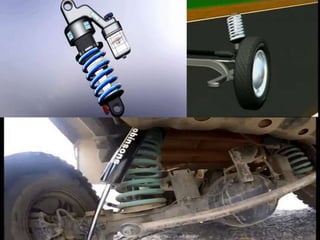
Coil Spring
• A coil by definition is a mechanical device which is
typically used to store energy and subsequently release
it, to absorb shock, or to maintain a force between
contacting surfaces.
• Coil spring suspensions offer more range of suspension
movement, and allow the user a wider tuning envelope
through the suspension range than leaf springs.
Practically all high performance applications use coil
springs where possible and if the budget permits.
• Coils are not ordinarily preferred for very heavy
vehicles, as the coil on axle setup isn’t so stable or
strong as a proper leaf spring.
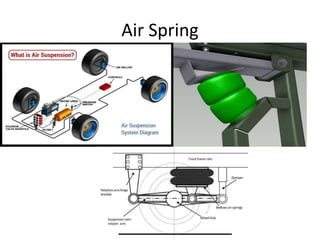
Air Spring
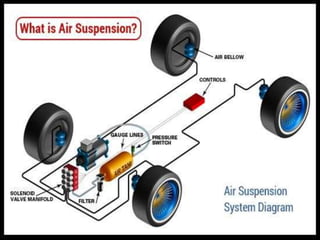
Air suspension
• An air suspension system is a suspension system in which an
air spring or airbag is used instead of a metal spring (coil or
leaf) to support the vehicle on the axles with an organization
of the airbags.
• Air suspension is a type of vehicle suspension powered by an
compressor.
• This compressor pumps the air into a flexible bellows, usually
made from textile-reinforced rubber. The air pressure inflates
the bellows, and raises the chassis from the axle.
• Air suspension is used in place of conventional steel springs in
heavy vehicle applications such as buses and trucks, and in
some passenger cars. It is widely used on semi
trailers and trains .
Air suspension
• Comprises of compressor , supplying air to air tank
• Pressure maintained – 5.6 to 7 kg/sq.m
• Air bags – on each wheel
• As load applied , air bags compressed actuating the
leveling valve .
• Air from the tank fills the compressed air bag &
hence raise the level of the frame.
• Air from air bag gets released as load on chassis
decreases .
Construction of Air Suspension
• The Air suspension system consists of three basic components
namely the air compressor, air accumulator, supply line, airbag,
the height control valve, and solenoid (in electrical systems).
1. Air compressor:
• The Air compressor is the primary component of the air supply
system in the suspension. It works by drawing the atmospheric air
into the pump and compressing it to a pressure of about 240 MPa
through a filter.
• It is generally mounted on the vehicle’s frame or in the trunk. The
drier in the compressor uses a substance known as a desiccant to
absorb the moisture from the air before the air is sent into the
system.
• The compressor can be activated either manually or automatically
and can be controlled by the driver itself or automatically in an
electronic system or a combination of both.
Construction of Air Suspension
2. Air accumulator:
• Some advanced compressors need a storage medium to store
the high-pressure air produced. These storing mediums are
called air accumulators. A safety relief valve is also attached to
the accumulator to release the excess air.
3. Supply line:
• Supply lines are used to carry the compressed air to the
airbags. These are mostly made up of rubber or polyurethane
composition but they can also be replaced by custom steel
lines.
Construction of Air Suspension
4. Airbag:
• Airbags are simple rubber that holds the air. It is also referred to as
air bellows.
• Airbags use the compressive abilities of air and rubber to absorb
vibrations and raise or lower the vehicle. The compressed air is
pushed into the airbags to inflate it and increase the height of the
suspension. These are located in the middle of the frame of the
vehicle and the vehicle axles.
• Airbags allow to lift and level up a vehicle when it is towing or
carrying uneven loads. It is adjustable according to the load which
allows compensating for the inconsistent load.
• The modern airbags are manufactured using the same method as
that of tires by using high-strength cords which are encapsulated in
rubber.
Construction of Air Suspension
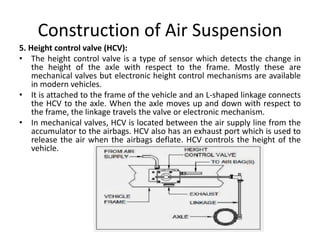
5. Height control valve (HCV):
• The height control valve is a type of sensor which detects the change in
the height of the axle with respect to the frame. Mostly these are
mechanical valves but electronic height control mechanisms are available
in modern vehicles.
• It is attached to the frame of the vehicle and an L-shaped linkage connects
the HCV to the axle. When the axle moves up and down with respect to
the frame, the linkage travels the valve or electronic mechanism.
• In mechanical valves, HCV is located between the air supply line from the
accumulator to the airbags. HCV also has an exhaust port which is used to
release the air when the airbags deflate. HCV controls the height of the
vehicle.
Construction of Air Suspension
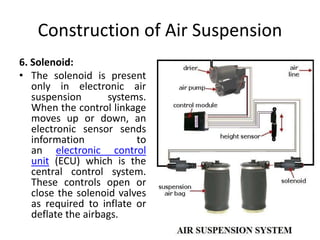
6. Solenoid:
• The solenoid is present
only in electronic air
suspension systems.
When the control linkage
moves up or down, an
electronic sensor sends
information to
an electronic control
unit (ECU) which is the
central control system.
These controls open or
close the solenoid valves
as required to inflate or
deflate the airbags.
How does Air suspension system works or Working?
The air suspension system working principle is simple
and automated. It consists of airbags, compressor or
tank and height sensors.
The airbags are connected with a pressure tank that
continuously supplies air to the bags. The height
sensors connected with the car computer regularly
monitor the ride height.
When the height is reduced due to additional weight
sensors activated and the air is supplied from the
compressor to the airbags increasing the height.
Similarly, height can be reduced by releasing air from
the airbags.
Classification of Air suspension system
• Based on the design of the air springs:
• Bellow type air suspension system
• Piston type air suspension system
• Elongated bellows type air suspension system
• Based on the working:
• Full air suspension system
• Semi air suspension system
Classification of Air suspension system
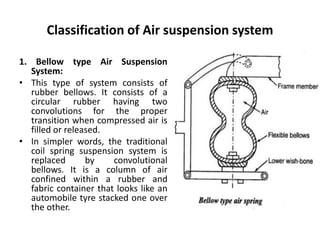
1. Bellow type Air Suspension
System:
• This type of system consists of
rubber bellows. It consists of a
circular rubber having two
convolutions for the proper
transition when compressed air is
filled or released.
• In simpler words, the traditional
coil spring suspension system is
replaced by convolutional
bellows. It is a column of air
confined within a rubber and
fabric container that looks like an
automobile tyre stacked one over
the other.
Classification of Air suspension system
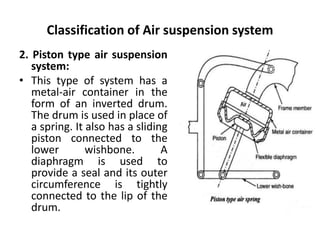
2. Piston type air suspension
system:
• This type of system has a
metal-air container in the
form of an inverted drum.
The drum is used in place of
a spring. It also has a sliding
piston connected to the
lower wishbone. A
diaphragm is used to
provide a seal and its outer
circumference is tightly
connected to the lip of the
drum.
Classification of Air suspension system
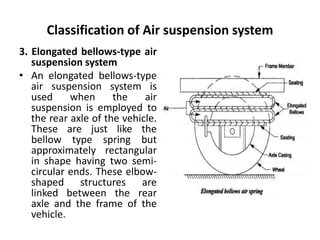
3. Elongated bellows-type air
suspension system
• An elongated bellows-type
air suspension system is
used when the air
suspension is employed to
the rear axle of the vehicle.
These are just like the
bellow type spring but
approximately rectangular
in shape having two semi-
circular ends. These elbow-
shaped structures are
linked between the rear
axle and the frame of the
vehicle.
Classification of Air suspension system
4. Full air suspension system:
• The full air suspension system implies a fully automatic or
adjustable suspension system. This system includes replacing the
conventional suspension system on both axles with a full air
suspension system.
• These filter out the minor unevenness on the road surfaces and
thereby increase ride comfort. The components in this system
include the compressor, accumulator, airbags, height sensor, supply
lines, and the electronic control unit (ECU).
5. Semi air suspension system:
• The semi-air suspension system implies supporting the existing
conventional suspension system with the use of air springs. This
system is often used on vehicles that regularly carry heavy loads.
Advantages of air suspension
• These maintain a constant frequency of vibration whether the
vehicle is laden or un laden.
• Constant frame height is maintained.
• It gives smooth and comfort ride of the vehicle.
• The stiffness of the system increases with the increase of the
deflection.
Type of Suspension System
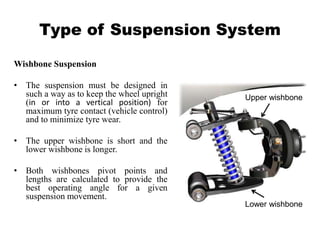
Wishbone Suspension
• The suspension must be designed in
such a way as to keep the wheel upright
(in or into a vertical position) for
maximum tyre contact (vehicle control)
and to minimize tyre wear.
• The upper wishbone is short and the
lower wishbone is longer.
• Both wishbones pivot points and
lengths are calculated to provide the
best operating angle for a given
suspension movement.
Upper wishbone
Lower wishbone
Double Wishbone Struts
• Double wishbone suspension allows each wheel to act and
react independently from the others. It achieves with the help
of two wishbone-shaped arms (also known as control arms or
double A-arms) that are located between the knuckle on the
wheel assembly and the car’s chassis.
• The upper and lower control arms have ball joints on both
ends to allow movement in multiple directions. Vertical
movement is controlled through the shock absorber and coil
spring which are mounted on the wishbones.
• By carefully adjusting the relationship between the upper and
lower control arms’ lengths and relative angles, we can
modify the car’s ride and handling. This includes controlling
the wheel’s motions, via parameters like camber angle, caster
angle, toe pattern, roll centre height, scrub radius and scuff.
Advantages & Disadvantages of
Wishbone type independent suspension
Advantages
• Ride quality is good.
• Improve the steering preciseness since the wheel movement are not
link.
• Ground clearance increase.
Disadvantages
• Initial cost is more
• Maintenance cost is more.
• Required frequent wheel alignment otherwise increase tyre wear.
Applications:-SUV
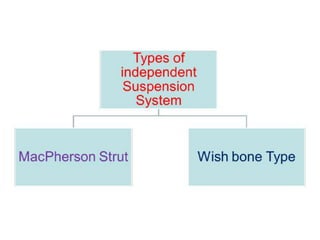
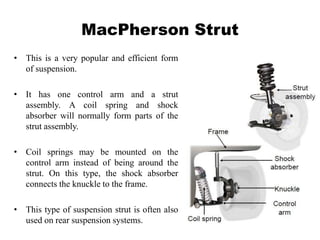
MacPherson Strut
• This is a very popular and efficient form
of suspension.
• It has one control arm and a strut
assembly. A coil spring and shock
absorber will normally form parts of the
strut assembly.
• Coil springs may be mounted on the
control arm instead of being around the
strut. On this type, the shock absorber
connects the knuckle to the frame.
• This type of suspension strut is often also
used on rear suspension systems.
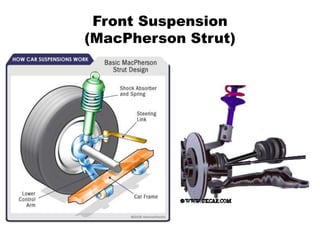
Front Suspension
(MacPherson Strut)
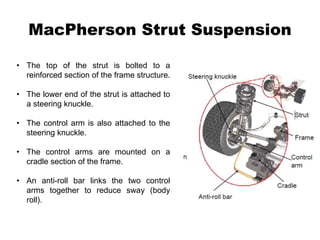
MacPherson Strut Suspension
• The top of the strut is bolted to a
reinforced section of the frame structure.
• The lower end of the strut is attached to
a steering knuckle.
• The control arm is also attached to the
steering knuckle.
• The control arms are mounted on a
cradle section of the frame.
• An anti-roll bar links the two control
arms together to reduce sway (body
roll).
Advantages & Disadvantages of
Macpherson strut suspension
Advantages
• Light in weight.
• Camber does not change due to up & movement of wheels
• Maximum Engine compartment available.
• Maintenance cost is less.
• Initial cost is less.
• Ride comfort is more.
• Improve road safety.
Disadvantages
• Not suitable for Heavy motor vehicle.
• Load caring capacity is less.

Module 2 - BMEE 0003 Lecture 13 - Suspension System.pptx

  • 1.
  • 2.
    What is suspensionsystem? • Suspension is the system of tires, tire air, springs, shock absorbers and linkages that connects a vehicle to its wheels and allows relative motion between the two. • It Protects the vehicle itself and any cargo or luggage from damage and wear.
  • 3.
    Function of suspensionsystem? • Supports the weight. • Provides a smooth ride. • Allows rapid cornering without extreme body roll. • Keeps tires in firm contact with the road. • Allows front wheels to turn side-to- side for steering. • Works with the steering system to keep the wheels in correct alignment.
  • 8.
    Type of SuspensionSystem • Non-independent/Rigid suspension has both right and left wheel attached to the same solid axle. When one wheel hits a bump in the road, its upward movement causes a slight tilt of the other wheel. • Independent suspension allows one wheel to move up and down with minimal effect to the other.
  • 11.
    Type of SuspensionSystem Basic Parts Springs: A. Coil spring B. Leaf spring C. Air spring
  • 12.
    Type of SuspensionSystem • Coil spring is the most common type of spring found on modern vehicles. • Leaf springs are now limited to the rear of some cars
  • 13.
    Leaf Spring • Aleaf spring suspension is made of a series of relatively long strips of steel attached at both ends to a frame and suspending the axle in the middle. A leaf spring takes the form of a slender arc-shaped length of spring steel of rectangular cross-section. • Leaf spring suspensions are much simpler in terms of functionality as the axle is suspended by the spring. They are capable of handling much higher loads with less deflection than coils. • Since this spring is attached at fixed points on the chassis, it leaves a minuscule room for adjustability and customization of the suspension geometry. These spring flexibility is less than coil springs, resulting in a loss of wheel-to-ground contact under extreme conditions.
  • 16.
    Coil Spring • Acoil by definition is a mechanical device which is typically used to store energy and subsequently release it, to absorb shock, or to maintain a force between contacting surfaces. • Coil spring suspensions offer more range of suspension movement, and allow the user a wider tuning envelope through the suspension range than leaf springs. Practically all high performance applications use coil springs where possible and if the budget permits. • Coils are not ordinarily preferred for very heavy vehicles, as the coil on axle setup isn’t so stable or strong as a proper leaf spring.
  • 20.
  • 21.
    Air suspension • Anair suspension system is a suspension system in which an air spring or airbag is used instead of a metal spring (coil or leaf) to support the vehicle on the axles with an organization of the airbags. • Air suspension is a type of vehicle suspension powered by an compressor. • This compressor pumps the air into a flexible bellows, usually made from textile-reinforced rubber. The air pressure inflates the bellows, and raises the chassis from the axle. • Air suspension is used in place of conventional steel springs in heavy vehicle applications such as buses and trucks, and in some passenger cars. It is widely used on semi trailers and trains .
  • 22.
    Air suspension • Comprisesof compressor , supplying air to air tank • Pressure maintained – 5.6 to 7 kg/sq.m • Air bags – on each wheel • As load applied , air bags compressed actuating the leveling valve . • Air from the tank fills the compressed air bag & hence raise the level of the frame. • Air from air bag gets released as load on chassis decreases .
  • 24.
    Construction of AirSuspension • The Air suspension system consists of three basic components namely the air compressor, air accumulator, supply line, airbag, the height control valve, and solenoid (in electrical systems). 1. Air compressor: • The Air compressor is the primary component of the air supply system in the suspension. It works by drawing the atmospheric air into the pump and compressing it to a pressure of about 240 MPa through a filter. • It is generally mounted on the vehicle’s frame or in the trunk. The drier in the compressor uses a substance known as a desiccant to absorb the moisture from the air before the air is sent into the system. • The compressor can be activated either manually or automatically and can be controlled by the driver itself or automatically in an electronic system or a combination of both.
  • 25.
    Construction of AirSuspension 2. Air accumulator: • Some advanced compressors need a storage medium to store the high-pressure air produced. These storing mediums are called air accumulators. A safety relief valve is also attached to the accumulator to release the excess air. 3. Supply line: • Supply lines are used to carry the compressed air to the airbags. These are mostly made up of rubber or polyurethane composition but they can also be replaced by custom steel lines.
  • 26.
    Construction of AirSuspension 4. Airbag: • Airbags are simple rubber that holds the air. It is also referred to as air bellows. • Airbags use the compressive abilities of air and rubber to absorb vibrations and raise or lower the vehicle. The compressed air is pushed into the airbags to inflate it and increase the height of the suspension. These are located in the middle of the frame of the vehicle and the vehicle axles. • Airbags allow to lift and level up a vehicle when it is towing or carrying uneven loads. It is adjustable according to the load which allows compensating for the inconsistent load. • The modern airbags are manufactured using the same method as that of tires by using high-strength cords which are encapsulated in rubber.
  • 27.
    Construction of AirSuspension 5. Height control valve (HCV): • The height control valve is a type of sensor which detects the change in the height of the axle with respect to the frame. Mostly these are mechanical valves but electronic height control mechanisms are available in modern vehicles. • It is attached to the frame of the vehicle and an L-shaped linkage connects the HCV to the axle. When the axle moves up and down with respect to the frame, the linkage travels the valve or electronic mechanism. • In mechanical valves, HCV is located between the air supply line from the accumulator to the airbags. HCV also has an exhaust port which is used to release the air when the airbags deflate. HCV controls the height of the vehicle.
  • 28.
    Construction of AirSuspension 6. Solenoid: • The solenoid is present only in electronic air suspension systems. When the control linkage moves up or down, an electronic sensor sends information to an electronic control unit (ECU) which is the central control system. These controls open or close the solenoid valves as required to inflate or deflate the airbags.
  • 29.
    How does Airsuspension system works or Working? The air suspension system working principle is simple and automated. It consists of airbags, compressor or tank and height sensors. The airbags are connected with a pressure tank that continuously supplies air to the bags. The height sensors connected with the car computer regularly monitor the ride height. When the height is reduced due to additional weight sensors activated and the air is supplied from the compressor to the airbags increasing the height. Similarly, height can be reduced by releasing air from the airbags.
  • 30.
    Classification of Airsuspension system • Based on the design of the air springs: • Bellow type air suspension system • Piston type air suspension system • Elongated bellows type air suspension system • Based on the working: • Full air suspension system • Semi air suspension system
  • 31.
    Classification of Airsuspension system 1. Bellow type Air Suspension System: • This type of system consists of rubber bellows. It consists of a circular rubber having two convolutions for the proper transition when compressed air is filled or released. • In simpler words, the traditional coil spring suspension system is replaced by convolutional bellows. It is a column of air confined within a rubber and fabric container that looks like an automobile tyre stacked one over the other.
  • 32.
    Classification of Airsuspension system 2. Piston type air suspension system: • This type of system has a metal-air container in the form of an inverted drum. The drum is used in place of a spring. It also has a sliding piston connected to the lower wishbone. A diaphragm is used to provide a seal and its outer circumference is tightly connected to the lip of the drum.
  • 33.
    Classification of Airsuspension system 3. Elongated bellows-type air suspension system • An elongated bellows-type air suspension system is used when the air suspension is employed to the rear axle of the vehicle. These are just like the bellow type spring but approximately rectangular in shape having two semi- circular ends. These elbow- shaped structures are linked between the rear axle and the frame of the vehicle.
  • 34.
    Classification of Airsuspension system 4. Full air suspension system: • The full air suspension system implies a fully automatic or adjustable suspension system. This system includes replacing the conventional suspension system on both axles with a full air suspension system. • These filter out the minor unevenness on the road surfaces and thereby increase ride comfort. The components in this system include the compressor, accumulator, airbags, height sensor, supply lines, and the electronic control unit (ECU). 5. Semi air suspension system: • The semi-air suspension system implies supporting the existing conventional suspension system with the use of air springs. This system is often used on vehicles that regularly carry heavy loads.
  • 35.
    Advantages of airsuspension • These maintain a constant frequency of vibration whether the vehicle is laden or un laden. • Constant frame height is maintained. • It gives smooth and comfort ride of the vehicle. • The stiffness of the system increases with the increase of the deflection.
  • 37.
    Type of SuspensionSystem Wishbone Suspension • The suspension must be designed in such a way as to keep the wheel upright (in or into a vertical position) for maximum tyre contact (vehicle control) and to minimize tyre wear. • The upper wishbone is short and the lower wishbone is longer. • Both wishbones pivot points and lengths are calculated to provide the best operating angle for a given suspension movement. Upper wishbone Lower wishbone
  • 38.
  • 39.
    Double Wishbone Struts •Double wishbone suspension allows each wheel to act and react independently from the others. It achieves with the help of two wishbone-shaped arms (also known as control arms or double A-arms) that are located between the knuckle on the wheel assembly and the car’s chassis. • The upper and lower control arms have ball joints on both ends to allow movement in multiple directions. Vertical movement is controlled through the shock absorber and coil spring which are mounted on the wishbones. • By carefully adjusting the relationship between the upper and lower control arms’ lengths and relative angles, we can modify the car’s ride and handling. This includes controlling the wheel’s motions, via parameters like camber angle, caster angle, toe pattern, roll centre height, scrub radius and scuff.
  • 40.
    Advantages & Disadvantagesof Wishbone type independent suspension Advantages • Ride quality is good. • Improve the steering preciseness since the wheel movement are not link. • Ground clearance increase. Disadvantages • Initial cost is more • Maintenance cost is more. • Required frequent wheel alignment otherwise increase tyre wear. Applications:-SUV
  • 41.
    MacPherson Strut • Thisis a very popular and efficient form of suspension. • It has one control arm and a strut assembly. A coil spring and shock absorber will normally form parts of the strut assembly. • Coil springs may be mounted on the control arm instead of being around the strut. On this type, the shock absorber connects the knuckle to the frame. • This type of suspension strut is often also used on rear suspension systems.
  • 42.
  • 44.
    MacPherson Strut Suspension •The top of the strut is bolted to a reinforced section of the frame structure. • The lower end of the strut is attached to a steering knuckle. • The control arm is also attached to the steering knuckle. • The control arms are mounted on a cradle section of the frame. • An anti-roll bar links the two control arms together to reduce sway (body roll).
  • 45.
    Advantages & Disadvantagesof Macpherson strut suspension Advantages • Light in weight. • Camber does not change due to up & movement of wheels • Maximum Engine compartment available. • Maintenance cost is less. • Initial cost is less. • Ride comfort is more. • Improve road safety. Disadvantages • Not suitable for Heavy motor vehicle. • Load caring capacity is less.