Rolesand
Functionsof
SocialWork
OBJECTIVES:
At the end of this lesson, you are expected:
to explain the roles and functions of social
workers.
describe the main focus of each role and
identify the main function associated with the
role.
ADVOCATE
A person who advances the
interest and welfare of a
particular sector through
speech, press or social action
for the purpose of meaningful
change, human security,
public safety and protection
from abuse or violence.
BROKER
 A person who assists
in locating for
resources or services
and in negotiating for
its acquisition or
accessibility and use
in favour of a client.
CASEMANAGER
•person who handles and
manages all information
and processes relating to a
specific issue, problem or
circumstance, that is
inimical to a person under
his/her care, guardianship,
custody or assignment.
CHANGEAGENT
•person who initiates specific
measure to transform or help
individuals, groups and communities
to become socially functional and be
an active participants in achieving
self-worth or societal change.
COUNSELOR
•person who provides guidance
and intervention to an individual
or group particularly in dealing
and managing an issue or a
problem or difficulty, that
includes helping them to look for
possible answers or solutions that
will alleviate suffering.
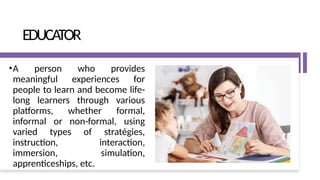
EDUCATOR
•A person who provides
meaningful experiences for
people to learn and become life-
long learners through various
platforms, whether formal,
informal or non-formal, using
varied types of stratégies,
instruction, interaction,
immersion, simulation,
apprenticeships, etc.
ENABLER
•A person who empowers
another by capacitating
him/her with the
necessary knowledge,
skills and values
necessary for his/her
transformation, recovery,
growth or development.
FACILITATOR
 Person who coordinates, leads or
directs a particular group to work for
specific task in the pursuit of
achieving productive results for the
attainment of group or organization’s
work goal.
MEDIATOR
 A person who assists in
settling issues, dispute,
disagreements or mere
problems, between
individuals or groups for the
purpose of reconciliation,
remediation, or settlement.
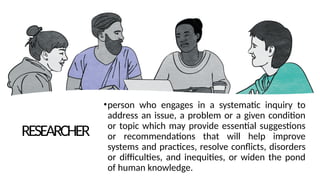
RESEARCHER
•person who engages in a systematic inquiry to
address an issue, a problem or a given condition
or topic which may provide essential suggestions
or recommendations that will help improve
systems and practices, resolve conflicts, disorders
or difficulties, and inequities, or widen the pond
of human knowledge.
Conclusion
Social workers play a crucial role in society by
advocating for and empowering individuals, families
and communities to improve their well-being and
achieve their full potential. They work across various
setting and specialize in different areas, but their core
functions remain consistent. Furthermore, social work
is a diverse and challenging field, but it offers the
opportunity to make a real difference in the lives of
other. Social workers play a vital role in building a
more just an
Thank
youvery
much!
1. Provide guidance to individuals who are
suffering from any difficulty. And help individuals
to find answers to their problems.
2. Collect, organize and analyze information or
data relative to a particular study. And formulate
suggestions and recommendations pertaining to a
problem statement
Directions.
Analyze the descriptions provided in each number.
Identify the role of a social worker relative to the given
descriptions.
3. Help in capacitating people to become
productive. And empower individuals, groups
and communities to become socially
functional.
4. Assist individuals in looking for resolutions
to alleviate their sufferings and facilitate
communication between parties involved in a
dispute or conflict.
5. Assist in finding resources and services to
help in augmenting client’s resources. And
negotiate with possible grantors for the
acquisition of resources and services.
6. Teach individuals in schools or in any other
learning environments and help individuals
cope with the realities in life.
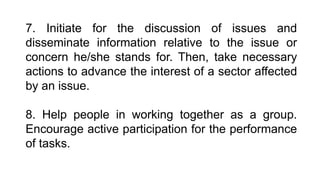
7. Initiate for the discussion of issues and
disseminate information relative to the issue or
concern he/she stands for. Then, take necessary
actions to advance the interest of a sector affected
by an issue.
8. Help people in working together as a group.
Encourage active participation for the performance
of tasks.
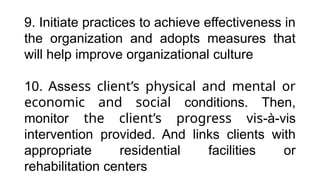
9. Initiate practices to achieve effectiveness in
the organization and adopts measures that
will help improve organizational culture
10. Assess client’s physical and mental or
economic and social conditions. Then,
monitor the client’s progress vis-à-vis
intervention provided. And links clients with
appropriate residential facilities or
rehabilitation centers

Module 13Roles and Function of Social Worker.pptx

  • 1.
  • 2.
    OBJECTIVES: At the endof this lesson, you are expected: to explain the roles and functions of social workers. describe the main focus of each role and identify the main function associated with the role.
  • 3.
    ADVOCATE A person whoadvances the interest and welfare of a particular sector through speech, press or social action for the purpose of meaningful change, human security, public safety and protection from abuse or violence.
  • 4.
    BROKER  A personwho assists in locating for resources or services and in negotiating for its acquisition or accessibility and use in favour of a client.
  • 5.
    CASEMANAGER •person who handlesand manages all information and processes relating to a specific issue, problem or circumstance, that is inimical to a person under his/her care, guardianship, custody or assignment.
  • 6.
    CHANGEAGENT •person who initiatesspecific measure to transform or help individuals, groups and communities to become socially functional and be an active participants in achieving self-worth or societal change.
  • 7.
    COUNSELOR •person who providesguidance and intervention to an individual or group particularly in dealing and managing an issue or a problem or difficulty, that includes helping them to look for possible answers or solutions that will alleviate suffering.
  • 8.
    EDUCATOR •A person whoprovides meaningful experiences for people to learn and become life- long learners through various platforms, whether formal, informal or non-formal, using varied types of stratégies, instruction, interaction, immersion, simulation, apprenticeships, etc.
  • 9.
    ENABLER •A person whoempowers another by capacitating him/her with the necessary knowledge, skills and values necessary for his/her transformation, recovery, growth or development.
  • 10.
    FACILITATOR  Person whocoordinates, leads or directs a particular group to work for specific task in the pursuit of achieving productive results for the attainment of group or organization’s work goal.
  • 11.
    MEDIATOR  A personwho assists in settling issues, dispute, disagreements or mere problems, between individuals or groups for the purpose of reconciliation, remediation, or settlement.
  • 12.
    RESEARCHER •person who engagesin a systematic inquiry to address an issue, a problem or a given condition or topic which may provide essential suggestions or recommendations that will help improve systems and practices, resolve conflicts, disorders or difficulties, and inequities, or widen the pond of human knowledge.
  • 13.
    Conclusion Social workers playa crucial role in society by advocating for and empowering individuals, families and communities to improve their well-being and achieve their full potential. They work across various setting and specialize in different areas, but their core functions remain consistent. Furthermore, social work is a diverse and challenging field, but it offers the opportunity to make a real difference in the lives of other. Social workers play a vital role in building a more just an
  • 14.
  • 15.
    1. Provide guidanceto individuals who are suffering from any difficulty. And help individuals to find answers to their problems. 2. Collect, organize and analyze information or data relative to a particular study. And formulate suggestions and recommendations pertaining to a problem statement Directions. Analyze the descriptions provided in each number. Identify the role of a social worker relative to the given descriptions.
  • 16.
    3. Help incapacitating people to become productive. And empower individuals, groups and communities to become socially functional. 4. Assist individuals in looking for resolutions to alleviate their sufferings and facilitate communication between parties involved in a dispute or conflict.
  • 17.
    5. Assist infinding resources and services to help in augmenting client’s resources. And negotiate with possible grantors for the acquisition of resources and services. 6. Teach individuals in schools or in any other learning environments and help individuals cope with the realities in life.
  • 18.
    7. Initiate forthe discussion of issues and disseminate information relative to the issue or concern he/she stands for. Then, take necessary actions to advance the interest of a sector affected by an issue. 8. Help people in working together as a group. Encourage active participation for the performance of tasks.
  • 19.
    9. Initiate practicesto achieve effectiveness in the organization and adopts measures that will help improve organizational culture 10. Assess client’s physical and mental or economic and social conditions. Then, monitor the client’s progress vis-à-vis intervention provided. And links clients with appropriate residential facilities or rehabilitation centers

Editor's Notes

  • #1 Role- The position or purpose that someone or something has in a situation, organization, society, or relationship: -Papel, tungkulin or responsibility Function- a purpose or duty, or the way something or someone works Social workers, like any other professionals, perform various roles and functions that are, in any manner, different from other applied social sciences professionals. Though similarities can be traced in some key areas, social workers’ distinctive roles are identified through the use of a wide range of legal and social work knowledge and skills particularly in effecting change among individuals, groups and communities – the paramount beneficiaries of social work services. Hence, this module introduces you a variety of roles social workers portray along with the corresponding functions expected for each role.
  • #2 Learning Objectives: (SET THE DIRECTION) Generally, at the end of the module, you are expected to explain the roles and functions of social workers. In particular, you are most likely to exhibit the following competencies: 1. describe the main focus of each role and identify the main function associated with the role. 2. deepen personal knowledge about the significance of social work professionals in today’s world. 3. write a critical essay pertaining to “How reality shapes our choices?” Vocabulary List:
  • #3 Fight; The voice of the voiceless, like mga indigeneous tribe, magsasaka, abuse human, usually through group they can be those people who can help to fight for their right. In this role, social workers fight for the rights of others and work to obtain needed resources by convincing others of the legitimate needs and rights of members of society. Social workers are particularly concerned for those who are vulnerable or are unable to speak up for themselves. Advocacy can occur on the local, county, state or national level. Some social workers are involved in. International human rights and advocacy for those in need. Initiate for the discussion of issues and disseminate information relative to the issue or concern he/she stands for. Then, take necessary actions to advance the interest of a sector affected by an issue
  • #4 Serve as the middle man, they try to connect for example mga non-government organization they want to help doon sa mga lugar community or group of people who need help. The social worker is involved in the process of making referrals to link a family or person to needed resources.  Social work professionals do not simply provide information. They also follow up to be sure the needed resources are attained. This requires knowing resources, eligibility requirements, fees and the location of services. The third professional role plays by the social worker is to become a broker. Different from the role of mediator, the broker helps the service users or clients to access their needs and help. For example, broker helps the marginalized people to voice out their rights so that the authorize parties can hear. In the role of broker, a social worker is a professional agent responsible for identifying, finding, and connecting clients or service user by using the best and suitable way to assist the clients or service users for their needs. When the clients or service user needs are analyzed and available services and facilities been assured, the broker helps the service user or clients in making the best and suitable services and facilities and helps them with arranging the services and facilities. Assist in finding resources and services to help in augmenting client’s resources. And negotiate with possible grantors for the acquisition of resources and services.
  • #5 Handle; Case managers are involved in locating services and assisting their clients to access those services. They evaluate the needs of clients (individuals, families, children) identify the services needed and create a plan to provide that care. They also responsible for evaluating the effectiveness of the care plan and services.  While case managers may do some limited intake counseling, their role is to manage the delivery of services, rather than perform social work tasks. Once they have identified clients’ needs and created a care plan, they turn over the delivery of that plan to professionals such as medical doctors, counselors, and others. Assess client’s physical and mental or economic and social conditions. Then, monitor the client’s progress vis-à-vis intervention provided. And links clients with appropriate residential facilities or rehabilitation centers Scope of Practice: Case managers have a broader scope of practice, encompassing assessment, planning, coordination, monitoring, and advocacy. Brokers primarily focus on resource identification, referral, and linkage. Client Relationship: Case managers typically develop long-term relationships with their clients, providing ongoing support and guidance. Brokers may have more transient interactions with clients, focusing on connecting them with the right resources. Level of Intervention: Case managers may engage in direct intervention, such as providing counseling or crisis support. Brokers primarily act as intermediaries, facilitating access to services rather than providing direct support.
  • #6 Promotes and support a new way of doing something for the betterment of the community. They make an impact in the community. Initiate practices to achieve effectiveness in the organization and adopts measures that will help improve organizational culture
  • #7 Assist; Empowering people to affirm their personal strengths and capabilities. Counselors can be considered social workers, not all social workers are counselors.
  • #8 Teaches other about basic community skills that will help the client to cope. It depends on the worker’s expertise (agriculture, Teach individuals in schools or in any other learning environments and help individuals cope with the realities in life.
  • #9 a person who encourages someone to do something. Help in capacitating people to become productive. And empower individuals, groups and communities to become socially functional.
  • #10 Coordinates; Must be capable to handle large groups for variety of purposes (advocacy, policy change, organization). Community organizer. In this role, social workers are involved in gathering groups of people together for a variety of purposes including community development, self-advocacy, political organization, and policy change. Social workers are involved as group therapists and task group leaders Help people in working together as a group. Encourage active participation for the performance of tasks
  • #11 Intervenes in disputes to find compromises, reconciliation or agreements. Assist individuals in looking for resolutions to alleviate their sufferings and facilitate communication between parties involved in a dispute or conflict.
  • #12 Recommends; Systematic inquiry-a process broken up into clear steps that lead to conclusions. Evaluates practice interventions and program outcomes, they evaluate if effective pa ba ang mga programs they offer and ang ilang findings they disseminate it to improve their practices. A person who engages in a systematic inquiry to address an issue, a problem or a giresolveven condition or topic which may provide essential suggestions or recommendations that will help improve systems and practices, conflicts, disorders or difficulties, and inequities, or widen the pond of human knowledge. Study the dynamic interactions between individuals, groups and communities Collect, organize and analyze information or data relative to a particular study. Formulate suggestions and recommendations pertaining to a problem statement
  • #15 1. COUNSELOR 2. RESEARCHER
  • #16 3. ENABLER 4. MEDIATOR
  • #17 5. BROKER 6. EDUCATOR
  • #18 7. ADVOCATE 8. FACILITATOR
  • #19 9. CHANGE AGENT 10. CASE MANAGER