Introduction to
Personality Development
Module # 1
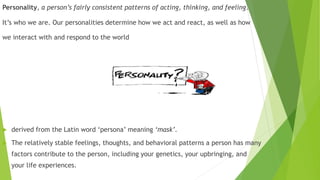
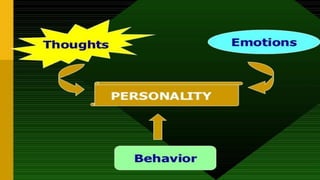
Personality, a person’s fairly consistent patterns of acting, thinking, and feeling.
It’s who we are. Our personalities determine how we act and react, as well as how
we interact with and respond to the world
 derived from the Latin word ‘persona’ meaning ‘mask’.
 The relatively stable feelings, thoughts, and behavioral patterns a person has many
factors contribute to the person, including your genetics, your upbringing, and
your life experiences.
Five philosophical questions about what really determines personality:
1. Freedom versus determinism: How much, if any, of an individual’s personality is under their
conscious control?
2. Heredity versus environment: Do internal (biological) or external (environmental) influences
play a larger role in determining personality?
3. Uniqueness versus universality: Are individuals generally more alike (similar to each other)
or different (unique) in nature?
4. Active versus reactive: Is human behavior passively shaped by environmental factors, or are
humans more active in this role?
5. Optimistic versus pessimistic: Are humans integral in the changing of their own personalities
(for instance, can they learn and change through human interaction and intervention)?
Personality psychology is the study of human personality and how it varies among
individuals and populations. Personality has been studied for over 2000 years,
beginning with Hippocrates in 370 BCE and spanning through modern theories such
as the psychodynamic perspective and trait theory.
Its a branch of psychology studies how the personality is developed within the
psyche and influenced by society.
Psychologists strive to understand how personality develops as well as how it
influences the way we think and behave. This area of psychology seeks to
understand personality and how it varies among individuals as well as how people
are similar in terms of personality.
Personality development
 is the development of the organized pattern of behaviors and attitudes that
makes a person distinctive.
 Personality development occurs by the ongoing interaction of temperament ,
character, and environment.
 an improvement in all spheres of an individual’s life, be it with friends, in
the office or in any other environment
 Personality development grooms an individual and helps him make a mark of
his/her own
 Personality development goes a long way in reducing stress and conflicts.
 Personality development helps you develop a positive attitude in life.
Module # 1. Intro to Personality development.pptx

Module # 1. Intro to Personality development.pptx

  • 1.
  • 2.
    Personality, a person’sfairly consistent patterns of acting, thinking, and feeling. It’s who we are. Our personalities determine how we act and react, as well as how we interact with and respond to the world  derived from the Latin word ‘persona’ meaning ‘mask’.  The relatively stable feelings, thoughts, and behavioral patterns a person has many factors contribute to the person, including your genetics, your upbringing, and your life experiences.
  • 4.
    Five philosophical questionsabout what really determines personality: 1. Freedom versus determinism: How much, if any, of an individual’s personality is under their conscious control? 2. Heredity versus environment: Do internal (biological) or external (environmental) influences play a larger role in determining personality? 3. Uniqueness versus universality: Are individuals generally more alike (similar to each other) or different (unique) in nature? 4. Active versus reactive: Is human behavior passively shaped by environmental factors, or are humans more active in this role? 5. Optimistic versus pessimistic: Are humans integral in the changing of their own personalities (for instance, can they learn and change through human interaction and intervention)?
  • 5.
    Personality psychology isthe study of human personality and how it varies among individuals and populations. Personality has been studied for over 2000 years, beginning with Hippocrates in 370 BCE and spanning through modern theories such as the psychodynamic perspective and trait theory. Its a branch of psychology studies how the personality is developed within the psyche and influenced by society. Psychologists strive to understand how personality develops as well as how it influences the way we think and behave. This area of psychology seeks to understand personality and how it varies among individuals as well as how people are similar in terms of personality.
  • 6.
    Personality development  isthe development of the organized pattern of behaviors and attitudes that makes a person distinctive.  Personality development occurs by the ongoing interaction of temperament , character, and environment.  an improvement in all spheres of an individual’s life, be it with friends, in the office or in any other environment
  • 7.
     Personality developmentgrooms an individual and helps him make a mark of his/her own  Personality development goes a long way in reducing stress and conflicts.  Personality development helps you develop a positive attitude in life.