PRE-TEST
Choose the letter of the best answer. Write the chosen letter
on a separate sheet of paper.
• 1. Understanding, Culture, Society, and Politics (UCSP) is a multidisciplinary course that integrates
and combines the contents, methods, and theories of the following EXCEPT:
• A. Anthropology
• B. Mathematics
• C. Political Science
• D. Sociology
• 2. It refers to the culturally defined standards by which people assess desirability, goodness, and
beauty and that serve as broad guidelines for social living.
• A. Folkways
• B. Mores
• C. Norms
• D. Values
• 2. It refers to the culturally defined standards by which people assess desirability,
goodness, and beauty and that serve as broad guidelines for social living.
• A. Folkways
• B. Mores
• C. Norms
• D. Values
• 4. The following are significance of studying society EXCEPT:
• A. It emphasizes the cognitive thinking of our mind.
• B. It acknowledges that social institutions shape and affect how we live our life.
• C. It broadens our perspectives on how we value our own and others’ culture.
• D. It gives us a full understanding of how social groups affect our thinking and
behavior.
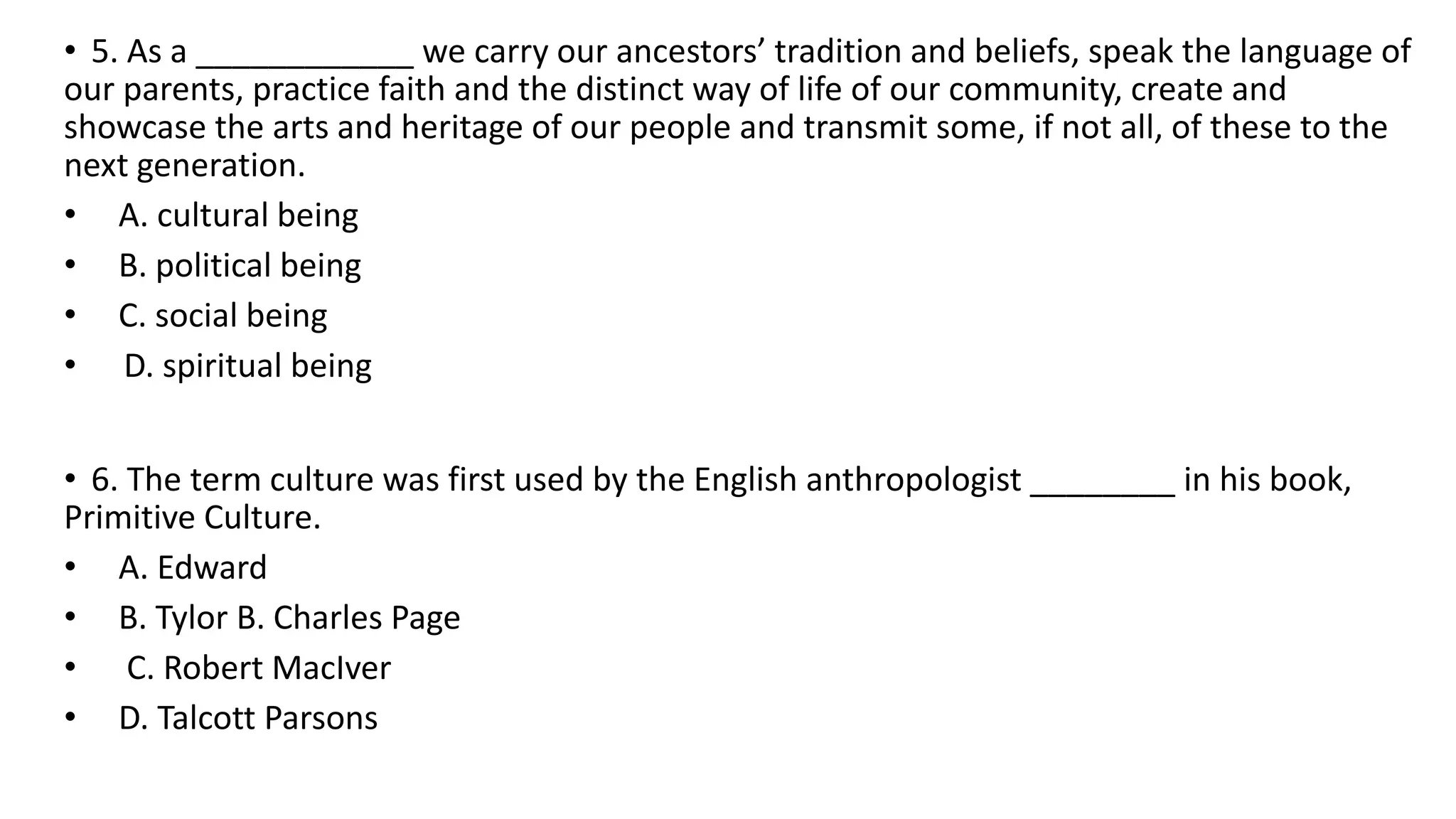
• 5. As a ____________ we carry our ancestors’ tradition and beliefs, speak the language of
our parents, practice faith and the distinct way of life of our community, create and
showcase the arts and heritage of our people and transmit some, if not all, of these to the
next generation.
• A. cultural being
• B. political being
• C. social being
• D. spiritual being
• 6. The term culture was first used by the English anthropologist ________ in his book,
Primitive Culture.
• A. Edward
• B. Tylor B. Charles Page
• C. Robert MacIver
• D. Talcott Parsons
• 7. Karen used to tease her newly transferred Mangyan classmate because of his
kinky hair and tanned skin. What kind of cultural view Karen has?
• A. Culture
• B. Cultural Relativism
• C. Ethnocentrism
• D. Society
• 9. “Sabong” is a vice which Lolo Imbo has been indulged with until this year. This
kind of gambling was being brought in the Philippines during the Spanish
colonization. This only proves that culture is __________.
• A. integrated
• B. learned
• C. shared
• D. symbolic
• 10.Sandra, a 16-year-old Filipina girl had been nominated to be an
exchangestudent in Australia during winter season. In her
preparation of things, she excluded her shorts and sleeveless and
start pulling out her jackets and boots on her cabinet, while her
Australian exchange student began to take in her shirts and shorts
on her personal baggage bag. What does this show?
• A. culture is abstract
• B. culture is adaptive
• C. culture is dynamic
• D. culture is symbolic
Read and reflect on the quotation inside the box. You may
answer in a separate sheet of paper.
• “A person may escape society for a while, but he can never escape
culture.” –
• Joseph H. Fichter.”
• Guide Questions: 1. What can you say about the quotation?
• 2. Do you agree with the author’s statement? Why or why not?
• 3. What do you think is the importance of studying this course?
• 4. How will this course contribute to you as a student?

PRE-TEST understanding culture society and politics.pptx

  • 1.
  • 2.
    Choose the letterof the best answer. Write the chosen letter on a separate sheet of paper. • 1. Understanding, Culture, Society, and Politics (UCSP) is a multidisciplinary course that integrates and combines the contents, methods, and theories of the following EXCEPT: • A. Anthropology • B. Mathematics • C. Political Science • D. Sociology • 2. It refers to the culturally defined standards by which people assess desirability, goodness, and beauty and that serve as broad guidelines for social living. • A. Folkways • B. Mores • C. Norms • D. Values
  • 3.
    • 2. Itrefers to the culturally defined standards by which people assess desirability, goodness, and beauty and that serve as broad guidelines for social living. • A. Folkways • B. Mores • C. Norms • D. Values • 4. The following are significance of studying society EXCEPT: • A. It emphasizes the cognitive thinking of our mind. • B. It acknowledges that social institutions shape and affect how we live our life. • C. It broadens our perspectives on how we value our own and others’ culture. • D. It gives us a full understanding of how social groups affect our thinking and behavior.
  • 4.
    • 5. Asa ____________ we carry our ancestors’ tradition and beliefs, speak the language of our parents, practice faith and the distinct way of life of our community, create and showcase the arts and heritage of our people and transmit some, if not all, of these to the next generation. • A. cultural being • B. political being • C. social being • D. spiritual being • 6. The term culture was first used by the English anthropologist ________ in his book, Primitive Culture. • A. Edward • B. Tylor B. Charles Page • C. Robert MacIver • D. Talcott Parsons
  • 5.
    • 7. Karenused to tease her newly transferred Mangyan classmate because of his kinky hair and tanned skin. What kind of cultural view Karen has? • A. Culture • B. Cultural Relativism • C. Ethnocentrism • D. Society • 9. “Sabong” is a vice which Lolo Imbo has been indulged with until this year. This kind of gambling was being brought in the Philippines during the Spanish colonization. This only proves that culture is __________. • A. integrated • B. learned • C. shared • D. symbolic
  • 6.
    • 10.Sandra, a16-year-old Filipina girl had been nominated to be an exchangestudent in Australia during winter season. In her preparation of things, she excluded her shorts and sleeveless and start pulling out her jackets and boots on her cabinet, while her Australian exchange student began to take in her shirts and shorts on her personal baggage bag. What does this show? • A. culture is abstract • B. culture is adaptive • C. culture is dynamic • D. culture is symbolic
  • 7.
    Read and reflecton the quotation inside the box. You may answer in a separate sheet of paper. • “A person may escape society for a while, but he can never escape culture.” – • Joseph H. Fichter.” • Guide Questions: 1. What can you say about the quotation? • 2. Do you agree with the author’s statement? Why or why not? • 3. What do you think is the importance of studying this course? • 4. How will this course contribute to you as a student?