International Research Journal of Engineering and Technology (IRJET) e-ISSN: 2395-0056
Volume: 09 Issue: 05 | May 2022 www.irjet.net p-ISSN: 2395-0072
© 2022, IRJET | Impact Factor value: 7.529 | ISO 9001:2008 Certified Journal | Page 194
Modification of Bladeless Fan
Manohar V. Zore1, Jaydeep V. Patil2, Pratik N. Patil3 , Prof. Jayesh Dhuri4
1,2,3,Student, Dept. of Mechatronics Engineering, New Horizon Institute of Technology and Management, Thane,
Maharashtra, India
4Professor, Dept. of Mechatronics Engineering, New Horizon Institute of Technology and Management, Thane,
Maharashtra, India
---------------------------------------------------------------------***---------------------------------------------------------------------
Abstract - Bladeless fan is the newest trend in the
industry. The major goal of this study is to create a method
for air circulation within a room in a 180° rotation of fan
with the mechanism of Servo Motor. On/Off operation,
Mobility and speech can be digitally controlled from
Mobile phone. The pressure difference created through
the airfoil-like cross-section of the nozzle ring combined
with the Coanda effect helps to create at a thruster that
has no externally rotating blades or propellers. It’s terribly
powerful because it multiplies the air flow coming back
out, thus, providing far better cooling. Bladeless fan could
be a novel kind of fan with an uncommon pure
mathematics and distinctive characteristics. This kind of
fans are being developed for domestic applications.
Key Words: Rotating Bladeless Fan, Digitally
Operated, Airfoil thruster, Coanda effect
1. INTRODUCTION
In this paper we’ve modified the general structure of a
table fan to overcome various problems associated with it
similar as noise, further space demand, effectiveness, non-
uniform inflow of air etc. In October 2009, James Dyson’s
consumer electronics company, well-known for it’s line of
vacuum cleaners, introduced a new device to the market
called the Dyson Air Multiplier. An air multiplier,
occasionally called Bladeless fan, It’s a fan which blows air
from a nozzle ring with no external blades. Calling the
Dyson Air Multiplier a fan with no blades is maybe a touch
misleading. There are blades in the fan you just can not see
them because its vanes are hidden in its pedestal and
direct the collected air flow through a toroid, blowing a
thin high velocity smooth air flow from a Non-Stop groove
across the shell of the tube or toroid. The pedestal of the
fan contains a Brushless electric motor that takes in air
and feeds it into the roundabout tube. Air flows within the
device until it reaches a slit inside the tube. The
combination of the brought inflow and the accelerated
inflow creates a high-pressure area across the other end of
the nozzle ring. It increases the output of airflow by 15-20
times the quantity it takes in through the pedestal’s motor.
By installing Servo Motor in Vertical inlet duct, rotation of
Fan can be achieve. ESP and relays are use to control the
Servo Motor and DC Motor. Website can be use to operate
the functions of fan.
2. SYSTEM DESIGN
A. Existing System
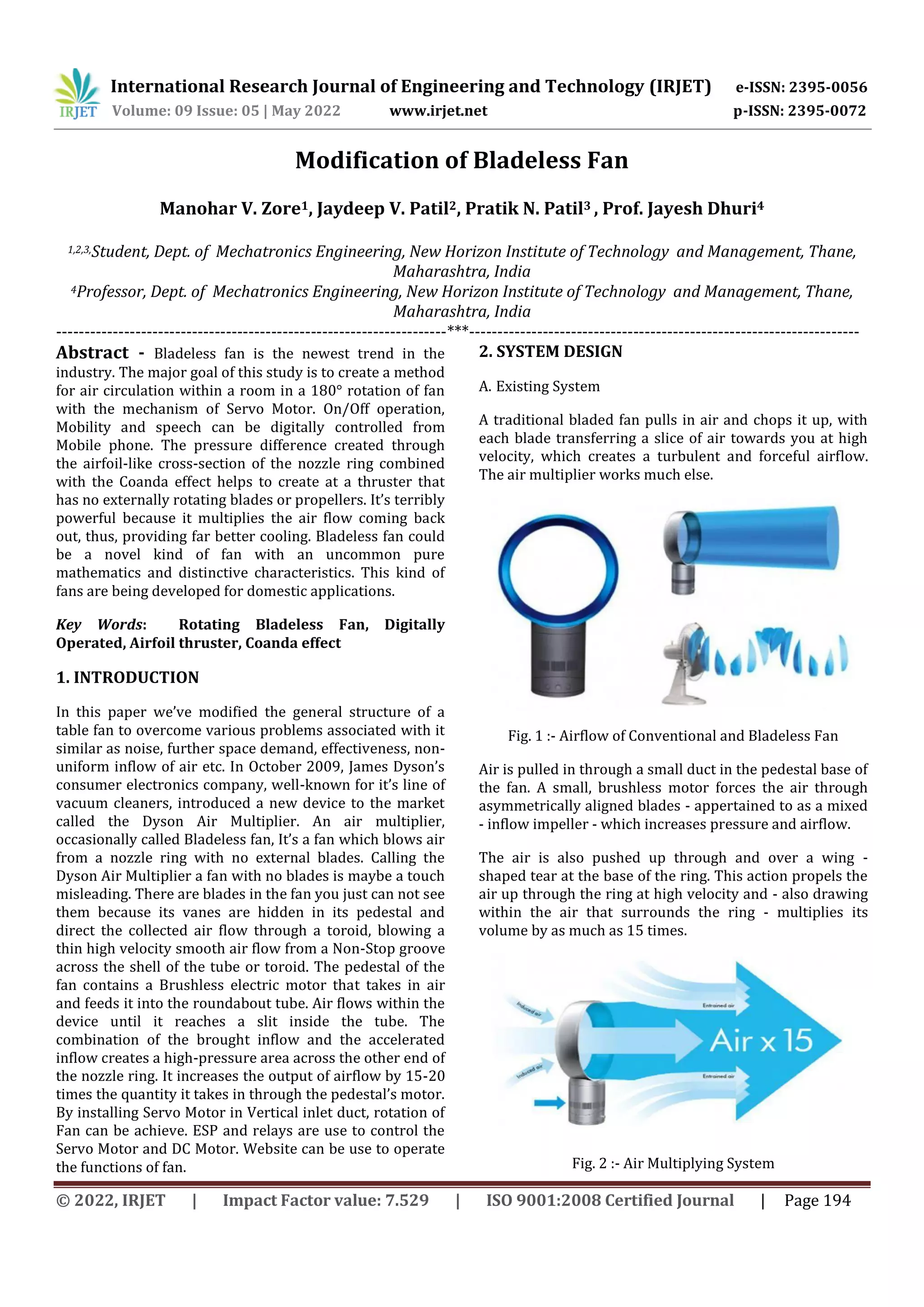
A traditional bladed fan pulls in air and chops it up, with
each blade transferring a slice of air towards you at high
velocity, which creates a turbulent and forceful airflow.
The air multiplier works much else.
Fig. 1 :- Airflow of Conventional and Bladeless Fan
Air is pulled in through a small duct in the pedestal base of
the fan. A small, brushless motor forces the air through
asymmetrically aligned blades - appertained to as a mixed
- inflow impeller - which increases pressure and airflow.
The air is also pushed up through and over a wing -
shaped tear at the base of the ring. This action propels the
air up through the ring at high velocity and - also drawing
within the air that surrounds the ring - multiplies its
volume by as much as 15 times.
Fig. 2 :- Air Multiplying System
International Research Journal of Engineering and Technology (IRJET) e-ISSN: 2395-0056
Volume: 09 Issue: 05 | May 2022 www.irjet.net p-ISSN: 2395-0072
© 2022, IRJET | Impact Factor value: 7.529 | ISO 9001:2008 Certified Journal | Page 195
B. Modified Design
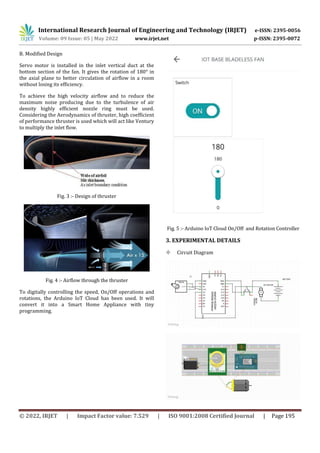
Servo motor is installed in the inlet vertical duct at the
bottom section of the fan. It gives the rotation of 180° in
the axial plane to better circulation of airflow in a room
without losing its efficiency.
To achieve the high velocity airflow and to reduce the
maximum noise producing due to the turbulence of air
density highly efficient nozzle ring must be used.
Considering the Aerodynamics of thruster, high coefficient
of performance thruster is used which will act like Ventury
to multiply the inlet flow.
Fig. 3 :- Design of thruster
Fig. 4 :- Airflow through the thruster
To digitally controlling the speed, On/Off operations and
rotations, the Arduino IoT Cloud has been used. It will
convert it into a Smart Home Appliance with tiny
programming.
Fig. 5 :- Arduino IoT Cloud On/Off and Rotation Controller
3. EXPERIMENTAL DETAILS
 Circuit Diagram
International Research Journal of Engineering and Technology (IRJET) e-ISSN: 2395-0056
Volume: 09 Issue: 05 | May 2022 www.irjet.net p-ISSN: 2395-0072
© 2022, IRJET | Impact Factor value: 7.529 | ISO 9001:2008 Certified Journal | Page 196
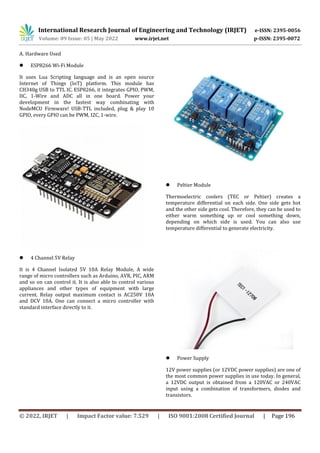
A. Hardware Used
 ESP8266 Wi-Fi Module
It uses Lua Scripting language and is an open source
Internet of Things (IoT) platform. This module has
CH340g USB to TTL IC. ESP8266, it integrates GPIO, PWM,
IIC, 1-Wire and ADC all in one board. Power your
development in the fastest way combinating with
NodeMCU Firmware! USB-TTL included, plug & play 10
GPIO, every GPIO can be PWM, I2C, 1-wire.
 4 Channel 5V Relay
It is 4 Channel Isolated 5V 10A Relay Module, A wide
range of micro controllers such as Arduino, AVR, PIC, ARM
and so on can control it. It is also able to control various
appliances and other types of equipment with large
current. Relay output maximum contact is AC250V 10A
and DCV 10A. One can connect a micro controller with
standard interface directly to it.
 Peltier Module
Thermoelectric coolers (TEC or Peltier) creates a
temperature differential on each side. One side gets hot
and the other side gets cool. Therefore, they can be used to
either warm something up or cool something down,
depending on which side is used. You can also use
temperature differential to generate electricity.
 Power Supply
12V power supplies (or 12VDC power supplies) are one of
the most common power supplies in use today. In general,
a 12VDC output is obtained from a 120VAC or 240VAC
input using a combination of transformers, diodes and
transistors.
International Research Journal of Engineering and Technology (IRJET) e-ISSN: 2395-0056
Volume: 09 Issue: 05 | May 2022 www.irjet.net p-ISSN: 2395-0072
© 2022, IRJET | Impact Factor value: 7.529 | ISO 9001:2008 Certified Journal | Page 197
 Heat Sink
A heat sink is a passive heat exchanger that transfers the
heat generated by an electronic or a mechanical device to
a fluid medium, often air or a liquid coolant, where it is
dissipated away from the device.
 Servo Motor
A servo motor is a rotary actuator or linear actuator that
allows for precise control of angular or linear position,
velocity and acceleration. It consists of a suitable motor
coupled to a sensor for position feedback.
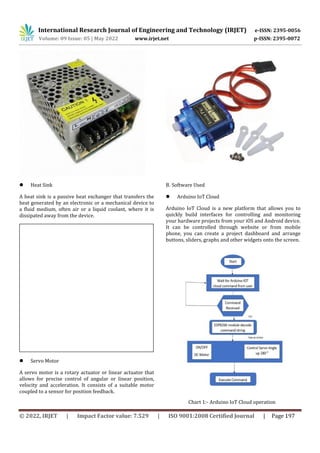
B. Software Used
 Arduino IoT Cloud
Arduino IoT Cloud is a new platform that allows you to
quickly build interfaces for controlling and monitoring
your hardware projects from your iOS and Android device.
It can be controlled through website or from mobile
phone, you can create a project dashboard and arrange
buttons, sliders, graphs and other widgets onto the screen.
Chart 1:- Arduino IoT Cloud operation
International Research Journal of Engineering and Technology (IRJET) e-ISSN: 2395-0056
Volume: 09 Issue: 05 | May 2022 www.irjet.net p-ISSN: 2395-0072
© 2022, IRJET | Impact Factor value: 7.529 | ISO 9001:2008 Certified Journal | Page 198
4. RESULTS AND DISCUSSION
The following are the observations during the testing of
the bladeless fan :-
 As the entrainment created within it amplifies the air
output, The airflow in the bladeless fans is stronger
than the regular fans.
 Using physics and aerodynamics, it generates less
noise and uses less energy in the whole process.
 They’re also a lot easier to clean- there’s no wedging
a duster in between a grate.
 Air Multipliers are far more allergy friendly than
conventional fans, they collect and spread less dust,
and can come equipped with air filtering systems.
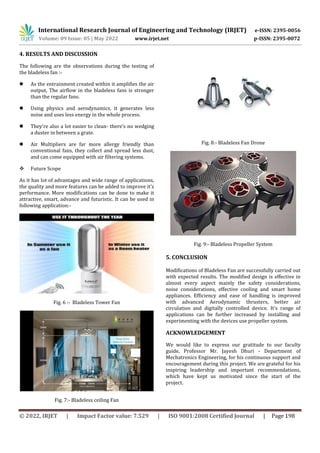
 Future Scope
As it has lot of advantages and wide range of applications,
the quality and more features can be added to improve it’s
performance. More modifications can be done to make it
attractive, smart, advance and futuristic. It can be used in
following application:-
Fig. 6 :- Bladeless Tower Fan
Fig. 7:- Bladeless ceiling Fan
Fig. 8:- Bladeless Fan Drone
Fig. 9:- Bladeless Propeller System
5. CONCLUSION
Modifications of Bladeless Fan are successfully carried out
with expected results. The modified design is effective in
almost every aspect mainly the safety considerations,
noise considerations, effective cooling and smart home
appliances. Efficiency and ease of handling is improved
with advanced Aerodynamic thrusters, better air
circulation and digitally controlled device. It’s range of
applications can be further increased by installing and
experimenting with the devices use propeller system.
ACKNOWLEDGEMENT
We would like to express our gratitude to our faculty
guide, Professor Mr. Jayesh Dhuri - Department of
Mechatronics Engineering, for his continuous support and
encouragement during this project. We are grateful for his
inspiring leadership and important recommendations,
which have kept us motivated since the start of the
project.
International Research Journal of Engineering and Technology (IRJET) e-ISSN: 2395-0056
Volume: 09 Issue: 05 | May 2022 www.irjet.net p-ISSN: 2395-0072
© 2022, IRJET | Impact Factor value: 7.529 | ISO 9001:2008 Certified Journal | Page 199
REFERENCES
[1] By Jonathan Stickland & Nathan Chandler “How the
Dyson Bladeless Fan Works” Feb 11, 2021
https://electronics.howstuffworks.com/gadgets/home/dy
son-bladeless-fan.htm
[2] International Journal of Electrical, Electronics and Data
Communication, ISSN(p): 2320-2084, ISSN(e): 2321-2950
Volume-8, Issue-6, Jun.-2020, http://iraj.in
[3] By Gene Gerrard “How Do Bladeless Fans Work? “April
21, 2020 https://www.yourbestdigs.com/reviews/how-
do-bladeless-fans-work/
[4] Wikipedia Article August 2020
https://en.m.wikipedia.org/wiki/Air_multiplier
[5] ShivamTyagi, Shekhar Gupta, SaurabhKhare, Dr. C. S.
Malvi International Journal of Scientific & Engineering
Research, Volume 8, Issue 4, April-2017 ISSN 2229-5518

Modification of Bladeless Fan

  • 1.
    International Research Journalof Engineering and Technology (IRJET) e-ISSN: 2395-0056 Volume: 09 Issue: 05 | May 2022 www.irjet.net p-ISSN: 2395-0072 © 2022, IRJET | Impact Factor value: 7.529 | ISO 9001:2008 Certified Journal | Page 194 Modification of Bladeless Fan Manohar V. Zore1, Jaydeep V. Patil2, Pratik N. Patil3 , Prof. Jayesh Dhuri4 1,2,3,Student, Dept. of Mechatronics Engineering, New Horizon Institute of Technology and Management, Thane, Maharashtra, India 4Professor, Dept. of Mechatronics Engineering, New Horizon Institute of Technology and Management, Thane, Maharashtra, India ---------------------------------------------------------------------***--------------------------------------------------------------------- Abstract - Bladeless fan is the newest trend in the industry. The major goal of this study is to create a method for air circulation within a room in a 180° rotation of fan with the mechanism of Servo Motor. On/Off operation, Mobility and speech can be digitally controlled from Mobile phone. The pressure difference created through the airfoil-like cross-section of the nozzle ring combined with the Coanda effect helps to create at a thruster that has no externally rotating blades or propellers. It’s terribly powerful because it multiplies the air flow coming back out, thus, providing far better cooling. Bladeless fan could be a novel kind of fan with an uncommon pure mathematics and distinctive characteristics. This kind of fans are being developed for domestic applications. Key Words: Rotating Bladeless Fan, Digitally Operated, Airfoil thruster, Coanda effect 1. INTRODUCTION In this paper we’ve modified the general structure of a table fan to overcome various problems associated with it similar as noise, further space demand, effectiveness, non- uniform inflow of air etc. In October 2009, James Dyson’s consumer electronics company, well-known for it’s line of vacuum cleaners, introduced a new device to the market called the Dyson Air Multiplier. An air multiplier, occasionally called Bladeless fan, It’s a fan which blows air from a nozzle ring with no external blades. Calling the Dyson Air Multiplier a fan with no blades is maybe a touch misleading. There are blades in the fan you just can not see them because its vanes are hidden in its pedestal and direct the collected air flow through a toroid, blowing a thin high velocity smooth air flow from a Non-Stop groove across the shell of the tube or toroid. The pedestal of the fan contains a Brushless electric motor that takes in air and feeds it into the roundabout tube. Air flows within the device until it reaches a slit inside the tube. The combination of the brought inflow and the accelerated inflow creates a high-pressure area across the other end of the nozzle ring. It increases the output of airflow by 15-20 times the quantity it takes in through the pedestal’s motor. By installing Servo Motor in Vertical inlet duct, rotation of Fan can be achieve. ESP and relays are use to control the Servo Motor and DC Motor. Website can be use to operate the functions of fan. 2. SYSTEM DESIGN A. Existing System A traditional bladed fan pulls in air and chops it up, with each blade transferring a slice of air towards you at high velocity, which creates a turbulent and forceful airflow. The air multiplier works much else. Fig. 1 :- Airflow of Conventional and Bladeless Fan Air is pulled in through a small duct in the pedestal base of the fan. A small, brushless motor forces the air through asymmetrically aligned blades - appertained to as a mixed - inflow impeller - which increases pressure and airflow. The air is also pushed up through and over a wing - shaped tear at the base of the ring. This action propels the air up through the ring at high velocity and - also drawing within the air that surrounds the ring - multiplies its volume by as much as 15 times. Fig. 2 :- Air Multiplying System
  • 2.
    International Research Journalof Engineering and Technology (IRJET) e-ISSN: 2395-0056 Volume: 09 Issue: 05 | May 2022 www.irjet.net p-ISSN: 2395-0072 © 2022, IRJET | Impact Factor value: 7.529 | ISO 9001:2008 Certified Journal | Page 195 B. Modified Design Servo motor is installed in the inlet vertical duct at the bottom section of the fan. It gives the rotation of 180° in the axial plane to better circulation of airflow in a room without losing its efficiency. To achieve the high velocity airflow and to reduce the maximum noise producing due to the turbulence of air density highly efficient nozzle ring must be used. Considering the Aerodynamics of thruster, high coefficient of performance thruster is used which will act like Ventury to multiply the inlet flow. Fig. 3 :- Design of thruster Fig. 4 :- Airflow through the thruster To digitally controlling the speed, On/Off operations and rotations, the Arduino IoT Cloud has been used. It will convert it into a Smart Home Appliance with tiny programming. Fig. 5 :- Arduino IoT Cloud On/Off and Rotation Controller 3. EXPERIMENTAL DETAILS  Circuit Diagram
  • 3.
    International Research Journalof Engineering and Technology (IRJET) e-ISSN: 2395-0056 Volume: 09 Issue: 05 | May 2022 www.irjet.net p-ISSN: 2395-0072 © 2022, IRJET | Impact Factor value: 7.529 | ISO 9001:2008 Certified Journal | Page 196 A. Hardware Used  ESP8266 Wi-Fi Module It uses Lua Scripting language and is an open source Internet of Things (IoT) platform. This module has CH340g USB to TTL IC. ESP8266, it integrates GPIO, PWM, IIC, 1-Wire and ADC all in one board. Power your development in the fastest way combinating with NodeMCU Firmware! USB-TTL included, plug & play 10 GPIO, every GPIO can be PWM, I2C, 1-wire.  4 Channel 5V Relay It is 4 Channel Isolated 5V 10A Relay Module, A wide range of micro controllers such as Arduino, AVR, PIC, ARM and so on can control it. It is also able to control various appliances and other types of equipment with large current. Relay output maximum contact is AC250V 10A and DCV 10A. One can connect a micro controller with standard interface directly to it.  Peltier Module Thermoelectric coolers (TEC or Peltier) creates a temperature differential on each side. One side gets hot and the other side gets cool. Therefore, they can be used to either warm something up or cool something down, depending on which side is used. You can also use temperature differential to generate electricity.  Power Supply 12V power supplies (or 12VDC power supplies) are one of the most common power supplies in use today. In general, a 12VDC output is obtained from a 120VAC or 240VAC input using a combination of transformers, diodes and transistors.
  • 4.
    International Research Journalof Engineering and Technology (IRJET) e-ISSN: 2395-0056 Volume: 09 Issue: 05 | May 2022 www.irjet.net p-ISSN: 2395-0072 © 2022, IRJET | Impact Factor value: 7.529 | ISO 9001:2008 Certified Journal | Page 197  Heat Sink A heat sink is a passive heat exchanger that transfers the heat generated by an electronic or a mechanical device to a fluid medium, often air or a liquid coolant, where it is dissipated away from the device.  Servo Motor A servo motor is a rotary actuator or linear actuator that allows for precise control of angular or linear position, velocity and acceleration. It consists of a suitable motor coupled to a sensor for position feedback. B. Software Used  Arduino IoT Cloud Arduino IoT Cloud is a new platform that allows you to quickly build interfaces for controlling and monitoring your hardware projects from your iOS and Android device. It can be controlled through website or from mobile phone, you can create a project dashboard and arrange buttons, sliders, graphs and other widgets onto the screen. Chart 1:- Arduino IoT Cloud operation
  • 5.
    International Research Journalof Engineering and Technology (IRJET) e-ISSN: 2395-0056 Volume: 09 Issue: 05 | May 2022 www.irjet.net p-ISSN: 2395-0072 © 2022, IRJET | Impact Factor value: 7.529 | ISO 9001:2008 Certified Journal | Page 198 4. RESULTS AND DISCUSSION The following are the observations during the testing of the bladeless fan :-  As the entrainment created within it amplifies the air output, The airflow in the bladeless fans is stronger than the regular fans.  Using physics and aerodynamics, it generates less noise and uses less energy in the whole process.  They’re also a lot easier to clean- there’s no wedging a duster in between a grate.  Air Multipliers are far more allergy friendly than conventional fans, they collect and spread less dust, and can come equipped with air filtering systems.  Future Scope As it has lot of advantages and wide range of applications, the quality and more features can be added to improve it’s performance. More modifications can be done to make it attractive, smart, advance and futuristic. It can be used in following application:- Fig. 6 :- Bladeless Tower Fan Fig. 7:- Bladeless ceiling Fan Fig. 8:- Bladeless Fan Drone Fig. 9:- Bladeless Propeller System 5. CONCLUSION Modifications of Bladeless Fan are successfully carried out with expected results. The modified design is effective in almost every aspect mainly the safety considerations, noise considerations, effective cooling and smart home appliances. Efficiency and ease of handling is improved with advanced Aerodynamic thrusters, better air circulation and digitally controlled device. It’s range of applications can be further increased by installing and experimenting with the devices use propeller system. ACKNOWLEDGEMENT We would like to express our gratitude to our faculty guide, Professor Mr. Jayesh Dhuri - Department of Mechatronics Engineering, for his continuous support and encouragement during this project. We are grateful for his inspiring leadership and important recommendations, which have kept us motivated since the start of the project.
  • 6.
    International Research Journalof Engineering and Technology (IRJET) e-ISSN: 2395-0056 Volume: 09 Issue: 05 | May 2022 www.irjet.net p-ISSN: 2395-0072 © 2022, IRJET | Impact Factor value: 7.529 | ISO 9001:2008 Certified Journal | Page 199 REFERENCES [1] By Jonathan Stickland & Nathan Chandler “How the Dyson Bladeless Fan Works” Feb 11, 2021 https://electronics.howstuffworks.com/gadgets/home/dy son-bladeless-fan.htm [2] International Journal of Electrical, Electronics and Data Communication, ISSN(p): 2320-2084, ISSN(e): 2321-2950 Volume-8, Issue-6, Jun.-2020, http://iraj.in [3] By Gene Gerrard “How Do Bladeless Fans Work? “April 21, 2020 https://www.yourbestdigs.com/reviews/how- do-bladeless-fans-work/ [4] Wikipedia Article August 2020 https://en.m.wikipedia.org/wiki/Air_multiplier [5] ShivamTyagi, Shekhar Gupta, SaurabhKhare, Dr. C. S. Malvi International Journal of Scientific & Engineering Research, Volume 8, Issue 4, April-2017 ISSN 2229-5518