WEBINAR
Modernizing Applications with 

Microservices and DC/OS
Markus Eisele (@myfear), Lightbend
Aaron Williams (@_arw_), Mesosphere
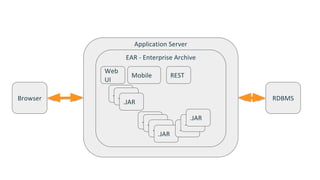
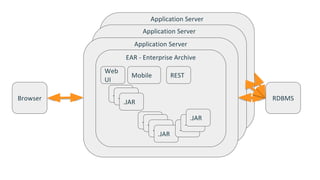
Classical Architectures?
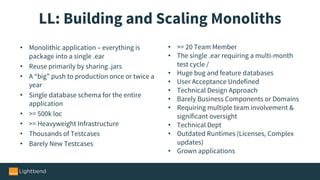
LL: Building and Scaling Monoliths
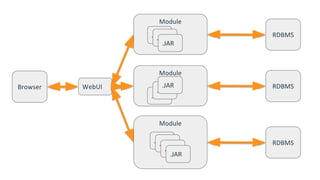
• Monolithic application – everything is
package into a single .ear
• Reuse primarily by sharing .jars
• A “big” push to production once or twice a
year
• Single database schema for the entire
application
• >= 500k loc
• >= Heavyweight Infrastructure
• Thousands of Testcases
• Barely New Testcases
• >= 20 Team Member
• The single .ear requiring a multi-month
test cycle /
• Huge bug and feature databases
• User Acceptance Undefined
• Technical Design Approach
• Barely Business Components or Domains
• Requiring multiple team involvement &
significant oversight
• Technical Dept
• Outdated Runtimes (Licenses, Complex
updates)
• Grown applications
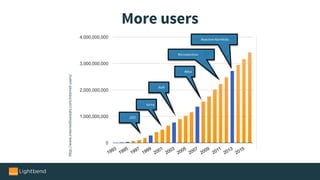
More users
http://www.internetlivestats.com/internet-users/
J2EE
Spring
RoR
Akka
Reactive Manifesto
Microservices
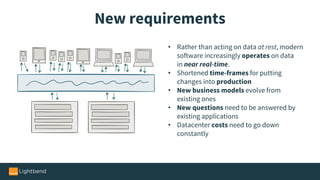
New requirements
• Rather than acting on data at rest, modern
software increasingly operates on data
in near real-time. 
• Shortened time-frames for putting
changes into production
• New business models evolve from
existing ones
• New questions need to be answered by
existing applications
• Datacenter costs need to go down
constantly
Modernization!
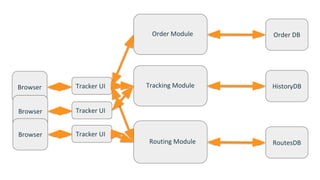
Routing Module
Tracking Module
Order Module
Tracker UIBrowser HistoryDB
Order DB
RoutesDB
Tracker UI
Tracker UI
Browser
Browser
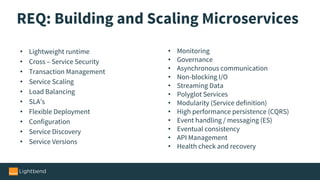
REQ: Building and Scaling Microservices
• Lightweight runtime
• Cross – Service Security
• Transaction Management
• Service Scaling
• Load Balancing
• SLA’s
• Flexible Deployment
• Configuration
• Service Discovery
• Service Versions
• Monitoring
• Governance
• Asynchronous communication
• Non-blocking I/O
• Streaming Data
• Polyglot Services
• Modularity (Service definition)
• High performance persistence (CQRS)
• Event handling / messaging (ES)
• Eventual consistency
• API Management
• Health check and recovery
“Microservices” is a lousy term
• Size is irrelevant
We want flexible systems and organizations that can
adapt to their complex environments, make changes
without rigid dependencies and coordination, can
learn, experiment, and exhibit emergent behavior.
We need to build systems for flexibility
and resiliency, not just efficiency and
robustness.
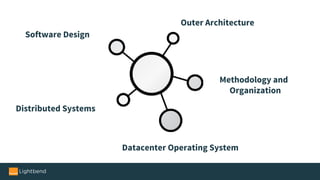
Software Design
Outer Architecture
Methodology and
Organization
Distributed Systems
Datacenter Operating System
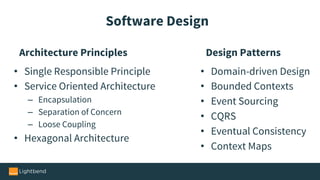
Software Design
Architecture Principles
• Single Responsible Principle
• Service Oriented Architecture
– Encapsulation
– Separation of Concern
– Loose Coupling
• Hexagonal Architecture
Design Patterns
• Domain-driven Design
• Bounded Contexts
• Event Sourcing
• CQRS
• Eventual Consistency
• Context Maps
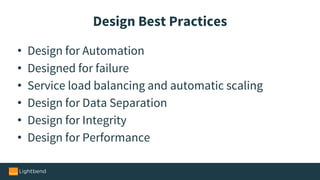
Design Best Practices
• Design for Automation
• Designed for failure
• Service load balancing and automatic scaling
• Design for Data Separation
• Design for Integrity
• Design for Performance
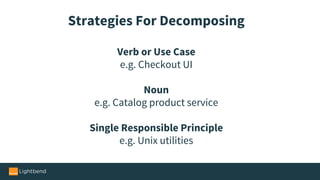
Strategies For Decomposing
Verb or Use Case
e.g. Checkout UI
Noun
e.g. Catalog product service
Single Responsible Principle
e.g. Unix utilities
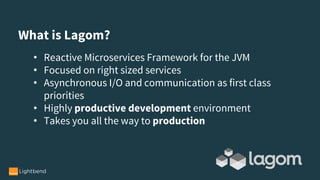
• Reactive Microservices Framework for the JVM
• Focused on right sized services
• Asynchronous I/O and communication as first class
priorities
• Highly productive development environment
• Takes you all the way to production
What is Lagom?
• Service API
• Persistence API
• Development environment
• Production environment
Highly opinionated
• Event sourced (deltas) with Cassandra backend by
default
• No object/relational impedance mismatch
• Can always replay to determine current state
• Allows you to learn more from your data later
• Persistent entity is an Aggregate Root in DDD
• Can be overridden for CRUD if you want
Lagom Persistence API
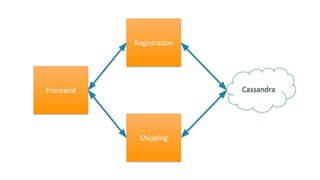
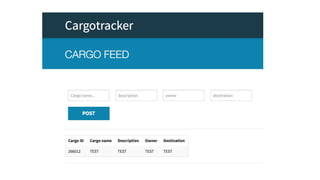
The little example!
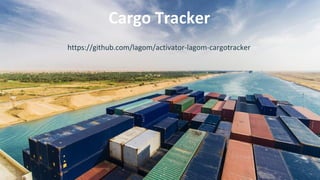
Cargo Tracker
https://github.com/lagom/activator-lagom-cargotracker
Registration
Shipping
Frontend Cassandra
>sbt bundle:dist
...
[info] Your package is ready in
/Users/myfear/lagom-cargotracker/front-
end/target/universal/front-end-1.0-
SNAPSHOT.zip
Create Service bundles
Now that we have our
bundles, how do we get
into production?
© 2015 Mesosphere, Inc. All Rights Reserved. 28
Datacenter Operating System (DC/OS)
ENTERPRISE
MICROSERVICES
© 2015 Mesosphere, Inc. All Rights Reserved.
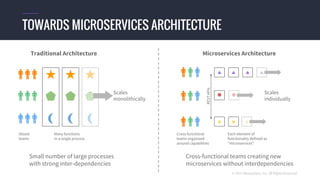
TOWARDS MICROSERVICES ARCHITECTURE
Traditional Architecture Microservices Architecture
Small number of large processes
with strong inter-dependencies
Cross-functional teams creating new
microservices without interdependencies
RESTAPIs
Scales
monolithically
Many functions
in a single process
Cross-functional
teams organized
around capabilities
Scales
individually
Siloed
teams
Each element of
functionality defined as
“microservices”
© 2015 Mesosphere, Inc. All Rights Reserved. 30
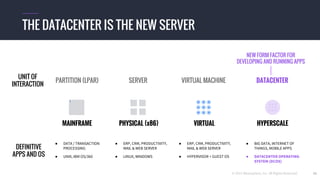
THE DATACENTER IS THE NEW SERVER
PHYSICAL (x86) VIRTUAL HYPERSCALEMAINFRAME
SERVER VIRTUAL MACHINEPARTITION (LPAR)
UNIT OF
INTERACTION
● ERP, CRM, PRODUCTIVITY,
MAIL & WEB SERVER
● LINUX, WINDOWS
● DATA / TRANSACTION
PROCESSING
● UNIX, IBM OS/360
DEFINITIVE
APPS AND OS
● ERP, CRM, PRODUCTIVITY,
MAIL & WEB SERVER
● HYPERVISOR + GUEST OS
● BIG DATA, INTERNET OF
THINGS, MOBILE APPS
● ???
???DATACENTER
NEW FORM FACTOR FOR
DEVELOPING AND RUNNING APPS
● BIG DATA, INTERNET OF
THINGS, MOBILE APPS
● DATACENTER OPERATING
SYSTEM (DCOS)
© 2015 Mesosphere, Inc. All Rights Reserved.
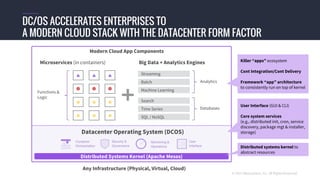
Datacenter Operating System (DCOS)
Distributed Systems Kernel (Apache Mesos)
DC/OS ACCELERATES ENTERPRISES TO
A MODERN CLOUD STACK WITH THE DATACENTER FORM FACTOR
Big Data + Analytics EnginesMicroservices (in containers)
Streaming
Batch
Machine Learning
Analytics
Functions &
Logic
Search
Time Series
SQL / NoSQL
Databases
Modern Cloud App Components
Distributed systems kernel to
abstract resources
Killer “apps” ecosystem
Cont Integration/Cont Delivery
Framework “app” architecture
to consistently run on top of kernel
User Interface (GUI & CLI)
Core system services
(e.g., distributed init, cron, service
discovery, package mgt & installer,
storage)
Any Infrastructure (Physical, Virtual, Cloud)
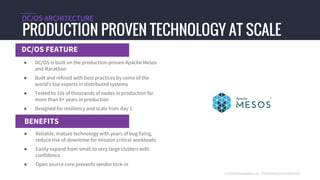
DC/OS FEATURE
PRODUCTION PROVEN TECHNOLOGY AT SCALE
DC/OS ARCHITECTURE
BENEFITS
© 2016 Mesosphere, Inc. Proprietary & Confidential
● DC/OS is built on the production-proven Apache Mesos
and Marathon
● Built and refined with best practices by some of the
world's top experts in distributed systems
● Tested to 10s of thousands of nodes in production for
more than 6+ years in production
● Designed for resiliency and scale from day 1
● Reliable, mature technology with years of bug fixing,
reduce risk of downtime for mission critical workloads
● Easily expand from small to very large clusters with
confidence
● Open source core prevents vendor lock-in
DC/OS FEATURE
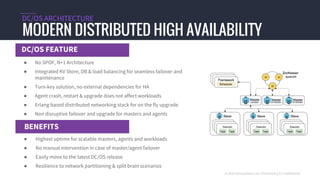
MODERN DISTRIBUTED HIGH AVAILABILITY
DC/OS ARCHITECTURE
BENEFITS
© 2016 Mesosphere, Inc. Proprietary & Confidential
● No SPOF, N+1 Architecture
● Integrated KV Store, DB & load balancing for seamless failover and
maintenance
● Turn-key solution, no external dependencies for HA
● Agent crash, restart & upgrade does not affect workloads
● Erlang based distributed networking stack for on the fly upgrade
● Non disruptive failover and upgrade for masters and agents
● Highest uptime for scalable masters, agents and workloads
● No manual intervention in case of master/agent failover
● Easily move to the latest DC/OS release
● Resilience to network partitioning & split brain scenarios
DC/OS FEATURE
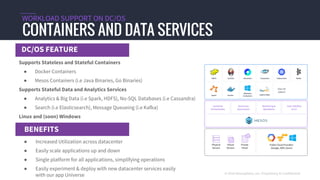
CONTAINERS AND DATA SERVICES
WORKLOAD SUPPORT ON DC/OS
BENEFITS
© 2016 Mesosphere, Inc. Proprietary & Confidential
Supports Stateless and Stateful Containers
● Docker Containers
● Mesos Containers (i.e Java Binaries, Go Binaries)
Supports Stateful Data and Analytics Services
● Analytics & Big Data (i.e Spark, HDFS), No-SQL Databases (i.e Cassandra)
● Search (i.e Elasticsearch), Message Queueing (i.e Kafka)
Linux and (soon) Windows
● Increased Utilization across datacenter
● Easily scale applications up and down
● Single platform for all applications, simplifying operations
● Easily experiment & deploy with new datacenter services easily
with our app Universe
DC/OS FEATURE
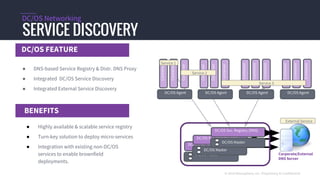
SERVICE DISCOVERY
DC/OS Networking
BENEFITS
© 2016 Mesosphere, Inc. Proprietary & Confidential
DC/OS Master
DC/OS Svc. Registry (DNS)
DC/OS Master
DC/OS Svc. Registry (DNS)
DC/OS Master
DC/OS Svc. Registry (DNS)
Corporate/External
DNS Server
DC/OS Agent
Container
Container
Container
DC/OS Agent
Container
Container
Container
DC/OS Agent
Container
Container
Container
DC/OS Agent
Container
Container
Container
Service 1
Service 2
Service 3
External Service
● DNS-based Service Registry & Distr. DNS Proxy
● Integrated DC/OS Service Discovery
● Integrated External Service Discovery
● Highly available & scalable service registry
● Turn-key solution to deploy micro-services
● Integration with existing non-DC/OS
services to enable brownfield
deployments.
DC/OS FEATURE
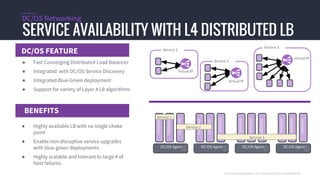
SERVICE AVAILABILITY WITH L4 DISTRIBUTED LB
DC/OS Networking
BENEFITS
© 2016 Mesosphere, Inc. Proprietary & Confidential
DC/OS Agent
Container
Container
Container
DC/OS Agent
Container
Container
Container
DC/OS Agent
Container
Container
Container
DC/OS Agent
Container
Container
Container
Service 1
Service 2
Service 3
Service 2
Virtual IP
Virtual IP
Service 1
Service 3
Virtual IP
● Fast Converging Distributed Load Balancer
● Integrated with DC/OS Service Discovery
● Integrated Blue-Green deployment
● Support for variety of Layer 4 LB algorithms
● Highly available LB with no single choke
point
● Enable non-disruptive service upgrades
with blue-green deployments.
● Highly scalable and tolerant to large # of
host failures.
DC/OS FEATURE
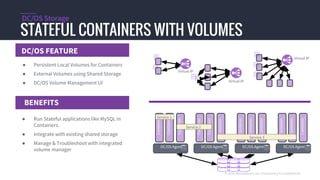
STATEFUL CONTAINERS WITH VOLUMES
DC/OS Storage
BENEFITS
© 2016 Mesosphere, Inc. Proprietary & Confidential
DC/OS Agent
Container
Container
Container
DC/OS Agent
Container
Container
Container
DC/OS Agent
Container
Container
Container
DC/OS Agent
Container
Container
Container
Service 1
Service 2
Service 3
Virtual IP
Virtual IP
Virtual IP
● Persistent Local Volumes for Containers
● External Volumes using Shared Storage
● DC/OS Volume Management UI
● Run Stateful applications like MySQL in
Containers.
● Integrate with existing shared storage
● Manage & Troubleshoot with integrated
volume manager
DC/OS FEATURE
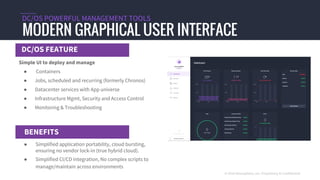
MODERN GRAPHICAL USER INTERFACE
DC/OS POWERFUL MANAGEMENT TOOLS
BENEFITS
© 2016 Mesosphere, Inc. Proprietary & Confidential
Simple UI to deploy and manage
● Containers
● Jobs, scheduled and recurring (formerly Chronos)
● Datacenter services with App universe
● Infrastructure Mgmt, Security and Access Control
● Monitoring & Troubleshooting
● Simplified application portability, cloud bursting,
ensuring no vendor lock-in (true hybrid cloud).
● Simplified CI/CD integration, No complex scripts to
manage/maintain across environments
DC/OS FEATURE
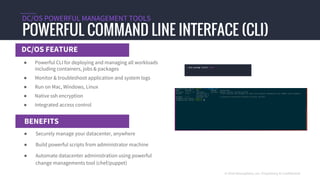
POWERFUL COMMAND LINE INTERFACE (CLI)
DC/OS POWERFUL MANAGEMENT TOOLS
BENEFITS
© 2016 Mesosphere, Inc. Proprietary & Confidential
● Powerful CLI for deploying and managing all workloads
including containers, jobs & packages
● Monitor & troubleshoot application and system logs
● Run on Mac, Windows, Linux
● Native ssh encryption
● Integrated access control
● Securely manage your datacenter, anywhere
● Build powerful scripts from administrator machine
● Automate datacenter administration using powerful
change managements tool (chef/puppet)
Next Steps! Download and try Lagom!
Project Site:
http://www.lightbend.com/lagom
GitHub Repo:
https://github.com/lagom
Documentation:
http://www.lagomframework.com/documentation/1.0.x/Home.html
Example:
https://github.com/typesafehub/activator-lagom-java
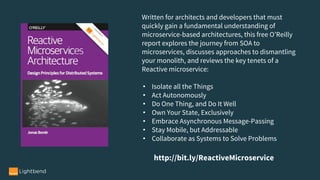
Written for architects and developers that must
quickly gain a fundamental understanding of
microservice-based architectures, this free O’Reilly
report explores the journey from SOA to
microservices, discusses approaches to dismantling
your monolith, and reviews the key tenets of a
Reactive microservice:
• Isolate all the Things
• Act Autonomously
• Do One Thing, and Do It Well
• Own Your State, Exclusively
• Embrace Asynchronous Message-Passing
• Stay Mobile, but Addressable
• Collaborate as Systems to Solve Problems
http://bit.ly/ReactiveMicroservice
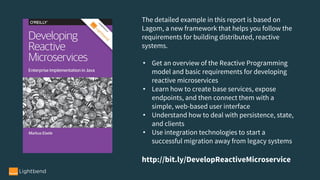
The detailed example in this report is based on
Lagom, a new framework that helps you follow the
requirements for building distributed, reactive
systems.
• Get an overview of the Reactive Programming
model and basic requirements for developing
reactive microservices 
• Learn how to create base services, expose
endpoints, and then connect them with a
simple, web-based user interface
• Understand how to deal with persistence, state,
and clients
• Use integration technologies to start a
successful migration away from legacy systems
http://bit.ly/DevelopReactiveMicroservice
https://www.reactivesummit.org/

Modernizing Applications with Microservices and DC/OS (Lightbend/Mesosphere co-webinar)

  • 1.
    WEBINAR Modernizing Applications with
 Microservices and DC/OS Markus Eisele (@myfear), Lightbend Aaron Williams (@_arw_), Mesosphere
  • 3.
  • 6.
    LL: Building andScaling Monoliths • Monolithic application – everything is package into a single .ear • Reuse primarily by sharing .jars • A “big” push to production once or twice a year • Single database schema for the entire application • >= 500k loc • >= Heavyweight Infrastructure • Thousands of Testcases • Barely New Testcases • >= 20 Team Member • The single .ear requiring a multi-month test cycle / • Huge bug and feature databases • User Acceptance Undefined • Technical Design Approach • Barely Business Components or Domains • Requiring multiple team involvement & significant oversight • Technical Dept • Outdated Runtimes (Licenses, Complex updates) • Grown applications
  • 7.
  • 8.
    New requirements • Ratherthan acting on data at rest, modern software increasingly operates on data in near real-time.  • Shortened time-frames for putting changes into production • New business models evolve from existing ones • New questions need to be answered by existing applications • Datacenter costs need to go down constantly
  • 9.
  • 11.
    Routing Module Tracking Module OrderModule Tracker UIBrowser HistoryDB Order DB RoutesDB Tracker UI Tracker UI Browser Browser
  • 12.
    REQ: Building andScaling Microservices • Lightweight runtime • Cross – Service Security • Transaction Management • Service Scaling • Load Balancing • SLA’s • Flexible Deployment • Configuration • Service Discovery • Service Versions • Monitoring • Governance • Asynchronous communication • Non-blocking I/O • Streaming Data • Polyglot Services • Modularity (Service definition) • High performance persistence (CQRS) • Event handling / messaging (ES) • Eventual consistency • API Management • Health check and recovery
  • 13.
    “Microservices” is alousy term • Size is irrelevant We want flexible systems and organizations that can adapt to their complex environments, make changes without rigid dependencies and coordination, can learn, experiment, and exhibit emergent behavior.
  • 14.
    We need tobuild systems for flexibility and resiliency, not just efficiency and robustness.
  • 15.
    Software Design Outer Architecture Methodologyand Organization Distributed Systems Datacenter Operating System
  • 16.
    Software Design Architecture Principles •Single Responsible Principle • Service Oriented Architecture – Encapsulation – Separation of Concern – Loose Coupling • Hexagonal Architecture Design Patterns • Domain-driven Design • Bounded Contexts • Event Sourcing • CQRS • Eventual Consistency • Context Maps
  • 17.
    Design Best Practices •Design for Automation • Designed for failure • Service load balancing and automatic scaling • Design for Data Separation • Design for Integrity • Design for Performance
  • 18.
    Strategies For Decomposing Verbor Use Case e.g. Checkout UI Noun e.g. Catalog product service Single Responsible Principle e.g. Unix utilities
  • 19.
    • Reactive MicroservicesFramework for the JVM • Focused on right sized services • Asynchronous I/O and communication as first class priorities • Highly productive development environment • Takes you all the way to production What is Lagom?
  • 20.
    • Service API •Persistence API • Development environment • Production environment Highly opinionated
  • 21.
    • Event sourced(deltas) with Cassandra backend by default • No object/relational impedance mismatch • Can always replay to determine current state • Allows you to learn more from your data later • Persistent entity is an Aggregate Root in DDD • Can be overridden for CRUD if you want Lagom Persistence API
  • 22.
  • 23.
  • 24.
  • 26.
    >sbt bundle:dist ... [info] Yourpackage is ready in /Users/myfear/lagom-cargotracker/front- end/target/universal/front-end-1.0- SNAPSHOT.zip Create Service bundles
  • 27.
    Now that wehave our bundles, how do we get into production?
  • 28.
    © 2015 Mesosphere,Inc. All Rights Reserved. 28 Datacenter Operating System (DC/OS) ENTERPRISE MICROSERVICES
  • 29.
    © 2015 Mesosphere,Inc. All Rights Reserved. TOWARDS MICROSERVICES ARCHITECTURE Traditional Architecture Microservices Architecture Small number of large processes with strong inter-dependencies Cross-functional teams creating new microservices without interdependencies RESTAPIs Scales monolithically Many functions in a single process Cross-functional teams organized around capabilities Scales individually Siloed teams Each element of functionality defined as “microservices”
  • 30.
    © 2015 Mesosphere,Inc. All Rights Reserved. 30 THE DATACENTER IS THE NEW SERVER PHYSICAL (x86) VIRTUAL HYPERSCALEMAINFRAME SERVER VIRTUAL MACHINEPARTITION (LPAR) UNIT OF INTERACTION ● ERP, CRM, PRODUCTIVITY, MAIL & WEB SERVER ● LINUX, WINDOWS ● DATA / TRANSACTION PROCESSING ● UNIX, IBM OS/360 DEFINITIVE APPS AND OS ● ERP, CRM, PRODUCTIVITY, MAIL & WEB SERVER ● HYPERVISOR + GUEST OS ● BIG DATA, INTERNET OF THINGS, MOBILE APPS ● ??? ???DATACENTER NEW FORM FACTOR FOR DEVELOPING AND RUNNING APPS ● BIG DATA, INTERNET OF THINGS, MOBILE APPS ● DATACENTER OPERATING SYSTEM (DCOS)
  • 31.
    © 2015 Mesosphere,Inc. All Rights Reserved. Datacenter Operating System (DCOS) Distributed Systems Kernel (Apache Mesos) DC/OS ACCELERATES ENTERPRISES TO A MODERN CLOUD STACK WITH THE DATACENTER FORM FACTOR Big Data + Analytics EnginesMicroservices (in containers) Streaming Batch Machine Learning Analytics Functions & Logic Search Time Series SQL / NoSQL Databases Modern Cloud App Components Distributed systems kernel to abstract resources Killer “apps” ecosystem Cont Integration/Cont Delivery Framework “app” architecture to consistently run on top of kernel User Interface (GUI & CLI) Core system services (e.g., distributed init, cron, service discovery, package mgt & installer, storage) Any Infrastructure (Physical, Virtual, Cloud)
  • 32.
    DC/OS FEATURE PRODUCTION PROVENTECHNOLOGY AT SCALE DC/OS ARCHITECTURE BENEFITS © 2016 Mesosphere, Inc. Proprietary & Confidential ● DC/OS is built on the production-proven Apache Mesos and Marathon ● Built and refined with best practices by some of the world's top experts in distributed systems ● Tested to 10s of thousands of nodes in production for more than 6+ years in production ● Designed for resiliency and scale from day 1 ● Reliable, mature technology with years of bug fixing, reduce risk of downtime for mission critical workloads ● Easily expand from small to very large clusters with confidence ● Open source core prevents vendor lock-in
  • 33.
    DC/OS FEATURE MODERN DISTRIBUTEDHIGH AVAILABILITY DC/OS ARCHITECTURE BENEFITS © 2016 Mesosphere, Inc. Proprietary & Confidential ● No SPOF, N+1 Architecture ● Integrated KV Store, DB & load balancing for seamless failover and maintenance ● Turn-key solution, no external dependencies for HA ● Agent crash, restart & upgrade does not affect workloads ● Erlang based distributed networking stack for on the fly upgrade ● Non disruptive failover and upgrade for masters and agents ● Highest uptime for scalable masters, agents and workloads ● No manual intervention in case of master/agent failover ● Easily move to the latest DC/OS release ● Resilience to network partitioning & split brain scenarios
  • 34.
    DC/OS FEATURE CONTAINERS ANDDATA SERVICES WORKLOAD SUPPORT ON DC/OS BENEFITS © 2016 Mesosphere, Inc. Proprietary & Confidential Supports Stateless and Stateful Containers ● Docker Containers ● Mesos Containers (i.e Java Binaries, Go Binaries) Supports Stateful Data and Analytics Services ● Analytics & Big Data (i.e Spark, HDFS), No-SQL Databases (i.e Cassandra) ● Search (i.e Elasticsearch), Message Queueing (i.e Kafka) Linux and (soon) Windows ● Increased Utilization across datacenter ● Easily scale applications up and down ● Single platform for all applications, simplifying operations ● Easily experiment & deploy with new datacenter services easily with our app Universe
  • 35.
    DC/OS FEATURE SERVICE DISCOVERY DC/OSNetworking BENEFITS © 2016 Mesosphere, Inc. Proprietary & Confidential DC/OS Master DC/OS Svc. Registry (DNS) DC/OS Master DC/OS Svc. Registry (DNS) DC/OS Master DC/OS Svc. Registry (DNS) Corporate/External DNS Server DC/OS Agent Container Container Container DC/OS Agent Container Container Container DC/OS Agent Container Container Container DC/OS Agent Container Container Container Service 1 Service 2 Service 3 External Service ● DNS-based Service Registry & Distr. DNS Proxy ● Integrated DC/OS Service Discovery ● Integrated External Service Discovery ● Highly available & scalable service registry ● Turn-key solution to deploy micro-services ● Integration with existing non-DC/OS services to enable brownfield deployments.
  • 36.
    DC/OS FEATURE SERVICE AVAILABILITYWITH L4 DISTRIBUTED LB DC/OS Networking BENEFITS © 2016 Mesosphere, Inc. Proprietary & Confidential DC/OS Agent Container Container Container DC/OS Agent Container Container Container DC/OS Agent Container Container Container DC/OS Agent Container Container Container Service 1 Service 2 Service 3 Service 2 Virtual IP Virtual IP Service 1 Service 3 Virtual IP ● Fast Converging Distributed Load Balancer ● Integrated with DC/OS Service Discovery ● Integrated Blue-Green deployment ● Support for variety of Layer 4 LB algorithms ● Highly available LB with no single choke point ● Enable non-disruptive service upgrades with blue-green deployments. ● Highly scalable and tolerant to large # of host failures.
  • 37.
    DC/OS FEATURE STATEFUL CONTAINERSWITH VOLUMES DC/OS Storage BENEFITS © 2016 Mesosphere, Inc. Proprietary & Confidential DC/OS Agent Container Container Container DC/OS Agent Container Container Container DC/OS Agent Container Container Container DC/OS Agent Container Container Container Service 1 Service 2 Service 3 Virtual IP Virtual IP Virtual IP ● Persistent Local Volumes for Containers ● External Volumes using Shared Storage ● DC/OS Volume Management UI ● Run Stateful applications like MySQL in Containers. ● Integrate with existing shared storage ● Manage & Troubleshoot with integrated volume manager
  • 38.
    DC/OS FEATURE MODERN GRAPHICALUSER INTERFACE DC/OS POWERFUL MANAGEMENT TOOLS BENEFITS © 2016 Mesosphere, Inc. Proprietary & Confidential Simple UI to deploy and manage ● Containers ● Jobs, scheduled and recurring (formerly Chronos) ● Datacenter services with App universe ● Infrastructure Mgmt, Security and Access Control ● Monitoring & Troubleshooting ● Simplified application portability, cloud bursting, ensuring no vendor lock-in (true hybrid cloud). ● Simplified CI/CD integration, No complex scripts to manage/maintain across environments
  • 39.
    DC/OS FEATURE POWERFUL COMMANDLINE INTERFACE (CLI) DC/OS POWERFUL MANAGEMENT TOOLS BENEFITS © 2016 Mesosphere, Inc. Proprietary & Confidential ● Powerful CLI for deploying and managing all workloads including containers, jobs & packages ● Monitor & troubleshoot application and system logs ● Run on Mac, Windows, Linux ● Native ssh encryption ● Integrated access control ● Securely manage your datacenter, anywhere ● Build powerful scripts from administrator machine ● Automate datacenter administration using powerful change managements tool (chef/puppet)
  • 41.
    Next Steps! Downloadand try Lagom! Project Site: http://www.lightbend.com/lagom GitHub Repo: https://github.com/lagom Documentation: http://www.lagomframework.com/documentation/1.0.x/Home.html Example: https://github.com/typesafehub/activator-lagom-java
  • 42.
    Written for architectsand developers that must quickly gain a fundamental understanding of microservice-based architectures, this free O’Reilly report explores the journey from SOA to microservices, discusses approaches to dismantling your monolith, and reviews the key tenets of a Reactive microservice: • Isolate all the Things • Act Autonomously • Do One Thing, and Do It Well • Own Your State, Exclusively • Embrace Asynchronous Message-Passing • Stay Mobile, but Addressable • Collaborate as Systems to Solve Problems http://bit.ly/ReactiveMicroservice
  • 43.
    The detailed examplein this report is based on Lagom, a new framework that helps you follow the requirements for building distributed, reactive systems. • Get an overview of the Reactive Programming model and basic requirements for developing reactive microservices  • Learn how to create base services, expose endpoints, and then connect them with a simple, web-based user interface • Understand how to deal with persistence, state, and clients • Use integration technologies to start a successful migration away from legacy systems http://bit.ly/DevelopReactiveMicroservice
  • 44.