Cloud Software Environments
ExploringAWS, Azure, and Google Cloud Platform
Course: Cloud Computing & Virtualization
Prepared & Compiled By: Prof. Bhupendra Panchal
2.
The Cloud ComputingRevolution
Cloud computing has fundamentally transformed how businesses access and
utilize technology resources. Rather than investing in expensive physical
infrastructure, organizations can now access computing power, storage, and
applications on-demand through the internet.
This paradigm shift offers unprecedented flexibility with a pay-as-you-go model
that scales automatically based on demand. From individual developers to Fortune
500 companies, cloud computing has democratized access to enterprise-grade
technology resources.
The global cloud market continues expanding rapidly, driven by digital
transformation initiatives and the need for remote accessibility in our increasingly
connected world.
3.
Understanding Cloud ServiceProviders
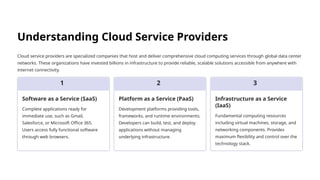
Cloud service providers are specialized companies that host and deliver comprehensive cloud computing services through global data center
networks. These organizations have invested billions in infrastructure to provide reliable, scalable solutions accessible from anywhere with
internet connectivity.
1
Software as a Service (SaaS)
Complete applications ready for
immediate use, such as Gmail,
Salesforce, or Microsoft Office 365.
Users access fully functional software
through web browsers.
2
Platform as a Service (PaaS)
Development platforms providing tools,
frameworks, and runtime environments.
Developers can build, test, and deploy
applications without managing
underlying infrastructure.
3
Infrastructure as a Service
(IaaS)
Fundamental computing resources
including virtual machines, storage, and
networking components. Provides
maximum flexibility and control over the
technology stack.
4.
Why Choose CloudService Providers?
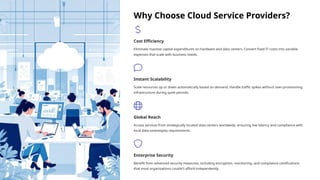
Cost Efficiency
Eliminate massive capital expenditures on hardware and data centers. Convert fixed IT costs into variable
expenses that scale with business needs.
Instant Scalability
Scale resources up or down automatically based on demand. Handle traffic spikes without over-provisioning
infrastructure during quiet periods.
Global Reach
Access services from strategically located data centers worldwide, ensuring low latency and compliance with
local data sovereignty requirements.
Enterprise Security
Benefit from advanced security measures, including encryption, monitoring, and compliance certifications
that most organizations couldn't afford independently.
5.
Amazon Web Services(AWS)
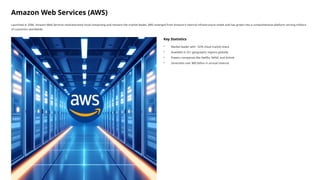
Launched in 2006, Amazon Web Services revolutionized cloud computing and remains the market leader. AWS emerged from Amazon's internal infrastructure needs and has grown into a comprehensive platform serving millions
of customers worldwide.
Key Statistics
• Market leader with ~32% cloud market share
• Available in 32+ geographic regions globally
• Powers companies like Netflix, NASA, and Airbnb
• Generates over $80 billion in annual revenue
6.
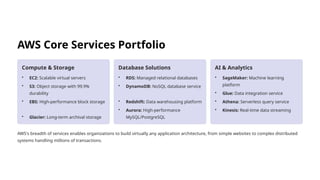
AWS Core ServicesPortfolio
Compute & Storage
• EC2: Scalable virtual servers
• S3: Object storage with 99.9%
durability
• EBS: High-performance block storage
• Glacier: Long-term archival storage
Database Solutions
• RDS: Managed relational databases
• DynamoDB: NoSQL database service
• Redshift: Data warehousing platform
• Aurora: High-performance
MySQL/PostgreSQL
AI & Analytics
• SageMaker: Machine learning
platform
• Glue: Data integration service
• Athena: Serverless query service
• Kinesis: Real-time data streaming
AWS's breadth of services enables organizations to build virtually any application architecture, from simple websites to complex distributed
systems handling millions of transactions.
7.
Microsoft Azure: EnterpriseCloud Leader
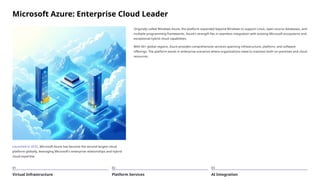
Launched in 2010, Microsoft Azure has become the second-largest cloud
platform globally, leveraging Microsoft's enterprise relationships and hybrid
cloud expertise.
Originally called Windows Azure, the platform expanded beyond Windows to support Linux, open-source databases, and
multiple programming frameworks. Azure's strength lies in seamless integration with existing Microsoft ecosystems and
exceptional hybrid cloud capabilities.
With 60+ global regions, Azure provides comprehensive services spanning infrastructure, platform, and software
offerings. The platform excels in enterprise scenarios where organizations need to maintain both on-premises and cloud
resources.
01
Virtual Infrastructure
02
Platform Services
03
AI Integration
8.
Google Cloud Platform:
InnovationEngine
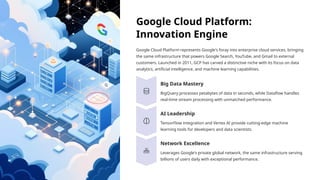
Google Cloud Platform represents Google's foray into enterprise cloud services, bringing
the same infrastructure that powers Google Search, YouTube, and Gmail to external
customers. Launched in 2011, GCP has carved a distinctive niche with its focus on data
analytics, artificial intelligence, and machine learning capabilities.
Big Data Mastery
BigQuery processes petabytes of data in seconds, while Dataflow handles
real-time stream processing with unmatched performance.
AI Leadership
TensorFlow integration and Vertex AI provide cutting-edge machine
learning tools for developers and data scientists.
Network Excellence
Leverages Google's private global network, the same infrastructure serving
billions of users daily with exceptional performance.
9.
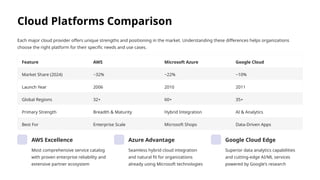
Cloud Platforms Comparison
Eachmajor cloud provider offers unique strengths and positioning in the market. Understanding these differences helps organizations
choose the right platform for their specific needs and use cases.
Feature AWS Microsoft Azure Google Cloud
Market Share (2024) ~32% ~22% ~10%
Launch Year 2006 2010 2011
Global Regions 32+ 60+ 35+
Primary Strength Breadth & Maturity Hybrid Integration AI & Analytics
Best For Enterprise Scale Microsoft Shops Data-Driven Apps
AWS Excellence
Most comprehensive service catalog
with proven enterprise reliability and
extensive partner ecosystem
Azure Advantage
Seamless hybrid cloud integration
and natural fit for organizations
already using Microsoft technologies
Google Cloud Edge
Superior data analytics capabilities
and cutting-edge AI/ML services
powered by Google's research
10.
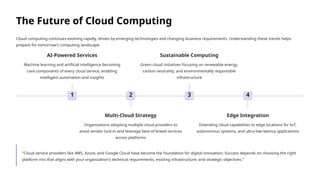
The Future ofCloud Computing
Cloud computing continues evolving rapidly, driven by emerging technologies and changing business requirements. Understanding these trends helps
prepare for tomorrow's computing landscape.
1
AI-Powered Services
Machine learning and artificial intelligence becoming
core components of every cloud service, enabling
intelligent automation and insights
2
Multi-Cloud Strategy
Organizations adopting multiple cloud providers to
avoid vendor lock-in and leverage best-of-breed services
across platforms
3
Sustainable Computing
Green cloud initiatives focusing on renewable energy,
carbon neutrality, and environmentally responsible
infrastructure
4
Edge Integration
Extending cloud capabilities to edge locations for IoT,
autonomous systems, and ultra-low latency applications
"Cloud service providers like AWS, Azure, and Google Cloud have become the foundation for digital innovation. Success depends on choosing the right
platform mix that aligns with your organization's technical requirements, existing infrastructure, and strategic objectives."