Model2Roo: Web Application
Development based on the Eclipse
Modeling Framework and Spring Roo
Juan Castrejón, Genoveva Vargas-Solar, Rafael Lozano
University of Grenoble, CNRS, Tecnológico de Monterrey


ACME 2012
2


Background
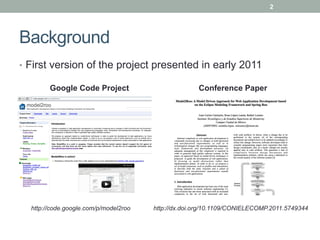
•  First version of the project presented in early 2011

        Google Code Project                          Conference Paper


  http://code.google.com/p/model2roo   http://dx.doi.org/10.1109/CONIELECOMP.2011.5749344
3


Objective
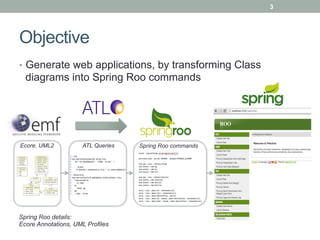
•  Generate web applications, by transforming Class
  diagrams into Spring Roo commands


Ecore, UML2          ATL Queries   Spring Roo commands


Spring Roo details:
Ecore Annotations, UML Profiles
4


Related work
•  Web application development based on MDE techniques
 is a widely studied topic
 •  Web Modeling Language (WebML), WebRatio
 •  UWE approach
 •  Acceleo generators


•  However, Model2Roo provides an association to modern
 development tools, through the Spring Roo project
 •  Spring Roo is responsible for the actual code generation
 •  Access to a wide variety of SpringSource projects
5


User-identified issues
1.  Insufficient support for graphical environments
   •  Limited support for complex UML editors, such as Papyrus
   •  Limited support for numeric data types


2.  Basic edition of Spring Roo properties
   •  Spring Roo properties could only be set as free text
   •  Users were required to know the domains for each property


3.  Troublesome installation procedure
   •  Tool deployed as a single plugin file
   •  Manual installation of the required dependencies (ATL, Papyrus)
6


Technical issues
1.  Maintenance of ATL queries
   •  Not a standard Model-To-Text specification


2.  Output Spring Roo commands into a file
   •  ATL was designed primarily for M2M not for M2T
   •  In order to generate files, we had to modify ATL loggers
   •  Not an elegant solution, prone to subtle errors


3.  Invocation of ATL queries from Eclipse plugin
   •  Limited documentation
7


Recent improvements
1.  Transformations implemented as Acceleo templates
   •  Standard notation (MOFM2T)
   •  Powerful syntax editors
   •  Automatic generation of UI Launcher projects (Eclipse plugin)


2.  Improved edition of Spring Roo properties
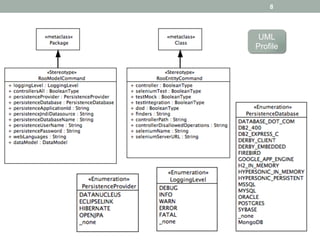
   •  Full support for Papyrus profiles (UML)
   •  Properties domains are specified in the UML profiles
   •  Fixed support for Ecore Annotations


3.  Improved installation procedure
   •  Eclipse update site containing all required dependencies
8


 UML
Profile
9


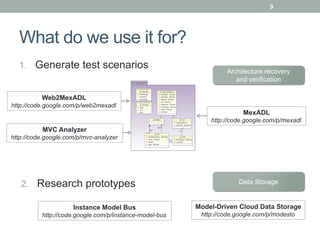
  What do we use it for?
  1.  Generate test scenarios
                                                                 Architecture recovery
                                                                    and verification

          Web2MexADL
http://code.google.com/p/web2mexadl
                                                                       MexADL
                                                            http://code.google.com/p/mexadl
          MVC Analyzer
http://code.google.com/p/mvc-analyzer


   2.  Research prototypes                                           Data Storage


                     Instance Model Bus                 Model-Driven Cloud Data Storage
          http://code.google.com/p/instance-model-bus    http://code.google.com/p/modesto
10


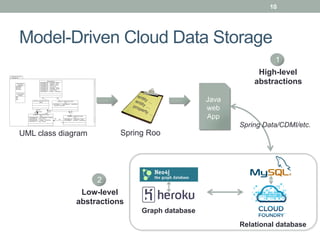
Model-Driven Cloud Data Storage
                                                                1
                                                           High-level
                                                          abstractions

                                               Java
                                               web
                                               App
                                                      Spring Data/CDMI/etc.
UML class diagram        Spring Roo


                    2
               Low-level
              abstractions
                              Graph database
                                                      Relational database
11


Demonstration / Questions


  Contact: Juan.Castrejon@imag.fr

Model2Roo - ACME

  • 1.
    Model2Roo: Web Application Developmentbased on the Eclipse Modeling Framework and Spring Roo Juan Castrejón, Genoveva Vargas-Solar, Rafael Lozano University of Grenoble, CNRS, Tecnológico de Monterrey ACME 2012
  • 2.
    2 Background •  First versionof the project presented in early 2011 Google Code Project Conference Paper http://code.google.com/p/model2roo http://dx.doi.org/10.1109/CONIELECOMP.2011.5749344
  • 3.
    3 Objective •  Generate webapplications, by transforming Class diagrams into Spring Roo commands Ecore, UML2 ATL Queries Spring Roo commands Spring Roo details: Ecore Annotations, UML Profiles
  • 4.
    4 Related work •  Webapplication development based on MDE techniques is a widely studied topic •  Web Modeling Language (WebML), WebRatio •  UWE approach •  Acceleo generators •  However, Model2Roo provides an association to modern development tools, through the Spring Roo project •  Spring Roo is responsible for the actual code generation •  Access to a wide variety of SpringSource projects
  • 5.
    5 User-identified issues 1.  Insufficientsupport for graphical environments •  Limited support for complex UML editors, such as Papyrus •  Limited support for numeric data types 2.  Basic edition of Spring Roo properties •  Spring Roo properties could only be set as free text •  Users were required to know the domains for each property 3.  Troublesome installation procedure •  Tool deployed as a single plugin file •  Manual installation of the required dependencies (ATL, Papyrus)
  • 6.
    6 Technical issues 1.  Maintenanceof ATL queries •  Not a standard Model-To-Text specification 2.  Output Spring Roo commands into a file •  ATL was designed primarily for M2M not for M2T •  In order to generate files, we had to modify ATL loggers •  Not an elegant solution, prone to subtle errors 3.  Invocation of ATL queries from Eclipse plugin •  Limited documentation
  • 7.
    7 Recent improvements 1.  Transformationsimplemented as Acceleo templates •  Standard notation (MOFM2T) •  Powerful syntax editors •  Automatic generation of UI Launcher projects (Eclipse plugin) 2.  Improved edition of Spring Roo properties •  Full support for Papyrus profiles (UML) •  Properties domains are specified in the UML profiles •  Fixed support for Ecore Annotations 3.  Improved installation procedure •  Eclipse update site containing all required dependencies
  • 8.
  • 9.
    9 Whatdo we use it for? 1.  Generate test scenarios Architecture recovery and verification Web2MexADL http://code.google.com/p/web2mexadl MexADL http://code.google.com/p/mexadl MVC Analyzer http://code.google.com/p/mvc-analyzer 2.  Research prototypes Data Storage Instance Model Bus Model-Driven Cloud Data Storage http://code.google.com/p/instance-model-bus http://code.google.com/p/modesto
  • 10.
    10 Model-Driven Cloud DataStorage 1 High-level abstractions Java web App Spring Data/CDMI/etc. UML class diagram Spring Roo 2 Low-level abstractions Graph database Relational database
  • 11.
    11 Demonstration / Questions Contact: Juan.Castrejon@imag.fr