Report
NAME- Priyanka FNU
ID – 99999-1305
STATUS – CPT
ROLE – Java Developer (Intern)
Training:
 Hibernate ORM tool
 JPA
 Spring framework
-> Spring IOC or Dependancy Injection(DI)
-> Spring MVC
-> Spring AOP
-> Spring JDBC
-> Spring Transactions
-> Spring Security
 Restful web service
Hibernate :-
Hibernate framework simplifies the development of java application to interact with
the database. Hibernate is an open source, lightweight, ORM (Object Relational
Mapping) tool.
An ORM tool simplifies the data creation, data manipulation and data access. It is a
programming technique that maps the object to the data stored in the database.
The ORM tool internally uses the JDBC API to interact with the database.
Advantages of Hibernate Framework
There are many advantages of Hibernate Framework. They are as follows:
1) Opensource and Lightweight: Hibernate framework is opensource under the LGPL
license and lightweight.
2) Fast performance: The performance of hibernate framework is fast because cache is
internally used in hibernate framework. There are two types of cache in hibernate framework
first level cache and second level cache. First level cache is enabled bydefault.
3) Database Independent query: HQL (Hibernate Query Language) is the object-oriented
version of SQL. It generates the database independent queries. So you don't need to write
database specific queries. Before Hibernate, If database is changed for the project, we need
to change the SQL query as well that leads to the maintenance problem.
4) Automatic table creation: Hibernate framework provides the facility to create the tables
of the database automatically. So there is no need to create tables in the database manually.
5) Simplifies complex join: To fetch data form multiple tables is easy in hibernate
framework.
6) Provides query statistics and database status: Hibernate supports Query cache and
provide statistics about query and database status.
Spring :-
Spring is a lightweight framework. It can be thought of as a framework of
frameworks because it provides support to various frameworks such as Struts,
Hibernate, Tapestry, EJB, JSF etc. The framework, in broader sense, can be defined
as a structure where we find solution of the various technical problems.
The Spring framework comprises several modules such as IOC, AOP, DAO, Context,
ORM, WEB MVC etc.
Advantages of Spring Framework
There are many advantages of Spring Framework. They are as follows:
1) Predefined Templates
Spring framework provides templates for JDBC, Hibernate, JPA etc. technologies. So
there is no need to write too much code. It hides the basic steps of these
technologies.
Let's take the example of JdbcTemplate, you don't need to write the code for
exception handling, creating connection, creating statement, committing transaction,
closing connection etc. You need to write the code of executing query only. Thus, it
save a lot of JDBC code.
2) Loose Coupling
The Spring applications are loosely coupled because of dependency injection.
3) Easy to test
The Dependency Injection makes easier to test the application. The EJB or Struts
application require server to run the application but Spring framework doesn't require
server.
4) Lightweight
Spring framework is lightweight because of its POJO implementation. The Spring
Framework doesn't force the programmer to inherit any class or implement any
interface. That is why it is said non-invasive.
5) Fast Development
The Dependency Injection feature of Spring Framework and it support to various
frameworks makes the easy development of JavaEE application.
6) Powerful abstraction
It provides powerful abstraction to JavaEE specifications such as JMS, JDBC, JPA and
JTA.
7) Declarative support
It provides declarative support for caching, validation, transactions and formatting.
Restful Webservices
> REST stands for REpresentational State Transfer
> REST is an architectural style not a protocol.
Advantages of RESTful Web Services
Fast: RESTful Web Services are fast because there is no strict specification like SOAP.
It consumes less bandwidth and resource.
Language and Platform independent: RESTful web services can be written in any
programming language and executed in any platform.
Can use SOAP: RESTful web services can use SOAP web services as the
implementation.
Permits different data format: RESTful web service permits different data format
such as Plain Text, HTML, XML and JSON.
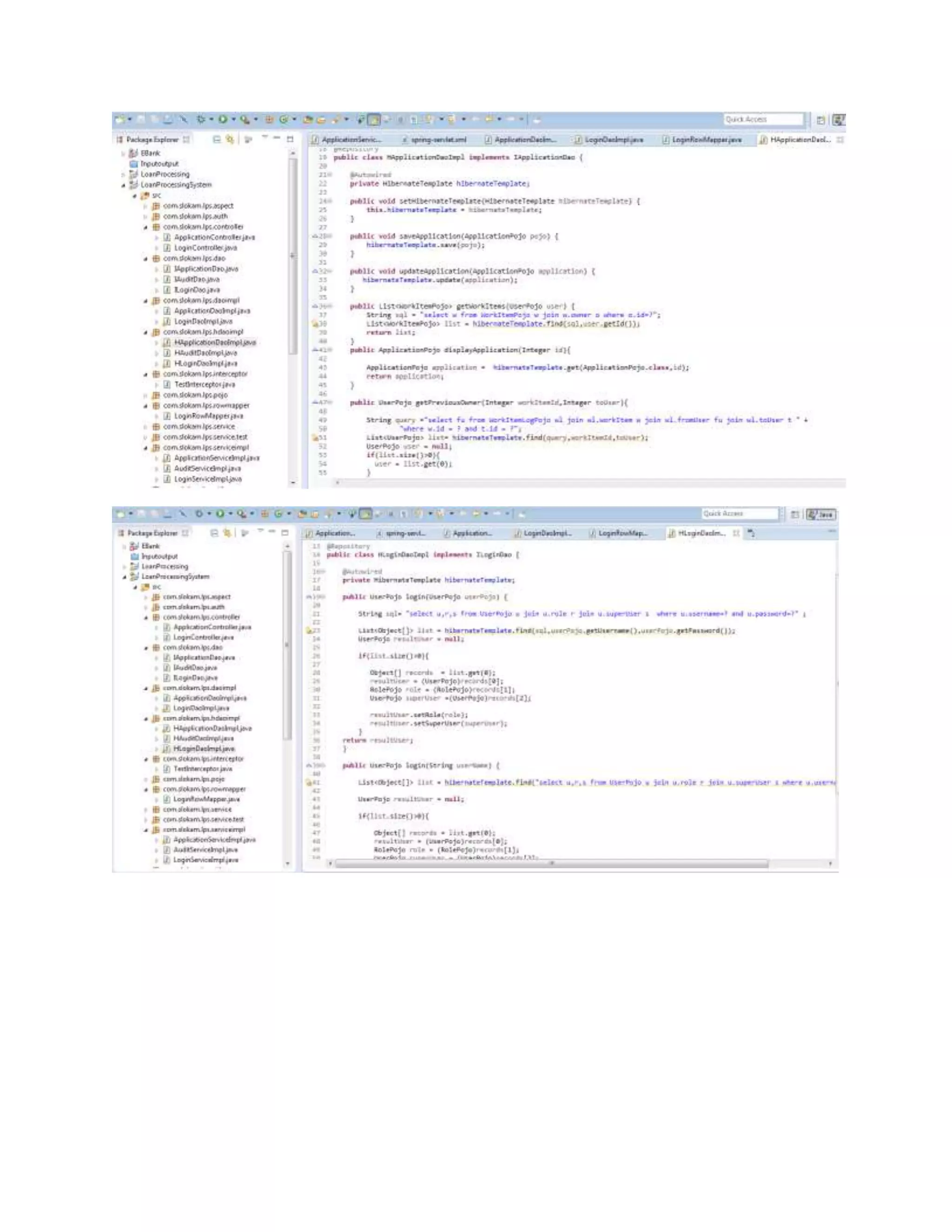
ScreenShots of Implementation :-
Month 3 report
Month 3 report

Month 3 report

  • 1.
    Report NAME- Priyanka FNU ID– 99999-1305 STATUS – CPT ROLE – Java Developer (Intern) Training:  Hibernate ORM tool  JPA  Spring framework -> Spring IOC or Dependancy Injection(DI) -> Spring MVC -> Spring AOP -> Spring JDBC -> Spring Transactions -> Spring Security  Restful web service
  • 2.
    Hibernate :- Hibernate frameworksimplifies the development of java application to interact with the database. Hibernate is an open source, lightweight, ORM (Object Relational Mapping) tool. An ORM tool simplifies the data creation, data manipulation and data access. It is a programming technique that maps the object to the data stored in the database. The ORM tool internally uses the JDBC API to interact with the database. Advantages of Hibernate Framework There are many advantages of Hibernate Framework. They are as follows: 1) Opensource and Lightweight: Hibernate framework is opensource under the LGPL license and lightweight. 2) Fast performance: The performance of hibernate framework is fast because cache is internally used in hibernate framework. There are two types of cache in hibernate framework first level cache and second level cache. First level cache is enabled bydefault. 3) Database Independent query: HQL (Hibernate Query Language) is the object-oriented version of SQL. It generates the database independent queries. So you don't need to write database specific queries. Before Hibernate, If database is changed for the project, we need to change the SQL query as well that leads to the maintenance problem. 4) Automatic table creation: Hibernate framework provides the facility to create the tables of the database automatically. So there is no need to create tables in the database manually. 5) Simplifies complex join: To fetch data form multiple tables is easy in hibernate framework. 6) Provides query statistics and database status: Hibernate supports Query cache and provide statistics about query and database status.
  • 3.
    Spring :- Spring isa lightweight framework. It can be thought of as a framework of frameworks because it provides support to various frameworks such as Struts, Hibernate, Tapestry, EJB, JSF etc. The framework, in broader sense, can be defined as a structure where we find solution of the various technical problems. The Spring framework comprises several modules such as IOC, AOP, DAO, Context, ORM, WEB MVC etc. Advantages of Spring Framework There are many advantages of Spring Framework. They are as follows: 1) Predefined Templates Spring framework provides templates for JDBC, Hibernate, JPA etc. technologies. So there is no need to write too much code. It hides the basic steps of these technologies. Let's take the example of JdbcTemplate, you don't need to write the code for exception handling, creating connection, creating statement, committing transaction, closing connection etc. You need to write the code of executing query only. Thus, it save a lot of JDBC code. 2) Loose Coupling The Spring applications are loosely coupled because of dependency injection. 3) Easy to test The Dependency Injection makes easier to test the application. The EJB or Struts application require server to run the application but Spring framework doesn't require server. 4) Lightweight Spring framework is lightweight because of its POJO implementation. The Spring Framework doesn't force the programmer to inherit any class or implement any interface. That is why it is said non-invasive. 5) Fast Development The Dependency Injection feature of Spring Framework and it support to various frameworks makes the easy development of JavaEE application.
  • 4.
    6) Powerful abstraction Itprovides powerful abstraction to JavaEE specifications such as JMS, JDBC, JPA and JTA. 7) Declarative support It provides declarative support for caching, validation, transactions and formatting. Restful Webservices > REST stands for REpresentational State Transfer > REST is an architectural style not a protocol. Advantages of RESTful Web Services Fast: RESTful Web Services are fast because there is no strict specification like SOAP. It consumes less bandwidth and resource. Language and Platform independent: RESTful web services can be written in any programming language and executed in any platform. Can use SOAP: RESTful web services can use SOAP web services as the implementation. Permits different data format: RESTful web service permits different data format such as Plain Text, HTML, XML and JSON.
  • 5.