Model Organism
Unit-2
Definition
Models are those organisms with a wealth of biological data that make
them attractive to study as examples for other species and/or natural
phenomena that are more difficult to study directly.
Why???
• Studying model organisms can be informative, but care must be taken
when generalizing from one organism to another.
• Often, model organisms (animals and plants) are chosen on the basis
that they are amenable to experimental manipulation.
• This usually will include characteristics such as short life-cycle,
techniques for genetic manipulation (inbred strains, stem cell lines,
and methods of transformation) and non-specialist living
requirements.
Why???
• Sometimes, the genome arrangement facilitates the sequencing of
the model organism’s genome, such as by being very compact or
having a low proportion of junk DNA (e.g., yeast, Arabidopsis, or
puffer fish).
• When researchers look for an organism to use in their studies in
Molecular Biology or biomedical researches, they look for several
traits.
• Among these are size, generation time, accessibility, manipulation,
genetics, conservation of mechanisms and potential economic
benefit.
Example
There are many model organisms. One of the first model systems for Molecular
Biology was the bacterium Escherichia coli (a Gram negative prokaryotic model
organism), which is a common constituent of the human digestive system.
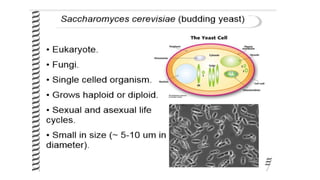
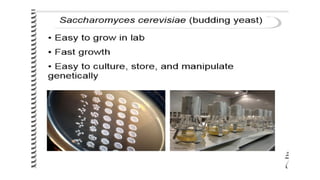
In eukaryotes, several yeasts, particularly Saccharomyces cerevisiae (baker’s or
budding yeast), have been widely used in Genetics and Cell Biology, largely
because they are quick and easy to grow.
The cell cycle in simple yeast is very similar to the cell cycle in humans, and is
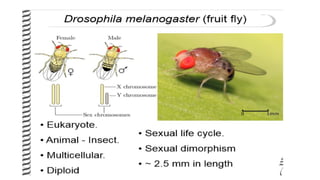
regulated by homologous proteins. The fruit fly, e.g., Drosophila melanogaster
(one of the most famous subjects for experiments) is studied again, because it is
easy to grow for an animal, and has various visible congenital traits and has a
polytene (giant) chromosome in its salivary glands that can be examined under a
light microscope.
Example
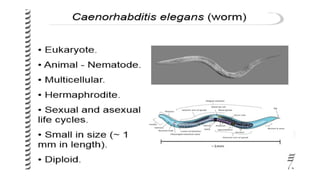
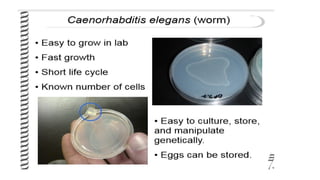
A roundworm (nematode), Caenorhabditis elegans is studied because it
has very defined development patterns involving fixed numbers of cells,
and it can be rapidly assayed for abnormalities.
Arabidopsis thaliana
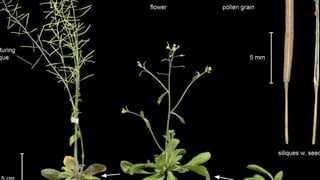
Arabidopsis thaliana is a small flowering plant that is widely used as
a model organism in plant biology. Arabidopsis is a member of the
mustard (Brassicaceae) family, which includes cultivated species such as
cabbage and radish.
Arabidopsis Thaliana is a model organism used to determine specific
defense mechanisms of plant-pathogen resistance. These plants have
special receptors on their cell surfaces that allow for detection of
pathogens and initiate mechanisms to inhibit pathogen growth.
Arabidopsis thaliana
Arabidopsis was originally adopted as a model organism because of its
usefulness for genetic experiments. Important features included a short
generation time, small size that limited the requirement for growth
facilities, and prolific seed production through self-pollination.
Model  Organism what and why it is required, examples

Model Organism what and why it is required, examples

  • 1.
  • 2.
    Definition Models are thoseorganisms with a wealth of biological data that make them attractive to study as examples for other species and/or natural phenomena that are more difficult to study directly.
  • 3.
    Why??? • Studying modelorganisms can be informative, but care must be taken when generalizing from one organism to another. • Often, model organisms (animals and plants) are chosen on the basis that they are amenable to experimental manipulation. • This usually will include characteristics such as short life-cycle, techniques for genetic manipulation (inbred strains, stem cell lines, and methods of transformation) and non-specialist living requirements.
  • 4.
    Why??? • Sometimes, thegenome arrangement facilitates the sequencing of the model organism’s genome, such as by being very compact or having a low proportion of junk DNA (e.g., yeast, Arabidopsis, or puffer fish). • When researchers look for an organism to use in their studies in Molecular Biology or biomedical researches, they look for several traits. • Among these are size, generation time, accessibility, manipulation, genetics, conservation of mechanisms and potential economic benefit.
  • 5.
    Example There are manymodel organisms. One of the first model systems for Molecular Biology was the bacterium Escherichia coli (a Gram negative prokaryotic model organism), which is a common constituent of the human digestive system. In eukaryotes, several yeasts, particularly Saccharomyces cerevisiae (baker’s or budding yeast), have been widely used in Genetics and Cell Biology, largely because they are quick and easy to grow. The cell cycle in simple yeast is very similar to the cell cycle in humans, and is regulated by homologous proteins. The fruit fly, e.g., Drosophila melanogaster (one of the most famous subjects for experiments) is studied again, because it is easy to grow for an animal, and has various visible congenital traits and has a polytene (giant) chromosome in its salivary glands that can be examined under a light microscope.
  • 6.
    Example A roundworm (nematode),Caenorhabditis elegans is studied because it has very defined development patterns involving fixed numbers of cells, and it can be rapidly assayed for abnormalities.
  • 12.
    Arabidopsis thaliana Arabidopsis thalianais a small flowering plant that is widely used as a model organism in plant biology. Arabidopsis is a member of the mustard (Brassicaceae) family, which includes cultivated species such as cabbage and radish. Arabidopsis Thaliana is a model organism used to determine specific defense mechanisms of plant-pathogen resistance. These plants have special receptors on their cell surfaces that allow for detection of pathogens and initiate mechanisms to inhibit pathogen growth.
  • 13.
    Arabidopsis thaliana Arabidopsis wasoriginally adopted as a model organism because of its usefulness for genetic experiments. Important features included a short generation time, small size that limited the requirement for growth facilities, and prolific seed production through self-pollination.