“ STARTING IN THE NAME OF ALLAH, THE MOST BENEFICENT, THE MOST MERCIFUL"
MADE BY:
SIDRA IFTIKHAR
M.Sc (MICROBIOLOGY)
MOLECULAR BIOLOGY AND VIROLOGY
GENETIC MODEL ORGANISMS
PART # 01
Model organisms—organisms studied by
many different researchers so they can
compare their results and determine scientific
principles that apply more broadly to other
species.
GENETIC MODEL ORGANISMS
1. a short generation time, and so several generations of genetic crosses can
be examined in reasonable time;
2. the production of numerous progeny, and so genetic ratios can be easily
observed;
3. the ability to carry out and control genetic crosses in the organism;
4. the ability to be reared in a laboratory environment, requiring little space
and few resources to maintain;
5. the availability of numerous genetic variants;
6. and an accumulated body of knowledge about their genetic systems.
KEY FEATURES OF GENETIC
MODEL ORGANISMS
Drosophila melanogaster
(fruit fly)
STATS
Taxonomy Insect
Size: 2–3 mm in length
Anatomy 3 body segments, 6 legs, 1 pair of wings
Habitat Feeds and reproduces on fruit
ADVANTAGES
1 Small size
2 Short generation time of 10 days at room temperature
3 Each female lays 400–500 eggs
4 Easy to culture in laboratory
5 Small genome
6 Large chromosomes except 4 chromosome pair
7 Many mutations available
Drosophila melanogaster
(fruit fly)
GENOME
Chromosomes 3 pairs of autosomes and X and Y (2n = 8)
Amount of DNA 175 million base pairs
Number of genes 14,000
Percentage of genes in common with humans ~50%
Average gene size 3000 base pairs
Genome sequenced in year 2000
CONTRIBUTIONS TO GENETICS
1 Basic principles of heredity including sex-linked inheritance,
multiple alleles, epistatsis, gene mapping, etc.
2 Mutation research
3 Chromosome variation and behavior
4 Population genetics
5 Genetic control of pattern formation
6 Behavioral genetics
Drosophila melanogaster
(fruit fly)
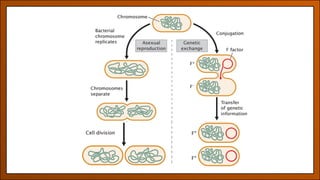
Escherichia coli (a bacterium)
STATS
Taxonomy Eubacteria
Size: 1–2 μm in length
Anatomy Single cell surrounded by cell wall with nucleoid region
Habitat Intestinal tract of warm-blooded animals
ADVANTAGES
1 Small size
2 Rapid reproduction, dividing every 20 minutes under optimal conditions
3 Easy to culture in liquid medium or on petri plates
4 Small genome
5 Many mutants available
6 Numerous methods available for genetic engineering
Escherichia coli
(a bacterium)
GENOME
Chromosomes 1 circular chromosome
Amount of DNA 4.64 million base pairs
Number of genes 4300
Percentage of genes in common with humans 8%
Average gene size 1000 base pairs
Genome sequenced in year 1997
CONTRIBUTIONS TO GENETICS
1 Gene regulation
2 Molecular biology and biochemistry of genetic processes, such as
replication, transcription, translation, recombination
3 Gene structure and organization in bacteria
4 Workhorse of recombinant DNA
5 Gene mutations
Escherichia coli
(a bacterium)
Caenorhabditis elegans
(a nematode worm)
C. elegans
Life cycle
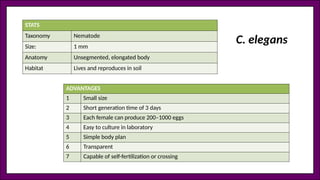
STATS
Taxonomy Nematode
Size: 1 mm
Anatomy Unsegmented, elongated body
Habitat Lives and reproduces in soil
ADVANTAGES
1 Small size
2 Short generation time of 3 days
3 Each female can produce 200–1000 eggs
4 Easy to culture in laboratory
5 Simple body plan
6 Transparent
7 Capable of self-fertilization or crossing
C. elegans
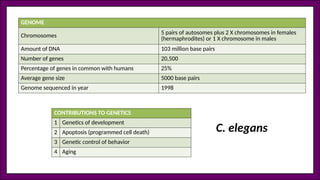
GENOME
Chromosomes 5 pairs of autosomes plus 2 X chromosomes in females
(hermaphrodites) or 1 X chromosome in males
Amount of DNA 103 million base pairs
Number of genes 20,500
Percentage of genes in common with humans 25%
Average gene size 5000 base pairs
Genome sequenced in year 1998
CONTRIBUTIONS TO GENETICS
1 Genetics of development
2 Apoptosis (programmed cell death)
3 Genetic control of behavior
4 Aging
C. elegans
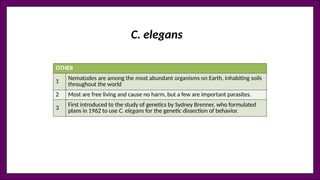
OTHER
1
Nematodes are among the most abundant organisms on Earth, inhabiting soils
throughout the world
2 Most are free living and cause no harm, but a few are important parasites.
3 First introduced to the study of genetics by Sydney Brenner, who formulated
plans in 1962 to use C. elegans for the genetic dissection of behavior.
C. elegans
Arabidopsis thaliana
(a flowering plant)
STATS
Taxonomy Flowering plant
Size: 10–20 cm
Anatomy Roots, one primary shoot, simple leaves, flowers
Habitat Meadows
ADVANTAGES
1 Small size
2 Short generation time of 6 weeks
3 Each plant can produce from 10,000 to 40,000 seeds
4 Ability to grow in laboratory
5 Small genome for a plant
6 Many variants available
7 Self-fertilizes and outcrosses
Arabidopsis
thaliana
(a
flowering
plant)
GENOME
Chromosomes 5 pairs (2n = 10)
Amount of DNA 125 million base pairs
Number of genes 25,700
Percentage of genes in common with humans 18%
Average gene size 2000 base pairs
Genome sequenced in year 2000
CONTRIBUTIONS TO GENETICS
1 Plant-genome organization
2 Gene regulation
3 Genetics of plant development
4 Genetics of flowering
Arabidopsis thaliana
(a flowering plant)
MODEL ORGANISMS 1 : EXAMPLES, CONTRIBUTION, ADVANTAGES

MODEL ORGANISMS 1 : EXAMPLES, CONTRIBUTION, ADVANTAGES

  • 1.
    “ STARTING INTHE NAME OF ALLAH, THE MOST BENEFICENT, THE MOST MERCIFUL" MADE BY: SIDRA IFTIKHAR M.Sc (MICROBIOLOGY) MOLECULAR BIOLOGY AND VIROLOGY GENETIC MODEL ORGANISMS PART # 01
  • 2.
    Model organisms—organisms studiedby many different researchers so they can compare their results and determine scientific principles that apply more broadly to other species. GENETIC MODEL ORGANISMS
  • 3.
    1. a shortgeneration time, and so several generations of genetic crosses can be examined in reasonable time; 2. the production of numerous progeny, and so genetic ratios can be easily observed; 3. the ability to carry out and control genetic crosses in the organism; 4. the ability to be reared in a laboratory environment, requiring little space and few resources to maintain; 5. the availability of numerous genetic variants; 6. and an accumulated body of knowledge about their genetic systems. KEY FEATURES OF GENETIC MODEL ORGANISMS
  • 4.
  • 6.
    STATS Taxonomy Insect Size: 2–3mm in length Anatomy 3 body segments, 6 legs, 1 pair of wings Habitat Feeds and reproduces on fruit ADVANTAGES 1 Small size 2 Short generation time of 10 days at room temperature 3 Each female lays 400–500 eggs 4 Easy to culture in laboratory 5 Small genome 6 Large chromosomes except 4 chromosome pair 7 Many mutations available Drosophila melanogaster (fruit fly)
  • 7.
    GENOME Chromosomes 3 pairsof autosomes and X and Y (2n = 8) Amount of DNA 175 million base pairs Number of genes 14,000 Percentage of genes in common with humans ~50% Average gene size 3000 base pairs Genome sequenced in year 2000 CONTRIBUTIONS TO GENETICS 1 Basic principles of heredity including sex-linked inheritance, multiple alleles, epistatsis, gene mapping, etc. 2 Mutation research 3 Chromosome variation and behavior 4 Population genetics 5 Genetic control of pattern formation 6 Behavioral genetics Drosophila melanogaster (fruit fly)
  • 8.
  • 10.
    STATS Taxonomy Eubacteria Size: 1–2μm in length Anatomy Single cell surrounded by cell wall with nucleoid region Habitat Intestinal tract of warm-blooded animals ADVANTAGES 1 Small size 2 Rapid reproduction, dividing every 20 minutes under optimal conditions 3 Easy to culture in liquid medium or on petri plates 4 Small genome 5 Many mutants available 6 Numerous methods available for genetic engineering Escherichia coli (a bacterium)
  • 11.
    GENOME Chromosomes 1 circularchromosome Amount of DNA 4.64 million base pairs Number of genes 4300 Percentage of genes in common with humans 8% Average gene size 1000 base pairs Genome sequenced in year 1997 CONTRIBUTIONS TO GENETICS 1 Gene regulation 2 Molecular biology and biochemistry of genetic processes, such as replication, transcription, translation, recombination 3 Gene structure and organization in bacteria 4 Workhorse of recombinant DNA 5 Gene mutations Escherichia coli (a bacterium)
  • 12.
  • 13.
  • 14.
    STATS Taxonomy Nematode Size: 1mm Anatomy Unsegmented, elongated body Habitat Lives and reproduces in soil ADVANTAGES 1 Small size 2 Short generation time of 3 days 3 Each female can produce 200–1000 eggs 4 Easy to culture in laboratory 5 Simple body plan 6 Transparent 7 Capable of self-fertilization or crossing C. elegans
  • 15.
    GENOME Chromosomes 5 pairsof autosomes plus 2 X chromosomes in females (hermaphrodites) or 1 X chromosome in males Amount of DNA 103 million base pairs Number of genes 20,500 Percentage of genes in common with humans 25% Average gene size 5000 base pairs Genome sequenced in year 1998 CONTRIBUTIONS TO GENETICS 1 Genetics of development 2 Apoptosis (programmed cell death) 3 Genetic control of behavior 4 Aging C. elegans
  • 16.
    OTHER 1 Nematodes are amongthe most abundant organisms on Earth, inhabiting soils throughout the world 2 Most are free living and cause no harm, but a few are important parasites. 3 First introduced to the study of genetics by Sydney Brenner, who formulated plans in 1962 to use C. elegans for the genetic dissection of behavior. C. elegans
  • 17.
  • 19.
    STATS Taxonomy Flowering plant Size:10–20 cm Anatomy Roots, one primary shoot, simple leaves, flowers Habitat Meadows ADVANTAGES 1 Small size 2 Short generation time of 6 weeks 3 Each plant can produce from 10,000 to 40,000 seeds 4 Ability to grow in laboratory 5 Small genome for a plant 6 Many variants available 7 Self-fertilizes and outcrosses Arabidopsis thaliana (a flowering plant)
  • 20.
    GENOME Chromosomes 5 pairs(2n = 10) Amount of DNA 125 million base pairs Number of genes 25,700 Percentage of genes in common with humans 18% Average gene size 2000 base pairs Genome sequenced in year 2000 CONTRIBUTIONS TO GENETICS 1 Plant-genome organization 2 Gene regulation 3 Genetics of plant development 4 Genetics of flowering Arabidopsis thaliana (a flowering plant)