MOCK ORTHOPAEDICS CASE
PRESENTATION
APOORV GARG
4thYear
DEMOGRAPHICS DATA
• NAME - XYZ
• AGE - 45
• GENDER - M
• ADDRESS – GURGOAN
• TELEPHONE NO – XYZ
• OCCUPATION – STUDENT
• ASSESSED AT – AMAR JYOTI INSTITUTE OF
PHYSIOTHERAPY
• DATE OF ASSESSMENT – 05 MAY 2022
• DOMINANCE – RIGHT
CHIEF COMPLAINT
• Pain since 1 week in lower back which radiates
till right ankle and foot and gives tingling
sensation and paresthesia.
• Pain increase after continuous sitting.
PAIN ASSESMENT
• Mechanism of injury – No mechanism of
injury is found.
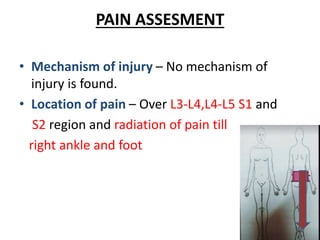
• Location of pain – Over L3-L4,L4-L5 S1 and
S2 region and radiation of pain till
right ankle and foot
• Duration of pain- Acute [Since 1 week]
• Onset of pain – Sudden
• Nature of pain- Constant
• Type of pain sensation – Pins and needle
sensation.
• Radiation of pain – Peripherlization.
• Intensity of pain- Measured through VAS [visual
analogue scale]
INTERPRETATION
From 0 to 10 cm Patient marked pain level at 7.2cm.
• Severity of pain – Level 4
1. Level 1 - Pain after specific activity.
2. Level 2 - Pain after specific activity resolves after
warm up.
3. Level 3 - Pain after and before specific activity
which doesn’t affect the performance.
4. Level 4 – Pain during and after specific activities
which affects the performance.
5. Level 5 – Pain with ADL
6. Level 6 – Constant dull aching pain at rest which
doesn’t affect sleep.
7. Level 7 – Dull aching pain which affects the sleep.
• Aggravating factors
o Bending activities are painful.
o Increase in pain after sitting for longer than 20-
25minutes.
• Relieving factors – After lying in supine position.
• Diurnal factors – No
• Pain with coughing/sneezing/deep
breathing/laughing- Pain in Excessive coughing
• Sleeping position – Supine or side lying .
• Past medical history – Nothing relevant.
• Surgical history – None
• Associated Probems- Patient has diabetes for
which he takes medication[AMLODIPIN]
• Personal history – Patient does not smoke or
drink.
• Patient goes for a walk daily.
• Family history – Not relevant
• Occupation history – IT job [ 7-8 hrs continuous
sitting][Due to Pain patient is not able to sit for
more than 20-25 min continous]
• Socioeconomic status – Good
• Physiotherapy history – In January 2022
Patient had physiotherapy treatment from
private clinic in gurgoan for 2 weeks .
From 7 May started physiotherapy treatment
in Amar Jyoti.
Observation
• Body type – Mesomorph
• Body mass index[BMI] – weight/[height sq.]
Weight - 75 kg
Height - 1.60 m[160cm]
BMI - 29 kg per m sq.
• Posture – FRONTAL VIEW
Right shoulder slightly depressed as compared
to left
Left side List[Lateral shift of spine]
SAGITTAL VIEW
Protracted Shoulders with Forward Head
 Gait - Qualitative analysis.
All phases of gait cycle are normal with all the
phases intact
A left lateral list can be seen during gait
Arm swing of both arms slightly reduced
Local Observation
• Attitude of limb
o Arms by the side internally rotated with palms
facing inside.
o The legs are externally rotated.
• Swelling – No swelling present on site of pain.
• Deformity – No deformity present.
• Muscle wasting – No muscle wasting .
• Tropical changes – No
• Scars - No
ON PALPATIONS
• Tenderness – Present
Site of tenderness- over area of L3, L4,L5 , S1
at Greater trochanter
Grade of tenderness- Grade 2 [Tenderness
with wince on deep palpation]
• Warmth – Normal body warmth on pain site
• Odema – No odema present.
• Spasm – Present at paraspinal muscles
EXAMINATION
Motor assessment
Range of motion [ROM]
Interpretation
All the ROM are less than normal range.
JOINT/MOTION ROM Normal ROM END FEEL
Thoracolumbar
Flexion
46.5 – 53= 6.5 cm 10 cm Firm
Thoracolumbar
Extension
46.5 – 43.5 = 3
cm
Firm
Lumbar flexion
[modified schober
test]
15 – 19 = 4 cm 5-7 cm Firm
Lumbar extension
[modified
schober test]
15 – 14 = 1 cm 1.6 cm Firm
Normal
ROM
END FEEL
[LEFT]
AROM
[LEFT]
JOINT/
MOTION
AROM
[RIGHT]
END FEEL
[RIGHT]
0-30 Firm 0 - 26 Thoraco-
lumbar
Lateral
Flexion
0 - 24 Firm
0-35 Firm 0 - 30 Thoraco-
lumbar
Rotation
0 - 25 Firm
Normal
range
END
FEEL
PROM
[LEFT]
AROM
[LEFT]
HIP
JOINT
MOTION
AROM
[RIGHT]
PROM
[RIGHT]
END FEEL
0-120 firm 0 - 120 0 - 115 Flexion 0 -105 0 - 115 soft
0-20 firm 0 - 20 0 - 16 Extension 0 - 15 0 - 18 firm
0-45 firm 0 - 45 0 - 40 Abduction 0 - 35 0 - 40 firm
45-0 firm 45- 0 40 - 0 Adduction 35 - 0 40 - 0 firm
0-40 firm 0 - 40 0 - 35 Internal
rotation
0 – 25 0 -30 firm
0-50 firm 0 -50 0 - 45 External
rotation
0-40 0 - 45 firm
Normal
ROM
END
FEEL
PROM
[LEFT]
AROM
[LEFT]
KNEE
JOINT
MOTION
AROM
[RIGHT]
PROM
[RIGHT]
END
FEEL
0-150 soft 0 - 150 0 - 140 Flexion 0 - 140 0 - 150 soft
150-0 firm 150- 0 140- 0 Extension 140- 0 150 - 0 firm
Normal
ROM
END
FEEL
PROM
[LEFT]
AROM
[LEFT]
ANKLE
JOINT
MOTION
AROM
[RIGHT]
PROM
[RIGHT]
END
FEEL
0-20 firm 0 - 20 0 - 15
Dorsiflexion
0 - 18 0 - 20 firm
0-50 firm 0 - 50 0 - 40 Plantar
flexion
0 - 45 0 - 50 firm
• INTERPRETATION
ROM of Hip joint of right side is less than
Normal
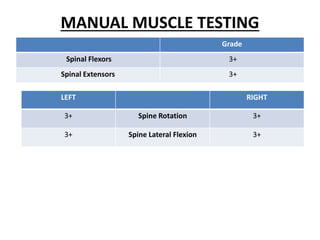
MANUAL MUSCLE TESTING
Grade
Spinal Flexors 3+
Spinal Extensors 3+
LEFT RIGHT
3+ Spine Rotation 3+
3+ Spine Lateral Flexion 3+
LEFT HIP JOINT RIGHT
4 Flexion [4]
4 Extension 4
4 Abduction [3+]
4 Adduction [3+]
4 Internal Rotation [3+]
4 External Rotation [3+]
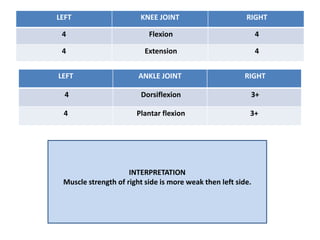
LEFT KNEE JOINT RIGHT
4 Flexion 4
4 Extension 4
LEFT ANKLE JOINT RIGHT
4 Dorsiflexion 3+
4 Plantar flexion 3+
INTERPRETATION
Muscle strength of right side is more weak then left side.
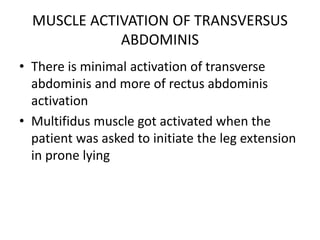
MUSCLE ACTIVATION OF TRANSVERSUS
ABDOMINIS
• There is minimal activation of transverse
abdominis and more of rectus abdominis
activation
• Multifidus muscle got activated when the
patient was asked to initiate the leg extension
in prone lying
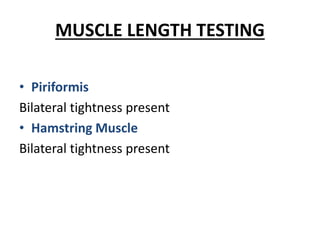
MUSCLE LENGTH TESTING
• Piriformis
Bilateral tightness present
• Hamstring Muscle
Bilateral tightness present
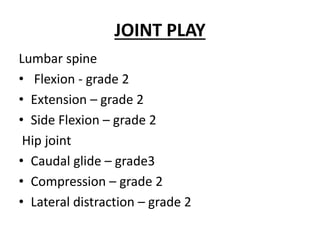
JOINT PLAY
Lumbar spine
• Flexion - grade 2
• Extension – grade 2
• Side Flexion – grade 2
Hip joint
• Caudal glide – grade3
• Compression – grade 2
• Lateral distraction – grade 2
POSTURE EXAMINATION
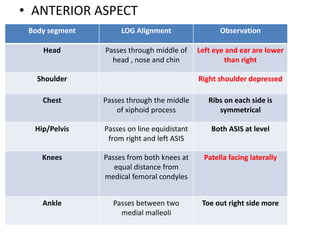
• ANTERIOR ASPECT
Body segment LOG Alignment Observation
Head Passes through middle of
head , nose and chin
Left eye and ear are lower
than right
Shoulder Right shoulder depressed
Chest Passes through the middle
of xiphoid process
Ribs on each side is
symmetrical
Hip/Pelvis Passes on line equidistant
from right and left ASIS
Both ASIS at level
Knees Passes from both knees at
equal distance from
medical femoral condyles
Patella facing laterally
Ankle Passes between two
medial malleoli
Toe out right side more
• POSTERIOR ASPECT
Body Segment LOG Location Observation
Head Plumb line passes through
middle of head
Right Neck shoulder
distance[7] is more than
left[6]
Shoulder Right shoulder depressed
Scapula Right scapula medially
rotated
Spine Bisecting vertebral
Column into equal halves
Left lateral shift /LIST
Hip/Pelvis Passes through the gluteal
cleft and equal distance
from PSIS
PSIS at level and gluteal
folds at level and
symmetrical
Knee Passes equidistant from
medial joint aspect
Neutral
Ankle Passes equidistant from
both the malleoli
Toe out right side more
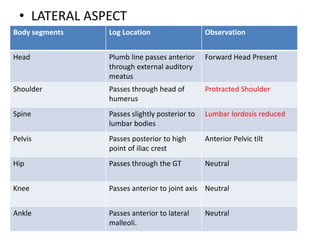
• LATERAL ASPECT
Body segments Log Location Observation
Head Plumb line passes anterior
through external auditory
meatus
Forward Head Present
Shoulder Passes through head of
humerus
Protracted Shoulder
Spine Passes slightly posterior to
lumbar bodies
Lumbar lordosis reduced
Pelvis Passes posterior to high
point of iliac crest
Anterior Pelvic tilt
Hip Passes through the GT Neutral
Knee Passes anterior to joint axis Neutral
Ankle Passes anterior to lateral
malleoli.
Neutral
GAIT EXAMINATION
[QUANTITATIVE ANALYSIS]
DISTANCE AND TIME
VARIABLE
RIGHT LEFT
STRIDE LENGHT 97.5 cm 97.8cm
STEP LENGTH 51.2cm 47cm
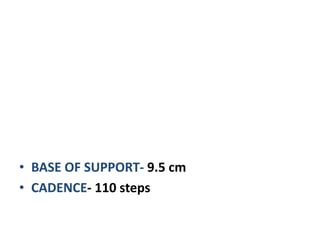
• BASE OF SUPPORT- 9.5 cm
• CADENCE- 110 steps
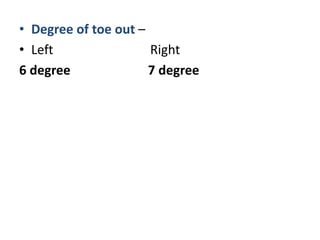
• Degree of toe out –
• Left Right
6 degree 7 degree
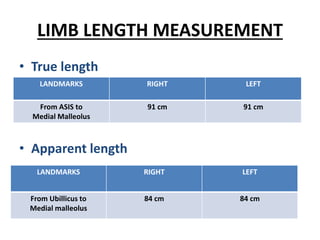
LIMB LENGTH MEASUREMENT
• True length
• Apparent length
LANDMARKS RIGHT LEFT
From ASIS to
Medial Malleolus
91 cm 91 cm
LANDMARKS RIGHT LEFT
From Ubillicus to
Medial malleolus
84 cm 84 cm
NEUROLOGICAL EXAMINATION
• Myotomal examination Examination
Myotomes Observation
L1 Hip Flexion Intact
L2 Hip Flexion Adduction
Medial Rotation
intact
L3 Leg Knee Extension intact
L4 Dorsiflexion intact
L5 Great/Big toe extension Weakness
S1 Ankle Planter flexion Eversion
Knee Flexion
Weakness[ Performed
one leg standing and on
toes but not able to
maintain ]
S2 Ankle Planter flexion
Knee Flexion
intact
• Dermatome Examination
.
Dermatom
es
[left]
Region Pain Temperatur
e
Light touch Pressur
e
L1 Back, over
trochanter
intact intact intact intact
L2 Front of thigh
to knee
intact Intact intact Intact
L3 Upper buttocks,
front of thigh
and knee,
medial lower
leg
intact Intact Intact Intact
L4 Inner buttocks
,outer thigh,
inside of leg ,
dorsum of foot
, big toe
intact intact Intact Intact
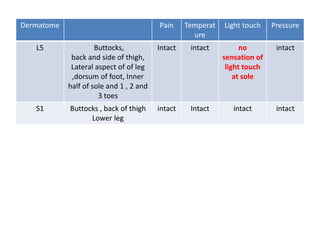
Dermatome Pain Temperat
ure
Light touch Pressure
L5 Buttocks,
back and side of thigh,
Lateral aspect of of leg
,dorsum of foot, Inner
half of sole and 1 , 2 and
3 toes
Intact intact no
sensation of
light touch
at sole
intact
S1 Buttocks , back of thigh
Lower leg
intact Intact intact intact
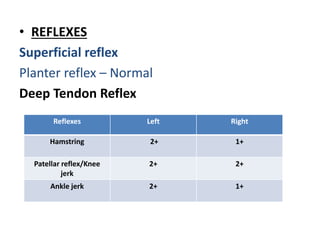
• REFLEXES
Superficial reflex
Planter reflex – Normal
Deep Tendon Reflex
Reflexes Left Right
Hamstring 2+ 1+
Patellar reflex/Knee
jerk
2+ 2+
Ankle jerk 2+ 1+
FUNCTIONAL ASSESSMENT
• The OSWESTRY
DISABILITY INDEX[ODI]
• Disability total score : 47
• Score obtained : 22
• Disability 22/47= 0.468
• Disability percentage= 46.8%
Interpretation of score
0%-20%=Minimal disability[can cope with ADLs]
21%-40%=Moderate disability[ Patient experience more pain and
difficulty in sitting , standing and lifting.]
41%-60%=Severe Disability [Pain remains the main problem in
this group but activities of daily living are affectted]
81%-100% =Patient are bedridden or exaggerating their
symptoms.
DIFFERENTIAL DIAGNOSIS
• Prolapsed Intervertebral Disc
• Piriformis syndrome
• Sciatic nerve impingement
SPECIAL TEST
• Straight leg raising test- Positive [to check for
sciatic nerve ]
Hip flexion [55 degree as patient complains of
pain in back ]and adduction
Knee extension
Ankle dorsiflexion
Pain complains of shooting pain in gluteal
region.
• Slump Test : Positive
Patient seated on edge of table
Slump test follows a sequence.
Cervical spine : Flexion
Thoraco lumbar: Flexion
Hip: Flexion
Knee : Extension
Ankle : Dorsiflexion
Patient complains of pain in lower back and
gluteal region.
• Piriformis test : Positive
• Side lying position with test leg uppermost.
• Patient flexes the test hip to 60 degree with
knee flexed.
• Examiner stabilize the hip with one hand and
applied downward pressure to knee.
Patient complains of pain in buttocks and
tingling sensation in sole of foot.
For SI joint
• Flamingo test : Negative
Stand on one leg , stress more on stance side
Patient complains no pain in pubis area or SI joint
• Gaenslen’s test : Negative
Patient in side lying [test leg uppermost]
Knee to chest in lower leg by patient
Stabilize the pelvis while extending the hip of test leg.
No Pain in SI Joint and L4 nerve root
• Yeoman’s : Negative
Patient in prone with knees 90 degree flexed
Examiner extend the hip.
No pain in lumbar region , Si joint and anterior thigh.
INVESTIGATIONS
• Date of MRI – 20 APRIL 2022
• There is mild disc dessication with diffuse disc bulge
present at level of L3-L4, L4-L5 that is indenting the
thecal sac, with mild narrowing of the bilateral neural
phenomenon
REHAB DIAGNOSIS
• Prolapsed Interverterbral disc leading to Left
lateral list with Pain in Forward flexion
• Piriformis tightness
• Sciatic nerve impingement.
PROBLEM LIST
• The continuous pain at pain site with
pheripherlization of pain.
• Tingling sensation on the sole of left foot.
• Muscle tightness of PIRIFORMIS and TA
• Left Lateral shift of spine/List.
• Decrease strength in hip musculature.
• Reduced mobility in lumbar region.
SHORT TERM GOALS
• Reduction of pain and peripherlization.
• Reduce tightness of Piriformis and TA
• Increase ROM of hip abductors and lateral
rotators
• Correction Of LIST.
• Improve mobility of lumbar region.
LONG TERM GOALS
• Good alignment of posture.
• Increase mobility of spine
• Maintain the strength of muscles and ROM
• Attainment of complete range of motion.
• Lifestyle modifications.
Treatment
• To reduce pain
Hot Pack on lower back
-application of hot pack to provide moist heat over the pain site. For
15 minutes.
Ultrasound on Greater trochanter
Frequency – 3 MHz
Intensity – 1w/cm sq.
Time – 5 minutes
Mode – 1:1
• IFT
2 pole modulated
At the origin of the pain and throughout the radiation
• Stretching of tightened muscle
Piriformis stretch
o By therapist – Patient in supine lying position.
o Place left heel on the right knee
o Therapist grasp the knee and pull it towards right shoulder.
Self Stretch.
o Lie on the back with both feet flat on the plinth.
o Both knees bent.
o Pull the right knee up to the chest
o Grasp the knee with the left hand and pull it towards the
left shoulder
o Hold the stretch.
• HAMSTRING stretching
o Patient is in supine lying position.
o The leg is made to undergo 90 degree flexion
at Hip and Knee.
o The knee is then extended with the hip flexion
maintained.
• Sciatic nerve neurodynamics tension
Patient in supine lying.
Hip flexion and adduction
Knee extension
Ankle dorsiflexion.
This position stretches the sciatic nerve.
• Massage
For sciatic nerve impingement
Gentle massage over gluteal region muscles help
to improve the circulation with simultaneously
activating the mechanoreceptors
Massage relax the piriformis muscle, which can
prevent from spasm and reduce pressure on
sciatic nerve.
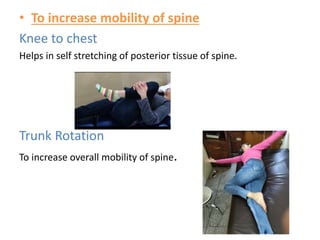
• To increase mobility of spine
Knee to chest
Helps in self stretching of posterior tissue of spine.
Trunk Rotation
To increase overall mobility of spine.
Lateral rotation of spine exercises
To increase the ROM
In standing or on gym ball.
Quadruped : Cat exercise
Maintain the abdominals, exhale and lower
Chest towards the floor.
Look up slightly.
To increase ROM and strength of hip abductors and lateral rotators
o Resisted exercises with free weight and therabands.
• Correction Of LIST/Lateral shift.
BY therapist
Standing with flexed elbow in the side of lateral
shift [left elbow flexed]
Then therapist should wrap the arm around the
patient’s pelvis on the opposite side[right
side]and simultaneously pull the pelvis
towards while pushing the thorax away.
Once the shift is corrected ,immediately make
the patient bend backward.
• Self correction
Side lying on the side to which the thorax is
shifted[left side].
Place a small pillow or towel roll under the
thorax.
Patient remain in this position until pain
centralize
Then roll prone and perform passive extension
or prone press ups.
MUSCLE STRENGTHENING
• TRANSVERSE ABDOMINIS ACTIVATION
Patient is asked to lie down in prone position
with a pressure biofeedback centred under the
navel.
The biofeedback is inflated to 70mm Hg then the
patient is asked to tuck in the tummy with help
of verbal commands and visual cues and upon
proper activation of the transverse activation
there should be a drop of 6-10 mm Hg on the
pressure biofeedback.
Muscle Strengthening
• MULTIFIDUS ACTIVATION
Patient is asked to lie down in prone position
the patient is asked to initiate the hip
extension but should initiate it and not lift the
leg
This will cause the multifidus activation and
would help in a better core stabilisation
Muscle Strengthening
• Gluteus Maximus
Prone SLR
Mini Squats
Full Squats
Home Program
• Self List correction
Patient is asked to stand against a wall where the hand of
the left side would be in contact with the wall and the
patient will shift the pelvis from the right side to the wall
• Self Piriformis Stretch
Patient in Supine lying with one knee bent, other being
straight.
The bent knee is pulled towards the opposite shoulder by
the patient
• Lumbar Rotations
• Transverse Abdominis Activation and Multifidus
Activation
Thank you

MOCK ORTHOPAEDICS CASE PRESENTATION(LOWER BACK PAIN).pptx

  • 1.
  • 2.
    DEMOGRAPHICS DATA • NAME- XYZ • AGE - 45 • GENDER - M • ADDRESS – GURGOAN • TELEPHONE NO – XYZ • OCCUPATION – STUDENT • ASSESSED AT – AMAR JYOTI INSTITUTE OF PHYSIOTHERAPY • DATE OF ASSESSMENT – 05 MAY 2022 • DOMINANCE – RIGHT
  • 3.
    CHIEF COMPLAINT • Painsince 1 week in lower back which radiates till right ankle and foot and gives tingling sensation and paresthesia. • Pain increase after continuous sitting.
  • 4.
    PAIN ASSESMENT • Mechanismof injury – No mechanism of injury is found. • Location of pain – Over L3-L4,L4-L5 S1 and S2 region and radiation of pain till right ankle and foot
  • 5.
    • Duration ofpain- Acute [Since 1 week] • Onset of pain – Sudden • Nature of pain- Constant • Type of pain sensation – Pins and needle sensation. • Radiation of pain – Peripherlization.
  • 6.
    • Intensity ofpain- Measured through VAS [visual analogue scale] INTERPRETATION From 0 to 10 cm Patient marked pain level at 7.2cm.
  • 7.
    • Severity ofpain – Level 4 1. Level 1 - Pain after specific activity. 2. Level 2 - Pain after specific activity resolves after warm up. 3. Level 3 - Pain after and before specific activity which doesn’t affect the performance. 4. Level 4 – Pain during and after specific activities which affects the performance. 5. Level 5 – Pain with ADL 6. Level 6 – Constant dull aching pain at rest which doesn’t affect sleep. 7. Level 7 – Dull aching pain which affects the sleep.
  • 8.
    • Aggravating factors oBending activities are painful. o Increase in pain after sitting for longer than 20- 25minutes. • Relieving factors – After lying in supine position. • Diurnal factors – No • Pain with coughing/sneezing/deep breathing/laughing- Pain in Excessive coughing • Sleeping position – Supine or side lying .
  • 9.
    • Past medicalhistory – Nothing relevant. • Surgical history – None • Associated Probems- Patient has diabetes for which he takes medication[AMLODIPIN] • Personal history – Patient does not smoke or drink. • Patient goes for a walk daily. • Family history – Not relevant • Occupation history – IT job [ 7-8 hrs continuous sitting][Due to Pain patient is not able to sit for more than 20-25 min continous]
  • 10.
    • Socioeconomic status– Good • Physiotherapy history – In January 2022 Patient had physiotherapy treatment from private clinic in gurgoan for 2 weeks . From 7 May started physiotherapy treatment in Amar Jyoti.
  • 11.
    Observation • Body type– Mesomorph • Body mass index[BMI] – weight/[height sq.] Weight - 75 kg Height - 1.60 m[160cm] BMI - 29 kg per m sq.
  • 12.
    • Posture –FRONTAL VIEW Right shoulder slightly depressed as compared to left Left side List[Lateral shift of spine] SAGITTAL VIEW Protracted Shoulders with Forward Head
  • 13.
     Gait -Qualitative analysis. All phases of gait cycle are normal with all the phases intact A left lateral list can be seen during gait Arm swing of both arms slightly reduced
  • 14.
    Local Observation • Attitudeof limb o Arms by the side internally rotated with palms facing inside. o The legs are externally rotated.
  • 15.
    • Swelling –No swelling present on site of pain. • Deformity – No deformity present. • Muscle wasting – No muscle wasting . • Tropical changes – No • Scars - No
  • 16.
    ON PALPATIONS • Tenderness– Present Site of tenderness- over area of L3, L4,L5 , S1 at Greater trochanter Grade of tenderness- Grade 2 [Tenderness with wince on deep palpation] • Warmth – Normal body warmth on pain site • Odema – No odema present. • Spasm – Present at paraspinal muscles
  • 17.
  • 18.
    Motor assessment Range ofmotion [ROM] Interpretation All the ROM are less than normal range. JOINT/MOTION ROM Normal ROM END FEEL Thoracolumbar Flexion 46.5 – 53= 6.5 cm 10 cm Firm Thoracolumbar Extension 46.5 – 43.5 = 3 cm Firm Lumbar flexion [modified schober test] 15 – 19 = 4 cm 5-7 cm Firm Lumbar extension [modified schober test] 15 – 14 = 1 cm 1.6 cm Firm
  • 19.
    Normal ROM END FEEL [LEFT] AROM [LEFT] JOINT/ MOTION AROM [RIGHT] END FEEL [RIGHT] 0-30Firm 0 - 26 Thoraco- lumbar Lateral Flexion 0 - 24 Firm 0-35 Firm 0 - 30 Thoraco- lumbar Rotation 0 - 25 Firm
  • 20.
    Normal range END FEEL PROM [LEFT] AROM [LEFT] HIP JOINT MOTION AROM [RIGHT] PROM [RIGHT] END FEEL 0-120 firm0 - 120 0 - 115 Flexion 0 -105 0 - 115 soft 0-20 firm 0 - 20 0 - 16 Extension 0 - 15 0 - 18 firm 0-45 firm 0 - 45 0 - 40 Abduction 0 - 35 0 - 40 firm 45-0 firm 45- 0 40 - 0 Adduction 35 - 0 40 - 0 firm 0-40 firm 0 - 40 0 - 35 Internal rotation 0 – 25 0 -30 firm 0-50 firm 0 -50 0 - 45 External rotation 0-40 0 - 45 firm
  • 21.
    Normal ROM END FEEL PROM [LEFT] AROM [LEFT] KNEE JOINT MOTION AROM [RIGHT] PROM [RIGHT] END FEEL 0-150 soft 0- 150 0 - 140 Flexion 0 - 140 0 - 150 soft 150-0 firm 150- 0 140- 0 Extension 140- 0 150 - 0 firm Normal ROM END FEEL PROM [LEFT] AROM [LEFT] ANKLE JOINT MOTION AROM [RIGHT] PROM [RIGHT] END FEEL 0-20 firm 0 - 20 0 - 15 Dorsiflexion 0 - 18 0 - 20 firm 0-50 firm 0 - 50 0 - 40 Plantar flexion 0 - 45 0 - 50 firm
  • 22.
    • INTERPRETATION ROM ofHip joint of right side is less than Normal
  • 23.
    MANUAL MUSCLE TESTING Grade SpinalFlexors 3+ Spinal Extensors 3+ LEFT RIGHT 3+ Spine Rotation 3+ 3+ Spine Lateral Flexion 3+
  • 24.
    LEFT HIP JOINTRIGHT 4 Flexion [4] 4 Extension 4 4 Abduction [3+] 4 Adduction [3+] 4 Internal Rotation [3+] 4 External Rotation [3+]
  • 25.
    LEFT KNEE JOINTRIGHT 4 Flexion 4 4 Extension 4 LEFT ANKLE JOINT RIGHT 4 Dorsiflexion 3+ 4 Plantar flexion 3+ INTERPRETATION Muscle strength of right side is more weak then left side.
  • 26.
    MUSCLE ACTIVATION OFTRANSVERSUS ABDOMINIS • There is minimal activation of transverse abdominis and more of rectus abdominis activation • Multifidus muscle got activated when the patient was asked to initiate the leg extension in prone lying
  • 27.
    MUSCLE LENGTH TESTING •Piriformis Bilateral tightness present • Hamstring Muscle Bilateral tightness present
  • 28.
    JOINT PLAY Lumbar spine •Flexion - grade 2 • Extension – grade 2 • Side Flexion – grade 2 Hip joint • Caudal glide – grade3 • Compression – grade 2 • Lateral distraction – grade 2
  • 29.
  • 30.
    • ANTERIOR ASPECT Bodysegment LOG Alignment Observation Head Passes through middle of head , nose and chin Left eye and ear are lower than right Shoulder Right shoulder depressed Chest Passes through the middle of xiphoid process Ribs on each side is symmetrical Hip/Pelvis Passes on line equidistant from right and left ASIS Both ASIS at level Knees Passes from both knees at equal distance from medical femoral condyles Patella facing laterally Ankle Passes between two medial malleoli Toe out right side more
  • 31.
    • POSTERIOR ASPECT BodySegment LOG Location Observation Head Plumb line passes through middle of head Right Neck shoulder distance[7] is more than left[6] Shoulder Right shoulder depressed Scapula Right scapula medially rotated Spine Bisecting vertebral Column into equal halves Left lateral shift /LIST Hip/Pelvis Passes through the gluteal cleft and equal distance from PSIS PSIS at level and gluteal folds at level and symmetrical Knee Passes equidistant from medial joint aspect Neutral Ankle Passes equidistant from both the malleoli Toe out right side more
  • 32.
    • LATERAL ASPECT Bodysegments Log Location Observation Head Plumb line passes anterior through external auditory meatus Forward Head Present Shoulder Passes through head of humerus Protracted Shoulder Spine Passes slightly posterior to lumbar bodies Lumbar lordosis reduced Pelvis Passes posterior to high point of iliac crest Anterior Pelvic tilt Hip Passes through the GT Neutral Knee Passes anterior to joint axis Neutral Ankle Passes anterior to lateral malleoli. Neutral
  • 33.
    GAIT EXAMINATION [QUANTITATIVE ANALYSIS] DISTANCEAND TIME VARIABLE RIGHT LEFT STRIDE LENGHT 97.5 cm 97.8cm STEP LENGTH 51.2cm 47cm
  • 34.
    • BASE OFSUPPORT- 9.5 cm • CADENCE- 110 steps
  • 35.
    • Degree oftoe out – • Left Right 6 degree 7 degree
  • 36.
    LIMB LENGTH MEASUREMENT •True length • Apparent length LANDMARKS RIGHT LEFT From ASIS to Medial Malleolus 91 cm 91 cm LANDMARKS RIGHT LEFT From Ubillicus to Medial malleolus 84 cm 84 cm
  • 37.
    NEUROLOGICAL EXAMINATION • Myotomalexamination Examination Myotomes Observation L1 Hip Flexion Intact L2 Hip Flexion Adduction Medial Rotation intact L3 Leg Knee Extension intact L4 Dorsiflexion intact L5 Great/Big toe extension Weakness S1 Ankle Planter flexion Eversion Knee Flexion Weakness[ Performed one leg standing and on toes but not able to maintain ] S2 Ankle Planter flexion Knee Flexion intact
  • 38.
    • Dermatome Examination . Dermatom es [left] RegionPain Temperatur e Light touch Pressur e L1 Back, over trochanter intact intact intact intact L2 Front of thigh to knee intact Intact intact Intact L3 Upper buttocks, front of thigh and knee, medial lower leg intact Intact Intact Intact L4 Inner buttocks ,outer thigh, inside of leg , dorsum of foot , big toe intact intact Intact Intact
  • 39.
    Dermatome Pain Temperat ure Lighttouch Pressure L5 Buttocks, back and side of thigh, Lateral aspect of of leg ,dorsum of foot, Inner half of sole and 1 , 2 and 3 toes Intact intact no sensation of light touch at sole intact S1 Buttocks , back of thigh Lower leg intact Intact intact intact
  • 40.
    • REFLEXES Superficial reflex Planterreflex – Normal Deep Tendon Reflex Reflexes Left Right Hamstring 2+ 1+ Patellar reflex/Knee jerk 2+ 2+ Ankle jerk 2+ 1+
  • 41.
    FUNCTIONAL ASSESSMENT • TheOSWESTRY DISABILITY INDEX[ODI]
  • 42.
    • Disability totalscore : 47 • Score obtained : 22 • Disability 22/47= 0.468 • Disability percentage= 46.8% Interpretation of score 0%-20%=Minimal disability[can cope with ADLs] 21%-40%=Moderate disability[ Patient experience more pain and difficulty in sitting , standing and lifting.] 41%-60%=Severe Disability [Pain remains the main problem in this group but activities of daily living are affectted] 81%-100% =Patient are bedridden or exaggerating their symptoms.
  • 43.
    DIFFERENTIAL DIAGNOSIS • ProlapsedIntervertebral Disc • Piriformis syndrome • Sciatic nerve impingement
  • 44.
    SPECIAL TEST • Straightleg raising test- Positive [to check for sciatic nerve ] Hip flexion [55 degree as patient complains of pain in back ]and adduction Knee extension Ankle dorsiflexion Pain complains of shooting pain in gluteal region.
  • 45.
    • Slump Test: Positive Patient seated on edge of table Slump test follows a sequence. Cervical spine : Flexion Thoraco lumbar: Flexion Hip: Flexion Knee : Extension Ankle : Dorsiflexion Patient complains of pain in lower back and gluteal region.
  • 46.
    • Piriformis test: Positive • Side lying position with test leg uppermost. • Patient flexes the test hip to 60 degree with knee flexed. • Examiner stabilize the hip with one hand and applied downward pressure to knee. Patient complains of pain in buttocks and tingling sensation in sole of foot.
  • 47.
    For SI joint •Flamingo test : Negative Stand on one leg , stress more on stance side Patient complains no pain in pubis area or SI joint • Gaenslen’s test : Negative Patient in side lying [test leg uppermost] Knee to chest in lower leg by patient Stabilize the pelvis while extending the hip of test leg. No Pain in SI Joint and L4 nerve root • Yeoman’s : Negative Patient in prone with knees 90 degree flexed Examiner extend the hip. No pain in lumbar region , Si joint and anterior thigh.
  • 48.
    INVESTIGATIONS • Date ofMRI – 20 APRIL 2022 • There is mild disc dessication with diffuse disc bulge present at level of L3-L4, L4-L5 that is indenting the thecal sac, with mild narrowing of the bilateral neural phenomenon
  • 49.
    REHAB DIAGNOSIS • ProlapsedInterverterbral disc leading to Left lateral list with Pain in Forward flexion • Piriformis tightness • Sciatic nerve impingement.
  • 50.
    PROBLEM LIST • Thecontinuous pain at pain site with pheripherlization of pain. • Tingling sensation on the sole of left foot. • Muscle tightness of PIRIFORMIS and TA • Left Lateral shift of spine/List. • Decrease strength in hip musculature. • Reduced mobility in lumbar region.
  • 51.
    SHORT TERM GOALS •Reduction of pain and peripherlization. • Reduce tightness of Piriformis and TA • Increase ROM of hip abductors and lateral rotators • Correction Of LIST. • Improve mobility of lumbar region.
  • 52.
    LONG TERM GOALS •Good alignment of posture. • Increase mobility of spine • Maintain the strength of muscles and ROM • Attainment of complete range of motion. • Lifestyle modifications.
  • 53.
    Treatment • To reducepain Hot Pack on lower back -application of hot pack to provide moist heat over the pain site. For 15 minutes. Ultrasound on Greater trochanter Frequency – 3 MHz Intensity – 1w/cm sq. Time – 5 minutes Mode – 1:1 • IFT 2 pole modulated At the origin of the pain and throughout the radiation
  • 54.
    • Stretching oftightened muscle Piriformis stretch o By therapist – Patient in supine lying position. o Place left heel on the right knee o Therapist grasp the knee and pull it towards right shoulder. Self Stretch. o Lie on the back with both feet flat on the plinth. o Both knees bent. o Pull the right knee up to the chest o Grasp the knee with the left hand and pull it towards the left shoulder o Hold the stretch.
  • 55.
    • HAMSTRING stretching oPatient is in supine lying position. o The leg is made to undergo 90 degree flexion at Hip and Knee. o The knee is then extended with the hip flexion maintained.
  • 56.
    • Sciatic nerveneurodynamics tension Patient in supine lying. Hip flexion and adduction Knee extension Ankle dorsiflexion. This position stretches the sciatic nerve.
  • 57.
    • Massage For sciaticnerve impingement Gentle massage over gluteal region muscles help to improve the circulation with simultaneously activating the mechanoreceptors Massage relax the piriformis muscle, which can prevent from spasm and reduce pressure on sciatic nerve.
  • 58.
    • To increasemobility of spine Knee to chest Helps in self stretching of posterior tissue of spine. Trunk Rotation To increase overall mobility of spine.
  • 59.
    Lateral rotation ofspine exercises To increase the ROM In standing or on gym ball. Quadruped : Cat exercise Maintain the abdominals, exhale and lower Chest towards the floor. Look up slightly. To increase ROM and strength of hip abductors and lateral rotators o Resisted exercises with free weight and therabands.
  • 60.
    • Correction OfLIST/Lateral shift. BY therapist Standing with flexed elbow in the side of lateral shift [left elbow flexed] Then therapist should wrap the arm around the patient’s pelvis on the opposite side[right side]and simultaneously pull the pelvis towards while pushing the thorax away. Once the shift is corrected ,immediately make the patient bend backward.
  • 61.
    • Self correction Sidelying on the side to which the thorax is shifted[left side]. Place a small pillow or towel roll under the thorax. Patient remain in this position until pain centralize Then roll prone and perform passive extension or prone press ups.
  • 62.
    MUSCLE STRENGTHENING • TRANSVERSEABDOMINIS ACTIVATION Patient is asked to lie down in prone position with a pressure biofeedback centred under the navel. The biofeedback is inflated to 70mm Hg then the patient is asked to tuck in the tummy with help of verbal commands and visual cues and upon proper activation of the transverse activation there should be a drop of 6-10 mm Hg on the pressure biofeedback.
  • 63.
    Muscle Strengthening • MULTIFIDUSACTIVATION Patient is asked to lie down in prone position the patient is asked to initiate the hip extension but should initiate it and not lift the leg This will cause the multifidus activation and would help in a better core stabilisation
  • 64.
    Muscle Strengthening • GluteusMaximus Prone SLR Mini Squats Full Squats
  • 65.
    Home Program • SelfList correction Patient is asked to stand against a wall where the hand of the left side would be in contact with the wall and the patient will shift the pelvis from the right side to the wall • Self Piriformis Stretch Patient in Supine lying with one knee bent, other being straight. The bent knee is pulled towards the opposite shoulder by the patient • Lumbar Rotations • Transverse Abdominis Activation and Multifidus Activation
  • 66.