Mobile Banking in 2020

15 Feb. 2010

Stephen F. Rasmussen

                  www.cgap.org/technology
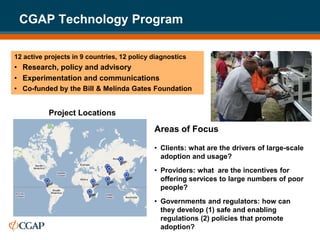
CGAP Technology Program

12 active projects in 9 countries, 12 policy diagnostics
• Research, policy and advisory
• Experimentation and communications
• Co-funded by the Bill & Melinda Gates Foundation


           Project Locations

                                             Areas of Focus

                                             • Clients: what are the drivers of large-scale
                                               adoption and usage?
                                             • Providers: what are the incentives for
                                               offering services to large numbers of poor
                                               people?
                                             • Governments and regulators: how can
                                               they develop (1) safe and enabling
                                               regulations (2) policies that promote
                                               adoption?
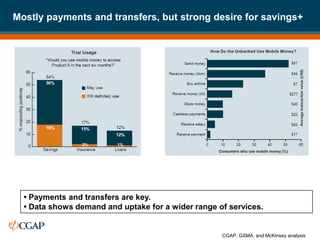
Mostly payments and transfers, but strong desire for savings+


  • Payments and transfers are key.
  • Data shows demand and uptake for a wider range of services.


                                                    CGAP, GSMA, and McKinsey analysis
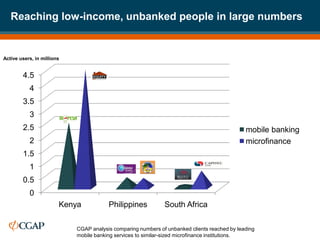
Reaching low-income, unbanked people in large numbers


Active users, in millions


        4.5
           4
        3.5
           3
        2.5                                                                                   mobile banking
           2                                                                                  microfinance
        1.5
           1
        0.5
           0
                        Kenya           Philippines           South Africa

                            CGAP analysis comparing numbers of unbanked clients reached by leading
                            mobile banking services to similar-sized microfinance institutions.
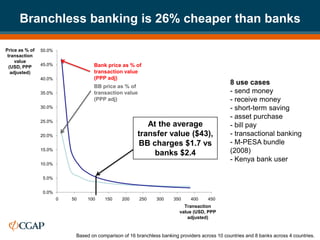
Branchless banking is 26% cheaper than banks

Price as % of   50.0%
 transaction
     value
                45.0%               Bank price as % of
  (USD, PPP
   adjusted)                        transaction value
                40.0%               (PPP adj)
                                    BB price as % of
                                                                                                 8 use cases
                35.0%               transaction value                                            - send money
                                    (PPP adj)                                                    - receive money
                30.0%                                                                            - short-term saving
                                                                                                 - asset purchase
                25.0%
                                                           At the average                        - bill pay
                20.0%                                   transfer value ($43),                    - transactional banking
                                                        BB charges $1.7 vs                       - M-PESA bundle
                15.0%
                                                             banks $2.4                          (2008)
                                                                                                 - Kenya bank user
                10.0%


                5.0%


                0.0%
                        0   50    100    150     200     250    300     350    400     450
                                                                            Transaction
                                                                          value (USD, PPP
                                                                             adjusted)


                             Based on comparison of 16 branchless banking providers across 10 countries and 8 banks across 4 countries.
Scenarios for Branchless Banking in 2020

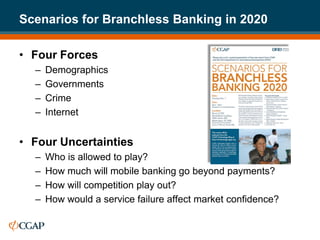
• Four Forces
  –   Demographics
  –   Governments
  –   Crime
  –   Internet


• Four Uncertainties
  –   Who is allowed to play?
  –   How much will mobile banking go beyond payments?
  –   How will competition play out?
  –   How would a service failure affect market confidence?
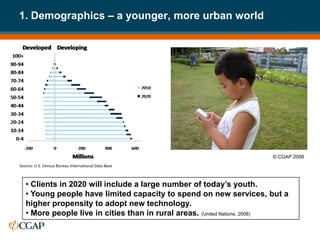
1. Demographics – a younger, more urban world


                                                                      © CGAP 2008
Source: U.S. Census Bureau International Data Base


   • Clients in 2020 will include a large number of today’s youth.
   • Young people have limited capacity to spend on new services, but a
   higher propensity to adopt new technology.
   • More people live in cities than in rural areas. (United Nations, 2008)
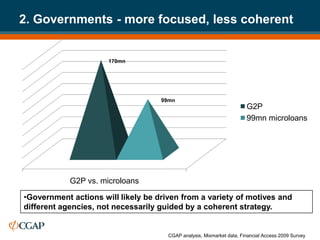
2. Governments - more focused, less coherent


                      170mn


                                    99mn
                                                                       G2P
                                                                       99mn microloans


            G2P vs. microloans

•Government actions will likely be driven from a variety of motives and
different agencies, not necessarily guided by a coherent strategy.


                                      CGAP analysis, Mixmarket data, Financial Access 2009 Survey
3. Where money goes, so does crime

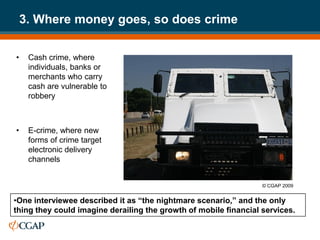
•    Cash crime, where
     individuals, banks or
     merchants who carry
     cash are vulnerable to
     robbery


•    E-crime, where new
     forms of crime target
     electronic delivery
     channels


                                                                  © CGAP 2009


•One interviewee described it as “the nightmare scenario,” and the only
thing they could imagine derailing the growth of mobile financial services.
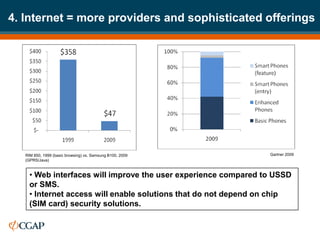
4. Internet = more providers and sophisticated offerings


   RIM 850, 1999 (basic browsing) vs. Samsung B100, 2009         Gartner 2009
   (GPRS/Java)


     • Web interfaces will improve the user experience compared to USSD
     or SMS.
     • Internet access will enable solutions that do not depend on chip
     (SIM card) security solutions.
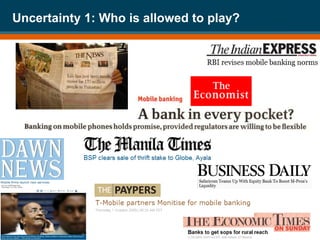
Uncertainty 1: Who is allowed to play?
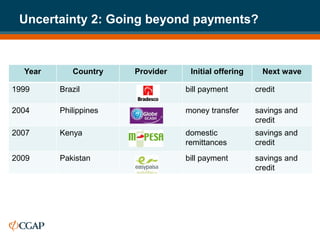
Uncertainty 2: Going beyond payments?


  Year      Country    Provider    Initial offering     Next wave

1999     Brazil                   bill payment        credit

2004     Philippines              money transfer      savings and
                                                      credit
2007     Kenya                    domestic            savings and
                                  remittances         credit
2009     Pakistan                 bill payment        savings and
                                                      credit
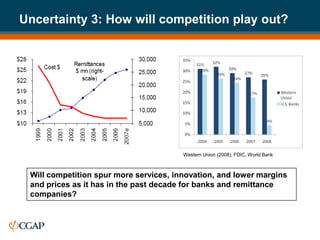
Uncertainty 3: How will competition play out?


                                        Western Union (2008), FDIC, World Bank


 Will competition spur more services, innovation, and lower margins
 and prices as it has in the past decade for banks and remittance
 companies?
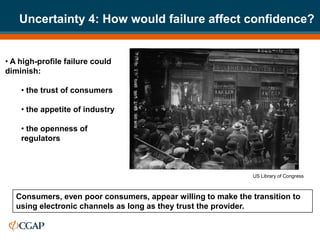
Uncertainty 4: How would failure affect confidence?


• A high-profile failure could
diminish:

    • the trust of consumers

    • the appetite of industry

    • the openness of
    regulators


                                                              US Library of Congress


   Consumers, even poor consumers, appear willing to make the transition to
   using electronic channels as long as they trust the provider.
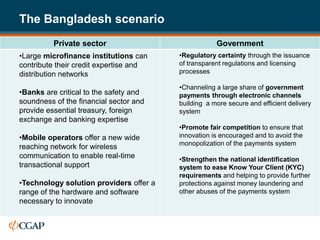
The Bangladesh scenario
          Private sector                             Government
•Large microfinance institutions can     •Regulatory certainty through the issuance
contribute their credit expertise and    of transparent regulations and licensing
distribution networks                    processes

                                         •Channeling a large share of government
•Banks are critical to the safety and    payments through electronic channels
soundness of the financial sector and    building a more secure and efficient delivery
provide essential treasury, foreign      system
exchange and banking expertise
                                         •Promote fair competition to ensure that
•Mobile operators offer a new wide       innovation is encouraged and to avoid the
                                         monopolization of the payments system
reaching network for wireless
communication to enable real-time        •Strengthen the national identification
transactional support                    system to ease Know Your Client (KYC)
                                         requirements and helping to provide further
•Technology solution providers offer a   protections against money laundering and
range of the hardware and software       other abuses of the payments system
necessary to innovate
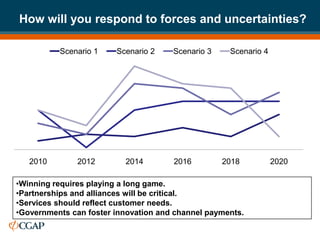
How will you respond to forces and uncertainties?

          Scenario 1    Scenario 2    Scenario 3    Scenario 4


   2010        2012       2014        2016         2018          2020

•Winning requires playing a long game.
•Partnerships and alliances will be critical.
•Services should reflect customer needs.
•Governments can foster innovation and channel payments.
Advancing financial access for the world’s poor
                 www.cgap.org
           www.microfinancegateway.org

Mobile Banking in 2020

  • 1.
    Mobile Banking in2020 15 Feb. 2010 Stephen F. Rasmussen www.cgap.org/technology
  • 2.
    CGAP Technology Program 12active projects in 9 countries, 12 policy diagnostics • Research, policy and advisory • Experimentation and communications • Co-funded by the Bill & Melinda Gates Foundation Project Locations Areas of Focus • Clients: what are the drivers of large-scale adoption and usage? • Providers: what are the incentives for offering services to large numbers of poor people? • Governments and regulators: how can they develop (1) safe and enabling regulations (2) policies that promote adoption?
  • 3.
    Mostly payments andtransfers, but strong desire for savings+ • Payments and transfers are key. • Data shows demand and uptake for a wider range of services. CGAP, GSMA, and McKinsey analysis
  • 4.
    Reaching low-income, unbankedpeople in large numbers Active users, in millions 4.5 4 3.5 3 2.5 mobile banking 2 microfinance 1.5 1 0.5 0 Kenya Philippines South Africa CGAP analysis comparing numbers of unbanked clients reached by leading mobile banking services to similar-sized microfinance institutions.
  • 5.
    Branchless banking is26% cheaper than banks Price as % of 50.0% transaction value 45.0% Bank price as % of (USD, PPP adjusted) transaction value 40.0% (PPP adj) BB price as % of 8 use cases 35.0% transaction value - send money (PPP adj) - receive money 30.0% - short-term saving - asset purchase 25.0% At the average - bill pay 20.0% transfer value ($43), - transactional banking BB charges $1.7 vs - M-PESA bundle 15.0% banks $2.4 (2008) - Kenya bank user 10.0% 5.0% 0.0% 0 50 100 150 200 250 300 350 400 450 Transaction value (USD, PPP adjusted) Based on comparison of 16 branchless banking providers across 10 countries and 8 banks across 4 countries.
  • 6.
    Scenarios for BranchlessBanking in 2020 • Four Forces – Demographics – Governments – Crime – Internet • Four Uncertainties – Who is allowed to play? – How much will mobile banking go beyond payments? – How will competition play out? – How would a service failure affect market confidence?
  • 7.
    1. Demographics –a younger, more urban world © CGAP 2008 Source: U.S. Census Bureau International Data Base • Clients in 2020 will include a large number of today’s youth. • Young people have limited capacity to spend on new services, but a higher propensity to adopt new technology. • More people live in cities than in rural areas. (United Nations, 2008)
  • 8.
    2. Governments -more focused, less coherent 170mn 99mn G2P 99mn microloans G2P vs. microloans •Government actions will likely be driven from a variety of motives and different agencies, not necessarily guided by a coherent strategy. CGAP analysis, Mixmarket data, Financial Access 2009 Survey
  • 9.
    3. Where moneygoes, so does crime • Cash crime, where individuals, banks or merchants who carry cash are vulnerable to robbery • E-crime, where new forms of crime target electronic delivery channels © CGAP 2009 •One interviewee described it as “the nightmare scenario,” and the only thing they could imagine derailing the growth of mobile financial services.
  • 10.
    4. Internet =more providers and sophisticated offerings RIM 850, 1999 (basic browsing) vs. Samsung B100, 2009 Gartner 2009 (GPRS/Java) • Web interfaces will improve the user experience compared to USSD or SMS. • Internet access will enable solutions that do not depend on chip (SIM card) security solutions.
  • 11.
    Uncertainty 1: Whois allowed to play?
  • 12.
    Uncertainty 2: Goingbeyond payments? Year Country Provider Initial offering Next wave 1999 Brazil bill payment credit 2004 Philippines money transfer savings and credit 2007 Kenya domestic savings and remittances credit 2009 Pakistan bill payment savings and credit
  • 13.
    Uncertainty 3: Howwill competition play out? Western Union (2008), FDIC, World Bank Will competition spur more services, innovation, and lower margins and prices as it has in the past decade for banks and remittance companies?
  • 14.
    Uncertainty 4: Howwould failure affect confidence? • A high-profile failure could diminish: • the trust of consumers • the appetite of industry • the openness of regulators US Library of Congress Consumers, even poor consumers, appear willing to make the transition to using electronic channels as long as they trust the provider.
  • 15.
    The Bangladesh scenario Private sector Government •Large microfinance institutions can •Regulatory certainty through the issuance contribute their credit expertise and of transparent regulations and licensing distribution networks processes •Channeling a large share of government •Banks are critical to the safety and payments through electronic channels soundness of the financial sector and building a more secure and efficient delivery provide essential treasury, foreign system exchange and banking expertise •Promote fair competition to ensure that •Mobile operators offer a new wide innovation is encouraged and to avoid the monopolization of the payments system reaching network for wireless communication to enable real-time •Strengthen the national identification transactional support system to ease Know Your Client (KYC) requirements and helping to provide further •Technology solution providers offer a protections against money laundering and range of the hardware and software other abuses of the payments system necessary to innovate
  • 16.
    How will yourespond to forces and uncertainties? Scenario 1 Scenario 2 Scenario 3 Scenario 4 2010 2012 2014 2016 2018 2020 •Winning requires playing a long game. •Partnerships and alliances will be critical. •Services should reflect customer needs. •Governments can foster innovation and channel payments.
  • 17.
    Advancing financial accessfor the world’s poor www.cgap.org www.microfinancegateway.org