Mobile Learning Final
Nelson Mendoza (Contributions in Italics)
(908001736
Robin Martinez (Contributions in BOLD)
(911386624)
Describe your personal
   learning preferences:
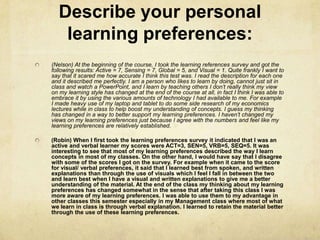
(Nelson) At the beginning of the course, I took the learning references survey and got the
following results: Active = 7, Sensing = 7, Global = 5, and Visual = 1. Quite frankly I want to
say that it scared me how accurate I think this test was. I read the description for each one
and it described me perfectly. I am a person who likes to learn by doing, cannot just sit in
class and watch a PowerPoint, and I learn by teaching others I don’t really think my view
on my learning style has changed at the end of the course at all, in fact I think I was able to
embrace it by using the various amounts of technology I had available to me. For example
I made heavy use of my laptop and tablet to do some side research of my economics
lectures while in class to help boost my understanding of concepts. I guess my thinking
has changed in a way to better support my learning preferences. I haven’t changed my
views on my learning preferences just because I agree with the numbers and feel like my
learning preferences are relatively established.

(Robin) When I first took the learning preferences survey it indicated that I was an
active and verbal learner my scores were ACT=3, SEN=5, VRB=5, SEQ=5. It was
interesting to see that most of my learning preferences described the way I learn
concepts in most of my classes. On the other hand, I would have say that I disagree
with some of the scores I got on the survey. For example when it came to the score
for visual/ verbal preferences, it said that I learned best from spoken, and written
explanations than through the use of visuals which I feel I fall in between the two
and learn best when I have a visual and written explanations to give me a better
understanding of the material. At the end of the class my thinking about my learning
preferences has changed somewhat in the sense that after taking this class I was
more aware of my learning preferences. I was able to use them to my advantage in
other classes this semester especially in my Management class where most of what
we learn in class is through verbal explanation. I learned to retain the material better
through the use of these learning preferences.
Summarize your group's
 thoughts about learning
            preferences: while trying
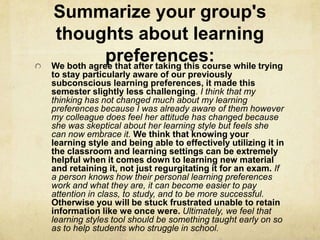
We both agree that after taking this course
to stay particularly aware of our previously
subconscious learning preferences, it made this
semester slightly less challenging. I think that my
thinking has not changed much about my learning
preferences because I was already aware of them however
my colleague does feel her attitude has changed because
she was skeptical about her learning style but feels she
can now embrace it. We think that knowing your
learning style and being able to effectively utilizing it in
the classroom and learning settings can be extremely
helpful when it comes down to learning new material
and retaining it, not just regurgitating it for an exam. If
a person knows how their personal learning preferences
work and what they are, it can become easier to pay
attention in class, to study, and to be more successful.
Otherwise you will be stuck frustrated unable to retain
information like we once were. Ultimately, we feel that
learning styles tool should be something taught early on so
as to help students who struggle in school.
Describe the learning
pathway you chose at the
 beginning of the class:
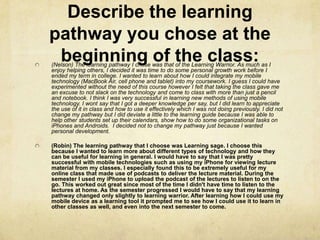
(Nelson) The learning pathway I chose was that of the Learning Warrior. As much as I
enjoy helping others, I decided it was time to do some personal growth work before I
ended my term in college. I wanted to learn about how I could integrate my mobile
technology (MacBook Air, cell phone and tablet) into my coursework. I guess I could have
experimented without the need of this course however I felt that taking the class gave me
an excuse to not slack on the technology and come to class with more than just a pencil
and notebook. I think I was very successful in learning new methods of using mobile
technology. I wont say that I got a deeper knowledge per say, but I did learn to appreciate
the use of it in class and how to use it effectively which I was not doing previously. I did not
change my pathway but I did deviate a little to the learning guide because I was able to
help other students set up their calendars, show how to do some organizational tasks on
iPhones and Androids. I decided not to change my pathway just because I wanted
personal development.

(Robin) The learning pathway that I choose was Learning sage. I choose this
because I wanted to learn more about different types of technology and how they
can be useful for learning in general. I would have to say that I was pretty
successful with mobile technologies such as using my iPhone for viewing lecture
material from my classes. I especially found this to be extremely useful for my
online class that made use of podcasts to deliver the lecture material. During the
semester I used my iPhone to upload the podcast of the lectures to listen to on the
go. This worked out great since most of the time I didn't have time to listen to the
lectures at home. As the semester progressed I would have to say that my learning
pathway changed only slightly to learning warrior. After learning how I could use my
mobile device as a learning tool it prompted me to see how I could use it to learn in
other classes as well, and even into the next semester to come.
Summarize how the activities you completed
  contributed or did not contribute to your
             learning pathway:

  We believe that there were a lot of activities that helped us
  understand how to use mobile technology. We (well Nelson
  helped me) set up some cool podcasts to listen to that were
  pertinent to some of our courses to listen to while on BART. The
  Podcasts Quest, in this case, along with the MP3 quest were
  extremely useful because it showed us different ways to listen.
  We were even able to record some our professors’ lectures and
  listen to them while reviewing notes and created podcasts for
  other students in our class. The iPad/Tablet also helped a lot
  because we both used to think that they were just giant iPod touches
  and/or giant cell phones. After reading the power points and listening
  to the podcasts of the lecture (on a tablet of course) and discovering
  new features, it became clear how much we could benefit from the
  use of mobile technology for learning not just for fun. Quite frankly,
  we both agree that doing the quizzes and
  reading/listening/watching the lectures for ALL of the quests
  were very helpful (especially since we both have different
  learning styles). Also, the level 3 portion of the iPad/Tablet quest
  helped a lot because it forced the use of mobile technology for
  experimental purposes in our learning throughout the semester. We
  think that specifically, the best activities were the ones that required
  interactive learning like the level 3 for the iPad and Podcasts. Again,
  they forced us to actually apply the technology into our lives.
Describe the top mobile
technologies you explored for
          learning:
(Nelson) The mobile technology quest I thought was most explored on my end was the iPad/Tablet quest. I
did a lot of work for the level 3 quest (application in our coursework). I bought an Android based tablet
(Samsung Galaxy Tab 2) so that I can use it to take notes I class and do some side research. I think it was
by far the best decision (and quest) in my academic career. I think it really did accommodate my active and
sensing learning preferences very well. Being an economics major is tough when you are an active learner.
A lot of the course work is theory and application does not come until the final courses. Using the mobile
technology in my classes kept me very active and helped me piece together the puzzles of the theoretical
work into real world applications. For me, if I can understand how to apply theory in real world, I will better
understand the theory. Having the tablet or laptop during class helped me link bookmarks, podcasts, and
even screencasts of relevance to the notes I was taking.

(Robin) The mobile technology quests that I explored during the semester were podcasts, and
iPods. These technologies were most used for my online classes, such as this one, and my
management class but I also used it for my other classes as well. For my classes I would use my
iPod/iPhone to listen to podcast lectures as well to view the lectures of the quests for this class
through screener in order to study the material. In addition I would also use it to take my online
quizzes, which is great since I don’t always carry my laptop with me. I think that these mobile
technologies really accommodate to my visual and verbal preferences the most. Through the use of
screener I was able to see the examples of the material while also being able to hear it was really
helpful since I understand the material better if I hear and see it at the same time. As for my other
learning preferences I would have to say that mobile technologies is useful for some of my learning
preferences such as my active learning preferences, and sequential preferences not so much the
sensing preferences. Through the use of interactive apps on my iPhone I could see that it allowed
me to learn by interacting with the sources to understand the information best such as the language
app. Other apps I found useful where the use of the chemistry app that feed to my sequential
learning preferences. This allowed me to follow logical paths in finding solutions to chemical
reactions.
Synthesize your group's experience
   investigating the use of different mobile
          technologies for learning:

Screencasts, tablets and the mobility of these technologies ability were probably the tools we were
most interested in as a group. What surprised me the most was that I underestimated the ability of a
tablet to double as a notebook and pencil and take such great notes and synchronizing them with
apps such as Evernote. We were skeptical about whether or not a tablet could double as form of note
taking and to both of our surprise it did and very well so. We could literally skip class and exchange notes
without ever having to see each other. We do think that a tablet can be extremely effective for learning and
carrying on your necessary data along with you because you can watch educational videos (screencasts),
listen to podcasts, and take notes with the versatility of just one tool. Screencasts were probably most
effective for me because I am a visual learner not just an audible one, I have to see what the person
is talking about in order for me to really grasp the concept. As much as I enjoy podcasts, we both
agree that as far as mobility goes, podcasts proved to be the weakest for both of us. Yes, it was
great being able to take a podcasts with you on a jog, while on BART, or even at work, the problem
is that we both get distracted easily so it made it easy to not follow along. It was somewhat effective
however because after watching a screencast of the topic in the podcast or in a visual lecture, we
get the “oh now I get it” feeling but not until after actually seeing it. In the future, we’d both like to
get to explore more functions of podcasts and recording them with a tablet or cell phone. The
reason being that we both take really good notes in class but agree that sometimes there are things
a professor will say and without a recording you will never remember it verbatim.

       Being that we were both active and visual or sensing learners, it really helped a lot to watch
screencasts and take notes on our laptops/tablet because it drowned our need to be fidgety in class (it
would seem we both have ADHD) and we were able to take notes and Google relevant
screencasts/podcasts to keep for later use. The fact that we were able to stay busy while paying
attention in class definitely helped us both out because it used to be hard to take notes and not
space out and then realize we were behind. Now, using things like Evernote, we could include links
to outside sources on our notes and in case we were lost or needed additional information, it would
be synced to our phones, laptop etc. for when we needed it for studying purposes. Its not so much
one particular mobile technology that helped us, but instead the ability to take all the technology mobile
alongside us and having it handy at any given necessary moment.
Summarize how you will
use what you learned in
      this class:
This course has taught us both a lot about ourselves and how we learn. After taking this course, we can
both agree that we will try to continue the use of mobile technology into the rest of the remaining
coursework the next semester because using a pencil and notebook is now dinosaur era. We both
were unaware of the extensive usage of podcasts available, screencasts, and the ability to take them
practically anywhere on our phones and laptops (and tablet). I think that the most useful strategy I will
always keep with me is the active earning using mobile technology just because I can have information at
the tap of my phones screen. On the other hand, I think that the visual aspect of mobile technology is
something I will continue to use because I can just pull out my phone and look for a good
screencast, YouTube video, etc. on the topic of interest and learn while on the go. The application of
such mobile technology can vary depending on the type of work one gets into. I want to be an Economist or
Financial Analyst, so having the relevant information, graphs, charts etc. handy can help while doing
research or on the job. I plan to get into Dietetics so being able to show clients the proper food
pyramids, building their profiles on the fly and having the necessary information available instantly
can be extremely helpful. Learning a new job can require an extensive amount of tedious work, but
being able to do research on the job, technique and so forth can be easily achieved if we have
mobile technology.

         I think that the technologies I will definitely continue to use are my MacBook Air, and my tablet. I can
easily synchronize all the necessary material I need back and forth and use one or the other depending on
my need. I think the tablet and laptop are good for taking notes in meetings, making lists and charts on the
go, and help in learning because you can always stay connected on the internet to find anything you need.
Also being able to record and converting to podcasts for learning purposes is extremely useful in
real world settings. I find that my iPhone’s usage of screencasts and podcasts is something I have
grown to love because I have such an extensive amount of information at my fingertips if need be. I
think I will probably avoid tablets for learning because it was too tedious for me to use and bulky. I
am better off using my laptop and tethering to my phone because, in my opinion, it’s just as useful
as a tablet. I think that microblogs and social networking on mobile applications are also least effective for
learning so I would not use those for learning purposes, just for my own personal use. Social bookmarking
will also be avoided by both of us because we found it too difficult to keep the bookmarks on a website
organized. Using these on mobile devices was too hard and complicated to keep organized.

Mobile technology final

  • 1.
    Mobile Learning Final NelsonMendoza (Contributions in Italics) (908001736 Robin Martinez (Contributions in BOLD) (911386624)
  • 2.
    Describe your personal learning preferences: (Nelson) At the beginning of the course, I took the learning references survey and got the following results: Active = 7, Sensing = 7, Global = 5, and Visual = 1. Quite frankly I want to say that it scared me how accurate I think this test was. I read the description for each one and it described me perfectly. I am a person who likes to learn by doing, cannot just sit in class and watch a PowerPoint, and I learn by teaching others I don’t really think my view on my learning style has changed at the end of the course at all, in fact I think I was able to embrace it by using the various amounts of technology I had available to me. For example I made heavy use of my laptop and tablet to do some side research of my economics lectures while in class to help boost my understanding of concepts. I guess my thinking has changed in a way to better support my learning preferences. I haven’t changed my views on my learning preferences just because I agree with the numbers and feel like my learning preferences are relatively established. (Robin) When I first took the learning preferences survey it indicated that I was an active and verbal learner my scores were ACT=3, SEN=5, VRB=5, SEQ=5. It was interesting to see that most of my learning preferences described the way I learn concepts in most of my classes. On the other hand, I would have say that I disagree with some of the scores I got on the survey. For example when it came to the score for visual/ verbal preferences, it said that I learned best from spoken, and written explanations than through the use of visuals which I feel I fall in between the two and learn best when I have a visual and written explanations to give me a better understanding of the material. At the end of the class my thinking about my learning preferences has changed somewhat in the sense that after taking this class I was more aware of my learning preferences. I was able to use them to my advantage in other classes this semester especially in my Management class where most of what we learn in class is through verbal explanation. I learned to retain the material better through the use of these learning preferences.
  • 3.
    Summarize your group's thoughts about learning preferences: while trying We both agree that after taking this course to stay particularly aware of our previously subconscious learning preferences, it made this semester slightly less challenging. I think that my thinking has not changed much about my learning preferences because I was already aware of them however my colleague does feel her attitude has changed because she was skeptical about her learning style but feels she can now embrace it. We think that knowing your learning style and being able to effectively utilizing it in the classroom and learning settings can be extremely helpful when it comes down to learning new material and retaining it, not just regurgitating it for an exam. If a person knows how their personal learning preferences work and what they are, it can become easier to pay attention in class, to study, and to be more successful. Otherwise you will be stuck frustrated unable to retain information like we once were. Ultimately, we feel that learning styles tool should be something taught early on so as to help students who struggle in school.
  • 4.
    Describe the learning pathwayyou chose at the beginning of the class: (Nelson) The learning pathway I chose was that of the Learning Warrior. As much as I enjoy helping others, I decided it was time to do some personal growth work before I ended my term in college. I wanted to learn about how I could integrate my mobile technology (MacBook Air, cell phone and tablet) into my coursework. I guess I could have experimented without the need of this course however I felt that taking the class gave me an excuse to not slack on the technology and come to class with more than just a pencil and notebook. I think I was very successful in learning new methods of using mobile technology. I wont say that I got a deeper knowledge per say, but I did learn to appreciate the use of it in class and how to use it effectively which I was not doing previously. I did not change my pathway but I did deviate a little to the learning guide because I was able to help other students set up their calendars, show how to do some organizational tasks on iPhones and Androids. I decided not to change my pathway just because I wanted personal development. (Robin) The learning pathway that I choose was Learning sage. I choose this because I wanted to learn more about different types of technology and how they can be useful for learning in general. I would have to say that I was pretty successful with mobile technologies such as using my iPhone for viewing lecture material from my classes. I especially found this to be extremely useful for my online class that made use of podcasts to deliver the lecture material. During the semester I used my iPhone to upload the podcast of the lectures to listen to on the go. This worked out great since most of the time I didn't have time to listen to the lectures at home. As the semester progressed I would have to say that my learning pathway changed only slightly to learning warrior. After learning how I could use my mobile device as a learning tool it prompted me to see how I could use it to learn in other classes as well, and even into the next semester to come.
  • 5.
    Summarize how theactivities you completed contributed or did not contribute to your learning pathway: We believe that there were a lot of activities that helped us understand how to use mobile technology. We (well Nelson helped me) set up some cool podcasts to listen to that were pertinent to some of our courses to listen to while on BART. The Podcasts Quest, in this case, along with the MP3 quest were extremely useful because it showed us different ways to listen. We were even able to record some our professors’ lectures and listen to them while reviewing notes and created podcasts for other students in our class. The iPad/Tablet also helped a lot because we both used to think that they were just giant iPod touches and/or giant cell phones. After reading the power points and listening to the podcasts of the lecture (on a tablet of course) and discovering new features, it became clear how much we could benefit from the use of mobile technology for learning not just for fun. Quite frankly, we both agree that doing the quizzes and reading/listening/watching the lectures for ALL of the quests were very helpful (especially since we both have different learning styles). Also, the level 3 portion of the iPad/Tablet quest helped a lot because it forced the use of mobile technology for experimental purposes in our learning throughout the semester. We think that specifically, the best activities were the ones that required interactive learning like the level 3 for the iPad and Podcasts. Again, they forced us to actually apply the technology into our lives.
  • 6.
    Describe the topmobile technologies you explored for learning: (Nelson) The mobile technology quest I thought was most explored on my end was the iPad/Tablet quest. I did a lot of work for the level 3 quest (application in our coursework). I bought an Android based tablet (Samsung Galaxy Tab 2) so that I can use it to take notes I class and do some side research. I think it was by far the best decision (and quest) in my academic career. I think it really did accommodate my active and sensing learning preferences very well. Being an economics major is tough when you are an active learner. A lot of the course work is theory and application does not come until the final courses. Using the mobile technology in my classes kept me very active and helped me piece together the puzzles of the theoretical work into real world applications. For me, if I can understand how to apply theory in real world, I will better understand the theory. Having the tablet or laptop during class helped me link bookmarks, podcasts, and even screencasts of relevance to the notes I was taking. (Robin) The mobile technology quests that I explored during the semester were podcasts, and iPods. These technologies were most used for my online classes, such as this one, and my management class but I also used it for my other classes as well. For my classes I would use my iPod/iPhone to listen to podcast lectures as well to view the lectures of the quests for this class through screener in order to study the material. In addition I would also use it to take my online quizzes, which is great since I don’t always carry my laptop with me. I think that these mobile technologies really accommodate to my visual and verbal preferences the most. Through the use of screener I was able to see the examples of the material while also being able to hear it was really helpful since I understand the material better if I hear and see it at the same time. As for my other learning preferences I would have to say that mobile technologies is useful for some of my learning preferences such as my active learning preferences, and sequential preferences not so much the sensing preferences. Through the use of interactive apps on my iPhone I could see that it allowed me to learn by interacting with the sources to understand the information best such as the language app. Other apps I found useful where the use of the chemistry app that feed to my sequential learning preferences. This allowed me to follow logical paths in finding solutions to chemical reactions.
  • 7.
    Synthesize your group'sexperience investigating the use of different mobile technologies for learning: Screencasts, tablets and the mobility of these technologies ability were probably the tools we were most interested in as a group. What surprised me the most was that I underestimated the ability of a tablet to double as a notebook and pencil and take such great notes and synchronizing them with apps such as Evernote. We were skeptical about whether or not a tablet could double as form of note taking and to both of our surprise it did and very well so. We could literally skip class and exchange notes without ever having to see each other. We do think that a tablet can be extremely effective for learning and carrying on your necessary data along with you because you can watch educational videos (screencasts), listen to podcasts, and take notes with the versatility of just one tool. Screencasts were probably most effective for me because I am a visual learner not just an audible one, I have to see what the person is talking about in order for me to really grasp the concept. As much as I enjoy podcasts, we both agree that as far as mobility goes, podcasts proved to be the weakest for both of us. Yes, it was great being able to take a podcasts with you on a jog, while on BART, or even at work, the problem is that we both get distracted easily so it made it easy to not follow along. It was somewhat effective however because after watching a screencast of the topic in the podcast or in a visual lecture, we get the “oh now I get it” feeling but not until after actually seeing it. In the future, we’d both like to get to explore more functions of podcasts and recording them with a tablet or cell phone. The reason being that we both take really good notes in class but agree that sometimes there are things a professor will say and without a recording you will never remember it verbatim. Being that we were both active and visual or sensing learners, it really helped a lot to watch screencasts and take notes on our laptops/tablet because it drowned our need to be fidgety in class (it would seem we both have ADHD) and we were able to take notes and Google relevant screencasts/podcasts to keep for later use. The fact that we were able to stay busy while paying attention in class definitely helped us both out because it used to be hard to take notes and not space out and then realize we were behind. Now, using things like Evernote, we could include links to outside sources on our notes and in case we were lost or needed additional information, it would be synced to our phones, laptop etc. for when we needed it for studying purposes. Its not so much one particular mobile technology that helped us, but instead the ability to take all the technology mobile alongside us and having it handy at any given necessary moment.
  • 8.
    Summarize how youwill use what you learned in this class: This course has taught us both a lot about ourselves and how we learn. After taking this course, we can both agree that we will try to continue the use of mobile technology into the rest of the remaining coursework the next semester because using a pencil and notebook is now dinosaur era. We both were unaware of the extensive usage of podcasts available, screencasts, and the ability to take them practically anywhere on our phones and laptops (and tablet). I think that the most useful strategy I will always keep with me is the active earning using mobile technology just because I can have information at the tap of my phones screen. On the other hand, I think that the visual aspect of mobile technology is something I will continue to use because I can just pull out my phone and look for a good screencast, YouTube video, etc. on the topic of interest and learn while on the go. The application of such mobile technology can vary depending on the type of work one gets into. I want to be an Economist or Financial Analyst, so having the relevant information, graphs, charts etc. handy can help while doing research or on the job. I plan to get into Dietetics so being able to show clients the proper food pyramids, building their profiles on the fly and having the necessary information available instantly can be extremely helpful. Learning a new job can require an extensive amount of tedious work, but being able to do research on the job, technique and so forth can be easily achieved if we have mobile technology. I think that the technologies I will definitely continue to use are my MacBook Air, and my tablet. I can easily synchronize all the necessary material I need back and forth and use one or the other depending on my need. I think the tablet and laptop are good for taking notes in meetings, making lists and charts on the go, and help in learning because you can always stay connected on the internet to find anything you need. Also being able to record and converting to podcasts for learning purposes is extremely useful in real world settings. I find that my iPhone’s usage of screencasts and podcasts is something I have grown to love because I have such an extensive amount of information at my fingertips if need be. I think I will probably avoid tablets for learning because it was too tedious for me to use and bulky. I am better off using my laptop and tethering to my phone because, in my opinion, it’s just as useful as a tablet. I think that microblogs and social networking on mobile applications are also least effective for learning so I would not use those for learning purposes, just for my own personal use. Social bookmarking will also be avoided by both of us because we found it too difficult to keep the bookmarks on a website organized. Using these on mobile devices was too hard and complicated to keep organized.