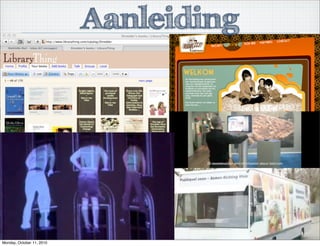
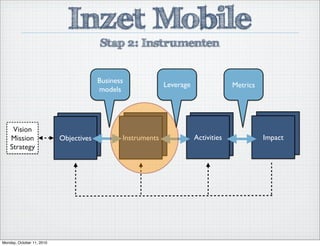
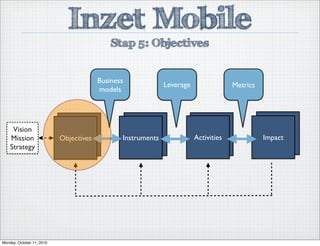
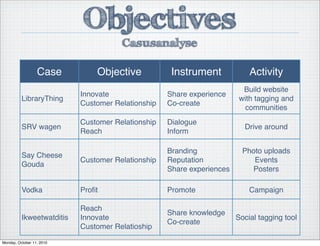
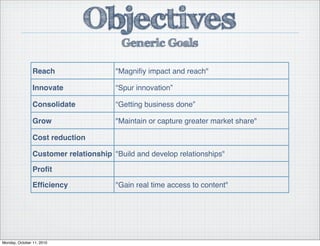
Instrumenten
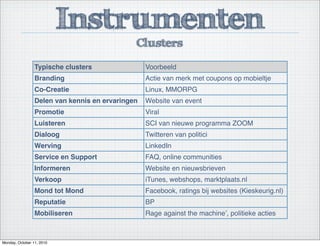
Typische clusters Voorbeeld
BrandingActie van merk met coupons op mobieltje
Co-Creatie Linux, MMORPG
Delen van kennis en ervaringen Website van event
Promotie Viral
Luisteren SCI van nieuwe programma ZOOM
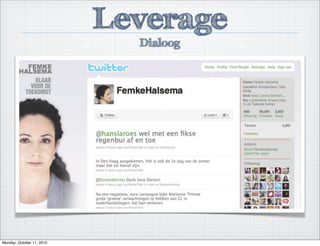
Dialoog Twitteren van politici
Werving LinkedIn
Service en Support FAQ, online communities
Informeren Website en nieuwsbrieven
Verkoop iTunes, webshops, marktplaats.nl
Mond tot Mond Facebook, ratings bij websites (Kieskeurig.nl)
Reputatie BP
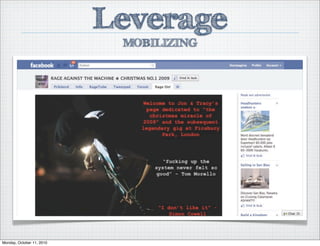
Mobiliseren Rage against the machineʼ, politieke acties
Clusters
Monday, October 11, 2010
13.
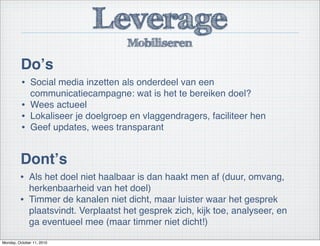
Leverage
Mobiliseren
Doʼs
• Social mediainzetten als onderdeel van een
communicatiecampagne: wat is het te bereiken doel?
• Wees actueel
• Lokaliseer je doelgroep en vlaggendragers, faciliteer hen
• Geef updates, wees transparant
Dontʼs
• Als het doel niet haalbaar is dan haakt men af (duur, omvang,
herkenbaarheid van het doel)
• Timmer de kanalen niet dicht, maar luister waar het gesprek
plaatsvindt. Verplaatst het gesprek zich, kijk toe, analyseer, en
ga eventueel mee (maar timmer niet dicht!)
Monday, October 11, 2010
Leverage
Dialoog
Doʼs
• Jij ok-ikok, oftewel de klant/gebruiker is een gelijkwaardige
gesprekspartner
• De digitale doelgroep is dezelfde als de fysieke doelgroep
• Stem de aard van de dialoog (niveau) af op de doelgroep
Dontʼs
• Niet terugkoppelen, niet laten zien wat er met input gebeurt.
• Building your own limonadestand: doe dit niet. Ga kijken
waar het gesprek plaatsvindt, en bevraag deelnemers wat
goed voor hen werkt.
Monday, October 11, 2010
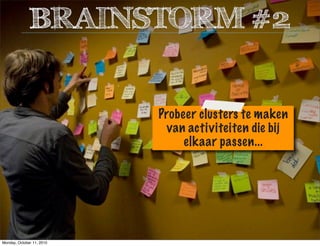
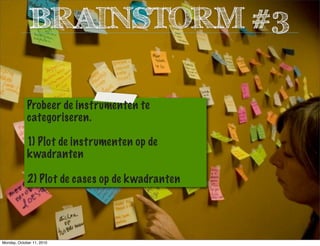
Probeer de instrumentente
categoriseren.
1) Plot de instrumenten op de
kwadranten
2) Plot de cases op de kwadranten
BRAINSTORM #3
Monday, October 11, 2010
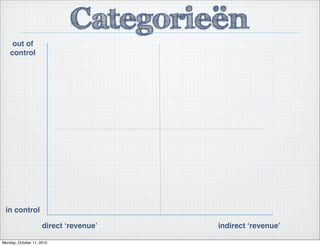
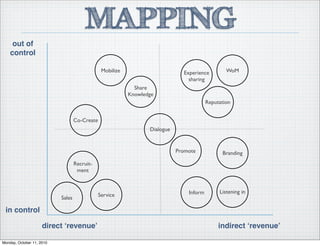
in control
out of
control
directʻrevenueʼ indirect ʻrevenueʼ
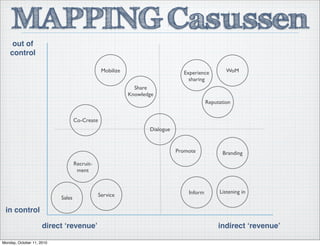
MAPPING
WoM
Promote
Reputation
Branding
Sales
Mobilize Experience
sharing
Service
Co-Create
Share
Knowledge
Listening in
Dialogue
Recruit-
ment
Inform
Monday, October 11, 2010
in control
out of
control
directʻrevenueʼ indirect ʻrevenueʼ
MAPPING Casussen
WoM
Promote
Reputation
Branding
Sales
Mobilize Experience
sharing
Service
Co-Create
Share
Knowledge
Listening in
Dialogue
Recruit-
ment
Inform
Monday, October 11, 2010
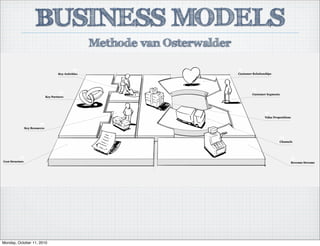
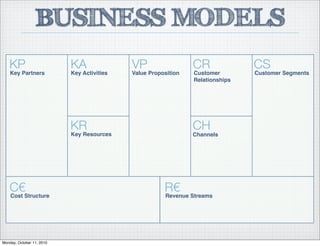
BUSINESS MODELS
KR
Key Resources
KP
KeyPartners
KA
Key Activities
C$
Cost Structure
CS
Customer Segments
CR
Customer Relationships
VP
Value Propositions
CH
Channels
R$
Revenue Streams
Methode van Osterwalder
Monday, October 11, 2010
25.
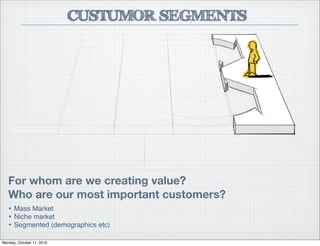
CUSTUMOR SEGMENTS
For whomare we creating value?
Who are our most important customers?
• Mass Market
• Niche market
• Segmented (demographics etc)
Monday, October 11, 2010
26.
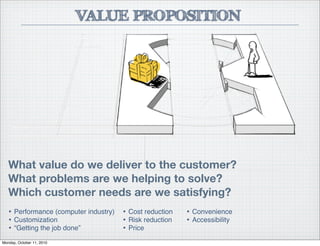
VALUE PROPOSITION
What valuedo we deliver to the customer?
What problems are we helping to solve?
Which customer needs are we satisfying?
• Performance (computer industry)
• Customization
• “Getting the job done”
• Cost reduction
• Risk reduction
• Price
• Convenience
• Accessibility
Monday, October 11, 2010
27.
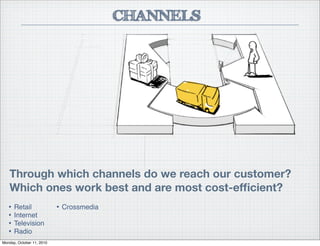
CHANNELS
Through which channelsdo we reach our customer?
Which ones work best and are most cost-efficient?
• Retail
• Internet
• Television
• Radio
• Crossmedia
Monday, October 11, 2010
28.
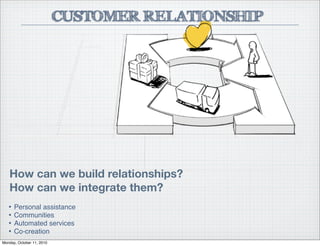
CUSTOMER RELATIONSHIP
How canwe build relationships?
How can we integrate them?
• Personal assistance
• Communities
• Automated services
• Co-creation
Monday, October 11, 2010
29.
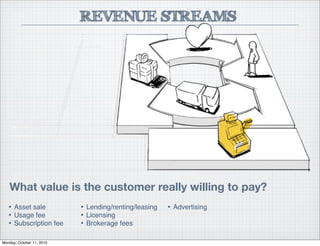
REVENUE STREAMS
What valueis the customer really willing to pay?
• Asset sale
• Usage fee
• Subscription fee
• Lending/renting/leasing
• Licensing
• Brokerage fees
• Advertising
Monday, October 11, 2010
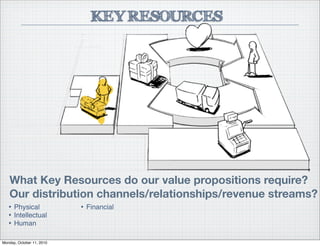
30.
KEY RESOURCES
What KeyResources do our value propositions require?
Our distribution channels/relationships/revenue streams?
• Physical
• Intellectual
• Human
• Financial
Monday, October 11, 2010
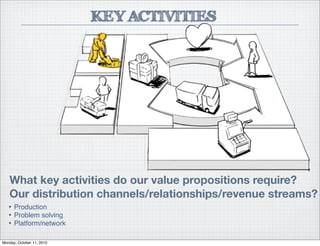
31.
KEY ACTIVITIES
What keyactivities do our value propositions require?
Our distribution channels/relationships/revenue streams?
• Production
• Problem solving
• Platform/network
Monday, October 11, 2010
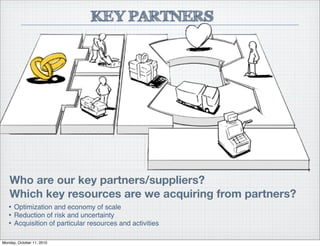
32.
KEY PARTNERS
Who areour key partners/suppliers?
Which key resources are we acquiring from partners?
• Optimization and economy of scale
• Reduction of risk and uncertainty
• Acquisition of particular resources and activities
Monday, October 11, 2010
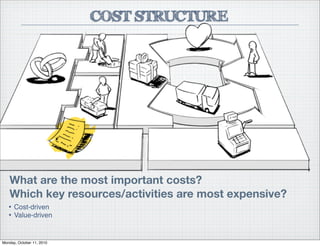
33.
COST STRUCTURE
What arethe most important costs?
Which key resources/activities are most expensive?
• Cost-driven
• Value-driven
Monday, October 11, 2010
34.
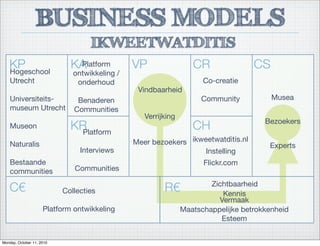
BUSINESS MODELS
KP
C€
KA
KR
VP CRCS
CH
R€
Customer Segments
Revenue StreamsCost Structure
Key Partners Key Activities
Key Resources
Value Proposition Customer
Relationships
Channels
Monday, October 11, 2010
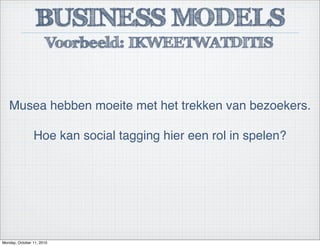
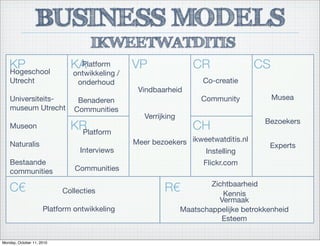
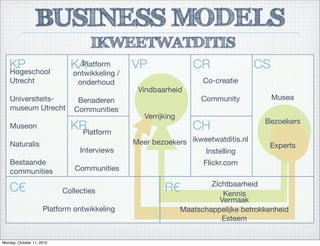
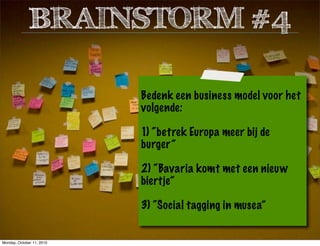
Bedenk een businessmodel voor het
volgende:
1) “betrek Europa meer bij de
burger”
2) “Bavaria komt met een nieuw
biertje”
3) “Social tagging in musea”
BRAINSTORM #4
Monday, October 11, 2010
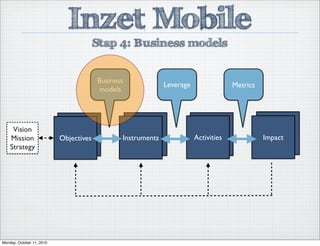
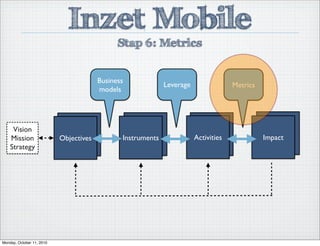
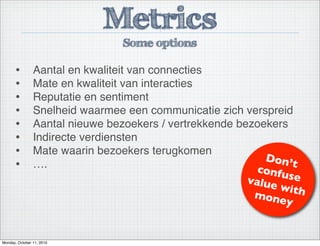
Metrics
Some options
• Aantalen kwaliteit van connecties
• Mate en kwaliteit van interacties
• Reputatie en sentiment
• Snelheid waarmee een communicatie zich verspreid
• Aantal nieuwe bezoekers / vertrekkende bezoekers
• Indirecte verdiensten
• Mate waarin bezoekers terugkomen
• ….
Don’t
confusevalue withmoney
Monday, October 11, 2010
47.
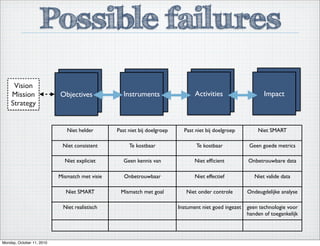
Possible failures
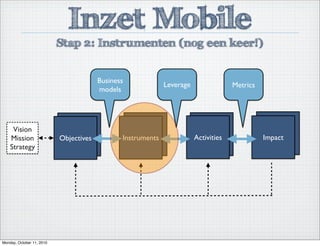
Objectives InstrumentsActivities Impact
Vision
Mission
Strategy
Niet helder Past niet bij doelgroep Past niet bij doelgroep Niet SMART
Niet consistent Te kostbaar Te kostbaar Geen goede metrics
Niet expliciet Geen kennis van Niet efficient Onbetrouwbare data
Mismatch met visie Onbetrouwbaar Niet effectief Niet valide data
Niet SMART Mismatch met goal Niet onder controle Ondeugdelijke analyse
Niet realistisch Instument niet goed ingezet geen technologie voor
handen of toegankelijk
Monday, October 11, 2010