Downloaded 14 times
![REFERENCES
[1] 3GNewsroom.com. 3UK disgraced by BBC watchdog programme.
http://www.3gnewsroom.com/, October 22, 2003.
[2] 3GToday. http://www.3gtoday.com/, 2006.
[3] D. Agrafiotis, C. N. Canagarajah, D. R. Bull, M. Dye, H. Twyford, J. Kyle, and
J. T. ChungHow. Optimized sign language video coding based on eye-tracking analysis. In VCIP,
pages 1244–1252, 2003.
[4] L. Aimar, L. Merritt, E. Petit, M. Chen, J. Clay, M. Rullgrd, C. Heine, and A. Izvorski.
x264 - a free h264/AVC encoder. http://www.videolan.org/x264.html, 2005.
[5] J. Bangham, S. J. Cox, M. Lincoln, I. Marshall, M. Tutt, and M. Wells. Signing for the Deaf
Using Virtual Humans. In IEE Colloquium on Speech and Language Processing for Disabled and
Elderly, 2000.](https://image.slidesharecdn.com/mobileasl-110702022904-phpapp02/85/Mobile-asl-13-320.jpg)

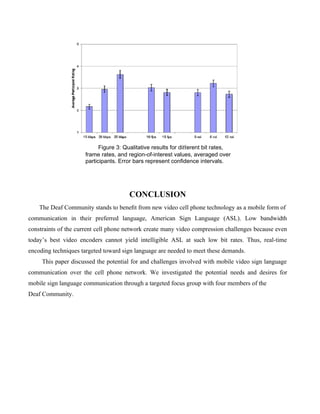
The Mobile ASL project aims to improve the transmission of American Sign Language (ASL) video over mobile networks, addressing challenges such as bandwidth limitations and video intelligibility. The study found that prioritizing quality in the facial region of ASL signers significantly enhances understanding, particularly at lower frame rates and bit rates suitable for current cell phone networks. Overall, the results suggest that minor encoding adjustments may enable real-time, intelligible ASL communication via mobile video calls, benefiting the deaf community.


