TEAM 6 
Adhithi 
Fan Sai 
Sanika 
Vanessa 
SPEECH 
RECOGNITION
TECHNOLOGY
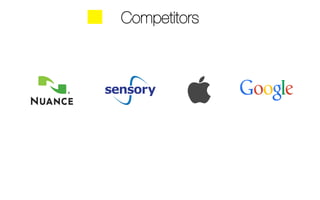
Competitors
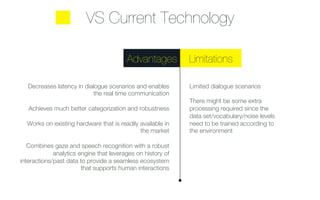
VS Current Technology 
Limitations 
Limited dialogue scenarios 
There might be some extra 
processing required since the 
data set/vocabulary/noise levels 
need to be trained according to 
the environment 
Advantages 
Decreases latency in dialogue scenarios and enables 
the real time communication 
Achieves much better categorization and robustness 
Works on existing hardware that is readily available in 
the market 
Combines gaze and speech recognition with a robust 
analytics engine that leverages on history of 
interactions/past data to provide a seamless ecosystem 
that supports human interactions
CONCEPT
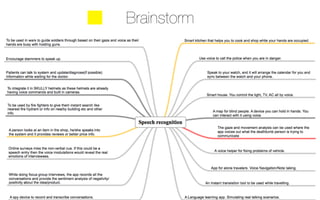
Brainstorm
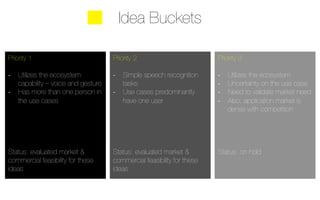
Idea Buckets 
Priority 1 
-­‐ Utilizes the ecosystem 
capability – voice and gesture 
-­‐ Has more than one person in 
the use cases 
Status: evaluated market & 
commercial feasibility for these 
ideas 
Priority 2 
-­‐ Simple speech recognition 
tasks 
-­‐ Use cases predominantly 
have one user 
Status: evaluated market & 
commercial feasibility for these 
ideas 
Priority 3 
-­‐ Utilizes the ecosystem 
-­‐ Uncertainty on the use case 
-­‐ Need to validate market need 
-­‐ Also, application market is 
dense with competition 
Status: on hold
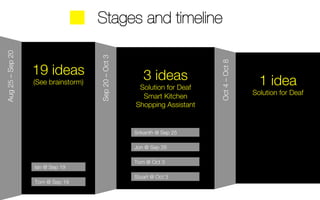
19 ideas 
(See brainstorm) 
3 ideas 
Solution for Deaf 
Smart Kitchen 
Shopping Assistant 
1 idea 
Solution for Deaf 
Tom @ Sep 19 
Srikanth @ Sep 25 
Jon @ Sep 26 
Tom @ Oct 3 
Aug 25 – Sep 20 
Sep 20 – Oct 3 
Oct 4 – Oct 8 
Stuart @ Oct 3 
Ian @ Sep 19 
Stages and timeline
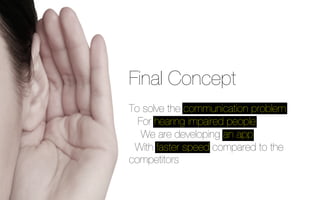
Final Concept 
To solve the communication problem 
For hearing impaired people 
We are developing an app 
With faster speed compared to the 
competitors
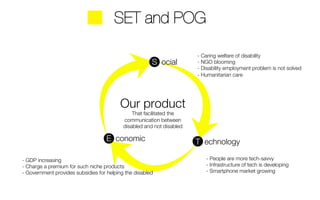
- Caring welfare of disability 
- NGO blooming 
- Disability employment problem is not solved 
- Humanitarian care 
- People are more tech-savvy 
- Infrastructure of tech is developing 
- Smartphone market growing 
SET and POG 
S ocial 
Our product 
That facilitated the 
communication between 
disabled and not disabled 
E conomic 
T echnology 
- GDP increasing 
- Charge a premium for such niche products 
- Government provides subsidies for helping the disabled
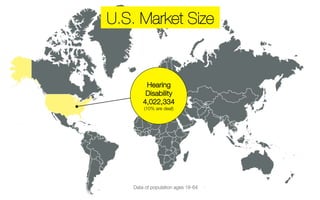
U.S. Market Size 
Hearing 
Disability 
4,022,334 
(10% are deaf) 
Data of population ages 18-64
UUsseer r Ssttuuddyy 
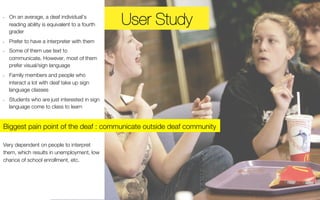
• On an average, a deaf individual’s 
reading ability is equivalent to a fourth 
grader 
• Prefer to have a interpreter with them 
• Some of them use text to 
communicate. However, most of them 
prefer visual/sign language 
• Family members and people who 
interact a lot with deaf take up sign 
language classes 
• Students who are just interested in sign 
language come to class to learn 
Biggest pain point of the deaf : communicate outside deaf community 
Very dependent on people to interpret 
them, which results in unemployment, low 
chance of school enrollment, etc.
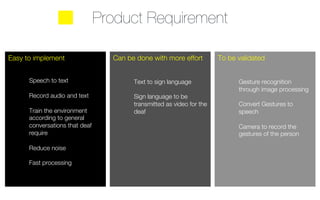
Product Requirement 
Easy to implement 
Speech to text 
Record audio and text 
Train the environment 
according to general 
conversations that deaf 
require 
Reduce noise 
Fast processing 
Can be done with more effort 
Text to sign language 
Sign language to be 
transmitted as video for the 
deaf 
To be validated 
Gesture recognition 
through image processing 
Convert Gestures to 
speech 
Camera to record the 
gestures of the person
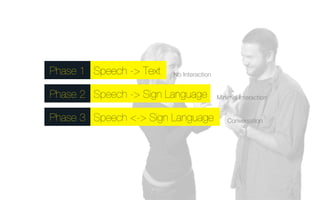
Phase 1Speech -> Text 
No Interaction 
Phase 2Speech -> Sign Language 
Phase 3Speech <-> Sign Language 
Minimal Interaction 
Conversation
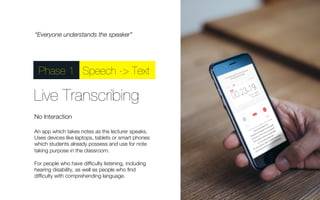
“Everyone understands the speaker” 
Phase 1Speech -> Text 
Live Transcribing 
No Interaction 
An app which takes notes as the lecturer speaks. 
Uses devices like laptops, tablets or smart phones 
which students already possess and use for note 
taking purpose in the classroom. 
For people who have difficulty listening, including 
hearing disability, as well as people who find 
difficulty with comprehending language.
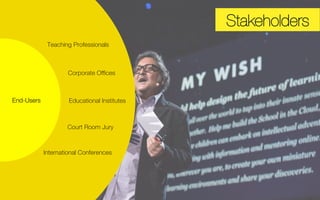
End-Users 
Teaching Professionals 
Corporate Offices 
Educational Institutes 
Court Room Jury 
International Conferences 
Stakeholders
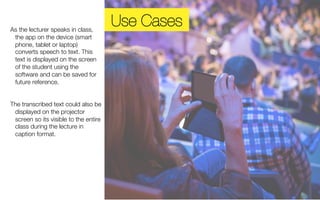
As the lecturer speaks in class, 
the app on the device (smart 
phone, tablet or laptop) 
converts speech to text. This 
text is displayed on the screen 
of the student using the 
software and can be saved for 
future reference. 
The transcribed text could also be 
displayed on the projector 
screen so its visible to the entire 
class during the lecture in 
caption format. 
Use Cases
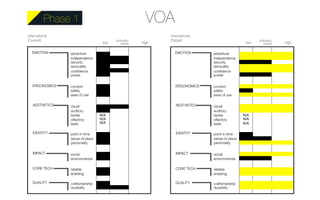
VOA 
N/A N/A 
N/A 
N/A 
N/A 
N/A 
Phase 1
Value Proposition 
“To help people who have difficulty listening, 
including hearing disability, as well as people who 
find difficulty with comprehending spoken language.” 
Phase 1
“Make the deaf employable in minimal conversation situations” 
Phase 2Speech -> Sign Language 
Speech to sign 
Minimal Interaction 
We plan to establish one way communication : 
Normal can communicate with the deaf via 
speech to sign language conversion 
This would be offered as an app on the mobile/ 
tablet 
Also, can be delivered as a web app which can be 
used via a normal desktop as well
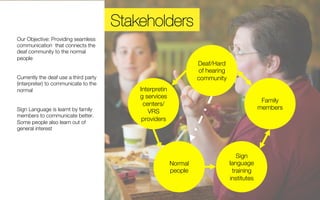
Interpretin 
g services 
centers/ 
VRS 
providers 
Family 
members 
Normal 
people 
Sign 
language 
training 
institutes 
Deaf/Hard 
of hearing 
community 
Our Objective: Providing seamless 
communication that connects the 
deaf community to the normal 
people 
Currently the deaf use a third party 
(interpreter) to communicate to the 
normal 
Sign Language is learnt by family 
members to communicate better. 
Some people also learn out of 
general interest 
Stakeholders
Stakeholders 
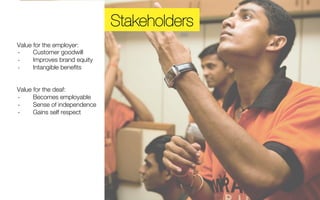
Value for the employer: 
-­‐ Customer goodwill 
-­‐ Improves brand equity 
-­‐ Intangible benefits 
Value for the deaf: 
-­‐ Becomes employable 
-­‐ Sense of independence 
-­‐ Gains self respect
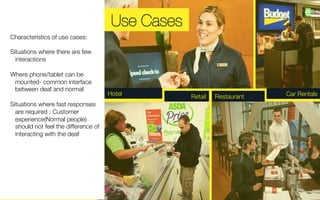
Hotel Retail Restaurant Car Rentals 
Characteristics of use cases: 
Situations where there are few 
interactions 
Where phone/tablet can be 
mounted- common interface 
between deaf and normal 
Situations where fast responses 
are required : Customer 
experience(Normal people) 
should not feel the difference of 
interacting with the deaf 
Use Cases
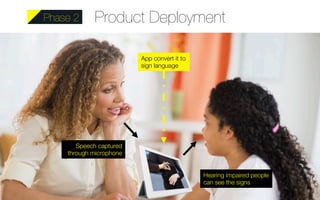
Product Deployment 
Speech captured 
through microphone 
App convert it to 
sign language 
Hearing impaired people 
can see the signs 
Phase 2
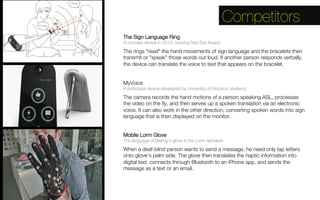
Competitors 
The Sign Language Ring 
A concept device in 2013, winning Red Dot Award 
The rings "read" the hand movements of sign language and the bracelets then 
transmit or "speak" those words out loud. If another person responds verbally, 
the device can translate the voice to text that appears on the bracelet. 
MyVoice 
A prototype device developed by University of Houston students 
The camera records the hand motions of a person speaking ASL, processes 
the video on the fly, and then serves up a spoken translation via an electronic 
voice. It can also work in the other direction, converting spoken words into sign 
language that is then displayed on the monitor. 
Mobile Lorm Glove 
The language of Bieling's glove is the Lorm alphabet 
When a deaf-blind person wants to send a message, he need only tap letters 
onto glove‘s palm side. The glove then translates the haptic information into 
digital text, connects through Bluetooth to an iPhone app, and sends the 
message as a text or an email.
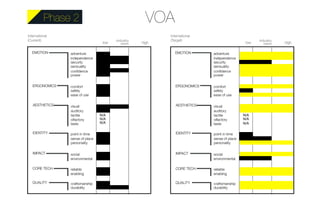
VOA 
N/A 
N/A 
N/A 
Phase 2 
N/A 
N/A 
N/A
Value proposition 
“Our product caters to the hearing impaired community by 
providing a faster means of interaction with normal people 
through a simple software app eliminating the need for any 
external hardware or sensors” 
Phase 2
“Enable seamless conversations for the deaf community” 
Phase 3Speech <-> Sign Language 
The objective of this phase is to allow deaf people “chat” with 
normal people." 
We’ll translate signs to voice, and let deaf people’s language to 
be understood by the people out of deaf community.
NEXT STEPS
Next steps 
More detailed development of phase 1 and 2 
Check viability of phase 3 
- Understand the complexity of converting sign language to speech and vice versa 
- Technical feasibility and processing requirements to enable two way communication 
- Understand the comfort level of the deaf community with single letter translation of words rather than 
conceptual translation: this reduces limits the vocabulary set
? 
TEAM 6 
Adhithi 
Fan Sai 
Sanika 
Vanessa

An communication app for hearing impaired groups

  • 1.
    TEAM 6 Adhithi Fan Sai Sanika Vanessa SPEECH RECOGNITION
  • 2.
  • 3.
  • 4.
    VS Current Technology Limitations Limited dialogue scenarios There might be some extra processing required since the data set/vocabulary/noise levels need to be trained according to the environment Advantages Decreases latency in dialogue scenarios and enables the real time communication Achieves much better categorization and robustness Works on existing hardware that is readily available in the market Combines gaze and speech recognition with a robust analytics engine that leverages on history of interactions/past data to provide a seamless ecosystem that supports human interactions
  • 5.
  • 6.
  • 7.
    Idea Buckets Priority1 -­‐ Utilizes the ecosystem capability – voice and gesture -­‐ Has more than one person in the use cases Status: evaluated market & commercial feasibility for these ideas Priority 2 -­‐ Simple speech recognition tasks -­‐ Use cases predominantly have one user Status: evaluated market & commercial feasibility for these ideas Priority 3 -­‐ Utilizes the ecosystem -­‐ Uncertainty on the use case -­‐ Need to validate market need -­‐ Also, application market is dense with competition Status: on hold
  • 8.
    19 ideas (Seebrainstorm) 3 ideas Solution for Deaf Smart Kitchen Shopping Assistant 1 idea Solution for Deaf Tom @ Sep 19 Srikanth @ Sep 25 Jon @ Sep 26 Tom @ Oct 3 Aug 25 – Sep 20 Sep 20 – Oct 3 Oct 4 – Oct 8 Stuart @ Oct 3 Ian @ Sep 19 Stages and timeline
  • 9.
    Final Concept Tosolve the communication problem For hearing impaired people We are developing an app With faster speed compared to the competitors
  • 10.
    - Caring welfareof disability - NGO blooming - Disability employment problem is not solved - Humanitarian care - People are more tech-savvy - Infrastructure of tech is developing - Smartphone market growing SET and POG S ocial Our product That facilitated the communication between disabled and not disabled E conomic T echnology - GDP increasing - Charge a premium for such niche products - Government provides subsidies for helping the disabled
  • 11.
    U.S. Market Size Hearing Disability 4,022,334 (10% are deaf) Data of population ages 18-64
  • 12.
    UUsseer r Ssttuuddyy • On an average, a deaf individual’s reading ability is equivalent to a fourth grader • Prefer to have a interpreter with them • Some of them use text to communicate. However, most of them prefer visual/sign language • Family members and people who interact a lot with deaf take up sign language classes • Students who are just interested in sign language come to class to learn Biggest pain point of the deaf : communicate outside deaf community Very dependent on people to interpret them, which results in unemployment, low chance of school enrollment, etc.
  • 13.
    Product Requirement Easyto implement Speech to text Record audio and text Train the environment according to general conversations that deaf require Reduce noise Fast processing Can be done with more effort Text to sign language Sign language to be transmitted as video for the deaf To be validated Gesture recognition through image processing Convert Gestures to speech Camera to record the gestures of the person
  • 14.
    Phase 1Speech ->Text No Interaction Phase 2Speech -> Sign Language Phase 3Speech <-> Sign Language Minimal Interaction Conversation
  • 15.
    “Everyone understands thespeaker” Phase 1Speech -> Text Live Transcribing No Interaction An app which takes notes as the lecturer speaks. Uses devices like laptops, tablets or smart phones which students already possess and use for note taking purpose in the classroom. For people who have difficulty listening, including hearing disability, as well as people who find difficulty with comprehending language.
  • 16.
    End-Users Teaching Professionals Corporate Offices Educational Institutes Court Room Jury International Conferences Stakeholders
  • 17.
    As the lecturerspeaks in class, the app on the device (smart phone, tablet or laptop) converts speech to text. This text is displayed on the screen of the student using the software and can be saved for future reference. The transcribed text could also be displayed on the projector screen so its visible to the entire class during the lecture in caption format. Use Cases
  • 18.
    VOA N/A N/A N/A N/A N/A N/A Phase 1
  • 19.
    Value Proposition “Tohelp people who have difficulty listening, including hearing disability, as well as people who find difficulty with comprehending spoken language.” Phase 1
  • 20.
    “Make the deafemployable in minimal conversation situations” Phase 2Speech -> Sign Language Speech to sign Minimal Interaction We plan to establish one way communication : Normal can communicate with the deaf via speech to sign language conversion This would be offered as an app on the mobile/ tablet Also, can be delivered as a web app which can be used via a normal desktop as well
  • 21.
    Interpretin g services centers/ VRS providers Family members Normal people Sign language training institutes Deaf/Hard of hearing community Our Objective: Providing seamless communication that connects the deaf community to the normal people Currently the deaf use a third party (interpreter) to communicate to the normal Sign Language is learnt by family members to communicate better. Some people also learn out of general interest Stakeholders
  • 22.
    Stakeholders Value forthe employer: -­‐ Customer goodwill -­‐ Improves brand equity -­‐ Intangible benefits Value for the deaf: -­‐ Becomes employable -­‐ Sense of independence -­‐ Gains self respect
  • 23.
    Hotel Retail RestaurantCar Rentals Characteristics of use cases: Situations where there are few interactions Where phone/tablet can be mounted- common interface between deaf and normal Situations where fast responses are required : Customer experience(Normal people) should not feel the difference of interacting with the deaf Use Cases
  • 24.
    Product Deployment Speechcaptured through microphone App convert it to sign language Hearing impaired people can see the signs Phase 2
  • 25.
    Competitors The SignLanguage Ring A concept device in 2013, winning Red Dot Award The rings "read" the hand movements of sign language and the bracelets then transmit or "speak" those words out loud. If another person responds verbally, the device can translate the voice to text that appears on the bracelet. MyVoice A prototype device developed by University of Houston students The camera records the hand motions of a person speaking ASL, processes the video on the fly, and then serves up a spoken translation via an electronic voice. It can also work in the other direction, converting spoken words into sign language that is then displayed on the monitor. Mobile Lorm Glove The language of Bieling's glove is the Lorm alphabet When a deaf-blind person wants to send a message, he need only tap letters onto glove‘s palm side. The glove then translates the haptic information into digital text, connects through Bluetooth to an iPhone app, and sends the message as a text or an email.
  • 26.
    VOA N/A N/A N/A Phase 2 N/A N/A N/A
  • 27.
    Value proposition “Ourproduct caters to the hearing impaired community by providing a faster means of interaction with normal people through a simple software app eliminating the need for any external hardware or sensors” Phase 2
  • 28.
    “Enable seamless conversationsfor the deaf community” Phase 3Speech <-> Sign Language The objective of this phase is to allow deaf people “chat” with normal people." We’ll translate signs to voice, and let deaf people’s language to be understood by the people out of deaf community.
  • 29.
  • 30.
    Next steps Moredetailed development of phase 1 and 2 Check viability of phase 3 - Understand the complexity of converting sign language to speech and vice versa - Technical feasibility and processing requirements to enable two way communication - Understand the comfort level of the deaf community with single letter translation of words rather than conceptual translation: this reduces limits the vocabulary set
  • 31.
    ? TEAM 6 Adhithi Fan Sai Sanika Vanessa