Application Software for Mobile Phones
APP
SMobile
Introduction
Mobile communication is so integrated into
our lives that many people feel uncomfortable
without a cell phone. Once upon a time, the
most popular functions of phones were calling
and sending texts. A smart phone is a
multifunctional device that not only communicates, but
helps to learn, earn, and have fun. This is made possible
by the development of mobile applications.
 In Simple terms we can say that an app is any computer
program that your mobile phone runs to either perform a
task, display media, facilitate communication,
entertain you, or to provide a service or any other
function.
 The term "app" is a shortening of the term
"application software". It has become very
popular, and in 2010 was listed as “Word of the Year” by
American Dialect Society.
What is an App ??
History of App
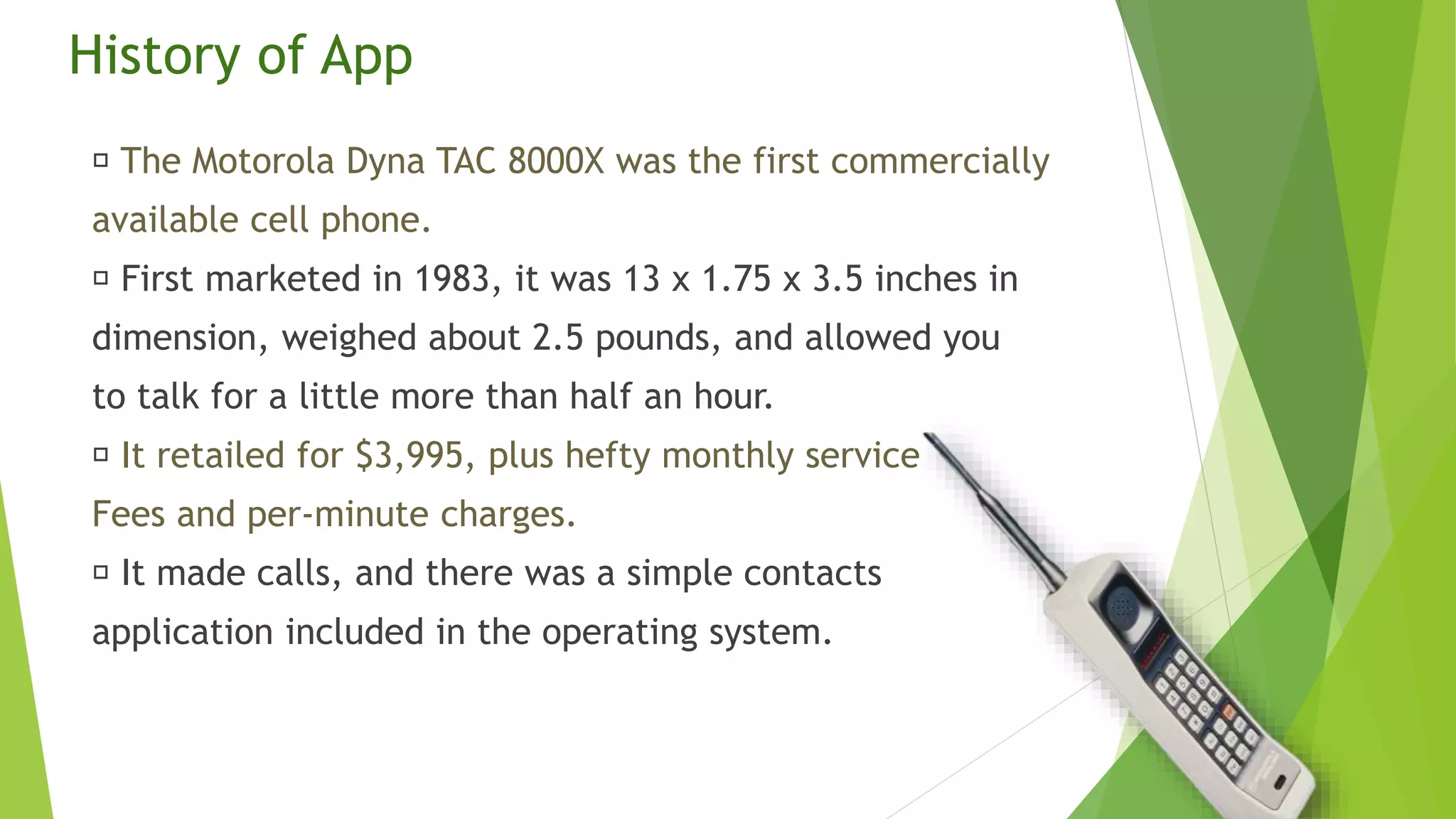
The Motorola Dyna TAC 8000X was the first commercially
available cell phone.
First marketed in 1983, it was 13 x 1.75 x 3.5 inches in
dimension, weighed about 2.5 pounds, and allowed you
to talk for a little more than half an hour.
It retailed for $3,995, plus hefty monthly service
Fees and per-minute charges.
It made calls, and there was a simple contacts
application included in the operating system.
History of App
It was during this period the first “time-waster” games begin to
appear. Nokia was famous for putting the 1970s video game.
Snake on some of its earliest phones. Other followed, adding
games like Pong, Tetris, and Tic-Tac-Toe. These early phones
changed the way people thought about communication. It turned
out direct phone access to the Internet. Customers began pushing
for more features and more games. By the late
90s, professional Web sites were
full color and They relied on
JavaScript and Flash to
enhance the user
experience.
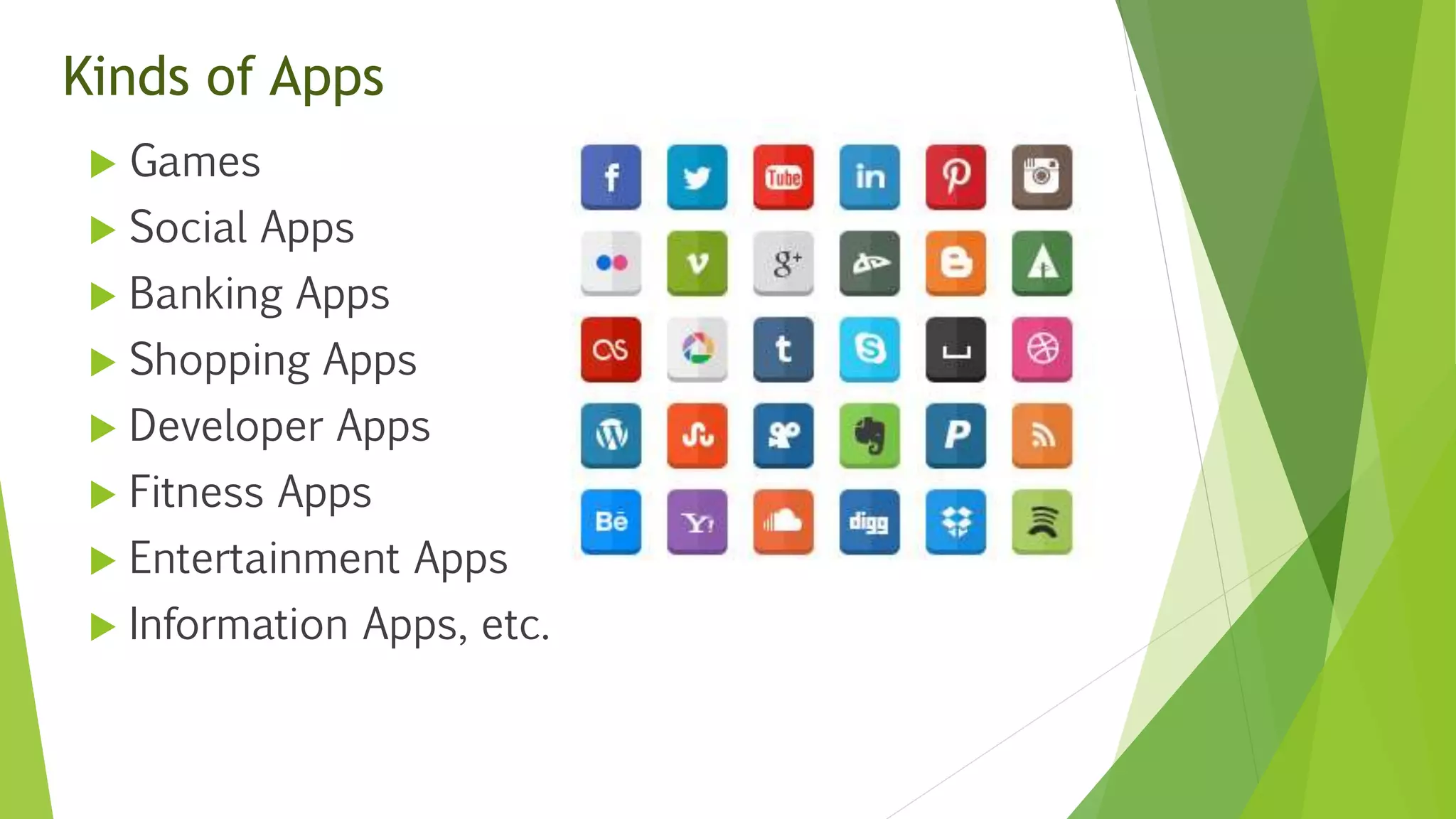
Kinds of Apps
 Games
 Social Apps
 Banking Apps
 Shopping Apps
 Developer Apps
 Fitness Apps
 Entertainment Apps
 Information Apps, etc.
Where We Get Apps ??
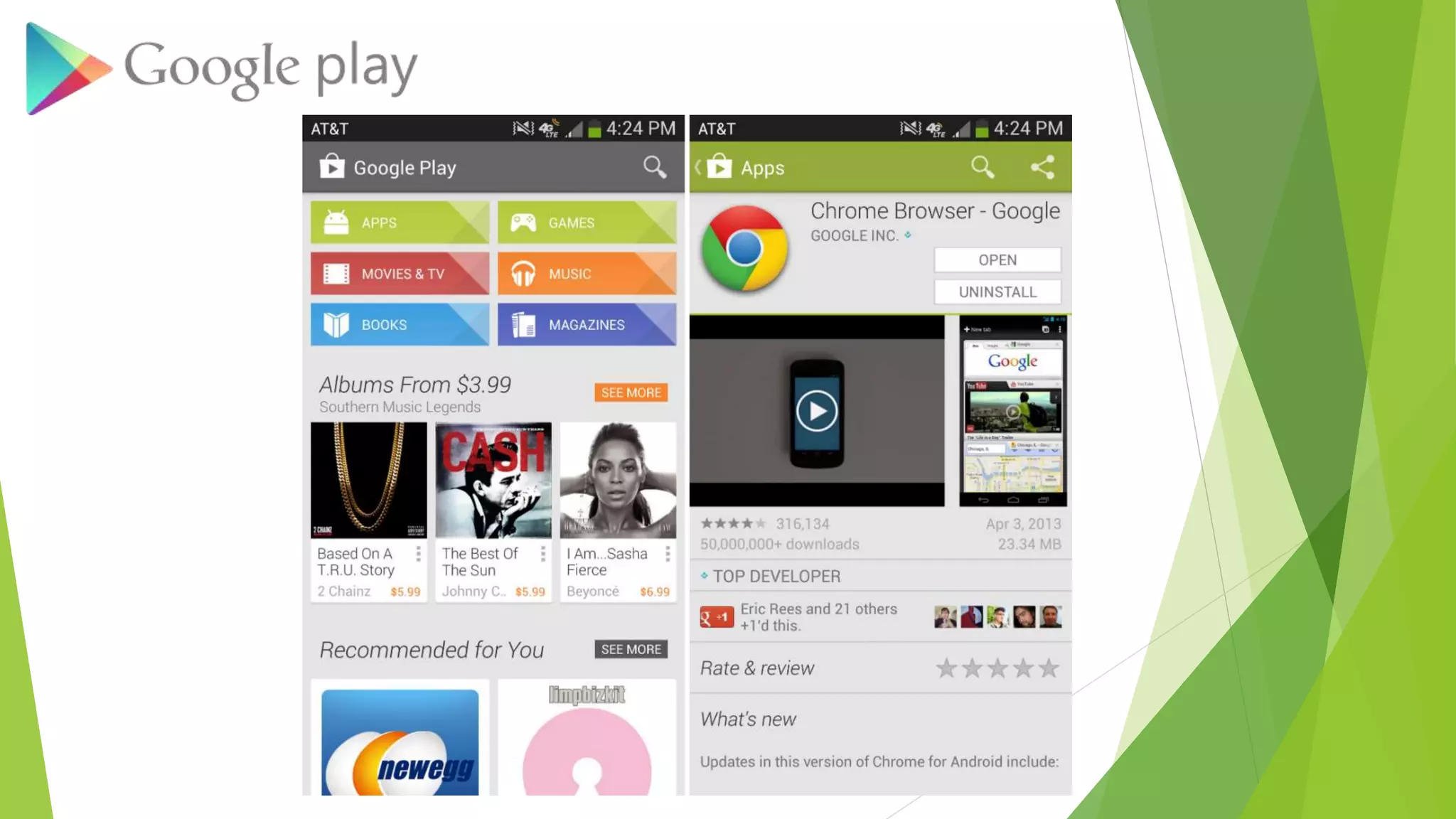
 Google Play – Android Apps
Google Play (formerly known as the Android Market) is an
international online software store developed by Google for
Android devices. It opened in October 2008.
 App Store – iOS
App Store - iOS ignited the mobile revolution and was opened
on July 10, 2008.
 Windows Store – Windows phone
Windows Store – Windows phone was introduced by Microsoft
for its Windows Phone platform, which was launched in
October 2010.
Entertainment App: Google Music
 Easy Sorting of Songs
 Diff. Categories
 Own Playlists
 Volume Control
 Online Downloads
 Sound Effects
 Awesome Look
Utensil App: Clean Master
 App Management
 Remove Junk Files
 Memory Boost
 Security
 Theme Management
 Awesome Look
Banking App: Fed Book
 Keep track of Savings, Current,
Overdraft, Loans and Deposits
accounts
 Get your account statements
anywhere anytime
 Track your clearing cheques
 Supports offline mode
 Real time transaction updates
 Customize syncing interval
 Facility to tag transactions and add
personalized remarks for transactions
 Search and filter facility to find a
transaction
 Multiple accounts view
Social App: Whats App
 Chat with people
 Voice Calling
 Multimedia Messaging
 No Sign Up
 Easy Use
 Individual & Group
 Fun Features
File Transferring Apps: Xender
 Android or iOS based
 Wireless (Wi-Fi Hotspot)
 High Speed
 Any File Type
 Easy & Convenient
 Multiple Phones
 Easy Sort Out
Advantages
 Easy Communication
 Always Connected
 Multiple Uses
 Emergency Tool
 All in One Device
 Updated Information
 Knowledge Tool
 Useful in all fields
Disadvantages
 Time Wasting
 Health Issues
 Lack of Social Interaction
 Character Variations
 Crimes
 Unreliable Information
 Virus Attack
Future of Mobile Apps
 As the number of people who own and use cell phones continues to grow, so does the
use of smart phones. 91% of the US adult population currently owns a cell phone and of
that 91%, 61% are smartphones.
 Further illustrating the popularity of smart phones 1 billion are expected to sell in the
coming year, doubling that of the number of PCs.
 With over 10 billion mobile Internet devices expected to be in use by 2016, the mobile
application industry will grow tremendously to match demand and keep up with ever-
evolving technologies.
 The future is not only bright for consumers but also those working in the technology and
application development fields. The projected job growth for Mobile Application
Developers is 131% and with an average salary of $115,000 per year, Mobile Application
Development is be considered one of the most promising careers in the job market.
Trends in mobile application development
 Social networking – fastest growing mobile application category.
 Context-aware marketing – will improve user application experience.
 Location-based services – 1.4 Billion: Consumer LBS expected user base in
2014.
 Mobile search – Product and price comparison for consumer products
 Mobile commerce – Will help streamline consumer shopping experience.
 Object recognition – Increase in sensor and processing capabilities
 Mobile payment systems – 1 in 5 smartphones will be Near Field
Communications enabled.
Jeril Peter
A Seminar
Presentation By

Mobile Apps

  • 1.
    Application Software forMobile Phones APP SMobile
  • 2.
    Introduction Mobile communication isso integrated into our lives that many people feel uncomfortable without a cell phone. Once upon a time, the most popular functions of phones were calling and sending texts. A smart phone is a multifunctional device that not only communicates, but helps to learn, earn, and have fun. This is made possible by the development of mobile applications.
  • 3.
     In Simpleterms we can say that an app is any computer program that your mobile phone runs to either perform a task, display media, facilitate communication, entertain you, or to provide a service or any other function.  The term "app" is a shortening of the term "application software". It has become very popular, and in 2010 was listed as “Word of the Year” by American Dialect Society. What is an App ??
  • 4.
    History of App TheMotorola Dyna TAC 8000X was the first commercially available cell phone. First marketed in 1983, it was 13 x 1.75 x 3.5 inches in dimension, weighed about 2.5 pounds, and allowed you to talk for a little more than half an hour. It retailed for $3,995, plus hefty monthly service Fees and per-minute charges. It made calls, and there was a simple contacts application included in the operating system.
  • 5.
    History of App Itwas during this period the first “time-waster” games begin to appear. Nokia was famous for putting the 1970s video game. Snake on some of its earliest phones. Other followed, adding games like Pong, Tetris, and Tic-Tac-Toe. These early phones changed the way people thought about communication. It turned out direct phone access to the Internet. Customers began pushing for more features and more games. By the late 90s, professional Web sites were full color and They relied on JavaScript and Flash to enhance the user experience.
  • 6.
    Kinds of Apps Games  Social Apps  Banking Apps  Shopping Apps  Developer Apps  Fitness Apps  Entertainment Apps  Information Apps, etc.
  • 7.
    Where We GetApps ??  Google Play – Android Apps Google Play (formerly known as the Android Market) is an international online software store developed by Google for Android devices. It opened in October 2008.  App Store – iOS App Store - iOS ignited the mobile revolution and was opened on July 10, 2008.  Windows Store – Windows phone Windows Store – Windows phone was introduced by Microsoft for its Windows Phone platform, which was launched in October 2010.
  • 11.
    Entertainment App: GoogleMusic  Easy Sorting of Songs  Diff. Categories  Own Playlists  Volume Control  Online Downloads  Sound Effects  Awesome Look
  • 12.
    Utensil App: CleanMaster  App Management  Remove Junk Files  Memory Boost  Security  Theme Management  Awesome Look
  • 13.
    Banking App: FedBook  Keep track of Savings, Current, Overdraft, Loans and Deposits accounts  Get your account statements anywhere anytime  Track your clearing cheques  Supports offline mode  Real time transaction updates  Customize syncing interval  Facility to tag transactions and add personalized remarks for transactions  Search and filter facility to find a transaction  Multiple accounts view
  • 14.
    Social App: WhatsApp  Chat with people  Voice Calling  Multimedia Messaging  No Sign Up  Easy Use  Individual & Group  Fun Features
  • 15.
    File Transferring Apps:Xender  Android or iOS based  Wireless (Wi-Fi Hotspot)  High Speed  Any File Type  Easy & Convenient  Multiple Phones  Easy Sort Out
  • 16.
    Advantages  Easy Communication Always Connected  Multiple Uses  Emergency Tool  All in One Device  Updated Information  Knowledge Tool  Useful in all fields
  • 17.
    Disadvantages  Time Wasting Health Issues  Lack of Social Interaction  Character Variations  Crimes  Unreliable Information  Virus Attack
  • 18.
    Future of MobileApps  As the number of people who own and use cell phones continues to grow, so does the use of smart phones. 91% of the US adult population currently owns a cell phone and of that 91%, 61% are smartphones.  Further illustrating the popularity of smart phones 1 billion are expected to sell in the coming year, doubling that of the number of PCs.  With over 10 billion mobile Internet devices expected to be in use by 2016, the mobile application industry will grow tremendously to match demand and keep up with ever- evolving technologies.  The future is not only bright for consumers but also those working in the technology and application development fields. The projected job growth for Mobile Application Developers is 131% and with an average salary of $115,000 per year, Mobile Application Development is be considered one of the most promising careers in the job market.
  • 19.
    Trends in mobileapplication development  Social networking – fastest growing mobile application category.  Context-aware marketing – will improve user application experience.  Location-based services – 1.4 Billion: Consumer LBS expected user base in 2014.  Mobile search – Product and price comparison for consumer products  Mobile commerce – Will help streamline consumer shopping experience.  Object recognition – Increase in sensor and processing capabilities  Mobile payment systems – 1 in 5 smartphones will be Near Field Communications enabled.
  • 20.