Mobile App Design and Functionality
       for Low Vision Users

   Penetrating International Markets
       and New Demographics
PodCamp Toronto
Saturday, February 23, 2013
          4:00 pm
         RCC 359A
Raising Accessibility
  Startup committed to breaking down barriers through technological solutions.

  In November 2012 conducted a usability study observing how people who
  experience visual impairment use mobile devices and interact with apps.

  Partnered with Devlin Digital and Good Wally, two pillars in the accessibility
  community.

  Close connection with the Toronto Accessibility & Inclusive Design Meetup Group.
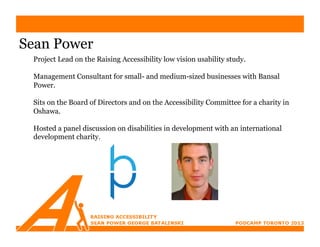
Sean Power
 Project Lead on the Raising Accessibility low vision usability study.

 Management Consultant for small- and medium-sized businesses with Bansal
 Power.

 Sits on the Board of Directors and on the Accessibility Committee for a charity in
 Oshawa.

 Hosted a panel discussion on disabilities in development with an international
 development charity.
Raising Accessibility Vision


  Design and develop technology that re-thinks human communication.

  Develop a set of tools that solve condition-specific problems for people with
  disabilities.

  Make assistive technology an obsolete term.
Questions Answered


 From which countries will your new users come in 2013 and on.

 Among which demographics will your app become popular in 2013 and on.

 How many of these new users experience a physical impairment.

 Design and functionality recommendations for serving these disabled users.
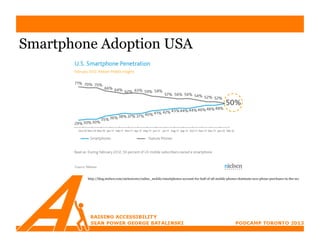
Smartphone Adoption USA


         http://blog.nielsen.com/nielsenwire/online_mobile/smartphones-account-for-half-of-all-mobile-phones-dominate-new-phone-purchases-in-the-us/
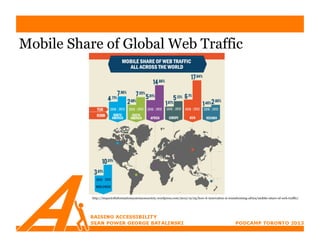
Mobile Share of Global Web Traffic


           http://impactofinformationsystemsonsociety.wordpress.com/2012/12/05/how-it-innovation-is-transforming-africa/mobile-share-of-web-traffic/
Reasons for Growth, Domestic and Int’l


  Increased access to mobile broadband.

  Price reduction for devices.

  Increasingly robust app ecosystem.
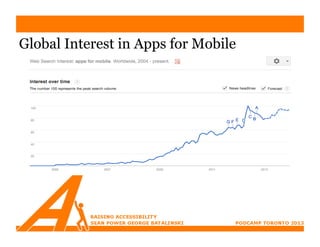
Global Interest in Apps for Mobile
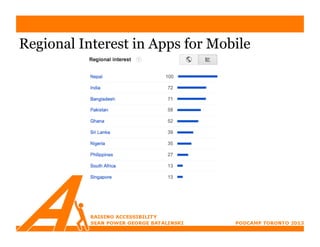
Regional Interest in Apps for Mobile
Questions Answered


 From which countries will your new users come in 2013 and on.

 Among which demographics will your app become popular in 2013 and on.

 How many of these new users experience a physical impairment.

 Design and functionality recommendations for serving these disabled users.
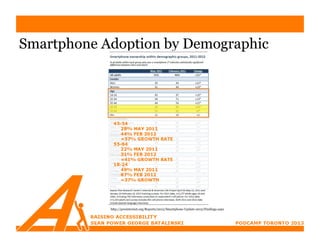
Smartphone Adoption by Demographic


            http://pewinternet.org/Reports/2012/Smartphone-Update-2012/Findings.aspx
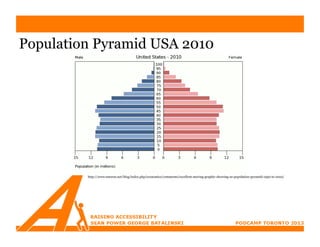
Population Pyramid USA 2010


         http://www.tutor2u.net/blog/index.php/economics/comments/excellent-moving-graphic-showing-us-population-pyramid-1950-to-2010/
Questions Answered


 From which countries will your new users come in 2013 and on.

 Among which demographics will your app become popular in 2013 and on.

 How many of these new users experience a physical impairment.

 Design and functionality recommendations for serving these disabled users.
Physical Disability in Int’l Markets
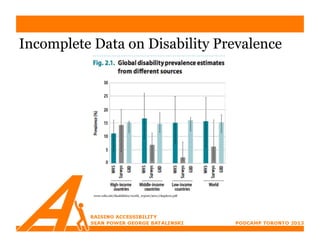
  Some challenges in measuring disability prevalence:

     Countries define disability differently.

          e.g. Canada/USA prevalence at 15%, India at 2% despite weaker health
     system.

     Census/reporting data often incomplete.

         Global Burden of Disease Survey estimates 15% of world’s population
     experiences disability.

         World Health Organization’s World Health Survey estimates 10%.
Incomplete Data on Disability Prevalence


           www.who.int/disabilities/world_report/2011/chapter2.pdf
Impact Solution Can Make in Int’l Markets


  Physical disabilities impact lives differently:

      In North America, children with poor eye vision get glasses and stay in school.

      In Brazil, many children with poor eye vision drop out due to lack of access to
      assistive devices.
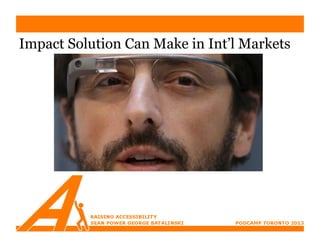
Impact Solution Can Make in Int’l Markets
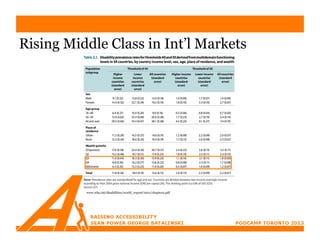
Rising Middle Class in Int’l Markets


          www.who.int/disabilities/world_report/2011/chapter2.pdf
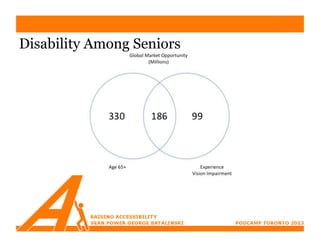
Disability Among Seniors
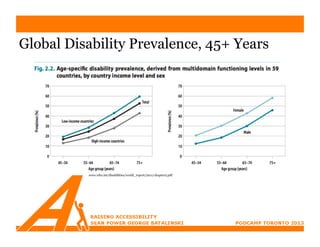
Global Disability Prevalence, 45+ Years


          www.who.int/disabilities/world_report/2011/chapter2.pdf
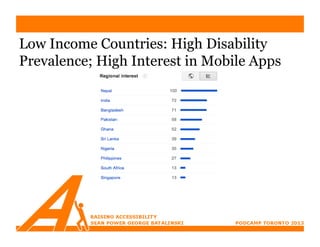
Low Income Countries: High Disability
Prevalence; High Interest in Mobile Apps
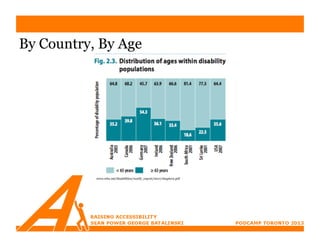
By Country, By Age


           www.who.int/disabilities/world_report/2011/chapter2.pdf
Questions Answered


 From which countries will your new users come in 2013 and on.

 Among which demographics will your app become popular in 2013 and on.

 How many of these new users experience a physical impairment.

 Design and functionality recommendations for serving these disabled users.
The Low Vision Usability Study


  Insert image of mocks of app.

  Play audio of question and answer.
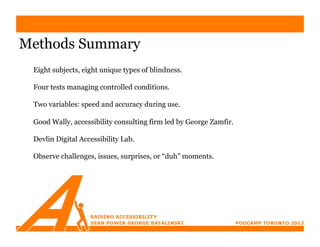
Methods Summary
 Eight subjects, eight unique types of blindness.

 Four tests managing controlled conditions.

 Two variables: speed and accuracy during use.

 Good Wally, accessibility consulting firm led by George Zamfir.

 Devlin Digital Accessibility Lab.

 Observe challenges, issues, surprises, or “duh” moments.
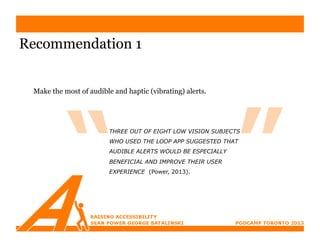
Recommendation 1


 Make the most of audible and haptic (vibrating) alerts.


                         THREE OUT OF EIGHT LOW VISION SUBJECTS
                         WHO USED THE LOOP APP SUGGESTED THAT
                         AUDIBLE ALERTS WOULD BE ESPECIALLY
                         BENEFICIAL AND IMPROVE THEIR USER
                         EXPERIENCE (Power, 2013).
Recommendation 2


 Use custom multi-touch gestures to improve navigation.


                       DURING OUR STUDY, SUBJECTS SOMETIMES
                       UNKNOWINGLY HELD THE PHONE UPSIDE
                       DOWN. ADJUSTING THE APP’S INTERFACE
                       ACCORDING TO THE PHONE’S POSITION
                       IMPROVES THE USER EXPERIENCE FOR
                       PEOPLE WITH LOW VISION (Power, 2013).
Recommendation 3


 Use high contrast, large buttons.


                         CONSIDER ADDING THE ABILITY TO CHANGE
                         THE CONTRAST AND COLOUR OF BUTTONS IN
                         THE SETTINGS MENU. EVERYBODY’S EYES
                         WORK DIFFERENTLY (Power, 2013).
Recommendation 4


 Think twice about how your app uses the camera.


                       SUBJECTS IN OUR FOCUS GROUP FOUND IT
                       DIFFICULT TO FIND THE OBJECT THEY HOPED
                       TO TARGET IN THE VIEWFINDER (Power,
                       2013).
Recommendation 5


 Consider how spatial awareness might impact how users interact with your app.


                        SUBJECTS USING LOOP WERE UNSURE
                        WHERE TO HOLD THE DEVICE RELATIVE TO
                        THEIR FACE AND TO THE OBJECT BEING
                        VIEWED. MOST ENDED UP EXPERIMENTING
                        WITH DISTANCE UNTIL THEY FOUND AN
                        OPTIMAL LENGTH (Power, 2013).
Questions Answered


 From which countries will your new users come in 2013 and on.

 Among which demographics will your app become popular in 2013 and on.

 How many of these new users experience a physical impairment.

 Design and functionality recommendations for serving these disabled users.
Download the Whitepaper


        http://www.raisingaccessibility.com/wp-content/uploads/2013/02/Mobile-App-Design-and-Functionality-for-Low-Vision-Users.pdf


                         Sean Power @seanmpower
                       George Batalinski @gbatalinski
   Raising Accessibility @RaiseAccess facebook.com/RaisingAccessibility
                       http://raisingaccessibility.com

Mobile App Design Global Trends

  • 1.
    Mobile App Designand Functionality for Low Vision Users Penetrating International Markets and New Demographics
  • 2.
    PodCamp Toronto Saturday, February23, 2013 4:00 pm RCC 359A
  • 3.
    Raising Accessibility Startup committed to breaking down barriers through technological solutions. In November 2012 conducted a usability study observing how people who experience visual impairment use mobile devices and interact with apps. Partnered with Devlin Digital and Good Wally, two pillars in the accessibility community. Close connection with the Toronto Accessibility & Inclusive Design Meetup Group.
  • 4.
    Sean Power ProjectLead on the Raising Accessibility low vision usability study. Management Consultant for small- and medium-sized businesses with Bansal Power. Sits on the Board of Directors and on the Accessibility Committee for a charity in Oshawa. Hosted a panel discussion on disabilities in development with an international development charity.
  • 5.
    Raising Accessibility Vision Design and develop technology that re-thinks human communication. Develop a set of tools that solve condition-specific problems for people with disabilities. Make assistive technology an obsolete term.
  • 6.
    Questions Answered Fromwhich countries will your new users come in 2013 and on. Among which demographics will your app become popular in 2013 and on. How many of these new users experience a physical impairment. Design and functionality recommendations for serving these disabled users.
  • 7.
    Smartphone Adoption USA http://blog.nielsen.com/nielsenwire/online_mobile/smartphones-account-for-half-of-all-mobile-phones-dominate-new-phone-purchases-in-the-us/
  • 8.
    Mobile Share ofGlobal Web Traffic http://impactofinformationsystemsonsociety.wordpress.com/2012/12/05/how-it-innovation-is-transforming-africa/mobile-share-of-web-traffic/
  • 9.
    Reasons for Growth,Domestic and Int’l Increased access to mobile broadband. Price reduction for devices. Increasingly robust app ecosystem.
  • 10.
    Global Interest inApps for Mobile
  • 11.
    Regional Interest inApps for Mobile
  • 12.
    Questions Answered Fromwhich countries will your new users come in 2013 and on. Among which demographics will your app become popular in 2013 and on. How many of these new users experience a physical impairment. Design and functionality recommendations for serving these disabled users.
  • 13.
    Smartphone Adoption byDemographic http://pewinternet.org/Reports/2012/Smartphone-Update-2012/Findings.aspx
  • 14.
    Population Pyramid USA2010 http://www.tutor2u.net/blog/index.php/economics/comments/excellent-moving-graphic-showing-us-population-pyramid-1950-to-2010/
  • 15.
    Questions Answered Fromwhich countries will your new users come in 2013 and on. Among which demographics will your app become popular in 2013 and on. How many of these new users experience a physical impairment. Design and functionality recommendations for serving these disabled users.
  • 16.
    Physical Disability inInt’l Markets Some challenges in measuring disability prevalence: Countries define disability differently. e.g. Canada/USA prevalence at 15%, India at 2% despite weaker health system. Census/reporting data often incomplete. Global Burden of Disease Survey estimates 15% of world’s population experiences disability. World Health Organization’s World Health Survey estimates 10%.
  • 17.
    Incomplete Data onDisability Prevalence www.who.int/disabilities/world_report/2011/chapter2.pdf
  • 18.
    Impact Solution CanMake in Int’l Markets Physical disabilities impact lives differently: In North America, children with poor eye vision get glasses and stay in school. In Brazil, many children with poor eye vision drop out due to lack of access to assistive devices.
  • 19.
    Impact Solution CanMake in Int’l Markets
  • 20.
    Rising Middle Classin Int’l Markets www.who.int/disabilities/world_report/2011/chapter2.pdf
  • 21.
  • 22.
    Global Disability Prevalence,45+ Years www.who.int/disabilities/world_report/2011/chapter2.pdf
  • 23.
    Low Income Countries:High Disability Prevalence; High Interest in Mobile Apps
  • 24.
    By Country, ByAge www.who.int/disabilities/world_report/2011/chapter2.pdf
  • 25.
    Questions Answered Fromwhich countries will your new users come in 2013 and on. Among which demographics will your app become popular in 2013 and on. How many of these new users experience a physical impairment. Design and functionality recommendations for serving these disabled users.
  • 26.
    The Low VisionUsability Study Insert image of mocks of app. Play audio of question and answer.
  • 27.
    Methods Summary Eightsubjects, eight unique types of blindness. Four tests managing controlled conditions. Two variables: speed and accuracy during use. Good Wally, accessibility consulting firm led by George Zamfir. Devlin Digital Accessibility Lab. Observe challenges, issues, surprises, or “duh” moments.
  • 28.
    Recommendation 1 Makethe most of audible and haptic (vibrating) alerts. THREE OUT OF EIGHT LOW VISION SUBJECTS WHO USED THE LOOP APP SUGGESTED THAT AUDIBLE ALERTS WOULD BE ESPECIALLY BENEFICIAL AND IMPROVE THEIR USER EXPERIENCE (Power, 2013).
  • 29.
    Recommendation 2 Usecustom multi-touch gestures to improve navigation. DURING OUR STUDY, SUBJECTS SOMETIMES UNKNOWINGLY HELD THE PHONE UPSIDE DOWN. ADJUSTING THE APP’S INTERFACE ACCORDING TO THE PHONE’S POSITION IMPROVES THE USER EXPERIENCE FOR PEOPLE WITH LOW VISION (Power, 2013).
  • 30.
    Recommendation 3 Usehigh contrast, large buttons. CONSIDER ADDING THE ABILITY TO CHANGE THE CONTRAST AND COLOUR OF BUTTONS IN THE SETTINGS MENU. EVERYBODY’S EYES WORK DIFFERENTLY (Power, 2013).
  • 31.
    Recommendation 4 Thinktwice about how your app uses the camera. SUBJECTS IN OUR FOCUS GROUP FOUND IT DIFFICULT TO FIND THE OBJECT THEY HOPED TO TARGET IN THE VIEWFINDER (Power, 2013).
  • 32.
    Recommendation 5 Considerhow spatial awareness might impact how users interact with your app. SUBJECTS USING LOOP WERE UNSURE WHERE TO HOLD THE DEVICE RELATIVE TO THEIR FACE AND TO THE OBJECT BEING VIEWED. MOST ENDED UP EXPERIMENTING WITH DISTANCE UNTIL THEY FOUND AN OPTIMAL LENGTH (Power, 2013).
  • 33.
    Questions Answered Fromwhich countries will your new users come in 2013 and on. Among which demographics will your app become popular in 2013 and on. How many of these new users experience a physical impairment. Design and functionality recommendations for serving these disabled users.
  • 34.
    Download the Whitepaper http://www.raisingaccessibility.com/wp-content/uploads/2013/02/Mobile-App-Design-and-Functionality-for-Low-Vision-Users.pdf Sean Power @seanmpower George Batalinski @gbatalinski Raising Accessibility @RaiseAccess facebook.com/RaisingAccessibility http://raisingaccessibility.com