

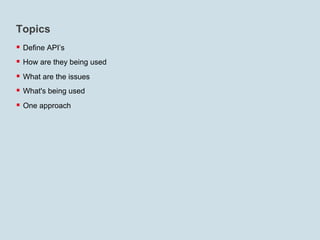



Topics
§  Define API’s
§  How are they being used
§  What are the issues
§  What's being used
§  One approach
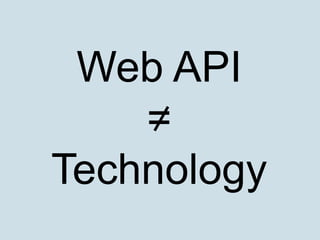
Web API
    =
Technology
Mobile and API identity – The New
Challenges
Aran White
Solution Architect
awhite@layer7.com
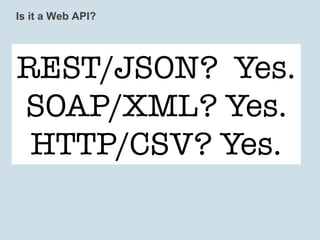
Is it a Web API?


REST/JSON? Yes.
SOAP/XML? Yes.
 HTTP/CSV? Yes.
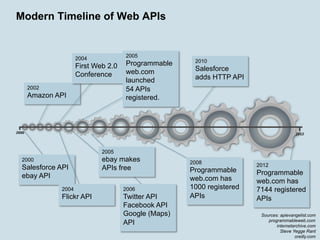
Modern Timeline of Web APIs


                                    2005
                    2004                             2010
                    First Web 2.0   Programmable
                                    web.com          Salesforce
                    Conference                       adds HTTP API
                                    launched
  2002                              54 APIs
  Amazon API                        registered.


                            2005
 2000                       ebay makes              2008              2012
 Salesforce API             APIs free               Programmable
 ebay API                                                             Programmable
                                                    web.com has       web.com has
             2004                   2006            1000 registered   7144 registered
             Flickr API             Twitter API     APIs              APIs
                                    Facebook API
                                    Google (Maps)                      Sources: apievangelist.com
                                                                          programmableweb.com
                                    API                                       internetarchive.com
                                                                                Steve Yegge Rant
                                                                                       oreilly.com
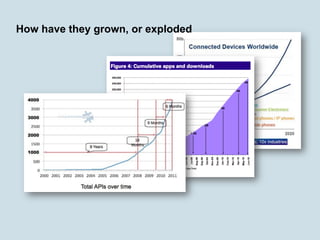
How have they grown, or exploded
Mobile is driving API publishers
The enterprise model:
Start with private APIs…
…consider going public
in the future
API’s From Internal Services
§  Create a new shiny API or enable our existing services
§  Integration for messages and security
§  Internal security verses external security
§  Who is using the service the most
§  How do we control the use
Applications Or Users
§  We don’t just want to trust the user what about the application?
§  Developers
  -  On boarding
  -  Controlling access
  -  Monitoring
  -  Managing
§  Will you allow application to store user credentials? Long term or per session
§  Do we trust all devices or platforms?
§  Do we trust Jail broken devices?
Single sign on issues
§  Multiple Applications
§  Multiple devices
§  Multiple APIs
§  Multiple API providers
§  Integration with cloud services
How are we tackling this
§  New security models
§  Oauth
§  Open ID connect
§  SAML
§  Tried and tested approaches
  -  SSL, Basic Auth, WS Security, XML security
  -  Standard threats
§  Multiple approaches per API
§  Brokering between the new world and the existing security
OAuth
§  Drafts keep changing (or did !!)
§  Can be complex
§  Picking the correct flow
§  Components which do I use.
§  Extensions
§  Brokering with existing security
Open ID Connet
§  OAuth based solution for authentication
§  Gives access to attributes.
§  Giving access to identities outside the enterprise
§  Helps scale and agility
§  Who is coming through the door
§  Tracking and audit
SAML
§  Still there as a very valid solution
§  Supported for federated SSO such as SFDC
§  Can be considered heavyweight and complex
§  B2B solutions still like SAML
§  STS deployments
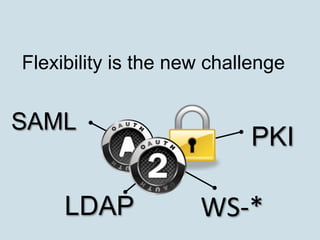
Flexibility is the new challenge


SAML
                            PKI

     LDAP            WS-­‐*	
  
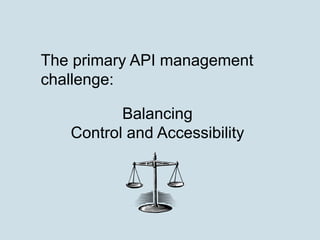
The primary API management
challenge:

          Balancing
   Control and Accessibility
API publishers want to encourage
utilization
Low barriers to access
Self service
Self documenting
But, API publishers also want to
restrict access to APIs
Smart rate limiting
Security enforcement
Brand control
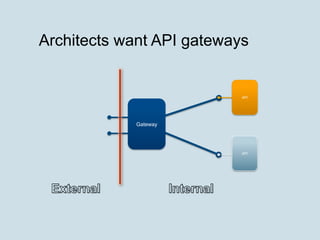
Architects want API gateways


                           API


            Gateway


                           API
Thank you
   Aran White
awhite@layer7.com

Mobile and API identity – The New Challenges

  • 3.
    Topics §  Define API’s § How are they being used §  What are the issues §  What's being used §  One approach
  • 4.
    Web API = Technology
  • 5.
    Mobile and APIidentity – The New Challenges Aran White Solution Architect awhite@layer7.com
  • 6.
    Is it aWeb API? REST/JSON? Yes. SOAP/XML? Yes. HTTP/CSV? Yes.
  • 7.
    Modern Timeline ofWeb APIs 2005 2004 2010 First Web 2.0 Programmable web.com Salesforce Conference adds HTTP API launched 2002 54 APIs Amazon API registered. 2005 2000 ebay makes 2008 2012 Salesforce API APIs free Programmable ebay API Programmable web.com has web.com has 2004 2006 1000 registered 7144 registered Flickr API Twitter API APIs APIs Facebook API Google (Maps) Sources: apievangelist.com programmableweb.com API internetarchive.com Steve Yegge Rant oreilly.com
  • 8.
    How have theygrown, or exploded
  • 9.
    Mobile is drivingAPI publishers
  • 10.
    The enterprise model: Startwith private APIs…
  • 11.
  • 12.
    API’s From InternalServices §  Create a new shiny API or enable our existing services §  Integration for messages and security §  Internal security verses external security §  Who is using the service the most §  How do we control the use
  • 13.
    Applications Or Users § We don’t just want to trust the user what about the application? §  Developers -  On boarding -  Controlling access -  Monitoring -  Managing §  Will you allow application to store user credentials? Long term or per session §  Do we trust all devices or platforms? §  Do we trust Jail broken devices?
  • 14.
    Single sign onissues §  Multiple Applications §  Multiple devices §  Multiple APIs §  Multiple API providers §  Integration with cloud services
  • 15.
    How are wetackling this §  New security models §  Oauth §  Open ID connect §  SAML §  Tried and tested approaches -  SSL, Basic Auth, WS Security, XML security -  Standard threats §  Multiple approaches per API §  Brokering between the new world and the existing security
  • 16.
    OAuth §  Drafts keepchanging (or did !!) §  Can be complex §  Picking the correct flow §  Components which do I use. §  Extensions §  Brokering with existing security
  • 17.
    Open ID Connet § OAuth based solution for authentication §  Gives access to attributes. §  Giving access to identities outside the enterprise §  Helps scale and agility §  Who is coming through the door §  Tracking and audit
  • 18.
    SAML §  Still thereas a very valid solution §  Supported for federated SSO such as SFDC §  Can be considered heavyweight and complex §  B2B solutions still like SAML §  STS deployments
  • 19.
    Flexibility is thenew challenge SAML PKI LDAP WS-­‐*  
  • 20.
    The primary APImanagement challenge: Balancing Control and Accessibility
  • 21.
    API publishers wantto encourage utilization
  • 22.
    Low barriers toaccess Self service Self documenting
  • 23.
    But, API publishersalso want to restrict access to APIs
  • 24.
    Smart rate limiting Securityenforcement Brand control
  • 25.
    Architects want APIgateways API Gateway API
  • 26.
    Thank you Aran White awhite@layer7.com