Marketing Management
101
Roy Dominic S. Damasco
MARKETING MANAGEMENT
Main Text Book Resource:
Eighth Edition
Marketing Management
Analysis, Planning,, Implementation, and Control
PHILIP KOTHLER
MARKETING MANAGEMENT
• Role of Marketing in Organizations and Society
• Identifying Marketing Opportunities and Target
Markets
• Developing Marketing Strategies
• Planning. Organizing, Implementing, and
Controlling Marketing Programs
• Trends in the Marketing World
• Online Marketing
MARKETING MANAGEMENT 101
House Rules
1. Respect one another.
2. No Phones, Turn it off or put in silent mode.
3. Anything you miss when late or absent, you cannot
retake.
4. Request for extra credits is welcome.
5. 2 times late = 1 absent.
6. 6 unjustified absences = Incomplete/Drop/Fail
FIRST QUIZ!!!
1. What are the 7P’s and 1 C of Marketing? P
2. P
3. P
4. P
5. P
6. P
7. P
8. C
9. And 10
10. Give 2 examples of commonly used Marketing Programs/Tools
ANSWERS
1. Positioning
2. Product
3. Place
4. Promotion
5. Packaging
6. People
7. Price
8. Customer
9. Advertising, Market Research, Public Relations, Promotions, Sponsorships
10. TV/Radio Commercials, Surveys, Posters, Banners, Flyers, Sale promo,
Coupons, Discount schemes, Motorcades, Celebrity Sponsorships, Contest
Sponsorships
MARKETING MANAGEMENT
Marketing, by Definition is…
- a social and managerial process by which
individuals and groups obtain what they need and
want through creating, offering, and exchanging
products of value with others.
MARKETING MANAGEMENT
Marketing Management is the process of planning
and executing the conception, pricing, promotion,
and distribution of goods, services, and ideas to
create exchange with target groups that satisfy
customer and organizational objectives
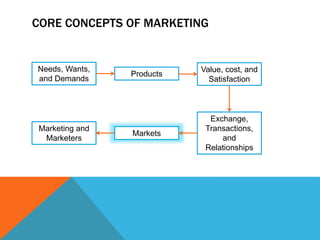
CORE CONCEPTS OF MARKETING
Needs, Wants,
and Demands
Products
Value, cost, and
Satisfaction
Exchange,
Transactions,
and
Relationships
Markets
Marketing and
Marketers
CORE CONCEPTS OF MARKETING
Needs, Wants,
and Demands
Products
Value, cost, and
Satisfaction
Exchange,
Transactions,
and
Relationships
Markets
Marketing and
Marketers
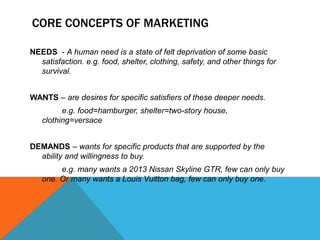
NEEDS - A human need is a state of felt deprivation of some basic
satisfaction. e.g. food, shelter, clothing, safety, and other things for
survival.
WANTS – are desires for specific satisfiers of these deeper needs.
e.g. food=hamburger, shelter=two-story house,
clothing=versace
DEMANDS – wants for specific products that are supported by the
ability and willingness to buy.
e.g. many wants a 2013 Nissan Skyline GTR, few can only buy
one. Or many wants a Louis Vuitton bag, few can only buy one.
CORE CONCEPTS OF MARKETING
Needs, Wants,
and Demands
Products
Value, cost, and
Satisfaction
Exchange,
Transactions,
and
Relationships
Markets
Marketing and
Marketers
CORE CONCEPTS OF MARKETING
Needs, Wants,
and Demands
Products
Value, cost, and
Satisfaction
Exchange,
Transactions,
and
Relationships
Markets
Marketing and
Marketers
CORE CONCEPTS OF MARKETING
Needs, Wants,
and Demands
Products
Value, cost, and
Satisfaction
Exchange,
Transactions,
and
Relationships
Markets
Marketing and
Marketers
CORE CONCEPTS OF MARKETING
Needs, Wants,
and Demands
Products
Value, cost, and
Satisfaction
Exchange,
Transactions,
and
Relationships
Markets
Marketing and
Marketers
CORE CONCEPTS OF MARKETING
MARKET -
A market consists of al the potential customers sharing a
particular need or want who might be willing and able to
engage in exchange to satisfy that need or want.
e.g. consumer market, philippine market, labor market.
CORE CONCEPTS OF MARKETING
Needs, Wants,
and Demands
Products
Value, cost, and
Satisfaction
Exchange,
Transactions,
and
Relationships
Markets
Marketing and
Marketers
The Production Concept
- consumers will favor those products that are
widely available and in low cost. Concentrates on
achieving high production efficiency and wide
distribution.
situations: product exceeds supply, production cost
must be lowered to expand the market
GUIDING CONCEPTS
The Product Concept
- Consumers will favor those products that offer the
most quality, performance, or innovative features.
Product Oriented companies focus energy on
making superior products and continuously
improving it.
- relies on scientific research and engineering to
improve products and not customer’s needs.
GUIDING CONCEPTS
GUIDING CONCEPTS
The Sales Concept
- Consumers, if left alone, will ordinarily not buy
enough of the organization’s products.
- relies on aggressive selling and promotion efforts.
GUIDING CONCEPTS
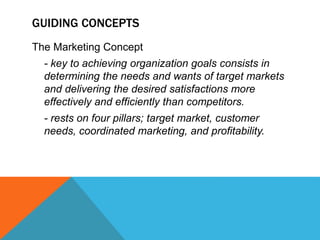
The Marketing Concept
- key to achieving organization goals consists in
determining the needs and wants of target markets
and delivering the desired satisfactions more
effectively and efficiently than competitors.
- rests on four pillars; target market, customer
needs, coordinated marketing, and profitability.
THE MARKETING CONCEPT
Target Market
- specific segment of the market with an identified need, which
a product or a company wants to satisfy.
- basis of Positioning, and in turn all marketing efforts.
- No company can play in all markets and satisfy every need.
THE MARKETING CONCEPT
Customer Needs
Kinds of Needs:
1. Stated Needs
2. Real Needs
3. Unstated Needs
4. Delight Needs
5. Secret Needs.
– A company can define its target
market but may fail to fully
understand customer’s needs.
Goals of Customer Oriented
Programs
- Customer Attraction
- Customer Satisfaction
- Customer Retention

Mm session1

  • 1.
  • 2.
    MARKETING MANAGEMENT Main TextBook Resource: Eighth Edition Marketing Management Analysis, Planning,, Implementation, and Control PHILIP KOTHLER
  • 3.
    MARKETING MANAGEMENT • Roleof Marketing in Organizations and Society • Identifying Marketing Opportunities and Target Markets • Developing Marketing Strategies • Planning. Organizing, Implementing, and Controlling Marketing Programs • Trends in the Marketing World • Online Marketing
  • 4.
    MARKETING MANAGEMENT 101 HouseRules 1. Respect one another. 2. No Phones, Turn it off or put in silent mode. 3. Anything you miss when late or absent, you cannot retake. 4. Request for extra credits is welcome. 5. 2 times late = 1 absent. 6. 6 unjustified absences = Incomplete/Drop/Fail
  • 5.
    FIRST QUIZ!!! 1. Whatare the 7P’s and 1 C of Marketing? P 2. P 3. P 4. P 5. P 6. P 7. P 8. C 9. And 10 10. Give 2 examples of commonly used Marketing Programs/Tools
  • 6.
    ANSWERS 1. Positioning 2. Product 3.Place 4. Promotion 5. Packaging 6. People 7. Price 8. Customer 9. Advertising, Market Research, Public Relations, Promotions, Sponsorships 10. TV/Radio Commercials, Surveys, Posters, Banners, Flyers, Sale promo, Coupons, Discount schemes, Motorcades, Celebrity Sponsorships, Contest Sponsorships
  • 7.
    MARKETING MANAGEMENT Marketing, byDefinition is… - a social and managerial process by which individuals and groups obtain what they need and want through creating, offering, and exchanging products of value with others.
  • 8.
    MARKETING MANAGEMENT Marketing Managementis the process of planning and executing the conception, pricing, promotion, and distribution of goods, services, and ideas to create exchange with target groups that satisfy customer and organizational objectives
  • 9.
    CORE CONCEPTS OFMARKETING Needs, Wants, and Demands Products Value, cost, and Satisfaction Exchange, Transactions, and Relationships Markets Marketing and Marketers
  • 10.
    CORE CONCEPTS OFMARKETING Needs, Wants, and Demands Products Value, cost, and Satisfaction Exchange, Transactions, and Relationships Markets Marketing and Marketers
  • 11.
    NEEDS - Ahuman need is a state of felt deprivation of some basic satisfaction. e.g. food, shelter, clothing, safety, and other things for survival. WANTS – are desires for specific satisfiers of these deeper needs. e.g. food=hamburger, shelter=two-story house, clothing=versace DEMANDS – wants for specific products that are supported by the ability and willingness to buy. e.g. many wants a 2013 Nissan Skyline GTR, few can only buy one. Or many wants a Louis Vuitton bag, few can only buy one. CORE CONCEPTS OF MARKETING
  • 12.
    CORE CONCEPTS OFMARKETING Needs, Wants, and Demands Products Value, cost, and Satisfaction Exchange, Transactions, and Relationships Markets Marketing and Marketers
  • 13.
    CORE CONCEPTS OFMARKETING Needs, Wants, and Demands Products Value, cost, and Satisfaction Exchange, Transactions, and Relationships Markets Marketing and Marketers
  • 14.
    CORE CONCEPTS OFMARKETING Needs, Wants, and Demands Products Value, cost, and Satisfaction Exchange, Transactions, and Relationships Markets Marketing and Marketers
  • 15.
    CORE CONCEPTS OFMARKETING Needs, Wants, and Demands Products Value, cost, and Satisfaction Exchange, Transactions, and Relationships Markets Marketing and Marketers
  • 16.
    CORE CONCEPTS OFMARKETING MARKET - A market consists of al the potential customers sharing a particular need or want who might be willing and able to engage in exchange to satisfy that need or want. e.g. consumer market, philippine market, labor market.
  • 17.
    CORE CONCEPTS OFMARKETING Needs, Wants, and Demands Products Value, cost, and Satisfaction Exchange, Transactions, and Relationships Markets Marketing and Marketers
  • 18.
    The Production Concept -consumers will favor those products that are widely available and in low cost. Concentrates on achieving high production efficiency and wide distribution. situations: product exceeds supply, production cost must be lowered to expand the market GUIDING CONCEPTS
  • 19.
    The Product Concept -Consumers will favor those products that offer the most quality, performance, or innovative features. Product Oriented companies focus energy on making superior products and continuously improving it. - relies on scientific research and engineering to improve products and not customer’s needs. GUIDING CONCEPTS
  • 20.
    GUIDING CONCEPTS The SalesConcept - Consumers, if left alone, will ordinarily not buy enough of the organization’s products. - relies on aggressive selling and promotion efforts.
  • 21.
    GUIDING CONCEPTS The MarketingConcept - key to achieving organization goals consists in determining the needs and wants of target markets and delivering the desired satisfactions more effectively and efficiently than competitors. - rests on four pillars; target market, customer needs, coordinated marketing, and profitability.
  • 22.
    THE MARKETING CONCEPT TargetMarket - specific segment of the market with an identified need, which a product or a company wants to satisfy. - basis of Positioning, and in turn all marketing efforts. - No company can play in all markets and satisfy every need.
  • 23.
    THE MARKETING CONCEPT CustomerNeeds Kinds of Needs: 1. Stated Needs 2. Real Needs 3. Unstated Needs 4. Delight Needs 5. Secret Needs. – A company can define its target market but may fail to fully understand customer’s needs. Goals of Customer Oriented Programs - Customer Attraction - Customer Satisfaction - Customer Retention