ML Types
Supervised, Unsupervised Learning…
PCS 206
1
Overview
ML Types
Supervised Learning
Unsupervised Learning
Semi supervised Learning
Reinforcement Learning
2
Machine Learning begins with DATA
• Labeled data
• Unlabeled data
3
Supervised Learning…Contd.
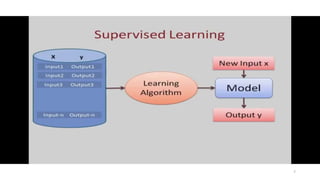
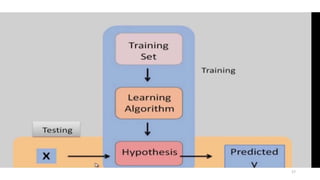
• A supervised learning algorithm analyzes the training data
• Produces an inferred function
• This function is used for mapping new examples.
4
Supervised Learning
• (x,y)
5
6
7
8
9
10
11
12
13
14
15
16
17
18
19
20
21
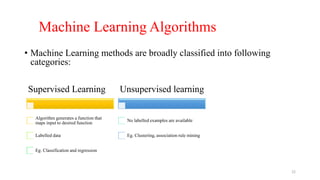
Machine Learning Algorithms
• Machine Learning methods are broadly classified into following
categories:
Supervised Learning
Algorithm generates a function that
maps input to desired function
Labelled data
Eg. Classification and regression
Unsupervised learning
No labelled examples are available
Eg. Clustering, association rule mining
22
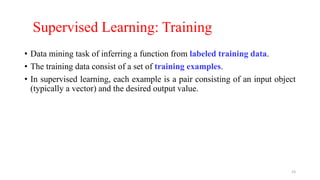
Supervised Learning: Training
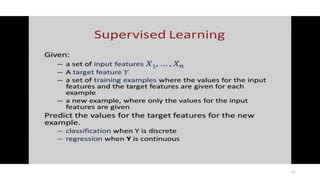
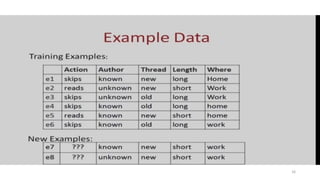
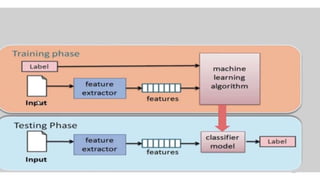
• Data mining task of inferring a function from labeled training data.
• The training data consist of a set of training examples.
• In supervised learning, each example is a pair consisting of an input object
(typically a vector) and the desired output value.
23
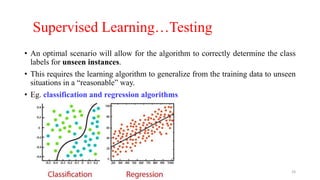
Supervised Learning…Testing
• An optimal scenario will allow for the algorithm to correctly determine the class
labels for unseen instances.
• This requires the learning algorithm to generalize from the training data to unseen
situations in a “reasonable” way.
• Eg. classification and regression algorithms
24
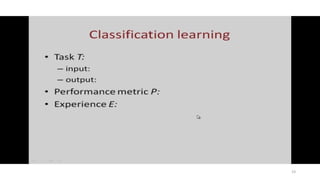
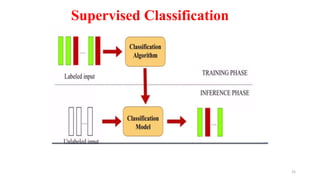
Supervised Classification
25
Unsupervised Learning
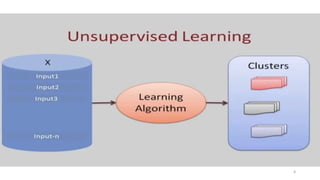
• The information used to train is neither classified nor labeled.
• U.L studies how systems can infer a function to describe a hidden structure from
unlabeled data.
• The system doesn’t figure out the right output, but it explores the data and can
differentiate the given input data.
• All clustering algorithms fall under supervised learning.
26

ML_Types_of_learning_SupUnSupervised.pptx

  • 1.
    ML Types Supervised, UnsupervisedLearning… PCS 206 1
  • 2.
    Overview ML Types Supervised Learning UnsupervisedLearning Semi supervised Learning Reinforcement Learning 2
  • 3.
    Machine Learning beginswith DATA • Labeled data • Unlabeled data 3
  • 4.
    Supervised Learning…Contd. • Asupervised learning algorithm analyzes the training data • Produces an inferred function • This function is used for mapping new examples. 4
  • 5.
  • 6.
  • 7.
  • 8.
  • 9.
  • 10.
  • 11.
  • 12.
  • 13.
  • 14.
  • 15.
  • 16.
  • 17.
  • 18.
  • 19.
  • 20.
  • 21.
  • 22.
    Machine Learning Algorithms •Machine Learning methods are broadly classified into following categories: Supervised Learning Algorithm generates a function that maps input to desired function Labelled data Eg. Classification and regression Unsupervised learning No labelled examples are available Eg. Clustering, association rule mining 22
  • 23.
    Supervised Learning: Training •Data mining task of inferring a function from labeled training data. • The training data consist of a set of training examples. • In supervised learning, each example is a pair consisting of an input object (typically a vector) and the desired output value. 23
  • 24.
    Supervised Learning…Testing • Anoptimal scenario will allow for the algorithm to correctly determine the class labels for unseen instances. • This requires the learning algorithm to generalize from the training data to unseen situations in a “reasonable” way. • Eg. classification and regression algorithms 24
  • 25.
  • 26.
    Unsupervised Learning • Theinformation used to train is neither classified nor labeled. • U.L studies how systems can infer a function to describe a hidden structure from unlabeled data. • The system doesn’t figure out the right output, but it explores the data and can differentiate the given input data. • All clustering algorithms fall under supervised learning. 26