www.logisticsit.comFor the latest news and to subscribe to the
Manufacturing and Logistics IT weekly newsletter visit
OCTOBER2016
The European magazine promoting the effective use of IT in supply chain applications
Special Technology Report:
PRINTING & LABELLING
Interview:
ELECTRIUM SALES LTD.
AAlso in this issue:
Gain the competitive edge with the right printers
Label management and the extended supply chain
Enterprise Asset Intelligence and the hardware to deliver it
Supply Chain Management in the Cloud
Download
M
anufacturing
&
Logistics
News
app
www.RetailTechnologyReview.com
3ITMANUFACTURING
&LOGISTICS
Putting IoT to the test
ITMANUFACTURING
&LOGISTICS
4 ITMANUFACTURING
&LOGISTICS
Manufacturing and Logistics IT
October 2016
Editor:
Ed Holden
Contributors:
Ken Moir, NiceLabel
Samuel Mueller, Scandit
Jörk Schüßler, Citizen Systems Europe
Richard Scott, SATO
David Stain, Zebra Technologies
Paul Swaddle, Pocket App
Mari Waldron, Honeywell printers
Publisher:
Dean Taylor
Designer:
First Sight Graphics Ltd,
www.firstsightgraphics.com
Production:
Carolyn Pither
Circulation:
Carole Chiesa
IT Manager:
Ian Curtis
Accounts:
Sarah Schofield
Published by:
B2B Publishing Ltd
PO Box 3575,
Barnet, Herts, EN5 9QD UK
Tel: +44 (0) 1707 664200
Email (publishing):
info@logisticsit.com
Email (editorial): editor@ibcpub.com
Printed by:
The Magazine Printing Company,
www.magprint.co.uk
No part of this publication may be reproduced in any
form without written permission from the publishers.
No liability is accepted for any action arising from
the contents of this publication; readers are advised
to check any manufacturer’s or supplier’s claim for
products. The publishers do not endorse opinions
expressed in any article by an outside contributor.
While every care is taken over photographs and
illustrations, which are returned when requested,
no liability can be assumed by the publishers for
the loss of such materials.
ISSN:1463-1172
ITMANUFACTURING
&LOGISTICS
CONTENTS
5 Electrium Sales Ltd.
Special Technology Report
10 Printing & Labelling
Printing & Labelling
18 Citizen Systems Europe: Gain the competitive edge with the right printers
NiceLabel: Label management and the extended supply chain
Honeywell: Mobile printers improve productivity
Seiko Instruments launches new MP-A40 Series mobile printers
SATO: Application-enabled printing solutions for the manufacturing and logistics industries
Automatic Data Capture
28 Zebra Technologies: Enterprise Asset Intelligence and the hardware to deliver it
Scandit: Mobile barcode scanning – capturing top performance without breaking the bank
Voice Picking
32 BEC: Modernising the warehouse puts Raleigh ahead of the pack
Voiteq launches VoiceMan Data Analysis
Warehouse Management Systems
36 Vanderlande: Automation paves the way for ifm’s success
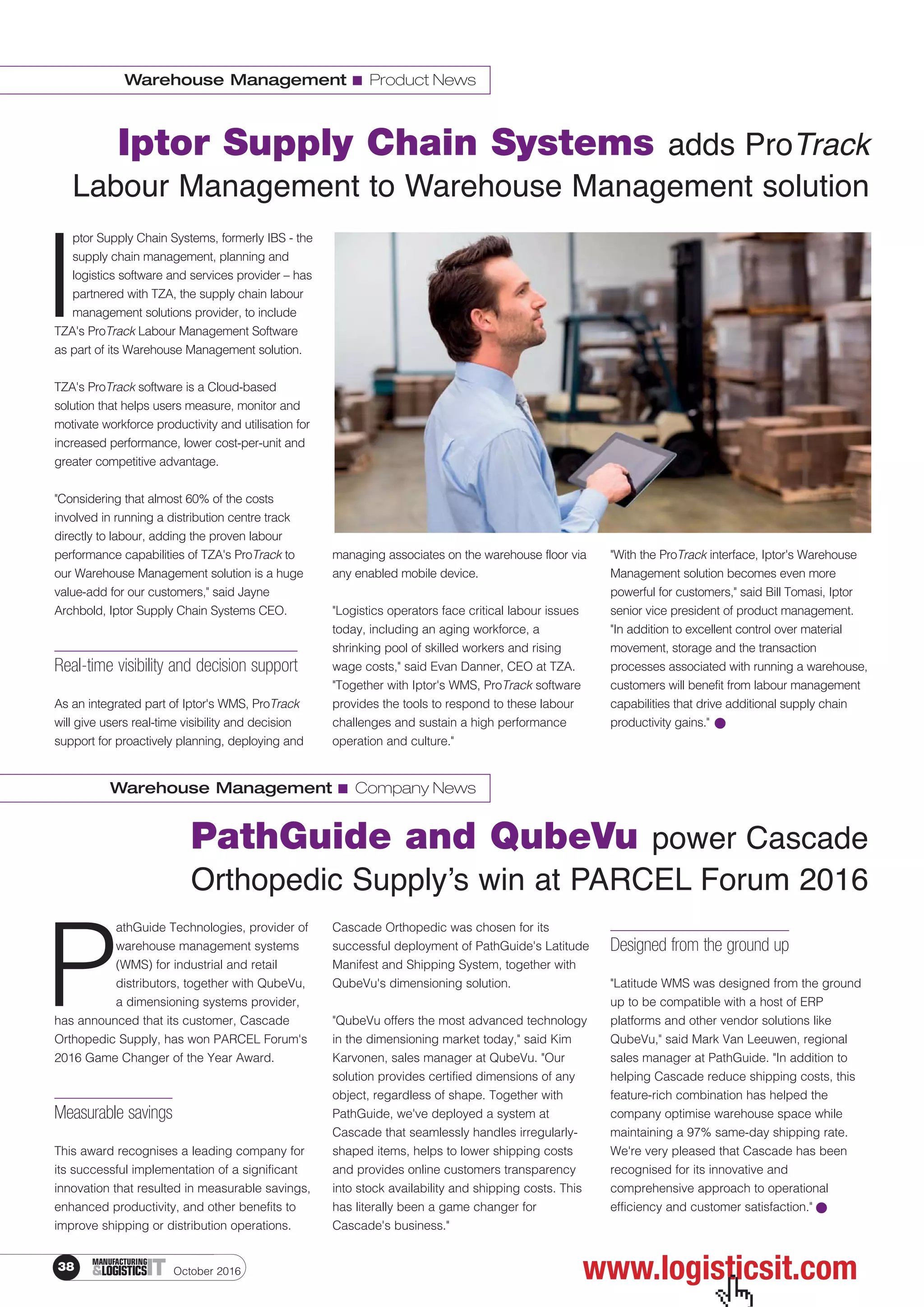
Iptor Supply Chain Systems adds ProTrack Labour Management to Warehouse
Management solution
Chess Logistics Technology: Cloud-based warehouse stock control for
e-commerce business
Manufacturing
40 Eco-friendly packaging manufacturer prepares for growth with QAD ERP
solution upgrade
Supply Chain Management
42 Oracle: Supply Chain Management in the Cloud
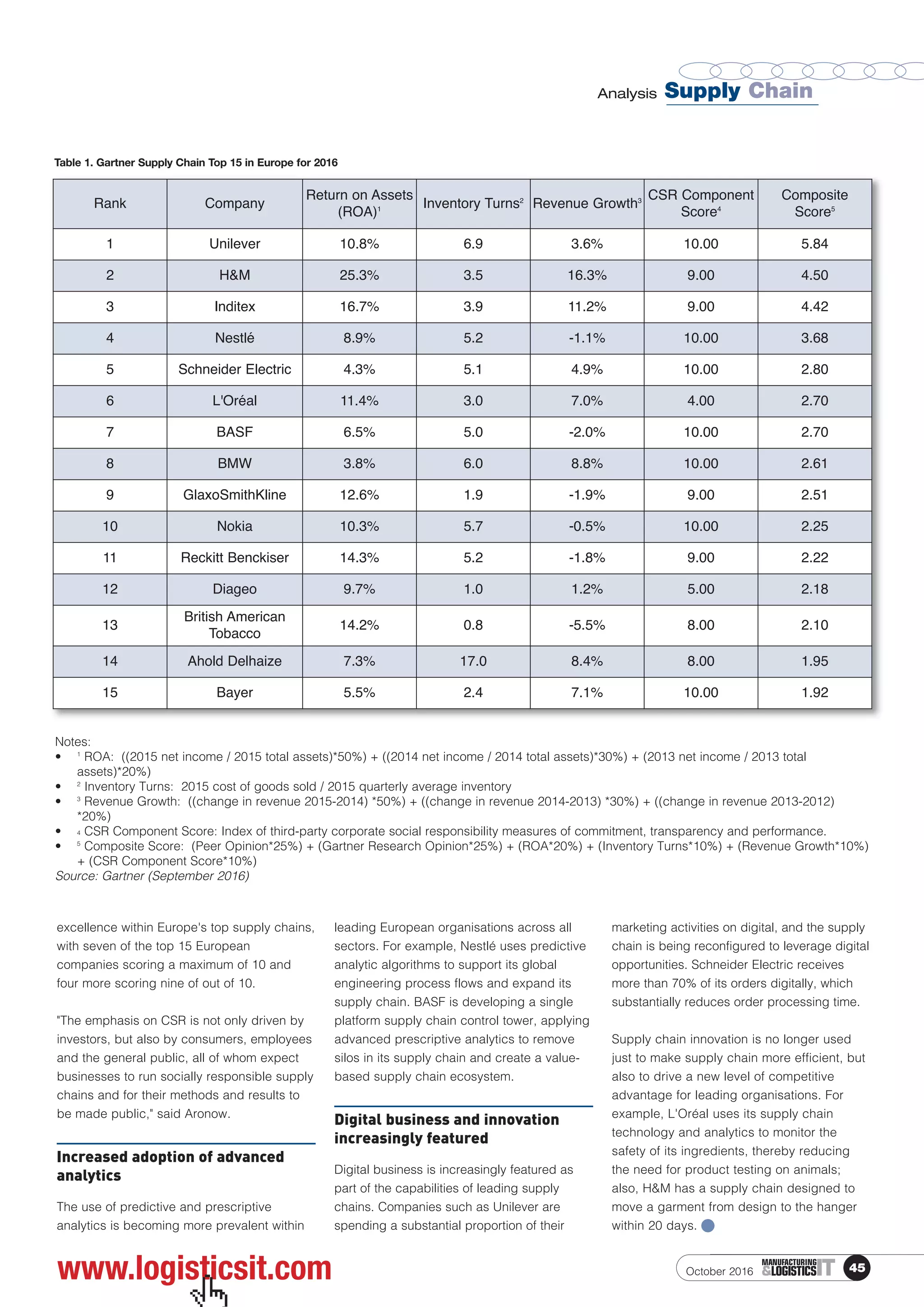
Gartner announces ranking of top European supply chain organisations for 2016
Transportation Management
46 PTV Group acquires DPS and invests in Cloud-based trip planning
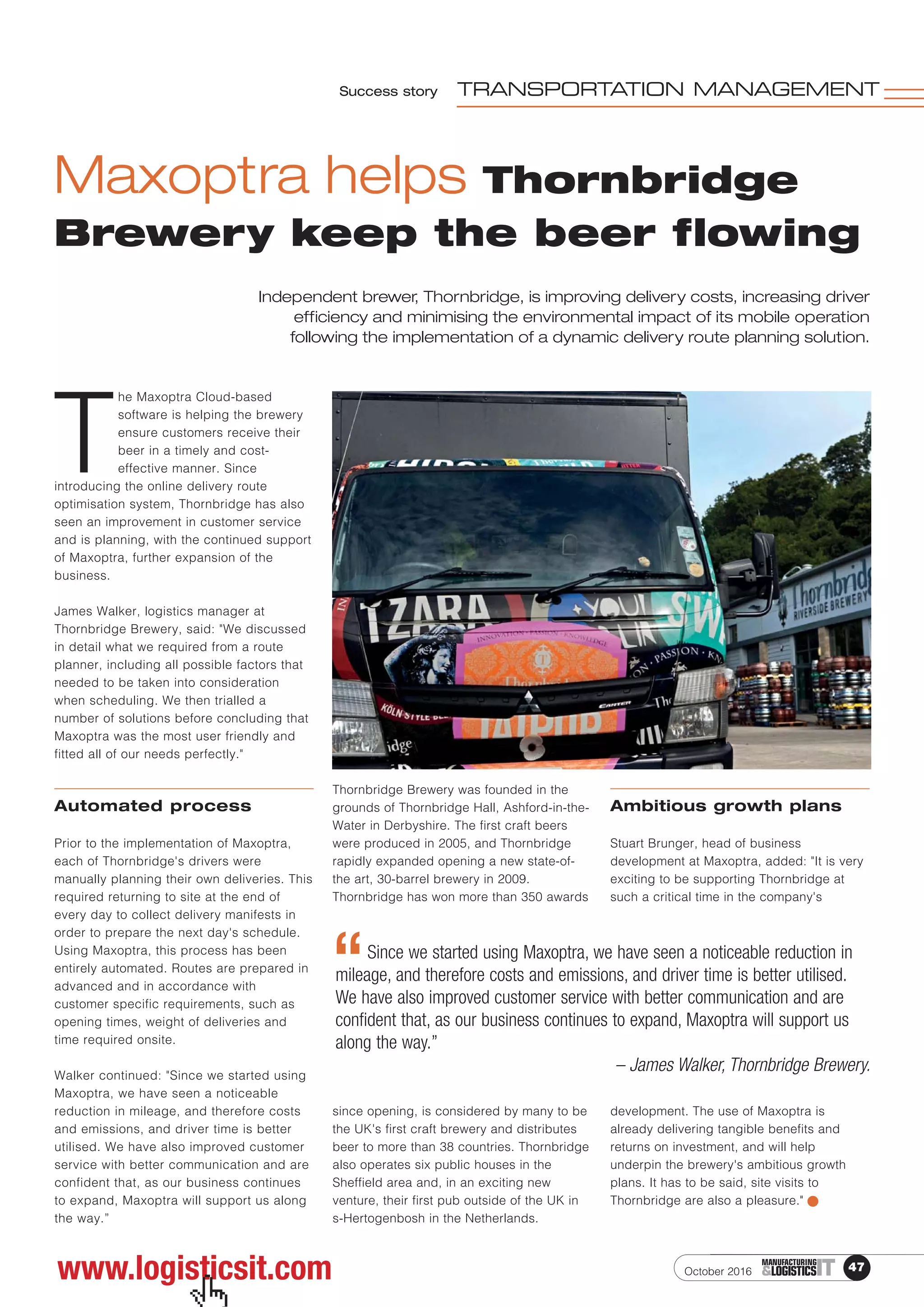
Maxoptra helps Thornbridge Brewery keep the beer flowing
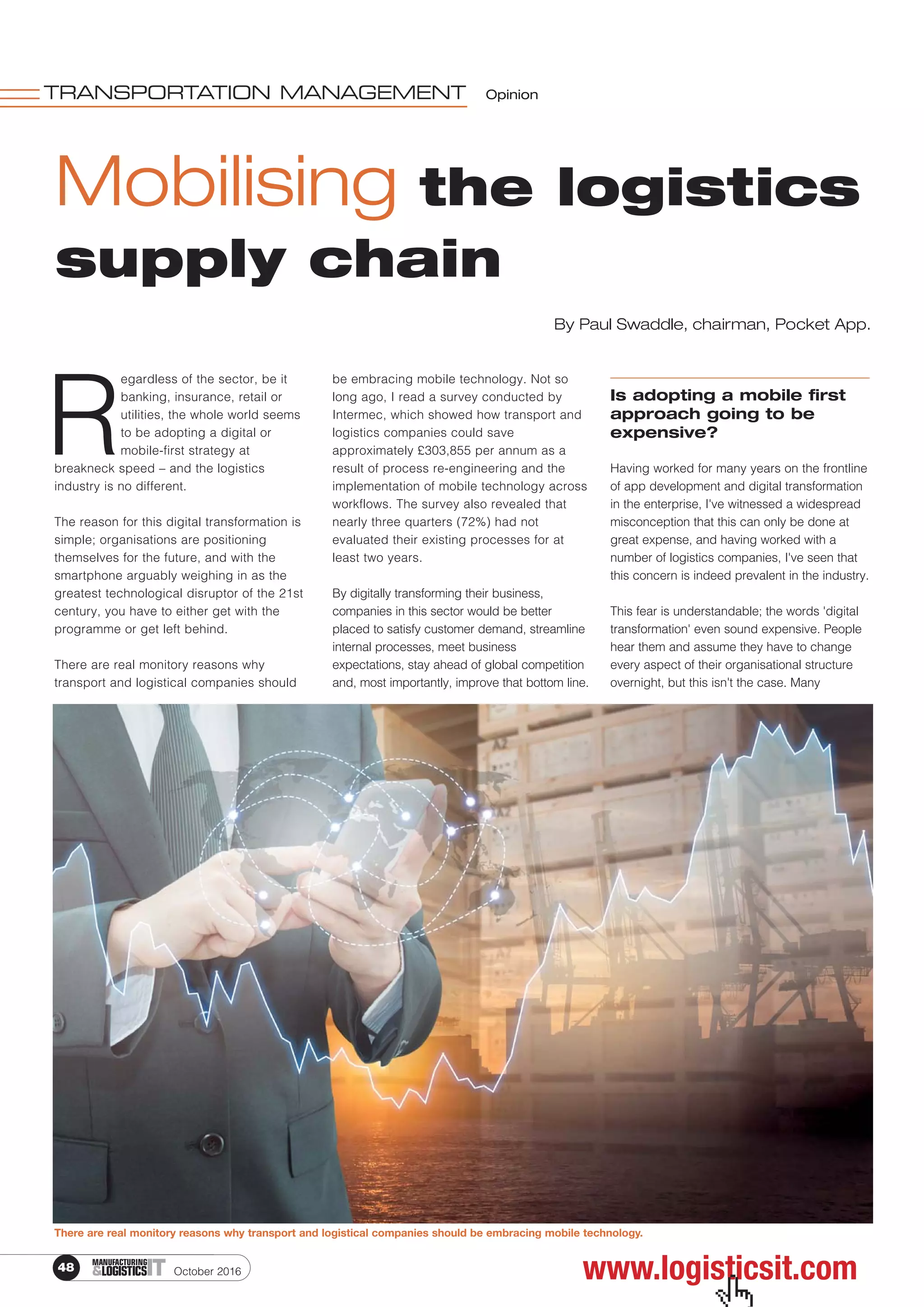
Pocket App: Mobilising the logistics supply chain
Electrium Sales Ltd. Interview
October 2016 5ITMANUFACTURING
&LOGISTICS
E
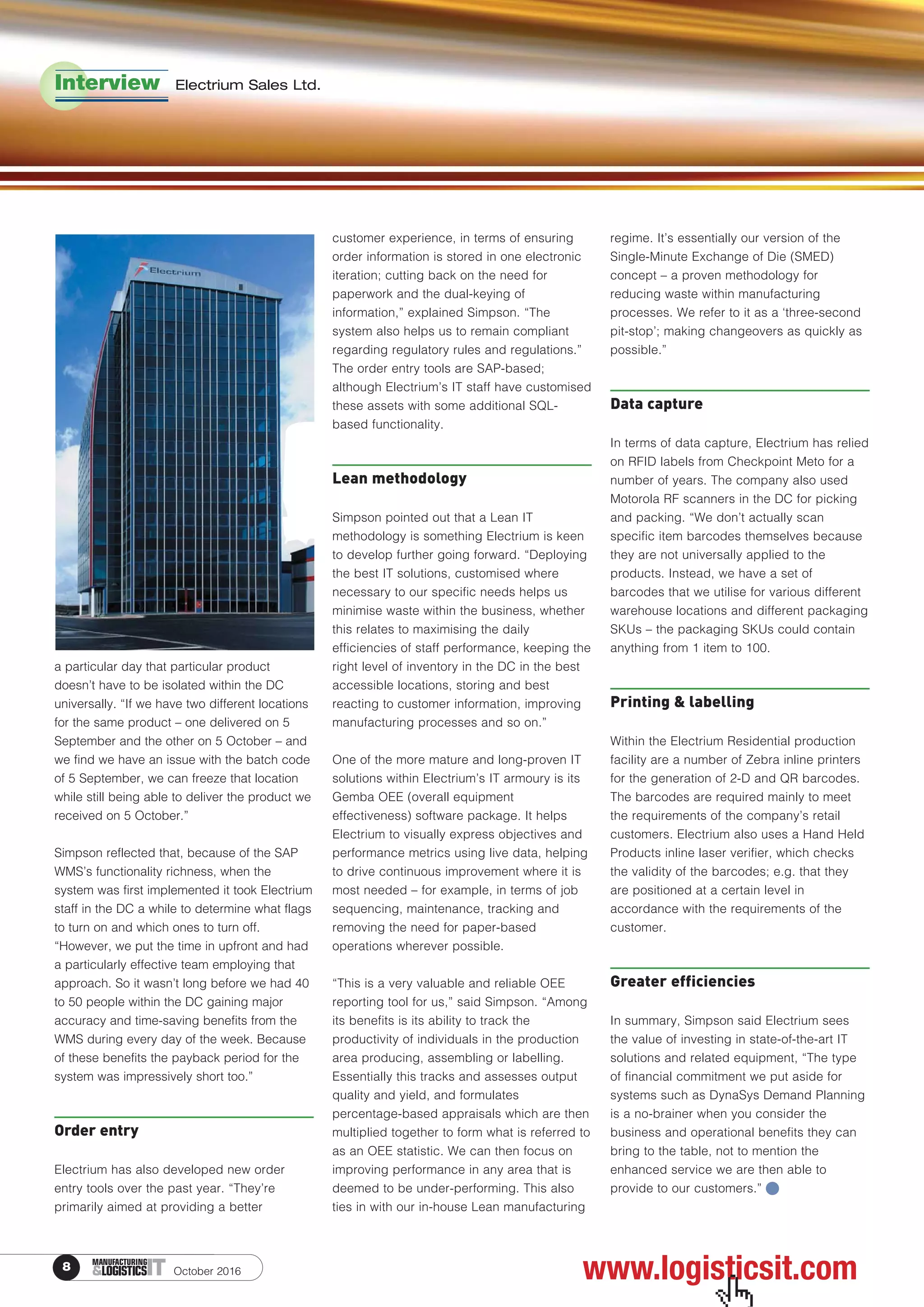
lectrium Sales Ltd. is one of the
UK’s largest electrical installation
equipment manufacturing
companies. The company’s supply
network operates throughout the
UK, as well as exporting to more than 40
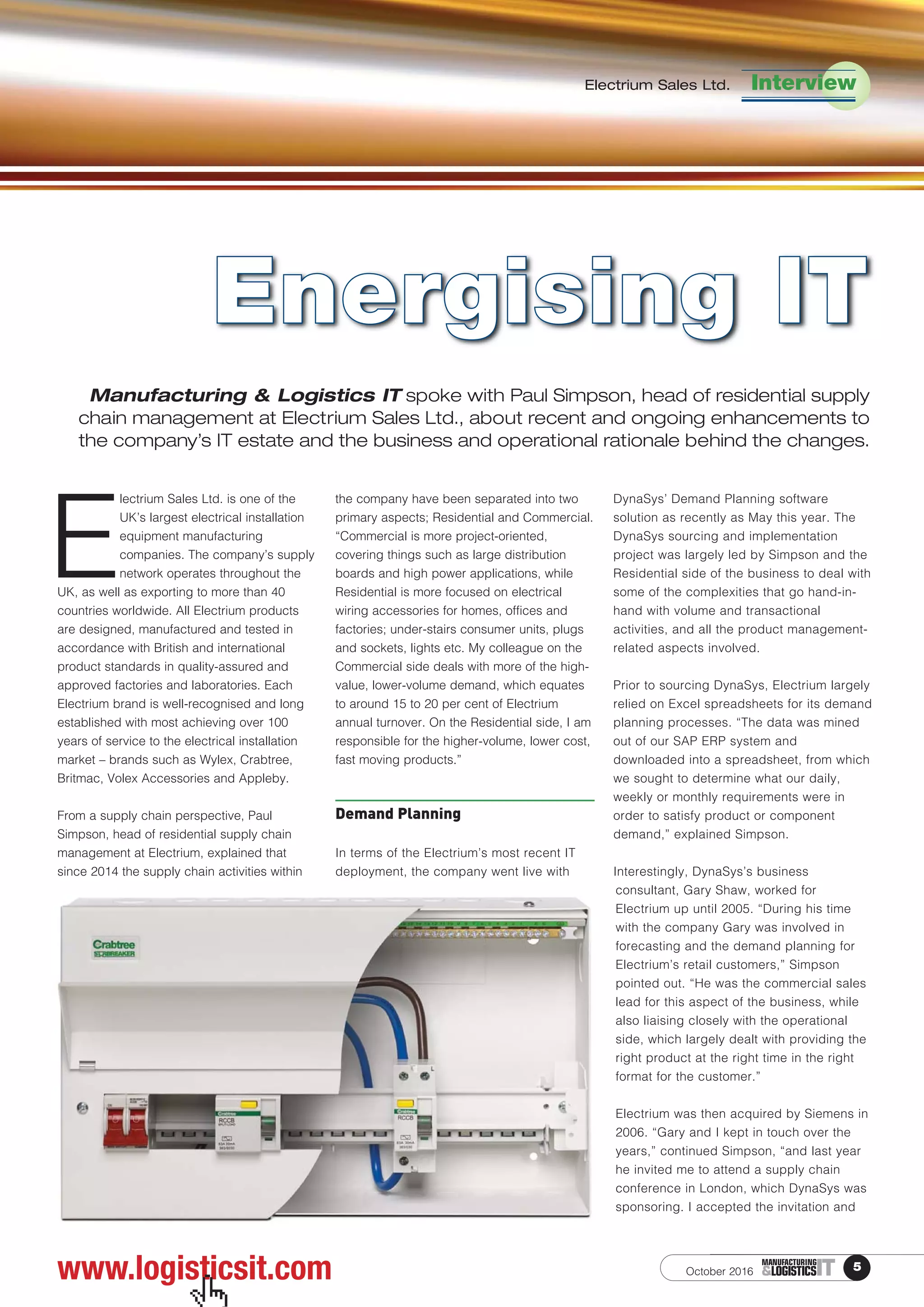
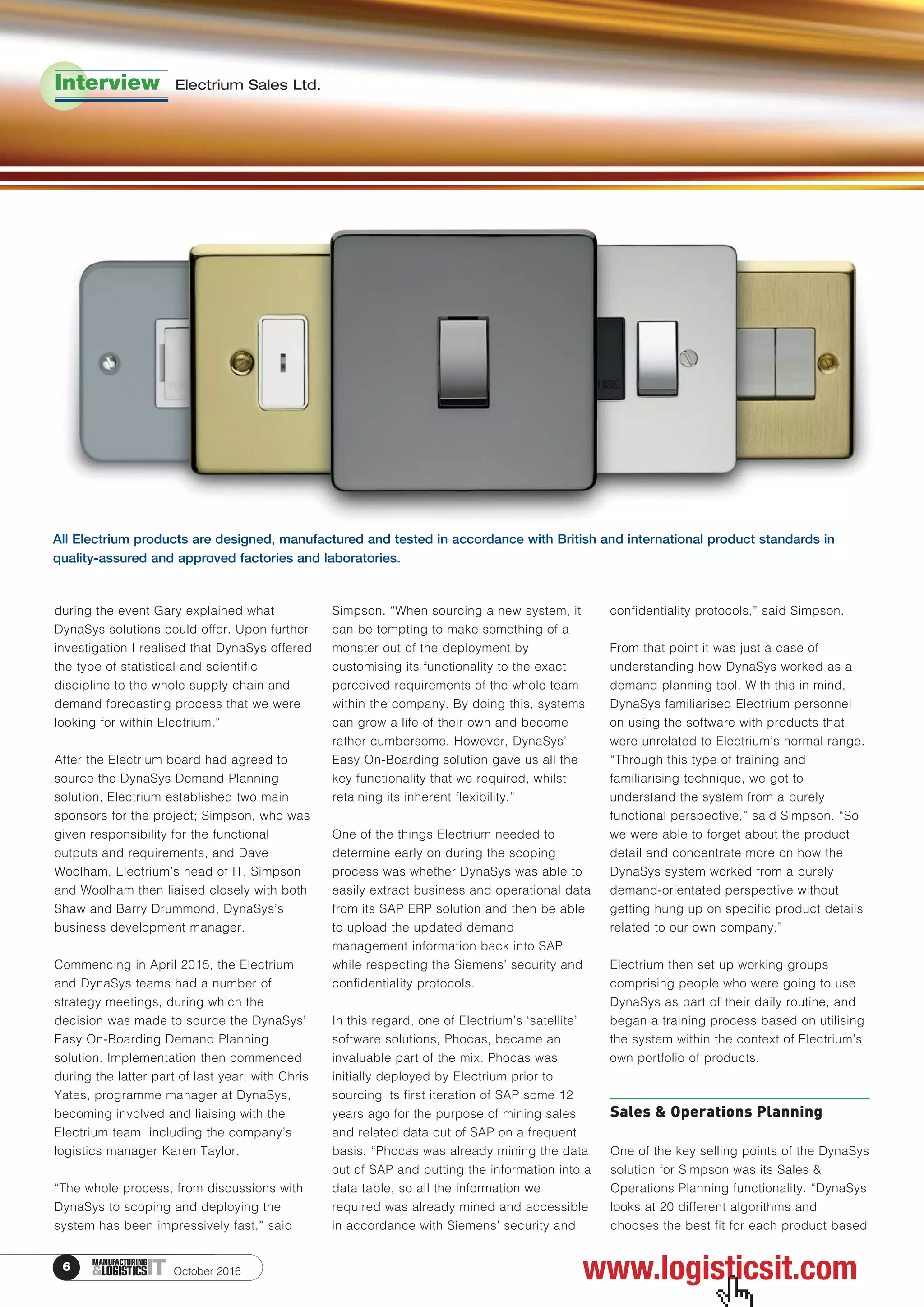
countries worldwide. All Electrium products
are designed, manufactured and tested in
accordance with British and international
product standards in quality-assured and
approved factories and laboratories. Each
Electrium brand is well-recognised and long
established with most achieving over 100
years of service to the electrical installation
market – brands such as Wylex, Crabtree,
Britmac, Volex Accessories and Appleby.
From a supply chain perspective, Paul
Simpson, head of residential supply chain
management at Electrium, explained that
since 2014 the supply chain activities within
the company have been separated into two
primary aspects; Residential and Commercial.
“Commercial is more project-oriented,
covering things such as large distribution
boards and high power applications, while
Residential is more focused on electrical
wiring accessories for homes, offices and
factories; under-stairs consumer units, plugs
and sockets, lights etc. My colleague on the
Commercial side deals with more of the high-
value, lower-volume demand, which equates
to around 15 to 20 per cent of Electrium
annual turnover. On the Residential side, I am
responsible for the higher-volume, lower cost,
fast moving products.”
Demand Planning
In terms of the Electrium’s most recent IT
deployment, the company went live with
DynaSys’ Demand Planning software
solution as recently as May this year. The
DynaSys sourcing and implementation
project was largely led by Simpson and the
Residential side of the business to deal with
some of the complexities that go hand-in-
hand with volume and transactional
activities, and all the product management-
related aspects involved.
Prior to sourcing DynaSys, Electrium largely
relied on Excel spreadsheets for its demand
planning processes. “The data was mined
out of our SAP ERP system and
downloaded into a spreadsheet, from which
we sought to determine what our daily,
weekly or monthly requirements were in
order to satisfy product or component
demand,” explained Simpson.
Interestingly, DynaSys’s business
consultant, Gary Shaw, worked for
Electrium up until 2005. “During his time
with the company Gary was involved in
forecasting and the demand planning for
Electrium’s retail customers,” Simpson
pointed out. “He was the commercial sales
lead for this aspect of the business, while
also liaising closely with the operational
side, which largely dealt with providing the
right product at the right time in the right
format for the customer.”
Electrium was then acquired by Siemens in
2006. “Gary and I kept in touch over the
years,” continued Simpson, “and last year
he invited me to attend a supply chain
conference in London, which DynaSys was
sponsoring. I accepted the invitation and
Manufacturing & Logistics IT spoke with Paul Simpson, head of residential supply
chain management at Electrium Sales Ltd., about recent and ongoing enhancements to
the company’s IT estate and the business and operational rationale behind the changes.
Energising IT
www.logisticsit.com
6 ITMANUFACTURING
&LOGISTICS October 2016
during the event Gary explained what
DynaSys solutions could offer. Upon further
investigation I realised that DynaSys offered
the type of statistical and scientific
discipline to the whole supply chain and
demand forecasting process that we were
looking for within Electrium.”
After the Electrium board had agreed to
source the DynaSys Demand Planning
solution, Electrium established two main
sponsors for the project; Simpson, who was
given responsibility for the functional
outputs and requirements, and Dave
Woolham, Electrium’s head of IT. Simpson
and Woolham then liaised closely with both
Shaw and Barry Drummond, DynaSys’s
business development manager.
Commencing in April 2015, the Electrium
and DynaSys teams had a number of
strategy meetings, during which the
decision was made to source the DynaSys’
Easy On-Boarding Demand Planning
solution. Implementation then commenced
during the latter part of last year, with Chris
Yates, programme manager at DynaSys,
becoming involved and liaising with the
Electrium team, including the company’s
logistics manager Karen Taylor.
“The whole process, from discussions with
DynaSys to scoping and deploying the
system has been impressively fast,” said
Simpson. “When sourcing a new system, it
can be tempting to make something of a
monster out of the deployment by
customising its functionality to the exact
perceived requirements of the whole team
within the company. By doing this, systems
can grow a life of their own and become
rather cumbersome. However, DynaSys’
Easy On-Boarding solution gave us all the
key functionality that we required, whilst
retaining its inherent flexibility.”
One of the things Electrium needed to
determine early on during the scoping
process was whether DynaSys was able to
easily extract business and operational data
from its SAP ERP solution and then be able
to upload the updated demand
management information back into SAP
while respecting the Siemens’ security and
confidentiality protocols.
In this regard, one of Electrium’s ‘satellite’
software solutions, Phocas, became an
invaluable part of the mix. Phocas was
initially deployed by Electrium prior to
sourcing its first iteration of SAP some 12
years ago for the purpose of mining sales
and related data out of SAP on a frequent
basis. “Phocas was already mining the data
out of SAP and putting the information into a
data table, so all the information we
required was already mined and accessible
in accordance with Siemens’ security and
confidentiality protocols,” said Simpson.
From that point it was just a case of
understanding how DynaSys worked as a
demand planning tool. With this in mind,
DynaSys familiarised Electrium personnel
on using the software with products that
were unrelated to Electrium’s normal range.
“Through this type of training and
familiarising technique, we got to
understand the system from a purely
functional perspective,” said Simpson. “So
we were able to forget about the product
detail and concentrate more on how the
DynaSys system worked from a purely
demand-orientated perspective without
getting hung up on specific product details
related to our own company.”
Electrium then set up working groups
comprising people who were going to use
DynaSys as part of their daily routine, and
began a training process based on utilising
the system within the context of Electrium’s
own portfolio of products.
Sales & Operations Planning
One of the key selling points of the DynaSys
solution for Simpson was its Sales &
Operations Planning functionality. “DynaSys
looks at 20 different algorithms and
chooses the best fit for each product based
Interview Electrium Sales Ltd.
www.logisticsit.com
October 2016 7ITMANUFACTURING
&LOGISTICS
upon historical demand. And because
Electrium deals with the retail, wholesale
and export markets, DynaSys also helps us
make forecast adjustments for each of
these segments.”
Simpson explained that DynaSys gives
Electrium statistical validity at the
granular/item level, so each product can be
treated in a different way. “For example, a
two-gang switch socket normally attracts a
very high demand, and prior to deploying
DynaSys we may have held six weeks’
worth of stock for the product. Because
DynaSys gives us the capability to treat the
requirements of each product individually,
we could more easily determine that,
because stock demand patterns for two-
gang switch sockets are so predictable it
might only be necessary to keep three
weeks’ worth of stock, thus freeing up
capital and space in the DC.”
ERP
In terms of its ERP requirements, Electrium
relies on SAP. “Prior to first sourcing SAP
around 5 years ago, we had used an IBM AS
-400 PRMS (Physical Resources Management
System),” remembered Simpson. “However,
this became increasingly customised in-
house. When users wanted to operate the
system in a particular way we would append
the system. With SAP you have the ability to
adjust the system to your requirements while
also benefitting from greater functional rigidity
and reliability within the system.”
Simpson added that, from Electrium’s
perspective, one of the key benefits of SAP is
that users can easily mine deep within its data
banks to access detailed information related to
any particular item in stock or on order.
However, in order to maximise the ease, speed
and flexibility of accessing data related to the
14,000 SKUs in its distribution centre (DC),
Electrium designed additional functionality within
Phocas so that it was able more easily to
present data in different groups. “We group
products into what we call ‘P types’, and we can
mine data out of Phocas to look at sales orders
within a particular P-type group. So, essentially
the process involves accessing data within SAP
at the granular level, and then analysing it as a
product group within Phocas. This functionality
is important in that it allows us to cluster
products together, moving sideways between
groups of product, and then diving down into
the detail to establish what is going on.”
On the sales and commercial side, Phocas was
first implemented around 15 years ago. “This
gave the company directors the ability to
analyse the activities of sales personnel and
how they were responding to different targets
etc.,” explained Simpson. “For example, you
could drill down to the national sales manager
level for a particular brand and then you could
drill down to regional teams or to individual
salespeople. So it was very useful in terms of
gaining a feel for what was going on in the
business and determining which areas of the
business needed more support.”
About nine years ago, Simpson and
Electrium’s then head of supply chain
management, John Gair, sat down and
discussed how the supply chain side of the
commercial Phocas functionality could be
enhanced so that the company could more
easily drill down into customer orders to
determine which customers were buying the
most stock, and survey supplier purchase
orders to ascertain which suppliers were the
most reliable terms of on-time delivery etc.
“For a number of years now, this aspect of
Phocas has been a highly respected
facilitator of this type of supply chain data,”
said Simpson.
WMS
In terms of warehouse management,
Electrium’s SAP WMS has proved itself to be
a highly effective system for stock control and
stock accuracy, according to Simpson. “We’re
well into the realm of 99.9 per cent stock
accuracy in the DC,” he enthused. “It used to
take four to five days to complete a stock take
with our old PRMS system; now within SAP we
can complete a wall-to-wall stock check –
every single product every single location, all
14,000 SKUs on site – in less than three days.
This offers major additional benefit in terms of
reduced downtime when counting items.
There are also the functional day-to-day
benefits that you get in terms of knowing
exactly what aisle and shelf location you need
to go to in order to pick a particular type and
quantity of product.”
Additionally, Simpson pointed out that if an
issue arises regarding a particular product on
Electrium Sales Ltd. Interview
www.logisticsit.com
October 20168 ITMANUFACTURING
&LOGISTICS
a particular day that particular product
doesn’t have to be isolated within the DC
universally. “If we have two different locations
for the same product – one delivered on 5
September and the other on 5 October – and
we find we have an issue with the batch code
of 5 September, we can freeze that location
while still being able to deliver the product we
received on 5 October.”
Simpson reflected that, because of the SAP
WMS’s functionality richness, when the
system was first implemented it took Electrium
staff in the DC a while to determine what flags
to turn on and which ones to turn off.
“However, we put the time in upfront and had
a particularly effective team employing that
approach. So it wasn’t long before we had 40
to 50 people within the DC gaining major
accuracy and time-saving benefits from the
WMS during every day of the week. Because
of these benefits the payback period for the
system was impressively short too.”
Order entry
Electrium has also developed new order
entry tools over the past year. “They’re
primarily aimed at providing a better
customer experience, in terms of ensuring
order information is stored in one electronic
iteration; cutting back on the need for
paperwork and the dual-keying of
information,” explained Simpson. “The
system also helps us to remain compliant
regarding regulatory rules and regulations.”
The order entry tools are SAP-based;
although Electrium’s IT staff have customised
these assets with some additional SQL-
based functionality.
Lean methodology
Simpson pointed out that a Lean IT
methodology is something Electrium is keen
to develop further going forward. “Deploying
the best IT solutions, customised where
necessary to our specific needs helps us
minimise waste within the business, whether
this relates to maximising the daily
efficiencies of staff performance, keeping the
right level of inventory in the DC in the best
accessible locations, storing and best
reacting to customer information, improving
manufacturing processes and so on.”
One of the more mature and long-proven IT
solutions within Electrium’s IT armoury is its
Gemba OEE (overall equipment
effectiveness) software package. It helps
Electrium to visually express objectives and
performance metrics using live data, helping
to drive continuous improvement where it is
most needed – for example, in terms of job
sequencing, maintenance, tracking and
removing the need for paper-based
operations wherever possible.
“This is a very valuable and reliable OEE
reporting tool for us,” said Simpson. “Among
its benefits is its ability to track the
productivity of individuals in the production
area producing, assembling or labelling.
Essentially this tracks and assesses output
quality and yield, and formulates
percentage-based appraisals which are then
multiplied together to form what is referred to
as an OEE statistic. We can then focus on
improving performance in any area that is
deemed to be under-performing. This also
ties in with our in-house Lean manufacturing
regime. It’s essentially our version of the
Single-Minute Exchange of Die (SMED)
concept – a proven methodology for
reducing waste within manufacturing
processes. We refer to it as a ‘three-second
pit-stop’; making changeovers as quickly as
possible.”
Data capture
In terms of data capture, Electrium has relied
on RFID labels from Checkpoint Meto for a
number of years. The company also used
Motorola RF scanners in the DC for picking
and packing. “We don’t actually scan
specific item barcodes themselves because
they are not universally applied to the
products. Instead, we have a set of
barcodes that we utilise for various different
warehouse locations and different packaging
SKUs – the packaging SKUs could contain
anything from 1 item to 100.
Printing & labelling
Within the Electrium Residential production
facility are a number of Zebra inline printers
for the generation of 2-D and QR barcodes.
The barcodes are required mainly to meet
the requirements of the company’s retail
customers. Electrium also uses a Hand Held
Products inline laser verifier, which checks
the validity of the barcodes; e.g. that they
are positioned at a certain level in
accordance with the requirements of the
customer.
Greater efficiencies
In summary, Simpson said Electrium sees
the value of investing in state-of-the-art IT
solutions and related equipment, “The type
of financial commitment we put aside for
systems such as DynaSys Demand Planning
is a no-brainer when you consider the
business and operational benefits they can
bring to the table, not to mention the
enhanced service we are then able to
provide to our customers.”
Interview Electrium Sales Ltd.
www.logisticsit.com
D
Unloc
Sales & O
k Supply Chain Potential
Operations Plannning
cross-func
a comprehensive, inte
o better analyse, plaTTo
at aligns
ou need
.tional priorities while increasing profitability
egrated and collaborative solution. A solution tha
n, simulate and optimise your Supply Chain, yo
.dys.com / contact@dys.comwww
+44 (0) 121 506 6500
Birmingham, B32 1AF
, Quinton Business Park7 Ridgeway
Sir Stanley Clarke House
.your organisational strategy
Benefit from our unique expertise in Supply Chain to help deliver
and operational levels of your extended Supply Chain.
DynaSys offers the DSCP suite, a solution that will optimise the strategic, tactical
Experts in Demand & Supply Chain Planning solutions for over 30 years,
October 201610 ITMANUFACTURING
&LOGISTICS
Special Technology Report Printing & Labelling
www.logisticsit.com
T
his report will consider a host of
current key discussion points and
recent and ongoing areas of
innovation and development with the
printing & labelling space; one of
the most vibrant and fast-changing technology
areas actively deployed within the
manufacturing, logistics and retail fields. Michael
Dizdar, project manager, Panorama Consulting,
opens the debate by observing that labels are
moving away from being a display mechanism
for static, dated data. “Gone are the days where
a label was printed two days’ ago when a pallet
was received (and may or not be correct at the
current time) to a vessel that can give updated
and changeable information based on
transactional events and environmental factors,”
he said. “New labelling advances from
companies like Thinfilm allow real-time
temperature data to be produced accurately
and timely based on the needs of the current
user, not what was produced in the past based
on stale information.”
In terms of drivers for change, Dizdar makes the
point that the pervasiveness of technology into
the day-to-day lives of consumers has
significantly impacted the changes in the
labelling and printing environments. An end-user
of a label mostly likely has a ‘smartphone’, has
played a new video game, and/or interacted
with a kiosk at the grocery store – maybe all
within the last day,” he said. “This ease of
technology understanding and adoption has
driven advances to end user labelling and
printing requirements.”
Viroop Narla, mobility research analyst, Frost &
Sullivan, considers 3D printing and the
technology’s impact on the automotive industry.
This, he states, has primarily been in research
and development (R&D), but OEMs are turning
the corner into commercially printed parts for
mainstream production. Frost & Sullivan
research indicates that in 2014, 90% of 3D
printing applications in the automotive industry
were for prototyping and 10% for production,
enabling OEMs and suppliers to:
• Create proof of concepts with localised
manufacturing.
• Fabricate complex and unique production
tools such as jigs, fixtures, and moulds.
• Prototype parts, such as Ford’s 4-cylinder
EcoBoost engine and F-150 exhaust
manifold.
By 2025, new US OEMs such as Local Motors
are expected to increase adoption of
microfactory business models to:
• Print parts at authorised representative
locations, reducing supply chain
complexities and cost.
• Expand crowdsourcing and collaborative
design to capitalise on a diverse talent pool.
• Enable convenient and quick vehicle
servicing to maximise customer satisfaction.
Expansion of 3D printing in the value chain is
expected to face multiple challenges, such as:
• The high cost of 3D printing machinery and
materials.
• Conventional component manufacturers
lobbying governments against 3D printing.
• Customer patent infringement implications
for OEMs and suppliers.
Manufacturing & Logistics IT spoke with a number of experts from the vendor and analyst
communities about recent developments in the world of printing & labelling technologies.
October 2016 11ITMANUFACTURING
&LOGISTICSwww.logisticsit.com
Special Technology ReportPrinting & Labelling
A shift from 3D prototyping to production is
expected by 2030 due to:
• An expected 40% reduction in raw material
prices for 3D printing.
• Price similarity: A conventionally
manufactured part now is 78% cheaper
than one that is 3D printed; the gap is
expected to shrink to as low as 11%.
Gartner analysts, Michael Shanler and Pete
Basiliere, comment that the 3D printing (3DP)
industry continues to see growth, innovation and
many new players. “While several of the seven
3DP technologies have existed for nearly 30
years, those early tools had limitations to speed,
quality, resolution and performance,” they said.
“They provided limited value to enterprises
beyond prototyping in manufacturing. Over the
last five years, the ‘maker movement’ catalysed
numerous 3DP activities and inspired 3DP
solution vendors and end users alike to begin
leveraging 3DP in ways to create brand new
values and societal impacts. Many industries
have moved beyond leveraging 3DP in
experiments and will be approaching an
inflection point within the next five years, where
executing on 3DP is industrialised into the value
chain.”
Shanler and Basiliere added that, recently,
major aerospace and automotive companies
have leveraged 3DP to create new products
and assemblies that were previously impossible
to build or to shorten delivery times on orders.
“New materials have been 3D-printed in the
retail industry to create new aesthetic and
performance characteristics, as well as to satisfy
consumers' growing appetite for personalised
products,” they remarked.
Shanler and Basiliere
also make the point
that the medical
device and healthcare
community has
moved toward
improved patient
outcomes and
reduced cycle times
by delivering 3D-
printed personalised
dental devices,
hearing aids, implants and surgical tools.
However, they comment that while there are a
lot of 3DP technologies that have promise and
have moved beyond the proof of concept phase
at companies, not every organisation is ready to
adopt. Further, merely adopting 3DP in a
vacuum can be a recipe for disaster, they said,
adding: “The majority of organisations still need
to adapt or create new internal processes for
handling 3DP workflows, data, hardware, supply
chain management and products. The
mainstream media, vendor capitalists (VCs) and
vendors are still creating a very ‘hyped’
environment where 3DP can solve everything –
from 3D-printed food to end world hunger to
creating body parts so people can live forever.”
Internet of Things
David Stain, senior vertical marketing manager
EMEA manufacturing, field mobility &
healthcare, Zebra Technologies, comments that
developments we see taking prominence are
the need to bring the Internet of Things (IoT) to
life in the printing/auto ID world. This, he
explains, is about making the print devices
visible across the user estate where there may
be several hundred or thousand devices,
flagging their status, use rate and being able to
manage them from a central location.
Configurability
Another development of note, according to
Stain, is the appreciation that the labels
themselves have become much more
configurable by use case; for example, new
RFID tags designed specifically to work better
on metal components, shelf-edge labels that
peel away more easily when being replaced
and wrist bands for medical applications. Stain
considers that the drivers for change can be
characterised as follows:
• Customisation. “Both end user and
enterprises want products and components
that are right for them. Hence we are seeing
mass customisation or product variants
being produced to fulfil this need.”
• Visibility. “In a connected world, all devices
need to be connected and indeed the
outputs of a printer – the tag or label –
enable the connectivity by giving a digital
voice to the item it
is placed on.
More and more
we are seeing,
however, the
need to connect
the printer to the
network so status
can be observed.
Also, the ability to
connect quickly to
other peripherals
such as scanners
or mobile computers is key to efficiency and
intelligence.”
• Availability. People will wait for goods and
merchandise if they get accurate and
convenient delivery commitments. Those
that won’t will shop around, so inventory
visibility is key and getting the stock to a
convenient location for the customer just as
key. Track & trace is vital to both.”
Centralisation and
standardisation
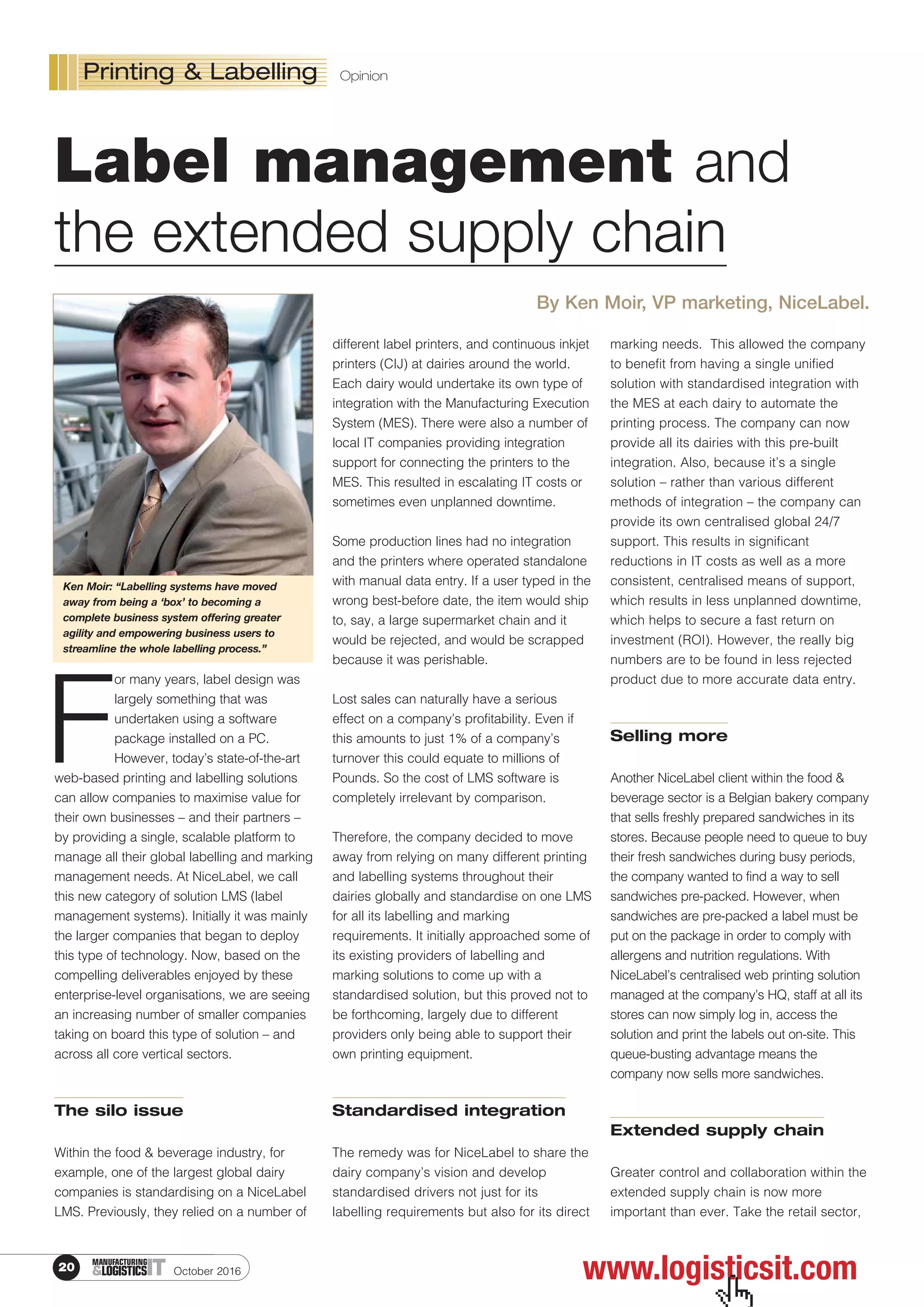
Ken Moir, VP marketing, NiceLabel,
comments that, first, there is more
centralisation and standardisation taking
place because companies want to increase
the agility of their business. “These types of
process optimisation benefits can mean
companies are able to ship product faster,
sell more product, have less downtime, have
less product returns, reduce inventory,
mitigate the risk of mislabelling etc. – these
are the key drivers for change,” he said.
Also, Moir points out that web technology now
allows companies to do client-side web printing.
“This is now fully usable,” he said. “The latest
web technology doesn’t require Silverlight or
Flash plugins, and doesn’t require administration
rights for users to install software locally. So
web-based technology can now be deployed
anywhere across the extended supply chain for
any authorised user. It can be deployed across
your own business, your stores, your franchises,
your suppliers, your contract manufacturers or
your 3PLs etc., and all be controlled centrally.”
Moir adds that the latest integration systems
and service buses also allow companies to
take advantage of universal templates and
www.logisticsit.comOctober 201612 ITMANUFACTURING
&LOGISTICS
Special Technology Report Printing & Labelling
print from any device on any operating
system. “So a big part of the story here is
mobility; it’s not just PCs that you can print
from, it’s also tablets and android devices,”
he remarked. “Most retail stores and
warehouses use mobile devices and it’s now
easy to actually print from these devices. You
no longer need to hard code or generate and
embed printer command templates in your
applications. This is what NiceLabel calls
next-generation mobile printing.”
Previously, explains Moir, some vendors
would offer template printing solutions
whereby users could design a label, print it to
file, take the printer command language and
embed it within their application. “However,
what users now want are universal templates,”
he said. “Integration systems now make it
easy for iOS, Android etc. to print universal
intelligent labels; they don’t need to store
separate templates for different mobile
devices. It’s now easy to integrate mobile
computers into label management systems
(LMS) so that users can print to any printer,
whether mobile or fixed. It doesn’t matter what
printer you use. The point is that mobile,
desktop or tablet computers can be easily
integrated into LMS.”
In terms of the key drivers for change, Moir
comments that, in addition to reduced product
returns, reduced inventory, reduction in
labelling errors, etc., there are drivers
concerning legal compliance. “In life sciences,
the FDA UDI deadline recently passed in the
US,” he pointed out. “The next thing regarding
medical device manufacture is going to be the
EU medical device
directive. In
pharmaceutical,
there will be further
changes regarding
serialisation and
track and trace over
the next couple of
years. This is all
naturally driving the
need for a more
centralised,
standardised
labelling
methodology.”
Greater business efficiency
Ioana Nitu, product manager at ICT services
provider Brother UK, states that the main
function of mobile and label printers in the
manufacturing and logistics industry is to
increase business efficiency by allowing
employees to print simply, quickly and easily
while on the move, and this hasn't changed.
However, what has changed in her view is the
capabilities of the technology in facilitating this,
and that is what is steering the biggest trends at
the minute. “As businesses across all sectors,
including this one, broaden the devices they're
using, connectivity has become more important,”
said Nitu. “Manufacturing businesses are
investing resource into innovative new
technology to help employees work more
efficiently while reducing costs, and any print
systems need to be compatible with these.”
Running almost parallel to this, according to Nitu,
is the growth of different technology used across
businesses and the impact this has on how
easily these different devices integrate. “As
technology develops, businesses are
continuously trialing new software and hardware,
making it more and more challenging to ensure
these different systems are compatible with each
other,” she said. “We're finding that customers,
now more than ever, want mobile printers that
integrate easily with existing systems and cause
minimum disruption.”
Additionally, Nitu considers that the evolution of
technology over the past decade has raised the
bar in terms of customer expectations. “In
everyday life people want solutions which have
an instant impact with minimal inconvenience,
and this is certainly the case in this sector,” she
said. “Customers are looking for high-speed,
compact devices that increase business
efficiency and empower employees from any
location.”
Nitu added that the speed that technology has
developed in recent years has led to a
continuous need for investment in Brother’s
products. “All of our solutions are designed with
the customers’ needs front of mind, and we
spend a lot of time understanding the sector and
the challenges they're facing to ensure our
products can help meet these needs,” she said.
“Our mobile print solutions seamlessly integrate
with industry-leading software, meaning the set-
up and incorporation of the technology into
existing systems is straightforward. We've also
invested in the range of connectivity options
available on our products, helping to ensure
they're compatible with a both iOS and Android
devices. Print speed has always been a key
feature for us, coupled with the continued need
for reliable, hardwearing and compact solutions.”
Mari Waldron, global business development
manager, Honeywell printers, points to key areas
of development as being simplicity, ease-of-use
and connectivity – with command language auto
sense, printers automatically analysing incoming
data streams. This, she explains, means a user
can pull the printer out of the box and
immediately start printing, which makes the start-
up process quick and simple for the end user.
“Customers have come to expect user-friendly
design, including a large, multi-colour touch
screen with easy-to-use commands,” said
Waldron. “This is driven by consumerisation
trends, which means a familiar interface and
compatibility with consumer devices, such as
smartphones.”
In terms of motivation for change, Waldron
believes the Industrial Internet of Things (IIoT)
and the need for connectivity is driving retailers,
manufacturers and supply chain firms to invest in
technology to enhance their business
performance. She points out that companies look
to connected devices to improve flexibility,
efficiency and profitability.
Increased adoption of
consumer technology
In addition, Waldron explains that Honeywell
customers place a strong emphasis on ease-
of-use when it comes to technology for their
workers. “This is partly driven by an increased
adoption of consumer technology,” she said.
“Workers on a manufacturing or distribution
centre floor expect the devices they use to be
familiar and intuitive. This is particularly
important when hiring and training new
workers. For seasonal workers hired during
peak times, a printer must be easy to use in
order for the new staff to be productive in a
short amount of time.”
October 2016 13ITMANUFACTURING
&LOGISTICS
Jörk Schüßler, marketing director EMEA for
Citizen Systems Europe, maintains that
omnichannel, mPOS and reverse logistic are
some of the most interesting current talking
points where printing and labelling is involved.
“For example, customers now receive and return
goods in a variety of ways, which can be
challenging for warehouse and logistics
operations,” he said. “To ensure this process is
efficient and not overly costly for the goods
provider, it requires perfect integration. For
instance, let’s say a customer who ordered
something online opts to pick up the
merchandise in store but return it via a courier if
they decide not to keep it. The customer will
receive a receipt from the store, and also a
returns label to send back the goods. This
places different demands on printers. The way to
overcome the challenge is to combine the use of
mobile POS and label printers or box printers,
and perfectly integrated them – through Wi-Fi or
Bluetooth – into the shop’s retail system.”
Regarding motivation for development, Schüßler
explains that these changes are simply driven by
the changing world and the different demands of
shoppers. “Potential customers are always online
nowadays and they expect the same from
shops,” he said. “They demand the same user
experience from the tools they use at home as
they do in their professional lives. The line
between private and professional IT is blurring
more and more, with the user experience
becoming a critical factor in the success of
implementing different technologies.”
Laurent Lassus, general manager marketing &
product management, SATO, believes the
most current trends in printing and labelling
are connectivity,
more intelligent
printing and mobility
of equipment, and
that they all relate to
the wider Internet of
Things (IOT)
megatrend. “End
users are demanding
printers that easily
connect to the
network and can
communicate
through a number of
ways; for example, Bluetooth and WiFi,” he
said.
Lassus added that printers with intelligence
onboard, such as SATO Application Enabled
Printing (AEP), mean that separate printers and
PCs are no longer required. “An application-
enabled printer not only has its own internal
processing power – so it can connect to other
devices such as weighing scales, a handheld
barcode scanner, or a keyboard, and it can print
without the need to connect to a PC – but it is
designed to be readily reprogrammable,” said
Lassus. “With increased intelligence, printers can
also monitor their status, reporting back to the
maintenance team 24/7, and alerting them before
any problems occur. This reduces downtime as
well as unnecessary regular service costs.”
Also, Lassus explains mobile printers that are
portable and easy to operate allow users to print
on the move, where and when required,
regardless of having to be near a power supply
or infrastructure. In Lassus’s view, drivers for
development include the continual need for
businesses to work more efficiently, and
streamline operations, with the adoption of
Cloud-based technologies.
Optimisation
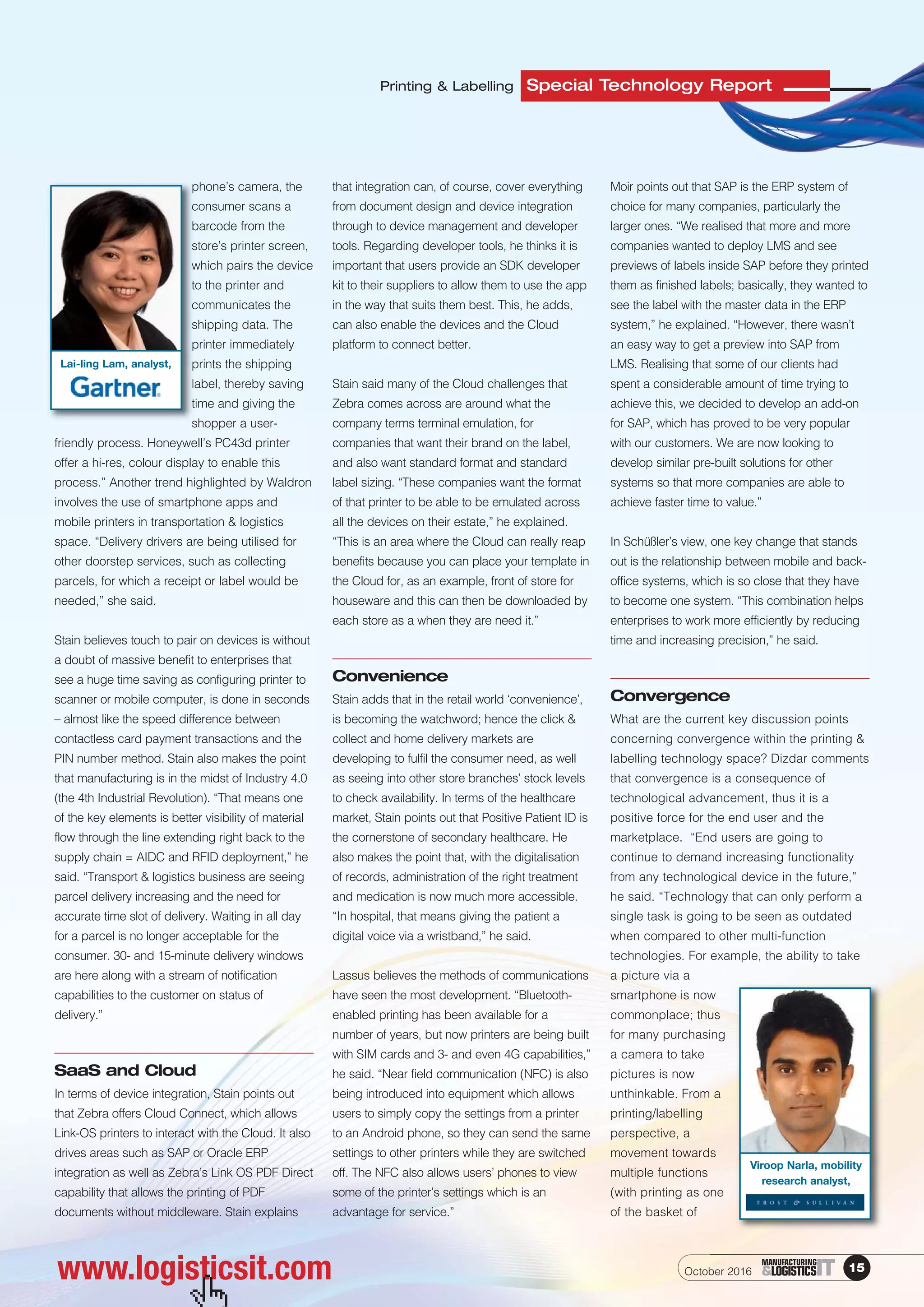
Gartner analyst, Lai-ling Lam, states that
providers can no longer rely on the success
formulae of print hardware and supplies to thrive
in this industry. Printing cost, being one of the
nonpriority expenses, was high on the cost-
cutting lists of most organisations. To control
printing costs, Lam points out that organisations
have embarked on projects to optimise their
printing fleets, reduce hardware purchases, and
control excessive printing and supplies usage.
As a result, print volume has shrunk, followed by
lower consumables sales. Total end-user
spending on printers, copiers and multifunction
products (MFPs) has declined for the past five
years. In 2015, total end-user spending on
printers, copiers and MFPs declined 6.2% while
consumables spending for enterprises shrank
13%, and the outlook for the next five years is not
expected to improve despite having small
pockets of growth, such as production printing.
Lam comments that adoption of print
management tools to track and monitor printing
patterns also helps
organisations to
manage printing
activities. “As
electronic business
and communication
processes gradually
replace paper,
organisations are
reducing costs by
moving pages from
printed to digital form
and printing only
when and where they
truly need physical documents,” she said.
Print providers, in turn, evaluate, transform and
adapt to a maturing technology market and
businesses' impending challenges, commented
Lam. “The need for organisations to manage
printing costs and move content freely back and
forth from physical to digital is creating
opportunities for providers,” she said. “The need
to better manage printing costs in organisations
led to the growth in managed print services
(MPS) over the years. As organisations seek to
digitise their work processes and manage their
workflow more efficiently and effectively, print
providers are investing in expanding their range
of solutions, such as data capture and retrieval
solutions, document management services and
managed content services (MCS), that help
companies to this end. Investment in high-
volume digital printing technology is increasing
as print service providers gradually shift from
offset to digital printing.”
Lam added that the growing trend toward Cloud
delivery, digital transformation and global
adoption of mobile devices leads to revenue
opportunities for print management solutions and
a possibility for managed IT services that extend
beyond printing.
Printable electronics and
the packaging industry
Mike Hopkins, project manager, CDi Yorkshire (a
special interest group of the BPIF), explains that
the increase in the use of smartphones and the
incorporation of printed electronic solutions and
printed logic into consumer products is creating
a global billion-dollar industry. “In 2013, over 967
Special Technology ReportPrinting & Labelling
www.logisticsit.com
www.logisticsit.com
Special Technology Report Printing & Labelling
million smartphones
were sold to
consumers worldwide
and it is projected that
by 2019 sales of
smartphones will
reach over 2 billion,”
he said. “The
capabilities of
smartphones and the
way in which we use
them has changed
since the first
smartphones came onto the market in the late
1990s. Today’s smartphones include touch-
screens, high-speed internet access and NFC
(near field communications) which has altered
the way we interact with people, and objects,
conduct business and make purchases.”
As the market opportunities and demand to
incorporate NFC into smart products grows,
Hopkins points out that so does the demand to
produce high-volume printed electronic
components at low cost. “This is essential to
extend the reach of electronic intelligence into
everyday objects, where conventional silicon-
based electronics is unsuitable,” he said.
The BPIF is involved with project SCOPE, the aim
of which is to develop new processes,
equipment and applications – in essence
building a UK supply chain – in order to meet the
growing demand for high volume (billions or
even trillions) units incorporating various
components, at low cost. It will also provide a
technology platform to develop new, innovative
and ultimately more complex and novel
functionalities and applications, build skills and
capabilities and strengthen the UK supply-chain.
Initial concepts have been carried out to develop
low-cost, high volume, printed logic for
integration into labels, for smart packaging and
product branding on fast moving consumable
goods for the end user. Initially prototypes were
produced using a combination of conventional
and printed electronics, including Labels
incorporating LEDs, used for promotional
purposes by one of the UK’s major fast moving
consumer goods manufacturers. While the
prototypes demonstrated the potential for printed
electronics, the concepts have been
predominantly manufactured with conventional
electronic components. The project is continuing
to work to overcome the challenges of creating a
hybrid label which will be manufactured with
both conventional and printed electronics that is
able to survive the rigorous application process
and post labelling electronic quality control.
Hopkins explains that the printing of electronic
functionality will enable designers to embed
technology into their designs, creating innovative
components that are smarter, lightweight and
wireless without the need for expensive and rigid
silicon chips. “Typically, the technology has been
embedded into RFID (radio frequency
identification device) tags used for tagging and
tracking purposes,” he said. “These electronic
tags (circuits) contain data which can then be
transmitted back to an antenna using radio
frequency signals. But NFC is an emerging
technology which goes one step further. An NFC
chip, which is embedded into a device, operates
as one part of a wireless link. Once it is activated
by another chip, data can then be gathered and
transferred between the two devices when held
a few centimetres apart.”
Hopkins adds that printable electronics is
moving from niche applications into more
lucrative mainstream applications. One such
application area is packaging and labelling. “As
the unit price for a printed electronic system falls,
smart packaging is set to become a reality and
may even evolve into what futurists are heralding
as an ‘Internet of Packaging’,” he said. Hopkins
observes that brands, packaging companies
and retailers are all keen to embrace this
technology for applications such as:
• Anti-counterfeiting/brand protection.
• Consumer management.
• Logistics track and trace.
• Monitoring a pack’s contents.
“All of these functions can be framed within
the umbrella term ‘smart packaging’ as a set
of technologies that allow packaging to
contain, evaluate and transmit relevant
information,” he said.
Back-office relationship
In terms of the relationship between some state-
of-the-art Printing and Labelling systems, what
do you feel have been some of the key recent
changes? Nitu believes this ties into the growing
trend for seamless integration. “Businesses are
looking for one solution to help them increase
business efficiency and cost savings,” she said.
“Our customers don't care if it's different
companies providing these services, so long as
they work together as one solution which is why
simple integration is key.” Nitu adds that due to
the flexibility that technology has offered
businesses, customers are also now demanding
bespoke end-to-end solutions that serve their
specific needs. “No one business and their
requirements is identical, so it's important ICT
services providers spend time understanding the
company and ensuring its mobile print or
labelling solution is going to achieve optimum
results,” she said.
Dizdar considers one revolutionary change to be
the increasing incidence of data that originates
outside of the ‘system’ (ERP/CRM/WMS, etc.)
and ends up being printed via a label or other
‘hard copy’ means. “Data collection is no longer
restricted to the four walls of a facility,” he said.
“Instead, information can be obtained via any
number of devices – whether a personal phone,
an anchored RFID reader, or a camera attached
to a traffic light. These different collection
mechanisms are driving consistency and
openness with the ERP/CRM/WMS vendors in
order to allow their customers ease of integration
and use.”
Waldron considers that, increasingly, users are
wanting to print their own shipping label directly
from their smartphones to reduce cost and
increase speed. “It is important for printers to
integrate with smartphones – supporting the
major mobile
operating systems –
in order to seamlessly
connect the devices,”
she said. “For
example, a consumer
needs to ship a
parcel. He or she
books the shipment
with a smartphone
app and takes the
parcel to a store to
ship. Using the
October 201614 ITMANUFACTURING
&LOGISTICS
www.logisticsit.com
Special Technology ReportPrinting & Labelling
phone’s camera, the
consumer scans a
barcode from the
store’s printer screen,
which pairs the device
to the printer and
communicates the
shipping data. The
printer immediately
prints the shipping
label, thereby saving
time and giving the
shopper a user-
friendly process. Honeywell’s PC43d printer
offer a hi-res, colour display to enable this
process.” Another trend highlighted by Waldron
involves the use of smartphone apps and
mobile printers in transportation & logistics
space. “Delivery drivers are being utilised for
other doorstep services, such as collecting
parcels, for which a receipt or label would be
needed,” she said.
Stain believes touch to pair on devices is without
a doubt of massive benefit to enterprises that
see a huge time saving as configuring printer to
scanner or mobile computer, is done in seconds
– almost like the speed difference between
contactless card payment transactions and the
PIN number method. Stain also makes the point
that manufacturing is in the midst of Industry 4.0
(the 4th Industrial Revolution). “That means one
of the key elements is better visibility of material
flow through the line extending right back to the
supply chain = AIDC and RFID deployment,” he
said. “Transport & logistics business are seeing
parcel delivery increasing and the need for
accurate time slot of delivery. Waiting in all day
for a parcel is no longer acceptable for the
consumer. 30- and 15-minute delivery windows
are here along with a stream of notification
capabilities to the customer on status of
delivery.”
SaaS and Cloud
In terms of device integration, Stain points out
that Zebra offers Cloud Connect, which allows
Link-OS printers to interact with the Cloud. It also
drives areas such as SAP or Oracle ERP
integration as well as Zebra’s Link OS PDF Direct
capability that allows the printing of PDF
documents without middleware. Stain explains
that integration can, of course, cover everything
from document design and device integration
through to device management and developer
tools. Regarding developer tools, he thinks it is
important that users provide an SDK developer
kit to their suppliers to allow them to use the app
in the way that suits them best. This, he adds,
can also enable the devices and the Cloud
platform to connect better.
Stain said many of the Cloud challenges that
Zebra comes across are around what the
company terms terminal emulation, for
companies that want their brand on the label,
and also want standard format and standard
label sizing. “These companies want the format
of that printer to be able to be emulated across
all the devices on their estate,” he explained.
“This is an area where the Cloud can really reap
benefits because you can place your template in
the Cloud for, as an example, front of store for
houseware and this can then be downloaded by
each store as a when they are need it.”
Convenience
Stain adds that in the retail world ‘convenience’,
is becoming the watchword; hence the click &
collect and home delivery markets are
developing to fulfil the consumer need, as well
as seeing into other store branches’ stock levels
to check availability. In terms of the healthcare
market, Stain points out that Positive Patient ID is
the cornerstone of secondary healthcare. He
also makes the point that, with the digitalisation
of records, administration of the right treatment
and medication is now much more accessible.
“In hospital, that means giving the patient a
digital voice via a wristband,” he said.
Lassus believes the methods of communications
have seen the most development. “Bluetooth-
enabled printing has been available for a
number of years, but now printers are being built
with SIM cards and 3- and even 4G capabilities,”
he said. “Near field communication (NFC) is also
being introduced into equipment which allows
users to simply copy the settings from a printer
to an Android phone, so they can send the same
settings to other printers while they are switched
off. The NFC also allows users’ phones to view
some of the printer’s settings which is an
advantage for service.”
Moir points out that SAP is the ERP system of
choice for many companies, particularly the
larger ones. “We realised that more and more
companies wanted to deploy LMS and see
previews of labels inside SAP before they printed
them as finished labels; basically, they wanted to
see the label with the master data in the ERP
system,” he explained. “However, there wasn’t
an easy way to get a preview into SAP from
LMS. Realising that some of our clients had
spent a considerable amount of time trying to
achieve this, we decided to develop an add-on
for SAP, which has proved to be very popular
with our customers. We are now looking to
develop similar pre-built solutions for other
systems so that more companies are able to
achieve faster time to value.”
In Schüßler’s view, one key change that stands
out is the relationship between mobile and back-
office systems, which is so close that they have
to become one system. “This combination helps
enterprises to work more efficiently by reducing
time and increasing precision,” he said.
Convergence
What are the current key discussion points
concerning convergence within the printing &
labelling technology space? Dizdar comments
that convergence is a consequence of
technological advancement, thus it is a
positive force for the end user and the
marketplace. “End users are going to
continue to demand increasing functionality
from any technological device in the future,”
he said. “Technology that can only perform a
single task is going to be seen as outdated
when compared to other multi-function
technologies. For example, the ability to take
a picture via a
smartphone is now
commonplace; thus
for many purchasing
a camera to take
pictures is now
unthinkable. From a
printing/labelling
perspective, a
movement towards
multiple functions
(with printing as one
of the basket of
October 2016 15ITMANUFACTURING
&LOGISTICS
Special Technology Report Printing & Labelling
functions) for a device will be seen as
commonplace and necessary at a minimum.”
Moir believes there will be an increasing level of
convergence in terms of, for example, labelling
and direct marking solutions. A good case in
point is the dairy company he referenced earlier,
which has adopted a NiceLabel LMS solution
that satisfies both its labelling and marking
requirements. Moir is also seeing convergence in
the ability to access label master data from ERP
and MES on mobile devices such as
smartphones and tablets; as well as on desktop
PCs. “Again, the requirement for greater
standardisation and centralisation is driving
conversion,” he said. “We also see that more
and more companies want to reduce IT
complexity because this also helps to reduce
costs and unplanned downtime, as well as save
time and increase agility.”
Schüßler sees the convergence trend as very
positive. “The acceptance is much higher and it
offers the chance to choose best of breed
solutions,” he said. “Besides that, IT isn’t any
longer a secret or bad things. Most people fully
understand that it is making their work life and
private life much easier.” Lassus also believes
the convergence of technology is a good thing
for manufacturers. “With printers using the same
common languages to communicate, installation
and operation will become much easier, so users
can ensure their workplace runs more efficiently,”
he remarked.
In general, Waldron considers technology
convergence to be a positive trend. “Today,
businesses face constant pressure to do more
with less,” she said. “More often, enterprises are
looking at Smart Printing, in which the printer
runs apps and
doesn’t require a
computer, to support
convergence. This
can help reduce
costs as a company
does not need to
invest in additional
computers to support
their printers. Smart
Printing also leads to
decreased energy
consumption, a
smaller environmental footprint and efficient use
of valuable space. We also see this in the field
for connecting mobile workers and enhancing
productivity. Logistics and direct-store-delivery
firms are implementing PrintPads which combine
a mobile computer and a printer, vehicle-mount
printers and wearable printers.”
Stain explains that Zebra is putting labels on hot
ingots of steel for Tata Steel. “If you have this
type of convergence capability regarding
adhesives and labelling within the business it
starts to open up many more avenues of
application,” he said. “I think part of the
challenge for many print companies is they don’t
have a print supply business, whereas Zebra
does. In terms of marking, from etching through
to direct part marking, our scanners can read
both.” Stain added that tap to pair is another
convergence where NFC enables printer and
scanner to be paired swiftly.
Stain considers that technology will continue to
advance, but believes we need to remember
that many enterprises want scalability. “So even
though sensing technology could be seen as a
threat to the printed barcode, having a portfolio
that embraces both positions the supplier in a
more strategic light with customers as it gives
them choices as to which technology to deploy
based on use case and density of visibility
needed.”
The future
What might be the next key
innovations/developments to look out for over
the next year or two within the printing &
labelling technology space? Dizdar
anticipates continued development of the
ability for a printed document or label to give
‘real-time’ information in a proactive instead
of a reactive manner. “Instead of a label
‘waiting’ to be accessed by a user, the label
will utilise rules and data to determine when
to inform due to changes in the entity that is
labelled,” he said. Another development,
states Dizdar, is to continue to allow for a
user outside of a closed system to access
data via a label or printed document. “This
will allow organisations to market better
transparency between themselves and the
end customer due to the end user’s ability to
access data via
labels or printed
material,” he
explained.
Schüßler reflects that
labelling & printing
are commodity
solutions nowadays.
“They might be
enhanced in a way
that they are APP like
and web-based
systems, so for the
next year or two I think usability might be the
main focus,” he said. Waldron believes linerless
media presents interesting, environmentally
friendly opportunities in printing and labelling in
industrial applications. “When printing linerless
labels, backing paper, which may end up in
land-fill, is eliminated,” she explained. “In
addition, there is no risk of workers slipping or
tripping over any backing paper hanging off a
printer in linerless printing.”
Waldron added that the future of the printing &
labelling marketplace will be dynamic as
companies look for ways to reduce costs and
increase productivity. “Consumers and retailers
are increasingly moving away from printed
receipts and instead receiving their confirmations
and invoices by email,” she said. “Printer
manufacturers need to continue to find new ways
to deliver solutions that still provide Return on
Investment where demand is reduced.”
Stain believes we will see the 2D barcode get
a lot smaller; to micro label size. “This can be
very valuable from a security and authenticity
(fake product) standpoint, for example,” he
said. “Zebra has already supplied micro
labelling to a number of electronic
manufacturing businesses. This means the
companies are able to identify small parts very
easily and readily using 2D barcodes with scan
capabilities on the other machines. Therefore, I
believe marking, and certainly 2D printing, will
increasingly become not just about ID; we will
also start to see more security features too.”
Stain also maintains that interoperability
between devices will grow, and that will yield
unprecedented ease of use, configuration and
manageability. Also, he believes the ability to
www.logisticsit.comOctober 201616 ITMANUFACTURING
&LOGISTICS
embed identity into a small form factor will help
lead to an age of total transparency.
Hopkins observes that developments in smart
and connected electronics applications are
opening up significant new market opportunities
in areas such as e-health, intelligent packaging
and wearable technology (IoT technology).
Hopkins reminds us that the Internet of Things
describes a world in which every day physical
objects or ‘things’ are embedded with
electronics, sensors and connectivity which
enable them to exchange data with the
manufacturer, operator and/or other connected
devices.
He adds that, although embedded computers
have been able to communicate wirelessly for
years, the majority of these have been closed
systems that are only able to communicate with
a central computer. “With the Internet of Things,
devices are able to communicate with other
devices,” he points out. “They have the ability to
communicate through wireless technologies
(such as RFID and NFC), are able to report on
activities worldwide through sensors, and they
can be controlled or accessed from anywhere in
the world. The Cloud provides the power to
store and exchange information, irrespective of
location.” Hopkins explains that we are able to:
• Connect to things simply by scanning them
with our smartphone.
• Monitor things remotely.
• Manage things better, from traffic flows to
use of energy within the home.
• Control things, such as smart thermostats.
Project SCOPE
Project SCOPE, in which the BPIF’s role is to
connect the technology and technology
providers to the packaging industry, began in
late 2014 and will conclude in the middle of next
year. Towards the end of the project the BPIF will
devise awareness and training programmes to
inform the industry of the new opportunities that
the technology will open up. Hopkins points out
that of particular importance will be the
brainstorming with the technology experts to
understand the potential applications of the
technology both now and in the future and how
the label industry in particular can integrate into
their production runs.
Narla considers that the future price of 3D
printing is expected to stagnate if speed,
machinery technical capabilities, software usage,
and material specifications do not change
significantly; conventional manufacturing
techniques are still expected to dominate.
He added that the cost of difference between
conventional manufacturing and 3D printing is
expected to shrink to only 11% by 2030 based
on close parity to raw material prices. A
summary of some of the key future indicators
regarding 3D printing from Frost & Sullivan’s
perspective is as follows:
• Large-scale commercialisation of 3D printing
is expected to bring about faster and
localised production, but only by achieving
economies of scale.
• Current high cost of materials and
machinery, and low printing speeds, prohibit
large-scale manufacturing.
• Only very-low-volume production can be
undertaken when tooling investment is
necessary.
• Prices decline exponentially as quantities
increase since cost is spread over
quantities.
• In the future, low prices for materials and
machinery are expected to lower production
costs.
• Printing time and material availability
challenges still expected to prohibit wide
adoption and stagnate prices.
Lassus believes the next generation of printers
will have look and feel of tablets and
smartphones, becoming PCs that print, rather
than simply printers. “Users will come to expect
a similar user experience throughout their
industrial applications as they find in their typical
day-to-day personal lives,” he said.
Lam comments that weak demand for print
hardware and consumables will remain the main
challenges for print vendors as demand for
printed pages stagnates or declines, and
content moves from paper to digital. She adds
that consumables spending will fall at a faster
pace than hardware spending within the forecast
period. Lam also maintains that print services
and solutions will become growth drivers that
place print vendors in front of enterprises;
however, their revenue
contribution would
remain a small part of
the overall print
industry. Lam adds that
total enterprise print
spending will still shrink
throughout the forecast
period. However, “the
shift to Cloud,
increased workforce
mobility and digital
business transformation are opening up
opportunities for print providers to sell related
MCS solutions”, she said.
Shanler comments that while there are myriad
options for 3D printing of concept ‘non-
functional’ prototypes to assist with iterative
design and feedback, users could consider
driving 3DP for creation of ‘functional
prototypes’. “This could mean leveraging more
advanced 3DP technologies, such as powder
bed fusion and directed energy deposition, that
may deliver more exotic materials than
traditional acrylonitrile, butadiene and styrene
(acrylonitrile butadiene styrene) plastics,” he
said. Shanler added that using 3DP for
prototyping can assist with reducing new
product development schedules via faster,
frequent and more insightful feedback when in
the concept/ideation, research, development
and beta-testing phases.
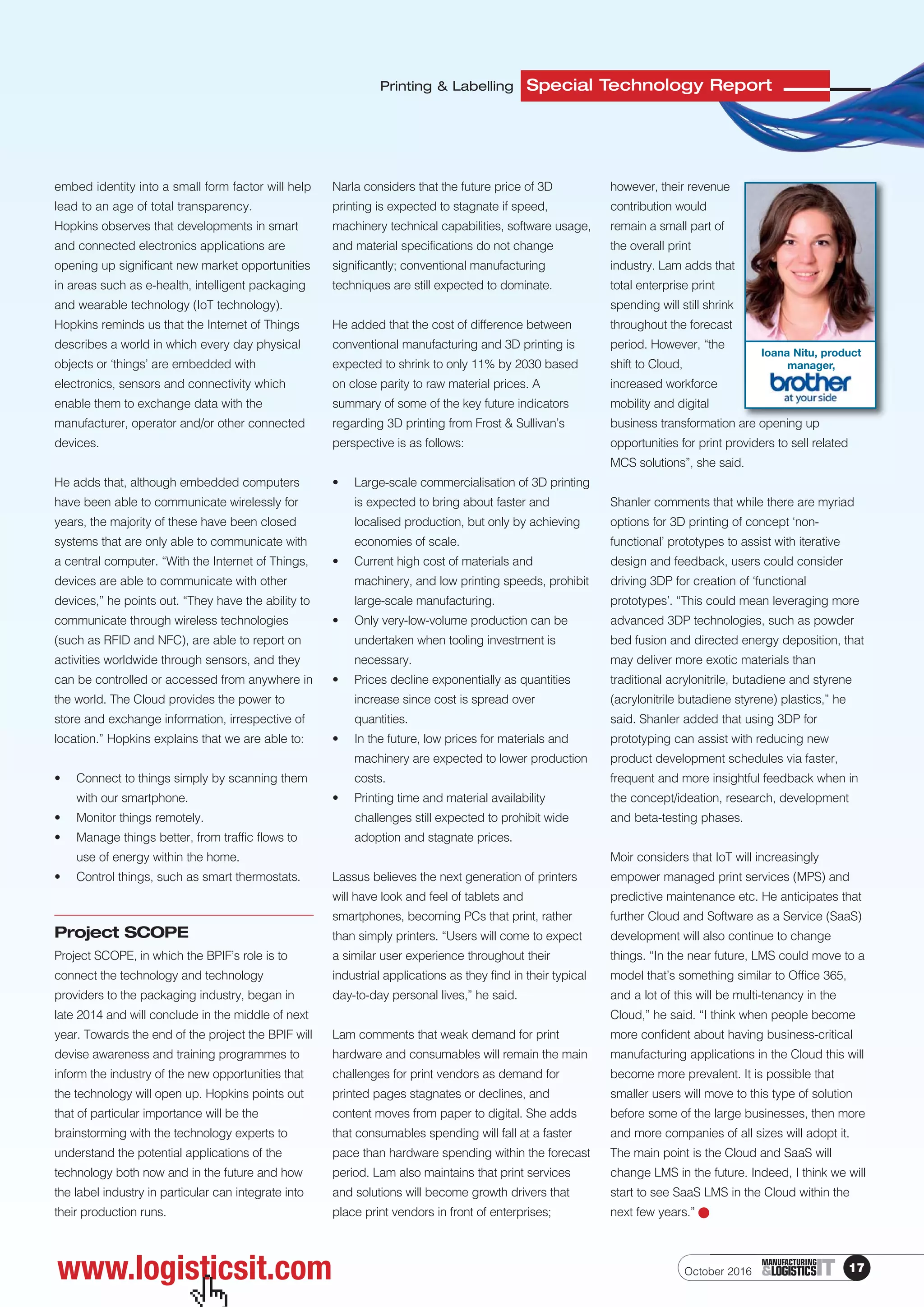
Moir considers that IoT will increasingly
empower managed print services (MPS) and
predictive maintenance etc. He anticipates that
further Cloud and Software as a Service (SaaS)
development will also continue to change
things. “In the near future, LMS could move to a
model that’s something similar to Office 365,
and a lot of this will be multi-tenancy in the
Cloud,” he said. “I think when people become
more confident about having business-critical
manufacturing applications in the Cloud this will
become more prevalent. It is possible that
smaller users will move to this type of solution
before some of the large businesses, then more
and more companies of all sizes will adopt it.
The main point is the Cloud and SaaS will
change LMS in the future. Indeed, I think we will
start to see SaaS LMS in the Cloud within the
next few years.”
Special Technology ReportPrinting & Labelling
October 2016 17ITMANUFACTURING
&LOGISTICSwww.logisticsit.com
October 201618 ITMANUFACTURING
&LOGISTICS
Printing & Labelling Opinion
W
ith more than 63,000
companies operating in
the sector, the UK logistics
environment has arguably
never been more
competitive. New small businesses and the
consolidation of larger companies, combined
with increasing fuel prices and the fluctuating
value of sterling, has resulted in significant
pressure on prices and therefore margins.
Indeed, considering the growing
opportunities in emerging markets, the
competitiveness of the sector is only going to
intensify in coming years. It’s therefore
becoming increasingly critical that logistics
firms focus on finding new ways to save time,
increase efficiency for enhanced
performance and deliver greater value to
customers.
In his foreword to the Freight Transport
Association (FTA) Logistics Report 2016, FTA
chief executive David Wells pinpointed
greater technical innovation as a key
opportunity, and one which has the potential
to make UK logistics firms among the best in
the world. This could not be truer, as the
technology is there for the taking.
Essential fixture
Everything from transportation management
systems to unmanned robotics is now a
possibility for the logistics industry, yet it is
often the smaller elements that can have the
biggest impact on operations. Take printers,
for example. They are an essential fixture in
any warehouse for producing documents,
slips and labels that if specified correctly can
streamline processes and boost productivity,
but if not can waste resources, cause
considerable delays and, ultimately, eat into
profits.
This is especially true when it comes to
barcode label printers as poor image
reproduction can result in rejected deliveries
and the associated significant, unnecessary
costs that come from extra transport and
administration fees. In the case of shipping
perishable goods, these costs can be
particularly steep and cause weighty damage
to a supplier’s bottom line and reputation.
Equally, some printers are not designed to
withstand the demanding warehouse
environment and will succumb after only
short operating lives, requiring frequent
replacements and resulting in yet more
unnecessary dents in the budget.
The job calls for rugged devices that can
cope with challenging environments and
consistently produce high quality, fast and
reliable results over high volume workloads if
tangible time and cost savings are to be
realised. In response, market leading printer
manufacturers that understand the
challenges experienced by the logistics
industry have been developing technology
that delivers exactly that to help firms
manage costs, achieve the best possible
return on investment and maximise
profitability.
The latest generation of industrial desktop
printers, such as the CL-S700 from Citizen
Systems, are specifically designed to provide
extreme efficiency over long operating lives in
busy warehouses. These robust yet compact
machines offer high performance printing at
up to 10 inches per second and excellent
quality definition for accurate DataBar, QR-
Code, Datamatrix and PDF417 reproduction.
Gain the competitive
www.logisticsit.com
October 2016 19ITMANUFACTURING
&LOGISTICSwww.logisticsit.com
Printing & LabellingOpinion
They are also ideal for the logistics industry
where space is often at a premium as they
include clever features like vertical opening,
which does not expand the already small
footprints of the units when the lid is opened
for media or ribbon changes.
Another innovation in the printer market that
is delivering huge benefits to logistics
companies is the introduction of mobile
printers. Harnessing the increased
capabilities of mobile devices, these
industrial handheld units are an ideal solution
for quick and easy label and receipt printing.
They have been specially designed for
simple operation and feature USB, Bluetooth
and Wi-Fi connectivity, as well as iOS and
Android compatibility, meaning that they can
be operated using a standard mobile
smartphone or tablet with suitable software or
an application.
Unlike some other mobile technologies, these
printers are built to last and withstand tough,
frequent use. Citizen’s CMP-40L, for instance,
is IP54 rated and made with a durable and
shock-resistant moulded plastic housing that
means it can survive being dropped from up
to 1.8 metres and keep on running. These
models also provide exceptionally long
battery life and ample media capacity for
reliable operation over long periods of time
without having to be charged or the media
being changed.
Reduced risk of errors
As well as providing a high quality print
output, convenient mobile printers can help
logistics firms to achieve substantial time
savings and increased productivity by
eliminating the need for unnecessary trips
backwards and forwards between a point in
a warehouse and an office, where a static
printer might otherwise have been located.
Similarly, this instant, on-the-spot printing in
situ reduces the risk of errors. The units are
also extremely quick and easy to set up and
configure and require minimum maintenance
for uninterrupted label and receipt
production. Consequently, the time saved
can be spent elsewhere on other areas of the
business that perhaps require more attention
for better operational efficiency.
Although the competitiveness of the sector
might be daunting, there are routes that
individual businesses can take and options
that can be explored for enhancing
operations and delivering greater value.
Giving due attention to the smaller details –
even down to the label and receipt printers in
a warehouse – can create significant
improvements in efficiency, productivity and
profitability that give logistics firms the
competitive edge.
www.citizen-systems.com
Citizen CL-E720
If you‘re searching for a
printing solution that can
help you to achieve efficiency
savings, look no further!
The CL-E720 is packed with
features usually reserved for
higher class machines. It is
a highly reliable and cost
effective printer, perfect for
busy environments.
Further key benefits:
• Space saving design
• Hi-Open™ Case
• Easy media loading
• Simple maintenance
operation
High spec,
low budget!
Scan for
more Info.
Label management
F
or many years, label design was
largely something that was
undertaken using a software
package installed on a PC.
However, today’s state-of-the-art
web-based printing and labelling solutions
can allow companies to maximise value for
their own businesses – and their partners –
by providing a single, scalable platform to
manage all their global labelling and marking
management needs. At NiceLabel, we call
this new category of solution LMS (label
management systems). Initially it was mainly
the larger companies that began to deploy
this type of technology. Now, based on the
compelling deliverables enjoyed by these
enterprise-level organisations, we are seeing
an increasing number of smaller companies
taking on board this type of solution – and
across all core vertical sectors.
The silo issue
Within the food & beverage industry, for
example, one of the largest global dairy
companies is standardising on a NiceLabel
LMS. Previously, they relied on a number of
different label printers, and continuous inkjet
printers (CIJ) at dairies around the world.
Each dairy would undertake its own type of
integration with the Manufacturing Execution
System (MES). There were also a number of
local IT companies providing integration
support for connecting the printers to the
MES. This resulted in escalating IT costs or
sometimes even unplanned downtime.
Some production lines had no integration
and the printers where operated standalone
with manual data entry. If a user typed in the
wrong best-before date, the item would ship
to, say, a large supermarket chain and it
would be rejected, and would be scrapped
because it was perishable.
Lost sales can naturally have a serious
effect on a company’s profitability. Even if
this amounts to just 1% of a company’s
turnover this could equate to millions of
Pounds. So the cost of LMS software is
completely irrelevant by comparison.
Therefore, the company decided to move
away from relying on many different printing
and labelling systems throughout their
dairies globally and standardise on one LMS
for all its labelling and marking
requirements. It initially approached some of
its existing providers of labelling and
marking solutions to come up with a
standardised solution, but this proved not to
be forthcoming, largely due to different
providers only being able to support their
own printing equipment.
Standardised integration
The remedy was for NiceLabel to share the
dairy company’s vision and develop
standardised drivers not just for its
labelling requirements but also for its direct
marking needs. This allowed the company
to benefit from having a single unified
solution with standardised integration with
the MES at each dairy to automate the
printing process. The company can now
provide all its dairies with this pre-built
integration. Also, because it’s a single
solution – rather than various different
methods of integration – the company can
provide its own centralised global 24/7
support. This results in significant
reductions in IT costs as well as a more
consistent, centralised means of support,
which results in less unplanned downtime,
which helps to secure a fast return on
investment (ROI). However, the really big
numbers are to be found in less rejected
product due to more accurate data entry.
Selling more
Another NiceLabel client within the food &
beverage sector is a Belgian bakery company
that sells freshly prepared sandwiches in its
stores. Because people need to queue to buy
their fresh sandwiches during busy periods,
the company wanted to find a way to sell
sandwiches pre-packed. However, when
sandwiches are pre-packed a label must be
put on the package in order to comply with
allergens and nutrition regulations. With
NiceLabel’s centralised web printing solution
managed at the company’s HQ, staff at all its
stores can now simply log in, access the
solution and print the labels out on-site. This
queue-busting advantage means the
company now sells more sandwiches.
Extended supply chain
Greater control and collaboration within the
extended supply chain is now more
important than ever. Take the retail sector,
October 201620 ITMANUFACTURING
&LOGISTICS www.logisticsit.com
Printing & Labelling Opinion
www.logisticsit.com
for example. NiceLabel works with a number of retailers on
supplier labelling. In the case of a leading luxury goods retailer,
our LMS was initially deployed within a number of regional
warehouses, then to several manufacturing sites and has now
just been rolled out across the business. The next stage of
development for the retailer is to deploy the solution within its
branded shops so that labels and tags can be reprinted in store
so products don’t have to be sent back to the warehouse, which
could result in lost sales opportunities.
Brand protection
Also, from a brand consistency and brand protection
perspective, the retailer is now able to control suppliers’
labelling activity and to be able to stop production overruns by
building-in anti-counterfeiting RFID methodology that can be
controlled via the web.
[subhead] Quality or regulatory compliance
Any company that relies on a quality management system to
remain ISO 9001 compliant should consider LMS as it provides
similar quality controls and procedures for the entire labelling
process. Highly regulated industries such as life sciences
(medical device manufacturers and pharmaceutical) require a
centralised, standardised labelling solution and it is critical in
order for these companies to remain compliant.
Regulatory requirements are very similar in both the medical
device and pharmaceutical sectors. In the US, for example, both
are regulated to 21 CFR Part 11, part of the Code of Federal
Regulations that establishes the US Food and Drug
Administration (FDA) regulations on electronic records and
electronic signatures (ERES). One of NiceLabel’s clients in this
area is pharmaceutical manufacturing company Krka, which
delivers medications to more than 70 countries worldwide. The
company has centralised and standardised its labelling
operations with NiceLabel’s LMS. The solution has improved
Krka’s master data management, streamlined compliance and
provided a next-generation system to support future growth.
Complete system
Labelling systems have moved away from being a ‘box’ to
becoming a complete business system offering greater agility
and empowering business users to streamline the whole
labelling process. It’s about not relying so much on IT; for
example, for making label change requests. We see this need
across all industries and among all sizes of company.
Companies want universal intelligent labels and the ability to
consolidate label variations. They also want to mitigate risk and
optimise processes by being able to seamlessly integrate with
the ERP’s or MES’s master data. NiceLabel is dedicated to
helping businesses to modernise and achieve significant
financial and productivity gains from their labelling process. We
call this ‘print productivity’.
Streamline your labeling
More than a million
companies use NiceLabel
technology to reduce
the complexity of
barcode labeling.
www.nicelabel.com
Find the solution that best meets your needs
Start producing professional labels without IT help.
Streamline label printing to control labour costs
and eliminate errors.
Standardize your entire labeling process to meet
quality requirements.
Mobile printers
B
usinesses are faced with more
and more complex supply
chain requirements, including
shorter delivery times, the
need for greater accuracy and
pressure to reduce costs. Companies need
to optimise their processes to prevent
disruptions that can lead to supply
shortages, financial losses and damage to
a company’s reputation.
One of the unsung productivity tools in the
supply chain is the mobile printer, which is
used for packaging and labeling of goods,
spare parts and shelves. Virtually every
product needs a label: during storage,
repackaging for short-term storage and
eventually shipment. These processes
involve a high potential for error if
distribution centre or manufacturing staff
have to pick up labels from a stationary
printer. To avoid duplication of work, they
may print the labels in groups and fix it to
the corresponding package. In this
method, they risk applying a label
incorrectly, which leads to delays in
processing or an error in the delivery.
Mobile printers can solve these challenges
and enhance operations in industrial and
warehouse environments considerably. By
attaching printers to vehicles such as
forklifts, they save valuable time and
reduce errors. Labels and receipts are
printed immediately and directly attached.
These mobile receipt and label printers
must meet high demands because the floor
of the manufacturing or distribution centre
– or on the loading dock – presents a
number of challenges such as confined
spaces and harsh environments. The
following tips and recommendations will
help operations managers select a mobile
printer that meets their needs.
Durable design
Fork trucks present a challenging work
environment for printers. The devices are
exposed to harsh conditions for long
periods of time. Printers must be able to
handle shock, vibration, high and low
temperatures and humidity throughout the
day. For these rigorous industrial
environments, the successful rugged
printers are the ones that are constructed
on a solid cast metal frame and protected
with metal die-cast covers.
Print in confined spaces
On the manufacturing or distribution centre
floor, space is incredibly valuable and the
smaller the printer, the less space it
occupies. Compact printers must have the
flexibility to be installed in a variety of
configurations on-site using additional
brackets and mounting plates. In addition
to the normal standing position, printers
may be installed vertically, on the wall or
even upside down.
Easy access to electrical power is
important. During space planning, owners
should consider placing a charging station
in a central location to avoid work
interruptions. With a voltage converter, a
mobile printer can be connected to the fork
truck’s battery. To avoid damage in this
configuration, mobile printers should offer
power spike and vibration detection.
Small but powerful
Users should also make sure that the
device is easy to use and powerful
enough to meet their needs. For example,
the new model of Honeywell’s MP
October 201622 ITMANUFACTURING
&LOGISTICS www.logisticsit.com
Printing & Labelling Opinion
October 2016 23ITMANUFACTURING
&LOGISTICSwww.logisticsit.com
Printing & LabellingOpinion
Compact printer weighs less than eight
pounds, making it easy to mount on
tables, walls or a mobile cart or forklift
truck. It supports higher media capacity to
reduce the frequency of reloading media
during a single shift, ultimately helping to
boost productivity. The Honeywell MP
Compact printers support large label rolls,
which are typically less expensive to
produce and thus cheaper to buy.
Ease of use
A user-friendly design is significant when
choosing a new printer. To prevent loss of
time when changing media, it is important
that the printer can be easily operated by
workers wearing leather or rubber gloves.
Look for a printer that allows fast reloading
by using a paper feeding form or a slot on
the side of the device. Ideally, rolls can be
changed without an employee having to
open any doors or removing covers. Parts
should be interchangeable and not require
special tools to replace. Finally, printers
should support quick and easy integration
into existing IT infrastructures.
Long-term thinking
When selecting printers, buyers prioritise
which devices offer the lowest possible
total cost of ownership, which includes
factoring in costs for service, repair and
spare parts. In some extreme cases,
certain printers may not have spare parts
readily available. Also important to
consider is having access to maintenance
service and support that is available
around the clock to fix defects quickly.
The following is a checklist that buyers
should consider for choosing the correct
mobile printer:
Printer type
• Compact, mobile printer solutions for
more flexibility in the supply chain.
• High print quality.
• Direct thermal and thermal transfer
printing.
Performance
• Option for processing wide label rolls.
• Larger rolls mean fewer changes and
interruptions of work.
• Connectivity to voltage onboard
industrial trucks.
Ruggedness
• Resistance to extreme temperatures,
moisture, drops, shocks and vibrations.
• Protective housing, such as cast metal.
• Additional brackets for multiple
mounting positions.
Intuitive operation
• Easy operation by workers with leather
or rubber gloves.
• Intuitive label feed.
Quick integration into existing IT
infrastructure
• WLAN (802.11 a / b / g / n) with WPA2
security protocol.
• Connectivity options: USB, serial
connection, Ethernet.
• Compatibility with common software.
Low total cost of ownership
• Availability of products and spare parts.
• Service and support options.
S
eiko Instruments USA Inc. (SII)
Thermal Printer Division, recently
launched a new mobile printer
line, the MP-A40 Series. The
printer offers a 100mm/second
print speed and is said to be able to
withstand multiple drops from up to 6.6 feet.
With up to a 4-inch paper width, and
weighing just a little more than 1.5 pounds,
the MP-A40 Series mobile printers are built
tough – but that doesn't mean they lack in
style or simplicity. With intuitive drop-in
paper loading and easy access button, the
printers offer a smart and robust design
that fits into the palm of your hand, or belt
clip; a small carry-on case offers the option
of over-the-shoulder transport.
Ergonomically designed
The MP-A40 Series mobile printers are
ergonomically designed to be used in
‘front-of-house’ verticals like retail and
hospitality, but also have the ruggedness
and strength for usage in areas such as
direct-store-delivery, warehousing and
logistics, field service, and public utilities.
Other important features of the new mobile
printer line include compatibility with the
latest operating systems, including
Windows 10, as well as SDK availability for
both Android and Windows CE print class
libraries for added mobility. The printer also
offers auto-detection Bluetooth interface
and Wi-Fi capabilities, providing added
value and easy transition from cable to
wireless communications.
"At a time when today's end users are
looking to further mobilize their business
processes, it was only natural that the MP-
A40 mobile printer line was designed with
these trends in mind," said Kaz Onishi, vice
president of Seiko Instruments USA. "In
addition, our partners are realising the
demand from their customers for this
technology, which is something that was at
top of mind during our research and
development process."
October 201624 ITMANUFACTURING
&LOGISTICS
www.logisticsit.com
Printing & Labelling Product News
T
o enhance and accelerate
sustainability commitments to
customers, employees and the
communities in which it operates,
Epson Europe has announced
that Henning Ohlsson, managing director for
Epson Deutschland, will also take on the new
role of Epson corporate social responsibility
(CSR) director for Europe, Middle East and
Russia (EMEAR).
Epson, provider of printing, wearable devices,
robotics and visual communications solutions
– comments that the appointment formalises
the company's long-standing commitment to
sustainability in Europe, building on a global
CSR track record that stretches back eight
decades to actions taken in the 1940s.
Epson's forward-thinking on the environment
is contained in its Environmental Vision 2050,
established in 2008 as a long-term guide for
environmental action, which includes the goal
of reducing CO2
emission by 90% across the
lifecycle of all of its products and services by
2050.
Sustainability Report
Ohlsson's appointment coincides with the
publication of Epson's Sustainability Report
2016, a new downloadable document
detailing the company's CSR actions in the
development of environmentally responsible
products, initiatives to develop its own
human resources with diverse values and
capabilities, steps taken to enhance
corporate governance and volunteer
programs launched in communities local to
Epson operations.
Rob Clark, senior vice president, Epson
Europe, said: "Bold sustainability actions
are our duty as a leading technology
manufacturer, considering the scale of the
environmental and social challenges that
the world faces. More than ever,
sustainability actions are also a business
imperative, helping us to deliver
differentiated value to our customers, retain
and attract the best talent in the industry,
and enhance the communities in which we
live. Henning's role in leading our CSR
initiatives across Europe is therefore critical
to our long-term success across the
region."
Ohlsson commented: "My role as CSR director
will include amplifying the environmental
benefits of our product range, ensuring our
regulatory compliance, and raising employee
awareness and engagement in local and
regional CSR initiatives. I'm proud to lead this
effort and to work for a company that takes its
environmental responsibilities so seriously."
Printing & Labelling Company News
Epson Europe appoints
Seiko Instruments
bmE
iltS
eofftnmeiod
ihtEd
ycneicfief
dtittdeneouyngihtyrevE:dneilmaertS
.t’donouyngihtno
p airt? Sdenilmaerto se do ww dHo
n, affu, flhsae flhl tld aniehe bvaeL
eeu nog ynihtyrevs ed ienilmaertS
wrofthgiarts s’t. It’nou dog ynihton
ft onemidobme ehl – tacimonoce
,donetitgeotde
.snoitcartsie dhy tawa
.hsiruod fln
,boe jho to dd te
,desuco, fdraw
nehd wn. Aycneicfief
trag pnilebae lhg tnikas mnaet mi
24Cw Pee nhs t’t: Idnamen dd ona
. Awell International© 2016 Honey
ormation, please visitor more infF
producaidc.com/well.honeywww
,ysa, etsab for juof yt o
.retnip Protkset D2
ved.All rights reser
topdeskprinters/cts/
Application-enabled printing
I
n the age of the Smart Phone, almost
everyone is familiar with ‘apps’- or
applications - in mainstream technology,
which allow users to take a standard
piece of equipment and adapt it with
software to easily configure a device that is
perfectly suited to the individual’s use.
Perhaps what is less well known or
considered however, are the huge benefits
that this technology holds for the business
world.
It should come as no surprise that the leading
printer manufacturers are now incorporating
this ability for end-users to customise their
product, giving the concept of customer
satisfaction a whole new meaning by helping
businesses streamline their printing
processes. In this paper, I will discuss how
Application-Enabled Printing technology is
offering manufacturing and logistics
environments sophisticated and flexible
solutions which are set to revolutionise the
way we do printing.
Businesses are always looking for ways to
work better and more efficiently, and one area
where major gains are possible – especially in
manufacturing and logistics – is printing. In
particular, the use of new intelligent printing
technologies to make the production of labels
and tags more flexible and cost-effective.
While businesses want label printing solutions
that are tailored to their individual needs and
work processes, too often they are offered a
standard non-intelligent package that either
does far more than they need and is complex
to install and maintain, or one that must be
laboriously built up from a kit of parts. The
result can be multiple labels where one would
suffice, plus wasted staff time and resource.
Smart Printing was one of the first
technologies to address these problems, and
it offered a partial solution. It allowed a printer
to be used stand-alone by making it
programmable and able to operate without
being attached to a PC. However, it had the
drawback that once programmed, the smart
printer became a single-purpose device until
it was taken back and reprogrammed, with all
the potential downtime it might entail. That
might be acceptable in some industries, but
not in more fast-moving areas that we find in
today’s era of e-commerce. To put it briefly, in
the world of manufacturing and logistics, one
size does not fit all.
Enter application-enabled printing (AEP), a
new generation of technology that leaps far
beyond the smart printer in capability. AEP
brings intelligent printing into the 21st century,
helping businesses get a grasp on their
printing processes. An application-enabled
printer not only has its own internal
processing power – so it can connect to other
devices such as weighing scales, a handheld
barcode scanner, or a keyboard, and it can
print without the need to connect to a PC –
but it is designed to be readily
reprogrammable. Unlike smart printers which
can only hold one program at a time, new
applications can be added to an existing
AEP, as you might add multiple apps to an
iPhone or Android smartphone.
For example, in a manufacturing and logistics
environment an app could be downloaded to
automatically calculate and print thaw and
use-by labels – relying on the printer's internal
real-time clock. Another app might use its
internal product and price database to
correctly calculate and clearly print mark-
down labels to clear older stock.
Not only does this mean that you could start
with a printer with one function, then add
others as the needs arise, it also means that
the printer can be customised to include
exactly the right set of applications for a given
purpose. The product more accurately fits the
user's needs, yet at the same time it also
means fewer components in the chain – fewer
devices to look after, fewer interconnections to
manage, and fewer things to go wrong.
It can also mean a simpler package that is
easier to understand. That is because it can
be easier to set up and tailor an AEP app for
a specific purpose than it would be to set up
a large PC-based software suite of which only
a few elements will actually be required. And
because AEP devices can be powered by
batteries, they can operate free of connection
to a PC and do not need a mains lead.
Printing can therefore be located where it is
required such as, on a trolley or a table in the
centre of a warehouse and away from any
power sockets, not where the infrastructure
dictates.
AEP devices are also designed to be user-
friendly. Some of the current models have a
mobile phone-type keyboard which will be
familiar to most users. Both the buttons and
the display screen are designed for ease of
use – the buttons are large and the screen is
wide. Future models could include a
smartphone-type touchscreen, too. Apps can
be downloaded to the AEP unit either using a
October 201626 ITMANUFACTURING
&LOGISTICS www.logisticsit.com
Printing & Labelling Opinion
October 2016 27ITMANUFACTURING
&LOGISTICSwww.logisticsit.com
Printing & LabellingOpinion
PC running a utility program, or loaded
directly as a package containing all the
necessary elements, such as a pricing
database. They can be loaded via a USB
cable, a wireless network (Wi-Fi) connection,
or on a memory card, with some AEP units
accepting the same SD-cards that are widely
used in digital cameras and other devices.
Programmable printing
So-called smart printers are not new, of
course: the ability to set a printer up and
then use it independently of a PC has been
around for many years. What has changed
now with the arrival of application-enabled
printing is the sophistication and flexibility
of those printers, and their ability to grow
with the customers, providing far greater
levels of investment protection.
The ease of programming has also
changed dramatically, mirroring the huge
advances that have taken place in
application development tools in recent
decades. Gone are the days of having to
write code in BASIC, and instead we look
for advanced scripting languages, and
development tools that abstract most of the
heavy lifting involved in creating new
applications. Called AEP Works, these app
development tools include a PC-based
printer simulator, enabling developers to
load new apps and test or demonstrate
them.
It also helps that the AEP is a system with
well-defined functional areas, unlike say an
Android or Apple smartphone which might
be called upon to be a telephone one
minute, a satnav the next, and a
videogame thereafter. Add advanced
programming tools to an AEP therefore,
and you have a system that allows new
applications to be created and deployed –
and subsequently updated – remarkably
easily.
A major benefit of being able to add
applications for the AEP is customisation,
with no need to buy an entire suite of
printing capabilities if you only need certain
specific ones. It allows an AEP to be set up
to exactly meet the user's needs by mixing
and matching from a standard set of apps,
either written by the manufacturer, or
bought in from other programmers,
appstore-style. If further customisation is
needed, existing apps can be modified or
new ones written to suit. AEP apps are also
able to run on multiple platforms, so there
is no need to redevelop apps if you
change or update your printer. Instead, an
app developed for the first generation AEP
units should also run on subsequent AEP-
capable devices, whether they are desktop
printers, mobile printers, or other print-
capable devices.
And of course if the manufacturer is not
sure yet what their needs will be, that does
not matter: they can choose an initial app
or set of apps to load now, then change
that mix or add more apps later on as their
use of the technology grows and as the
need arises. These capabilities are not
entirely free of effort, and some
programming skills are required to modify
AEP programs.
Today's implementation of application-
enabled printing is just the start. The same
concept will be implemented on multiple
classes of printers in the future, including
both mobile and desktop printers ranging
from low-end to high-end. All these devices
will be able to run the same AEP-
developed apps. It is also possible to run
the intelligence behind AEP on a separate
device, such as a smartphone or tablet
computer, and have it print to a mobile
printer, or even a suitably-equipped
desktop printer.
SATO’s NX Series
The NX Series printers features SATO’s AEP
technology, offering users a more flexible and
cost-effective option for the printing of labels
and tags. SATO’s NX Series printers are quick
and easy to install and maintain, all these help
reduce downtime and improve productivity.
For businesses which are often running 24/7,
reducing downtime is key to responding to
customer queries effectively while improving
operational efficiencies. Minimising costs
associated with maintenance can also go a
long way to improving the bottom line.
SATO’s CL4NX/CL6NX are plug-and-play
printers that are easy to set up, without
needing specialists to install them. They can
also can print immediately. Printers that have
been designed for parts to be replaced by
the users, without having to call in technicians
are also preferable. They are designed to
allow for fast parts replacements. ‘Wear parts’
such as print head and platen roller are quick
to replace with no tools needed, while help
videos are also available in the front display,
to aid with maintenance.
The SATO NX display reads in up to 31 global
languages and are intuitive and simple to
operate, reducing the time spent on staff
training. In addition, SATO’s NX family is
equipped with 100MB user accessible
memory allowing formats, large graphics and
custom fonts while delivering best-in-class
speed processing and fast throughput, which
is also essential when it comes to fulfilling
orders as fast as possible.
AUTOMATIC DATA CAPTURE
MOBILE COMPUTING
28 ITMANUFACTURING
&LOGISTICS October 2016 www.logisticsit.com
A
s manufacturing and logistics
businesses strive for products
that deliver on their promise
together with flawless fulfilment,
realising these can be
challenging. Today’s customer invariably not
only wants more product customisation as
standard but also transparency of when the
product or merchandise is available.
Relationships and revenue streams are built
around the ability of suppliers to deliver on
their promise of when components will be
delivered to a manufacturer and onwards from
the manufacturer to its promise of when it will
deliver finished product to a customer.
The use of technology in these environments is
critical, and whilst investment can be seen as a
barrier it is something that must be overcome if
companies are to survive and grow.
Enterprise Asset Intelligence and
how it helps
At Zebra, we have looked at the challenges
you face, and come up with a solution in the
form of Enterprise Asset Intelligence, a full
cycle of visibility for the manufacturing sector.
Enterprise Asset Intelligence is about
delivering visibility solutions to help
manufacturers both improve productivity and
deliver better experiences for their customers
through sensing, analysing, and driving
business actions. Using tools and technologies
that give you real-time operational visibility into
people and things, you get a full sense of what
is happening in your enterprise, helping you to
simplify and improve operations.
Where it is all-pervasive and potentially
overwhelming, we help you to extract and
analyse the most appropriate data and
formulate actionable information to drive
smarter business decisions and enhanced
profitability.
Sense – Analyse – Act
The key features and benefits of Enterprise
Asset Intelligence solutions include:
• A functionality portfolio that addresses
every point in the plant manufacturing
lifecycle; from supply in, to build, to supply
out.
• Adherence to operational KPIs – on cost,
on plan, on specification, safely.
• The ability to extract the maximum value
from the Internet of Things (IoT).
• These solutions are developed to optimise
efficiency, productivity and asset utilisation.
What the solution looks like
In a 2014 survey Zebra commissioned from
Forrester, over 80% of firms indicated that IoT
solutions would be the most strategic
technology initiative for their organisation within
a decade.
IoT and mobile capabilities provide operational
and actionable data on the location and
condition of assets. This gives you better
control of processes and costs and helps to
mitigate risk, while enabling more functionality
and increased collaboration. Today’s
technologies can help to create a smarter,
more connected business that incorporates
complete visibility, enabling you to take a
holistic view of operations and know what’s
going on across your demand chain.
By capturing the data available, and turning it
into actionable information, you can streamline
processes and make positive steps towards
optimal production. The two themes of focus
that resonate across the manufacturing sector
were identified as:
• Track & Trace
• Process Compliance
Tell me something I don’t already
know
As a technology company it is sometimes a
lottery as to how much a customer’s enterprise
actually knows what technology can do for
them. They are busy people, and taking on
new technology or refreshing their current
hardware can be daunting. However, the
following are just a few insights that might start
to help you realise that the challenge is worth
the effort.
Enterprise Asset Intelligence and
the hardware to deliver it
Opinion
By David Stain, senior vertical marketing manager EMEA
manufacturing, field mobility & healthcare, Zebra Technologies.
A manufacturer may be driven by its customer
to comply with a product specification and
deliver those products on a just-in-time basis.
This in turn often drives that manufacturer to
either look at its environment to establish
pinch points and compliance challenges.
Technology becomes the enabler to follow
due process by making work instruction
visible on a mobile PC screen or voice-
directed via a mobile PC in the ear of the
operator etc.
29ITMANUFACTURING
&LOGISTICS
AUTOMATIC DATA CAPTURE
MOBILE COMPUTING
October 2016www.logisticsit.com
Maintenance operations
Industry 4.0 - the fourth industrial revolution –
has arrived. The cyber physical world is
where the human-to-machine interface is
becoming critical, so to bring this into the
here and now think about the way you
manage your critical machine assets (be that
a manufacturing line machine or your vehicle
fleet). Maintenance – be that preventative or
reactive – can be much better served by
providing technicians with the information they
need real time; the schematic drawing on a
mobile PC, the ability to scan a barcode label
on the machine to determine the model type
or calibration setting, the ability to locate parts
on the system all make sense.
Assembly line
As we think about manufacturing line
operations the ability to bring new staff on
board or to cross-skill staff becomes
imperative. With technology tools such as
wrist-mounted wearable computers, voice-
guided assembly and intelligent ID badging,
the skills uptake becomes much more
achievable within a shorter time frame, with
the potential of a clear audit trail generated
giving operations undertaken, when, by who,
and using what tools.
Another point worthy of mention is as product
complexity increases the correct components
fitted to an assembly is critical. Build manifests
are the backbone of process compliance, so
the notion of scanning in components used
and of printing on-demand the new
assemblies’ identity makes a lot of sense for
product assurance and for audit trail needs in
the event of a quality or efficiency issue.
Line side parts
With eKanban forming the basis of an efficient
template to work with, the opportunity to
shrink storage space at manufacturing
facilities and drive the supply chain to deliver
just-in-time to line side means that barcodes
and RFID working together can drive
unprecedented efficiencies across the
demand chain. Technology in this instance
can link up the demand chain silos into a
powerful visibility engine that drives
inefficiency out and enables agility to
unpredicted events.
Stage and gate
Track & trace and process compliance – the
foundations to smart manufacturing. There’s a
tendency for different cells and areas of
plants and supply chain to operate as silos.
Stage and gates help to cross these divides.
A gate is a point for tracking, checking and
auditing – for example, at goods-in to check a
delivery manifest against arriving materials or
components. The stage is the area between
two gates. It follows that the more gates there
are, the more visibility you have. You can
automate the data collection processes at
gates by using barcode and RFID labels and
tags. The data on labels can be captured
using handheld scanners or automated
systems whereby fixed RFID readers in your
facilities track the location of items as they
move through.
With the data from tags shared over Wi-Fi
networks with your back office and control
systems, and your team’s mobile devices, you
can keep a constant eye over the progress of
the manufacturing line. Best practice track
and trace embeds the right technologies into
every element of the stage and gate process,
giving every physical asset a digital profile,
and every action a measurable and
manageable value. In this scenario, on time in
full is very much achievable.
Process compliance
Today’s technologies can help operations to
execute, monitor, diagnose and resolve asset
and equipment issues to decrease downtime,
increase repeatability and supply efficiency.
They can improve inventory accuracy and
reduce associated time and costs of
manufacture.
The key to working this way is to give every
physical object a digital identity or signature
using a combination of mobile computers,
barcode printers, scanners, tablets and RFID
readers. By also capturing and presenting
information to mobile devices the visibility that
results, when incorporated into wider
operations, helps to assure compliance, drive
product quality and optimise process
efficiency.
A manufacturer may be driven by its customer
to comply with a product specification and
deliver those products on a just-in-time basis.
This in turn often drives that manufacturer to
either look at its environment to establish pinch
points and compliance challenges. Technology
becomes the enabler to see these areas and
also the enabler to follow due process by, for
instance, making work instruction visible on a
mobile PC screen or voice-directed via a
mobile PC in the ear of the operator. Scalability
is the key so that the investment can be staged
as the organisation grows.
With the right combination of technology,
processes, solutions and people in place, the
potential to create a world-class
manufacturing operation is very real indeed,
and not to be missed.
Transforming visibility
Gartner projects that 25 billion connected
things will be in operation by 2025. With smart
sensors and labels and tags attached to items
the Internet of Things promises to transform
visibility over your production line and through
the demand chain. As Abraham Lincoln, 16th
President of the United States, said: “An
investment in knowledge pays the best
interest.”
Opinion
With eKanban forming the basis of an efficient
template to work with, the opportunity to
shrink storage space at manufacturing
facilities and drive the supply chain to deliver
just in time to line side means that barcode
and RFID working together can drive
unprecedented efficiencies across the
demand chain.
P
urchasing barcode scanners has
become a matter of varied
choices. No longer are enterprises
restricted to selecting from an
array of dedicated scanners or
traditional mobile computers. Barcode
scanning options now include smartphones.
Organisations must determine which device
will deliver the scanning performance needed
at the right price.
As any IT buyer knows, one of the most
important considerations in a technology
purchase is getting the biggest bang for your
buck. Upfront costs are only one of many
factors barcode scanning device buyers need
to include in their evaluation. Others include
how long the device will last, how frequent
and expensive maintenance and repairs will
be, ruggedness, the amount of training
needed, ergonomics, scan performance
levels, and how many different tasks the
device will handle.
Taken together, these and other elements
comprise the total cost of ownership (TCO).
TCO accounts for all hard costs (such as the
device itself, the software that runs on it and
associated software development costs) and
soft costs (such as training, operation and
downtime expenses).
Lower TCO
First, it's important to understand that
smartphones can be deployed as
consumer-grade devices to be used in a
variety of enterprise workplaces. However,
they are also available in rugged models to
ensure operation in physically demanding
environments. By deploying ruggedised
smartphones, or smartphones protected by
rugged cases, enterprises can further lower
TCO and benefit from the same durability
as traditional rugged mobile computers or
dedicated scanners.
Mitigating the higher hardware costs of
rugged smartphones is the fact that they
still have a much lower TCO than the
dedicated scanning devices traditionally
used in demanding scan scenarios.[1]
Even
so, mobile computers can still cost over five
times as much as a rugged smartphone
over the device's lifetime. Meanwhile,
rugged smartphones developed by
traditional barcode scanning hardware
manufacturers can cost three times as
much as standard iOS or Android
smartphones.[2]
Fortunately, other options exist for
enterprises seeking to perform rugged
scanning operations without paying too high
a price. In good news for supply chain
managers seeking convenient and efficient
scanning solutions, enterprise technology
providers offer cloud-based software that
utilises the built-in camera and flash of a
smartphone to turn it into an enterprise
scanner. Many smartphone manufacturers
also offer ruggedised smartphones
designed for use in harsh environments.
Employee familiarity
Some organisations are even leveraging
employee's personal devices instead of
investing in enterprise hardware. Apps that
utilise a smartphone's camera can be extended
to personal devices via bring your own device
(BYOD) IT policies, eliminating hardware costs
from the TCO equation. Training on iOS and
Android-based smartphones may also be
easier and more cost-effective, simply because
of employee familiarity.
Other benefits, which may further reduce the
TCO of a consumer smartphone (ruggedised
or non-ruggedised), include its applicability to
numerous non-scanning functions. As
opposed to a dedicated scanning device,
smartphones can also be utilised for tasks
such as communication and navigation.
Rugged smartphones, as well as
smartphones protected by ruggedised cases,
offer a lower TCO by a large margin. IT
buyers and supply chain managers should
note they also offer alternative advantages to
businesses with a barcode scanning
requirement. With fully-ruggedised and
encasement options now available,
smartphone-based scanning solutions offer a
more economically viable alternative that will
suit the rigours of even the most demanding
environments.
AUTOMATIC DATA CAPTURE
MOBILE COMPUTING
30 ITMANUFACTURING
&LOGISTICS www.logisticsit.com
Data Capture
Mobile barcode scanning – capturing top
performance without breaking the bank
October 2016
By Samuel Mueller, CEO, Scandit.
[1]
TCO Models for Mobile Computing and Communications Platforms – VDC Research
[2]
Total Cost of Ownership of Mobile Barcode Scanning – Scandit
Mitigating the higher hardware costs of rugged smartphones is the
fact that they still have a much lower TCO than the dedicated scanning
devices traditionally used in demanding scan scenarios.”
“
GE PROO MANAAGY TOGTECHNOL
.Just-in-time
.ARIETYY.ODUCT VVA
-and-traceMLcom/track.zebra.online LIT
A
sk anyone in the UK to
remember their first bike and the
chances are that one brand is
mentioned more fondly than any
other – Raleigh. The company is
one of the most successful bicycle brands in
history, stretching back to its foundations in
Raleigh Street, Nottingham, in 1885, and
growing to become one of the largest
manufacturers and distributors of bicycles and
accessories in the UK and around the world.
For many bike fans, Raleigh is adored for its
iconic Chopper, Mustang and famed ‘Banana’
road bike from the 1980s, which is now a
sought-after collector’s item amongst British
hipsters. Raleigh’s pioneering designs and
reliability have kept it at the forefront of the bike
business for decades. In order to keep pace
with its flourishing e-commerce business,
Raleigh undertook a project to transform its
warehouse into a faster and sleeker operation.
Needs
Raleigh’s Parts and Accessories business
was running a manual, completely paper-
based warehouse system, which was not as
efficient as it could have been in terms of the
picking process, resulting in a lot of location
errors. Furthermore, the admin team were
always a few hours behind actual stock levels
on products, so managing sales in real-time
was impossible. This was compounded by
the seasonality of the bicycle business, which
means that Raleigh employs seasonal
workers at peak times of the year to keep
pace with customer demand. However, the
paper-based system only made training more
difficult and further slowed down their
productivity.
The solution
Raleigh knew it needed to change and brought
in BEC (Systems Integration) Ltd., a UK-based
leader in data capture solutions for supply
chain logistics and manufacturing, to map out a
project to automate the warehouse in its
entirety. BEC proposed a two-phase project
using its eSmart WMS software underpinned by
Honeywell hardware to update the goods-in
and goods-out sides of Raleigh’s Parts and
Accessories business. At every stage of the
process, BEC was on hand to help ensure a
smooth delivery of the project.
Phase One focused on the receiving and
picking side of the business, eliminating
existing issues around stock control by
ensuring that all the stock received into the
warehouse was barcoded. Raleigh used
Honeywell barcode scanners to make sure that
everything coming into the business was
scanned and coded appropriately and that the
data was correct before products could move
forward into the storage and distribution
process.
Honeywell CK3 mobile computers were
selected for receiving goods-in as they are
designed for rugged warehouse environments.
For packing, Raleigh opted for 3820 cordless
Bluetooth scanners, which are ideal for
October 201632 ITMANUFACTURING
&LOGISTICS
VOICE
technology
www.logisticsit.com
Success Story
BEC proposed a two-phase project using its eSmart WMS software
underpinned by Honeywell hardware to update the goods-in and goods-out
sides of Raleigh’s Parts and Accessories business.”
– Philip Jarrett, BEC.
“
Modernising the warehouse
puts Raleigh ahead of the pack
October 2016 33ITMANUFACTURING
&LOGISTICS
VOICE
technology
www.logisticsit.com
Success Story
scanning applications where freedom of
movement is essential.
Phase Two dealt with picking and
replenishment, equipping warehouse staff with
Vocollect A730 Talkman devices, which are
purpose-built for Voice-recognition in
challenging warehouse environments. The
A730 integrates a Voice-activated scanner so
workers are completely ‘hands-free’, while SRX2
headsets allow them to communicate directly
with the warehouse management system.
The results
When the management team at Raleigh first
informed the workforce that they were looking at
implementing Voice and scanning technology,
there was a degree of trepidation, especially
about how effective the Voice technology would
be, however it was well received and there
have been no negative issues.
Introducing Voice-directed workflows into the
warehouse has had an additional benefit for
training seasonal workers, who can now be fully
trained up within a couple of days and are
immediately working with great accuracy.
For Raleigh’s pickers and packers, the Voice
system works well and is quick, being much
more efficient than paper. The workers report
that the headsets are extremely comfortable to
wear and that they forget they are wearing them
in no time. The improvements have led to an
increase in worker productivity, enabling them
to pack and launch much more quickly,
accurately and effectively.
Raleigh also has access to more data than ever
before regarding all the picks, packs and
processes happening within the warehouse.
One of the key benefits is that Raleigh is now
able to produce individual carton packing lists,
which it couldn’t do before.
Compared with paper, the use of Honeywell’s
scanners and the Vocollect Voice system gives
more accuracy and control. It also adds the
benefits of real-time stock control because
personnel are recording directly into the
Warehouse Management System about stock
movement, allowing for a real-time view on
available stock, whereas it used to take
between two and three hours to update the
system. Furthermore, BEC’s eSmart solution lets
Raleigh manage an unlimited number of
concurrent orders, which is essential in
enabling the management and growth of its e-
commerce business.
The benefits of the new system have even
spread to the physical layout of the warehouse.
Raleigh has been able to create a flexible pick-
face which has quadrupled the number of
locations it has for picking without increasing
the physical space. Due to the success of the
Honeywell and BEC system, Raleigh now plans
to extend the solution across the rest of the
business.
Benefits
Call BEC today and speak to the experts:
+44 (0)1254 688 088 or visit www.becsi.co.uk
VOICE WMS
BEC eSmart®
Voice WMS
Enabling Complete Door-to-Door Voice Solutions
Increase worker productivity by up to 35%
Reduction in picking errors by up to 50%
ROI typically within 6-12 months
Built with voice technology at its core, not as an add-on
Based on our proven eSmart Warehouse platform
Real-time dashboard reporting & status updates
Seamless integration into any host ERP system
C
ommitted to providing its
customers with highly reliable
and innovative solutions, Data
Analysis has been developed to
meet the growing need for
actionable insights in the supply chain;
providing understandable and usable
information to improve business processes and
performance. With Data Analysis, customers
are able to benefit from interactive
visualisations; supporting more informed
decision-making for both short and long-term
planning.
With the latest business intelligence
technologies, VoiceMan Data Analysis uses
predictive analytics for users to test future
'what-if?' scenarios. An easy-to-use application,
the new solution doesn't require any changes
to be made to existing host systems and data
visualisations are available at the touch of a
button, whether it's for one site or multiple
operations across the network.
Isabel McCabe, managing director, Voiteq Ltd.
said: "Supply chain is under increasing
pressure to reduce costs and meet ever
increasing demands. So visibility into logistics
operations is vital. Customers are realising that
big data is the solution and are looking for
more powerful tools to access the information
needed to run smarter operations.
"We've always been at the forefront of the voice
market and our latest solution proves that we
are staying ahead of where our customers
need to be. We have invested a lot into our
data capture and reporting methods.
Understanding the market and our customers'
needs, we are now taking data to the next
level, moving from static reporting to providing
a platform with dynamic, advanced, interactive
data analysis capabilities. VoiceMan Data
Analysis is the next generation analysis tool."
Predictive analysis – 'what-if?'
capabilities
In addition to current and historic information,
VoiceMan Data Analysis includes predictive
analytics, calculating future outcomes for
proactive management and allowing 'what-if?'
analysis of future scenarios, including year-on-
year comparisons. Data Analysis can also be
used to simulate the short-term impact of
operational changes, such as reallocating
resources or workloads around a busy
distribution centre. This gives managers the
ability to plan ahead and proactively manage
service levels and performance.
Deep-dive analytics
Data Analysis works in near real-time providing
clear visibility of critical operational information
October 201634 ITMANUFACTURING
&LOGISTICS
VOICE
technology
www.logisticsit.com
Product News
Voiteq launches VoiceMan
Data Analysis
Voiteq, global provider of Voice-directed work solutions, launched its 'next
generation' business intelligence solution, VoiceMan Data Analysis, at IMHX 2016.
and processes; converting raw data captured
by VoiceMan into valuable, actionable
information and making it available for deep-
diving analysis by managers and staff in a
single site or across a warehouse network.
Big picture and tiniest detail
Data can be analysed with a high degree of
granularity without 'walking the floor' – ranging
from identifying bottlenecks, weekly and daily
shortage counts, mismatches in staff
deployment to reviewing productivity rates by
person, team or zone, and much more.
Historical information can be retained for long-
term analysis. This allows for precise
comparison of performance over time against
standard or bespoke KPIs or amongst
individuals, teams and sites.
Flexible access
Accessed via a browser, data can be viewed
by remote or off-site personnel. Access can be
assigned to specified users, limited by
parameters (team, zone, date) or broadcast
within the workplace. Multi-language support is
simple, reflecting the capabilities of the
VoiceMan system itself.
Data can be filtered as required, and then
exported to CSV files for seamless integration
into other reporting tools. Data Analysis users
can also query the data warehouse directly,
enabling customers to add VoiceMan
generated data into any existing investment in
business intelligence.
Interactive visualisations
Rather than traditional reports and dashboards,
Data Analysis offers more sophisticated,
interactive visualisations including a blend of
text, charts and images that can be viewed on
desktop, tablet or mobile devices and feature
touch-friendly user interfaces. With the ability to
drill down and move through data to access
the information when needed – users don't
have to switch from report to report or across
applications. The powerful, yet simple user
interface, also means that customers can 'self-
serve'; easily creating custom views and filters
to highlight data most important to their
operation.
Supports better decision-making
Isabel McCabe added: "The value of data
comes when it is distilled to help make better
decisions. Resourcing, managing seasonal
peaks, identifying process improvements and
responding to trends are just some of the
areas where our new VoiceMan Data Analysis
solution can deliver significant benefits to
companies.
"Often business intelligence tools are
controlled by IT departments. Operational
staff can find that data is either out-of-date or
too rigid to get the information they need. With
VoiceMan Data Analysis, operations teams
can have access to valuable information when
they need it to help them run a more efficient
business and identify opportunities for further
process improvement."
October 2016 35ITMANUFACTURING
&LOGISTICS
VOICE
technology
www.logisticsit.com
Product News
The logistics world is constantly changing, with
more SKUs and an increased frequency of smaller
deliveries, keeping on top of it all is a challenge.
s crucial for you to be in control and responsiveIt’
to consumer spending habits as well as seasonal
oiteq offers a solution that will flex andpeaks; Vo
grow with your business.
Business intelligence should be at the core of
oiteq we are data-led. Usingy operation; at Voever
our powerful Data Analysis tools, rich visualisations
enable you to see, understand and interact with
d t bli t k b tt d i i
Hearing a S oicemarter VVo
Hear a smarter voice, run
a smarter warehouse
Visibility
Improved Productivity
Increased Accuracy
24/7 Support
your data – enabling you to make better decisions
in your smarter warehouse.
voiteq.com/voice
S
ince its foundation in 1969, ifm,
based in Essen, Germany, has
developed, produced and sold
sensors, controllers and systems
for industrial automation worldwide.
The company has over 5500 employees, with
around 700 working in research and
development (R&D) and 3800 based in
Germany. In 2013, it achieved a turnover of €
630 million and this had grown to more than €
720 million in 2015. Essen is home to its new
6,200m2 worldwide distribution centre, which
supplies the company’s distribution network in
over 70 countries.
Turning challenges into opportunities
ifm’s ambition is to develop into an integrated
provider of hardware, IT and services, which
through the course of Industry 4.0 will help
companies with the maintenance and
monitoring of their machines. However, the
company recently faced a number of
challenges in realising its growth potential.
One of the challenges was that its old
warehouse was too small to handle the group’s
next phase of development. Order processing
was predominantly carried out manually at the
site and the number of existing storage
locations was no longer sufficient for the
constantly increasing number of products.
Warehouse staff worked from picking lists and
RF terminals in determining what products to
select from shelves and flow racks. This was a
labour-intensive method, with picking errors
and relatively low operator performance not
uncommon. Within the confines of the old
warehouse, it was simply not possible for ifm to
increase its packaging output. In addition, the
inefficient manner of picking goods did not
match ifm’s image as a company at the cutting
edge of technological innovation.
New home, new horizons
ifm’s solution was to move to a new location in
which a future-proof, automated solution could
be implemented. In January 2015, ifm selected
Vanderlande to help it plan for – and realise – a
new solution to overcome its logistic
challenges.
The two organisations worked closely during
the initial phases to develop a solution based
on Vanderlande’s ADAPTO system. This is a
3D solution that ensures easy access to
around 8000 different products in 23,320
locations at all times. It comprises: a racking
structure across ten aisles with an integrated
shuttle track system; 25 multidirectional
shuttles; and seven lifts that allow the shuttles
to move between rack levels and system
exits/entries.
Each shuttle can reach every location in the
system, keeping service levels at a maximum.
Maintenance platforms with additional
staircases also allow quick operator access for
fast troubleshooting if and when required. This
is also supported by a spare parts package,
as well as a maintenance and hotline contract
(to follow).
ADAPTO performs independently of the
number of SKUs and order size, and maintains
a high level of control and shortened lead
times. In addition, it can change rapidly to
match varying business requirements, and
represents a favourable ROI.
“We preferred a ‘hybrid’ system, which
combines goods-to-person and person-to-
goods technologies,” explained ifm’s
Managing Director Thorben Petersen.
“ADAPTO is an excellent solution for moving
goods to the operator, but for faster moving
items, we chose a Pick-to-Light system, in
which the operator moves to the goods. This
combined approach is a perfect match, and its
flexibility and scalability are two of the key
features.”
The optimum process
The process begins at the receiving stage,
when trucks deliver pallets of goods from either
ifm’s production facility in south Germany
(daily), or the company’s other manufacturing
plants in Poland, Singapore and the USA (less
frequently). Additional deliveries are also
received every day from different couriers.
At the ergonomic workstations, pallets are
October 201636 ITMANUFACTURING
&LOGISTICS
Warehouse Management I Success story
www.logisticsit.com
Automation paves the
way for ifm’s success
Warehouse Management I Success story
raised to an optimum height and operators
position the individual cartons on trays and
scan these on to the system. The cartons are
filled with either one product or different items
spread across four compartments.
If the barcode is positioned on the outside of
the carton, this indicates that only one product
type is contained inside. If there are multiple
products, the operator scans the four
compartments internally in a clockwise
direction. In this way, the system knows the
exact layout of the compartments, which is vital
when it comes to the picking stage.
The cartons are moved down a conveyor and
into a lift, which connects them to another
conveyor. This feeds the new stock on to one
of the shuttles, which carries it quickly to an
available location within the racking.
There are two optional destinations when a tray
is recalled by the system and leaves ADAPTO
again via one of the shuttles: the fast movers
(top 250 products) as replenishment for the
flow racks directly connected to ADAPTO; or
the slow movers for order-related picking at the
goods-to-person workstations (CPS).
ifm utilises four types of cartons – the largest
(600 x 400 x 200mm) is used for both shipping
and storage on site – and three smaller
varieties for shipping only. The numbers of
each shipping carton required are assembled
via a fully automated carton erector. These are
automatically labelled and either transported to
the flow racks or the CPS workstations.
The cartons required for order picking are
‘married’ to an order on their way to the
designated flow racking. With Pick-to-Light,
operators at the three zone-pick workstations
can select from 300 channels through the
‘pick-pack’ procedure. The barcode on the
carton is scanned and the operator is advised
of the direction for locating each product,
which is more accurately indicated by a light.
ADAPTO delivers the cartons in the correct
sequence for each of the three goods-to-
person compact-pick workstations. The
sequence is built within the three-dimensional
shuttle cube, which means that an extensive
installation of loops – found in conventional
systems – can be omitted.
Cost efficiencies
ADAPTO is also providing ifm with a range of
other benefits. The cost efficiencies are
significant as, in addition to the optimised
storage density and maximum system
availability, there is a better return on the
investment should the structure of the business
change.
“The current system is set up for 800 shipping
cartons per hour, so with that level of
technology at our disposal, we can comfortably
reach our 2026 turnover target,” said Petersen.
“The biggest benefit to us is that we can copy
this design to other warehouse locations in the
world, in fast-growing markets. It is therefore
the blueprint for the development of these sites
and the springboard to offer this solution to
other markets.”
WAREHOUSING
Reliable partner for value-added
logistic process automation
The pressure on your warehouse is increasing with the explosive growth of e-commerce, the high number of stock items and short lead times required to
meet demand. The need to optimise the flexibility of your processes has never been greater – and this is where Vanderlande can help. We are a reliable partner for
many of the world’s largest retailers, wholesalers and e-commerce operators, who benefit from our vast experience. Whether it’s a new or refurbished facility, we
are a leader in innovative systems, intelligent software and life-cycle services for warehouse automation solutions. Want to know more? E: info@vanderlande.com.
> vanderlande.com
October 201638 ITMANUFACTURING
&LOGISTICS
Warehouse Management I Product News
Iptor Supply Chain Systems adds ProTrack
Labour Management to Warehouse Management solution
I
ptor Supply Chain Systems, formerly IBS - the
supply chain management, planning and
logistics software and services provider – has
partnered with TZA, the supply chain labour
management solutions provider, to include
TZA's ProTrack Labour Management Software
as part of its Warehouse Management solution.
TZA's ProTrack software is a Cloud-based
solution that helps users measure, monitor and
motivate workforce productivity and utilisation for
increased performance, lower cost-per-unit and
greater competitive advantage.
"Considering that almost 60% of the costs
involved in running a distribution centre track
directly to labour, adding the proven labour
performance capabilities of TZA's ProTrack to
our Warehouse Management solution is a huge
value-add for our customers," said Jayne
Archbold, Iptor Supply Chain Systems CEO.
Real-time visibility and decision support
As an integrated part of Iptor's WMS, ProTrack
will give users real-time visibility and decision
support for proactively planning, deploying and
managing associates on the warehouse floor via
any enabled mobile device.
"Logistics operators face critical labour issues
today, including an aging workforce, a
shrinking pool of skilled workers and rising
wage costs," said Evan Danner, CEO at TZA.
"Together with Iptor's WMS, ProTrack software
provides the tools to respond to these labour
challenges and sustain a high performance
operation and culture."
"With the ProTrack interface, Iptor's Warehouse
Management solution becomes even more
powerful for customers," said Bill Tomasi, Iptor
senior vice president of product management.
"In addition to excellent control over material
movement, storage and the transaction
processes associated with running a warehouse,
customers will benefit from labour management
capabilities that drive additional supply chain
productivity gains."
Warehouse Management I Company News
PathGuide and QubeVu power Cascade
Orthopedic Supply’s win at PARCEL Forum 2016
P
athGuide Technologies, provider of
warehouse management systems
(WMS) for industrial and retail
distributors, together with QubeVu,
a dimensioning systems provider,
has announced that its customer, Cascade
Orthopedic Supply, has won PARCEL Forum's
2016 Game Changer of the Year Award.
Measurable savings
This award recognises a leading company for
its successful implementation of a significant
innovation that resulted in measurable savings,
enhanced productivity, and other benefits to
improve shipping or distribution operations.
Cascade Orthopedic was chosen for its
successful deployment of PathGuide's Latitude
Manifest and Shipping System, together with
QubeVu's dimensioning solution.
"QubeVu offers the most advanced technology
in the dimensioning market today," said Kim
Karvonen, sales manager at QubeVu. "Our
solution provides certified dimensions of any
object, regardless of shape. Together with
PathGuide, we've deployed a system at
Cascade that seamlessly handles irregularly-
shaped items, helps to lower shipping costs
and provides online customers transparency
into stock availability and shipping costs. This
has literally been a game changer for
Cascade's business."
Designed from the ground up
"Latitude WMS was designed from the ground
up to be compatible with a host of ERP
platforms and other vendor solutions like
QubeVu," said Mark Van Leeuwen, regional
sales manager at PathGuide. "In addition to
helping Cascade reduce shipping costs, this
feature-rich combination has helped the
company optimise warehouse space while
maintaining a 97% same-day shipping rate.
We're very pleased that Cascade has been
recognised for its innovative and
comprehensive approach to operational
efficiency and customer satisfaction."
www.logisticsit.com
October 2016 39ITMANUFACTURING
&LOGISTICS
Warehouse Management I Product News
www.logisticsit.com
Cloud-based warehouse stock
control for e-commerce business
T
he application integrates quickly
and easily with all popular e-
commerce platforms including
eBay, Amazon, Woo Commerce,
Magento and Shopify, as well as
traditional CRM solutions such as Sage. It
supports the essential warehouse stock
management functions including receipt and
putaway, picking and despatch, stock
management, and reporting. ProSKU has
been developed by Chess Logistics
Technology, which has delivered enterprise
warehouse management systems for nearly
30 years.
Many online retailers offer exceptional
customer experiences but struggle to manage
their stock effectively; particularly as their
businesses grow. Inaccurate stock
information and failure to identify where items
are located in the warehouse can limit a
retailer's ability to provide customers with
stock availability or fully meet order demand
on request. Stock levels may be too high,
leading to inefficient use of space and hidden
cost, or too low, leading to missed
opportunities.
Supports single and multi-site operations
ProSKU sets out to provide a well-featured
and easily deployed solution designed to
meet the current and future needs of online
retailers. Single and multi-site operations are
supported. During set-up, users follow simple
and intuitive on-screen workflows to create
their warehouse layout and enter stored
product data which along with customer,
supplier and live inventory data can be
entered manually or imported in any common
data format. The application also incorporates
an API for rapid integration with other web
applications.
ProSKU is hosted on secure backed-up
servers. This is claimed to ensure a robust
and resilient stock management component to
the integrated e-commerce solution with
maximum possible service availability and
almost no risk of data loss. The application
can be accessed from any PC, laptop, tablet
or smartphone using any modern browser.
Pricing is based on a simple monthly pricing
plan with a minimum commitment of one
month and no hidden start-up costs. The
system is accessible to the extent that set-up
can be undertaken by the user with minimal
assistance from the vendor. Detailed
operating guides and video tutorials are
provided to assist but ProSKU also provides
cost-effective support services for those
customers who require more handholding
during the key implementation phase. After
commencing live operations, a range of
support options is available to suit varying
needs.
Stock control and warehouse
management functions
ProSKU incorporates all mission-critical stock
control and warehouse management
functions:
Receipts and putaway: simple and flexible
management of incoming stock items. Users
can process receipts rapidly while recording
important data accurately. The system makes
intelligent automatic decisions but also allows
manual operations. It generates pallet labels
and documentation for putaway execution,
and allows rapid confirmation or amendment
of successfully completed movements. Post
confirmation, all receipt data is archived with
full movement history, as well as period-
based goods-inward reporting.
Picking and despatch: these functions
facilitate rapid conversion of orders to
despatches. Automatically imported (API or
CSV) or manually keyed orders can be
viewed, selected and processed. Flexible
picking strategy allows order selection by
ability to fulfil with pre-process check to verify
product quantities. Single, wave and cluster
picking options are standard.
Standard stock rotation is FIFO (first in, first
out) or BBE (best-before-end), with specific
criteria selection including date, batch and
status also available. Standard task
documents and on-screen confirmation are
provided with an optional handheld scanning
module to allow combined execution and
confirmation. Handling of pick exceptions
ensures full integrity at the confirmation stage.
The despatch function offers dual options to
confirm onward consignments. A standard
despatch process allows quick validation and
despatch paperwork print, while a 'scan and
pack' feature offers order scanning at product
or item level to ensure despatch integrity.
Stock Management: all the essential stock
management functions are included, providing
users with the ability to control and deal with all
stock-handling scenarios and exceptions.
Stock check functions allow verification by
location, product or ownership, offering the
flexibility for regular cyclic stock checking.
Reporting options are designed to offer stock
and movement data in a highly accessible
form while allowing considerable scope for
formatting. Reports have pre-defined fields
and allow additional user field definition.
Sequence selection, filtering, sorting and
totalling are also available where appropriate.
All reports will be selectable by key identities
like depot and stock ownership.
ProSKU is a new Cloud-based warehouse stock management application that enables online
retailers to manage and track inventory in warehouses and store rooms efficiently to enhance
customer service, reduce cost and minimise administrative input.
October 201640 ITMANUFACTURING
&LOGISTICS
 Manufacturing  Success story
manufacturer
prepares for growth with QAD ERP
solution upgrade
M
auser is a worldwide
producer of industrial
packaging. The company
manufactures and
reconditions a wide range of
plastic, steel and fibre containers including
drums, injection-moulded packaging and
bottles.
Working with agricultural, petro, industrial
chemical, medical waste, food and beverage,
paint, and pharmaceutical companies,
Mauser supplies them with reliable, perfectly
sealed products that reduce risks and prevent
industrial spills and accidents.
Using a ‘buy and build’ strategy of global
acquisitions and joint ventures, Mauser’s
major focus is on expansion of its global
presence and reconditioning business.
Mauser has:
• More than EUR 1 billion revenue.
• 4400 Employees.
• 82 Facilities at 57 production locations in
18 countries worldwide.
• Joint ventures in Europe, Asia and the
Americas.
The challenge: keeping ahead
of the curve
Mauser has to deal with a wide variety of
customer needs and distribution challenges
as well as the volatile European economy. The
company also has to accommodate different
currencies and the business and tax
practices of widely diverse cultures.
Mauser has been running QAD enterprise
resource planning (ERP) solutions since 1994.
The company realised an upgrade of its
current system was needed to maximise its
effectiveness and put it in the best possible
position as the company implement its ‘buy
and build’ plans.
“We believe all things have a life cycle,
including our ERP system,” said Dr. Bernhard
Rohde, global CIO at Mauser. “We need our
financial and planning systems to stay ahead
of the curve.”
The solution: thoughtful design
and testing make for a
successful upgrade
QAD met with Mauser to discuss its current
and future ERP needs, set goals and
determine an upgrade timeline.
Strategic goals
• Growth through acquisitions and joint
ventures.
• Continuous refining of delivery abilities.
• Expansion and enhancements of product
offers.
• The most effective, flexible and
easily/quickly deployed ERP system
possible.
• Optimised business processes with
www.logisticsit.com
October 2016 41ITMANUFACTURING
&LOGISTICS
Success story  Manufacturing 
www.logisticsit.com
streamlined IT support strongly based on
QAD’s ERP solution as the core
transaction system.
Mauser determined an upgrade to QAD
Enterprise Applications Enterprise Edition
(QAD EE) was the best solution and upgrade
goals were defined.
Upgrade goals
• Enhanced financial functionality.
• Better built-in reporting functionality,
easily customized by the user.
• Ability to better forecast and more
accurately compare actual vs. budget.
• Clean-up and standardisation of existing
processes including data structures in
accounting, master data, and harmonised
customer, supplier and item numbers.
• Easier ERP maintenance through
reduction of customisations.
• Greater transparency and granularity on
freight costs with QAD Trade Activity
Management.
• More effective management of the supply
chain, especially transport of goods to
customers.
Mauser and QAD partner Kontext-E worked
through the system design, which was based
on a strategy from the QAD Customer
Engagement Process. The superior
internationalisation features built into QAD EE
made it easy to design the system to
accommodate the current countries Mauser
does business in and prepares for future
expansion.
Each of Mauser’s project objectives was
discussed, carefully considered and
incorporated into the system design. Financial
aspects were a particular focus. Mauser was
open to testing, which helped the design
process move forward more quickly, avoiding
problems later in implementation.
Benefits: bigger, faster, better
and primed for the future
“This upgrade was a major success for us,”
says Dr. Rohde. “It was a huge project but the
time frame from the first planning meeting to
going live in Germany was only seven months
— fast and right on schedule. There were few
technical problems and the entire process
was quite painless from a system point of
view. The standardisation efforts to harmonise
system data have been immense and promise
to be a big ongoing success.”
With the upgrade to QAD EE, Mauser’s
financial processes have seen many
improvements mainly in the ease and speed
of the financial closing process. The new
features facilitating the booking in local GAAP
and the group-wide IFRS standard are
particularly a tremendous benefit. Closing the
books is now faster and more accurate,
resulting in both an increase in effectiveness
and a decrease in costs. Moreover, Mauser
was fully prepared for the general switch to
the Single Euro Payments Area (SEPA) bank
transaction required in Europe.
The new user interface has received positive
feedback on ease of use as well as the better
reporting functionality. QAD’s Browses have
become a major part of day-to-day work, and
the ease to filter and export data has
improved process efficiency.
Budgeting has become easier and more
accurate as forecasting improved with the
addition of more weeks of concrete orders in
the system to better predict customer
demand –resulting in budget versus actual
improvement.
“We have seen improvement sooner and it
has been more tangible than we ever
expected,” said Dr. Rohde. “Standardisation
is taking hold in our data structures
including accounting, master data, and
global customer, supplier, and item
numbers. Our IT department is happy that
with the upgrade. ERP maintenance is
reduced as fewer customisations are
needed, and the greater transparency on
freight costs has already allowed us to save
money and be more efficient.”
Mauser has seen a 20% improvement in
reporting and won a QAD Visionary Award for
record implementation.
“We can now more effectively manage the
supply chain, especially transport of goods to
customers,” added Rohde. “With the success
of the upgrade process and the immediate
and long-term benefits we are seeing, this has
been a great intellectual and cultural
investment for us. QAD’s and their partner’s
care and concern for Mauser’s needs during
the planning and implementation process was
very impressive. When the time comes for the
next upgrade, I will not hesitate.”
We took the ERP update project as an opportunity to reconsider our core
business processes and to discuss, optimise and document them on a company-
wide basis.”
– Dr. Bernhard Rohde, global CIO, Mauser.
“
Highlights
A
t Oracle’s two-day Modern
Supply Chain Experience event
staged at the Intercontinental
London – The O2 earlier this
year, professionals from the
manufacturing, logistics and retail sectors
were able to hear presentations and
participate in roundtable discussions covering
the current state of play and likely future
trends regarding a number of manufacturing
and supply chain-related topics. One of these
themes was supply chain management in the
Cloud.
Rick Jewell, SVP applications development at
Oracle, said that over 80 per cent of all
companies either are using, or plan to use,
Cloud applications for their supply chain
management requirements. Jewell’s view is
that adoption of the Cloud model for supply
chain management is now a case of ‘when’,
not ‘if’. He added that Oracle has embraced
supply chain Cloud as one of its key areas of
development, as is evidenced by the launch
of Release 11 earlier this year, a package that
has been built for use in the Cloud ‘from the
ground up’.
Jewell said that some of solutions vendors
simply adapt existing SCM solutions and offer
them in the Cloud realm, but he stressed that
this is simply dressing up something
designed for the supply chain world of
yesterday into something more fashionable.
However, he added that the modern supply
chain environment is markedly different from
that of a few years ago. Indeed, he made the
point that the way companies interact with
each other – shipping, buying and selling
goods – is constantly changing and adapting
to current needs. Therefore, supply chain
professionals need a software solution that is
able to change and adapt easily as the
market trends themselves. This is why, said
Jewell, the level of rigidity within many on-
premise systems, together with issues
surrounding integration with other software
packages, can stifle effective business
performance rather than enhance it.
With this in mind, Jewell said Oracle has set
about developing entirely new SCM
capabilities with a focus on ease of use,
flexibility and cross-functional business flows,
making integration with the wide portfolio of
complementary Oracle Cloud solutions a
straightforward process.
Shift in mindset
Vikram Singla, product innovation and
supply chain apps leader, Oracle UK,
added that due to the increasing level of
42 ITMANUFACTURING
&LOGISTICS
Supply Chain Event
Manufacturing & Logistics IT attended Oracle’s Modern Supply Chain
Experience event in London earlier this year to find out about Oracle’s views on
forward-looking supply chain software developments and strategies.
Supply Chain Management
in the Cloud
October 2016 www.logisticsit.com
confidence and satisfaction in Cloud-based
applications among manufacturers and
logistics professionals there is now a
significant shift in mindset towards the
Cloud. He added that while the majority of
today’s supply chain solution adoptions are
still undertaken in the traditional on premise
fashion (whereby the solution is normally
owned and maintained by the user
company’s IT department), the Cloud model
is being seen as increasingly compelling
among Oracle customers.
Routes to Cloud deployment
In terms of the route to Cloud adoption,
Singla explained that individual companies
will find that their level of required change
may differ. “This is why we champion a fully
flexible deployment model leading to the
Cloud,” he explained. “For instance, a
company may already have an SCM solution
installed on-premise, and it may still satisfy
the company’s core requirements on the
whole. However, the company might wish to
add extra functionality in order to, for
example, maximise compliance or security.
This extra functionality could be provided as
an SCM Cloud solution. We refer to this
process as complementary change.”
Singla explained that the second level of
change – which Oracle refers to as
incremental change, is one whereby the
user’s SCM Cloud functionality of choice is
able to offer the flexibility to be fully and
seamlessly integrated within an existing IT
suite; whether as a hybrid (part on-premise
and part-Cloud) model or whether these
solutions are sourced from the same
provider or other vendor.
He then pointed out that Oracle describes the
third potential mode of change as
transformational. “If a company has been
relying on an old legacy SCM system for a
number of years and is looking to replace it,
then a more transformational approach could
be the best option,” he said. “Here, the
company could set about moving to the
Cloud wholesale for its SCM needs. Similarly,
in the case of a start-up business, where the
strategy is to become operational and
efficient very quickly, while also avoiding often
expensive up-font capex and ongoing
consultancy costs associated with the on-
premise option, then Cloud has to be the
route to go down,” he said. Singla explained
that SCM in the Cloud also offers greater
levels of smart supply chain connectivity,
enabling Industry 4.0 to be realised.
Platform enhancements
So, it can be seen that Oracle’s SCM
functionality offerings in the Cloud are fully
flexible and broad-ranging. But what of the
platform server options on offer, whether for
Oracle’s SCM solutions or an array of other
complementary suites? Last month
(September), Oracle announced new additions
to its Cloud Platform, which enable customers
to get the best of both multi-tenant and single-
tenant environments. These new additions
include Oracle Bare Metal Cloud Services,
Oracle Ravello Cloud Service, Oracle
Container Cloud Service and enhancements to
existing Oracle Cloud services.
Oracle Cloud Platform offerings now also
support Oracle MySQL Cloud Service, Oracle
Big Data Cloud Service and Oracle Event
Hub Cloud Service in addition to enhanced
levels of support for Oracle’s existing
Platform-as-a-Service offerings.
“As more and more enterprises leverage the
Cloud, they want a simple, seamless way to
migrate their large and complex IT
infrastructures to the Cloud, and to use the
security and management controls that their
IT teams already know,” said Thomas Kurian,
president of product development, Oracle.
“The latest additions to the Oracle Cloud
Platform enable organisations to seamlessly
connect their existing resources to the Oracle
Cloud using Virtual Cloud Network (VCN) and
select from a wide variety of computer
services including bare metal, virtual
machines and engineered systems as if it
were a part of their own datacentre.”
Carefully phased migration
Singla concluded that whether a company’s
path to the supply chain Cloud is
transformational, incremental or
complimentary, Oracle can help with a
carefully phased migration, with a focus on
ensuring that SCM in the Cloud delivers
everything the customer wants, and more.
43ITMANUFACTURING
&LOGISTICS
Supply ChainEvent
October 2016www.logisticsit.com
"In this year's edition, four of the top five
European supply chain organisations from
2015 (see Table 1) remained in the top five.
H&M and Inditex switched places at No. 2
and No. 3, respectively and Schneider
Electric made its debut in the European top
five," said Stan Aronow, research vice
president at Gartner. "Three new companies
also made the supply chain top 15 ranking in
Europe this year, with Bayer joining the list for
the first time and Nokia and Ahold Delhaize
rejoining after several years."
This year, Unilever not only maintained the
No. 1 spot in the European supply chain
ranking, but also ranked No. 1 globally.
Unilever has made supply chain a true
partner to the business in delivering its
broader Unilever Sustainable Living Plan,
with the aim of doubling revenue and halving
its environmental impact by 2020. H&M
climbed one place to gain the No. 2
European ranking this year, reflecting a
strong record in sustainability and workers'
rights, as it quickly grows its business.
Uncertainty in Europe exists and has
increased since the UK's decision to leave
the European Union. "More than ever, leading
organisations in Europe will need to optimise
their supply chain functions and embrace bi-
modal capabilities in order to drive growth
and remain competitive in new markets," said
Aronow. "They will also need to deliver
strategies that add real value to consumers,
be mindful of new competitors capitalising on
this period of uncertainty, and incorporate
corporate social responsibility (CSR) goals
into their supply chain strategy and
operations."
Gartner has outlined below some of the
common challenges and key supply chain
capabilities of this year's leading European
supply chain organisations:
Growing emphasis on corporate
social responsibility
This year, for the first time, Gartner included
a CSR score in order to highlight CSR
44 ITMANUFACTURING
&LOGISTICS
www.logisticsit.comOctober 2016
Gartner, Inc., revealed its 2016 ranking of the top 15 supply chain organisations based in
Europe at its annual Supply Chain Executive Conference, held from 19 to 20 September in
London.
Supply Chain Analysis
Gartner announces ranking
of top European supply chain
organisations for 2016
excellence within Europe's top supply chains,
with seven of the top 15 European
companies scoring a maximum of 10 and
four more scoring nine of out of 10.
"The emphasis on CSR is not only driven by
investors, but also by consumers, employees
and the general public, all of whom expect
businesses to run socially responsible supply
chains and for their methods and results to
be made public," said Aronow.
Increased adoption of advanced
analytics
The use of predictive and prescriptive
analytics is becoming more prevalent within
leading European organisations across all
sectors. For example, Nestlé uses predictive
analytic algorithms to support its global
engineering process flows and expand its
supply chain. BASF is developing a single
platform supply chain control tower, applying
advanced prescriptive analytics to remove
silos in its supply chain and create a value-
based supply chain ecosystem.
Digital business and innovation
increasingly featured
Digital business is increasingly featured as
part of the capabilities of leading supply
chains. Companies such as Unilever are
spending a substantial proportion of their
marketing activities on digital, and the supply
chain is being reconfigured to leverage digital
opportunities. Schneider Electric receives
more than 70% of its orders digitally, which
substantially reduces order processing time.
Supply chain innovation is no longer used
just to make supply chain more efficient, but
also to drive a new level of competitive
advantage for leading organisations. For
example, L'Oréal uses its supply chain
technology and analytics to monitor the
safety of its ingredients, thereby reducing
the need for product testing on animals;
also, H&M has a supply chain designed to
move a garment from design to the hanger
within 20 days.
Notes:
• 1
ROA: ((2015 net income / 2015 total assets)*50%) + ((2014 net income / 2014 total assets)*30%) + (2013 net income / 2013 total
assets)*20%)
• 2
Inventory Turns: 2015 cost of goods sold / 2015 quarterly average inventory
• 3
Revenue Growth: ((change in revenue 2015-2014) *50%) + ((change in revenue 2014-2013) *30%) + ((change in revenue 2013-2012)
*20%)
• 4 CSR Component Score: Index of third-party corporate social responsibility measures of commitment, transparency and performance.
• 5
Composite Score: (Peer Opinion*25%) + (Gartner Research Opinion*25%) + (ROA*20%) + (Inventory Turns*10%) + (Revenue Growth*10%)
+ (CSR Component Score*10%)
Source: Gartner (September 2016)
45ITMANUFACTURING
&LOGISTICS
Supply ChainAnalysis
October 2016www.logisticsit.com
Rank Company
Return on Assets
(ROA)1 Inventory Turns2
Revenue Growth3 CSR Component
Score4
Composite
Score5
1 Unilever 10.8% 6.9 3.6% 10.00 5.84
2 H&M 25.3% 3.5 16.3% 9.00 4.50
3 Inditex 16.7% 3.9 11.2% 9.00 4.42
4 Nestlé 8.9% 5.2 -1.1% 10.00 3.68
5 Schneider Electric 4.3% 5.1 4.9% 10.00 2.80
6 L'Oréal 11.4% 3.0 7.0% 4.00 2.70
7 BASF 6.5% 5.0 -2.0% 10.00 2.70
8 BMW 3.8% 6.0 8.8% 10.00 2.61
9 GlaxoSmithKline 12.6% 1.9 -1.9% 9.00 2.51
10 Nokia 10.3% 5.7 -0.5% 10.00 2.25
11 Reckitt Benckiser 14.3% 5.2 -1.8% 9.00 2.22
12 Diageo 9.7% 1.0 1.2% 5.00 2.18
13
British American
Tobacco
14.2% 0.8 -5.5% 8.00 2.10
14 Ahold Delhaize 7.3% 17.0 8.4% 8.00 1.95
15 Bayer 5.5% 2.4 7.1% 10.00 1.92
www.logisticsit.com
PTV Group acquires DPS and
invests in Cloud-based trip planning
P
TV Group in Karlsruhe, Germany has
acquired the British company,
Distribution Planning Software
International Ltd. (DPS).
Both companies supply software to the
transport logistics market and plan to
expand the international market coverage
of their products. The range of solutions
will grow for both companies, and both will
profit as a result. The transport logistics
market is benefitting from a new cloud-
based product for trip planning via
routeoptimiser.com.
Vincent Kobesen, CEO of the PTV Group,
said: "The integration of DPS, with all its
employees, products and offices, into our
group of companies has come at exactly
the right time. It enables us to further
extend the geographical coverage for our
logistics software business in the UK,
Sweden and South Africa, gaining new
planning and optimisation products at the
same time."
The DPS Route Optimiser product
enhances the existing PTV product range
by adding trip optimisation to its Cloud
solutions. Logistics companies now have
easier access to powerful technology in
today's connected environments.
Growth objective
Both companies own international sales
units that are mutually complementary. PTV
has had its own office in Birmingham since
2013 and has set itself the objective of
further growth, not only in the traffic sector,
but also in transport logistics. To achieve
this goal, the local sales and marketing
presence in the UK and Scandinavia will
undergo further expansion.
DPS is based in Birmingham, with
additional offices in Sweden and South
Africa. In future, these offices will market
the range of solutions offered by both
companies under the PTV Group flag.
In North America, PTV is already well-
established in the traffic sector with offices
on the East and West Coasts. With its
Cloud-based route scheduling PTV Group
has yet another product in its portfolio,
which is expected to put it in a strong
position to specifically target the logistics
market.
"This takeover allows us
to continue to strengthen
our market position,
especially in the UK, and
double our existing
revenue in this region.
DPS is now 100% owned
by the PTV Group,” said
Kobesen. “All staff have
been retained. We even
plan to take on additional personnel. We
guarantee to all customers that existing
contracts and product service agreements
will be continued. Later changes are
possible but are not foreseen in the near
future.”
Global market presence
Paul Palmer, founder and previous owner of
DPS, added: "DPS benefits from an extended
reach and immediate access to a global
market presence for its products. I am excited
to be part of the PTV/DPS journey in my new
role in the expanded
business." As a new PTV
subsidiary, DPS can
operate in the market with
a broader solution
portfolio.
PTV Group has been
operating for almost 40
years, with 700 employees
supplying software for traffic and transport
logistics to the entire world from their
headquarters in Karlsruhe. The business has
performed extremely well over the past few
years. The company currently produces a
turnover of over 100 million euros.
TRANSPORTATION MANAGEMENT Company news
46 ITMANUFACTURING
&LOGISTICS October 2016
This takeover allows us to
continue to strengthen our
market position, especially in
the UK, and double our existing
revenue in this region.”
– Vincent Kobesen, PTV Group.
“
www.logisticsit.com
Success story TRANSPORTATION MANAGEMENT
October 2016 47ITMANUFACTURING
&LOGISTICS
Maxoptra helps Thornbridge
Brewery keep the beer flowing
T
he Maxoptra Cloud-based
software is helping the brewery
ensure customers receive their
beer in a timely and cost-
effective manner. Since
introducing the online delivery route
optimisation system, Thornbridge has also
seen an improvement in customer service
and is planning, with the continued support
of Maxoptra, further expansion of the
business.
James Walker, logistics manager at
Thornbridge Brewery, said: "We discussed
in detail what we required from a route
planner, including all possible factors that
needed to be taken into consideration
when scheduling. We then trialled a
number of solutions before concluding that
Maxoptra was the most user friendly and
fitted all of our needs perfectly."
Automated process
Prior to the implementation of Maxoptra,
each of Thornbridge's drivers were
manually planning their own deliveries. This
required returning to site at the end of
every day to collect delivery manifests in
order to prepare the next day's schedule.
Using Maxoptra, this process has been
entirely automated. Routes are prepared in
advanced and in accordance with
customer specific requirements, such as
opening times, weight of deliveries and
time required onsite.
Walker continued: "Since we started using
Maxoptra, we have seen a noticeable
reduction in mileage, and therefore costs
and emissions, and driver time is better
utilised. We have also improved customer
service with better communication and are
confident that, as our business continues
to expand, Maxoptra will support us along
the way.”
Thornbridge Brewery was founded in the
grounds of Thornbridge Hall, Ashford-in-the-
Water in Derbyshire. The first craft beers
were produced in 2005, and Thornbridge
rapidly expanded opening a new state-of-
the art, 30-barrel brewery in 2009.
Thornbridge has won more than 350 awards
since opening, is considered by many to be
the UK's first craft brewery and distributes
beer to more than 38 countries. Thornbridge
also operates six public houses in the
Sheffield area and, in an exciting new
venture, their first pub outside of the UK in
s-Hertogenbosh in the Netherlands.
Ambitious growth plans
Stuart Brunger, head of business
development at Maxoptra, added: "It is very
exciting to be supporting Thornbridge at
such a critical time in the company's
development. The use of Maxoptra is
already delivering tangible benefits and
returns on investment, and will help
underpin the brewery's ambitious growth
plans. It has to be said, site visits to
Thornbridge are also a pleasure."
Independent brewer, Thornbridge, is improving delivery costs, increasing driver
efficiency and minimising the environmental impact of its mobile operation
following the implementation of a dynamic delivery route planning solution.
Since we started using Maxoptra, we have seen a noticeable reduction in
mileage, and therefore costs and emissions, and driver time is better utilised.
We have also improved customer service with better communication and are
confident that, as our business continues to expand, Maxoptra will support us
along the way.”
– James Walker, Thornbridge Brewery.
“
October 201648 ITMANUFACTURING
&LOGISTICS
Mobilising the logistics
supply chain
TRANSPORTATION MANAGEMENT Opinion
R
egardless of the sector, be it
banking, insurance, retail or
utilities, the whole world seems
to be adopting a digital or
mobile-first strategy at
breakneck speed – and the logistics
industry is no different.
The reason for this digital transformation is
simple; organisations are positioning
themselves for the future, and with the
smartphone arguably weighing in as the
greatest technological disruptor of the 21st
century, you have to either get with the
programme or get left behind.
There are real monitory reasons why
transport and logistical companies should
be embracing mobile technology. Not so
long ago, I read a survey conducted by
Intermec, which showed how transport and
logistics companies could save
approximately £303,855 per annum as a
result of process re-engineering and the
implementation of mobile technology across
workflows. The survey also revealed that
nearly three quarters (72%) had not
evaluated their existing processes for at
least two years.
By digitally transforming their business,
companies in this sector would be better
placed to satisfy customer demand, streamline
internal processes, meet business
expectations, stay ahead of global competition
and, most importantly, improve that bottom line.
Is adopting a mobile first
approach going to be
expensive?
Having worked for many years on the frontline
of app development and digital transformation
in the enterprise, I've witnessed a widespread
misconception that this can only be done at
great expense, and having worked with a
number of logistics companies, I've seen that
this concern is indeed prevalent in the industry.
This fear is understandable; the words 'digital
transformation' even sound expensive. People
hear them and assume they have to change
every aspect of their organisational structure
overnight, but this isn't the case. Many
www.logisticsit.com
By Paul Swaddle, chairman, Pocket App.
October 2016 49ITMANUFACTURING
&LOGISTICSwww.logisticsit.com
Opinion TRANSPORTATION MANAGEMENT
businesses can take huge leaps forward just
by focusing on small, fundamental changes.
A prime example of how a relatively low cost
digital change can have a dramatic impact is a
project we undertook for Bridgestone Europe,
a global manufacturer of tyres and rubber
products, and provider of services and vehicle
management. Bridgestone required a means of
monitoring tyre pressure more efficiently than
the manual procedures that were in place, so
we developed a smartphone-based system
which monitors pressure readings from
Bridgestone's TPMS sensors using a Bluetooth
Transceiver.
Transmitters on the valves of each tyre send
data to the Bridgestone Capture Pack (BCP),
and then to the smartphone via Bluetooth. The
phone displays the number of tyres that are
under minimum air pressure, indicating which
need to be serviced.
Before Bridgestone had this mobile system in
place, drivers had to monitor their tyre
pressure by inserting a manual pressure
gauge into each tyre, which took a huge
amount of time and effort. Thanks to the mobile
solution, Bridgestone is able to more efficiently
ensure that its tyres are at the optimal
pressure, and that the company is therefore
getting the most value out of its fleet.
That said, we know that measuring tyre
pressure is not a key concern for everyone,
and this is just one of many examples of how
mobile technology can improve business and
logistics operations. Here are other ways an
organisation might benefit:
Receipt of data in real-time
Perhaps the greatest advantage of
implementing a mobile app is the ability to
deliver crucial data in real-time to both
business employees and customers. Apps
can also record and store valuable data,
yielding more responsive business decisions
by making it easier to perform accounting,
billing and regulatory reporting tasks. In
addition, paper waste is eliminated,
manpower is reduced and human error is
diminished, which in turn, will improve
profitability and enhance your bottom line.
Tracking and notifications
For companies in areas such as shipping or
transportation, access to accurate tracking
facilities and notifications that can be sent
automatically at each stage of a journey will
enable companies to easily keep track of
vehicles and their cargo. Logistics companies
were previously only able to track deliveries
each time they arrived at a key destination
(depot, port, or at the customer's location).
Mobile makes it possible to track an individual
parcel on a meter-by-meter, second-by-
second basis, monitoring the transport
processes and not only identifying issues
when they arise, but predicting problems
before they appear.
Improve customer service
The opportunities to improve customer service
by utilising mobile apps are virtually endless.
An app can allow customers to track
shipments, arrange updates to deliveries or
even live chat with a company representative.
From a business perspective, an app can
also be used to communicate product news
and offers with customers.
Automation of existing
paper-based processes
Finally, one of the main benefits that mobile
technology introduces is the automation of
existing paper-based processes. Nowadays, you
can eliminate paper forms by replacing them
with instant mobile reports. This will not only save
you time, but you can also be sure that your data
is safe and collected in one place.
The logistics industry, like most modern
business sectors, is continuously transforming
and evolving, as business race to meet
customer demands and keep up with
increasingly sophisticated competition. The
continued growth of ecommerce sees no
signs of abating and this is putting pressure
on all aspects of the supply chain. With the
increasing popularity and ever-expanding
functionality of mobile affecting companies
worldwide it is essential that organisations
recognise how mobile can prove not only
beneficial but relevant.
FREESUBSCRIPTION-FREEINFORMATIONSERVICE
ITMANUFACTURING
&LOGISTICS
Section 1 Your Details
Please complete in all cases
Name ..............................................................................................................................................................................................
Company ......................................................................................................................................................................................
Job title..........................................................................................................................................................................................
Address ........................................................................................................................................................................................
..........................................................................................................................................................................................................
Tel: ........................................................................................ Fax: ..............................................................................................
E-mail: ............................................................................................................................................................................................
Section 2 Job Function (Tick one box only)
Corporate management K IT management K Purchasing K Warehousing / Inventory K
Operations / Production K Sales / Marketing K Consultant K
Other , please specify .................................................................................................................... K
Section 3 Business Function (Tick all boxes that apply)
Manufacturer / Producer K Food / Drink K Retail K Warehouse / Distribution K Finance K
Transport / Logistics K Utilities K Consultant / Education K Agriculture / Construction K
Other , please specify ...................................................................................... K
Signature .................................................................................... Date ......................................................
Only signed and dated forms can be accepted
Do you wish to continue to receive Manufacturing and Logistics IT Magazine:
yes K no K
Print K or Digital K
To subscribe to either print or digital version please scan and e-mail this form to
info@LogisticsIT.com - or go on-line at http://www.logisticsit.com/subscribe
OCTOBER 2016
www.TransportDistributionEurope.com
www.LogisticsHandling.com
www.LogisticsIT.com
www.RetailTechnologyReview.com www.IT-Reseller.com
www.YourTechTV.com
www.YourLogisticsTV.com
A GLOBAL
NETWORK
FIRST CLASS SERVICE
& SUPPORT
RFID
SOLUTIONS
STANDALONE
SOLUTIONS
EXCELLENT PARTNER
PROGRAM
A PRINTING SOLUTION
TO FIT ANY APPLICATION
CL4NX / CL6NX S84-ex / S86-ex
Next Generation Barcode Printers
CG2 MB2 / MB4
M10e Lt408M84 PROCT4i
CG4 TH2
Retail ManufacturingFood Service Logistics Healthcare Public Sector
www.satoeurope.com
Beyond Expectations

Mlit october 2016

  • 1.
    www.logisticsit.comFor the latestnews and to subscribe to the Manufacturing and Logistics IT weekly newsletter visit OCTOBER2016 The European magazine promoting the effective use of IT in supply chain applications Special Technology Report: PRINTING & LABELLING Interview: ELECTRIUM SALES LTD. AAlso in this issue: Gain the competitive edge with the right printers Label management and the extended supply chain Enterprise Asset Intelligence and the hardware to deliver it Supply Chain Management in the Cloud Download M anufacturing & Logistics News app
  • 2.
  • 3.
    3ITMANUFACTURING &LOGISTICS Putting IoT tothe test ITMANUFACTURING &LOGISTICS
  • 4.
    4 ITMANUFACTURING &LOGISTICS Manufacturing andLogistics IT October 2016 Editor: Ed Holden Contributors: Ken Moir, NiceLabel Samuel Mueller, Scandit Jörk Schüßler, Citizen Systems Europe Richard Scott, SATO David Stain, Zebra Technologies Paul Swaddle, Pocket App Mari Waldron, Honeywell printers Publisher: Dean Taylor Designer: First Sight Graphics Ltd, www.firstsightgraphics.com Production: Carolyn Pither Circulation: Carole Chiesa IT Manager: Ian Curtis Accounts: Sarah Schofield Published by: B2B Publishing Ltd PO Box 3575, Barnet, Herts, EN5 9QD UK Tel: +44 (0) 1707 664200 Email (publishing): info@logisticsit.com Email (editorial): editor@ibcpub.com Printed by: The Magazine Printing Company, www.magprint.co.uk No part of this publication may be reproduced in any form without written permission from the publishers. No liability is accepted for any action arising from the contents of this publication; readers are advised to check any manufacturer’s or supplier’s claim for products. The publishers do not endorse opinions expressed in any article by an outside contributor. While every care is taken over photographs and illustrations, which are returned when requested, no liability can be assumed by the publishers for the loss of such materials. ISSN:1463-1172 ITMANUFACTURING &LOGISTICS CONTENTS 5 Electrium Sales Ltd. Special Technology Report 10 Printing & Labelling Printing & Labelling 18 Citizen Systems Europe: Gain the competitive edge with the right printers NiceLabel: Label management and the extended supply chain Honeywell: Mobile printers improve productivity Seiko Instruments launches new MP-A40 Series mobile printers SATO: Application-enabled printing solutions for the manufacturing and logistics industries Automatic Data Capture 28 Zebra Technologies: Enterprise Asset Intelligence and the hardware to deliver it Scandit: Mobile barcode scanning – capturing top performance without breaking the bank Voice Picking 32 BEC: Modernising the warehouse puts Raleigh ahead of the pack Voiteq launches VoiceMan Data Analysis Warehouse Management Systems 36 Vanderlande: Automation paves the way for ifm’s success Iptor Supply Chain Systems adds ProTrack Labour Management to Warehouse Management solution Chess Logistics Technology: Cloud-based warehouse stock control for e-commerce business Manufacturing 40 Eco-friendly packaging manufacturer prepares for growth with QAD ERP solution upgrade Supply Chain Management 42 Oracle: Supply Chain Management in the Cloud Gartner announces ranking of top European supply chain organisations for 2016 Transportation Management 46 PTV Group acquires DPS and invests in Cloud-based trip planning Maxoptra helps Thornbridge Brewery keep the beer flowing Pocket App: Mobilising the logistics supply chain
  • 5.
    Electrium Sales Ltd.Interview October 2016 5ITMANUFACTURING &LOGISTICS E lectrium Sales Ltd. is one of the UK’s largest electrical installation equipment manufacturing companies. The company’s supply network operates throughout the UK, as well as exporting to more than 40 countries worldwide. All Electrium products are designed, manufactured and tested in accordance with British and international product standards in quality-assured and approved factories and laboratories. Each Electrium brand is well-recognised and long established with most achieving over 100 years of service to the electrical installation market – brands such as Wylex, Crabtree, Britmac, Volex Accessories and Appleby. From a supply chain perspective, Paul Simpson, head of residential supply chain management at Electrium, explained that since 2014 the supply chain activities within the company have been separated into two primary aspects; Residential and Commercial. “Commercial is more project-oriented, covering things such as large distribution boards and high power applications, while Residential is more focused on electrical wiring accessories for homes, offices and factories; under-stairs consumer units, plugs and sockets, lights etc. My colleague on the Commercial side deals with more of the high- value, lower-volume demand, which equates to around 15 to 20 per cent of Electrium annual turnover. On the Residential side, I am responsible for the higher-volume, lower cost, fast moving products.” Demand Planning In terms of the Electrium’s most recent IT deployment, the company went live with DynaSys’ Demand Planning software solution as recently as May this year. The DynaSys sourcing and implementation project was largely led by Simpson and the Residential side of the business to deal with some of the complexities that go hand-in- hand with volume and transactional activities, and all the product management- related aspects involved. Prior to sourcing DynaSys, Electrium largely relied on Excel spreadsheets for its demand planning processes. “The data was mined out of our SAP ERP system and downloaded into a spreadsheet, from which we sought to determine what our daily, weekly or monthly requirements were in order to satisfy product or component demand,” explained Simpson. Interestingly, DynaSys’s business consultant, Gary Shaw, worked for Electrium up until 2005. “During his time with the company Gary was involved in forecasting and the demand planning for Electrium’s retail customers,” Simpson pointed out. “He was the commercial sales lead for this aspect of the business, while also liaising closely with the operational side, which largely dealt with providing the right product at the right time in the right format for the customer.” Electrium was then acquired by Siemens in 2006. “Gary and I kept in touch over the years,” continued Simpson, “and last year he invited me to attend a supply chain conference in London, which DynaSys was sponsoring. I accepted the invitation and Manufacturing & Logistics IT spoke with Paul Simpson, head of residential supply chain management at Electrium Sales Ltd., about recent and ongoing enhancements to the company’s IT estate and the business and operational rationale behind the changes. Energising IT www.logisticsit.com
  • 6.
    6 ITMANUFACTURING &LOGISTICS October2016 during the event Gary explained what DynaSys solutions could offer. Upon further investigation I realised that DynaSys offered the type of statistical and scientific discipline to the whole supply chain and demand forecasting process that we were looking for within Electrium.” After the Electrium board had agreed to source the DynaSys Demand Planning solution, Electrium established two main sponsors for the project; Simpson, who was given responsibility for the functional outputs and requirements, and Dave Woolham, Electrium’s head of IT. Simpson and Woolham then liaised closely with both Shaw and Barry Drummond, DynaSys’s business development manager. Commencing in April 2015, the Electrium and DynaSys teams had a number of strategy meetings, during which the decision was made to source the DynaSys’ Easy On-Boarding Demand Planning solution. Implementation then commenced during the latter part of last year, with Chris Yates, programme manager at DynaSys, becoming involved and liaising with the Electrium team, including the company’s logistics manager Karen Taylor. “The whole process, from discussions with DynaSys to scoping and deploying the system has been impressively fast,” said Simpson. “When sourcing a new system, it can be tempting to make something of a monster out of the deployment by customising its functionality to the exact perceived requirements of the whole team within the company. By doing this, systems can grow a life of their own and become rather cumbersome. However, DynaSys’ Easy On-Boarding solution gave us all the key functionality that we required, whilst retaining its inherent flexibility.” One of the things Electrium needed to determine early on during the scoping process was whether DynaSys was able to easily extract business and operational data from its SAP ERP solution and then be able to upload the updated demand management information back into SAP while respecting the Siemens’ security and confidentiality protocols. In this regard, one of Electrium’s ‘satellite’ software solutions, Phocas, became an invaluable part of the mix. Phocas was initially deployed by Electrium prior to sourcing its first iteration of SAP some 12 years ago for the purpose of mining sales and related data out of SAP on a frequent basis. “Phocas was already mining the data out of SAP and putting the information into a data table, so all the information we required was already mined and accessible in accordance with Siemens’ security and confidentiality protocols,” said Simpson. From that point it was just a case of understanding how DynaSys worked as a demand planning tool. With this in mind, DynaSys familiarised Electrium personnel on using the software with products that were unrelated to Electrium’s normal range. “Through this type of training and familiarising technique, we got to understand the system from a purely functional perspective,” said Simpson. “So we were able to forget about the product detail and concentrate more on how the DynaSys system worked from a purely demand-orientated perspective without getting hung up on specific product details related to our own company.” Electrium then set up working groups comprising people who were going to use DynaSys as part of their daily routine, and began a training process based on utilising the system within the context of Electrium’s own portfolio of products. Sales & Operations Planning One of the key selling points of the DynaSys solution for Simpson was its Sales & Operations Planning functionality. “DynaSys looks at 20 different algorithms and chooses the best fit for each product based Interview Electrium Sales Ltd. www.logisticsit.com
  • 7.
    October 2016 7ITMANUFACTURING &LOGISTICS uponhistorical demand. And because Electrium deals with the retail, wholesale and export markets, DynaSys also helps us make forecast adjustments for each of these segments.” Simpson explained that DynaSys gives Electrium statistical validity at the granular/item level, so each product can be treated in a different way. “For example, a two-gang switch socket normally attracts a very high demand, and prior to deploying DynaSys we may have held six weeks’ worth of stock for the product. Because DynaSys gives us the capability to treat the requirements of each product individually, we could more easily determine that, because stock demand patterns for two- gang switch sockets are so predictable it might only be necessary to keep three weeks’ worth of stock, thus freeing up capital and space in the DC.” ERP In terms of its ERP requirements, Electrium relies on SAP. “Prior to first sourcing SAP around 5 years ago, we had used an IBM AS -400 PRMS (Physical Resources Management System),” remembered Simpson. “However, this became increasingly customised in- house. When users wanted to operate the system in a particular way we would append the system. With SAP you have the ability to adjust the system to your requirements while also benefitting from greater functional rigidity and reliability within the system.” Simpson added that, from Electrium’s perspective, one of the key benefits of SAP is that users can easily mine deep within its data banks to access detailed information related to any particular item in stock or on order. However, in order to maximise the ease, speed and flexibility of accessing data related to the 14,000 SKUs in its distribution centre (DC), Electrium designed additional functionality within Phocas so that it was able more easily to present data in different groups. “We group products into what we call ‘P types’, and we can mine data out of Phocas to look at sales orders within a particular P-type group. So, essentially the process involves accessing data within SAP at the granular level, and then analysing it as a product group within Phocas. This functionality is important in that it allows us to cluster products together, moving sideways between groups of product, and then diving down into the detail to establish what is going on.” On the sales and commercial side, Phocas was first implemented around 15 years ago. “This gave the company directors the ability to analyse the activities of sales personnel and how they were responding to different targets etc.,” explained Simpson. “For example, you could drill down to the national sales manager level for a particular brand and then you could drill down to regional teams or to individual salespeople. So it was very useful in terms of gaining a feel for what was going on in the business and determining which areas of the business needed more support.” About nine years ago, Simpson and Electrium’s then head of supply chain management, John Gair, sat down and discussed how the supply chain side of the commercial Phocas functionality could be enhanced so that the company could more easily drill down into customer orders to determine which customers were buying the most stock, and survey supplier purchase orders to ascertain which suppliers were the most reliable terms of on-time delivery etc. “For a number of years now, this aspect of Phocas has been a highly respected facilitator of this type of supply chain data,” said Simpson. WMS In terms of warehouse management, Electrium’s SAP WMS has proved itself to be a highly effective system for stock control and stock accuracy, according to Simpson. “We’re well into the realm of 99.9 per cent stock accuracy in the DC,” he enthused. “It used to take four to five days to complete a stock take with our old PRMS system; now within SAP we can complete a wall-to-wall stock check – every single product every single location, all 14,000 SKUs on site – in less than three days. This offers major additional benefit in terms of reduced downtime when counting items. There are also the functional day-to-day benefits that you get in terms of knowing exactly what aisle and shelf location you need to go to in order to pick a particular type and quantity of product.” Additionally, Simpson pointed out that if an issue arises regarding a particular product on Electrium Sales Ltd. Interview www.logisticsit.com
  • 8.
    October 20168 ITMANUFACTURING &LOGISTICS aparticular day that particular product doesn’t have to be isolated within the DC universally. “If we have two different locations for the same product – one delivered on 5 September and the other on 5 October – and we find we have an issue with the batch code of 5 September, we can freeze that location while still being able to deliver the product we received on 5 October.” Simpson reflected that, because of the SAP WMS’s functionality richness, when the system was first implemented it took Electrium staff in the DC a while to determine what flags to turn on and which ones to turn off. “However, we put the time in upfront and had a particularly effective team employing that approach. So it wasn’t long before we had 40 to 50 people within the DC gaining major accuracy and time-saving benefits from the WMS during every day of the week. Because of these benefits the payback period for the system was impressively short too.” Order entry Electrium has also developed new order entry tools over the past year. “They’re primarily aimed at providing a better customer experience, in terms of ensuring order information is stored in one electronic iteration; cutting back on the need for paperwork and the dual-keying of information,” explained Simpson. “The system also helps us to remain compliant regarding regulatory rules and regulations.” The order entry tools are SAP-based; although Electrium’s IT staff have customised these assets with some additional SQL- based functionality. Lean methodology Simpson pointed out that a Lean IT methodology is something Electrium is keen to develop further going forward. “Deploying the best IT solutions, customised where necessary to our specific needs helps us minimise waste within the business, whether this relates to maximising the daily efficiencies of staff performance, keeping the right level of inventory in the DC in the best accessible locations, storing and best reacting to customer information, improving manufacturing processes and so on.” One of the more mature and long-proven IT solutions within Electrium’s IT armoury is its Gemba OEE (overall equipment effectiveness) software package. It helps Electrium to visually express objectives and performance metrics using live data, helping to drive continuous improvement where it is most needed – for example, in terms of job sequencing, maintenance, tracking and removing the need for paper-based operations wherever possible. “This is a very valuable and reliable OEE reporting tool for us,” said Simpson. “Among its benefits is its ability to track the productivity of individuals in the production area producing, assembling or labelling. Essentially this tracks and assesses output quality and yield, and formulates percentage-based appraisals which are then multiplied together to form what is referred to as an OEE statistic. We can then focus on improving performance in any area that is deemed to be under-performing. This also ties in with our in-house Lean manufacturing regime. It’s essentially our version of the Single-Minute Exchange of Die (SMED) concept – a proven methodology for reducing waste within manufacturing processes. We refer to it as a ‘three-second pit-stop’; making changeovers as quickly as possible.” Data capture In terms of data capture, Electrium has relied on RFID labels from Checkpoint Meto for a number of years. The company also used Motorola RF scanners in the DC for picking and packing. “We don’t actually scan specific item barcodes themselves because they are not universally applied to the products. Instead, we have a set of barcodes that we utilise for various different warehouse locations and different packaging SKUs – the packaging SKUs could contain anything from 1 item to 100. Printing & labelling Within the Electrium Residential production facility are a number of Zebra inline printers for the generation of 2-D and QR barcodes. The barcodes are required mainly to meet the requirements of the company’s retail customers. Electrium also uses a Hand Held Products inline laser verifier, which checks the validity of the barcodes; e.g. that they are positioned at a certain level in accordance with the requirements of the customer. Greater efficiencies In summary, Simpson said Electrium sees the value of investing in state-of-the-art IT solutions and related equipment, “The type of financial commitment we put aside for systems such as DynaSys Demand Planning is a no-brainer when you consider the business and operational benefits they can bring to the table, not to mention the enhanced service we are then able to provide to our customers.” Interview Electrium Sales Ltd. www.logisticsit.com
  • 9.
    D Unloc Sales & O kSupply Chain Potential Operations Plannning cross-func a comprehensive, inte o better analyse, plaTTo at aligns ou need .tional priorities while increasing profitability egrated and collaborative solution. A solution tha n, simulate and optimise your Supply Chain, yo .dys.com / contact@dys.comwww +44 (0) 121 506 6500 Birmingham, B32 1AF , Quinton Business Park7 Ridgeway Sir Stanley Clarke House .your organisational strategy Benefit from our unique expertise in Supply Chain to help deliver and operational levels of your extended Supply Chain. DynaSys offers the DSCP suite, a solution that will optimise the strategic, tactical Experts in Demand & Supply Chain Planning solutions for over 30 years,
  • 10.
    October 201610 ITMANUFACTURING &LOGISTICS SpecialTechnology Report Printing & Labelling www.logisticsit.com T his report will consider a host of current key discussion points and recent and ongoing areas of innovation and development with the printing & labelling space; one of the most vibrant and fast-changing technology areas actively deployed within the manufacturing, logistics and retail fields. Michael Dizdar, project manager, Panorama Consulting, opens the debate by observing that labels are moving away from being a display mechanism for static, dated data. “Gone are the days where a label was printed two days’ ago when a pallet was received (and may or not be correct at the current time) to a vessel that can give updated and changeable information based on transactional events and environmental factors,” he said. “New labelling advances from companies like Thinfilm allow real-time temperature data to be produced accurately and timely based on the needs of the current user, not what was produced in the past based on stale information.” In terms of drivers for change, Dizdar makes the point that the pervasiveness of technology into the day-to-day lives of consumers has significantly impacted the changes in the labelling and printing environments. An end-user of a label mostly likely has a ‘smartphone’, has played a new video game, and/or interacted with a kiosk at the grocery store – maybe all within the last day,” he said. “This ease of technology understanding and adoption has driven advances to end user labelling and printing requirements.” Viroop Narla, mobility research analyst, Frost & Sullivan, considers 3D printing and the technology’s impact on the automotive industry. This, he states, has primarily been in research and development (R&D), but OEMs are turning the corner into commercially printed parts for mainstream production. Frost & Sullivan research indicates that in 2014, 90% of 3D printing applications in the automotive industry were for prototyping and 10% for production, enabling OEMs and suppliers to: • Create proof of concepts with localised manufacturing. • Fabricate complex and unique production tools such as jigs, fixtures, and moulds. • Prototype parts, such as Ford’s 4-cylinder EcoBoost engine and F-150 exhaust manifold. By 2025, new US OEMs such as Local Motors are expected to increase adoption of microfactory business models to: • Print parts at authorised representative locations, reducing supply chain complexities and cost. • Expand crowdsourcing and collaborative design to capitalise on a diverse talent pool. • Enable convenient and quick vehicle servicing to maximise customer satisfaction. Expansion of 3D printing in the value chain is expected to face multiple challenges, such as: • The high cost of 3D printing machinery and materials. • Conventional component manufacturers lobbying governments against 3D printing. • Customer patent infringement implications for OEMs and suppliers. Manufacturing & Logistics IT spoke with a number of experts from the vendor and analyst communities about recent developments in the world of printing & labelling technologies.
  • 11.
    October 2016 11ITMANUFACTURING &LOGISTICSwww.logisticsit.com SpecialTechnology ReportPrinting & Labelling A shift from 3D prototyping to production is expected by 2030 due to: • An expected 40% reduction in raw material prices for 3D printing. • Price similarity: A conventionally manufactured part now is 78% cheaper than one that is 3D printed; the gap is expected to shrink to as low as 11%. Gartner analysts, Michael Shanler and Pete Basiliere, comment that the 3D printing (3DP) industry continues to see growth, innovation and many new players. “While several of the seven 3DP technologies have existed for nearly 30 years, those early tools had limitations to speed, quality, resolution and performance,” they said. “They provided limited value to enterprises beyond prototyping in manufacturing. Over the last five years, the ‘maker movement’ catalysed numerous 3DP activities and inspired 3DP solution vendors and end users alike to begin leveraging 3DP in ways to create brand new values and societal impacts. Many industries have moved beyond leveraging 3DP in experiments and will be approaching an inflection point within the next five years, where executing on 3DP is industrialised into the value chain.” Shanler and Basiliere added that, recently, major aerospace and automotive companies have leveraged 3DP to create new products and assemblies that were previously impossible to build or to shorten delivery times on orders. “New materials have been 3D-printed in the retail industry to create new aesthetic and performance characteristics, as well as to satisfy consumers' growing appetite for personalised products,” they remarked. Shanler and Basiliere also make the point that the medical device and healthcare community has moved toward improved patient outcomes and reduced cycle times by delivering 3D- printed personalised dental devices, hearing aids, implants and surgical tools. However, they comment that while there are a lot of 3DP technologies that have promise and have moved beyond the proof of concept phase at companies, not every organisation is ready to adopt. Further, merely adopting 3DP in a vacuum can be a recipe for disaster, they said, adding: “The majority of organisations still need to adapt or create new internal processes for handling 3DP workflows, data, hardware, supply chain management and products. The mainstream media, vendor capitalists (VCs) and vendors are still creating a very ‘hyped’ environment where 3DP can solve everything – from 3D-printed food to end world hunger to creating body parts so people can live forever.” Internet of Things David Stain, senior vertical marketing manager EMEA manufacturing, field mobility & healthcare, Zebra Technologies, comments that developments we see taking prominence are the need to bring the Internet of Things (IoT) to life in the printing/auto ID world. This, he explains, is about making the print devices visible across the user estate where there may be several hundred or thousand devices, flagging their status, use rate and being able to manage them from a central location. Configurability Another development of note, according to Stain, is the appreciation that the labels themselves have become much more configurable by use case; for example, new RFID tags designed specifically to work better on metal components, shelf-edge labels that peel away more easily when being replaced and wrist bands for medical applications. Stain considers that the drivers for change can be characterised as follows: • Customisation. “Both end user and enterprises want products and components that are right for them. Hence we are seeing mass customisation or product variants being produced to fulfil this need.” • Visibility. “In a connected world, all devices need to be connected and indeed the outputs of a printer – the tag or label – enable the connectivity by giving a digital voice to the item it is placed on. More and more we are seeing, however, the need to connect the printer to the network so status can be observed. Also, the ability to connect quickly to other peripherals such as scanners or mobile computers is key to efficiency and intelligence.” • Availability. People will wait for goods and merchandise if they get accurate and convenient delivery commitments. Those that won’t will shop around, so inventory visibility is key and getting the stock to a convenient location for the customer just as key. Track & trace is vital to both.” Centralisation and standardisation Ken Moir, VP marketing, NiceLabel, comments that, first, there is more centralisation and standardisation taking place because companies want to increase the agility of their business. “These types of process optimisation benefits can mean companies are able to ship product faster, sell more product, have less downtime, have less product returns, reduce inventory, mitigate the risk of mislabelling etc. – these are the key drivers for change,” he said. Also, Moir points out that web technology now allows companies to do client-side web printing. “This is now fully usable,” he said. “The latest web technology doesn’t require Silverlight or Flash plugins, and doesn’t require administration rights for users to install software locally. So web-based technology can now be deployed anywhere across the extended supply chain for any authorised user. It can be deployed across your own business, your stores, your franchises, your suppliers, your contract manufacturers or your 3PLs etc., and all be controlled centrally.” Moir adds that the latest integration systems and service buses also allow companies to take advantage of universal templates and
  • 12.
    www.logisticsit.comOctober 201612 ITMANUFACTURING &LOGISTICS SpecialTechnology Report Printing & Labelling print from any device on any operating system. “So a big part of the story here is mobility; it’s not just PCs that you can print from, it’s also tablets and android devices,” he remarked. “Most retail stores and warehouses use mobile devices and it’s now easy to actually print from these devices. You no longer need to hard code or generate and embed printer command templates in your applications. This is what NiceLabel calls next-generation mobile printing.” Previously, explains Moir, some vendors would offer template printing solutions whereby users could design a label, print it to file, take the printer command language and embed it within their application. “However, what users now want are universal templates,” he said. “Integration systems now make it easy for iOS, Android etc. to print universal intelligent labels; they don’t need to store separate templates for different mobile devices. It’s now easy to integrate mobile computers into label management systems (LMS) so that users can print to any printer, whether mobile or fixed. It doesn’t matter what printer you use. The point is that mobile, desktop or tablet computers can be easily integrated into LMS.” In terms of the key drivers for change, Moir comments that, in addition to reduced product returns, reduced inventory, reduction in labelling errors, etc., there are drivers concerning legal compliance. “In life sciences, the FDA UDI deadline recently passed in the US,” he pointed out. “The next thing regarding medical device manufacture is going to be the EU medical device directive. In pharmaceutical, there will be further changes regarding serialisation and track and trace over the next couple of years. This is all naturally driving the need for a more centralised, standardised labelling methodology.” Greater business efficiency Ioana Nitu, product manager at ICT services provider Brother UK, states that the main function of mobile and label printers in the manufacturing and logistics industry is to increase business efficiency by allowing employees to print simply, quickly and easily while on the move, and this hasn't changed. However, what has changed in her view is the capabilities of the technology in facilitating this, and that is what is steering the biggest trends at the minute. “As businesses across all sectors, including this one, broaden the devices they're using, connectivity has become more important,” said Nitu. “Manufacturing businesses are investing resource into innovative new technology to help employees work more efficiently while reducing costs, and any print systems need to be compatible with these.” Running almost parallel to this, according to Nitu, is the growth of different technology used across businesses and the impact this has on how easily these different devices integrate. “As technology develops, businesses are continuously trialing new software and hardware, making it more and more challenging to ensure these different systems are compatible with each other,” she said. “We're finding that customers, now more than ever, want mobile printers that integrate easily with existing systems and cause minimum disruption.” Additionally, Nitu considers that the evolution of technology over the past decade has raised the bar in terms of customer expectations. “In everyday life people want solutions which have an instant impact with minimal inconvenience, and this is certainly the case in this sector,” she said. “Customers are looking for high-speed, compact devices that increase business efficiency and empower employees from any location.” Nitu added that the speed that technology has developed in recent years has led to a continuous need for investment in Brother’s products. “All of our solutions are designed with the customers’ needs front of mind, and we spend a lot of time understanding the sector and the challenges they're facing to ensure our products can help meet these needs,” she said. “Our mobile print solutions seamlessly integrate with industry-leading software, meaning the set- up and incorporation of the technology into existing systems is straightforward. We've also invested in the range of connectivity options available on our products, helping to ensure they're compatible with a both iOS and Android devices. Print speed has always been a key feature for us, coupled with the continued need for reliable, hardwearing and compact solutions.” Mari Waldron, global business development manager, Honeywell printers, points to key areas of development as being simplicity, ease-of-use and connectivity – with command language auto sense, printers automatically analysing incoming data streams. This, she explains, means a user can pull the printer out of the box and immediately start printing, which makes the start- up process quick and simple for the end user. “Customers have come to expect user-friendly design, including a large, multi-colour touch screen with easy-to-use commands,” said Waldron. “This is driven by consumerisation trends, which means a familiar interface and compatibility with consumer devices, such as smartphones.” In terms of motivation for change, Waldron believes the Industrial Internet of Things (IIoT) and the need for connectivity is driving retailers, manufacturers and supply chain firms to invest in technology to enhance their business performance. She points out that companies look to connected devices to improve flexibility, efficiency and profitability. Increased adoption of consumer technology In addition, Waldron explains that Honeywell customers place a strong emphasis on ease- of-use when it comes to technology for their workers. “This is partly driven by an increased adoption of consumer technology,” she said. “Workers on a manufacturing or distribution centre floor expect the devices they use to be familiar and intuitive. This is particularly important when hiring and training new workers. For seasonal workers hired during peak times, a printer must be easy to use in order for the new staff to be productive in a short amount of time.”
  • 13.
    October 2016 13ITMANUFACTURING &LOGISTICS JörkSchüßler, marketing director EMEA for Citizen Systems Europe, maintains that omnichannel, mPOS and reverse logistic are some of the most interesting current talking points where printing and labelling is involved. “For example, customers now receive and return goods in a variety of ways, which can be challenging for warehouse and logistics operations,” he said. “To ensure this process is efficient and not overly costly for the goods provider, it requires perfect integration. For instance, let’s say a customer who ordered something online opts to pick up the merchandise in store but return it via a courier if they decide not to keep it. The customer will receive a receipt from the store, and also a returns label to send back the goods. This places different demands on printers. The way to overcome the challenge is to combine the use of mobile POS and label printers or box printers, and perfectly integrated them – through Wi-Fi or Bluetooth – into the shop’s retail system.” Regarding motivation for development, Schüßler explains that these changes are simply driven by the changing world and the different demands of shoppers. “Potential customers are always online nowadays and they expect the same from shops,” he said. “They demand the same user experience from the tools they use at home as they do in their professional lives. The line between private and professional IT is blurring more and more, with the user experience becoming a critical factor in the success of implementing different technologies.” Laurent Lassus, general manager marketing & product management, SATO, believes the most current trends in printing and labelling are connectivity, more intelligent printing and mobility of equipment, and that they all relate to the wider Internet of Things (IOT) megatrend. “End users are demanding printers that easily connect to the network and can communicate through a number of ways; for example, Bluetooth and WiFi,” he said. Lassus added that printers with intelligence onboard, such as SATO Application Enabled Printing (AEP), mean that separate printers and PCs are no longer required. “An application- enabled printer not only has its own internal processing power – so it can connect to other devices such as weighing scales, a handheld barcode scanner, or a keyboard, and it can print without the need to connect to a PC – but it is designed to be readily reprogrammable,” said Lassus. “With increased intelligence, printers can also monitor their status, reporting back to the maintenance team 24/7, and alerting them before any problems occur. This reduces downtime as well as unnecessary regular service costs.” Also, Lassus explains mobile printers that are portable and easy to operate allow users to print on the move, where and when required, regardless of having to be near a power supply or infrastructure. In Lassus’s view, drivers for development include the continual need for businesses to work more efficiently, and streamline operations, with the adoption of Cloud-based technologies. Optimisation Gartner analyst, Lai-ling Lam, states that providers can no longer rely on the success formulae of print hardware and supplies to thrive in this industry. Printing cost, being one of the nonpriority expenses, was high on the cost- cutting lists of most organisations. To control printing costs, Lam points out that organisations have embarked on projects to optimise their printing fleets, reduce hardware purchases, and control excessive printing and supplies usage. As a result, print volume has shrunk, followed by lower consumables sales. Total end-user spending on printers, copiers and multifunction products (MFPs) has declined for the past five years. In 2015, total end-user spending on printers, copiers and MFPs declined 6.2% while consumables spending for enterprises shrank 13%, and the outlook for the next five years is not expected to improve despite having small pockets of growth, such as production printing. Lam comments that adoption of print management tools to track and monitor printing patterns also helps organisations to manage printing activities. “As electronic business and communication processes gradually replace paper, organisations are reducing costs by moving pages from printed to digital form and printing only when and where they truly need physical documents,” she said. Print providers, in turn, evaluate, transform and adapt to a maturing technology market and businesses' impending challenges, commented Lam. “The need for organisations to manage printing costs and move content freely back and forth from physical to digital is creating opportunities for providers,” she said. “The need to better manage printing costs in organisations led to the growth in managed print services (MPS) over the years. As organisations seek to digitise their work processes and manage their workflow more efficiently and effectively, print providers are investing in expanding their range of solutions, such as data capture and retrieval solutions, document management services and managed content services (MCS), that help companies to this end. Investment in high- volume digital printing technology is increasing as print service providers gradually shift from offset to digital printing.” Lam added that the growing trend toward Cloud delivery, digital transformation and global adoption of mobile devices leads to revenue opportunities for print management solutions and a possibility for managed IT services that extend beyond printing. Printable electronics and the packaging industry Mike Hopkins, project manager, CDi Yorkshire (a special interest group of the BPIF), explains that the increase in the use of smartphones and the incorporation of printed electronic solutions and printed logic into consumer products is creating a global billion-dollar industry. “In 2013, over 967 Special Technology ReportPrinting & Labelling www.logisticsit.com
  • 14.
    www.logisticsit.com Special Technology ReportPrinting & Labelling million smartphones were sold to consumers worldwide and it is projected that by 2019 sales of smartphones will reach over 2 billion,” he said. “The capabilities of smartphones and the way in which we use them has changed since the first smartphones came onto the market in the late 1990s. Today’s smartphones include touch- screens, high-speed internet access and NFC (near field communications) which has altered the way we interact with people, and objects, conduct business and make purchases.” As the market opportunities and demand to incorporate NFC into smart products grows, Hopkins points out that so does the demand to produce high-volume printed electronic components at low cost. “This is essential to extend the reach of electronic intelligence into everyday objects, where conventional silicon- based electronics is unsuitable,” he said. The BPIF is involved with project SCOPE, the aim of which is to develop new processes, equipment and applications – in essence building a UK supply chain – in order to meet the growing demand for high volume (billions or even trillions) units incorporating various components, at low cost. It will also provide a technology platform to develop new, innovative and ultimately more complex and novel functionalities and applications, build skills and capabilities and strengthen the UK supply-chain. Initial concepts have been carried out to develop low-cost, high volume, printed logic for integration into labels, for smart packaging and product branding on fast moving consumable goods for the end user. Initially prototypes were produced using a combination of conventional and printed electronics, including Labels incorporating LEDs, used for promotional purposes by one of the UK’s major fast moving consumer goods manufacturers. While the prototypes demonstrated the potential for printed electronics, the concepts have been predominantly manufactured with conventional electronic components. The project is continuing to work to overcome the challenges of creating a hybrid label which will be manufactured with both conventional and printed electronics that is able to survive the rigorous application process and post labelling electronic quality control. Hopkins explains that the printing of electronic functionality will enable designers to embed technology into their designs, creating innovative components that are smarter, lightweight and wireless without the need for expensive and rigid silicon chips. “Typically, the technology has been embedded into RFID (radio frequency identification device) tags used for tagging and tracking purposes,” he said. “These electronic tags (circuits) contain data which can then be transmitted back to an antenna using radio frequency signals. But NFC is an emerging technology which goes one step further. An NFC chip, which is embedded into a device, operates as one part of a wireless link. Once it is activated by another chip, data can then be gathered and transferred between the two devices when held a few centimetres apart.” Hopkins adds that printable electronics is moving from niche applications into more lucrative mainstream applications. One such application area is packaging and labelling. “As the unit price for a printed electronic system falls, smart packaging is set to become a reality and may even evolve into what futurists are heralding as an ‘Internet of Packaging’,” he said. Hopkins observes that brands, packaging companies and retailers are all keen to embrace this technology for applications such as: • Anti-counterfeiting/brand protection. • Consumer management. • Logistics track and trace. • Monitoring a pack’s contents. “All of these functions can be framed within the umbrella term ‘smart packaging’ as a set of technologies that allow packaging to contain, evaluate and transmit relevant information,” he said. Back-office relationship In terms of the relationship between some state- of-the-art Printing and Labelling systems, what do you feel have been some of the key recent changes? Nitu believes this ties into the growing trend for seamless integration. “Businesses are looking for one solution to help them increase business efficiency and cost savings,” she said. “Our customers don't care if it's different companies providing these services, so long as they work together as one solution which is why simple integration is key.” Nitu adds that due to the flexibility that technology has offered businesses, customers are also now demanding bespoke end-to-end solutions that serve their specific needs. “No one business and their requirements is identical, so it's important ICT services providers spend time understanding the company and ensuring its mobile print or labelling solution is going to achieve optimum results,” she said. Dizdar considers one revolutionary change to be the increasing incidence of data that originates outside of the ‘system’ (ERP/CRM/WMS, etc.) and ends up being printed via a label or other ‘hard copy’ means. “Data collection is no longer restricted to the four walls of a facility,” he said. “Instead, information can be obtained via any number of devices – whether a personal phone, an anchored RFID reader, or a camera attached to a traffic light. These different collection mechanisms are driving consistency and openness with the ERP/CRM/WMS vendors in order to allow their customers ease of integration and use.” Waldron considers that, increasingly, users are wanting to print their own shipping label directly from their smartphones to reduce cost and increase speed. “It is important for printers to integrate with smartphones – supporting the major mobile operating systems – in order to seamlessly connect the devices,” she said. “For example, a consumer needs to ship a parcel. He or she books the shipment with a smartphone app and takes the parcel to a store to ship. Using the October 201614 ITMANUFACTURING &LOGISTICS
  • 15.
    www.logisticsit.com Special Technology ReportPrinting& Labelling phone’s camera, the consumer scans a barcode from the store’s printer screen, which pairs the device to the printer and communicates the shipping data. The printer immediately prints the shipping label, thereby saving time and giving the shopper a user- friendly process. Honeywell’s PC43d printer offer a hi-res, colour display to enable this process.” Another trend highlighted by Waldron involves the use of smartphone apps and mobile printers in transportation & logistics space. “Delivery drivers are being utilised for other doorstep services, such as collecting parcels, for which a receipt or label would be needed,” she said. Stain believes touch to pair on devices is without a doubt of massive benefit to enterprises that see a huge time saving as configuring printer to scanner or mobile computer, is done in seconds – almost like the speed difference between contactless card payment transactions and the PIN number method. Stain also makes the point that manufacturing is in the midst of Industry 4.0 (the 4th Industrial Revolution). “That means one of the key elements is better visibility of material flow through the line extending right back to the supply chain = AIDC and RFID deployment,” he said. “Transport & logistics business are seeing parcel delivery increasing and the need for accurate time slot of delivery. Waiting in all day for a parcel is no longer acceptable for the consumer. 30- and 15-minute delivery windows are here along with a stream of notification capabilities to the customer on status of delivery.” SaaS and Cloud In terms of device integration, Stain points out that Zebra offers Cloud Connect, which allows Link-OS printers to interact with the Cloud. It also drives areas such as SAP or Oracle ERP integration as well as Zebra’s Link OS PDF Direct capability that allows the printing of PDF documents without middleware. Stain explains that integration can, of course, cover everything from document design and device integration through to device management and developer tools. Regarding developer tools, he thinks it is important that users provide an SDK developer kit to their suppliers to allow them to use the app in the way that suits them best. This, he adds, can also enable the devices and the Cloud platform to connect better. Stain said many of the Cloud challenges that Zebra comes across are around what the company terms terminal emulation, for companies that want their brand on the label, and also want standard format and standard label sizing. “These companies want the format of that printer to be able to be emulated across all the devices on their estate,” he explained. “This is an area where the Cloud can really reap benefits because you can place your template in the Cloud for, as an example, front of store for houseware and this can then be downloaded by each store as a when they are need it.” Convenience Stain adds that in the retail world ‘convenience’, is becoming the watchword; hence the click & collect and home delivery markets are developing to fulfil the consumer need, as well as seeing into other store branches’ stock levels to check availability. In terms of the healthcare market, Stain points out that Positive Patient ID is the cornerstone of secondary healthcare. He also makes the point that, with the digitalisation of records, administration of the right treatment and medication is now much more accessible. “In hospital, that means giving the patient a digital voice via a wristband,” he said. Lassus believes the methods of communications have seen the most development. “Bluetooth- enabled printing has been available for a number of years, but now printers are being built with SIM cards and 3- and even 4G capabilities,” he said. “Near field communication (NFC) is also being introduced into equipment which allows users to simply copy the settings from a printer to an Android phone, so they can send the same settings to other printers while they are switched off. The NFC also allows users’ phones to view some of the printer’s settings which is an advantage for service.” Moir points out that SAP is the ERP system of choice for many companies, particularly the larger ones. “We realised that more and more companies wanted to deploy LMS and see previews of labels inside SAP before they printed them as finished labels; basically, they wanted to see the label with the master data in the ERP system,” he explained. “However, there wasn’t an easy way to get a preview into SAP from LMS. Realising that some of our clients had spent a considerable amount of time trying to achieve this, we decided to develop an add-on for SAP, which has proved to be very popular with our customers. We are now looking to develop similar pre-built solutions for other systems so that more companies are able to achieve faster time to value.” In Schüßler’s view, one key change that stands out is the relationship between mobile and back- office systems, which is so close that they have to become one system. “This combination helps enterprises to work more efficiently by reducing time and increasing precision,” he said. Convergence What are the current key discussion points concerning convergence within the printing & labelling technology space? Dizdar comments that convergence is a consequence of technological advancement, thus it is a positive force for the end user and the marketplace. “End users are going to continue to demand increasing functionality from any technological device in the future,” he said. “Technology that can only perform a single task is going to be seen as outdated when compared to other multi-function technologies. For example, the ability to take a picture via a smartphone is now commonplace; thus for many purchasing a camera to take pictures is now unthinkable. From a printing/labelling perspective, a movement towards multiple functions (with printing as one of the basket of October 2016 15ITMANUFACTURING &LOGISTICS
  • 16.
    Special Technology ReportPrinting & Labelling functions) for a device will be seen as commonplace and necessary at a minimum.” Moir believes there will be an increasing level of convergence in terms of, for example, labelling and direct marking solutions. A good case in point is the dairy company he referenced earlier, which has adopted a NiceLabel LMS solution that satisfies both its labelling and marking requirements. Moir is also seeing convergence in the ability to access label master data from ERP and MES on mobile devices such as smartphones and tablets; as well as on desktop PCs. “Again, the requirement for greater standardisation and centralisation is driving conversion,” he said. “We also see that more and more companies want to reduce IT complexity because this also helps to reduce costs and unplanned downtime, as well as save time and increase agility.” Schüßler sees the convergence trend as very positive. “The acceptance is much higher and it offers the chance to choose best of breed solutions,” he said. “Besides that, IT isn’t any longer a secret or bad things. Most people fully understand that it is making their work life and private life much easier.” Lassus also believes the convergence of technology is a good thing for manufacturers. “With printers using the same common languages to communicate, installation and operation will become much easier, so users can ensure their workplace runs more efficiently,” he remarked. In general, Waldron considers technology convergence to be a positive trend. “Today, businesses face constant pressure to do more with less,” she said. “More often, enterprises are looking at Smart Printing, in which the printer runs apps and doesn’t require a computer, to support convergence. This can help reduce costs as a company does not need to invest in additional computers to support their printers. Smart Printing also leads to decreased energy consumption, a smaller environmental footprint and efficient use of valuable space. We also see this in the field for connecting mobile workers and enhancing productivity. Logistics and direct-store-delivery firms are implementing PrintPads which combine a mobile computer and a printer, vehicle-mount printers and wearable printers.” Stain explains that Zebra is putting labels on hot ingots of steel for Tata Steel. “If you have this type of convergence capability regarding adhesives and labelling within the business it starts to open up many more avenues of application,” he said. “I think part of the challenge for many print companies is they don’t have a print supply business, whereas Zebra does. In terms of marking, from etching through to direct part marking, our scanners can read both.” Stain added that tap to pair is another convergence where NFC enables printer and scanner to be paired swiftly. Stain considers that technology will continue to advance, but believes we need to remember that many enterprises want scalability. “So even though sensing technology could be seen as a threat to the printed barcode, having a portfolio that embraces both positions the supplier in a more strategic light with customers as it gives them choices as to which technology to deploy based on use case and density of visibility needed.” The future What might be the next key innovations/developments to look out for over the next year or two within the printing & labelling technology space? Dizdar anticipates continued development of the ability for a printed document or label to give ‘real-time’ information in a proactive instead of a reactive manner. “Instead of a label ‘waiting’ to be accessed by a user, the label will utilise rules and data to determine when to inform due to changes in the entity that is labelled,” he said. Another development, states Dizdar, is to continue to allow for a user outside of a closed system to access data via a label or printed document. “This will allow organisations to market better transparency between themselves and the end customer due to the end user’s ability to access data via labels or printed material,” he explained. Schüßler reflects that labelling & printing are commodity solutions nowadays. “They might be enhanced in a way that they are APP like and web-based systems, so for the next year or two I think usability might be the main focus,” he said. Waldron believes linerless media presents interesting, environmentally friendly opportunities in printing and labelling in industrial applications. “When printing linerless labels, backing paper, which may end up in land-fill, is eliminated,” she explained. “In addition, there is no risk of workers slipping or tripping over any backing paper hanging off a printer in linerless printing.” Waldron added that the future of the printing & labelling marketplace will be dynamic as companies look for ways to reduce costs and increase productivity. “Consumers and retailers are increasingly moving away from printed receipts and instead receiving their confirmations and invoices by email,” she said. “Printer manufacturers need to continue to find new ways to deliver solutions that still provide Return on Investment where demand is reduced.” Stain believes we will see the 2D barcode get a lot smaller; to micro label size. “This can be very valuable from a security and authenticity (fake product) standpoint, for example,” he said. “Zebra has already supplied micro labelling to a number of electronic manufacturing businesses. This means the companies are able to identify small parts very easily and readily using 2D barcodes with scan capabilities on the other machines. Therefore, I believe marking, and certainly 2D printing, will increasingly become not just about ID; we will also start to see more security features too.” Stain also maintains that interoperability between devices will grow, and that will yield unprecedented ease of use, configuration and manageability. Also, he believes the ability to www.logisticsit.comOctober 201616 ITMANUFACTURING &LOGISTICS
  • 17.
    embed identity intoa small form factor will help lead to an age of total transparency. Hopkins observes that developments in smart and connected electronics applications are opening up significant new market opportunities in areas such as e-health, intelligent packaging and wearable technology (IoT technology). Hopkins reminds us that the Internet of Things describes a world in which every day physical objects or ‘things’ are embedded with electronics, sensors and connectivity which enable them to exchange data with the manufacturer, operator and/or other connected devices. He adds that, although embedded computers have been able to communicate wirelessly for years, the majority of these have been closed systems that are only able to communicate with a central computer. “With the Internet of Things, devices are able to communicate with other devices,” he points out. “They have the ability to communicate through wireless technologies (such as RFID and NFC), are able to report on activities worldwide through sensors, and they can be controlled or accessed from anywhere in the world. The Cloud provides the power to store and exchange information, irrespective of location.” Hopkins explains that we are able to: • Connect to things simply by scanning them with our smartphone. • Monitor things remotely. • Manage things better, from traffic flows to use of energy within the home. • Control things, such as smart thermostats. Project SCOPE Project SCOPE, in which the BPIF’s role is to connect the technology and technology providers to the packaging industry, began in late 2014 and will conclude in the middle of next year. Towards the end of the project the BPIF will devise awareness and training programmes to inform the industry of the new opportunities that the technology will open up. Hopkins points out that of particular importance will be the brainstorming with the technology experts to understand the potential applications of the technology both now and in the future and how the label industry in particular can integrate into their production runs. Narla considers that the future price of 3D printing is expected to stagnate if speed, machinery technical capabilities, software usage, and material specifications do not change significantly; conventional manufacturing techniques are still expected to dominate. He added that the cost of difference between conventional manufacturing and 3D printing is expected to shrink to only 11% by 2030 based on close parity to raw material prices. A summary of some of the key future indicators regarding 3D printing from Frost & Sullivan’s perspective is as follows: • Large-scale commercialisation of 3D printing is expected to bring about faster and localised production, but only by achieving economies of scale. • Current high cost of materials and machinery, and low printing speeds, prohibit large-scale manufacturing. • Only very-low-volume production can be undertaken when tooling investment is necessary. • Prices decline exponentially as quantities increase since cost is spread over quantities. • In the future, low prices for materials and machinery are expected to lower production costs. • Printing time and material availability challenges still expected to prohibit wide adoption and stagnate prices. Lassus believes the next generation of printers will have look and feel of tablets and smartphones, becoming PCs that print, rather than simply printers. “Users will come to expect a similar user experience throughout their industrial applications as they find in their typical day-to-day personal lives,” he said. Lam comments that weak demand for print hardware and consumables will remain the main challenges for print vendors as demand for printed pages stagnates or declines, and content moves from paper to digital. She adds that consumables spending will fall at a faster pace than hardware spending within the forecast period. Lam also maintains that print services and solutions will become growth drivers that place print vendors in front of enterprises; however, their revenue contribution would remain a small part of the overall print industry. Lam adds that total enterprise print spending will still shrink throughout the forecast period. However, “the shift to Cloud, increased workforce mobility and digital business transformation are opening up opportunities for print providers to sell related MCS solutions”, she said. Shanler comments that while there are myriad options for 3D printing of concept ‘non- functional’ prototypes to assist with iterative design and feedback, users could consider driving 3DP for creation of ‘functional prototypes’. “This could mean leveraging more advanced 3DP technologies, such as powder bed fusion and directed energy deposition, that may deliver more exotic materials than traditional acrylonitrile, butadiene and styrene (acrylonitrile butadiene styrene) plastics,” he said. Shanler added that using 3DP for prototyping can assist with reducing new product development schedules via faster, frequent and more insightful feedback when in the concept/ideation, research, development and beta-testing phases. Moir considers that IoT will increasingly empower managed print services (MPS) and predictive maintenance etc. He anticipates that further Cloud and Software as a Service (SaaS) development will also continue to change things. “In the near future, LMS could move to a model that’s something similar to Office 365, and a lot of this will be multi-tenancy in the Cloud,” he said. “I think when people become more confident about having business-critical manufacturing applications in the Cloud this will become more prevalent. It is possible that smaller users will move to this type of solution before some of the large businesses, then more and more companies of all sizes will adopt it. The main point is the Cloud and SaaS will change LMS in the future. Indeed, I think we will start to see SaaS LMS in the Cloud within the next few years.” Special Technology ReportPrinting & Labelling October 2016 17ITMANUFACTURING &LOGISTICSwww.logisticsit.com
  • 18.
    October 201618 ITMANUFACTURING &LOGISTICS Printing& Labelling Opinion W ith more than 63,000 companies operating in the sector, the UK logistics environment has arguably never been more competitive. New small businesses and the consolidation of larger companies, combined with increasing fuel prices and the fluctuating value of sterling, has resulted in significant pressure on prices and therefore margins. Indeed, considering the growing opportunities in emerging markets, the competitiveness of the sector is only going to intensify in coming years. It’s therefore becoming increasingly critical that logistics firms focus on finding new ways to save time, increase efficiency for enhanced performance and deliver greater value to customers. In his foreword to the Freight Transport Association (FTA) Logistics Report 2016, FTA chief executive David Wells pinpointed greater technical innovation as a key opportunity, and one which has the potential to make UK logistics firms among the best in the world. This could not be truer, as the technology is there for the taking. Essential fixture Everything from transportation management systems to unmanned robotics is now a possibility for the logistics industry, yet it is often the smaller elements that can have the biggest impact on operations. Take printers, for example. They are an essential fixture in any warehouse for producing documents, slips and labels that if specified correctly can streamline processes and boost productivity, but if not can waste resources, cause considerable delays and, ultimately, eat into profits. This is especially true when it comes to barcode label printers as poor image reproduction can result in rejected deliveries and the associated significant, unnecessary costs that come from extra transport and administration fees. In the case of shipping perishable goods, these costs can be particularly steep and cause weighty damage to a supplier’s bottom line and reputation. Equally, some printers are not designed to withstand the demanding warehouse environment and will succumb after only short operating lives, requiring frequent replacements and resulting in yet more unnecessary dents in the budget. The job calls for rugged devices that can cope with challenging environments and consistently produce high quality, fast and reliable results over high volume workloads if tangible time and cost savings are to be realised. In response, market leading printer manufacturers that understand the challenges experienced by the logistics industry have been developing technology that delivers exactly that to help firms manage costs, achieve the best possible return on investment and maximise profitability. The latest generation of industrial desktop printers, such as the CL-S700 from Citizen Systems, are specifically designed to provide extreme efficiency over long operating lives in busy warehouses. These robust yet compact machines offer high performance printing at up to 10 inches per second and excellent quality definition for accurate DataBar, QR- Code, Datamatrix and PDF417 reproduction. Gain the competitive www.logisticsit.com
  • 19.
    October 2016 19ITMANUFACTURING &LOGISTICSwww.logisticsit.com Printing& LabellingOpinion They are also ideal for the logistics industry where space is often at a premium as they include clever features like vertical opening, which does not expand the already small footprints of the units when the lid is opened for media or ribbon changes. Another innovation in the printer market that is delivering huge benefits to logistics companies is the introduction of mobile printers. Harnessing the increased capabilities of mobile devices, these industrial handheld units are an ideal solution for quick and easy label and receipt printing. They have been specially designed for simple operation and feature USB, Bluetooth and Wi-Fi connectivity, as well as iOS and Android compatibility, meaning that they can be operated using a standard mobile smartphone or tablet with suitable software or an application. Unlike some other mobile technologies, these printers are built to last and withstand tough, frequent use. Citizen’s CMP-40L, for instance, is IP54 rated and made with a durable and shock-resistant moulded plastic housing that means it can survive being dropped from up to 1.8 metres and keep on running. These models also provide exceptionally long battery life and ample media capacity for reliable operation over long periods of time without having to be charged or the media being changed. Reduced risk of errors As well as providing a high quality print output, convenient mobile printers can help logistics firms to achieve substantial time savings and increased productivity by eliminating the need for unnecessary trips backwards and forwards between a point in a warehouse and an office, where a static printer might otherwise have been located. Similarly, this instant, on-the-spot printing in situ reduces the risk of errors. The units are also extremely quick and easy to set up and configure and require minimum maintenance for uninterrupted label and receipt production. Consequently, the time saved can be spent elsewhere on other areas of the business that perhaps require more attention for better operational efficiency. Although the competitiveness of the sector might be daunting, there are routes that individual businesses can take and options that can be explored for enhancing operations and delivering greater value. Giving due attention to the smaller details – even down to the label and receipt printers in a warehouse – can create significant improvements in efficiency, productivity and profitability that give logistics firms the competitive edge. www.citizen-systems.com Citizen CL-E720 If you‘re searching for a printing solution that can help you to achieve efficiency savings, look no further! The CL-E720 is packed with features usually reserved for higher class machines. It is a highly reliable and cost effective printer, perfect for busy environments. Further key benefits: • Space saving design • Hi-Open™ Case • Easy media loading • Simple maintenance operation High spec, low budget! Scan for more Info.
  • 20.
    Label management F or manyyears, label design was largely something that was undertaken using a software package installed on a PC. However, today’s state-of-the-art web-based printing and labelling solutions can allow companies to maximise value for their own businesses – and their partners – by providing a single, scalable platform to manage all their global labelling and marking management needs. At NiceLabel, we call this new category of solution LMS (label management systems). Initially it was mainly the larger companies that began to deploy this type of technology. Now, based on the compelling deliverables enjoyed by these enterprise-level organisations, we are seeing an increasing number of smaller companies taking on board this type of solution – and across all core vertical sectors. The silo issue Within the food & beverage industry, for example, one of the largest global dairy companies is standardising on a NiceLabel LMS. Previously, they relied on a number of different label printers, and continuous inkjet printers (CIJ) at dairies around the world. Each dairy would undertake its own type of integration with the Manufacturing Execution System (MES). There were also a number of local IT companies providing integration support for connecting the printers to the MES. This resulted in escalating IT costs or sometimes even unplanned downtime. Some production lines had no integration and the printers where operated standalone with manual data entry. If a user typed in the wrong best-before date, the item would ship to, say, a large supermarket chain and it would be rejected, and would be scrapped because it was perishable. Lost sales can naturally have a serious effect on a company’s profitability. Even if this amounts to just 1% of a company’s turnover this could equate to millions of Pounds. So the cost of LMS software is completely irrelevant by comparison. Therefore, the company decided to move away from relying on many different printing and labelling systems throughout their dairies globally and standardise on one LMS for all its labelling and marking requirements. It initially approached some of its existing providers of labelling and marking solutions to come up with a standardised solution, but this proved not to be forthcoming, largely due to different providers only being able to support their own printing equipment. Standardised integration The remedy was for NiceLabel to share the dairy company’s vision and develop standardised drivers not just for its labelling requirements but also for its direct marking needs. This allowed the company to benefit from having a single unified solution with standardised integration with the MES at each dairy to automate the printing process. The company can now provide all its dairies with this pre-built integration. Also, because it’s a single solution – rather than various different methods of integration – the company can provide its own centralised global 24/7 support. This results in significant reductions in IT costs as well as a more consistent, centralised means of support, which results in less unplanned downtime, which helps to secure a fast return on investment (ROI). However, the really big numbers are to be found in less rejected product due to more accurate data entry. Selling more Another NiceLabel client within the food & beverage sector is a Belgian bakery company that sells freshly prepared sandwiches in its stores. Because people need to queue to buy their fresh sandwiches during busy periods, the company wanted to find a way to sell sandwiches pre-packed. However, when sandwiches are pre-packed a label must be put on the package in order to comply with allergens and nutrition regulations. With NiceLabel’s centralised web printing solution managed at the company’s HQ, staff at all its stores can now simply log in, access the solution and print the labels out on-site. This queue-busting advantage means the company now sells more sandwiches. Extended supply chain Greater control and collaboration within the extended supply chain is now more important than ever. Take the retail sector, October 201620 ITMANUFACTURING &LOGISTICS www.logisticsit.com Printing & Labelling Opinion
  • 21.
    www.logisticsit.com for example. NiceLabelworks with a number of retailers on supplier labelling. In the case of a leading luxury goods retailer, our LMS was initially deployed within a number of regional warehouses, then to several manufacturing sites and has now just been rolled out across the business. The next stage of development for the retailer is to deploy the solution within its branded shops so that labels and tags can be reprinted in store so products don’t have to be sent back to the warehouse, which could result in lost sales opportunities. Brand protection Also, from a brand consistency and brand protection perspective, the retailer is now able to control suppliers’ labelling activity and to be able to stop production overruns by building-in anti-counterfeiting RFID methodology that can be controlled via the web. [subhead] Quality or regulatory compliance Any company that relies on a quality management system to remain ISO 9001 compliant should consider LMS as it provides similar quality controls and procedures for the entire labelling process. Highly regulated industries such as life sciences (medical device manufacturers and pharmaceutical) require a centralised, standardised labelling solution and it is critical in order for these companies to remain compliant. Regulatory requirements are very similar in both the medical device and pharmaceutical sectors. In the US, for example, both are regulated to 21 CFR Part 11, part of the Code of Federal Regulations that establishes the US Food and Drug Administration (FDA) regulations on electronic records and electronic signatures (ERES). One of NiceLabel’s clients in this area is pharmaceutical manufacturing company Krka, which delivers medications to more than 70 countries worldwide. The company has centralised and standardised its labelling operations with NiceLabel’s LMS. The solution has improved Krka’s master data management, streamlined compliance and provided a next-generation system to support future growth. Complete system Labelling systems have moved away from being a ‘box’ to becoming a complete business system offering greater agility and empowering business users to streamline the whole labelling process. It’s about not relying so much on IT; for example, for making label change requests. We see this need across all industries and among all sizes of company. Companies want universal intelligent labels and the ability to consolidate label variations. They also want to mitigate risk and optimise processes by being able to seamlessly integrate with the ERP’s or MES’s master data. NiceLabel is dedicated to helping businesses to modernise and achieve significant financial and productivity gains from their labelling process. We call this ‘print productivity’. Streamline your labeling More than a million companies use NiceLabel technology to reduce the complexity of barcode labeling. www.nicelabel.com Find the solution that best meets your needs Start producing professional labels without IT help. Streamline label printing to control labour costs and eliminate errors. Standardize your entire labeling process to meet quality requirements.
  • 22.
    Mobile printers B usinesses arefaced with more and more complex supply chain requirements, including shorter delivery times, the need for greater accuracy and pressure to reduce costs. Companies need to optimise their processes to prevent disruptions that can lead to supply shortages, financial losses and damage to a company’s reputation. One of the unsung productivity tools in the supply chain is the mobile printer, which is used for packaging and labeling of goods, spare parts and shelves. Virtually every product needs a label: during storage, repackaging for short-term storage and eventually shipment. These processes involve a high potential for error if distribution centre or manufacturing staff have to pick up labels from a stationary printer. To avoid duplication of work, they may print the labels in groups and fix it to the corresponding package. In this method, they risk applying a label incorrectly, which leads to delays in processing or an error in the delivery. Mobile printers can solve these challenges and enhance operations in industrial and warehouse environments considerably. By attaching printers to vehicles such as forklifts, they save valuable time and reduce errors. Labels and receipts are printed immediately and directly attached. These mobile receipt and label printers must meet high demands because the floor of the manufacturing or distribution centre – or on the loading dock – presents a number of challenges such as confined spaces and harsh environments. The following tips and recommendations will help operations managers select a mobile printer that meets their needs. Durable design Fork trucks present a challenging work environment for printers. The devices are exposed to harsh conditions for long periods of time. Printers must be able to handle shock, vibration, high and low temperatures and humidity throughout the day. For these rigorous industrial environments, the successful rugged printers are the ones that are constructed on a solid cast metal frame and protected with metal die-cast covers. Print in confined spaces On the manufacturing or distribution centre floor, space is incredibly valuable and the smaller the printer, the less space it occupies. Compact printers must have the flexibility to be installed in a variety of configurations on-site using additional brackets and mounting plates. In addition to the normal standing position, printers may be installed vertically, on the wall or even upside down. Easy access to electrical power is important. During space planning, owners should consider placing a charging station in a central location to avoid work interruptions. With a voltage converter, a mobile printer can be connected to the fork truck’s battery. To avoid damage in this configuration, mobile printers should offer power spike and vibration detection. Small but powerful Users should also make sure that the device is easy to use and powerful enough to meet their needs. For example, the new model of Honeywell’s MP October 201622 ITMANUFACTURING &LOGISTICS www.logisticsit.com Printing & Labelling Opinion
  • 23.
    October 2016 23ITMANUFACTURING &LOGISTICSwww.logisticsit.com Printing& LabellingOpinion Compact printer weighs less than eight pounds, making it easy to mount on tables, walls or a mobile cart or forklift truck. It supports higher media capacity to reduce the frequency of reloading media during a single shift, ultimately helping to boost productivity. The Honeywell MP Compact printers support large label rolls, which are typically less expensive to produce and thus cheaper to buy. Ease of use A user-friendly design is significant when choosing a new printer. To prevent loss of time when changing media, it is important that the printer can be easily operated by workers wearing leather or rubber gloves. Look for a printer that allows fast reloading by using a paper feeding form or a slot on the side of the device. Ideally, rolls can be changed without an employee having to open any doors or removing covers. Parts should be interchangeable and not require special tools to replace. Finally, printers should support quick and easy integration into existing IT infrastructures. Long-term thinking When selecting printers, buyers prioritise which devices offer the lowest possible total cost of ownership, which includes factoring in costs for service, repair and spare parts. In some extreme cases, certain printers may not have spare parts readily available. Also important to consider is having access to maintenance service and support that is available around the clock to fix defects quickly. The following is a checklist that buyers should consider for choosing the correct mobile printer: Printer type • Compact, mobile printer solutions for more flexibility in the supply chain. • High print quality. • Direct thermal and thermal transfer printing. Performance • Option for processing wide label rolls. • Larger rolls mean fewer changes and interruptions of work. • Connectivity to voltage onboard industrial trucks. Ruggedness • Resistance to extreme temperatures, moisture, drops, shocks and vibrations. • Protective housing, such as cast metal. • Additional brackets for multiple mounting positions. Intuitive operation • Easy operation by workers with leather or rubber gloves. • Intuitive label feed. Quick integration into existing IT infrastructure • WLAN (802.11 a / b / g / n) with WPA2 security protocol. • Connectivity options: USB, serial connection, Ethernet. • Compatibility with common software. Low total cost of ownership • Availability of products and spare parts. • Service and support options.
  • 24.
    S eiko Instruments USAInc. (SII) Thermal Printer Division, recently launched a new mobile printer line, the MP-A40 Series. The printer offers a 100mm/second print speed and is said to be able to withstand multiple drops from up to 6.6 feet. With up to a 4-inch paper width, and weighing just a little more than 1.5 pounds, the MP-A40 Series mobile printers are built tough – but that doesn't mean they lack in style or simplicity. With intuitive drop-in paper loading and easy access button, the printers offer a smart and robust design that fits into the palm of your hand, or belt clip; a small carry-on case offers the option of over-the-shoulder transport. Ergonomically designed The MP-A40 Series mobile printers are ergonomically designed to be used in ‘front-of-house’ verticals like retail and hospitality, but also have the ruggedness and strength for usage in areas such as direct-store-delivery, warehousing and logistics, field service, and public utilities. Other important features of the new mobile printer line include compatibility with the latest operating systems, including Windows 10, as well as SDK availability for both Android and Windows CE print class libraries for added mobility. The printer also offers auto-detection Bluetooth interface and Wi-Fi capabilities, providing added value and easy transition from cable to wireless communications. "At a time when today's end users are looking to further mobilize their business processes, it was only natural that the MP- A40 mobile printer line was designed with these trends in mind," said Kaz Onishi, vice president of Seiko Instruments USA. "In addition, our partners are realising the demand from their customers for this technology, which is something that was at top of mind during our research and development process." October 201624 ITMANUFACTURING &LOGISTICS www.logisticsit.com Printing & Labelling Product News T o enhance and accelerate sustainability commitments to customers, employees and the communities in which it operates, Epson Europe has announced that Henning Ohlsson, managing director for Epson Deutschland, will also take on the new role of Epson corporate social responsibility (CSR) director for Europe, Middle East and Russia (EMEAR). Epson, provider of printing, wearable devices, robotics and visual communications solutions – comments that the appointment formalises the company's long-standing commitment to sustainability in Europe, building on a global CSR track record that stretches back eight decades to actions taken in the 1940s. Epson's forward-thinking on the environment is contained in its Environmental Vision 2050, established in 2008 as a long-term guide for environmental action, which includes the goal of reducing CO2 emission by 90% across the lifecycle of all of its products and services by 2050. Sustainability Report Ohlsson's appointment coincides with the publication of Epson's Sustainability Report 2016, a new downloadable document detailing the company's CSR actions in the development of environmentally responsible products, initiatives to develop its own human resources with diverse values and capabilities, steps taken to enhance corporate governance and volunteer programs launched in communities local to Epson operations. Rob Clark, senior vice president, Epson Europe, said: "Bold sustainability actions are our duty as a leading technology manufacturer, considering the scale of the environmental and social challenges that the world faces. More than ever, sustainability actions are also a business imperative, helping us to deliver differentiated value to our customers, retain and attract the best talent in the industry, and enhance the communities in which we live. Henning's role in leading our CSR initiatives across Europe is therefore critical to our long-term success across the region." Ohlsson commented: "My role as CSR director will include amplifying the environmental benefits of our product range, ensuring our regulatory compliance, and raising employee awareness and engagement in local and regional CSR initiatives. I'm proud to lead this effort and to work for a company that takes its environmental responsibilities so seriously." Printing & Labelling Company News Epson Europe appoints Seiko Instruments
  • 25.
    bmE iltS eofftnmeiod ihtEd ycneicfief dtittdeneouyngihtyrevE:dneilmaertS .t’donouyngihtno p airt? Sdenilmaertose do ww dHo n, affu, flhsae flhl tld aniehe bvaeL eeu nog ynihtyrevs ed ienilmaertS wrofthgiarts s’t. It’nou dog ynihton ft onemidobme ehl – tacimonoce ,donetitgeotde .snoitcartsie dhy tawa .hsiruod fln ,boe jho to dd te ,desuco, fdraw nehd wn. Aycneicfief trag pnilebae lhg tnikas mnaet mi 24Cw Pee nhs t’t: Idnamen dd ona . Awell International© 2016 Honey ormation, please visitor more infF producaidc.com/well.honeywww ,ysa, etsab for juof yt o .retnip Protkset D2 ved.All rights reser topdeskprinters/cts/
  • 26.
    Application-enabled printing I n theage of the Smart Phone, almost everyone is familiar with ‘apps’- or applications - in mainstream technology, which allow users to take a standard piece of equipment and adapt it with software to easily configure a device that is perfectly suited to the individual’s use. Perhaps what is less well known or considered however, are the huge benefits that this technology holds for the business world. It should come as no surprise that the leading printer manufacturers are now incorporating this ability for end-users to customise their product, giving the concept of customer satisfaction a whole new meaning by helping businesses streamline their printing processes. In this paper, I will discuss how Application-Enabled Printing technology is offering manufacturing and logistics environments sophisticated and flexible solutions which are set to revolutionise the way we do printing. Businesses are always looking for ways to work better and more efficiently, and one area where major gains are possible – especially in manufacturing and logistics – is printing. In particular, the use of new intelligent printing technologies to make the production of labels and tags more flexible and cost-effective. While businesses want label printing solutions that are tailored to their individual needs and work processes, too often they are offered a standard non-intelligent package that either does far more than they need and is complex to install and maintain, or one that must be laboriously built up from a kit of parts. The result can be multiple labels where one would suffice, plus wasted staff time and resource. Smart Printing was one of the first technologies to address these problems, and it offered a partial solution. It allowed a printer to be used stand-alone by making it programmable and able to operate without being attached to a PC. However, it had the drawback that once programmed, the smart printer became a single-purpose device until it was taken back and reprogrammed, with all the potential downtime it might entail. That might be acceptable in some industries, but not in more fast-moving areas that we find in today’s era of e-commerce. To put it briefly, in the world of manufacturing and logistics, one size does not fit all. Enter application-enabled printing (AEP), a new generation of technology that leaps far beyond the smart printer in capability. AEP brings intelligent printing into the 21st century, helping businesses get a grasp on their printing processes. An application-enabled printer not only has its own internal processing power – so it can connect to other devices such as weighing scales, a handheld barcode scanner, or a keyboard, and it can print without the need to connect to a PC – but it is designed to be readily reprogrammable. Unlike smart printers which can only hold one program at a time, new applications can be added to an existing AEP, as you might add multiple apps to an iPhone or Android smartphone. For example, in a manufacturing and logistics environment an app could be downloaded to automatically calculate and print thaw and use-by labels – relying on the printer's internal real-time clock. Another app might use its internal product and price database to correctly calculate and clearly print mark- down labels to clear older stock. Not only does this mean that you could start with a printer with one function, then add others as the needs arise, it also means that the printer can be customised to include exactly the right set of applications for a given purpose. The product more accurately fits the user's needs, yet at the same time it also means fewer components in the chain – fewer devices to look after, fewer interconnections to manage, and fewer things to go wrong. It can also mean a simpler package that is easier to understand. That is because it can be easier to set up and tailor an AEP app for a specific purpose than it would be to set up a large PC-based software suite of which only a few elements will actually be required. And because AEP devices can be powered by batteries, they can operate free of connection to a PC and do not need a mains lead. Printing can therefore be located where it is required such as, on a trolley or a table in the centre of a warehouse and away from any power sockets, not where the infrastructure dictates. AEP devices are also designed to be user- friendly. Some of the current models have a mobile phone-type keyboard which will be familiar to most users. Both the buttons and the display screen are designed for ease of use – the buttons are large and the screen is wide. Future models could include a smartphone-type touchscreen, too. Apps can be downloaded to the AEP unit either using a October 201626 ITMANUFACTURING &LOGISTICS www.logisticsit.com Printing & Labelling Opinion
  • 27.
    October 2016 27ITMANUFACTURING &LOGISTICSwww.logisticsit.com Printing& LabellingOpinion PC running a utility program, or loaded directly as a package containing all the necessary elements, such as a pricing database. They can be loaded via a USB cable, a wireless network (Wi-Fi) connection, or on a memory card, with some AEP units accepting the same SD-cards that are widely used in digital cameras and other devices. Programmable printing So-called smart printers are not new, of course: the ability to set a printer up and then use it independently of a PC has been around for many years. What has changed now with the arrival of application-enabled printing is the sophistication and flexibility of those printers, and their ability to grow with the customers, providing far greater levels of investment protection. The ease of programming has also changed dramatically, mirroring the huge advances that have taken place in application development tools in recent decades. Gone are the days of having to write code in BASIC, and instead we look for advanced scripting languages, and development tools that abstract most of the heavy lifting involved in creating new applications. Called AEP Works, these app development tools include a PC-based printer simulator, enabling developers to load new apps and test or demonstrate them. It also helps that the AEP is a system with well-defined functional areas, unlike say an Android or Apple smartphone which might be called upon to be a telephone one minute, a satnav the next, and a videogame thereafter. Add advanced programming tools to an AEP therefore, and you have a system that allows new applications to be created and deployed – and subsequently updated – remarkably easily. A major benefit of being able to add applications for the AEP is customisation, with no need to buy an entire suite of printing capabilities if you only need certain specific ones. It allows an AEP to be set up to exactly meet the user's needs by mixing and matching from a standard set of apps, either written by the manufacturer, or bought in from other programmers, appstore-style. If further customisation is needed, existing apps can be modified or new ones written to suit. AEP apps are also able to run on multiple platforms, so there is no need to redevelop apps if you change or update your printer. Instead, an app developed for the first generation AEP units should also run on subsequent AEP- capable devices, whether they are desktop printers, mobile printers, or other print- capable devices. And of course if the manufacturer is not sure yet what their needs will be, that does not matter: they can choose an initial app or set of apps to load now, then change that mix or add more apps later on as their use of the technology grows and as the need arises. These capabilities are not entirely free of effort, and some programming skills are required to modify AEP programs. Today's implementation of application- enabled printing is just the start. The same concept will be implemented on multiple classes of printers in the future, including both mobile and desktop printers ranging from low-end to high-end. All these devices will be able to run the same AEP- developed apps. It is also possible to run the intelligence behind AEP on a separate device, such as a smartphone or tablet computer, and have it print to a mobile printer, or even a suitably-equipped desktop printer. SATO’s NX Series The NX Series printers features SATO’s AEP technology, offering users a more flexible and cost-effective option for the printing of labels and tags. SATO’s NX Series printers are quick and easy to install and maintain, all these help reduce downtime and improve productivity. For businesses which are often running 24/7, reducing downtime is key to responding to customer queries effectively while improving operational efficiencies. Minimising costs associated with maintenance can also go a long way to improving the bottom line. SATO’s CL4NX/CL6NX are plug-and-play printers that are easy to set up, without needing specialists to install them. They can also can print immediately. Printers that have been designed for parts to be replaced by the users, without having to call in technicians are also preferable. They are designed to allow for fast parts replacements. ‘Wear parts’ such as print head and platen roller are quick to replace with no tools needed, while help videos are also available in the front display, to aid with maintenance. The SATO NX display reads in up to 31 global languages and are intuitive and simple to operate, reducing the time spent on staff training. In addition, SATO’s NX family is equipped with 100MB user accessible memory allowing formats, large graphics and custom fonts while delivering best-in-class speed processing and fast throughput, which is also essential when it comes to fulfilling orders as fast as possible.
  • 28.
    AUTOMATIC DATA CAPTURE MOBILECOMPUTING 28 ITMANUFACTURING &LOGISTICS October 2016 www.logisticsit.com A s manufacturing and logistics businesses strive for products that deliver on their promise together with flawless fulfilment, realising these can be challenging. Today’s customer invariably not only wants more product customisation as standard but also transparency of when the product or merchandise is available. Relationships and revenue streams are built around the ability of suppliers to deliver on their promise of when components will be delivered to a manufacturer and onwards from the manufacturer to its promise of when it will deliver finished product to a customer. The use of technology in these environments is critical, and whilst investment can be seen as a barrier it is something that must be overcome if companies are to survive and grow. Enterprise Asset Intelligence and how it helps At Zebra, we have looked at the challenges you face, and come up with a solution in the form of Enterprise Asset Intelligence, a full cycle of visibility for the manufacturing sector. Enterprise Asset Intelligence is about delivering visibility solutions to help manufacturers both improve productivity and deliver better experiences for their customers through sensing, analysing, and driving business actions. Using tools and technologies that give you real-time operational visibility into people and things, you get a full sense of what is happening in your enterprise, helping you to simplify and improve operations. Where it is all-pervasive and potentially overwhelming, we help you to extract and analyse the most appropriate data and formulate actionable information to drive smarter business decisions and enhanced profitability. Sense – Analyse – Act The key features and benefits of Enterprise Asset Intelligence solutions include: • A functionality portfolio that addresses every point in the plant manufacturing lifecycle; from supply in, to build, to supply out. • Adherence to operational KPIs – on cost, on plan, on specification, safely. • The ability to extract the maximum value from the Internet of Things (IoT). • These solutions are developed to optimise efficiency, productivity and asset utilisation. What the solution looks like In a 2014 survey Zebra commissioned from Forrester, over 80% of firms indicated that IoT solutions would be the most strategic technology initiative for their organisation within a decade. IoT and mobile capabilities provide operational and actionable data on the location and condition of assets. This gives you better control of processes and costs and helps to mitigate risk, while enabling more functionality and increased collaboration. Today’s technologies can help to create a smarter, more connected business that incorporates complete visibility, enabling you to take a holistic view of operations and know what’s going on across your demand chain. By capturing the data available, and turning it into actionable information, you can streamline processes and make positive steps towards optimal production. The two themes of focus that resonate across the manufacturing sector were identified as: • Track & Trace • Process Compliance Tell me something I don’t already know As a technology company it is sometimes a lottery as to how much a customer’s enterprise actually knows what technology can do for them. They are busy people, and taking on new technology or refreshing their current hardware can be daunting. However, the following are just a few insights that might start to help you realise that the challenge is worth the effort. Enterprise Asset Intelligence and the hardware to deliver it Opinion By David Stain, senior vertical marketing manager EMEA manufacturing, field mobility & healthcare, Zebra Technologies. A manufacturer may be driven by its customer to comply with a product specification and deliver those products on a just-in-time basis. This in turn often drives that manufacturer to either look at its environment to establish pinch points and compliance challenges. Technology becomes the enabler to follow due process by making work instruction visible on a mobile PC screen or voice- directed via a mobile PC in the ear of the operator etc.
  • 29.
    29ITMANUFACTURING &LOGISTICS AUTOMATIC DATA CAPTURE MOBILECOMPUTING October 2016www.logisticsit.com Maintenance operations Industry 4.0 - the fourth industrial revolution – has arrived. The cyber physical world is where the human-to-machine interface is becoming critical, so to bring this into the here and now think about the way you manage your critical machine assets (be that a manufacturing line machine or your vehicle fleet). Maintenance – be that preventative or reactive – can be much better served by providing technicians with the information they need real time; the schematic drawing on a mobile PC, the ability to scan a barcode label on the machine to determine the model type or calibration setting, the ability to locate parts on the system all make sense. Assembly line As we think about manufacturing line operations the ability to bring new staff on board or to cross-skill staff becomes imperative. With technology tools such as wrist-mounted wearable computers, voice- guided assembly and intelligent ID badging, the skills uptake becomes much more achievable within a shorter time frame, with the potential of a clear audit trail generated giving operations undertaken, when, by who, and using what tools. Another point worthy of mention is as product complexity increases the correct components fitted to an assembly is critical. Build manifests are the backbone of process compliance, so the notion of scanning in components used and of printing on-demand the new assemblies’ identity makes a lot of sense for product assurance and for audit trail needs in the event of a quality or efficiency issue. Line side parts With eKanban forming the basis of an efficient template to work with, the opportunity to shrink storage space at manufacturing facilities and drive the supply chain to deliver just-in-time to line side means that barcodes and RFID working together can drive unprecedented efficiencies across the demand chain. Technology in this instance can link up the demand chain silos into a powerful visibility engine that drives inefficiency out and enables agility to unpredicted events. Stage and gate Track & trace and process compliance – the foundations to smart manufacturing. There’s a tendency for different cells and areas of plants and supply chain to operate as silos. Stage and gates help to cross these divides. A gate is a point for tracking, checking and auditing – for example, at goods-in to check a delivery manifest against arriving materials or components. The stage is the area between two gates. It follows that the more gates there are, the more visibility you have. You can automate the data collection processes at gates by using barcode and RFID labels and tags. The data on labels can be captured using handheld scanners or automated systems whereby fixed RFID readers in your facilities track the location of items as they move through. With the data from tags shared over Wi-Fi networks with your back office and control systems, and your team’s mobile devices, you can keep a constant eye over the progress of the manufacturing line. Best practice track and trace embeds the right technologies into every element of the stage and gate process, giving every physical asset a digital profile, and every action a measurable and manageable value. In this scenario, on time in full is very much achievable. Process compliance Today’s technologies can help operations to execute, monitor, diagnose and resolve asset and equipment issues to decrease downtime, increase repeatability and supply efficiency. They can improve inventory accuracy and reduce associated time and costs of manufacture. The key to working this way is to give every physical object a digital identity or signature using a combination of mobile computers, barcode printers, scanners, tablets and RFID readers. By also capturing and presenting information to mobile devices the visibility that results, when incorporated into wider operations, helps to assure compliance, drive product quality and optimise process efficiency. A manufacturer may be driven by its customer to comply with a product specification and deliver those products on a just-in-time basis. This in turn often drives that manufacturer to either look at its environment to establish pinch points and compliance challenges. Technology becomes the enabler to see these areas and also the enabler to follow due process by, for instance, making work instruction visible on a mobile PC screen or voice-directed via a mobile PC in the ear of the operator. Scalability is the key so that the investment can be staged as the organisation grows. With the right combination of technology, processes, solutions and people in place, the potential to create a world-class manufacturing operation is very real indeed, and not to be missed. Transforming visibility Gartner projects that 25 billion connected things will be in operation by 2025. With smart sensors and labels and tags attached to items the Internet of Things promises to transform visibility over your production line and through the demand chain. As Abraham Lincoln, 16th President of the United States, said: “An investment in knowledge pays the best interest.” Opinion With eKanban forming the basis of an efficient template to work with, the opportunity to shrink storage space at manufacturing facilities and drive the supply chain to deliver just in time to line side means that barcode and RFID working together can drive unprecedented efficiencies across the demand chain.
  • 30.
    P urchasing barcode scannershas become a matter of varied choices. No longer are enterprises restricted to selecting from an array of dedicated scanners or traditional mobile computers. Barcode scanning options now include smartphones. Organisations must determine which device will deliver the scanning performance needed at the right price. As any IT buyer knows, one of the most important considerations in a technology purchase is getting the biggest bang for your buck. Upfront costs are only one of many factors barcode scanning device buyers need to include in their evaluation. Others include how long the device will last, how frequent and expensive maintenance and repairs will be, ruggedness, the amount of training needed, ergonomics, scan performance levels, and how many different tasks the device will handle. Taken together, these and other elements comprise the total cost of ownership (TCO). TCO accounts for all hard costs (such as the device itself, the software that runs on it and associated software development costs) and soft costs (such as training, operation and downtime expenses). Lower TCO First, it's important to understand that smartphones can be deployed as consumer-grade devices to be used in a variety of enterprise workplaces. However, they are also available in rugged models to ensure operation in physically demanding environments. By deploying ruggedised smartphones, or smartphones protected by rugged cases, enterprises can further lower TCO and benefit from the same durability as traditional rugged mobile computers or dedicated scanners. Mitigating the higher hardware costs of rugged smartphones is the fact that they still have a much lower TCO than the dedicated scanning devices traditionally used in demanding scan scenarios.[1] Even so, mobile computers can still cost over five times as much as a rugged smartphone over the device's lifetime. Meanwhile, rugged smartphones developed by traditional barcode scanning hardware manufacturers can cost three times as much as standard iOS or Android smartphones.[2] Fortunately, other options exist for enterprises seeking to perform rugged scanning operations without paying too high a price. In good news for supply chain managers seeking convenient and efficient scanning solutions, enterprise technology providers offer cloud-based software that utilises the built-in camera and flash of a smartphone to turn it into an enterprise scanner. Many smartphone manufacturers also offer ruggedised smartphones designed for use in harsh environments. Employee familiarity Some organisations are even leveraging employee's personal devices instead of investing in enterprise hardware. Apps that utilise a smartphone's camera can be extended to personal devices via bring your own device (BYOD) IT policies, eliminating hardware costs from the TCO equation. Training on iOS and Android-based smartphones may also be easier and more cost-effective, simply because of employee familiarity. Other benefits, which may further reduce the TCO of a consumer smartphone (ruggedised or non-ruggedised), include its applicability to numerous non-scanning functions. As opposed to a dedicated scanning device, smartphones can also be utilised for tasks such as communication and navigation. Rugged smartphones, as well as smartphones protected by ruggedised cases, offer a lower TCO by a large margin. IT buyers and supply chain managers should note they also offer alternative advantages to businesses with a barcode scanning requirement. With fully-ruggedised and encasement options now available, smartphone-based scanning solutions offer a more economically viable alternative that will suit the rigours of even the most demanding environments. AUTOMATIC DATA CAPTURE MOBILE COMPUTING 30 ITMANUFACTURING &LOGISTICS www.logisticsit.com Data Capture Mobile barcode scanning – capturing top performance without breaking the bank October 2016 By Samuel Mueller, CEO, Scandit. [1] TCO Models for Mobile Computing and Communications Platforms – VDC Research [2] Total Cost of Ownership of Mobile Barcode Scanning – Scandit Mitigating the higher hardware costs of rugged smartphones is the fact that they still have a much lower TCO than the dedicated scanning devices traditionally used in demanding scan scenarios.” “
  • 31.
    GE PROO MANAAGYTOGTECHNOL .Just-in-time .ARIETYY.ODUCT VVA -and-traceMLcom/track.zebra.online LIT
  • 32.
    A sk anyone inthe UK to remember their first bike and the chances are that one brand is mentioned more fondly than any other – Raleigh. The company is one of the most successful bicycle brands in history, stretching back to its foundations in Raleigh Street, Nottingham, in 1885, and growing to become one of the largest manufacturers and distributors of bicycles and accessories in the UK and around the world. For many bike fans, Raleigh is adored for its iconic Chopper, Mustang and famed ‘Banana’ road bike from the 1980s, which is now a sought-after collector’s item amongst British hipsters. Raleigh’s pioneering designs and reliability have kept it at the forefront of the bike business for decades. In order to keep pace with its flourishing e-commerce business, Raleigh undertook a project to transform its warehouse into a faster and sleeker operation. Needs Raleigh’s Parts and Accessories business was running a manual, completely paper- based warehouse system, which was not as efficient as it could have been in terms of the picking process, resulting in a lot of location errors. Furthermore, the admin team were always a few hours behind actual stock levels on products, so managing sales in real-time was impossible. This was compounded by the seasonality of the bicycle business, which means that Raleigh employs seasonal workers at peak times of the year to keep pace with customer demand. However, the paper-based system only made training more difficult and further slowed down their productivity. The solution Raleigh knew it needed to change and brought in BEC (Systems Integration) Ltd., a UK-based leader in data capture solutions for supply chain logistics and manufacturing, to map out a project to automate the warehouse in its entirety. BEC proposed a two-phase project using its eSmart WMS software underpinned by Honeywell hardware to update the goods-in and goods-out sides of Raleigh’s Parts and Accessories business. At every stage of the process, BEC was on hand to help ensure a smooth delivery of the project. Phase One focused on the receiving and picking side of the business, eliminating existing issues around stock control by ensuring that all the stock received into the warehouse was barcoded. Raleigh used Honeywell barcode scanners to make sure that everything coming into the business was scanned and coded appropriately and that the data was correct before products could move forward into the storage and distribution process. Honeywell CK3 mobile computers were selected for receiving goods-in as they are designed for rugged warehouse environments. For packing, Raleigh opted for 3820 cordless Bluetooth scanners, which are ideal for October 201632 ITMANUFACTURING &LOGISTICS VOICE technology www.logisticsit.com Success Story BEC proposed a two-phase project using its eSmart WMS software underpinned by Honeywell hardware to update the goods-in and goods-out sides of Raleigh’s Parts and Accessories business.” – Philip Jarrett, BEC. “ Modernising the warehouse puts Raleigh ahead of the pack
  • 33.
    October 2016 33ITMANUFACTURING &LOGISTICS VOICE technology www.logisticsit.com SuccessStory scanning applications where freedom of movement is essential. Phase Two dealt with picking and replenishment, equipping warehouse staff with Vocollect A730 Talkman devices, which are purpose-built for Voice-recognition in challenging warehouse environments. The A730 integrates a Voice-activated scanner so workers are completely ‘hands-free’, while SRX2 headsets allow them to communicate directly with the warehouse management system. The results When the management team at Raleigh first informed the workforce that they were looking at implementing Voice and scanning technology, there was a degree of trepidation, especially about how effective the Voice technology would be, however it was well received and there have been no negative issues. Introducing Voice-directed workflows into the warehouse has had an additional benefit for training seasonal workers, who can now be fully trained up within a couple of days and are immediately working with great accuracy. For Raleigh’s pickers and packers, the Voice system works well and is quick, being much more efficient than paper. The workers report that the headsets are extremely comfortable to wear and that they forget they are wearing them in no time. The improvements have led to an increase in worker productivity, enabling them to pack and launch much more quickly, accurately and effectively. Raleigh also has access to more data than ever before regarding all the picks, packs and processes happening within the warehouse. One of the key benefits is that Raleigh is now able to produce individual carton packing lists, which it couldn’t do before. Compared with paper, the use of Honeywell’s scanners and the Vocollect Voice system gives more accuracy and control. It also adds the benefits of real-time stock control because personnel are recording directly into the Warehouse Management System about stock movement, allowing for a real-time view on available stock, whereas it used to take between two and three hours to update the system. Furthermore, BEC’s eSmart solution lets Raleigh manage an unlimited number of concurrent orders, which is essential in enabling the management and growth of its e- commerce business. The benefits of the new system have even spread to the physical layout of the warehouse. Raleigh has been able to create a flexible pick- face which has quadrupled the number of locations it has for picking without increasing the physical space. Due to the success of the Honeywell and BEC system, Raleigh now plans to extend the solution across the rest of the business. Benefits Call BEC today and speak to the experts: +44 (0)1254 688 088 or visit www.becsi.co.uk VOICE WMS BEC eSmart® Voice WMS Enabling Complete Door-to-Door Voice Solutions Increase worker productivity by up to 35% Reduction in picking errors by up to 50% ROI typically within 6-12 months Built with voice technology at its core, not as an add-on Based on our proven eSmart Warehouse platform Real-time dashboard reporting & status updates Seamless integration into any host ERP system
  • 34.
    C ommitted to providingits customers with highly reliable and innovative solutions, Data Analysis has been developed to meet the growing need for actionable insights in the supply chain; providing understandable and usable information to improve business processes and performance. With Data Analysis, customers are able to benefit from interactive visualisations; supporting more informed decision-making for both short and long-term planning. With the latest business intelligence technologies, VoiceMan Data Analysis uses predictive analytics for users to test future 'what-if?' scenarios. An easy-to-use application, the new solution doesn't require any changes to be made to existing host systems and data visualisations are available at the touch of a button, whether it's for one site or multiple operations across the network. Isabel McCabe, managing director, Voiteq Ltd. said: "Supply chain is under increasing pressure to reduce costs and meet ever increasing demands. So visibility into logistics operations is vital. Customers are realising that big data is the solution and are looking for more powerful tools to access the information needed to run smarter operations. "We've always been at the forefront of the voice market and our latest solution proves that we are staying ahead of where our customers need to be. We have invested a lot into our data capture and reporting methods. Understanding the market and our customers' needs, we are now taking data to the next level, moving from static reporting to providing a platform with dynamic, advanced, interactive data analysis capabilities. VoiceMan Data Analysis is the next generation analysis tool." Predictive analysis – 'what-if?' capabilities In addition to current and historic information, VoiceMan Data Analysis includes predictive analytics, calculating future outcomes for proactive management and allowing 'what-if?' analysis of future scenarios, including year-on- year comparisons. Data Analysis can also be used to simulate the short-term impact of operational changes, such as reallocating resources or workloads around a busy distribution centre. This gives managers the ability to plan ahead and proactively manage service levels and performance. Deep-dive analytics Data Analysis works in near real-time providing clear visibility of critical operational information October 201634 ITMANUFACTURING &LOGISTICS VOICE technology www.logisticsit.com Product News Voiteq launches VoiceMan Data Analysis Voiteq, global provider of Voice-directed work solutions, launched its 'next generation' business intelligence solution, VoiceMan Data Analysis, at IMHX 2016.
  • 35.
    and processes; convertingraw data captured by VoiceMan into valuable, actionable information and making it available for deep- diving analysis by managers and staff in a single site or across a warehouse network. Big picture and tiniest detail Data can be analysed with a high degree of granularity without 'walking the floor' – ranging from identifying bottlenecks, weekly and daily shortage counts, mismatches in staff deployment to reviewing productivity rates by person, team or zone, and much more. Historical information can be retained for long- term analysis. This allows for precise comparison of performance over time against standard or bespoke KPIs or amongst individuals, teams and sites. Flexible access Accessed via a browser, data can be viewed by remote or off-site personnel. Access can be assigned to specified users, limited by parameters (team, zone, date) or broadcast within the workplace. Multi-language support is simple, reflecting the capabilities of the VoiceMan system itself. Data can be filtered as required, and then exported to CSV files for seamless integration into other reporting tools. Data Analysis users can also query the data warehouse directly, enabling customers to add VoiceMan generated data into any existing investment in business intelligence. Interactive visualisations Rather than traditional reports and dashboards, Data Analysis offers more sophisticated, interactive visualisations including a blend of text, charts and images that can be viewed on desktop, tablet or mobile devices and feature touch-friendly user interfaces. With the ability to drill down and move through data to access the information when needed – users don't have to switch from report to report or across applications. The powerful, yet simple user interface, also means that customers can 'self- serve'; easily creating custom views and filters to highlight data most important to their operation. Supports better decision-making Isabel McCabe added: "The value of data comes when it is distilled to help make better decisions. Resourcing, managing seasonal peaks, identifying process improvements and responding to trends are just some of the areas where our new VoiceMan Data Analysis solution can deliver significant benefits to companies. "Often business intelligence tools are controlled by IT departments. Operational staff can find that data is either out-of-date or too rigid to get the information they need. With VoiceMan Data Analysis, operations teams can have access to valuable information when they need it to help them run a more efficient business and identify opportunities for further process improvement." October 2016 35ITMANUFACTURING &LOGISTICS VOICE technology www.logisticsit.com Product News The logistics world is constantly changing, with more SKUs and an increased frequency of smaller deliveries, keeping on top of it all is a challenge. s crucial for you to be in control and responsiveIt’ to consumer spending habits as well as seasonal oiteq offers a solution that will flex andpeaks; Vo grow with your business. Business intelligence should be at the core of oiteq we are data-led. Usingy operation; at Voever our powerful Data Analysis tools, rich visualisations enable you to see, understand and interact with d t bli t k b tt d i i Hearing a S oicemarter VVo Hear a smarter voice, run a smarter warehouse Visibility Improved Productivity Increased Accuracy 24/7 Support your data – enabling you to make better decisions in your smarter warehouse. voiteq.com/voice
  • 36.
    S ince its foundationin 1969, ifm, based in Essen, Germany, has developed, produced and sold sensors, controllers and systems for industrial automation worldwide. The company has over 5500 employees, with around 700 working in research and development (R&D) and 3800 based in Germany. In 2013, it achieved a turnover of € 630 million and this had grown to more than € 720 million in 2015. Essen is home to its new 6,200m2 worldwide distribution centre, which supplies the company’s distribution network in over 70 countries. Turning challenges into opportunities ifm’s ambition is to develop into an integrated provider of hardware, IT and services, which through the course of Industry 4.0 will help companies with the maintenance and monitoring of their machines. However, the company recently faced a number of challenges in realising its growth potential. One of the challenges was that its old warehouse was too small to handle the group’s next phase of development. Order processing was predominantly carried out manually at the site and the number of existing storage locations was no longer sufficient for the constantly increasing number of products. Warehouse staff worked from picking lists and RF terminals in determining what products to select from shelves and flow racks. This was a labour-intensive method, with picking errors and relatively low operator performance not uncommon. Within the confines of the old warehouse, it was simply not possible for ifm to increase its packaging output. In addition, the inefficient manner of picking goods did not match ifm’s image as a company at the cutting edge of technological innovation. New home, new horizons ifm’s solution was to move to a new location in which a future-proof, automated solution could be implemented. In January 2015, ifm selected Vanderlande to help it plan for – and realise – a new solution to overcome its logistic challenges. The two organisations worked closely during the initial phases to develop a solution based on Vanderlande’s ADAPTO system. This is a 3D solution that ensures easy access to around 8000 different products in 23,320 locations at all times. It comprises: a racking structure across ten aisles with an integrated shuttle track system; 25 multidirectional shuttles; and seven lifts that allow the shuttles to move between rack levels and system exits/entries. Each shuttle can reach every location in the system, keeping service levels at a maximum. Maintenance platforms with additional staircases also allow quick operator access for fast troubleshooting if and when required. This is also supported by a spare parts package, as well as a maintenance and hotline contract (to follow). ADAPTO performs independently of the number of SKUs and order size, and maintains a high level of control and shortened lead times. In addition, it can change rapidly to match varying business requirements, and represents a favourable ROI. “We preferred a ‘hybrid’ system, which combines goods-to-person and person-to- goods technologies,” explained ifm’s Managing Director Thorben Petersen. “ADAPTO is an excellent solution for moving goods to the operator, but for faster moving items, we chose a Pick-to-Light system, in which the operator moves to the goods. This combined approach is a perfect match, and its flexibility and scalability are two of the key features.” The optimum process The process begins at the receiving stage, when trucks deliver pallets of goods from either ifm’s production facility in south Germany (daily), or the company’s other manufacturing plants in Poland, Singapore and the USA (less frequently). Additional deliveries are also received every day from different couriers. At the ergonomic workstations, pallets are October 201636 ITMANUFACTURING &LOGISTICS Warehouse Management I Success story www.logisticsit.com Automation paves the way for ifm’s success
  • 37.
    Warehouse Management ISuccess story raised to an optimum height and operators position the individual cartons on trays and scan these on to the system. The cartons are filled with either one product or different items spread across four compartments. If the barcode is positioned on the outside of the carton, this indicates that only one product type is contained inside. If there are multiple products, the operator scans the four compartments internally in a clockwise direction. In this way, the system knows the exact layout of the compartments, which is vital when it comes to the picking stage. The cartons are moved down a conveyor and into a lift, which connects them to another conveyor. This feeds the new stock on to one of the shuttles, which carries it quickly to an available location within the racking. There are two optional destinations when a tray is recalled by the system and leaves ADAPTO again via one of the shuttles: the fast movers (top 250 products) as replenishment for the flow racks directly connected to ADAPTO; or the slow movers for order-related picking at the goods-to-person workstations (CPS). ifm utilises four types of cartons – the largest (600 x 400 x 200mm) is used for both shipping and storage on site – and three smaller varieties for shipping only. The numbers of each shipping carton required are assembled via a fully automated carton erector. These are automatically labelled and either transported to the flow racks or the CPS workstations. The cartons required for order picking are ‘married’ to an order on their way to the designated flow racking. With Pick-to-Light, operators at the three zone-pick workstations can select from 300 channels through the ‘pick-pack’ procedure. The barcode on the carton is scanned and the operator is advised of the direction for locating each product, which is more accurately indicated by a light. ADAPTO delivers the cartons in the correct sequence for each of the three goods-to- person compact-pick workstations. The sequence is built within the three-dimensional shuttle cube, which means that an extensive installation of loops – found in conventional systems – can be omitted. Cost efficiencies ADAPTO is also providing ifm with a range of other benefits. The cost efficiencies are significant as, in addition to the optimised storage density and maximum system availability, there is a better return on the investment should the structure of the business change. “The current system is set up for 800 shipping cartons per hour, so with that level of technology at our disposal, we can comfortably reach our 2026 turnover target,” said Petersen. “The biggest benefit to us is that we can copy this design to other warehouse locations in the world, in fast-growing markets. It is therefore the blueprint for the development of these sites and the springboard to offer this solution to other markets.” WAREHOUSING Reliable partner for value-added logistic process automation The pressure on your warehouse is increasing with the explosive growth of e-commerce, the high number of stock items and short lead times required to meet demand. The need to optimise the flexibility of your processes has never been greater – and this is where Vanderlande can help. We are a reliable partner for many of the world’s largest retailers, wholesalers and e-commerce operators, who benefit from our vast experience. Whether it’s a new or refurbished facility, we are a leader in innovative systems, intelligent software and life-cycle services for warehouse automation solutions. Want to know more? E: info@vanderlande.com. > vanderlande.com
  • 38.
    October 201638 ITMANUFACTURING &LOGISTICS WarehouseManagement I Product News Iptor Supply Chain Systems adds ProTrack Labour Management to Warehouse Management solution I ptor Supply Chain Systems, formerly IBS - the supply chain management, planning and logistics software and services provider – has partnered with TZA, the supply chain labour management solutions provider, to include TZA's ProTrack Labour Management Software as part of its Warehouse Management solution. TZA's ProTrack software is a Cloud-based solution that helps users measure, monitor and motivate workforce productivity and utilisation for increased performance, lower cost-per-unit and greater competitive advantage. "Considering that almost 60% of the costs involved in running a distribution centre track directly to labour, adding the proven labour performance capabilities of TZA's ProTrack to our Warehouse Management solution is a huge value-add for our customers," said Jayne Archbold, Iptor Supply Chain Systems CEO. Real-time visibility and decision support As an integrated part of Iptor's WMS, ProTrack will give users real-time visibility and decision support for proactively planning, deploying and managing associates on the warehouse floor via any enabled mobile device. "Logistics operators face critical labour issues today, including an aging workforce, a shrinking pool of skilled workers and rising wage costs," said Evan Danner, CEO at TZA. "Together with Iptor's WMS, ProTrack software provides the tools to respond to these labour challenges and sustain a high performance operation and culture." "With the ProTrack interface, Iptor's Warehouse Management solution becomes even more powerful for customers," said Bill Tomasi, Iptor senior vice president of product management. "In addition to excellent control over material movement, storage and the transaction processes associated with running a warehouse, customers will benefit from labour management capabilities that drive additional supply chain productivity gains." Warehouse Management I Company News PathGuide and QubeVu power Cascade Orthopedic Supply’s win at PARCEL Forum 2016 P athGuide Technologies, provider of warehouse management systems (WMS) for industrial and retail distributors, together with QubeVu, a dimensioning systems provider, has announced that its customer, Cascade Orthopedic Supply, has won PARCEL Forum's 2016 Game Changer of the Year Award. Measurable savings This award recognises a leading company for its successful implementation of a significant innovation that resulted in measurable savings, enhanced productivity, and other benefits to improve shipping or distribution operations. Cascade Orthopedic was chosen for its successful deployment of PathGuide's Latitude Manifest and Shipping System, together with QubeVu's dimensioning solution. "QubeVu offers the most advanced technology in the dimensioning market today," said Kim Karvonen, sales manager at QubeVu. "Our solution provides certified dimensions of any object, regardless of shape. Together with PathGuide, we've deployed a system at Cascade that seamlessly handles irregularly- shaped items, helps to lower shipping costs and provides online customers transparency into stock availability and shipping costs. This has literally been a game changer for Cascade's business." Designed from the ground up "Latitude WMS was designed from the ground up to be compatible with a host of ERP platforms and other vendor solutions like QubeVu," said Mark Van Leeuwen, regional sales manager at PathGuide. "In addition to helping Cascade reduce shipping costs, this feature-rich combination has helped the company optimise warehouse space while maintaining a 97% same-day shipping rate. We're very pleased that Cascade has been recognised for its innovative and comprehensive approach to operational efficiency and customer satisfaction." www.logisticsit.com
  • 39.
    October 2016 39ITMANUFACTURING &LOGISTICS WarehouseManagement I Product News www.logisticsit.com Cloud-based warehouse stock control for e-commerce business T he application integrates quickly and easily with all popular e- commerce platforms including eBay, Amazon, Woo Commerce, Magento and Shopify, as well as traditional CRM solutions such as Sage. It supports the essential warehouse stock management functions including receipt and putaway, picking and despatch, stock management, and reporting. ProSKU has been developed by Chess Logistics Technology, which has delivered enterprise warehouse management systems for nearly 30 years. Many online retailers offer exceptional customer experiences but struggle to manage their stock effectively; particularly as their businesses grow. Inaccurate stock information and failure to identify where items are located in the warehouse can limit a retailer's ability to provide customers with stock availability or fully meet order demand on request. Stock levels may be too high, leading to inefficient use of space and hidden cost, or too low, leading to missed opportunities. Supports single and multi-site operations ProSKU sets out to provide a well-featured and easily deployed solution designed to meet the current and future needs of online retailers. Single and multi-site operations are supported. During set-up, users follow simple and intuitive on-screen workflows to create their warehouse layout and enter stored product data which along with customer, supplier and live inventory data can be entered manually or imported in any common data format. The application also incorporates an API for rapid integration with other web applications. ProSKU is hosted on secure backed-up servers. This is claimed to ensure a robust and resilient stock management component to the integrated e-commerce solution with maximum possible service availability and almost no risk of data loss. The application can be accessed from any PC, laptop, tablet or smartphone using any modern browser. Pricing is based on a simple monthly pricing plan with a minimum commitment of one month and no hidden start-up costs. The system is accessible to the extent that set-up can be undertaken by the user with minimal assistance from the vendor. Detailed operating guides and video tutorials are provided to assist but ProSKU also provides cost-effective support services for those customers who require more handholding during the key implementation phase. After commencing live operations, a range of support options is available to suit varying needs. Stock control and warehouse management functions ProSKU incorporates all mission-critical stock control and warehouse management functions: Receipts and putaway: simple and flexible management of incoming stock items. Users can process receipts rapidly while recording important data accurately. The system makes intelligent automatic decisions but also allows manual operations. It generates pallet labels and documentation for putaway execution, and allows rapid confirmation or amendment of successfully completed movements. Post confirmation, all receipt data is archived with full movement history, as well as period- based goods-inward reporting. Picking and despatch: these functions facilitate rapid conversion of orders to despatches. Automatically imported (API or CSV) or manually keyed orders can be viewed, selected and processed. Flexible picking strategy allows order selection by ability to fulfil with pre-process check to verify product quantities. Single, wave and cluster picking options are standard. Standard stock rotation is FIFO (first in, first out) or BBE (best-before-end), with specific criteria selection including date, batch and status also available. Standard task documents and on-screen confirmation are provided with an optional handheld scanning module to allow combined execution and confirmation. Handling of pick exceptions ensures full integrity at the confirmation stage. The despatch function offers dual options to confirm onward consignments. A standard despatch process allows quick validation and despatch paperwork print, while a 'scan and pack' feature offers order scanning at product or item level to ensure despatch integrity. Stock Management: all the essential stock management functions are included, providing users with the ability to control and deal with all stock-handling scenarios and exceptions. Stock check functions allow verification by location, product or ownership, offering the flexibility for regular cyclic stock checking. Reporting options are designed to offer stock and movement data in a highly accessible form while allowing considerable scope for formatting. Reports have pre-defined fields and allow additional user field definition. Sequence selection, filtering, sorting and totalling are also available where appropriate. All reports will be selectable by key identities like depot and stock ownership. ProSKU is a new Cloud-based warehouse stock management application that enables online retailers to manage and track inventory in warehouses and store rooms efficiently to enhance customer service, reduce cost and minimise administrative input.
  • 40.
    October 201640 ITMANUFACTURING &LOGISTICS Manufacturing Success story manufacturer prepares for growth with QAD ERP solution upgrade M auser is a worldwide producer of industrial packaging. The company manufactures and reconditions a wide range of plastic, steel and fibre containers including drums, injection-moulded packaging and bottles. Working with agricultural, petro, industrial chemical, medical waste, food and beverage, paint, and pharmaceutical companies, Mauser supplies them with reliable, perfectly sealed products that reduce risks and prevent industrial spills and accidents. Using a ‘buy and build’ strategy of global acquisitions and joint ventures, Mauser’s major focus is on expansion of its global presence and reconditioning business. Mauser has: • More than EUR 1 billion revenue. • 4400 Employees. • 82 Facilities at 57 production locations in 18 countries worldwide. • Joint ventures in Europe, Asia and the Americas. The challenge: keeping ahead of the curve Mauser has to deal with a wide variety of customer needs and distribution challenges as well as the volatile European economy. The company also has to accommodate different currencies and the business and tax practices of widely diverse cultures. Mauser has been running QAD enterprise resource planning (ERP) solutions since 1994. The company realised an upgrade of its current system was needed to maximise its effectiveness and put it in the best possible position as the company implement its ‘buy and build’ plans. “We believe all things have a life cycle, including our ERP system,” said Dr. Bernhard Rohde, global CIO at Mauser. “We need our financial and planning systems to stay ahead of the curve.” The solution: thoughtful design and testing make for a successful upgrade QAD met with Mauser to discuss its current and future ERP needs, set goals and determine an upgrade timeline. Strategic goals • Growth through acquisitions and joint ventures. • Continuous refining of delivery abilities. • Expansion and enhancements of product offers. • The most effective, flexible and easily/quickly deployed ERP system possible. • Optimised business processes with www.logisticsit.com
  • 41.
    October 2016 41ITMANUFACTURING &LOGISTICS Successstory Manufacturing www.logisticsit.com streamlined IT support strongly based on QAD’s ERP solution as the core transaction system. Mauser determined an upgrade to QAD Enterprise Applications Enterprise Edition (QAD EE) was the best solution and upgrade goals were defined. Upgrade goals • Enhanced financial functionality. • Better built-in reporting functionality, easily customized by the user. • Ability to better forecast and more accurately compare actual vs. budget. • Clean-up and standardisation of existing processes including data structures in accounting, master data, and harmonised customer, supplier and item numbers. • Easier ERP maintenance through reduction of customisations. • Greater transparency and granularity on freight costs with QAD Trade Activity Management. • More effective management of the supply chain, especially transport of goods to customers. Mauser and QAD partner Kontext-E worked through the system design, which was based on a strategy from the QAD Customer Engagement Process. The superior internationalisation features built into QAD EE made it easy to design the system to accommodate the current countries Mauser does business in and prepares for future expansion. Each of Mauser’s project objectives was discussed, carefully considered and incorporated into the system design. Financial aspects were a particular focus. Mauser was open to testing, which helped the design process move forward more quickly, avoiding problems later in implementation. Benefits: bigger, faster, better and primed for the future “This upgrade was a major success for us,” says Dr. Rohde. “It was a huge project but the time frame from the first planning meeting to going live in Germany was only seven months — fast and right on schedule. There were few technical problems and the entire process was quite painless from a system point of view. The standardisation efforts to harmonise system data have been immense and promise to be a big ongoing success.” With the upgrade to QAD EE, Mauser’s financial processes have seen many improvements mainly in the ease and speed of the financial closing process. The new features facilitating the booking in local GAAP and the group-wide IFRS standard are particularly a tremendous benefit. Closing the books is now faster and more accurate, resulting in both an increase in effectiveness and a decrease in costs. Moreover, Mauser was fully prepared for the general switch to the Single Euro Payments Area (SEPA) bank transaction required in Europe. The new user interface has received positive feedback on ease of use as well as the better reporting functionality. QAD’s Browses have become a major part of day-to-day work, and the ease to filter and export data has improved process efficiency. Budgeting has become easier and more accurate as forecasting improved with the addition of more weeks of concrete orders in the system to better predict customer demand –resulting in budget versus actual improvement. “We have seen improvement sooner and it has been more tangible than we ever expected,” said Dr. Rohde. “Standardisation is taking hold in our data structures including accounting, master data, and global customer, supplier, and item numbers. Our IT department is happy that with the upgrade. ERP maintenance is reduced as fewer customisations are needed, and the greater transparency on freight costs has already allowed us to save money and be more efficient.” Mauser has seen a 20% improvement in reporting and won a QAD Visionary Award for record implementation. “We can now more effectively manage the supply chain, especially transport of goods to customers,” added Rohde. “With the success of the upgrade process and the immediate and long-term benefits we are seeing, this has been a great intellectual and cultural investment for us. QAD’s and their partner’s care and concern for Mauser’s needs during the planning and implementation process was very impressive. When the time comes for the next upgrade, I will not hesitate.” We took the ERP update project as an opportunity to reconsider our core business processes and to discuss, optimise and document them on a company- wide basis.” – Dr. Bernhard Rohde, global CIO, Mauser. “ Highlights
  • 42.
    A t Oracle’s two-dayModern Supply Chain Experience event staged at the Intercontinental London – The O2 earlier this year, professionals from the manufacturing, logistics and retail sectors were able to hear presentations and participate in roundtable discussions covering the current state of play and likely future trends regarding a number of manufacturing and supply chain-related topics. One of these themes was supply chain management in the Cloud. Rick Jewell, SVP applications development at Oracle, said that over 80 per cent of all companies either are using, or plan to use, Cloud applications for their supply chain management requirements. Jewell’s view is that adoption of the Cloud model for supply chain management is now a case of ‘when’, not ‘if’. He added that Oracle has embraced supply chain Cloud as one of its key areas of development, as is evidenced by the launch of Release 11 earlier this year, a package that has been built for use in the Cloud ‘from the ground up’. Jewell said that some of solutions vendors simply adapt existing SCM solutions and offer them in the Cloud realm, but he stressed that this is simply dressing up something designed for the supply chain world of yesterday into something more fashionable. However, he added that the modern supply chain environment is markedly different from that of a few years ago. Indeed, he made the point that the way companies interact with each other – shipping, buying and selling goods – is constantly changing and adapting to current needs. Therefore, supply chain professionals need a software solution that is able to change and adapt easily as the market trends themselves. This is why, said Jewell, the level of rigidity within many on- premise systems, together with issues surrounding integration with other software packages, can stifle effective business performance rather than enhance it. With this in mind, Jewell said Oracle has set about developing entirely new SCM capabilities with a focus on ease of use, flexibility and cross-functional business flows, making integration with the wide portfolio of complementary Oracle Cloud solutions a straightforward process. Shift in mindset Vikram Singla, product innovation and supply chain apps leader, Oracle UK, added that due to the increasing level of 42 ITMANUFACTURING &LOGISTICS Supply Chain Event Manufacturing & Logistics IT attended Oracle’s Modern Supply Chain Experience event in London earlier this year to find out about Oracle’s views on forward-looking supply chain software developments and strategies. Supply Chain Management in the Cloud October 2016 www.logisticsit.com
  • 43.
    confidence and satisfactionin Cloud-based applications among manufacturers and logistics professionals there is now a significant shift in mindset towards the Cloud. He added that while the majority of today’s supply chain solution adoptions are still undertaken in the traditional on premise fashion (whereby the solution is normally owned and maintained by the user company’s IT department), the Cloud model is being seen as increasingly compelling among Oracle customers. Routes to Cloud deployment In terms of the route to Cloud adoption, Singla explained that individual companies will find that their level of required change may differ. “This is why we champion a fully flexible deployment model leading to the Cloud,” he explained. “For instance, a company may already have an SCM solution installed on-premise, and it may still satisfy the company’s core requirements on the whole. However, the company might wish to add extra functionality in order to, for example, maximise compliance or security. This extra functionality could be provided as an SCM Cloud solution. We refer to this process as complementary change.” Singla explained that the second level of change – which Oracle refers to as incremental change, is one whereby the user’s SCM Cloud functionality of choice is able to offer the flexibility to be fully and seamlessly integrated within an existing IT suite; whether as a hybrid (part on-premise and part-Cloud) model or whether these solutions are sourced from the same provider or other vendor. He then pointed out that Oracle describes the third potential mode of change as transformational. “If a company has been relying on an old legacy SCM system for a number of years and is looking to replace it, then a more transformational approach could be the best option,” he said. “Here, the company could set about moving to the Cloud wholesale for its SCM needs. Similarly, in the case of a start-up business, where the strategy is to become operational and efficient very quickly, while also avoiding often expensive up-font capex and ongoing consultancy costs associated with the on- premise option, then Cloud has to be the route to go down,” he said. Singla explained that SCM in the Cloud also offers greater levels of smart supply chain connectivity, enabling Industry 4.0 to be realised. Platform enhancements So, it can be seen that Oracle’s SCM functionality offerings in the Cloud are fully flexible and broad-ranging. But what of the platform server options on offer, whether for Oracle’s SCM solutions or an array of other complementary suites? Last month (September), Oracle announced new additions to its Cloud Platform, which enable customers to get the best of both multi-tenant and single- tenant environments. These new additions include Oracle Bare Metal Cloud Services, Oracle Ravello Cloud Service, Oracle Container Cloud Service and enhancements to existing Oracle Cloud services. Oracle Cloud Platform offerings now also support Oracle MySQL Cloud Service, Oracle Big Data Cloud Service and Oracle Event Hub Cloud Service in addition to enhanced levels of support for Oracle’s existing Platform-as-a-Service offerings. “As more and more enterprises leverage the Cloud, they want a simple, seamless way to migrate their large and complex IT infrastructures to the Cloud, and to use the security and management controls that their IT teams already know,” said Thomas Kurian, president of product development, Oracle. “The latest additions to the Oracle Cloud Platform enable organisations to seamlessly connect their existing resources to the Oracle Cloud using Virtual Cloud Network (VCN) and select from a wide variety of computer services including bare metal, virtual machines and engineered systems as if it were a part of their own datacentre.” Carefully phased migration Singla concluded that whether a company’s path to the supply chain Cloud is transformational, incremental or complimentary, Oracle can help with a carefully phased migration, with a focus on ensuring that SCM in the Cloud delivers everything the customer wants, and more. 43ITMANUFACTURING &LOGISTICS Supply ChainEvent October 2016www.logisticsit.com
  • 44.
    "In this year'sedition, four of the top five European supply chain organisations from 2015 (see Table 1) remained in the top five. H&M and Inditex switched places at No. 2 and No. 3, respectively and Schneider Electric made its debut in the European top five," said Stan Aronow, research vice president at Gartner. "Three new companies also made the supply chain top 15 ranking in Europe this year, with Bayer joining the list for the first time and Nokia and Ahold Delhaize rejoining after several years." This year, Unilever not only maintained the No. 1 spot in the European supply chain ranking, but also ranked No. 1 globally. Unilever has made supply chain a true partner to the business in delivering its broader Unilever Sustainable Living Plan, with the aim of doubling revenue and halving its environmental impact by 2020. H&M climbed one place to gain the No. 2 European ranking this year, reflecting a strong record in sustainability and workers' rights, as it quickly grows its business. Uncertainty in Europe exists and has increased since the UK's decision to leave the European Union. "More than ever, leading organisations in Europe will need to optimise their supply chain functions and embrace bi- modal capabilities in order to drive growth and remain competitive in new markets," said Aronow. "They will also need to deliver strategies that add real value to consumers, be mindful of new competitors capitalising on this period of uncertainty, and incorporate corporate social responsibility (CSR) goals into their supply chain strategy and operations." Gartner has outlined below some of the common challenges and key supply chain capabilities of this year's leading European supply chain organisations: Growing emphasis on corporate social responsibility This year, for the first time, Gartner included a CSR score in order to highlight CSR 44 ITMANUFACTURING &LOGISTICS www.logisticsit.comOctober 2016 Gartner, Inc., revealed its 2016 ranking of the top 15 supply chain organisations based in Europe at its annual Supply Chain Executive Conference, held from 19 to 20 September in London. Supply Chain Analysis Gartner announces ranking of top European supply chain organisations for 2016
  • 45.
    excellence within Europe'stop supply chains, with seven of the top 15 European companies scoring a maximum of 10 and four more scoring nine of out of 10. "The emphasis on CSR is not only driven by investors, but also by consumers, employees and the general public, all of whom expect businesses to run socially responsible supply chains and for their methods and results to be made public," said Aronow. Increased adoption of advanced analytics The use of predictive and prescriptive analytics is becoming more prevalent within leading European organisations across all sectors. For example, Nestlé uses predictive analytic algorithms to support its global engineering process flows and expand its supply chain. BASF is developing a single platform supply chain control tower, applying advanced prescriptive analytics to remove silos in its supply chain and create a value- based supply chain ecosystem. Digital business and innovation increasingly featured Digital business is increasingly featured as part of the capabilities of leading supply chains. Companies such as Unilever are spending a substantial proportion of their marketing activities on digital, and the supply chain is being reconfigured to leverage digital opportunities. Schneider Electric receives more than 70% of its orders digitally, which substantially reduces order processing time. Supply chain innovation is no longer used just to make supply chain more efficient, but also to drive a new level of competitive advantage for leading organisations. For example, L'Oréal uses its supply chain technology and analytics to monitor the safety of its ingredients, thereby reducing the need for product testing on animals; also, H&M has a supply chain designed to move a garment from design to the hanger within 20 days. Notes: • 1 ROA: ((2015 net income / 2015 total assets)*50%) + ((2014 net income / 2014 total assets)*30%) + (2013 net income / 2013 total assets)*20%) • 2 Inventory Turns: 2015 cost of goods sold / 2015 quarterly average inventory • 3 Revenue Growth: ((change in revenue 2015-2014) *50%) + ((change in revenue 2014-2013) *30%) + ((change in revenue 2013-2012) *20%) • 4 CSR Component Score: Index of third-party corporate social responsibility measures of commitment, transparency and performance. • 5 Composite Score: (Peer Opinion*25%) + (Gartner Research Opinion*25%) + (ROA*20%) + (Inventory Turns*10%) + (Revenue Growth*10%) + (CSR Component Score*10%) Source: Gartner (September 2016) 45ITMANUFACTURING &LOGISTICS Supply ChainAnalysis October 2016www.logisticsit.com Rank Company Return on Assets (ROA)1 Inventory Turns2 Revenue Growth3 CSR Component Score4 Composite Score5 1 Unilever 10.8% 6.9 3.6% 10.00 5.84 2 H&M 25.3% 3.5 16.3% 9.00 4.50 3 Inditex 16.7% 3.9 11.2% 9.00 4.42 4 Nestlé 8.9% 5.2 -1.1% 10.00 3.68 5 Schneider Electric 4.3% 5.1 4.9% 10.00 2.80 6 L'Oréal 11.4% 3.0 7.0% 4.00 2.70 7 BASF 6.5% 5.0 -2.0% 10.00 2.70 8 BMW 3.8% 6.0 8.8% 10.00 2.61 9 GlaxoSmithKline 12.6% 1.9 -1.9% 9.00 2.51 10 Nokia 10.3% 5.7 -0.5% 10.00 2.25 11 Reckitt Benckiser 14.3% 5.2 -1.8% 9.00 2.22 12 Diageo 9.7% 1.0 1.2% 5.00 2.18 13 British American Tobacco 14.2% 0.8 -5.5% 8.00 2.10 14 Ahold Delhaize 7.3% 17.0 8.4% 8.00 1.95 15 Bayer 5.5% 2.4 7.1% 10.00 1.92
  • 46.
    www.logisticsit.com PTV Group acquiresDPS and invests in Cloud-based trip planning P TV Group in Karlsruhe, Germany has acquired the British company, Distribution Planning Software International Ltd. (DPS). Both companies supply software to the transport logistics market and plan to expand the international market coverage of their products. The range of solutions will grow for both companies, and both will profit as a result. The transport logistics market is benefitting from a new cloud- based product for trip planning via routeoptimiser.com. Vincent Kobesen, CEO of the PTV Group, said: "The integration of DPS, with all its employees, products and offices, into our group of companies has come at exactly the right time. It enables us to further extend the geographical coverage for our logistics software business in the UK, Sweden and South Africa, gaining new planning and optimisation products at the same time." The DPS Route Optimiser product enhances the existing PTV product range by adding trip optimisation to its Cloud solutions. Logistics companies now have easier access to powerful technology in today's connected environments. Growth objective Both companies own international sales units that are mutually complementary. PTV has had its own office in Birmingham since 2013 and has set itself the objective of further growth, not only in the traffic sector, but also in transport logistics. To achieve this goal, the local sales and marketing presence in the UK and Scandinavia will undergo further expansion. DPS is based in Birmingham, with additional offices in Sweden and South Africa. In future, these offices will market the range of solutions offered by both companies under the PTV Group flag. In North America, PTV is already well- established in the traffic sector with offices on the East and West Coasts. With its Cloud-based route scheduling PTV Group has yet another product in its portfolio, which is expected to put it in a strong position to specifically target the logistics market. "This takeover allows us to continue to strengthen our market position, especially in the UK, and double our existing revenue in this region. DPS is now 100% owned by the PTV Group,” said Kobesen. “All staff have been retained. We even plan to take on additional personnel. We guarantee to all customers that existing contracts and product service agreements will be continued. Later changes are possible but are not foreseen in the near future.” Global market presence Paul Palmer, founder and previous owner of DPS, added: "DPS benefits from an extended reach and immediate access to a global market presence for its products. I am excited to be part of the PTV/DPS journey in my new role in the expanded business." As a new PTV subsidiary, DPS can operate in the market with a broader solution portfolio. PTV Group has been operating for almost 40 years, with 700 employees supplying software for traffic and transport logistics to the entire world from their headquarters in Karlsruhe. The business has performed extremely well over the past few years. The company currently produces a turnover of over 100 million euros. TRANSPORTATION MANAGEMENT Company news 46 ITMANUFACTURING &LOGISTICS October 2016 This takeover allows us to continue to strengthen our market position, especially in the UK, and double our existing revenue in this region.” – Vincent Kobesen, PTV Group. “
  • 47.
    www.logisticsit.com Success story TRANSPORTATIONMANAGEMENT October 2016 47ITMANUFACTURING &LOGISTICS Maxoptra helps Thornbridge Brewery keep the beer flowing T he Maxoptra Cloud-based software is helping the brewery ensure customers receive their beer in a timely and cost- effective manner. Since introducing the online delivery route optimisation system, Thornbridge has also seen an improvement in customer service and is planning, with the continued support of Maxoptra, further expansion of the business. James Walker, logistics manager at Thornbridge Brewery, said: "We discussed in detail what we required from a route planner, including all possible factors that needed to be taken into consideration when scheduling. We then trialled a number of solutions before concluding that Maxoptra was the most user friendly and fitted all of our needs perfectly." Automated process Prior to the implementation of Maxoptra, each of Thornbridge's drivers were manually planning their own deliveries. This required returning to site at the end of every day to collect delivery manifests in order to prepare the next day's schedule. Using Maxoptra, this process has been entirely automated. Routes are prepared in advanced and in accordance with customer specific requirements, such as opening times, weight of deliveries and time required onsite. Walker continued: "Since we started using Maxoptra, we have seen a noticeable reduction in mileage, and therefore costs and emissions, and driver time is better utilised. We have also improved customer service with better communication and are confident that, as our business continues to expand, Maxoptra will support us along the way.” Thornbridge Brewery was founded in the grounds of Thornbridge Hall, Ashford-in-the- Water in Derbyshire. The first craft beers were produced in 2005, and Thornbridge rapidly expanded opening a new state-of- the art, 30-barrel brewery in 2009. Thornbridge has won more than 350 awards since opening, is considered by many to be the UK's first craft brewery and distributes beer to more than 38 countries. Thornbridge also operates six public houses in the Sheffield area and, in an exciting new venture, their first pub outside of the UK in s-Hertogenbosh in the Netherlands. Ambitious growth plans Stuart Brunger, head of business development at Maxoptra, added: "It is very exciting to be supporting Thornbridge at such a critical time in the company's development. The use of Maxoptra is already delivering tangible benefits and returns on investment, and will help underpin the brewery's ambitious growth plans. It has to be said, site visits to Thornbridge are also a pleasure." Independent brewer, Thornbridge, is improving delivery costs, increasing driver efficiency and minimising the environmental impact of its mobile operation following the implementation of a dynamic delivery route planning solution. Since we started using Maxoptra, we have seen a noticeable reduction in mileage, and therefore costs and emissions, and driver time is better utilised. We have also improved customer service with better communication and are confident that, as our business continues to expand, Maxoptra will support us along the way.” – James Walker, Thornbridge Brewery. “
  • 48.
    October 201648 ITMANUFACTURING &LOGISTICS Mobilisingthe logistics supply chain TRANSPORTATION MANAGEMENT Opinion R egardless of the sector, be it banking, insurance, retail or utilities, the whole world seems to be adopting a digital or mobile-first strategy at breakneck speed – and the logistics industry is no different. The reason for this digital transformation is simple; organisations are positioning themselves for the future, and with the smartphone arguably weighing in as the greatest technological disruptor of the 21st century, you have to either get with the programme or get left behind. There are real monitory reasons why transport and logistical companies should be embracing mobile technology. Not so long ago, I read a survey conducted by Intermec, which showed how transport and logistics companies could save approximately £303,855 per annum as a result of process re-engineering and the implementation of mobile technology across workflows. The survey also revealed that nearly three quarters (72%) had not evaluated their existing processes for at least two years. By digitally transforming their business, companies in this sector would be better placed to satisfy customer demand, streamline internal processes, meet business expectations, stay ahead of global competition and, most importantly, improve that bottom line. Is adopting a mobile first approach going to be expensive? Having worked for many years on the frontline of app development and digital transformation in the enterprise, I've witnessed a widespread misconception that this can only be done at great expense, and having worked with a number of logistics companies, I've seen that this concern is indeed prevalent in the industry. This fear is understandable; the words 'digital transformation' even sound expensive. People hear them and assume they have to change every aspect of their organisational structure overnight, but this isn't the case. Many www.logisticsit.com By Paul Swaddle, chairman, Pocket App.
  • 49.
    October 2016 49ITMANUFACTURING &LOGISTICSwww.logisticsit.com OpinionTRANSPORTATION MANAGEMENT businesses can take huge leaps forward just by focusing on small, fundamental changes. A prime example of how a relatively low cost digital change can have a dramatic impact is a project we undertook for Bridgestone Europe, a global manufacturer of tyres and rubber products, and provider of services and vehicle management. Bridgestone required a means of monitoring tyre pressure more efficiently than the manual procedures that were in place, so we developed a smartphone-based system which monitors pressure readings from Bridgestone's TPMS sensors using a Bluetooth Transceiver. Transmitters on the valves of each tyre send data to the Bridgestone Capture Pack (BCP), and then to the smartphone via Bluetooth. The phone displays the number of tyres that are under minimum air pressure, indicating which need to be serviced. Before Bridgestone had this mobile system in place, drivers had to monitor their tyre pressure by inserting a manual pressure gauge into each tyre, which took a huge amount of time and effort. Thanks to the mobile solution, Bridgestone is able to more efficiently ensure that its tyres are at the optimal pressure, and that the company is therefore getting the most value out of its fleet. That said, we know that measuring tyre pressure is not a key concern for everyone, and this is just one of many examples of how mobile technology can improve business and logistics operations. Here are other ways an organisation might benefit: Receipt of data in real-time Perhaps the greatest advantage of implementing a mobile app is the ability to deliver crucial data in real-time to both business employees and customers. Apps can also record and store valuable data, yielding more responsive business decisions by making it easier to perform accounting, billing and regulatory reporting tasks. In addition, paper waste is eliminated, manpower is reduced and human error is diminished, which in turn, will improve profitability and enhance your bottom line. Tracking and notifications For companies in areas such as shipping or transportation, access to accurate tracking facilities and notifications that can be sent automatically at each stage of a journey will enable companies to easily keep track of vehicles and their cargo. Logistics companies were previously only able to track deliveries each time they arrived at a key destination (depot, port, or at the customer's location). Mobile makes it possible to track an individual parcel on a meter-by-meter, second-by- second basis, monitoring the transport processes and not only identifying issues when they arise, but predicting problems before they appear. Improve customer service The opportunities to improve customer service by utilising mobile apps are virtually endless. An app can allow customers to track shipments, arrange updates to deliveries or even live chat with a company representative. From a business perspective, an app can also be used to communicate product news and offers with customers. Automation of existing paper-based processes Finally, one of the main benefits that mobile technology introduces is the automation of existing paper-based processes. Nowadays, you can eliminate paper forms by replacing them with instant mobile reports. This will not only save you time, but you can also be sure that your data is safe and collected in one place. The logistics industry, like most modern business sectors, is continuously transforming and evolving, as business race to meet customer demands and keep up with increasingly sophisticated competition. The continued growth of ecommerce sees no signs of abating and this is putting pressure on all aspects of the supply chain. With the increasing popularity and ever-expanding functionality of mobile affecting companies worldwide it is essential that organisations recognise how mobile can prove not only beneficial but relevant.
  • 50.
    FREESUBSCRIPTION-FREEINFORMATIONSERVICE FREESUBSCRIPTION-FREEINFORMATIONSERVICE ITMANUFACTURING &LOGISTICS Section 1 YourDetails Please complete in all cases Name .............................................................................................................................................................................................. Company ...................................................................................................................................................................................... Job title.......................................................................................................................................................................................... Address ........................................................................................................................................................................................ .......................................................................................................................................................................................................... Tel: ........................................................................................ Fax: .............................................................................................. E-mail: ............................................................................................................................................................................................ Section 2 Job Function (Tick one box only) Corporate management K IT management K Purchasing K Warehousing / Inventory K Operations / Production K Sales / Marketing K Consultant K Other , please specify .................................................................................................................... K Section 3 Business Function (Tick all boxes that apply) Manufacturer / Producer K Food / Drink K Retail K Warehouse / Distribution K Finance K Transport / Logistics K Utilities K Consultant / Education K Agriculture / Construction K Other , please specify ...................................................................................... K Signature .................................................................................... Date ...................................................... Only signed and dated forms can be accepted Do you wish to continue to receive Manufacturing and Logistics IT Magazine: yes K no K Print K or Digital K To subscribe to either print or digital version please scan and e-mail this form to info@LogisticsIT.com - or go on-line at http://www.logisticsit.com/subscribe OCTOBER 2016
  • 51.
  • 52.
    A GLOBAL NETWORK FIRST CLASSSERVICE & SUPPORT RFID SOLUTIONS STANDALONE SOLUTIONS EXCELLENT PARTNER PROGRAM A PRINTING SOLUTION TO FIT ANY APPLICATION CL4NX / CL6NX S84-ex / S86-ex Next Generation Barcode Printers CG2 MB2 / MB4 M10e Lt408M84 PROCT4i CG4 TH2 Retail ManufacturingFood Service Logistics Healthcare Public Sector www.satoeurope.com Beyond Expectations