Information from English Professor Stephanie Zerkel and the library staff @
Maple Woods
Created by Ms.
Basics


When using MLA Style, you cite sources in two
places in your essay:
 Parenthetically

in the body of your essay after you
use information taken from a source
 On the Works Cited page, where you list all of the
sources you used in your essay.
Basics


MLA requires you to cite a source
whenever you:
 use

an original idea derived from a source,
whether it is quoted or paraphrased
 summarize original ideas by a source
 use factual information that is not common
knowledge
 *COMMON

KNOWLEDGE is information that recurs in
source after source or is widely known.

 use

any exact wording copied from a source
Basics


Direct Quote
A

direct, word-for-word copy of statements taken
from a source. This is information that is NOT in
quotation marks in the original source.



Indirect Quote
A

word-for-word copy of statements taken from a
source that are from someone other than the
author of that work. This IS information that IS in
quotation marks in the original source and tells
who said that information.
Basics


Paraphrase
 When

you restate information you read in a
source.
 NOTE:

you need to completely rewrite the information
into your own words. Do not just change a few words
or adjust the order of the words.
 REMEMBER: you still have to give the author credit
for that information.
Basics


Summary
A

condensed version of the main ideas in a
reading.
 The major difference between a paraphrase and
a summary is the amount of original information
you start with.
 In

a paraphrase, the original work and your
paraphrase will be about the same length.
 In a summary, the original work could be the entire
article from a magazine or chapter from a book that
you summarize in a couple of sentences.
Basics








Only 10% of your research should be quoted
in your essay; the rest of your research should
be paraphrased.
For a shorter research paper, you should avoid
the use of long quotes (more than four lines
typed).
In longer papers, use of long quotes should
still be limited.
No more than 25% of your total paper should
be research. Which means that at least 75%
must be your own thoughts and ideas.
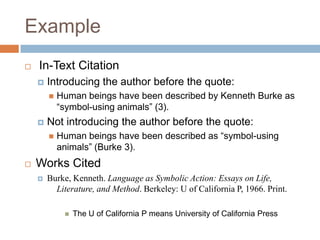
Example


In-Text Citation


Introducing the author before the quote:




Not introducing the author before the quote:




Human beings have been described by Kenneth Burke as
“symbol-using animals” (3).

Human beings have been described as “symbol-using
animals” (Burke 3).

Works Cited


Burke, Kenneth. Language as Symbolic Action: Essays on Life,
Literature, and Method. Berkeley: U of California P, 1966. Print.


The U of California P means University of California Press
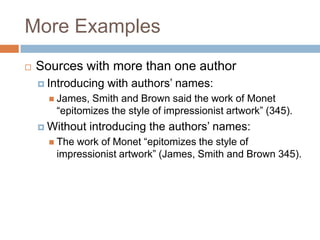
More Examples


Sources with more than one author
 Introducing

with authors’ names:

 James,

Smith and Brown said the work of Monet
“epitomizes the style of impressionist artwork” (345).

 Without
 The

introducing the authors’ names:

work of Monet “epitomizes the style of
impressionist artwork” (James, Smith and Brown 345).
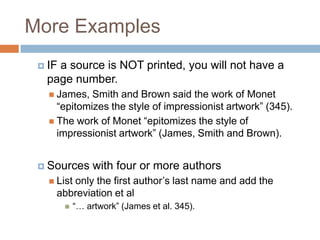
More Examples
 IF

a source is NOT printed, you will not have a
page number.
 James,

Smith and Brown said the work of Monet
“epitomizes the style of impressionist artwork” (345).
 The work of Monet “epitomizes the style of
impressionist artwork” (James, Smith and Brown).
 Sources

with four or more authors

 List

only the first author’s last name and add the
abbreviation et al


“… artwork” (James et al. 345).
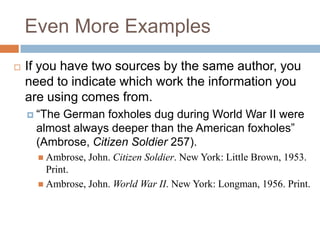
Even More Examples


If you have two sources by the same author, you
need to indicate which work the information you
are using comes from.
 “The

German foxholes dug during World War II were
almost always deeper than the American foxholes”
(Ambrose, Citizen Soldier 257).
 Ambrose,

John. Citizen Soldier. New York: Little Brown, 1953.

Print.
 Ambrose, John. World War II. New York: Longman, 1956. Print.
Even More Examples


Indirect Source
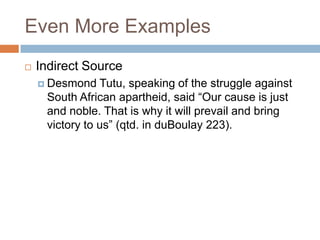
 Desmond

Tutu, speaking of the struggle against
South African apartheid, said “Our cause is just
and noble. That is why it will prevail and bring
victory to us” (qtd. in duBoulay 223).
Changes for 2009


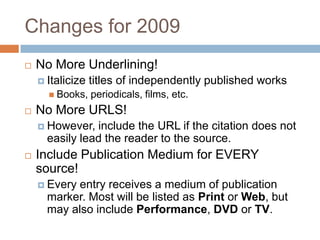
No More Underlining!
 Italicize
 Books,



titles of independently published works
periodicals, films, etc.

No More URLS!
 However,

include the URL if the citation does not
easily lead the reader to the source.



Include Publication Medium for EVERY
source!
 Every

entry receives a medium of publication
marker. Most will be listed as Print or Web, but
may also include Performance, DVD or TV.
More Changes


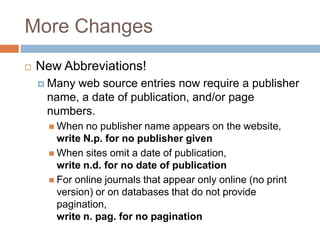
New Abbreviations!
 Many

web source entries now require a publisher
name, a date of publication, and/or page
numbers.
 When

no publisher name appears on the website,
write N.p. for no publisher given
 When sites omit a date of publication,
write n.d. for no date of publication
 For online journals that appear only online (no print
version) or on databases that do not provide
pagination,
write n. pag. for no pagination
Works Cited Examples - Books


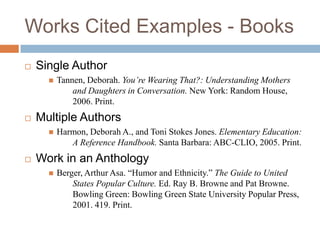
Single Author




Multiple Authors




Tannen, Deborah. You’re Wearing That?: Understanding Mothers
and Daughters in Conversation. New York: Random House,
2006. Print.

Harmon, Deborah A., and Toni Stokes Jones. Elementary Education:
A Reference Handbook. Santa Barbara: ABC-CLIO, 2005. Print.

Work in an Anthology


Berger, Arthur Asa. “Humor and Ethnicity.” The Guide to United
States Popular Culture. Ed. Ray B. Browne and Pat Browne.
Bowling Green: Bowling Green State University Popular Press,
2001. 419. Print.
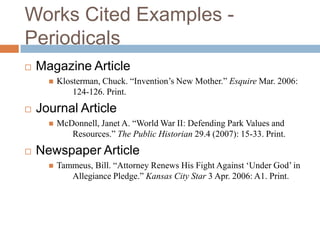
Works Cited Examples Periodicals


Magazine Article




Journal Article




Klosterman, Chuck. “Invention‟s New Mother.” Esquire Mar. 2006:
124-126. Print.
McDonnell, Janet A. “World War II: Defending Park Values and
Resources.” The Public Historian 29.4 (2007): 15-33. Print.

Newspaper Article


Tammeus, Bill. “Attorney Renews His Fight Against „Under God‟ in
Allegiance Pledge.” Kansas City Star 3 Apr. 2006: A1. Print.
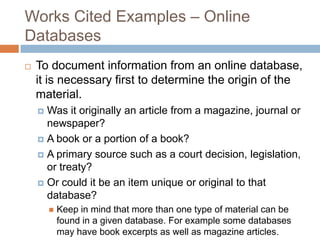
Works Cited Examples – Online
Databases


To document information from an online database,
it is necessary first to determine the origin of the
material.
Was it originally an article from a magazine, journal or
newspaper?
 A book or a portion of a book?
 A primary source such as a court decision, legislation,
or treaty?
 Or could it be an item unique or original to that
database?




Keep in mind that more than one type of material can be
found in a given database. For example some databases
may have book excerpts as well as magazine articles.
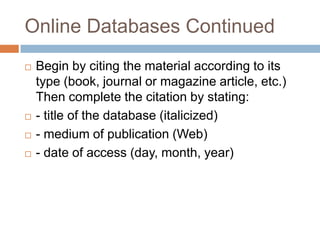
Online Databases Continued






Begin by citing the material according to its
type (book, journal or magazine article, etc.)
Then complete the citation by stating:
- title of the database (italicized)
- medium of publication (Web)
- date of access (day, month, year)
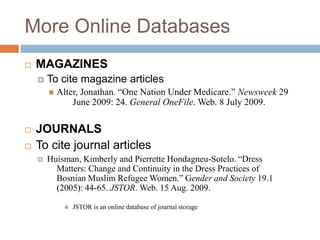
More Online Databases


MAGAZINES


To cite magazine articles





Alter, Jonathan. “One Nation Under Medicare.” Newsweek 29
June 2009: 24. General OneFile. Web. 8 July 2009.

JOURNALS
To cite journal articles


Huisman, Kimberly and Pierrette Hondagneu-Sotelo. “Dress
Matters: Change and Continuity in the Dress Practices of
Bosnian Muslim Refugee Women.” Gender and Society 19.1
(2005): 44-65. JSTOR. Web. 15 Aug. 2009.


JSTOR is an online database of journal storage
More Online Databases


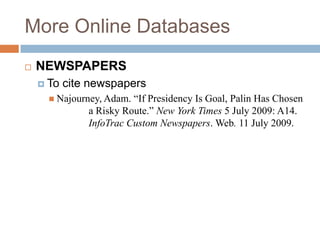
NEWSPAPERS
 To

cite newspapers

 Najourney, Adam.

“If Presidency Is Goal, Palin Has Chosen
a Risky Route.” New York Times 5 July 2009: A14.
InfoTrac Custom Newspapers. Web. 11 July 2009.
More Online Databases


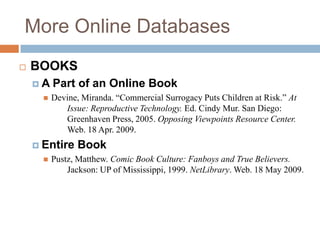
BOOKS
A


Part of an Online Book
Devine, Miranda. “Commercial Surrogacy Puts Children at Risk.” At
Issue: Reproductive Technology. Ed. Cindy Mur. San Diego:
Greenhaven Press, 2005. Opposing Viewpoints Resource Center.
Web. 18 Apr. 2009.

 Entire


Book

Pustz, Matthew. Comic Book Culture: Fanboys and True Believers.
Jackson: UP of Mississippi, 1999. NetLibrary. Web. 18 May 2009.
Web Sites


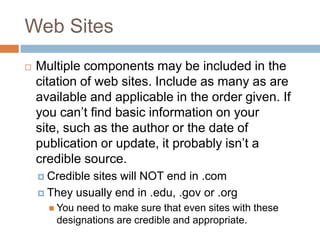
Multiple components may be included in the
citation of web sites. Include as many as are
available and applicable in the order given. If
you can’t find basic information on your
site, such as the author or the date of
publication or update, it probably isn’t a
credible source.
 Credible

sites will NOT end in .com
 They usually end in .edu, .gov or .org
 You

need to make sure that even sites with these
designations are credible and appropriate.
Web Sites


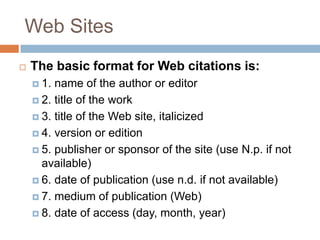
The basic format for Web citations is:
 1.

name of the author or editor
 2. title of the work
 3. title of the Web site, italicized
 4. version or edition
 5. publisher or sponsor of the site (use N.p. if not
available)
 6. date of publication (use n.d. if not available)
 7. medium of publication (Web)
 8. date of access (day, month, year)
Web Site Citation Examples


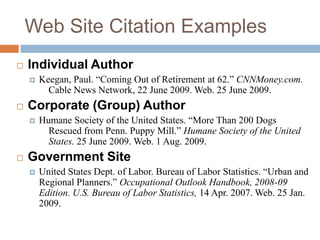
Individual Author




Corporate (Group) Author




Keegan, Paul. “Coming Out of Retirement at 62.” CNNMoney.com.
Cable News Network, 22 June 2009. Web. 25 June 2009.
Humane Society of the United States. “More Than 200 Dogs
Rescued from Penn. Puppy Mill.” Humane Society of the United
States. 25 June 2009. Web. 1 Aug. 2009.

Government Site


United States Dept. of Labor. Bureau of Labor Statistics. “Urban and
Regional Planners.” Occupational Outlook Handbook, 2008-09
Edition. U.S. Bureau of Labor Statistics, 14 Apr. 2007. Web. 25 Jan.
2009.
More Web Site Citation
Examples






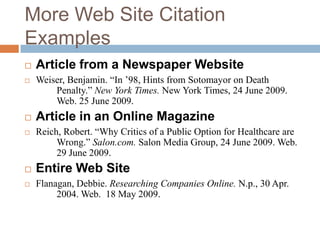
Article from a Newspaper Website
Weiser, Benjamin. “In ‟98, Hints from Sotomayor on Death
Penalty.” New York Times. New York Times, 24 June 2009.
Web. 25 June 2009.

Article in an Online Magazine
Reich, Robert. “Why Critics of a Public Option for Healthcare are
Wrong.” Salon.com. Salon Media Group, 24 June 2009. Web.
29 June 2009.



Entire Web Site



Flanagan, Debbie. Researching Companies Online. N.p., 30 Apr.
2004. Web. 18 May 2009.
Sample Paper


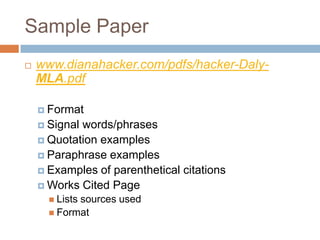
www.dianahacker.com/pdfs/hacker-DalyMLA.pdf
 Format
 Signal

words/phrases
 Quotation examples
 Paraphrase examples
 Examples of parenthetical citations
 Works Cited Page
 Lists

sources used
 Format

Mla style power point

  • 1.
    Information from EnglishProfessor Stephanie Zerkel and the library staff @ Maple Woods Created by Ms.
  • 2.
    Basics  When using MLAStyle, you cite sources in two places in your essay:  Parenthetically in the body of your essay after you use information taken from a source  On the Works Cited page, where you list all of the sources you used in your essay.
  • 3.
    Basics  MLA requires youto cite a source whenever you:  use an original idea derived from a source, whether it is quoted or paraphrased  summarize original ideas by a source  use factual information that is not common knowledge  *COMMON KNOWLEDGE is information that recurs in source after source or is widely known.  use any exact wording copied from a source
  • 4.
    Basics  Direct Quote A direct, word-for-wordcopy of statements taken from a source. This is information that is NOT in quotation marks in the original source.  Indirect Quote A word-for-word copy of statements taken from a source that are from someone other than the author of that work. This IS information that IS in quotation marks in the original source and tells who said that information.
  • 5.
    Basics  Paraphrase  When you restateinformation you read in a source.  NOTE: you need to completely rewrite the information into your own words. Do not just change a few words or adjust the order of the words.  REMEMBER: you still have to give the author credit for that information.
  • 6.
    Basics  Summary A condensed version ofthe main ideas in a reading.  The major difference between a paraphrase and a summary is the amount of original information you start with.  In a paraphrase, the original work and your paraphrase will be about the same length.  In a summary, the original work could be the entire article from a magazine or chapter from a book that you summarize in a couple of sentences.
  • 7.
    Basics     Only 10% ofyour research should be quoted in your essay; the rest of your research should be paraphrased. For a shorter research paper, you should avoid the use of long quotes (more than four lines typed). In longer papers, use of long quotes should still be limited. No more than 25% of your total paper should be research. Which means that at least 75% must be your own thoughts and ideas.
  • 8.
    Example  In-Text Citation  Introducing theauthor before the quote:   Not introducing the author before the quote:   Human beings have been described by Kenneth Burke as “symbol-using animals” (3). Human beings have been described as “symbol-using animals” (Burke 3). Works Cited  Burke, Kenneth. Language as Symbolic Action: Essays on Life, Literature, and Method. Berkeley: U of California P, 1966. Print.  The U of California P means University of California Press
  • 9.
    More Examples  Sources withmore than one author  Introducing with authors’ names:  James, Smith and Brown said the work of Monet “epitomizes the style of impressionist artwork” (345).  Without  The introducing the authors’ names: work of Monet “epitomizes the style of impressionist artwork” (James, Smith and Brown 345).
  • 10.
    More Examples  IF asource is NOT printed, you will not have a page number.  James, Smith and Brown said the work of Monet “epitomizes the style of impressionist artwork” (345).  The work of Monet “epitomizes the style of impressionist artwork” (James, Smith and Brown).  Sources with four or more authors  List only the first author’s last name and add the abbreviation et al  “… artwork” (James et al. 345).
  • 11.
    Even More Examples  Ifyou have two sources by the same author, you need to indicate which work the information you are using comes from.  “The German foxholes dug during World War II were almost always deeper than the American foxholes” (Ambrose, Citizen Soldier 257).  Ambrose, John. Citizen Soldier. New York: Little Brown, 1953. Print.  Ambrose, John. World War II. New York: Longman, 1956. Print.
  • 12.
    Even More Examples  IndirectSource  Desmond Tutu, speaking of the struggle against South African apartheid, said “Our cause is just and noble. That is why it will prevail and bring victory to us” (qtd. in duBoulay 223).
  • 13.
    Changes for 2009  NoMore Underlining!  Italicize  Books,  titles of independently published works periodicals, films, etc. No More URLS!  However, include the URL if the citation does not easily lead the reader to the source.  Include Publication Medium for EVERY source!  Every entry receives a medium of publication marker. Most will be listed as Print or Web, but may also include Performance, DVD or TV.
  • 14.
    More Changes  New Abbreviations! Many web source entries now require a publisher name, a date of publication, and/or page numbers.  When no publisher name appears on the website, write N.p. for no publisher given  When sites omit a date of publication, write n.d. for no date of publication  For online journals that appear only online (no print version) or on databases that do not provide pagination, write n. pag. for no pagination
  • 15.
    Works Cited Examples- Books  Single Author   Multiple Authors   Tannen, Deborah. You’re Wearing That?: Understanding Mothers and Daughters in Conversation. New York: Random House, 2006. Print. Harmon, Deborah A., and Toni Stokes Jones. Elementary Education: A Reference Handbook. Santa Barbara: ABC-CLIO, 2005. Print. Work in an Anthology  Berger, Arthur Asa. “Humor and Ethnicity.” The Guide to United States Popular Culture. Ed. Ray B. Browne and Pat Browne. Bowling Green: Bowling Green State University Popular Press, 2001. 419. Print.
  • 16.
    Works Cited ExamplesPeriodicals  Magazine Article   Journal Article   Klosterman, Chuck. “Invention‟s New Mother.” Esquire Mar. 2006: 124-126. Print. McDonnell, Janet A. “World War II: Defending Park Values and Resources.” The Public Historian 29.4 (2007): 15-33. Print. Newspaper Article  Tammeus, Bill. “Attorney Renews His Fight Against „Under God‟ in Allegiance Pledge.” Kansas City Star 3 Apr. 2006: A1. Print.
  • 17.
    Works Cited Examples– Online Databases  To document information from an online database, it is necessary first to determine the origin of the material. Was it originally an article from a magazine, journal or newspaper?  A book or a portion of a book?  A primary source such as a court decision, legislation, or treaty?  Or could it be an item unique or original to that database?   Keep in mind that more than one type of material can be found in a given database. For example some databases may have book excerpts as well as magazine articles.
  • 18.
    Online Databases Continued     Beginby citing the material according to its type (book, journal or magazine article, etc.) Then complete the citation by stating: - title of the database (italicized) - medium of publication (Web) - date of access (day, month, year)
  • 19.
    More Online Databases  MAGAZINES  Tocite magazine articles    Alter, Jonathan. “One Nation Under Medicare.” Newsweek 29 June 2009: 24. General OneFile. Web. 8 July 2009. JOURNALS To cite journal articles  Huisman, Kimberly and Pierrette Hondagneu-Sotelo. “Dress Matters: Change and Continuity in the Dress Practices of Bosnian Muslim Refugee Women.” Gender and Society 19.1 (2005): 44-65. JSTOR. Web. 15 Aug. 2009.  JSTOR is an online database of journal storage
  • 20.
    More Online Databases  NEWSPAPERS To cite newspapers  Najourney, Adam. “If Presidency Is Goal, Palin Has Chosen a Risky Route.” New York Times 5 July 2009: A14. InfoTrac Custom Newspapers. Web. 11 July 2009.
  • 21.
    More Online Databases  BOOKS A  Partof an Online Book Devine, Miranda. “Commercial Surrogacy Puts Children at Risk.” At Issue: Reproductive Technology. Ed. Cindy Mur. San Diego: Greenhaven Press, 2005. Opposing Viewpoints Resource Center. Web. 18 Apr. 2009.  Entire  Book Pustz, Matthew. Comic Book Culture: Fanboys and True Believers. Jackson: UP of Mississippi, 1999. NetLibrary. Web. 18 May 2009.
  • 22.
    Web Sites  Multiple componentsmay be included in the citation of web sites. Include as many as are available and applicable in the order given. If you can’t find basic information on your site, such as the author or the date of publication or update, it probably isn’t a credible source.  Credible sites will NOT end in .com  They usually end in .edu, .gov or .org  You need to make sure that even sites with these designations are credible and appropriate.
  • 23.
    Web Sites  The basicformat for Web citations is:  1. name of the author or editor  2. title of the work  3. title of the Web site, italicized  4. version or edition  5. publisher or sponsor of the site (use N.p. if not available)  6. date of publication (use n.d. if not available)  7. medium of publication (Web)  8. date of access (day, month, year)
  • 24.
    Web Site CitationExamples  Individual Author   Corporate (Group) Author   Keegan, Paul. “Coming Out of Retirement at 62.” CNNMoney.com. Cable News Network, 22 June 2009. Web. 25 June 2009. Humane Society of the United States. “More Than 200 Dogs Rescued from Penn. Puppy Mill.” Humane Society of the United States. 25 June 2009. Web. 1 Aug. 2009. Government Site  United States Dept. of Labor. Bureau of Labor Statistics. “Urban and Regional Planners.” Occupational Outlook Handbook, 2008-09 Edition. U.S. Bureau of Labor Statistics, 14 Apr. 2007. Web. 25 Jan. 2009.
  • 25.
    More Web SiteCitation Examples     Article from a Newspaper Website Weiser, Benjamin. “In ‟98, Hints from Sotomayor on Death Penalty.” New York Times. New York Times, 24 June 2009. Web. 25 June 2009. Article in an Online Magazine Reich, Robert. “Why Critics of a Public Option for Healthcare are Wrong.” Salon.com. Salon Media Group, 24 June 2009. Web. 29 June 2009.  Entire Web Site  Flanagan, Debbie. Researching Companies Online. N.p., 30 Apr. 2004. Web. 18 May 2009.
  • 26.
    Sample Paper  www.dianahacker.com/pdfs/hacker-DalyMLA.pdf  Format Signal words/phrases  Quotation examples  Paraphrase examples  Examples of parenthetical citations  Works Cited Page  Lists sources used  Format