
Vimala Judy
Kamalodeen
31/7/2016
The University
of the West
Indies, STA
Arthur Lok Jack
Mixed Methods
Research
VJKamalodeen 31/7/16
2
What is Mixed Methods?
Many definitions of mixed methods are available
in the literature but not agreed upon (e.g., see
Johnson, Onwuegbuzie, & Turner, 2007).
Application of mixed methods research to “wicked
problems” requiring trans-disciplinary and
methodological approaches to generate novel
understandings (Mertens, 2015)
VJKamalodeen 31/7/16
3
A purpose to consider:
For purposes of this discussion, mixed methods research or mixed
research (Onwuegbuzie,2012) will be defined as a research approach
or methodology:
 focusing on research questions that call for real-life contextual
understandings, multi-level perspectives, and cultural influences;
 employing rigorous quantitative research assessing magnitude and
frequency of constructs and rigorous qualitative research exploring
the meaning and understanding of constructs;
 utilizing multiple methods (e.g., intervention trials and in-depth
interviews);
 intentionally integrating or combining these methods to draw on the
strengths of each; and
 framing the investigation within philosophical and theoretical
positions.
VJKamalodeen 31/7/16
4
A bit on the so-called paradigm war
Positivism/realism
Constructivism/interpretivism
VJKamalodeen 31/7/16
5
6
Saunders, Lewis, & Thornhill, A. (2007)
Philosophy in Mixed Methods Research
Mixed methods researchers use and often make explicit
diverse philosophical positions. These positions often
are referred to as dialectal stances that bridge
 postpositivist and social constructivist worldviews,
 pragmatic perspectives (what works)
 transformative perspectives (social justice)
(Greene, 2007).
VJKamalodeen 31/7/16
7
Theories and mixed methods research:
 Optimally, all studies draw upon one or more
theoretical frameworks from the social, behavioral,
or biological sciences to inform all phases of the
study.
 Mixed methods studies provide opportunities for
the integration of a variety of theoretical
perspectives (e.g., ecological theories, complexity
theory, stress theory, critical theories, or others).
VJKamalodeen 31/7/16
8
Creswell on mixed methods
 https://youtu.be/1OaNiTlpyX8
VJKamalodeen 31/7/16
9
The nature of qualitative research and
its evidence
 A salient strength of qualitative research is its focus on the
contexts and meaning of human lives and experiences for the
purpose of inductive or theory-development driven research.
 Qualitative data help researchers understand processes,
especially those that emerge over time, provide detailed
information about setting or context, and emphasize the voices
of participants through quotes.
 Qualitative methods facilitate the collection of data when
measures do not exist and provide a depth of understanding of
concepts. Typical qualitative approaches used in education
research are case studies, grounded theory, ethnography, and
phenomenology.
VJKamalodeen 31/7/16
10
The nature of quantitative
research and its evidence:
 Quantitative research is a mode of inquiry used often for deductive
research, when the goal is to test theories or hypotheses, gather
descriptive information, or examine relationships among variables.
 These variables are measured and yield numeric data that can be
analyzed statistically. Quantitative data have the potential to provide
measurable evidence, to help to establish (probable) cause and effect,
to yield efficient data collection procedures, to create the possibility of
replication and generalization to a population, to facilitate the
comparison of groups, and to provide insight into a breadth of
experiences.
 Typical quantitative approaches used in the education are descriptive
surveys, observational studies, case-control studies, randomized
controlled trials, and quasi-experimental designs.
VJKamalodeen 31/7/16
11
Towards the “radical” middle:
Qual Quant
VJKamalodeen 31/7/16
12
m
i
x
e
d
r
e
s
e
a
r
c
h
Onwuegbuzie (2012)
The integration of multiple forms of
data
 In mixed methods studies, investigators intentionally
integrate or combine quantitative and qualitative data
rather than keeping them separate. The basic concept is
that integration of quantitative and qualitative data
maximizes the strengths and minimizes the weaknesses
of each type of data. This idea of integration separates
current views of mixed methods from older perspectives
in which investigators collected both forms of data, but
kept them separate or casually combined them rather
than using systematic integrative procedures. One of the
most difficult challenges is how to integrate different
forms of data. Three approaches have been discussed in
the literature (Creswell & Plano Clark, 2011): merging
data, connecting data, and embedding data.
VJKamalodeen 31/7/16
13
Reasons to Mix Methods
 Triangulation
 Complementarity
 Development
 Initiation
 Expansion
 Explanation
VJKamalodeen 31/7/16
14
VJKamalodeen 31/7/16
15
When Should Mixed
Methods Be Used?
Research problems suitable for mixed
methods
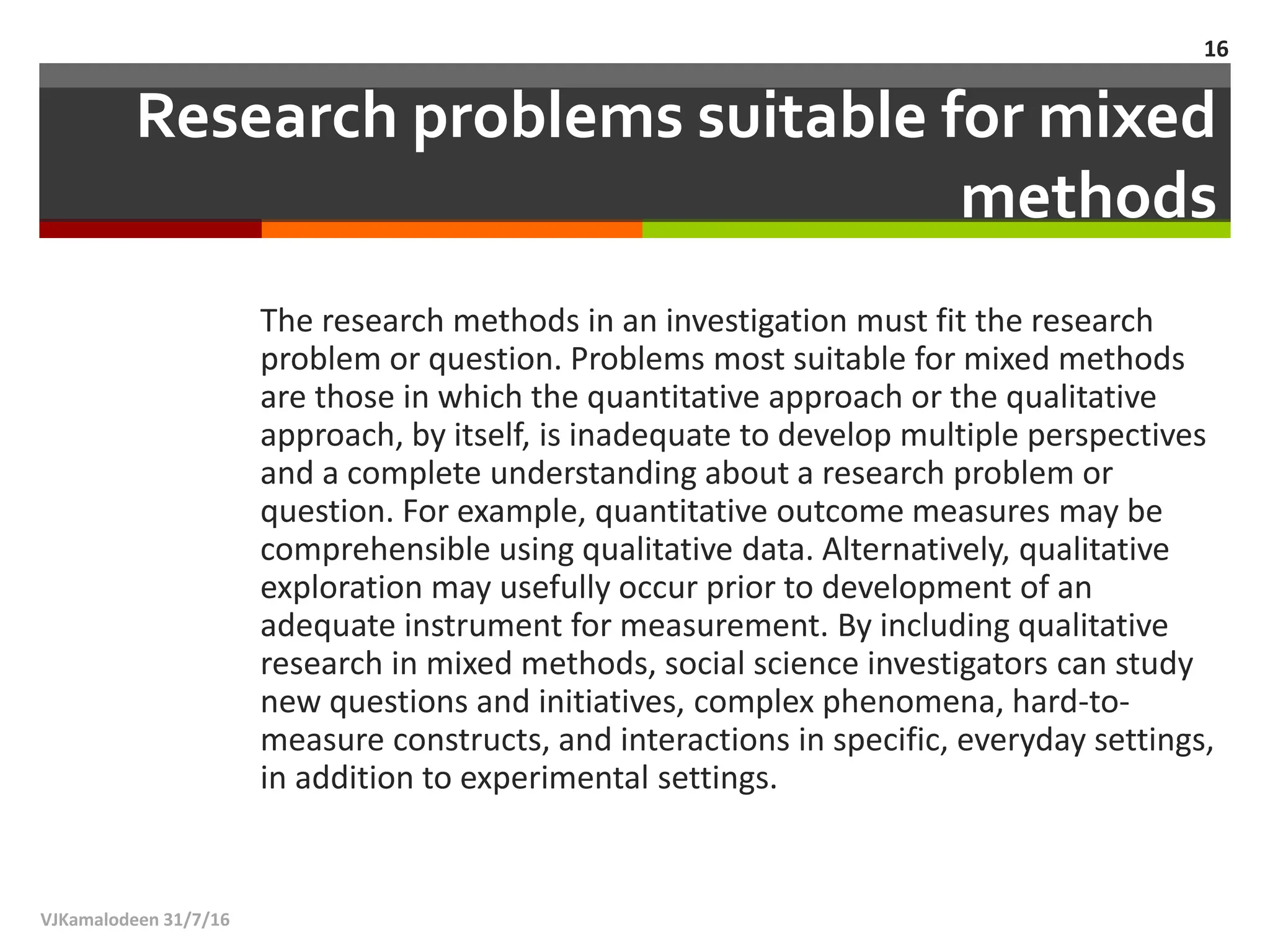
The research methods in an investigation must fit the research
problem or question. Problems most suitable for mixed methods
are those in which the quantitative approach or the qualitative
approach, by itself, is inadequate to develop multiple perspectives
and a complete understanding about a research problem or
question. For example, quantitative outcome measures may be
comprehensible using qualitative data. Alternatively, qualitative
exploration may usefully occur prior to development of an
adequate instrument for measurement. By including qualitative
research in mixed methods, social science investigators can study
new questions and initiatives, complex phenomena, hard-to-
measure constructs, and interactions in specific, everyday settings,
in addition to experimental settings.
VJKamalodeen 31/7/16
16
VJKamalodeen 31/7/16
17
How Can Mixed Methods
Research be Designed?
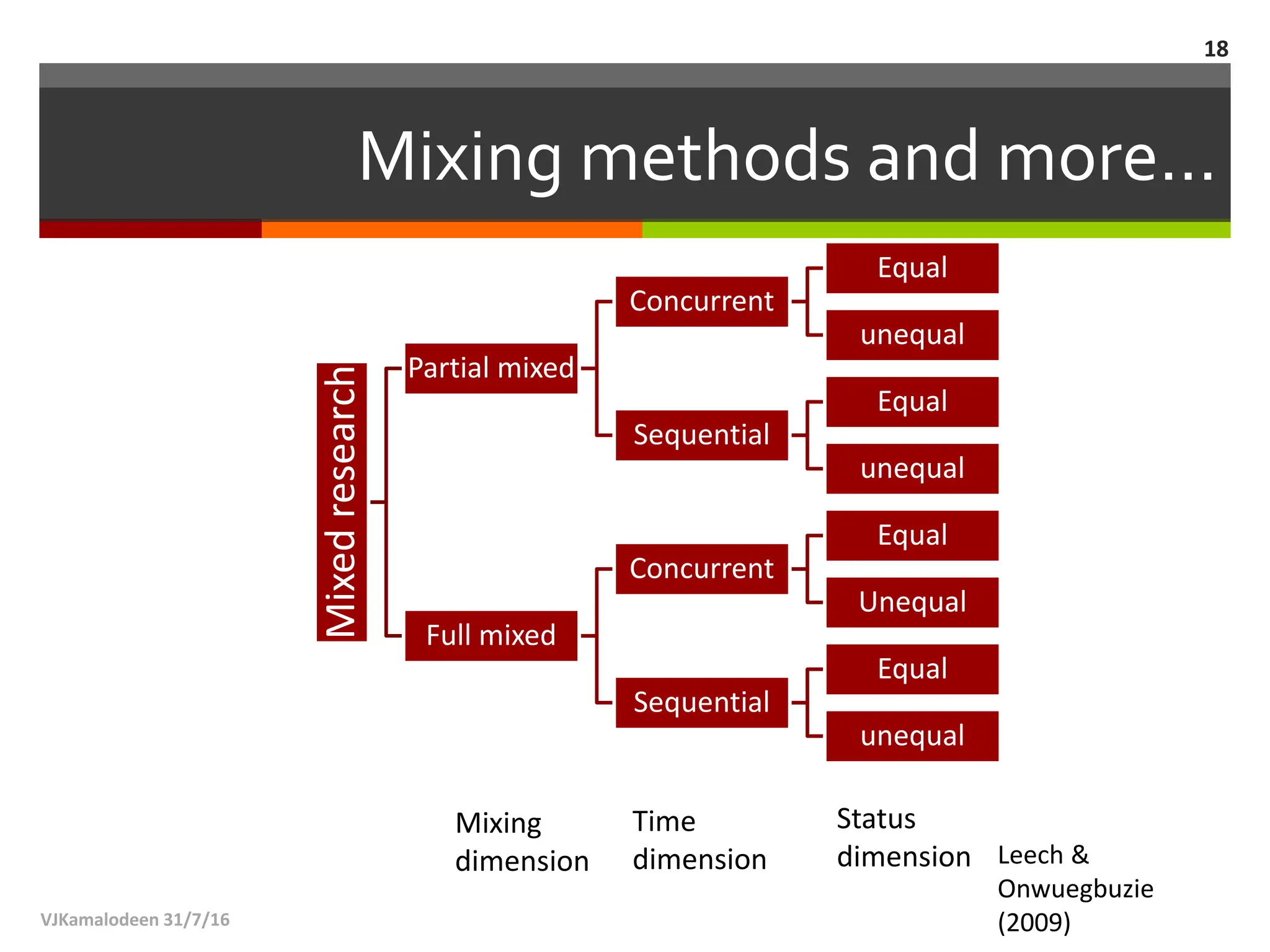
Mixing methods and more…
Mixed
research
Partial mixed
Concurrent
Equal
unequal
Sequential
Equal
unequal
Full mixed
Concurrent
Equal
Unequal
Sequential
Equal
unequal
VJKamalodeen 31/7/16
18
Leech &
Onwuegbuzie
(2009)
Mixing
dimension
Time
dimension
Status
dimension
Matrix Crossing Purpose of Mixed Methods
Research byTime Orientation
Purpose of Mixed Methods
Research
Concurrent Design
Appropriate?
Sequential Design
Appropriate?
Triangulation Yes No
Complementarity Yes Yes
Development No Yes
Initiation Yes Yes
Expansion No Yes
VJKamalodeen 31/7/16
19
Onwuegbuzie & Leech(2007)
Mixing by Status
• Equal status
• Qual Dominant
• Quant Dominant
VJKamalodeen 31/7/16
20
steps of MMR Design
Research
formulation
1. Determine the
mixed goal
2. Formulate
research objectives
3. Determine
rationale
4.Determine
purpose
5. Write research
question[s]
Research
planning
6. choose sampling
framework
7. choose mixed
methods design
including time and
status dimensions
Research
Implementation
8. collect and
analyze quantitative
and/or qualitative
data
9.
validate/legitimate
and interpret the
mixed research
findings
10. write the mixed
research report, and
reformulate the
mixed research
question[s]).
VJKamalodeen 31/7/16
21
Onwuegbuzie, Frels, Collins & Leech (2013)
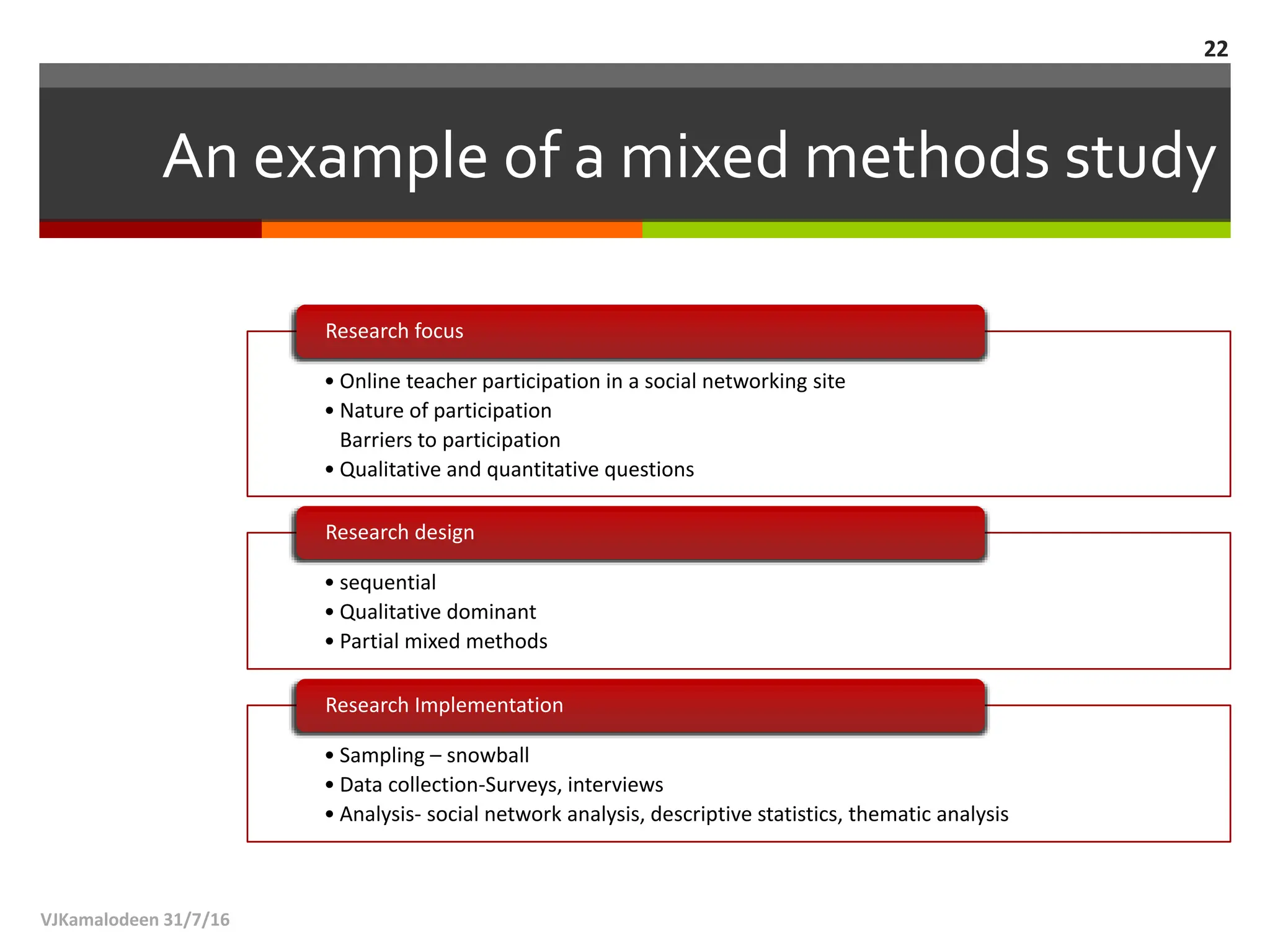
An example of a mixed methods study
• Online teacher participation in a social networking site
• Nature of participation
Barriers to participation
• Qualitative and quantitative questions
Research focus
• sequential
• Qualitative dominant
• Partial mixed methods
Research design
• Sampling – snowball
• Data collection-Surveys, interviews
• Analysis- social network analysis, descriptive statistics, thematic analysis
Research Implementation
VJKamalodeen 31/7/16
22
Some mixed methods references
VJKamalodeen 31/7/16
23
Books
0 Creswell, J. (2015). A concise introduction to mixed methods research.
Thousand Oaks, CA: Sage.
0 Creswell, J., & Plano-Clark, V. (2011). Designing and conducting mixed
methods research (2nd ed.). Thousand Oaks, CA: Sage.
0 Curry, L. A., & Nunez-Smith, M. (2015). Mixed Methods in Health
Sciences Research. Thousand Oaks, CA: Sage.
0 Greene, J. (2007). Mixed methods in social inquiry. San Francisco:
Jossey-Bass.
0 Hesse-Biber, S. (2010). Mixed Methods Research. NY: Guilford Press.
0 Teddlie, C., & Tashakkori, A. (2009). Foundations of mixed methods
research. Thousand Oaks, CA: Sage.
Some mixed methods references
VJKamalodeen 31/7/16
24
Articles
-Journal of Mixed Methods Research
Johnson, R. B., Onwuegbuzie, A. J., & Turner, L. A. (2007). Toward a Definition of Mixed Methods Research, Journal of Mixed Methods Research, 1,
112-133. DOI: 10.1177/1558689806298224
- This was published in the initial issue of the journal and remains on my “need to” read list
Collins, K. M. T., & O'Cathain, A. (2009). Ten points about mixed methods research to be considered by the novice researcher. International Journal
of Multiple Research Approaches, 3(1), 2-7.
- This is a great beginning place for researchers to think about what “needs” to be thought about
Bazeley, P., & Kemp, L. (2012). Mosaics, Triangles, and DNA Metaphors for integrated analysis in mixed methods research. Journal of Mixed
Methods Research, 6(1), 55-72. doi: 10.1177/1558689811419514
- I love this article description of analysis- I believe Pat Bazeley’s analysis book comes out this year!
Hesse-Biber, S., & Johnson, R. B. (2013). Coming at things differently: Future directions of possible engagement with mixed methods research.
Journal of Mixed Methods Research, 7, 103-109. doi: DOI: 10.1177/1558689813483987
-A wonderful beginning conversation of the future of mixed methods
Mertens, D.M. (2011). Publishing Mixed Methods Research, Journal of Mixed Methods Research, 5, 3-5. DOI: 10.1177/1558689810390217
- Great resource, written by Donna Mertens when she was editor of the Journal
Onwuegbuzie, A. J., & Combs, J. P. (2010). Emergent data analysis techniques in mixed methods research: A synthesis. In A. Tashakkori & C. Teddlie
(Eds.), Handbook of mixed methods in social and behavioral research (2nd ed., pp. 397-430). Thousand Oaks, CA: Sage.
Onwuegbuzie, A. J., Leech, N. L., & Collins, K. M. T. (2011). Toward a new era for conducting mixed analysis: The role of quantitative dominant and
qualitative dominant crossover mixed analysis. In M. Williams & W. P. Vogt (Eds.), The Sage Handbook of Innovation in Social Research Methods
(pp. 353-384). Thousand Oaks, CA
Thank you! and questions?
 Dr. Vimala Judy Kamalodeen
 School of Education
 Faculty of Humanities and Education
 The University of the West Indies, St. Augustine
 Email: vimala.kamalodeen@sta.uwi.edu
VJKamalodeen 31/7/16
25

Mixed Method Research by bangladesh-.ppt

  • 1.
     Vimala Judy Kamalodeen 31/7/2016 The University ofthe West Indies, STA Arthur Lok Jack Mixed Methods Research
  • 2.
  • 3.
    What is MixedMethods? Many definitions of mixed methods are available in the literature but not agreed upon (e.g., see Johnson, Onwuegbuzie, & Turner, 2007). Application of mixed methods research to “wicked problems” requiring trans-disciplinary and methodological approaches to generate novel understandings (Mertens, 2015) VJKamalodeen 31/7/16 3
  • 4.
    A purpose toconsider: For purposes of this discussion, mixed methods research or mixed research (Onwuegbuzie,2012) will be defined as a research approach or methodology:  focusing on research questions that call for real-life contextual understandings, multi-level perspectives, and cultural influences;  employing rigorous quantitative research assessing magnitude and frequency of constructs and rigorous qualitative research exploring the meaning and understanding of constructs;  utilizing multiple methods (e.g., intervention trials and in-depth interviews);  intentionally integrating or combining these methods to draw on the strengths of each; and  framing the investigation within philosophical and theoretical positions. VJKamalodeen 31/7/16 4
  • 5.
    A bit onthe so-called paradigm war Positivism/realism Constructivism/interpretivism VJKamalodeen 31/7/16 5
  • 6.
    6 Saunders, Lewis, &Thornhill, A. (2007)
  • 7.
    Philosophy in MixedMethods Research Mixed methods researchers use and often make explicit diverse philosophical positions. These positions often are referred to as dialectal stances that bridge  postpositivist and social constructivist worldviews,  pragmatic perspectives (what works)  transformative perspectives (social justice) (Greene, 2007). VJKamalodeen 31/7/16 7
  • 8.
    Theories and mixedmethods research:  Optimally, all studies draw upon one or more theoretical frameworks from the social, behavioral, or biological sciences to inform all phases of the study.  Mixed methods studies provide opportunities for the integration of a variety of theoretical perspectives (e.g., ecological theories, complexity theory, stress theory, critical theories, or others). VJKamalodeen 31/7/16 8
  • 9.
    Creswell on mixedmethods  https://youtu.be/1OaNiTlpyX8 VJKamalodeen 31/7/16 9
  • 10.
    The nature ofqualitative research and its evidence  A salient strength of qualitative research is its focus on the contexts and meaning of human lives and experiences for the purpose of inductive or theory-development driven research.  Qualitative data help researchers understand processes, especially those that emerge over time, provide detailed information about setting or context, and emphasize the voices of participants through quotes.  Qualitative methods facilitate the collection of data when measures do not exist and provide a depth of understanding of concepts. Typical qualitative approaches used in education research are case studies, grounded theory, ethnography, and phenomenology. VJKamalodeen 31/7/16 10
  • 11.
    The nature ofquantitative research and its evidence:  Quantitative research is a mode of inquiry used often for deductive research, when the goal is to test theories or hypotheses, gather descriptive information, or examine relationships among variables.  These variables are measured and yield numeric data that can be analyzed statistically. Quantitative data have the potential to provide measurable evidence, to help to establish (probable) cause and effect, to yield efficient data collection procedures, to create the possibility of replication and generalization to a population, to facilitate the comparison of groups, and to provide insight into a breadth of experiences.  Typical quantitative approaches used in the education are descriptive surveys, observational studies, case-control studies, randomized controlled trials, and quasi-experimental designs. VJKamalodeen 31/7/16 11
  • 12.
    Towards the “radical”middle: Qual Quant VJKamalodeen 31/7/16 12 m i x e d r e s e a r c h Onwuegbuzie (2012)
  • 13.
    The integration ofmultiple forms of data  In mixed methods studies, investigators intentionally integrate or combine quantitative and qualitative data rather than keeping them separate. The basic concept is that integration of quantitative and qualitative data maximizes the strengths and minimizes the weaknesses of each type of data. This idea of integration separates current views of mixed methods from older perspectives in which investigators collected both forms of data, but kept them separate or casually combined them rather than using systematic integrative procedures. One of the most difficult challenges is how to integrate different forms of data. Three approaches have been discussed in the literature (Creswell & Plano Clark, 2011): merging data, connecting data, and embedding data. VJKamalodeen 31/7/16 13
  • 14.
    Reasons to MixMethods  Triangulation  Complementarity  Development  Initiation  Expansion  Explanation VJKamalodeen 31/7/16 14
  • 15.
  • 16.
    Research problems suitablefor mixed methods The research methods in an investigation must fit the research problem or question. Problems most suitable for mixed methods are those in which the quantitative approach or the qualitative approach, by itself, is inadequate to develop multiple perspectives and a complete understanding about a research problem or question. For example, quantitative outcome measures may be comprehensible using qualitative data. Alternatively, qualitative exploration may usefully occur prior to development of an adequate instrument for measurement. By including qualitative research in mixed methods, social science investigators can study new questions and initiatives, complex phenomena, hard-to- measure constructs, and interactions in specific, everyday settings, in addition to experimental settings. VJKamalodeen 31/7/16 16
  • 17.
    VJKamalodeen 31/7/16 17 How CanMixed Methods Research be Designed?
  • 18.
    Mixing methods andmore… Mixed research Partial mixed Concurrent Equal unequal Sequential Equal unequal Full mixed Concurrent Equal Unequal Sequential Equal unequal VJKamalodeen 31/7/16 18 Leech & Onwuegbuzie (2009) Mixing dimension Time dimension Status dimension
  • 19.
    Matrix Crossing Purposeof Mixed Methods Research byTime Orientation Purpose of Mixed Methods Research Concurrent Design Appropriate? Sequential Design Appropriate? Triangulation Yes No Complementarity Yes Yes Development No Yes Initiation Yes Yes Expansion No Yes VJKamalodeen 31/7/16 19 Onwuegbuzie & Leech(2007)
  • 20.
    Mixing by Status •Equal status • Qual Dominant • Quant Dominant VJKamalodeen 31/7/16 20
  • 21.
    steps of MMRDesign Research formulation 1. Determine the mixed goal 2. Formulate research objectives 3. Determine rationale 4.Determine purpose 5. Write research question[s] Research planning 6. choose sampling framework 7. choose mixed methods design including time and status dimensions Research Implementation 8. collect and analyze quantitative and/or qualitative data 9. validate/legitimate and interpret the mixed research findings 10. write the mixed research report, and reformulate the mixed research question[s]). VJKamalodeen 31/7/16 21 Onwuegbuzie, Frels, Collins & Leech (2013)
  • 22.
    An example ofa mixed methods study • Online teacher participation in a social networking site • Nature of participation Barriers to participation • Qualitative and quantitative questions Research focus • sequential • Qualitative dominant • Partial mixed methods Research design • Sampling – snowball • Data collection-Surveys, interviews • Analysis- social network analysis, descriptive statistics, thematic analysis Research Implementation VJKamalodeen 31/7/16 22
  • 23.
    Some mixed methodsreferences VJKamalodeen 31/7/16 23 Books 0 Creswell, J. (2015). A concise introduction to mixed methods research. Thousand Oaks, CA: Sage. 0 Creswell, J., & Plano-Clark, V. (2011). Designing and conducting mixed methods research (2nd ed.). Thousand Oaks, CA: Sage. 0 Curry, L. A., & Nunez-Smith, M. (2015). Mixed Methods in Health Sciences Research. Thousand Oaks, CA: Sage. 0 Greene, J. (2007). Mixed methods in social inquiry. San Francisco: Jossey-Bass. 0 Hesse-Biber, S. (2010). Mixed Methods Research. NY: Guilford Press. 0 Teddlie, C., & Tashakkori, A. (2009). Foundations of mixed methods research. Thousand Oaks, CA: Sage.
  • 24.
    Some mixed methodsreferences VJKamalodeen 31/7/16 24 Articles -Journal of Mixed Methods Research Johnson, R. B., Onwuegbuzie, A. J., & Turner, L. A. (2007). Toward a Definition of Mixed Methods Research, Journal of Mixed Methods Research, 1, 112-133. DOI: 10.1177/1558689806298224 - This was published in the initial issue of the journal and remains on my “need to” read list Collins, K. M. T., & O'Cathain, A. (2009). Ten points about mixed methods research to be considered by the novice researcher. International Journal of Multiple Research Approaches, 3(1), 2-7. - This is a great beginning place for researchers to think about what “needs” to be thought about Bazeley, P., & Kemp, L. (2012). Mosaics, Triangles, and DNA Metaphors for integrated analysis in mixed methods research. Journal of Mixed Methods Research, 6(1), 55-72. doi: 10.1177/1558689811419514 - I love this article description of analysis- I believe Pat Bazeley’s analysis book comes out this year! Hesse-Biber, S., & Johnson, R. B. (2013). Coming at things differently: Future directions of possible engagement with mixed methods research. Journal of Mixed Methods Research, 7, 103-109. doi: DOI: 10.1177/1558689813483987 -A wonderful beginning conversation of the future of mixed methods Mertens, D.M. (2011). Publishing Mixed Methods Research, Journal of Mixed Methods Research, 5, 3-5. DOI: 10.1177/1558689810390217 - Great resource, written by Donna Mertens when she was editor of the Journal Onwuegbuzie, A. J., & Combs, J. P. (2010). Emergent data analysis techniques in mixed methods research: A synthesis. In A. Tashakkori & C. Teddlie (Eds.), Handbook of mixed methods in social and behavioral research (2nd ed., pp. 397-430). Thousand Oaks, CA: Sage. Onwuegbuzie, A. J., Leech, N. L., & Collins, K. M. T. (2011). Toward a new era for conducting mixed analysis: The role of quantitative dominant and qualitative dominant crossover mixed analysis. In M. Williams & W. P. Vogt (Eds.), The Sage Handbook of Innovation in Social Research Methods (pp. 353-384). Thousand Oaks, CA
  • 25.
    Thank you! andquestions?  Dr. Vimala Judy Kamalodeen  School of Education  Faculty of Humanities and Education  The University of the West Indies, St. Augustine  Email: vimala.kamalodeen@sta.uwi.edu VJKamalodeen 31/7/16 25

Editor's Notes

  • #8 For example, researchers who hold different philosophical positions may find mixed methods research to be challenging because of the tensions created by their different beliefs (Greene, 2007). However, mixed methods research also represents an opportunity to transform these tensions into new knowledge through a dialectical discovery. A pragmatic perspective draws on employing “what works,” using diverse approaches, giving primacy to the importance of the research problem and question, and valuing both objective and subjective knowledge (see Morgan, 2007). A transformative perspective suggests an orienting framework for a mixed methods study based on creating a more just and democratic society that permeates the entire research process, from the problem to the conclusions, and the use of results (Mertens, 2009).
  • #11 It is a systematic and rigorous form of inquiry that uses methods of data collection such as in-depth interviews, ethnographic observation, and review of documents.
  • #13 Mixed methods research begins with the assumption that investigators, in understanding the social world, gather evidence based on the nature of the question and theoretical orientation. Social inquiry is targeted toward various sources and many levels that influence a given problem (e.g., policies, organizations, family, individual). Quantitative (mainly deductive) methods are ideal for measuring pervasiveness of “known” phenomena and central patterns of association, including inferences of causality. Qualitative (mainly inductive) methods allow for identification of previously unknown processes, explanations of why and how phenomena occur, and the range of their effects (Pasick et al., 2009). Mixed methods research, then, is more than simply collecting qualitative data from interviews, or collecting multiple forms of qualitative evidence (e.g., observations and interviews) or multiple types of quantitative evidence (e.g., surveys and diagnostic tests). It involves the intentional collection of both quantitative and qualitative data and the combination of the strengths of each to answer research questions.
  • #19 Typology of Mixed Methods Design
  • #20 View problems from multiple perspectives to enhance and enrich the meaning of a singular perspective. Contextualize information, to take a macro picture of a system (e.g., a school) and add in information about individuals (e.g., working at different levels). Develop a more complete understanding of a problem; to develop a complementary picture; to compare, validate, or triangulate results; to provide illustrations of context for trends; or to examine processes/experiences along with outcomes (Plano Clark, 2010)