1 This specialissue of Contemporary Educational
Psychology
3
Highlights specific mixed methods strategies to achieve
and communicate the integration aspects within their
studies
2
Unique insights that can be gained when researchers
intentionally integrate quantitative and qualitative
methods within mixed methods studies.
4
Strategies provides useful models for scholars
planning mixed methods studies and scholars
reviewing reports of mixed methods studies within
educational psychology and beyond.
KEYNOTES FROM ABSTRACT
4.
03/17/2025
BACKGROUND
4
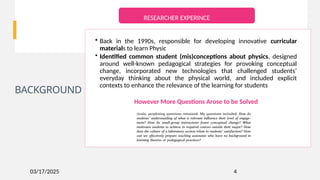
• Back inthe 1990s, responsible for developing innovative curricular
materials to learn Physic
• Identified common student (mis)conceptions about physics, designed
around well-known pedagogical strategies for provoking conceptual
change, incorporated new technologies that challenged students’
everyday thinking about the physical world, and included explicit
contexts to enhance the relevance of the learning for students
However More Questions Arose to be Solved
RESEARCHER EXPERINCE
5.
03/17/2025
BACKGROUND
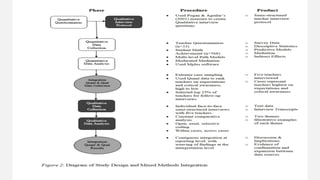
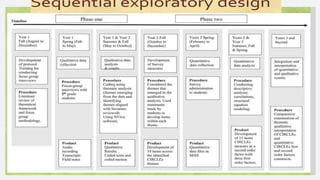
5
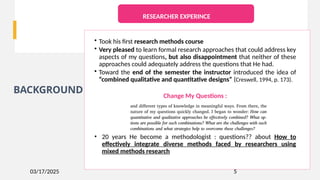
• Took hisfirst research methods course
• Very pleased to learn formal research approaches that could address key
aspects of my questions, but also disappointment that neither of these
approaches could adequately address the questions that He had.
• Toward the end of the semester the instructor introduced the idea of
“combined qualitative and quantitative designs” (Creswell, 1994, p. 173).
Change My Questions :
• 20 years He become a methodologist : questions?? about How to
effectively integrate diverse methods faced by researchers using
mixed methods research
RESEARCHER EXPERINCE
6.
TOPICS
1 Mixed MethodsResearch And
The Centrality Of Integration
2
Integration Strategies
Highlighted In The Special
Issue
3 A Few Final Thoughts
7.
03/17/2025 7
Mixed MethodsResearch And The
Centrality Of Integration
• Understanding how people learn is a complex problem that calls for
educational psychologists to use rigorous and diverse approaches to
research to examine the many facets of this complexity.
• Quantitative research approaches: for measuring the magnitude and
frequency of variables, assessing relationships and differences across
groups and time, and testing theories.
• Qualitative research approaches: for describing real-life contexts,
interpreting the meaning of phenomena, and generating theories.
• Although many research questions can be answered by using the
methods associated with one approach, there are also questions that
require researchers to researchers combine quantitative and qualitative
approaches
8.
03/17/2025 8
• Opportunityto draw on the full repertoire of
methods and methodologies found within a
researcher’s toolbox to generate new knowledge and
insights in response to their research questions
• Great potential for addressing complex research
questions, it is also a challenging research approach
because researchers must creatively and logically
design and implement the combination of methods
in ways that allow them to generate meaningful and
defensible conclusions.
9.
9
• Within thecontext of five articles, this special issue
represents a remarkable array of the possibilities for
applying mixed methods research within educational
psychology and provides insight into cutting edge
strategies that researchers use to effectively
combine quantitative and qualitative methods
within their studies.
10.
10
• The studieswere concerned with populations including teachers
and students representing great diversity in terms of age, gender,
ethnicity, socioeconomic status, and prior experiences.
• Similarly, the studies were situated in a variety of contexts
including rural, metropolitan, and urban settings as well as
elementary, middle school, secondary, and post-secondary
environments.
• The studies were also framed from a variety of foundations (e.g.,
pragmatism and transformative worldviews) and theoretical
perspectives (e.g., Critical Race Theory and social cognitive theory).
All Studies Are Positioned Within Topics, Populations, Settings, And
Frameworks.
11.
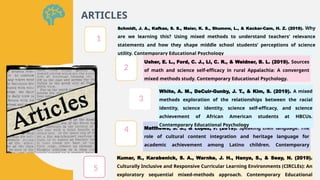
Schmidt, J. A.,Kafkas, S. S., Maier, K. S., Shumow, L., & Kackar-Cam, H. Z. (2019). Why
are we learning this? Using mixed methods to understand teachers’ relevance
statements and how they shape middle school students’ perceptions of science
utility. Contemporary Educational Psychology
Matthews, J. S., & López, F. (2019). Speaking their language: The
role of cultural content integration and heritage language for
academic achievement among Latino children. Contemporary
Educational Psychology
ARTICLES
Usher, E. L., Ford, C. J., Li, C. R., & Weidner, B. L. (2019). Sources
of math and science self-efficacy in rural Appalachia: A convergent
mixed methods study. Contemporary Educational Psychology.
White, A. M., DeCuir-Gunby, J. T., & Kim, S. (2019). A mixed
methods exploration of the relationships between the racial
identity, science identity, science self-efficacy, and science
achievement of African American students at HBCUs.
Contemporary Educational Psychology
Kumar, R., Karabenick, S. A., Warnke, J. H., Hanya, S., & Seay, N. (2019).
Culturally Inclusive and Responsive Curricular Learning Environments (CIRCLEs): An
exploratory sequential mixed-methods approach. Contemporary Educational
1
2
3
4
5
13.
EXAMPLES FOR 3PROTOTYPICAL DESIGN
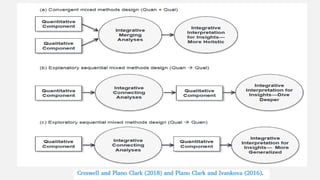
• The convergent mixed methods design involves the
implementation of independent quantitative and qualitative
study components, the results of which are then integrated
through merging analyses and interpretation to develop more
holistic and comprehensive conclusions .
• Examples Article 1,2,3
14.
1. Schmidt, Kafkas,Maier, Shumow, and Kackar Cam combined
qualitative descriptions of teachers’ communication with
quantitative ratings of student perceptions to develop a more
comprehensive account of the influence of teacher beliefs
about relevance on student perceptions of the utility of class
content.
2. Usher, Ford, Li, and Weidner compared general statistical
results with student descriptions to create a more nuanced and
colorful picture of predictors of domain-specific self-efficacy.
15.
3. White, DeCuir-Gunby,and Kim combined the results of path
analyses with individual student stories to gain deeper
understanding of how the environmental context influences the
relationship between science identity and racial identity.
16.
EXPLANATORY SEQUENTIAL MIXEDMETHODS
1. Matthews and López qualitatively described the experiences of
high-performing teachers to explain how initial quantitative
results about the use of asset-based pedagogies manifest in the
classroom.
Involves the implementation of an initial quantitative
component followed by a subsequent qualitative component that
depends on and is informed by the initial quantitative results. This
design allows researchers to dive deeper into understanding the
nuances and mechanisms that explain the quantitative results
17.
EXPLANATORY SEQUENTIAL MIXEDMETHODS
1. Matthews and López (this issue) qualitatively described the
experiences of high-performing teachers to explain how initial
quantitative results about the use of asset-based pedagogies
manifest in the classroom.
Involves the implementation of an initial quantitative
component followed by a subsequent qualitative component that
depends on and is informed by the initial quantitative results. This
design allows researchers to dive deeper into understanding the
nuances and mechanisms that explain the quantitative results
18.
EXAMPLES FOR
EXPLORATORY SEQUENTIALMIXED METHODS
1. Kumar, Karabenick, Warnke, Hanya, and Seay developed and
tested an instrument across diverse settings based on initial
qualitative results about student perceptions of culturally
inclusive learning environments.
involves the implementation of an initial qualitative component
followed by a subsequent quantitative component that builds on
and generalizes or tests the initial qualitative results
19.
KEY POINTS
NOT ONLY:
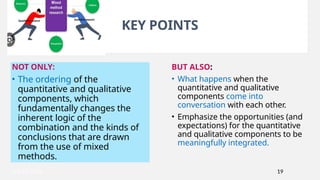
•The ordering of the
quantitative and qualitative
components, which
fundamentally changes the
inherent logic of the
combination and the kinds of
conclusions that are drawn
from the use of mixed
methods.
03/17/2025 19
BUT ALSO:
• What happens when the
quantitative and qualitative
components come into
conversation with each other.
• Emphasize the opportunities (and
expectations) for the quantitative
and qualitative components to be
meaningfully integrated.
20.
Integration is theexplicit
conversation between (or
interrelating of) the quantitative
and qualitative components of a
mixed methods study. It is what
separates a mixed methods study
from a study that happens to
include some quantitative
information and some qualitative
information only.
(Bazeley, 2018; Fetters, Curry, & Creswell, 2013; Teddlie &
Tashakkori,2006).
INTEGRATION
The unique potential of
mixed methods research
comes from the effective
integration of the
quantitative and
qualitative perspectives,
methodologies, data
sources, and data analyses.
However, the unique
challenge of mixed
methods is planning for
and achieving meaningful
integration
21.
CENTRALITY OF RIGOROUSINTEGRATION IN
MIXED METHODS RESEARCH FOR
1. The Institute of Education Sciences (IES) in the United States
emphasized the need for integration in their examination of
mixed methods applications in education research (IES
Technical Working Group, 2015.
2. The W. T. Grant Foundation offered guidance on developing
mixed methods applications that emphasizes the need to plan
for integration within mixed methods studies (Lieber, 2016)
3. The American Psychological Association (2018) has recently
published standards for reporting mixed methods studies that
recommend that researchers describe both the integration
analysis and integration results within their journal articles.
22.
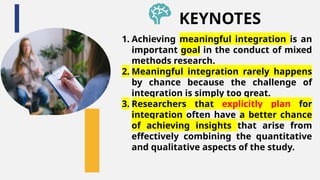
1. Achieving meaningfulintegration is an
important goal in the conduct of mixed
methods research.
2. Meaningful integration rarely happens
by chance because the challenge of
integration is simply too great.
3. Researchers that explicitly plan for
integration often have a better chance
of achieving insights that arise from
effectively combining the quantitative
and qualitative aspects of the study.
KEYNOTES
23.
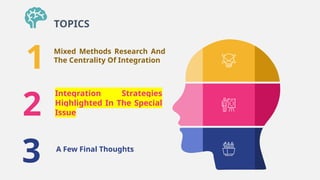
TOPICS
1 Mixed MethodsResearch And
The Centrality Of Integration
2
Integration Strategies
Highlighted In The Special
Issue
3 A Few Final Thoughts
24.
BENEFIT OF INTEGRATIONSTRATEGIES
1. Help researchers design their mixed methods studies with integration in
mind and implement the integration plans during the conduct and
reporting of the studies.
2. Helpful for readers and reviewers of published mixed methods studies
3. Serve as prominent signposts of quality mixed methods applications and
assist readers in understanding why, what, when, and how integration
occurs within mixed methods studies.
25.
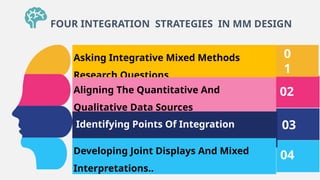
Asking Integrative MixedMethods
Research Questions
Aligning The Quantitative And
Qualitative Data Sources
Identifying Points Of Integration
Developing Joint Displays And Mixed
Interpretations..
0
1
02
03
04
FOUR INTEGRATION STRATEGIES IN MM DESIGN
26.
WHY INTEGRATE: ASKINGINTEGRATIVE MIXED METHODS RESEARCH QUESTIONS
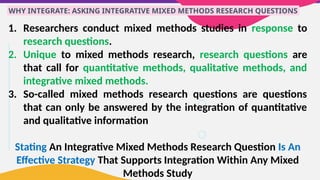
1. Researchers conduct mixed methods studies in response to
research questions.
2. Unique to mixed methods research, research questions are
that call for quantitative methods, qualitative methods, and
integrative mixed methods.
3. So-called mixed methods research questions are questions
that can only be answered by the integration of quantitative
and qualitative information
Stating An Integrative Mixed Methods Research Question Is An
Effective Strategy That Supports Integration Within Any Mixed
Methods Study
27.
WHY INTEGRATE: ASKINGINTEGRATIVE MIXED METHODS RESEARCH
QUESTIONS
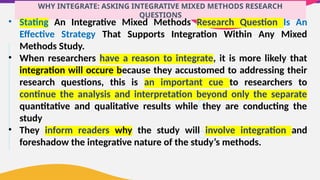
• Stating An Integrative Mixed Methods Research Question Is An
Effective Strategy That Supports Integration Within Any Mixed
Methods Study.
• When researchers have a reason to integrate, it is more likely that
integration will occure because they accustomed to addressing their
research questions, this is an important cue to researchers to
continue the analysis and interpretation beyond only the separate
quantitative and qualitative results while they are conducting the
study
• They inform readers why the study will involve integration and
foreshadow the integrative nature of the study’s methods.
KEYNOTES
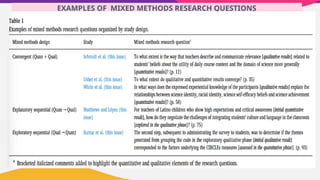
1. The mixedmethods research questions from the three
convergent studies indicate intents to compare or relate the
quantitative and qualitative results to determine insights
about the topic under study.
2. In contrast, the mixed methods research questions for the
two sequential studies convey why the second-phase results
will build on and expand results from the initial phase
30.
WHAT TO INTEGRATE:ALIGNING THE QUANTITATIVE AND QUALITATIVE DATA SOURCES
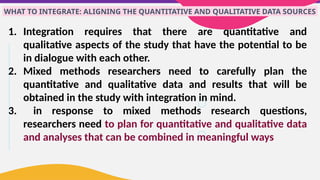
1. Integration requires that there are quantitative and
qualitative aspects of the study that have the potential to be
in dialogue with each other.
2. Mixed methods researchers need to carefully plan the
quantitative and qualitative data and results that will be
obtained in the study with integration in mind.
3. in response to mixed methods research questions,
researchers need to plan for quantitative and qualitative data
and analyses that can be combined in meaningful ways
31.
A good strategyfor identifying integration possibilities
1. To list out the main constructs of interest in the study along
with the corresponding quantitative and qualitative data
sources and identify links among them
2. To plans to gather both quantitative information and
qualitative information about the same construct because
then the researcher has opportunities for integrating the
information.
3. The application of this strategy was particularly effective
when this alignment was represented within a table
If each different data source is used to examine a separate construct, then it
encourages the researcher to keep the quantitative and qualitative results and
interpretations separate
32.
WHEN TO INTEGRATE:IDENTIFYING POINTS OF INTEGRATION
1. These opportunities for integration have also been referred to
as points of interface (Morse & Niehaus, 2009) because they
represent the moments in a mixed methods study when the
two methods come into contact with each other.
2. They can be a challenge to identify and plan for because there
are so many activities occurring in the implementation of a
mixed methods study
3. key strategy highlighted is the development of mixed methods
procedural diagrams.
33.
WHEN TO INTEGRATE:IDENTIFYING POINTS OF INTEGRATION
• Procedural diagrams are visual displays that map out the
temporal flow of activities within a mixed methods study.
• These diagrams are similar in form to the diagrams included in
Fig. 1, but they include specific details about the particular
mixed methods study.
• The activities included are typically the quantitative and
qualitative data collection and analysis, points of integration,
and interpretation (Creswell & Plano Clark, 2018; Ivankova,
Creswell, & Stick, 2006).
34.
WHEN TO INTEGRATE:IDENTIFYING POINTS OF INTEGRATION
• By developing a procedural diagram, mixed methods
researchers work through the timing of the different methods
and explicitly identify when integrative activities will take place.
• These diagrams are often included within journal articles
because they provide readers with a succinct overview of the
methods used in a study.
35.
WHEN TO INTEGRATE:IDENTIFYING POINTS OF INTEGRATION
• The figures for the three convergent designs used a pair of
arrows to indicate when the quantitative and qualitative
components are converged together for integration and
interpretation.
• The sequential designs indicate the two points of integration
that occur: (a) the point between the first and second phases
and (b) the point after the completion of the second phase.
Several of the authors used features to highlight the points
when integration occurred within the figure such as using a
different shape or shading to indicate integration points
38.
HOW TO INTEGRATE:DEVELOPING JOINT DISPLAYS AND MIXED INTERPRETATIONS
• As identified in (Creswell and Plano Clark (2018) Merging
analyses are procedures that interrelate quantitative data and
results with qualitative data and results. Connecting analyses
are procedures for linking the results of one method to the
collection and analysis of data representing the other method.
• The rigorous design and implementation of these integrative
analytic procedures should be communicated in an article’s
method section and a study’s procedural diagram.
• Strategy use of joint displays (analytic and integrative thinking
must occure)
41.
TOPICS
1 Mixed MethodsResearch And
The Centrality Of Integration
2
Integration Strategies
Highlighted In The Special
Issue
3 A Few Final Thoughts
42.
KEYNOTES
• Why tointegrate: Mixing methods can contribute
new insights about the wide range of topics,
populations, settings, and contexts of interest to the
field.
• What to integrate: The studies reported in the
special issue clearly integrated at the level of
methods, with a focus on the data and results
obtained
43.
KEYNOTES
• When tointegrate: Researchers using mixed
methods should follow the example of the special
issue authors by including a procedural diagram that
overviews the study design and highlights points of
integration in their study reports.
• How to integrate: Joint displays are becoming more
widely recognized as highly effective tools for helping
to accomplish meaningful integration within mixed
methods studies.






![CTEV [ clubfoot] DR ARUN LAL ,DR MOHAMED ASHRAF travancore medical college k...](https://cdn.slidesharecdn.com/ss_thumbnails/ctevclubfootdrarunlaldrmohamedashraftravancoremedicalcollegekollamkeralaindia-260208063247-18fc466c-thumbnail.jpg?width=640&height=640&fit=bounds)


![ONFH[AVN HIP] -TRIPLE REGIME -A NOVAL SURGICAL CONCEPT .pptx](https://cdn.slidesharecdn.com/ss_thumbnails/onfhavnhip2026koaconcalicutdrgokuldevdrmashraf-260210064517-213ec005-thumbnail.jpg?width=640&height=640&fit=bounds)


