ISSN 2309-0081 Shah, Durrani & Rehman (2021) 203
Iwww.irss.academyirmbr.com April 2021
International Review of Social Sciences Vol. 9 Issue.4
R
S
S
Identification and Categorization of Research Gaps: An
Overview of Theoretical Gaps
Dr. AHMED ULLAH SHAH
Assistant Professor in Management Sciences,
Kohat University of Science & Technology, Kohat.
Email: dr.ahmed@kust.edu.pk
Tel: +92-333-9685969
SHAHZAD KHAN DURRANI
Lecturer in Management Sciences,
Kohat University of Science & Technology, Kohat.
Email: shahzaddurrani@hotmail.com
SHAHAB REHMAN
Lecturer in English, Kohat University of Science & Technology, Kohat.
Email: shahabrehman214@gmail.com
Abstract
One of the most fundamental and challenging tasks of a researcher is to identify gaps and challenges in
literature and quickly start their research studies. A review of the literature reveals that there exist seven
research gaps in total with no proper categorization. This paper addresses this issue by identifying two
additional research gaps and proposed a proper categorization that will help researchers to specify
whether a gap pertains to a theory or method. This study also highlights different sources of research gaps
and further explanation as to how they may identify research gaps and translate them to problem
statements to start new research studies quickly.
Keywords: Research Gaps, Challenges, Research Methods, Literature Review, Systematic Review, Meta-
Analysis.
Introduction
Researchers in different fields of science have made considerable contributions in their respective fields,
and they have laid a strong foundation by proposing many basic theories and developed significant
literature. Thanks to their persistent contributions, they have evolved and developed their respective fields
up to the level that contemporary researchers can use their prior theories and models to start their studies.
However, many research scholars claim that there exist theoretical or methodological gaps, issues, or errors
in different fields (Farooq, 2018; Miles, 2017).
Thanks to critics, they have also contributed their efforts to identify different kinds of gaps or errors in
literature to build agenda for future research. Robinson, Saldanhea, and McKoy (2011) were among the
earlier scholars who identified five gaps in the literature, such as (1) Outcomes, (2) Comparison, (3)
Population, (4) Intervention, and (5) Setting. Similarly, Muller-Bloch and Kranz, (2014), based on Jacob’s
(2011) theory also reported a list of six research gaps, which include: (1) Knowledge Void Gap, (2)
Contradictory Evidence Gap, (3) Action-Knowledge Conflict Gap, (4) Evaluation Void Gap, (5)
ISSN 2309-0081 Shah, Durrani & Rehman (2021) 204
Iwww.irss.academyirmbr.com April 2021
International Review of Social Sciences Vol. 9 Issue.4
R
S
S
Methodological Gap, and (6) Theory Application Void Gap. While Miles (2017) extended this list to seven
research gaps, which are: (1) Practical-Knowledge Conflict Gap, (2) Evidence Gap, (3) Empirical Gap, (4)
Theoretical Gap, (5) Methodological Gap, (6) Knowledge Gap, and (7) Population Gap.
The literature reviewed in the aforementioned papers reveals that research problems, issues, or errors in
different fields of sciences evolved with time and expanded in the form of research gaps; at present, such
research gaps are greater than 5 in a majority of cases. The abovementioned sources further reveal seven
research gaps at maximum with no clear distinction between theoretical and methodological gaps.
However, in some fields, such as organizational behavior and human resource management such gaps have
been divided into theoretical and methodological gaps. For example, Paauwe & Boselie (2005) mentioned
there exist theoretical and methodological problems. Likewise, Wright & Gardner (2003) have also
reported that there are significant methodological and theoretical challenges in the field of HRM.
This paper concentrates on theoretical gaps only and more specifically focuses on the evidence gap,
knowledge gap, and practical gaps, which would provide a strong foundation for this study. Furthermore, it
presents an overview and summarizes the theoretical gaps, issues in the literature, which may then be used
to initiate future research. The objective of this paper is to review existing theoretical gaps and to identify
the remaining gaps available in the literature. Even though researchers have identified many theoretical
gaps, which helps new researchers and Ph.D. students to create agenda for research; however, some gaps
still need to be identified for future research. The research method of this paper is evaluating and
combining the existing available scientific literature on theoretical gaps, issues, and errors.
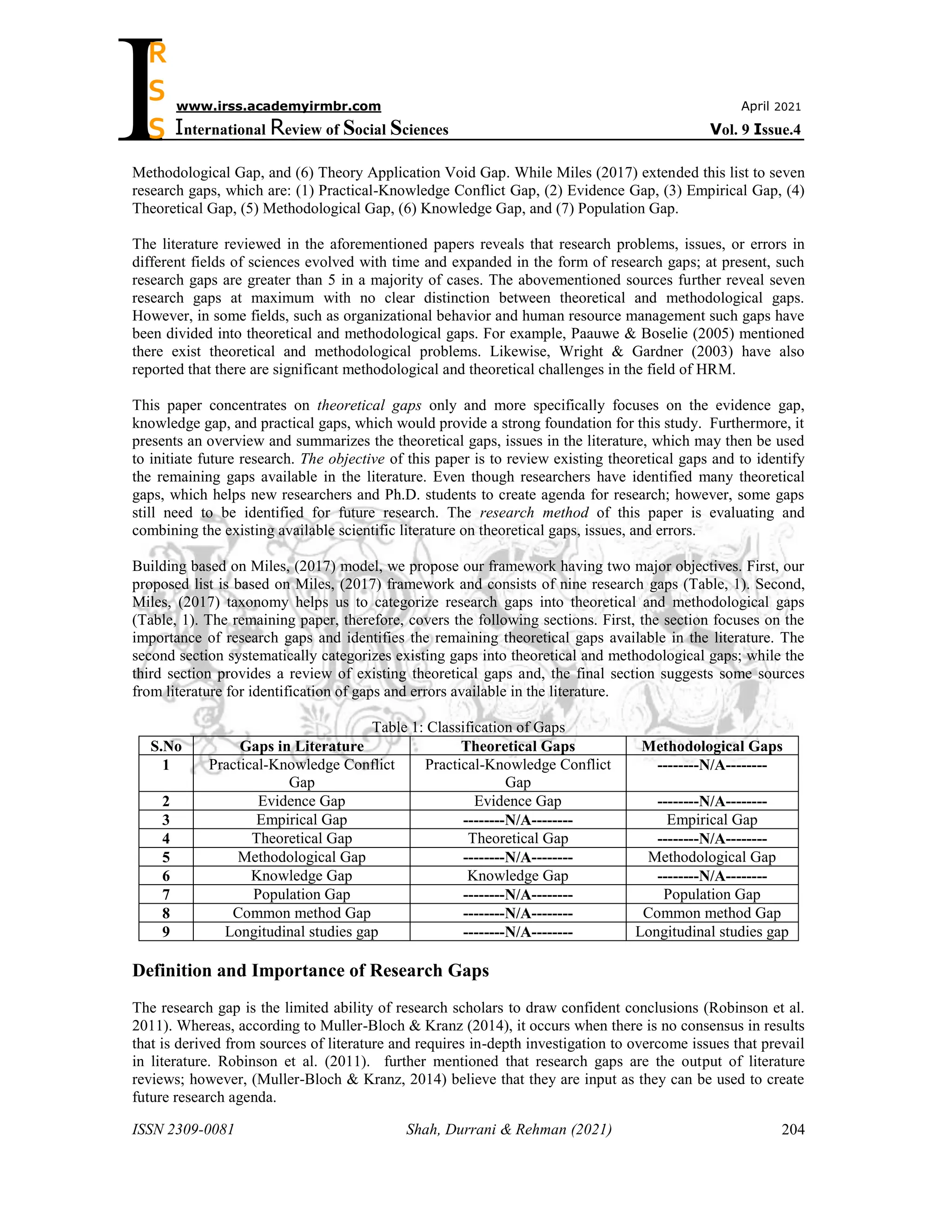
Building based on Miles, (2017) model, we propose our framework having two major objectives. First, our
proposed list is based on Miles, (2017) framework and consists of nine research gaps (Table, 1). Second,
Miles, (2017) taxonomy helps us to categorize research gaps into theoretical and methodological gaps
(Table, 1). The remaining paper, therefore, covers the following sections. First, the section focuses on the
importance of research gaps and identifies the remaining theoretical gaps available in the literature. The
second section systematically categorizes existing gaps into theoretical and methodological gaps; while the
third section provides a review of existing theoretical gaps and, the final section suggests some sources
from literature for identification of gaps and errors available in the literature.
Table 1: Classification of Gaps
S.No Gaps in Literature Theoretical Gaps Methodological Gaps
1 Practical-Knowledge Conflict
Gap
Practical-Knowledge Conflict
Gap
--------N/A--------
2 Evidence Gap Evidence Gap --------N/A--------
3 Empirical Gap --------N/A-------- Empirical Gap
4 Theoretical Gap Theoretical Gap --------N/A--------
5 Methodological Gap --------N/A-------- Methodological Gap
6 Knowledge Gap Knowledge Gap --------N/A--------
7 Population Gap --------N/A-------- Population Gap
8 Common method Gap --------N/A-------- Common method Gap
9 Longitudinal studies gap --------N/A-------- Longitudinal studies gap
Definition and Importance of Research Gaps
The research gap is the limited ability of research scholars to draw confident conclusions (Robinson et al.
2011). Whereas, according to Muller-Bloch & Kranz (2014), it occurs when there is no consensus in results
that is derived from sources of literature and requires in-depth investigation to overcome issues that prevail
in literature. Robinson et al. (2011). further mentioned that research gaps are the output of literature
reviews; however, (Muller-Bloch & Kranz, 2014) believe that they are input as they can be used to create
future research agenda.
ISSN 2309-0081 Shah, Durrani & Rehman (2021) 205
Iwww.irss.academyirmbr.com April 2021
International Review of Social Sciences Vol. 9 Issue.4
R
S
S
According to Jacobs (2011), the research problem statement consists of multiple gaps in sources of
literature that when systematically evaluated, results in the creation of future research agenda. He further
suggested that research problems should be identified through literature reviews. Whereas the research
agenda is a number of research questions designed for future research (vom Brocke et al. 2009).
Literature is commonly used for the identification of research gaps or errors; however, the process used is
unclear. In this connection, a survey of sixty-four international systematic review organizations found that
out of thirty-seven organizations only five respondents presented a due process for the identification of
research gaps. The identification of research gaps, issues, and errors in different areas of research is
challenging for new researchers and research students. Many academicians and scholars feel difficulty in
identification of relevant research gaps in their area of research interest. For example, identification of a
broad problem area and then narrowing it down to a specific area can lead to the identification of the
research problem and problem statement. This area of research has not been properly addressed, in prior
research (Farooq, 2018; Miles, 2017).
Identification of Missing Research Gaps
Robinson et al., (2011) initially presented five research gaps in literature; while Muller-Bloch and Kranz,
(2014) reported six research gaps. Likewise, Miles (2017) extended this list to seven research gaps.
However, in the literature, there are other research gaps that have not been highlighted by the
aforementioned sources. For example, significant numbers of scholars have talked about common method
gaps, and cross-sectional designs, whereas these two gaps have not been included in the aforementioned
sources.
Common method gap arises when data regarding an independent and dependent variable is collected from a
single respondent (Patterson et al., 2010; Wright et al., 2000; Becker & Gerhart, 1996; Wright et al., 2001;
Wall & Wood, 2005; Gerhart, 2007; & Purcell & Kinnie, 2007). This gap by and large arises irrespective of
organizational size and the effect sizes are difficult to interpret (Wright et al., 2000). This type of gap may
lead to biased results pertaining to their research questions.
Similarly, Wall & Wood (2005) reviewed 25 papers out of which 21 papers used the common method.
They also reported that a large focus on a common method produces spurious results. Similarly, Patterson
et al., (2010) also mentioned that considerable numbers of research articles have used a common method.
This indicates that this gap is largely prevalent in literature irrespective of the fact that it may produce
biased results.
Furthermore, the sources of literature on research gaps further reveal that researchers, by and large, have
used cross-sectional design; at the cost of longitudinal research designs (Legge, 2005; Wright & Gardner,
2003; Boxall, Purcell & Wright, 2007). Many researchers have criticized over-emphasis on cross-sectional
designs (Boselie et al., 2005; Wall & Wood, 2005; & Purcell & Kinnie, 2007). Moreover, Patterson et al.,
(2010) reported that this over-reliance may confine the researchers’ ability to reach conclusions. The
problem with this design is that it does not lead to causality; therefore, it should be avoided in future
research (Sonnentag, 2003).
Categorization of Research Gaps
Using Miles's (2017) framework we have categorized research gaps into theoretical and methodological
gaps (Table 1). Miles (2017) provides a clear conceptual base of different research gaps, which help us to
easily categorize it in their specific category. A simple criterion for the categorization of different gaps was
used. For instance, all those gaps which were relevant to the theory were placed in theoretical gaps; while
those gaps which were related to methods were grouped under the heading of methodological gaps. Such
type of categorization seems logical as it would help researchers to avoid these gaps specifically both in
theory and in methods.
ISSN 2309-0081 Shah, Durrani & Rehman (2021) 206
Iwww.irss.academyirmbr.com April 2021
International Review of Social Sciences Vol. 9 Issue.4
R
S
S
For example, pertaining to the evidence gap it states that there is no clear definition or consensus on the
concept or construct. This was also reported in contemporary literature (Jacobs, 2011; Miles, 2017; Muller-
Bloch & Kranz, 2014) that research results would permit for conclusions in researchers’ own right, but it is
not consistent when evaluated from a broader perspective, such as systematic review, and meta-analysis.
This definition of evidence gap clearly deals with the gaps in theory; therefore, this gap was categorized
under the heading of theoretical gaps.
Similarly, the knowledge gap states that results are not in compliance with our expectations. In this context,
(Jacobs, 2011; Miles, 2017; Muller-Bloch & Kranz, 2014) reported that desired results do not exist. As the
knowledge gap relates to the gaps in theory; hence, this knowledge gap was also included in the list of
theoretical gaps.
Moreover, practical knowledge gaps indicate that there is a conflict between theory and practice. More
recent studies also found that professional/manager behavior is not consistent with research results or some
theories/models are not covered by research (Jacobs, 2011; Miles, 2017; Muller-Bloch & Kranz, 2014).
This means that there are some missing theories, which have not been covered in the research. Since this
gap is also related to the gaps in theory, so it is also grouped under the heading of theoretical gaps.
Likewise, the empirical gap states that research results need to be analyzed or verified empirically.
Contemporary research on this gap generally reported that very few researchers to date have analyzed an
area/subject or topic from an empirical perspective (Jacobs, 2011; Miles, 2017; Muller-Bloch & Kranz,
2014). As this gap deals with a gap in research methods; therefore, it has been categorized under the
heading of methodological gaps.
The population gap pertains to people that are not sufficiently researched/represented in prior research. For
example, a particular age may have been ignored in any particular area or a particular gender or ethnic
group may not have sufficient representation in prior research. Literature, in this regard, maybe evaluated
based on race, gender, ethnic group, and age, etc to identify the population gaps (Jacobs, 2011; Miles, 2017;
Muller-Bloch & Kranz, 2014). Since this gap deals with methods; therefore, it has also been categorized
under the heading of methodological gaps.
Further, in our prior section, we have presented a review of two additional gaps, which include: common
method gap, and the longitudinal studies gap. Since these two gaps also deal with methodology; hence, they
have been grouped in methodological gaps.
Theoretical Gaps
According to Miles (2017), theoretical gaps are the kind of gap that exists in prior research and deals with
the gaps in the theory. This gap occurs if a concept is explained through many theoretical and conceptual
models; in this case, theoretical conflict occurs. Researchers would try to evaluate whether one theoretical
model is better than others to explain the concept (Muler-Bloch & Kranz, 2014).
For example, the concept of human resource management has been explained through many theoretical
models, such as universalistic perspective, contingency theory, ability, motivation, and opportunity theory,
configurational perspective, resource-based view, fully integrated model, a mixture of two to three models,
and organizational justice, etc. In this case, we can say that there is no consensus among researchers
regarding the conceptualization of this concept. This means that a single concept is defined and believe
differently by different researchers; therefore, theoretical gaps exist in this concept. Muler-Bloch & Kranz,
(2014) believe that theoretical gaps have significant prevalence in literature while evaluating prior research
on a concept/construct.
ISSN 2309-0081 Shah, Durrani & Rehman (2021) 207
Iwww.irss.academyirmbr.com April 2021
International Review of Social Sciences Vol. 9 Issue.4
R
S
S
Table 2: Research Gap and Its Types
Type of Research Gap Research Gap Definition
Theoretical Gap
Theory must be used to clear research gaps and to create new
research agenda. There are some missing elements in theory;
therefore, a gap exists (Jacobs, 2011; Miles, 2017; Muller-Bloch &
Kranz, 2014).
Evidence Gap
Research results would permit for conclusions in researchers’ own
right, but they are not consistent when evaluated from a broader
perspective (Jacobs, 2011; Miles, 2017; Muller-Bloch & Kranz,
2014).
Knowledge Gap Empirical results are not according to our expectations (Jacobs,
2011; Miles, 2017; Muller-Bloch & Kranz, 2014).
Practical Knowledge Gap
This type of conflict arises when managers'/agents' behavior is not
consistent with theories (Jacobs, 2011; Miles, 2017; Muller-Bloch &
Kranz, 2014).
Source: Robinson, Saldanhea, & McKoy (2011); Miles, 2017; Muller-Bloch & Kranz, (2014).
Evidence Gap
This type of gap arises when contemporary research results are not consistent with generally accepted
conclusions. This gap contains errors in the empirical results of the prior research. Contemporary literature
(Jacobs, 2011; Miles, 2017; Muller-Bloch & Kranz, 2014) also reported that such research results would
permit for conclusions in researchers’ own right, but they are not consistent when evaluated from a broader
perspective, such as systematic review, and meta-analysis. Evidence gaps are usually identified when each
research stream is analyzed separately. Such results may then be summarized or synthesized via meta-
analysis or systematic analysis to identify inconsistent evidence (Muller-Bloch & Kranz, 2014).
Knowledge Gap
This type of gap is most common in prior research. Muller-Bloch & Kranz (2014) reported two situations,
where the knowledge gap most likely occurs. First, there will be little or no knowledge in the actual field in
the form of theories and literature but in other relevant research areas. In this connection, scholars need to
refer to concepts, theories, and models of the related research areas to complete the concept or theory.
Second, it may be the reason that research findings differ from our expectations. This kind of unexpected
results provides additional opportunities for further research (Muller-Bloch & Kranz, 2014).
Practical-Knowledge Gap
This type of conflict arises when managers'/agents’ behavior is not consistent with theories. This type of
inconsistent behavior of professionals creates a gap and motivates researchers to conduct new research in
order to determine the level of the conflict and to identify the reasons behind it (Muller-Bloch & Kranz,
2014).
ISSN 2309-0081 Shah, Durrani & Rehman (2021) 208
Iwww.irss.academyirmbr.com April 2021
International Review of Social Sciences Vol. 9 Issue.4
R
S
S
Gaps
Theoretical
Gaps
Knowledge Gap
Knowlege
Conflict Gap
Evidence Gap
Methodological
Gaps
Population
Gaps
Empirical Gap
Common
Method Gap
Longitudnal
Studies Gap
Graph 1. Types of Gaps
Sources of Research Gaps
Muller-Bloch & Kranz, (2014) proposed a review of relevant literature for the identification of research
gaps. However, Farooq (2017) has proposed six additional sources, such as citation analysis, content
analysis, meta-analysis, systematic review, future research, and preferred reporting items of systematic
reviews and meta-analysis framework. A brief overview of some of the sources is presented here as to how
they may be used to identify research gaps for future research.
Review of Relevant Literature
One of the most comprehensive approaches for research gaps identification is an in-depth review of the
literature (Muller, 2015). A review of existing literature should evaluate prior sources of research regarding
a particular field and should also identify research gaps (Rowe 2014; Hart 2009; and Webster & Watson
2002) that may be identified while evaluating and summarizing existing research (Cooper 1998). A
research synthesis and systematic review may be helpful as to why and where further research would be
more useful (Eagly & Wood, 1994).
Some researchers (Vom Brocke et al. 2009) mentioned that a review of relevant literature in the area of IS
comprises five phases. First, the scope of the relevant literature review needs to be determined. Second, the
concept should be defined, and its dimensions be identified. This phase should include concept definitions
and the definition of concept major dimensions (Zorn & Campbell, 2006). Third, sources of literature are
identified by literature search. In this phase (phase four), the relevant literature is evaluated and
summarized. Finally, many research questions are identified based on research gaps derived from literature
synthesis (vom Brocke et al. 2009). This shows that the last phase of Von Brocke et al. (2009) framework
is extremely important for the identification of research gaps. It is highly relevant to mention that the
literature evaluation and synthesis (phase 4) is different from the identification of research gaps process
(phase 5) according to Brocke et al. (2009) framework.
Meta-Analysis
It is the process of evaluating and combining the results of prior research studies by statistically evaluating
the literature. The use of literature reviews especially meta-analysis for the identification of research gaps is
one of the most challenging jobs for research scholars who have limited knowledge and understanding
pertaining to meta-analysis (Farooq, 2017). Meta-analysis presents a comprehensive overview of a
ISSN 2309-0081 Shah, Durrani & Rehman (2021) 209
Iwww.irss.academyirmbr.com April 2021
International Review of Social Sciences Vol. 9 Issue.4
R
S
S
particular concept, that is., how a concept was empirically tested and measured and what are the empirical
results of that particular concept. Identifying theoretical research gaps employing literature review
especially meta-analysis is unused and unknown due to limited knowledge and information of researchers
regarding meta-analysis (Farooq, 2017).
Systematic Reviews
The systematic review is the process of evaluating, summarizing, and reporting the empirical results and
implications of a large number of research papers (Green, 2005). This type of review collects the literature
pertaining to a specific issue and then evaluates it to identify the gaps and research problems. The objective
of a systematic review is to analyze the literature for the identification of research questions and contribute
further to existing literature (Tranfield et al. 2003). Robinson et al. (2011) also proposed a theory applying
systematic reviews to identify and define research gaps prevailing in literature.
Future Research and Limitations
In addition to earlier mentioned sources, some researchers (Price, 2004) have also talked about research
limitations, such as, limitation in research design or small sample size, or limitations in the questionnaire
are the gaps that the researcher was unable to control; therefore, it may affect the results”. Research
limitation is an essential section of theses, research papers, and reports, etc which is available to identify
research gaps and agenda for future research. For example, if a researcher intends to find the association
between human resource management practices and employees’ turnover, and the researcher has not
included the intervening mechanism of job satisfaction, this will be the limitation of his study and a gap for
future research. A review and synthesis of research limitations and future research would be helpful to
identify research gaps and research questions for further research in any particular field (Farooq, 2017).
References
Becker, B.E., & Gerhart, B. (1996). The impact of human resource management on organizational
performance: Progress and prospects. Academy of Management Journal, 39, 779-801.
Boxall, P., Purcell, J., & Wright, P. (2007). The oxford handbook of human resource management edited
by. Oxford University Press.
Brocke, Jan vom, et al., (2009). Reconstructing the giant: on the importance of rigour in documenting the
literature search process".
Eagly, A. H., & Wood, W. (1991). Explaining sex differences in social behavior: A meta-analytic
perspective. Personality and Social Psychology Bulletin, 17, 306-315.
Farooq, R. (2017). A framework for identifying research gap in social sciences: evidence from the
past. Journal of Management and Research, 16, 66.
Green S. (2005). Systematic reviews and meta-analysis. Singapore medical journal, 46(6), 270–274.
J. Webster, R.T. Watson Analyzing the past to prepare for the future: Writing a literature review
Management Information Systems Quarterly, 26 (2002), p.3.
Jacobs, R. L. (2011). Developing a research problem and purpose statement" in The Handbook of Scholarly
Writing and Publishing, T. S. Rocco and T. Hatcher (eds.), San Francisco: Jossey-Bass, pp. 125–141.
Legge, K. (2005). Human resource management rhetoric and realities. London: Palgrave Macmillan.
Miles, D.A. (2017). A taxonomy of research gaps: identifying and defining the seven research gaps,
Doctoral Student Workshop: Finding Research Gaps - Research Methods and Strategies, Dallas,
Texas.
Müller-Bloch, C. & Kranz, J., (2014). A framework for rigorously identifying research gaps in qualitative
literature reviews, The Thirty Sixth International Conference on Information Systems, Fort Worth
2015, pp. 1–19.
Müller-Bloch, C., & Kranz, J. (2015). A framework for rigorously identifying research gaps in Qualitative
Literature Reviews. ICIS.
ISSN 2309-0081 Shah, Durrani & Rehman (2021) 210
Iwww.irss.academyirmbr.com April 2021
International Review of Social Sciences Vol. 9 Issue.4
R
S
S
Paauwe, J. & Boselie, P. (2005). HRM and performance: what next? Human Resource Management
Journal, 15, 68–83.
Paauwe, J. & Boselie, P. (2005). HRM and performance: what next? Human Resource Management
Journal, 15, 68–83.
Patterson, M., Rick, J., Wood, S., Carroll, C., Balain, S., and Booth, A. (2010). Systematic review of the
links between human resource management practices and performance. Health Technology
Assessment, 14(51).
Purcell, J. and Kinnie, N. (2007). Human resource management and business performance. In The oxford
handbook of human resource management, (eds) P. Boxall, J. Purcell and P. Wright. Oxford
University Press, Oxford.
Robinson, K. A., Saldanha, I. J., & McKoy, N. A. (2011). Development of a framework to identify research
gaps from systematic reviews. Journal of clinical epidemiology, 64(12), 1325–1330.
Robinson, K., Saldanha, I. & McKoy, N.A. (2011). Development of a framework for to identify research
gaps systematic reviews. Journal of Epidemiology, 64(1), pp. 1325-1330.
Rowe F. What literature review is not: diversity, boundaries and recommendations. European Journal of
Information Systems. 2014;23(3):241–255.
Summers, J. (2011). Guidelines for conducting research and publishing in marketing: from
conceptualization through the review process, Journal of the Academy of Marketing Science, 29(4), pp.
405-415.
Tranfield, D., Denyer, D. and Smart, P. (2003). Towards a methodology for developing evidence: informed
management knowledge by means of systematic review. British Journal of Management, 14, 207-222.
Wall, T. D., & Wood, S. J. (2005). The romance of human resource management and business
performance, and the case for big science. Human Relations, 58(4), 429-462.
Wright, P.M. & Gardner, T.M (2003). The human resource–firm performance relationship:
Methodological and theoretical challenges. In D. Holman, T.D. Wall, C.W. Clegg, P. Sparrow & A.
Howard (Eds), The new workplace: A guide to the human impact of modern working practices.
Chichester: Wiley.
Wright, P.M., Gardner, T.M., Moynihan, L.M., & Allen, M.R. (2005). The relationship between HR practices
and firm performance: Examining the causal order. Personnel Psychology, 52, 409-446.
Wright, P.M., Gardner, T.M., Moynihan, L.M., Park, H.J., Delery, J.R., & Gerhart, B. (2001).
Measurement error in research on human resources and firm performance: Additional data and
suggestions for future research. Personnel Psychology, 54, 875-901.
Zorn, T. & Campbell, N. (2006), Improving the writing of literature reviews through a literature integration
exercise. Business Communication Quarterly, 69(2), 172-183.

research gap research gap research gap research gap

  • 1.
    ISSN 2309-0081 Shah,Durrani & Rehman (2021) 203 Iwww.irss.academyirmbr.com April 2021 International Review of Social Sciences Vol. 9 Issue.4 R S S Identification and Categorization of Research Gaps: An Overview of Theoretical Gaps Dr. AHMED ULLAH SHAH Assistant Professor in Management Sciences, Kohat University of Science & Technology, Kohat. Email: dr.ahmed@kust.edu.pk Tel: +92-333-9685969 SHAHZAD KHAN DURRANI Lecturer in Management Sciences, Kohat University of Science & Technology, Kohat. Email: shahzaddurrani@hotmail.com SHAHAB REHMAN Lecturer in English, Kohat University of Science & Technology, Kohat. Email: shahabrehman214@gmail.com Abstract One of the most fundamental and challenging tasks of a researcher is to identify gaps and challenges in literature and quickly start their research studies. A review of the literature reveals that there exist seven research gaps in total with no proper categorization. This paper addresses this issue by identifying two additional research gaps and proposed a proper categorization that will help researchers to specify whether a gap pertains to a theory or method. This study also highlights different sources of research gaps and further explanation as to how they may identify research gaps and translate them to problem statements to start new research studies quickly. Keywords: Research Gaps, Challenges, Research Methods, Literature Review, Systematic Review, Meta- Analysis. Introduction Researchers in different fields of science have made considerable contributions in their respective fields, and they have laid a strong foundation by proposing many basic theories and developed significant literature. Thanks to their persistent contributions, they have evolved and developed their respective fields up to the level that contemporary researchers can use their prior theories and models to start their studies. However, many research scholars claim that there exist theoretical or methodological gaps, issues, or errors in different fields (Farooq, 2018; Miles, 2017). Thanks to critics, they have also contributed their efforts to identify different kinds of gaps or errors in literature to build agenda for future research. Robinson, Saldanhea, and McKoy (2011) were among the earlier scholars who identified five gaps in the literature, such as (1) Outcomes, (2) Comparison, (3) Population, (4) Intervention, and (5) Setting. Similarly, Muller-Bloch and Kranz, (2014), based on Jacob’s (2011) theory also reported a list of six research gaps, which include: (1) Knowledge Void Gap, (2) Contradictory Evidence Gap, (3) Action-Knowledge Conflict Gap, (4) Evaluation Void Gap, (5)
  • 2.
    ISSN 2309-0081 Shah,Durrani & Rehman (2021) 204 Iwww.irss.academyirmbr.com April 2021 International Review of Social Sciences Vol. 9 Issue.4 R S S Methodological Gap, and (6) Theory Application Void Gap. While Miles (2017) extended this list to seven research gaps, which are: (1) Practical-Knowledge Conflict Gap, (2) Evidence Gap, (3) Empirical Gap, (4) Theoretical Gap, (5) Methodological Gap, (6) Knowledge Gap, and (7) Population Gap. The literature reviewed in the aforementioned papers reveals that research problems, issues, or errors in different fields of sciences evolved with time and expanded in the form of research gaps; at present, such research gaps are greater than 5 in a majority of cases. The abovementioned sources further reveal seven research gaps at maximum with no clear distinction between theoretical and methodological gaps. However, in some fields, such as organizational behavior and human resource management such gaps have been divided into theoretical and methodological gaps. For example, Paauwe & Boselie (2005) mentioned there exist theoretical and methodological problems. Likewise, Wright & Gardner (2003) have also reported that there are significant methodological and theoretical challenges in the field of HRM. This paper concentrates on theoretical gaps only and more specifically focuses on the evidence gap, knowledge gap, and practical gaps, which would provide a strong foundation for this study. Furthermore, it presents an overview and summarizes the theoretical gaps, issues in the literature, which may then be used to initiate future research. The objective of this paper is to review existing theoretical gaps and to identify the remaining gaps available in the literature. Even though researchers have identified many theoretical gaps, which helps new researchers and Ph.D. students to create agenda for research; however, some gaps still need to be identified for future research. The research method of this paper is evaluating and combining the existing available scientific literature on theoretical gaps, issues, and errors. Building based on Miles, (2017) model, we propose our framework having two major objectives. First, our proposed list is based on Miles, (2017) framework and consists of nine research gaps (Table, 1). Second, Miles, (2017) taxonomy helps us to categorize research gaps into theoretical and methodological gaps (Table, 1). The remaining paper, therefore, covers the following sections. First, the section focuses on the importance of research gaps and identifies the remaining theoretical gaps available in the literature. The second section systematically categorizes existing gaps into theoretical and methodological gaps; while the third section provides a review of existing theoretical gaps and, the final section suggests some sources from literature for identification of gaps and errors available in the literature. Table 1: Classification of Gaps S.No Gaps in Literature Theoretical Gaps Methodological Gaps 1 Practical-Knowledge Conflict Gap Practical-Knowledge Conflict Gap --------N/A-------- 2 Evidence Gap Evidence Gap --------N/A-------- 3 Empirical Gap --------N/A-------- Empirical Gap 4 Theoretical Gap Theoretical Gap --------N/A-------- 5 Methodological Gap --------N/A-------- Methodological Gap 6 Knowledge Gap Knowledge Gap --------N/A-------- 7 Population Gap --------N/A-------- Population Gap 8 Common method Gap --------N/A-------- Common method Gap 9 Longitudinal studies gap --------N/A-------- Longitudinal studies gap Definition and Importance of Research Gaps The research gap is the limited ability of research scholars to draw confident conclusions (Robinson et al. 2011). Whereas, according to Muller-Bloch & Kranz (2014), it occurs when there is no consensus in results that is derived from sources of literature and requires in-depth investigation to overcome issues that prevail in literature. Robinson et al. (2011). further mentioned that research gaps are the output of literature reviews; however, (Muller-Bloch & Kranz, 2014) believe that they are input as they can be used to create future research agenda.
  • 3.
    ISSN 2309-0081 Shah,Durrani & Rehman (2021) 205 Iwww.irss.academyirmbr.com April 2021 International Review of Social Sciences Vol. 9 Issue.4 R S S According to Jacobs (2011), the research problem statement consists of multiple gaps in sources of literature that when systematically evaluated, results in the creation of future research agenda. He further suggested that research problems should be identified through literature reviews. Whereas the research agenda is a number of research questions designed for future research (vom Brocke et al. 2009). Literature is commonly used for the identification of research gaps or errors; however, the process used is unclear. In this connection, a survey of sixty-four international systematic review organizations found that out of thirty-seven organizations only five respondents presented a due process for the identification of research gaps. The identification of research gaps, issues, and errors in different areas of research is challenging for new researchers and research students. Many academicians and scholars feel difficulty in identification of relevant research gaps in their area of research interest. For example, identification of a broad problem area and then narrowing it down to a specific area can lead to the identification of the research problem and problem statement. This area of research has not been properly addressed, in prior research (Farooq, 2018; Miles, 2017). Identification of Missing Research Gaps Robinson et al., (2011) initially presented five research gaps in literature; while Muller-Bloch and Kranz, (2014) reported six research gaps. Likewise, Miles (2017) extended this list to seven research gaps. However, in the literature, there are other research gaps that have not been highlighted by the aforementioned sources. For example, significant numbers of scholars have talked about common method gaps, and cross-sectional designs, whereas these two gaps have not been included in the aforementioned sources. Common method gap arises when data regarding an independent and dependent variable is collected from a single respondent (Patterson et al., 2010; Wright et al., 2000; Becker & Gerhart, 1996; Wright et al., 2001; Wall & Wood, 2005; Gerhart, 2007; & Purcell & Kinnie, 2007). This gap by and large arises irrespective of organizational size and the effect sizes are difficult to interpret (Wright et al., 2000). This type of gap may lead to biased results pertaining to their research questions. Similarly, Wall & Wood (2005) reviewed 25 papers out of which 21 papers used the common method. They also reported that a large focus on a common method produces spurious results. Similarly, Patterson et al., (2010) also mentioned that considerable numbers of research articles have used a common method. This indicates that this gap is largely prevalent in literature irrespective of the fact that it may produce biased results. Furthermore, the sources of literature on research gaps further reveal that researchers, by and large, have used cross-sectional design; at the cost of longitudinal research designs (Legge, 2005; Wright & Gardner, 2003; Boxall, Purcell & Wright, 2007). Many researchers have criticized over-emphasis on cross-sectional designs (Boselie et al., 2005; Wall & Wood, 2005; & Purcell & Kinnie, 2007). Moreover, Patterson et al., (2010) reported that this over-reliance may confine the researchers’ ability to reach conclusions. The problem with this design is that it does not lead to causality; therefore, it should be avoided in future research (Sonnentag, 2003). Categorization of Research Gaps Using Miles's (2017) framework we have categorized research gaps into theoretical and methodological gaps (Table 1). Miles (2017) provides a clear conceptual base of different research gaps, which help us to easily categorize it in their specific category. A simple criterion for the categorization of different gaps was used. For instance, all those gaps which were relevant to the theory were placed in theoretical gaps; while those gaps which were related to methods were grouped under the heading of methodological gaps. Such type of categorization seems logical as it would help researchers to avoid these gaps specifically both in theory and in methods.
  • 4.
    ISSN 2309-0081 Shah,Durrani & Rehman (2021) 206 Iwww.irss.academyirmbr.com April 2021 International Review of Social Sciences Vol. 9 Issue.4 R S S For example, pertaining to the evidence gap it states that there is no clear definition or consensus on the concept or construct. This was also reported in contemporary literature (Jacobs, 2011; Miles, 2017; Muller- Bloch & Kranz, 2014) that research results would permit for conclusions in researchers’ own right, but it is not consistent when evaluated from a broader perspective, such as systematic review, and meta-analysis. This definition of evidence gap clearly deals with the gaps in theory; therefore, this gap was categorized under the heading of theoretical gaps. Similarly, the knowledge gap states that results are not in compliance with our expectations. In this context, (Jacobs, 2011; Miles, 2017; Muller-Bloch & Kranz, 2014) reported that desired results do not exist. As the knowledge gap relates to the gaps in theory; hence, this knowledge gap was also included in the list of theoretical gaps. Moreover, practical knowledge gaps indicate that there is a conflict between theory and practice. More recent studies also found that professional/manager behavior is not consistent with research results or some theories/models are not covered by research (Jacobs, 2011; Miles, 2017; Muller-Bloch & Kranz, 2014). This means that there are some missing theories, which have not been covered in the research. Since this gap is also related to the gaps in theory, so it is also grouped under the heading of theoretical gaps. Likewise, the empirical gap states that research results need to be analyzed or verified empirically. Contemporary research on this gap generally reported that very few researchers to date have analyzed an area/subject or topic from an empirical perspective (Jacobs, 2011; Miles, 2017; Muller-Bloch & Kranz, 2014). As this gap deals with a gap in research methods; therefore, it has been categorized under the heading of methodological gaps. The population gap pertains to people that are not sufficiently researched/represented in prior research. For example, a particular age may have been ignored in any particular area or a particular gender or ethnic group may not have sufficient representation in prior research. Literature, in this regard, maybe evaluated based on race, gender, ethnic group, and age, etc to identify the population gaps (Jacobs, 2011; Miles, 2017; Muller-Bloch & Kranz, 2014). Since this gap deals with methods; therefore, it has also been categorized under the heading of methodological gaps. Further, in our prior section, we have presented a review of two additional gaps, which include: common method gap, and the longitudinal studies gap. Since these two gaps also deal with methodology; hence, they have been grouped in methodological gaps. Theoretical Gaps According to Miles (2017), theoretical gaps are the kind of gap that exists in prior research and deals with the gaps in the theory. This gap occurs if a concept is explained through many theoretical and conceptual models; in this case, theoretical conflict occurs. Researchers would try to evaluate whether one theoretical model is better than others to explain the concept (Muler-Bloch & Kranz, 2014). For example, the concept of human resource management has been explained through many theoretical models, such as universalistic perspective, contingency theory, ability, motivation, and opportunity theory, configurational perspective, resource-based view, fully integrated model, a mixture of two to three models, and organizational justice, etc. In this case, we can say that there is no consensus among researchers regarding the conceptualization of this concept. This means that a single concept is defined and believe differently by different researchers; therefore, theoretical gaps exist in this concept. Muler-Bloch & Kranz, (2014) believe that theoretical gaps have significant prevalence in literature while evaluating prior research on a concept/construct.
  • 5.
    ISSN 2309-0081 Shah,Durrani & Rehman (2021) 207 Iwww.irss.academyirmbr.com April 2021 International Review of Social Sciences Vol. 9 Issue.4 R S S Table 2: Research Gap and Its Types Type of Research Gap Research Gap Definition Theoretical Gap Theory must be used to clear research gaps and to create new research agenda. There are some missing elements in theory; therefore, a gap exists (Jacobs, 2011; Miles, 2017; Muller-Bloch & Kranz, 2014). Evidence Gap Research results would permit for conclusions in researchers’ own right, but they are not consistent when evaluated from a broader perspective (Jacobs, 2011; Miles, 2017; Muller-Bloch & Kranz, 2014). Knowledge Gap Empirical results are not according to our expectations (Jacobs, 2011; Miles, 2017; Muller-Bloch & Kranz, 2014). Practical Knowledge Gap This type of conflict arises when managers'/agents' behavior is not consistent with theories (Jacobs, 2011; Miles, 2017; Muller-Bloch & Kranz, 2014). Source: Robinson, Saldanhea, & McKoy (2011); Miles, 2017; Muller-Bloch & Kranz, (2014). Evidence Gap This type of gap arises when contemporary research results are not consistent with generally accepted conclusions. This gap contains errors in the empirical results of the prior research. Contemporary literature (Jacobs, 2011; Miles, 2017; Muller-Bloch & Kranz, 2014) also reported that such research results would permit for conclusions in researchers’ own right, but they are not consistent when evaluated from a broader perspective, such as systematic review, and meta-analysis. Evidence gaps are usually identified when each research stream is analyzed separately. Such results may then be summarized or synthesized via meta- analysis or systematic analysis to identify inconsistent evidence (Muller-Bloch & Kranz, 2014). Knowledge Gap This type of gap is most common in prior research. Muller-Bloch & Kranz (2014) reported two situations, where the knowledge gap most likely occurs. First, there will be little or no knowledge in the actual field in the form of theories and literature but in other relevant research areas. In this connection, scholars need to refer to concepts, theories, and models of the related research areas to complete the concept or theory. Second, it may be the reason that research findings differ from our expectations. This kind of unexpected results provides additional opportunities for further research (Muller-Bloch & Kranz, 2014). Practical-Knowledge Gap This type of conflict arises when managers'/agents’ behavior is not consistent with theories. This type of inconsistent behavior of professionals creates a gap and motivates researchers to conduct new research in order to determine the level of the conflict and to identify the reasons behind it (Muller-Bloch & Kranz, 2014).
  • 6.
    ISSN 2309-0081 Shah,Durrani & Rehman (2021) 208 Iwww.irss.academyirmbr.com April 2021 International Review of Social Sciences Vol. 9 Issue.4 R S S Gaps Theoretical Gaps Knowledge Gap Knowlege Conflict Gap Evidence Gap Methodological Gaps Population Gaps Empirical Gap Common Method Gap Longitudnal Studies Gap Graph 1. Types of Gaps Sources of Research Gaps Muller-Bloch & Kranz, (2014) proposed a review of relevant literature for the identification of research gaps. However, Farooq (2017) has proposed six additional sources, such as citation analysis, content analysis, meta-analysis, systematic review, future research, and preferred reporting items of systematic reviews and meta-analysis framework. A brief overview of some of the sources is presented here as to how they may be used to identify research gaps for future research. Review of Relevant Literature One of the most comprehensive approaches for research gaps identification is an in-depth review of the literature (Muller, 2015). A review of existing literature should evaluate prior sources of research regarding a particular field and should also identify research gaps (Rowe 2014; Hart 2009; and Webster & Watson 2002) that may be identified while evaluating and summarizing existing research (Cooper 1998). A research synthesis and systematic review may be helpful as to why and where further research would be more useful (Eagly & Wood, 1994). Some researchers (Vom Brocke et al. 2009) mentioned that a review of relevant literature in the area of IS comprises five phases. First, the scope of the relevant literature review needs to be determined. Second, the concept should be defined, and its dimensions be identified. This phase should include concept definitions and the definition of concept major dimensions (Zorn & Campbell, 2006). Third, sources of literature are identified by literature search. In this phase (phase four), the relevant literature is evaluated and summarized. Finally, many research questions are identified based on research gaps derived from literature synthesis (vom Brocke et al. 2009). This shows that the last phase of Von Brocke et al. (2009) framework is extremely important for the identification of research gaps. It is highly relevant to mention that the literature evaluation and synthesis (phase 4) is different from the identification of research gaps process (phase 5) according to Brocke et al. (2009) framework. Meta-Analysis It is the process of evaluating and combining the results of prior research studies by statistically evaluating the literature. The use of literature reviews especially meta-analysis for the identification of research gaps is one of the most challenging jobs for research scholars who have limited knowledge and understanding pertaining to meta-analysis (Farooq, 2017). Meta-analysis presents a comprehensive overview of a
  • 7.
    ISSN 2309-0081 Shah,Durrani & Rehman (2021) 209 Iwww.irss.academyirmbr.com April 2021 International Review of Social Sciences Vol. 9 Issue.4 R S S particular concept, that is., how a concept was empirically tested and measured and what are the empirical results of that particular concept. Identifying theoretical research gaps employing literature review especially meta-analysis is unused and unknown due to limited knowledge and information of researchers regarding meta-analysis (Farooq, 2017). Systematic Reviews The systematic review is the process of evaluating, summarizing, and reporting the empirical results and implications of a large number of research papers (Green, 2005). This type of review collects the literature pertaining to a specific issue and then evaluates it to identify the gaps and research problems. The objective of a systematic review is to analyze the literature for the identification of research questions and contribute further to existing literature (Tranfield et al. 2003). Robinson et al. (2011) also proposed a theory applying systematic reviews to identify and define research gaps prevailing in literature. Future Research and Limitations In addition to earlier mentioned sources, some researchers (Price, 2004) have also talked about research limitations, such as, limitation in research design or small sample size, or limitations in the questionnaire are the gaps that the researcher was unable to control; therefore, it may affect the results”. Research limitation is an essential section of theses, research papers, and reports, etc which is available to identify research gaps and agenda for future research. For example, if a researcher intends to find the association between human resource management practices and employees’ turnover, and the researcher has not included the intervening mechanism of job satisfaction, this will be the limitation of his study and a gap for future research. A review and synthesis of research limitations and future research would be helpful to identify research gaps and research questions for further research in any particular field (Farooq, 2017). References Becker, B.E., & Gerhart, B. (1996). The impact of human resource management on organizational performance: Progress and prospects. Academy of Management Journal, 39, 779-801. Boxall, P., Purcell, J., & Wright, P. (2007). The oxford handbook of human resource management edited by. Oxford University Press. Brocke, Jan vom, et al., (2009). Reconstructing the giant: on the importance of rigour in documenting the literature search process". Eagly, A. H., & Wood, W. (1991). Explaining sex differences in social behavior: A meta-analytic perspective. Personality and Social Psychology Bulletin, 17, 306-315. Farooq, R. (2017). A framework for identifying research gap in social sciences: evidence from the past. Journal of Management and Research, 16, 66. Green S. (2005). Systematic reviews and meta-analysis. Singapore medical journal, 46(6), 270–274. J. Webster, R.T. Watson Analyzing the past to prepare for the future: Writing a literature review Management Information Systems Quarterly, 26 (2002), p.3. Jacobs, R. L. (2011). Developing a research problem and purpose statement" in The Handbook of Scholarly Writing and Publishing, T. S. Rocco and T. Hatcher (eds.), San Francisco: Jossey-Bass, pp. 125–141. Legge, K. (2005). Human resource management rhetoric and realities. London: Palgrave Macmillan. Miles, D.A. (2017). A taxonomy of research gaps: identifying and defining the seven research gaps, Doctoral Student Workshop: Finding Research Gaps - Research Methods and Strategies, Dallas, Texas. Müller-Bloch, C. & Kranz, J., (2014). A framework for rigorously identifying research gaps in qualitative literature reviews, The Thirty Sixth International Conference on Information Systems, Fort Worth 2015, pp. 1–19. Müller-Bloch, C., & Kranz, J. (2015). A framework for rigorously identifying research gaps in Qualitative Literature Reviews. ICIS.
  • 8.
    ISSN 2309-0081 Shah,Durrani & Rehman (2021) 210 Iwww.irss.academyirmbr.com April 2021 International Review of Social Sciences Vol. 9 Issue.4 R S S Paauwe, J. & Boselie, P. (2005). HRM and performance: what next? Human Resource Management Journal, 15, 68–83. Paauwe, J. & Boselie, P. (2005). HRM and performance: what next? Human Resource Management Journal, 15, 68–83. Patterson, M., Rick, J., Wood, S., Carroll, C., Balain, S., and Booth, A. (2010). Systematic review of the links between human resource management practices and performance. Health Technology Assessment, 14(51). Purcell, J. and Kinnie, N. (2007). Human resource management and business performance. In The oxford handbook of human resource management, (eds) P. Boxall, J. Purcell and P. Wright. Oxford University Press, Oxford. Robinson, K. A., Saldanha, I. J., & McKoy, N. A. (2011). Development of a framework to identify research gaps from systematic reviews. Journal of clinical epidemiology, 64(12), 1325–1330. Robinson, K., Saldanha, I. & McKoy, N.A. (2011). Development of a framework for to identify research gaps systematic reviews. Journal of Epidemiology, 64(1), pp. 1325-1330. Rowe F. What literature review is not: diversity, boundaries and recommendations. European Journal of Information Systems. 2014;23(3):241–255. Summers, J. (2011). Guidelines for conducting research and publishing in marketing: from conceptualization through the review process, Journal of the Academy of Marketing Science, 29(4), pp. 405-415. Tranfield, D., Denyer, D. and Smart, P. (2003). Towards a methodology for developing evidence: informed management knowledge by means of systematic review. British Journal of Management, 14, 207-222. Wall, T. D., & Wood, S. J. (2005). The romance of human resource management and business performance, and the case for big science. Human Relations, 58(4), 429-462. Wright, P.M. & Gardner, T.M (2003). The human resource–firm performance relationship: Methodological and theoretical challenges. In D. Holman, T.D. Wall, C.W. Clegg, P. Sparrow & A. Howard (Eds), The new workplace: A guide to the human impact of modern working practices. Chichester: Wiley. Wright, P.M., Gardner, T.M., Moynihan, L.M., & Allen, M.R. (2005). The relationship between HR practices and firm performance: Examining the causal order. Personnel Psychology, 52, 409-446. Wright, P.M., Gardner, T.M., Moynihan, L.M., Park, H.J., Delery, J.R., & Gerhart, B. (2001). Measurement error in research on human resources and firm performance: Additional data and suggestions for future research. Personnel Psychology, 54, 875-901. Zorn, T. & Campbell, N. (2006), Improving the writing of literature reviews through a literature integration exercise. Business Communication Quarterly, 69(2), 172-183.