Education arises from some ingenious
balance between challenges & Support
Support
Mentors need to support their mentees,
but challenge them too
Challenges
MITRAL STENOSIS
Dr. JALAGAM THIRUPATHI RAO
PROFESSOR OF GENERAL MEDICINE
INTRODUCTION
• Mitral stenosis (MS), known in the literature since at
least the 1669
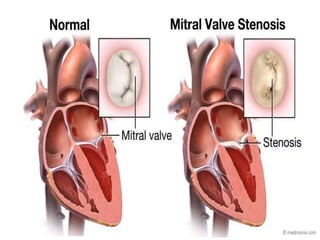
• MS characterized by narrowing of the mitral valve,
causing obstructed blood flow from the left atrium to
the ventricle
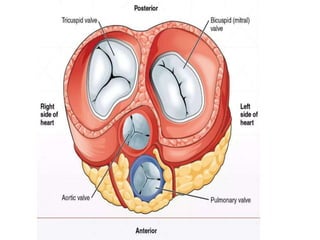
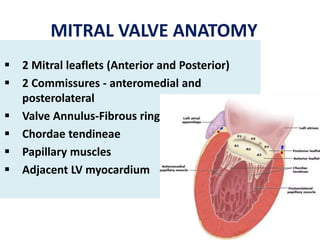
MITRAL VALVE ANATOMY
 2 Mitral leaflets (Anterior and Posterior)
 2 Commissures - anteromedial and
posterolateral
 Valve Annulus-Fibrous ring
 Chordae tendineae
 Papillary muscles
 Adjacent LV myocardium
EPIDEMIOLOGY
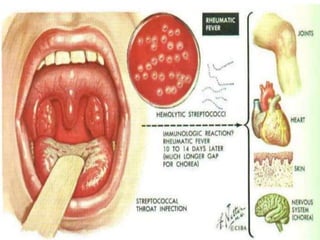
• Rheumatic Mitral Stenosis
largely concentrated among the low and middle
income countries that are endemic for group A
Streptococcus (GAS) pharyngitis and acute
rheumatic fever
• Non-rheumatic Mitral Stenosis
Degenerative MS is most common in the Western
world and is mainly mitral annular calcification
related
ETIOLOGY
• 1) Rheumatic fever
• 2) Congenital (parachute valve, cor triatriatum)
• 3) Severe mitral annular calcification extending to
leaflets
• 4) SLE, RA
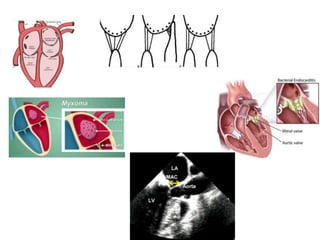
• 5) LA Myxoma
• 6) IE with large vegetations
• 7) Malignant carcinoid
• 8) Mucopolysaccharoidoses – hunter hurley type
• 9) Amyloid deposits
• 10) Drugs - Methysergide therapy
• The developed world eliminated Rheumatic
heart disease
• It continues to be a major cause of heart
disease, morbidity, and mortality in the low
and middle income countries
• Pure or Predominant MS in 40 % of RHD
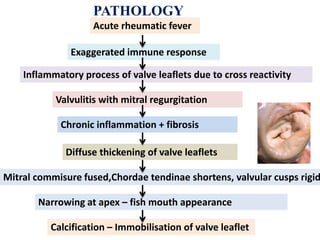
PATHOLOGY
Acute rheumatic fever
Exaggerated immune response
Inflammatory process of valve leaflets due to cross reactivity
Valvulitis with mitral regurgitation
Chronic inflammation + fibrosis
Diffuse thickening of valve leaflets
Mitral commisure fused,Chordae tendinae shortens, valvular cusps rigid
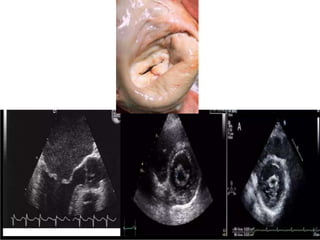
Narrowing at apex – fish mouth appearance
Calcification – Immobilisation of valve leaflet
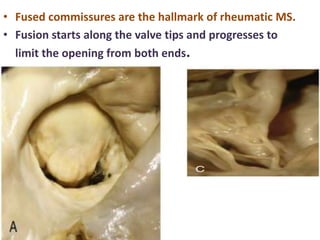
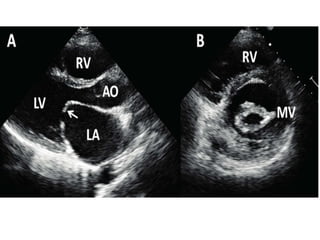
• Fused commissures are the hallmark of rheumatic MS.
• Fusion starts along the valve tips and progresses to
limit the opening from both ends.
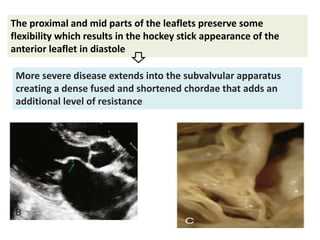
The proximal and mid parts of the leaflets preserve some
flexibility which results in the hockey stick appearance of the
anterior leaflet in diastole
More severe disease extends into the subvalvular apparatus
creating a dense fused and shortened chordae that adds an
additional level of resistance
• Mitral orifice 4 to 6 cm2
• Anterior leaflet is thicker
• Posterior leaflet is more prone for prolapse
• Postero-medial papillary muscle is more
commonly involved in acute myocardial
infarction as it has only single vessel supply,
supplied by RCA
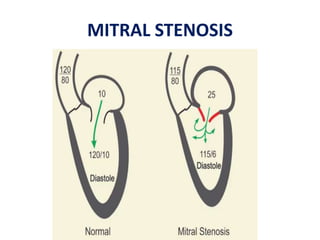
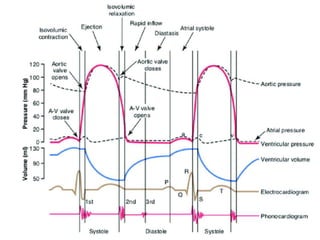
• In normal diastole
Left atrial pressure (LAP) = left ventricular
diastolic pressure(LVDP)
• No diastolic gradiant across mitral valve
LAP = LVEDP = PCWP = PAEDP
PCWP : Pulomary Capillary Wedge Pressure
PAEDP : Pulmonary Artery End Diastolic Pressure
HEMODYNAMICS
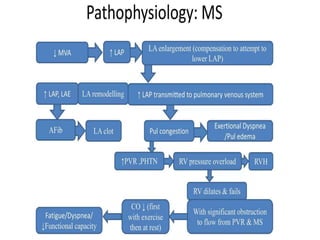
Consequences of LA Pressure
Pulmonary venous hypertension
Pulmonary capillary hypertension
Pulmonary arterial hypertension
RV Dilatation & failure
Secondary TR
MITRAL STENOSIS
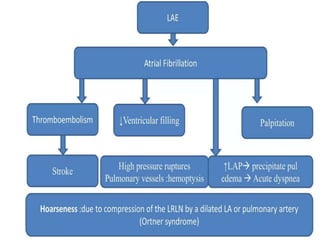
Why AF in MS
• Left atrial dilatation
• Fibrosis of LA Wall
• Disorganisation of Atrial muscle fibers
• After established AF
• Hemodynamic deterioration
• Impaired LA contractility
• Decreased CO
• Thrombus formation
Pulmonary hypertension
• (1) Passive backward transmission of the elevated
LA pressure
• (2) Pulmonary arteriolar constriction (the so-
called “second stenosis”), which presumably is
triggered by LA and pulmonary venous
hypertension (Reactive pulmonary hypertension)
• (3) Interstitial edema in the walls of the small
pulmonary vessels
• (4) At end stage, organic obliterative changes in
the pulmonary vascular bed.
Symptoms of Mitral Stenosis
• Latent period between the initial rheumatic carditis and the
development of symptoms due to MS is two decades
• Dyspnea and cough
• Orthopnea and PND
• Hemoptysis
• Oedema, Ascites, Hepatomegaly (RVF), Hydrothorax
• Fatigue and decreased exercise tolerance
• Recurrent pulmonary emboli
• Winter bronchitis : Pulmonary infections, i.e. ,
bronchitis, bronchopneumonia, and Lobar
pneumonia
Clinical features- symptoms
▪Duration:
▪Initial attack of rheumatic carditis to MS symptoms → 20
years
▪Smaller interval around 10 years in tropical & developing
countries
▪Common presentation in fourth decade of life
▪Dyspnea
▪Precipitated by exertion
▪↑ severity of MS → Easier precipitation, Orthopnea, PND
develops ( adrenergic drive & Resp. drive, Fluid shift )
▪Hemoptysis:
▪Due to LAP , Pulmonary venous
hypertension
▪Due to rupture of thin walled dilated
bronchial veins
▪Sudden hemorrhage due to rupture of thin
walled dilated bronchial veins ( Pulomary
apoplexy)
▪Pulmonary edema with rupture of
pulmonary alveolar capillaries (Pink frothy
sputum)
▪Anti coagulation for AF
▪Recurrent pulmonary emboli &
infarcts
▪Important cause of morbidity and
mortality
▪Pulmonary changes:
▪Fibrosis of capillary & alveoli walls
▪↓ Vital capacity, TLC, O2 uptake,
compliance (with ↑capillary
pressure)
▪Thrombo-embolism:
▪Thrombi formed in LA, especially in enlarged atrial appendage
▪10-20% incidence
▪High risk in patient with AF, age > 65, ↓ cardiac output
▪Important cause of morbidity & mortality
• Hoarseness in MS patients (Ortner’s syndrome)-
due to compression of recurrent laryngeal nerve by a greatly
dilated left atrium, enlarged tracheobronchial lymph nodes, and
dilated pulmonary artery.
• Swelling Increased systemic vein pressure
• Chest pain – Severe RV HTN, RV Ischemia , Pulm. HTN, Pulm.,
Coronary embolisation, Embolism (ASD)
• Palpitations – AF (LAE)
•Large left atrium causes
•Atrial fibrillation
•Compression bronchi causing persistant cough
•Compression of recurrent laryngeal nerve,
hoarseness
•Esophagus , dysphagia
•Left atrial appendage clots
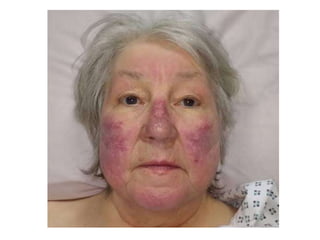
•Mitral facies pinkish purple patches on cheeks due to
decreased cardiac output produces vasoconstriction
Triggers of MS
• Exercise
• Anaemia
• Pregnancy
• Thyrotoxicosis
• Infections
• Atrial Fibrillation
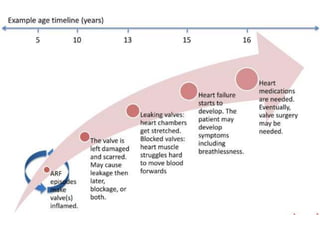
Natural History
Arterial Pulse in mitral stenosis
• The factors influencing the arterial pulse in mitral stenosis are
– Rhythm
– Severity of mitral stenosis
– Aortic valve disease, Systemic HTN, Anaemia
– Age of the patient
– Right ventricular failure and functional TR
– Presence absence of systemic embolism
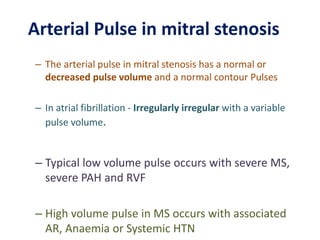
– The arterial pulse in mitral stenosis has a normal or
decreased pulse volume and a normal contour Pulses
– In atrial fibrillation - Irregularly irregular with a variable
pulse volume.
– Typical low volume pulse occurs with severe MS,
severe PAH and RVF
– High volume pulse in MS occurs with associated
AR, Anaemia or Systemic HTN
Arterial Pulse in mitral stenosis
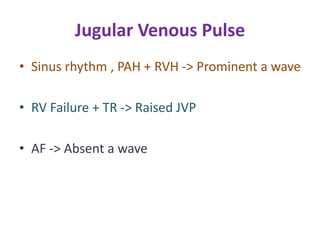
Jugular Venous Pulse
• Sinus rhythm , PAH + RVH -> Prominent a wave
• RV Failure + TR -> Raised JVP
• AF -> Absent a wave
Jugular Venous Pulse
– Depends on severity of MS, Degree of PAH, arterial HTN,
associated tricuspid valve disease, diuretic therapy, rhythm
( AF or sinus rhythm ) and presence or absence of RVF
– Most impressive JVP features are seen with severe MS,
severe PAH, severe functional TR and RVF
– The earlobe may move with each v wave and pulsatile
exophthalmos may be seen in some patients with severe
TR
– Tricuspid regurgitation, a common complication, will result
in a large systolic CV wave
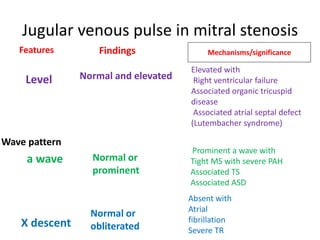
Jugular venous pulse in mitral stenosis
Features
Level
Wave pattern
a wave
X descent
Findings
Normal and elevated
Mechanisms/significance
Normal or
prominent
Elevated with
Right ventricular failure
Associated organic tricuspid
disease
Associated atrial septal defect
(Lutembacher syndrome)
Prominent a wave with
Tight MS with severe PAH
Associated TS
Associated ASD
Absent with
Atrial
fibrillation
Severe TR
Normal or
obliterated
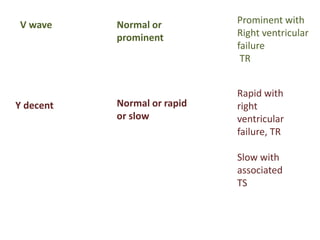
Prominent with
Right ventricular
failure
TR
Rapid with
right
ventricular
failure, TR
Slow with
associated
TS
Normal or
prominent
Normal or rapid
or slow
V wave
Y decent
Cardiac impulse in mitral stenosis
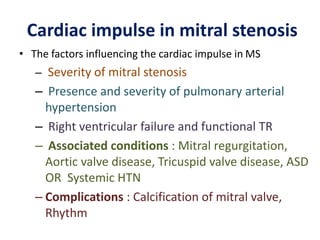
• The factors influencing the cardiac impulse in MS
– Severity of mitral stenosis
– Presence and severity of pulmonary arterial
hypertension
– Right ventricular failure and functional TR
– Associated conditions : Mitral regurgitation,
Aortic valve disease, Tricuspid valve disease, ASD
OR Systemic HTN
– Complications : Calcification of mitral valve,
Rhythm
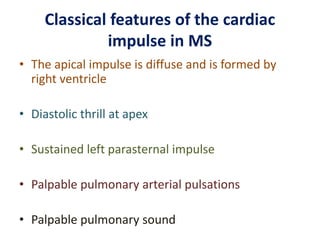
Classical features of the cardiac
impulse in MS
• The apical impulse is diffuse and is formed by
right ventricle
• Diastolic thrill at apex
• Sustained left parasternal impulse
• Palpable pulmonary arterial pulsations
• Palpable pulmonary sound
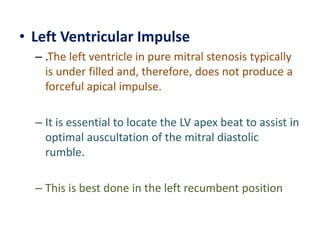
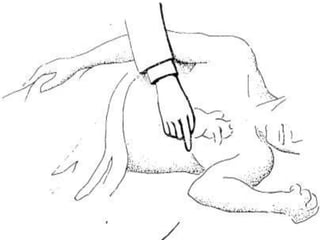
• Left Ventricular Impulse
– .The left ventricle in pure mitral stenosis typically
is under filled and, therefore, does not produce a
forceful apical impulse.
– It is essential to locate the LV apex beat to assist in
optimal auscultation of the mitral diastolic
rumble.
– This is best done in the left recumbent position
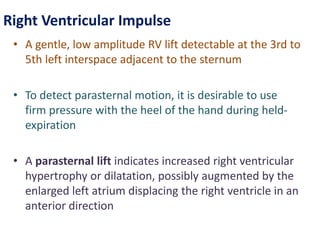
Right Ventricular Impulse
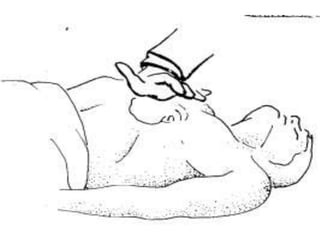
• A gentle, low amplitude RV lift detectable at the 3rd to
5th left interspace adjacent to the sternum
• To detect parasternal motion, it is desirable to use
firm pressure with the heel of the hand during held-
expiration
• A parasternal lift indicates increased right ventricular
hypertrophy or dilatation, possibly augmented by the
enlarged left atrium displacing the right ventricle in an
anterior direction
Heart Sounds
Characteristics of S1
• The first heart sound is typically discrete and loud
and has a slapping quality
• S1 is audible throughout the precordium and is
heard maximally between the lower sternal edge and
the apex.
• The loud S1 is often palpable.
• It is important to recognize the palpable shock of S1
and differentiate it from the left ventricular apex
impulse, which usually is feeble is mitral stenosis
Mechanism of loud first heart sound
• Open mitral valve at end diastole
• Wide open valve cusps
• Delayed closure of mitral valve
• Mitral valve closure at higher pressure of left
ventricle - (IVC)
• Rate of raise LV Pressure – dp/dt
• Morphology - Thickened but mobile mitral valve
• Tachycardia ---> Short PR Interval – Closes with a high
velocity large excursion
• The thickened leaflets and high pressure in the left
atrium are the central features.
Causes of soft first heart sound
– Heavily calcified mitral valve
– Calcification results in loss of pliability
– Severe sub valvular fusion
– Associated mitral regurgitation
– Associated severe aortic regurgitation
– Masked left ventricular events due to severe right
ventricular hypertrophy
– Active Rheumatic carditis (Due to prolonged PR
interval)
– Left atrial failure (LAF)
S2
• In mild or moderate MS – Normal split
• In severe MS with severe PAH
Close split or single
• Intensity of pulmonic sound correlates well
with the severity of PAH
• Wide split S2 in MS – Associated ASD
considered
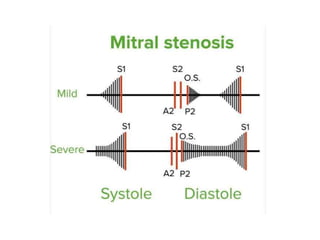
Opening Snap in MS
• Due to thickening of the valve with a doming motion
towards the left ventricle due to high pressure in the
left atrium
• Sudden tensing of valve cusps
Opening Snap
• The opening snap (OS) is one of the classic findings in
cardiac physical diagnosis
• This sound results from the maximal opening
excursion of the mitral valve cusps into the left
ventricular cavity in early diastole after LV pressure
falls below that in the left atrium
• The OS coincides precisely with the maximal opening
movement of the anterior leaflet of the mitral valve
• The opening snap is typically a medium to high
frequency sound, quite distinct and sharp, which
initiates the mitral diastolic rumble
• The OS is best heard inside or medial to the LV apex
in the mid-precordial area.
• The opening snap should be sought by using firm
pressure with the diaphragm of the stethoscope in
both the supine and left lateral recumbent positions.
Mild exercise or handgrip will augment the intensity
of the snap
• OS present means mitral valve is not
significantly rigid and calcified
OS
• Loudest apex
S2
• Best heard at base
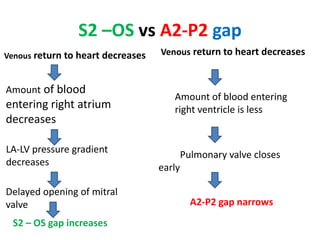
S2 –OS vs A2-P2 gap
Venous return to heart decreases
Amount of blood
entering right atrium
decreases
A2-P2 gap narrows
LA-LV pressure gradient
decreases
Delayed opening of mitral
valve
S2 – OS gap increases
Pulmonary valve closes
early
Venous return to heart decreases
Amount of blood entering
right ventricle is less
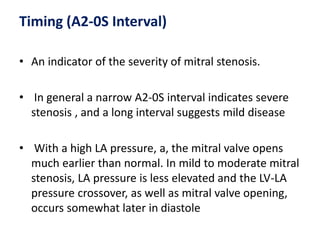
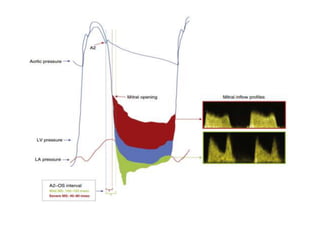
Timing (A2-0S Interval)
• An indicator of the severity of mitral stenosis.
• In general a narrow A2-0S interval indicates severe
stenosis , and a long interval suggests mild disease
• With a high LA pressure, a, the mitral valve opens
much earlier than normal. In mild to moderate mitral
stenosis, LA pressure is less elevated and the LV-LA
pressure crossover, as well as mitral valve opening,
occurs somewhat later in diastole
Missing opening snap in mitral
stenosis
• Severely calcified mitral valve
• Mitral regurgitation (significant)
• Aortic regurgitation (severe)
• Aortic stenosis (severe)
• Coronary artery disease with left ventricular
dysfunction
• Any condition with associated left ventricular failure
• Very close S2-OS (<30 msec)
• Auscultatory incompetence
• OS heard but mistaken for wide split second heart
sound
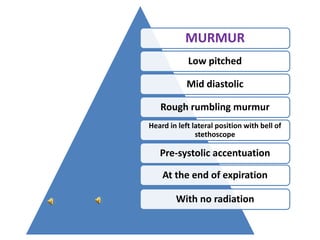
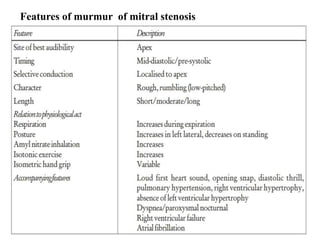
MURMUR
Low pitched
Mid diastolic
Rough rumbling murmur
Heard in left lateral position with bell of
stethoscope
Pre-systolic accentuation
At the end of expiration
With no radiation
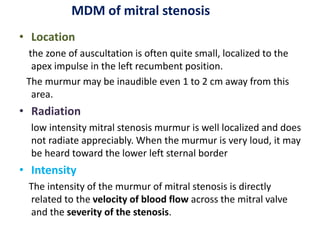
• Location
the zone of auscultation is often quite small, localized to the
apex impulse in the left recumbent position.
The murmur may be inaudible even 1 to 2 cm away from this
area.
• Radiation
low intensity mitral stenosis murmur is well localized and does
not radiate appreciably. When the murmur is very loud, it may
be heard toward the lower left sternal border
• Intensity
The intensity of the murmur of mitral stenosis is directly
related to the velocity of blood flow across the mitral valve
and the severity of the stenosis.
MDM of mitral stenosis
Mechanisms influencing length of the murmur
• Cardiac output
• Heart rate
• Left atrial pressure
• Left ventricular end-diastolic pressure
• Heart rhythm
Absent MDM in MS
• Severe silent MS
• Severe cardiac failure
• Emphysema
• Obesity
•Loud P2 and palpable P2
• Prominent parasternal heave : right ventricular
hypertrophy
• Tricuspid regurgitation murmur, Pansystolic- best
heard along lower left sternal border : caravallo’s sign
• Hepatomegaly, edema, ascitis
• Prominent epigastric suprsternal space pulsations
• JVP – a wave and v wave-- Prominent
FEATURES OF PULMONARY HYPERTENTION
▪MS + Sev. Pul. HTN
▪ High-pitched, diastolic, decrescendo
blowing murmur along the left sternal
border
▪(Graham Steell mumur of PR)
• Non valvular pulmonary ejection sound –
Dilatation of PA
• Diminished during inspiration
MDM other than MS
• Carey coombs murmur – Acute rhuematic fever
• Austin flint murmur – Severe AR
• Atrial myxoma
• Large VSD, PDA, Severe MR – Increased flow
across non stenotic mitral valve
• Large ASD, Severe TR – Increased flow across
non stenotic Tricuspid valve
Why there is MDM in Mitral stenosis
• The valve will open only after the
isovolumetric relaxation phase
Questions need to be answered at the
end of physical examination
• Is it MS or condition simulating it
• If MS, what is the severity
• Is the valve pliable or calcified
• Is there sub valvular fusion
• What is rhythm
• Is there PAH, what is the severity
• Is there RHF
• Are there associated lesions
• Is there a discrepancy between symptoms and physical
signs
• Is there a peripheral embolism
• Is left atrial myxoma, a possibility
Before OR after - Theory OR Practical exams
STRATEGIC TIMEOUT
• If you could eliminate one
thing from your daily routine,
what would it be and why?
INVESTIGATIONS
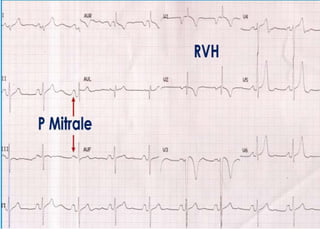
ELECTROCARDIOGRAPHIC FINDINGS :
In severe MS & sinus rhythm – P waves usually
suggest LA enlargement (90%)
P-WAVE : Tall peaked in lead ll
upright in V1 [ when severe
pulmonary HTN or TS complicate MS & RA
enlargment
QRS – normal [ with severe pulmonary HTN -
right axis deviation , RV hypertrophy ]
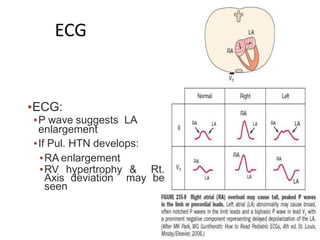
ECG
▪ECG:
▪P wave suggests LA
enlargement
▪If Pul. HTN develops:
▪RA enlargement
▪RV hypertrophy & Rt.
Axis deviation may be
seen
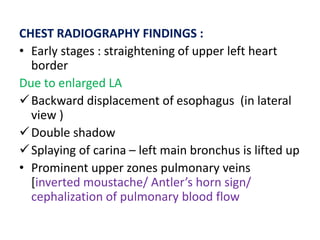
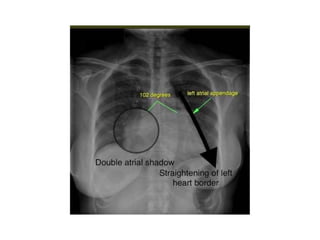
CHEST RADIOGRAPHY FINDINGS :
• Early stages : straightening of upper left heart
border
Due to enlarged LA
Backward displacement of esophagus (in lateral
view )
Double shadow
Splaying of carina – left main bronchus is lifted up
• Prominent upper zones pulmonary veins
[inverted moustache/ Antler’s horn sign/
cephalization of pulmonary blood flow
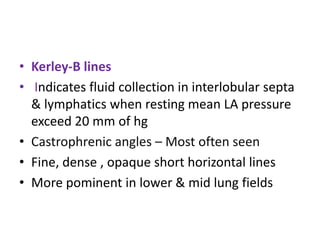
• Kerley-B lines
• Indicates fluid collection in interlobular septa
& lymphatics when resting mean LA pressure
exceed 20 mm of hg
• Castrophrenic angles – Most often seen
• Fine, dense , opaque short horizontal lines
• More pominent in lower & mid lung fields
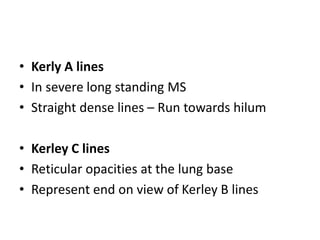
• Kerly A lines
• In severe long standing MS
• Straight dense lines – Run towards hilum
• Kerley C lines
• Reticular opacities at the lung base
• Represent end on view of Kerley B lines
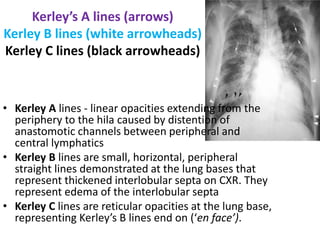
Kerley’s A lines (arrows)
Kerley B lines (white arrowheads)
Kerley C lines (black arrowheads)
• Kerley A lines - linear opacities extending from the
periphery to the hila caused by distention of
anastomotic channels between peripheral and
central lymphatics
• Kerley B lines are small, horizontal, peripheral
straight lines demonstrated at the lung bases that
represent thickened interlobular septa on CXR. They
represent edema of the interlobular septa
• Kerley C lines are reticular opacities at the lung base,
representing Kerley’s B lines end on (‘en face’).
ECHOCARDIGRAM :
Transthoracic echo with color flow
&spectral doppler imaging shows
• Measurements of mitral inflow velocity during
early[ E-waves ] & late [A-waves] in pts with
sinus rhythm – diastolic filling
• Estimates transvlavular peak , mean gradients,
& mitral area orifice
• Severity of any association of MR
• Extent of leaflet calcification & restriction
• Degree of distortion of subvalvular apparatus
• Anatomy for percutaneous mitral balloon
commissurotomy
also assessment of LV,RV function
 chamber size
Estimation of PA systolic pressure based on
tricuspid regurgitation velocity
Pressure & severity of associated valvular
leions [AS/&AR]
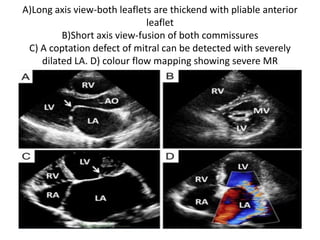
A)Long axis view-both leaflets are thickend with pliable anterior
leaflet
B)Short axis view-fusion of both commissures
C) A coptation defect of mitral can be detected with severely
dilated LA. D) colour flow mapping showing severe MR
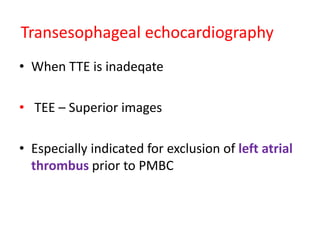
• When TTE is inadeqate
• TEE – Superior images
• Especially indicated for exclusion of left atrial
thrombus prior to PMBC
Transesophageal echocardiography
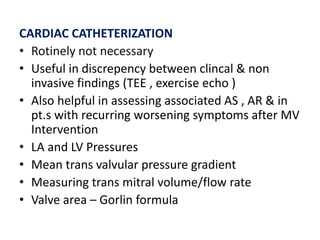
CARDIAC CATHETERIZATION
• Rotinely not necessary
• Useful in discrepency between clincal & non
invasive findings (TEE , exercise echo )
• Also helpful in assessing associated AS , AR & in
pt.s with recurring worsening symptoms after MV
Intervention
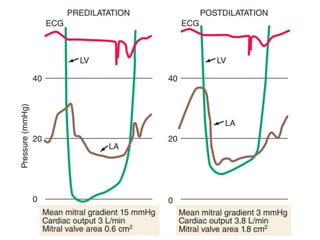
• LA and LV Pressures
• Mean trans valvular pressure gradient
• Measuring trans mitral volume/flow rate
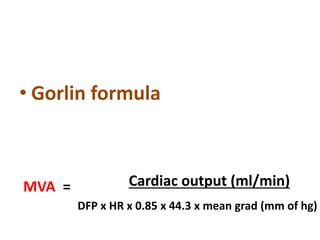
• Valve area – Gorlin formula
• Gorlin formula
Cardiac output (ml/min)
DFP x HR x 0.85 x 44.3 x mean grad (mm of hg)
MVA =
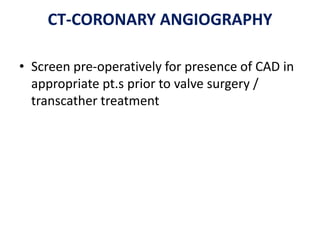
CT-CORONARY ANGIOGRAPHY
• Screen pre-operatively for presence of CAD in
appropriate pt.s prior to valve surgery /
transcather treatment
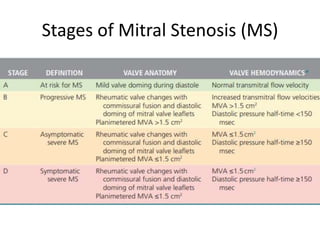
Stages of Mitral Stenosis (MS)
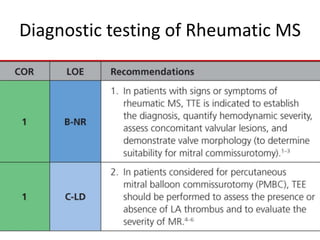
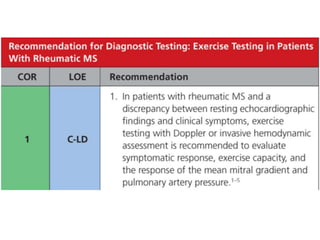
Diagnostic testing of Rheumatic MS
• Prevention of recurrent Rheumatic fever
• Prevent and treatment complications of MS
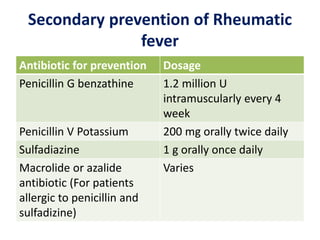
Secondary prevention of Rheumatic
fever
Antibiotic for prevention Dosage
Penicillin G benzathine 1.2 million U
intramuscularly every 4
week
Penicillin V Potassium 200 mg orally twice daily
Sulfadiazine 1 g orally once daily
Macrolide or azalide
antibiotic (For patients
allergic to penicillin and
sulfadizine)
Varies
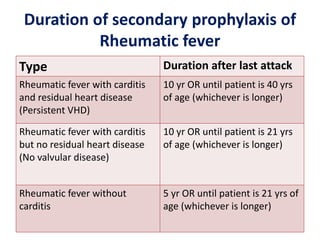
Duration of secondary prophylaxis of
Rheumatic fever
Type Duration after last attack
Rheumatic fever with carditis
and residual heart disease
(Persistent VHD)
10 yr OR until patient is 40 yrs
of age (whichever is longer)
Rheumatic fever with carditis
but no residual heart disease
(No valvular disease)
10 yr OR until patient is 21 yrs
of age (whichever is longer)
Rheumatic fever without
carditis
5 yr OR until patient is 21 yrs of
age (whichever is longer)
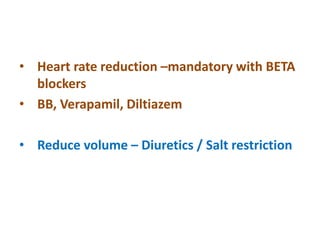
• Heart rate reduction –mandatory with BETA
blockers
• BB, Verapamil, Diltiazem
• Reduce volume – Diuretics / Salt restriction
Indications for Anti coagulation
• AF
• Any prior embolic event
• LA Thrombus
Warfarin [INR 2-3 ]
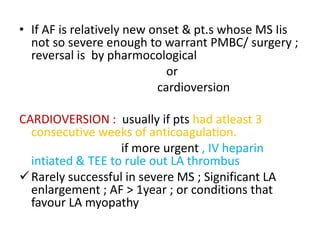
• If AF is relatively new onset & pt.s whose MS Iis
not so severe enough to warrant PMBC/ surgery ;
reversal is by pharmocological
or
cardioversion
CARDIOVERSION : usually if pts had atleast 3
consecutive weeks of anticoagulation.
if more urgent , IV heparin
intiated & TEE to rule out LA thrombus
Rarely successful in severe MS ; Significant LA
enlargement ; AF > 1year ; or conditions that
favour LA myopathy
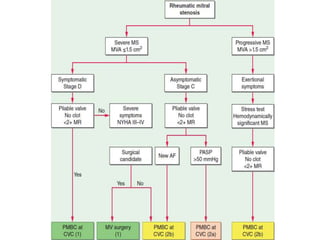
• PBMV – Preserve native valve
• MV Repair – OMV / CMV
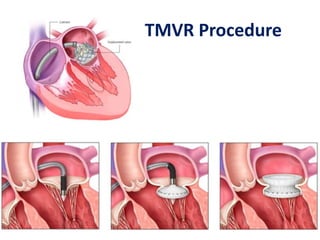
• TMVR
PBMV
• Pliability of valve
• Loud S1, Sharp (crisp) OS
• 2 D echo
:
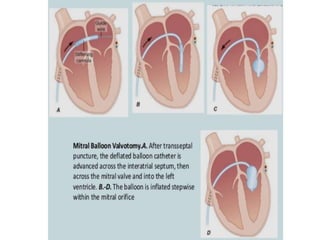
INDICATIONS [AHA]
1. Symptomatic pt.s [NYHA II , lll , lV ] ; Severe
Rheumatic MS ; favorable MV morphology &
No clot in LA / Less than moderate MR
2. Favourable valve morphology wilkins < 8
3. Less than moderate MR < 2 +
4. TEE prior to BMV
5. Avoid BMV in commissural calcification
PERCUTANOUS MITRAL BALLON VALVOTOMY
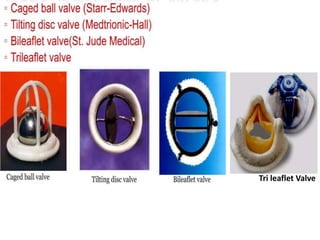
Tri leaflet Valve
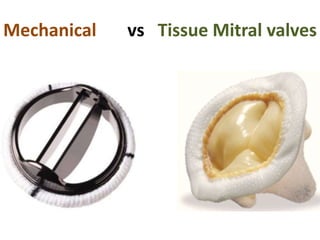
Mechanical vs Tissue Mitral valves
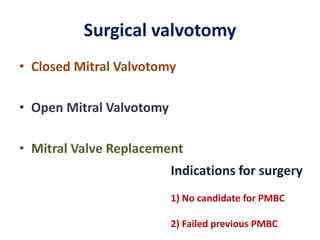
Surgical valvotomy
• Closed Mitral Valvotomy
• Open Mitral Valvotomy
• Mitral Valve Replacement
Indications for surgery
1) No candidate for PMBC
2) Failed previous PMBC
TMVR Procedure
SUMMARY
Mentor shows the door of success &
Helps mentee open it
“There is no lack
of knowledge
out there ….
Just a shortage
of asking for
HELP”
TEACH
Encourage
Features of murmur of mitral stenosis
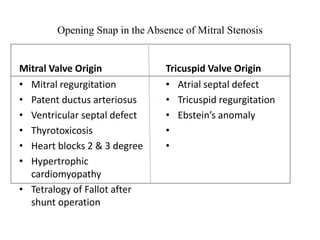
Opening Snap in the Absence of Mitral Stenosis
Mitral Valve Origin
• Mitral regurgitation
• Patent ductus arteriosus
• Ventricular septal defect
• Thyrotoxicosis
• Heart blocks 2 & 3 degree
• Hypertrophic
cardiomyopathy
• Tetralogy of Fallot after
shunt operation
Tricuspid Valve Origin
• Atrial septal defect
• Tricuspid regurgitation
• Ebstein’s anomaly
•
•
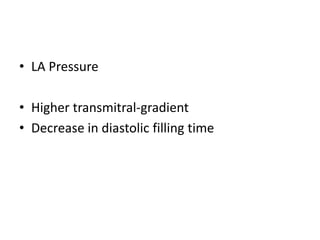
• LA Pressure
• Higher transmitral-gradient
• Decrease in diastolic filling time
• A2-OS gap
• Length of murmur
• Presystolic accentuation
• AF
• PHT MVA = 220/PHT
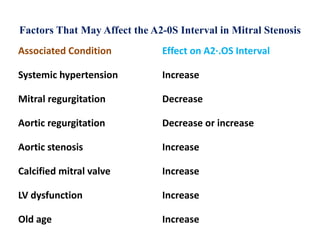
Factors That May Affect the A2-0S Interval in Mitral Stenosis
Associated Condition Effect on A2·.OS Interval
Systemic hypertension Increase
Mitral regurgitation Decrease
Aortic regurgitation Decrease or increase
Aortic stenosis Increase
Calcified mitral valve Increase
LV dysfunction Increase
Old age Increase
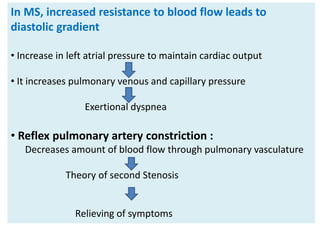
In MS, increased resistance to blood flow leads to
diastolic gradient
• Increase in left atrial pressure to maintain cardiac output
• It increases pulmonary venous and capillary pressure
Exertional dyspnea
• Reflex pulmonary artery constriction :
Decreases amount of blood flow through pulmonary vasculature
Theory of second Stenosis
Relieving of symptoms

MITRAL STENOSIS - UG Final by Dr JTR.pptx

  • 1.
    Education arises fromsome ingenious balance between challenges & Support Support Mentors need to support their mentees, but challenge them too Challenges
  • 2.
    MITRAL STENOSIS Dr. JALAGAMTHIRUPATHI RAO PROFESSOR OF GENERAL MEDICINE
  • 3.
    INTRODUCTION • Mitral stenosis(MS), known in the literature since at least the 1669 • MS characterized by narrowing of the mitral valve, causing obstructed blood flow from the left atrium to the ventricle
  • 6.
    MITRAL VALVE ANATOMY 2 Mitral leaflets (Anterior and Posterior)  2 Commissures - anteromedial and posterolateral  Valve Annulus-Fibrous ring  Chordae tendineae  Papillary muscles  Adjacent LV myocardium
  • 7.
    EPIDEMIOLOGY • Rheumatic MitralStenosis largely concentrated among the low and middle income countries that are endemic for group A Streptococcus (GAS) pharyngitis and acute rheumatic fever • Non-rheumatic Mitral Stenosis Degenerative MS is most common in the Western world and is mainly mitral annular calcification related
  • 9.
    ETIOLOGY • 1) Rheumaticfever • 2) Congenital (parachute valve, cor triatriatum) • 3) Severe mitral annular calcification extending to leaflets • 4) SLE, RA • 5) LA Myxoma • 6) IE with large vegetations • 7) Malignant carcinoid • 8) Mucopolysaccharoidoses – hunter hurley type • 9) Amyloid deposits • 10) Drugs - Methysergide therapy
  • 11.
    • The developedworld eliminated Rheumatic heart disease • It continues to be a major cause of heart disease, morbidity, and mortality in the low and middle income countries • Pure or Predominant MS in 40 % of RHD
  • 12.
    PATHOLOGY Acute rheumatic fever Exaggeratedimmune response Inflammatory process of valve leaflets due to cross reactivity Valvulitis with mitral regurgitation Chronic inflammation + fibrosis Diffuse thickening of valve leaflets Mitral commisure fused,Chordae tendinae shortens, valvular cusps rigid Narrowing at apex – fish mouth appearance Calcification – Immobilisation of valve leaflet
  • 13.
    • Fused commissuresare the hallmark of rheumatic MS. • Fusion starts along the valve tips and progresses to limit the opening from both ends.
  • 14.
    The proximal andmid parts of the leaflets preserve some flexibility which results in the hockey stick appearance of the anterior leaflet in diastole More severe disease extends into the subvalvular apparatus creating a dense fused and shortened chordae that adds an additional level of resistance
  • 15.
    • Mitral orifice4 to 6 cm2 • Anterior leaflet is thicker • Posterior leaflet is more prone for prolapse • Postero-medial papillary muscle is more commonly involved in acute myocardial infarction as it has only single vessel supply, supplied by RCA
  • 16.
    • In normaldiastole Left atrial pressure (LAP) = left ventricular diastolic pressure(LVDP) • No diastolic gradiant across mitral valve LAP = LVEDP = PCWP = PAEDP PCWP : Pulomary Capillary Wedge Pressure PAEDP : Pulmonary Artery End Diastolic Pressure HEMODYNAMICS
  • 17.
    Consequences of LAPressure Pulmonary venous hypertension Pulmonary capillary hypertension Pulmonary arterial hypertension RV Dilatation & failure Secondary TR
  • 18.
  • 23.
    Why AF inMS • Left atrial dilatation • Fibrosis of LA Wall • Disorganisation of Atrial muscle fibers • After established AF • Hemodynamic deterioration • Impaired LA contractility • Decreased CO • Thrombus formation
  • 24.
    Pulmonary hypertension • (1)Passive backward transmission of the elevated LA pressure • (2) Pulmonary arteriolar constriction (the so- called “second stenosis”), which presumably is triggered by LA and pulmonary venous hypertension (Reactive pulmonary hypertension) • (3) Interstitial edema in the walls of the small pulmonary vessels • (4) At end stage, organic obliterative changes in the pulmonary vascular bed.
  • 25.
    Symptoms of MitralStenosis • Latent period between the initial rheumatic carditis and the development of symptoms due to MS is two decades • Dyspnea and cough • Orthopnea and PND • Hemoptysis • Oedema, Ascites, Hepatomegaly (RVF), Hydrothorax • Fatigue and decreased exercise tolerance • Recurrent pulmonary emboli • Winter bronchitis : Pulmonary infections, i.e. , bronchitis, bronchopneumonia, and Lobar pneumonia
  • 26.
    Clinical features- symptoms ▪Duration: ▪Initialattack of rheumatic carditis to MS symptoms → 20 years ▪Smaller interval around 10 years in tropical & developing countries ▪Common presentation in fourth decade of life ▪Dyspnea ▪Precipitated by exertion ▪↑ severity of MS → Easier precipitation, Orthopnea, PND develops ( adrenergic drive & Resp. drive, Fluid shift )
  • 27.
    ▪Hemoptysis: ▪Due to LAP, Pulmonary venous hypertension ▪Due to rupture of thin walled dilated bronchial veins ▪Sudden hemorrhage due to rupture of thin walled dilated bronchial veins ( Pulomary apoplexy) ▪Pulmonary edema with rupture of pulmonary alveolar capillaries (Pink frothy sputum) ▪Anti coagulation for AF
  • 28.
    ▪Recurrent pulmonary emboli& infarcts ▪Important cause of morbidity and mortality ▪Pulmonary changes: ▪Fibrosis of capillary & alveoli walls ▪↓ Vital capacity, TLC, O2 uptake, compliance (with ↑capillary pressure)
  • 29.
    ▪Thrombo-embolism: ▪Thrombi formed inLA, especially in enlarged atrial appendage ▪10-20% incidence ▪High risk in patient with AF, age > 65, ↓ cardiac output ▪Important cause of morbidity & mortality • Hoarseness in MS patients (Ortner’s syndrome)- due to compression of recurrent laryngeal nerve by a greatly dilated left atrium, enlarged tracheobronchial lymph nodes, and dilated pulmonary artery. • Swelling Increased systemic vein pressure • Chest pain – Severe RV HTN, RV Ischemia , Pulm. HTN, Pulm., Coronary embolisation, Embolism (ASD) • Palpitations – AF (LAE)
  • 30.
    •Large left atriumcauses •Atrial fibrillation •Compression bronchi causing persistant cough •Compression of recurrent laryngeal nerve, hoarseness •Esophagus , dysphagia •Left atrial appendage clots •Mitral facies pinkish purple patches on cheeks due to decreased cardiac output produces vasoconstriction
  • 32.
    Triggers of MS •Exercise • Anaemia • Pregnancy • Thyrotoxicosis • Infections • Atrial Fibrillation
  • 33.
  • 35.
    Arterial Pulse inmitral stenosis • The factors influencing the arterial pulse in mitral stenosis are – Rhythm – Severity of mitral stenosis – Aortic valve disease, Systemic HTN, Anaemia – Age of the patient – Right ventricular failure and functional TR – Presence absence of systemic embolism
  • 36.
    – The arterialpulse in mitral stenosis has a normal or decreased pulse volume and a normal contour Pulses – In atrial fibrillation - Irregularly irregular with a variable pulse volume. – Typical low volume pulse occurs with severe MS, severe PAH and RVF – High volume pulse in MS occurs with associated AR, Anaemia or Systemic HTN Arterial Pulse in mitral stenosis
  • 37.
    Jugular Venous Pulse •Sinus rhythm , PAH + RVH -> Prominent a wave • RV Failure + TR -> Raised JVP • AF -> Absent a wave
  • 38.
    Jugular Venous Pulse –Depends on severity of MS, Degree of PAH, arterial HTN, associated tricuspid valve disease, diuretic therapy, rhythm ( AF or sinus rhythm ) and presence or absence of RVF – Most impressive JVP features are seen with severe MS, severe PAH, severe functional TR and RVF – The earlobe may move with each v wave and pulsatile exophthalmos may be seen in some patients with severe TR – Tricuspid regurgitation, a common complication, will result in a large systolic CV wave
  • 39.
    Jugular venous pulsein mitral stenosis Features Level Wave pattern a wave X descent Findings Normal and elevated Mechanisms/significance Normal or prominent Elevated with Right ventricular failure Associated organic tricuspid disease Associated atrial septal defect (Lutembacher syndrome) Prominent a wave with Tight MS with severe PAH Associated TS Associated ASD Absent with Atrial fibrillation Severe TR Normal or obliterated
  • 40.
    Prominent with Right ventricular failure TR Rapidwith right ventricular failure, TR Slow with associated TS Normal or prominent Normal or rapid or slow V wave Y decent
  • 41.
    Cardiac impulse inmitral stenosis • The factors influencing the cardiac impulse in MS – Severity of mitral stenosis – Presence and severity of pulmonary arterial hypertension – Right ventricular failure and functional TR – Associated conditions : Mitral regurgitation, Aortic valve disease, Tricuspid valve disease, ASD OR Systemic HTN – Complications : Calcification of mitral valve, Rhythm
  • 42.
    Classical features ofthe cardiac impulse in MS • The apical impulse is diffuse and is formed by right ventricle • Diastolic thrill at apex • Sustained left parasternal impulse • Palpable pulmonary arterial pulsations • Palpable pulmonary sound
  • 43.
    • Left VentricularImpulse – .The left ventricle in pure mitral stenosis typically is under filled and, therefore, does not produce a forceful apical impulse. – It is essential to locate the LV apex beat to assist in optimal auscultation of the mitral diastolic rumble. – This is best done in the left recumbent position
  • 45.
    Right Ventricular Impulse •A gentle, low amplitude RV lift detectable at the 3rd to 5th left interspace adjacent to the sternum • To detect parasternal motion, it is desirable to use firm pressure with the heel of the hand during held- expiration • A parasternal lift indicates increased right ventricular hypertrophy or dilatation, possibly augmented by the enlarged left atrium displacing the right ventricle in an anterior direction
  • 47.
  • 48.
    Characteristics of S1 •The first heart sound is typically discrete and loud and has a slapping quality • S1 is audible throughout the precordium and is heard maximally between the lower sternal edge and the apex. • The loud S1 is often palpable. • It is important to recognize the palpable shock of S1 and differentiate it from the left ventricular apex impulse, which usually is feeble is mitral stenosis
  • 49.
    Mechanism of loudfirst heart sound • Open mitral valve at end diastole • Wide open valve cusps • Delayed closure of mitral valve • Mitral valve closure at higher pressure of left ventricle - (IVC) • Rate of raise LV Pressure – dp/dt • Morphology - Thickened but mobile mitral valve • Tachycardia ---> Short PR Interval – Closes with a high velocity large excursion • The thickened leaflets and high pressure in the left atrium are the central features.
  • 50.
    Causes of softfirst heart sound – Heavily calcified mitral valve – Calcification results in loss of pliability – Severe sub valvular fusion – Associated mitral regurgitation – Associated severe aortic regurgitation – Masked left ventricular events due to severe right ventricular hypertrophy – Active Rheumatic carditis (Due to prolonged PR interval) – Left atrial failure (LAF)
  • 51.
    S2 • In mildor moderate MS – Normal split • In severe MS with severe PAH Close split or single • Intensity of pulmonic sound correlates well with the severity of PAH • Wide split S2 in MS – Associated ASD considered
  • 52.
    Opening Snap inMS • Due to thickening of the valve with a doming motion towards the left ventricle due to high pressure in the left atrium • Sudden tensing of valve cusps
  • 53.
    Opening Snap • Theopening snap (OS) is one of the classic findings in cardiac physical diagnosis • This sound results from the maximal opening excursion of the mitral valve cusps into the left ventricular cavity in early diastole after LV pressure falls below that in the left atrium • The OS coincides precisely with the maximal opening movement of the anterior leaflet of the mitral valve
  • 54.
    • The openingsnap is typically a medium to high frequency sound, quite distinct and sharp, which initiates the mitral diastolic rumble • The OS is best heard inside or medial to the LV apex in the mid-precordial area. • The opening snap should be sought by using firm pressure with the diaphragm of the stethoscope in both the supine and left lateral recumbent positions. Mild exercise or handgrip will augment the intensity of the snap
  • 55.
    • OS presentmeans mitral valve is not significantly rigid and calcified
  • 56.
    OS • Loudest apex S2 •Best heard at base
  • 57.
    S2 –OS vsA2-P2 gap Venous return to heart decreases Amount of blood entering right atrium decreases A2-P2 gap narrows LA-LV pressure gradient decreases Delayed opening of mitral valve S2 – OS gap increases Pulmonary valve closes early Venous return to heart decreases Amount of blood entering right ventricle is less
  • 58.
    Timing (A2-0S Interval) •An indicator of the severity of mitral stenosis. • In general a narrow A2-0S interval indicates severe stenosis , and a long interval suggests mild disease • With a high LA pressure, a, the mitral valve opens much earlier than normal. In mild to moderate mitral stenosis, LA pressure is less elevated and the LV-LA pressure crossover, as well as mitral valve opening, occurs somewhat later in diastole
  • 60.
    Missing opening snapin mitral stenosis • Severely calcified mitral valve • Mitral regurgitation (significant) • Aortic regurgitation (severe) • Aortic stenosis (severe) • Coronary artery disease with left ventricular dysfunction • Any condition with associated left ventricular failure • Very close S2-OS (<30 msec) • Auscultatory incompetence • OS heard but mistaken for wide split second heart sound
  • 61.
    MURMUR Low pitched Mid diastolic Roughrumbling murmur Heard in left lateral position with bell of stethoscope Pre-systolic accentuation At the end of expiration With no radiation
  • 63.
    • Location the zoneof auscultation is often quite small, localized to the apex impulse in the left recumbent position. The murmur may be inaudible even 1 to 2 cm away from this area. • Radiation low intensity mitral stenosis murmur is well localized and does not radiate appreciably. When the murmur is very loud, it may be heard toward the lower left sternal border • Intensity The intensity of the murmur of mitral stenosis is directly related to the velocity of blood flow across the mitral valve and the severity of the stenosis. MDM of mitral stenosis
  • 64.
    Mechanisms influencing lengthof the murmur • Cardiac output • Heart rate • Left atrial pressure • Left ventricular end-diastolic pressure • Heart rhythm
  • 65.
    Absent MDM inMS • Severe silent MS • Severe cardiac failure • Emphysema • Obesity
  • 66.
    •Loud P2 andpalpable P2 • Prominent parasternal heave : right ventricular hypertrophy • Tricuspid regurgitation murmur, Pansystolic- best heard along lower left sternal border : caravallo’s sign • Hepatomegaly, edema, ascitis • Prominent epigastric suprsternal space pulsations • JVP – a wave and v wave-- Prominent FEATURES OF PULMONARY HYPERTENTION
  • 67.
    ▪MS + Sev.Pul. HTN ▪ High-pitched, diastolic, decrescendo blowing murmur along the left sternal border ▪(Graham Steell mumur of PR)
  • 68.
    • Non valvularpulmonary ejection sound – Dilatation of PA • Diminished during inspiration
  • 69.
    MDM other thanMS • Carey coombs murmur – Acute rhuematic fever • Austin flint murmur – Severe AR • Atrial myxoma • Large VSD, PDA, Severe MR – Increased flow across non stenotic mitral valve • Large ASD, Severe TR – Increased flow across non stenotic Tricuspid valve
  • 70.
    Why there isMDM in Mitral stenosis • The valve will open only after the isovolumetric relaxation phase
  • 71.
    Questions need tobe answered at the end of physical examination • Is it MS or condition simulating it • If MS, what is the severity • Is the valve pliable or calcified • Is there sub valvular fusion • What is rhythm • Is there PAH, what is the severity • Is there RHF • Are there associated lesions • Is there a discrepancy between symptoms and physical signs • Is there a peripheral embolism • Is left atrial myxoma, a possibility
  • 72.
    Before OR after- Theory OR Practical exams
  • 73.
    STRATEGIC TIMEOUT • Ifyou could eliminate one thing from your daily routine, what would it be and why?
  • 74.
  • 75.
    ELECTROCARDIOGRAPHIC FINDINGS : Insevere MS & sinus rhythm – P waves usually suggest LA enlargement (90%) P-WAVE : Tall peaked in lead ll upright in V1 [ when severe pulmonary HTN or TS complicate MS & RA enlargment QRS – normal [ with severe pulmonary HTN - right axis deviation , RV hypertrophy ]
  • 76.
    ECG ▪ECG: ▪P wave suggestsLA enlargement ▪If Pul. HTN develops: ▪RA enlargement ▪RV hypertrophy & Rt. Axis deviation may be seen
  • 78.
    CHEST RADIOGRAPHY FINDINGS: • Early stages : straightening of upper left heart border Due to enlarged LA Backward displacement of esophagus (in lateral view ) Double shadow Splaying of carina – left main bronchus is lifted up • Prominent upper zones pulmonary veins [inverted moustache/ Antler’s horn sign/ cephalization of pulmonary blood flow
  • 79.
    • Kerley-B lines •Indicates fluid collection in interlobular septa & lymphatics when resting mean LA pressure exceed 20 mm of hg • Castrophrenic angles – Most often seen • Fine, dense , opaque short horizontal lines • More pominent in lower & mid lung fields
  • 80.
    • Kerly Alines • In severe long standing MS • Straight dense lines – Run towards hilum • Kerley C lines • Reticular opacities at the lung base • Represent end on view of Kerley B lines
  • 81.
    Kerley’s A lines(arrows) Kerley B lines (white arrowheads) Kerley C lines (black arrowheads) • Kerley A lines - linear opacities extending from the periphery to the hila caused by distention of anastomotic channels between peripheral and central lymphatics • Kerley B lines are small, horizontal, peripheral straight lines demonstrated at the lung bases that represent thickened interlobular septa on CXR. They represent edema of the interlobular septa • Kerley C lines are reticular opacities at the lung base, representing Kerley’s B lines end on (‘en face’).
  • 83.
    ECHOCARDIGRAM : Transthoracic echowith color flow &spectral doppler imaging shows • Measurements of mitral inflow velocity during early[ E-waves ] & late [A-waves] in pts with sinus rhythm – diastolic filling • Estimates transvlavular peak , mean gradients, & mitral area orifice • Severity of any association of MR
  • 84.
    • Extent ofleaflet calcification & restriction • Degree of distortion of subvalvular apparatus • Anatomy for percutaneous mitral balloon commissurotomy also assessment of LV,RV function  chamber size Estimation of PA systolic pressure based on tricuspid regurgitation velocity Pressure & severity of associated valvular leions [AS/&AR]
  • 85.
    A)Long axis view-bothleaflets are thickend with pliable anterior leaflet B)Short axis view-fusion of both commissures C) A coptation defect of mitral can be detected with severely dilated LA. D) colour flow mapping showing severe MR
  • 88.
    • When TTEis inadeqate • TEE – Superior images • Especially indicated for exclusion of left atrial thrombus prior to PMBC Transesophageal echocardiography
  • 89.
    CARDIAC CATHETERIZATION • Rotinelynot necessary • Useful in discrepency between clincal & non invasive findings (TEE , exercise echo ) • Also helpful in assessing associated AS , AR & in pt.s with recurring worsening symptoms after MV Intervention • LA and LV Pressures • Mean trans valvular pressure gradient • Measuring trans mitral volume/flow rate • Valve area – Gorlin formula
  • 90.
    • Gorlin formula Cardiacoutput (ml/min) DFP x HR x 0.85 x 44.3 x mean grad (mm of hg) MVA =
  • 91.
    CT-CORONARY ANGIOGRAPHY • Screenpre-operatively for presence of CAD in appropriate pt.s prior to valve surgery / transcather treatment
  • 92.
    Stages of MitralStenosis (MS)
  • 93.
  • 95.
    • Prevention ofrecurrent Rheumatic fever • Prevent and treatment complications of MS
  • 96.
    Secondary prevention ofRheumatic fever Antibiotic for prevention Dosage Penicillin G benzathine 1.2 million U intramuscularly every 4 week Penicillin V Potassium 200 mg orally twice daily Sulfadiazine 1 g orally once daily Macrolide or azalide antibiotic (For patients allergic to penicillin and sulfadizine) Varies
  • 97.
    Duration of secondaryprophylaxis of Rheumatic fever Type Duration after last attack Rheumatic fever with carditis and residual heart disease (Persistent VHD) 10 yr OR until patient is 40 yrs of age (whichever is longer) Rheumatic fever with carditis but no residual heart disease (No valvular disease) 10 yr OR until patient is 21 yrs of age (whichever is longer) Rheumatic fever without carditis 5 yr OR until patient is 21 yrs of age (whichever is longer)
  • 98.
    • Heart ratereduction –mandatory with BETA blockers • BB, Verapamil, Diltiazem • Reduce volume – Diuretics / Salt restriction
  • 99.
    Indications for Anticoagulation • AF • Any prior embolic event • LA Thrombus Warfarin [INR 2-3 ]
  • 100.
    • If AFis relatively new onset & pt.s whose MS Iis not so severe enough to warrant PMBC/ surgery ; reversal is by pharmocological or cardioversion CARDIOVERSION : usually if pts had atleast 3 consecutive weeks of anticoagulation. if more urgent , IV heparin intiated & TEE to rule out LA thrombus Rarely successful in severe MS ; Significant LA enlargement ; AF > 1year ; or conditions that favour LA myopathy
  • 101.
    • PBMV –Preserve native valve • MV Repair – OMV / CMV • TMVR
  • 102.
    PBMV • Pliability ofvalve • Loud S1, Sharp (crisp) OS • 2 D echo
  • 103.
    : INDICATIONS [AHA] 1. Symptomaticpt.s [NYHA II , lll , lV ] ; Severe Rheumatic MS ; favorable MV morphology & No clot in LA / Less than moderate MR 2. Favourable valve morphology wilkins < 8 3. Less than moderate MR < 2 + 4. TEE prior to BMV 5. Avoid BMV in commissural calcification PERCUTANOUS MITRAL BALLON VALVOTOMY
  • 107.
  • 108.
    Mechanical vs TissueMitral valves
  • 109.
    Surgical valvotomy • ClosedMitral Valvotomy • Open Mitral Valvotomy • Mitral Valve Replacement Indications for surgery 1) No candidate for PMBC 2) Failed previous PMBC
  • 111.
  • 112.
  • 113.
    Mentor shows thedoor of success & Helps mentee open it “There is no lack of knowledge out there …. Just a shortage of asking for HELP” TEACH Encourage
  • 116.
    Features of murmurof mitral stenosis
  • 117.
    Opening Snap inthe Absence of Mitral Stenosis Mitral Valve Origin • Mitral regurgitation • Patent ductus arteriosus • Ventricular septal defect • Thyrotoxicosis • Heart blocks 2 & 3 degree • Hypertrophic cardiomyopathy • Tetralogy of Fallot after shunt operation Tricuspid Valve Origin • Atrial septal defect • Tricuspid regurgitation • Ebstein’s anomaly • •
  • 118.
    • LA Pressure •Higher transmitral-gradient • Decrease in diastolic filling time
  • 119.
    • A2-OS gap •Length of murmur • Presystolic accentuation • AF • PHT MVA = 220/PHT
  • 120.
    Factors That MayAffect the A2-0S Interval in Mitral Stenosis Associated Condition Effect on A2·.OS Interval Systemic hypertension Increase Mitral regurgitation Decrease Aortic regurgitation Decrease or increase Aortic stenosis Increase Calcified mitral valve Increase LV dysfunction Increase Old age Increase
  • 121.
    In MS, increasedresistance to blood flow leads to diastolic gradient • Increase in left atrial pressure to maintain cardiac output • It increases pulmonary venous and capillary pressure Exertional dyspnea • Reflex pulmonary artery constriction : Decreases amount of blood flow through pulmonary vasculature Theory of second Stenosis Relieving of symptoms

Editor's Notes

  • #13 Inflammation and edema pf valve leaflets Platelet fibrin thrombi along leaflet contact zones Subsequent scarring Valve deformity Disruption of leaflet architecture Neovascularisation Connective tissue changes – increased collagen and tissue cellularity
  • #33 Increase of the rate of blood flow across MV Orifice – Increase LA Pressure Decrease in diastolic filling time – decrease CO Higher transmitral gradient + Inadequate GV filling
  • #50 Structural integrity of valve Position of mitral valve leaflets at the end of diastole Velocity of mitral valve closure Timing of closure AV valves Dp/dt of IVC Transmission charecteristics of thoracic cavity
  • #51 The aortic ejection click is often mistaken for a loud first heart sound. When the first heart sound is louder at base than apex , an ejection click is likely.
  • #53 The as does not represent the onset of mitral valve opening. It follows the LA-LV ventricular pressure crossover by 20 to 40 msec (Fig. 16-2). Flow across the mitral valve into the LV begins just before the opening snap, although peak transmitral flow occurs after the as.
  • #54 The as does not represent the onset of mitral valve opening. It follows the LA-LV ventricular pressure crossover by 20 to 40 msec (Fig. 16-2). Flow across the mitral valve into the LV begins just before the opening snap, although peak transmitral flow occurs after the as.
  • #91 Diastolic filling period = DFP
  • #103 Diastolic filling period = DFP
  • #104 Sellar’s criteria