1
 2000, QualityToolBox.com, LLC, all rights reserved
A Strategy for
Performance
Excellence
2
 2000, QualityToolBox.com, LLC, all rights reserved
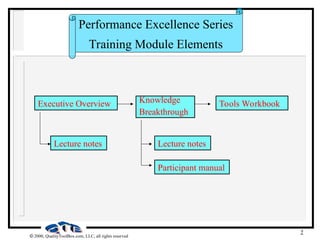
Executive Overview
Participant manual
Tools Workbook
Knowledge
Breakthrough
Lecture notes Lecture notes
Performance Excellence Series
Training Module Elements
3
 2000, QualityToolBox.com, LLC, all rights reserved
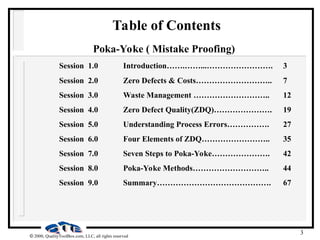
Table of Contents
Poka-Yoke ( Mistake Proofing)
Session 1.0 Introduction…….……...……………………. 3
Session 2.0 Zero Defects & Costs……………………….. 7
Session 3.0 Waste Management ……………………….. 12
Session 4.0 Zero Defect Quality(ZDQ)…………………. 19
Session 5.0 Understanding Process Errors……………. 27
Session 6.0 Four Elements of ZDQ…………………….. 35
Session 7.0 Seven Steps to Poka-Yoke…………………. 42
Session 8.0 Poka-Yoke Methods……………………….. 44
Session 9.0 Summary……………………………………. 67
4
 2000, QualityToolBox.com, LLC, all rights reserved
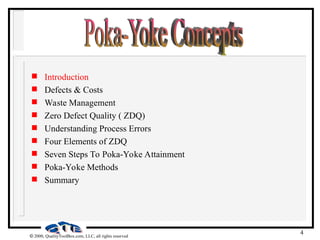
 Introduction
 Defects & Costs
 Waste Management
 Zero Defect Quality ( ZDQ)
 Understanding Process Errors
 Four Elements of ZDQ
 Seven Steps To Poka-Yoke Attainment
 Poka-Yoke Methods
 Summary
5
 2000, QualityToolBox.com, LLC, all rights reserved
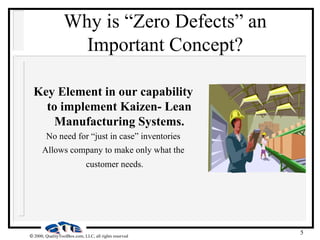
Why is “Zero Defects” an
Important Concept?
Key Element in our capability
to implement Kaizen- Lean
Manufacturing Systems.
No need for “just in case” inventories
Allows company to make only what the
customer needs.
6
 2000, QualityToolBox.com, LLC, all rights reserved
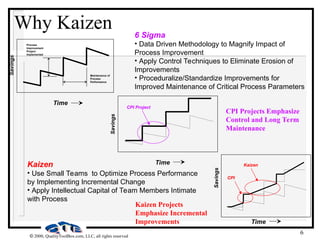
Why Kaizen
Time
CPI Project
Time
CPI
Time
Savings
Savings
Savings
Process
Improvement
Project
Implemented
Maintenance of
Process
Performance
Kaizen
6 Sigma
• Data Driven Methodology to Magnify Impact of
Process Improvement
• Apply Control Techniques to Eliminate Erosion of
Improvements
• Proceduralize/Standardize Improvements for
Improved Maintenance of Critical Process Parameters
Kaizen
• Use Small Teams to Optimize Process Performance
by Implementing Incremental Change
• Apply Intellectual Capital of Team Members Intimate
with Process
CPI Projects Emphasize
Control and Long Term
Maintenance
Kaizen Projects
Emphasize Incremental
Improvements
7
 2000, QualityToolBox.com, LLC, all rights reserved
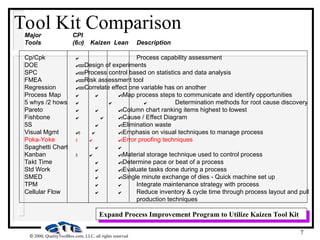
Major CPI
Tools (6) Kaizen Lean Description
Cp/Cpk  Process capability assessment
DOE Design of experiments
SPC Process control based on statistics and data analysis
FMEA Risk assessment tool
Regression Correlate effect one variable has on another
Process Map   Map process steps to communicate and identify opportunities
5 whys /2 hows Determination methods for root cause discovery
Pareto   Column chart ranking items highest to lowest
Fishbone   Cause / Effect Diagram
5S  Elimination waste
Visual Mgmt  Emphasis on visual techniques to manage process
Poka-Yoke  Error proofing techniques
Spaghetti Chart  
Kanban  Material storage technique used to control process
Takt Time  Determine pace or beat of a process
Std Work  Evaluate tasks done during a process
SMED  Single minute exchange of dies - Quick machine set up
TPM   Integrate maintenance strategy with process
Cellular Flow   Reduce inventory & cycle time through process layout and pull
production techniques
Expand Process Improvement Program to Utilize Kaizen Tool Kit
Tool Kit Comparison
8
 2000, QualityToolBox.com, LLC, all rights reserved
 Introduction
 Defects & Costs
 Waste Management
 Zero Defect Quality ( ZDQ)
 Understanding Process Errors
 Four Elements of ZDQ
 Seven Steps to Poka-Yoke Attainment
 Poka-Yoke Methods
 Summary
9
 2000, QualityToolBox.com, LLC, all rights reserved
Why is “Zero Defects” an Important
Concept?
Maintain Customer Satisfaction & Loyalty
Happy Customers mean more sales!
10
 2000, QualityToolBox.com, LLC, all rights reserved
Why is “Zero Defects” an Important
Concept?
COST
There is always a cost
associated with
manufacturing defects!
11
 2000, QualityToolBox.com, LLC, all rights reserved
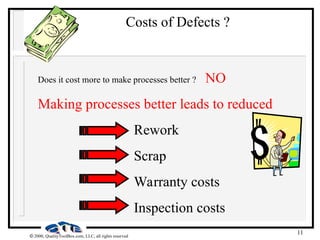
Costs of Defects ?
Does it cost more to make processes better ? NO
Making processes better leads to reduced
Rework
Scrap
Warranty costs
Inspection costs
12
 2000, QualityToolBox.com, LLC, all rights reserved
1-10-100 Rule
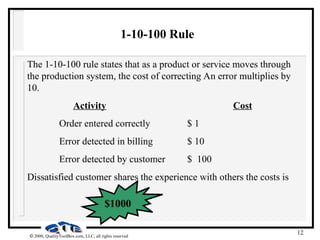
The 1-10-100 rule states that as a product or service moves through
the production system, the cost of correcting An error multiplies by
10.
Activity Cost
Order entered correctly $ 1
Error detected in billing $ 10
Error detected by customer $ 100
Dissatisfied customer shares the experience with others the costs is
$1000
13
 2000, QualityToolBox.com, LLC, all rights reserved
 Introduction
 Defects & Costs
 Waste Management
 Zero Defect Quality ( ZDQ)
 Understanding Process Errors
 Four Elements of ZDQ
 Seven Steps to Poka-Yoke Attainment
 Poka-Yoke Methods
 Summary
14
 2000, QualityToolBox.com, LLC, all rights reserved
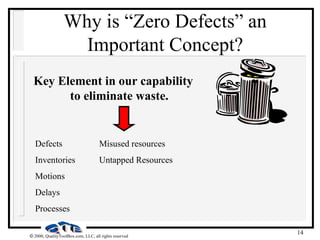
Why is “Zero Defects” an
Important Concept?
Key Element in our capability
to eliminate waste.
Defects Misused resources
Inventories Untapped Resources
Motions
Delays
Processes
15
 2000, QualityToolBox.com, LLC, all rights reserved
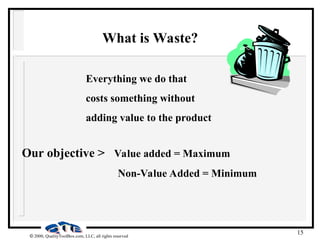
What is Waste?
Everything we do that
costs something without
adding value to the product
Our objective > Value added = Maximum
Non-Value Added = Minimum
16
 2000, QualityToolBox.com, LLC, all rights reserved
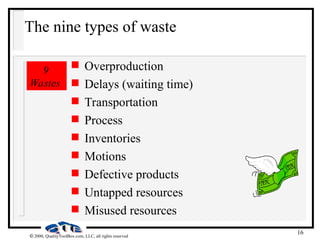
The nine types of waste
 Overproduction
 Delays (waiting time)
 Transportation
 Process
 Inventories
 Motions
 Defective products
 Untapped resources
 Misused resources
9
Wastes
17
 2000, QualityToolBox.com, LLC, all rights reserved
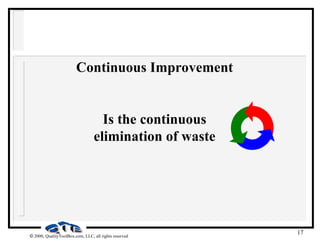
Continuous Improvement
Is the continuous
elimination of waste
18
 2000, QualityToolBox.com, LLC, all rights reserved
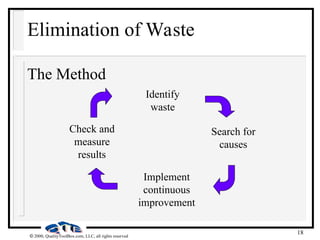
Elimination of Waste
The Method
Check and
measure
results
Identify
waste
Search for
causes
Implement
continuous
improvement
19
 2000, QualityToolBox.com, LLC, all rights reserved
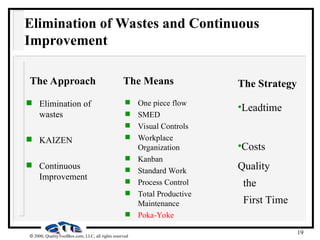
Elimination of Wastes and Continuous
Improvement
 Elimination of
wastes
 KAIZEN
 Continuous
Improvement
 One piece flow
 SMED
 Visual Controls
 Workplace
Organization
 Kanban
 Standard Work
 Process Control
 Total Productive
Maintenance
 Poka-Yoke
•Leadtime
•Costs
Quality
the
First Time
The Approach The Means The Strategy
20
 2000, QualityToolBox.com, LLC, all rights reserved
 Introduction
 Defects & Costs
 Waste Management
 Zero Defect Quality ( ZDQ)
 Understanding Process Errors
 Four Elements of ZDQ
 Seven Steps to Poka-Yoke Attainment
 Poka-Yoke Methods
 Summary
21
 2000, QualityToolBox.com, LLC, all rights reserved
What is a Zero Defect Quality
System (ZDQ)?
A quality concept to manufacture ZERO defects
& elimination of waste associated with defects!
“ZERO” is the goal!
22
 2000, QualityToolBox.com, LLC, all rights reserved
What is a Zero Defect Quality
System (ZDQ)?
Based on a discipline that
defects are prevented.
Control the process so that defects
are impossible!
23
 2000, QualityToolBox.com, LLC, all rights reserved
What is a Zero Defect Quality
System (ZDQ)?
No Finger Pointing.
Operators and Machines
will sometimes make
mistakes.
Find ways to keep errors from
becoming defects!
24
 2000, QualityToolBox.com, LLC, all rights reserved
What is a Zero Defect Quality
System (ZDQ)?
A Method for Mistake-
Proofing (Poka-yoke) a
process.
ZDQ assures that defects are not
shipped!
25
 2000, QualityToolBox.com, LLC, all rights reserved
How ZDQ Makes Work Easier
Mistake-Proof or Poka-yoke the process!
Recognize that it is natural
for people to make
mistakes.
26
 2000, QualityToolBox.com, LLC, all rights reserved
How ZDQ Makes Work Easier
Mistake-Proof or Poka-yoke the process!
Not noticing that an error is
made or a machine is not
functioning does not make a
person stupid or foolish.
27
 2000, QualityToolBox.com, LLC, all rights reserved
How Do We Achieve ZDQ ?
Mistake-Proof or Poka-yoke the process!
Errors never become defects!
No finger pointing after the
fact. No mandate to do
better next time.
28
 2000, QualityToolBox.com, LLC, all rights reserved
 Introduction
 Defects & Costs
 Waste Management
 Zero Defect Quality ( ZDQ)
 Understanding Process Errors
 Four Elements of ZDQ
 Seven Steps to Poka-Yoke Attainment
 Poka-Yoke Methods
 Summary
29
 2000, QualityToolBox.com, LLC, all rights reserved
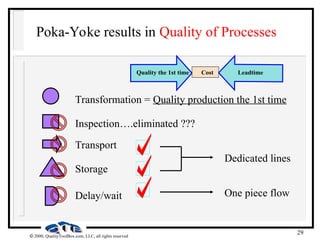
Poka-Yoke results in Quality of Processes
Dedicated lines
One piece flow
Transformation = Quality production the 1st time
Inspection….eliminated ???
Transport
Storage
Delay/wait
Leadtime
Quality the 1st time Cost
30
 2000, QualityToolBox.com, LLC, all rights reserved
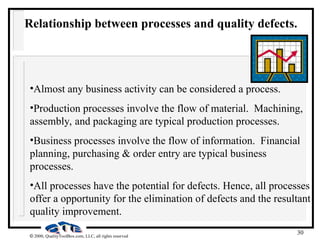
Relationship between processes and quality defects.
•Almost any business activity can be considered a process.
•Production processes involve the flow of material. Machining,
assembly, and packaging are typical production processes.
•Business processes involve the flow of information. Financial
planning, purchasing & order entry are typical business
processes.
•All processes have the potential for defects. Hence, all processes
offer a opportunity for the elimination of defects and the resultant
quality improvement.
31
 2000, QualityToolBox.com, LLC, all rights reserved
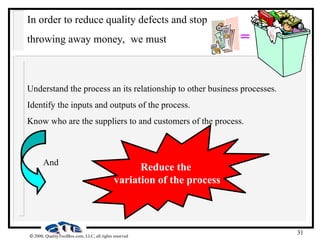
In order to reduce quality defects and stop
throwing away money, we must
Understand the process an its relationship to other business processes.
Identify the inputs and outputs of the process.
Know who are the suppliers to and customers of the process.
=
Reduce the
variation of the process
And
32
 2000, QualityToolBox.com, LLC, all rights reserved
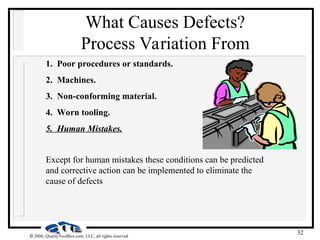
What Causes Defects?
Process Variation From
1. Poor procedures or standards.
2. Machines.
3. Non-conforming material.
4. Worn tooling.
5. Human Mistakes.
Except for human mistakes these conditions can be predicted
and corrective action can be implemented to eliminate the
cause of defects
33
 2000, QualityToolBox.com, LLC, all rights reserved
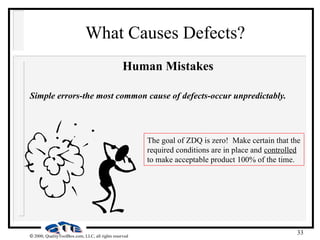
What Causes Defects?
Human Mistakes
Simple errors-the most common cause of defects-occur unpredictably.
The goal of ZDQ is zero! Make certain that the
required conditions are in place and controlled
to make acceptable product 100% of the time.
34
 2000, QualityToolBox.com, LLC, all rights reserved
Ten Types of Human Mistakes
 Forgetfulness
 Misunderstanding
 Wrong identification
 Lack of experience
 Willful (ignoring rules or procedure)
 Inadvertent or sloppiness
 Slowliness
 Lack of standardization
 Surprise (unexpected machine operation, etc.)
 Intentional (sabotage)
35
 2000, QualityToolBox.com, LLC, all rights reserved
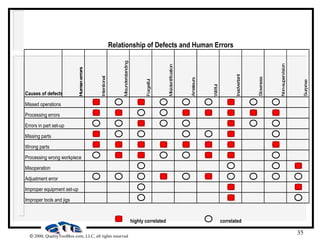
Relationship of Defects and Human Errors
Causes of defects
Human
errors
Intentional
Misunderstanding
Forgetful
Misidentification
Amateurs
Willful
Inadvertant
Slowness
Non-supervision
Surprise
Missed operations
Processing errors
Errors in part set-up
Missing parts
Wrong parts
Processing wrong workpiece
Misoperation
Adjustment error
Improper equipment set-up
Improper tools and jigs
highly correlated correlated
36
 2000, QualityToolBox.com, LLC, all rights reserved
 Introduction
 Defects & Costs
 Waste Management
 Zero Defect Quality ( ZDQ)
 Understanding Process Errors
 Four Elements of ZDQ
 Seven Steps to Poka-Yoke Attainment
 Poka-Yoke Methods
 Summary
37
 2000, QualityToolBox.com, LLC, all rights reserved
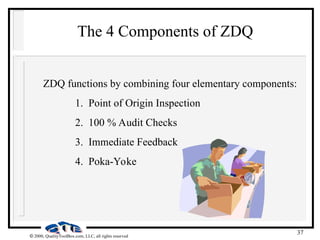
The 4 Components of ZDQ
ZDQ functions by combining four elementary components:
1. Point of Origin Inspection
2. 100 % Audit Checks
3. Immediate Feedback
4. Poka-Yoke
38
 2000, QualityToolBox.com, LLC, all rights reserved
Inspection
The 3 basic approaches to inspection of processed product are:
Judgement/Standard Inspection
Informative Inspection
Point of Origin Inspection
The first two approaches are widely used and considered
traditional.
Only Point of Origin Inspection actually eliminates
defects.
39
 2000, QualityToolBox.com, LLC, all rights reserved
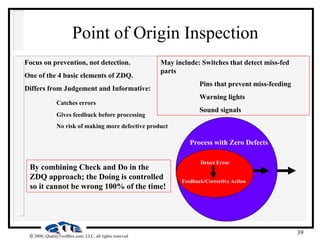
Point of Origin Inspection
Focus on prevention, not detection.
One of the 4 basic elements of ZDQ.
Differs from Judgement and Informative:
Catches errors
Gives feedback before processing
No risk of making more defective product
Detect Error
Feedback/Corrective Action
Process with Zero Defects
By combining Check and Do in the
ZDQ approach; the Doing is controlled
so it cannot be wrong 100% of the time!
May include: Switches that detect miss-fed
parts
Pins that prevent miss-feeding
Warning lights
Sound signals
40
 2000, QualityToolBox.com, LLC, all rights reserved
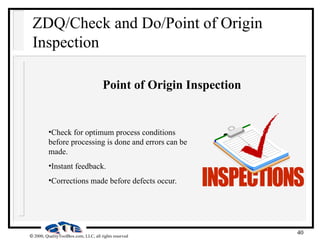
ZDQ/Check and Do/Point of Origin
Inspection
Point of Origin Inspection
•Check for optimum process conditions
before processing is done and errors can be
made.
•Instant feedback.
•Corrections made before defects occur.
41
 2000, QualityToolBox.com, LLC, all rights reserved
100% Audit Checks
Point of Origin Inspection on every piece.
The second of the 4 basic elements of ZDQ.
Differs from SQC inspection:
Does not rely on sampling
Prevents defects
Does not assume defects will statistically occur
100% Audit checks everything on the line!
Zero Defects
42
 2000, QualityToolBox.com, LLC, all rights reserved
Quick Feedback
Error correction as soon as possible
The third of the 4 basic elements of ZDQ.
Differs from traditional inspection approaches that:
Correct problems after the process
Address the problem when errors are already defects
In some cases never identify an error has occurred
ZDQ sends the operator a signal and alarms
the person that an error has happened!
ZDQ Inspections = Immediate Feedback
43
 2000, QualityToolBox.com, LLC, all rights reserved
 Introduction
 Defects & Costs
 Waste Management
 Zero Defect Quality ( ZDQ)
 Understanding Process Errors
 Four Elements of ZDQ
 Seven Steps to Poka-Yoke Attainment
 Poka-Yoke Methods
 Summary
44
 2000, QualityToolBox.com, LLC, all rights reserved
The Seven Guidelines to Poka- Yoke Attainment
1.) Quality Processes - Design “Robust” quality processes to achieve zero defects.
2.) Utilize a Team Environment- leverage the teams knowledge,experience to
enhance the improvement efforts.
3.) Elimination of Errors -Utilize a robust problem solving methodology to drive
defects towards zero.
4.) Eliminate the “Root Cause” of The Errors-Use the 5 Why’s and 2 H’s approach
5.) Do It Right The First Time- Utilizing resources to perform functions correctly the
“first” time.
6.) Eliminate Non-Value Added Decisions- Don’t make excuses-just do it !
7.) Implement an Incremental Continual Improvement Approach-implement
improvement actions immediately and focus on incremental improvements; efforts do
not have to result in a 100% improvement immediately.
45
 2000, QualityToolBox.com, LLC, all rights reserved
 Introduction
 Defects & Costs
 Waste Management
 Zero Defect Quality ( ZDQ)
 Understanding Process Errors
 Four Elements of ZDQ
 Seven Steps to Poka-Yoke Attainment
 Poka-Yoke Methods
 Summary
46
 2000, QualityToolBox.com, LLC, all rights reserved
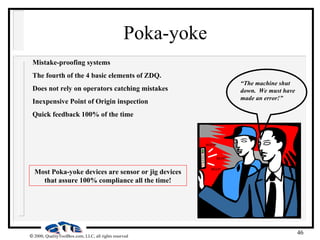
Poka-yoke
Mistake-proofing systems
The fourth of the 4 basic elements of ZDQ.
Does not rely on operators catching mistakes
Inexpensive Point of Origin inspection
Quick feedback 100% of the time
“The machine shut
down. We must have
made an error!”
BEEP!
BEEP!
BEEP!
Most Poka-yoke devices are sensor or jig devices
that assure 100% compliance all the time!
47
 2000, QualityToolBox.com, LLC, all rights reserved
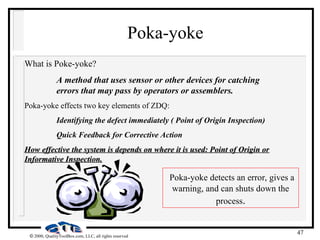
Poka-yoke
What is Poke-yoke?
A method that uses sensor or other devices for catching
errors that may pass by operators or assemblers.
Poka-yoke effects two key elements of ZDQ:
Identifying the defect immediately ( Point of Origin Inspection)
Quick Feedback for Corrective Action
How effective the system is depends on where it is used: Point of Origin or
Informative Inspection.
Poka-yoke detects an error, gives a
warning, and can shuts down the
process.
48
 2000, QualityToolBox.com, LLC, all rights reserved
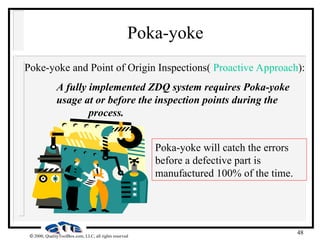
Poka-yoke
Poke-yoke and Point of Origin Inspections( Proactive Approach):
A fully implemented ZDQ system requires Poka-yoke
usage at or before the inspection points during the
process.
Poka-yoke will catch the errors
before a defective part is
manufactured 100% of the time.
49
 2000, QualityToolBox.com, LLC, all rights reserved
Poka-yoke
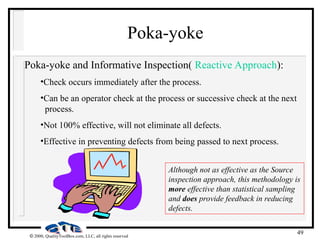
Poka-yoke and Informative Inspection( Reactive Approach):
•Check occurs immediately after the process.
•Can be an operator check at the process or successive check at the next
process.
•Not 100% effective, will not eliminate all defects.
•Effective in preventing defects from being passed to next process.
Although not as effective as the Source
inspection approach, this methodology is
more effective than statistical sampling
and does provide feedback in reducing
defects.
50
 2000, QualityToolBox.com, LLC, all rights reserved
Poka-yoke Systems Govern the Process
Two Poka-Yoke System approaches are utilized in
manufacturing which lead to successful ZDQ:
1. Control Approach
Shuts down the process when an error
occurs.
Keeps the “suspect” part in place when
an operation is incomplete.
2. Warning Approach
Signals the operator to stop the process
and correct the problem.
51
 2000, QualityToolBox.com, LLC, all rights reserved
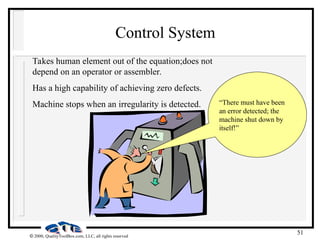
Control System
Takes human element out of the equation;does not
depend on an operator or assembler.
Has a high capability of achieving zero defects.
Machine stops when an irregularity is detected. “There must have been
an error detected; the
machine shut down by
itself!”
52
 2000, QualityToolBox.com, LLC, all rights reserved
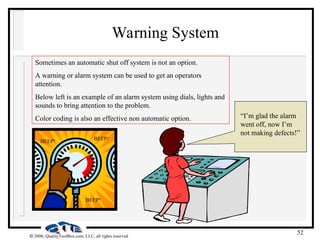
Warning System
Sometimes an automatic shut off system is not an option.
A warning or alarm system can be used to get an operators
attention.
Below left is an example of an alarm system using dials, lights and
sounds to bring attention to the problem.
Color coding is also an effective non automatic option.
BEEP!
BEEP!
BEEP!
“I’m glad the alarm
went off, now I’m
not making defects!”
53
 2000, QualityToolBox.com, LLC, all rights reserved
Methods for Using Poka-yoke
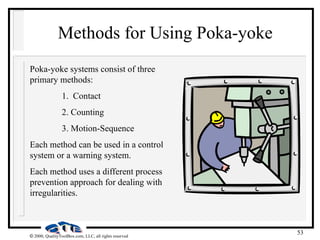
Poka-yoke systems consist of three
primary methods:
1. Contact
2. Counting
3. Motion-Sequence
Each method can be used in a control
system or a warning system.
Each method uses a different process
prevention approach for dealing with
irregularities.
54
 2000, QualityToolBox.com, LLC, all rights reserved
Contact Method
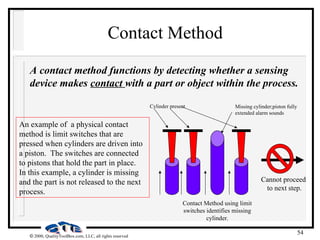
A contact method functions by detecting whether a sensing
device makes contact with a part or object within the process.
Missing cylinder;piston fully
extended alarm sounds
Contact Method using limit
switches identifies missing
cylinder.
An example of a physical contact
method is limit switches that are
pressed when cylinders are driven into
a piston. The switches are connected
to pistons that hold the part in place.
In this example, a cylinder is missing
and the part is not released to the next
process.
Cannot proceed
to next step.
Cylinder present
55
 2000, QualityToolBox.com, LLC, all rights reserved
Physical Contact Devices
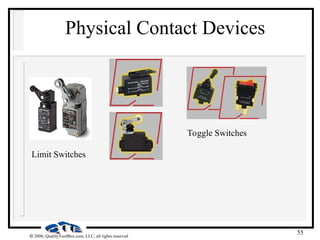
Limit Switches
Toggle Switches
56
 2000, QualityToolBox.com, LLC, all rights reserved
Energy Contact Devices
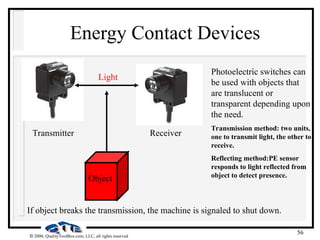
Photoelectric switches can
be used with objects that
are translucent or
transparent depending upon
the need.
Transmission method: two units,
one to transmit light, the other to
receive.
Reflecting method:PE sensor
responds to light reflected from
object to detect presence.
Light
Transmitter Receiver
Object
If object breaks the transmission, the machine is signaled to shut down.
57
 2000, QualityToolBox.com, LLC, all rights reserved
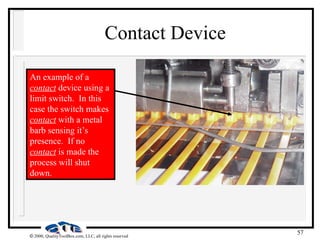
Contact Device
An example of a
contact device using a
limit switch. In this
case the switch makes
contact with a metal
barb sensing it’s
presence. If no
contact is made the
process will shut
down.
58
 2000, QualityToolBox.com, LLC, all rights reserved
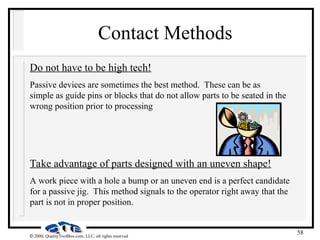
Contact Methods
Do not have to be high tech!
Passive devices are sometimes the best method. These can be as
simple as guide pins or blocks that do not allow parts to be seated in the
wrong position prior to processing
Take advantage of parts designed with an uneven shape!
A work piece with a hole a bump or an uneven end is a perfect candidate
for a passive jig. This method signals to the operator right away that the
part is not in proper position.
59
 2000, QualityToolBox.com, LLC, all rights reserved
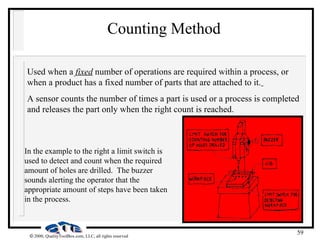
Counting Method
Used when a fixed number of operations are required within a process, or
when a product has a fixed number of parts that are attached to it.
A sensor counts the number of times a part is used or a process is completed
and releases the part only when the right count is reached.
In the example to the right a limit switch is
used to detect and count when the required
amount of holes are drilled. The buzzer
sounds alerting the operator that the
appropriate amount of steps have been taken
in the process.
60
 2000, QualityToolBox.com, LLC, all rights reserved
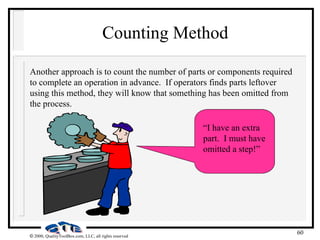
Counting Method
Another approach is to count the number of parts or components required
to complete an operation in advance. If operators finds parts leftover
using this method, they will know that something has been omitted from
the process.
“I have an extra
part. I must have
omitted a step!”
61
 2000, QualityToolBox.com, LLC, all rights reserved
Motion-Sequence Method
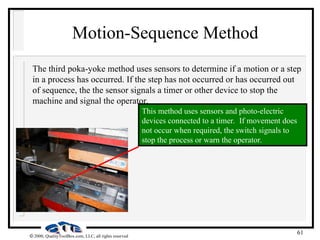
The third poka-yoke method uses sensors to determine if a motion or a step
in a process has occurred. If the step has not occurred or has occurred out
of sequence, the the sensor signals a timer or other device to stop the
machine and signal the operator.
This method uses sensors and photo-electric
devices connected to a timer. If movement does
not occur when required, the switch signals to
stop the process or warn the operator.
62
 2000, QualityToolBox.com, LLC, all rights reserved
Motion-Sequence Method
In order to help operators select the right parts for the right step in a process
the “sequencing” aspect of the motion-step method is used. This is
especially helpful when using multiple parts that are similar in size and
shape.
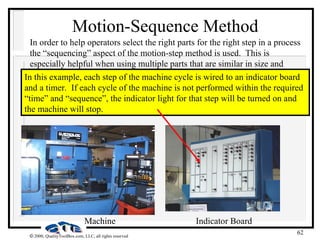
In this example, each step of the machine cycle is wired to an indicator board
and a timer. If each cycle of the machine is not performed within the required
“time” and “sequence”, the indicator light for that step will be turned on and
the machine will stop.
Indicator Board
Machine
63
 2000, QualityToolBox.com, LLC, all rights reserved
Types of Sensing Devices
Sensing devices that are traditionally used in poka-yoke
systems can be divided into three categories:
1. Physical contact devices
2. Energy sensing devices
3. Warning Sensors
Each category of sensors includes a broad range
of devices that can be used depending on the
process.
64
 2000, QualityToolBox.com, LLC, all rights reserved
Physical Contact Sensors
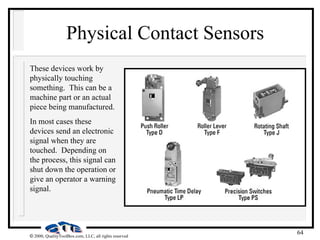
These devices work by
physically touching
something. This can be a
machine part or an actual
piece being manufactured.
In most cases these
devices send an electronic
signal when they are
touched. Depending on
the process, this signal can
shut down the operation or
give an operator a warning
signal.
65
 2000, QualityToolBox.com, LLC, all rights reserved
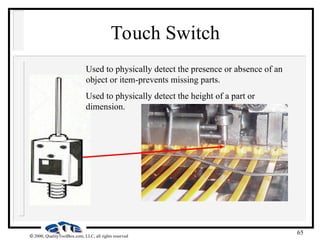
Touch Switch
Used to physically detect the presence or absence of an
object or item-prevents missing parts.
Used to physically detect the height of a part or
dimension.
66
 2000, QualityToolBox.com, LLC, all rights reserved
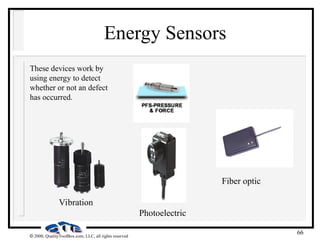
Energy Sensors
These devices work by
using energy to detect
whether or not an defect
has occurred.
Fiber optic
Photoelectric
Vibration
67
 2000, QualityToolBox.com, LLC, all rights reserved
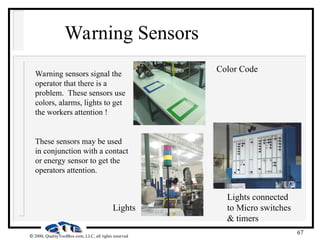
Warning Sensors
Warning sensors signal the
operator that there is a
problem. These sensors use
colors, alarms, lights to get
the workers attention !
These sensors may be used
in conjunction with a contact
or energy sensor to get the
operators attention.
Color Code
Lights
Lights connected
to Micro switches
& timers
68
 2000, QualityToolBox.com, LLC, all rights reserved
 Introduction
 Defects & Costs
 Waste Management
 Zero Defect Quality ( ZDQ)
 Understanding Process Errors
 Four Elements of ZDQ
 Seven Steps to Poka-Yoke Attainment
 Poka-Yoke Methods
 Summary
69
 2000, QualityToolBox.com, LLC, all rights reserved
To prevent mistakes, develop error proofing devices
POKA-YOKE
to avoid (yokeru) inadvertent errors (poka)
 Checklists
 Dowel and locating pins
 Error & alarm detectors
 Limit or touch switches
 Detectors, readers, meters, counters
70
 2000, QualityToolBox.com, LLC, all rights reserved
Two types of error proofing devices
POKA-YOKE
 Control - eliminates the possibility of a
mistake to occur (automatic machine
shutdown)
 Warning - signals that a mistake can occur
(blinking light, alarm, etc.)
71
 2000, QualityToolBox.com, LLC, all rights reserved
3 Rules of POKA-YOKE
 Don’t wait for the perfect POKA-
YOKE. Do it now!
 If your POKA-YOKE idea has
better than 50% chance to
succeed…Do it!
 Do it now….improve later!
72
 2000, QualityToolBox.com, LLC, all rights reserved
Some examples of POKA-YOKE devices
 Attached gas cap
 Gas pump nozzle
 Polarized electrical plug and socket
 Disc brake pad warning noise
73
 2000, QualityToolBox.com, LLC, all rights reserved
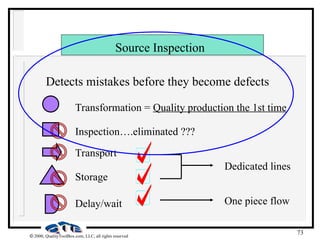
Source Inspection
Detects mistakes before they become defects
Transformation = Quality production the 1st time
Inspection….eliminated ???
Transport
Storage
Delay/wait
Dedicated lines
One piece flow

Mistake and proofing Poka yokae slide presentation

  • 1.
    1  2000, QualityToolBox.com,LLC, all rights reserved A Strategy for Performance Excellence
  • 2.
    2  2000, QualityToolBox.com,LLC, all rights reserved Executive Overview Participant manual Tools Workbook Knowledge Breakthrough Lecture notes Lecture notes Performance Excellence Series Training Module Elements
  • 3.
    3  2000, QualityToolBox.com,LLC, all rights reserved Table of Contents Poka-Yoke ( Mistake Proofing) Session 1.0 Introduction…….……...……………………. 3 Session 2.0 Zero Defects & Costs……………………….. 7 Session 3.0 Waste Management ……………………….. 12 Session 4.0 Zero Defect Quality(ZDQ)…………………. 19 Session 5.0 Understanding Process Errors……………. 27 Session 6.0 Four Elements of ZDQ…………………….. 35 Session 7.0 Seven Steps to Poka-Yoke…………………. 42 Session 8.0 Poka-Yoke Methods……………………….. 44 Session 9.0 Summary……………………………………. 67
  • 4.
    4  2000, QualityToolBox.com,LLC, all rights reserved  Introduction  Defects & Costs  Waste Management  Zero Defect Quality ( ZDQ)  Understanding Process Errors  Four Elements of ZDQ  Seven Steps To Poka-Yoke Attainment  Poka-Yoke Methods  Summary
  • 5.
    5  2000, QualityToolBox.com,LLC, all rights reserved Why is “Zero Defects” an Important Concept? Key Element in our capability to implement Kaizen- Lean Manufacturing Systems. No need for “just in case” inventories Allows company to make only what the customer needs.
  • 6.
    6  2000, QualityToolBox.com,LLC, all rights reserved Why Kaizen Time CPI Project Time CPI Time Savings Savings Savings Process Improvement Project Implemented Maintenance of Process Performance Kaizen 6 Sigma • Data Driven Methodology to Magnify Impact of Process Improvement • Apply Control Techniques to Eliminate Erosion of Improvements • Proceduralize/Standardize Improvements for Improved Maintenance of Critical Process Parameters Kaizen • Use Small Teams to Optimize Process Performance by Implementing Incremental Change • Apply Intellectual Capital of Team Members Intimate with Process CPI Projects Emphasize Control and Long Term Maintenance Kaizen Projects Emphasize Incremental Improvements
  • 7.
    7  2000, QualityToolBox.com,LLC, all rights reserved Major CPI Tools (6) Kaizen Lean Description Cp/Cpk  Process capability assessment DOE Design of experiments SPC Process control based on statistics and data analysis FMEA Risk assessment tool Regression Correlate effect one variable has on another Process Map   Map process steps to communicate and identify opportunities 5 whys /2 hows Determination methods for root cause discovery Pareto   Column chart ranking items highest to lowest Fishbone   Cause / Effect Diagram 5S  Elimination waste Visual Mgmt  Emphasis on visual techniques to manage process Poka-Yoke  Error proofing techniques Spaghetti Chart   Kanban  Material storage technique used to control process Takt Time  Determine pace or beat of a process Std Work  Evaluate tasks done during a process SMED  Single minute exchange of dies - Quick machine set up TPM   Integrate maintenance strategy with process Cellular Flow   Reduce inventory & cycle time through process layout and pull production techniques Expand Process Improvement Program to Utilize Kaizen Tool Kit Tool Kit Comparison
  • 8.
    8  2000, QualityToolBox.com,LLC, all rights reserved  Introduction  Defects & Costs  Waste Management  Zero Defect Quality ( ZDQ)  Understanding Process Errors  Four Elements of ZDQ  Seven Steps to Poka-Yoke Attainment  Poka-Yoke Methods  Summary
  • 9.
    9  2000, QualityToolBox.com,LLC, all rights reserved Why is “Zero Defects” an Important Concept? Maintain Customer Satisfaction & Loyalty Happy Customers mean more sales!
  • 10.
    10  2000, QualityToolBox.com,LLC, all rights reserved Why is “Zero Defects” an Important Concept? COST There is always a cost associated with manufacturing defects!
  • 11.
    11  2000, QualityToolBox.com,LLC, all rights reserved Costs of Defects ? Does it cost more to make processes better ? NO Making processes better leads to reduced Rework Scrap Warranty costs Inspection costs
  • 12.
    12  2000, QualityToolBox.com,LLC, all rights reserved 1-10-100 Rule The 1-10-100 rule states that as a product or service moves through the production system, the cost of correcting An error multiplies by 10. Activity Cost Order entered correctly $ 1 Error detected in billing $ 10 Error detected by customer $ 100 Dissatisfied customer shares the experience with others the costs is $1000
  • 13.
    13  2000, QualityToolBox.com,LLC, all rights reserved  Introduction  Defects & Costs  Waste Management  Zero Defect Quality ( ZDQ)  Understanding Process Errors  Four Elements of ZDQ  Seven Steps to Poka-Yoke Attainment  Poka-Yoke Methods  Summary
  • 14.
    14  2000, QualityToolBox.com,LLC, all rights reserved Why is “Zero Defects” an Important Concept? Key Element in our capability to eliminate waste. Defects Misused resources Inventories Untapped Resources Motions Delays Processes
  • 15.
    15  2000, QualityToolBox.com,LLC, all rights reserved What is Waste? Everything we do that costs something without adding value to the product Our objective > Value added = Maximum Non-Value Added = Minimum
  • 16.
    16  2000, QualityToolBox.com,LLC, all rights reserved The nine types of waste  Overproduction  Delays (waiting time)  Transportation  Process  Inventories  Motions  Defective products  Untapped resources  Misused resources 9 Wastes
  • 17.
    17  2000, QualityToolBox.com,LLC, all rights reserved Continuous Improvement Is the continuous elimination of waste
  • 18.
    18  2000, QualityToolBox.com,LLC, all rights reserved Elimination of Waste The Method Check and measure results Identify waste Search for causes Implement continuous improvement
  • 19.
    19  2000, QualityToolBox.com,LLC, all rights reserved Elimination of Wastes and Continuous Improvement  Elimination of wastes  KAIZEN  Continuous Improvement  One piece flow  SMED  Visual Controls  Workplace Organization  Kanban  Standard Work  Process Control  Total Productive Maintenance  Poka-Yoke •Leadtime •Costs Quality the First Time The Approach The Means The Strategy
  • 20.
    20  2000, QualityToolBox.com,LLC, all rights reserved  Introduction  Defects & Costs  Waste Management  Zero Defect Quality ( ZDQ)  Understanding Process Errors  Four Elements of ZDQ  Seven Steps to Poka-Yoke Attainment  Poka-Yoke Methods  Summary
  • 21.
    21  2000, QualityToolBox.com,LLC, all rights reserved What is a Zero Defect Quality System (ZDQ)? A quality concept to manufacture ZERO defects & elimination of waste associated with defects! “ZERO” is the goal!
  • 22.
    22  2000, QualityToolBox.com,LLC, all rights reserved What is a Zero Defect Quality System (ZDQ)? Based on a discipline that defects are prevented. Control the process so that defects are impossible!
  • 23.
    23  2000, QualityToolBox.com,LLC, all rights reserved What is a Zero Defect Quality System (ZDQ)? No Finger Pointing. Operators and Machines will sometimes make mistakes. Find ways to keep errors from becoming defects!
  • 24.
    24  2000, QualityToolBox.com,LLC, all rights reserved What is a Zero Defect Quality System (ZDQ)? A Method for Mistake- Proofing (Poka-yoke) a process. ZDQ assures that defects are not shipped!
  • 25.
    25  2000, QualityToolBox.com,LLC, all rights reserved How ZDQ Makes Work Easier Mistake-Proof or Poka-yoke the process! Recognize that it is natural for people to make mistakes.
  • 26.
    26  2000, QualityToolBox.com,LLC, all rights reserved How ZDQ Makes Work Easier Mistake-Proof or Poka-yoke the process! Not noticing that an error is made or a machine is not functioning does not make a person stupid or foolish.
  • 27.
    27  2000, QualityToolBox.com,LLC, all rights reserved How Do We Achieve ZDQ ? Mistake-Proof or Poka-yoke the process! Errors never become defects! No finger pointing after the fact. No mandate to do better next time.
  • 28.
    28  2000, QualityToolBox.com,LLC, all rights reserved  Introduction  Defects & Costs  Waste Management  Zero Defect Quality ( ZDQ)  Understanding Process Errors  Four Elements of ZDQ  Seven Steps to Poka-Yoke Attainment  Poka-Yoke Methods  Summary
  • 29.
    29  2000, QualityToolBox.com,LLC, all rights reserved Poka-Yoke results in Quality of Processes Dedicated lines One piece flow Transformation = Quality production the 1st time Inspection….eliminated ??? Transport Storage Delay/wait Leadtime Quality the 1st time Cost
  • 30.
    30  2000, QualityToolBox.com,LLC, all rights reserved Relationship between processes and quality defects. •Almost any business activity can be considered a process. •Production processes involve the flow of material. Machining, assembly, and packaging are typical production processes. •Business processes involve the flow of information. Financial planning, purchasing & order entry are typical business processes. •All processes have the potential for defects. Hence, all processes offer a opportunity for the elimination of defects and the resultant quality improvement.
  • 31.
    31  2000, QualityToolBox.com,LLC, all rights reserved In order to reduce quality defects and stop throwing away money, we must Understand the process an its relationship to other business processes. Identify the inputs and outputs of the process. Know who are the suppliers to and customers of the process. = Reduce the variation of the process And
  • 32.
    32  2000, QualityToolBox.com,LLC, all rights reserved What Causes Defects? Process Variation From 1. Poor procedures or standards. 2. Machines. 3. Non-conforming material. 4. Worn tooling. 5. Human Mistakes. Except for human mistakes these conditions can be predicted and corrective action can be implemented to eliminate the cause of defects
  • 33.
    33  2000, QualityToolBox.com,LLC, all rights reserved What Causes Defects? Human Mistakes Simple errors-the most common cause of defects-occur unpredictably. The goal of ZDQ is zero! Make certain that the required conditions are in place and controlled to make acceptable product 100% of the time.
  • 34.
    34  2000, QualityToolBox.com,LLC, all rights reserved Ten Types of Human Mistakes  Forgetfulness  Misunderstanding  Wrong identification  Lack of experience  Willful (ignoring rules or procedure)  Inadvertent or sloppiness  Slowliness  Lack of standardization  Surprise (unexpected machine operation, etc.)  Intentional (sabotage)
  • 35.
    35  2000, QualityToolBox.com,LLC, all rights reserved Relationship of Defects and Human Errors Causes of defects Human errors Intentional Misunderstanding Forgetful Misidentification Amateurs Willful Inadvertant Slowness Non-supervision Surprise Missed operations Processing errors Errors in part set-up Missing parts Wrong parts Processing wrong workpiece Misoperation Adjustment error Improper equipment set-up Improper tools and jigs highly correlated correlated
  • 36.
    36  2000, QualityToolBox.com,LLC, all rights reserved  Introduction  Defects & Costs  Waste Management  Zero Defect Quality ( ZDQ)  Understanding Process Errors  Four Elements of ZDQ  Seven Steps to Poka-Yoke Attainment  Poka-Yoke Methods  Summary
  • 37.
    37  2000, QualityToolBox.com,LLC, all rights reserved The 4 Components of ZDQ ZDQ functions by combining four elementary components: 1. Point of Origin Inspection 2. 100 % Audit Checks 3. Immediate Feedback 4. Poka-Yoke
  • 38.
    38  2000, QualityToolBox.com,LLC, all rights reserved Inspection The 3 basic approaches to inspection of processed product are: Judgement/Standard Inspection Informative Inspection Point of Origin Inspection The first two approaches are widely used and considered traditional. Only Point of Origin Inspection actually eliminates defects.
  • 39.
    39  2000, QualityToolBox.com,LLC, all rights reserved Point of Origin Inspection Focus on prevention, not detection. One of the 4 basic elements of ZDQ. Differs from Judgement and Informative: Catches errors Gives feedback before processing No risk of making more defective product Detect Error Feedback/Corrective Action Process with Zero Defects By combining Check and Do in the ZDQ approach; the Doing is controlled so it cannot be wrong 100% of the time! May include: Switches that detect miss-fed parts Pins that prevent miss-feeding Warning lights Sound signals
  • 40.
    40  2000, QualityToolBox.com,LLC, all rights reserved ZDQ/Check and Do/Point of Origin Inspection Point of Origin Inspection •Check for optimum process conditions before processing is done and errors can be made. •Instant feedback. •Corrections made before defects occur.
  • 41.
    41  2000, QualityToolBox.com,LLC, all rights reserved 100% Audit Checks Point of Origin Inspection on every piece. The second of the 4 basic elements of ZDQ. Differs from SQC inspection: Does not rely on sampling Prevents defects Does not assume defects will statistically occur 100% Audit checks everything on the line! Zero Defects
  • 42.
    42  2000, QualityToolBox.com,LLC, all rights reserved Quick Feedback Error correction as soon as possible The third of the 4 basic elements of ZDQ. Differs from traditional inspection approaches that: Correct problems after the process Address the problem when errors are already defects In some cases never identify an error has occurred ZDQ sends the operator a signal and alarms the person that an error has happened! ZDQ Inspections = Immediate Feedback
  • 43.
    43  2000, QualityToolBox.com,LLC, all rights reserved  Introduction  Defects & Costs  Waste Management  Zero Defect Quality ( ZDQ)  Understanding Process Errors  Four Elements of ZDQ  Seven Steps to Poka-Yoke Attainment  Poka-Yoke Methods  Summary
  • 44.
    44  2000, QualityToolBox.com,LLC, all rights reserved The Seven Guidelines to Poka- Yoke Attainment 1.) Quality Processes - Design “Robust” quality processes to achieve zero defects. 2.) Utilize a Team Environment- leverage the teams knowledge,experience to enhance the improvement efforts. 3.) Elimination of Errors -Utilize a robust problem solving methodology to drive defects towards zero. 4.) Eliminate the “Root Cause” of The Errors-Use the 5 Why’s and 2 H’s approach 5.) Do It Right The First Time- Utilizing resources to perform functions correctly the “first” time. 6.) Eliminate Non-Value Added Decisions- Don’t make excuses-just do it ! 7.) Implement an Incremental Continual Improvement Approach-implement improvement actions immediately and focus on incremental improvements; efforts do not have to result in a 100% improvement immediately.
  • 45.
    45  2000, QualityToolBox.com,LLC, all rights reserved  Introduction  Defects & Costs  Waste Management  Zero Defect Quality ( ZDQ)  Understanding Process Errors  Four Elements of ZDQ  Seven Steps to Poka-Yoke Attainment  Poka-Yoke Methods  Summary
  • 46.
    46  2000, QualityToolBox.com,LLC, all rights reserved Poka-yoke Mistake-proofing systems The fourth of the 4 basic elements of ZDQ. Does not rely on operators catching mistakes Inexpensive Point of Origin inspection Quick feedback 100% of the time “The machine shut down. We must have made an error!” BEEP! BEEP! BEEP! Most Poka-yoke devices are sensor or jig devices that assure 100% compliance all the time!
  • 47.
    47  2000, QualityToolBox.com,LLC, all rights reserved Poka-yoke What is Poke-yoke? A method that uses sensor or other devices for catching errors that may pass by operators or assemblers. Poka-yoke effects two key elements of ZDQ: Identifying the defect immediately ( Point of Origin Inspection) Quick Feedback for Corrective Action How effective the system is depends on where it is used: Point of Origin or How effective the system is depends on where it is used: Point of Origin or Informative Inspection. Informative Inspection. Poka-yoke detects an error, gives a warning, and can shuts down the process.
  • 48.
    48  2000, QualityToolBox.com,LLC, all rights reserved Poka-yoke Poke-yoke and Point of Origin Inspections( Proactive Approach): A fully implemented ZDQ system requires Poka-yoke usage at or before the inspection points during the process. Poka-yoke will catch the errors before a defective part is manufactured 100% of the time.
  • 49.
    49  2000, QualityToolBox.com,LLC, all rights reserved Poka-yoke Poka-yoke and Informative Inspection( Reactive Approach): •Check occurs immediately after the process. •Can be an operator check at the process or successive check at the next process. •Not 100% effective, will not eliminate all defects. •Effective in preventing defects from being passed to next process. Although not as effective as the Source inspection approach, this methodology is more effective than statistical sampling and does provide feedback in reducing defects.
  • 50.
    50  2000, QualityToolBox.com,LLC, all rights reserved Poka-yoke Systems Govern the Process Two Poka-Yoke System approaches are utilized in manufacturing which lead to successful ZDQ: 1. Control Approach Shuts down the process when an error occurs. Keeps the “suspect” part in place when an operation is incomplete. 2. Warning Approach Signals the operator to stop the process and correct the problem.
  • 51.
    51  2000, QualityToolBox.com,LLC, all rights reserved Control System Takes human element out of the equation;does not depend on an operator or assembler. Has a high capability of achieving zero defects. Machine stops when an irregularity is detected. “There must have been an error detected; the machine shut down by itself!”
  • 52.
    52  2000, QualityToolBox.com,LLC, all rights reserved Warning System Sometimes an automatic shut off system is not an option. A warning or alarm system can be used to get an operators attention. Below left is an example of an alarm system using dials, lights and sounds to bring attention to the problem. Color coding is also an effective non automatic option. BEEP! BEEP! BEEP! “I’m glad the alarm went off, now I’m not making defects!”
  • 53.
    53  2000, QualityToolBox.com,LLC, all rights reserved Methods for Using Poka-yoke Poka-yoke systems consist of three primary methods: 1. Contact 2. Counting 3. Motion-Sequence Each method can be used in a control system or a warning system. Each method uses a different process prevention approach for dealing with irregularities.
  • 54.
    54  2000, QualityToolBox.com,LLC, all rights reserved Contact Method A contact method functions by detecting whether a sensing device makes contact with a part or object within the process. Missing cylinder;piston fully extended alarm sounds Contact Method using limit switches identifies missing cylinder. An example of a physical contact method is limit switches that are pressed when cylinders are driven into a piston. The switches are connected to pistons that hold the part in place. In this example, a cylinder is missing and the part is not released to the next process. Cannot proceed to next step. Cylinder present
  • 55.
    55  2000, QualityToolBox.com,LLC, all rights reserved Physical Contact Devices Limit Switches Toggle Switches
  • 56.
    56  2000, QualityToolBox.com,LLC, all rights reserved Energy Contact Devices Photoelectric switches can be used with objects that are translucent or transparent depending upon the need. Transmission method: two units, one to transmit light, the other to receive. Reflecting method:PE sensor responds to light reflected from object to detect presence. Light Transmitter Receiver Object If object breaks the transmission, the machine is signaled to shut down.
  • 57.
    57  2000, QualityToolBox.com,LLC, all rights reserved Contact Device An example of a contact device using a limit switch. In this case the switch makes contact with a metal barb sensing it’s presence. If no contact is made the process will shut down.
  • 58.
    58  2000, QualityToolBox.com,LLC, all rights reserved Contact Methods Do not have to be high tech! Passive devices are sometimes the best method. These can be as simple as guide pins or blocks that do not allow parts to be seated in the wrong position prior to processing Take advantage of parts designed with an uneven shape! A work piece with a hole a bump or an uneven end is a perfect candidate for a passive jig. This method signals to the operator right away that the part is not in proper position.
  • 59.
    59  2000, QualityToolBox.com,LLC, all rights reserved Counting Method Used when a fixed number of operations are required within a process, or when a product has a fixed number of parts that are attached to it. A sensor counts the number of times a part is used or a process is completed and releases the part only when the right count is reached. In the example to the right a limit switch is used to detect and count when the required amount of holes are drilled. The buzzer sounds alerting the operator that the appropriate amount of steps have been taken in the process.
  • 60.
    60  2000, QualityToolBox.com,LLC, all rights reserved Counting Method Another approach is to count the number of parts or components required to complete an operation in advance. If operators finds parts leftover using this method, they will know that something has been omitted from the process. “I have an extra part. I must have omitted a step!”
  • 61.
    61  2000, QualityToolBox.com,LLC, all rights reserved Motion-Sequence Method The third poka-yoke method uses sensors to determine if a motion or a step in a process has occurred. If the step has not occurred or has occurred out of sequence, the the sensor signals a timer or other device to stop the machine and signal the operator. This method uses sensors and photo-electric devices connected to a timer. If movement does not occur when required, the switch signals to stop the process or warn the operator.
  • 62.
    62  2000, QualityToolBox.com,LLC, all rights reserved Motion-Sequence Method In order to help operators select the right parts for the right step in a process the “sequencing” aspect of the motion-step method is used. This is especially helpful when using multiple parts that are similar in size and shape. In this example, each step of the machine cycle is wired to an indicator board and a timer. If each cycle of the machine is not performed within the required “time” and “sequence”, the indicator light for that step will be turned on and the machine will stop. Indicator Board Machine
  • 63.
    63  2000, QualityToolBox.com,LLC, all rights reserved Types of Sensing Devices Sensing devices that are traditionally used in poka-yoke systems can be divided into three categories: 1. Physical contact devices 2. Energy sensing devices 3. Warning Sensors Each category of sensors includes a broad range of devices that can be used depending on the process.
  • 64.
    64  2000, QualityToolBox.com,LLC, all rights reserved Physical Contact Sensors These devices work by physically touching something. This can be a machine part or an actual piece being manufactured. In most cases these devices send an electronic signal when they are touched. Depending on the process, this signal can shut down the operation or give an operator a warning signal.
  • 65.
    65  2000, QualityToolBox.com,LLC, all rights reserved Touch Switch Used to physically detect the presence or absence of an object or item-prevents missing parts. Used to physically detect the height of a part or dimension.
  • 66.
    66  2000, QualityToolBox.com,LLC, all rights reserved Energy Sensors These devices work by using energy to detect whether or not an defect has occurred. Fiber optic Photoelectric Vibration
  • 67.
    67  2000, QualityToolBox.com,LLC, all rights reserved Warning Sensors Warning sensors signal the operator that there is a problem. These sensors use colors, alarms, lights to get the workers attention ! These sensors may be used in conjunction with a contact or energy sensor to get the operators attention. Color Code Lights Lights connected to Micro switches & timers
  • 68.
    68  2000, QualityToolBox.com,LLC, all rights reserved  Introduction  Defects & Costs  Waste Management  Zero Defect Quality ( ZDQ)  Understanding Process Errors  Four Elements of ZDQ  Seven Steps to Poka-Yoke Attainment  Poka-Yoke Methods  Summary
  • 69.
    69  2000, QualityToolBox.com,LLC, all rights reserved To prevent mistakes, develop error proofing devices POKA-YOKE to avoid (yokeru) inadvertent errors (poka)  Checklists  Dowel and locating pins  Error & alarm detectors  Limit or touch switches  Detectors, readers, meters, counters
  • 70.
    70  2000, QualityToolBox.com,LLC, all rights reserved Two types of error proofing devices POKA-YOKE  Control - eliminates the possibility of a mistake to occur (automatic machine shutdown)  Warning - signals that a mistake can occur (blinking light, alarm, etc.)
  • 71.
    71  2000, QualityToolBox.com,LLC, all rights reserved 3 Rules of POKA-YOKE  Don’t wait for the perfect POKA- YOKE. Do it now!  If your POKA-YOKE idea has better than 50% chance to succeed…Do it!  Do it now….improve later!
  • 72.
    72  2000, QualityToolBox.com,LLC, all rights reserved Some examples of POKA-YOKE devices  Attached gas cap  Gas pump nozzle  Polarized electrical plug and socket  Disc brake pad warning noise
  • 73.
    73  2000, QualityToolBox.com,LLC, all rights reserved Source Inspection Detects mistakes before they become defects Transformation = Quality production the 1st time Inspection….eliminated ??? Transport Storage Delay/wait Dedicated lines One piece flow

Editor's Notes

  • #6 6 Sigma uses a 6 step approach to achieve process performance improvement. Step 1 Measure Step 4 Verify Step 2 Evaluate Step 5 Standardize Step 3 Improve Step 6 Repeat steps 1-5 It is a conceptual strategy of approach utilizing process mapping any number of statistical methods tools to assess efficiency of performance. Kaizen is a performance improvement methodology focused on identification and elimination of the 7 forms of process waste.
  • #7 Poka-yoke is a key success factor required to achieve 6 sigma and Kaizen improvements, which will eliminate wastes and variation associated with processes.
  • #11 Eliminating process wastes,such as defects, through implementation of Poka-yoke efforts, will result in more repeatable and reproducible processes. Thus, processes will be more efficient and be more cost effective.
  • #12 This rule shows the importance and the possible escalation of the costs associated with defects. The idea is, that as the defective item is processed, the costs increased by a factor of 10 at each successive step. Theses increases in costs are due to the accumulation of wastes of each successive step as well as the increase in the consumption of resources associated with each additional step in the process.
  • #15 What is waste ? Waste is defined here in general terms. Waste does not add value to the products and services we provide and is therefore non-value added. Thus, by the elimination of wastes, we reduce activities that do not add value to the customer and do not contribute to the profits of our organization! Moreover, when we reduce wastes, we have more time and resources to focus on the value-added activities which are important to our customer and which do contribute the our profits !
  • #16 These are the nine characteristic types of waste affecting process performance. Everything we do or make that does not add value to the product is waste. The goal is to minimize wastes, maximize value add.
  • #17 In order for an organization to continually improve in all aspects of their business, they must eliminate the wastes associated with the processes.
  • #18 As processes are dynamic over time , new wastes appear. The continuous improvement cycle repeats indefinitely in order to address the changing face of waste.
  • #19  The focus on elimination of wastes (muda) is the core concept of Kaizen. Several means are employed to achieve the strategy of reducing lead times, costs, and producing quality the first time, every time.
  • #29 If quality is designed into the production process, it may be possible to eliminate inspection.
  • #30 Work is a series of interrelated processes. All processes have variation associated with them. Variation results in defects. Defects in one process can lead to defects in another process. When defects escalate costs escalate.
  • #34 Mistakes can be assigned to any of ten categories depending on the basis of their origin.
  • #35 The causes of defects correlate to varying degrees with the 10 categories of human error as diagrammed above.
  • #44 These are the sevens rules to a successful Poka-yoke implementation, generally in most text you will see 8 guidelines to poka-yoke attainment;we combined two steps into one. These should be custom fitted to your organization and culture.
  • #63 Sensing devices are the actual mechanism used to make contact, count, or identify the motion sequence of a work piece. They are the third tier of a poka-yoke system ( tires: approaches-methods-sensing devices).
  • #64 Various examples
  • #69  To prevent mistakes from becoming defects, Poka-Yoke, or error proofing devices build quality into a process. To avoid (yokeru) inadvertent errors (poka) Often worker originated
  • #70 Control examples : polarized electrical plug, gas pump nozzle, car transmission must be in park in order to start engine. Warning examples : disc brake pad noise when pad becomes thin, alarm for car lights left on after engine is turned off.
  • #71  Adopt a bias for action, avoid paralysis by analysis
  • #72  Ask others to give more examples from their experience
  • #73 Building quality into the process design so that mistakes are detected before they become defects is the road to quality the first time, every time.