BUSINESS PROCESS RE
ENGINEERING
Re -engineering
 “Re-engineering is the fundamental rethinking and radical design of
business processes to achieve dramatic improvements in critical,
contemporary measures of performance, such as cost, quality, service and
speed” (M. Hammer, J. Champy, 1993)
 “Re-engineering has been simply define as analysis and redesign of
business and manufacturing processes to eliminate that which adds no
value” (K. Parker, 1993)
 “Re-engineering is a radical new process or organizational change that
many companies are using to renew their commitment to customer
service” (Janson, 1992-93)
 A successful business process reengineering can turn an average company
into an industry leader. A good example would be Ford company and how
they redesigned their production processes, substituting manual work
with an assembly line.
 Before 1913, Ford’s workers produced their cars manually and
the production was not streamlined. Once the company introduced new
machinery and redesigned the production process into an assembly line,
Ford decreased the time it took to build their cars from over 12 hours to
2.5 hours.
Steps of business process reengineering (BPR)
 Map the current state of your business processes
Gather data from all resources–both software tools and stakeholders.
Understand how the process is performing currently.
 Analyze them and find any process gaps or disconnects
Identify all the errors and delays that hold up a free flow of the process. Make
sure if all details are available in the respective steps for the stakeholders to
make quick decisions.
 Look for improvement opportunities and validate them
Check if all the steps are absolutely necessary. If a step is there to solely
inform the person, remove the step, and add an automated email trigger.
Steps of business process reengineering (BPR)
 Design a cutting-edge future-state process map
Create a new process that solves all the problems you have identified. Don’t
be afraid to design a totally new process that is sure to work well. Designate
KPIs for every step of the process.
 Implement future state changes and be mindful of dependencies
Inform every stakeholder of the new process. Only proceed after everyone is
on board and educated about how the new process works.
Principles of business process reengineering
 Work should be designed such that it is result-oriented and not
process-oriented
 Involve those people in the process who face the output
 Merging data collection and processing units
 Bridging the processes which are running on similar lines
 Decision making should also be a part of the work performed
House of Quality (HOQ)
 A house of quality (HOQ) involves collecting and analyzing the “voice of the
customer” and a key component of the Quality Functional Deployment
technique. It is used to define the relationship between customer desires
and the product or company capabilities.
 Step 1: Customer Requirements – “Voice of the Customer”
The first step is to determine the market segments and identification of
prospective customers. Then team collects customer requirements for the
product or service and rate on a scale of 1 to 5. With 5 being the most
important and 1 being the least. Calculate the relative importance.
 Step2: Technical measures
Product requirements or technical characteristics are aligned to the voice of
customer. This step can be quite difficult as it involves people working in
groups to skim out the variable that may affect the customer requirement
factors the most. Parameters should be meaningful, measurable, and global.
 Step 3: Roof / Correlation Matrix
The triangular “roof” matrix of the House of Quality is to identify how the
design requirements interact with each other. It helps the designers in the
next phase of Q project. The triangular matrix looks like a house with a roof.
The interrelations are rating strong positive as “+ +”, where as strong negative
as “- -“and blank for no interrelation.
 Step4: Relationship Matrix
Develop correlation between customer requirements or voice of customer
and design characteristics or technical requirements. Decide the symbols that
you want to use to describe the grades you want. These should be consistent
and easy to understand.
The ranking system use is a set of symbols for strong, medium and weak
relationships. Each of the symbols represents a value of 9 for strong, 3 for
medium and 1 for weak.
 Step5: Importance Rating
It is the result of calculating the total sum of each column when multiplied by
the customer importance factor. It helps to determine where to assign the
most resources. Then calculate the percent of importance.
 Step 6: Competitive Evaluation
It helps to understand competitor products to fulfil the customer
requirements. It is also a good idea to ask customers how the product or
service rates in relation to the competition. Use surveys, customer meetings,
or focus groups/clinics to obtain feedback. Measure the satisfaction in 1 to 5
scales. Where 1 being highly dissatisfied and 5 being highly satisfied.
Poka-Yoke
 The term Poka-Yoke (poh-kah yoh-keh) was coined in Japan during the 1960s
by Shigeo Shingo, an industrial engineer at Toyota. Shingo also created and
formalized Zero Quality Control – a combination of Poka-Yoke techniques to correct
possible defects and source inspection to prevent defects.
 Poka-Yoke means ‘mistake-proofing’ or more literally – avoiding (yokeru) inadvertent
errors (poka).
 Poka-Yoke is any mechanism in a Lean manufacturing process that helps to avoid
mistakes.
 Its purpose is to eliminate product defects by preventing, correcting, or drawing
attention to human errors as they occur.
EXAMPLE
 A car with an automatic transmission, which has a switch that requires the
vehicle to be in “Park” or “Neutral” before it can be started.
 These serve as behavior-shaping constraints as there are actions that must
be performed before the car is allowed to start. This way, over time, the
driver’s behavior is adjusted to the requirements by repetition and habit.
WHEN TO USE MISTAKE PROOFING
• When a process step has been identified where human error can cause
mistakes or defects to occur, especially in processes that rely on the worker’s
attention, skill, or experience
• In a service process, where the customer can make an error which affects the
output
• At a hand-off step in a process, when output (or for service processes, the
customer) is transferred to another worker
• When a minor error early in the process causes major problems later in the
process
• When the consequences of an error are expensive or dangerous
MISTAKE PROOFING PROCEDURE
1. Obtain or create a flowchart of the process. Review each step, thinking about where and when human errors
are likely to occur.
2. For each potential error, work back through the process to find its source.
3. For each error, think of potential ways to make it impossible for the error to occur. Consider:
1. Elimination: eliminating the step that causes the error.
2. Replacement: replacing the step with an error-proof one.
3. Facilitation: making the correct action far easier than the error.
4. If you cannot make it impossible for the error to occur, think of ways to detect the error and minimize its
effects. Consider inspection methods, setting functions, and regulatory functions expanded on below.
5. Choose the best mistake-proofing method or device for each error. Test it, then implement it. Three kinds
of inspection methods provide rapid feedback:
1. Successive inspection is done at the next step of the process by the next worker.
2. Self-inspection means workers check their own work immediately after doing it.
3. Source inspection checks, before the process step takes place, that conditions are correct. Often it’s automatic and
keeps the process from proceeding until conditions are right.
MISTAKE PROOFING EXAMPLE
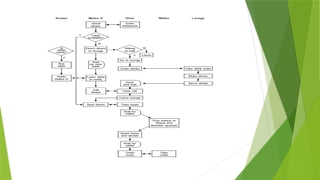
 The Parisian Experience restaurant wished to ensure high service quality
through mistake proofing. They reviewed the deployment chart (a
detailed flowchart that shows who performs each step) of the seating process
shown below and identified human errors on the part of restaurant staff or
customers that could cause service problems.
Types of poka-yoke
The contact method of poka-yoke
 The contact method of poka-yoke identifies defects through physical
attributes. This method uses a sensory device that detects abnormalities in
a product’s shape, size, colour, weight, or dimension. The device alerts
either a person or a machine to the current state of the product.
 The contact method is useful in situations involving fast repetition,
infrequent production, or environmental problems like dust, noise or poor
lighting – in other words, anything that distracts workers or leads to
mistakes.
The fixed value method of poka-yoke
 The fixed value method in poka-yoke ensures a set number of movements
are used in processes where an activity is repeated several times. This
method often involves basic techniques that allow workers to easily track
the frequency with which an activity has been performed, and ensure quality
standards are met.
 For example, if an employee is responsible for placing six screws on a
product before passing it down the production line, the activity of inserting
screws is performed to a fixed value – which is six times. A fixed value poka-
yoke method addresses this by ensuring the exact quantities to complete
the task are provided. By placing the screws in containers of six, the
employee can easily ensure the process is completed correctly by using up
the screws in the container.
The motion-step method of poka-yoke
 Motion-step in poka-yoke determines whether prescribed steps are
completed in order. Much like the fixed-value method, motion-step is
helpful where several different activities are performed by an individual
operator. The main difference from fixed value is that it deals with activities
performed in a set sequence.
 Motion-step therefore prevents and detects errors arising from an
incorrect sequence of events. Devices detect whether each motion is
performed, alerting workers when a step is skipped and enabling them to
remedy the error.
Examples
• Automotive safety features. Motor vehicles come equipped with many poka-yoke safety
features like automatic braking systems, cameras and radars to keep drivers and passengers
safe on the road.
• Pharmaceutical goods. Tamper-proof packaging and child-safe lids on pill bottles are poka-yoke
safety measures to prevent product interference or accidental consumption of potentially life-
threatening medicines.
• Household appliances. Washing machines, dryers, dishwashers, microwaves, blenders and
many other household electrical appliances all have mechanisms to prevent unsafe operation.
• Sporting equipment. Exercise equipment such as treadmills come equipped with safety clips
that – when pulled – will stop the treadmill if the exerciser trips of falls.
• Leak-proof drink containers. Travel mugs and water bottles often come with press and hold
buttons to enable users to drink from them. This poka-yoke mechanism prevents contents from
leaking or spilling when the container is not being used.
• Power outlets. Many electrical plugs are designed to only be inserted one way – an example of
the contact method of poka-yoke.
Challenges of Implementing Business Process
Reengineering
 Lack of knowledge
 Poor planning
 Insufficient resources
 Technology issues
 Internal politics
 Poor documentation
 Withholding information
Overcoming Challenges of Implementing Business
Process Reengineering
 Determining Actual Root Causes
You might think you know why a current business process is failing.
To avoid making false assumptions, focus on building a team that can get to
the real root of pain points.
Rather than pointing fingers and placing blame, take a pragmatic approach
that involves the people who best know the processes.
 Balancing Your Focus Between Current and Future State
Business process reengineering does require you to look ahead many years
down the road.
To define your future state, you must map your current processes so you can
identify the differences between your current and future state.
 Securing Executive Support
You need your executives to support every aspect of your digital
transformation, especially the business process reengineering aspect.
If even one business leader rejects the proposed plan, then you could be left
without the financial and operational support needed to reengineer your
processes
 Integrating Organizational Change Management
 Starting Early Enough
 Investing Time and Resources

BUSINESS PROCESS RE ENGINEERING PRESENTAT

  • 1.
  • 2.
    Re -engineering  “Re-engineeringis the fundamental rethinking and radical design of business processes to achieve dramatic improvements in critical, contemporary measures of performance, such as cost, quality, service and speed” (M. Hammer, J. Champy, 1993)  “Re-engineering has been simply define as analysis and redesign of business and manufacturing processes to eliminate that which adds no value” (K. Parker, 1993)  “Re-engineering is a radical new process or organizational change that many companies are using to renew their commitment to customer service” (Janson, 1992-93)
  • 3.
     A successfulbusiness process reengineering can turn an average company into an industry leader. A good example would be Ford company and how they redesigned their production processes, substituting manual work with an assembly line.  Before 1913, Ford’s workers produced their cars manually and the production was not streamlined. Once the company introduced new machinery and redesigned the production process into an assembly line, Ford decreased the time it took to build their cars from over 12 hours to 2.5 hours.
  • 4.
    Steps of businessprocess reengineering (BPR)  Map the current state of your business processes Gather data from all resources–both software tools and stakeholders. Understand how the process is performing currently.  Analyze them and find any process gaps or disconnects Identify all the errors and delays that hold up a free flow of the process. Make sure if all details are available in the respective steps for the stakeholders to make quick decisions.  Look for improvement opportunities and validate them Check if all the steps are absolutely necessary. If a step is there to solely inform the person, remove the step, and add an automated email trigger.
  • 5.
    Steps of businessprocess reengineering (BPR)  Design a cutting-edge future-state process map Create a new process that solves all the problems you have identified. Don’t be afraid to design a totally new process that is sure to work well. Designate KPIs for every step of the process.  Implement future state changes and be mindful of dependencies Inform every stakeholder of the new process. Only proceed after everyone is on board and educated about how the new process works.
  • 6.
    Principles of businessprocess reengineering  Work should be designed such that it is result-oriented and not process-oriented  Involve those people in the process who face the output  Merging data collection and processing units  Bridging the processes which are running on similar lines  Decision making should also be a part of the work performed
  • 7.
    House of Quality(HOQ)  A house of quality (HOQ) involves collecting and analyzing the “voice of the customer” and a key component of the Quality Functional Deployment technique. It is used to define the relationship between customer desires and the product or company capabilities.  Step 1: Customer Requirements – “Voice of the Customer” The first step is to determine the market segments and identification of prospective customers. Then team collects customer requirements for the product or service and rate on a scale of 1 to 5. With 5 being the most important and 1 being the least. Calculate the relative importance.
  • 8.
     Step2: Technicalmeasures Product requirements or technical characteristics are aligned to the voice of customer. This step can be quite difficult as it involves people working in groups to skim out the variable that may affect the customer requirement factors the most. Parameters should be meaningful, measurable, and global.
  • 9.
     Step 3:Roof / Correlation Matrix The triangular “roof” matrix of the House of Quality is to identify how the design requirements interact with each other. It helps the designers in the next phase of Q project. The triangular matrix looks like a house with a roof. The interrelations are rating strong positive as “+ +”, where as strong negative as “- -“and blank for no interrelation.
  • 10.
     Step4: RelationshipMatrix Develop correlation between customer requirements or voice of customer and design characteristics or technical requirements. Decide the symbols that you want to use to describe the grades you want. These should be consistent and easy to understand. The ranking system use is a set of symbols for strong, medium and weak relationships. Each of the symbols represents a value of 9 for strong, 3 for medium and 1 for weak.
  • 11.
     Step5: ImportanceRating It is the result of calculating the total sum of each column when multiplied by the customer importance factor. It helps to determine where to assign the most resources. Then calculate the percent of importance.  Step 6: Competitive Evaluation It helps to understand competitor products to fulfil the customer requirements. It is also a good idea to ask customers how the product or service rates in relation to the competition. Use surveys, customer meetings, or focus groups/clinics to obtain feedback. Measure the satisfaction in 1 to 5 scales. Where 1 being highly dissatisfied and 5 being highly satisfied.
  • 13.
    Poka-Yoke  The termPoka-Yoke (poh-kah yoh-keh) was coined in Japan during the 1960s by Shigeo Shingo, an industrial engineer at Toyota. Shingo also created and formalized Zero Quality Control – a combination of Poka-Yoke techniques to correct possible defects and source inspection to prevent defects.  Poka-Yoke means ‘mistake-proofing’ or more literally – avoiding (yokeru) inadvertent errors (poka).  Poka-Yoke is any mechanism in a Lean manufacturing process that helps to avoid mistakes.  Its purpose is to eliminate product defects by preventing, correcting, or drawing attention to human errors as they occur.
  • 14.
    EXAMPLE  A carwith an automatic transmission, which has a switch that requires the vehicle to be in “Park” or “Neutral” before it can be started.  These serve as behavior-shaping constraints as there are actions that must be performed before the car is allowed to start. This way, over time, the driver’s behavior is adjusted to the requirements by repetition and habit.
  • 15.
    WHEN TO USEMISTAKE PROOFING • When a process step has been identified where human error can cause mistakes or defects to occur, especially in processes that rely on the worker’s attention, skill, or experience • In a service process, where the customer can make an error which affects the output • At a hand-off step in a process, when output (or for service processes, the customer) is transferred to another worker • When a minor error early in the process causes major problems later in the process • When the consequences of an error are expensive or dangerous
  • 16.
    MISTAKE PROOFING PROCEDURE 1.Obtain or create a flowchart of the process. Review each step, thinking about where and when human errors are likely to occur. 2. For each potential error, work back through the process to find its source. 3. For each error, think of potential ways to make it impossible for the error to occur. Consider: 1. Elimination: eliminating the step that causes the error. 2. Replacement: replacing the step with an error-proof one. 3. Facilitation: making the correct action far easier than the error. 4. If you cannot make it impossible for the error to occur, think of ways to detect the error and minimize its effects. Consider inspection methods, setting functions, and regulatory functions expanded on below. 5. Choose the best mistake-proofing method or device for each error. Test it, then implement it. Three kinds of inspection methods provide rapid feedback: 1. Successive inspection is done at the next step of the process by the next worker. 2. Self-inspection means workers check their own work immediately after doing it. 3. Source inspection checks, before the process step takes place, that conditions are correct. Often it’s automatic and keeps the process from proceeding until conditions are right.
  • 17.
    MISTAKE PROOFING EXAMPLE The Parisian Experience restaurant wished to ensure high service quality through mistake proofing. They reviewed the deployment chart (a detailed flowchart that shows who performs each step) of the seating process shown below and identified human errors on the part of restaurant staff or customers that could cause service problems.
  • 19.
    Types of poka-yoke Thecontact method of poka-yoke  The contact method of poka-yoke identifies defects through physical attributes. This method uses a sensory device that detects abnormalities in a product’s shape, size, colour, weight, or dimension. The device alerts either a person or a machine to the current state of the product.  The contact method is useful in situations involving fast repetition, infrequent production, or environmental problems like dust, noise or poor lighting – in other words, anything that distracts workers or leads to mistakes.
  • 20.
    The fixed valuemethod of poka-yoke  The fixed value method in poka-yoke ensures a set number of movements are used in processes where an activity is repeated several times. This method often involves basic techniques that allow workers to easily track the frequency with which an activity has been performed, and ensure quality standards are met.  For example, if an employee is responsible for placing six screws on a product before passing it down the production line, the activity of inserting screws is performed to a fixed value – which is six times. A fixed value poka- yoke method addresses this by ensuring the exact quantities to complete the task are provided. By placing the screws in containers of six, the employee can easily ensure the process is completed correctly by using up the screws in the container.
  • 21.
    The motion-step methodof poka-yoke  Motion-step in poka-yoke determines whether prescribed steps are completed in order. Much like the fixed-value method, motion-step is helpful where several different activities are performed by an individual operator. The main difference from fixed value is that it deals with activities performed in a set sequence.  Motion-step therefore prevents and detects errors arising from an incorrect sequence of events. Devices detect whether each motion is performed, alerting workers when a step is skipped and enabling them to remedy the error.
  • 22.
    Examples • Automotive safetyfeatures. Motor vehicles come equipped with many poka-yoke safety features like automatic braking systems, cameras and radars to keep drivers and passengers safe on the road. • Pharmaceutical goods. Tamper-proof packaging and child-safe lids on pill bottles are poka-yoke safety measures to prevent product interference or accidental consumption of potentially life- threatening medicines. • Household appliances. Washing machines, dryers, dishwashers, microwaves, blenders and many other household electrical appliances all have mechanisms to prevent unsafe operation. • Sporting equipment. Exercise equipment such as treadmills come equipped with safety clips that – when pulled – will stop the treadmill if the exerciser trips of falls. • Leak-proof drink containers. Travel mugs and water bottles often come with press and hold buttons to enable users to drink from them. This poka-yoke mechanism prevents contents from leaking or spilling when the container is not being used. • Power outlets. Many electrical plugs are designed to only be inserted one way – an example of the contact method of poka-yoke.
  • 23.
    Challenges of ImplementingBusiness Process Reengineering  Lack of knowledge  Poor planning  Insufficient resources  Technology issues  Internal politics  Poor documentation  Withholding information
  • 24.
    Overcoming Challenges ofImplementing Business Process Reengineering  Determining Actual Root Causes You might think you know why a current business process is failing. To avoid making false assumptions, focus on building a team that can get to the real root of pain points. Rather than pointing fingers and placing blame, take a pragmatic approach that involves the people who best know the processes.
  • 25.
     Balancing YourFocus Between Current and Future State Business process reengineering does require you to look ahead many years down the road. To define your future state, you must map your current processes so you can identify the differences between your current and future state.  Securing Executive Support You need your executives to support every aspect of your digital transformation, especially the business process reengineering aspect. If even one business leader rejects the proposed plan, then you could be left without the financial and operational support needed to reengineer your processes
  • 26.
     Integrating OrganizationalChange Management  Starting Early Enough  Investing Time and Resources