MINOR DISORDERS
DURING PREGNANCY &
ITS MANAGEMENT
ALLY ABDUL
BSc.Mid
January, 2019.
INTRODUCTION:
Many women experience some minor
disorder during pregnancy.
These disorder should be treated
adequately as they may escalate and
become life-threatening.
Minor disorder may occur due to
hormonal changes, accommodation
changes, metabolic changes and
postural changes.
Every system of body may affected by
DIGESTIVE SYSTEM
Nausea and vomiting
Constipation
Acidity and heartburn
Excessive salivation(Ptyalism)
Abdominal discomfort
Pica
CONT.
NAUSEA AND VOMITING
Especially in the morning,
soon after getting out of
bed
Usually common in
Primigravidae
50% women have both
nausea and vomiting, 25%
have nausea only and 25%
are unaffected
Most commonly occurs
during the first 10 weeks
Related to higher levels of
hcg
MANAGMENT
Dietary changes
Behavior modification
Hospitalization may be necessary to correct fluid and
electrolyte imbalance
Explanation, reassurance, and symptomatic relief are
sufficient.
Avoid: Disagreeable odors and rich, spicy, or greasy
foods
Drink water or other fluids between meals to avoid
dehydration and acidosis
Medication:
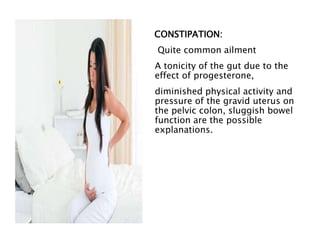
CONSTIPATION:
Quite common ailment
A tonicity of the gut due to the
effect of progesterone,
diminished physical activity and
pressure of the gravid uterus on
the pelvic colon, sluggish bowel
function are the possible
explanations.
MANAGMENT
Regular bowel habit may
be restored
Emphasize ample fluids
and laxative foods and
prescribe a stool softener
Purgatives should be
avoided because of the
possibility of inducing
labor.
Exercise and good bowel
habits are helpful
Mineral oil is
contraindicated because it
absorbs fat-soluble
vitamins from the bowel
and leaks from the anus.
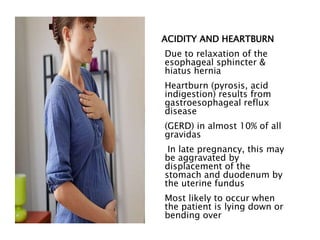
ACIDITY AND HEARTBURN
Due to relaxation of the
esophageal sphincter &
hiatus hernia
Heartburn (pyrosis, acid
indigestion) results from
gastroesophageal reflux
disease
(GERD) in almost 10% of all
gravidas
In late pregnancy, this may
be aggravated by
displacement of the
stomach and duodenum by
the uterine fundus
Most likely to occur when
the patient is lying down or
bending over
MANAGMENT
To avoid over eating and not to go to bed
immediately after the meal.
Liquid antacids may be helpful
Sleeping in semi-reclining position with high
pillows
This hernia is reduced spontaneously after
delivery
Symptomatic treatment, not surgery, is
recommended
Hot tea and change of posture are helpful.
Calcium-containing antacids & the histamine
H2 receptor antagonists are pregnancy
category B(e.g., Tums) to reduce gastric
EXCESSIVE SALIVATION
(PTYALISM)
Increased secretion of saliva is observed during
pregnancy. It may be associated with increased intake of
starch, though actual cause is not known.
Management:
This problem is usually self-limiting and may be
overcome by decreasing intake of carbohydrates.
It is not associated with any adverse pregnancy
outcome.
ABDOMINAL DISCOMFORT
Due to Pressure, pelvic heaviness, is caused by the
weight of the uterus on the pelvic supports and the
abdominal wall
Round ligament tension, tenderness along the course of
the round ligament (usually the left) during late
pregnancy, is due to traction on this structure by the
uterus, which is displaced by the large bowel to be
rotated slightly to the right
Flatulence and distention can be due to large meals,
gas-forming foods, and chilled beverages.
These are poorly tolerated by pregnant women
MANAGMENT
Rest frequently, preferably in the lateral recumbent
position
Local heat and change of position
Dietary modifications
Regular bowel function should be maintained, and
exercise is beneficial
Acetaminophen 0.3–0.6, 2–3 times daily may be of value
Intra abdominal disorders must be diagnosed and
treated appropriately.
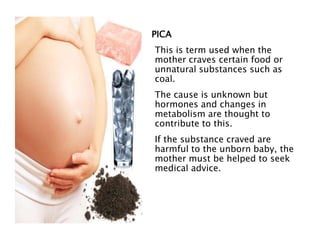
PICA
This is term used when the
mother craves certain food or
unnatural substances such as
coal.
The cause is unknown but
hormones and changes in
metabolism are thought to
contribute to this.
If the substance craved are
harmful to the unborn baby, the
mother must be helped to seek
medical advice.
MUSCULO-SKELETOL
SYSTEM
Fatigue
Backache
Leg cramps
Round ligament pain
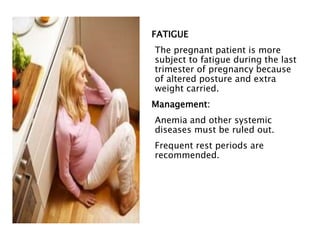
FATIGUE
The pregnant patient is more
subject to fatigue during the last
trimester of pregnancy because
of altered posture and extra
weight carried.
Management:
Anemia and other systemic
diseases must be ruled out.
Frequent rest periods are
recommended.
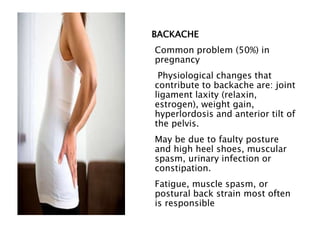
BACKACHE
Common problem (50%) in
pregnancy
Physiological changes that
contribute to backache are: joint
ligament laxity (relaxin,
estrogen), weight gain,
hyperlordosis and anterior tilt of
the pelvis.
May be due to faulty posture
and high heel shoes, muscular
spasm, urinary infection or
constipation.
Fatigue, muscle spasm, or
postural back strain most often
is responsible
MANAGMENT
Excessive weight gain should be avoided.
Rest with elevation of the legs to flex the hips may be
helpful.
Improvement of posture, well-fitted pelvic girdle belt
which corrects the lumbar lordosis during walking and
rest in hard bed
Improvement in posture is often achieved by the wearing
of low-heeled shoes.
To achieve proper posture, the abdomen should be
flattened, the pelvis tilted forward, and the buttocks
tucked under to straighten the back.
CONT.
Massaging the back muscles, analgesics and rest
Back exercises under the supervision of a rehabilitation
physician, an orthopedist, or a physical therapist.
Recommend sleep on a firm mattress.
Apply local heat and light massage to relax tense, taut
back muscles.
Give acetaminophen 0.3–0.6 g orally or equivalent.
Obtain orthopedic consultation if disability results.
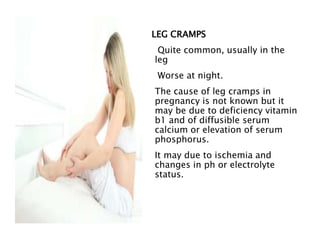
LEG CRAMPS
Quite common, usually in the
leg
Worse at night.
The cause of leg cramps in
pregnancy is not known but it
may be due to deficiency vitamin
b1 and of diffusible serum
calcium or elevation of serum
phosphorus.
It may due to ischemia and
changes in ph or electrolyte
status.
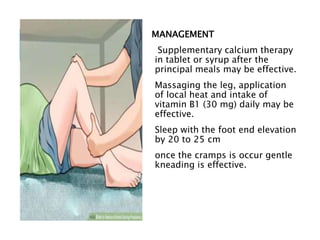
MANAGEMENT
Supplementary calcium therapy
in tablet or syrup after the
principal meals may be effective.
Massaging the leg, application
of local heat and intake of
vitamin B1 (30 mg) daily may be
effective.
Sleep with the foot end elevation
by 20 to 25 cm
once the cramps is occur gentle
kneading is effective.
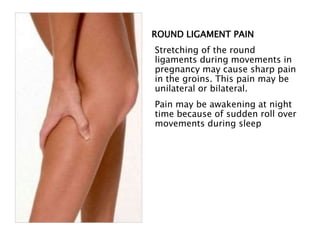
ROUND LIGAMENT PAIN
Stretching of the round
ligaments during movements in
pregnancy may cause sharp pain
in the groins. This pain may be
unilateral or bilateral.
Pain may be awakening at night
time because of sudden roll over
movements during sleep
MANAGEMENT
Pain may be reduced by making movements gradual
instead of sudden.
Local heat application is helpful.
Analgesics are rarely needed.
CIRCULATORY SYSTEM
Varicose veins
Hemorrhoids
Syncope
Ankle edema
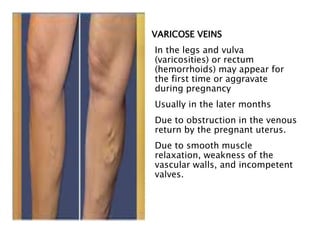
VARICOSE VEINS
In the legs and vulva
(varicosities) or rectum
(hemorrhoids) may appear for
the first time or aggravate
during pregnancy
Usually in the later months
Due to obstruction in the venous
return by the pregnant uterus.
Due to smooth muscle
relaxation, weakness of the
vascular walls, and incompetent
valves.
MANAGEMENT
For leg varicosities, elastic crepe bandage during movements
and elevation of the limbs during rest can give symptomatic
relief.
Elevate legs above the level of her body and control excessive
weight gain.
Avoid forceful massage (especially downward, i.e., against
venous return) and point-pressure over the legs.
Injection or surgical correction of varicose veins usually is not
recommended during pregnancy
HEMORRHOIDS
It may cause annoying complications like bleeding or may get
prolapsed.
May cause considerable discomfort.
Straining at stool often causes hemorrhoids, especially in women
prone to varicosities.
Management:
Regular use of laxative
Local application of hydrocortisone ointment
Surgical treatment is better to be withheld as the condition
improves following delivery.
Treat constipation early.
Do not suture. Sitz baths, rectal ointments, suppositories, and mild
laxatives are indicated postoperatively or post delivery.
Injection treatments are contraindicated.
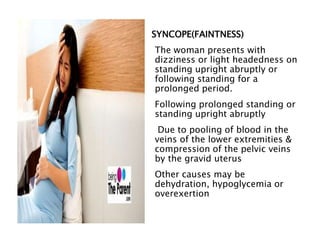
SYNCOPE(FAINTNESS)
The woman presents with
dizziness or light headedness on
standing upright abruptly or
following standing for a
prolonged period.
Following prolonged standing or
standing upright abruptly
Due to pooling of blood in the
veins of the lower extremities &
compression of the pelvic veins
by the gravid uterus
Other causes may be
dehydration, hypoglycemia or
overexertion
MANAGEMENT
Syncope usually resolves rapidly on lying in left lateral
position.
Syncope in supine position is also managed by resting in
lateral recumbent position.
Recurrent syncope needs cardiological evaluation.
Encourage the patient to eat six small meals a day rather
than three large ones.
Stimulants (spirits of ammonia, coffee, tea) are indicated
for attacks due to postural hypotension
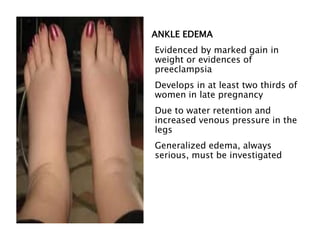
ANKLE EDEMA
Evidenced by marked gain in
weight or evidences of
preeclampsia
Develops in at least two thirds of
women in late pregnancy
Due to water retention and
increased venous pressure in the
legs
Generalized edema, always
serious, must be investigated
MANAGEMENT
No treatment is required for
physiological edema or orthostatic
edema.
Edema subsides on rest with slight
elevation of the limbs.
Diuretics should not be
prescribed.
Treatment is largely preventive
and symptomatic.
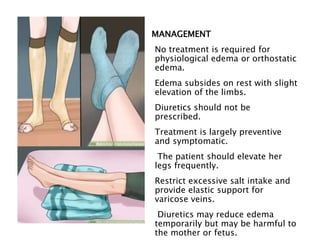
The patient should elevate her
legs frequently.
Restrict excessive salt intake and
provide elastic support for
varicose veins.
Diuretics may reduce edema
temporarily but may be harmful to
the mother or fetus.
NERVOUS SYSTEM
Insomnia
Headache
Carpal tunnel syndrome
INSOMNIA
This is relatively common in late pregnancy owning to
the discomfort caused by the fetal movements,
frequency of mituration, and difficulty in finding a
comfortable position.
It may also due to some deep- seated anxiety or fear.
MANAGEMENT
Take rest in the afternoon
Drink a glass of warm milk at bed time
Tuck a pillow under the abdomen when lying in a lateral
position
Talk about her fear and anxiety so that she can have a
sense of normality and lightness
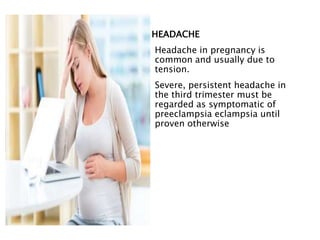
HEADACHE
Headache in pregnancy is
common and usually due to
tension.
Severe, persistent headache in
the third trimester must be
regarded as symptomatic of
preeclampsia eclampsia until
proven otherwise
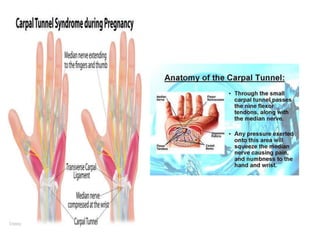
CARPAL TUNNEL SYNDROME
(10%)
Pain and numbness in the thumb, index and the middle
finger
weakness in the muscles for thumb movements due to
compression effect on the median nerve
Physiological changes in pregnancy with retention of
excess fluid are the common cause
MANAGEMENT
Treatment is mostly symptomatic.
A splint is applied during sleep time to the slightly flexed
wrist to give relief.
Corticosteroid injection or surgical decompression is
rarely needed.
It resolves spontaneously following delivery
GENITOURINARY SYSTEM
Vaginal discharge
Leucorrhea
Urinary symptoms
VAGINAL DISCHARGE
Management:
Assurance to the patient and advice for local cleanliness
are all that are required.
Presence of any infection (Trichomonas, Candida,
Bacterial vaginosis) should be treated with vaginal
application of metronidazole or miconazole
LEUCORRHEA
Gradual increase in the amount of nonirritating vaginal
discharge due to estrogen stimulation of cervical mucus
is normal during pregnancy.
Such vaginal fluid is milky, thin, and nonirritating unless
infection has occurred.
Persistent external moisture due to mucus may cause
mild pruritus, but itching is rarely severe without
infection.
MANAGEMENT
Reassure the patient, and suggest protective perineal
pads.
Excessive leukorrhea accompanied by pruritus or
discoloration of the secretion may indicate bleeding nor
infection, requiring treatment
URINARY SYMPTOMPS
Urinary frequency, urgency, and stress incontinence in
multiparas are common, especially in advanced
pregnancy.
Due to increased intra abdominal pressure and reduced
bladder capacity.
Suspect urinary tract disease if dysuria or hematuria is
present.
MANAGEMENT
When urgency is particularly troublesome, limit caffeine,
spices, and popular beverages.
An 8 oz glass of cranberry juice assists in both
maintaining urinary acidity as well as decreasing urinary
tract infections.
RESPIRATORY SYSTEM
BREATHLESSNESS:
Breathlessness, not actual dyspnea, is a progesterone
effect.
In nonsmokers and others free of cough or allergic
problems, breathlessness occurs as early as the 12th
week of pregnancy, and most women have this symptom
by the 30th week.
Management:
There is no effective treatment
INTEGUMENTARY
SYSTEM
SKIN:
Some mothers complaints of generalized itching, which
often starts over the abdomen.
Due to have some connection with the liver's response to
the hormones in pregnancy and with raised bilirubin
levels.
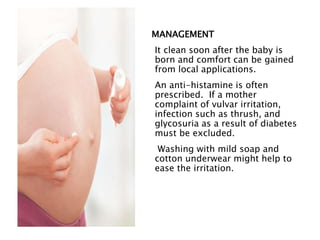
MANAGEMENT
It clean soon after the baby is
born and comfort can be gained
from local applications.
An anti-histamine is often
prescribed. If a mother
complaint of vulvar irritation,
infection such as thrush, and
glycosuria as a result of diabetes
must be excluded.
Washing with mild soap and
cotton underwear might help to
ease the irritation.
DISORDERS THAT REQUIRE
IMMEDIATE
ACTION
Vaginal bleeding
Reduced fetal movement
Frontal or recurring headache
Sudden swelling/edema
Rupture of the membrane
Premature onset of contraction
Sudden nausea and sickness
Epigastric pain
SUMMARY
Minor disorders during pregnancy
Digestive system
Musculoskeletal system
Circulatory system
Nervous system
Genitourinary system
Respiratory system
Integumetary system
Disorder that require immediate action
Minor disorders during.   pregnancy.pptx

Minor disorders during. pregnancy.pptx

  • 1.
    MINOR DISORDERS DURING PREGNANCY& ITS MANAGEMENT ALLY ABDUL BSc.Mid January, 2019.
  • 2.
    INTRODUCTION: Many women experiencesome minor disorder during pregnancy. These disorder should be treated adequately as they may escalate and become life-threatening. Minor disorder may occur due to hormonal changes, accommodation changes, metabolic changes and postural changes. Every system of body may affected by
  • 3.
    DIGESTIVE SYSTEM Nausea andvomiting Constipation Acidity and heartburn Excessive salivation(Ptyalism) Abdominal discomfort Pica
  • 4.
    CONT. NAUSEA AND VOMITING Especiallyin the morning, soon after getting out of bed Usually common in Primigravidae 50% women have both nausea and vomiting, 25% have nausea only and 25% are unaffected Most commonly occurs during the first 10 weeks Related to higher levels of hcg
  • 5.
    MANAGMENT Dietary changes Behavior modification Hospitalizationmay be necessary to correct fluid and electrolyte imbalance Explanation, reassurance, and symptomatic relief are sufficient. Avoid: Disagreeable odors and rich, spicy, or greasy foods Drink water or other fluids between meals to avoid dehydration and acidosis Medication:
  • 6.
    CONSTIPATION: Quite common ailment Atonicity of the gut due to the effect of progesterone, diminished physical activity and pressure of the gravid uterus on the pelvic colon, sluggish bowel function are the possible explanations.
  • 7.
    MANAGMENT Regular bowel habitmay be restored Emphasize ample fluids and laxative foods and prescribe a stool softener Purgatives should be avoided because of the possibility of inducing labor. Exercise and good bowel habits are helpful Mineral oil is contraindicated because it absorbs fat-soluble vitamins from the bowel and leaks from the anus.
  • 8.
    ACIDITY AND HEARTBURN Dueto relaxation of the esophageal sphincter & hiatus hernia Heartburn (pyrosis, acid indigestion) results from gastroesophageal reflux disease (GERD) in almost 10% of all gravidas In late pregnancy, this may be aggravated by displacement of the stomach and duodenum by the uterine fundus Most likely to occur when the patient is lying down or bending over
  • 9.
    MANAGMENT To avoid overeating and not to go to bed immediately after the meal. Liquid antacids may be helpful Sleeping in semi-reclining position with high pillows This hernia is reduced spontaneously after delivery Symptomatic treatment, not surgery, is recommended Hot tea and change of posture are helpful. Calcium-containing antacids & the histamine H2 receptor antagonists are pregnancy category B(e.g., Tums) to reduce gastric
  • 10.
    EXCESSIVE SALIVATION (PTYALISM) Increased secretionof saliva is observed during pregnancy. It may be associated with increased intake of starch, though actual cause is not known. Management: This problem is usually self-limiting and may be overcome by decreasing intake of carbohydrates. It is not associated with any adverse pregnancy outcome.
  • 11.
    ABDOMINAL DISCOMFORT Due toPressure, pelvic heaviness, is caused by the weight of the uterus on the pelvic supports and the abdominal wall Round ligament tension, tenderness along the course of the round ligament (usually the left) during late pregnancy, is due to traction on this structure by the uterus, which is displaced by the large bowel to be rotated slightly to the right Flatulence and distention can be due to large meals, gas-forming foods, and chilled beverages. These are poorly tolerated by pregnant women
  • 12.
    MANAGMENT Rest frequently, preferablyin the lateral recumbent position Local heat and change of position Dietary modifications Regular bowel function should be maintained, and exercise is beneficial Acetaminophen 0.3–0.6, 2–3 times daily may be of value Intra abdominal disorders must be diagnosed and treated appropriately.
  • 13.
    PICA This is termused when the mother craves certain food or unnatural substances such as coal. The cause is unknown but hormones and changes in metabolism are thought to contribute to this. If the substance craved are harmful to the unborn baby, the mother must be helped to seek medical advice.
  • 14.
  • 15.
    FATIGUE The pregnant patientis more subject to fatigue during the last trimester of pregnancy because of altered posture and extra weight carried. Management: Anemia and other systemic diseases must be ruled out. Frequent rest periods are recommended.
  • 16.
    BACKACHE Common problem (50%)in pregnancy Physiological changes that contribute to backache are: joint ligament laxity (relaxin, estrogen), weight gain, hyperlordosis and anterior tilt of the pelvis. May be due to faulty posture and high heel shoes, muscular spasm, urinary infection or constipation. Fatigue, muscle spasm, or postural back strain most often is responsible
  • 17.
    MANAGMENT Excessive weight gainshould be avoided. Rest with elevation of the legs to flex the hips may be helpful. Improvement of posture, well-fitted pelvic girdle belt which corrects the lumbar lordosis during walking and rest in hard bed Improvement in posture is often achieved by the wearing of low-heeled shoes. To achieve proper posture, the abdomen should be flattened, the pelvis tilted forward, and the buttocks tucked under to straighten the back.
  • 18.
    CONT. Massaging the backmuscles, analgesics and rest Back exercises under the supervision of a rehabilitation physician, an orthopedist, or a physical therapist. Recommend sleep on a firm mattress. Apply local heat and light massage to relax tense, taut back muscles. Give acetaminophen 0.3–0.6 g orally or equivalent. Obtain orthopedic consultation if disability results.
  • 19.
    LEG CRAMPS Quite common,usually in the leg Worse at night. The cause of leg cramps in pregnancy is not known but it may be due to deficiency vitamin b1 and of diffusible serum calcium or elevation of serum phosphorus. It may due to ischemia and changes in ph or electrolyte status.
  • 20.
    MANAGEMENT Supplementary calcium therapy intablet or syrup after the principal meals may be effective. Massaging the leg, application of local heat and intake of vitamin B1 (30 mg) daily may be effective. Sleep with the foot end elevation by 20 to 25 cm once the cramps is occur gentle kneading is effective.
  • 21.
    ROUND LIGAMENT PAIN Stretchingof the round ligaments during movements in pregnancy may cause sharp pain in the groins. This pain may be unilateral or bilateral. Pain may be awakening at night time because of sudden roll over movements during sleep
  • 22.
    MANAGEMENT Pain may bereduced by making movements gradual instead of sudden. Local heat application is helpful. Analgesics are rarely needed.
  • 23.
  • 24.
    VARICOSE VEINS In thelegs and vulva (varicosities) or rectum (hemorrhoids) may appear for the first time or aggravate during pregnancy Usually in the later months Due to obstruction in the venous return by the pregnant uterus. Due to smooth muscle relaxation, weakness of the vascular walls, and incompetent valves.
  • 25.
    MANAGEMENT For leg varicosities,elastic crepe bandage during movements and elevation of the limbs during rest can give symptomatic relief. Elevate legs above the level of her body and control excessive weight gain. Avoid forceful massage (especially downward, i.e., against venous return) and point-pressure over the legs. Injection or surgical correction of varicose veins usually is not recommended during pregnancy
  • 26.
    HEMORRHOIDS It may causeannoying complications like bleeding or may get prolapsed. May cause considerable discomfort. Straining at stool often causes hemorrhoids, especially in women prone to varicosities. Management: Regular use of laxative Local application of hydrocortisone ointment Surgical treatment is better to be withheld as the condition improves following delivery. Treat constipation early. Do not suture. Sitz baths, rectal ointments, suppositories, and mild laxatives are indicated postoperatively or post delivery. Injection treatments are contraindicated.
  • 27.
    SYNCOPE(FAINTNESS) The woman presentswith dizziness or light headedness on standing upright abruptly or following standing for a prolonged period. Following prolonged standing or standing upright abruptly Due to pooling of blood in the veins of the lower extremities & compression of the pelvic veins by the gravid uterus Other causes may be dehydration, hypoglycemia or overexertion
  • 28.
    MANAGEMENT Syncope usually resolvesrapidly on lying in left lateral position. Syncope in supine position is also managed by resting in lateral recumbent position. Recurrent syncope needs cardiological evaluation. Encourage the patient to eat six small meals a day rather than three large ones. Stimulants (spirits of ammonia, coffee, tea) are indicated for attacks due to postural hypotension
  • 29.
    ANKLE EDEMA Evidenced bymarked gain in weight or evidences of preeclampsia Develops in at least two thirds of women in late pregnancy Due to water retention and increased venous pressure in the legs Generalized edema, always serious, must be investigated
  • 30.
    MANAGEMENT No treatment isrequired for physiological edema or orthostatic edema. Edema subsides on rest with slight elevation of the limbs. Diuretics should not be prescribed. Treatment is largely preventive and symptomatic. The patient should elevate her legs frequently. Restrict excessive salt intake and provide elastic support for varicose veins. Diuretics may reduce edema temporarily but may be harmful to the mother or fetus.
  • 31.
  • 32.
    INSOMNIA This is relativelycommon in late pregnancy owning to the discomfort caused by the fetal movements, frequency of mituration, and difficulty in finding a comfortable position. It may also due to some deep- seated anxiety or fear.
  • 33.
    MANAGEMENT Take rest inthe afternoon Drink a glass of warm milk at bed time Tuck a pillow under the abdomen when lying in a lateral position Talk about her fear and anxiety so that she can have a sense of normality and lightness
  • 34.
    HEADACHE Headache in pregnancyis common and usually due to tension. Severe, persistent headache in the third trimester must be regarded as symptomatic of preeclampsia eclampsia until proven otherwise
  • 35.
    CARPAL TUNNEL SYNDROME (10%) Painand numbness in the thumb, index and the middle finger weakness in the muscles for thumb movements due to compression effect on the median nerve Physiological changes in pregnancy with retention of excess fluid are the common cause
  • 37.
    MANAGEMENT Treatment is mostlysymptomatic. A splint is applied during sleep time to the slightly flexed wrist to give relief. Corticosteroid injection or surgical decompression is rarely needed. It resolves spontaneously following delivery
  • 38.
  • 39.
    VAGINAL DISCHARGE Management: Assurance tothe patient and advice for local cleanliness are all that are required. Presence of any infection (Trichomonas, Candida, Bacterial vaginosis) should be treated with vaginal application of metronidazole or miconazole
  • 40.
    LEUCORRHEA Gradual increase inthe amount of nonirritating vaginal discharge due to estrogen stimulation of cervical mucus is normal during pregnancy. Such vaginal fluid is milky, thin, and nonirritating unless infection has occurred. Persistent external moisture due to mucus may cause mild pruritus, but itching is rarely severe without infection.
  • 41.
    MANAGEMENT Reassure the patient,and suggest protective perineal pads. Excessive leukorrhea accompanied by pruritus or discoloration of the secretion may indicate bleeding nor infection, requiring treatment
  • 42.
    URINARY SYMPTOMPS Urinary frequency,urgency, and stress incontinence in multiparas are common, especially in advanced pregnancy. Due to increased intra abdominal pressure and reduced bladder capacity. Suspect urinary tract disease if dysuria or hematuria is present.
  • 43.
    MANAGEMENT When urgency isparticularly troublesome, limit caffeine, spices, and popular beverages. An 8 oz glass of cranberry juice assists in both maintaining urinary acidity as well as decreasing urinary tract infections.
  • 44.
    RESPIRATORY SYSTEM BREATHLESSNESS: Breathlessness, notactual dyspnea, is a progesterone effect. In nonsmokers and others free of cough or allergic problems, breathlessness occurs as early as the 12th week of pregnancy, and most women have this symptom by the 30th week. Management: There is no effective treatment
  • 45.
    INTEGUMENTARY SYSTEM SKIN: Some mothers complaintsof generalized itching, which often starts over the abdomen. Due to have some connection with the liver's response to the hormones in pregnancy and with raised bilirubin levels.
  • 46.
    MANAGEMENT It clean soonafter the baby is born and comfort can be gained from local applications. An anti-histamine is often prescribed. If a mother complaint of vulvar irritation, infection such as thrush, and glycosuria as a result of diabetes must be excluded. Washing with mild soap and cotton underwear might help to ease the irritation.
  • 47.
    DISORDERS THAT REQUIRE IMMEDIATE ACTION Vaginalbleeding Reduced fetal movement Frontal or recurring headache Sudden swelling/edema Rupture of the membrane Premature onset of contraction Sudden nausea and sickness Epigastric pain
  • 48.
    SUMMARY Minor disorders duringpregnancy Digestive system Musculoskeletal system Circulatory system Nervous system Genitourinary system Respiratory system Integumetary system Disorder that require immediate action