Divya Electronics
Mini Case
Presented By:
Ashish Kumar
Case Study:
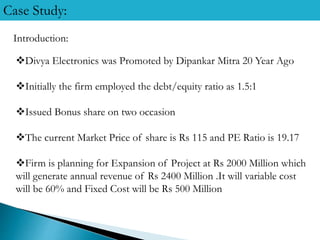
Introduction:
Divya Electronics was Promoted by Dipankar Mitra 20 Year Ago
Initially the firm employed the debt/equity ratio as 1.5:1
Issued Bonus share on two occasion
The current Market Price of share is Rs 115 and PE Ratio is 19.17
Firm is planning for Expansion of Project at Rs 2000 Million which
will generate annual revenue of Rs 2400 Million .It will variable cost
will be 60% and Fixed Cost will be Rs 500 Million
Case Study:
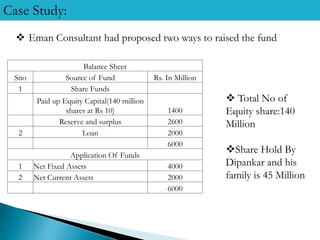
Balance Sheet
Sno Source of Fund Rs. In Million
1 Share Funds
Paid up Equity Capital(140 million
shares at Rs 10) 1400
Reserve and surplus 2600
2 Loan 2000
6000
Application Of Funds
1 Net Fixed Assets 4000
2 Net Current Assets 2000
6000
 Total No of
Equity share:140
Million
Share Hold By
Dipankar and his
family is 45 Million
 Eman Consultant had proposed two ways to raised the fund
Case Study:
 Total No of
Equity share:140
Million
Share Hold By
Dipankar and his
family is 45 Million
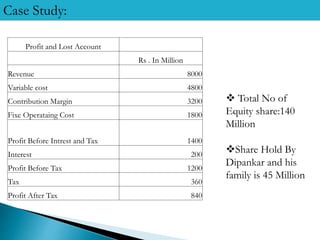
Profit and Lost Account
Rs . In Million
Revenue 8000
Variable cost 4800
Contribution Margin 3200
Fixe Operataing Cost 1800
Profit Before Intrest and Tax 1400
Interest 200
Profit Before Tax 1200
Tax 360
Profit After Tax 840
Case Study:
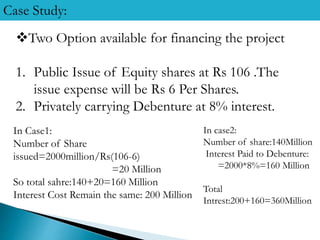
Two Option available for financing the project
1. Public Issue of Equity shares at Rs 106 .The
issue expense will be Rs 6 Per Shares.
2. Privately carrying Debenture at 8% interest.
In Case1:
Number of Share
issued=2000million/Rs(106-6)
=20 Million
So total sahre:140+20=160 Million
Interest Cost Remain the same: 200 Million
In case2:
Number of share:140Million
Interest Paid to Debenture:
=2000*8%=160 Million
Total
Intrest:200+160=360Million
Case Study:
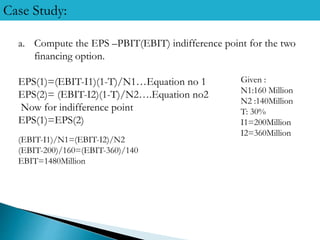
a. Compute the EPS –PBIT(EBIT) indifference point for the two
financing option.
EPS(1)=(EBIT-I1)(1-T)/N1…Equation no 1
EPS(2)= (EBIT-I2)(1-T)/N2….Equation no2
Now for indifference point
EPS(1)=EPS(2)
Given :
N1:160 Million
N2 :140Million
T: 30%
I1=200Million
I2=360Million
(EBIT-I1)/N1=(EBIT-I2)/N2
(EBIT-200)/160=(EBIT-360)/140
EBIT=1480Million
Case Study:
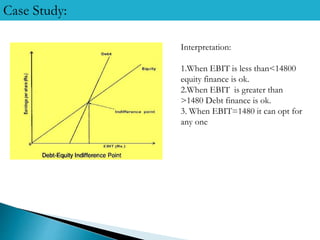
Interpretation:
1.When EBIT is less than<14800
equity finance is ok.
2.When EBIT is greater than
>1480 Debt finance is ok.
3. When EBIT=1480 it can opt for
any one
Case Study:
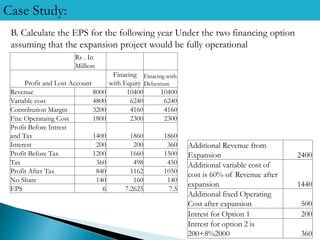
B. Calculate the EPS for the following year Under the two financing option
assuming that the expansion project would be fully operational
Rs . In
Million
Profit and Lost Account
Finacing
with Equity
Finacing with
Debenture
Revenue 8000 10400 10400
Variable cost 4800 6240 6240
Contribution Margin 3200 4160 4160
Fixe Operataing Cost 1800 2300 2300
Profit Before Intrest
and Tax 1400 1860 1860
Interest 200 200 360
Profit Before Tax 1200 1660 1500
Tax 360 498 450
Profit After Tax 840 1162 1050
No Share 140 160 140
EPS 6 7.2625 7.5
Additional Revenue from
Expansion 2400
Additional variable cost of
cost is 60% of Revenue after
expansion 1440
Additional fixed Operating
Cost after expansion 500
Intrest for Option 1 200
Intrest for option 2 is
200+8%2000 360
Case Study
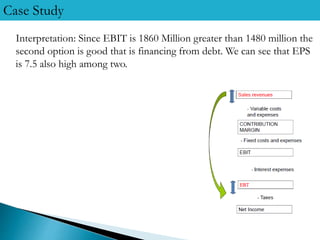
Interpretation: Since EBIT is 1860 Million greater than 1480 million the
second option is good that is financing from debt. We can see that EPS
is 7.5 also high among two.
Case Study
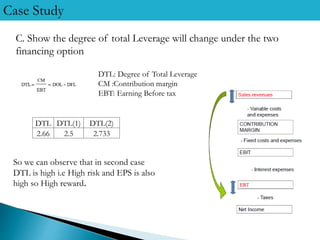
C. Show the degree of total Leverage will change under the two
financing option
DTL: Degree of Total Leverage
CM :Contribution margin
EBT: Earning Before tax
DTL DTL(1) DTL(2)
2.66 2.5 2.733
So we can observe that in second case
DTL is high i.e High risk and EPS is also
high so High reward.
Case Study
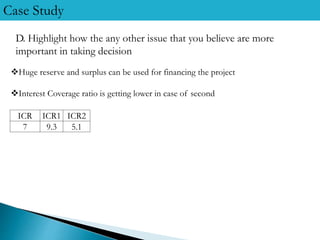
D. Highlight how the any other issue that you believe are more
important in taking decision
Huge reserve and surplus can be used for financing the project
Interest Coverage ratio is getting lower in case of second
ICR ICR1 ICR2
7 9.3 5.1
Mini case

Mini case

  • 1.
  • 2.
    Case Study: Introduction: Divya Electronicswas Promoted by Dipankar Mitra 20 Year Ago Initially the firm employed the debt/equity ratio as 1.5:1 Issued Bonus share on two occasion The current Market Price of share is Rs 115 and PE Ratio is 19.17 Firm is planning for Expansion of Project at Rs 2000 Million which will generate annual revenue of Rs 2400 Million .It will variable cost will be 60% and Fixed Cost will be Rs 500 Million
  • 3.
    Case Study: Balance Sheet SnoSource of Fund Rs. In Million 1 Share Funds Paid up Equity Capital(140 million shares at Rs 10) 1400 Reserve and surplus 2600 2 Loan 2000 6000 Application Of Funds 1 Net Fixed Assets 4000 2 Net Current Assets 2000 6000  Total No of Equity share:140 Million Share Hold By Dipankar and his family is 45 Million  Eman Consultant had proposed two ways to raised the fund
  • 4.
    Case Study:  TotalNo of Equity share:140 Million Share Hold By Dipankar and his family is 45 Million Profit and Lost Account Rs . In Million Revenue 8000 Variable cost 4800 Contribution Margin 3200 Fixe Operataing Cost 1800 Profit Before Intrest and Tax 1400 Interest 200 Profit Before Tax 1200 Tax 360 Profit After Tax 840
  • 5.
    Case Study: Two Optionavailable for financing the project 1. Public Issue of Equity shares at Rs 106 .The issue expense will be Rs 6 Per Shares. 2. Privately carrying Debenture at 8% interest. In Case1: Number of Share issued=2000million/Rs(106-6) =20 Million So total sahre:140+20=160 Million Interest Cost Remain the same: 200 Million In case2: Number of share:140Million Interest Paid to Debenture: =2000*8%=160 Million Total Intrest:200+160=360Million
  • 6.
    Case Study: a. Computethe EPS –PBIT(EBIT) indifference point for the two financing option. EPS(1)=(EBIT-I1)(1-T)/N1…Equation no 1 EPS(2)= (EBIT-I2)(1-T)/N2….Equation no2 Now for indifference point EPS(1)=EPS(2) Given : N1:160 Million N2 :140Million T: 30% I1=200Million I2=360Million (EBIT-I1)/N1=(EBIT-I2)/N2 (EBIT-200)/160=(EBIT-360)/140 EBIT=1480Million
  • 7.
    Case Study: Interpretation: 1.When EBITis less than<14800 equity finance is ok. 2.When EBIT is greater than >1480 Debt finance is ok. 3. When EBIT=1480 it can opt for any one
  • 8.
    Case Study: B. Calculatethe EPS for the following year Under the two financing option assuming that the expansion project would be fully operational Rs . In Million Profit and Lost Account Finacing with Equity Finacing with Debenture Revenue 8000 10400 10400 Variable cost 4800 6240 6240 Contribution Margin 3200 4160 4160 Fixe Operataing Cost 1800 2300 2300 Profit Before Intrest and Tax 1400 1860 1860 Interest 200 200 360 Profit Before Tax 1200 1660 1500 Tax 360 498 450 Profit After Tax 840 1162 1050 No Share 140 160 140 EPS 6 7.2625 7.5 Additional Revenue from Expansion 2400 Additional variable cost of cost is 60% of Revenue after expansion 1440 Additional fixed Operating Cost after expansion 500 Intrest for Option 1 200 Intrest for option 2 is 200+8%2000 360
  • 9.
    Case Study Interpretation: SinceEBIT is 1860 Million greater than 1480 million the second option is good that is financing from debt. We can see that EPS is 7.5 also high among two.
  • 10.
    Case Study C. Showthe degree of total Leverage will change under the two financing option DTL: Degree of Total Leverage CM :Contribution margin EBT: Earning Before tax DTL DTL(1) DTL(2) 2.66 2.5 2.733 So we can observe that in second case DTL is high i.e High risk and EPS is also high so High reward.
  • 11.
    Case Study D. Highlighthow the any other issue that you believe are more important in taking decision Huge reserve and surplus can be used for financing the project Interest Coverage ratio is getting lower in case of second ICR ICR1 ICR2 7 9.3 5.1

Editor's Notes

  • #11 Introduction of debt lead to risk . Issue of Debenture is rsiky because the balance is disturb on fulcrum
  • #12 Intrset coverage ratio lower means company is burden bu Debt under this condition the option 1 is better