4.
.
5.
6.
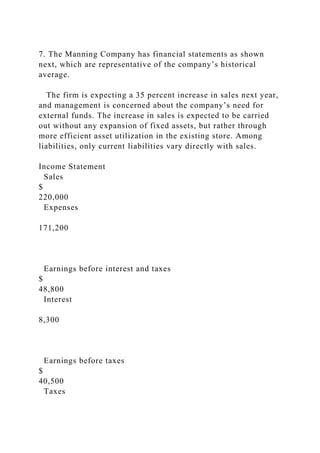
7. The Manning Company has financial statements as shown
next, which are representative of the company’s historical
average.
The firm is expecting a 35 percent increase in sales next year,
and management is concerned about the company’s need for
external funds. The increase in sales is expected to be carried
out without any expansion of fixed assets, but rather through
more efficient asset utilization in the existing store. Among
liabilities, only current liabilities vary directly with sales.
Income Statement
Sales
$
220,000
Expenses
171,200
Earnings before interest and taxes
$
48,800
Interest
8,300
Earnings before taxes
$
40,500
Taxes
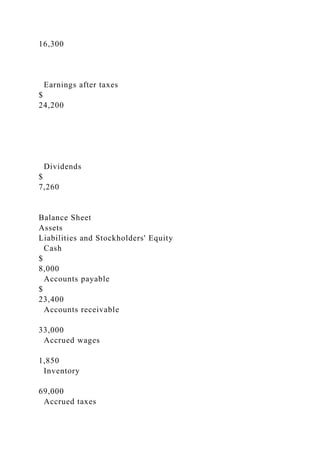
16,300
Earnings after taxes
$
24,200
Dividends
$
7,260
Balance Sheet
Assets
Liabilities and Stockholders' Equity
Cash
$
8,000
Accounts payable
$
23,400
Accounts receivable
33,000
Accrued wages
1,850
Inventory
69,000
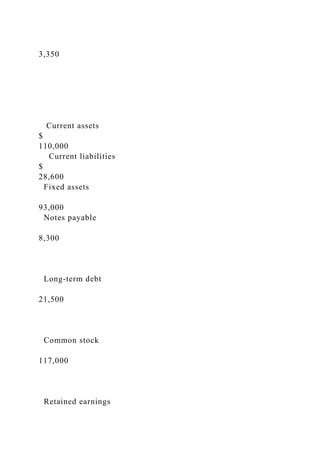
Accrued taxes
3,350
Current assets
$
110,000
Current liabilities
$
28,600
Fixed assets
93,000
Notes payable
8,300
Long-term debt
21,500
Common stock
117,000
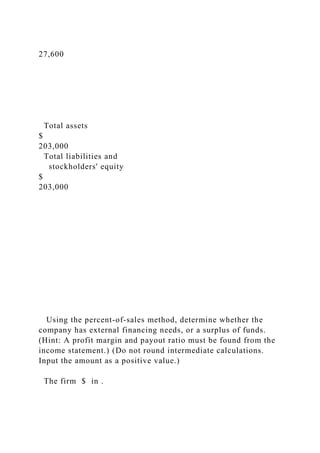
Retained earnings
27,600
Total assets
$
203,000
Total liabilities and
stockholders' equity
$
203,000
Using the percent-of-sales method, determine whether the
company has external financing needs, or a surplus of funds.
(Hint: A profit margin and payout ratio must be found from the
income statement.) (Do not round intermediate calculations.
Input the amount as a positive value.)
The firm $ in .
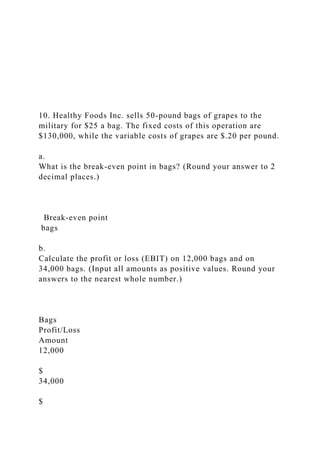
10. Healthy Foods Inc. sells 50-pound bags of grapes to the
military for $25 a bag. The fixed costs of this operation are
$130,000, while the variable costs of grapes are $.20 per pound.
a.
What is the break-even point in bags? (Round your answer to 2
decimal places.)
Break-even point
bags
b.
Calculate the profit or loss (EBIT) on 12,000 bags and on
34,000 bags. (Input all amounts as positive values. Round your
answers to the nearest whole number.)
Bags
Profit/Loss
Amount
12,000
$
34,000
$
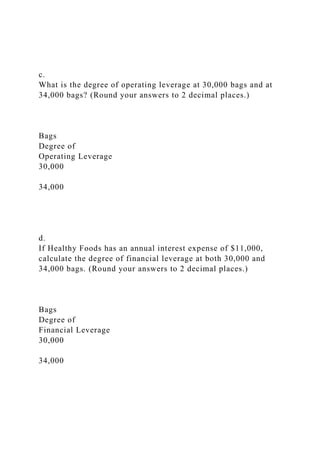
c.
What is the degree of operating leverage at 30,000 bags and at
34,000 bags? (Round your answers to 2 decimal places.)
Bags
Degree of
Operating Leverage
30,000
34,000
d.
If Healthy Foods has an annual interest expense of $11,000,
calculate the degree of financial leverage at both 30,000 and
34,000 bags. (Round your answers to 2 decimal places.)
Bags
Degree of
Financial Leverage
30,000
34,000
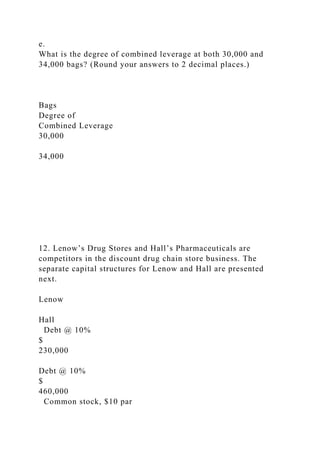
e.
What is the degree of combined leverage at both 30,000 and
34,000 bags? (Round your answers to 2 decimal places.)
Bags
Degree of
Combined Leverage
30,000
34,000
12. Lenow’s Drug Stores and Hall’s Pharmaceuticals are
competitors in the discount drug chain store business. The
separate capital structures for Lenow and Hall are presented
next.
Lenow
Hall
Debt @ 10%
$
230,000
Debt @ 10%
$
460,000
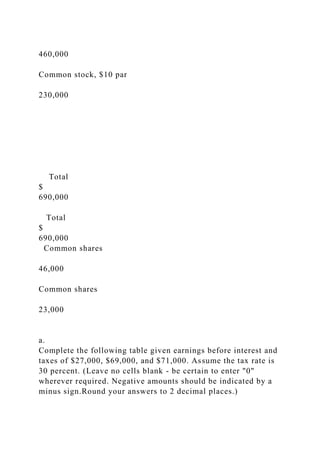
Common stock, $10 par
460,000
Common stock, $10 par
230,000
Total
$
690,000
Total
$
690,000
Common shares
46,000
Common shares
23,000
a.
Complete the following table given earnings before interest and
taxes of $27,000, $69,000, and $71,000. Assume the tax rate is
30 percent. (Leave no cells blank - be certain to enter "0"
wherever required. Negative amounts should be indicated by a
minus sign.Round your answers to 2 decimal places.)
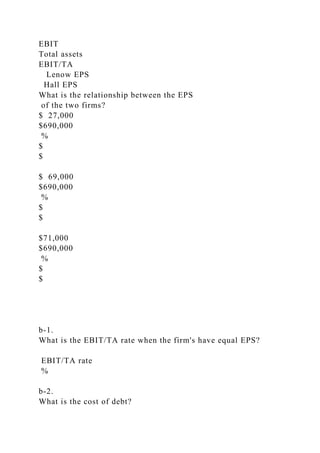
EBIT
Total assets
EBIT/TA
Lenow EPS
Hall EPS
What is the relationship between the EPS
of the two firms?
$ 27,000
$690,000
%
$
$
$ 69,000
$690,000
%
$
$
$71,000
$690,000
%
$
$
b-1.
What is the EBIT/TA rate when the firm's have equal EPS?
EBIT/TA rate
%
b-2.
What is the cost of debt?
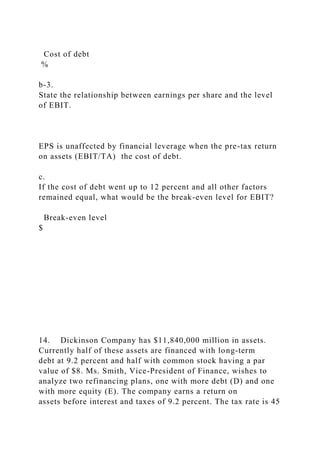
Cost of debt
%
b-3.
State the relationship between earnings per share and the level
of EBIT.
EPS is unaffected by financial leverage when the pre-tax return
on assets (EBIT/TA) the cost of debt.
c.
If the cost of debt went up to 12 percent and all other factors
remained equal, what would be the break-even level for EBIT?
Break-even level
$
14. Dickinson Company has $11,840,000 million in assets.
Currently half of these assets are financed with long-term
debt at 9.2 percent and half with common stock having a par
value of $8. Ms. Smith, Vice-President of Finance, wishes to
analyze two refinancing plans, one with more debt (D) and one
with more equity (E). The company earns a return on
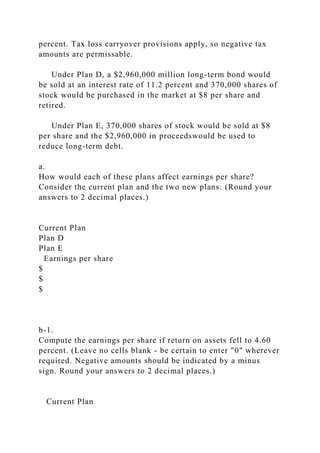
assets before interest and taxes of 9.2 percent. The tax rate is 45
percent. Tax loss carryover provisions apply, so negative tax
amounts are permissable.
Under Plan D, a $2,960,000 million long-term bond would
be sold at an interest rate of 11.2 percent and 370,000 shares of
stock would be purchased in the market at $8 per share and
retired.
Under Plan E, 370,000 shares of stock would be sold at $8
per share and the $2,960,000 in proceedswould be used to
reduce long-term debt.
a.
How would each of these plans affect earnings per share?
Consider the current plan and the two new plans. (Round your
answers to 2 decimal places.)
Current Plan
Plan D
Plan E
Earnings per share
$
$
$
b-1.
Compute the earnings per share if return on assets fell to 4.60
percent. (Leave no cells blank - be certain to enter "0" wherever
required. Negative amounts should be indicated by a minus
sign. Round your answers to 2 decimal places.)
Current Plan
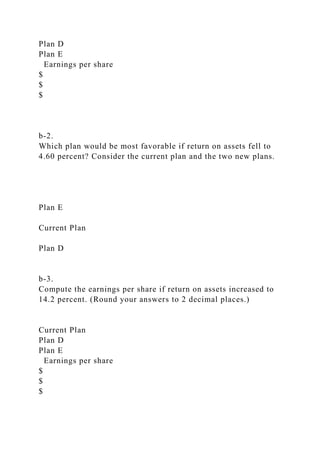
Plan D
Plan E
Earnings per share
$
$
$
b-2.
Which plan would be most favorable if return on assets fell to
4.60 percent? Consider the current plan and the two new plans.
Plan E
Current Plan
Plan D
b-3.
Compute the earnings per share if return on assets increased to
14.2 percent. (Round your answers to 2 decimal places.)
Current Plan
Plan D
Plan E
Earnings per share
$
$
$
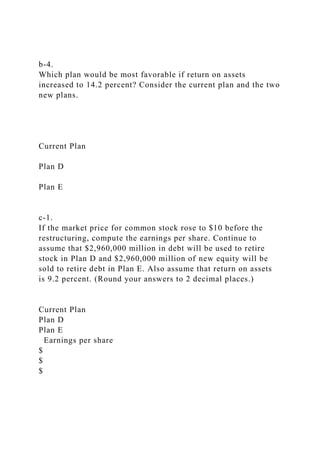
b-4.
Which plan would be most favorable if return on assets
increased to 14.2 percent? Consider the current plan and the two
new plans.
Current Plan
Plan D
Plan E
c-1.
If the market price for common stock rose to $10 before the
restructuring, compute the earnings per share. Continue to
assume that $2,960,000 million in debt will be used to retire
stock in Plan D and $2,960,000 million of new equity will be
sold to retire debt in Plan E. Also assume that return on assets
is 9.2 percent. (Round your answers to 2 decimal places.)
Current Plan
Plan D
Plan E
Earnings per share
$
$
$
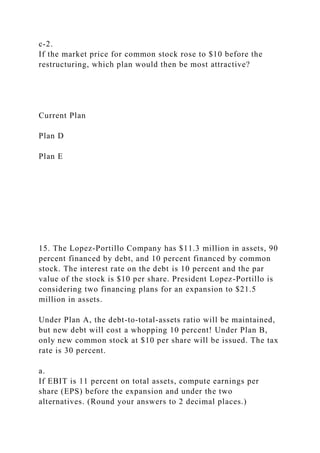
c-2.
If the market price for common stock rose to $10 before the
restructuring, which plan would then be most attractive?
Current Plan
Plan D
Plan E
15. The Lopez-Portillo Company has $11.3 million in assets, 90
percent financed by debt, and 10 percent financed by common
stock. The interest rate on the debt is 10 percent and the par
value of the stock is $10 per share. President Lopez-Portillo is
considering two financing plans for an expansion to $21.5
million in assets.
Under Plan A, the debt-to-total-assets ratio will be maintained,
but new debt will cost a whopping 10 percent! Under Plan B,
only new common stock at $10 per share will be issued. The tax
rate is 30 percent.
a.
If EBIT is 11 percent on total assets, compute earnings per
share (EPS) before the expansion and under the two
alternatives. (Round your answers to 2 decimal places.)
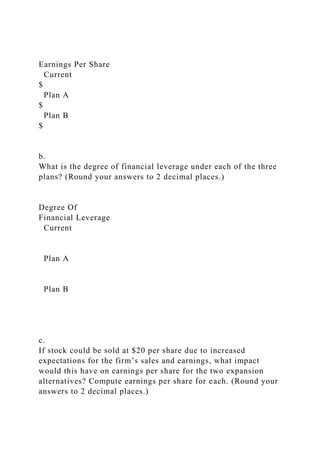
Earnings Per Share
Current
$
Plan A
$
Plan B
$
b.
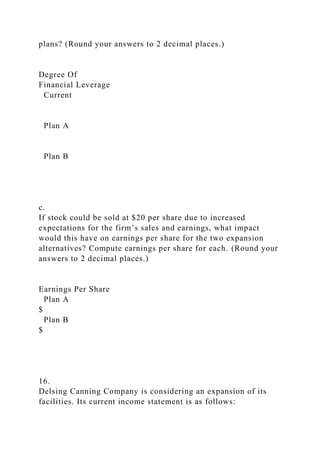
What is the degree of financial leverage under each of the three
plans? (Round your answers to 2 decimal places.)
Degree Of
Financial Leverage
Current
Plan A
Plan B
c.
If stock could be sold at $20 per share due to increased
expectations for the firm’s sales and earnings, what impact
would this have on earnings per share for the two expansion
alternatives? Compute earnings per share for each. (Round your
answers to 2 decimal places.)
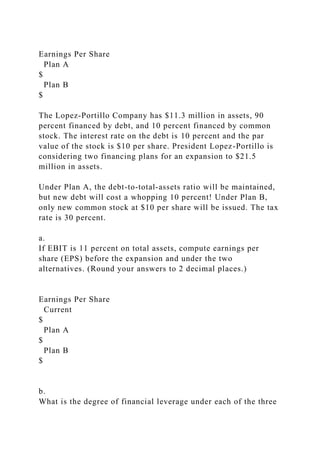
Earnings Per Share
Plan A
$
Plan B
$
The Lopez-Portillo Company has $11.3 million in assets, 90
percent financed by debt, and 10 percent financed by common
stock. The interest rate on the debt is 10 percent and the par
value of the stock is $10 per share. President Lopez-Portillo is
considering two financing plans for an expansion to $21.5
million in assets.
Under Plan A, the debt-to-total-assets ratio will be maintained,
but new debt will cost a whopping 10 percent! Under Plan B,
only new common stock at $10 per share will be issued. The tax
rate is 30 percent.
a.
If EBIT is 11 percent on total assets, compute earnings per
share (EPS) before the expansion and under the two
alternatives. (Round your answers to 2 decimal places.)
Earnings Per Share
Current
$
Plan A
$
Plan B
$
b.
What is the degree of financial leverage under each of the three
plans? (Round your answers to 2 decimal places.)
Degree Of
Financial Leverage
Current
Plan A
Plan B
c.
If stock could be sold at $20 per share due to increased
expectations for the firm’s sales and earnings, what impact
would this have on earnings per share for the two expansion
alternatives? Compute earnings per share for each. (Round your
answers to 2 decimal places.)
Earnings Per Share
Plan A
$
Plan B
$
16.
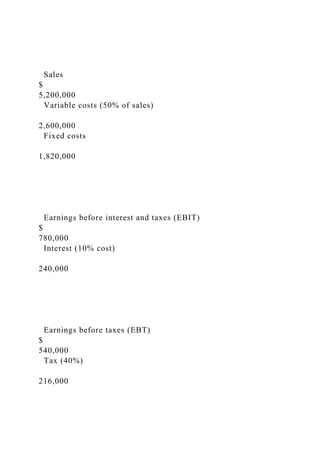
Delsing Canning Company is considering an expansion of its
facilities. Its current income statement is as follows:
Sales
$
5,200,000
Variable costs (50% of sales)
2,600,000
Fixed costs
1,820,000
Earnings before interest and taxes (EBIT)
$
780,000
Interest (10% cost)
240,000
Earnings before taxes (EBT)
$
540,000
Tax (40%)
216,000
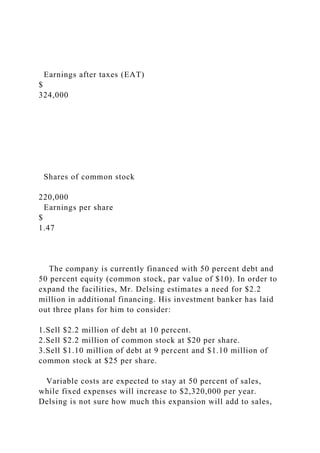
Earnings after taxes (EAT)
$
324,000
Shares of common stock
220,000
Earnings per share
$
1.47
The company is currently financed with 50 percent debt and
50 percent equity (common stock, par value of $10). In order to
expand the facilities, Mr. Delsing estimates a need for $2.2
million in additional financing. His investment banker has laid
out three plans for him to consider:
1.Sell $2.2 million of debt at 10 percent.
2.Sell $2.2 million of common stock at $20 per share.
3.Sell $1.10 million of debt at 9 percent and $1.10 million of
common stock at $25 per share.
Variable costs are expected to stay at 50 percent of sales,
while fixed expenses will increase to $2,320,000 per year.
Delsing is not sure how much this expansion will add to sales,
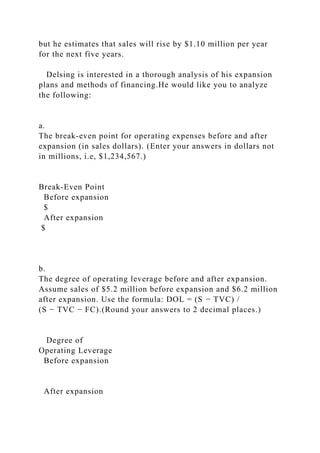
but he estimates that sales will rise by $1.10 million per year
for the next five years.
Delsing is interested in a thorough analysis of his expansion
plans and methods of financing.He would like you to analyze
the following:
a.
The break-even point for operating expenses before and after
expansion (in sales dollars). (Enter your answers in dollars not
in millions, i.e, $1,234,567.)
Break-Even Point
Before expansion
$
After expansion
$
b.
The degree of operating leverage before and after expansion.
Assume sales of $5.2 million before expansion and $6.2 million
after expansion. Use the formula: DOL = (S − TVC) /
(S − TVC − FC).(Round your answers to 2 decimal places.)
Degree of
Operating Leverage
Before expansion
After expansion
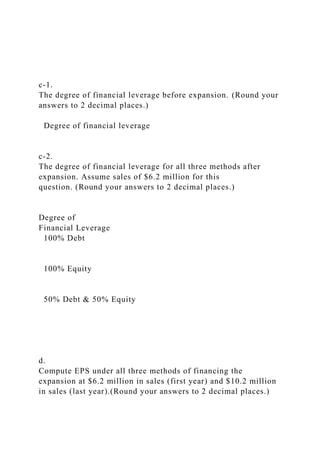
c-1.
The degree of financial leverage before expansion. (Round your
answers to 2 decimal places.)
Degree of financial leverage
c-2.
The degree of financial leverage for all three methods after
expansion. Assume sales of $6.2 million for this
question. (Round your answers to 2 decimal places.)
Degree of
Financial Leverage
100% Debt
100% Equity
50% Debt & 50% Equity
d.
Compute EPS under all three methods of financing the
expansion at $6.2 million in sales (first year) and $10.2 million
in sales (last year).(Round your answers to 2 decimal places.)
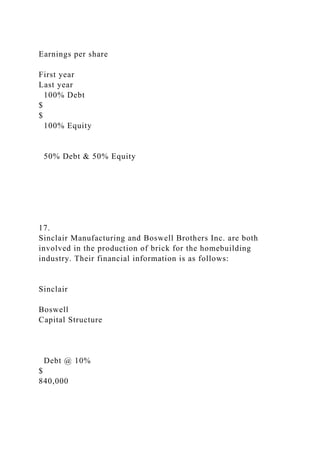
Earnings per share
First year
Last year
100% Debt
$
$
100% Equity
50% Debt & 50% Equity
17.
Sinclair Manufacturing and Boswell Brothers Inc. are both
involved in the production of brick for the homebuilding
industry. Their financial information is as follows:
Sinclair
Boswell
Capital Structure
Debt @ 10%
$
840,000
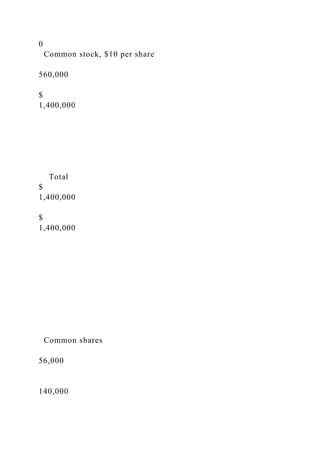
0
Common stock, $10 per share
560,000
$
1,400,000
Total
$
1,400,000
$
1,400,000
Common shares
56,000
140,000
Operating Plan:
Sales (54,000 units at $15 each)
$
810,000
$
810,000
Variable costs
648,000
324,000
Fixed costs
0
304,000
Earnings before interest and taxes (EBIT)
$
162,000
$
182,000
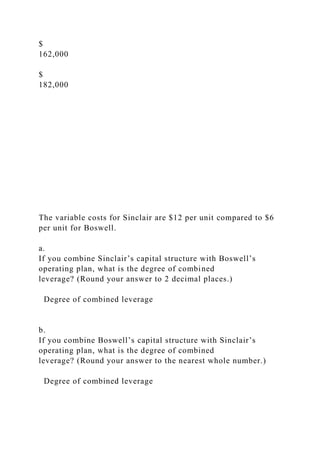
The variable costs for Sinclair are $12 per unit compared to $6
per unit for Boswell.
a.
If you combine Sinclair’s capital structure with Boswell’s
operating plan, what is the degree of combined
leverage? (Round your answer to 2 decimal places.)
Degree of combined leverage
b.
If you combine Boswell’s capital structure with Sinclair’s
operating plan, what is the degree of combined
leverage? (Round your answer to the nearest whole number.)
Degree of combined leverage
c.
In part b, if sales double, by what percentage will EPS
increase? (Round your answer to the nearest whole percent.)
EPS will increase by
%
(Click to select)
(Click to select)

4. . 5.6..docx

  • 1.
  • 2.
    7. The ManningCompany has financial statements as shown next, which are representative of the company’s historical average. The firm is expecting a 35 percent increase in sales next year, and management is concerned about the company’s need for external funds. The increase in sales is expected to be carried out without any expansion of fixed assets, but rather through more efficient asset utilization in the existing store. Among liabilities, only current liabilities vary directly with sales. Income Statement Sales $ 220,000 Expenses 171,200 Earnings before interest and taxes $ 48,800 Interest 8,300 Earnings before taxes $ 40,500 Taxes
  • 3.
    16,300 Earnings after taxes $ 24,200 Dividends $ 7,260 BalanceSheet Assets Liabilities and Stockholders' Equity Cash $ 8,000 Accounts payable $ 23,400 Accounts receivable 33,000 Accrued wages 1,850 Inventory 69,000 Accrued taxes
  • 4.
    3,350 Current assets $ 110,000 Current liabilities $ 28,600 Fixedassets 93,000 Notes payable 8,300 Long-term debt 21,500 Common stock 117,000 Retained earnings
  • 5.
    27,600 Total assets $ 203,000 Total liabilitiesand stockholders' equity $ 203,000 Using the percent-of-sales method, determine whether the company has external financing needs, or a surplus of funds. (Hint: A profit margin and payout ratio must be found from the income statement.) (Do not round intermediate calculations. Input the amount as a positive value.) The firm $ in .
  • 6.
    10. Healthy FoodsInc. sells 50-pound bags of grapes to the military for $25 a bag. The fixed costs of this operation are $130,000, while the variable costs of grapes are $.20 per pound. a. What is the break-even point in bags? (Round your answer to 2 decimal places.) Break-even point bags b. Calculate the profit or loss (EBIT) on 12,000 bags and on 34,000 bags. (Input all amounts as positive values. Round your answers to the nearest whole number.) Bags Profit/Loss Amount 12,000 $ 34,000 $
  • 7.
    c. What is thedegree of operating leverage at 30,000 bags and at 34,000 bags? (Round your answers to 2 decimal places.) Bags Degree of Operating Leverage 30,000 34,000 d. If Healthy Foods has an annual interest expense of $11,000, calculate the degree of financial leverage at both 30,000 and 34,000 bags. (Round your answers to 2 decimal places.) Bags Degree of Financial Leverage 30,000 34,000
  • 8.
    e. What is thedegree of combined leverage at both 30,000 and 34,000 bags? (Round your answers to 2 decimal places.) Bags Degree of Combined Leverage 30,000 34,000 12. Lenow’s Drug Stores and Hall’s Pharmaceuticals are competitors in the discount drug chain store business. The separate capital structures for Lenow and Hall are presented next. Lenow Hall Debt @ 10% $ 230,000 Debt @ 10% $ 460,000 Common stock, $10 par
  • 9.
    460,000 Common stock, $10par 230,000 Total $ 690,000 Total $ 690,000 Common shares 46,000 Common shares 23,000 a. Complete the following table given earnings before interest and taxes of $27,000, $69,000, and $71,000. Assume the tax rate is 30 percent. (Leave no cells blank - be certain to enter "0" wherever required. Negative amounts should be indicated by a minus sign.Round your answers to 2 decimal places.)
  • 10.
    EBIT Total assets EBIT/TA Lenow EPS HallEPS What is the relationship between the EPS of the two firms? $ 27,000 $690,000 % $ $ $ 69,000 $690,000 % $ $ $71,000 $690,000 % $ $ b-1. What is the EBIT/TA rate when the firm's have equal EPS? EBIT/TA rate % b-2. What is the cost of debt?
  • 11.
    Cost of debt % b-3. Statethe relationship between earnings per share and the level of EBIT. EPS is unaffected by financial leverage when the pre-tax return on assets (EBIT/TA) the cost of debt. c. If the cost of debt went up to 12 percent and all other factors remained equal, what would be the break-even level for EBIT? Break-even level $ 14. Dickinson Company has $11,840,000 million in assets. Currently half of these assets are financed with long-term debt at 9.2 percent and half with common stock having a par value of $8. Ms. Smith, Vice-President of Finance, wishes to analyze two refinancing plans, one with more debt (D) and one with more equity (E). The company earns a return on assets before interest and taxes of 9.2 percent. The tax rate is 45
  • 12.
    percent. Tax losscarryover provisions apply, so negative tax amounts are permissable. Under Plan D, a $2,960,000 million long-term bond would be sold at an interest rate of 11.2 percent and 370,000 shares of stock would be purchased in the market at $8 per share and retired. Under Plan E, 370,000 shares of stock would be sold at $8 per share and the $2,960,000 in proceedswould be used to reduce long-term debt. a. How would each of these plans affect earnings per share? Consider the current plan and the two new plans. (Round your answers to 2 decimal places.) Current Plan Plan D Plan E Earnings per share $ $ $ b-1. Compute the earnings per share if return on assets fell to 4.60 percent. (Leave no cells blank - be certain to enter "0" wherever required. Negative amounts should be indicated by a minus sign. Round your answers to 2 decimal places.) Current Plan
  • 13.
    Plan D Plan E Earningsper share $ $ $ b-2. Which plan would be most favorable if return on assets fell to 4.60 percent? Consider the current plan and the two new plans. Plan E Current Plan Plan D b-3. Compute the earnings per share if return on assets increased to 14.2 percent. (Round your answers to 2 decimal places.) Current Plan Plan D Plan E Earnings per share $ $ $
  • 14.
    b-4. Which plan wouldbe most favorable if return on assets increased to 14.2 percent? Consider the current plan and the two new plans. Current Plan Plan D Plan E c-1. If the market price for common stock rose to $10 before the restructuring, compute the earnings per share. Continue to assume that $2,960,000 million in debt will be used to retire stock in Plan D and $2,960,000 million of new equity will be sold to retire debt in Plan E. Also assume that return on assets is 9.2 percent. (Round your answers to 2 decimal places.) Current Plan Plan D Plan E Earnings per share $ $ $
  • 15.
    c-2. If the marketprice for common stock rose to $10 before the restructuring, which plan would then be most attractive? Current Plan Plan D Plan E 15. The Lopez-Portillo Company has $11.3 million in assets, 90 percent financed by debt, and 10 percent financed by common stock. The interest rate on the debt is 10 percent and the par value of the stock is $10 per share. President Lopez-Portillo is considering two financing plans for an expansion to $21.5 million in assets. Under Plan A, the debt-to-total-assets ratio will be maintained, but new debt will cost a whopping 10 percent! Under Plan B, only new common stock at $10 per share will be issued. The tax rate is 30 percent. a. If EBIT is 11 percent on total assets, compute earnings per share (EPS) before the expansion and under the two alternatives. (Round your answers to 2 decimal places.)
  • 16.
    Earnings Per Share Current $ PlanA $ Plan B $ b. What is the degree of financial leverage under each of the three plans? (Round your answers to 2 decimal places.) Degree Of Financial Leverage Current Plan A Plan B c. If stock could be sold at $20 per share due to increased expectations for the firm’s sales and earnings, what impact would this have on earnings per share for the two expansion alternatives? Compute earnings per share for each. (Round your answers to 2 decimal places.)
  • 17.
    Earnings Per Share PlanA $ Plan B $ The Lopez-Portillo Company has $11.3 million in assets, 90 percent financed by debt, and 10 percent financed by common stock. The interest rate on the debt is 10 percent and the par value of the stock is $10 per share. President Lopez-Portillo is considering two financing plans for an expansion to $21.5 million in assets. Under Plan A, the debt-to-total-assets ratio will be maintained, but new debt will cost a whopping 10 percent! Under Plan B, only new common stock at $10 per share will be issued. The tax rate is 30 percent. a. If EBIT is 11 percent on total assets, compute earnings per share (EPS) before the expansion and under the two alternatives. (Round your answers to 2 decimal places.) Earnings Per Share Current $ Plan A $ Plan B $ b. What is the degree of financial leverage under each of the three
  • 18.
    plans? (Round youranswers to 2 decimal places.) Degree Of Financial Leverage Current Plan A Plan B c. If stock could be sold at $20 per share due to increased expectations for the firm’s sales and earnings, what impact would this have on earnings per share for the two expansion alternatives? Compute earnings per share for each. (Round your answers to 2 decimal places.) Earnings Per Share Plan A $ Plan B $ 16. Delsing Canning Company is considering an expansion of its facilities. Its current income statement is as follows:
  • 19.
    Sales $ 5,200,000 Variable costs (50%of sales) 2,600,000 Fixed costs 1,820,000 Earnings before interest and taxes (EBIT) $ 780,000 Interest (10% cost) 240,000 Earnings before taxes (EBT) $ 540,000 Tax (40%) 216,000
  • 20.
    Earnings after taxes(EAT) $ 324,000 Shares of common stock 220,000 Earnings per share $ 1.47 The company is currently financed with 50 percent debt and 50 percent equity (common stock, par value of $10). In order to expand the facilities, Mr. Delsing estimates a need for $2.2 million in additional financing. His investment banker has laid out three plans for him to consider: 1.Sell $2.2 million of debt at 10 percent. 2.Sell $2.2 million of common stock at $20 per share. 3.Sell $1.10 million of debt at 9 percent and $1.10 million of common stock at $25 per share. Variable costs are expected to stay at 50 percent of sales, while fixed expenses will increase to $2,320,000 per year. Delsing is not sure how much this expansion will add to sales,
  • 21.
    but he estimatesthat sales will rise by $1.10 million per year for the next five years. Delsing is interested in a thorough analysis of his expansion plans and methods of financing.He would like you to analyze the following: a. The break-even point for operating expenses before and after expansion (in sales dollars). (Enter your answers in dollars not in millions, i.e, $1,234,567.) Break-Even Point Before expansion $ After expansion $ b. The degree of operating leverage before and after expansion. Assume sales of $5.2 million before expansion and $6.2 million after expansion. Use the formula: DOL = (S − TVC) / (S − TVC − FC).(Round your answers to 2 decimal places.) Degree of Operating Leverage Before expansion After expansion
  • 22.
    c-1. The degree offinancial leverage before expansion. (Round your answers to 2 decimal places.) Degree of financial leverage c-2. The degree of financial leverage for all three methods after expansion. Assume sales of $6.2 million for this question. (Round your answers to 2 decimal places.) Degree of Financial Leverage 100% Debt 100% Equity 50% Debt & 50% Equity d. Compute EPS under all three methods of financing the expansion at $6.2 million in sales (first year) and $10.2 million in sales (last year).(Round your answers to 2 decimal places.)
  • 23.
    Earnings per share Firstyear Last year 100% Debt $ $ 100% Equity 50% Debt & 50% Equity 17. Sinclair Manufacturing and Boswell Brothers Inc. are both involved in the production of brick for the homebuilding industry. Their financial information is as follows: Sinclair Boswell Capital Structure Debt @ 10% $ 840,000
  • 24.
    0 Common stock, $10per share 560,000 $ 1,400,000 Total $ 1,400,000 $ 1,400,000 Common shares 56,000 140,000
  • 25.
    Operating Plan: Sales (54,000units at $15 each) $ 810,000 $ 810,000 Variable costs 648,000 324,000 Fixed costs 0 304,000 Earnings before interest and taxes (EBIT)
  • 26.
    $ 162,000 $ 182,000 The variable costsfor Sinclair are $12 per unit compared to $6 per unit for Boswell. a. If you combine Sinclair’s capital structure with Boswell’s operating plan, what is the degree of combined leverage? (Round your answer to 2 decimal places.) Degree of combined leverage b. If you combine Boswell’s capital structure with Sinclair’s operating plan, what is the degree of combined leverage? (Round your answer to the nearest whole number.) Degree of combined leverage
  • 27.
    c. In part b,if sales double, by what percentage will EPS increase? (Round your answer to the nearest whole percent.) EPS will increase by % (Click to select) (Click to select)