Digital 2013
Mindshare
In 1996 it took 25 mins to
download 1 song…
…Now it takes 25 seconds
on your mobile phone
3
To update this brand zone text, on the Insert tab, click Header & Footer
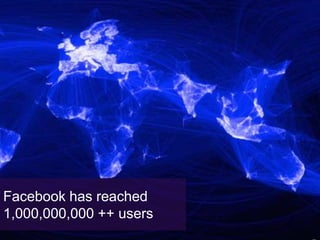
Facebook has reached
1,000,000,000 ++ users
He’s made a lot of money
5

To update this brand zone text, on the Insert tab, click Header & Footer
6

How many of you knew this
guy 1 year ago?
The world is going through a
period of profound change

7
To update this brand zone text, on the Insert tab, click Header & Footer
It’s happening quickly and
it’s driven by technology and
the internet
What does this
mean for
Vietnam?
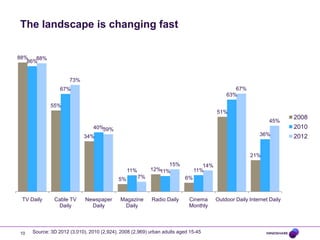
The landscape is changing fast
88%
88%
86%

73%
67%
63%

67%
55%

51%
45%

2010

40%
39%
34%

36%

21%
15%
12%11%

11%
5%

TV Daily

10

Cable TV
Daily

Newspaper
Daily

2008

7%

Magazine
Daily

14%
11%
6%

Radio Daily

Cinema
Monthly

Source: 3D 2012 (3,010), 2010 (2,924), 2008 (2,969) urban adults aged 15-45

Outdoor Daily Internet Daily

2012
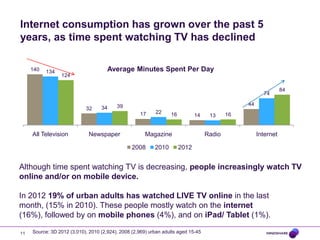
Internet consumption has grown over the past 5
years, as time spent watching TV has declined
140

134

Average Minutes Spent Per Day
124

74
32

34

44

39
17

All Television

Newspaper

84

22

16

14

Magazine
2008

2010

13

Radio

16

Internet

2012

Although time spent watching TV is decreasing, people increasingly watch TV
online and/or on mobile device.
In 2012 19% of urban adults has watched LIVE TV online in the last
month, (15% in 2010). These people mostly watch on the internet
(16%), followed by on mobile phones (4%), and on iPad/ Tablet (1%).
11

Source: 3D 2012 (3,010), 2010 (2,924), 2008 (2,969) urban adults aged 15-45
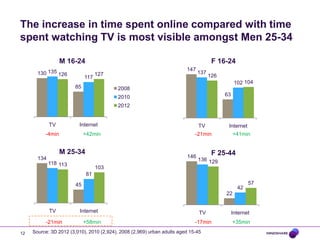
The increase in time spent online compared with time
spent watching TV is most visible amongst Men 25-34
M 16-24
130 135 126

F 16-24

117

147

127

137

126
102 104

85

2008
63

2010
2012

TV

Internet

-4min

+42min

M 25-34

TV
-21min

146

134
118 113

Internet
+41min

F 25-44
136 129

103
81
45

42

57

22
TV
-21min
12

Internet
+58min

TV

Internet

-17min

+35min

Source: 3D 2012 (3,010), 2010 (2,924), 2008 (2,969) urban adults aged 15-45
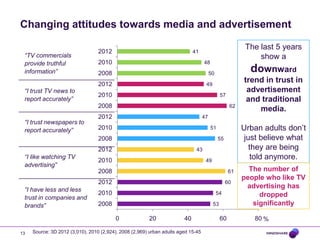
Changing attitudes towards media and advertisement
“TV commercials
provide truthful
information”
“I trust TV news to
report accurately”

2012

The last 5 years
show a

41

2010

48

2008

downward

50

2012

49

2010

57

2008
“I trust newspapers to
report accurately”

62

2012

47

2010

Urban adults don’t
just believe what
they are being
told anymore.

51

2008

55

2012
“I like watching TV
advertising”

43

2010

49

2008

61

2012

“I have less and less
trust in companies and
brands”

60

2010

54

2008

53

0
13

trend in trust in
advertisement
and traditional
media.

20

40

Source: 3D 2012 (3,010), 2010 (2,924), 2008 (2,969) urban adults aged 15-45

60

The number of
people who like TV
advertising has
dropped
significantly
80 %
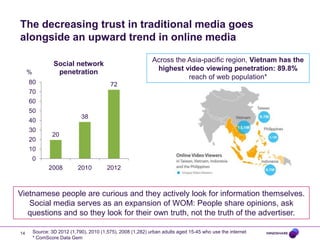
The decreasing trust in traditional media goes
alongside an upward trend in online media
Across the Asia-pacific region, Vietnam has the
highest video viewing penetration: 89.8%
reach of web population*

Social network
penetration

%
80

72

70
60
50
38

40
30
20

20

10
0
2008

2010

2012

Vietnamese people are curious and they actively look for information themselves.
Social media serves as an expansion of WOM: People share opinions, ask
questions and so they look for their own truth, not the truth of the advertiser.
14

Source: 3D 2012 (1,790), 2010 (1,575), 2008 (1,282) urban adults aged 15-45 who use the internet
* ComScore Data Gem
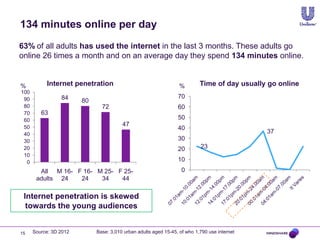
134 minutes online per day
63% of all adults has used the internet in the last 3 months. These adults go
online 26 times a month and on an average day they spend 134 minutes online.
%
100
90
80
70
60
50
40
30
20
10
0

Internet penetration
84

%

Time of day usually go online

70

80
72

60

63

50
47

40

37

30
20

23

10
All M 16- F 16- M 25- F 25adults 24
24
34
44

0

Internet penetration is skewed
towards the young audiences

15

Source: 3D 2012

Base: 3,010 urban adults aged 15-45, of who 1,790 use internet
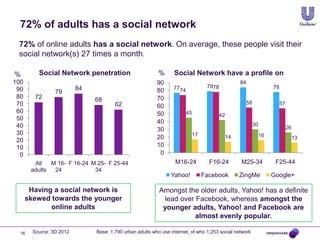
72% of adults has a social network
72% of online adults has a social network. On average, these people visit their
social network(s) 27 times a month.
Social Network penetration

%
100
90
80
70
60
50
40
30
20
10
0

72

79

84
68

62

All
M 16- F 16-24 M 25- F 25-44
adults
24
34

Having a social network is
skewed towards the younger
online adults

16

Source: 3D 2012

%
90
80
70
60
50
40
30
20
10
0

Social Network have a profile on
84

7978

7774

78
58

45

57

42
30
17

M16-24
Yahoo!

16

14

F16-24
Facebook

26

M25-34
ZingMe

13

F25-44
Google+

Amongst the older adults, Yahoo! has a definite
lead over Facebook, whereas amongst the
younger adults, Yahoo! and Facebook are
almost evenly popular.

Base: 1,790 urban adults who use internet, of who 1,253 social network
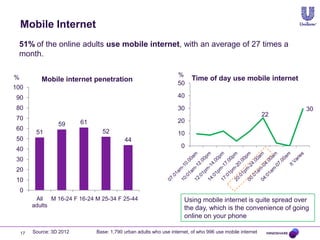
Mobile Internet
51% of the online adults use mobile internet, with an average of 27 times a
month.
%

Mobile internet penetration

100

%
50

90

40

80

Time of day use mobile internet

30
22

70
60

59
51

50

30

20

61
52

10
44
0

40
30

20
10
0
All M 16-24 F 16-24 M 25-34 F 25-44
adults

17

Source: 3D 2012

Using mobile internet is quite spread over
the day, which is the convenience of going
online on your phone

Base: 1,790 urban adults who use internet, of who 996 use mobile internet
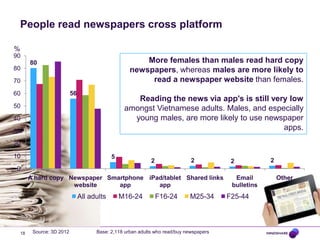
People read newspapers cross platform
%
90
80

More females than males read hard copy
newspapers, whereas males are more likely to
read a newspaper website than females.

80

70
56

60

Reading the news via app’s is still very low
amongst Vietnamese adults. Males, and especially
young males, are more likely to use newspaper
apps.

50
40
30
20
10

5

2

2

2

2

0
A hard copy Newspaper Smartphone iPad/tablet Shared links
website
app
app

All adults

18

Source: 3D 2012

M16-24

F16-24

M25-34

Base: 2,118 urban adults who read/buy newspapers

Email
bulletins

F25-44

Other
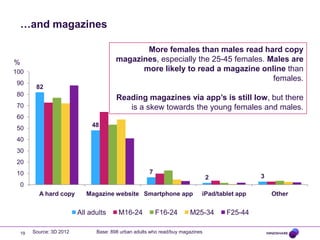
…and magazines
More females than males read hard copy
magazines, especially the 25-45 females. Males are
more likely to read a magazine online than
females.

%
100

90

82

80

Reading magazines via app’s is still low, but there
is a skew towards the young females and males.

70
60
48

50
40
30
20

7

10

3

2

0
A hard copy

Magazine website Smartphone app

All adults
19

Source: 3D 2012

M16-24

F16-24

iPad/tablet app

M25-34

Base: 898 urban adults who read/buy magazines

F25-44

Other
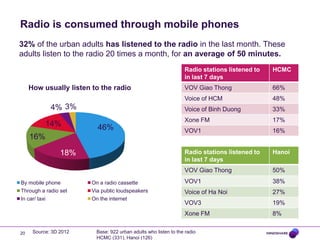
Radio is consumed through mobile phones
32% of the urban adults has listened to the radio in the last month. These
adults listen to the radio 20 times a month, for an average of 50 minutes.

Radio stations listened to
in last 7 days

By mobile phone
Through a radio set

On a radio cassette
Via public loudspeakers

In car/ taxi

On the internet

20

Source: 3D 2012

VOV1

16%
Hanoi
50%

VOV1

38%

Voice of Ha Noi

27%

VOV3

19%

Xone FM

18%

17%

Radio stations listened to
in last 7 days

16%

33%

Xone FM

46%

48%

VOV Giao Thong

14%

66%

Voice of Binh Duong

4% 3%

VOV Giao Thong
Voice of HCM

How usually listen to the radio

HCMC

8%

Base: 922 urban adults who listen to the radio
HCMC (331), Hanoi (126)
Consumer experience of the
world does not fit in neat

boxes
The lines between the real and virtual worlds are
disappearing

The lines between the real
and the virtual world are
disappearing
What we as marketers call digital has just been absorbed
into consumers daily lives
Mail is just Email or Messaging
Music is just MP3
Photo Albums are just Facebook

Videos on Tablet, PC or Mobile are just the new TV
Conversations are on Facebook
Games are just played online, with friends, in social networks
Mobile phones are just something they use to pass the time when they
are bored, and they use them to interact with whatever is around them
Our customers are the best integrated marketers out there

Your customers do not see the lines we see between channels
They do not perceive how you communicate with them in the digital
space as separate to the real world
They are experts at connecting the two together already
What they see on TV or Posters or in Newspapers, or at an event, or
anywhere else in the real world they share and act on online
That is the biggest opportunity in 2013
25
In the technology revolution, things change daily

1. Content is now more liquid
2. Communication is always on
3. And advertising is about Orchestration, not just Integration

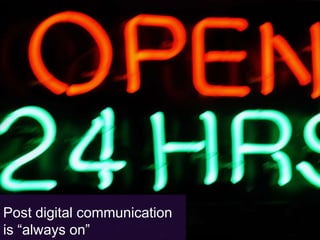
Post digital communication
is “always on”
Integration happens around
social and mobile
Social listening becomes
even more important for
brands
Mobile devices are a key
connector
Commerce gets legs
and goes mobile
“MOBILE IS THE MOST OVERHYPED MEDIUM IN THE SHORT
TERM AND THE MOST UNDERHYPED MEDIUM IN THE LONG
TERM.”
MARTIN SORRELL, CEO, WPP
Customer service becomes
more integrated with
marketing
Think
Mobile

Think
Social

Don’t think
in boxes!
Beware the “Cargo Cult”
mentality
THANK YOU!

Mindshare Digital Vietnam 2013

  • 1.
  • 2.
    In 1996 ittook 25 mins to download 1 song…
  • 3.
    …Now it takes25 seconds on your mobile phone 3 To update this brand zone text, on the Insert tab, click Header & Footer
  • 4.
  • 5.
    He’s made alot of money 5 To update this brand zone text, on the Insert tab, click Header & Footer
  • 6.
    6 How many ofyou knew this guy 1 year ago?
  • 7.
    The world isgoing through a period of profound change 7 To update this brand zone text, on the Insert tab, click Header & Footer
  • 8.
    It’s happening quicklyand it’s driven by technology and the internet
  • 9.
    What does this meanfor Vietnam?
  • 10.
    The landscape ischanging fast 88% 88% 86% 73% 67% 63% 67% 55% 51% 45% 2010 40% 39% 34% 36% 21% 15% 12%11% 11% 5% TV Daily 10 Cable TV Daily Newspaper Daily 2008 7% Magazine Daily 14% 11% 6% Radio Daily Cinema Monthly Source: 3D 2012 (3,010), 2010 (2,924), 2008 (2,969) urban adults aged 15-45 Outdoor Daily Internet Daily 2012
  • 11.
    Internet consumption hasgrown over the past 5 years, as time spent watching TV has declined 140 134 Average Minutes Spent Per Day 124 74 32 34 44 39 17 All Television Newspaper 84 22 16 14 Magazine 2008 2010 13 Radio 16 Internet 2012 Although time spent watching TV is decreasing, people increasingly watch TV online and/or on mobile device. In 2012 19% of urban adults has watched LIVE TV online in the last month, (15% in 2010). These people mostly watch on the internet (16%), followed by on mobile phones (4%), and on iPad/ Tablet (1%). 11 Source: 3D 2012 (3,010), 2010 (2,924), 2008 (2,969) urban adults aged 15-45
  • 12.
    The increase intime spent online compared with time spent watching TV is most visible amongst Men 25-34 M 16-24 130 135 126 F 16-24 117 147 127 137 126 102 104 85 2008 63 2010 2012 TV Internet -4min +42min M 25-34 TV -21min 146 134 118 113 Internet +41min F 25-44 136 129 103 81 45 42 57 22 TV -21min 12 Internet +58min TV Internet -17min +35min Source: 3D 2012 (3,010), 2010 (2,924), 2008 (2,969) urban adults aged 15-45
  • 13.
    Changing attitudes towardsmedia and advertisement “TV commercials provide truthful information” “I trust TV news to report accurately” 2012 The last 5 years show a 41 2010 48 2008 downward 50 2012 49 2010 57 2008 “I trust newspapers to report accurately” 62 2012 47 2010 Urban adults don’t just believe what they are being told anymore. 51 2008 55 2012 “I like watching TV advertising” 43 2010 49 2008 61 2012 “I have less and less trust in companies and brands” 60 2010 54 2008 53 0 13 trend in trust in advertisement and traditional media. 20 40 Source: 3D 2012 (3,010), 2010 (2,924), 2008 (2,969) urban adults aged 15-45 60 The number of people who like TV advertising has dropped significantly 80 %
  • 14.
    The decreasing trustin traditional media goes alongside an upward trend in online media Across the Asia-pacific region, Vietnam has the highest video viewing penetration: 89.8% reach of web population* Social network penetration % 80 72 70 60 50 38 40 30 20 20 10 0 2008 2010 2012 Vietnamese people are curious and they actively look for information themselves. Social media serves as an expansion of WOM: People share opinions, ask questions and so they look for their own truth, not the truth of the advertiser. 14 Source: 3D 2012 (1,790), 2010 (1,575), 2008 (1,282) urban adults aged 15-45 who use the internet * ComScore Data Gem
  • 15.
    134 minutes onlineper day 63% of all adults has used the internet in the last 3 months. These adults go online 26 times a month and on an average day they spend 134 minutes online. % 100 90 80 70 60 50 40 30 20 10 0 Internet penetration 84 % Time of day usually go online 70 80 72 60 63 50 47 40 37 30 20 23 10 All M 16- F 16- M 25- F 25adults 24 24 34 44 0 Internet penetration is skewed towards the young audiences 15 Source: 3D 2012 Base: 3,010 urban adults aged 15-45, of who 1,790 use internet
  • 16.
    72% of adultshas a social network 72% of online adults has a social network. On average, these people visit their social network(s) 27 times a month. Social Network penetration % 100 90 80 70 60 50 40 30 20 10 0 72 79 84 68 62 All M 16- F 16-24 M 25- F 25-44 adults 24 34 Having a social network is skewed towards the younger online adults 16 Source: 3D 2012 % 90 80 70 60 50 40 30 20 10 0 Social Network have a profile on 84 7978 7774 78 58 45 57 42 30 17 M16-24 Yahoo! 16 14 F16-24 Facebook 26 M25-34 ZingMe 13 F25-44 Google+ Amongst the older adults, Yahoo! has a definite lead over Facebook, whereas amongst the younger adults, Yahoo! and Facebook are almost evenly popular. Base: 1,790 urban adults who use internet, of who 1,253 social network
  • 17.
    Mobile Internet 51% ofthe online adults use mobile internet, with an average of 27 times a month. % Mobile internet penetration 100 % 50 90 40 80 Time of day use mobile internet 30 22 70 60 59 51 50 30 20 61 52 10 44 0 40 30 20 10 0 All M 16-24 F 16-24 M 25-34 F 25-44 adults 17 Source: 3D 2012 Using mobile internet is quite spread over the day, which is the convenience of going online on your phone Base: 1,790 urban adults who use internet, of who 996 use mobile internet
  • 18.
    People read newspaperscross platform % 90 80 More females than males read hard copy newspapers, whereas males are more likely to read a newspaper website than females. 80 70 56 60 Reading the news via app’s is still very low amongst Vietnamese adults. Males, and especially young males, are more likely to use newspaper apps. 50 40 30 20 10 5 2 2 2 2 0 A hard copy Newspaper Smartphone iPad/tablet Shared links website app app All adults 18 Source: 3D 2012 M16-24 F16-24 M25-34 Base: 2,118 urban adults who read/buy newspapers Email bulletins F25-44 Other
  • 19.
    …and magazines More femalesthan males read hard copy magazines, especially the 25-45 females. Males are more likely to read a magazine online than females. % 100 90 82 80 Reading magazines via app’s is still low, but there is a skew towards the young females and males. 70 60 48 50 40 30 20 7 10 3 2 0 A hard copy Magazine website Smartphone app All adults 19 Source: 3D 2012 M16-24 F16-24 iPad/tablet app M25-34 Base: 898 urban adults who read/buy magazines F25-44 Other
  • 20.
    Radio is consumedthrough mobile phones 32% of the urban adults has listened to the radio in the last month. These adults listen to the radio 20 times a month, for an average of 50 minutes. Radio stations listened to in last 7 days By mobile phone Through a radio set On a radio cassette Via public loudspeakers In car/ taxi On the internet 20 Source: 3D 2012 VOV1 16% Hanoi 50% VOV1 38% Voice of Ha Noi 27% VOV3 19% Xone FM 18% 17% Radio stations listened to in last 7 days 16% 33% Xone FM 46% 48% VOV Giao Thong 14% 66% Voice of Binh Duong 4% 3% VOV Giao Thong Voice of HCM How usually listen to the radio HCMC 8% Base: 922 urban adults who listen to the radio HCMC (331), Hanoi (126)
  • 21.
    Consumer experience ofthe world does not fit in neat boxes
  • 22.
    The lines betweenthe real and virtual worlds are disappearing The lines between the real and the virtual world are disappearing
  • 23.
    What we asmarketers call digital has just been absorbed into consumers daily lives Mail is just Email or Messaging Music is just MP3 Photo Albums are just Facebook Videos on Tablet, PC or Mobile are just the new TV Conversations are on Facebook Games are just played online, with friends, in social networks Mobile phones are just something they use to pass the time when they are bored, and they use them to interact with whatever is around them
  • 24.
    Our customers arethe best integrated marketers out there Your customers do not see the lines we see between channels They do not perceive how you communicate with them in the digital space as separate to the real world They are experts at connecting the two together already What they see on TV or Posters or in Newspapers, or at an event, or anywhere else in the real world they share and act on online That is the biggest opportunity in 2013
  • 25.
  • 26.
    In the technologyrevolution, things change daily 1. Content is now more liquid 2. Communication is always on 3. And advertising is about Orchestration, not just Integration Post digital communication is “always on”
  • 27.
  • 28.
    Social listening becomes evenmore important for brands
  • 29.
    Mobile devices area key connector
  • 30.
  • 31.
    “MOBILE IS THEMOST OVERHYPED MEDIUM IN THE SHORT TERM AND THE MOST UNDERHYPED MEDIUM IN THE LONG TERM.” MARTIN SORRELL, CEO, WPP
  • 32.
    Customer service becomes moreintegrated with marketing
  • 35.
  • 36.
    Beware the “CargoCult” mentality
  • 37.

Editor's Notes

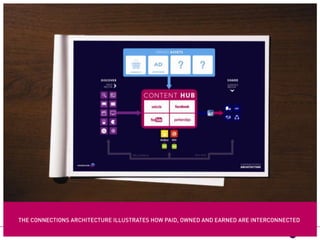
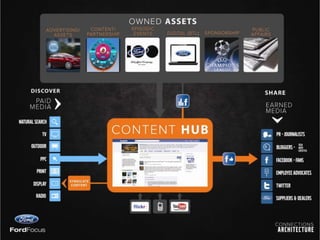
  • #34 POE is built on the idea that advocacy drives successful business and that the internet has changed everything especially the way people have relationships with brands. In the centre the brands owned assets are represented with one of them being more prominent as the hubOn the left the key paid media channels are highlighted and the on the right the earned platforms are shown.The arrows show the direction of flow around the brand’s comms ecosystem
  • #37 It’s a challenge the industry frequently faces quite often especially amongst brands with limited resources or a very traditional view of communications. In their simplest form, legacy media strategies for traditional outlets may become a one dimensional list defining which executions run on which TV channels or newspapers with what frequency. Transpose this to digital, and we get a list of search keyphrases and household-name websites.In response to this, a colleague of mine Nick Fawbert of Third Space based in Singapore recently christened it a ‘cargo cult’ strategy.A cargo cult, is a quasi-religious movement that started to appear among some Pacific islanders around a century ago with the advent of serious international trade in the region. It reached a peak after the Second World War, when the islands had become saturated with the foot soldiers of various warring nations.The technologies islanders were exposed to were so far beyond their experience (particularly those delivered by aircraft) that the locals decided they must be of divine provenance as a reward for good behaviour. They also became somewhat tetchy that these assets seemed to be hoovered up by foreign forces, and came to the conclusion that this must be down to the particular forms of worship they engaged in.Post-conflict, these regular cargo deliveries quickly ground to a halt, and the foreign forces departed, leaving behind a local population now hooked on tinned spam and socket sets.To attract the deliveries back once more, islanders determined to emulate the foreign religion, and built runways, airports, and control towers out of straw and bamboo. One even went so far as to fashion a headset complete with ariels of bamboo for the ground crew. They developed rituals that entailed copying military routines like square bashing, and painted US flags on their bodies in all the appropriate places.Thus the ‘cargo’ cults were born.They were, of course, despite their comprehensive recreation of the airport experience, totally useless.So why do I bring this up at the beginning of a conference? Looking at Effective communications strategy by emulating the outward manifestations of successful campaigns, but without understanding the infrastructure and ecosystem that are necessary to support it.At the root of it all is the work that goes into establishing a unique value proposition—recognition of the contribution all assets can make at all levels of a company from research and design through manufacturing, distribution, retail and customer service.CRM for example is often dismissed as something for the “techies”Lest we forget, some of the most successful digital campaigns of recent years, such as Dell Storm, are those that have integrated the customer into the creation and sales process through dialogue and crowdsourcing.Those relationships are business critical. Good customer relationships improve business performance by enhancing customer satisfaction and driving up customer loyalty. This increases frequency and value of purchases.The telecom industry sees a 10 per cent increase in customer satisfaction generating a 2 per cent rise in customer retention and a 3 per cent rise in revenues. Volvo discovered that a one-point increase in customer satisfaction results in a 4 per cent increase in dealer profitability, because they don’t have to work so hard to make the next sale. Lexus calculated that each ‘delighted’ customer (their metric) makes them an average of S$1.2 million in sales recommendations.