What is Mindfulness?
Definition of Mindfulness:
It may be best defined as
awareness of
one’s present experience
with acceptance.
Mindfulness is:
intentionally directing one’s attention to
the present experience without being
overcome by:
 judgment (rejecting experience)
 internal dialogue (internal noise)
 emotional reactivity (triggers)
 physical reactivity (impulses)
 clinging onto pleasant experience
Mindfulness Meditation
 Concentration, Awareness, & Diligence
 Designed to strengthen mindfulness
 Without trying we develop habits of escaping,
distracting, and avoiding our own experience.
 Meditation is less about having a wonderful
experience than it is about strengthening the habit of
mindfulness.
 The goal of a meditation practice is to strengthen the
habit of mindfulness so it is greater than our habits of
escape, distraction, and avoidance.
 It takes awhile before you reap its benefits.
Doing Mindfulness Meditation
Sitting meditation:
sitting still (try not to move)
back straight but relaxed
focus on your breath in abdomen (in-pause-out)
maintaining awareness of internal
and external stimuli (and responses?)
do not try to block out anything
(sense doors are open)
return back to breath when “caught in thought”
Doing Mindfulness Meditation
Walking meditation:
focus on lifting, placing, shifting feet
same directions otherwise: come back to your
sensation of walking when “caught in thought”
Eating meditation:
focus on bring food to mouth,
touching and/or seeing food
putting food in mouth, salivating, and tasting
chewing and eventual swallowing
Doing Mindfulness Meditation
Can be done with many other activities:
Doing the dishes
Sweeping
Listening
And
Talking
Research Findings On
Meditation:
 increases positive feelings and well-being
 decreases anxiety, depression, & stress
 reverses memory loss
 increases tolerance to pain
 strengthens immune functioning
 Improves ability to focus
 may ward off effects of ageing
 Increases capacity for emotional regulation
What is Emotional Intelligence?
Following Gardner’s (1983) concept of
“Multiple Intelligences” ,
Salvoy and Mayer (1990) coined the term
“Emotional Intelligence”
as one of the many types of intelligence.
Salovey and Mayer’s definition:
“a form of social intelligence that involves
the ability to:
 monitor one’s own and other’s feeling and
emotion (awareness),
 discriminate among them (understanding),
 and to use this information to guide one’s
thinking and emotion (management).”
Goleman’s Model of E.I.
 Popularized first in his book on E.I. (1995)
 Developed in his book Primal Leaderhip (2002)
with Richard Boyatzis and Annie McKee
 Four generic domains
 Self awareness
 Social-awareness
 Self-management
 Relationship management
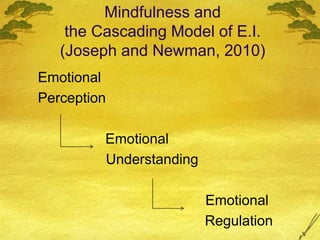
Mindfulness and
the Cascading Model of E.I.
(Joseph and Newman, 2010)
Emotional
Perception
Emotional
Understanding
Emotional
Regulation
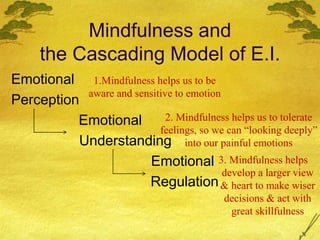
Mindfulness and
the Cascading Model of E.I.
Emotional
Perception
Emotional
Understanding
Emotional
Regulation
1.Mindfulness helps us to be
aware and sensitive to emotion
2. Mindfulness helps us to tolerate
feelings, so we can “looking deeply”
into our painful emotions
3. Mindfulness helps
develop a larger view
& heart to make wiser
decisions & act with
great skillfulness
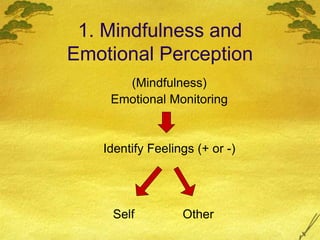
(Mindfulness)
Emotional Monitoring
Identify Feelings (+ or -)
Self Other
1. Mindfulness and
Emotional Perception
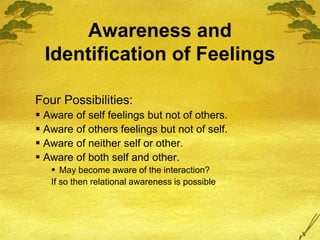
Awareness and
Identification of Feelings
Four Possibilities:
 Aware of self feelings but not of others.
 Aware of others feelings but not of self.
 Aware of neither self or other.
 Aware of both self and other.
 May become aware of the interaction?
If so then relational awareness is possible
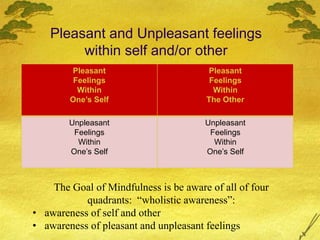
Pleasant and Unpleasant feelings
within self and/or other
Pleasant
Feelings
Within
One’s Self
Pleasant
Feelings
Within
The Other
Unpleasant
Feelings
Within
One’s Self
Unpleasant
Feelings
Within
One’s Self
The Goal of Mindfulness is be aware of all of four
quadrants: “wholistic awareness”:
• awareness of self and other
• awareness of pleasant and unpleasant feelings
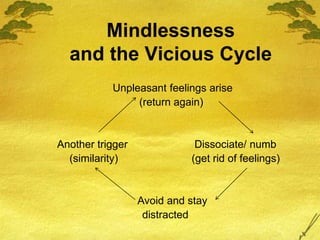
Mindlessness
and the Vicious Cycle
Unpleasant feelings arise
(return again)
Another trigger Dissociate/ numb
(similarity) (get rid of feelings)
Avoid and stay
distracted
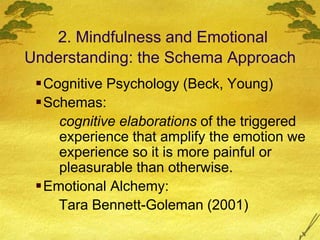
2. Mindfulness and Emotional
Understanding: the Schema Approach
Cognitive Psychology (Beck, Young)
Schemas:
cognitive elaborations of the triggered
experience that amplify the emotion we
experience so it is more painful or
pleasurable than otherwise.
Emotional Alchemy:
Tara Bennett-Goleman (2001)
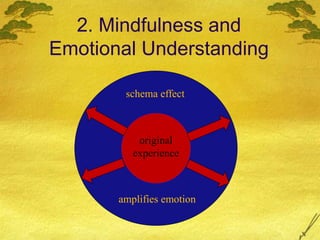
2. Mindfulness and
Emotional Understanding
original
experience
schema effect
amplifies emotion
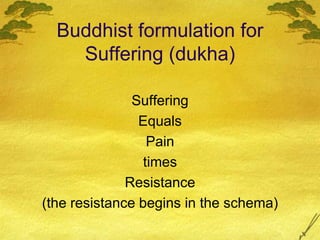
Buddhist formulation for
Suffering (dukha)
Suffering
Equals
Pain
times
Resistance
(the resistance begins in the schema)
Schemas in Close
Relationships
 Abandonment: “I will be left alone, without
anyone”
 Deprivation: “My needs won’t ever be met”
 Subjugation: “Others’ needs always take priority”
 Mistrust: “People can’t be trusted”
 Unlovability: “No one will ever love me”
Schemas in the World
 Exclusion: “I’m always the outsider, no place for me”
 Vulnerability: “Something horrible is going to
happen”
 Failure: “I’m not worthy/smart enough to succeed”
 Perfectionism: “I’ll never be good enough to
succeed”
 Entitlement: “Rules don’t apply to me, I’m special”
Schema Attacks
(Amygdala Hijacking)
Consciously we seem okay until we
encounter a trigger that brings on an attack.
When the attack occurs our prefrontal
cortex is disabled and we go into the
emergency mode: fight, flight, freeze
Our perception is narrowed we see only the
danger, we not only lose our reasoning
ability but also our awareness of the
surround.
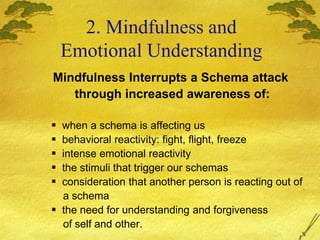
Mindfulness Interrupts a Schema attack
through increased awareness of:
 when a schema is affecting us
 behavioral reactivity: fight, flight, freeze
 intense emotional reactivity
 the stimuli that trigger our schemas
 consideration that another person is reacting out of
a schema
 the need for understanding and forgiveness
of self and other.
2. Mindfulness and
Emotional Understanding
3. Mindfulness and
Emotional Regulation
 With mindfulness we “contain” ourselves from the emotional
and behavioral reactivity caused by schemas.
 With mindfulness we can “look deeply” into our schemas
and “see” the original pain from which our schema
distortions developed.
 With mindfulness we experience compassionate
understanding for ourselves (instead of harsh judgment),
feel better and more easily “let go” of our fixations.
 Extending our understanding beyond ourselves, we can
understand others better (increased empathy).
Mindfulness and Emotional
Regulation
With mindfulness we come out of the
emergency mode and we can use our
rational capacities much better.
With mindfulness we relax into a greater
awareness of the surround: the people
and contexts that affect what is
happening now.
With mindfulness we are more relaxed
and open.
3. Mindfulness and
Emotional Regulation
Most importantly,
because our hearts and minds are open,
and because we are calm and can think,
we make better decisions,
and we act with greater wisdom and
compassion.
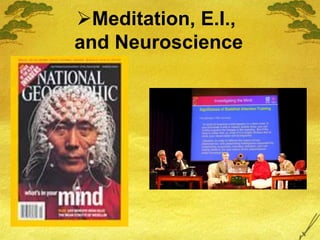
Meditation, E.I.,
and Neuroscience
Meditation, E.I.,
and Neuroscience
 The research suggests that greater E.I. occurs:
 when there is balanced left-right hemisphere
activation (Rt:rational,linear/ Lt:intuitive,spatial)
 when the limbic system is not overly activated
(amygdala hijacking/ schema attack) and therefore
stays in communication with the prefrontal cortex.
 when mirror neurons are strengthened (in frontal
and parietal lobes insula limbic system).
 when the brain is working as an integrated whole.
Meditation, E.I.,
and Neuroscience
 Meditation practice seems to improve all four:
 Increases left-right balance allowing for rational-
intuitive integration.
 Decreases amygdala hijacking allowing for
a larger, calmer perspective with rational thought.
 Increases mirror neurons allowing for greater
compassion and empathy.
 long-term meditators have higher levels of gamma
waves in brain suggesting total brain sychrony.
Conclusion
http://www.youtube.com/watch?v=F
oVuPTqj7gk&feature=related
Increase your emotional intelligence by
increasing your mindfulness
And increase your mindfulness through
mediation.
Meditation at GSU this Summer
Mondays at noon
with Tim Pedigo
OR
Thursdays at 3:30 pm
with Dave O’Donnell
Locations: TBA

Mindfulness and EI Quotient.ppt

  • 1.
  • 2.
    Definition of Mindfulness: Itmay be best defined as awareness of one’s present experience with acceptance.
  • 3.
    Mindfulness is: intentionally directingone’s attention to the present experience without being overcome by:  judgment (rejecting experience)  internal dialogue (internal noise)  emotional reactivity (triggers)  physical reactivity (impulses)  clinging onto pleasant experience
  • 4.
    Mindfulness Meditation  Concentration,Awareness, & Diligence  Designed to strengthen mindfulness  Without trying we develop habits of escaping, distracting, and avoiding our own experience.  Meditation is less about having a wonderful experience than it is about strengthening the habit of mindfulness.  The goal of a meditation practice is to strengthen the habit of mindfulness so it is greater than our habits of escape, distraction, and avoidance.  It takes awhile before you reap its benefits.
  • 5.
    Doing Mindfulness Meditation Sittingmeditation: sitting still (try not to move) back straight but relaxed focus on your breath in abdomen (in-pause-out) maintaining awareness of internal and external stimuli (and responses?) do not try to block out anything (sense doors are open) return back to breath when “caught in thought”
  • 6.
    Doing Mindfulness Meditation Walkingmeditation: focus on lifting, placing, shifting feet same directions otherwise: come back to your sensation of walking when “caught in thought” Eating meditation: focus on bring food to mouth, touching and/or seeing food putting food in mouth, salivating, and tasting chewing and eventual swallowing
  • 7.
    Doing Mindfulness Meditation Canbe done with many other activities: Doing the dishes Sweeping Listening And Talking
  • 8.
    Research Findings On Meditation: increases positive feelings and well-being  decreases anxiety, depression, & stress  reverses memory loss  increases tolerance to pain  strengthens immune functioning  Improves ability to focus  may ward off effects of ageing  Increases capacity for emotional regulation
  • 9.
    What is EmotionalIntelligence?
  • 10.
    Following Gardner’s (1983)concept of “Multiple Intelligences” , Salvoy and Mayer (1990) coined the term “Emotional Intelligence” as one of the many types of intelligence.
  • 11.
    Salovey and Mayer’sdefinition: “a form of social intelligence that involves the ability to:  monitor one’s own and other’s feeling and emotion (awareness),  discriminate among them (understanding),  and to use this information to guide one’s thinking and emotion (management).”
  • 12.
    Goleman’s Model ofE.I.  Popularized first in his book on E.I. (1995)  Developed in his book Primal Leaderhip (2002) with Richard Boyatzis and Annie McKee  Four generic domains  Self awareness  Social-awareness  Self-management  Relationship management
  • 13.
    Mindfulness and the CascadingModel of E.I. (Joseph and Newman, 2010) Emotional Perception Emotional Understanding Emotional Regulation
  • 14.
    Mindfulness and the CascadingModel of E.I. Emotional Perception Emotional Understanding Emotional Regulation 1.Mindfulness helps us to be aware and sensitive to emotion 2. Mindfulness helps us to tolerate feelings, so we can “looking deeply” into our painful emotions 3. Mindfulness helps develop a larger view & heart to make wiser decisions & act with great skillfulness
  • 15.
    (Mindfulness) Emotional Monitoring Identify Feelings(+ or -) Self Other 1. Mindfulness and Emotional Perception
  • 16.
    Awareness and Identification ofFeelings Four Possibilities:  Aware of self feelings but not of others.  Aware of others feelings but not of self.  Aware of neither self or other.  Aware of both self and other.  May become aware of the interaction? If so then relational awareness is possible
  • 17.
    Pleasant and Unpleasantfeelings within self and/or other Pleasant Feelings Within One’s Self Pleasant Feelings Within The Other Unpleasant Feelings Within One’s Self Unpleasant Feelings Within One’s Self The Goal of Mindfulness is be aware of all of four quadrants: “wholistic awareness”: • awareness of self and other • awareness of pleasant and unpleasant feelings
  • 18.
    Mindlessness and the ViciousCycle Unpleasant feelings arise (return again) Another trigger Dissociate/ numb (similarity) (get rid of feelings) Avoid and stay distracted
  • 19.
    2. Mindfulness andEmotional Understanding: the Schema Approach Cognitive Psychology (Beck, Young) Schemas: cognitive elaborations of the triggered experience that amplify the emotion we experience so it is more painful or pleasurable than otherwise. Emotional Alchemy: Tara Bennett-Goleman (2001)
  • 20.
    2. Mindfulness and EmotionalUnderstanding original experience schema effect amplifies emotion
  • 21.
    Buddhist formulation for Suffering(dukha) Suffering Equals Pain times Resistance (the resistance begins in the schema)
  • 22.
    Schemas in Close Relationships Abandonment: “I will be left alone, without anyone”  Deprivation: “My needs won’t ever be met”  Subjugation: “Others’ needs always take priority”  Mistrust: “People can’t be trusted”  Unlovability: “No one will ever love me”
  • 23.
    Schemas in theWorld  Exclusion: “I’m always the outsider, no place for me”  Vulnerability: “Something horrible is going to happen”  Failure: “I’m not worthy/smart enough to succeed”  Perfectionism: “I’ll never be good enough to succeed”  Entitlement: “Rules don’t apply to me, I’m special”
  • 24.
    Schema Attacks (Amygdala Hijacking) Consciouslywe seem okay until we encounter a trigger that brings on an attack. When the attack occurs our prefrontal cortex is disabled and we go into the emergency mode: fight, flight, freeze Our perception is narrowed we see only the danger, we not only lose our reasoning ability but also our awareness of the surround.
  • 25.
    Mindfulness Interrupts aSchema attack through increased awareness of:  when a schema is affecting us  behavioral reactivity: fight, flight, freeze  intense emotional reactivity  the stimuli that trigger our schemas  consideration that another person is reacting out of a schema  the need for understanding and forgiveness of self and other. 2. Mindfulness and Emotional Understanding
  • 26.
    3. Mindfulness and EmotionalRegulation  With mindfulness we “contain” ourselves from the emotional and behavioral reactivity caused by schemas.  With mindfulness we can “look deeply” into our schemas and “see” the original pain from which our schema distortions developed.  With mindfulness we experience compassionate understanding for ourselves (instead of harsh judgment), feel better and more easily “let go” of our fixations.  Extending our understanding beyond ourselves, we can understand others better (increased empathy).
  • 27.
    Mindfulness and Emotional Regulation Withmindfulness we come out of the emergency mode and we can use our rational capacities much better. With mindfulness we relax into a greater awareness of the surround: the people and contexts that affect what is happening now. With mindfulness we are more relaxed and open.
  • 28.
    3. Mindfulness and EmotionalRegulation Most importantly, because our hearts and minds are open, and because we are calm and can think, we make better decisions, and we act with greater wisdom and compassion.
  • 29.
  • 30.
    Meditation, E.I., and Neuroscience The research suggests that greater E.I. occurs:  when there is balanced left-right hemisphere activation (Rt:rational,linear/ Lt:intuitive,spatial)  when the limbic system is not overly activated (amygdala hijacking/ schema attack) and therefore stays in communication with the prefrontal cortex.  when mirror neurons are strengthened (in frontal and parietal lobes insula limbic system).  when the brain is working as an integrated whole.
  • 31.
    Meditation, E.I., and Neuroscience Meditation practice seems to improve all four:  Increases left-right balance allowing for rational- intuitive integration.  Decreases amygdala hijacking allowing for a larger, calmer perspective with rational thought.  Increases mirror neurons allowing for greater compassion and empathy.  long-term meditators have higher levels of gamma waves in brain suggesting total brain sychrony.
  • 32.
    Conclusion http://www.youtube.com/watch?v=F oVuPTqj7gk&feature=related Increase your emotionalintelligence by increasing your mindfulness And increase your mindfulness through mediation.
  • 33.
    Meditation at GSUthis Summer Mondays at noon with Tim Pedigo OR Thursdays at 3:30 pm with Dave O’Donnell Locations: TBA