MINDFULNESS FOR LAWYERSDrIan Ellis-JonesBA, LLB (Syd), LLM, PhD (UTS), DD, Dip Relig Stud (LCIS), Adv Mgmt Cert (STC)Solicitor of the Supreme Court of New South Walesand the High Court of AustraliaPrincipal, Ian Ellis-Jones, LawyerDirector, Ellis-Jones Enterprises Pty LimitedVisiting Associate, NSW Institute of PsychiatryFormer Senior Lecturer-in-Law, University of Technology, SydneyCommissioner of Inquiry under the Local Government Act (NSW)Retreat Director, Mediator, Facilitator, Trainer and Consultant
Copyright, Terms of Use and DisclaimerCopyright © 2010 Ellis-Jones Enterprises Pty Limited (ABN 38 088 534 141).All Rights Reserved.All material on the slides comprising this PowerPoint presentation are subject to copyright, trademark and other intellectual property rights protection under national and international laws.The reproduction, downloading or many other use of any material contained in this PowerPoint presentationwithout the prior written permission of Ellis-Jones Pty Limited is strictly prohibited.The purpose of the facilitated training session the subject of this PowerPoint presentation as well as any copy of the presentation (“this document”) is to give information,  and provide inspiration, for educational training purposes which may be of general interest to the participants as a whole. The information provided at the facilitated training session and in this document (“Information”) is not, and is not intended to be, professional advice to be relied upon as a basis for action on the part of any individual in respect ofany matter in relation to which there could be loss or damage. To the maximum extent permitted by law, Ellis-Jones Enterprises Pty Limited and its directors and employees (jointly and severally “EJE”) make no representation or warranty of any kind, express, implied or statutory regarding the Information, which is not intended to be a replacement for professional medical advice. If needed, such advice should be obtained through the services of a competent health professional. EJE does not accept any liability for any loss or damage arising directly or indirectly from action taken, or not taken, in reliance of or upon the Information but excludes completely any and all such liability.Although some of the Information is derived from certain ancient healing practices and principles and may be associated with certain spiritual traditions, participants do not have to be religious or belong to or join any particular faith tradition in order to practise and otherwise derive benefits from the techniques, methods and principles described in the Information. Although some references may be made from time to time to particular religious leaders, teachers or faith  traditions for the purpose of explaining or expounding what is being presented EJE does not endorse any religion, religious institution or any religious doctrine or dogma, nor endorses or favours any particular religion or faith tradition in its training sessions. The Information is taught without a religious context in a secular, non-sectarian and cross-cultural manner.
Grateful acknowledgments are due to the various rights holders whose permission has been given to the use of copyright material. All rights reserved.
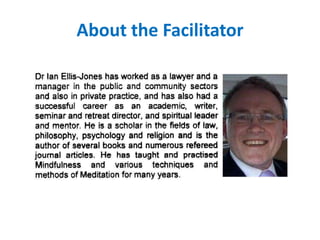
About the Facilitator
Objectives of Training Session
Objectives of Training SessionTo assist and empowerLegal Practitioners in their practice of law…to enhance their efficiency and effectiveness in the workplace and their overall wellbeingto better serve their clientsto work more collaboratively with their colleagues …		... cont’d
Objectives of Training Session… by means of the regular practice anduseof certain naturalisticpractices, principles, ideas and thought forms known as Mindfulness …of which Mindfulness Meditationforms an integral part.   ... cont’d
Objectives of Training SessionTo present Mindfulness as a coping skill and mode of being which can:effectimprovements in the physical bodyimprove one’s ability to cope with and release stress ...... cont’d
Objectives of Training Session-  assist in developing the mind’s ability to observe and understand many changing psycho-physiological processes and external surroundingsassist in “untying” one’s thoughts from their emotional content and reaction, thereby defusing and dissipating the latter.								         ... cont’d
Objectives of Training SessionTo presentMindfulness as a mental skill and cognitive ability which can:enhancecognitive functioning and performanceimproveconcentration, capacity for focus, memory, learning and consciousness, ability to think laterally and openness to new ideasincreaseverbal creativity and greater attention to detail.... cont’d
Objectives of Training SessionTo presentMindfulness as a means to ...empty ourselves of self-centrednessfoster ethical behaviourimprove skills in mediation, negotiation and resolution of complex issues.... cont’d
Objectives of Training SessionTo presentMindfulness as a means to ...seethe limitations of conditioned patterns of thinkingbringself-knowledgeenhanceself-esteem.
Objectives of Training SessionTo presentMindfulness as a means to ...lead to greater work satisfactioncontinuously develop expertise.
Training Methods
Training MethodsPowerPoint PresentationTalks, Stories, Sayings and AnecdotesSelf-questioningBreathing ExercisesGuided MeditationsSupply and Use of Printed Material (copies of PowerPoint slides and Select Bibliography)Questions and Answers
Topic Areas
Topic AreasIntroduction to MindfulnessIntroduction to Meditation and Mindfulness MeditationThe “Purposes” of Meditation“Techniques” and “Methods” of MeditationMindfulness and Mindfulness Meditation … core values, “tips”, benefitsMindfulness of Breathing ... and Breathing ExercisesMindfulness Sitting and Walking Meditations 	... cont’d
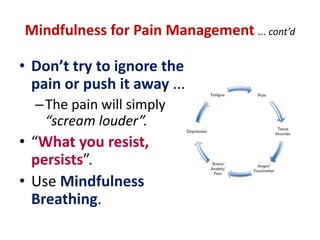
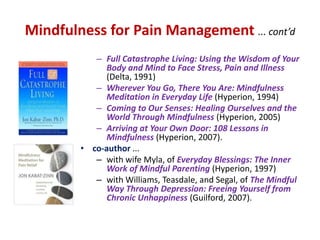
Topic Areas ... cont’dContinuous Mindfulness and Awareness of RealityListening to Clients MindfullyMindfulness of SensationsMindfulness for Pain ManagementMindfulness, Laughter and HumourEvening Meditation for Self-Questioning and Self-ReflectionQuestions and Answers
Anticipated Outcomes
Anticipated OutcomesParticipants in the training session are expected to gain a workable understanding of:the practice and principles of Mindfulness and Mindfulness Meditationthe mindful use of breathing ...
Anticipated Outcomes ... cont’dthe practice of listening mindfully to others, especially one’s clientsthe use of Mindfulness for pain relief, andas a means of personal and professional self-development.
The Practice of Law
The Practice of LawThe statistics regarding lawyer depression, divorce, suicide, physical and other mental illness, and alcohol and other substance abuse aresimply staggering ...
The Practice of Law Over 50% of practising lawyers describe themselves as emotionally dissatisfiedwith their work ...and their lives.
The Practice of LawLawyers top the list of professions whose members suffer from a major depressive orderrate of depression3.6 times higher than employed persons generally.
The Practice of Law  Lawyers also suffer from alcoholism and illegal drug useat rates far higher than non-lawyers.
The Practice of Law  The divorce rate among lawyers is also higherthan the divorce rate among other professionals.
The Practice of Law... and the statistics seem to get worse each year!
The Practice of LawMYTHS AND DENIAL IN THE LEGAL PROFESSIONStress? Drug problems? Not in our firm!Stress? Long hours? It’s par for the course!If you can’t cope with the stress … the billable hours … the long days … then perhaps you shouldn’t be a lawyer.
The Practice of LawMYTHS AND DENIAL IN THE LEGAL PROFESSIONIf you’re stressed out, that’s your problem. Solve it yourself, quickly … or else.Your wellbeing is not the firm’s responsibility.
The Practice of LawDOING … as opposed to simply BEING“What must I do today?”billable hoursthings to do …people to meet …
The Practice of LawSUCCESS is defined by reference to what one has done.. and how others see you“I want to be remembered for having done …”
The Practice of LawThe practice of law is injurious to your health unless ...
The Practice of Law ... you can practise a way of living and approaching life that involves ...
The Practice of Lawa stable, steady, alert and clear mind, and
a state of being psychologicallypresent and withwhatever happens in and around youMINDFULNESS... An Introduction
One approach ... MINDFULNESSOnenatural means by which to respond to the stress of law practice ... and otherwise empower oneself, is ... MINDFULNESS
MINDFULNESS“Mindfulness ... makes us accessible to depthsof awareness and clear seeing into the waythings are.”- Christopher Titmuss.
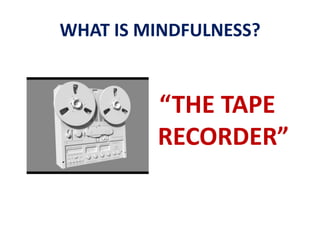
WHAT IS MINDFULNESS?“THE TAPE RECORDER”
WHAT IS MINDFULNESS?   A STABLE ... STEADY ... CALM ... ALERT ... OBSERVANT ... CLEAR ... DELIBERATE ... PURPOSEFUL ... ACTIVE ... FOCUSED …ENGAGED and yet DETACHED ... SKILLFULAWARENESSof the present moment ... including one’s ...
WHAT IS MINDFULNESS?BODY FUNCTIONS&SENSATIONS
CONTENT OF CONSCIOUSNESS(thoughts, feelings, images, etc)
CONSCIOUSNESS itself
EXTERNAL SURROUNDINGSWHAT IS MINDFULNESS?The practice of paying attentionin the presentpurposefully andreceptively deeply andopenlynon-judgmentally ...
WHAT IS MINDFULNESS?... to whatever arises in the present moment ... moment to moment … both inside andoutside of us
WHAT IS MINDFULNESS?Mindfulness enables usto move from the level of conceptual thinking tothe level of direct,non-judgmental awareness.
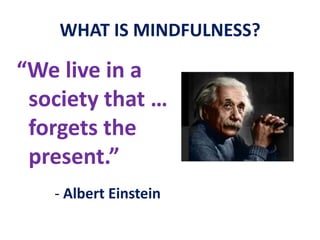
WHAT IS MINDFULNESS?“We live in a society that … forgets the present.”- Albert Einstein
WHAT IS MINDFULNESS?Keep your eyes open … RIGHT NOW.Witness all that is in front of you, above you, and around you … RIGHT NOW.What do you see … feel … smell? … RIGHT NOW.
WHAT IS MINDFULNESS?Lookeverywhere … RIGHT NOW.See and experienceeverything … RIGHT NOW.Stayin the NOW.Sense each part of your body … hands, legs, chest, head, etc.
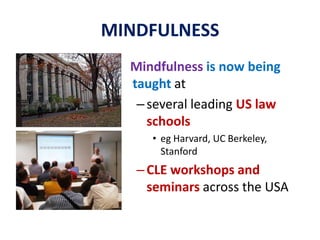
MINDFULNESS   Mindfulness is now being taught atseveral leading US law schoolseg Harvard, UC Berkeley, Stanford CLE workshops and seminars across the USA
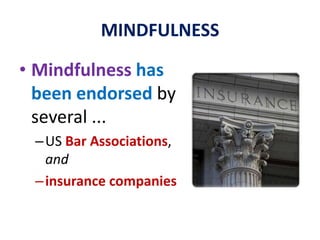
MINDFULNESSMindfulness has been endorsed by several ...US Bar Associations,andinsurance companies
MINDFULNESSALL of what follows is … DIRECTLY RELATED TO THE PRACTICE OF LAW
MINDFULNESSMindfulness takes meditation … in the form of deliberate and purposeful awarenessand ...
MINDFULNESS... applies itto one’sWHOLE life!
MINDFULNESSWe need to create space for formal meditation practice within the busy framework of ourdaily lives.
MindfulnessMindfulness and Mindfulness Meditation can both refer to a specific type or practice of meditation ...
Mindfulness Meditation... used as a psychological and educational tool in somenaturalistic forms of Buddhism and Buddhist meditationespeciallyVipassanā Meditation(also known asInsight[ful], SensoryorThought Watching Meditation)
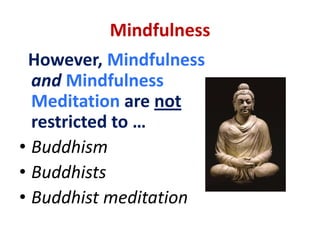
MindfulnessHowever, MindfulnessandMindfulness Meditation are not restricted to …Buddhism
Buddhists
Buddhist meditationMindfulnessYou do not have to a Buddhist to practiseeitherMindfulnessorMindfulness Meditation
You do not even have to be religious to do so …MindfulnessWhat are presented in this training session arenon-religious, naturalistic, psychological forms of Mindfulness andMindfulness Meditation.
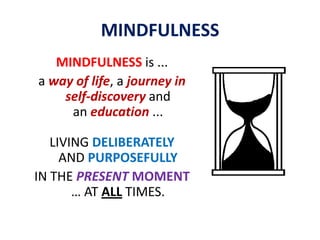
MINDFULNESSMINDFULNESS is ... a way of life, a journey in self-discovery andan education ...LIVING DELIBERATELYAND PURPOSEFULLYIN THE PRESENT MOMENT… AT ALL TIMES.
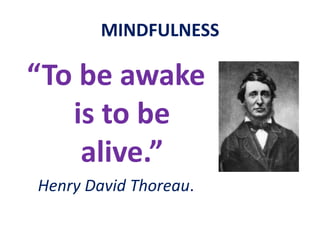
MINDFULNESS“To be awake is to be alive.”Henry David Thoreau.
MINDFULNESSMindfulness ... “a watchful awareness of one’s own inwardness, nourished by meditation, and appropriate outward activity ...”- Emeritus Professor Winston L. King.
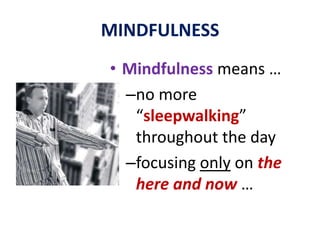
MINDFULNESSMindfulness means … no more “sleepwalking” throughout the dayfocusing only on the here and now …
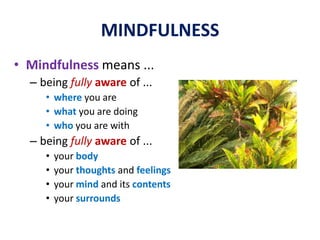
MINDFULNESSMindfulness means ...being fullyaware of ...where you arewhat you are doingwho you are withbeing fullyaware of ...your bodyyour thoughts and feelingsyour mindand its contentsyour surrounds
“Core Values” ofMindfulness andMindfulness Meditation
“Core Values”There are certain “core values” of Mindfulness,among them ...
“Core Values”ATTENTION ... being, and living, attentively in the present moment, onpurpose …… for moments pass … THIS moment has already gone forever!AWARENESS (“mindfulness”) ... mind free and unattached ... indeed detached but watchful“Core Values”UNDERSTANDING ... to gain self-knowledge insight into ourselves and others
COMPASSION ... from a sense of ego-self to a sense of Being (non-self/others) ... loss of all sense of duality and separateness.lovingkindness for oneself and all other beings
Mindfulness of Breathing
MINDFULNESSMINDFULNESS is all about ...AWARENESS ... and CLARITY OF MIND
A MIND that is DETACHED but OBSERVANT of ..
the thoughts that arise
ongoing events and experienceMINDFULNESSMINDFULNESS is …
OPEN, CONSCIOUS and DEFUSEDAWARENESS
of PRESENT EXPERIENCE
with ACCEPTANCEMINDFULNESSThe OPEN, CONSCIOUS and DEFUSEDAWARENESS, and DETACHEDOBSERVATION, has been described as being that of SEEING CLEARLY but“BARELY KNOWING”
MINDFULNESSSTOP Don’t get lost in your own mind!LOOK What is happening now?LISTEN… inner and outer soundsBE PRESENT… in the here and now
MINDFULNESSObserving the BREATH or the movement of the ABDOMEN is used asa major focus of AWARENESS
MINDFULNESSFollowing either the breath or the movement of the abdomen is INTEGRATED with MINDFULNESS of: BREATH SENSATIONSTHOUGHTS, EMOTIONS, etc SENSE OF BODY AS A WHOLESENSATIONS WITHIN THE BODYEXTERNAL CIRCUMSTANCES (sounds, etc)“BE-ING”
MINDFULNESSBREATHINGALSOCALMS BOTHTHE BODY ANDTHE MIND
MINDFULNESSA SIMPLE RELAXING BREATHING EXERCISESit up in your chair … straight back … feet flat on the floor
MINDFULNESSA SIMPLE RELAXING BREATHING EXERCISE... cont’dSeated posture ... chair or cushionstillness and relaxationtranquil mind and settled bodyFold hands in your lap orlay palms up (or down) on your thighs
MINDFULNESSA SIMPLE RELAXING BREATHING EXERCISE... cont’dClose your eyesTake a deep cleansing breathTake a few moments to settle
MINDFULNESSA SIMPLE RELAXING BREATHING EXERCISE... cont’dBring your full attention to your body
Feel yourself in your body
“Let go” all overMINDFULNESSA SIMPLE RELAXING BREATHING EXERCISE... cont’dBring your attention to your breathing
Start breathing in an even pattern.MINDFULNESSA SIMPLE RELAXING BREATHING EXERCISE... cont’dAt the start … Breathing in … count and say (think) inwardly … 1 Breathing out … count and say (think) inwardly … 2     …
MINDFULNESSA SIMPLE RELAXING BREATHING EXERCISE... cont’dIn-breath … 3Out-breath … 4 …Count to 10.
MINDFULNESSA SIMPLE RELAXING BREATHING EXERCISE... cont’dContinue to observeyour in-breath and out-breath.“Taste” the breath.
MINDFULNESSA SIMPLE RELAXING BREATHING EXERCISE... cont’dBreathe in ... Breathe out... just like that!   Just concentrate onbreathing in and out.
MINDFULNESSA SIMPLE RELAXING BREATHING EXERCISE... cont’dKnow when the air comesin and goes out.Take this as your subjectof awareness.
MINDFULNESSA SIMPLE RELAXING BREATHING EXERCISE... cont’dWhen the air comes in ...you know it.When the air goes out ...you know it.
MINDFULNESSA SIMPLE RELAXING BREATHING EXERCISE... cont’dContinue this pattern throughout your breathing meditation ... and your breath will becomerefined and softer.
MINDFULNESSA SIMPLE RELAXING BREATHING EXERCISE... cont’dAfter a while, no longer say or think the counts ... just follow and be attentive to your breathing. Alternatively, follow and be attentive the rise and fall of your lower abdomen.
MINDFULNESSA SIMPLE RELAXING BREATHING EXERCISE... cont’dNoise or sound? ... Note it, and say, “Hearing, hearing”Thought? ... Note it, and say, “Thinking, thinking”Feeling? ... Note it, and say, “Feeling, feeling”Pain? ... Note it, and say, “Burning [or Throbbing” ... and so forth.
MINDFULNESSA SIMPLE RELAXING BREATHING EXERCISE... cont’dAlways return, as mindfully as possible, to observing your breathing pattern oryour abdominal movements.
MINDFULNESSA SIMPLE RELAXING BREATHING EXERCISE... cont’dLet your awareness gradually fill your body.
Notice where your breath is most vivid ... - 	nose? belly? ...
MINDFULNESSA SIMPLE RELAXING BREATHING EXERCISE... cont’dReturn your attention to, and continue to observe, the pattern of your breathing …Continue for at least 5 minutes.
MINDFULNESSA SIMPLE RELAXING BREATHING EXERCISE... cont’dLet your mind be peaceful ... undisturbed ... not restless.
MINDFULNESSA SIMPLE RELAXING BREATHING EXERCISE... cont’dWhen you are ready ...open your eyes slowlytake in your surroundings.
MINDFULNESSREMAIN CALM, POISED AND RELAXEDAT ALL TIMES.
Mindfulness of BreathingShould thoughts arise, just notice them ...Be aware of them ... with detachment.Observe and acknowledge them gently, dispassionately … without judgment … and let them go.
Mindfulness of BreathingOBSERVE … as opposed toIDENTIFYACKNOWLEDGE ... LET BE
RELEASE ... LET GOMindfulness of BreathingNOTE. “Thoughts” include … feelings and emotions
images, memories and reflections
plans, concepts and commentaries,
sense perceptions
body sensations.Mindfulness of BreathingDon’t try to actively bring thoughts up.Wait and see what comes up next.
Mindfulness of BreathingTreat any new thought the same way ...Observe ... Acknowledge ... Release and Let Go.Notice any judging/evaluating ... Let it go.
Mindfulness of BreathingRest in the “blank spaces” between thoughts.Don’t try to make sense of any thoughts.
Mindfulness of BreathingContinue to follow your breath or abdominal movements.Feel the breath going in and out or the rise and fall of your abdomenJust follow it ... with choicelessawareness.
Mindfulness of BreathingStay awake and aware ...It’s not about the breath or the movement of the abdomen ... but the awareness.
Mindfulness of BreathingBreathing in and out assists in relieving tension and calmingthe mind.
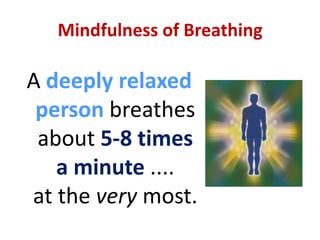
Mindfulness of BreathingA deeply relaxed person breathes about 5-8 times a minute ....at the very most.
Mindfulness of Breathing  Breathe consciously as you go about your daily life.
Mindfulness of BreathingLet your breath go slow and deep … into the centre of your being.
MINDFULNESS
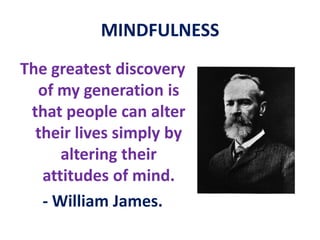
MINDFULNESSThe greatest discovery of my generation is that people can alter their lives simply by altering their attitudes of mind.- William James.
MINDFULNESSMindfulness takes you beyond the limitations of cognition and the analytical mind ... a bit of a challenge at firstfor most lawyers!
MINDFULNESSMindfulnessdoes not involve notions of the supernatural ...that is, the notion that there are higher and lower levels or orders of reality ...
MINDFULNESSMindfulnessis bothnatural and transnatural ...that is, it “grows out of ordinary nature, but transcends it” (Sir Julian Huxley)not contrary to reason or irrational
MINDFULNESSMINDFULNESS means ...being alert, curious, receptive, choicelessly aware of, and present on purpose with, every thought ...
MINDFULNESSwithdetachmentwithoutjudgment, condemnation or evaluationwithouttrying to controlwithoutresistance, suppression or sublimation
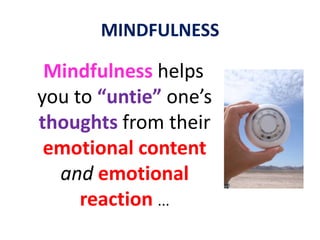
MINDFULNESSMindfulness helps you to “untie” one’s thoughts from their emotional content andemotional reaction...
MINDFULNESS… thereby defusing, dissipating and short circuiting the “hot stuff” 	... especially “stuff” from the subconscious mind that you would otherwise act upon
MINDFULNESSMindfulness lets you ... see this “stuff” … from a distance observe and acknowledge itlet it go … before things spiral out of control act, rather than habitually react as if on “auto pilot”
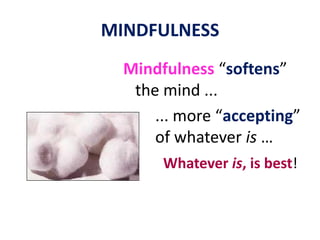
MINDFULNESSMindfulness “softens”the mind ... 		... more “accepting”	of whatever is … Whatever is, is best!
MINDFULNESSWith the regular practice of mindfulnessboth the body and the mind become soft(i.e. relaxed).
MINDFULNESSMINDFULNESS, as memory, also involves …present-centred recollection …retropective memory of some past eventprospective remembering to do something in the future.
MINDFULNESSThe will acts all the time … shifting from one mental image to another ...each arising within about one millionth of a second.
MINDFULNESSThe mind can only focus on one mental image …at any given point in time.
MINDFULNESSStay withwhatever arises …for as long as it lasts.
MINDFULNESS Notice what is passing through your mind with choiceless awareness … by getting up close.
MINDFULNESS... “Awareness-ing” ... Let your awareness take note of what’s going on ... inandoutsideof your mind.
MINDFULNESSRest inchoiceless awareness ... momentbymoment
MINDFULNESSMindfulness is ...a self-liberating experience
a way to be freeMINDFULNESSLive in the mind’s natural state ... mindfulness!boundless ... spaceless “be-ing”presence of mind
MINDFULNESSCHOICELESS AWARENESS ...NOT THE SAME THING AS “THOUGHTLESS AWARENESS”(cfSahaja Yoga).
MINDFULNESSThe aim of Mindfulness ...NOT to eliminate all thoughtThinkingisn’t the problem.
MINDFULNESSEndless non-purposeful thinking ... especially of a negative kind ...is the problem.
MINDFULNESSBE AWARE OF EVERY THOUGHT.PAY ATTENTION!
MINDFULNESSWatch and movewith EACH thought ... moment by moment ... choicelessly... and purposefully.
MINDFULNESSNote what the body is experiencing ... when walking, sitting, reading, driving the car ...ThinkingthoughtsHearingsoundsHavingmental imagesFeeling pain or bodily discomfort ...
MINDFULNESSMINDFULNESS (sati) literally means “memory” ... Remembering ...Distraction = forgettingRemember what ispresentRemember to staypresent at all times.Recollectin the present what has happened before.
MINDFULNESSMINDFULNESS is NOT the same thing as “consciousness” Stream of consciousness “Trains” of awareness Distraction = forgetting
MINDFULNESS  How many thoughts go through the human mind per minute?
MINDFULNESSWhat is a “thought”?no easy answer ...Thoughts are ...abstractnot quantitative, as such.
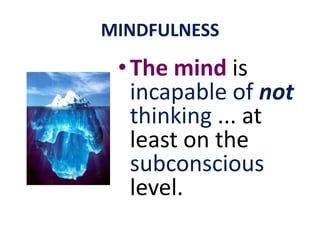
MINDFULNESSThe mind is incapable of notthinking ... at least on the subconscious level.
MINDFULNESSHow many thoughts per minute?The question is considered unanswerable ... at present.
MINDFULNESS Only observeoneobject per moment.
MINDFULNESSThe braincan only “think” one thought at any given moment in timecan only handle one cognitive function at a time
MINDFULNESSSo-called “multitasking” ... ... nothing other than“switch-tasking” ... toggling between one task and another ... each time witha “startup cost”
MINDFULNESSMultitasking ...makes us feelefficientslows down our thinkingerodes our attentionmakes us more stressed out, depressed and less able to connect with others
MINDFULNESSBepresent!Bemindful!
MINDFULNESSRealize that your thoughts, feelings and memories are not you.You are not your thoughts, feelings or memories.
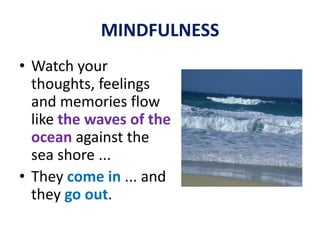
MINDFULNESSWatch your thoughts, feelings and memories flow like the waves of the ocean against the sea shore ...They come in ... and they go out.
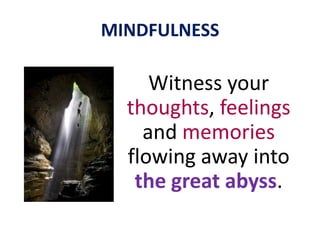
MINDFULNESSWitness your thoughts, feelings and memories flowing away intothe great abyss.
MINDFULNESS Being “constantly aware” is a manner of speaking.
MINDFULNESS  It is, of course, impracticable to be constantly aware ...
MINDFULNESS... that is, turning the attention to what passes in our minds, allof the hours and minutes of the working day.
MINDFULNESSMindfulness involves …focused attention on the present…energy enough “effort” to remember to focus attentionmomentary butdetached concentration … each moment … whatever arises
MINDFULNESSHowever, be sensitive to what is discordant or negative ... and clear it out ... indirectly.
MINDFULNESSWatch and move with your thoughts... withdetachment, NOT attachment.
MINDFULNESS- Be psychologically presenton purpose (“up close”) with whatever happens in and around you.
MINDFULNESSDeliberately keep the mind at the level of bare attention.
MINDFULNESSRemain (“be”) in the present on purpose ...at all times ...
MINDFULNESSThe “here and now” is all that really “is”
The past and the future “exist” only in one’s imaginationMINDFULNESSThe only time we ever have is the present moment
We can only live in and experience the presentMINDFULNESSLive and think only in the present …... the ever-present, ever-vanishing “eternal now”Live in and inhabit the reality of the nowwithout past or futurewith choiceless awareness.
MINDFULNESSThe pastis deadThe future is yet to be born
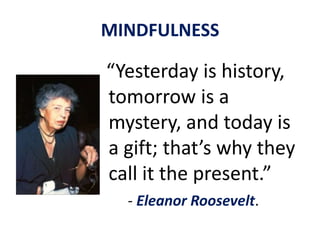
MINDFULNESS  “Yesterday is history, tomorrow is a mystery, and today is a gift; that’s why they call it the present.”  - Eleanor Roosevelt.
MINDFULNESSAll that we can know is our present thoughtThe only thing we have to “heal” or otherwise “deal with” is the present thought
MINDFULNESSMINDFULNESS HELPS BRING OUR MINDS TO THE PRESENT MOMENT.
MINDFULNESSMindfulness …is active, NOTpassiveis experiential, NOTintellectual
MINDFULNESSLet your awareness be unconnected to theobjects of its attention.MINDFULNESSDo not try to alter your experience or change your thoughts or sensations.
Meditation
What is Meditation?The etymological meaning of the word ...Latin-derived wordmeditatus, past participle of meditari, frequentative of medērirelated to “middle”, “mediation”, “medical” and “measure”also denotes “reflecting”, “pondering” ...
What is Meditation?What is Meditation?... “a medicine for the mind which does its work by measuring out time, when it can reach a median, a point of equilibrium”.	- Robert Ellwood, Finding the Quiet Mind (TPH, 1983).
“Types” of MeditationThere are 3 main “types” or “schools” of Meditation ...		1. Contemplative Meditation. 		2. “Letting Go” or“Surrender” 	    Meditation.		3. Mindfulness Meditation.
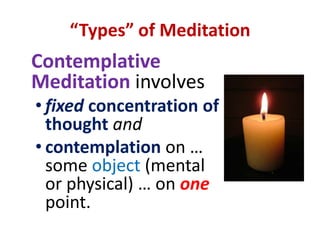
“Types” of MeditationContemplative Meditation involves fixed concentration of thought and
contemplation on … some object (mental or physical) … on one point.“Types” of Meditation“Letting Go” or“Surrender Meditation”(egCentering Prayer)involves:
the emptying of self, and
the opening of one’s mind and heart to “the Ultimate” (God/the “Self”/the Ground of Being, InterBeing, the Livingness of your life, etc) ... a state beyond thoughts, emotions and words.“Types” of MeditationMindfulness Meditation involves a “clarity of mind” in which you become purposefully alert, aware of, present with, and attentive to ...your thoughts, feelings, emotions, bodily sensations, etc, and
your external surroundings.“Types” of MeditationMindfulness Meditation is:NOTabsorption, that is, fixed or deep concentration on one single object
choiceless awareness … a non-judgmental observation of all things as they are
living in the present momentThe Nature of MeditationWhat it is Not...Meditation is not “mind control” ... in the sense of subjugation,
sublimation
suppressionThe Nature of MeditationWhat it is Not...Meditation is a form of escape from life
Meditation must be done in some special posture (eg the “full lotus position”)
Meditation must be done in some special place (eg mountain top, cave, monastery)Meditation is a religiousritual or ceremonyMeditation is trance-like state ...NOT SO!!!
What is Mindfulness Meditation?Mindfulness Meditation a bit of a misnomeroften misunderstood …
What is Mindfulness Meditation?Mindfulness Meditation …is meditation for daily life …
encompasses mindfulness    of one’sbody
feelings
mental states
mental contents… in ALL situations of everyday life
What is Mindfulness Meditation?   What it is Not ...  		It is not … fixed or exclusive concentration of thought
but momentary concentration … paying attention to whatever arises … a momentary look at the present moment
contemplation.What is Mindfulness Meditation?Focused Attention -NOTfixed concentrationTrue “control of mind” … the giving  of constant attention.
What is Mindfulness Meditation?Mindfulness Meditation involves the giving of unwavering attention ...  to ALL things in lifeNOT merely particular things or one’s own thoughts.
What is Mindfulness Meditation?Mindfulness Meditation is literallypractice ...
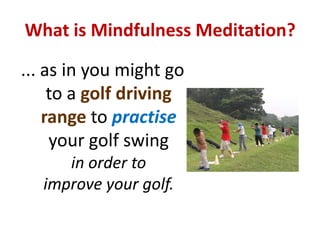
What is Mindfulness Meditation?... as in you might go to a golf driving range to practise your golf swingin order toimprove your golf.
What is Mindfulness Meditation?Mindfulness Meditation involves simply observing whatever mental or physical process is predominantwithin the present moment … in order to understand the true nature of it.
What is Mindfulness Meditation?What it is Not ...It is not a religion or cult or even inherently religious …
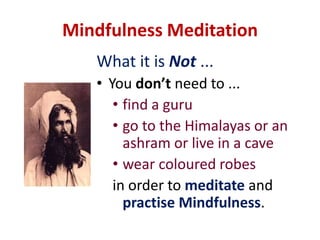
Meditation does not require you to be religious at all.Mindfulness MeditationWhat it is Not ...You don’t need to ...
find a guru
go to the Himalayas or an ashram or live in a cave
wear coloured robesin order to meditate and practise Mindfulness.
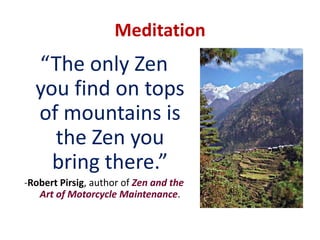
Meditation“The only Zenyou find on tops of mountains is the Zen you bring there.”-Robert Pirsig, author of Zen and the Art of Motorcycle Maintenance.
MeditationContemplation is different from Mindfulness and Mindfulness MeditationMindfulness Meditation requires a mind completely denuded of all previous ideas and knowledge
Mindfulness MeditationWhatever then “takes place” in the mind is:NOT from previous thoughts, feelings or memoriesfrom an inner initiative ... out of the depths of one’s very being
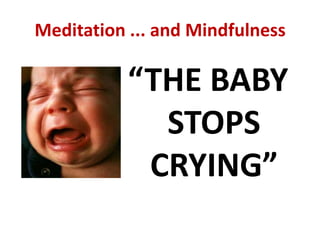
Meditation ... and Mindfulness“THE BABY STOPS CRYING”
Mindfulness MeditationWhen the mind is ...no longer speakingno longer analysingno longer caught up in the process of becoming.
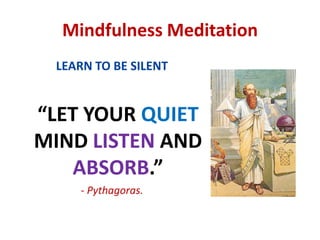
Mindfulness MeditationLEARN TO BE SILENT“LET YOUR QUIET MIND LISTEN AND ABSORB.”- Pythagoras.
Mindfulness Meditation“A single-pointed mind isthe fully trained state ofthe meditative mind. It serves as the ground forcultivating wisdom ...”- GesheWangchen.
Mindfulness MeditationA QUIET MIND“Free Quiet”
“Sitting quietly, doing nothing”
“Not doing”
“Intentional Quiet”
Purposefully, and progressively, going deeper and deeper, interiorly. Mindfulness MeditationA state of “bare attention” and “choiceless awareness”A near-automatic habit of self-reflection
Mindfulness MeditationA state of freedom from external and internal obsessivenessA means of developing and practisingmidfulness
Mindfulness MeditationMindfulness Meditationis NOT just relaxationis NOT just stress reliefbut it does involve identifying and recognising stress causing factors  ►►► stress reduction
Mindfulness MeditationMindfulness Meditationis realization of your body and mind as they appear to you nowthe mind is alert, sharp and mindfully awarethe body is relaxed and not tense or rigid
Meditation ... Do it!Meditation is of little value if practised ...only occasionallyonly at a certain specified time or times of the dayonly in a particular posture.
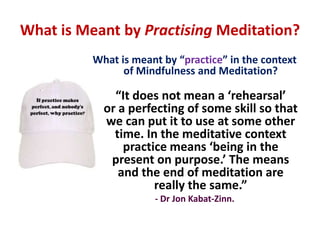
What is Meant by Practising Meditation?What is meant by “practice” in the context of Mindfulness and Meditation?“It does not mean a ‘rehearsal’or a perfecting of some skill so that we can put it to use at some other time. In the meditative context practice means ‘being in the present on purpose.’ The means and the end of meditation arereally the same.”- Dr Jon Kabat-Zinn.
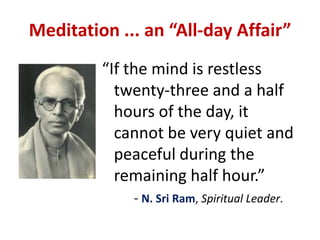
Meditation ... an “All-day Affair”“If the mind is restless twenty-three and a half hours of the day, it cannot be very quiet and peaceful during the remaining half hour.”		- N. Sri Ram, Spiritual Leader.
Meditation ... an “All-day Affair”Meditation needs to be applied ...in everymoment, andin everycircumstance ... of our daily lives
Meditation ... an “All-day Affair”What is our life?We only have “moments”The future is only a conceptMemories of the past are also only conceptsWe can only live in the present momentWe need to inhabit the now more ... with awareness
Meditation ... “Effort Defeats Itself”Meditation is NOT a question of effort.Don’ttry to relax! Don’ttrynot to think!Don’ttry to think of nothing.
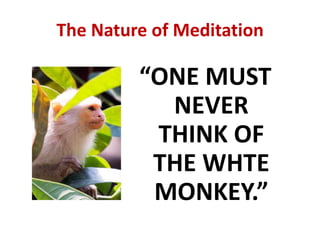
The Nature of Meditation“ONE MUST NEVER THINK OF THE WHTE MONKEY.”
The Nature of Meditation“Hang out in the space betweenyour thoughts.”- Alan Cohen.
The “Purposes”of Meditation
The “Purposes” of MeditationIn a sense there are no “purposes” of meditation.
 Meditation is ...
a “thing-in-itself”
a way of life
a journey in self-discovery
a path of well-being
an enriched, expanded experience of life, personally and professionally
a means of tapping into “resources” of power and joy contained in the mind.The “Purposes” of Meditation“We could say that meditation doesn't have a reason or doesn't have a purpose. In this respect it's unlike almost all other things we do except perhaps making music and dancing. When we make music we don't do it in order to reach a certain point, such as the end of the composition.If that were the purpose of music then obviously the fastest playerswould be the best. ...... cont’d
The “Purposes” of Meditation   ... Also, when we are dancing we are not aiming to arrive at a particular place on the floor as in a journey. When we dance, the journey itself is the point, as when we play music the playing itself is the point. And exactly the same thing is true in meditation. Meditation is the discovery that the point of life is always arrived at in the immediate moment.”      - Alan Watts.
“Techniques” and “Methods”of Meditation
“Techniques” and “Methods”As there are no “purposes”, as such, of meditation ... andAsmeditation is a “thing-in-itself”...
“Techniques” and “Methods”... no “techniques” or “methods”, as such, are required.
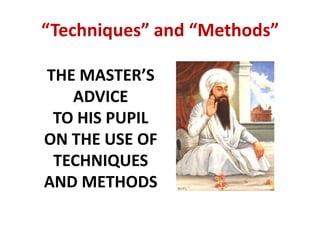
“Techniques” and “Methods”THE MASTER’S ADVICETO HIS PUPILON THE USE OFTECHNIQUES AND METHODS
“Techniques” and “Methods”The essence of all meditation practicesis this ... Cling to nothing.
“Techniques” and “Methods”There is a danger in clinging to any one “method” thathas worked for you.Always be prepared to ... let go.
“Techniques” and “Methods”ARE “TECHNIQUES” AND “METHODS” MERELY A FORM OF PROGRAMMING OF ONE PERSON BY ANOTHER?
“Techniques” and “Methods”“Techniques” and “methods”:establish stereotypes in the minddig grooves (neural pathways) out of which you may be unable to extricate yourself.DO NOT GET STUCK ANYWHERE!
“Techniques” and “Methods”“Techniques” and “methods” are all SECONDARY to the CULTIVATION of a “CLEAR MIND”.
“Techniques” and “Methods”Mindfulness has been described as being ... “the method ofno-method”.
“Techniques” and “Methods”Mindfulness means just being aware... just being awake...
“Techniques” and “Methods”... all with an“effortless effort” ... resting in the momentum ofthe continuity ofthe present moment
“Techniques” and “Methods”To have “clarity of mind” you must develop and exhibit ... calmness of mindand body.
MindfulnessSITTING MEDITATION
SITTING MEDITATIONSit on achair or cushion … straight back … feet flat on the floor (if seated on a chair) ... otherwise, use some other accepted traditional posture (eg Burmese style, half lotus, full lotus)
SITTING MEDITATION“Sit straight and be straight in the practice.”- Zen saying.
SITTING MEDITATIONGently hold your hands in your lap ...Alternatively, lay your palms up (or down) on your thighs.Close your eyes
SITTING MEDITATIONTake a few moments to settle.Resolve to sit still for the entire meditation session.
SITTING MEDITATIONFeel the ground support your feet and bottomFeel totally grounded and supported
SITTING MEDITATIONBring your attention to your breathing.Take a deep cleansing breath.
SITTING MEDITATIONStart breathing in an evenpatternContinue this pattern throughout your meditation.
SITTING MEDITATIONLet your breath go slow and deep … into the centre of your beingBe mindfulof and follow your breathing, that is, your in-breath and your out-breath...through the nostrilsormouth, into your lungs ...
SITTING MEDITATIONAlternatively, you may wish to be mindful of and follow your breathing in the form of the rise/expansion and fall/contractionof your lower abdomen
SITTING MEDITATIONEither of the above is known as your “anchor” or “primary object of meditation”
SITTING MEDITATIONYour anchor helps you to remain fixed and focused in, and to be mindful of, the moment
SITTING MEDITATIONWHY USE AN “ANCHOR”?Because we can’t focus our mindon every changing momentwithout a certain degreeof concentrationto keep pace with the moment.
SITTING MEDITATIONAlways be prepared to attend to any “secondary objects of meditation” (egthoughts, bodily sensations, pain sensations) if, and as and when, they arise.
SITTING MEDITATIONWhenever a thought, feeling, bodily sensation, etc, arises ...Be aware of it as just a thought, feeling, etc ... Let it goDo NOT resist it or try to expel or drive it away ...
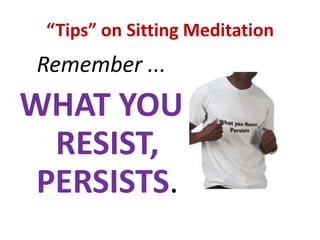
SITTING MEDITATIONRemember the “law of non-resistance” ...“Whatever you resist, persists”
SITTING MEDITATIONSimply observe and notice, with detachment, what your body ... including your mind ... is experiencingLabel what you’re experiencing if necessary ...
SITTING MEDITATIONLabelling…Say, interiorly, the word of that being experiencedOnly label objects or processes if they are predominant                     … cont’d
SITTING MEDITATIONLabelling…Use only single words (eg “Hearing”, “Thinking”, “Feeling”, “Throbbing”, “Analyzing”) andkeep to a minimumDrop the labelling… if you can be aware without thinking, analyzing, judging, comparing, etc… cont’d
SITTING MEDITATIONLabelling…
No need to keep labellinguntil object disappears … it may not!
Don’t concentrate on the labels
labels only a means to an end …
i.e., to direct your mind to the present moment without thinking, analyzing, judging, comparing, etcSITTING MEDITATIONLabelling…a tool to recogniseONLY the bare fact of the perception of ... the coming and going ... the arising and passing away … of  thoughts, feelings, bodily sensations, etcNOT a tool to interfere, judge, evaluate, analyze, etc
SITTING MEDITATIONReturnas soon as possibleto your anchor ... that is, return to following either your breathor your abdominal movements
SITTING MEDITATIONRest in choiceless awareness ... momentbymoment ... Keep your mind at the level of bare attention ... without judgment, evaluation, self-criticism, condemnation, comparison, etcLet it be
SITTING MEDITATIONContinue as above throughout the period of meditationRemain poised and relaxedat all times
SITTING MEDITATIONDon’t rush off immediately at the end of the meditation sessionEvaluate the experienceResolve to meditation again ... soon
“Tips” onSitting Meditation
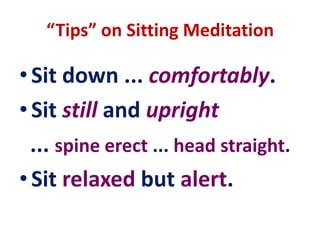
“Tips” on Sitting MeditationSit down ... comfortably.Sit still and upright  ... spine erect ... head straight.Sit relaxed but alert.
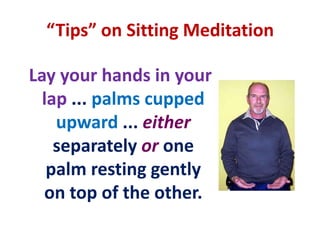
“Tips” on Sitting MeditationLay your hands in your lap ... palms cupped upward ... either separately orone palm resting gentlyon top of the other.
“Tips” on Sitting MeditationRemember ... you cannot meditate unless the mind is collected and quiet
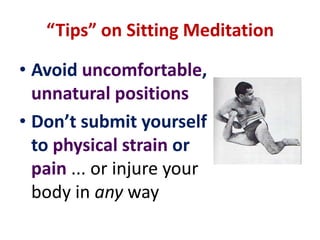
“Tips” on Sitting MeditationAvoid uncomfortable, unnatural positionsDon’t submit yourself to physical strain or pain ... or injure your body in any way
“Tips” on Sitting MeditationKeep the body still... but if you need to change your position, do soDon’t try too hard ...   indeed, don’t try at all.
“Tips” on Sitting MeditationMindfulness is bare knowing... knowing things as they really areMindfulness is seeing things clearly ... as they really are
“Tips” on Sitting MeditationUse “effortless effort”Observe ... directly, objectively
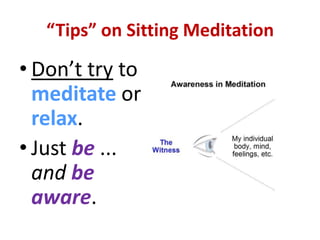
“Tips” on Sitting MeditationDon’t try to meditate or relax. Just be ... andbe aware.
“Tips” on Sitting MeditationClose your eyeslightly.Turn your mind “inwardly” and silently.Commence deepmindful breathing ... paying attention to your breathing.
“Tips” on Sitting MeditationPractise meditation gently ... butsteadily.Practise the “Law of Indirectness” …
“Tips” on Sitting MeditationThe LAW OF INDIRECTNESS ...DON’Tresist thoughts and other distractionsDON’Tfight against themDON’Ttry to drive them out or awayDON’Tdwell upon them …
“Tips” on Sitting MeditationThe LAW OF INDIRECTNESS (cont’d) ...DON’Thang on to them … or even think about them!DON’T fuel their storyDON’Tjudge, analyze, evaluate, categorize or compare them DON’T attempt to put them out of your mind
“Tips” on Sitting MeditationThe LAW OF INDIRECTNESS (cont’d) ...LOOKupon your thoughts as if they were on a TV or movie screenGENTLY OBSERVE and, if necessary,LABELyour thoughts ... Say, simply, “Thinking” or “Feeling”, etcBy so doing, you can untie them from their emotional contentThey will pass and disappear in time ... All things pass
“Tips” on Sitting MeditationTURN YOUR MIND INWARDSOBSERVE the momentBE with the moment ... be “embodied” in the moment
“Tips” on Sitting MeditationBE PRESENT with all that happensSTAY with the moment“REMEMBER” the moment
“Tips” on Sitting MeditationNoteany thoughts, feelings, bodily sensationsPausebrieflyNote the “tone” of any notingReturnto observing your breath or following the rise and fall of your abdomen
“Tips” on Sitting MeditationCareful, mindfulobservation …Don’t interfereDon’t “feed” your thoughts, feelings, mental movies, etc …IN TIME, THEY WILL … LOSE THEIR POWER!
“Tips” on Sitting MeditationMindfulness Meditation is ...NOT about stopping the mindNOT about stoppingthoughtsMindfulness Meditation is ...about allowingthoughts to be present ... but NOT letting them run you!
“Tips” on Sitting MeditationRemember ... WHAT YOU RESIST, PERSISTS.
“Tips” on Sitting MeditationDon’t try to experience “the silence”If you do, you only become aware of ...apast silence ... a self-projected mental repetition
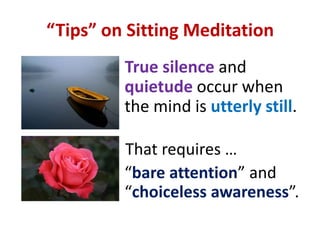
“Tips” on Sitting Meditation   True silence and quietude occur when the mind is utterly still. That requires …   “bare attention” and “choiceless awareness”.
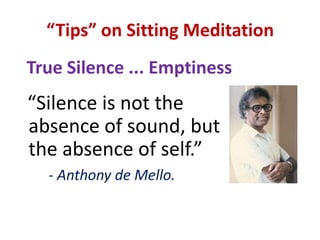
“Tips” on Sitting MeditationTrue Silence ... Emptiness“Silence is not the absence of sound, but the absence of self.”- Anthony de Mello.
“Tips” on Sitting Meditation  If the mind wanders,be mindful of the wandering and your thinking and imagining
“Tips” on Sitting MeditationSay inwardly, “Wandering, Wandering” or “Thinking, Thinking” … until the intrusive thoughts, etc, disappear.
“Tips” on Sitting MeditationWhen thoughts, etc, are too dominant, intrusive or painful to let go by labelling …
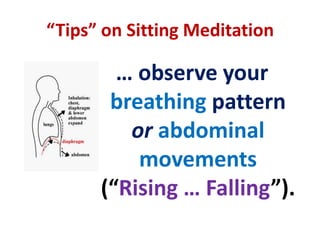
“Tips” on Sitting Meditation… observe your breathing patternorabdominal movements(“Rising … Falling”).
“Tips” on Sitting MeditationWhen the mind wanders, simply observe itas it is
“Tips” on Sitting MeditationExpand the feeling of awareness of and around the breath to include a sense of the body as a whole ... “re-bodying” yourself ...resting in awareness.
“Tips” on Sitting Meditation Meditate, mindfully,preferably twice daily …for about 15 minutes on each occasion.
Mindfulness MeditationIn addition, at least ONCE per day, practice “walking meditation”
Mindfulness MeditationAlso, practise “continuous mindfulness” all throughout the day.Remember to listen to others mindfully ... being in the present on purpose.
Mindfulness MeditationRemember ... anyactivity done mindfully is a form of meditation.
MindfulnessWalking Meditation
Walking Meditation“Walking meditation is an art! You are not going anywhere, you are walking justfor the sake of walking.”– Martine Batchelor.
Walking Meditation ... cont’dWalking Meditation helps to foster:calmnessrelaxationawareness ...
Walking Meditation ... cont’d... Yes, the “key” is to be aware as you walk
Walking Meditation ... cont’dWalking meditationis meditation in actionusing the natural movement of walking to foster mindfulnessthe bare experience of walking
Walking Meditation ... cont’dWalking meditationcan be the preferred form of Mindfulness Meditationordinarilyprecedes a sitting meditation … centres the mind
Walking Meditation ... cont’dWalking meditationsimilar to normal walking butslowerdeliberate, intentionalandmindful
Walking Meditation ... cont’dWalking meditationnot physical exercisebutwakeful presence
Walking Meditation ... cont’dWalking meditationchoose a quiet place …without distractionsindoors oroutdoorsshort path ...some 3-10 (preferably around 6) metres in lengththe path must have a definite “start” and “end” flat, even surface ...backwards and forwards or circular
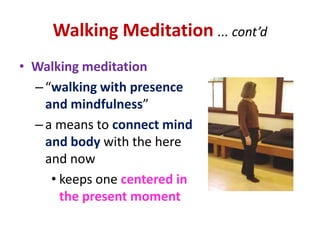
Walking Meditation ... cont’dWalking meditation“walking with presence and mindfulness”a means to connect mind and body with the here and nowkeeps one centered in the present moment
Walking Meditation ... cont’dWalking meditationBegin by standing at the beginning of your pathStart with a “standing meditation” (“Standing, standing”)for a minute or 2 ... watch the breath
Walking Meditation ... cont’dWalking meditationFocus on your bodyFeel the sensation of your feet “pressing” against the floor/earthFeel the whole body standing … andlaterturning (“Turning, turning”) ... with awareness ...
Walking Meditation ... cont’dWalking meditationFocus your attentionminutely and purposefully on each action.You are not going anywhere ... You are just walking.
Walking Meditation ... cont’dIn sitting meditationthe focus of attention isthe breath.In walking meditationthe focus of attention isthe moving body.
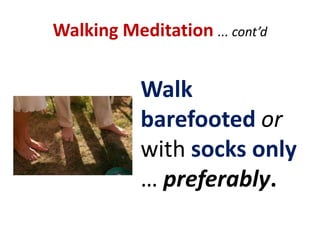
Walking Meditation ... cont’d	Walk barefootedor with socks only …preferably.
Walking Meditation ... cont’dBegin to walk slowly.Focus on each step.Feel each step as it comes.Be fully present with each step.Notice every sensation of the walking process.
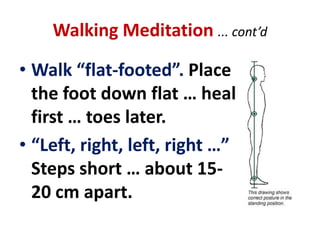
Walking Meditation ... cont’dWalk “flat-footed”. Place the foot down flat … heal first … toes later.“Left, right, left, right …” Steps short … about 15- 20 cm apart.
Walking Meditation ... cont’dMaintain correct posture in the standing position.Walk mindfully … eyes half-open
looking straight ahead (not around)
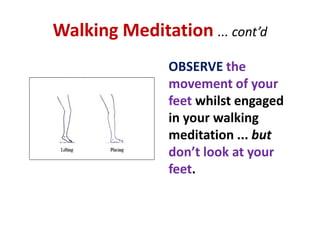
pace ... very slow to brisk.Walking Meditation ... cont’dNote (and mentally note or label, at least at the beginning) ...the lifting of the heel (“lifting”),
the forward movement (“moving” or “pushing”), and
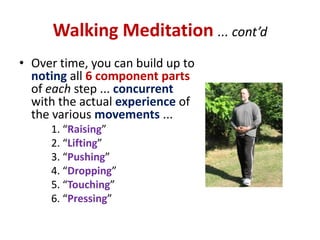
the placing of the foot down (“putting” or “dropping”) …Walking Meditation ... cont’dOver time, you can build up to noting all 6 component parts of each step ... concurrent with the actual experience of the various movements ...		1. “Raising”		2. “Lifting”		3. “Pushing”		4. “Dropping”		5. “Touching”		6. “Pressing”
Walking Meditation ... cont’dBe aware of the contact between your foot andthe ground.
Walking Meditation ... cont’dAllow some 60% of your “tension” to dissipate through your feet ...
Walking Meditation ... cont’d... with the remaining 40% dissipating in the non-resistant “zone of airspace” in front of you, into which you are constantly entering.
Walking Meditation ... cont’dFeel the airspace in front of you as yours to feel, enter and embrace ...feel its non-resistance,emptinessand friendliness
Walking Meditation ... cont’dBe gentle with yourself.Say to yourself, interiorly, “Be well” ... sending out loving kindness to others and yourself.
Walking Meditation ... cont’dWalk through this airspacemindfully but gracefully, effortlessly andwithout resistance ...for such is its nature.
Walking Meditation ... cont’dOBSERVEthe movement of your feet whilst engaged in your walking meditation ... but don’t look at your feet.
Walking Meditation ... cont’dFeel each step mindfully as you lift each foot off the floor/ground.Feel the sensations in each foot, ankle, leg, knee, the hips, the back, the neck, the head, the face, etc.
Walking Meditation ... cont’dLook at a place about 2 metres ahead. Don’t gaze about here and there.
Walking Meditation ... cont’dMaintain good posture … straight back.Hands by side, in pockets or clasped in front or at rear ...resting easily ... wherever they’re comfortable.Breathe normally.
Walking Meditation ... cont’dIf background thoughts, etc, arise ... simply KEEP FOCUSED on NOTING your steps.
Walking Meditation ... cont’dPay no attention to your breathor abdominal movements.Be aware of ...the movements with your mindthe sensations throughout your body.
Walking Meditation ... cont’dIf you become distracted, and focusing on noting your steps doesn’t help ... STAND for a few momentsWATCH your breathuntil the mind calms.
Walking Meditation ... cont’dBe fully mindful with an alert, relaxed attention to the present moment.
Walking Meditation ... cont’dContinue to walk mindfully for 10to 20 minutes ...or longer.
Walking Meditation ... cont’dAt end of walk, stand(“standing, standing”) for a short while, observing your posture and breathing … mindfullyandattentively.
Walking Meditation ... cont’dAfter standing mindfully for a few moments,gentlyreturn to your “daily life”.
The Results ofMindfulness andMindfulness Meditation
MindfulnessNEUROPLASTICITYJust as physical exercise is good for the body, and can make positive changes to the body ... so MEDITATION and MINDFULNESS can make positive neuro-physio-psychological changes to the mind
Mindfulness  Mindfulness makes us more aware of ...our thoughts, feelings, emotions and bodily sensations
our external surroundings ...Mindfulness ... As a result, we develop a heightened sense of sensitivity ... and begin to perceive things differently …
MindfulnessWe then perceive each momentas it actually is.
MindfulnessWe come toacceptwhat cannotbe changed
Mindfulness We are empowered to change what can be changed ... HOW?
MindfulnessHOW? ... “Just do it!” ...OBSERVE ... BE AWARE ... with DETACHMENTACKNOWLEDGERELEASE ... LET GO
MindfulnessBefore we can “let go” we must first “let be”.
Mindfulness  We become more able to acceptstress, pain and other difficultiesthan before ... without resistanceor avoidance.
MindfulnessDon’t focus on the past.Don’tanalysethe past.Don’t attempt to change other people.Focus your attention on your owninner states, thoughts, feelings and bodily sensations ... non-judgmentally.
Mindfulness MeditationMost importantly ...Always meditate with complete attention
The Benefits ofMindfulness Meditation
The Benefits of Mindfulness MeditationMindfulness meditation produces psycho-physical changes in the body and the mind ...
The Benefits of Mindfulness MeditationChanges in the Body include ...reducedheart rate and blood pressureincreased cardiovascular efficiencyreducedcholesterolreducedmuscle tensionimproved gastrointestinal functioningreduced sensitivity to painimprovedcirculation of blood and lymphenhanced immune systemimproved posture, overallrelaxation of the bodyandsleep.
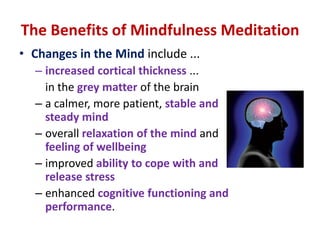
The Benefits of Mindfulness MeditationChanges in the Mind include ...increased cortical thickness ...in the grey matter of the braina calmer, more patient, stable and steady mindoverall relaxation of the mind and feeling of wellbeingimproved ability to cope with and release stressenhanced cognitive functioning and performance.
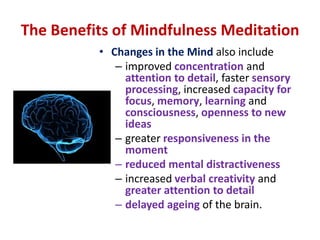
The Benefits of Mindfulness MeditationChanges in the Mind alsoincludeimproved concentration and attention to detail, faster sensory processing, increased capacity for focus, memory, learning and consciousness, openness to new ideasgreater responsiveness in the momentreduced mental distractivenessincreased verbal creativity and greater attention to detaildelayed ageing of the brain.
The Benefits of Mindfulness MeditationMindfulnessmeditation as a way of being also ...fosters ethical behaviourand empathy toward othersimproves skills in mediation and negotiationenhances self-esteemleads to greater work satisfaction.
The Benefits of Mindfulness MeditationPSYCHONEUROIMMUNOLOGY (“PNI”)The study of the complexfunctional relationshipsbetween the nervous system,the neuroendocrine system,and the immune system.
The Benefits of Mindfulness MeditationPSYCHONEUROIMMUNOLOGY (“PNI”)Our thoughts, emotions and beliefs govern our susceptibilityto illnesses of various kinds.
The Benefits of Mindfulness MeditationPSYCHONEUROIMMUNOLOGY (“PNI”)Altering our mentaland emotional statecan boost our immune system ... and thus our overall health and wellbeing.
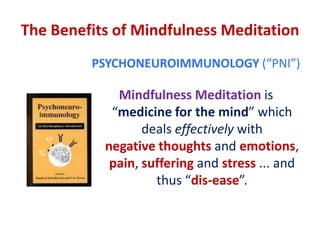
The Benefits of Mindfulness MeditationPSYCHONEUROIMMUNOLOGY (“PNI”)Mindfulness Meditation is “medicine for the mind” which deals effectively withnegative thoughts and emotions, pain, sufferingandstress ... and thus “dis-ease”.
The Benefits of Mindfulness MeditationTHIS IS NOT MERE OPINION ...IT IS MEDICAL FACT!!... attested to by ...INNUMERABLE NEUROSCIENTIFIC FINDINGS ... reported in REPUTABLE MEDICAL AND SCIENTIFIC JOURNAL ARTICLES ...NUMEROUS SCHOLARLY LAW JOURNAL ARTICLESon the beneficial results of MINDFULNESS IN LEGAL PRACTICE.
The Benefits of Mindfulness MeditationALL of this is GOOD for:the individual lawyer ... personally and professionallythelaw firm as a wholeclientsof the firmthelocal community and thewider publictheworld at large.
Mindfulness Meditation  ALL of this is … DIRECTLY AND FULLY RELATED TO THE PRACTICEOF LAW.
Continuous Mindfulnessand Awareness of Reality
Continuous Mindfulnessand Awareness of RealityBreathe consciously…slowly…anddeeplyas you go about your daily life.Observe everything inside and outside of you.
Continuous Mindfulnessand Awareness of RealityFeel the “life” all around you.Be fully present ... here and now ... in the present moment.
Continuous Mindfulnessand Awareness of Reality ... cont’dDisidentifywith:
the ego-self
the various “me’s” within your mind  ... your “mental noise” and chatter.
Continuous Mindfulnessand Awareness of Reality ... cont’dWatch ... almost with disinterest
as if it were happening to someone else ...
with no comment, judgment or attempt to change anything.Continuous Mindfulnessand Awareness of Reality ... cont’dNote the presence of any unhealthy, painful thoughts or emotions …Don’t suppress or deny themStep back with dissociation from the “activating event” ...“See” and feel the emotion insteadPractise willingness … and acceptance.
Continuous Mindfulnessand Awareness of Reality ... cont’dObserve ...and be constantly aware... only to understand.AWARENESSisINSIGHT
Listening to Clients Mindfully
Listening to Clients MindfullyMindfulness has been shown to assist lawyers to provide a better service that:suits their clients’ needsdelivers desired outcomes.
Listening to Clients MindfullyLawyers are notoriously bad listeners!!!Watch yourself carefully.Listen attentively at all times.
Listening to Clients Mindfully ... cont’dBe mindful of what is being said“Am I fully aware of what is being said?”Don’t simply identify with what is being said.
Listening to Clients Mindfully ... cont’dIf negative thoughts or emotions arise:Don’t identify with themAsk yourself ... “What is happening here? What brought this on?”Don’t judge or condemn yourself.Simply observe, note ... and understand.
Mindfulness of Sensations
Mindfulness of SensationsSit comfortably in a meditation posture.Observe and follow the breath ... mindfully.Bring the attention back to the breath each time the mind wanders.Continue this for about 5-10 minutes.

MINDFULNESS FOR LAWYERS

  • 1.
    MINDFULNESS FOR LAWYERSDrIanEllis-JonesBA, LLB (Syd), LLM, PhD (UTS), DD, Dip Relig Stud (LCIS), Adv Mgmt Cert (STC)Solicitor of the Supreme Court of New South Walesand the High Court of AustraliaPrincipal, Ian Ellis-Jones, LawyerDirector, Ellis-Jones Enterprises Pty LimitedVisiting Associate, NSW Institute of PsychiatryFormer Senior Lecturer-in-Law, University of Technology, SydneyCommissioner of Inquiry under the Local Government Act (NSW)Retreat Director, Mediator, Facilitator, Trainer and Consultant
  • 2.
    Copyright, Terms ofUse and DisclaimerCopyright © 2010 Ellis-Jones Enterprises Pty Limited (ABN 38 088 534 141).All Rights Reserved.All material on the slides comprising this PowerPoint presentation are subject to copyright, trademark and other intellectual property rights protection under national and international laws.The reproduction, downloading or many other use of any material contained in this PowerPoint presentationwithout the prior written permission of Ellis-Jones Pty Limited is strictly prohibited.The purpose of the facilitated training session the subject of this PowerPoint presentation as well as any copy of the presentation (“this document”) is to give information, and provide inspiration, for educational training purposes which may be of general interest to the participants as a whole. The information provided at the facilitated training session and in this document (“Information”) is not, and is not intended to be, professional advice to be relied upon as a basis for action on the part of any individual in respect ofany matter in relation to which there could be loss or damage. To the maximum extent permitted by law, Ellis-Jones Enterprises Pty Limited and its directors and employees (jointly and severally “EJE”) make no representation or warranty of any kind, express, implied or statutory regarding the Information, which is not intended to be a replacement for professional medical advice. If needed, such advice should be obtained through the services of a competent health professional. EJE does not accept any liability for any loss or damage arising directly or indirectly from action taken, or not taken, in reliance of or upon the Information but excludes completely any and all such liability.Although some of the Information is derived from certain ancient healing practices and principles and may be associated with certain spiritual traditions, participants do not have to be religious or belong to or join any particular faith tradition in order to practise and otherwise derive benefits from the techniques, methods and principles described in the Information. Although some references may be made from time to time to particular religious leaders, teachers or faith traditions for the purpose of explaining or expounding what is being presented EJE does not endorse any religion, religious institution or any religious doctrine or dogma, nor endorses or favours any particular religion or faith tradition in its training sessions. The Information is taught without a religious context in a secular, non-sectarian and cross-cultural manner.
  • 3.
    Grateful acknowledgments aredue to the various rights holders whose permission has been given to the use of copyright material. All rights reserved.
  • 4.
  • 5.
  • 6.
    Objectives of TrainingSessionTo assist and empowerLegal Practitioners in their practice of law…to enhance their efficiency and effectiveness in the workplace and their overall wellbeingto better serve their clientsto work more collaboratively with their colleagues … ... cont’d
  • 7.
    Objectives of TrainingSession… by means of the regular practice anduseof certain naturalisticpractices, principles, ideas and thought forms known as Mindfulness …of which Mindfulness Meditationforms an integral part. ... cont’d
  • 8.
    Objectives of TrainingSessionTo present Mindfulness as a coping skill and mode of being which can:effectimprovements in the physical bodyimprove one’s ability to cope with and release stress ...... cont’d
  • 9.
    Objectives of TrainingSession- assist in developing the mind’s ability to observe and understand many changing psycho-physiological processes and external surroundingsassist in “untying” one’s thoughts from their emotional content and reaction, thereby defusing and dissipating the latter. ... cont’d
  • 10.
    Objectives of TrainingSessionTo presentMindfulness as a mental skill and cognitive ability which can:enhancecognitive functioning and performanceimproveconcentration, capacity for focus, memory, learning and consciousness, ability to think laterally and openness to new ideasincreaseverbal creativity and greater attention to detail.... cont’d
  • 11.
    Objectives of TrainingSessionTo presentMindfulness as a means to ...empty ourselves of self-centrednessfoster ethical behaviourimprove skills in mediation, negotiation and resolution of complex issues.... cont’d
  • 12.
    Objectives of TrainingSessionTo presentMindfulness as a means to ...seethe limitations of conditioned patterns of thinkingbringself-knowledgeenhanceself-esteem.
  • 13.
    Objectives of TrainingSessionTo presentMindfulness as a means to ...lead to greater work satisfactioncontinuously develop expertise.
  • 14.
  • 15.
    Training MethodsPowerPoint PresentationTalks,Stories, Sayings and AnecdotesSelf-questioningBreathing ExercisesGuided MeditationsSupply and Use of Printed Material (copies of PowerPoint slides and Select Bibliography)Questions and Answers
  • 16.
  • 17.
    Topic AreasIntroduction toMindfulnessIntroduction to Meditation and Mindfulness MeditationThe “Purposes” of Meditation“Techniques” and “Methods” of MeditationMindfulness and Mindfulness Meditation … core values, “tips”, benefitsMindfulness of Breathing ... and Breathing ExercisesMindfulness Sitting and Walking Meditations ... cont’d
  • 18.
    Topic Areas ...cont’dContinuous Mindfulness and Awareness of RealityListening to Clients MindfullyMindfulness of SensationsMindfulness for Pain ManagementMindfulness, Laughter and HumourEvening Meditation for Self-Questioning and Self-ReflectionQuestions and Answers
  • 19.
  • 20.
    Anticipated OutcomesParticipants inthe training session are expected to gain a workable understanding of:the practice and principles of Mindfulness and Mindfulness Meditationthe mindful use of breathing ...
  • 21.
    Anticipated Outcomes ...cont’dthe practice of listening mindfully to others, especially one’s clientsthe use of Mindfulness for pain relief, andas a means of personal and professional self-development.
  • 22.
  • 23.
    The Practice ofLawThe statistics regarding lawyer depression, divorce, suicide, physical and other mental illness, and alcohol and other substance abuse aresimply staggering ...
  • 24.
    The Practice ofLaw Over 50% of practising lawyers describe themselves as emotionally dissatisfiedwith their work ...and their lives.
  • 25.
    The Practice ofLawLawyers top the list of professions whose members suffer from a major depressive orderrate of depression3.6 times higher than employed persons generally.
  • 26.
    The Practice ofLaw Lawyers also suffer from alcoholism and illegal drug useat rates far higher than non-lawyers.
  • 27.
    The Practice ofLaw The divorce rate among lawyers is also higherthan the divorce rate among other professionals.
  • 28.
    The Practice ofLaw... and the statistics seem to get worse each year!
  • 29.
    The Practice ofLawMYTHS AND DENIAL IN THE LEGAL PROFESSIONStress? Drug problems? Not in our firm!Stress? Long hours? It’s par for the course!If you can’t cope with the stress … the billable hours … the long days … then perhaps you shouldn’t be a lawyer.
  • 30.
    The Practice ofLawMYTHS AND DENIAL IN THE LEGAL PROFESSIONIf you’re stressed out, that’s your problem. Solve it yourself, quickly … or else.Your wellbeing is not the firm’s responsibility.
  • 31.
    The Practice ofLawDOING … as opposed to simply BEING“What must I do today?”billable hoursthings to do …people to meet …
  • 32.
    The Practice ofLawSUCCESS is defined by reference to what one has done.. and how others see you“I want to be remembered for having done …”
  • 33.
    The Practice ofLawThe practice of law is injurious to your health unless ...
  • 34.
    The Practice ofLaw ... you can practise a way of living and approaching life that involves ...
  • 35.
    The Practice ofLawa stable, steady, alert and clear mind, and
  • 36.
    a state ofbeing psychologicallypresent and withwhatever happens in and around youMINDFULNESS... An Introduction
  • 37.
    One approach ...MINDFULNESSOnenatural means by which to respond to the stress of law practice ... and otherwise empower oneself, is ... MINDFULNESS
  • 38.
    MINDFULNESS“Mindfulness ... makesus accessible to depthsof awareness and clear seeing into the waythings are.”- Christopher Titmuss.
  • 39.
  • 40.
    WHAT IS MINDFULNESS? A STABLE ... STEADY ... CALM ... ALERT ... OBSERVANT ... CLEAR ... DELIBERATE ... PURPOSEFUL ... ACTIVE ... FOCUSED …ENGAGED and yet DETACHED ... SKILLFULAWARENESSof the present moment ... including one’s ...
  • 41.
    WHAT IS MINDFULNESS?BODYFUNCTIONS&SENSATIONS
  • 42.
  • 43.
  • 44.
    EXTERNAL SURROUNDINGSWHAT ISMINDFULNESS?The practice of paying attentionin the presentpurposefully andreceptively deeply andopenlynon-judgmentally ...
  • 45.
    WHAT IS MINDFULNESS?...to whatever arises in the present moment ... moment to moment … both inside andoutside of us
  • 46.
    WHAT IS MINDFULNESS?Mindfulnessenables usto move from the level of conceptual thinking tothe level of direct,non-judgmental awareness.
  • 47.
    WHAT IS MINDFULNESS?“Welive in a society that … forgets the present.”- Albert Einstein
  • 48.
    WHAT IS MINDFULNESS?Keepyour eyes open … RIGHT NOW.Witness all that is in front of you, above you, and around you … RIGHT NOW.What do you see … feel … smell? … RIGHT NOW.
  • 49.
    WHAT IS MINDFULNESS?Lookeverywhere… RIGHT NOW.See and experienceeverything … RIGHT NOW.Stayin the NOW.Sense each part of your body … hands, legs, chest, head, etc.
  • 50.
    MINDFULNESS Mindfulness is now being taught atseveral leading US law schoolseg Harvard, UC Berkeley, Stanford CLE workshops and seminars across the USA
  • 51.
    MINDFULNESSMindfulness has beenendorsed by several ...US Bar Associations,andinsurance companies
  • 52.
    MINDFULNESSALL of whatfollows is … DIRECTLY RELATED TO THE PRACTICE OF LAW
  • 53.
    MINDFULNESSMindfulness takes meditation… in the form of deliberate and purposeful awarenessand ...
  • 54.
    MINDFULNESS... applies ittoone’sWHOLE life!
  • 55.
    MINDFULNESSWe need tocreate space for formal meditation practice within the busy framework of ourdaily lives.
  • 56.
    MindfulnessMindfulness and MindfulnessMeditation can both refer to a specific type or practice of meditation ...
  • 57.
    Mindfulness Meditation... usedas a psychological and educational tool in somenaturalistic forms of Buddhism and Buddhist meditationespeciallyVipassanā Meditation(also known asInsight[ful], SensoryorThought Watching Meditation)
  • 58.
  • 59.
  • 60.
    Buddhist meditationMindfulnessYou donot have to a Buddhist to practiseeitherMindfulnessorMindfulness Meditation
  • 61.
    You do noteven have to be religious to do so …MindfulnessWhat are presented in this training session arenon-religious, naturalistic, psychological forms of Mindfulness andMindfulness Meditation.
  • 62.
    MINDFULNESSMINDFULNESS is ...a way of life, a journey in self-discovery andan education ...LIVING DELIBERATELYAND PURPOSEFULLYIN THE PRESENT MOMENT… AT ALL TIMES.
  • 63.
    MINDFULNESS“To be awakeis to be alive.”Henry David Thoreau.
  • 64.
    MINDFULNESSMindfulness ... “awatchful awareness of one’s own inwardness, nourished by meditation, and appropriate outward activity ...”- Emeritus Professor Winston L. King.
  • 65.
    MINDFULNESSMindfulness means …no more “sleepwalking” throughout the dayfocusing only on the here and now …
  • 66.
    MINDFULNESSMindfulness means ...beingfullyaware of ...where you arewhat you are doingwho you are withbeing fullyaware of ...your bodyyour thoughts and feelingsyour mindand its contentsyour surrounds
  • 67.
    “Core Values” ofMindfulnessandMindfulness Meditation
  • 68.
    “Core Values”There arecertain “core values” of Mindfulness,among them ...
  • 69.
    “Core Values”ATTENTION ...being, and living, attentively in the present moment, onpurpose …… for moments pass … THIS moment has already gone forever!AWARENESS (“mindfulness”) ... mind free and unattached ... indeed detached but watchful“Core Values”UNDERSTANDING ... to gain self-knowledge insight into ourselves and others
  • 70.
    COMPASSION ... froma sense of ego-self to a sense of Being (non-self/others) ... loss of all sense of duality and separateness.lovingkindness for oneself and all other beings
  • 71.
  • 72.
    MINDFULNESSMINDFULNESS is allabout ...AWARENESS ... and CLARITY OF MIND
  • 73.
    A MIND thatis DETACHED but OBSERVANT of ..
  • 74.
  • 75.
    ongoing events andexperienceMINDFULNESSMINDFULNESS is …
  • 76.
    OPEN, CONSCIOUS andDEFUSEDAWARENESS
  • 77.
  • 78.
    with ACCEPTANCEMINDFULNESSThe OPEN,CONSCIOUS and DEFUSEDAWARENESS, and DETACHEDOBSERVATION, has been described as being that of SEEING CLEARLY but“BARELY KNOWING”
  • 79.
    MINDFULNESSSTOP Don’t getlost in your own mind!LOOK What is happening now?LISTEN… inner and outer soundsBE PRESENT… in the here and now
  • 80.
    MINDFULNESSObserving the BREATHor the movement of the ABDOMEN is used asa major focus of AWARENESS
  • 81.
    MINDFULNESSFollowing either thebreath or the movement of the abdomen is INTEGRATED with MINDFULNESS of: BREATH SENSATIONSTHOUGHTS, EMOTIONS, etc SENSE OF BODY AS A WHOLESENSATIONS WITHIN THE BODYEXTERNAL CIRCUMSTANCES (sounds, etc)“BE-ING”
  • 82.
  • 83.
    MINDFULNESSA SIMPLE RELAXINGBREATHING EXERCISESit up in your chair … straight back … feet flat on the floor
  • 84.
    MINDFULNESSA SIMPLE RELAXINGBREATHING EXERCISE... cont’dSeated posture ... chair or cushionstillness and relaxationtranquil mind and settled bodyFold hands in your lap orlay palms up (or down) on your thighs
  • 85.
    MINDFULNESSA SIMPLE RELAXINGBREATHING EXERCISE... cont’dClose your eyesTake a deep cleansing breathTake a few moments to settle
  • 86.
    MINDFULNESSA SIMPLE RELAXINGBREATHING EXERCISE... cont’dBring your full attention to your body
  • 87.
  • 88.
    “Let go” alloverMINDFULNESSA SIMPLE RELAXING BREATHING EXERCISE... cont’dBring your attention to your breathing
  • 89.
    Start breathing inan even pattern.MINDFULNESSA SIMPLE RELAXING BREATHING EXERCISE... cont’dAt the start … Breathing in … count and say (think) inwardly … 1 Breathing out … count and say (think) inwardly … 2 …
  • 90.
    MINDFULNESSA SIMPLE RELAXINGBREATHING EXERCISE... cont’dIn-breath … 3Out-breath … 4 …Count to 10.
  • 91.
    MINDFULNESSA SIMPLE RELAXINGBREATHING EXERCISE... cont’dContinue to observeyour in-breath and out-breath.“Taste” the breath.
  • 92.
    MINDFULNESSA SIMPLE RELAXINGBREATHING EXERCISE... cont’dBreathe in ... Breathe out... just like that! Just concentrate onbreathing in and out.
  • 93.
    MINDFULNESSA SIMPLE RELAXINGBREATHING EXERCISE... cont’dKnow when the air comesin and goes out.Take this as your subjectof awareness.
  • 94.
    MINDFULNESSA SIMPLE RELAXINGBREATHING EXERCISE... cont’dWhen the air comes in ...you know it.When the air goes out ...you know it.
  • 95.
    MINDFULNESSA SIMPLE RELAXINGBREATHING EXERCISE... cont’dContinue this pattern throughout your breathing meditation ... and your breath will becomerefined and softer.
  • 96.
    MINDFULNESSA SIMPLE RELAXINGBREATHING EXERCISE... cont’dAfter a while, no longer say or think the counts ... just follow and be attentive to your breathing. Alternatively, follow and be attentive the rise and fall of your lower abdomen.
  • 97.
    MINDFULNESSA SIMPLE RELAXINGBREATHING EXERCISE... cont’dNoise or sound? ... Note it, and say, “Hearing, hearing”Thought? ... Note it, and say, “Thinking, thinking”Feeling? ... Note it, and say, “Feeling, feeling”Pain? ... Note it, and say, “Burning [or Throbbing” ... and so forth.
  • 98.
    MINDFULNESSA SIMPLE RELAXINGBREATHING EXERCISE... cont’dAlways return, as mindfully as possible, to observing your breathing pattern oryour abdominal movements.
  • 99.
    MINDFULNESSA SIMPLE RELAXINGBREATHING EXERCISE... cont’dLet your awareness gradually fill your body.
  • 100.
    Notice where yourbreath is most vivid ... - nose? belly? ...
  • 101.
    MINDFULNESSA SIMPLE RELAXINGBREATHING EXERCISE... cont’dReturn your attention to, and continue to observe, the pattern of your breathing …Continue for at least 5 minutes.
  • 102.
    MINDFULNESSA SIMPLE RELAXINGBREATHING EXERCISE... cont’dLet your mind be peaceful ... undisturbed ... not restless.
  • 103.
    MINDFULNESSA SIMPLE RELAXINGBREATHING EXERCISE... cont’dWhen you are ready ...open your eyes slowlytake in your surroundings.
  • 104.
    MINDFULNESSREMAIN CALM, POISEDAND RELAXEDAT ALL TIMES.
  • 105.
    Mindfulness of BreathingShouldthoughts arise, just notice them ...Be aware of them ... with detachment.Observe and acknowledge them gently, dispassionately … without judgment … and let them go.
  • 106.
    Mindfulness of BreathingOBSERVE… as opposed toIDENTIFYACKNOWLEDGE ... LET BE
  • 107.
    RELEASE ... LETGOMindfulness of BreathingNOTE. “Thoughts” include … feelings and emotions
  • 108.
  • 109.
    plans, concepts andcommentaries,
  • 110.
  • 111.
    body sensations.Mindfulness ofBreathingDon’t try to actively bring thoughts up.Wait and see what comes up next.
  • 112.
    Mindfulness of BreathingTreatany new thought the same way ...Observe ... Acknowledge ... Release and Let Go.Notice any judging/evaluating ... Let it go.
  • 113.
    Mindfulness of BreathingRestin the “blank spaces” between thoughts.Don’t try to make sense of any thoughts.
  • 114.
    Mindfulness of BreathingContinueto follow your breath or abdominal movements.Feel the breath going in and out or the rise and fall of your abdomenJust follow it ... with choicelessawareness.
  • 115.
    Mindfulness of BreathingStayawake and aware ...It’s not about the breath or the movement of the abdomen ... but the awareness.
  • 116.
    Mindfulness of BreathingBreathingin and out assists in relieving tension and calmingthe mind.
  • 117.
    Mindfulness of BreathingAdeeply relaxed person breathes about 5-8 times a minute ....at the very most.
  • 118.
    Mindfulness of Breathing Breathe consciously as you go about your daily life.
  • 119.
    Mindfulness of BreathingLetyour breath go slow and deep … into the centre of your being.
  • 120.
  • 121.
    MINDFULNESSThe greatest discoveryof my generation is that people can alter their lives simply by altering their attitudes of mind.- William James.
  • 122.
    MINDFULNESSMindfulness takes youbeyond the limitations of cognition and the analytical mind ... a bit of a challenge at firstfor most lawyers!
  • 123.
    MINDFULNESSMindfulnessdoes not involvenotions of the supernatural ...that is, the notion that there are higher and lower levels or orders of reality ...
  • 124.
    MINDFULNESSMindfulnessis bothnatural andtransnatural ...that is, it “grows out of ordinary nature, but transcends it” (Sir Julian Huxley)not contrary to reason or irrational
  • 125.
    MINDFULNESSMINDFULNESS means ...beingalert, curious, receptive, choicelessly aware of, and present on purpose with, every thought ...
  • 126.
    MINDFULNESSwithdetachmentwithoutjudgment, condemnation orevaluationwithouttrying to controlwithoutresistance, suppression or sublimation
  • 127.
    MINDFULNESSMindfulness helps youto “untie” one’s thoughts from their emotional content andemotional reaction...
  • 128.
    MINDFULNESS… thereby defusing,dissipating and short circuiting the “hot stuff” ... especially “stuff” from the subconscious mind that you would otherwise act upon
  • 129.
    MINDFULNESSMindfulness lets you... see this “stuff” … from a distance observe and acknowledge itlet it go … before things spiral out of control act, rather than habitually react as if on “auto pilot”
  • 130.
    MINDFULNESSMindfulness “softens”the mind... ... more “accepting” of whatever is … Whatever is, is best!
  • 131.
    MINDFULNESSWith the regularpractice of mindfulnessboth the body and the mind become soft(i.e. relaxed).
  • 132.
    MINDFULNESSMINDFULNESS, as memory,also involves …present-centred recollection …retropective memory of some past eventprospective remembering to do something in the future.
  • 133.
    MINDFULNESSThe will actsall the time … shifting from one mental image to another ...each arising within about one millionth of a second.
  • 134.
    MINDFULNESSThe mind canonly focus on one mental image …at any given point in time.
  • 135.
    MINDFULNESSStay withwhatever arises…for as long as it lasts.
  • 136.
    MINDFULNESS Notice whatis passing through your mind with choiceless awareness … by getting up close.
  • 137.
    MINDFULNESS... “Awareness-ing” ...Let your awareness take note of what’s going on ... inandoutsideof your mind.
  • 138.
  • 139.
    MINDFULNESSMindfulness is ...aself-liberating experience
  • 140.
    a way tobe freeMINDFULNESSLive in the mind’s natural state ... mindfulness!boundless ... spaceless “be-ing”presence of mind
  • 141.
    MINDFULNESSCHOICELESS AWARENESS ...NOTTHE SAME THING AS “THOUGHTLESS AWARENESS”(cfSahaja Yoga).
  • 142.
    MINDFULNESSThe aim ofMindfulness ...NOT to eliminate all thoughtThinkingisn’t the problem.
  • 143.
    MINDFULNESSEndless non-purposeful thinking... especially of a negative kind ...is the problem.
  • 144.
    MINDFULNESSBE AWARE OFEVERY THOUGHT.PAY ATTENTION!
  • 145.
    MINDFULNESSWatch and movewithEACH thought ... moment by moment ... choicelessly... and purposefully.
  • 146.
    MINDFULNESSNote what thebody is experiencing ... when walking, sitting, reading, driving the car ...ThinkingthoughtsHearingsoundsHavingmental imagesFeeling pain or bodily discomfort ...
  • 147.
    MINDFULNESSMINDFULNESS (sati) literallymeans “memory” ... Remembering ...Distraction = forgettingRemember what ispresentRemember to staypresent at all times.Recollectin the present what has happened before.
  • 148.
    MINDFULNESSMINDFULNESS is NOTthe same thing as “consciousness” Stream of consciousness “Trains” of awareness Distraction = forgetting
  • 149.
    MINDFULNESS Howmany thoughts go through the human mind per minute?
  • 150.
    MINDFULNESSWhat is a“thought”?no easy answer ...Thoughts are ...abstractnot quantitative, as such.
  • 151.
    MINDFULNESSThe mind isincapable of notthinking ... at least on the subconscious level.
  • 152.
    MINDFULNESSHow many thoughtsper minute?The question is considered unanswerable ... at present.
  • 153.
  • 154.
    MINDFULNESSThe braincan only“think” one thought at any given moment in timecan only handle one cognitive function at a time
  • 155.
    MINDFULNESSSo-called “multitasking” ...... nothing other than“switch-tasking” ... toggling between one task and another ... each time witha “startup cost”
  • 156.
    MINDFULNESSMultitasking ...makes usfeelefficientslows down our thinkingerodes our attentionmakes us more stressed out, depressed and less able to connect with others
  • 157.
  • 158.
    MINDFULNESSRealize that yourthoughts, feelings and memories are not you.You are not your thoughts, feelings or memories.
  • 159.
    MINDFULNESSWatch your thoughts,feelings and memories flow like the waves of the ocean against the sea shore ...They come in ... and they go out.
  • 160.
    MINDFULNESSWitness your thoughts,feelings and memories flowing away intothe great abyss.
  • 161.
    MINDFULNESS Being “constantlyaware” is a manner of speaking.
  • 162.
    MINDFULNESS Itis, of course, impracticable to be constantly aware ...
  • 163.
    MINDFULNESS... that is,turning the attention to what passes in our minds, allof the hours and minutes of the working day.
  • 164.
    MINDFULNESSMindfulness involves …focusedattention on the present…energy enough “effort” to remember to focus attentionmomentary butdetached concentration … each moment … whatever arises
  • 165.
    MINDFULNESSHowever, be sensitiveto what is discordant or negative ... and clear it out ... indirectly.
  • 166.
    MINDFULNESSWatch and movewith your thoughts... withdetachment, NOT attachment.
  • 167.
    MINDFULNESS- Be psychologicallypresenton purpose (“up close”) with whatever happens in and around you.
  • 168.
    MINDFULNESSDeliberately keep themind at the level of bare attention.
  • 169.
    MINDFULNESSRemain (“be”) inthe present on purpose ...at all times ...
  • 170.
    MINDFULNESSThe “here andnow” is all that really “is”
  • 171.
    The past andthe future “exist” only in one’s imaginationMINDFULNESSThe only time we ever have is the present moment
  • 172.
    We can onlylive in and experience the presentMINDFULNESSLive and think only in the present …... the ever-present, ever-vanishing “eternal now”Live in and inhabit the reality of the nowwithout past or futurewith choiceless awareness.
  • 173.
    MINDFULNESSThe pastis deadThefuture is yet to be born
  • 174.
    MINDFULNESS “Yesterdayis history, tomorrow is a mystery, and today is a gift; that’s why they call it the present.” - Eleanor Roosevelt.
  • 175.
    MINDFULNESSAll that wecan know is our present thoughtThe only thing we have to “heal” or otherwise “deal with” is the present thought
  • 176.
    MINDFULNESSMINDFULNESS HELPS BRINGOUR MINDS TO THE PRESENT MOMENT.
  • 177.
    MINDFULNESSMindfulness …is active,NOTpassiveis experiential, NOTintellectual
  • 178.
    MINDFULNESSLet your awarenessbe unconnected to theobjects of its attention.MINDFULNESSDo not try to alter your experience or change your thoughts or sensations.
  • 179.
  • 180.
    What is Meditation?Theetymological meaning of the word ...Latin-derived wordmeditatus, past participle of meditari, frequentative of medērirelated to “middle”, “mediation”, “medical” and “measure”also denotes “reflecting”, “pondering” ...
  • 181.
    What is Meditation?Whatis Meditation?... “a medicine for the mind which does its work by measuring out time, when it can reach a median, a point of equilibrium”. - Robert Ellwood, Finding the Quiet Mind (TPH, 1983).
  • 182.
    “Types” of MeditationThereare 3 main “types” or “schools” of Meditation ... 1. Contemplative Meditation. 2. “Letting Go” or“Surrender” Meditation. 3. Mindfulness Meditation.
  • 183.
    “Types” of MeditationContemplativeMeditation involves fixed concentration of thought and
  • 184.
    contemplation on …some object (mental or physical) … on one point.“Types” of Meditation“Letting Go” or“Surrender Meditation”(egCentering Prayer)involves:
  • 185.
    the emptying ofself, and
  • 186.
    the opening ofone’s mind and heart to “the Ultimate” (God/the “Self”/the Ground of Being, InterBeing, the Livingness of your life, etc) ... a state beyond thoughts, emotions and words.“Types” of MeditationMindfulness Meditation involves a “clarity of mind” in which you become purposefully alert, aware of, present with, and attentive to ...your thoughts, feelings, emotions, bodily sensations, etc, and
  • 187.
    your external surroundings.“Types”of MeditationMindfulness Meditation is:NOTabsorption, that is, fixed or deep concentration on one single object
  • 188.
    choiceless awareness …a non-judgmental observation of all things as they are
  • 189.
    living in thepresent momentThe Nature of MeditationWhat it is Not...Meditation is not “mind control” ... in the sense of subjugation,
  • 190.
  • 191.
    suppressionThe Nature ofMeditationWhat it is Not...Meditation is a form of escape from life
  • 192.
    Meditation must bedone in some special posture (eg the “full lotus position”)
  • 193.
    Meditation must bedone in some special place (eg mountain top, cave, monastery)Meditation is a religiousritual or ceremonyMeditation is trance-like state ...NOT SO!!!
  • 194.
    What is MindfulnessMeditation?Mindfulness Meditation a bit of a misnomeroften misunderstood …
  • 195.
    What is MindfulnessMeditation?Mindfulness Meditation …is meditation for daily life …
  • 196.
  • 197.
  • 198.
  • 199.
    mental contents… inALL situations of everyday life
  • 200.
    What is MindfulnessMeditation? What it is Not ... It is not … fixed or exclusive concentration of thought
  • 201.
    but momentary concentration… paying attention to whatever arises … a momentary look at the present moment
  • 202.
    contemplation.What is MindfulnessMeditation?Focused Attention -NOTfixed concentrationTrue “control of mind” … the giving of constant attention.
  • 203.
    What is MindfulnessMeditation?Mindfulness Meditation involves the giving of unwavering attention ... to ALL things in lifeNOT merely particular things or one’s own thoughts.
  • 204.
    What is MindfulnessMeditation?Mindfulness Meditation is literallypractice ...
  • 205.
    What is MindfulnessMeditation?... as in you might go to a golf driving range to practise your golf swingin order toimprove your golf.
  • 206.
    What is MindfulnessMeditation?Mindfulness Meditation involves simply observing whatever mental or physical process is predominantwithin the present moment … in order to understand the true nature of it.
  • 207.
    What is MindfulnessMeditation?What it is Not ...It is not a religion or cult or even inherently religious …
  • 208.
    Meditation does notrequire you to be religious at all.Mindfulness MeditationWhat it is Not ...You don’t need to ...
  • 209.
  • 210.
    go to theHimalayas or an ashram or live in a cave
  • 211.
    wear coloured robesinorder to meditate and practise Mindfulness.
  • 212.
    Meditation“The only Zenyoufind on tops of mountains is the Zen you bring there.”-Robert Pirsig, author of Zen and the Art of Motorcycle Maintenance.
  • 213.
    MeditationContemplation is differentfrom Mindfulness and Mindfulness MeditationMindfulness Meditation requires a mind completely denuded of all previous ideas and knowledge
  • 214.
    Mindfulness MeditationWhatever then“takes place” in the mind is:NOT from previous thoughts, feelings or memoriesfrom an inner initiative ... out of the depths of one’s very being
  • 215.
    Meditation ... andMindfulness“THE BABY STOPS CRYING”
  • 216.
    Mindfulness MeditationWhen themind is ...no longer speakingno longer analysingno longer caught up in the process of becoming.
  • 217.
    Mindfulness MeditationLEARN TOBE SILENT“LET YOUR QUIET MIND LISTEN AND ABSORB.”- Pythagoras.
  • 218.
    Mindfulness Meditation“A single-pointedmind isthe fully trained state ofthe meditative mind. It serves as the ground forcultivating wisdom ...”- GesheWangchen.
  • 219.
    Mindfulness MeditationA QUIETMIND“Free Quiet”
  • 220.
  • 221.
  • 222.
  • 223.
    Purposefully, and progressively,going deeper and deeper, interiorly. Mindfulness MeditationA state of “bare attention” and “choiceless awareness”A near-automatic habit of self-reflection
  • 224.
    Mindfulness MeditationA stateof freedom from external and internal obsessivenessA means of developing and practisingmidfulness
  • 225.
    Mindfulness MeditationMindfulness MeditationisNOT just relaxationis NOT just stress reliefbut it does involve identifying and recognising stress causing factors ►►► stress reduction
  • 226.
    Mindfulness MeditationMindfulness Meditationisrealization of your body and mind as they appear to you nowthe mind is alert, sharp and mindfully awarethe body is relaxed and not tense or rigid
  • 227.
    Meditation ... Doit!Meditation is of little value if practised ...only occasionallyonly at a certain specified time or times of the dayonly in a particular posture.
  • 228.
    What is Meantby Practising Meditation?What is meant by “practice” in the context of Mindfulness and Meditation?“It does not mean a ‘rehearsal’or a perfecting of some skill so that we can put it to use at some other time. In the meditative context practice means ‘being in the present on purpose.’ The means and the end of meditation arereally the same.”- Dr Jon Kabat-Zinn.
  • 229.
    Meditation ... an“All-day Affair”“If the mind is restless twenty-three and a half hours of the day, it cannot be very quiet and peaceful during the remaining half hour.” - N. Sri Ram, Spiritual Leader.
  • 230.
    Meditation ... an“All-day Affair”Meditation needs to be applied ...in everymoment, andin everycircumstance ... of our daily lives
  • 231.
    Meditation ... an“All-day Affair”What is our life?We only have “moments”The future is only a conceptMemories of the past are also only conceptsWe can only live in the present momentWe need to inhabit the now more ... with awareness
  • 232.
    Meditation ... “EffortDefeats Itself”Meditation is NOT a question of effort.Don’ttry to relax! Don’ttrynot to think!Don’ttry to think of nothing.
  • 233.
    The Nature ofMeditation“ONE MUST NEVER THINK OF THE WHTE MONKEY.”
  • 234.
    The Nature ofMeditation“Hang out in the space betweenyour thoughts.”- Alan Cohen.
  • 235.
  • 236.
    The “Purposes” ofMeditationIn a sense there are no “purposes” of meditation.
  • 237.
  • 238.
  • 239.
  • 240.
    a journey inself-discovery
  • 241.
    a path ofwell-being
  • 242.
    an enriched, expandedexperience of life, personally and professionally
  • 243.
    a means oftapping into “resources” of power and joy contained in the mind.The “Purposes” of Meditation“We could say that meditation doesn't have a reason or doesn't have a purpose. In this respect it's unlike almost all other things we do except perhaps making music and dancing. When we make music we don't do it in order to reach a certain point, such as the end of the composition.If that were the purpose of music then obviously the fastest playerswould be the best. ...... cont’d
  • 244.
    The “Purposes” ofMeditation ... Also, when we are dancing we are not aiming to arrive at a particular place on the floor as in a journey. When we dance, the journey itself is the point, as when we play music the playing itself is the point. And exactly the same thing is true in meditation. Meditation is the discovery that the point of life is always arrived at in the immediate moment.” - Alan Watts.
  • 245.
  • 246.
    “Techniques” and “Methods”Asthere are no “purposes”, as such, of meditation ... andAsmeditation is a “thing-in-itself”...
  • 247.
    “Techniques” and “Methods”...no “techniques” or “methods”, as such, are required.
  • 248.
    “Techniques” and “Methods”THEMASTER’S ADVICETO HIS PUPILON THE USE OFTECHNIQUES AND METHODS
  • 249.
    “Techniques” and “Methods”Theessence of all meditation practicesis this ... Cling to nothing.
  • 250.
    “Techniques” and “Methods”Thereis a danger in clinging to any one “method” thathas worked for you.Always be prepared to ... let go.
  • 251.
    “Techniques” and “Methods”ARE“TECHNIQUES” AND “METHODS” MERELY A FORM OF PROGRAMMING OF ONE PERSON BY ANOTHER?
  • 252.
    “Techniques” and “Methods”“Techniques”and “methods”:establish stereotypes in the minddig grooves (neural pathways) out of which you may be unable to extricate yourself.DO NOT GET STUCK ANYWHERE!
  • 253.
    “Techniques” and “Methods”“Techniques”and “methods” are all SECONDARY to the CULTIVATION of a “CLEAR MIND”.
  • 254.
    “Techniques” and “Methods”Mindfulnesshas been described as being ... “the method ofno-method”.
  • 255.
    “Techniques” and “Methods”Mindfulnessmeans just being aware... just being awake...
  • 256.
    “Techniques” and “Methods”...all with an“effortless effort” ... resting in the momentum ofthe continuity ofthe present moment
  • 257.
    “Techniques” and “Methods”Tohave “clarity of mind” you must develop and exhibit ... calmness of mindand body.
  • 258.
  • 259.
    SITTING MEDITATIONSit onachair or cushion … straight back … feet flat on the floor (if seated on a chair) ... otherwise, use some other accepted traditional posture (eg Burmese style, half lotus, full lotus)
  • 260.
    SITTING MEDITATION“Sit straightand be straight in the practice.”- Zen saying.
  • 261.
    SITTING MEDITATIONGently holdyour hands in your lap ...Alternatively, lay your palms up (or down) on your thighs.Close your eyes
  • 262.
    SITTING MEDITATIONTake afew moments to settle.Resolve to sit still for the entire meditation session.
  • 263.
    SITTING MEDITATIONFeel theground support your feet and bottomFeel totally grounded and supported
  • 264.
    SITTING MEDITATIONBring yourattention to your breathing.Take a deep cleansing breath.
  • 265.
    SITTING MEDITATIONStart breathingin an evenpatternContinue this pattern throughout your meditation.
  • 266.
    SITTING MEDITATIONLet yourbreath go slow and deep … into the centre of your beingBe mindfulof and follow your breathing, that is, your in-breath and your out-breath...through the nostrilsormouth, into your lungs ...
  • 267.
    SITTING MEDITATIONAlternatively, youmay wish to be mindful of and follow your breathing in the form of the rise/expansion and fall/contractionof your lower abdomen
  • 268.
    SITTING MEDITATIONEither ofthe above is known as your “anchor” or “primary object of meditation”
  • 269.
    SITTING MEDITATIONYour anchorhelps you to remain fixed and focused in, and to be mindful of, the moment
  • 270.
    SITTING MEDITATIONWHY USEAN “ANCHOR”?Because we can’t focus our mindon every changing momentwithout a certain degreeof concentrationto keep pace with the moment.
  • 271.
    SITTING MEDITATIONAlways beprepared to attend to any “secondary objects of meditation” (egthoughts, bodily sensations, pain sensations) if, and as and when, they arise.
  • 272.
    SITTING MEDITATIONWhenever athought, feeling, bodily sensation, etc, arises ...Be aware of it as just a thought, feeling, etc ... Let it goDo NOT resist it or try to expel or drive it away ...
  • 273.
    SITTING MEDITATIONRemember the“law of non-resistance” ...“Whatever you resist, persists”
  • 274.
    SITTING MEDITATIONSimply observeand notice, with detachment, what your body ... including your mind ... is experiencingLabel what you’re experiencing if necessary ...
  • 275.
    SITTING MEDITATIONLabelling…Say, interiorly,the word of that being experiencedOnly label objects or processes if they are predominant … cont’d
  • 276.
    SITTING MEDITATIONLabelling…Use onlysingle words (eg “Hearing”, “Thinking”, “Feeling”, “Throbbing”, “Analyzing”) andkeep to a minimumDrop the labelling… if you can be aware without thinking, analyzing, judging, comparing, etc… cont’d
  • 277.
  • 278.
    No need tokeep labellinguntil object disappears … it may not!
  • 279.
  • 280.
    labels only ameans to an end …
  • 281.
    i.e., to directyour mind to the present moment without thinking, analyzing, judging, comparing, etcSITTING MEDITATIONLabelling…a tool to recogniseONLY the bare fact of the perception of ... the coming and going ... the arising and passing away … of thoughts, feelings, bodily sensations, etcNOT a tool to interfere, judge, evaluate, analyze, etc
  • 282.
    SITTING MEDITATIONReturnas soonas possibleto your anchor ... that is, return to following either your breathor your abdominal movements
  • 283.
    SITTING MEDITATIONRest inchoiceless awareness ... momentbymoment ... Keep your mind at the level of bare attention ... without judgment, evaluation, self-criticism, condemnation, comparison, etcLet it be
  • 284.
    SITTING MEDITATIONContinue asabove throughout the period of meditationRemain poised and relaxedat all times
  • 285.
    SITTING MEDITATIONDon’t rushoff immediately at the end of the meditation sessionEvaluate the experienceResolve to meditation again ... soon
  • 286.
  • 287.
    “Tips” on SittingMeditationSit down ... comfortably.Sit still and upright ... spine erect ... head straight.Sit relaxed but alert.
  • 288.
    “Tips” on SittingMeditationLay your hands in your lap ... palms cupped upward ... either separately orone palm resting gentlyon top of the other.
  • 289.
    “Tips” on SittingMeditationRemember ... you cannot meditate unless the mind is collected and quiet
  • 290.
    “Tips” on SittingMeditationAvoid uncomfortable, unnatural positionsDon’t submit yourself to physical strain or pain ... or injure your body in any way
  • 291.
    “Tips” on SittingMeditationKeep the body still... but if you need to change your position, do soDon’t try too hard ... indeed, don’t try at all.
  • 292.
    “Tips” on SittingMeditationMindfulness is bare knowing... knowing things as they really areMindfulness is seeing things clearly ... as they really are
  • 293.
    “Tips” on SittingMeditationUse “effortless effort”Observe ... directly, objectively
  • 294.
    “Tips” on SittingMeditationDon’t try to meditate or relax. Just be ... andbe aware.
  • 295.
    “Tips” on SittingMeditationClose your eyeslightly.Turn your mind “inwardly” and silently.Commence deepmindful breathing ... paying attention to your breathing.
  • 296.
    “Tips” on SittingMeditationPractise meditation gently ... butsteadily.Practise the “Law of Indirectness” …
  • 297.
    “Tips” on SittingMeditationThe LAW OF INDIRECTNESS ...DON’Tresist thoughts and other distractionsDON’Tfight against themDON’Ttry to drive them out or awayDON’Tdwell upon them …
  • 298.
    “Tips” on SittingMeditationThe LAW OF INDIRECTNESS (cont’d) ...DON’Thang on to them … or even think about them!DON’T fuel their storyDON’Tjudge, analyze, evaluate, categorize or compare them DON’T attempt to put them out of your mind
  • 299.
    “Tips” on SittingMeditationThe LAW OF INDIRECTNESS (cont’d) ...LOOKupon your thoughts as if they were on a TV or movie screenGENTLY OBSERVE and, if necessary,LABELyour thoughts ... Say, simply, “Thinking” or “Feeling”, etcBy so doing, you can untie them from their emotional contentThey will pass and disappear in time ... All things pass
  • 300.
    “Tips” on SittingMeditationTURN YOUR MIND INWARDSOBSERVE the momentBE with the moment ... be “embodied” in the moment
  • 301.
    “Tips” on SittingMeditationBE PRESENT with all that happensSTAY with the moment“REMEMBER” the moment
  • 302.
    “Tips” on SittingMeditationNoteany thoughts, feelings, bodily sensationsPausebrieflyNote the “tone” of any notingReturnto observing your breath or following the rise and fall of your abdomen
  • 303.
    “Tips” on SittingMeditationCareful, mindfulobservation …Don’t interfereDon’t “feed” your thoughts, feelings, mental movies, etc …IN TIME, THEY WILL … LOSE THEIR POWER!
  • 304.
    “Tips” on SittingMeditationMindfulness Meditation is ...NOT about stopping the mindNOT about stoppingthoughtsMindfulness Meditation is ...about allowingthoughts to be present ... but NOT letting them run you!
  • 305.
    “Tips” on SittingMeditationRemember ... WHAT YOU RESIST, PERSISTS.
  • 306.
    “Tips” on SittingMeditationDon’t try to experience “the silence”If you do, you only become aware of ...apast silence ... a self-projected mental repetition
  • 307.
    “Tips” on SittingMeditation True silence and quietude occur when the mind is utterly still. That requires … “bare attention” and “choiceless awareness”.
  • 308.
    “Tips” on SittingMeditationTrue Silence ... Emptiness“Silence is not the absence of sound, but the absence of self.”- Anthony de Mello.
  • 309.
    “Tips” on SittingMeditation If the mind wanders,be mindful of the wandering and your thinking and imagining
  • 310.
    “Tips” on SittingMeditationSay inwardly, “Wandering, Wandering” or “Thinking, Thinking” … until the intrusive thoughts, etc, disappear.
  • 311.
    “Tips” on SittingMeditationWhen thoughts, etc, are too dominant, intrusive or painful to let go by labelling …
  • 312.
    “Tips” on SittingMeditation… observe your breathing patternorabdominal movements(“Rising … Falling”).
  • 313.
    “Tips” on SittingMeditationWhen the mind wanders, simply observe itas it is
  • 314.
    “Tips” on SittingMeditationExpand the feeling of awareness of and around the breath to include a sense of the body as a whole ... “re-bodying” yourself ...resting in awareness.
  • 315.
    “Tips” on SittingMeditation Meditate, mindfully,preferably twice daily …for about 15 minutes on each occasion.
  • 316.
    Mindfulness MeditationIn addition,at least ONCE per day, practice “walking meditation”
  • 317.
    Mindfulness MeditationAlso, practise“continuous mindfulness” all throughout the day.Remember to listen to others mindfully ... being in the present on purpose.
  • 318.
    Mindfulness MeditationRemember ...anyactivity done mindfully is a form of meditation.
  • 319.
  • 320.
    Walking Meditation“Walking meditationis an art! You are not going anywhere, you are walking justfor the sake of walking.”– Martine Batchelor.
  • 321.
    Walking Meditation ...cont’dWalking Meditation helps to foster:calmnessrelaxationawareness ...
  • 322.
    Walking Meditation ...cont’d... Yes, the “key” is to be aware as you walk
  • 323.
    Walking Meditation ...cont’dWalking meditationis meditation in actionusing the natural movement of walking to foster mindfulnessthe bare experience of walking
  • 324.
    Walking Meditation ...cont’dWalking meditationcan be the preferred form of Mindfulness Meditationordinarilyprecedes a sitting meditation … centres the mind
  • 325.
    Walking Meditation ...cont’dWalking meditationsimilar to normal walking butslowerdeliberate, intentionalandmindful
  • 326.
    Walking Meditation ...cont’dWalking meditationnot physical exercisebutwakeful presence
  • 327.
    Walking Meditation ...cont’dWalking meditationchoose a quiet place …without distractionsindoors oroutdoorsshort path ...some 3-10 (preferably around 6) metres in lengththe path must have a definite “start” and “end” flat, even surface ...backwards and forwards or circular
  • 328.
    Walking Meditation ...cont’dWalking meditation“walking with presence and mindfulness”a means to connect mind and body with the here and nowkeeps one centered in the present moment
  • 329.
    Walking Meditation ...cont’dWalking meditationBegin by standing at the beginning of your pathStart with a “standing meditation” (“Standing, standing”)for a minute or 2 ... watch the breath
  • 330.
    Walking Meditation ...cont’dWalking meditationFocus on your bodyFeel the sensation of your feet “pressing” against the floor/earthFeel the whole body standing … andlaterturning (“Turning, turning”) ... with awareness ...
  • 331.
    Walking Meditation ...cont’dWalking meditationFocus your attentionminutely and purposefully on each action.You are not going anywhere ... You are just walking.
  • 332.
    Walking Meditation ...cont’dIn sitting meditationthe focus of attention isthe breath.In walking meditationthe focus of attention isthe moving body.
  • 333.
    Walking Meditation ...cont’d Walk barefootedor with socks only …preferably.
  • 334.
    Walking Meditation ...cont’dBegin to walk slowly.Focus on each step.Feel each step as it comes.Be fully present with each step.Notice every sensation of the walking process.
  • 335.
    Walking Meditation ...cont’dWalk “flat-footed”. Place the foot down flat … heal first … toes later.“Left, right, left, right …” Steps short … about 15- 20 cm apart.
  • 336.
    Walking Meditation ...cont’dMaintain correct posture in the standing position.Walk mindfully … eyes half-open
  • 337.
  • 338.
    pace ... veryslow to brisk.Walking Meditation ... cont’dNote (and mentally note or label, at least at the beginning) ...the lifting of the heel (“lifting”),
  • 339.
    the forward movement(“moving” or “pushing”), and
  • 340.
    the placing ofthe foot down (“putting” or “dropping”) …Walking Meditation ... cont’dOver time, you can build up to noting all 6 component parts of each step ... concurrent with the actual experience of the various movements ... 1. “Raising” 2. “Lifting” 3. “Pushing” 4. “Dropping” 5. “Touching” 6. “Pressing”
  • 341.
    Walking Meditation ...cont’dBe aware of the contact between your foot andthe ground.
  • 342.
    Walking Meditation ...cont’dAllow some 60% of your “tension” to dissipate through your feet ...
  • 343.
    Walking Meditation ...cont’d... with the remaining 40% dissipating in the non-resistant “zone of airspace” in front of you, into which you are constantly entering.
  • 344.
    Walking Meditation ...cont’dFeel the airspace in front of you as yours to feel, enter and embrace ...feel its non-resistance,emptinessand friendliness
  • 345.
    Walking Meditation ...cont’dBe gentle with yourself.Say to yourself, interiorly, “Be well” ... sending out loving kindness to others and yourself.
  • 346.
    Walking Meditation ...cont’dWalk through this airspacemindfully but gracefully, effortlessly andwithout resistance ...for such is its nature.
  • 347.
    Walking Meditation ...cont’dOBSERVEthe movement of your feet whilst engaged in your walking meditation ... but don’t look at your feet.
  • 348.
    Walking Meditation ...cont’dFeel each step mindfully as you lift each foot off the floor/ground.Feel the sensations in each foot, ankle, leg, knee, the hips, the back, the neck, the head, the face, etc.
  • 349.
    Walking Meditation ...cont’dLook at a place about 2 metres ahead. Don’t gaze about here and there.
  • 350.
    Walking Meditation ...cont’dMaintain good posture … straight back.Hands by side, in pockets or clasped in front or at rear ...resting easily ... wherever they’re comfortable.Breathe normally.
  • 351.
    Walking Meditation ...cont’dIf background thoughts, etc, arise ... simply KEEP FOCUSED on NOTING your steps.
  • 352.
    Walking Meditation ...cont’dPay no attention to your breathor abdominal movements.Be aware of ...the movements with your mindthe sensations throughout your body.
  • 353.
    Walking Meditation ...cont’dIf you become distracted, and focusing on noting your steps doesn’t help ... STAND for a few momentsWATCH your breathuntil the mind calms.
  • 354.
    Walking Meditation ...cont’dBe fully mindful with an alert, relaxed attention to the present moment.
  • 355.
    Walking Meditation ...cont’dContinue to walk mindfully for 10to 20 minutes ...or longer.
  • 356.
    Walking Meditation ...cont’dAt end of walk, stand(“standing, standing”) for a short while, observing your posture and breathing … mindfullyandattentively.
  • 357.
    Walking Meditation ...cont’dAfter standing mindfully for a few moments,gentlyreturn to your “daily life”.
  • 358.
    The Results ofMindfulnessandMindfulness Meditation
  • 359.
    MindfulnessNEUROPLASTICITYJust as physicalexercise is good for the body, and can make positive changes to the body ... so MEDITATION and MINDFULNESS can make positive neuro-physio-psychological changes to the mind
  • 360.
    Mindfulness Mindfulnessmakes us more aware of ...our thoughts, feelings, emotions and bodily sensations
  • 361.
    our external surroundings...Mindfulness ... As a result, we develop a heightened sense of sensitivity ... and begin to perceive things differently …
  • 362.
    MindfulnessWe then perceiveeach momentas it actually is.
  • 363.
  • 364.
    Mindfulness We areempowered to change what can be changed ... HOW?
  • 365.
    MindfulnessHOW? ... “Justdo it!” ...OBSERVE ... BE AWARE ... with DETACHMENTACKNOWLEDGERELEASE ... LET GO
  • 366.
    MindfulnessBefore we can“let go” we must first “let be”.
  • 367.
    Mindfulness Webecome more able to acceptstress, pain and other difficultiesthan before ... without resistanceor avoidance.
  • 368.
    MindfulnessDon’t focus onthe past.Don’tanalysethe past.Don’t attempt to change other people.Focus your attention on your owninner states, thoughts, feelings and bodily sensations ... non-judgmentally.
  • 369.
    Mindfulness MeditationMost importantly...Always meditate with complete attention
  • 370.
  • 371.
    The Benefits ofMindfulness MeditationMindfulness meditation produces psycho-physical changes in the body and the mind ...
  • 372.
    The Benefits ofMindfulness MeditationChanges in the Body include ...reducedheart rate and blood pressureincreased cardiovascular efficiencyreducedcholesterolreducedmuscle tensionimproved gastrointestinal functioningreduced sensitivity to painimprovedcirculation of blood and lymphenhanced immune systemimproved posture, overallrelaxation of the bodyandsleep.
  • 373.
    The Benefits ofMindfulness MeditationChanges in the Mind include ...increased cortical thickness ...in the grey matter of the braina calmer, more patient, stable and steady mindoverall relaxation of the mind and feeling of wellbeingimproved ability to cope with and release stressenhanced cognitive functioning and performance.
  • 374.
    The Benefits ofMindfulness MeditationChanges in the Mind alsoincludeimproved concentration and attention to detail, faster sensory processing, increased capacity for focus, memory, learning and consciousness, openness to new ideasgreater responsiveness in the momentreduced mental distractivenessincreased verbal creativity and greater attention to detaildelayed ageing of the brain.
  • 375.
    The Benefits ofMindfulness MeditationMindfulnessmeditation as a way of being also ...fosters ethical behaviourand empathy toward othersimproves skills in mediation and negotiationenhances self-esteemleads to greater work satisfaction.
  • 376.
    The Benefits ofMindfulness MeditationPSYCHONEUROIMMUNOLOGY (“PNI”)The study of the complexfunctional relationshipsbetween the nervous system,the neuroendocrine system,and the immune system.
  • 377.
    The Benefits ofMindfulness MeditationPSYCHONEUROIMMUNOLOGY (“PNI”)Our thoughts, emotions and beliefs govern our susceptibilityto illnesses of various kinds.
  • 378.
    The Benefits ofMindfulness MeditationPSYCHONEUROIMMUNOLOGY (“PNI”)Altering our mentaland emotional statecan boost our immune system ... and thus our overall health and wellbeing.
  • 379.
    The Benefits ofMindfulness MeditationPSYCHONEUROIMMUNOLOGY (“PNI”)Mindfulness Meditation is “medicine for the mind” which deals effectively withnegative thoughts and emotions, pain, sufferingandstress ... and thus “dis-ease”.
  • 380.
    The Benefits ofMindfulness MeditationTHIS IS NOT MERE OPINION ...IT IS MEDICAL FACT!!... attested to by ...INNUMERABLE NEUROSCIENTIFIC FINDINGS ... reported in REPUTABLE MEDICAL AND SCIENTIFIC JOURNAL ARTICLES ...NUMEROUS SCHOLARLY LAW JOURNAL ARTICLESon the beneficial results of MINDFULNESS IN LEGAL PRACTICE.
  • 381.
    The Benefits ofMindfulness MeditationALL of this is GOOD for:the individual lawyer ... personally and professionallythelaw firm as a wholeclientsof the firmthelocal community and thewider publictheworld at large.
  • 382.
    Mindfulness Meditation ALL of this is … DIRECTLY AND FULLY RELATED TO THE PRACTICEOF LAW.
  • 383.
  • 384.
    Continuous Mindfulnessand Awarenessof RealityBreathe consciously…slowly…anddeeplyas you go about your daily life.Observe everything inside and outside of you.
  • 385.
    Continuous Mindfulnessand Awarenessof RealityFeel the “life” all around you.Be fully present ... here and now ... in the present moment.
  • 386.
    Continuous Mindfulnessand Awarenessof Reality ... cont’dDisidentifywith:
  • 387.
  • 388.
    the various “me’s”within your mind ... your “mental noise” and chatter.
  • 389.
    Continuous Mindfulnessand Awarenessof Reality ... cont’dWatch ... almost with disinterest
  • 390.
    as if itwere happening to someone else ...
  • 391.
    with no comment,judgment or attempt to change anything.Continuous Mindfulnessand Awareness of Reality ... cont’dNote the presence of any unhealthy, painful thoughts or emotions …Don’t suppress or deny themStep back with dissociation from the “activating event” ...“See” and feel the emotion insteadPractise willingness … and acceptance.
  • 392.
    Continuous Mindfulnessand Awarenessof Reality ... cont’dObserve ...and be constantly aware... only to understand.AWARENESSisINSIGHT
  • 393.
  • 394.
    Listening to ClientsMindfullyMindfulness has been shown to assist lawyers to provide a better service that:suits their clients’ needsdelivers desired outcomes.
  • 395.
    Listening to ClientsMindfullyLawyers are notoriously bad listeners!!!Watch yourself carefully.Listen attentively at all times.
  • 396.
    Listening to ClientsMindfully ... cont’dBe mindful of what is being said“Am I fully aware of what is being said?”Don’t simply identify with what is being said.
  • 397.
    Listening to ClientsMindfully ... cont’dIf negative thoughts or emotions arise:Don’t identify with themAsk yourself ... “What is happening here? What brought this on?”Don’t judge or condemn yourself.Simply observe, note ... and understand.
  • 398.
  • 399.
    Mindfulness of SensationsSitcomfortably in a meditation posture.Observe and follow the breath ... mindfully.Bring the attention back to the breath each time the mind wanders.Continue this for about 5-10 minutes.